Increased immigration urged to support economic growth amid aging population: Conference Board

This boosterism is in contrast to the more sober assessment (see Jason Kirby’s Canada’s demographic gap can’t be filled with immigrants):

Ottawa will need to raise its annual immigration level by one-third to 407,000 by 2030 to sustain its economic growth amid an aging population, says a new report on Canada’s demographic trends.

Currently, Canadians 65 and over account for 16 per cent of the total population, but the ratio is expected to rise to 24 per cent in the next two decades, according to the report by the Conference Board of Canada, released Thursday.

With a birth rate hovering around 1.55 children per woman and a longer life expectancy, researchers examined five scenarios of population targets between now and the year 2100, and their impact on labour force growth and government expenditures for health care and old age security benefits.

“The aging of Canada’s population will have a significant impact on Canada’s potential economic growth. Weaker labour force growth will have a negative impact on household spending, while a more slowly expanding economy will engender less investment spending,” warns the 54-page report.

“Weaker economic growth over the long-term will limit the amount of revenue that governments in Canada collect over the forecast period at a time when the aging of Canada’s population will require significantly more expenditures. . . Higher immigration can increase the growth of Canada’s labour force over the long-term and generate higher economic growth.”

The call for a higher immigration level came just as a new Angus Reid Institute poll this week found 68 per cent of Canadians said they prefer minorities to “do more to fit in” with mainstream Canada — and a drop in public support for multiculturalism.

While Immigration Minister John McCallum has hinted the Liberal government’s intent to increase the number of immigrants “substantially,” the Conservative party’s leadership race has sparked a debate over the needs to test would-be immigrants on “Canadian values.”

According to the conference board report, Canada’s natural rate of increase currently adds about 120,000 people to the population each year, but will drop progressively in the coming years as the number of deaths rises steadily and births decrease.

With the current annual immigration level at 260,000 (or less than 1 per cent of the 35 million population) and birth rate, Canada’s economic growth would slow from the current 2 per cent to around 1.6 per cent by 2050.

By reaching the 100 million population target in 2100, the report said Canada would need to increase its annual immigration levels to 407,000 a year by 2030.

From 2030 to 2050, it said, the immigration growth must be raised annually to 2.1 per cent of the population in order to improve Canada’s economic growth to 2.3 per cent by the middle of the century from the current projection of 2 per cent.

The impact of growing to 100 million people in 2100 can reduce old age security spending from 12 per cent to below 10 per cent of government revenues, as well as cutting the provincial health costs from 34.5 per cent to 29.2 per cent of provincial spending.

At that population growth rate, the number of new houses built would rise to 432,000 rather than 268,000 under the status-quo projection of 53.7 million population in 2100. Spending growth will also spread to durable goods and in investment, said the study.

“Higher immigration and fertility rates soften the significant cost strains on the Canadian system in the long-term,” the report noted. “However, over the next 25 years, Canada must also look to other solutions to address the impact of an aging population . . . Growth in the population is one level that can be part of the mix.”

Source: Increased immigration urged to support economic growth amid aging population | Toronto Star
Canada’s demographic gap can’t be filled with immigrants

Jason Kirby on the limits on immigration to address the aging population and the economic integration challenges immigrants face:

This isn’t to say immigrants can’t mitigate the effects of Canada’s aging population. This country’s ability to absorb people from diverse cultures is an advantage remarkably few other nations enjoy.

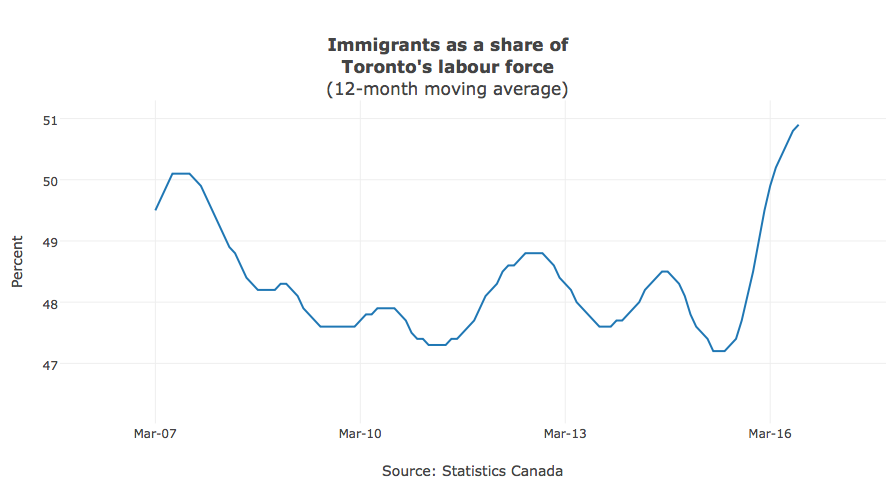
As it is, immigrants are already a major driver of Canada’s labour force. In Toronto, for instance immigrants now account for nearly 51 per cent of the city’s labour force. It’s slightly less in Vancouver (41 per cent) and lower still in Montreal (26 per cent) but all three cities have seen immigrants grow as a share of the labour force over the past few years.

kirby-article

There’s a problem here too, though. New immigrants don’t fare well in Canada’s job market. The unemployment rate among immigrants who landed in Canada within the last five years has, on average, been more than double that of Canadian-born workers over the last decade. Those who came between five and 10 years ago are a bit better off—their unemployment rate is about 1.5 times higher. It’s only among immigrants who’ve been in the country for more than a decade that the gap with Canadian-born workers is erased. It shows that even if Canada ramps up the number of newcomers it accepts, their performance in the labour market will surely lag for years.

The experience over the last year with the influx of more than 30,000 Syrian refugees, who are included in this year’s higher immigration count, has shown how challenging it is to quickly integrate large numbers of people. So too has the backlash in Vancouver against homebuyers from mainland China (and the murky question of who is a foreign buyer and who is a genuine immigrant) even as Canada works to double the number of visa offices in that country. Meanwhile, Canada may pride itself on being more open and tolerant of immigrants, especially in contrast to the ugliness going on in the U.S. and Europe, yet internal polling carried out by Immigration Canada shows one quarter of Canadians feel immigration levels are too high as it is. The news of this year’s immigration boom does not sit well with them.

Which is silly, really, because despite that headline-grabbing number of new immigrants, their number works out to just 0.8 per cent of Canada’s population, or 0.1 percentage points higher than the average of the last 20 years. Some boom.

Source: Canada’s demographic gap can’t be filled with immigrants – Macleans.ca

Jason Kenney on life after Ottawa and uniting Alberta’s right [comments on ethnic vote and Leitch]

Worth noting:

Q: Within the Conservative party, you were known as someone who connected with multicultural voters. But most recently, support for the party has melted away in those communities. What do you think is going on there?

A: I would challenge that assertion: it has not melted away. When we started this project in the 2004 election, the Conservative party was at just over 20 per cent of support of new Canadians, and by the 2011 election we were at about 42 per cent—a higher share of the vote than of native-born Canadians. We are the only centre-right party in the world of whom that is true. But I never had the hubris to imagine that we would have a kind of permanent lock on the plurality of that share of Canadian electors. I think what we’ve done through our hard work in cultural communities is to create a competitive political environment. No longer can any party, such as the Liberals, take for granted the support of new Canadians or cultural communities, as though they are some kind of a passive vote-bank.

Q: With the federal Conservative leadership race, you’ve made a few critical comments about Kellie Leitch’s immigrant-values test proposal. What’s your take on the screening people have to go through?

A: I have an enormous amount of experience in this area as multiculturalism minister for 10 years, then being minister of immigration responsible for screening and selection, and minister of citizenship. I find her approach to be disingenuous. I don’t think she’s ever thought deeply about these questions. She never raised these questions in Parliament, in public, in caucus or in cabinet. She seemed only to latch on to this as a theme after her campaign was circulating some questions on an online poll that was probably designed to generate email addresses. I just find the whole approach a bit slapdash. What concerns me is that these are extraordinarily sensitive questions that must be addressed with a great deal of nuance and prudence. Having said that, I do believe there is absolutely space for legitimate debate in a liberal democracy about immigration selection, screening and integration.

Q: You previously spent a lot of your time touring and campaigning with multicultural groups, and now you’re visiting smaller, rural areas in Alberta that must be a lot more homogeneous. What are you taking from those communities and hearing from people?

A: Rural Alberta is a lot less homogeneous than it used to be, partly because of my immigration policies. You go to a lot of small communities in rural Alberta and you’ll find a degree of diversity that probably hasn’t existed in terms of immigration for a century—you’ll find the Filipino grocery store, and the African Pentecostal church and maybe a mosque. Albertans are pro-immigration; they’re also pro-integration. In my years in this province I cannot recall more than a handful of expressions of xenophobia or nativism that I’ve encountered. It’s the land of new beginnings and fresh starts—it is rare Albertans who trace their roots here back more than a generation or two. It’s extraordinarily welcoming.

Source: Jason Kenney on life after Ottawa and uniting Alberta’s right – Macleans.ca

For the full, non-edited, comments on Kellie Leitch, see

Jason Kenney on Kellie Leitch’s values test

Kathleen Weil slams Jean-François Lisée’s immigration comments

More on Quebec immigration and identity debates:

Immigration Minister Kathleen Weil has slammed PQ leadership candidate Jean-François Lisée for listing three European cities as he called on Quebec to have the “best immigration possible.”

The Parti Québécois leadership hopeful said Monday the province should select rapidly employable, educated francophone immigrants from top job fairs in Paris, Brussels and Barcelona because they can integrate quickly into Quebec society. Lisée also talked about recruiting francophones from around the world.

“That is perfect immigration,” he said.

Weil attacked the comments as discriminatory.

“Every human being has the potential to integrate and to live a full life and to contribute to the society that they live in, and that is the history of Quebec,” she said.

Weil argued Quebec boasts the most diversified immigration in Canada.

 “Quebec is an open society; we have greeted, welcomed and settled people from all over the world and we’re going to continue to do that.”

Weil said she was surprised by Lisée’s comments because “people usually don’t discriminate in their comments, certainly not here (in the National Assembly) over the origins of somebody, about who’s a better immigrant.”

She told reporters it is “certainly” discriminatory to “differentiate people based on their cultural background, their origin.”

Lisée’s positions have earned him criticism from inside his own party, too.

PQ MNA Maka Kotto — who supports Lisée’s contender, Alexandre Cloutier, for the party leadership — told La Presse that Lisée was “agitating vectors that tickle the dark part of our souls.”

Kotto later told reporters in Quebec City it had been “imprudent” of Lisée to raise the issue of immigration levels and composition during the leadership race.

“You know this is a topic that stirs up passions and sometimes skids out of control,” Kotto said.

Lisée argued his critics are twisting his words.

“Saying that I want to favour European immigration is nothing but a willful distortion of what I said. My point is that perfect immigration is when we can provide a job, education and integration to every newcomer wherever he or she comes from.”

A new study by the Institut de recherche et d’informations socio-économiques (IRIS) suggests immigrants in Quebec are victims of “systemic racism.”

Source: Kathleen Weil slams Jean-François Lisée’s immigration comments | Montreal Gazette

Good to talk about Canadian values, and let’s think it through: Andrew Cardozo

Good piece by Andrew Cardozo going through all the limitations in values testing for immigrants and proposing a more positive approach:

But this is not to say we cannot talk about Canadian values or tell newcomers—and immigration applicants, about Canadian values; that way they can know what to expect or decide not to come here if they don’t like any of our values.

The healthier way is to be strong and clear about these values, because there is no question that some of our values are not universally held or practised. Besides some Canadian-born folks who have old-fashioned ideas, there are some newcomers who come with attitudes of inequality as compared to the “Canadian norm.” Many people come here precisely because of our values and others come here without considering what that may mean for them and their families and children.

Not only is it healthier and nicer, it is a more successful way to encourage newcomers to embrace the values of our liberal democratic society. Being proudly progressive and Canadian is the best way to root out many of the attitudes of inequality and discrimination across all communities.

The thing about the uniquely “Canadian values” of equality and respect is that they are fairly clear, only fairly. Some are legislated, some are not. And it is that complex and careful balancing over time—with lots of variation and nuance—that allows for a free and peaceful society. Fundamentalist societies are the ones that allow for no deviation and they generally are not very peaceful or cohesive.

Source: Good to talk about Canadian values, and let’s think it through – The Hill Times – The Hill Times

Monsef could face consequences, immigration lawyers warn 

Lots of coverage on Maryam Monsef and her birthplace.

Most coverage conflate birthplace, citizenship and identity. While they can for many be one and the same, this is not the case for all, particularly in the case of immigrants.

For example, my mother was born in Russia on the eve of the Russian revolution, her family as refugees fled to Latvia, and her Canadian passport listed Riga as her birthplace, likely reflecting that the chaos at the time made it impossible to obtain a Russian birth certificate. But we all knew her true birthplace.

As to the speculation by some regarding whether or not her citizenship and immigration status could or should be revoked, Monsef arrived in Canada at the age of 11 so all documents would have been submitted by her mother. So while her mother’s status could theoretically be subject to review, hard to see why any government would do so some 20 years after the fact and given that it is not material to the family’s status as refugees.

Iran has between one and three million Afghan refugees, which are not well integrated into Iranian society, and largely live within Afghan neighbourhoods.

So I am sceptical of the reasoning of the immigration lawyers contacted by the Sun (Guidy Mamann, Chantal Desloges and Julie Taub):

Canadian immigration lawyers say Democratic Reform Minister Maryam Monsef could suffer consequences if her refugee or citizenship applications included false information.

“It’s extraordinarily serious,” Toronto immigration lawyer Guidy Mamann said. “From a strictly legal point of view – and I’m assuming cabinet ministers want to observe the law – she is a person right now who has citizenship through fraud. It may be intentional or unintentional, but her citizenship in Canada right now is open to attack.”

…“If you had false info on your citizenship application you could be subject to having it revoked,” Toronto immigration lawyer Chantal Desloges explained. “It could not go so far as a criminal charge because for her to be charged criminally you’d have to do it knowingly.”

While lawyers the Sun spoke to disagreed on certain specifics, none doubted that a case such as Monsef’s would typically undergo a review.

“There are differences in cases where they probably decide not to proceed when false info is presented for reasons of safety and security. But that’s rare,” says Ottawa immigration lawyer Julie Taub, a former member of the Immigration and Refugee Board.

“The situation is if she was not an MP, if she was not a cabinet minister, if she was just your average Joe, the government would probably seek to vacate her status and once that protection is gone they could go after her citizenship,” Mamann added.

“I think the government is going to be in a hard position because they obviously won’t want to take any action on it but if they don’t, how is that going to look, that she’s getting preferential treatment?” Desloges said.

Source: Monsef could face consequences, immigration lawyers warn | furey | Canada | News

Michael Friscolanti demonstrates a more sophisticated understanding of the issues involved, and the likelihood of removing her immigrant and citizenship status:

If her mother provided inaccurate information to the IRB, does that mean Monsef could be stripped of her citizenship?

Again, it’s not clear what Basir told the IRB. But even if she failed to disclose where her daughters were born, experts in refugee law are divided about the potential consequences. According to the Citizenship Act, the government has the power to revoke citizenship on the grounds it was obtained “by false representation or fraud or by knowingly concealing material circumstances.” Material is the key word. Simply put, would the evidence that has come to light have altered the IRB’s original opinion that Monsef was a bona fide refugee? “If it was not disclosed that she was born in Iran, that, in my opinion, is a material misrepresentation,” says Toronto immigration lawyer Guidy Mamann. “If you find one lie, then you start questioning the whole story.”

Michelle Rempel, the Conservative Immigration critic, seems to agree, saying there could be “serious consequences” if Monsef’s refugee claim contained false information. But Showler, the former IRB chair, sees it differently. Because Monsef had no legal status in Iran (to repeat: she wasn’t a citizen, despite being born there), her birthplace had zero bearing on the case. “What you are doing with a refugee claim is you’re saying: ‘I cannot go back to my home country because I will be persecuted,’” he says. “Whether or not she was born in Iran is irrelevant. The only country for which she had citizenship was Afghanistan, and that is the country from which she feared persecution.” Showler says “there is not one chance in 1,000″ that Monsef’s immigration status is in jeopardy. “It’s very, very difficult to unwind citizenship status,” he continues. “You can do it, but almost always when it happens, it’s because somebody has committed a serious crime and there are reasons you want to get them out of the country. For something like this, there would be absolutely no reason for doing it.”

What if her mother did tell the IRB that Monsef was born in Iran?

For one thing, it would eliminate any chance, however remote, of the minister being stripped of her citizenship. It would mean Basir provided all relevant facts to the IRB, and that the board concluded all four claimants were genuine refugees. If that’s the case, however, it does raise yet another question.

If the Immigration and Refugee Board was told that Monsef was born in Iran, how could she not know?

Think back to the ensuing document trail. If the IRB was informed of her true birthplace, that same location would have been listed on her subsequent permanent residency forms, her citizenship application, etc. Under such a scenario, it seems implausible that Monsef would have remained oblivious to the truth all this time—or that the Privy Council Office, which conducts a “rigorous vetting process” for would-be cabinet ministers, would not have stumbled upon the evidence. It’s much more likely, as discussed above, that Monsef’s mother chose to hide from the IRB what she hid from her daughters: that they were born in Iran.

Source: Maryam Monsef’s personal revelations leave lingering questions               


Every day, immigrants are busting myths and building Canada

Useful vignette:

Riverside Natural Foods, launched just three years ago this August, began with one syrup kettle, a few baking trays and just 10 employees. Today it has 100. The Riverside plant near York University has production lines running from the pre-dawn hours till past midnight in two buildings, with a third expected to open in January. MadeGood bars are popping up everywhere from corner stores to major supermarkets. Riverside clients include giants like Loblaws, Costco and Whole Foods. “It’s been quite a ride,” says Ms. Fotovat.

Her brother Nima is company president, her sister Salma is in charge of the supply chain. She is head of operations. She arrives at the plant every weekday around 7 a.m. After scrubbing her hands, putting on a lab coat and pulling a net over her hair, she walks onto the floor to see how things are going. In one part of the plant, workers are pouring oats into a mixing machine; in another, a group of women are packing snacks into boxes for shipment; in another, a big ultrasonic cutting machine is dividing a sheet of cooked oats into bars.

With production ramping up so fast, the company is always bringing in new, more sophisticated machinery from Italy, Germany or the United States. But Ms. Fotovat says the key to its success, and the hope for its future, is the people.

She relies on their quick wits to fix production glitches and help figure out how to do things better. “What I’ve learned over the years is you’ve got to give people time to show what they can do,” she says. “You don’t think they can do it and then they blow your mind.”

The Riverside staff is a typical Toronto mix. One manager comes from Venezuela, another from Peru. Most of the workers on the floor come from the Philippines. Ms. Fotovat hired many through a temp agency.

One of her finds was Renato Resurreccion, who walked in the door as a temp and now manages 20 to 30 people on the morning shift. Another is Fernando Yarcia, who oversees the mixing machine. “He just cares,” says Ms. Fotovat. “If he sees a piece of garbage on the floor, he’s the one who will pick it up and put it in the garbage.” He wept when he heard the company was hiring him on full time.

Riverside doesn’t just want to be a big company. It wants to be a model company, where employees feel that they have a stake and share in its success. It is the kind of place where they remember your birthday and listen to your ideas.

In other words, it is about as far as you could imagine from the sweatshop that Trump fans and their Canadian cousins have in mind when they complain about how immigration is wrecking everything. Here is a business that rather than lowering standards and undercutting more established firms is setting high standards for innovation and creativity, while going out of its way to treat its employees right.

A paper by University of Waterloo professor Bessma Momani for this week’s 6 Degrees Citizen Space event in Toronto finds that “Canadian immigrants are more likely than Canadian-born people to start their own businesses. They employ other Canadians, innovate new products and services, disrupt business as usual and generate wealth and prosperity for Canada and all Canadians.”

Source: Every day, immigrants are busting myths and building Canada – The Globe and Mail

Jason Kenney: ‘I still wonder how I got here’ – remarks on Canada

In addition to the obligatory thanks to all, and his plea for civility and thoughtful deliberations, Kenney’s remarks on Canada worth noting, and consistent with his time in office:

As a last word about this country, which we all serve—this magnificent country with limitless potential—as I worked as minister of immigration, citizenship, and multiculturalism and welcomed refugees to this country, I was reminded of the words of Desmond Morton, a great Canadian historian and a former NDP candidate. He said that Canada is made up of people who have been on the wrong side of history. That includes our first nations at the time of European contact.

That also includes French Canadians at the time of the conquest and Acadians, with the great upheaval and the tragedy of what happened to them.

It includes the United Empire Loyalists; English Canada was founded by refugees, including some of my ancestors, who came here from the American Revolution. It includes those who saw Canada as the North Star through the Underground Railroad, who escaped slavery in the United States to achieve freedom in this country, sometimes with the scars of slavery on their backs. There were the Highland clearance Scots, who founded Cape Breton. There were the famine Irish, including some of my ancestors—and members can see that the Kenneys have recovered from the famine. There were Jewish victims of the pogroms before the Second World War, in the early 20th century, and the victims of the Shoah, who came after the Second World War. There were the eastern Europeans, the men in sheepskin coats who fled political oppression to pursue new opportunities in settling the Canadian Prairies; the Hungarians of 1958; the Czechs of 1968; and the Vietnamese of 1979. With the Chinese premier here today, we should also remember the Uyghurs and Tibetans and Falun Gong practitioners and those who stood at Tiananmen Square. There are so many others right to this day: the Syrian refugees whom we welcome; the 25,000 Iraqi refugees who came through a program that I established; the gay Iranians and men and women of all backgrounds. All of them in their own way were losers of history, yet by becoming Canadian they have become winners of history.

All of those people would have cause to live in a spirit of bitterness and recrimination but, instead, have decided not to forget their tragic past, to remember and memorialize it but move forward with hope in the future, as Canadians with a common sense of responsibility for one another.

I close my two decades in this place by quoting the words of former prime minister Diefenbaker, when he introduced the Canadian Bill of Rights. In expressing a sentiment that applies to all of those losers of history who have built one of the greatest countries of history, he stated:

“I am a Canadian, a free Canadian, free to speak without fear, free to worship God in my own way, free to stand for what I think right, free to oppose what I believe wrong, free to choose those who shall govern my country. This heritage of freedom I pledge to uphold for myself and all mankind.”

Immigrants Aren’t Taking Americans’ Jobs, New Study Finds – The New York Times

Worth noting, but unlikely to convince those who believe otherwise:

Do immigrants take jobs from Americans and lower their wages by working for less?

The answer, according to a report published on Wednesday by the National Academies of Sciences, Engineering and Medicine, is no, immigrants do not take American jobs — but with some caveats.

The question is at the heart of the furious debate over immigration that has divided the country and polarized the presidential race. Many American workers, struggling to recover from the recession, have said they feel squeezed out by immigrants.

Donald J. Trump, the Republican nominee, has called for a crackdown on illegal immigrants, saying they “compete directly against vulnerable American workers.” He promises to cut back legal immigration with new controls he says would “boost wages and ensure open jobs are offered to American workers first.”

Hillary Clinton, his Democratic rival, takes an upbeat view, saying immigrants contribute to the economy whether they are here legally or not, by providing labor for American employers and opening businesses that create jobs for Americans rather than taking them.

The report assembles research from 14 leading economists, demographers and other scholars, including some, like Marta Tienda of Princeton, who write favorably about the impacts of immigration and others who are skeptical of its benefits, like George J. Borjas, a Harvard economist. Here’s what the report says:

• “We found little to no negative effects on overall wages and employment of native-born workers in the longer term,” said Francine D. Blau, an economics professor at Cornell University who led the group that produced the 550-page report.

• Some immigrants who arrived in earlier generations, but were still in the same low-wage labor markets as foreigners just coming to the country, earned less and had more trouble finding jobs because of the competition with newer arrivals.

• Teenagers who did not finish high school also saw their hours of work reduced by immigrants, although not their ability to find jobs. Professor Blau said economists had found many reasons that young people who drop out of high school struggle to find work. “There is no indication immigration is the major factor,” she said.

• High-skilled immigrants, especially in technology and science, who have come in larger numbers in recent years, had a significant “positive impact” on Americans with skills, and also on working-class Americans. They spurred innovation, helping to create jobs.

“The prospects for long-run economic growth in the United States would be considerably dimmed without the contributions of high-skilled immigrants,” the report said. It did not focus on American technology workers, many of whom have been displaced from their jobs in recent years by immigrants on temporary visas.

The report asked another question Americans are debating: Do immigrants burden government budgets?

That answer is “more mixed,” Professor Blau said.

• The first generation of newcomers generally cost governments more than they contribute in taxes, with most of the costs falling on state and local governments, mainly because of the expense of educating the children of immigrant families.

For those governments, total annual costs for first-generation immigrants are about $57 billion. But by the second generation in those families, immigrants, with improved education and taxpaying ability, become a benefit to government coffers, adding about $30 billion a year. By the third generation, immigrant families contribute about $223 billion a year to government finances.

• In the last two decades, the number of immigrants in the country increased 70 percent to about 43 million people; they are now 13 percent of the population. One in every four Americans is either an immigrant or the child of one. And since 2001, about one million immigrants have come legally to the United States each year.

The report called immigration “integral to the nation’s economic growth” because immigrants bring new ideas and add to an American labor force that would be shrinking without them, helping ensure continued growth into the future.

Australia finally ending long nightmare of peaceful multiculturalism

Andrew Street’s critical look at Australia’s language and actions with respect to immigrants and refugees:

And while we might differ over what constitutes a “generous humanitarian program” when taking 18,750 of the literal millions of people seeking asylum, the Prime Minister’s argument appears to run as follows: fierce border protection allows Australians to be generous and welcoming to those we invite to join in our proud multicultural success story.

If we’re not taking just anyone, in other words, we can afford to be generous with those we do take. And that would be awesome if it wasn’t also completely, laughably, insultingly false.

It can’t be lost on Malc that our increasing level of panic about The Boats hasn’t exactly been accompanied by a commensurate increase in tolerance and celebration of our nation’s cultural diversity. Isn’t that right, Muslim Australians?

In fact, you might say that all the evidence points in the oppositedirection – almost as though years of leaders making political mileage by demonising foreigners as at best greedy and at worst probably terrorists has encouraged the worst racist instincts of Australians.

Should this seem like an unfair assessment, a quick look at the current make up of the Senate might be instructive.

(And while everyone is apparently united in their anti-people smuggling rhetoric, is anyone else curious as to why people smugglers are clearly evil opportunists preying on the vulnerable when we’re talking about countries with less-white populations but they were brave freedom fighters snubbing their noses at repressive regimes when, say, smuggling economic migrants out of communist East Germany?)

Also, the PM might more easily highlight Australia’s gosh-darn generosity in resettling 12,000 Syrian refugees, if maybe more than a quarter of them had actually been resettled in the year since the promise was made, amid accusations that the government has been deliberately focussing on accepting non-Muslim refugees because… um, their suffering is more noble, presumably?

And sure, suggesting that harsh border policies somehow fosters greater generosity within Australia might be accurately perceived as being a new version of arguing that indefinite offshore detention under horrific circumstances is somehow “saving lives at sea”: a complete non-sequiter designed to deflect criticism with zero basis in fact.

But on the plus side, by dividing those fleeing violence, oppression and terror into the deserving and undeserving on the basis of their religion or ethnicity, the Turnbull government is helping to embed an outspokenly us-and-them spirit which puts Australian citizens at risk while encouraging racists to express their vile, hateful opinions in word and in deed to a degree that risks destroying this peaceful, stable, genuinely magnificent society we’ve built together.

And making Australia a more hateful, unstable, violent place to live is the plan, right? Because if so, it all appears to be going great.

That being said, I do think that support for immigration does correlate with confidence that inflows are controlled and managed, at least in the Canadian context.

Source: Australia finally ending long nightmare of peaceful multiculturalism