Canadian immigration policy makers should also take note on the difference of overall GDP growth and the more important measure, per capita GDP growth:
ANZ economists believe there is a “slim” prospect of a population-driven recovery for the New Zealand economy given the weak outlook for migration. They also claimed that immigration “was never a sustainable source of growth”anyway:
This crisis has turned New Zealand’s recent model of migration-driven growth on its head… Once borders reopen, we expect net inflows to rebound, but to lower levels than before the crisis (figure 1)…
Migration-induced population growth has been one of the most dominant drivers of economic activity in recent years, with per capita GDP growth trailing well below the headline measure (figure 4). This was never a sustainable source of growth.
Overall, the weaker outlook for migration means that the prospect of a population-led recovery is slim. That will put the burden on domestic stimulus and productivity. So far, we’ve seen nothing on the policy front to convince us that productivity is about to take the reins, so expect a pretty ho-hum performance on the other side.
Meanwhile, a new report for the New Zealand Productivity Commission claims that mass immigration has distorted the economy and wrecked productivity:
The substantial net migration inflows that New Zealand has received over the past 25 years has been a strong source of support for headline GDP growth, but has created a series of distortions and pressures in the New Zealand economy: infrastructure and cost pressures, greater residential real estate demand (with implications for allocation of investment capital), downward wage pressure that deters business investment, as well as upward exchange rate pressure. An explicit immigration policy that was focused on quality and filling skills gaps, with lower gross inflows, would create a more supportive environment for higher levels of international engagement by New Zealand firms.
Given the similarities between the New Zealand and Australian economies and immigration systems, these findings can be equally applied to Australia.
Good investigative reporting on the policy and enforcement failures after the quarantine period:
When the novel coronavirus pandemic hit in March, the annual flow of farm labour into Canada hung in the balance.
Farmers feared that border closings and grounded planes would prevent agricultural workers, coming from countries such as Mexico, Guatemala and Jamaica, from reaching their fields and greenhouses in time for the seeding season. Knowing this, Ottawa allowed entry of temporary foreign workers critical to the food system.
Conditions – including a mandatory 14-day quarantine upon arrival – were put in place to protect Canadians. But advocates and health officials say not enough was done to protect the workers themselves.
In interviews, farm workers detailed the myriad reasons that COVID-19 has infiltrated farms with such success: a lack of personal protective equipment (PPE), an information vacuum and pressure to work, despite symptoms. In one instance, a feverish worker developed chest pains and a nosebleed that dripped on the vegetables he tended; he said his supervisors refused to take him home until the shift was over. Photos, videos and interviews portrayed overrun bunkhouses with broken toilets and stoves, cockroach and bed-bug infestations, and holes in the ceiling.
Rules were rolled out, but they weren’t adequately enforced and failed to consider what life on a farm is actually like for a migrant worker. Ottawa requires that farms, which generally provide housing under the Temporary Foreign Worker (TFW) program, ensure that accommodations allow physical distancing during the initial quarantine period.
But what happened after those 14 days was a massive blind spot. After isolating, workers often move into the bunkhouses, where they share bathrooms and kitchens and climb atop one another to get into bed. As former migrant worker Gabriel Allahdua put it, conditions in farm accommodations are a “recipe for COVID-19 to spread like wildfire.”
In Ontario alone, more than 600 foreign farm workers have tested positive for COVID-19, according to a Globe and Mail count; health officials have stressed that, for the most part, the workers came to Canada healthy and contracted the virus locally. British Columbia, Alberta and Quebec have also recorded outbreaks among migrant agri-food workers.
The situation is most dire in Southwestern Ontario, home to the continent’s highest concentration of greenhouses. Ontario’s largest outbreak is at Scotlynn Group, where at least 167 of 216 migrant workers have tested positive. Mexico has become so concerned by the outbreaks that Ambassador Juan Jose Gomez Camacho told The Globe that his country has “put a pause” on sending more workers – 5,000 more are still due to make the trip – until Canadian officials ramp up monitoring of health and safety rules, and ensure workers are paid while in isolation.
Two of Mr. Gomez Camacho’s countrymen have already died. Bonifacio Eugenio Romero, 31, and Rogelio Munoz Santos, 24, left their loved ones in Mexico to earn a better living. Their families are now planning the young men’s funerals. Mr. Eugenio Romero and Mr. Munoz Santos died – on May 30 and June 5, respectively – after testing positive for COVID-19. Their final days were spent mostly in hotel rooms, mostly alone.
“For a 24-year-old to die of this is beyond tragic,” said David Musyj, president and chief executive of Windsor Regional Hospital, where Mr. Munoz Santos died. “It should not happen. Just because he was from Mexico, I don’t give a damn. He was my son’s age. He was in Canada. And we should be taking care of him.” Mr. Munoz Santos is one of the youngest people in Canada to die from COVID-19-related causes. Ontario’s Office of the Chief Coroner is investigating both deaths and will decide whether to launch the province’s first inquest into a migrant worker fatality.
The federal government has the power to conduct pro-active inspections of farm accommodations, but during a six-week period at the height of the pandemic, these audits stopped. They are now being done virtually. The provinces are responsible for occupational health and safety, but in Ontario at least, the Ministry of Labour does not inspect employer-provided accommodations. Local public-health units in the province typically inspect farm bunkhouses once or twice a year, but this is done before workers arrive; an empty space looks markedly different from one with dozens of occupants.
In Canada, advocates and community health care workers for months warned federal and provincial politicians, as well as local public-health officials, that migrant workers were at a heightened risk. In letters, e-mails and conference calls, they asked for a number of measures, including increased funding for public-health units to ensure adequate housing inspections and limits on the number of people using each bathroom in bunkhouses. While some action was taken, many people say help came too little, too late. And advocates worry that unless enforcement and public-health outreach kick into high gear, there are lives and livelihoods at stake, along with the potential for disruption to the food system.
To understand what went so wrong, The Globe interviewed seven migrant workers across four farm operations, at times through a translator, as well as employers, advocates, academics, hospital executives, former migrant workers, doctors, lawyers and industry associations. The Globe reviewed four immigration files detailing allegations of employers who did little or nothing to protect workers. Migrant workers’ identities are being concealed because of privacy concerns and fears of reprisals.
The investigation revealed that problems in an already broken system have only been exacerbated by the pandemic. The experiences of workers varied, with some describing decent housing and respectful bosses who have worked hard to keep them healthy. Others spoke of racism and recounted threats of termination or deportation if they didn’t meet stringent productivity quotas.
Syed Hussan, executive director of Migrant Workers Alliance for Change (MWAC), said there is a massive disconnect at play. “Migrant workers,” he said, “have been treated as expendable and exploitable – and essential, all at the same time.”
The agriculture sector employs approximately 60,000 temporary foreign workers each year, with upward of 10,000 of them in Windsor-Essex county, which includes Leamington. Under the TFW program, foreign nationals are allowed to work for a particular employer for a set amount of time. Some stay for several months, others are here year-round. There are also foreigners who work in the country unauthorized; according to some estimates, Canada is home to hundreds of thousands of undocumented migrants.
Latest from Douglas Todd on the decline in international students as a result of COVID-19 travel and related restrictions.
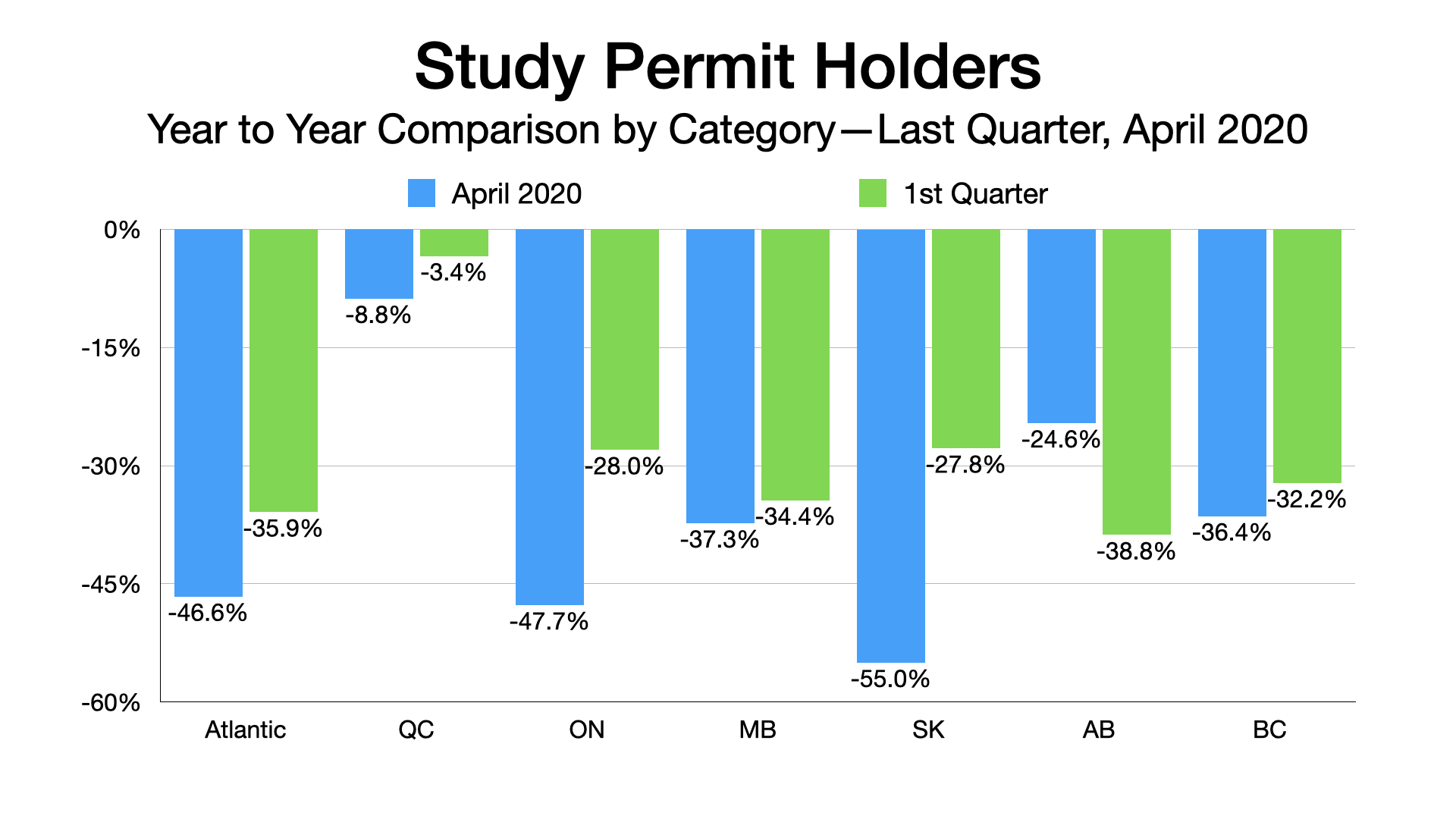
The three charts below highlight the extent of the decline starting in late 2019, along with the impact of the largest 10 source countries (2018 basis) contrasting the April 2020 change with the the first quarter of 2020.
The extent to which COVID-19 will impact the third quarter, when most students arrive, is of course the big question facing universities and colleges and the related economic impact:
The number of people from China obtaining Canadian study permits nosedived 44 per cent in the first four months of this year as COVID-19 restrictions and diplomatic battles took their toll.
Australia is experiencing an even more precipitous slump in what has been its largest foreign-student contingent — as China’s leaders this week warned against studying in Australia, which it said discriminates against Asians.
Many countries are enduring rising global tensions with China. But Australia has earned the extra wrath of the world’s most populous country by leading the charge for the World Health Organization to investigate the precise origins of COVID-19, which emerged in Wuhan. Canada didn’t call for a probe until scores of countries had already raised their voices.
Even though Canada has been embroiled in its own diplomatic and trade disputes with China — with the Communist’s party’s newspaper calling Canada a “pathetic clown” for the continuing house arrest in Vancouver of a Huawei CEO — Beijing has not openly told its youth to avoid studying in this country.
In addition, Canada has in the past two months come up with several incentives designed to limit the drop in study visas and woo high-fee-paying international students, who numbered 642,000 in Canada at the end of 2019, making up one in five of all those in higher education.
More than 150,000 Mainland Chinese citizens studied and worked in Canada in 2019, the second largest foreign-student group after India. Greater Toronto last year was the temporary home to 53,000 students from China, while Metro Vancouver had 34,000 and Victoria hosted 4,000.
This year, however, a Chinese study visa downturn appears to be coming in response to COVID-19 lockdowns, diplomatic tensions, border restrictions, a switch to online teaching and massive job losses in labour sectors that often get filled by foreign students.
The latest Immigration Department figures show just 12,065 citizens of the People’s Republic of China obtained study visas in Canada in the first four months of 2020. That’s down 44 per cent from the same period last year.
It’s more severe than the 31 per cent overall decline in study visas from all foreign students. Of the four other largest source countries sending students to Canada, the number of Indians has dropped by 29 per cent this year, South Koreans are down 35 per cent, French have declined 29 per cent and Vietnamese dipped 15 per cent.
When it comes to China’s 640,000 foreign students, almost all have chosen to study in five English-language countries, including the U.S., Britain and New Zealand. But Australia and Canada have welcomed by far the highest number per capita.
While specialists say the international-student market will struggle over the next few years because of coronavirus restrictions, students from China, who have arguably flocked the most to foreign institutions, appear now to be among those most reluctant to head abroad.
When the pandemic hit and Australian politicians urged all foreign nationals who couldn’t financially support themselves to go home, the country’s leaders in effect began saying goodbye to many of the nation’s 720,000 international students, including 212,000 from China.
Australia’s plunge is coming at the same time China has singled out the country, telling citizens “by no means travel to Australia,” and citing “racist incidents targeting Asians.” It also brought up health risks from COVID-19, even though Australia has a much lower rate of coronavirus deaths than the U.S. and Canada. Some reports say only a tiny trickle of Chinese students have obtained study visas in Australia this year.
For his part, Australian Prime Minister Scott Morrison on Thursday told China, which has also cut its Australia beef imports, that he wouldn’t be bullied by offshore “coercion.”
The reaction from Canadian Prime Minister Justin Trudeau has been almost the opposite, even while China has unfairly placed two Canadians in solitary confinement and drastically cut Canadian canola imports.
In addition to speaking softly about China, Canada’s Liberal government has recently offered unprecedented incentives to international students, which it says bring $21 billion annually into higher education and the economy.
In an effort to head off more drastic drops, Ottawa recently removed the cap on how many hours most foreign students can work while studying.
In addition, the Liberals changed policy so that up to a million foreign students, refugees and guest workers already in Canada could apply for the government’s Canada Emergency Response Benefit of $2,000 a month without providing proof of a work permit.
In late May, the Liberals also announced that foreign students will be permitted to complete 50 per cent of their studies outside Canada. Perhaps most importantly, Ottawa also said such students will still be able to get a postgraduate work permit for up to three years.
How far should Ottawa continue to go to lure international-student dollars and workers, including from China? Clearly, a lot of transnational money is at stake.
Last year, students from China made up 40 per cent of the 153,000 foreign students in B.C. The University of B.C. recently enrolled 6,281 students with Chinese citizenship, taking in $184 million a year from their fees. Almost half of Simon Fraser University’s foreign students have been from China, paying $126 million in fees in the 2018-19 school year. They also typically fill low-wage jobs and pay rent.
There is no doubt Canada has built a significant reliance on China and its students. Now, dealing with COVID-19 and country-to-country tensions, that dependence is being put to the test.
Valid if somewhat imbalanced commentary on the vulnerability of temporary agriculture workers by Edward Dunsworth but yes, more and better regulation required. Permanent residency for seasonal work is more problematic:
On May 30, Bonifacio Eugenio Romero, a 31-year-old Mexican migrant farm worker in Windsor-Essex County, became the first known temporary foreign farm labourer to die from COVID-19 in Canada. One week later, a second Mexican migrant in Windsor-Essex, 24-year-old Rogelio Munoz Santos, met the same fate.
Elsewhere in Ontario, hundreds of farm workers have tested positive for the virus and dozens have been hospitalized, with the biggest outbreak occurring at the Scotlynn Group farm in Norfolk County, where about three-quarters of the migrant work force has contracted the novel coronavirus.
Lamentably, for these men and women, risking their lives in the course of their work is nothing new. Instead, in the half-century in which they have laboured in Canada, seasonal farm workers from the Global South have found themselves in a permanent state of risk – of illness, injury and death – while governments and employers have demurred on enacting meaningful reforms. These latest tragic deaths and the swell of infections during the pandemic are part of a rotten, decades-old regime of racial and economic apartheid and amount to nothing less than the systemic sacrifice of human lives at the altar of profit.
Mr. Eugenio Romero, Mr. Munoz Santos and the Scotlynn farm workers all came to Canada through the Seasonal Agricultural Worker Program (SAWP). Founded in 1966, the SAWP brings upward of 40,000 workers to Canada each year from Mexico, Jamaica and other Caribbean countries to work seasonal jobs in agriculture and food processing. Another 20,000 or so temporary farm workers enter Canada each year through other programs.
Participants in the SAWP are bound to their assigned employer, unable to freely change jobs. In most provinces, they are barred from joining or forming a union. They are often housed in cramped, if not downright appalling, conditions – perfectly suited for the spread of infectious disease. With their employment and immigration status effectively controlled by employers, migrants dependent on their minimum-wage Canadian incomes have a strong disincentive to speak out against abuses. And though many toil for decades in Canada, there is no pathway for SAWP workers to become permanent residents in the country that so desperately needs their labour. (A small permanent residency pilot program announced last year is open only to workers on year-round contracts, thus excluding the large majority.)
This has been evident since the very founding of the SAWP. While none of the 264 Jamaicans who travelled to Canada in the program’s first year died on the job, 13 of them were chased out of their bunkhouse one night by a drunken, shotgun-toting friend of their boss, and forced to flee seven kilometres down a dark rural road. The program’s first fatalities came in 1967, its second year, when two of the 1,077 participants died in Canada from unknown causes.
In the decades since, dozens of workers have had their names added to this unenviable list, with countless more injured and taken ill. A Jamaican worker, who is unnamed in government reports, was killed by lightning strike in Beamsville, Ont., in 1973. Ned Peart, another Jamaican, was killed in 2002 on a tobacco farm in Brantford, Ont. In 2012, in Hampstead, Ont., a passenger van carrying 13 Peruvian and Nicaraguan poultry labourers returning home after a long day’s work collided with a truck driven by Christopher Fulton; David Armando Blancas Hernandez, Elvio Suncion Bravo, Enrique Arturo Arenaza Leon, Juan Castillo, Fernando Martin Valdiviezo Correa, Jose Mercedes Valdiviezo Taboa, Cesar Augusto Sanchez Palacios, Corsino Jaramillo, Lizardo Mario Abril and Oscar Walter Campomanes Corzo were killed, as was Mr. Fulton. Ivan Guerrero of Mexico drowned in 2014 while trying to fix a leak near his bunkhouse in Ormstown, Que., a year after recording a video in which he described being treated like a dog by his employer. Sheldon McKenzie, a Jamaican worker who suffered a severe head injury working at a tomato farm in Leamington, Ont., passed away months later in September, 2015. Zenaida, a Mexican woman whose last name was not made public, was killed in a hit-and-run in Niagara last summer. And now, Mr. Eugenio Romero and Mr. Munoz Santos.
Just as the Black Lives Matter movement has so poignantly implored us to do for victims of police violence, we should know – and say – their names.
Then and now, employers that have built a multibillion dollar industry on the backs of migrant labourers have demonstrated more concern for the financial costs of death and illness than with providing safer conditions for workers.
The primary response from growers to the two SAWP workers’ deaths in 1967 was to lobby the government on cost-sharing arrangements. “The employers … felt that they should not be held responsible for the costs of burial in case of the death of a worker,” a government memo tersely noted.
Amid the current pandemic, as a scathing June 8 report by the Migrant Workers Alliance for Change reveals, employers have illegally clawed back wages from quarantining workers, imposed draconian restrictions on their freedoms and required employees to live and work in wildly unsafe conditions.
Publicly, farmers have voiced opposition to quarantine rules, and stridently so in Norfolk County, the site of the Scotlynn outbreak. In recent weeks, Schuyler Farms – with the vocal support of many other area growers – launched a legal challenge against local health unit regulations that prohibit more than three workers sharing accommodations during their two-week quarantine upon arrival in Canada. Even with the Scotlynn outbreak in full effect, Schuyler has pushed forward with the challenge, decrying the threat to crops and calling the requirement “arbitrary.”
Meanwhile, Scotlynn chief executive Scott Biddle saw it fit to give a newspaper interview last week lamenting the loss of 450 acres of asparagus, even as seven of his employees lay in hospital beds – two in intensive care – with COVID-19.
For their part, governments in both Canada and migrant-sending countries have remained steadfastly disinterested in taking measures to better safeguard the health and safety of migrant workers, preferring to treat worker deaths and accidents as isolated incidents rather than as manifestations of systemic oppression.
To date, there has never been a single coroner’s inquest into the death of a migrant farm worker, despite significant pressure from victims’ families and advocacy groups such as Justicia for Migrant Workers over the years. Meanwhile, workers who have been incapacitated on the job in Canada are frequently sent back home and cut off from compensation payments, regardless of their employment prospects. And now, as Toronto Star uncovered, Jamaican workers leaving for Canada are required to sign waivers that release the Jamaican government from liability for any coronavirus-related “costs, damages and loss.”
Urgent changes are needed to protect migrant farm workers from COVID-19. But the coronavirus is merely the latest symptom of a decades-old illness for Canada’s migrant agricultural work force. To treat it properly will require a complete overhaul of the temporary foreign worker regime, a key component of which will be the granting of permanent residency status to all participants, as has been done for front-line migrant workers in many other countries during the pandemic.
Only then can Canada begin to correct the rank hypocrisy of treating essential workers as expendable and turn a page on this shameful part of our history.
Yet another article of the shift with some interesting data:
Indian students are slowly getting over their fascination with the US.
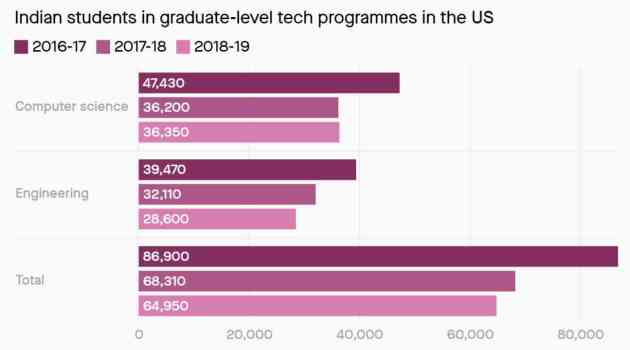
The number of Indians enrolled in graduate-level computer science and engineering courses at American universities declined by more than 25% between 2016-’17 and 2018-’19, according to an analysis of government data by the National Foundation for American Policy.
Data: National Foundation for American Policy, US Department of Homeland Security, US Immigration and Customs Enforcement, special tabulations (2018) of the Student and Exchange Visitor Information System (SEVIS) database via Quartz
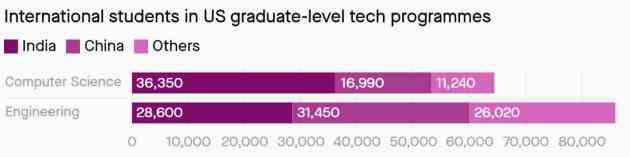
This decline is a massive hit to the entire international tech student population in the US, as Indians form an outsized proportion of the group.
Data: National Foundation for American Policy, US Department of Homeland Security, US Immigration and Customs Enforcement, special tabulations (2018) of the Student and Exchange Visitor Information System (SEVIS) database via Quartz
America’s loss
In a letter dated June 2, 21 members of the US Congress highlighted that international students and their families contributed approximately $41 billion to the US economy in 2018-’19 alone, despite making up just 5.5% of overall US college enrollments. This cohort subsidises tuition for many domestic students.
Moreover, “as a source of research assistants, graduate students help professors conduct research and retain top faculty,” the National Foundation for American Policy report said. “Without the ability to perform high-level research, many leading professors would move on to other careers, which would weaken American universities as a global centre for science.”
While the US is losing out on Indian talent, its neighbour is making strides.
Canada’s gain
National Foundation for American Policy’s research shows that the share of Indian students in Canada more than doubled between the academic years 2016-’17 and 2018-’19.
Data: Canadian Bureau for International Education, National Foundation for American Policy via Quartz
Unlike America’s hardline approach, Canada’s policies have been incentivising students. In June 2018, Immigration, Refugees and Citizenship Canada announced the Student Direct Stream for China, India, Vietnam, and the Philippines. Students from these four countries enrolled in any of the 1,400-plus designated learning institutes in Canada can fast-track their applications, as long as they pass English-language tests and prove they are financially stable.
While the US has suspended immigration due to coronavirus outbreak and is reconsidering the post-graduate work programme Optional Practical Training, Canada isn’t letting Covid-19 get in its way.
As of May 14, international students with valid study permits in Canada from before March 18 have been exempted from the travel restrictions contingent on passing health checks and following isolation protocols.
Not just students but even Indian working professionals have been flocking to Canada as Trump’s anti-immigration rhetoric builds up. Several Indian techies have been swapping Silicon Valley for the more immigrant-friendly neighbour.
“Canada is benefiting from a diversion of young Indian tech workers from US destinations, largely because of the challenges of obtaining and renewing H-1B visas and finding a reliable route to US permanent residence,” said Peter Rekai, founder of the Toronto-based immigration law firm Rekai LLP. The country even offers express entry for skilled immigrants.
Moreover, Canada allows permanent residents to apply for citizenship after six years. Indian permanent residents admitted into the country jumped up over 117% between fiscal years 2016 and 2019, National Foundation for American Policy found.
Looking forward to the details. Hopefully implementation will be closer to CERB than Phoenix:
A complete overhaul of how Canada processes immigration applications is in the works as the government braces for post-pandemic demand for migration to Canada.
Aging computer systems, paper applications and in-person interviews are among the things that must be adapted for the “new normal” after COVID-19, Immigration, Refugees and Citizenship Canada said in a tender posted to the government’s procurement website and marked “urgent.”
“When travel restrictions begin to ease, a significant surge of applications and support requirements is anticipated, putting tremendous demand on our global operations and supporting branches,” the tender request says.
“IRCC needs to act quickly to develop (i) updated and new strategies, and (ii) processes and digital systems to cope with the rapid change it is undergoing.”
Immigration to Canada came to a near-halt in March when borders around the world slammed shut to slow the spread of COVID-19.
Though some already authorized to enter Canada before the pandemic – temporary foreign workers and students – have still been able to arrive, thousands of others, including refugees, remain abroad, waiting for travel restrictions to lift.
Meanwhile, the government has closed or significantly scaled back many of its immigration operations, including all in-person interviews and the collection of biometrics, while many private visa centres around the globe that have contracts with Canada are also shuttered.
It’s effectively put the kibosh on new applications, and the uncertainty means the government has now abandoned even estimates on how long it will take to process them.
The department is trying to get through some of the applications, said spokesperson Nancy Caron.
“In the face of so many challenges, IRCC has made great efforts to adapt, for instance, by prioritizing applications from Canadians returning to Canada, vulnerable people and people who perform or support essential services,” she said in an email.
“We are processing those as quickly as possible.”
In its request, the department notes that among its challenges is operating while respecting physical-distancing protocols. The requirements make it harder to do everything from in-person interviews to citizenship ceremonies.
At least one virtual citizenship ceremony has already been held, for a researcher awarded a major grant to study the impact of the pandemic on supply chains, but the tender seeks guidance on more digital solutions for those and for traditional in-person interviews.
The Liberal government had intended to welcome as many as 371,000 new permanent residents in 2020, a number that will fall dramatically due to COVID-19.
A recent report from RBC Economics suggested the slowdown will have knock-on effects on the economy, noting among other things the $6 billion in tuition alone that international students contribute to the economy each year.
With her usual sensationalist style, Candice Malcom reports on the findings of a poll commissioned by the True North Centre.
However, first of all, the company “ONE” does not appear to have a website according to a Google search and is not known by industry professionals I consulted.
So is the company named “ONE” just one person and if so, who?
Secondly, the poll question was with respect to a temporary pause not a total pause, two very different questions. For Malcolm to mischaracterize as a total pause is irresponsible and unethical at best.
Hard not to think of this as just clickbait to solicit donations to True North ongoing overly simplistic conservative commentary on immigration and related issues:
The majority of Canadians want to close the borders and pause immigration into the country until the coronavirus threat has passed and until Canada’s economy has fully recovered, according to a recent scientific poll commissioned by True North.
Three quarters (76%) of Canadians polled by ONE, a research company based out of Toronto, strongly agree or moderately agree with the statement: Canada should temporarily pause immigration until a vaccine is developed for coronavirus and the unemployment rate drops down to pre-coronavirus levels.
The survey shows a vast consensus to the immigration pause among all regions, age groups, education levels, income levels, political party preference and in both official languages.
Two-thirds of Canadians who voted Liberal (67%) in the 2019 federal election support the statement, as do two-thirds of NDP voters (66%). The consensus is even stronger among Conservative voters, as 67% strongly agree and another 22% moderately agree. Likewise, 48% of Bloc voters strongly agree and 39% moderately agree with the immigration pause.
Canadians similarly agree that Canada’s temporary immigration programs should also be suspended during this time.
Nearly two-thirds (61%) of Canadians surveyed agree that “Canada should temporarily pause the Temporary Foreign Workers program until a vaccine is developed for coronavirus and the unemployment rate drops down to pre-coronavirus levels.”
Back in April, Prime Minister Justin Trudeau hinted that life in Canada will not go back to normal until a vaccine is developed. “Normality as it was before will not come back full-on until we get a vaccine for this… that will be a very long way off,” said the prime minister during his daily COVID-19 media performance. “We will have to remain vigilant for at least a year.”
While a vaccine may be years away, Canada’s economy may need even more time to recover. The unemployment rate in February 2020, prior to the coronavirus pandemic and resulting lockdowns, was 5.6%. According to the May 2020 jobs report, Canada’s unemployment rate is at an all-time high of 13.7%.
With millions of Canadians out of work and looking for jobs, the rationale for bringing in temporary foreign workers to fill gaps in the labour market is wearing thin for Canadians. Rather than importing cheap labour from developing countries and risking that those travellers may bring coronavirus with them, this survey shows Canadians would broadly prefer hiring domestically.
There is also confusion around the state of Canada’s immigration system and the policies introduced during the coronavirus lockdown.
Many Canadians wrongly believe that our borders are currently closed and that Canada’s immigration system has been shut down. Trudeau announced border and airport closures and travel restrictions in mid-March, and the mainstream media largely reported that the borders were closed.
Official numbers from the Canadian Border Security Agency (CBSA), however, paint a different picture.
According to the most recent CBSA Traveller Statistics released on June 3, more than one million travellers entered Canada at land border crossings between the period of March 21 and June 2. An additional 763,000 travellers arrived at our international airport during that same week.
CBSA does not release the immigration status of land travellers, but it does for air travellers. Of the 763,000 people who landed at Canadian international airports since Trudeau’s March announcement, only 283,000 were Canadian citizens and 21,000 were Permanent Residents. More than half of the people arriving in Canada — 459,000 — were new immigrants.
This is because the Trudeau government’s travel ban includes wide exemptions for new immigrants, including students, agricultural workers and others who come to Canada through the Temporary Foreign Workers Program.
A recent employment report compiled by the federal government likewise revealed that 13,000 foreign workers were approved to come to Canada between March 15 to May 8, or approximately 1,625 per week.
According to ONE’s research, most Canadians would prefer no immigration for the time being.
ONE surveyed 1,000 Canadians using a national representative sample between June 3 and June 6 in both official languages. The survey was commissioned by True North Centre for Public Policy and the margin of error is +/- 4.3%.
Leave it to other historians to provide more informed comment but of interest and relevance:
Instances of xenophobia shook the cities, each one worse than the next, in the anxious years of the early fifth-century Roman Empire. Doors were slammed in immigrants’ faces when they asked for food, immigrant family members were kidnapped and beaten on the road, an immigrant house of worship was set on fire. One commentator, taking up his stylus to decry the foreign “pestilence” ravaging his comfortable way of life, won instant applause from Latin-speaking audiences. He twittered about contemporary events with matter-of-fact indifference. “Everyone insults the immigrant,” the poet Claudian said.
Among the many ideas modern societies have inherited from Claudian’s Rome, none has had a more pernicious power than his people’s questionable notion of dividing the world into the civilized and barbarian, us and them. A modern version of that antiquated ideology still holds power. For example, even before the pandemic, Trump adviser Stephen Miller—who, the Southern Poverty Law Center has found, has shared material from white nationalist websites—reportedly scoured the federal law code for novel ways to restrict legalized immigration. The arrival of the novel coronavirus has only intensified the Trump Administration’s priorities, offering a convenient pretext to reduce green cards and tighten the borders.
But history didn’t have to turn out this way. The circumstances that led Western Europe and the U.S. to embrace the worst of classical culture demand a second look, now more than ever.
According to tradition, the once-great and formerly welcoming city of Rome had been founded in the eighth century B.C. as an asylum, a Latin word meaning “sanctuary for refugees.” As Rome grew from monarchy to humble republic to unrivaled empire, the Roman people developed a winning formula for ending wars, fostering stability and achieving widespread, lasting economic success: They extended citizenship to non-residents of the capital.
By any conservative account, Rome’s government did so three times by Claudian’s day: first, in its wars of Italian conquest in the first century B.C.; then, during its aggressive period of colonial expansion in the first and second centuries A.D.; and finally, in 212 A.D., when Emperor Caracalla granted citizenship rights to every free-born person in Rome’s orbit. In this multilingual, multiethnic world of nearly 60 million people—a disturbing number of whom were enslaved—hundreds of thousands of people in Europe, Africa and Asia saw their fortunes improve because of Caracalla’s law.
If you lived at the empire’s frontier, citizenship guaranteed your ability to hear a case before a Roman judge. If you grew up at the border, it ensured that you and your family could not suffer arbitrarily at the hands of slave traders, who stole boys and girls like hungry wolves. Citizenship also promoted a widespread public trust in investment and fostered economic growth. Fides, the Roman god of reliability, always looked favorably on citizens who drew up their contracts in writing, or so the Romans believed.
Citizenship had long worked quieter miracles throughout Rome’s long history. After 25 years of service, veterans were regularly handed a diploma, a bronze certificate “folded in two” that recorded for posterity their hard-won citizenship status. They passed it to their children. Outside the military, individuals earned citizenship when struggling families left the Mediterranean for a more precarious—but potentially more lucrative life—on the frontiers. When they petitioned the government to grant them equal resident status to families in Italy, thankful emperors obliged. As Romans and locals married, the picture of a Roman changed.
But that shift also spawned a backlash, the legacy of which still appeals to racists, xenophobes and white nationalists, many of whom have opted to embrace the worst features of “Western civilization” to justify their own bigotries. When a foreign-born soldier named Maximinus was acclaimed emperor after Caracalla’s law, traditionalists in the Roman Senate resorted to stereotypes to undermine his rule. Pegging him as monstrous “Cyclops,” they groused about his “lowly origin” and implied, one contemporary wrote, that he had won his position “by luck,” not talent.
Stereotyping left a lasting mark on Europe. By the Middle Ages, monks circulated short, alliterative lists, cataloging what they thought to be the worst of foreigners’ supposed behavior, immortalizing tropes they copied from classical writers. Egyptians were evasive, Jews jealous, Gauls gluttons, Saxons stupid. Modern opponents of immigration draw on this same ancient playbook, as if they’re waging a battle against the globe’s new “barbarians.” But they’d better look more closely at the history of what happened to Rome.
After Caracalla’s reform extended citizenship, one generation passed, then the next, but a repeat was not forthcoming. The new waves of new foreigners who wanted a Roman life were met with no such welcome. Even as Rome became noticeably“dependent on the help of these same foreigners for their livelihood” (as the great chronicler of the fourth-century empire, Ammianus, wrote), a more rigid, two-tiered society hardened over time. Citizens and non-citizens lived side-by-side, often in the same towns, but with widely different rights. Roman law variously categorized them as “allies,” “transfers” or “fortunate ones.” Still, no politician ever proposed a policy for releasing them from these second-tier categories.
By Claudian’s day, Rome’s government and its people simply presumed that immigrants would always till their farms, stock their cupboard, and serve at the front lines of the next war, without any reward for their sacrifices. But on Aug. 24, 410, a disgruntled immigrant named Alaric the Goth gave up waiting for change and unleashed a surprise attack on Rome’s unjust empire. Even as the Romans picked up the pieces of their city in the weeks that followed, their political convictions remained stubbornly unchanged. Within a decade, it was widely thought to be more convenient to dissolve the empire than to articulate a strategy for incorporating foreigners within it. By 476, Rome fell apart.
Many policy-makers have drawn the wrong lessons from Alaric’s attack, seeing in it a reason to fear outsiders. But in fact, the long-beating heart of classical civilization had depended on its embrace of immigrants—and for citizens of modern states who aspire to stay united, this turning point in world history invites a closer look.
They call them the “guardian angels,” the thousands of personal-support workers (PSWs), orderlies, cooks and janitors who have been toiling for months in Quebec’s beleaguered and often overwhelmed long-term care homes during the COVID-19 pandemic.
Almost all of them are women, many from racialized communities, including a disproportionately large number from Quebec’s Haitian community.
In recent days, one subset of this overworked, underpaid work force has received a lot of attention – asylum seekers.
Why?
Because, despite doing essential work that no one else would and literally putting their lives at risk, juggling multiple part-time gigs for as little as $13 an hour, many of these front-line workers could face deportation.
That’s disgraceful, and un-Canadian.
Lawyer and social entrepreneur Fabrice Vil has been leading the social-media campaign #JeMeSouviendrai (I will remember) to get the provincial and federal governments to “regularize” the immigration status of asylum seekers working as essential workers.
“This pandemic has shown us the human face and the real sacrifices of essential workers,” Mr. Vil said on the popular Radio-Canada talk showTout le monde en parle. “When people make a contribution to society, we need to recognize that contribution.”
Quebec Premier François Legault has been cool to the idea, but in recent days, in response to growing public pressure, he has softened his position a bit.
A little recent history helps explain the political volatility of this issue.
In 2017 and 2018, more than 37,000 people made an “irregular” border crossing and requested asylum in Canada. Most of them simply trudged up Roxham Road in Saint-Bernard-de-Lacolle, Que., exploiting a loophole in the Canada-U.S. Safe Third Country Agreement, which said they could only be turned back at official border crossings.
Before he was Premier, Mr. Legault took a hard line on the asylum seekers, saying Quebec could not welcome “all the world’s misery” and demanding the Roxham Road crossing be shut down. It has been. Since March, there have been only 14 “irregular” crossings and all have been sent back to the United States. Yet, “Roxham Road” remains a dog-whistle term for anti-immigration proponents.
Let’s not forget that most of the asylum seekers have been working while waiting for their cases to be processed. Many have been working in long-term care for two or three years, invisible until the pandemic hit.
When the idea of granting residency to asylum seekers was first floated, the now-Premier rejected it out of hand, saying: “We can’t open the door and say, ‘If you come here illegally, if you find a job, we’ll accept you as an immigrant.’ That’s not how it works.”
His critics responded by saying that, first of all, asylum seekers are not illegals. Further, they stressed that what is wanted is a special dispensation for those who work in health care facilities in these extraordinarily difficult times. The precise number is unclear, but believed to be at least 2,000.
Mr. Legault responded by promising to review their requests on a case-by-case basis, potentially accepting them as economic immigrants. (While immigration is a federal jurisdiction, this is a provincial program.) Federal Immigration Minister Marco Mendicino has tried to stay out of the fray, saying “all asylum claimants will receive a fair and full hearing on the individual merits of their claim.”
Quebec’s Immigration Minister, Simon Jolin-Barrette, has also announced a plan to recruit 550 temporary workers as PSWs and fast-track their permanent residency applications.
Around the same time, Quebec also announced a bold plan to hire 10,000 PSWs by offering a paid three-month training course and full-time jobs at $26 an hour. (About a $50,000 annual salary.)
The catch is that the program is only for Canadian citizens, so asylum seekers, refugees and migrant workers are shut out again.
This sparked another wave of outrage.
Wilner Cayo of the advocacy group Debout pour la dignité says the exclusion adds insult to injury.
“These women were good when it came to working for a miserable salary,” he told CBC News. “But now that this work is going to be well paid, the thank-you they get is ‘You can’t be part of the program.’”
At a demonstration last week, the sentiment was well summarized on a protester’s sign, written in Haitian Créole: “Nou pap mouri pou gran mèsi!”
Translation: “We will not die for a ‘thank you’ and we will not die in vain.”
Indeed, a proper thank-you must begin with granting permanent residency. Then full-time jobs. And speeding up family reunifications.
It’s the least we can do for these guardian angels, for services rendered selflessly.
No surprise. Broadly consistent with other countries:
On 21st May 2020, the government released its ‘Immigration statistics, year ending March 2020’, and it confirmed what those in the world of academia already knew; that there was a sharp drop in the number of international students when the lockdown took hold at the end of March. While the publication was not intended to provide a full analysis of the impact of Coronavirus on the immigration system, it did find a significant fall in applications for study visas in March 2020; it states, “in March 2020, Tier 4 visa applications fell significantly when compared to March 2019, in particular for Chinese nationals, and likely related to COVID-19. At the same time, the number of Tier 4 (sponsored study) visas issued in the first quarter of 2020 increased by 84&#x c;ompared with the same quarter in 2019, although there were falls towards the end of March 2020”.
The fall in student numbers follows record increases in 2019
The clear reduction in student numbers is all the more jarring given that the sector has seen a boom in international students in recent years, helped in large part by the reversal of Theresa May’s student immigration policy which required students to depart only four months after completing their studies. According to Government data, in the year ending September 2019, sponsored study visas increased by a not inconsiderable 13&#x (;258,787 students), of which 86&#x w;ere for university education.
UK universities planning for a return of students
There is no doubt that UK academic institutions have been hit hard by COVID-19, not least because of the large black hole which now exists in place of the regular supply of domestic and international student fee revenue. According to a recent analysis by London Economics for the University and College Union, it is expected that UK universities will see a £2.6 billion shortfall in the next academic year due to the ongoing impacts of COVID-19. Of this £2.6 billion is from domestic students and the remainder from international students. It is clear; therefore, how important overseas students are to UK universities and positive and reassuring that plans are now in place to allow some students to return to campus-based learning.
Some UK universities are planning to reopen from June 2020 with a range of essential measures to ensure the safety of staff and students being put place. Smaller class sizes and an increase in the number of online lectures will become normal from the middle of this year. While not all universities have a plan to reopen yet and are instead waiting for clarity from the government before reopening, some have mature plans almost ready to go. The University of Wolverhampton, for example, will be offering a “full digital suite of course material”, and will prioritise the opening of building openings over time. The university’s vice-chancellor Geoff Layer stated, “We will be looking at a gradual return to certain buildings being open and we will develop a plan which prioritises which parts can open first. It won’t be ‘we’re all back’. Social distancing has to be part of what we do, so I’d imagine we would be opening selected spaces over time”.
At Birmingham City University some, but not all, of the 2019-20 cohort of students will be returning for lessons from June 2020. The 2020-21 intake will start their courses in September 2020 with a new set of COVID-19 safety measures designed to protect the wellbeing of students and teachers in place. The university’s vice-chancellor, Professor Philip Plowden, says that students will be returning to the campus “on a limited basis”, and that changes are being made to the way in which buildings are utilised to ensure adherence with social distancing. Professor Plowdon believes that this partial reopening is essential to allow students who are reliant on-campus facilities to complete their courses; “Our priority for this year is to ensure that every student gets the qualifications for which they are working, or are able to make progress towards getting those qualifications. Our absolute priority is the safety of our staff and students and all of our decisions continue to be made with the safety of our community in mind.”
Even if academic institutions won’t be back to where they were before the COVID-19 pandemic, the confidence and boost to sentiment, not to say, cash flow, will be warmly welcomed by the sector.
Those universities which are not reopening in June 2020 will no doubt be watching those that do with considerable interest, not only to see whether it can be done but also to understand the measures which they too will need to put in place in the near future. It is also likely that international students will be watching to see how safe UK universities are over the next few weeks in anticipation of resuming their own studies in September 2020. As such, UK learning institutions can do much to inspire confidence in prospective overseas students by responding effectively now.
Returning students will be required to self-isolate
Anyone arriving in the UK from the 8th June 2020, including those holding a Tier 4 study visa, will be required by law to self-isolate. They will be asked to provide an address for where they will be in quarantine and will face fines of up to £1,000 and random spot checks. Unfortunately, there is no guarantee these additional measures put in place by the government will be lifted by September 2020 for the start of the new academic year, hence it is best to plan for an earlier arrival.
Wrapping up
The impact of COVID-19 on the UK’s education sector will be remembered for many years, but hopefully, with time, students from overseas will be able to continue their studies in earnest. Global events such as this allow us to truly appreciate the wonderful opportunities provided by the overseas study. As we start to see the light at the end of the tunnel, our immigration specialists look forward to helping international student clients and their families over the coming months to return to the UK to resume their studies.