Immigration article of interest March 2026

Articles and opinions related to immigration that I found of interest in March (bit overly long):

  • IRCC Management/OAG International Students
  • General
  • Quebec perspectives
  • Refugees and Asylum Seekers
  • Other

IRCC Management/OAG International Students

Understandably, considerable coverage and commentary over the lack of management and integrity of the international student program contained in the OAG report. A key question, which we will probably never know for sure, is whether public service identified risks to the political level, and if so, was any critical advice toned down, and if so how much, as it moved up to the deputy level. And of course while the federal government is responsible, this does not let provincial governments, education institutions and business communities for pushing for higher levels:

Canada’s international student program blasted by auditor for failing to address ‘integrity concerns’

Canada’s Immigration Department failed to crack down on study permit applicants and holders flagged for potential fraud and non-compliance — and did not even know if those with expired permits had left the country, a government audit has found.

Between 2023 and 2024, more than 153,000 post-secondary international students were identified as potentially non-compliant with study permit rules, but officials had funding to probe only 2,000 cases annually, according to a report released Monday by the Office of the Auditor General of Canada.

The department began 4,057 investigations, but 41 per cent of these cases could not be closed because the students did not respond; another 50 cases were identified as non-compliant and requiring further follow-up.

“While there were some adjustments made to improve the integrity of the program, what’s concerning for me is that the department isn’t acting on the information that it has,” Auditor General Karen Hogan told a news conference.

“There are so many things that were raised by the department themselves, and then no follow-through.”

The international student program has been under close scrutiny since 2023, when borders reopened after the pandemic and international enrolment surged past one million. Runaway growth in the temporary resident population — including foreign workers and asylum seekers — was blamed for the affordable housing crisis, straining public resources such as health care and rising unemployment.

It prompted then prime minister Justin Trudeau’s government to cap the number of international student applications and reduce new study permits issued by 35 per cent in 2024 and another 10 per cent in 2025. New measures were also introduced to tighten eligibility for postgraduation work permits, address fraud and strengthen program integrity.

The audit findings, however, don’t appear to help boost public confidence in these reforms.

“There’s enough to still frighten people about what’s going on and question the integrity of our immigration system,” said York University Prof. Roopa Trilokekar, who focuses on government policy on international education.

The fast-growing international student program was the result of aggressive recruiting by the post-secondary education sector due to years of provincial underfunding and by unregulated foreign agents looking to profit from signing up students.

Under Ottawa’s two-step immigration pathways that favour applicants with Canadian education credentials and work experience, migrants increasingly look at studying in Canada as a back door to working and earning permanent residence here.

According to the audit, officials identified 800 approved study permits issued between 2018 and 2023 where applicants had either used fraudulent documentation or misrepresented information to gain entry to Canada. Most of them later applied for other immigration permits once in the country, and half have been approved.

“The absence of having a warning or something on their file to say fraudulent documentation or misrepresentation was used in the initial application means you weren’t able to then apply rigour on the second application,” Hogan cautioned….

Source: Canada’s international student program blasted by auditor for failing to address ‘integrity concerns’

Globe editorial: Ottawa hasn’t learned its lesson on immigration

…Lena Metlege Diab, the immigration minister, has said she accepts the Auditor-General’s recommendations. She needs to clearly articulate a path to return the international student program to its original purpose – not as a ticket to citizenship, but to allow foreigners to study here temporarily. 

Canada shouldn’t promote study permits as a pathway to permanent residency, and it should restrict the hours students can work off-campus. While the lax issuing of student visas in recent years has been useful to employers seeking low-cost labour, and post-secondary institutions keen to fill budget holes, it has distorted the program.

The immigration department needs to be able to quickly root out cases of misuse and fraud to ensure the system’s integrity. This requires closer scrutiny of renewals of people already in the country and better coordination with the CBSA.

After years of mismanagement of the immigration file, the Liberals have lost any benefit of the doubt. Immigration is an essential ingredient in Canada’s success, but it can’t be run on the honour system.

Source: Ottawa hasn’t learned its lesson on immigration

With hindsight, former immigration minister says he would have capped international students sooner

Justice Minister Sean Fraser, who was in charge of immigration during some of the years Auditor General Karen Hogan found instances of fraud in Canada’s international student program, said with hindsight, he would have acted sooner to fundamentally change it.

The Opposition Conservatives have been calling for his resignation, along with that of current Immigration Minister Lena Diab and Fraser’s immediate successor Marc Miller, from Prime Minister Mark Carney’s cabinet.

“With the benefit of hindsight, I would have liked to actually change the program fundamentally and say the federal government is placing a cap on this, and letting provinces allocate their share of the cap to different institutions,” Fraser told CBC News on Wednesday.

However, he also said the federal government was negotiating as part of “a good-faith relationship with the provinces who were requesting additional access to immigration programs at the time.”…

Source: With hindsight, former immigration minister says he would have capped international students sooner

General

Clark: Time to plan for the return of sane immigration

Reasonable and need for a longer term immigration and population policy, one that avoids the mistakes of the “more the merrier” approach that got us here:

…Most importantly, the system to select economic immigrants, which should aim to recruit highly productive newcomers that raise Canada’s standard of living, has been balkanized with a series of programs to fill alleged labour shortages, often with lower-wage workers.

Immigration means recruiting a big part of the population of the future. It can make the lives of Canadians born today dramatically richer or poorer. 

Now, the recruitment is essentially on hold – probably for two more years. The short-term goal is to pause population growth. In the meantime, there is a compelling need to focus on what immigration should be over the long term, and plan for it. 

The country is going to need it.

Source: Time to plan for the return of sane immigration

Globe editorial: The two Tory mindsets on immigration

Captures the dynamic:

…But if the Conservatives need added motivation, here are two: the demagogic tone makes it all too easy for the Liberals to ignore the long list of reforms that the Opposition has proposed, and makes it much harder for any centrist voter to contemplate supporting the Tories.

Many of the reforms proposed by the Conservatives are worth debate, including but not limited to: closing a loophole that courts have used to avoid the deportation of migrants convicted of serious criminal offences; barring asylum claims from anyone who is a national of the European Union or a G7 country, or who transited through such a country to come to Canada; and greater transparency from the immigration system. The party does not lack for ideas; it does not need to indulge in weak rhetorical legerdemain.

And there’s no need to confect issues if embarrassing the Liberals is your goal; the unadorned facts will get the job done. Such as the backlog of asylum claims sitting at 299,960 at the end of January, down fractionally from the record high of 300,154 at the end of 2025. At that rate, the backlog should be cleared sometime in 2155.

What has happened that one-sixth of all new asylum claims in 2025 were from just one country, India – a flawed democracy, but a democracy nonetheless? Why is it that asylum claims from India have surged from 379 in 2015 to 17,835 last year, an astonishing 4,505 per cent rise? And why is it that just 22 per cent of asylum claims from Indian nationals that were finalized in 2025 were successful, about a third of the overall success rate?

Those questions, and many others on the immigration file, are serious issues that the Liberals should be compelled to address. The thoughtful Conservative Party could do that, if the rage-baiting Conservative Party would just get out of the way.

Source: The two Tory mindsets on immigration

Rempel Garner: Big Immigration must be reined in. Parliamentary power must be restored.

General tendency over the years to diminish the distinction between citizens and non-citizens (e.g., public service employment, Iranian victims of Iran’s shooting down of a Ukrainian airline) but agree that this decision goes too far and will likely further reduce public confidence in immigration:

…But given the hull-buckling groans emanating from most Canadian social welfare programs, the deep deficits most Canadian governments are running, and the disarray that Canada’s immigration system is already in, Prime Minister Mark Carney has a duty to prevent ideologically-homogenous activists from using the Kanyinda framework to block reasonable reforms or make the system even more dysfunctional than it already is.

There are many other reasons to prevent further blurring of the distinction between citizen and non-citizen using the Kanyinda framework. It will be virtually impossible for any level of government to disincentivize abuse of the asylum system if there are endless legal options for unverified claimants (or outright fraudsters) to access social services they were never intended to receive. Blurred boundaries on who is eligible to receive benefits will, beyond the obvious sustainability problems, make it even harder to prioritize those truly vulnerable groups.

For many members of the public, this lack of distinction will be perceived as a lack of fairness. In turn, there will be even less public appetite to extend social welfare benefits to asylum claimants, or for immigration writ large. Further legal erosion of the difference between citizen and non-citizen will only serve to continue to diminish the value of Canadian citizenship and accelerate the fragmentation of our already diffuse national identity.

Perhaps most importantly, Kanyinda adds a thick layer of judicial overreach to an existing spread of rulings that have already severely eroded both Parliamentary supremacy in setting immigration law and the federal government’s ability to enforce it. Changes in 2012, which prevented non-citizens who made fraudulent asylum claims from receiving taxpayer-funded supplemental health benefits (like vision care) while awaiting removal from the country, were almost immediately struck down by the Federal Court (R. v. Pham, 2013 SCC 15). This led to the now-frequent practice of judges giving more lenient sentences to non-citizens convicted of serious crimes in order to avoid consequences for their immigration status.

Parliamentary Committee testimony during the review of the immigration provisions in the current Bill C-12 suggested its reforms would immediately be challenged in court by Big Immigration. Justice Wagner’s tone in Kanyinda suggests that this lobby will be successful. Allowing this trend to go unchecked by the federal government will only further engrain the Canadian public’s sense that they are losing control, and in turn, further erode support for immigration. It will also suggest that the federal Liberals’ willingness to prevent asylum system abuse only goes so far as the court’s willingness to accept their reforms.

At present, Canadian immigration law and Canadian public support for immigration is predicated upon the principle that it is legal, fair and necessary to treat different non-citizens differently than citizens for the purposes of immigration selection and entry into Canada. This concept is reinforced by Section 91(25) of the Constitution Act, 1867, which gives Canada’s Parliament the main power to set immigration laws.

And so the public expects that they can turn to and rely on the federal government and Parliament to both support a strong Canadian national identity, manage a fair and orderly immigration system, and secure our nation’s borders. But the Kanyinda framework shows that Canada’s Supreme Court is willing to fixate on the increasingly tone-deaf voices of Big Immigration and directly challenge these foundational principles.

The Charter has a built-in fail-safe for potential extreme situations such as these, and the government and Parliament have other tools at their disposal to rein in an overzealous judiciary.

It’s now up to Mark Carney to provide clarity on how much more judicially-inspired immigration dysfunction his government will tolerate before he directs it to act.

Let’s pray that his patience has boundaries, and that the judiciary and Big Immigration doesn’t further test their limits.

Source: Big Immigration must be reined in. Parliamentary power must be restored.

Douglas Todd: B.C. voices did speak up against Trudeau’s migration policies, but were ignored

Unclear how much of this commentary made it into ministerial briefing material (my assumption is that some of it did):

…At least a dozen noted people responsibly ignored the Canadian taboo against criticizing Ottawa’s immigration policy — and ran the risk of being labelled “xenophobic,” “racist” or “nativist” by the Liberals and their allies.

They included some of the labour economists McCallum consulted a decade ago, such as the University of B.C.’s David Green, Carleton University’s Christopher Worswick and Waterloo’s Mikal Skuterud.

In 2016 Green, Worswick and UBC’s Craig Riddell published an important article in Policy Options, which was highlighted by Postmedia. They were critical of then-immigration minister Ahmed Hussen, who was trumpeting his “ambitious plan” to drastically increase migration rates to build the economy. The economists cautioned that “immigration cannot be relied upon as a source of higher per capita incomes.”

Again, in 2019, Green expanded upon his remarks, saying the rapid rise in low-skilled workers entering Canada would likely lower the earnings of existing workers.

In 2017 Simon Fraser University political scientist Sanjay Jeram, along with former immigration department official Andrew Griffith, flagged that a national debate was needed on immigration economics. Jeram said Canadians’ individual financial well-being would shrink as corporations brought in low-skill immigrants to make up for alleged labour shortages.

“Earlier, in 2016, SFU economist Herb Grubel had cautioned high migration rates were not compatible with welfare societies, ultimately imposing a “fiscal burden” on taxpayers.

By 2021, the newly retired head of B.C.’s civil service, Don Wright, took advantage of his new-found freedom to write that Ottawa’s immigration policies were contributing greatly to the abandonment of the “broad middle-classes, by allowing real wages to stagnate.”

By last year, when Trudeau resigned after plummeting popularity, Canada’s GDP per capita, which measures economic growth per person, had dismally inched up only two per cent in a decade. In the same period, U.S. GDP per capita jumped 20 per cent.

International student alarms

As the Liberals were cranking up the number of foreign students, Kwantlen’s Polytechnic University’s Shinder Purewal told Postmedia in 2016 that Canada was marketing study visas around the world, creating a giant for-profit business, with hidden costs to taxpayers.”

“The University of Toronto’s Jane Knight, a specialist in higher education, was cited by Postmedia in 2013, saying Canada’s foreign-student programs were already losing their humanitarian ideals, becoming fixated on “self-interest” and “prestige-building.”

While politicians and post-secondary officials applauded how foreign students spent on retail goods and rent and created teaching jobs, most scholars harbouring critical thoughts felt it safer to stay quiet.

By 2019, however, B.C. immigration lawyer Sam Hyman and consultant Laleh Sahba were among those telling Postmedia how uneasy they were about a Statistics Canada report that up to one in three study-visa holders were not going to school. They described how many international students were being advised by dubious agents they could bypass school to work in Canada while pursuing the dream of permanent resident status…

Source: Douglas Todd: B.C. voices did speak up against Trudeau’s migration policies, but were ignored

Quebec perspectives

Lisée | Enfin, la pause démographique!

Not surprising that Lisée would take this position but it has been increasingly made in English Canada as well:

…Oui, mais la croissance ? Des économistes estiment que tout cela va réduire la croissance du produit intérieur brut total. Les organisations patronales affirment que tout cela est une catastrophe pour les entreprises, car l’augmentation de leur production est freinée par leur incapacité d’importer des salariés. En effet, mais cela les force à se tourner vers l’augmentation de leur productivité, l’automation et la robotisation. Ce faisant, la richesse totale n’augmente pas aussi vite, mais la richesse par habitant, oui. Pour résumer : si vous êtes un produit intérieur brut, c’est une mauvaise nouvelle. Si vous êtes une personne, c’est une bonne nouvelle.

L’incidence de l’intelligence artificielle. Nous entrons dans une phase totalement imprévisible de destruction de l’emploi par l’intelligence artificielle. Les experts débattent de la réalité, de la rapidité et de l’ampleur de ce bouleversement. Chez nous, l’Institut du Québec estime que 18 % des emplois québécois y sont vulnérables, taux qui grimpe à 24 % chez les jeunes. Il est donc impératif que nous ne soyons pas en surplus de population et de main-d’œuvre.

“Savoir s’adapter. Selon les scénarios démographiques, certaines régions vont décroître (Montréal, le Saguenay, le Bas-Saint-Laurent, la Gaspésie, l’Abitibi, la Côte-Nord) et toutes les autres vont croître. Plutôt que de tenter de renverser la tendance, l’État a intérêt à l’accompagner. Le télétravail et la régionalisation des tâches gouvernementales sont des outils permettant d’amortir le choc dans les régions à risque.

La pyramide des âges. Il y a davantage de vieux et moins d’enfants. On peut s’en désoler. Ou penser qu’il y aura enfin assez de places en CPE pour tout le monde, qu’on pourra réduire le nombre d’élèves par classe et mieux accompagner chacun de nos bambins.

La croissance, économique ou démographique, n’est pas un projet en soi, sauf pour les adeptes du gigantisme. Le projet est la qualité de la vie de chacun, l’épanouissement individuel et collectif, la poursuite du bonheur. On est neuf millions, on peut y arriver.”

Source: Chronique | Enfin, la pause démographique!

Nicolas: politiquement viable, et nous

Difference between raising issues and concerns and fanning the flames:

…Bernard Drainville et Paul St-Pierre Plamondon nous ont donné à la fin de la semaine un autre exemple d’un ton acerbe qui, il me semble, aurait été politiquement non viable il n’y a pas si longtemps. Au sujet de la décision de la Cour suprême du Canada sur l’accès des demandeurs d’asile aux CPE, le chef du PQ nous a assuré vendredi que les « milliards de personnes dans le monde qui auraient intérêt à immigrer au Québec pour améliorer leur qualité de vie ne peuvent avoir le même statut et le même droit à bénéficier des services publics que les citoyens québécois ».

Je ne peux pas croire qu’un homme comme lui ne sait pas qu’il attise les peurs en parlant de « milliards » de personnes, tout en étant dans l’erreur factuelle grossière. Je ne crois pas non plus que Bernard Drainville ignore que sa proposition de retirer aux demandeurs l’accès au filet social nous mènerait tout droit à la crise sociale, laquelle finit toujours par être plus coûteuse à l’État, en plus d’être catastrophique sur le plan humain.

Mais l’important, au bout du compte, c’est peut-être moins de répondre à chaque élément de ce type de discours que de ce type de discours que de se demander pourquoi et auprès de qui il résonne, et à quel coût. Le ton et le contenu de ces propositions politiques pourraient redevenir non viables. Ça dépend beaucoup de nous, et de la société que l’on se souhaite.

Source: Chronique | Le politiquement viable, et nous

Lisée | Accueillir toute la marmaille du monde

On the recent Supreme Court decision and that judges and their blurring of distinctions and rights between citizens and non-citizens:

…La Cour suprême du Canada ne partage pas cet avis. Dans sa récente décision qui ordonne au Québec d’ouvrir les portes de ses centres de la petite enfance aux bambins des demandeurs d’asile, même si leur demande n’est pas encore jugée valable, même s’ils n’ont pas de permis de travail, elle indique finalement que le Québec a le devoir d’offrir des places à toute la marmaille du monde. Le fait qu’il n’y a pas suffisamment de places pour tout le monde déjà présent sur le territoire — malgré le fait que la Coalition avenir Québec a, dans les huit dernières années, créé chaque année plus de places que tous les gouvernements précédents — ne lui fait pas un pli sur la toge.

Les juges ne sont pas de vulgaires comptables. Ils n’ont pas, par principe, à se préoccuper des conséquences budgétaires de leurs décisions. Ils vivent dans un monde parallèle, le monde juridique, où des droits existent ou n’existent pas. Aux élus de se débrouiller ensuite avec l’intendance.

On pouvait cependant penser que des distinctions existaient entre, d’une part, les citoyens canadiens et les résidents permanents, et, d’autre part, les personnes qui ne le sont pas. Cette distinction existe dans la plupart des démocraties avancées, y compris dans les pays scandinaves, où seuls les citoyens ont droit à la totalité du filet social. Mais le Canada, grâce à ses juges, est exceptionnel.

“La Charte des droits de Pierre Trudeau est entrée en vigueur en 1982. Il n’a fallu que trois ans, avec l’arrêt Singh en 1985, pour que la Cour enterre la distinction entre citoyens et non-citoyens. Voyez, a-t-elle écrit, à son article 7, la Charte indique que « chacun a droit à la vie, à la liberté et à la sécurité ». « Chacun » signifie toute personne présente sur le territoire.

En 1989, elle est allée plus loin en déclarant que les non-citoyens pouvaient être considérés comme un groupe discriminé en vertu de l’article 15 de la Charte, qui ne les mentionnait pas. Mais il y avait le mot « notamment » avec la liste des groupes, donc ils ont fait leur entrée.

Par conséquent, comme tout citoyen, un sans-papiers ou un demandeur d’asile peuvent se prévaloir de la totalité des droits d’appel si on leur refuse le statut de réfugié. Tant pis si ça prend huit ans. Tant pis si ça coûte des fortunes. Tant pis si ça rend humainement déchirant de retourner des gens chez eux après tout ce temps. Tant pis si, dans d’autres pays, ils font ça en quelques mois.

“Le remède ? Je vais vous faire sourire. Il faudrait changer la Constitution pour écrire « chaque citoyen » au lieu de « chacun » et enlever le mot « notamment ». Il y a un plan B : faire l’indépendance et insérer ces précisions dans la constitution du nouveau pays. Je vous laisse choisir la solution qui vous paraît la plus rapide.

La décision de vendredi, usant d’une logique intersectionnelle (femmes + asile), étend logiquement ce principe d’inclusion à l’ensemble des éléments du filet social. Je n’ai pas de doute que les juristes trudeauistes sont à l’œuvre pour contester, forts de ce nouveau précédent, toute différenciation restante entre les services offerts aux citoyens ou ceux offerts aux autres, touristes compris. J’exagère ? Voyez ce que disait Justin Trudeau sur son blogue en 2008 : « Si des extraterrestres venaient sur Terre et choisissaient le Canada comme société d’accueil, ils seraient protégés par la Charte canadienne des droits et libertés. »

Source: https://apple.news/AFGco-VIyTOOiFK17kprz3g

Refugees and Asylum Seekers

Iranians converting to Christianity ‘the easiest way’ to get asylum in Canada

As always, those desperate or motivated will find a way:

At a downtown Vancouver church, a Christian baptism takes place during a recent Sunday service. Amid the incense and infants dressed in white getting ready to receive the holy water is a group of four Iranian nationals also waiting to receive adult baptisms.

As with past baptisms, some of them will likely not return to the church after receiving their baptismal certificate. It is simply a means to an end — claiming asylum.

When a parishioner congratulates one of the newly baptized Farsi speakers, mentioning Iran’s significant Christian and Jewish populations, as well as Muslim, they reply in heavily accented English.

“I hate Muslims.”

While not quite the Christian message one might have expected, the conversion of Iranians to Christianity has been an increasingly popular trend over the past decade (one study suggests as many as 1.2 million Christian converts in Iran alone)…

Source: Iranians converting to Christianity ‘the easiest way’ to get asylum in Canada

Omidvar: Behind every refugee statistic is a personal and painful moment. Don’t lose sight of that

Good reminder that behind the statistics, there are people. But not all refugees are in the same situation that she and others were in, as recent increases indicate:

…That is why I find it troubling when refugee movements are reduced to numbers or political talking points. Governments understandably debate capacity, border management and the integrity of asylum systems. These are legitimate policy questions.

But behind every statistic is a deeply personal moment: the hurried packing of a bag, the quiet goodbye to a home that may never be seen again, the crossing of a border with little certainty about what comes next.

Most refugees did not imagine their lives unfolding this way. Most are not explicitly political actors or activists. They are teachers, engineers, shopkeepers, students – ordinary people like you or me. But in my life I’ve learned a crucial lesson that has stayed with me: No matter what, you cannot isolate yourself from the politics that are raging around you. Politics affects the way we all live. This is why I am today a “political” person.

Canada has been shaped by successive waves of people who arrived through moments of upheaval – from postwar Europe to Southeast Asia, from the Balkans to Syria. Many came with little more than resilience and hope. But over time, they became Canadians. They built businesses, strengthened institutions, raised families and contributed to the social and economic life of the country that welcomed them. I am one of those people.

Today, Canada is once again debating immigration and refugee policy with intensity. We are tightening numbers, making it more difficult for refugees to find safety in Canada. This is not just a signal of concern about our capacity and management, but also a real reflection of a growing political narrative that constrains our compassion. It threatens to make us lose sight of the human stories at the heart of these debates.

Granted, none of the contributions refugees eventually make are visible at the moment they cross a border. At that moment, refugees often look like uncertainty itself. They arrive tired, anxious and unsure about whether the world will make room for them.

But the refugee story does not end at the border. In many ways, it is where the next chapter begins. 

When I see images today of Iranians gathering at the Turkish border, I do not see strangers; I see families standing at the threshold of the same uncertain journey that my own familybegan almost five decades ago. And I am reminded that the line between an ordinary life and exile can appear faster than anyone expects – and that what happens next for them goes beyond those people, and into politics.

Source: Behind every refugee statistic is a personal and painful moment. Don’t lose sight of that

Other

Banerjee: Not all immigration paths are equal: Some immigrants thrive, while others struggle, in Canada’s two-step system

Good detailed comparative analysis:

…The tax data show that permit type, not Canadian experience alone, shapes the economic success of two-step immigrants. While high-performing groups — such as PGWP holders and ICTs — enjoy high, growing wages by benefiting from Canadian education or employer-driven entry, others — inc|luding WHMs and SPOU holders — face persistent economic disadvantage. Permit conditions, dependence on a partner for status and concentration in low-wage job sectors or geographically remote jobs likely compound vulnerability for the latter. The lack of transparency and coherence across temporary migration pathways makes these inequalities worse.

Policymakers should respond with co-ordinated actions in the short and medium term, drawing on the mandates of Immigration, Refugees and Citizenship Canada (IRCC) as the federal lead; Statistics Canada, and Employment and Social Development Canada for data and labour-market information; and provincial and territorial governments for post-secondary oversight and settlement programming. Settlement agencies, post-secondary institutions and employer partners are also critical delivery partners….

This analysis focused only on immigrants who successfully transitioned to permanent residency. This excludes many temporary residents who failed or are failing to secure permanent status — a major source of precarity within the IMP. Moreover, our data end in 2014. Since then, the IMP has grown dramatically, particularly through the PGWP stream, and the profile of international students has shifted toward college-level programs with weaker labour-market prospects (on entry of IMP permit holders to 2021 by stream, including the PGWP, see Vosko, 2025).

Recent federal policy changes compound these pressures. Since 2024, PR targets have been reduced and transition rules tightened. Many temporary residents now attempt to manage uncertainty by switching between permit types to extend their stay — a strategy that often disrupts employment and prolongs temporary status. Unless the federal government rebalances the relationship between temporary and permanent immigration, these trends will deepen structural inequities and erode the economic benefits.

Source: Not all immigration paths are equal: Some immigrants thrive, while others struggle, in Canada’s two-step system 

Jeziorek: Canada’s immigration system is going digital, and accountability must keep pace

Somewhat ironic as the OAG report on international students highlights the lack of accountability of current systems:

…Keeping automation accountable

Canada already has several oversight mechanisms in place, including algorithmic impact assessments required by directives on automated decision-making. 

These measures represent meaningful progress toward responsible digital governance. However, as immigration administration becomes increasingly automated and platform-based, additional safeguards are needed to ensure accountability keeps pace.

Possible measures include expanding public documentation about automated triage systems, introducing independent review processes and ensuring clear pathways for human review. Such steps would better align digital modernization with Canada’s existing oversight frameworks for automated decision-making.

Canada’s immigration system is often described as rights-basedand grounded in equity, fairness and inclusion. Maintaining public trust in that system depends on ensuring administrative decision systems remain transparent, contestable and accountable.

Automation and platform-based administration are reshaping Canada’s migration. Efficiency alone cannot sustain public trust. As Canada modernizes immigration administration, accountability must be built into digital systems as deliberately as the technologies themselves.

Source: Canada’s immigration system is going digital, and accountability must keep pace

Canada is letting rural employers hire more temporary foreign workers. Economists say it’s a misstep
Government does not appear to have learned from previous lobbying and changes:

Ottawa is introducing new measures to let rural employers hire more low-wage workers through the temporary foreign worker program, a move businesses say is needed to address ongoing labour shortages but economists and advocates warn is a step in the wrong direction.

Employers in “eligible rural regions” will be permitted to staff up to 15 per cent of their workforce with low-wage, temporary foreign workers, up from 10 per cent, the federal government announced Friday.  The new measures will be implemented as early as April 1, 2026, until March 31, 2027.

“Some rural communities continue to face acute labour shortages due to low unemployment rates, and ongoing difficulties attracting, recruiting, and retaining workers,” said a statement from Employment and Social Development Canada (ESDC), which oversees the temporary foreign worker (TFW) program….

The TFW program’s new rules are “a step in the wrong direction,” said Christopher Worswick, an economist at Carleton University in Ottawa, adding that the federal government is giving into pressure of employer groups when the focus should instead be on permanent immigration. In 2024, Ottawa started reining in immigration after years of rapid population growth largely driven by a surge of international students and temporary foreign workers who arrived during the pandemic. 

Leaning on low-wage TFWs reinforces a system where short-term labour fills permanent needs, leaving deeper challenges in attracting and retaining workers unaddressed, Worswick said. Migrant workers whose status is tied to a single employer often fear speaking out about low wages and poor conditions, creating a power imbalance that benefits employers seeking a compliant workforce.

Without the program, businesses struggling to hire would have to raise workers’ wages and improve working conditions to attract applicants, or invest in new technology to save money, he added.

“When there’s a shortage of a good, demand is greater than supply so you should see upward pressure on price until demand equals supply,” he said. “The labour market is basically the same thing.”

In other words, “if you can’t hire somebody, then what economics would say is you should re-advertise at a higher wage.”

But industry groups maintain that restricting access to TFWs could force businesses to scale back or shut down entirely, particularly in rural and remote areas where hiring challenges are most acute. They say the new rules will give employers more flexibility to fill persistent labour gaps and keep operations running when local workers are not available….

Source: Canada is letting rural employers hire more temporary foreign workers. Economists say it’s a misstep

Ifill: Bureaucratic efforts are just ‘diversity’ icing on a white cake

The overall data, of course, shows marked improvement in the past six years in which desegregated data by equity group, particularly for visible minorities and within visible minorities, for Black public servants including executives.

Somewhat unserious to ignore this data…

Calling for DMs to be replaced may feel good but is unrealistic, and she clearly has little understanding about how government and the public service work and that change, albeit too slow for some, occurs within a bureaucratic context.

As for the call for action, I also tend to be somewhat cynical as it appears to be adding yet another reporting requirement and it is too early to assess whether it has moved the needle beyond process:

In the months following the murder of George Floyd in 2020, and the global protests against police brutality and anti-Black racism that lasted the summer of that year, every corporation and government agency vowed to improve the economic lot of Black people by introducing watered-down diversity, equity, and inclusion (DEI) practices. Naturally, I was skeptical, considering my own experiences in the public service with anti-Black racism. I knew that nothing but transformative change led by Black and Indigenous people would suffice. As I wrote in this paper in February 2021, the Privy Council Office clerk’s effort was “a diversity and inclusion endeavour, dressed up as anti-racism. Devoid of an accountability framework, it makes no tangible effort to interrogate the systems that perpetuate racism.”

Two-and-a-half years later, the anti-Black racism measures the Liberals introduced for the public service are as good as six feet under. In the 2021 mandate letter to then-Treasury Board president Mona Fortier, the prime minister directed her to establish “a mental health fund for Black public servants and supporting career advancement, training, sponsorship and educational opportunities.” A year later, Black public servants involved in the fund blew the whistle on the racism they experienced while working on an anti-racism measure. As the Canadian Press reported last December, “The Federal Black Employee Caucus [FBEC] sent a letter to the Treasury Board’s chief human resources officer this month saying the workers supported efforts to address racism within the public service, only to be ‘continuously faced with the crushing weight of it.’”

I feel for those who worked so hard to make these initiatives happen. Countless hours and emotional labour have been added to the workload of many racialized employees for free, only for them to experience more racism. The CBC reported on the treatment of Black employees as outlined in FBEC’s letter to the Treasury Board Secretariat: “The email alleges that senior Treasury Board Secretariat officials created a toxic workplace culture. When the Federal Employee Black Caucus members pushed back, the email states, they were met with micro-aggressions and ‘character assassinations.’”

And those experiences bear out in evidence provided by the auditor general.

On Oct. 19, Auditor General Karen Hogan tabled the semi-annual report on performance audits of the public service—and government writ large—to the House of Commons in a series of nine parts. Report 5 looked at Inclusion in the Workplace of Racialized Employees, and it is not kind. It determined that “Canada’s efforts to combat racism and discrimination in major departments and agencies are falling short,” as reported by the Canadian PressThe AG selected a sample of six organizations“responsible in whole or in part for providing safety, the administration of justice, or policing services in Canada. Together, they employ about 21 per cent of workers in the federal core public administration.” Note that 20 per cent of the public service is racialized.

Let’s look at the highlights from the report:

  • Racialized employees reported rates of discrimination at least 30 per cent higher than non‑racialized respondents;
  • The organizations all established DEI plans to correct the conditions of disadvantage experienced by racialized employees, but failed to develop and institute accountability measures (I called this: “A system without accountability is a corrupt one, and in this system there is no justice”);
  • They failed to collect or use data to assess progress on their plans, and failed to create, assess and implement key performance indicators; and
  • No specific initiatives in action plans to address concerns and complaints related to barriers to raising instances of racism.

So basically, the public service wasted everyone’s time with this theatrical performance of DEI icing on a white cake, as I said they would. But it’s no surprise considering that we’re led by a performative government.

Furthermore, if the public service has discriminated against you, the institutions set up to “help” you only double down on that discrimination. As the Canadian Press reported in March, “The Treasury Board Secretariat found last week that the Canadian Human Rights Commission [CHRC], whose mandate is to protect the core principle of equal opportunity, discriminated against Black and racialized employees.”

Remember the Black Class Action lawsuit? The Trudeau government is still trying to ignore the problem by refusing to negotiate while attempting to get the case dismissed. In response to the CHRC discriminating against Black employees, the Class Action Secretariat said, “It also raises concerns about the CHRC’s capacity to offer justice to the broader experiences of Black workers across the entirety of the federal public service who share similar stories and experiences for over 50 years.”

This is how racism is systemic, systematic, and institutional. I have written about how racism within institutions carries over into public policy. Remember the three words: “the dirty 30.”

There is no reason to trust these corrupt systems that are intended to keep Black and racialized employees in subservient positions to white, male, heterosexual power. Deputy ministers have shown us, through action, that they are unserious “leaders” who are comfortable with overseeing abusive, toxic environments that increase the burden of performance on their employees, according to race. Seems discriminatory in itself.

Those who do not follow the directives from mandate letters and budget direction are committing insubordination, and are undermining political decisions. They should be removed from their positions. Deputy ministers are only supposed to oversee the implementation of policy; they are unelected administrators, not representatives elected by the people. Therefore, their decisions cannot supersede those political directives. Do we really want deputy ministers quietly subverting democracy just because they don’t like particular groups of people?

Source: Bureaucratic efforts are just ‘diversity’ icing on a white cake

Feds talk a good game when it comes to equity, but are flailing when it comes to strong data, states Auditor General report

Source: Feds talk a good game when it comes to equity, but are flailing when it comes to strong data, states Auditor General report

Prison service must do more to remove barriers for Indigenous, Black offenders: AG

Of note. Another ongoing issue, one not easy to resolve but one would hope to see some ongoing progress:

The federal auditor general says Canada’s prison service has not given offenders timely access to programs to help ease them back into society, including courses specific to women, Indigenous people and visible minorities.

Auditor general Karen Hogan found Black and Indigenous offenders experienced poorer outcomes than any other groups in the federal correctional system and faced greater barriers to a safe and gradual return to the outside world.

Hogan pointed out her office raised similar issues in audits in 2015, 2016 and 2017, yet the correctional service has done little to change the policies, practices, tools and approaches that produce these differing outcomes.

Hogan says disparities were present from the moment offenders entered federal institutions.

The process for selecting security classifications saw Indigenous and Black offenders assigned to maximum-security institutions at twice the rate of other groups of offenders.

They also remained in federal custody longer and at higher levels of security before their release.

The audit found that timely access to correctional programs continued to decline across all groups of offenders. Access to programming, which teaches crucial skills like problem solving and goal setting, worsened during the COVID-19 pandemic.

Of men serving sentences of two to four years who were released from April to December 2021, 94 per cent had not completed the correctional programs they needed before they were first eligible to apply for day parole.

“This is a barrier to serving the remainder of their sentences under supervision in the community,” the report says.

The prison service needs to find a different way to organize programming, because “that timely access is so critical to an offender’s successful path forward,” Hogan said Tuesday at a news conference.

Correctional service efforts to support greater equity, diversity and inclusion in the workplace also fell short, leaving persistent barriers unresolved, the report says.

Close to one-quarter of management and staff had not completed mandatory diversity training a year after the deadline.

In addition, the prison service had not established a plan to build a workforce that reflects the diversity of its offender populations, which has particular relevance for institutions with high numbers of Indigenous and Black offenders, the report says.

Hogan noted the correctional service has acknowledged systemic racism in the system, initiating an anti-racism framework to identify and remove systemic barriers.

The service has agreed to act on the auditor general’s recommendations to remedy the various issues she identified.

Public Safety Minister Marco Mendicino stressed efforts toward “rooting out racism in all of its forms” by diversifying the prison service’s workforce, improving our training and collecting data to inform policies. “And we know we’ve got a long way to go.”

Mendicino noted he recently directed the correctional service head to create a new position of deputy commissioner for Indigenous corrections, saying it will ensure the overrepresentation of Indigenous offenders in the system, especially women, is addressed.

Source: Prison service must do more to remove barriers for Indigenous, Black offenders: AG

Auditor-General to probe lapse in Canada’s pandemic warning system

Needed:

Canada’s Auditor-General is planning to investigate what went wrong with the country’s once-vaunted early warning system for pandemics after the unit curtailed its surveillance work and ceased issuing alerts more than a year ago, raising questions about whether it failed when it was needed most.

Sources close to the matter said the Auditor-General is planning to probe the government’s handling of the Global Public Health Intelligence Network, or GPHIN, which was a central part of the country’s advance surveillance, early detection and risk-assessment capacity for outbreaks.

The Globe and Mail reported on Saturday that a key part of GPHIN’s function was effectively shut down last spring, amid changing government priorities that shifted analysts to other work. According to 10 years of documents obtained by The Globe, the system went silent on May 24 last year, after issuing more than 1,500 alerts over the past decade about potential outbreaks including MERS, H1N1, avian flu and Ebola.

GPHIN was part of Canada’s contribution to the World Health Organization. Those alerts often helped Canada, the WHO and other countries assess outbreaks at their earliest stages to determine the urgency of the situation. It was responsible for alerting the WHO to the first signs of several potentially catastrophic events, including a 2009 outbreak of H1N1 in Mexico, a 2005 flare-up of bird flu in Iran that the government there tried to hide, and the 1998 emergence of SARS in China.

According to federal documents, “approximately 20 per cent of the WHO’s epidemiological intelligence” came from GPHIN. But sources from inside the Public Health Agency of Canada (PHAC) said the analysts were stripped of their ability to independently issue alerts in late 2018. Those alerts, which had garnered GPHIN a global reputation as a leader in pandemic intelligence, had to be approved by senior management, a move that ultimately silenced the system.

Several past and present employees told The Globe that the government had grown wary of GPHIN’s mandate in recent years, believing it was too internationally focused, given that pandemic events were rare. Analysts were given domestic projects to focus on that didn’t involve global surveillance, and the operation’s early-warning capacity soon suffered. Over the past decade, doctors inside Public Health also began to fear their messages weren’t being heard, or understood, on important topics, the employees said, which affected Canada’s readiness for the COVID-19 pandemic.

The Auditor-General is also planning to look at Canada’s risk assessments during the pandemic, which may have affected the speed and urgency of mitigation measures, such as border closings, airport shutdowns and the use of protective masks. Throughout January, February and into March, the government maintained the risk the virus posed to Canada was “Low,” even as evidence of human-to-human spread became increasingly evident around the world. Canada didn’t elevate its risk rating to “High” until March 16, nearly seven weeks after the WHO declared the global risk was high and urged countries to start preparing.

The Office of the Auditor-General has previously signalled that it would be taking a critical look at the federal government’s response to COVID-19, but the probe of GPHIN is now among its top priorities, according to sources familiar with the matter. The sources were not authorized to speak publicly and the Auditor-General, as a matter of course, does not comment publicly on its investigations. The work is to be completed late this year or early next year.

“It’s still early in the process,” said Vincent Frigon, spokesman for the Office of the Auditor-General. “We don’t comment on ongoing audits, however when we do have a better idea of what’s the scope of the audit we should be able to release the information. … We should have a more specific timeline later this year.”

A PHAC spokesman said the agency would assist in the audit. “The Auditor-General plays an important role in Canada’s democracy as a key Officer of Parliament,” PHAC said in an e-mailed statement. “The Public Health Agency of Canada is fully prepared to assist the Office of the Auditor-General as they work on their audit of the Government’s pandemic preparedness and response.”

Few outside GPHIN knew the operation had curtailed its outbreak surveillance work to the extent it had. When a senior public health official addressed the WHO in November, the government described the system as still active. In a 2018 assessment of Canada’s pandemic preparedness capabilities, the WHO referred to GPHIN as the “cornerstone” of Canada’s pandemic response capability, and “the foundation” of global early warning, where signals are “rapidly acted upon” and “trigger a cascade of actions” by governments.

The unit, which involves roughly a dozen highly trained epidemiologists and doctors fluent in multiple languages, began as an experiment in the 1990s during the advent of the internet, but was elevated after the 2003 SARS crisis, when Canada realized it needed to be better prepared for serious outbreaks.

When fully operational, it was a combination of machine learning and human analysis, with GPHIN’s algorithms sifting through more than 7,000 data points from around the world each day, from local news reports and online discussions to arcane medical data, searching for unusual patterns. Those were then narrowed down for closer analysis by medical experts.

Source: https://www.theglobeandmail.com/canada/investigations/article-auditor-general-to-probe-oversight-of-countrys-pandemic-warning/

Almost 35,000 people pegged for removal from Canada evade border agency

Overall, pretty devastating report.

One aspect that I found particularly of interest is that the numbers have largely remained the same over the past three years. Unfortunately, the OAG report did not include earlier years in its analysis:

Canada’s border agency has failed to promptly remove most of the people under orders to leave the country, and in tens of thousands of cases it has simply lost track of them, the federal auditor general says.

In a report tabled Wednesday in Parliament, the auditor said the Canada Border Services Agency’s efforts were hampered by poor data quality and case-management flaws, resulting in avoidable delays in thousands of cases.

Problems in information-sharing with immigration officials also slowed things down.

The border agency is responsible for carrying out removal orders to ensure public safety and the integrity of the immigration system.

The report noted the federal government had made significant investments over the last decade to improve the efficiency of the asylum system, including removals.

However, the level of enforceable removal orders — those involving people who have exhausted or waived all legal avenues to stay in Canada — remained largely unchanged, even for priority cases.

As of April 2019, there were about 50,000 people in Canada with enforceable removal orders. Two-thirds of these — 34,700 cases — involved individuals whose whereabouts were unknown. Of these, 2,800 had criminal histories.

Still, the border agency was often not conducting regular follow-ups to try to find them by opening each file at least every three years, or once a year for people with criminal issues.

Data integrity shortcomings limited the agency’s ability to know which removal orders to enforce, the report said.

“Without a reliable inventory of removal orders, the agency could not effectively prioritize removals according to risk and complexity. We also found cases in which the agency was unaware that removal orders had been issued,” it said.

“Many cases we examined were also stalled because officers had done little to overcome impediments like missing travel documents.”

The auditor noted that many countries, mostly in Europe, offer assistance programs that promote the voluntary return of foreign nationals to their countries of origin. Some operate through independent third parties and are not limited to failed asylum claimants, the report said.

“All recognize that voluntary returns are preferred to enforced removals, are more cost-effective, and facilitate rapid departures.”

The government will do a better job of ensuring the integrity of the system, Prime Minister Justin Trudeau pledged at a news briefing Wednesday.

Public Safety Minister Bill Blair, the cabinet member responsible for the border agency, said the government accepts the auditor’s recommendations to fix the various problems.

In addition to improving its removals strategy, the border agency will enhance the way it tracks and triages cases to ensure priority ones are addressed promptly, Blair said in a statement.

“This includes continuing to implement a data integrity strategy to ensure that it can quickly identify the stages all cases are at so they can move forward in a timely fashion.”

The border agency is taking steps to find foreign nationals whose whereabouts are unknown by reviewing all outstanding cases, prioritizing criminal cases and focusing investigations on the most serious ones, Blair added.

Finally, the agency will develop an “incentive program” to increase voluntary compliance, he said.

The agency’s problems with managing removals date back more than a decade, long before the Liberals took the government reins from the Conservatives.

But Conservative Leader Andrew Scheer said it was another example of the Liberal government being unable to ensure a fair, orderly and compassionate immigration system. “We need a government that takes this kind of thing seriously.”

NDP public safety critic Jack Harris said the Liberals must make sure the border agency “has sufficient resources to perform their duties.”

Source: Almost 35,000 people pegged for removal from Canada evade border agency

Bagnall: Phoenix — a disaster so bad, it just might spark real change

Good analysis by Bagnall:

While software experts sort through the technical problems, the government has gone on a hiring binge so Public Services and other federal departments can begin to make a dent in pay requests that require manual processing. The irony, of course, is that the Conservatives, starting in 2014, had reduced the number of compensation advisers across government from 2,000 to 1,350 in anticipation of a more efficient system.

The government today now employs more compensation advisers and support staff than it did prior to the launch of Phoenix — counting the employees within departments who have recently been reassigned — temporarily, one hopes — to handle pay issues.

Such is the “all-hands-on-deck” sentiment throughout government that even the public service unions are contemplating agreeing to simpler language in dozens of collective agreements.

They have a number of incentives to make changes in contract language, even if it potentially eliminates certain types of overtime pay or complex provisions relating to paid leave. Labour leaders have been inundated with demands from members to help get Phoenix fixed. Few blame the unions for the broken system but blame is no longer the point.

Phoenix has been in crisis so long that government employees are now making career decisions stemming from their fear of payroll consequences. If they transfer to another department, retire, go on paternity leave or accept a raise, will they be able to weather a temporary loss of pay?

There are other knock-on effects of Phoenix, most notably in other departments that are also managing complex information technology projects. Earlier this year, the Department of National Defence cancelled a procurement that would have linked part of its pay system to Phoenix. Departments are also evaluating whether they should manage IT projects in a different manner altogether.

The federal government has a long history of top-down management — intricate, massive designs that try to anticipate every contingency. But by the time all aspects are locked in, the world of technology has moved on.

In the case of Phoenix, project managers seemed to understand the risks and potential complications of the system they were proposing — but at a theoretical level. The auditor general made it clear that very little was ready when the system was launched at a practical level — not the software, the processes or the oversight. When the system early on began sounding warning sirens, those managing Phoenix didn’t know how to ask the right questions to establish a fix.

This knowledge gap existed because Public Services and Procurement Canada tried to do everything itself.

Ferguson concluded his report by urging Public Services and Treasury Board — the federal government’s main employer — to develop a sustainable repair for Phoenix based on a fuller understanding of the system’s underlying flaws.

Ideally such a fix would address the culture that produces such IT disasters. There’s too little direct experience in IT, too much fear of making errors that embarrass cabinet members and top brass in the department, too little feedback from the rest of government.

Getting all this right might mean we’d never have to read another report as damning as the one Ferguson delivered Tuesday.

via Bagnall: Phoenix — a disaster so bad, it just might spark real change | Ottawa Citizen

Temporary foreign worker program rife with oversight problems, says auditor

Which program has the OAG not found problems with?

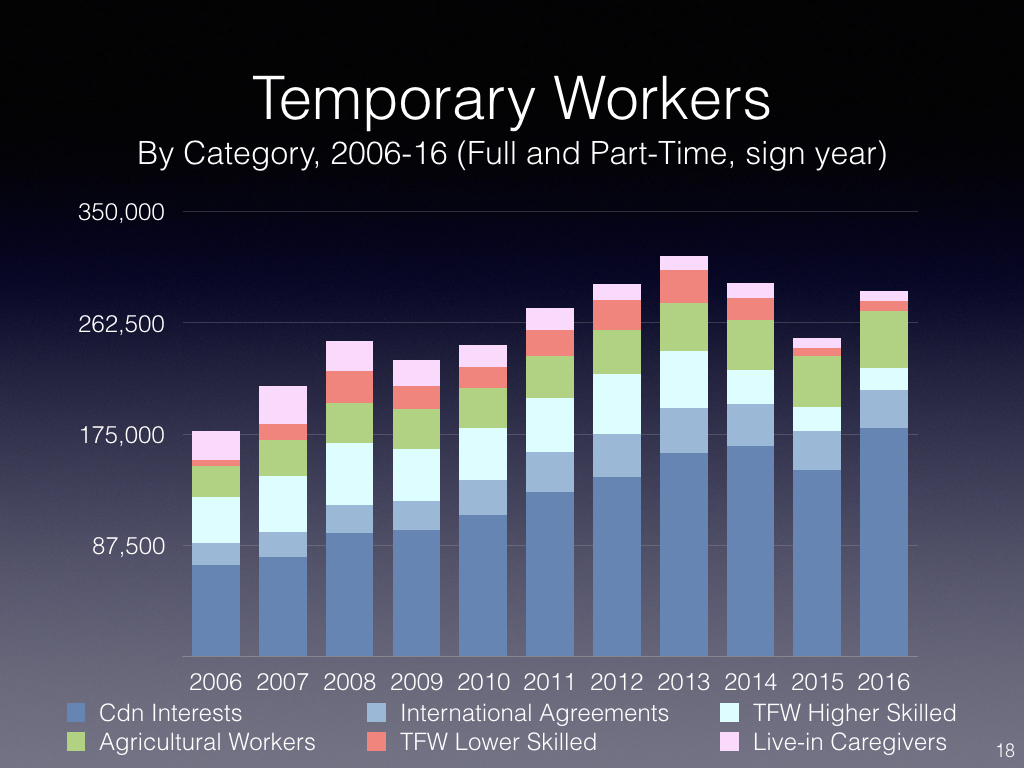
Highlights oversight and enforcement capacity issues within government. Above chart shows both temporary workers under the TFWP and the International Mobility Program:

Canada’s temporary foreign workers program is rife with oversight problems that appear to have allowed lower-paid international workers to take jobs that out-of-work Canadians could fill, the federal auditor general says.

Some companies have effectively built a business model on the program that could be having unintended consequences that the government doesn’t know about, including wage suppression or discouraging capital investment and innovation, said Michael Ferguson’s report on the program, part of a fresh batch of federal audits tabled Tuesday.

Ferguson’s report says the government approved applications for temporary foreign workers even when employers had not demonstrated reasonable efforts to train existing employees or hire unemployed Canadians, including those from under-represented groups, such as First Nations.

Nor did officials effectively crack down on companies that were found to have run afoul of the rules; few on-site inspections or face-to-face interviews with the foreign workers themselves were conducted, the audit found. Even when corrective action was recommended, it took months for all the necessary approvals.

Ferguson is calling for better oversight of the program and more pushback from federal officials to ensure companies applying to hire temporary foreign workers are doing so for the right reasons.

The department overseeing the program, Employment and Social Development Canada, says it plans to implement all of Ferguson’s recommendations.

Ferguson’s report comes months after a Commons committee recommended an overhaul to the program, and three years after the previous Conservative government made changes in a bid to ensure the program worked as intended: to help companies fill job vacancies only when qualified Canadians couldn’t be found for the work, and only when it didn’t negatively affect the local labour market.

Between 2013 and 2015, the number of temporary foreign workers in Canada dropped from 163,000 to just over 90,000, a result of the 2014 changes and the economic downturn.

Despite the drop in numbers, the audit team said it found numerous cases where employers gave dizzying reasons for needing a temporary foreign worker that departmental officials failed to challenge in 40 per cent of the cases reviewed as part of the audit.

Source: Temporary foreign worker program rife with oversight problems, says auditor – Macleans.ca

Government consistently fails to fix mistakes, Auditor-General says [need for citizen-centred program delivery]

Strong condemnation, widely noted. Despite the many years and efforts with respect to performance management and reporting, shows just how entrenched the government remains in measuring process and outputs, rather than results for citizens.

And ‘deliverology’ is unlikely to change this, as it is easier to track political commitments met, than actual benefits and outcomes for citizens.

During my time at Service Canada, we spent considerable time and effort to develop service strategies that aimed to place the citizen at the heart of service delivery, not the program management. There was considerable resistance from the various program branches, who were more comfortable, given the nature of accountabilities, to operate within silos. The slide below highlights the nature of change proposed, with the left showing the program and service maze, the right showing a more citizen-centric way of organizing programs.

ssso_implementation_plan_-_scmb_dec_2005_-_v5_08dec2005_e_scmb

Canada’s Auditor-General says the federal government must adjust the way it does business after a broad evaluation in which he says departments fail to consider whether their services actually benefit Canadians, cannot stay ahead of emerging trends and do not correct inadequacies even after they have been pointed out.

In marking the midpoint of his 10-year term, Michael Ferguson used his fall report to take an unusual step back from the assessments of specific programs to point to more systemic problems. Parliament, said Mr. Ferguson, uses his reports to learn about things that have gone wrong but does not ensure that changes are made to set them right.

“What about programs that are managed to accommodate the people running them rather than the people receiving the services?” asked Mr. Ferguson. “I am also talking about problems like regulatory bodies that cannot keep up with the industries they regulate, and public accountability reports that fail to provide a full and clear picture of what is going on….”

Departments and agencies work in silos, he said, failing to learn from what others outside, or even inside, their own organizations are doing.

“Our audits come across the same problems in different organizations time and time again. Even more concerning is that, when we come back to audit the same area again, we often find that program results have not improved,” said Mr. Ferguson. “In just five years, with some 100 performance audits and special examinations behind me since I began my mandate, the results of some audits seem to be – in the immortal words of Yogi Berra – ‘déjà vu all over again.’ ”

For instance, said Mr. Ferguson, many past audits have revealed the government’s lack of focus on Canadians who are the end users of its services.

And that trend continues in a new study of the Beyond the Border Action Plan which was introduced in December, 2011, to enhance security and the flow of goods and people across the Canada-U.S. border. Five years and $585-million later, the departments and agencies involved cannot show how the measures that were part of the plan have made Canadians safer or accelerated the movement of either trade or travellers.

“We found that, where performance indicators were developed,” says the audit, “they measured whether activities and deliverables were completed, not the resulting benefits.”

Source: Government consistently fails to fix mistakes, Auditor-General says – The Globe and Mail

His full message is also worth reading beyond the excerpt below and soundbites above:

In the interest of assisting our still-new Parliament in carrying out its oversight role and of helping government “do service well,” I believe there is value in looking back over the body of work produced by the Office of the Auditor General of Canada. This is a way to identify those issues that show up in audit after audit, year after year, and sometimes persist for decades.

These problems include departments and agencies struggling to work outside their silos, either to learn from what is happening within their organizations, or more broadly, to learn from what their external counterparts are doing.

And what about programs that are managed to accommodate the people running them rather than the people receiving the services? What about programs in which the focus is on measuring what civil servants are doing rather than how well Canadians are being served? In such cases, the perception of the service is very different depending on whether you are talking to the service provider or to the citizen trying to navigate the red tape.

I am also talking about problems like regulatory bodies that cannot keep up with the industries they regulate, and public accountability reports that fail to provide a full and clear picture of what is going on for a myriad of reasons—such as systems that are outdated or just not working, or data that is unreliable or incomplete, not suited to the needs, or not being used. Our audits come across these same problems in different organizations time and time again. Even more concerning is that when we come back to audit the same area again, we often find that program results have not improved.

Lack of focus on citizens

In our system of government, Parliament makes the rules, departments and agencies carry out the wishes of Parliament, and citizens receive the services. At least, that is the way the system is designed. Over the years, our audit work has revealed government’s lack of focus on end-users, Canadians.

Message from the Auditor General

Gaps in Ottawa’s detection of citizenship fraud, auditor finds

I did not find this OAG study all that surprising, particularly the challenges of maintaining accurate and consistent database records (e.g., spelling of addresses) and the lack of consistent follow-up to any cases flagged.

One of the lasting legacies of the Conservative government was increased attention to the integrity of the program, beyond the issues identified in the OAG report (e.g., rotating citizenship test questions, more rigorous and consistent language assessment, and the integrity measures of C-24).

But like many OAG reports, it is weak with respect to the materiality of fraud and the gaps it uncovered.

Six addresses out of 9,778 that IRCC officials missed is 0.06 percent. Other aspects are more problematic, multiple versions of addresses in particular, as well as lack of follow-up to warning flags and coordination between IRCC and RCMP or CBSA.

IRCC’s own number of revocation cases pending is 700, again a relatively small number (0.14 percent) compared to  the large numbers of new citizens in the past two years (500,000). And of course there is no comparative data in the report on permanent residency, EI, CPP or other program fraud to relate compare these numbers with.

So while any fraud is by definition unacceptable, the realities of large programs means that some degree, as small as possible, is inevitable, and ongoing attention to reducing its incidence is necessary:

Canada’s immigration department did not properly detect and prevent citizenship fraud, resulting in the review of some 700 citizenship cases as of January, according to Auditor-General Michael Ferguson’s spring report.

The report, tabled in the House of Commons Tuesday morning, found a number of concerns in the citizenship program affecting the department’s capability to prevent citizenship fraud, including the absence of a method to identify and document fraud risks.

“We concluded that Immigration, Refugees and Citizenship Canada’s (IRCC) efforts to detect and prevent citizenship fraud were not adequate,” said Mr. Ferguson in a prepared statement. “These gaps make it difficult for Immigration, Refugees and Citizenship Canada to assess the impacts of its efforts to combat citizenship fraud.”

…According to the report, the most common reasons for revoking citizenship are residency and identity fraud, and undeclared criminal proceedings.

The report found that citizenship officers did not consistently apply their own methods to identify and prevent fraud when dealing with suspicious immigration documents, such as altered passports. For example, in one region, citizenship officers did not seize any suspicious documents for in-depth analysis since at least 2010, while they did in another.

It was also found that citizenship officers did not have the information they needed to properly identify “problem addresses” when making decisions to grant citizenship. Problem addresses are those known or suspected to be associated with fraud, and used by citizenship applicants to meet residency requirements for citizenship.

“For example, one address was not identified as a problem even though it had been used by 50 different applicants, seven of whom were granted citizenship,” said Mr. Ferguson.

The problem was further complicated by poor sharing of information with the RCMP, which provides information about criminal behaviour among permanent residents, and the Canada Border Services Agency, which leads investigations of immigration fraud, said the report.

While the department did not track the exact number of citizenship fraud risks, it reported 700 pending revocation cases as of January. According to the report, revoking citizenship after fraud is discovered is “time consuming and costly.”

Source: Gaps in Ottawa’s detection of citizenship fraud, auditor finds – The Globe and Mail,

Dozens of fraudsters and suspected criminals became Canadian citizens, watchdog says in damning report

Liberals order investigation into possible citizenship fraud