ICYMI: International students studying online will still qualify for Canadian work permits

Appropriate flexibility. Looking forward to reviewing monthly data on study permits to assess impact:

International students who are forced to enrol in online courses this fall due to COVID-19 will still be eligible for postgraduate work permits, the federal government has announced.

The news is being welcomed by Canada’s education sector and experts, who say the move can help the country retain international students in uncertain times as borders are closed and commercial flights are reduced as a result of the pandemic.

“This is terrific news for students and for our province. It ensures students outside Canada who want to pursue the quality programs at Ontario’s colleges will get that opportunity this fall,” said Linda Franklin, president and CEO of Colleges Ontario, which represents the province’s 24 public colleges.

“We’re grateful the federal and provincial governments are supporting us during these challenging times.”

International education is a significant source of revenues for Canada, with international students contributing $21.6 billion in tuition and spending to the country’s GDP and supporting nearly 170,000 jobs in 2018.

As of Dec. 31, 2019, there were 498,735 post-secondary international students in Canada, which is a popular destination because it allows international students to work part-time during the school year and grants them work permits when they graduate as a pathway for permanent residence.

Under normal circumstances, international students from government-designated schools are issued postgraduate work permits that are good for one to three years, depending on the length of their studies. However, distance learning and time spent studying outside Canada don’t count.

Due to COVID, all post-secondary schools from coast to coast have moved their programs online and Ottawa had no choice but changed its criteria in order to retain international student enrolment and save its lucrative international education sector.

The confusion and uncertainty hanging over their studies already led many current and prospective international students to put their plan on hold and delay admissions for the May/June and summer term.

“International students who wish to eventually apply for Canadian immigration will want to capitalize on the opportunity to complete a portion of their studies in their countries of origin, while still being able to access the same benefits (the work permits) had they been required to physically study in Canada,” said immigration policy analyst Kareem El-Assal.

“The cost to study in Canada will decline for them, since they will not have to incur additional living expenses at the outset of their Canadian education.”

The Immigration Department announcement will be a boon for the slowing Canadan economy ravaged by the pandemic, said El-Assal, director of policy and digital strategy at CanadaVisa, an immigration website run by a Montreal-based law firm.

“The tuition that international students will pay will help to support jobs at colleges and universities across Canada,” he said. “International students will support economic activity in a number of ways once they arrive to Canada, through their spending, labour, and the taxes they will pay as workers.”

The Immigration Department said international students may begin their classes while outside Canada and can complete up to 50 per cent of their program via distance learning if they cannot travel to Canada sooner.

Students in this situation won’t have time deducted from the length of a future post-graduation work permit for studies completed outside of Canada up to Dec. 31, it said.

Source: International students studying online will still qualify for Canadian work permits

Revive Canada’s immigrant investor program, IIAC says

Favourite line: “a formal immigrant investor program, building on the strengths of the previous federal program.”

Reality: the evaluation that showed minimal to no benefits (Evaluation of the Federal Business Immigration Programwww.canada.ca › english › pdf › pub › e2-2013_fbip – the backlog was not the issue) and census data showing lower incomes than refugees.

The Harper government correctly ended the program.

IIAC’s citing the Quebec program as a model is risable as most end up elsewhere in Canada with the same minimal impact or contribution to the economy (Douglas Todd: Time to end ‘honour system’ in Quebec’s immigrant-investor scheme).

Government should not go there as main benefits accrue to the consultants that push for such programs:

The Investment Industry Association of Canada (IIAC) has suggested that increasing foreign direct investment (FDI) in Canada could help rebuild the economy in the wake of Covid-19.

In a May 5 letter to federal Finance Minister Bill Morneau, IIAC president and CEO Ian Russell wrote that there are “tens of thousands” of foreign investors looking for permanent residence in Canada, and other countries will benefit from their wealth if Canada doesn’t.

Russell suggested the federal government could increase FDI by re-introducing “a formal immigrant investor program, building on the strengths of the previous federal program.”

The previous program, the Federal Immigrant Investor Program (FIIP), was closed in 2014 as a result of the Economic Action Plan 2014 Act, which found that large backlogs of applications tied to economic immigration programs were a major hurdle for the immigration system.

IIAC conceded that the FIIP had issues, but suggested a new program could be temporary and tied to the economic recovery from Covid-19.

“To speed up [the program’s] implementation, its structure could be similar to what exists in Quebec but with the addition of a non-refundable contribution to boost its impact,” Russell wrote. “Unlike regular investors or entrepreneurs, immigrant investors are more interested in obtaining permanent residence for themselves and their families, and having the return of their portion of capital guaranteed after a reasonable time period (5-7 years).”

The implementation of such a program would require collaboration between multiple ministries, and “the government could decide where the FDI would be best invested as per its needs for post-Covid-19 recovery,” Russell said.

Dealer firms regulated by the Investment Industry Regulatory Organization of Canada (IIROC) could “help design, promote and support this new [FIIP] program,” Russell suggested, adding that many IIROC members were “involved in the FIIP process” and some have acted as consultants to other countries.

In data released in late February, Statistics Canada said foreign direct investment in Canada was positive in Q4 2019, but lower than what was recorded a year earlier.

Read the full IIAC letter.

Source: Revive Canada’s immigrant investor program, IIAC says

Susan Delacourt: COVID-19 has made Canada wary of newcomers. So how can Ottawa make the case for the immigrants we so desperately need?

More on Minister Mendicino’s thinking:

On the fateful day in March that the COVID-19 virus officially became an international pandemic, Canada’s immigration minister, Marco Mendicino, was paying tribute to employers who hire newcomers to this country.

The ceremony was held at the National Arts Centre in Ottawa on March 11 and, as the proceedings were getting under way, the host read aloud a bracing bulletin from German chancellor Angela Merkel. The virus, Merkel had just declared, could infect up to 70 per cent of Germans.

Mendicino was stopped in his tracks. A little over a week before, he had been sitting beside Merkel at an immigration-themed event in Berlin, where he had been invited to share stories of how Canada handled the integration of newcomers.

That event had been a big deal for a rookie minister, only sworn into cabinet a few months earlier. But this news from Merkel in Germany was suddenly a much bigger deal.

“That was the moment. That was enough to give me and everybody else in the room pause,” Mendicino said. “It was the moment that the world changed for me.”

What made this moment even more surreal is that it came only one day before Mendicino was due to make the annual announcement on how many immigrants would be welcomed to Canada in the years ahead — 341,00 for the coming year; 361,000 by 2022.

Even as Mendicino was gamely rolling out this plan on the Thursday of that week, however, the world was closing its doors. Donald Trump had shut down entry of all travellers from Europe the night before. Canada’s own prime minister, Justin Trudeau, went into isolation that day, after his wife tested positive for the coronavirus.

Mendicino was asked at his March 12 news conference about how he could possibly be talking about welcoming more immigrants to Canada while borders were slamming shut all over the planet.

“We are at a moment where we are responding to COVID-19, but we also are planning for the future,” he said. “The future of this country depends on immigration. We need to continue to grow because we have an aging population, an aging workforce.”

Making the case for immigration in an increasingly insular, inward-looking world was already a hard sell. Mendicino says that he and Trudeau talked about this candidly when he was asked to take on the job after the last election. Canada is a lot more polarized over immigration today than it was in the heady days for Trudeau after the 2015 election, when one of the first big gestures of the new Liberal government was to welcome floods of Syrian refugees to Canada.

Since then, Trump has become president; Britain has voted to leave the European Union; and repeated polls in this country show that sentiments about immigration are hardening.

In the midst of this, COVID-19 has very conveniently handed a big win to all those political forces looking for larger walls between nations and stricter limits on who gets into their countries. Add to that the record unemployment the pandemic is causing and, one assumes, accompanying resentment at anyone coming to this country to do jobs Canadians could do.

It didn’t help fans of immigration either that in the early days of the crisis almost all the cases of COVID-19 had come to this country from abroad. Xenophobia, meet germophobia.

Where has that put Canada’s immigration minister in this crisis? I joked to Mendicino before interviewing him this week about whether he is now the Maytag repairman of cabinet, on lonely call, but presiding over a system that has effectively been shut down until further notice.

Mendicino emphatically disagrees with the premise of that joke. For the past two months, he’s set up his office in the basement of his home in Toronto and he hasn’t been short of things to do. While he remains vague on what’s happened to that 341,000 immigrants target — “we’ll have more to say in the fall” — Mendicino would say that people are still arriving here.

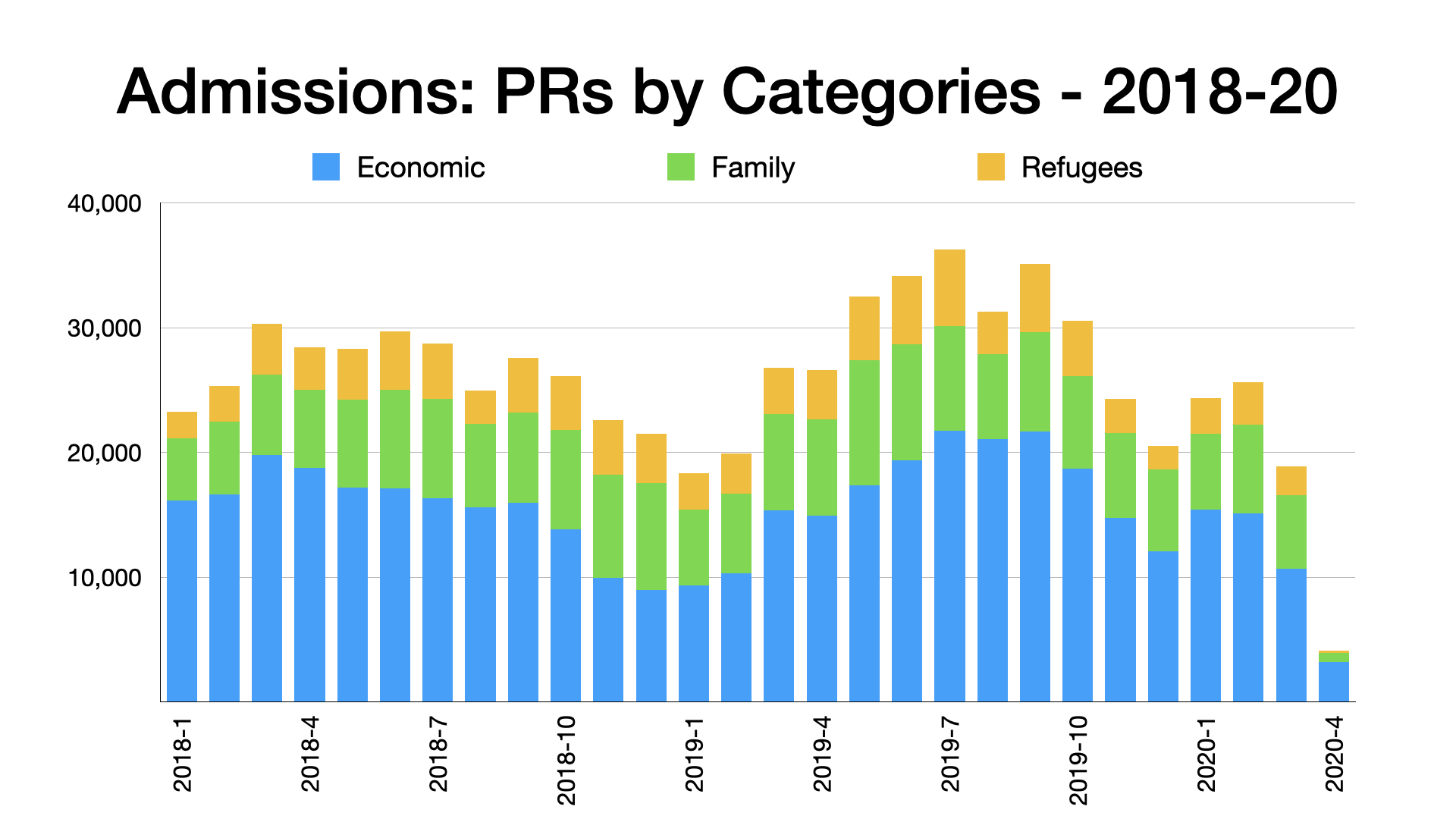
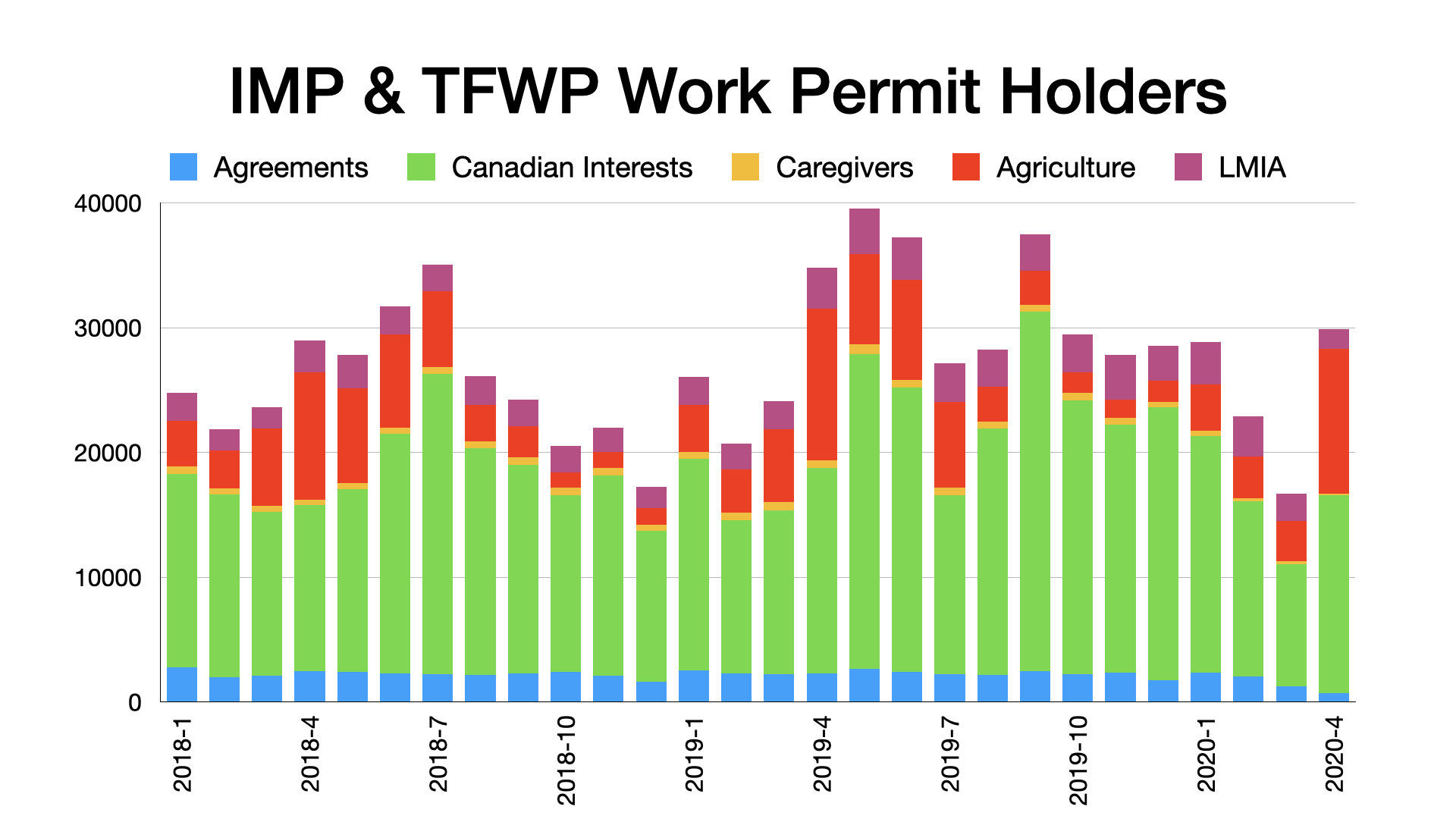
According to rough counts from Mendicino’s department, about 3,000 permanent residents arrived in Canada in April — a massive decline from the usual 25,000 or so who arrive as permanent residents each month during normal times. In the first three months of this year, Canada took in nearly 70,000 permanent residents, but the numbers started to tail markedly downward in the last half of March, once the pandemic hit. In addition, the immigration department was busy in April welcoming a little more than 20,000 temporary foreign workers into the country.

Canada still needs immigrants, maybe more now than ever before, Mendicino says, as the pandemic exposes just how dependent this country is on those who come here from abroad to work in essential businesses.

“The notion that somehow immigration has stopped doesn’t square with the reality that we are continuing to welcome temporary workers, international students and continuing to land those who wish to come to Canada, and lend their experience, their hard work to our country,” Mendicino says.

It should be said that for all the help that COVID-19 has given to arguments for closed borders, the pandemic has also forced Canadians to look at how much the economy depends on welcoming workers from elsewhere.

The havoc that the pandemic has been wreaking in long-term-care homes, for instance, has shone a light on how that whole sector is highly dependent on immigrants. Hospitals are similarly reliant. According to StatsCan, one in every four health-care workers in this country is a newcomer to Canada. More than a third of family physicians are immigrants; roughly the same proportions are seen in the fields of nursing, nursing aides and other related occupations.

Then there are the temporary workers in agriculture, urgently needed this spring when planting season was under way across Canada. Universities are already worrying about what will happen if they lose international students, whose high tuition costs account for about half of universities’ tuition revenue by some estimates.

Mendicino believes that all these facts are going to help make the case for immigration, once it’s safe to open the borders again. “Immigration has been a lifeline during the pandemic by safeguarding our food supply, recruiting additional support for our essential services on the front lines of our hospitals,” he says.

But here’s the blunt question: how do you get Canadians feeling good about opening up borders when they’re still extremely cautious about what’s going in and out of their own front doors? Two months of isolationism is going to be a hard habit to break, especially when it comes to envisioning thousands once again at Canada’s gates.

“We’ve adapted our immigration processes so that everyone is screened at the border, not only immigrants but returning Canadians too,” Mendicino says.

This still relatively new immigration minister refuses to be drawn into any questions about whether his job is tougher now or how he’s going to modify his arguments in favour of immigration in a world that has been locked down for two months.

“I have faith that Canadians believe in immigration,” he says. “That’s because they relate to it. It’s part of who we are. At its core, immigration is about people coming together to build a stronger country, which is what we’ve seen throughout our history, throughout this pandemic and, I’m confident, what we will see in the future.”

As with everything around this pandemic, though, no one knows whether this experience will make Canada more closed, or more aware of how much this country is connected to the world. Attitudes to immigration — and Mendicino — will be at the centre of that debate.

Source: Susan Delacourt: COVID-19 has made Canada wary of newcomers. So how can Ottawa make the case for the immigrants we so desperately need?

UK #Coronavirus: ‘World has changed’ and harsh new immigration rules must be rethought, Tory MPs tell Boris Johnson

Needed rethink. All governments will likely have to review their ranking and selection systems given the importance of the essential and lower-skilled support workers:

Conservative MPs have called on Boris Johnson to rethink his harsh new immigration rules, because “the world has changed” with the vital role played by lower-paid migrant staff during the pandemic.

Ahead of the plans reaching the Commons on Monday, former ministers have spoken out about their fears for the NHS and social care, as well as tourism, hospitality and farming – one branding the rules “stupid”.

One Tory MP warned of “very serious consequences” if care homes – where a quarter of Covid-19 deaths have taken place – lose more staff, while a second pointed out that many hospital cleaners and porters are EU migrants.

Caroline Nokes, a former Home Office minister, called for urgent changes, telling The Independent: “If the last six weeks have shown us anything, it is that we are dependent upon workers from all round the globe, but in large numbers the EU, for many essential roles.”

And Stephen Hammond, a former health minister, said: “I believe an exemption for social care workers is one that would be widely welcomed.”

The crackdown drawn up by home secretary Priti Patel – to replace free movement of EU citizens, from next January – will impose a minimum salary threshold of £25,600 for most workers seeking to enter the UK.

There will be no exemptions for so-called low-skilled jobs, other than seasonal workers, and social care has been excluded from a list of shortage occupations with a more lenient wage floor of as low as £20,480.

Around 70 per cent of the 200,000 EU migrants who come to the UK each year are expected to be excluded by the new rules, officials believe – which would mean around 140,000 shut out.

Even before the coronavirus laid bare how care services depend on migrant workers – some of whom have paid the ultimate price – the package was branded “a disaster” by social care leaders, who fear a deepening recruitment crisis.

Ms Nokes said she supported what the Home Office calls a “points-based system”, recognising education level, ability to speak English and shortage occupations, which will apply to migrants from anywhere in the world.

But she warned: “The Home Office will also have to build in flexibilities to make sure we don’t run out of carers, child care workers, farm labourers, road hauliers, retail assistants.

“These may not be regarded as ‘skilled’ workers in cold immigration terms, but do any of us look at those care workers on the front line of the battle against Covid-19 and think of them as ‘unskilled’?”

Steve Double, the MP for St Austell and Newquay, in Cornwall, said: “The proposals came out of what we thought back in December and January, but the world has changed. We are now looking at a very different world.”

On social care, he added: “There are very serious consequences if we get this wrong and there is no one to care for an elderly person in a residential home.”

Sir Roger Gale, the MP for North Thanet, in Kent, said: “Unless and until there is a sea change in our attitude to funding social care, we are not going to attract the people to fill the vacancies.”

He also pointed to the NHS’s dependence on migrants for ancillary staff, adding: “We have got to reflect the reality and, while I understand what Priti is trying to achieve, now is not the moment.”

One former senior minister said the plans now looked “stupid”, adding: “In the light of recent events, these salary thresholds make no sense at all and may be counterproductive, by arbitrarily increasing the salaries of the migrant workers we will still desperately need.”

Sally Warren, director of policy at The King’s Fund, said there were 122,000 social care job vacancies – while one in six staff are non-British – adding: “It is hard to see how staff shortages can be plugged without overseas recruitment.

“As the care sector struggles to cope with the ongoing impact of Covid-19, the government cannot allow international recruitment to fall off a cliff.”

The row came amid anger over Ms Patel’s refusal – revealed by The Independent – to waive the £624 immigration health surcharge for foreign healthcare workers.

The Immigration and Social Security Coordination (EU Withdrawal) Bill will have its second reading on Monday, in a race against time to complete the dramatic shake-up in just seven months – with an extension to the post-Brexit transition period ruled out.

However, the bill itself will simply end free movement, with the battle to come in future months over salary thresholds and shortage occupations which will be settled in secondary legislation.

Nevertheless, the Liberal Democrats vowed to vote against the “destructive” ending of free movement in the midst of the pandemic.

“Priti Patel may consider care workers to be ‘low skilled’, but they are on the front lines protecting us and our loved ones every single day,” said Christine Jardine, the party’s home affairs spokesperson.

The new rules will require migrants to speak English to “B1” level, enabling someone to, for example, open a bank account, or cope with “most situations” at home, work or leisure.

The are expected to be charged around £1,200 for a work visa, or £900 in a shortage occupation – the same fee paid by non-EU migrants currently.

Ms Patel has hailed Brexit as a “once-in-a-generation opportunity to strengthen the security of the UK border”, blaming free movement for letting in illegal immigrants, terrorists, drugs and guns.

“We will attract the brightest and the best from around the globe, boosting the economy and our communities, and unleash this country’s full potential,” she said in February.

Source: Coronavirus: ‘World has changed’ and harsh new immigration rules must be rethought, Tory MPs tell Boris Johnson

Trump administration weighs suspending program for foreign students, prompting backlash from business, tech

Yet another example of Trump administration considering further immigration restrictions, one that would reduce the attractiveness of studying in the US:

At the direction of the White House, the Department of Homeland Security has sent recommendations for further restricting legal immigration during the COVID-19 pandemic, according to one former and two current administration officials.

Among the recommendations expected to be considered is the suspension of a program for foreign students to stay in the U.S. to get one or two years of occupational training between secondary education and full-time employment, a move many in the business and university communities are fighting.

The program, known as Optional Practical Training, or OPT, is an incentive for foreign students to come to U.S. universities, as it provides some cushion between school and employment. Talk of suspending OPT has pitted business interests against immigration hard-liners like President Donald Trump’s senior adviser Stephen Miller, the officials said.

Miller, acting DHS Secretary Chad Wolf and Sen. Tom Cotton, R-Ark., have all said the program has been rife with abuses, particularly by Chinese students whom they accuse of getting American educations and then returning to China. Data from the Congressional Research Service, however, shows otherwise.

“Suspending or ending OPT makes no practical sense — it solves no problem, it reduces the quality of America’s higher education system, and it threatens the international exchange of ideas so vital to academic freedom,” said Julie Schmid, executive director of the American Association of University Professors.

“International students contribute nearly $41 billion a year to the U.S. economy. Our campuses and our communities benefit from the contributions international students make to education and research,” Schmid said. “This move does nothing to ensure the health of U.S. citizens during the COVID crisis. As with Trump’s Muslim ban, this is just bigotry posing as concern for national security.”

The new guidelines, expected to be announced in an executive order this month, would expand curbs on legal migration announced by the White House in April. The administration is expected to frame the move as economic protection for Americans faced with staggering unemployment rates.

Representatives of the White House and DHS did not respond to requests for comment.

A U.S. official familiar with the matter said, “While we won’t comment on internal administrative policy discussions one way or the other, millions of Americans have been forced out of work by the pandemic and they ought to be first in line for jobs — not lower-paid imported labor. Polling shows Democrats, Republicans and Independents agree.”

Critics of the proposals say Miller and other immigration hawks are using the pandemic to accomplish a goal they have had since Trump took office: bringing down the overall number of legal immigrants.

When Miller served on the staff of then-Sen. Jeff Sessions, R-Ala., he helped draft a bill that would have eliminated OPT. Now, four Republican senators have asked the White House to take the issue of curbing OPT and other legal migration programs into their own hands.

“We urge you to continue to suspend new nonimmigrant guest workers for one year or until our new national unemployment figures return to normal levels whichever comes first,” Cotton and Sens. Ted Cruz of Texas, Chuck Grassley of Iowa and Josh Hawley of Missouri said in a letter to the White House on May 7. The letter said OPT, along with H-1B visas for highly skilled workers and H-2B visas for non-agricultural seasonal workers, should be suspended.

Todd Schulte, president of FWD.US, a pro-immigration reform group of business and tech leaders that counts Bill Gates and Mark Zuckerberg among its founders, said the plan is too similar to previous proposals to be framed as a legitimate response to the economic crisis caused by COVID-19.

“Three years ago, when unemployment was at 4 percent, the signatories who were in the Senate at the time tried to slash legal immigration by more than 50 percent. … Today, as unemployment has skyrocketed, these senators now say we need to slash legal immigration in response to the COVID-19 crisis,” Schulte said.

An official familiar with discussions at the White House said the influence of the business community, often communicated by the U.S. Chamber of Commerce, could sink plans to suspend OPT.

But Rosemary Jenks, executive vice president of NumbersUSA, which shares Miller’s goal of decreasing overall immigration, said it would be a mistake to keep the program open. Jenks noted that OPT is a regulatory program not protected by statute.

“At a time when millions of Americans and lawful permanent residents are graduating from college with severely limited job opportunities due to COVID-19, it makes absolutely no sense for the administration to continue a regulatory program that allows foreign graduates to take jobs Americans need,” she said.

New immigration plan targets agricultural workers

The government continues to implement more targeted immigration programs:

A long-awaited program to give temporary agricultural workers a path to citizenship will be launched today, but its tight criteria will exclude many of them, including those who work in Manitoba.

“Immigration criteria is set up for urban-centric occupations and not rural, farm and food occupations,” said Janet Krayden, a spokeswoman for Mushrooms Canada.

The federal Liberals announced the agri-food immigration pilot program last summer, but delayed its launch, set for March, due to COVID-19. It will offer permanent residency to non-seasonal, year-round agricultural workers in Canada who meet certain criteria.

Ottawa will grant permanent status to as many as 8,250 workers over three years. Just as many people can qualify as family members, for a total of 16,500.

But applicants have to pay for an assessment of their home country’s high school degree. They also must pay for a Canadian Language Benchmark-4 language test, a level that involves being able to read a recipe and give driving directions.

“The requirements are fairly high,” said Diwa Marcelino, an organizer with Migrante Manitoba.

Seasonal workers, who continue to spend summers in Canada before returning to their home countries, are ineligible for the pilot program.

Yet the Canadian Agricultural Human Resource Council praised the program, saying the sector has lobbied for years to keep workers with skills that agricultural companies need, but whom Ottawa doesn’t deem as specialized labour.

“This is what this new program is designed to address,” said council head Portia MacDonald-Dewhirst.

Her group found that in 2017, 1,100 unfilled Manitoba agriculture jobs cost the sector $367 million in lost sales. The council believes Manitoba is on track to fall short by 5,300 jobs at the end of this decade, as demand rises for grain, oilseeds, beef and pork.

MacDonald-Dewhirst said her industry has pushed hard to hire Canadians, but recruitment campaigns haven’t bridged the growing job gap that leads to unharvested food.

Now, COVID-19 travel restrictions make it harder to fly in foreign workers and safely house them, and the coronavirus is disrupting supply chains that import food.

“This is a great time to be doing this project,” MacDonald-Dewhirst said of the pilot. “These are people who are here on a temporary basis, and are looking to make Canada their home; they’re excited to do so.”

Marcelino fears the program will worsen the exploitation of foreign workers. His group has long advocated that agricultural workers are only safe when they have Canadian citizenship.

“There’s a huge power imbalance employers have over their employees, because their status is dependent on their employment,” he said.

Marcelino argued employers will use the pilot program as leverage to make sure workers don’t cause a fuss over labour conditions.

“You have this even bigger carrot on a stick that workers are vying for.”

Marcelino argued that’s especially dangerous during COVID-19, with migrant workers alleging that Alberta meat plants encouraged them to keep working even though they had symptoms, sparking some of the largest coronavirus outbreaks on the continent.

Source: New citizenship plan targets agricultural workers

Nova Scotia’s immigration picture uncertain amid pandemic

Realistic acknowledgement of uncertainty by the minister:

Nova Scotia welcomed a record number of immigrants in 2019, setting high expectations for immigration numbers in 2020.

But with travel restrictions in place to prevent the spread of COVID-19, it’s uncertain whether the province will be able to welcome as many or more immigrants this year than it did last year.

In 2019, the province welcomed 7,580 new permanent residents, surpassing the previous record of 5,970 in 2018.

And Nova Scotia was off to a good start and “certainly on track” to setting a new record in 2020, according to Immigration Minister Lena Metlege Diab. In the first quarter, the province admitted 1,185 permanent residents, compared to 1,270 in the first quarter of 2019.

Diab said it’s too soon to tell how COVID-19 will affect immigration numbers in Nova Scotia for the remainder of the year.

“Going on eight weeks now, and immigration is a long-term process, it obviously takes months for people, once they’re approved and so on to actually land in the country, so at the moment we don’t see that as an issue,” she said.

“Premature what will happen if this (pandemic) continues months and months, but at the moment we’re continuing to process applications and our staff is all working remotely.”

She added the province is prioritizing the immigration of essential workers including health-care professionals and truck drivers to address a “shortage of workers in those areas.”

Immigration predictions

Seeing how Nova Scotia has planted “very significant immigration roots” in the last five years, Halifax immigration lawyer Lee Cohen said he thinks it’s “likely” that the province will enjoy the immigration numbers that it did last year, if not exceed them in 2020.

“I think the appetite out there in the world for people wanting to immigrate to Canada and wanting to immigrate to Nova Scotia specifically remains high and active,” said Cohen.

“The COVID-19 event of course slows down the movement of paper and certainly the movement of people. … How long the restrictions will remain in place will determine the outcome here, but I think that Halifax specifically and Nova Scotia generally have become immigration destination locations.”

Jennifer Watts, CEO of the Immigrant Services Association of Nova Scotia, said the number of immigrants coming to the province has “definitely slowed down quite a bit” since the start of the pandemic, following “a fantastic uptick” of immigrants and refugees arriving over the past couple of years.

She said her association will be waiting to see how immigration programs move forward.

“Obviously there’s a lot of interest and there’d be a big benefit to Nova Scotia, where we really benefit so much from immigration, to be able to have those opportunities again, to really help drive, even more so now, the economic development of our province,” said Watts, adding immigration helps further “social and cultural diversity” in the province as well.

Watts said the contributions of immigrants in the province have been “quite significant” during the pandemic, as many are working in frontline services, noting the arrival of more immigrants will help the province in its “recovery” stage once the pandemic is over as well.

“What we really gain from immigrants coming in is the innovation, the new ideas and the global competitiveness that they bring, so that will be also very key, as we’re really trying to reimagine what our new way of life is going to be, and the more broad-based experiences, the new ideas, the new ways of looking at things that immigrants have always brought into our community, will be very valuable,” she said.

ISANS is also waiting to see when the federal government will resume refugee settlement in Canada, said Watts.

“We will be waiting to see as the government once again establishes their offices overseas and the flights begin to run … so it may be that we see not many (refugees) arriving over the next couple of months, but we’re not quite sure what will happen in the fall.”

Source: Nova Scotia’s immigration picture uncertain amid pandemic

Canada immigration visas fell by 26% in March 2020

Not surprising, with further declines expected over the next few months (March was just partially affected by the travel restrictions and lockdowns. Not as confident on full rebound as the medium-term economic impacts work through the economy:

Permanent resident (PR) visas issued by the Canadian government fell by 26 per cent in March 2020 compared with the previous month.

This new data released by Immigration, Refugees and Citizenship Canada (IRCC) shows the immediate impact that the coronavirus pandemic has had on Canada’s immigration system.

While Canada’s provinces and territories and federal government employees did not begin to go into lockdown until the second half of March, this two-week disruption was enough to contribute to a steep decline in new PR visas issued.

Last year, Canada’s PR intake increased by 33 per cent in March 2019 compared with February 2019.

March changes by province

Nearly every province saw their immigration levels fall by 30 per cent between February and March 2020. The two major exceptions were New Brunswick (0 per cent change) and Alberta (an 8 per cent decline).

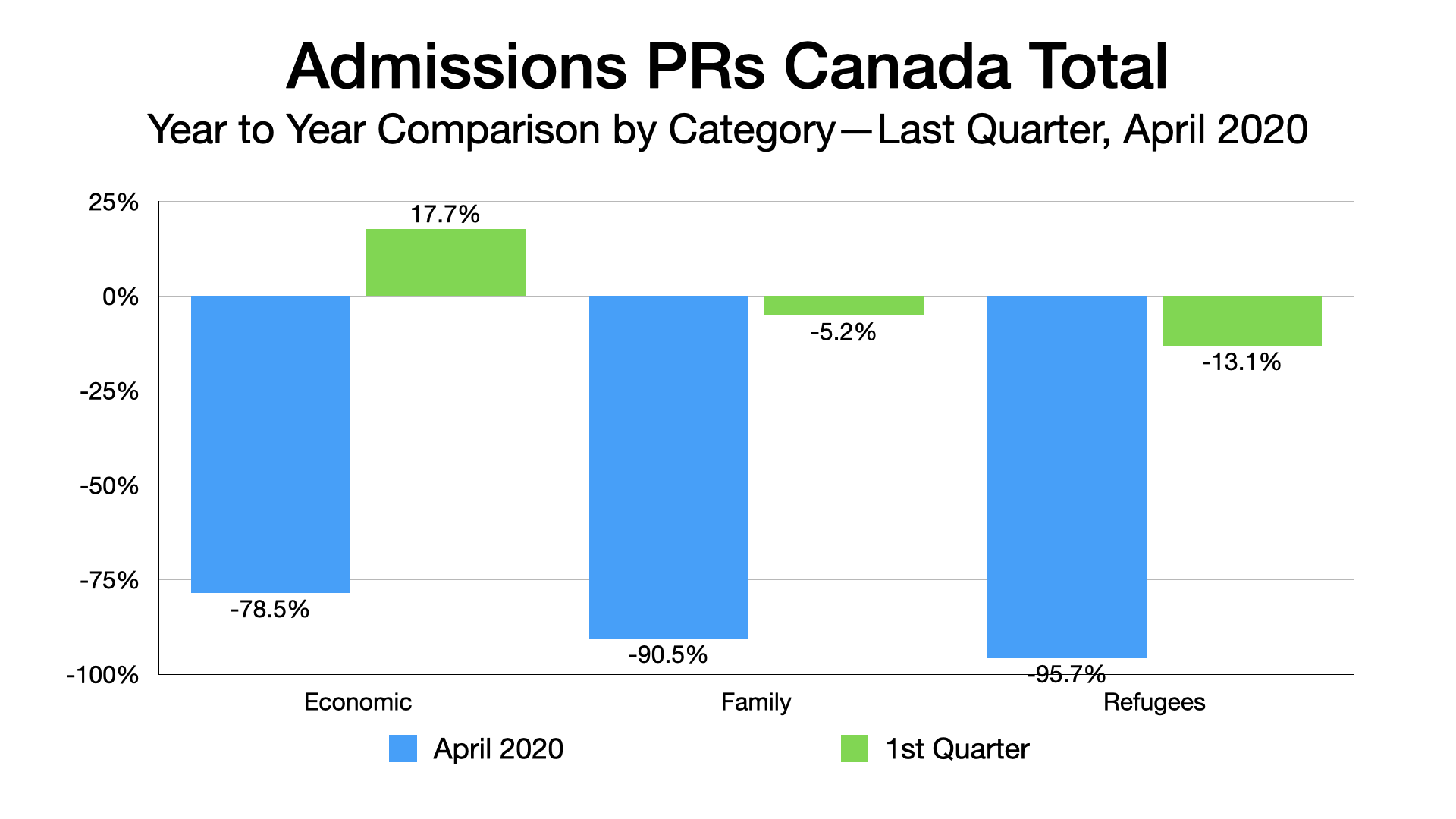
Economic class immigration suffered across the board. Family reunification and refugee class immigration fluctuated by province, seeing some losses but also some gains.

Alberta saw the smallest change in immigration across the board, with a 9 per cent loss of new economic class immigrants, an 8 per cent loss in family class, and a 5 per cent loss in refugee class immigration.

New Brunswick only saw a loss in its economic class immigration of 9 per cent. The family and refugee classes saw 40 per cent and 43 per cent gains, respectively.

The largest gain in family class immigration for March was felt in Newfoundland and Labrador, which saw a 67 per cent increase over February. There was no change in refugee class immigration, however, the province saw a 53 per cent loss in economic class immigration, the biggest hit in Canada.

The largest gain in the refugee class was seen in Saskatchewan at 67 per cent. The province lost 35 per cent of economic class immigration and 36 per cent of family class immigration.

Why PR numbers should increase later in 2020

Despite its coronavirus special measures, Canada is continuing to process new applications for permanent and temporary residence.

IRCC is still holding Express Entry draws. Even after travel restrictions were implemented at the Canadian border, there have been more Invitations to Apply (ITAs) for PR issued to Express Entry candidates so far in 2020 than there were at the same time last year.

In addition, the Provincial Nominee Program (PNP) remains in operations with Nova Scotia, Ontario, Manitoba, Saskatchewan, Alberta, and British Columbia all holding PNP draws since March.

Family class immigration has been the least affected by the restrictions. Family members of Canadian citizens and permanent residents may come to Canada for essential reasons.

Refugee class immigration has been most impacted as the United Nations High Commissioner for Refugees (UNHCR) has stopped resettlement amid the pandemic.

Following the recent disruptions, there are reasons to believe Canada’s immigration system will begin to stabilize.

Canada’s immigration minister Marco Mendicino has said that the federal government remains committed to welcoming newcomers to support the country’s economy.

Canada has increased its Express Entry ITAs since the start of the pandemic. In April, Canada issued ITAs to 11,700 Express Entry candidates compared with about 8,000 per month prior to the pandemic.

Hence, Canada should see some recovery in PR levels in the second half of the year due to more Express Entry ITAs being issued, family reunification continuing, as federal government processing normalizes, and as lockdowns and travel restrictions ease in Canada and around the world.

Source: Canada immigration visas fell by 26% in March 2020

A COVID-19 surge has exposed Singapore’s migrant-worker blind spot

More on Singapore, migrant workers and COVID-19:

As a former journalist working in the thick of things in Asia, my favourite assignment was an annual interview with the founder of modern Singapore, Lee Kuan Yew, for Forbes magazine.

A man with an unparalleled grasp of history, a steely gaze and incredible discipline, Mr. Lee knew that in a country such as Singapore – home to a multiracial society, and sitting on an island with almost no natural resources – incredible stamina would be needed to survive. He set in motion a series of policies that catapulted the former British colony into one of the world’s wealthiest enclaves in the span of a few decades. The country is now home to one of the globe’s busiest shipping-container ports and the tenth-largest foreign reserves.

Against all odds, Singapore has survived racial riots, several disease outbreaks, economic downturns and seasonal bouts of debilitating pollution haze from neighbouring countries. Its ability to respond quickly to external threats is credited to its small size, compliant citizenry and place among the world’s most wired nations.

So it came as little surprise that when COVID-19 began to take off, Singapore quickly set the gold standard in its public health response, with early and aggressive testing, meticulous contact tracing, quarantines and travel restrictions. Until recently, it managed to keep the number of positive cases to fewer than 200.

Mr. Lee would have been proud.

But a major blind spot threw the country off-course: it failed to consider the congested dormitories that house 180,000 migrant workers across the island, which became perfect vectors for disease transmission. That oversight has cost the city-state dearly. The number of positive coronavirus cases in the country has surpassed 24,000 – up from 16,000 cases just a week ago – representing, by far, the largest caseload in all of Southeast Asia.

These workers now account for almost 90 per cent of coronavirus cases in Singapore. All are now under quarantine, at a high cost to the country’s economy.

For a government that never leaves even the smallest detail to chance, the blind spot has been a political embarrassment. Singapore’s traditional rival and much larger neighbour, Malaysia, has many more migrant workers and has managed to keep its number of positive COVID-19 cases to fewer than 7,000. Malaysia also started implementing lockdowns earlier than Singapore did.

Strangely, precautions were not put into place even though Singapore’s migrant-worker dormitories have previously suffered outbreaks of measles, dengue fever, tuberculosis and the Zika virus.

The situation has also generated significant foreign-media coverage, exposing the workers’ low pay, congested and often unhygienic living conditions, hazardous working environments, and abuse by employers.

In fairness, many Western countries, including Canada, have also had their weak spots for viral transmission exposed in the fight against COVID-19, including long-term care homes, penitentiaries and meat-processing facilities.

Singapore’s Prime Minister, Lee Hsien Loong, who is the elder Mr. Lee’s son, has introduced measures that will make the dormitories much more secure in the future. Unlike many other world leaders, he has been open in his communication with Singaporeans, stating that normalcy could be months away until a vaccine is developed.

In a memorable televised speech on April 21, Mr. Lee struck a compassionate tone in addressing the country’s migrant workers: “We will care for you, just like we care for Singaporeans.”

The good news is that the government, supported by “Singapore, Inc.” (a term coined to describe the country’s economic expansion strategy in the 20th century), is throwing all it can into the fight against this pandemic, including money, technology and targeted public health messaging. Even robots have been deployed to help maintain physical distancing in parks. Policies known as “circuit-breaker measures,” including stay-at-home orders, will remain in place until at least June.

In my countless interviews with Singapore, Inc.’s leaders in the past, I cannot recall one word ever uttered about the contribution of migrant workers, who come mainly from Bangladesh, India, Malaysia and China.

But as has happened in North America and elsewhere, ordinary citizens have developed a newfound appreciation for front-line labourers – charitablesupport funds for Singapore’s dormitory workers have been heavily supported.

In the longer term, Singapore will have to work hard to deal with a huge plunge in tourism, business travel, shipping and oil refining – all linchpins of its economy.

The country’s post-COVID-19 reset will need to include a look at its weaknesses, starting with the conditions experienced by migrant workers. These workers need to be recognized for who they are – as critical contributors to Singapore’s success story.

Source: A COVID-19 surge has exposed Singapore’s migrant-worker blind spot: Michael Bociurkiw

Immigrants with work visas, suddenly jobless, must leave the US if they aren’t rehired

Trump administration continues its anti-immigration push:

Like millions of American workers, an Indian software engineer, a British market researcher and an Iranian architect lost their jobs amid the coronavirus pandemic. Unlike Americans, they are not entitled to unemployment benefits, despite paying taxes, because they are on foreign work visas. And, if they fail to find similar jobs soon, they must leave the country.

Rejish Ravindran analyzed data for a national footwear retailer, helping make sales projections and investment decisions. After hiring him on an H-1B skilled-worker visa nearly two years ago, the company recently sponsored his application for legal permanent residency, a process that takes several years to complete.

“It was going good. I thought I would be in Michigan forever. We were going to buy a house and settle down here,” said Ravindran, 35, who lives in Grand Rapids, Michigan. His wife, Amrutha, a nurse, was finishing a course and hoped to put her training to use soon.

But battered by the coronavirus outbreak, the retailer furloughed Ravindran last month, which is not allowed under the terms of his visa. So two days later, the company terminated him.

“Everything came crashing down,” said Ravindran, who arrived in the United States in 2012.

Now, he is scrambling to find another job before the 60-day grace period for transferring his visa to another employer expires early next month. He is not optimistic.

The lives of tens of thousands of foreign workers on skilled-worker visas, such as H-1Bs, have been upended by the economic fallout from the COVID-19 crisis. Many have been waiting in a backlog for several years to obtain permanent legal residency through their employer, and now face the prospect of deportation.

The Trump administration is also expected within the next few weeks to halt the issuance of new work visas such as the H-1B, for high skilled foreigners, and the H-2B, for seasonal employment. The new measures under review, according to two current and two former government immigration officials, would also eliminate a program that enables foreign graduates of American universities to remain in the country and work.

The tightening work rules come as unemployment in the U.S. soared last month to 14.7%, the highest level on record, and as calls escalated in Congress for Americans to be given priority for jobs.

“Given the extreme lack of available jobs for American job-seekers as portions of our economy begin to reopen, it defies common sense to admit additional foreign guest workers to compete for such limited employment,” a group of Republican senators said in a letter last week calling for a suspension of new visas to guest workers who have not yet entered the country.

For those already rooted in the U.S., the consequences of canceling the existing visas are “life-altering,” said Shev Dalal-Dheini, director of government relations for the American Immigration Lawyers Association.

“They have been thrown into limbo. It’s not like they can go and just find any job, like at a pizza place,” said Dalal-Dheini. A new job must meet specific criteria for the visa, such as by paying a certain salary and requiring at least a bachelor’s degree.

Dalal-Dheini’s association of 15,000 lawyers has asked U.S. Citizenship and Immigration Services to extend the grace period, giving H-1B holders at least 90 days after the public health emergency has ended to find employment.

An agency spokesman did not address whether an extension was under consideration. He said the agency would continue to monitor the coronavirus and “assess various options related to temporary worker programs.”

Since taking office, President Donald Trump has thrust immigration and job displacement onto center stage, introducing a series of policies to curtail both legal and illegal immigration. More recently, his administration has cited the pandemic to justify even stricter restrictions.

On April 22, Trump suspended the entry of new immigrants for 60 days. Less noticed in his proclamation was the order to the secretaries of labor and homeland security for a speedy review of nonimmigrant work visa programs.

As of Jan. 21, there were 421,276 people in the United States on H-1B visas, three-quarters of them Indians, and many of them technology workers. About 220,000 people were enrolled in the 2018-19 academic year in the Optional Practical Training program, which allows foreign students to work after completing their studies.

The strong economy had fueled brisk demand for foreign workers in recent years, with H-1B applications by private companies far outstripping the annual supply of 85,000, a situation that prompted the government to resort to a lottery to award them.

But proponents of limiting immigration say that if there was ever a time to prioritize American workers, it is now.

“If an H-1B visa holder is terminated from their job and is unable to find another employer willing to sponsor them, they should go back home,” said Kevin Lynn, executive director of Progressives for Immigration Reform, which advocates for American technology workers.

U.S. citizens with foreign partners on visas are also affected.

Andrew Jenkins and Krista York of Minnesota began more than a year ago to plan their wedding. The couple had settled on getting married Aug. 20 at the majestic Cathedral of St. Paul, where York’s grandparents were married decades ago and she was confirmed in the church as a teenager. Then the coronavirus struck.

York was furloughed. Jenkins, who is British, lost his job as a market research analyst. Because he is on an H-1B visa, Jenkins is not eligible for unemployment. “It’s far from ideal to not have any income when you’re planning your wedding,” said Jenkins, 27.

What’s worse, the couple said, is that Jenkins is in a race against time to find another job before his visa expires in July.

Unless he succeeds, they may have to hurriedly get married at a courthouse so that Jenkins can salvage his immigrant status — by filing an application for a green card through a spouse. If that happens, the couple will not be allowed to hold a religious ceremony at the cathedral.

“Everything is ready to go for the cathedral. But if we have to get married on paper, we’ll have to find another church,” said York, 27.

Bahar Shirkhanloo of Iran completed a master’s degree in architecture two years ago and used the Optional Practical Training program to get a job at a firm in Chicago, where she is part of a team that designs high-rise residential buildings.

Early this year, the firm decided to sponsor her for a green card. But she was abruptly terminated in early April when projects came to a standstill, leaving her with 60 days, under the terms of the program, to find a new job.

“I’m applying every day, everywhere in the U.S. you can think of,” said Shirkhanloo, 28. Most often, she hears the same thing: “They are interested, but, for now, there’s a hiring freeze.”

In Michigan, Ravindran is contemplating selling his 2013 Honda Accord to make the rent and pay outstanding bills, including $6,000 for a hospital visit by his wife last year.

The son of a tea stall owner and the first to attend college in his family, the software engineer said that if he ends up having to return to India, “I want to clear all my debts. I need to make a smooth exit from the U.S.”

But there is a wrinkle: Commercial flights to India have been suspended since that country went into lockdown in March. While the government recently started repatriating some Indians stranded abroad, it has stipulated that pregnant women, older people and those with medical conditions will have priority.

That could put someone like Ravindran at risk of overstaying his visa, which could jeopardize his ability to live in the United States in the future.

“If I don’t find a new job, I can’t stay here,” he said.

Source: Immigrants with work visas, suddenly jobless, must leave the US if they aren’t rehired