Ottawa didn’t enforce rules for employers of migrant farm workers during pandemic

Appears to be a significant program implementation fail, particularly with respect to Ontario in contrast to British Columbia:

The federal government allowed some employers of migrant farm workers to submit three-year-old housing inspection reports in order to secure labour during the pandemic, instead of requiring up-to-date evidence of compliance with the temporary foreign worker program.

As well, for a six-week period at the outset of COVID-19, the government stopped conducting housing inspections under the TFW program altogether. When the audits resumed, they were done remotely.

While Employment and Social Development Canada (ESDC) has received 32 COVID-19-related complaints regarding the program in the agri-food sector since March, not a single farm has so far been found in violation of several key pandemic-related rules. For example, employer-provided accommodations must allow workers to keep a distance of two metres, and employees must be paid for their mandatory quarantine upon arrival in Canada.

The federal government is ultimately in charge of the TFW program. It has the power to conduct pro-active inspections of accommodations, which can include bunkhouses, trailers and sheds. The provinces and local public-health units also have a role to play in oversight, creating a jurisdictional quagmire that has proved detrimental to the well-being of some temporary foreign workers.

In Ontario alone, more than 1,000 migrant farm workers have tested positive for COVID-19, according to a Globe and Mail survey of local public-health units. Health officials have stressed that, for the most part, the workers arrived in Canada healthy and contracted the virus locally. Three men from Mexico have died.

A Globe investigation into the outbreaks published last month exposed the unsafe conditions endured by some migrant workers. Interviews, photos and videos portrayed overcrowded accommodations, broken toilets and cockroach and bed-bug infestations. As well, sheets and cardboard were used as dividers between bunk beds. Workers also recounted not being fully paid for their initial quarantine.

Federal guidance for employers of temporary foreign workers, updated in April, said that if an agri-food operation can’t submit a valid housing inspection report owing to COVID-19, “they must try to provide a satisfactory” report within the previous three years. The employer must later provide proof of compliance before the end of the permit term.

And even if an employer can’t produce a report from the previous three years, the company can still be approved to receive temporary foreign workers “if photos of the accommodation are provided and the employer agrees to submit an updated [report] to ESDC within the duration of the work permit.”

The department said in an e-mail that it would be rare for an employer to submit a three-year-old housing inspection report. In prepandemic times, employers had to provide, on an annual basis, a satisfactory report no older than eight months if they wanted to hire temporary foreign workers. This means that if a business employed migrant workers last year, for example, it would have had a recent report that it could submit.

In an interview with The Globe last month, Employment Minister Carla Qualtrough acknowledged shortcomings in the TFW program and said Ottawa will overhaul it. Ms. Qualtrough said “nothing is off the table,” including changes to the enforcement regime. She also said that the government may create national housing standards that would have to be met for employers to qualify for the program.

Santiago Escobar, a co-ordinator with the Agriculture Workers Alliance, said the group has long sought improvements to what he described as “so-called inspections.” The alliance operates under the United Food and Commercial Workers union and represents migrant employees. “[The oversight regime] is not doing enough,” he said. “All inspections must be done in person, before workers arrive, and again once they’ve moved in.”

Over the past few months, Mr. Escobar said, the alliance has helped process dozens of applications for federal open work permits. This type of authorization, launched last year for vulnerable migrant workers, allows foreign nationals to leave abusive employers and work elsewhere for up to one year. Mr. Escobar said many of the applications included pandemic-related concerns. All of the submissions were approved.

And yet no employers have faced penalties for breaches of federal COVID-19-related rules. The employment department noted, however, that approximately 11 per cent of employers have required “some correction to minor issues” before being deemed compliant.

Of the 32 COVID-19-related complaints regarding the TFW program, the department has launched 11 inspections. Three are complete, with the employer found compliant in all areas. The rest of the complaints are under review. The federal government has the authority to penalize employers found to be non-compliant, including through a fine of up to $1-million and a ban on accessing labour through the program.

From mid-March to the end of April, Ottawa halted its housing inspections; ESDC said this was done to protect the health and safety of migrant workers, employers and government staff. When the inspections resumed, they were done remotely.

York University professor Leah Vosko, a Canada research chair whose work focuses on enforcement of employment standards and the precarious immigration status of migrant workers, said remote inspections are problematic. They don’t always accurately establish whether employers are abiding by the rules, she said, and information can be easily fabricated and manipulated.

In addition to more in-person audits, Prof. Vosko said Ottawa should increase unannounced inspections. “[A worker] being seen as a ‘troublemaker’ can jeopardize current and future employment contracts and lead to repatriation,” she said in an e-mail. “Proactive inspections are therefore needed to address the well-documented exploitative and unsafe conditions migrant farm workers labour under.”

One migrant farm worker told The Globe that when employers are given advance notice of an inspection, they have time to make conditions appear better than they are. “They’re prepared for the inspection, and usually what they do is show the good lunch room or the part of the facilities that are in good shape,” the worker said. The Globe is not identifying the worker because of concerns about future employment.

Prof. Vosko said Ottawa must create a national housing standard for temporary foreign workers. She pointed to a 2018 federally commissioned study on employer-provided accommodations that found a lack of uniformity in housing conditions and oversight.

“Consequently, prior to the pandemic, there were no concrete federal directives around housing capacities, bed size, number of windows and doors, privacy measures, food preparation and storage, [and] sanitation facilities,” she said.

At the provincial level, Ontario Premier Doug Ford has repeatedly cited Ministry of Labour inspections and compliance orders as evidence that his government is taking action to protect migrant farm workers. But ministry inspections cover workplaces, not housing. The ministry said in an e-mail that it conducted 142 field visits in the agri-food sector related to COVID-19 between mid-March and early June. The inspections resulted in 34 COVID-19-related orders to improve conditions.

Scotlynn Group’s farm in Vittoria has been the subject of two formal COVID-19-related complaints to the Ministry of Labour. In May, there was a complaint with regard to “lack of COVID-19 measures,” and in June, there was a second one regarding “quarantine requirements,” according to ministry records provided to The Globe.

Investigations into the complaints are continuing; neither has so far resulted in a compliance order. The ministry is also investigating the June 21 death of Juan Lopez Chaparro, a 55-year-old Scotlynn worker from Mexico who had been admitted to hospital with COVID-19. The ministry declined to comment on the continuing fatality investigation.

Mr. Lopez Chaparro was one of 216 migrant workers at the Scotlynn farm; almost all of them have tested positive for the virus. Without a work force to speak of, the farm abandoned its asparagus harvest in early June.

The president and chief executive of Scotlynn Group – a North American transportation logistics and farming company with one of the largest vegetable operations in Ontario – told The Globe last week that all of the Vittoria workers have since tested negative and have been cleared to return to work. Scott Biddle said the Ministry of Labour told him they would likely be on site for two days to investigate Mr. Lopez Chaparro’s death, but ended up staying for two hours.

Mr. Biddle said officials interviewed him about the farm’s health and safety measures, including as it relates to accommodations for the initial mandatory quarantine. He said he rented hotel rooms for nearly 200 workers; 21 employees were isolated across seven bunkhouses, in line with a public-health occupancy directive that limited the number of workers per bunkhouse to three.

After four pro-active Ministry of Labour inspections and follow-up visits between January of 2010 and June of 2020, Scotlynn’s farming operation has been issued 13 compliance orders, according to ministry records. The orders require, among other measures, that the company prepare a policy for harassment and “assess the risks of workplace violence that may arise from the nature of the workplace, the type of work or the conditions of work.”

In five instances, the compliance order says vaguely, “the employer shall take every precaution reasonable in the circumstances for the protection of a worker.”

Three Scotlynn workers were among those interviewed for The Globe’s recent investigation. The men described overrun living conditions; ill workers living with healthy ones; and no PPE to guard against the virus.

Mr. Biddle said the two formal COVID-19-related complaints submitted to the Ministry of Labour are baseless and were brought by one “rogue” employee. “Every company has had complaints, but we’ve never had a fine,” he said. “We take every precautionary measure possible. We always go above and beyond.”

Source: https://www.theglobeandmail.com/canada/article-how-ottawas-enforcement-regime-failed-migrant-workers-during-the/

Canadian universities scramble to maintain flow of international students and the revenue they bring

As are other countries, save the USA:

Canadian universities are trying to salvage the incoming class of international students as travel restrictions, quarantine rules and the move to online learning threaten to disrupt what has become a crucial revenue source.

Chauffeur service to a quarantined room, catered meals, daily health checks with a thermometer for every student, even the possibility of chartered flights to get students to Canada – all are on the table as institutions prepare for the fall term.

The financial stakes are significant. In a little more than a decade, the number of international students attending Canadian universities has tripled, to nearly 500,000 in 2019, representing about a quarter of all new university enrolments, according to a recent StatsCan report.

With international students typically paying tuition fees two to five times higher than Canadian students, they now contribute roughly $6-billion a year to Canadian postsecondary institutions – half of all tuition revenue at domestic institutions. As provincial government funding to universities stagnated over the past decade, those fees have paid for rising institutional and labour costs.

Over all, universities are bracing for a potential drop of 10 to 35 per cent or more in international student fees – on top of revenue already lost to cancelled conferences and shuttered recreation facilities.

Some schools are at greater risk in the short term – particularly those that have taken a lot of international students in recent years. While universities across the country have seen growth in international student enrolment, it has been notably high in parts of Atlantic Canada. Cape Breton University, for example, is nearly two-thirds international, and Saint Mary’s in Halifax is nearly one-third. At Dalhousie, tuition revenue is projected to decline by between $30-million and $50-million this year, primarily because of the loss of international students, who make up 22 per cent of the student body.

The University of Toronto also relies heavily on international fees – one in four of its students come from abroad – and detailed plans have been drawn up to get them from the airport into university dorms or even hotel rooms so they can quarantine for the mandatory two weeks. The university is willing to book hundreds of hotel rooms, if need be. But it will also prepare special quarantine kits for every incoming student, including a thermometer for daily temperature checks. All their meals and other amenities would be delivered, with students required to speak via video once daily with a health professional. The university said it’s still examining how to provide testing for the virus or its antibodies at the start and end of quarantine.

“It’s a big project, but it’s an incredibly important project, given the talent pipeline that these students represent,” said Ted Sargent, vice-president, international, at U of T.

It’s not clear, however, how all these services – including the hotel rooms and meals – would be paid for. U of T and other schools have been speaking to federal and provincial governments about securing additional funding, but so far, there’s been no agreement. “It’s clearly not going to be a small cost,” said Prof. Sargent, suggesting the province, the federal government and the university could share the added costs of quarantine for incoming students.

With roughly two months until the start of classes, universities have plenty of logistical hurdles to overcome – not least whether students will even be allowed to enter the country. “It’s still too early to tell what travel and health restrictions will continue through the months ahead,” according to Immigration officials. Currently, only students with a travel permit issued before March 18 are allowed to enter Canada.

It’s not clear how many visas have been issued since then. Processing has been slowed dramatically by the pandemic and universities still don’t know whether those with permits issued after mid-March will be allowed to cross the border for the start of classes. Universities Canada, the agency that represents schools at the federal level, said it has been told the department can process a surge of applications quickly, but time is running out.

Families overseas are also likely trying to determine whether it’s safe to travel and whether there’s any value in paying for a year in Canada with so much lingering uncertainty around how much of the education will be delivered online. Students can begin their studies online in their home countries, but many universities worry students won’t be prepared to pay high tuition fees without the Canadian experience attached. One survey by a British higher-education consultancy this spring showed more than half of international students planning on coming to Canada intended to defer admission for a year.

“We’ve got to find a way of making this work,” said Paul Davidson, president of Universities Canada. “We’ve got to make sure it’s safe and secure and that we don’t have setbacks that would impact on our international reputation. The level of interest on the part of international students in Canada remains very, very strong.”

Although COVID-19 poses a threat to Canada’s gains in the international student sector, Canada could emerge stronger compared with other countries. The United States, for instance, said this week that students attending universities that don’t offer in-person classes will have to return to their home countries, sparking an outcry. It has also made it more difficult for foreign students to obtain work visas after graduation.

The Canadian government, meanwhile, recently announced a key policy adjustment designed to aid international students, ensuring those who begin their studies online from abroad won’t be penalized with shorter postgraduate work permits. That’s a significant factor for those attracted by the prospect of being able to earn Canadian wages to offset the cost of the degree and who hope to use the experience as a springboard to gain permanent residency in Canada.

Nonetheless, one recruitment agent based in India said he has recommended to some students that they consider starting their courses online at home and waiting until winter 2021 to travel to Canada.

Sushil Sukhwani, director of Edwise International India, said he expects to send 30 to 40 per cent fewer students to Canada this year due to the pandemic. In some cases, students are concerned that even if they do get into Canada, classes will be primarily online, meaning they’ll be spending thousands of dollars on accommodations and other amenities when they could be studying from home.

He also said many students worry that with unemployment high in Canada, they won’t be able to find part-time jobs to offset their living expenses. In a survey of several hundred clients, he found a little more than 40 per cent were willing to consider starting their Canadian studies online from India.

“I tell parents that if you are worried about these things, then start with the online option and wait for things to settle down. That way, their costs are lower, and they don’t run the risk of not getting a part-time job,” Mr. Sukhwani said.

At Thompson Rivers University (TRU), international students make up about 17 per cent of the student population. Baihua Chadwick, associate vice-president, international, at TRU, said she anticipates a drop in international enrolment for the fall – but how big is still difficult to say.

“That’s the $10-million question, and maybe a lot more than that,” she said with a laugh.

Her best estimate is that TRU will enroll 30 per cent fewer international students this fall. One of the reasons she foresees a drop is because so many visa applications haven’t been processed by Canadian immigration officials.

“Visa offices were closed, particularly in our major source countries. Now some of them have opened, and we’re seeing visas being issued very slowly, which is a major concern for us,” Ms. Chadwick said.

There is also a sense that Canada’s deteriorating relationship with China, damaged by the fallout from the arrest of Huawei executive Meng Wanzhou, could trigger a drop in students from that country. China has for years been Canada’s top source country for university students, and Ms. Chadwick said she’s seeing fewer of them applying to TRU than in the past.

Already a number of applicants to TRU in China have been rejected by Canadian government officials for reasons that remain unclear, she said, and students who travelled to Canada were even turned back at the border.

“Even if you just have a few students being returned or denied entry, the word spreads like wildfire,” she said. “And so [international recruiters] will be advising their students not to attempt” to travel.

Travel could also be difficult because of the relatively small number of international flights still operating. TRU and other universities have looked into booking their own charter aircraft to get students to Canada. But the price quoted was a hefty $500,000 a flight, Ms. Chadwick said, and for now they’ve decided against it.

Instead, the university plans to greet arriving international students at Vancouver airport, whisk them directly to waiting buses and drive four hours to campus in Kamloops, where the students would quarantine for 14 days.

Haonan Deng, 23, is an international student who plans to attend TRU in the fall. He had intended to return to China after graduating with a degree in business in June, but the depressed economy persuaded him to enroll in a master’s degree program at TRU, even though it will be delivered online.

As a member of the school’s Chinese student association, he’s been in touch with prospective students weighing whether they should travel to Canada in September. He said the main concern he encounters is from students worried that if they stay home and begin their studies online, they could still be rejected by Canada when they apply for a visa once it’s safe to travel. Mr. Deng added that some kind of guarantee from the government – assuring students they’ll eventually be allowed to enter Canada to complete their studies in person – would be welcome.

“They want to know how they will complete their degree,” he said.

Source: https://www.theglobeandmail.com/canada/article-canadian-universities-scramble-to-maintain-flow-of-international/

Covid 19 Canadian Immigration Effects: May 2020 Update

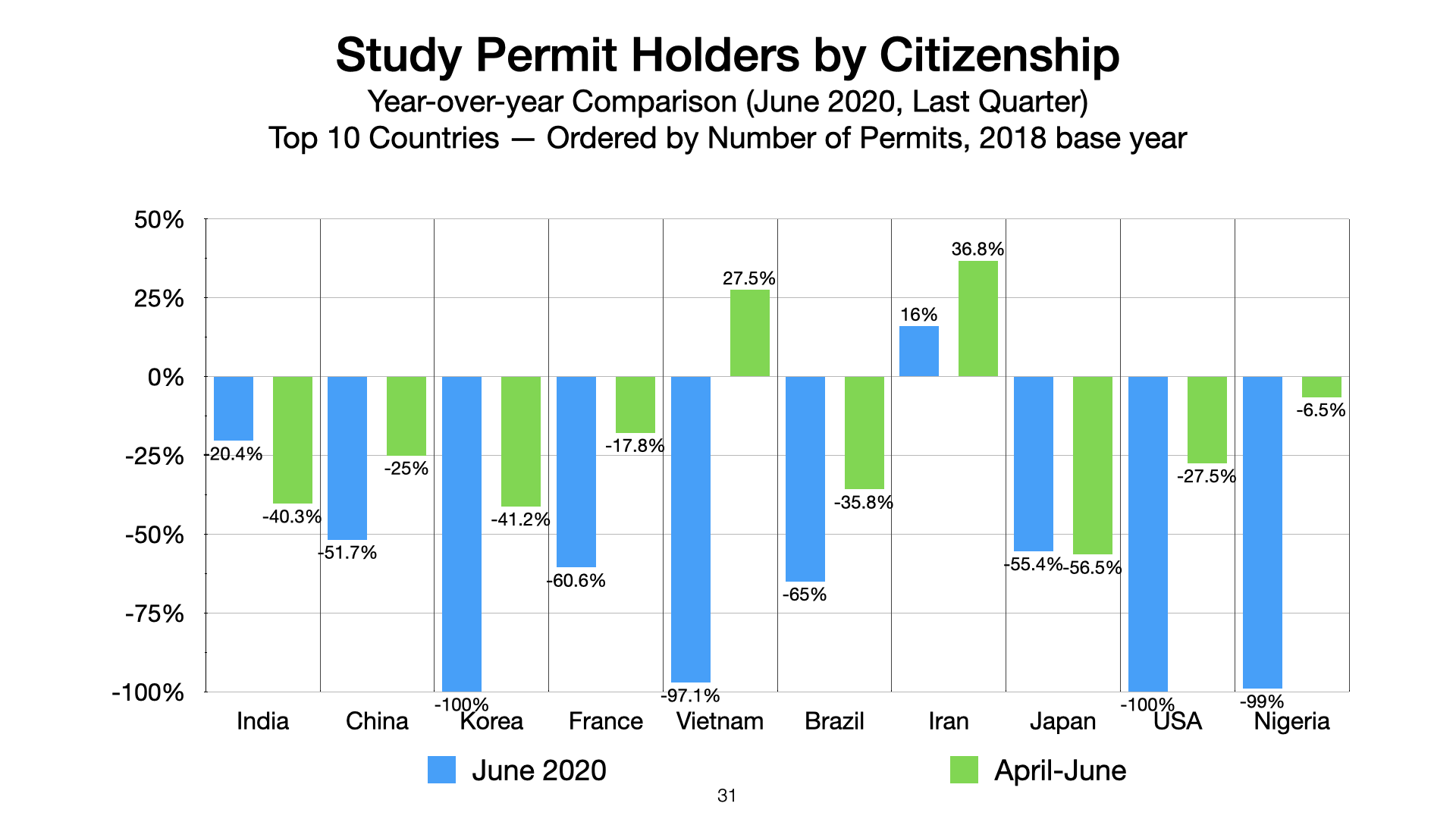
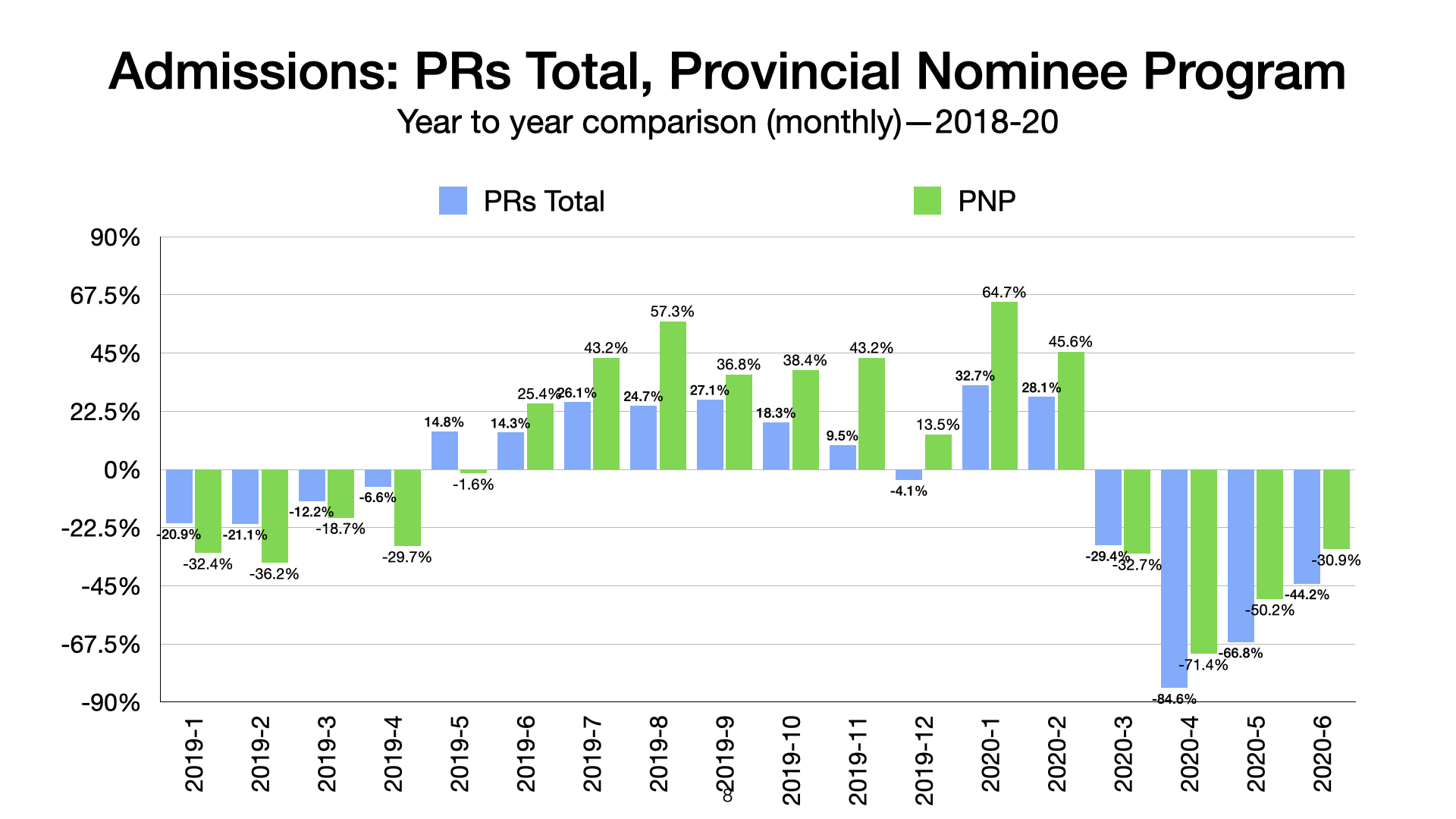
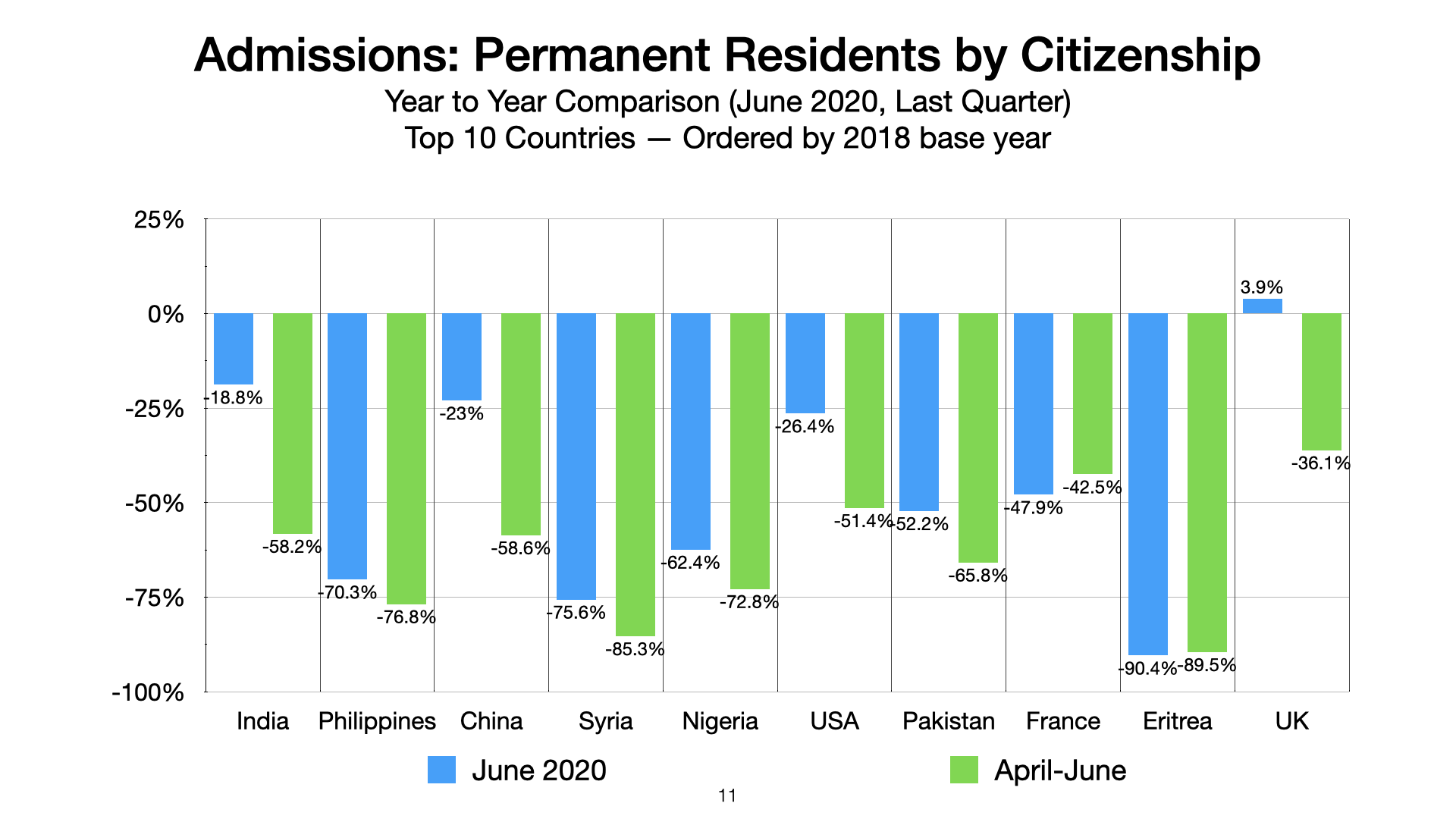
This deck examines monthly changes due to COVID-19 on permanent resident admissions, temporary resident work permit holders, and study permit holders, broken down by category and program, region and top countries and province (Provincial Nominee Program and study permits).


Trump immigration policy sparks anxiety among Canadians studying in U.S.

No surprise:

Questions over whether thousands of international students could be deported from the U.S. under a new Trump administration policy are causing consternation among school officials and anxiety among Canadians studying south of the border.

The policy — which triggered a lawsuit from Harvard University and the Massachusetts Institute of Technology (MIT) on Wednesday — stipulates that international students who take a fully virtual course this fall will not be allowed to remain in the country.

Under the new guidelines, international students would still be able to take more online courses than normal, but will have their visa rescinded if they attempt to take a fully online course load.

According to a statement released by the U.S. Immigration and Customs Enforcement agency on Monday, international students will only be able to remain in the country if they are taking a mix of in-person and virtual classes.

While Canadians do not need a visa to study in the U.S., they are still required to produce a similar form, known as an I-20, signed by the school they are attending. That school will now need to offer hybrid courses in order for Canadian students to stay in the country.

Sarah Klassen, an accounting student at Wichita State University, said her school has not yet determined how it will deal with the policy.

But Klassen, 19, notes that being forced to leave the U.S. would likely be a death blow for her studies, as she relies on a bowling scholarship to pay her tuition.

“I’m scared even going down (to the border) now that I might not be able to get back in. There’s so many strict guidelines,” Klassen said over the phone from her family home in Niagara-on-the-Lake, Ont.

Yvonne Kang, who is earning her law degree at the University of Connecticut, said being forced to move back home to Toronto would involve breaking a newly signed lease on an apartment and cost her thousands of dollars in unnecessary expenses.

Kang, 23, said says she doesn’t understand why ICE is targeting international students when they are such a major contributor to the American economy.

“We pay American landlords, we go grocery shopping in American stores, they charge international students double the tuition (of domestic students),” she said.

The Institute for International Education puts the number at roughly $45 billion in 2018, with more than $1.1 billion of that coming from Canadians. A report from the institute estimated there were 26,170 Canadians studying in the U.S. in 2018-2019.

The new guidelines have provoked backlash from universities across the U.S., with Harvard president Lawrence Bacow saying the order’s “cruelty” is surpassed only by its “recklessness.”

“It appears that it was designed purposefully to place pressure on colleges and universities to open their on-campus classrooms for in-person instruction this fall, without regard to concerns for the health and safety of students, instructors, and others,” Bacow said.

“This comes at a time when the United States has been setting daily records for the number of new (COVID-19) infections, with more than 300,000 new cases reported since July 1.”

Edward Alden, a senior fellow with the Council on Foreign Relations, a New York-based think tank, said the new policy creates an “onerous” task for students and institutions to undertake.

“Most schools are still trying to figure out what their mix (between online and in-person classes) is going to be,” Alden said.

“Now they’re going to have to scrape together a new program and reissue I-20s — and make it all happen in under a month.”

ICE is enacting the policy through a program that was introduced after 9/11 to handle the screening and verification of international students.

The program designates whether an individual qualifies for the F, M or J-class visas that are required to enter and reside in the U.S. as a student.

Normally, guidelines forbid international students from taking more than one course online per semester, but that restriction was relaxed when the COVID-19 pandemic caused a global lockdown in March.

International students who were outside of the country when the pandemic began and continue to take online courses from abroad will not have their status affected, nor will their visa be rescinded, according to documents from ICE.

But students who are currently living in the U.S. and whose schools are going fully online next semester will have only two options: leave the country or transfer to a different school.

The news from ICE, released on the same day Harvard announced that all of its 2020-2021 fall classes would be online-only, sent ripples of outrage across the country.

Dozens of colleges have said they plan to offer at least some classes in person this fall, but some say it’s too risky.

The University of Southern California last week reversed course on a plan to bring students to campus, saying classes will be hosted primarily or exclusively online.

Source: Trump immigration policy sparks anxiety among Canadians studying in U.S.

Ontario overestimated cost of services to irregular border crossers, AG finds

In contrast to Quebec, which estimated correctly:

Ontario significantly overstated the costs of providing services to asylum seekers coming into Canada from the United States, the province’s auditor general said Wednesday.

In a special report, Bonnie Lysyk said the $200 million estimate given by the governing Progressive Conservatives in 2018 represented the cost of providing services to all refugee claimants, not just so-called “irregular” border crossers.

She said the minister of social services at the time, Lisa MacLeod, was given inaccurate information by civil servants.

“The accuracy of information provided by the ministry to the minister for the public announcement was far off the mark,” Lysyk said in a statement Wednesday.

“Senior government officials need to ensure the accuracy of the information provided to government for public announcements and decision-making.”

MacLeod had formally requested $200 million from Ottawa to cover costs she said were incurred by the province and its municipalities as a result of an influx of asylum seekers arriving from the U.S.

Lysyk said her office found the Ontario government spent roughly $81 million on services for irregular asylum seekers between April 1, 2017 — when the federal government first started tracking their arrival — and July 31, 2018.

More costs were incurred until the border was closed due to the COVID-19 pandemic, Lysyk said.

She recommended Ontario seek an immigration agreement with the federal government that includes compensation for providing services to refugee claimants, including irregular border crossers.

The current deal does not, and the federal government has given $15.6 million in compensation to Toronto, Ottawa and Peel Region for their expenses during the April 2017 to August 2018 period, she said.

Quebec, which has a separate cost-sharing agreement with Ottawa, incurred $300 million in costs and has received $286 million in compensation, Lysyk said.

When asked about the report Wednesday, Premier Doug Ford said his government did not intentionally mislead the public and was simply relying on the information provided.

Ford blamed the federal government for leaving the province to shoulder the costs of what he called “illegal immigration,” and suggested the auditor general should do another report to examine more recent expenses related to the issue.

“Where’s the money? We need the money,” the premier said. “Every single day, it’s costing us more and more and more.”

Opposition legislators criticized the government for using inflated numbers to make policy decisions.

“The auditor general’s report makes clear that the claims Doug Ford and Lisa MacLeod made about the cost of accommodating asylum seekers in Ontario were pure fiction,” NDP Leader Andrea Horwath said in a statement.

“Shame on them for making stuff up to fan the flames of division instead of uniting us like they should have been.”

Liberal House Leader John Fraser said the Ford government has a record of “continually overstating, overstepping, and exaggerating.”

Ford previously came under fire for saying his government inherited a $15 billion deficit from the Liberals, and later revising that number down by about half, to $7.4 billion.

Green Party Leader Mike Schreiner said the debate over the costs of services for irregular border crossers took place at a time when many governments were “playing politics with immigration.”

“The government inflated this number … to provide cover for what in this case is a divisive political agenda, which I think was to question immigration policy in this country. And I think it’s wrong,” he said.

Canada’s Safe Third Country agreement with the U.S. says asylum seekers are required to make their claims in the first “safe” country where they arrive, which means those who try to enter Canada at an official land crossing are sent back to make their claim in the U.S.

The agreement does not cover those who come in through unofficial crossings, known as “irregular” asylum seekers.

The auditor says 36 per cent of refugee claimants in Ontario in recent years entered at unofficial points.

Federal data show 26,415 asylum claims were filed in Ontario in 2019, which could include some filed by irregular border crossers.

The province provides services such as temporary housing, settlement services and language training.

Source: Ontario overestimated cost of services to irregular border crossers, AG finds

Almost 35,000 people pegged for removal from Canada evade border agency

Overall, pretty devastating report.

One aspect that I found particularly of interest is that the numbers have largely remained the same over the past three years. Unfortunately, the OAG report did not include earlier years in its analysis:

Canada’s border agency has failed to promptly remove most of the people under orders to leave the country, and in tens of thousands of cases it has simply lost track of them, the federal auditor general says.

In a report tabled Wednesday in Parliament, the auditor said the Canada Border Services Agency’s efforts were hampered by poor data quality and case-management flaws, resulting in avoidable delays in thousands of cases.

Problems in information-sharing with immigration officials also slowed things down.

The border agency is responsible for carrying out removal orders to ensure public safety and the integrity of the immigration system.

The report noted the federal government had made significant investments over the last decade to improve the efficiency of the asylum system, including removals.

However, the level of enforceable removal orders — those involving people who have exhausted or waived all legal avenues to stay in Canada — remained largely unchanged, even for priority cases.

As of April 2019, there were about 50,000 people in Canada with enforceable removal orders. Two-thirds of these — 34,700 cases — involved individuals whose whereabouts were unknown. Of these, 2,800 had criminal histories.

Still, the border agency was often not conducting regular follow-ups to try to find them by opening each file at least every three years, or once a year for people with criminal issues.

Data integrity shortcomings limited the agency’s ability to know which removal orders to enforce, the report said.

“Without a reliable inventory of removal orders, the agency could not effectively prioritize removals according to risk and complexity. We also found cases in which the agency was unaware that removal orders had been issued,” it said.

“Many cases we examined were also stalled because officers had done little to overcome impediments like missing travel documents.”

The auditor noted that many countries, mostly in Europe, offer assistance programs that promote the voluntary return of foreign nationals to their countries of origin. Some operate through independent third parties and are not limited to failed asylum claimants, the report said.

“All recognize that voluntary returns are preferred to enforced removals, are more cost-effective, and facilitate rapid departures.”

The government will do a better job of ensuring the integrity of the system, Prime Minister Justin Trudeau pledged at a news briefing Wednesday.

Public Safety Minister Bill Blair, the cabinet member responsible for the border agency, said the government accepts the auditor’s recommendations to fix the various problems.

In addition to improving its removals strategy, the border agency will enhance the way it tracks and triages cases to ensure priority ones are addressed promptly, Blair said in a statement.

“This includes continuing to implement a data integrity strategy to ensure that it can quickly identify the stages all cases are at so they can move forward in a timely fashion.”

The border agency is taking steps to find foreign nationals whose whereabouts are unknown by reviewing all outstanding cases, prioritizing criminal cases and focusing investigations on the most serious ones, Blair added.

Finally, the agency will develop an “incentive program” to increase voluntary compliance, he said.

The agency’s problems with managing removals date back more than a decade, long before the Liberals took the government reins from the Conservatives.

But Conservative Leader Andrew Scheer said it was another example of the Liberal government being unable to ensure a fair, orderly and compassionate immigration system. “We need a government that takes this kind of thing seriously.”

NDP public safety critic Jack Harris said the Liberals must make sure the border agency “has sufficient resources to perform their duties.”

Source: Almost 35,000 people pegged for removal from Canada evade border agency

Queen’s launching new program to train immigration and citizenship consultants

Interesting back and forth between the lawyers and academics quoted. Although I am not a great fan of consultants compared to lawyers, given the history of poor and, in some cases, fraudulent representation, the program is professionally designed given the people involved:

On Aug. 1, Queen’s University will launch a graduate diploma in immigration and citizenship law. The program will be the only English-language educational pathway to becoming a regulated immigration consultant.

Queen’s developed the program and won a competitive bid with immigration consulting’s national regulator and will be the sole accredited English provider of the program.

Ravi Jain, national chair of the Canadian Bar Association Immigration Law Section, says the program should not exist, arguing it lends credibility to an industry that has been marred by incompetence and misconduct since its inception.

“By continuing to facilitate immigration consultants to be engaged in the practice of immigration law, it does it does actual Queen’s law JD students a disservice,” says Jain, who is certified by the Law Society of Ontario as a specialist in immigration law and is partner at Green and Spiegel LLP, in Toronto.

“This program is a terrible idea. Graduates will claim that they have ‘gone to law school.’ The public will be even further confused. Most think that they are hiring lawyers when they hire immigration consultants,” says Jain. “Immigration consultants have a horrific history in Canada.”

Queen’s Law Dean Mark Walters says the problems known in the industry is one of the reasons his school launched the program.

“We all appreciate that at present, the profession of immigration consultant is not well regulated, and that there have been abuses in the system and concerns legitimately raised. And that’s, in fact, why we’re involved,” Walters says.

Associate Professor at Queen’s Law and expert in immigration and refugee law Sharry Aiken says the federal government decided long ago that there was a place in the immigration administrative process for consultants.

“It’s a profession that’s here to stay. And the key is to ensure that it’s properly regulated and that the people in that profession are professionals and trained as such,” she says. “It’s a massive system and non-lawyers can perform a really important role to ensuring that vulnerable people get proper advice and assistance as they work their way through elaborate administrative system.”

The program at Queen’s comes after the regulation of immigration consultants has gone through three different stages. In 2001, the Supreme Court of Canada case Law Society of British Columbia v. Mangat ruled it was not a breach of the Legal Profession Act for non-lawyer consultants to represent people in immigration hearings in B.C. Since then, the door has been open for the non-lawyer consultants to serve clients looking to relocate to Canada.

The first governing body — the Canadian Society of Immigration Consultants — eventually attracted a parliamentary review in 2010 due to lack of policing and professional and ethical standards. The Immigration Consultants of Canada Regulatory Council followed but problems persisted, and another parliamentary review took place in 2017. The Standing Committee on Citizenship and Immigration produced a report: “Starting Again: Improving Government Oversight of Immigration Consultants.” The report showed misconduct was still prevalent, with international students, live-in caregivers and temporary foreign workers being the most vulnerable to abuse. The committee’s witnesses repeatedly accused the ICCRC of failing to deal with unauthorized practitioners, known as ghost consultants.

The 2017 report produced the College of Immigration and Citizenship Consultants Act, which turned the ICCRC into a new self-regulatory College of Immigration and Citizenship Consultants — instituting a licensing regime, code of conduct, complaints and discipline committees and putting the board of directors under the guidance of the minister of immigration, refugees and citizenship.

While the argument in favour of including consultants in the immigration system involves the need to increase access to justice, Jain says that the immigration bar is uniquely accessible to the public they serve. Jain calls the access to justice argument “absolutely ridiculous.”

“I would ask the dean and others to point me to evidence that there are problems with respect to immigrants and refugees retaining lawyers,” Jain says. “The average income of an immigration lawyer is about $75,000. People go into it out of humanitarian instinct and there’s lots of pro bono work and low-bono work where there are very low fees. So, there’s no evidence of an access problem. None, whatsoever.”

He adds that the issue raises the question of why society deems immigrants and refugees, who are particularly vulnerable, to not need the help of a trained lawyer.

“Why should immigrants and refugees be told that they don’t need a proper lawyer? It’s only the marginalized and the racialized that are told that, in our society. It’s never the other areas of law. And so, I just find that argument to be highly problematic.”

Aiken says that many other areas of law also use paralegals and consultants play “a very important role in access to justice for vulnerable communities.” She adds that the new iteration of the regulatory body, past forms of which have been “plagued with structural deficits” has made positive changes, including an expanded regulatory authority to discipline members and other new enforcement powers.

Before setting up the Queen’s program, Aiken established a National Advisory Committee, which included members of the immigration bar including past chair of the Canadian Bar Association national section for Citizenship and Immigration Robin Seligman and Lobat Sadrehashemi past president of the Canadian Association of Refugee Lawyers.

Source: Queen’s launching new program to train immigration and citizenship consultants

Australia: Victorian economy hardest hit by coronavirus fallout as immigration dries up

While Australian approach to immigration is more restrictive than Canada’s, Canada’s economic and immigration recovery may also be longer than expected. But like all projections and estimates, time will tell.

Australia has been one of the more successful countries in addressing COVID-19, with only 311 infections and 4 deaths per million (July 1):

Australia’s second-most populous state was poised to take the biggest economic hit from the COVID-19 pandemic even before a dramatic spike in cases over the past fortnight forced renewed shutdowns in large parts of Melbourne.

The latest business outlook from consultancy Deloitte Access Economics tips Victoria to suffer the biggest fall in gross state product in the 2020-21 financial year, which just began.

Deloitte predicts Victoria’s domestic economy will shrink 1.6 per cent this financial year, also leaving it with the worst economic performance in the nation this calendar year.

“The largest downturn is likely to be felt in Victoria given its current spike in cases, as well as that state’s dependence on migration and on foreign students in an age of lockdowns and closed borders,” Deloitte’s Chris Richardson said in the report.

Most state economies are expected to shrink around 3 per cent this year due to the pandemic.
Most state economies are expected to shrink around 3 per cent this year due to the pandemic.(Supplied: Deloitte)

Mr Richardson said Victoria’s economy was particularly vulnerable due to the latest wave of coronavirus cases, which would see the state cut off from the rest of the country, once the border with New South Wales closed from Wednesday.

“Victoria has had the strongest COVID restrictions across the country and now, with the prospect of a second wave returning and the reintroduction of restrictions, the state is likely to see some prolonged misery in particularly hard-hit sectors,” he noted.

Melbourne’s construction sector facing ‘severe setback’

While travel-related sectors, such as tourism and education, and hospitality will be the most immediate casualties, Mr Richardson says the medium-term effects will be felt acutely in the state’s previously booming construction sector.

“Victoria’s construction sector was already showing signs of weakness before COVID hit,” he wrote.

“With high levels of uncertainty, and an unexpected drop in population growth, construction is likely to suffer a severe setback over the coming year.

“Demand for office and apartments in Melbourne, including those projects that are halfway through, are being reconsidered as the density of Melbourne’s CBD is now less attractive across people’s daily lives.”

Mr Richardson added that one silver lining for Victoria’s construction sector was that there was a lot of planned infrastructure investment, something which would also be seen in the second-most pandemic-affected state, New South Wales.

It will particularly target transport projects in Melbourne and Sydney.

However, that investment is not expected to wholly make up for the loss of overseas arrivals.

“Other things equal, keeping tourists, students and migrants away for longer means that Australia’s economy will be some 4 to 5 per cent smaller than it could otherwise be,” Mr Richardson said.

Deloitte observed that New South Wales was similarly affected by the closure of international borders, with the state usually receiving more than a third of migrants who arrive in Australia from overseas.

However, in recent years, New South Wales has been losing existing residents to other Australian states, notably Victoria, a trend which Deloitte expects to have paused during the crisis, especially due to hard border closures.

The state’s comparatively better success in containing the virus so far has Deloitte tipping just a 0.1 per cent fall in New South Wales gross state product this financial year, as domestic activities continue to return to normal.

Some other states are expected to see a rise in their domestic activity — again excluding the large drop in exports, which includes foreign tourism and education — while the two territories are tipped to perform best.

“The lift in LNG-related exports from the Ichthys project will protect the Northern Territory, while its strong public sector base is a very welcome anchor in the storm for the ACT,” Mr Richardson explained.

Even though their domestic economies are expected to take a smaller hit than the bigger states, Deloitte is warning South Australia and Queensland will suffer the nation’s highest unemployment rates, above 9 per cent, while Western Australia and Tasmania will also have a weaker jobs market than Victoria.

Deloitte tips unemployment to be at its lowest in the ACT (5.7 per cent) and New South Wales (7.5 per cent).

COVID-19 infections ‘best’ economic indicator

Overall, Deloitte is forecasting a relatively fast recovery from the pandemic, tipping only a 0.4 per cent decline in GDP nationwide this financial year, following on from a 0.1 per cent fall in 2019-20.

It is predicting robust national economic growth of 5.3 per cent the following financial year, 2021-22.

However, this forecast is based on Australia keeping COVID-19 cases suppressed, a vaccine or good anti-viral treatments being widely available by the middle of next year, and international travel gradually recommencing, starting with trips to New Zealand at the end of this year and expanding to a general reopening of Australia’s borders by the end of next year.

Mr Richardson said a continued and widespread spike in cases would lead to much worse economic outcomes.

“That’s why opening up if virus numbers aren’t under control is risky.

“And, in a volatile environment, it is also why the best leading indicator of how an economy will perform is how that nation is going in its fight against the virus.”

Source: Victorian economy hardest hit by coronavirus fallout as immigration dries up

ICE: Foreign Students Must Leave The U.S. If Their Colleges Go Online-Only This Fall

Yet another Canadian advantage, short-lived should Trump be defeated:

Foreign students attending U.S. colleges that will operate entirely online this fall semester cannot remain in the country to do so, according to new regulations released Monday by U.S. Immigration and Customs Enforcement.

As college students across the United States and around the world contemplate what their upcoming semester might look like, the federal guidance limits options for international students and leaves them with an uncomfortable choice: attend in-person classes during a pandemic or take them online from another country.

And for students enrolled in schools that have already announced plans to operate fully online, there is no choice. Under the new rules, the State Department will not issue them visas, and U.S. Customs and Border Protection will not allow them to enter the country.

“Active students currently in the United States enrolled in such programs must depart the country or take other measures, such as transferring to a school with in-person instruction to remain in lawful status,” read a release from ICE’s Student and Exchange Visitor Program. “If not, they may face immigration consequences including, but not limited to, the initiation of removal proceedings.”

The agency said students already in the country and faced with a fully online course of study may take alternative measures to maintain their nonimmigrant status, “such as a reduced course load or appropriate medical leave.”

The rule applies to holders of F-1 and M-1 nonimmigrant visas, which allow nonimmigrant students to pursue academic and vocational coursework, respectively.

More than 1 million of the country’s higher education students come from overseas, according to the nonprofit Institute of International Education.

Typically, foreign students are limited in how many online courses they can take and are required to do the majority of their learning in the classroom, according to immigration lawyer Fiona McEntee. Once the pandemic struck, students were given flexibility to take more online classes — but only for the spring and summer semesters.

“It’s an unprecedented public health crisis, and I don’t think it’s too much to ask for the allowances that they made to continue, especially given the fact that we clearly, quite clearly do not have a handle on the pandemic here right now, unlike other countries that have,” McEntee said. “This makes no sense.”

McEntee said the decision is especially puzzling given the value of foreign students, which is quantifiable economically.

According to an economic analysis by NAFSA: Association of International Educators, international students studying at U.S. colleges and universities contributed $41 billion and supported 458,290 jobs during the 2018-2019 academic year.

McEntee added that losing foreign students is a huge blow to university budgets, something that will impact domestic students as well. Similarly, the decision to attend classes in person impacts all students present.

“If students can study online successfully from an academic point of view, why are we forcing them to come into a situation where they could put their health at risk and also the health of their classmates at risk?” she asked.

Students attending schools operating as usual will remain bound by existing federal regulations that permit them to take a maximum of one class or three credit hours online.

Students attending schools implementing a hybrid model can take more online classes or credits, though their school must certify “that the program is not entirely online, that the student is not taking an entirely online course load this semester, and that the student is taking the minimum number of online classes required to make normal progress in their degree program.”

The announcement comes as higher education institutions are releasing frameworks for reopening in the fall semester. Schools are preparing to offer in-person instruction, online classes or a mix of both.

Eight percent of colleges are planning to operate online, according to the Chronicle of Higher Education, which is tracking the reopening plans of more than 1,000 U.S. colleges. Sixty percent are planning for in-person instruction, and 23% are proposing a hybrid model, with a combined 8.5% undecided or considering a range of scenarios.

Harvard University is one of the latest institutions to unveil its plans, announcing on Monday that all undergraduate and graduate course instruction for the academic year will be held online. Nevertheless, the university plans to bring 40% of undergraduates, including all freshmen, onto campus.

Harvard President Larry Bacow said in a statement emailed to NPR that the ICE policy is “a blunt, one-size-fits-all approach to a complex problem.”

“We must do all that we can to ensure that our students can continue their studies without fear of being forced to leave the country mid-way through the year, disrupting their academic progress and undermining the commitments—and sacrifices—that many of them have made to advance their education,” the statement said.

School reopening plans may be subject to change because of the evolving nature of the pandemic, especially with daily case totals continuing to break records in parts of the country.

In acknowledgment, the agency instructs schools to update their information in the Student and Exchange Visitor Information System within 10 days of making the switch to online-only classes.

Immigration lawyer McEntee, a former international student herself, said leaving for school can be challenging enough, not to mention during a pandemic and in a landscape of near-constant immigration restrictions. She called the new rule, both in substance and timing, “not right.”

“This is not the America that I think foreign students come to live in,” she said.

The American Council on Education, a higher education lobbying group, also condemned the rule change in a statement issued Monday afternoon. ACE President Ted Mitchell said the guidance “provides confusion and complexity rather than certainty and clarity” and called on ICE to rethink its position.

“At a time when institutions are doing everything they can to help reopen our country, we need flexibility, not a big step in the wrong direction,” he wrote. “ICE should allow any international student with a valid visa to continue their education regardless of whether a student is receiving his or her education online, in person, or through a combination of both, whether in the United States or in their home country, during this unprecedented global health crisis.”

Source: ICE: Foreign Students Must Leave The U.S. If Their Colleges Go Online-Only This Fall

New study provides evidence for “healthy immigrant effect” suggesting immigrants are less likely to ha …

Interesting study and findings, including what appear to be reasonable explanations for these findings. Most health-related studies of immigrants tend to highlight health disparities between immigrants and non-immigrants and the adverse effects of Canadian diets on immigrants over time:

A Canadian study found that immigrants had 30% lower odds of being diagnosed with an anxiety disorder than Canadian-born adults. The study was published in the International Journal of Environmental Research and Public Health.

Anxiety disorders are among the most commonly diagnosed disabilities around the globe. Previous research suggests that the risk for anxiety disorders varies according to demographic, socio-economic, and health-related factors. Interestingly, despite the fact that immigrants face certain hardships and unique disadvantages compared to nonimmigrants, new research has found that immigrants show lower rates of anxiety.

“Our research team is interested in analyzing Canadian Longitudinal Study on Aging data to examine factors which affect mental health,” said Karen Davison, North American Primary Care Research Group Fellow and Health Science Program Chair at Kwantlen Polytechnic University in Surrey, who led the study.

“Given that anxiety disorders have such a high global burden related to disability, we were particularly interested in examining various social, economic, health, and nutrition-related factors and their relationships with the condition. This information could help to improve health practices, programs, and policies for adults.”

Davison and her team conducted a study to explore the relationship between immigrant status and anxiety disorders with a focus on older adults. They further explored nutritional and health-related factors that might mitigate the risk for anxiety disorders among all Canadians.

The researchers analyzed baseline data from the ongoing Canadian Longitudinal Study on Aging, resulting in a sample of 26,991 Canadian residents between the ages of 45-85. The survey measured self-reported lifetime anxiety disorder with the question, “Has a doctor ever told you that you have an anxiety disorder such as a phobia, obsessive-compulsive disorder or a panic disorder?” The study also included various demographic, economic, health, and nutritional measures.

Across the sample, 8.5% of respondents reported being diagnosed with an anxiety disorder at some point in their lifetime. Interestingly, while 9% of Canadian-born respondents reported an anxiety diagnosis, only 6% of immigrants did. When accounting for age and sex, this represented 30% lower odds of being diagnosed with anxiety for immigrants.

The authors offered several explanations for what researchers call the “healthy immigrant effect.” Canada uses a points-based immigration system, which classifies a person’s eligibility to immigrate to Canada according to their skills and qualifications. Those accepted to immigrate generally have a higher education and better work experience, qualities that may lessen their susceptibility to anxiety disorders.

“Another potential explanation … is that potential immigrants with anxiety disorders would find the challenges of relocation too anxiety inducing and would therefore not choose to immigrate,” the authors wrote.

Certain health factors impacted the likelihood of an anxiety disorder diagnosis. Having at least one existing health condition, experiencing chronic pain, being categorized as underweight, having a higher percentage of body fat, or smoking 100 or more cigarettes over one’s lifetime were each associated with increased odds of being diagnosed with anxiety.

Nutritional factors also impacted reports of anxiety. Across the sample, those who consumed two or more fiber sources a day or one or more pastries a day were more likely to be diagnosed with an anxiety disorder. Alternatively, those who consumed 0.5 to 2 sources of pulses and nuts per day or three or more sources of fruit and vegetables per day were less likely to have anxiety. This may be because fruits, vegetables, and nuts contain high levels of zinc, magnesium, and vitamin B, which have been associated with reduced anxiety.

“We believe the main message of this study is that after accounting for many social, economic, health, and nutrition-related factors, a significant relationship was found between fruit and vegetable intakes and having been diagnosed with an anxiety disorder. It is well established that fruit and vegetable intakes are associated with physical health. This study lends to the increasing evidence that shows there are also links with mental health,” Davison told PsyPost.

“In this study we found that lower intakes of calcium rich foods with high vitamin D content are associated with lower odds of anxiety disorders. However, as the number of sources consumed increased, the trends in the odds ratios showed what seemed to be a positive or dose-response type relationship. For future studies we would like to examine supplement sources of calcium and vitamin D which are commonly taken by older adults and their relationship with anxiety disorders. In addition, for future work we plan to examine biomarkers and genomic markers related to calcium and vitamin D which may help us to better understand these relationships.”

“Another finding we would like to highlight is the associations we found with higher percent body fat and anxiety. This relationship may be due to mechanisms related to immune-inflammatory activation. Previous research has shown that individuals with high body fat and mental ill health have increased inflammatory markers, such as C-reactive protein, interleukin-6, and tumour necrosis factor-alpha. The activation of certain immune system cells in response to ongoing chronic inflammation, has been linked with poor mental health. Certainly more research is needed to better understand the possible links between body composition and anxiety,” Davison added.

The authors concluded that their findings offer insight into nutritional, health-rated, and social factors associated with anxiety disorder diagnoses among immigrants and Canadian-born residents of Canada. These insights could help inform treatment for middle age and older adults with anxiety.

The study, “Nutritional Factors, Physical Health and Immigrant Status Are Associated with Anxiety Disorders among Middle-Aged and Older Adults: Findings from Baseline Data of The Canadian Longitudinal Study on Aging (CLSA)”, was authored by Karen M. Davison, Shen (Lamson) Lin, Hongmei Tong, Karen M. Kobayashi, Jose G. Mora-Almanza, and Esme Fuller-Thomson.

Source: New study provides evidence for “healthy immigrant effect” suggesting immigrants are less likely to ha …