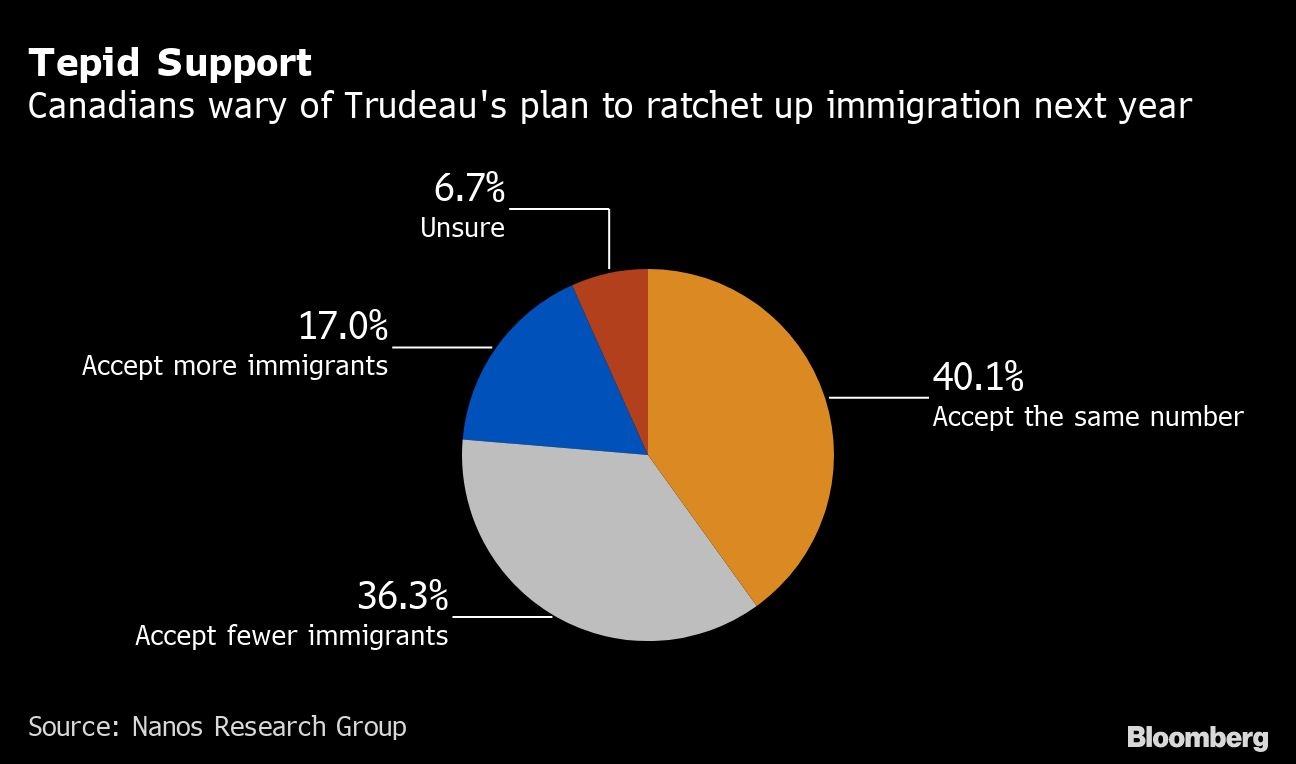
While it would be helpful to have more information on the context and wording of the framing questions, overall seems to make sense. But not that negative: 40 percent maintaining the current level (340,000) and 17 percent supporting an increase, is very positive during an economic downturn:
Prime Minister Justin Trudeau may struggle to sell his ambitious new immigration plan to Canadians, a new survey shows.
Only 17 per cent of respondents say the country should accept more immigrants in 2021 than it did last year, according to a Nanos Research Group poll conducted for Bloomberg News. That suggests most Canadians are less than enthusiastic about aggressive new targets announced last week.
Trudeau hopes to attract 401,000 newcomers next year, 60,000 more than in 2019. The target would rise by 10,000 in each subsequent year, bringing it to 421,000 in 2023. Respondents were asked whether the government should raise levels above last year’s actual inflows.
Tepid Support
An open-door policy is a central tenet of the Liberal government’s long-term growth agenda. But with the economy recovering from the damage wrought by COVID-19, opposition parties are raising concern.
“We’re facing 9 per cent to 10 per cent unemployment — more than a million Canadians are out of work,” Conservative lawmaker Raquel Dancho said in an interview, adding that affordable housing is also scarce. “Where are these folks going to work? Where are these folks going to live?”
Closed borders and pandemic-related travel restrictions have slowed immigration this year and the country is on pace to meet only 60 per cent of its 2020 target of 341,000 permanent residents.
Labor Gaps
The survey results suggest Trudeau’s new targets don’t enjoy widespread support. Some 40 per cent of respondents say the government should reduce the number of new permanent residents accepted in 2021 below 340,000. And 36 per cent say they would like the country to maintain the same immigration levels as 2019.
Immigration Minister Marco Mendicino argues increasing the number of permanent residents will support the economy’s recovery from COVID-19 and help fill vacancies in essential work like healthcare. He is also hoping to draw on the more than 1 million foreign students, temporary workers and asylum seekers already in the country to achieve the increased targets.
“Canadians have a long, proud history of welcoming immigrants, because we know immigration makes our country stronger,” Mendicino said Friday by email, citing support for the higher targets from business and unions.
The flow of newcomers into Canada has been credited with helping counter aging demographics and supporting everything from the housing market to banking services. Before COVID-19, the government’s policies helped drive the fastest pace of population growth in three decades.
Dancho, the chief Conservative spokeswoman on the issue, said her party is pro-immigration but thinks the Liberal government’s announcement of new targets was “tone deaf” as “it did not acknowledge the feasibility concerns of bringing in this many new workers.”
The Nanos survey of 1,000 Canadians was conducted between Oct. 28 and Nov. 1 via telephone and online. The government announced the new targets Oct. 30.
Valid approach to target foreign nationals currently working or studying in the USA:
In the difficult, bewildering days right after Donald Trump won the presidential election in 2016, then-vice-president Joe Biden made a quick trip to snowy Ottawa for a state dinner.
It’s worth remembering what he told Canadian leaders at the time: Canadians and Americans are deeply united in their values, Biden said, especially “the abhorrence of the abuse of power, whether it’s physical, economic or political, as well as the notion that every person deserves to be treated with dignity.
“It’s about dignity.”
The words were probably meant to console Canadians as much as to console himself at the turn of events and the coarsening of politics that a Trump victory would surely herald.
Fast-forward four years, and the day after the 2020 election was equally bewildering for many Canadians who could not digest the fact that, regardless of who the eventual president is, about half of American voters chose Trump for a second time.
But when we’re done reeling over the stark, pervasive divisions within the American electorate and move on to grappling with what next, perhaps we can put our own appreciation of dignity to good use, and make it work to our advantage — through immigration.
Just last week, Immigration Minister Marco Mendicino set out a very ambitious plan for Canada: to boost immigration to never-seen-before levels and pull the country’s economic growth out of its funk.
“We are at a unique juncture in Canadian history. We are facing the challenge of our generation, and we will meet our moment,” Mendicino said. “Before the pandemic, our government’s goal to drive the economy forward through immigration was ambitious. Now, it is simply vital.”
Canada will aim to bring in 1.2 million new immigrants over the next three years, partly to make up for lost ground during the pandemic but also raising the target substantially from previous plans. Instead of 351,000 people targeted for 2021, Ottawa is now aiming for 401,000. Instead of 361,000 in 2022, Ottawa hopes for 411,000.
For sure, there are many reasons to increase immigration. Family reunification and a safe haven for refugees are what dignified, decent countries do. But since the federal government’s overriding goal is to boost the economy, it’s time to take a strategic look at the U.S. landscape.
Of course, the move-to-Canada idea was all the rage after the 2016 election, and especially after Trump kicked off his term in power by cracking down on immigrants from specific countries — a move that prompted Justin Trudeau to famously tweet #WelcomeToCanada because “diversity is our strength.”
The Canadian dream bubbled up again on Wednesday in the media and on social media.
But initial efforts over the past few years to recruit large numbers of skilled immigrants from the ranks of disaffected Democrats didn’t really materialize.
We have a second chance this time around and can take steps, and have money, to make it happen.
“There is an opportunity there,” says Mikal Skuterud, an economics professor at the University of Waterloo who specializes in immigration and labour.
Not all immigration automatically boosts Canada’s pace of growth, which is why Mendicino is putting more weight on the economic class of immigration than on family reunification and refugees. The hope is that by attracting skilled workers from other countries, Canada can expand the population of entrepreneurs, consumers, taxpayers, homebuyers, hard workers and wealth contributors in our economy.
People educated in the United States come with easily recognized credentials and are a quick fit into Canada’s labour market.
“If you want to leverage immigration for economic growth, you have to look at talent,” Skuterud says.
But Canada has long had stiff competition from the Americans next door in attracting those people, he adds, pointing to research that shows skilled immigrants to the United States prospering while those with a similar profile in Canada have struggled with lower wages.
Canada’s best bet to attract highly-skilled immigrants from the United States is to look there for foreigners and migrants, especially students and recent graduates, since they’re usually more mobile than the rest of the population, says Skuterud.
If Canada is to bolster growth over the long term, not just to recuperate from the pandemic but also to improve our standard of living and our ability to care for the most vulnerable in our society, we will need to make some bold, strategic moves to make our mark.
So much of Canada’s policy and recovery from the pandemic is in slow motion right now, waiting to see where Washington lands and how the U.S. political dynamic washes over the border.
Immigration is one area where we have already dared to stick our neck out and go our own way, at least in the targets and the rhetoric that comes from our political leaders. Dignity looks like a selling point these days.
Needed discussion and questioning of the 2021-23 immigration plan given the economic and social context:
Canada’s ambitious plan to admit 1.2 million immigrants over the next three years sparks discussion on the nation’s ability to accommodate this surge.
It is hard to find anyone who doubts Canada’s need for immigrants, the only point of disagreement seems to be the number of immigrants Canada admits each year.
In September, the Department of Immigration’s annual tracking study found that four in 10 Canadians believed immigration quotas were too high, and 52 per cent of the surveyed agreed with the statement that “Canada should focus on helping unemployed Canadians rather than looking for skilled immigrants for our workforce.”
This poll obviously wasn’t taken into account because last week Minister of Immigration, Refugees and Citizenship Marco Mendicino announced a plan to bring in 1.2 million new immigrants over the next three years — a historic high for the country.
Few would argue with the need to bring in around 300,000 immigrants annually, but increasing that number at a time when 1.8 million people in Canada are officially categorized as unemployed (as of September) has taken many aback.
It seems to me that apart from politicians, immigration consultants, manufacturing and business associations, there is little appetite among many Canadians for high levels of immigration during an economic crisis brought about by COVID-19.
The rationale offered by Minister Mendicino is that since the pandemic struck, immigrants and international students played a prominent role as front-line workers in grocery stores, warehouses and in long-term care facilities.
Very supportive of high immigration numbers is the Canadian Manufacturers and Exporters association, who are on record stating that the immigration numbers for the next three years were too modest given the shortfall of admissions in 2020.
As the Business Council of Canada President and CEO Goldy Hyder said in a statement, “There is widespread agreement across party lines that immigration is essential to long-term economic growth. Newcomers bring energy, skills, new ideas and entrepreneurial spirit. They start companies, fill skill shortages, buy houses and pay taxes.”
The reality of the job market
According to StatsCan, as of August, there were still 2.2 million unemployed people in Canada. The unemployment rate for people aged 15 to 69 was 11.3 per cent. As of September, it hovered around nine per cent.
But Canada’s unemployment rate would likely be much higher had it not been for the Canada Emergency Wage Subsidy (CEWS), which has ensured that employers continue to keep on their rolls 3.7 million Canadian workers.
The CEWS will continue until June 2021, after which a spike in unemployment is a distinct possibility. Most companies across the country are restructuring their businesses, reducing staff and investing more in automation.
Amazon, one of Canada’s largest employers, with 21,000 full- and part-time staff, as well as its rivals are increasingly requiring warehouse employees to get used to working with robots. Amazon alone now has more than 200,000 robotic vehicles it calls “drives” that are moving goods through its delivery-fulfilment centres around the U.S. That’s double the number it had last year and up from 15,000 units in 2014.
It is quite likely that in a matter of years, most manufacturing companies and warehouses here in Canada won’t be needing more than a few dozen workers to oversee the robots.
Another big employer, Loblaws, began investing heavily in artificial intelligence and automation at the company’s offices, distribution centres and stores in 2019.
So, it is quite possible that those politicians and mostly small-business owners who are up at night worrying about impending labour shortages are not taking into account the rapid pace at which artificial intelligence and other technologies are expected to significantly reduce their staffing needs.
Working from “home” could mean anywhere
Thousands of employees working at some of Canada’s top companies are expected to work from home even after the pandemic passes. Technological improvements over the past year has made it possible for any company to outsource an even greater number of jobs.
There is little stopping a company from hiring a software engineer anywhere in the world and giving him or her the option of working from “home” without setting foot in Canada. Technology makes “attracting” the best brains and talent from around the world possible on a scale that could never have been imagined.
Immigration has historically been a convenient way to address labour shortfalls which could last for decades, however in today’s fast-changing economy, it may not be wise to bring in permanent residents to essentially do jobs that are expected to become redundant in a matter of years.
By 2034, immigration will account for 100 per cent of Canada’s population growth, as the number of deaths is expected to exceed the number of births. There will have to be a steady influx of immigrants, but not in the numbers we see today. While most Canadians have been led to believe that fewer immigrants would lead to the collapse of the economy, perhaps one could point to Japan which is facing a steep population decline. In 2014, its population was 127 million and is expected to shrink to 107 million by 2040. Not wanting to stoke xenophobia, the government has not resorted to mass immigration despite a growing labour shortage. There is more acceptance of automation and robots than for immigration and companies are automating at record speed.
At some point in the near future, Canada will have to become more creative when it comes to dealing with its labour shortages.
A case to calibrate immigration with the economy
There is plenty of evidence that in previous Canadian recessions new immigrants suffered high rates of chronic unemployment and underemployment, sometimes with lasting effect — a phenomenon referred to as the “scarring effect.”
For example, immigrants who had been in Canada for less than five years preceding the 2009 economic downturn suffered job losses at a rate far more than their Canadian-born peers. During the current COVID-19 pandemic, several visible minority groups have significantly higher rates of joblessness, such as South Asian (17.8 per cent), Arab (17.3 per cent), and Black (16.8 per cent) Canadians.
Whether Canada sinks deeper into recession after government subsidies dry up in mid-2021 or rebounds is anybody’s guess. Public hostility toward immigrants could rise and xenophobes could blame them for worsening a bad economic situation when immigrants themselves could well be hurting more than the average out-of-work Canadian.
Lou Janssen Dangzalan is an immigration lawyer who works with home care workers, healthcare workers, and international students.
Possible expansion of Express Entry stream for caregivers?
Last week, Migrant Rights Network, an advocacy group advancing the cause of migrant justice, published a report titled Behind Closed Doors, which documented the challenges faced by Canada’s foreigncare workers. The abuses are not new, but the pandemic has made them worse: accounts ranged from gruelling 12-hour work shifts with no days off, to wage theft. Some involved workers barred from leaving their employer’s house – becoming virtual prisoners – for fear of bringing COVID home. As these temporary-work permit holders depend on their employers to secure permanent residence (PR), they generally do not speak up.
The report advocates PR status for all migrant workers, which would give them more options to work for other employers, but it’s unlikely that this will happen owing to the current high bar to qualify. But there are concrete steps the government can take to prevent these abuses by creating clear and predictable pathways to permanent residence for our care workers.
Many governments in the past have unsuccessfully tried to find a solution to the abuses faced by migrant care workers, who will endure mind-boggling abuses for PR status because this allows them to bring their family to Canada These abuses remain a black eye on Canada’s reputation as a country that claims to uphold human rights and fight modern-day slavery.
The Live-In Caregiver Program introduced in 1992 allowed a foreign national to apply for PR after working in Canada as a caregiver for two years. It remained until 2014, when the Harper government introduced two pilot programs – Caring for Children and People, and Caring for People with High Medical Needs – to address the abuses that had started to be uncovered by the media. These pilots removed the “live-in” requirement, meaning that caregivers were no longer required to reside with their employers, which was thought to be one of the major causes of abuse. The Harper pilots also introduced higher language and education requirements.
Confused with all the changes? So are the caregivers – and there’s more. The latest occurred in 2019, when the Trudeau government implemented new pilots: Home Child Care Provider, and Home Support Worker. These programs prescreen would-be caregivers for permanent residence before they receive their work permits. The purpose is to sift out caregiver candidates who would not qualify for PR through some form of inadmissibility. They also implemented an interim program designed to eliminate the backlog from the legacy Live-In Caregiver Program. However, the Interim Pathway for Caregivers’ introduction was abrupt and it was open only for two brief windows of three months each in 2019, and did not clear the backlog. Reintroducing this program in a meaningful way would address that problem and buy the government some time to put together a more effective immigration program for caregivers.
Today, the Trudeau pilot programs prescreen caregiver applicants for permanent resident status, allowing workers who complete the two-year program to quickly qualify. However, this new requirement is leading to longer processing times. PR screening requires a stricter security, background, and health check compared with those applying for a work permit. Depending on the visa office in a caregiver’s home country,the time added to process an application could be in the order of months, or worse, years. This renders the programs untenable for most employers. Someone who needs a caregiver cannot wait that long.
Two days after the release of the Migrant Rights Network report, Immigration Minister Marco Mendicino announced Canada’s plan to welcome 1.2 million permanent residents in the next three years. As the government will undoubtedly have trouble fulfilling its ambitious target of 400,000 new PRs in 2021, they should prioritize those who are already in Canada, including caregivers, who do not enjoy PR status. Such a move would increase Ottawa’s chance of meeting that target.
A clear and sustainable long-term caregiver program must be developed. Government must do away with flimsy pilot programs that only confuse our caregivers. There is a clear demand for caregivers in Canada and the vocationdeserves its own permanent place in the immigration system.
One approach would be topiggy-back the caregiver program under the Express Entry system. Express Entry, Canada’s main intake system for economic immigration, is seen as a huge success, especially from the government’s perspective. The government can create a class or program under the system similar to the Federal Skilled Trades program and ensure that there are caregiver-specific Express Entry draws from the general pool of candidates.
This would create predictability and transparency in the system. Successful government programs already exist that can serve as blueprints to ensure quick deployment. Mr. Mendicino has shown an openness to revamping our immigration system in the face of once-in-a-century challenges such as COVID. If he succeeds in finding a tenable solution to the caregiver immigration mess, it would be a legacy he would leave that ends decades of abuses, exploitation and failed pilot programs.
Useful reminder. Canada, of course, separated Indigenous children from their parents in residential schools:
On Thursday, the House Judiciary Committee released a 550-page report confirming that the Trump Administration had “full knowledge that hundreds of children would likely be lost to their families forever” as a result of its 2018 “zero tolerance” policy. This discovery directly contradicts Administration officials’ repeated denials that “zero tolerance” intentionally separated families—the insistence that what happened to children was nothing more than a side effect of the decision to prosecute adults for unlawful entry.
Now, 545 children are still living with the consequences of “zero tolerance,” more than two years after its implementation. These minors still have not been reunited with their parents. President Trump has demonstrated no urgency to reunite these families and has even brushed aside concern by insisting that children were “so well taken care of” in immigration custody.
Despite the apparent novelty of this policy, this is not the first time undocumented children have had to endure prolonged family separation, lone deportation or relegation to the foster care system. About 40 years ago, authorities separated families and lost track of children. Nor is this the first time government officials have obscured such a situation—a fact that offers dual lessons for the present about how to reconcile competing accounts of immigrant treatment.
In the 1970s and ’80s, at a moment when the law numerically restricted Latino immigration while poverty and violence constrained young people’s lives in Mexico and Central America, the face of unauthorized immigration changed dramatically to include growing numbers of women and children. The Immigration and Naturalization Service responded by stepping up its enforcement efforts. This hardening of the U.S.-Mexico border, the U.S. government’s preference for refugees fleeing communism and growing desperation among migrants contributed to the explosion of the coyotaje(human smuggling) business.
In a bid to thwart the increase in unauthorized migration, the Immigration Service in the late 1970s started to prosecute individual coyotes in court as a matter of policy. This decision did little to hold accountable well-resourced smugglers, who could secure bail within a single day of arrest. Instead, as authorities attempted to gather “material witnesses” against coyotes, the decision caused what the Midwest Coalition in Defense of Immigrants deemed “a violation of the most elementary human rights of children”: the mass imprisonment of thousands of Mexican and Central American minors, and the separation of families.
In 1979, when 340,00 immigrants were arrested at the border, more than 8,000 were children and 600 of them served as witnesses. In the late 1980s, the government incarcerated about 5,000 children a year and used 900 as witnesses in a single year. Immigration authorities resorted to incarcerating the women and children based on the erroneous belief, which is still untrue even today, that undocumented immigrants do not show up for scheduled court appearances if released from detention.
Their very incarceration frequently involved physical separation, since non-English-speaking children and their adult relatives were held on separate floors of detention centers, causing widespread confusion and fear. It was not until the Obama Administration built family detention centers that the government had the infrastructure to incarcerate entire families together.
Immigration and prison officials of the time forcefully denied that children were being separated from their parents or, in some cases, that they were even being imprisoned. A prison warden in San Diego told reporters for the San Diego Union that, “we have never separated children under 10 years old from their parents.” The District Director of the Immigration Service in 1980 denied incarcerating young children at all or “releasing” them to authorities in Mexico “or other Hispanic nations” unless the government could establish contact with an adult responsible for them.
Not only did the denials indirectly confirm the separation of older minors from their families, but human-rights defenders, journalists and detained migrants on hunger strikes also brought press attention to cases of newborns kept in prisons and young children separated from their parents.
Apprehended children were asked to choose between remaining inside the same detention centers that held their parents or separating from their families to get assigned to unrelated foster parents, who volunteered to sponsor the children through local Catholic institutions under contract with the U.S. Marshals Service. In 1979, government officials publicly depicted this program as a “humane effort to solve the problem of illegal aliens,” but privately acknowledged in manuals for the program that, “most foster children are disturbed by separation from their family.”
In one especially egregious case reported on by the L.A. Times, 4-year-old Orlando from El Salvador was separated from his mother, Ana Margarita, for an entire year and sent to a foster home until a protracted legal battle won their reunion.
Other 4- and 5-year-olds were separated from their families to gather intelligence about coyotes. One Border Patrol officer in El Paso, Texas, touted to a New York Times journalist that “if you browbeat them [the young children] enough, tell them ‘We’re going to leave your mama locked up forever if you don’t tell us the truth,’ the kid’ll tell you everything” about their border-crossings.
When parents remained incarcerated to serve as “material witnesses,” their children were sometimes deported alone to northern Mexico. According to the Committee on Chicano Rights and firsthand accounts obtained by the L.A. Times, some of these youths ended up being arrested and thrown into overcrowded Tijuana juvenile detention facilities. Beyond being subjected to a double criminalization, apprehended child deportees were beaten by guards and tortured by Mexican police—tragedies not unlike the violence faced by asylum-seekers pressured into deportationand forced to “Remain in Mexico” today.
Critics charged that no serious effort was made on the part of the government to reunite parents with children who had been “lost” to the federal bureaucracy, thus permanently separating families who lacked the resources to wage drawn-out legal battles.
This little-known moment of family separation and child detention offers a warning for today, as advocates work to make sure the 545 un-reunited children are not forgotten: government narratives about the treatment of undocumented children and families have long been unreliable, and official statements must be considered alongside testimony from immigrants and their advocates. Otherwise, the full repercussions of draconian immigration policies might not be conspicuous to the public until the damage to families has long been done.
Historians’ perspectives on how the past informs the present
Ivón Padilla-Rodríguez is a U.S. history Ph.D. candidate at Columbia University specializing in the 20th century legal history of child migration. Outside of the academy, she has conducted research on child migration for the federal government and non-profits in the U.S. and Mexico.
Have been following the various reactions to date regarding the government’s (overly) ambitious targets for the next three years. Relatively few op-eds and commentary, possibly due to the focus on COVID and the US presidential election which are taking up most of the oxygen.
And much of the commentary focusses overly on the administrative issues, not the more substantive issues related to economic integration of immigrants during an economic recession, one that is likely to linger for a few years.
Have grouped these by constituency:
Business-oriented
The plan was welcomed by the business sector.
“There is widespread agreement across party lines that immigration is essential to long-term economic growth,” said Goldy Hyder, president and CEO of the Business Council of Canada, which represents some of the country’s largest businesses.
“Newcomers bring energy, skills, new ideas and entrepreneurial spirit. They start companies, fill skill shortages, buy houses and pay taxes, … The minister’s plan will allow Canada to make up lost ground as the pandemic eases. It will inject new dynamism into our economy.”
The Canadian Manufacturers and Exporters even went one step further, saying Ottawa’s objectives were too modest and will not allow the country to catch up quickly enough over the coming months to compensate for the reduced number of immigrant admissions this year.
“Manufacturers are increasingly using immigration to supplement their workforce but there are not enough immigrants to meet the demand,” said Dennis Danby, its president and CEO, who represents 2,500 leading manufacturers in the country.
“If manufacturing is to be at the core of the economic recovery following the COVID-19 crisis, we must do more in prioritizing immigration from the economic stream.” (Toronto Star)
As Canada’s leading voice on smart population growth, Century Initiative continues to advocate not just for increasing our population, but for policies to support that growth through investments in education and in the national and urban infrastructure that will allow our communities to grow in a sustainable manner. We also need to prioritize supporting parents with a national childcare strategy, and our children with early education programs.
Now is the right time to invest in growing our population. Environics Institute’s recent Focus Canada survey shows that a record two-thirds (66%) of Canadians reject the idea that immigration levels are too high, and that Canadians recognize the critical contribution immigrants make to our economy and our social fabric. We have a tremendous opportunity before us and welcome the opportunity to continue working with gover(nment to seize it in the interest of future generations of Canadians. (Century Initiative)
Opposition critics
Opposition MPs took aim at the way the government has handled immigration throughout the pandemic and questioned how the new targets would be achieved.
Conservative immigration critic Raquel Dancho said the government is announcing new levels without a plan for how they will be safely implemented.
Jenny Kwan, immigration critic for the NDP, said she believes the numbers are “a bit of a hoax” because the backlog to process applications is so great that the targets will be hard to meet.
Christine Normandin, the Bloc Québécois immigration critic, said in French that Ottawa is taking the opposite approach to the Quebec system. She said the province takes only as many immigrants as it can process in one year, while Ottawa sets goals without taking into account its capacity to do the paperwork. (Globe)
That lower-end target is actually below the low end of the number of immigrants, pre-pandemic, the Liberals had planned to admit in 2021, pointed out NDP immigration critic Jenny Kwan.
“The Liberals demonstrate a lack of conviction in their targets and left the door wide open for immigration levels to decrease,” she said in a statement.
It’s also not clear how unused room is being carried over.
For example: the Liberals had planned to admit 49,000 refugees this year. Next year, according to Friday’s plan, they are aiming for 59,500.
While that looks like an increase of 10,000, the number of refugees who have actually arrived in the first eight months of this year was down nearly 60 per cent from 2019 arrivals.
So it’s possible that the 2021 figures merely incorporate the shortfall from this year, as opposed to being an overall increase. Mendicino wasn’t clear when asked about that issue Friday. (Canadian Press)
NDP immigration critic Jenny Kwan said the government must not overlook the compassionate aspects of the immigration system, such as removing travel restrictions for asylum seekers and ensuring permanent residence status for migrant workers in recognition of their contributions during the pandemic.
“The immigration department’s processing abilities is still spotty at best and serious investment in staffing, far beyond what we’ve seen so far, is needed,” said Kwan.
“Without these investments, applicants are to expect significant increases in processing times for years to come, which were already long before the pandemic.” (Toronto Star)
Tweets from CPC critic Dancho:
The Liberals have failed to layout a plan to bring in newcomers to Canada safely. No widespread access to rapid tests and the 14 day quarantine is not a financial option for many people. #cdnpoli https://twitter.com/RaquelDancho/status/1322270115921055746?s=20
They have no plan to better resource immigration department to fulfil the levels promised. Liberals are simply adding to their massive, years-long immigration backlogs that fail to provide potential newcomers with certainty, dignity or respect. #cdnpoli https://twitter.com/RaquelDancho/status/1322270117384851456?s=20
The ministers announcement did not acknowledge the economic devastation caused by COVID-19 or the hundreds of thousands of Canadians facing unemployment since the pandemic hit and how these new ambitious immigration numbers will impact them. #cdnpoli https://twitter.com/RaquelDancho/status/1322270118290903040?s=20
International organizations
Either way, that Canada even continues to open its arms is welcome, said Rema Jamous Imseis, the UN refugee agency’s Canadian representative.
“In an era of travel restrictions and closed borders, refugees continue to be welcomed by Canadians,” she said in a statement.
“The significance of this lifeline and the deep generosity of Canadians cannot be overstated.” (Canadian Press)
Academics
While experts had expected Ottawa to stay the course with its immigration goals — given the government had publicly stated immigration would be key to restarting the post-COVID-19 economy, they were surprised the Liberals would decide to take it up a notch.
Although critics have raised concerns about high immigration given that the country’s jobless rate hovered at nine per cent in September — after peaking at 13.4 per cent in May — from 5.6 per cent before the pandemic, some experts say the government is on the right track.
“The timing for expanding the program now is good. But I’m surprised how high the targets are they have set. I don’t know how realistic it is from a bureaucratic administrative perspective,” said Carleton University economist Chris Worswick, who specializes in the economics of immigration.
“I commend the government for thinking about immigration again. I was worried that it wouldn’t happen. I wonder if they’re being too ambitious. I’m cautiously optimistic that we’ll end up at a good place.” (Toronto Star)
Immigration lawyers and advocates
Immigration and refugee experts welcomed the move to grant permanent residency to those already in the country.
“I’ve always thought, even before COVID, that it makes a lot more sense to target people who are already educated here, or have work experience here, or at least have lived here. … These are people who are already demonstrating their genuine interest in Canada,” immigration lawyer Chantal Desloges said.
Janet Dench, executive director of the Canadian Council for Refugees, said her organization has urged the government to give permanent residency to those in Canada.
“What we need to see is that realization actually reflected in actual operations, actual policies, because at this point, the way the Immigration Department is working is running in completely the opposite direction,” she said. (Globe)
Contrary to what the government is saying, there is NO INCREASE in IMMIGRATION LEVELS. Instead, there was a 150,000 shortfall in immigrants in 2020, and the government is trying to catch up for it by increasing 50,000 each year for the next three years. But as COVID-19 continues, these promises are unlikely to be kept.+
The overall proportion of new immigrants remain the same, with the primary focus on “high waged” immigrants. However, to qualify for these immigration programs, migrants must show 12-24 months of high-waged work. With COVID-19-related job losses disproportionately impacting racialized people, many migrants don’t have access to these jobs and won’t qualify. No plan has been announced to ensure full and permanent immigration status for all migrant and undocumented people right now.+ Many migrants — including care workers and former international students — were not able to complete requirements for permanent residency in 2020 due to COVID-19. However, there is no meaningful increase in numbers on fixing of rules for these migrants in today’s announcement. (Migrant Workers Alliance)
On the right
Recent polls have shown that Canadians are weary about increasing immigration levels in the wake of the coronavirus pandemic.
A poll commissioned by True North found that an overwhelming 76% of Canadians strongly agreed with the idea of a temporary pause until a coronavirus vaccine is developed and unemployment drops to pre-coronavirus levels. Note: Polling firm unknown and thus is not credible
The poll results show a surprising consensus among political parties as well with 67% of Liberals wanting to impose a temporary pause, 66% of NDP voters and 89% of Conservatives.
“Given today’s global circumstances of a public health pandemic and severe economic crisis, now is the perfect opportunity to revert back to our successful historic immigration model, listen to the majority of Canadians, and take another pause,” True North’s founder Candice Malcolm wrote when the poll was released.
“It’s time for our leaders to listen to the people and do what’s best for our country.” (“True” North)
While the government touted the need for migrants to strengthen the economy, the unemployment rate in Canada, the unemployment rate currently stands at 9%, from an all-time high of 14% in May. Over 8 million Canadians applied for emergency COVID relief benefits in the form of the CERB. Canada’s unemployment rate was around 5% prior the pandemic. (Rebel Media)
Good analysis by Craig Damian Smith (header understates influence):
Immigration was largely absent from the U.S. presidential campaign until the final debate. The short exchange highlighted the chasm between the Biden and Trump platforms and came a day after reports that lawyers could not locate the deported parents of 545 previously incarcerated children. This grave outcome of “zero tolerance” on the U.S.-Mexico border is but one example of President Donald Trump’s vast and punitive changes to immigration and asylum.
Trump policies have already affected Canada. Increased immigration enforcement, the gutting of the U.S. asylum system and plans to cancel Temporary Protected Status opened the Roxham Road route on the New York-Quebec border, where almost 60,000 people have claimed asylum since 2016. Slashing U.S. refugee resettlement quotas from more than 100,000 in 2016 to 15,000 in 2020 made Canada the world’s top resettlement country. It is also likely that skilled immigrants, entrepreneurs and students considered Canada over the U.S.
Tomorrow could bring more significant change. A second Trump term could dismantle the remnants of America’s asylum and resettlement systems. The Supreme Court’s conservative majority could be weaponized against “Dreamers,” Temporary Protected Status recipients, sanctuary jurisdictions and groups that aid migrants. It could mean more immigration raids, incarceration and deportation and may further embolden militarized white supremacists.
Canada may have to reconcile its role as a champion of refugee rights with the fact that its asylum policies are hitched to those of the U.S. In July, the Federal Court struck down the Canada-U.S. Safe Third Country Agreement (STCA) because it subjects asylum seekers to punitive detention in the U.S. Last week the government was granted a stay by arguing that ending the STCA will create a “pull factor” for a surge of asylum seekers. While this argument misses the point about refugees’ rights, forecasting and political considerations are warranted.
Though overlooked by advocates, the STCA is predicated on “responsibility (or burden) sharing.” Its preamble stipulates a commitment to equivalent asylum systems and co-operation. More broadly, the norm of responsibility sharing underpins global agreements concerning refugees, recognizing that states have common but differentiated roles in addressing displacement. Poor countries host 85 per cent of the world’s 26 million refugees. Rich countries have a choice between financial support, offering asylum or resettlement. The Trump administration has reneged on all three. In Trumpian terms, there is no deal.
Joe Biden’s immigration platform is vastly different. In the final debate, Mr. Biden distanced himself from Barack Obama’s record-level deportations and border policies. He promised to reform asylum, stop immigration raids and work to regularize 11 million undocumented people.
Reforms will not change the fact that immigration judges have resigned or retired early in record numbers. Nor will they immediately bring back the dozens of closed local settlement offices or fill massive vacancies at the U.S. State Department and Citizenship and Immigration Services. More immediately for Canada, Mr. Biden faces a long road to repairing the perception that the U.S. is not a safe destination.
Speculating on the election’s impacts means abandoning simple “push” and “pull” arguments. A growing body of research shows asylum seekers carefully consider destinations based on existing networks, welfare provision and perceptions about long-term safety. We should expect no less given the intergenerational implications of such a decision. Indeed, the STCA’s purpose is to limit what is pejoratively called “asylum shopping” by politicians and pundits whose neoliberal worldview is based on individuals making decisions in their best interests.
States compete to attract the best, brightest and wealthiest immigrants. Conversely, they dissuade refugees by militarizing borders, limiting social supports and the right to work, incarcerating migrants and making asylum more onerous. Mr. Trump’s America leads that race to the bottom. The Trudeau government’s insistence on maintaining the STCA hews dangerously close to joining it. It should instead prepare for what’s to come.
A Trump victory makes more asylum claims likely; it is possible even if Mr. Biden wins. Canada must immediately reconsider whom it lets across the border during the pandemic in the event of a second Trump term. As the Canadian Association of Refugee Lawyers, Amnesty International and experts have argued, letting hockey players and businesspeople cross while barring asylum seekers is wrong. In the longer term, it will mean four more years of reacting to a malign neighbour working to shift the burden, foster a climate of fear of and for immigrants and avoid international responsibility sharing.
A Biden victory would mean shouldering more responsibility while the U.S. repairs its institutions and reputation. For example, hundreds of thousands are trapped in Mexico and Central America because of Mr. Trump’s policies and pandemic border closings. Canada can ease the burden through resettlement while it supports U.S. reforms.
Refugee advocates should admit that ending the STCA will influence mobility decisions. Luckily, Canada has the world’s most developed settlement sector, an increasingly efficient asylum system and a remarkable resistance to anti-immigrant populism. Our resilience and policy options will depend on having a partner in the White House.
Good discussion of the changing and possibly declining comparative advantage of Canadian university education for international students, with a credible recommendation to focus on employability post-graduation:
With Canada announcing the opening of its borders on 20 October, no one can fail to be impressed by its meteoric rise in the realms of international education. But past gains are no guarantee of future success and the shifting tides of international student mobility can rapidly change direction.
There has been plenty of talk over the years about some United Kingdom universities being in the ‘squeezed middle’ of being relatively small and not academically top rank. They tend to rely on their reputation as places that are friendly, very welcoming to students and not the most demanding on entry requirements. It begins to sound like a caricature of the Canadian approach to international marketing.
In terms of global ranking, the United States and United Kingdom are streets ahead of Canada in globally ranked institutions and even Australia has 22 in the Times Higher Education or THE World University Rankings top 300 compared to Canada’s 14.
We are beginning to see Canadian institutions under financial pressure in provinces such as Calgary and Alberta opening up to talks with private pathway providers. But the marketing machine continues to offer easier visa channels, post-study work opportunities and routes to citizenship – none of which is a sustainable advantage if other countries choose to compete.
Canada’s rise
The Canadian success story is worth reviewing. Between 2014 and 2018, the number of international students in Canada increased by 68%. In 2018, a total of 721,205 international students at all levels studied in Canada – the largest number ever.
Canada has moved into third place globally behind the United States of America and Australia.
Total income from international students increased from CA$1.25 billion in 2009-10 to CA$2.75 billion in 2015-16. The CA$1.5 billion increase almost exactly offset the CA$1.7 billion fall in combined federal and provincial government funding over the same period.
International student fees now account for 12% of operating revenue and 35% of all fees collected by institutions and that percentage is increasing. Already some large institutions – including the University of Toronto – are receiving more money from international student tuition fees than they are in operating grants from their provincial governments.
In terms of diversity, Canada’s student population is almost twice as dependent on India, accounting for 56% of international students compared to 22% from China, as the US, UK and Australia, where these positions are reversed.
The post-COVID reality
Considering borders reopening and this glowing report card to date, why should we predict trouble ahead for Canada?
• The prospect of a Biden-Harris administration will make the US far more popular.
• The UK seems to have been the main beneficiary (if there is one) of COVID-19, taking market share from all major English-speaking markets (Australia, Canada and the US).
• Australia will not rest on its laurels after losing out on a full academic cycle and will return to the market stronger and more determined to grow, especially in emerging markets.
• Market dependency on India and China, which account for more than 75% of Canada’s international student population. India’s economy contracted by 23.9% in the three months to the end of June, making it the worst slump since 1996 and the worst impacted economy in Asia. This combined with trade tensions with China could spell trouble ahead.
• A lack of jobs due to the global recession may lessen the attractiveness of Canada in terms of post-study work and a route to immigration.
With the UK on the move, Australia hungry to get back in the game and the US possibly resurgent if Biden wins in November, Canada may only have a six-month window to differentiate its offer.
In order to maintain its meteoric rise and fend off the prospect of increased competition from English-speaking counterparts, it would be worthwhile for EduCanada and their partners to think strategically about how they will differentiate and maintain their growth during and following the global pandemic.
Our top tip is to focus on employability, both for students that remain in Canada (the majority of whom are from South Asia) and those who return home. With robust data on international graduate outcomes, Canada would be the first nation to put employability at the heart of their National Inbound International Student Recruitment campaign and lead the pack in terms of evidencing the return on investment of a Canadian degree.
Louise Nicol is director of the Asia Careers Group.
Good overview of this study, showing that overall STEM immigrants do worse in Canada than the USA, with Statistics Canada providing possible explanations:
Immigrants make up a large share of university-educated workers in STEM fields in both Canada and the U.S., and a recent study looked into which country sees better outcomes for immigrants in these sectors.
The Statistics Canada study looked at the economic outcomes of immigrants age 25 to 64 who had at least a bachelor’s degree in a STEM— science, technology, engineering, mathematics—field. In Canada, the data is from 2016, while U.S. data is from 2015 to 2017.
In general, U.S. immigrants saw better outcomes.
In both countries, immigrants with at least a bachelor’s degree were twice as likely as the native-born population to have studied in a STEM field. They were also three times as likely to have studied engineering, computer science, and math.
In terms of occupational outcomes, more than half of STEM-educated immigrant workers in both countries held non-STEM jobs. The study said this was, generally, not a big issue because STEM skills are valued in many other occupations. However, it becomes an issue when STEM-educated immigrants in Canada end up working at jobs that do not require a university education. In Canada, only 20 per cent of STEM educated immigrants working outside of the field are actually working a job that requires a university degree. In the U.S., it is 48 per cent.
Among all STEM-educated workers, immigrants earned 25 per cent less than their Canadian-born counterparts. There was no earnings gap between immigrants and U.S.-born workers.
Even within the Canadian STEM field, immigrants who found work earned 17 per cent less than Canadian-born individuals. In the U.S., immigrants earned about 4 per cent more than their native-born counterparts.
STEM-educated immigrants who did not find a job in the field earned about 34 per cent less than Canadians with the same education. The wage gap was narrower in the States, with immigrants earning about 7 per cent less.
Why are outcomes better in the U.S.?
Statistics Canada offers five possible explanations, though little research has been done on this question.
U.S. is first choice for many high-skilled immigrants
It may be that the skills of STEM-educated immigrants entering the U.S. are higher on overage than those entering Canada.
The study referenced a paper that examined the wage gap between immigrants and native-born workers in Australia, Canada and the U.S. It found significant earning gaps in Australia and Canada compared to the U.S. The authors said the tendency for highly-skilled immigrants to choose the U.S. over other countries was a primary factor in their better relative earnings outcomes in the U.S.
More STEM-educated immigrants in Canada
A higher percentage of Canada’s STEM-educated workforce are immigrants compared to the U.S. The number of STEM-educated immigrants who entered Canada rose significantly in the 1990s in response to the high-tech boom, and has remained at high levels since. Canada does not face a general shortage of STEM workers, the study says.
When there’s an abundance of workers, employers may tend to hire STEM graduates from universities that they are familiar with, and who have experience from countries with similar economies to Canada.
Different immigrant selection processes
In order to immigrate to the U.S. as a skilled worker, immigrants typically already have a job offer when they arrive, or they are international students who can be interviewed by prospective employers in the country. Immigrants who entered the U.S. contingent on job offers were more likely to get skilled jobs. Those who entered on a student, trainee, or temporary work visa, had a significant advantage over the native-born population in wages, patenting and publishing. Much of this advantage was due to their comparatively higher levels of education.
Canada’s points-based immigration system, which has been in use since the 1960s, selects economic immigrants based on their human capital. These days, the Express Entry system ranks candidates based on factors like education, work experience, age, and language ability. The highest-scoring candidates get invited to apply for permanent immigration. Though candidates can get extra points for having a job offer, in some cases, it is not required in order to immigrate to Canada.
The study found that STEM-educated immigrants that immigrate through the CEC do relatively well compared to others, and those who go through the PNP typically have the poorest outcomes. One major difference is that the CEC requires immigrants to have at least one year of skilled work experience in Canada, whereas the PNP is more varied, and includes pathways for low-skilled and medium-skilled workers to become permanent residents.
Differences in country of education
Country of education is one of the most important determinants of immigrant earnings, along with language and race or visible minority status, the study says.
Country of education may differ significantly among STEM-educated immigrants in Canada and the U.S. STEM immigrants educated in non-Western countries do not do as well, economically, as others. The study suggest this is for a number of reasons, for example, the quality of education may be lower, or perceived to be lower. In the absence of a shortage of STEM workers, employers may prefer to hire those educated in Western counties. Also, some credentials are not recognized by professional associations in the host country, either for valid or invalid reasons, and this may prevent immigrants from developing countries from getting STEM jobs. Language or cultural issues may also prevent immigrants from being able to use their STEM education. Discrimination may also be a factor.
Other factors unrelated to immigration policy
Factors unrelated to immigration policies may also contribute to better outcomes of STEM-educated immigrants in the U.S., for example, the U.S. industrial structure may result in a higher demand for STEM-educated workers in comparison to other countries.
Will be interesting to observe the range of commentary on these ambitious targets. Hard to square this with Bank of Canada Governor Tiff Macklem’s warning that the economy is unlikely to get back on track until 2023. Moreover, previous downturns and recessions tell us that immigrants who arrive during difficult economic times suffer economically in both the short and longer term::
In the midst of a second wave of COVID-19, Canada isn’t just maintaining its immigration strategy, but taking it up a notch, increasing the number of people it will bring into the country in a bid to stimulate the post-pandemic economic recovery.
On Friday, Immigration Minister Marco Mendicino said Canada will welcome more than 1.2 million new immigrants over the next three years, with an annual intake that could reach 401,000 in 2021; 411,000 in 2022; and 421,000 in 2023 — equivalent to one per cent of the population.
The previous plan, unveiled right before the onset of the pandemic lockdown in March, set targets of 351,000 in 2021 and 361,000 in 2022.
“Immigration is essential to getting us through the pandemic, but also to our short-term economic recovery and our long-term economic growth. Canadians have seen how newcomers are playing an outsized role in our hospitals and care homes, and helping us to keep food on the table,” Mendicino said.
“Immigration is essential to getting us through the pandemic, but also to our short-term economic recovery and our long-term economic growth. Canadians have seen how newcomers are playing an outsized role in our hospitals and care homes, and helping us to keep food on the table,” Mendicino said.
“As we look to recovery, newcomers create jobs not just by giving our businesses the skills they need to thrive, but also by starting businesses themselves. Our plan will help to address some of our most acute labour shortages and to grow our population to keep Canada competitive on the world stage.”
The much anticipated 2021-23 immigration plan was tabled amid a cloud of uncertainty over Canada’s economic future in the middle of a global pandemic that has seen the country’s jobless rate surged to nine per cent last month from 5.6 per cent before the pandemic. It peaked at 13.4 per cent in May.
Canada was on track to bring in 341,000 newcomers this year; 351,000 in 2021; and 361,000 in 2022 — with about 58 per cent of the intake being skilled immigrants, 26 per cent under family reunification and the remaining 26 per cent as refuges or on humanitarian grounds.
The new plan hopes to make up the shortfall over the next three years, with 60 per cent of the intake coming from economic class, 30 per cent from family reunification and 10 per cent under refugee protection and resettlement.
Last month, Statistics Canada’s latest demographic update showed the country’s population has reached 38 million but only recorded a 0.1 per cent growth or an increase of 25,384 persons between April and June — the lowest since 1972 — because of the pandemic.
In contrast, the growth rate stood at 0.5 per cent in each of the past two years at this time. In 2019, immigration accounted for 86.5 per cent of Canada’s population growth in the second quarter. This year, that dropped to 38.2 per cent (an addition of 9,700 persons).
Pre-release commentary by the Conservative and NDP immigration critics:
Conservative immigration critic Raquel Dancho said that whatever the Trudeau government announces today, it must have a concrete plan for bringing people safely into the country during a pandemic and for integrating them into Canadian society.
She said the backlog of applicants has grown during the pandemic.
“The immigration system has not been well-managed, I think to say the least, in the last eight months. So I will be looking for some sort of plan for how they’re going to improve it,” Dancho said.
“The number can be whatever it’s going to be, but unless they bring forward a plan for how they’re going to change course and get better at processing immigration applications, it’s really all for nothing.”
Dancho said Canadians must have a clear explanation of how immigration targets will meet Canada’s labour needs while upholding its humanitarian commitments.
NDP immigration critic Jenny Kwan urged the government to increase its capacity to help vulnerable people in need of protection in Canada, noting that persecution abroad has not stopped during the pandemic.
She said Canada also should give permanent residence status to people who want it and are already in the country, such as temporary foreign workers and international students with job offers.
“Canada can, in fact, take a true humanitarian approach by regularizing all those immigrants and refugees and undocumented people,” she said.
And Quebec continuing to have relatively low immigration targets, making the demographic gap between Quebec and the rest of Canada continue to grow:
Quebec could welcome between 44,500 and 47,500 immigrants in 2021.
The immigration targets for 2021 were announced as part of the Plan d’immigration du Québec 2021, released on October 29. This report coincides with Immigration, Refugees and Citizenship Canada‘s (IRCC) announcement of its multi-year plan, which is expected this week and will guide Canada’s immigration planning for 2021 to 2023.
In 2021, the majority of new admissions to Quebec — 62 per cent — are expected to come through the province’s economic immigration programs.
The new Quebec immigration levels represent a slight increase over its 2020 targets when Quebec’s goal was to welcome between 43,000 and 44,500 immigrants.
According to estimates in the plan released today, Quebec will admit a maximum of 30,500 immigrants this year, instead of the projected maximum of 44,500. The province says travel restrictions and the closure of federal offices and processing centres around the world make it difficult to meet immigration targets for 2020.
However, the province’s immigration ministry said its targets for 2021 include a rebalancing plan “with the admission of an additional 7,000 people, representing the deferment of some of the admissions that were not fulfilled in 2020 due to the health crisis.”
As a result of the health crisis, the province estimates the number of unrealized admissions in 2020 to be between 13,000 and 18,000 but plans to make up the shortfall over the next two years.
Quebec’s Admissions targets for 2021
For 2021, Quebec has set a range of between 27,500 and 29,300 new admissions for its economic immigration programs, including a maximum of 24,200 skilled workers.
In addition, a maximum of 800 admissions is set for “other economic categories” such as live-in caregivers and others.
Another 10,200 new permanent residents are expected to arrive through family sponsorship, refugee and other immigration programs.
2021 Quebec Selection Certificate targets
Under the provisions of the Canada-Quebec Accord, Quebec has the power to select all economic class immigrants and certain refugees to the province.
Those selected are awarded a Quebec Selection Certificate (Certificat de sélection du Québec, or CSQ) and can then apply to Canada’s federal government for a permanent residence visa.
Quebec’s plan calls for 26,500 to 31,200 selection certificates to be issued in 2021, slightly more than its 2020 plan, which called for a range of 20,100 to 24,700.
The majority — up to 22,400 — would go to skilled worker candidates.
The selection certificate targets are as follows:
Skilled workers: between 19,400 and 22,400;
Business immigrants: between 1,500 and 2,300;
Other economic immigrants: between 400 and 600;
Refugees selected abroad: between 4,400 and 4,700;
Other immigrants: between 800 and 1,200.
The targets set for 2021 include applications in process or waiting to be processed in Quebec and at the federal level. They also take into consideration the time it takes for candidates to complete all the immigration procedures.