Yalnizyan: Our temporary residents provide a resource we can’t ignore

Armine’s piece coming out of Ryerson’s CERC panel a few months ago.

I remain sceptical regarding maintaining current target levels during a recession and lowering the CRS minimum points to 75 (essentially, anyone 25-34 with one years Canadian work experience) as a good immigration strategy in terms of economic and social outcomes.

And, as StatsCan helpfully remained us, not all temporary workers will necessarily want to transition to permanent status:

Over the last decade or two, about one third of temporary foreign workers and one quarter of international students became landed immigrants within 15 years after their first arrival. TFWs who had low earnings tended to have low earnings after becoming landed immigrants.— feng hou (@fenghou9) March 7, 2021

Worried about immigration during the pandemic? You may be shocked to learn that for every new permanent resident admitted to Canada in 2019, almost three temporary residents were admitted to work or study. Immigration refers only to permanent residents, so any conversation about immigration is only talking about 28 per cent of all the people entering Canada.

This little-known statistic directly informs a recent conversationabout Canada’s Immigration Plan at Ryerson University, the core theme of which is that we could miss a remarkable opportunity if we don’t see the whole chessboard.

In particular, the surest path to an equitable post-COVID-19 recovery involves increasing the number of immigrants Canada accepts by expanding the paths to permanent residency for people already studying and working here, Canada’s temporary residents. That single reform could bolster Canada’s future in both the short and long run. Here’s why:

It comes as no surprise that Canada’s immigration intake was almost cut in half as a result of COVID-19, bringing us back to levels last seen in the late 1990s. Those levels are not good enough for the post-pandemic future, which will be marked by population aging and a shrinking working-age cohort.

The pandemic accelerated a process already in play, with more people over 55 exiting the workforce than entrants aged 25 and younger. This dynamic hastens that moment when Canada’s net labour-force growth goes negative if not for the addition of workers born outside Canada. A shrinking Canadian labour force, with little or no productivity growth since 2015, is a recipe for economic decline. That’s not a future anyone wants.

Nonetheless, some experts are worried about Immigration Minister Marco Mendicino’s pledge to make up for the shortfall in the 2020 target of 341,000 new immigrants by increasing targets over the next three years: 401,000 new immigrants in 2021, rising to 421,000 by 2023.

For critics, it’s too soon for such ambitious plans. COVID-19-related job losses and foregone hours of paid work mean the current labour underutilization rate is over 18 per cent. Given that the pandemic hit low-income workers the hardest, and that low-income workers are disproportionately women, youth, racialized minorities and recent immigrants, it could seem counterproductive to add more people to the mix as the nation’s hardest-hit citizens struggle to find their feet again in the post-pandemic world. Indeed, the Conservative immigration critic, Raquel Dancho, describes the goal of accepting 1.2 million new immigrants by 2023 as “pure fantasy.”

Higher targets do raise legitimate concerns about the well-known challenges of integration, given the current inadequacy of settlement services. But is the Liberals’ plan really so unattainable and undesirable?

Consider the numbers: Canada accepted more than 1.2 million newcomers in just one year, 2019, (see Chart 1) through permits for both permanent and temporary residency — a number that has increased steadily over the years, particularly among for those brought into Canada for economic reasons.

In 2019 (see Chart 2), about 30 per cent of those who entered Canada as permanent residents had made the transition from temporary-resident status. We can easily accommodate 1.2 million new immigrants over the next three years if we draw from the ranks of temporary residents who already work or study here. They have adjusted to life in Canada to some degree. Providing them with better settlement services like subsidized housing, English/French as a second language instruction and learning supports is a low-cost, high-yield return on public spending that also creates new jobs for Canadians.

Ironically, admitting more immigrants may be the surest path to a more equitable recovery, if one looks at the entire system of the intake of newcomers, including temporary residents. We don’t know for sure how many want to stay, but there’s plenty of demand for pathways to permanence among the more than 530,000 international students, 459,000 migrant workers (via the International Mobility Programs) and 77,000 temporary foreign workers who were in Canada as of December 31, 2020, and that’s in the middle of a pandemic. It is hard to believe that this deep well of human aspiration could not satisfy most, if not all, of the minister’s goal of adding 50,000 more immigrants this year. More generally, failing to integrate those who are already here studying and working and who want to stay is like leaving money on the table.

Though hard to imagine right now, we will soon be looking at widespread labour shortages. While population aging creates an unprecedented opportunity to increase skills and employment opportunities for whole groups of systemically underemployed Canadian residents, like the ones hardest hit by the pandemic, we’ll nonetheless need more newcomers to address temporary and permanent labour and skills shortages.

Historically, we have admitted more permanent residents than temporary ones to address labour shortages. But in 2006 the lines crossed. Ever since, we’ve admitted more migrant workers than economic immigrants. Take a hard look at the trajectory in Chart 2 and ask yourself: can you imagine living in a society where the vast majority of economic newcomers are migrants? Is this the future you envision for Canada?

The shift described in Chart 2 erodes workers’ rights in industries like accommodation, food service, personal services, elder care and child care, long-term care, and some types of manufacturing. These sectors, which have long relied on low-wage immigrants, reduce costs even further by turning to migrant workers with even less ability to exercise statutory labour protections. Exhibit A: seasonal agricultural workers, the essential workers who make sure we are fed, but may not be able to protect their own health and safety. Most come back, year after year; but this year some couldn’t even get tests or take time off when they fell ill with COVID-19. We can do better, for them and for us.

This process has begun. Small steps to create more pathways to permanence started in 2019, with a new pilot for personal care workers, joined by two others in 2020 for seasonal agricultural workers and live-in caregivers, and one for health-care workersin 2021. To these measures was added the recent federal invitation to basically everyone in Canada to put in an application to become a permanent resident. Last month the federal government drew 27,800 people from these applications. 

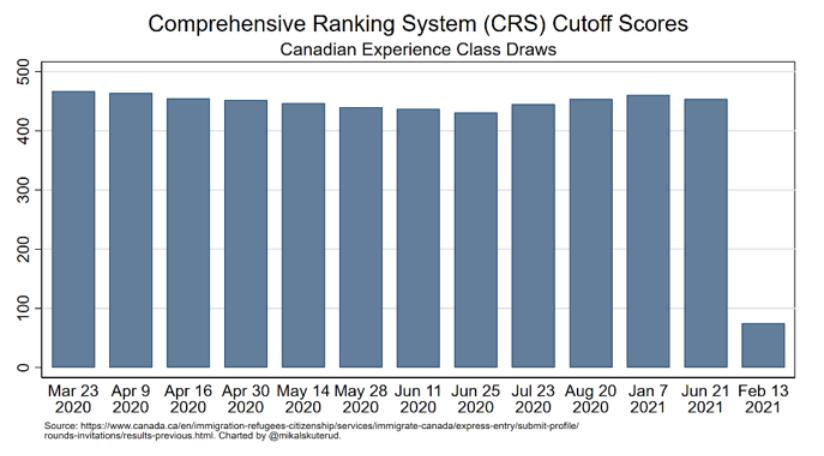
Canadian immigration is based on a point system, and the lowest score of applicants was 75. A normal draw features applicants with 400 points, sometimes more. Does this downgrade the “quality” of immigrants and hence their ability to integrate? No. They were already here, studying and working, but at risk of losing their status and deported during the pandemic. This was effectively a regularization program. (Note: Canada hasn’t had a major regularization program for residents without status since the 1970s, under Trudeau père. If not during a pandemic, when should such measures be taken? Never?)

We should celebrate, not be afraid of these measures. Permitting more migrant workers to transition to permanent status increases their ability to access labour protections and basic human rights. If we reduce exploitation of these workers, we improve working conditions for everyone in the workplaces where they are employed.

The de facto “two-step immigration process” that has emerged in recent years has been primarily driven by business demands for faster intake of newcomers, but could lead to better integration and lives for “low” and “high” skilled workers alike. If temporary foreign workers are good enough to work for us, they are good enough to live among us, permanently, if that is what they wish.

Let’s not look at the immigration story with our eyes wide shut. How we live with others will define the labour market, society, and future of Canada.
Source: https://www.thestar.com/news/insight/2021/03/06/our-temporary-residents-provide-a-resource-we-cant-ignore.html

COVID-19 pandemic prompts recent newcomers to leave Canada for their home countries

Data on departures less accurate than arrivals. But a decline in permanent residents of 41,000 in 2020 compared to 2019 using labour force data is much smaller than the drop in new permanent residents, which fell by 156,000, so I think the significance is over-stated:

The economic and life disruption caused by the COVID-19 pandemic has prompted some recent immigrants to leave Canada and return to their countries of origin, where they have more social and family connections.

The number of permanent residents who have been in Canada for less than five years declined by four per cent to 1,019,000 by the end of 2020 from 1,060,000 the year before, according to an analysis of Statistics Canada’s labour force survey that measures the number of workers between 15 and 65 years old by their immigration status.

The number had grown three per cent a year, on average, in the previous 10 years.

The data show that the number of permanent residents who have been in Canada for five to 10 years also dropped from 1,170,000 in 2019 to 1,146,000 in 2020.

“It’s actually not uncommon to have immigrants go back to their home country during the recessionary periods,” said Robert Falconer, a researcher at the University of Calgary School of Public Policy.

“If they’ve lost their job, they can go and live with their family and not pay rent. They can maybe find some social connections and work back home.”

He said the number of new immigrants fell by about three per cent between 2008 and 2009 during the financial crisis and the recession that followed.

He said many of those who have left in the past year might not come back if the economy doesn’t recover quickly.

“The longer they stay at home in their home countries, the less likely they are to come back to Canada.”

A study by Statistics Canada released in August showed that in the early months of the pandemic, recent immigrants to Canada were more likely than Canadian-born workers to lose their jobs, mainly because they had held them for less time and, as a whole, are overrepresented in lower-wage employment. That includes in service-sector jobs.

Julien Bérard-Chagnon, an analyst with Statistics Canada, said the agency doesn’t keep a monthly count of immigrants who leave the country but a group of its analysts are now working on a paper to examine the issue during COVID-19 pandemic.

“The literature signals that immigrants, especially recent immigrants, are more likely to emigrate than the Canadian-born population,” he said.

While the pandemic has also driven down immigration to Canada by about 40 per cent in 2020 compared to 2019, the Liberal government announced in October that Canada is seeking to admit upwards of 1.2 million new permanent residents in the next three years, including 401,000 this year.

But this number seems optimistic as travel restrictions and the sharp economic downtown remain.

“I doubt they will hit their target this year,” Falconer said.

A spokesman for Immigration Minister Marco Mendicino said the government is very confident it will meet it immigration targets in the next three years.

“In January 2021, we welcomed more new permanent residents than in January 2020, when there was no pandemic,” Alexander Cohen said in a statement.

“We’re already ahead of schedule, welcoming new permanent residents at a rate 37 per cent higher than our projections.”

Falconer said the government is focusing on transitioning temporary residents in Canada to permanent status.

“It’s the best thing to do for people who are living here,” he said. “But in terms of this population growth, it’s a wash, meaning that we’re not actually increasing our population.”

He said this policy is necessary but not sufficient to help the government meet its high immigration target this year.

“Not every temporary resident wants to become a Canadian permanent resident or Canadian citizen. Some of them are here to work, to study and they are perfectly happy to go back home.”

He said the incentive for the government is still to try to increase immigration numbers, especially in jobs related to health care and technology because having fewer immigrants will harm these two sectors more than others.

Andrew Griffith, a former director of citizenship and multiculturalism at the Immigration Department, says immigrants who arrive during an economic downturns tend to suffer economically, at least in the short term, more than those who arrive when the economy is growing.

He said maintaining high levels of immigration at a time when the economy is weak and sectors such as hospitality, retail and tourism are devastated has an element of irresponsibility.

Griffith said immigrants leaving Canada can reflect a failure of Canadian integration policies.

He said the government needs to put more focus on immigrants who are already here as we face structural change in sectors including hospitality, travel and service industries that will affect mostly women, visible minorities and recent immigrants.

“We may be in a fairly structural shift that will eliminate some jobs or dramatically reduce some jobs, and then what kind of retraining programs or other programs we need to support people as they transition.”

Cohen said the government has invested in settlement services during the COVID-19 pandemic by increasing funding to help boost wages by 15 per cent. It has helped buy personal protective equipment to keep staff safe, as well as cellphones and laptops to ensure services, including language training and job-search help, can be offered remotely.

Falconer said the government should address problems with licensing and professional development that many newcomers face in Canada.

“We make it very, very difficult for somebody who worked in a profession in their home country to come here and work in the same profession.”

“Immigrants come here with aspirations or hopes of being able to work and earn a much better living here in Canada than they did in their home country and they discover that they’re actually going to be working in an unpaid, underemployed job.”

Source: COVID-19 pandemic prompts recent newcomers to leave Canada for their home countries

International students warming to US after Biden victory

We shall see how this affects Canada’s relative position but the largest source country for international students is also India as is the case in the US survey. Certainly the Trump administration did result in increased interest in studying and working in Canada:

International students’ perceptions of the United States as a study destination have significantly improved following the presidential election win by Joe Biden, according to new research by IDP Connect. 

The improved perceptions of the US among students surveyed in early 2021 could impact on the pulling power of rival destination countries Canada, the United Kingdom and Australia, the research suggests. 

A survey of more than 800 prospective international students in more than 40 countries who are interested in studying in the US – albeit with more than half of respondents based in India – has found that more than three quarters (76%) have improved perceptions of the US since the 2020 presidential election, with 67% stating they are now more likely to study there. 

“I really hope that the result of the election helps students like me to move to America and pursue our dreams,” said one respondent.

Simon Emmett, CEO of IDP Connect, said US higher education institutions should review their marketing and recruitment programmes to take full advantage of the change in perceptions. 

“Since the election in November 2020, we’ve seen higher search activity for the US, with the US now overtaking the UK in regard to international student search volumes.” 

He said: “US universities, colleges and education institutions should be looking at their recruitment strategies and practices to ensure they capture this momentum and support students in their decision-making process.”

When asked how nine key factors would be affected by the Biden administration, respondents expected all to improve, with the welfare of international students, safety of its citizens and visitors, and post-study work visa policies perceived to see the most improvements. 

Furthermore, the majority of students (69%) expected the new presidential administration would have a positive effect on their home country. 

As the students surveyed were at the early stages of their journey, many indicated they are still considering other destinations. Of those surveyed, half (50%) were also considering Canada, while 41% were considering the UK, just over a quarter (28%) were considering Australia and 13% were considering New Zealand as their study destination in addition to the US. 

Increased competition

This suggests that rising demand for study places in the US could mean increased competition for market share among these rival destination countries, the research notes.

The survey also showed that students from Africa were more likely to be exploring their study options in the US and Canada, while Middle Eastern and Southeast Asian students tended to look at the US and UK, IDP Connect said. The country from which students had the most improved perception of the US was Kenya.

A prospective graduate student from Nigeria said: “With this new administration, the United States will favour citizens of my country to study appropriately with due consideration.”

Emmett said the findings of the research are a reminder that students are tuned into global political discussions. 

“Of the students who stated they have a high awareness of US politics, 86% reported a better perception following the election,” Emmett said. 

Respondents were asked to rate how they feel the new administration would affect nine key factors on a scale of 0-10, with 0 representing ‘will become much worse’ and 10 representing ‘will become much better’. Overall, students expect all nine factors to improve. 

This list was topped by ‘welfare of international students’ (7.52), followed by ‘safety of citizens and visitors’ (7.48), ‘post-study work visa policies’ (7.32), ‘economic stability of the US’ (7.28), ‘perceptions of the US overseas’ (7.24), ‘response to coronavirus’ (7.17), ‘political stability of the US’ (7.11), ‘management of social issues, eg community divisions’ (7.10) and ‘travel restriction policies’ (6.94).

Among respondents, 13% indicated they had high awareness of US politics (‘I follow US politics closely’), compared with moderate awareness (34%), low awareness (42%) and no awareness (‘I do not follow US politics’) (11%). 

Biden’s first steps

On his first day in office, Biden revoked former president Donald Trump’s travel bans blocking people from seven mostly Muslim-majority nations from entering the United States, a critical first step towards rebuilding the reputation of US higher education in a global context.

Ted Mitchell, president of the American Council on Education (ACE), in late November wrote to then President-Elect Joe Biden and Vice President-Elect Kamala Harris on behalf of 43 US university associations calling on them to move to ensure that American colleges and universities are “once again, the destination of choice for the world’s best international students and scholars”.

They urged Biden to withdraw Trump administration proposals to limit international students’ duration of stay and make it harder and costlier to obtain H-1B visas, which provide a pathway for foreign-born researchers to stay in the US on a long-term basis.

They also urged him to make it clear that the Optional Practical Training programme would remain in place. 

Biden has since proposed across the board changes to US immigration laws, including a step to make it easier for international graduate students with advanced STEM degrees to stay in the US by exempting them from immigrant visa caps. 

The draft immigration bill also includes permission for ‘dual intent’, which would mean student visa applicants no longer have to promise that they intend to leave the US when they finish their studies. Under the current single intent requirement, nine in 10 visa denials – close to a quarter of all applications – relate to a failure to convince officials that they solely intend to come and study and then leave.

However, it is not clear yet if the bill could garner enough political support.

Emmett said: “While the new administration has a more welcoming stance towards international students than the predecessor, it will be interesting to see if student perceptions of the US as a study destination continue to improve over the long term.”

Motivations for study in US

When asked why they are interested in studying in the US, the top motivation among respondents was ‘quality of teaching compared to my home country’ (64%), ‘modern, progressive, dynamic’ (59%), ‘institution or university of choice is located there’ (46%), ‘availability of part-time work’ (43%), ‘multicultural’ (33%), ‘attractive climate, weather, environment’ (30%), ‘safe country’ (29%), ‘Optional Practical Training or post-study work programme’ (26%), ‘affordable place to live and study’ (18%) and ‘family or friends recommended’ (14%). 

Among those who responded, 51% were interested in graduate programmes, 30% in undergraduate programmes and 19% in other (non-degree) programmes. Their expected start date of studying abroad was April to July 2021 (19%), August to October 2021 (38%), January to March 2022 (12%), April to July 2022 (6%), August to October 2022 (15%) and ‘beyond 2022’ (8%).

The survey results come with the caveat that they are dominated by views of students in India, one of the largest source countries for international students in the US. A majority and by far the largest group of respondents were located in India (483), followed by Kenya (74), Bangladesh (74), Indonesia (50), Egypt (29), Pakistan (27), Nepal (22), Philippines (22), Vietnam (16) and Cambodia (15). 

In 2019-20 the top five source countries for the more than one million international students in the US were: China, 372,532 students (34.6%); India, 193,124 (18%); South Korea, 49,809 (4.6%); Saudi Arabia, 30,957 (2.9%); and Canada, 25,992 (2.4%), according to datafrom the Institute of International Education’s Open Doors report.

Source: https://www.universityworldnews.com/post-nl.php?story=20210303133839873

USA: Immigration Bill Shows Need To End Employment-Based Immigrant Backlog

Good backgrounder:

Without a change in immigration law, it will be sometime in the year 2216—195 years from now—when the last person born in India waiting today in the employment-based immigrant backlog is expected to receive a green card. Barring advances in human longevity, businesses and high-skilled foreign nationals must rely on Congress to solve this problem and enact reasonable policies to welcome highly skilled people who want to become Americans.

The Scope of the Problem: H-1B and L-1 (intracompany transferee) are temporary statuses, meaning if someone wishes to remain in the United States, they must obtain an employment-based immigrant visa (or green card) that grants permanent residence. However, there is far greater demand for high-skilled individuals than the limited number of employment-based green cards allotted by Congress.

Since 1990, when Congress set the annual limit on employment-based immigrants at 140,000 (and 65,000 H-1B temporary visas), changes in technology have accelerated the demand for high-skilled technical labor. Congress established the current employment-based limits before the internet became a part of daily life. It also predates the iPhone, the iPad, YouTube, e-commerce, Netflix, Google, cloud computing and thousands of innovative companies and technologies that have come into existence and fueled the demand for high-skilled labor.

U.S. businesses would still need more scientists and engineers to grow and innovate even if the number of Americans earning degrees in science and engineering had exploded—and it hasn’t.

Between 1995 and 2015, full-time U.S. graduate students in electrical engineering decreased by 17%. The number of full-time U.S. graduate students in computer science increased by 45% from 1995 to 2015, while international graduate students increased by over 480%. (H-1B visa fees paid by employers have funded approximately 100,000 college scholarships for U.S. students in science and engineering.)

As of March 2020, the backlog in EB-1, EB-2 and EB-3—the employment-based first, second and third preferences—was 915,497, according to the Congressional Research Service (CRS).

Without Congressional action, notes CRS, the problem will grow worse: “The total backlog for all three categories would increase from an estimated 915,497 individuals currently to an estimated 2,195,795 individuals by FY 2030.”

Let that number sink in: Within a decade, more than 2 million people will be waiting in line, most for many years or even decades, for employment-based green cards. And there are indications this underestimates the problem.

Table 1 shows that in FY 2018 only about 4,500 Indians obtained permanent residence in the employment-based second preference and fewer than 6,000 received green cards in the employment-based third preference. (The National Foundation for American Policy obtained the data via a Freedom of Information Act request.)

CRS estimates the annual demand for employment-based green cards in the three preference categories is 262,376 (including dependents). This is based on petitions U.S. Citizenship and Immigration Services (USCIS) approved in FY 2018. CRS explains the backlog grew because there is a “current limit of 120,120 green cards for the three employment-based immigration categories.”

Another problem is that Congress established a per-country limit of 7% for each country that burdens mainly potential employment-based immigrants from India but also affects people born in China and the Philippines. The law, in effect, gives the same number of green cards for employment to India as it does Iceland.

In the employment-based second preference (EB-2): “Under current law, and owing to a limited number of green card issuances, the current backlog of 568,414 Indian nationals would require an estimated 195 years to disappear,” according to CRS. David Bier of the Cato Institute predicts “about 186,038 Indian immigrants will die . . . before they receive green cards even if they could remain in line forever.”

“By FY 2030, [the] estimated wait time would more than double,” according to CRS. “Under S. 386, the estimated wait time for newly approved EB-2 petition holders would shrink to 17 years, and in FY 2030, the wait time would be 37 years, the same as for all other foreign nationals.”

S. 386 was a bill in the last Congress sponsored by Sen. Mike Lee (R-UT) that would have eliminated the per-country limit for employment-based immigrants. Rep. Zoe Lofgren (D-CA) wrote H.R. 1044 with Rep. Ken Buck (R-CO) and it passed the House in July 2019. The companion bill, S. 386, was blocked in the Senate for more than a year. It became a Christmas tree for extraneous immigration provisions. The Senate finally approved S. 386 near the end of the session but the House found the provisions to be objectionable and it did not become law. The bill would not have increased the number of employment-based green cards but would have reduced the wait times for those waiting the longest for permanent residence, particularly professionals from India.

Without any change in the law, CRS predicts: “Currently, new Indian beneficiaries entering the EB-3 [employment-based third preference] backlog can expect to wait 27 years before receiving a green card.” (The wait time would be much longer in the EB-2 category.)

Scientists and engineers waiting for their green cards may see their children who have lived in the United States for years be forced to leave the country when they “age out” of their place on a mother or father’s immigration application when reaching 21 years old. USCIS policies during the Trump administration caused many spouses of H-1B visa holders waiting for green cards to lose their work authorization due to long processing delays.

New Immigration Bill Would End the Employment-Based Backlog: The U.S. Citizenship Act, developed by the Biden administration, would eliminate the employment-based backlog within 10 years through various provisions, according to a National Foundation for American Policy (NFAP) analysis.

First, the bill would no longer count spouses and children toward the annual limit, which would approximately double the annual number of employment-based green cards. Second, the legislation increases the annual limit for family-sponsored immigrants and allows unused numbers from the family categories to be used by the employment categories. That means once the family backlog is eliminated, which NFAP predicts could happen within 5 or 6 years, backlog reduction in the employment-based categories would accelerate.

Third, the bill eliminates the per-country limit. Fourth, the legislation allows unused green cards from earlier years to be redirected to reduce family and employment backlogs.

The bill also contains a provision, which NFAP has recommended, to allow any individuals who wait at least 10 years with an approved immigrant petition to receive permanent residence without numerical limit. If Congress passed only this reform, it would help many people and bring certainty to otherwise interminable waits for many employment-based immigrants.

Related to the backlog, in its final days, the Trump administration published a final rule designed to price employment-based immigrants and H-1B visa holders out of the U.S. labor market. The regulation would boost required wages 23% to 41% depending on the occupation, according to an NFAP study. The regulation could block people waiting for green cards if the new required salary is too high for an employer to retain them in H-1B status. (Individuals can be extended in H-1B status while waiting for an employment-based green card.)

If the Biden administration keeps the rule, it would be a significant victory for former White House adviser Stephen Miller and opponents of immigration.

Numerous studies and private wage surveys show that there is no evidence high-skilled foreign nationals are paid less than comparable U.S. professionals. If employers were forced to pay high-skilled immigrants 41% more than comparable U.S. workers, one would expect critics would still claim the immigrants were paid less because that is typically the only argument put forward against high-skilled foreign nationals who work in America. Members of Congress are repeatedly told to believe the only value someone born in another country offers a U.S. business or the U.S. economy is a willingness to work for less money.

If we have learned one thing from the pandemic, it is how valuable immigrants are to America. Immigrants play key roles in the two companies responsible for the Covid-19 vaccines Americans are receiving to protect their lives. Moderna’s leaders, two cofounders and critical scientific personnel are immigrants, as are the chief executive (and chief science officer) of Pfizer and a key scientist (Katalin Karikó) who made a crucial breakthrough on messenger RNA,” as noted in a December 2020 article. Even the founders of Pfizer were immigrants.

“We have blown the opportunity to maximize the incredible high-skilled immigrants in this country,” said Sen. Kevin Cramer (R-ND) at a recent hearing. “The backlog of green cards is immoral to me.” Will this be the year moral outrage and economic sense lead to a solution for employment-based immigrants?

Source: Immigration Bill Shows Need To End Employment-Based Immigrant Backlog

Canada kept doors open to temporary foreign workers during 2020’s pandemic lockdown, new numbers reveal

The project that Dan Hiebert, Howard Ramos and I have been working on:

Despite its pandemic lockdown, Canada managed to keep its doors open to temporary foreign workers last year, new numbers reveal.

Amid travel restrictions and vastly reduced immigration, 322,815 people were issued a work permit under various temporary foreign worker programs, according to a joint project that tracks the pandemic’s impacts on Canadian immigration. 

Although that represents a drop of 10 per cent from the year before, temporary foreign workers appear to have been substantially less interrupted by COVID-19 than those in other streams of immigration to this country.

Here are some of the highlights:

  • The number of permanent residents admitted to Canada last year nosedived by 45.7 per cent, to just 185,130, from 2019;
  • The number of study permit holders also dropped by 33 per cent to 277,720, with the enrolment in primary and secondary schools down 32.3 per cent and in post-secondary education down almost 32 per cent. Those in language programs fell by 54 per cent; and
  • A total of 23,845 people sought asylum in Canada, compared to 64,045 in 2019. Claims made at airports and land borders dropped by 77 per cent and 72 per cent, respectively, due primarily to border closures. 

“Canada has been pretty dedicated to bringing in the people that it needs on a temporary work side,” said University of British Columbia professor Daniel Hiebert, a co-founder of the COVID research project. “There’s a Canadian interest story to be told.”

According to the immigration data, 215,080 work permit holders were admitted under “Canadian interests,” which include athletes, scholars, those in culture and entertainment, youth in international exchange programs and international students who graduated from a designated Canadian college or university. The group fell by just eight per cent from 233,430.

Migrant farm workers made up the second largest group, accounting for 54,145 of the work permit holders, representing a 6.1 per cent decline from 2019.

Those temporary foreign workers who required a labour market assessment to prove they’re not taking a job from a Canadian dropped by almost 13 per cent to 30,890 from 35,365 in 2019.

The biggest losers were foreign caregivers and foreign workers under trades agreements such as intra-company transferees, down by 49 per cent and 31 per cent respectively.

Andrew Griffith, another co-founder of the COVID and Immigration research project, said it makes sense for Ottawa to prioritize processing temporary residents such as migrant workers and international students, who are of Canada’s short-term economic interest and a crucial group in the country’s permanent resident pipeline.

Just in February, with the border still closed to prospective immigrants overseas, Ottawa invited a record 27,332 people to apply for permanent residence, and 90 per cent of the invitees are already living in Canada, with at least one year of Canadian work experience. 

With the immigration shortfall in 2020, Ottawa plans to welcome more than 1.2 million permanent residents over the next three years.

“I’m worried about the impact of COVID on those already in Canada,” said Griffith, a former director general at the immigration department. “Is it fair and ethical to encourage a large number of immigrants at a time when their economic prospects are not that great?” 

The immigration data also showed the number of permanent resident applications plummeted in 2020 by a whopping 54.6 per cent to 186,000 from 409,500 in 2019.

Applications from the Americas fell by 64 per cent, followed by those from Europe (57 per cent), Asia (56 per cent), Africa and Oceania (both at 46 per cent).

“Everywhere around the world people are hunkering down a little bit more, just thinking, ‘Why do I want to move thousands of kilometres away during a crisis?’ What’s on people’s minds is, ‘Who’s going to let me in as an immigrant now anyway?’” said Hiebert.

“There’s a sense that this isn’t the right time to try to get into another country. People are just being realistic.”

While it’s hard to predict how global migration will transform as the world digs itself out of the pandemic, Western University professor Howard Ramos said the notion of emigration out of the traditional source countries such as China, India and the Philippines in 2021 and going forward is different than before COVID-19.

“In any of those countries, they are now wrestling for the first time an aging population and potentially shrinking populations as a result of lower child births. The level of development is higher and people are more urban and have more education and affluence at home. The appeal to going abroad is not as it once was,” said Ramos, who works with Hiebert and Griffith on the COVID immigration tracking project.

“North America and Europe look very different than what they once did before the pandemic, as you see some of the chaos experienced with the rollout of the vaccines or when you look at public attitudes. We’ve seen an ugly turn in Canada with anti-Asian hate crime that certainly gives a different lens of Canada as a welcoming country.”

Permanent residents eager to become Canadian citizens were another group that suffered during the pandemic. Only 108,159 immigrants were granted citizenship in 2020, down by 56.8 per cent from 250,083 the year before as officials struggled to transition to offer virtual citizenship tests and oath-taking ceremonies.

While the research project has so far been operating more in a record-keeping mode, Griffith said the data will provide a better sense of the Canadian government’s immigration policy responses to the pandemic and their impact down the road.

“In the end, the interesting question is not just what happened, but why it happened. Did the policy responses have an impact? Was it good impact, bad impact? Was there something that needs to be done differently with hindsight?” Griffith asked.

“Those are the deeper questions, but it’s too early to answer them. This has been the year that the world has gone to hell. Hopefully, starting sometime in late summer we’re getting out of that hole.”

Source: https://www.thestar.com/news/canada/2021/03/03/canada-kept-doors-open-to-temporary-foreign-workers-during-2020s-pandemic-lockdown-new-numbers-reveal.html

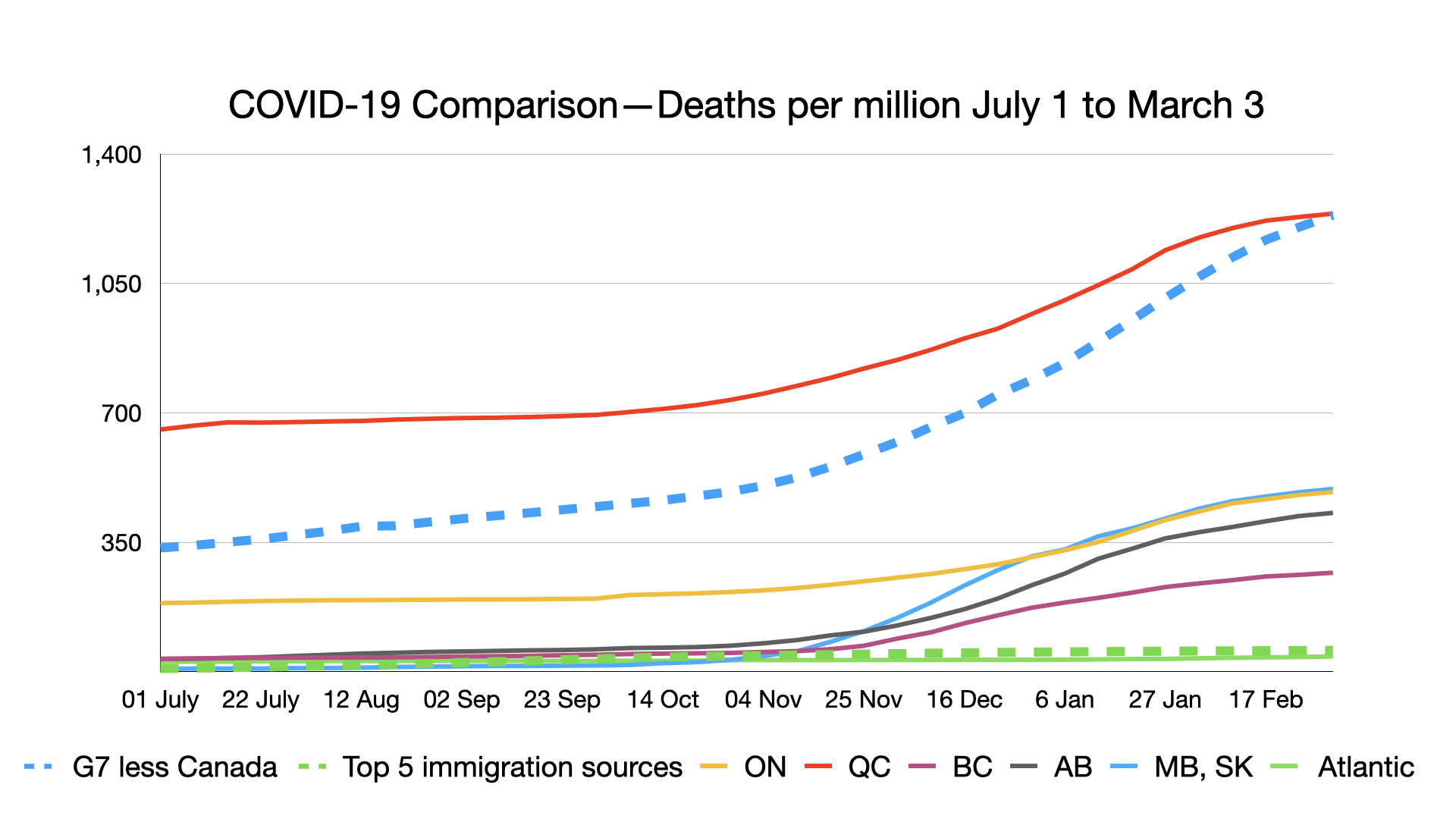
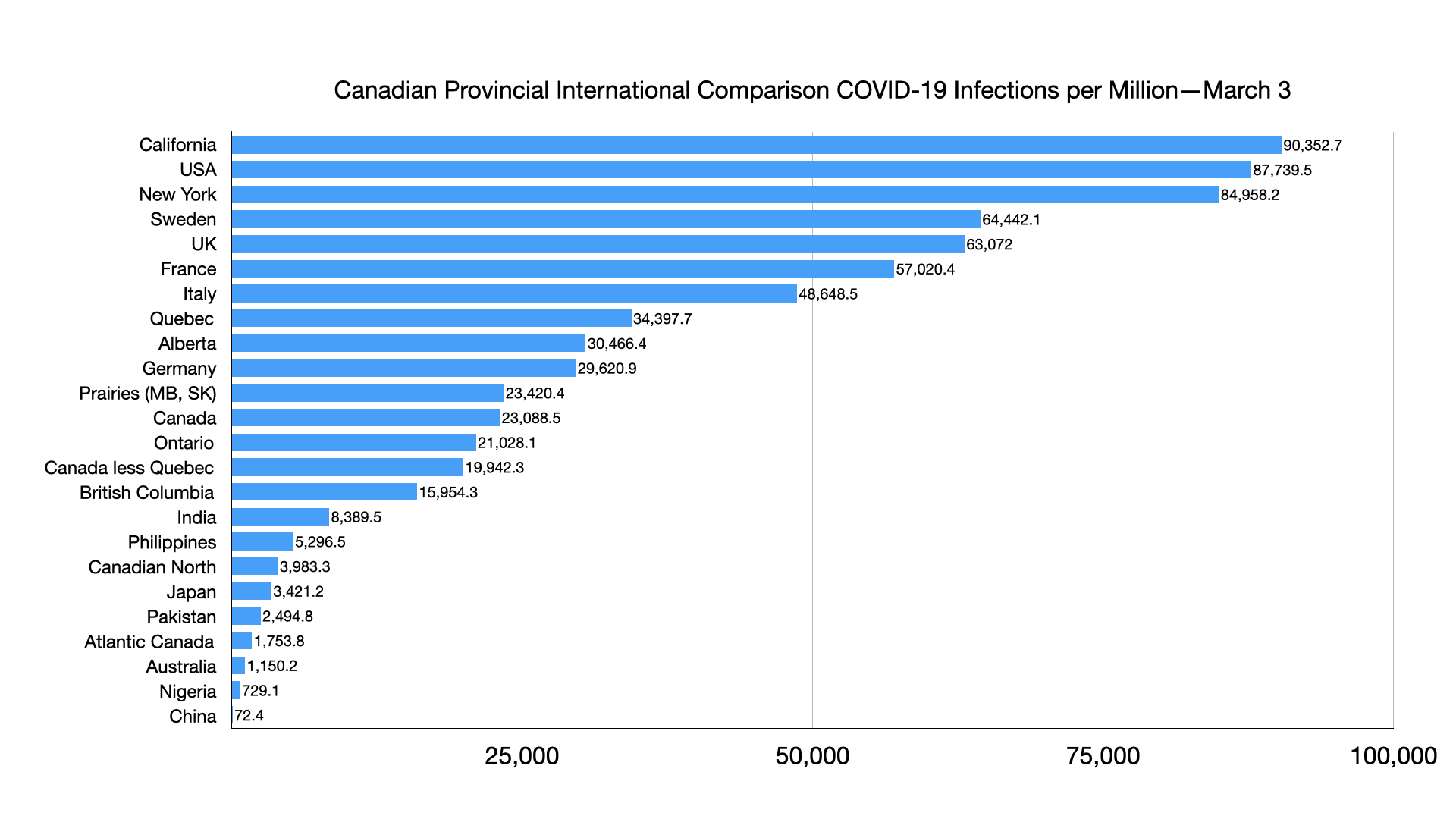
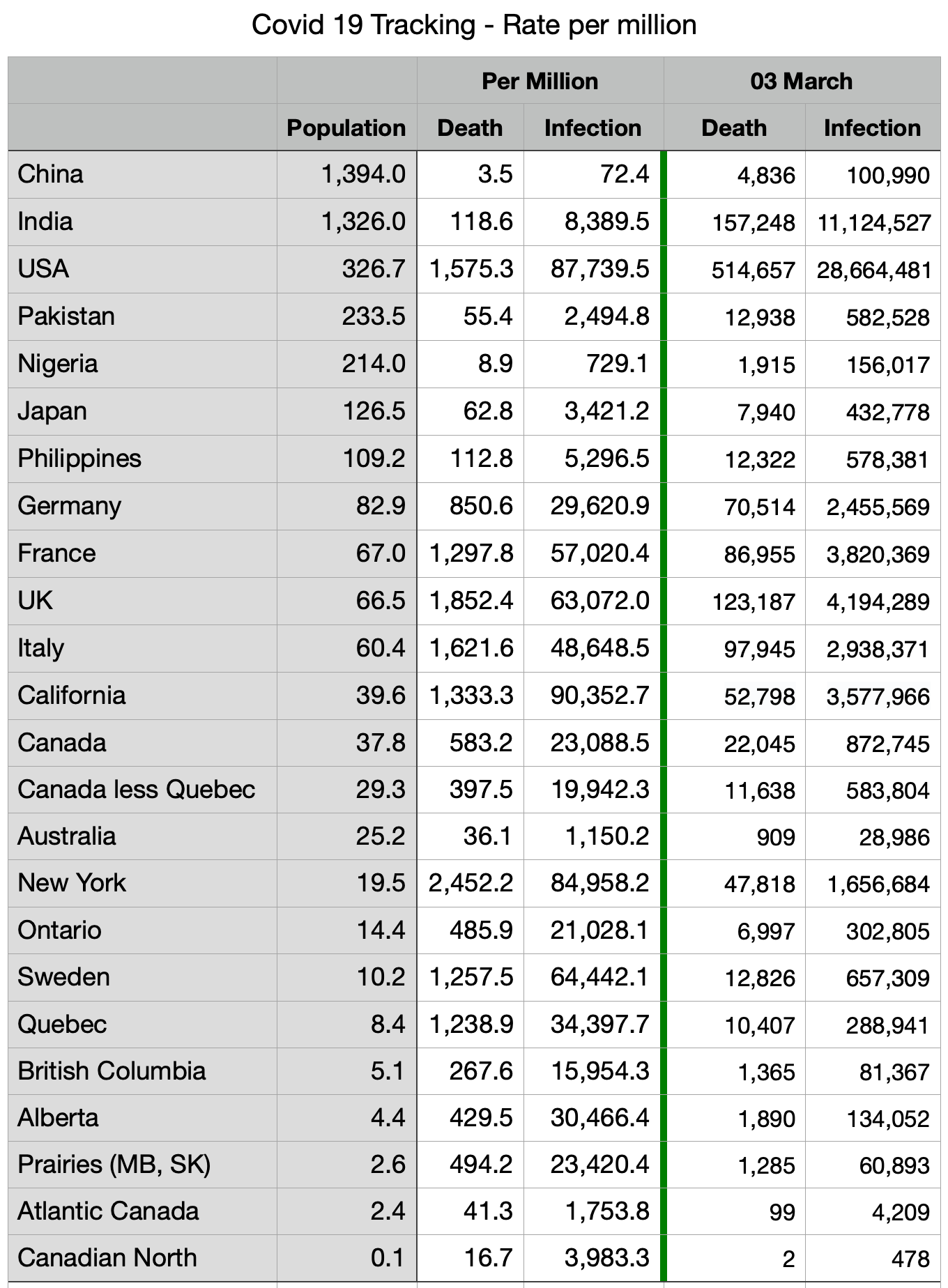
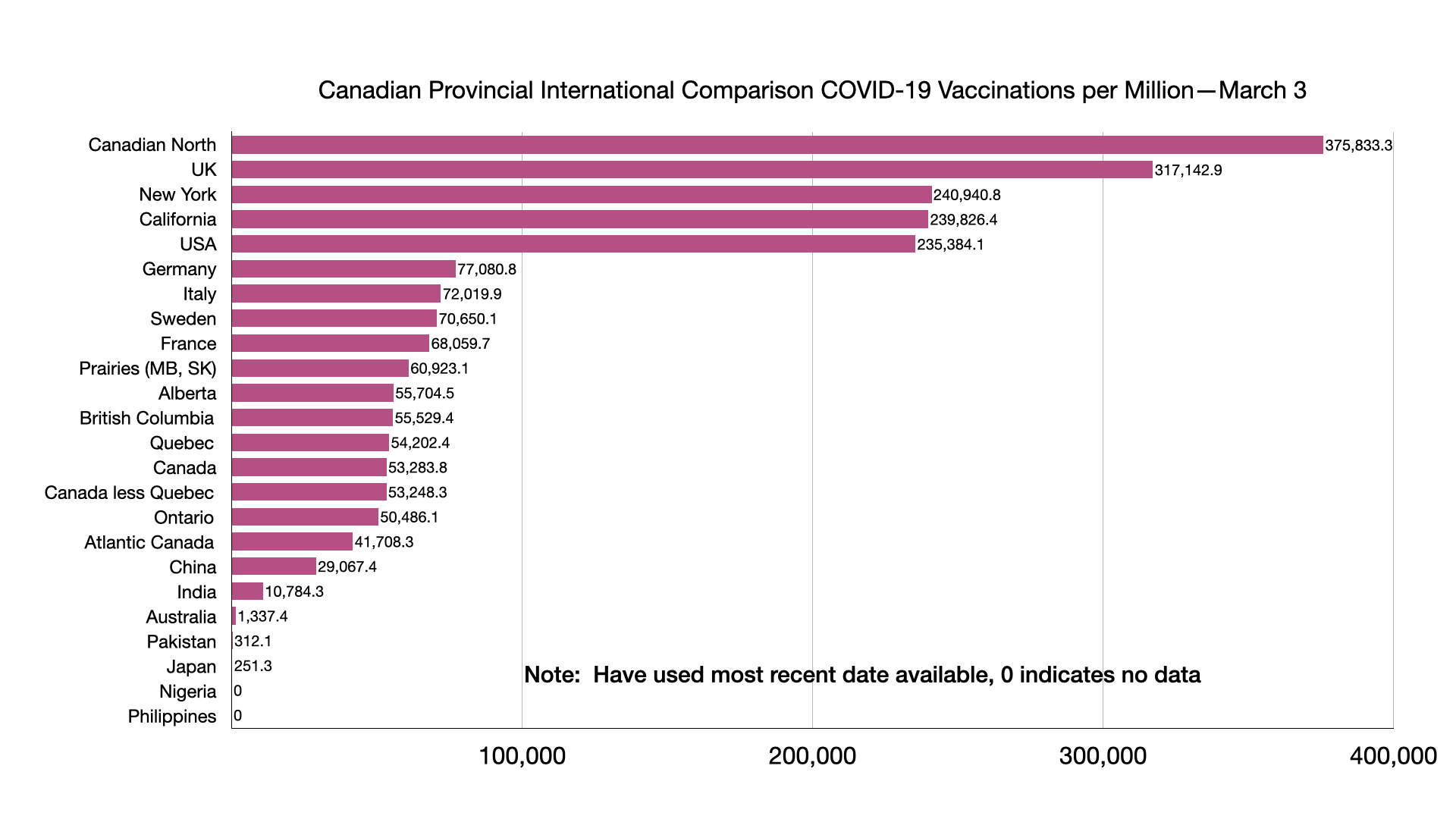
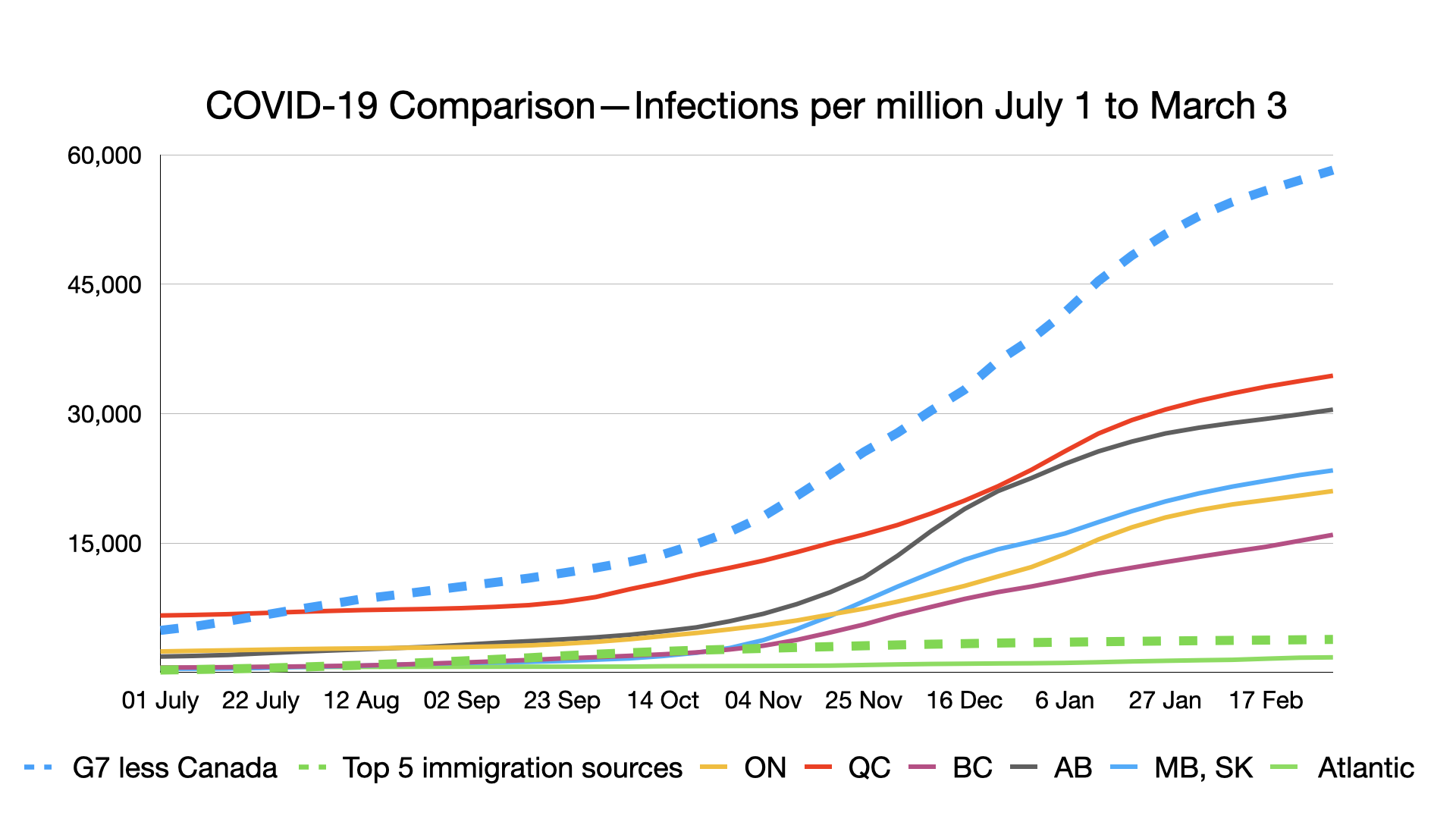
#COVID-19: Comparing provinces with other countries 3 March Update

The latest charts, compiled 3 March (not international vaccination data is latest available).

Vaccinations: The gap between all G7 countries save Japan continues to grow, all European countries slightly ahead of Canada.

Trendline charts

Infections per million: The overall trend of a flattening curve is seen in G7 countries and most provinces save for the Prairies and British Columbia.

Deaths per million: Most Canadian provinces continue to flatten the curve, Quebec most dramatically. Overall G7 death rate at point of surpassing Quebec.

Vaccinations per million: Gap between G7 and Canada, driven not only by the UK and USA, remains largely unchanged.

Weekly

Infections per million: No relative change.

Deaths per million: California ahead of Sweden and Quebec, Sweden ahead of Quebec 

Saunders: How Canada learned what’s wrong with its immigration system – by slamming its borders shut

Usual thought provoking column by Doug Saunders, even if I am more sceptical regarding the government’s approach:

How do you find 401,000 immigrants to become new Canadians when nobody’s even allowed to enter the country? That was the puzzle Ottawa faced at the beginning of the year, after the federal government set admirably high annual immigration targets in 2020 that will bring in 1.2 million people over the next three years in a bold effort to build economic growth through population expansion.

Air and land borders have been shut tight because of the coronavirus pandemic, and neither immigrants nor refugees have been arriving – 2020′s immigration intake was the lowest since the 1990s. The new targets, representing more than 1 per cent of Canada’s population per year, would produce immigration rates Canada hasn’t seen since the 1960s – but begin during a border-closing pandemic. Opposition and business critics said our immigration bureaucrats could never meet that target.

Two weeks ago, those bureaucrats announced a solution that was surprising and potentially ingenious. But it also revealed some of the deep flaws in an outdated and overcomplicated immigration system that was designed for restriction rather than growth, and that leaves hundreds of thousands of families in Canada unable to participate fully in its economy.

In essence, Immigration Minister Marco Mendicino recognized that most of those 401,000 immigrants are already living and working in Canada, and often have been for years – they just don’t have the right kind of visa, or haven’t accumulated right number of points along our Byzantine immigration pathway, to qualify for permanent-residency status and eventual citizenship.

On Valentine’s Day weekend, as it does every few weeks, the Immigration Department sent out invitations for selected temporary immigrants, all of whom have worked in Canada for at least a year, to apply for permanent-resident status. Instead of the usual 3,000 to 5,000 invitations, though, it sent out more than 27,000, and hinted that this high rate would continue for some time. In order to find enough current residents to invite, the number of points needed was lowered dramatically. (Canada’s long-established points system, properly known as the Comprehensive Ranking System, awards points toward permanent status for such things as work experience, education and language skills.)

Immigrants who expected to have to wait months or years longer, and to jump through dozens more bureaucratic hoops, suddenly learned they were on a pathway to become Canadians. Immigration lawyers, who found themselves deluged with clients last week, said the supply of qualified high-quality people was always here; it just took a crisis for the government to see it.

“Yes, they can hit the 400,000 target because there are half a million temporary foreign workers and international students in Canada right now,” says Raj Sharma, a Calgary-based immigration lawyer. “I think they’re going to meet the target, and it’s going to have repercussions on the way they do things – they always should have prioritized people already living in Canada.”

Drawing on immigrants with lower point scores is not a case of “scraping the bottom of the barrel,” as Mr. Sharma notes, because the great majority of those in Canada on a temporary basis (with only a few possible exceptions, such as seasonal agricultural workers) are able to be here, for study or work, precisely because they have skills and are fluent in a Canadian language. What has denied most of these people and their families access to citizenship is not a lack of actual skills or experience, but a complex and often self-contradictory set of rules and classifications.

For example, a temporary worker employed for a year as an accounts-receivable clerk does not earn enough points to qualify under normal rules; the same worker employed as a bookkeeper does. In some provinces, an immigrant employed caring for elderly and disabled people in their own homes is ineligible to apply for permanent residency, while an immigrant doing the same work in a long-term care facility is.

At root are two decades-old assumptions behind our immigration system, both of which have been challenged by the pandemic. The first is that highly skilled, educated and fluent immigrants are a comparative rarity and a lengthy weeding-out process is needed to find them. The second is that immigrants divide neatly into two groups of very different people: temporary and low-skilled, and permanent and high-skilled.

That hasn’t been true for decades. Not only are most “temporary” immigrants to Canada people who are educated and considered middle-class in their countries of origin, but temporary low-wage work is most often used as a stepping-stone to permanent work in professions or skilled trades, or to small-business ownership. A high proportion of temporary-immigrant women employed as live-in caregivers and nannies, for example, have postsecondary diplomas and degrees from their home countries.

These assumptions have exacted a high cost on Canada’s economic prospects, by leaving large numbers of newcomers in a limbo state, unable to invest in their communities, start legal businesses or set down family roots because they’re not eligible to become Canadians – even though they’re here because the economy needs them. In the early 2000s, under prime minister Stephen Harper’s earlier policies, a majority of immigrants in Canada were temporary foreign workers without access to permanent residency.

The later Harper years and early Trudeau years saw pathways to permanent residency created for most classes of temporary workers and students. In the prepandemic years, several thousand people per month were making this transition, though few of them were lower-wage immigrants from the Temporary Foreign Worker Program, who face difficult bureaucratic hurdles regardless of their skill or education level.

The pandemic shone a light on this problem. The jobs deemed “essential” – and thus the jobs that expose employees to the greatest coronavirus risk – are very often the ones held by immigrants who have the least possibility of becoming Canadians.

“I do think that COVID-19 provides an opportunity to rethink our immigration policy, given what we have seen in terms of essential workers, traditionally undervalued and underpaid,” says Andrew Griffith, a former director-general of Canada’s immigration department. He doesn’t believe it will be necessary for the government to permanently lower its points-score requirements for permanent residency, especially during a pandemic recession. Even though there are many labour shortages in low-skill fields, much of that demand is filled not by primary immigrants but by their relatives – the family members who accompany them, and who they later sponsor.

This crisis may have come along at just the right time. If Canada wants to reach a level of population density that provides the most ecological, economic and cultural benefits – especially in a world whose borders and markets are becoming less open – it doesn’t have much time. As recent academic analyses have pointed out, Canada’s projected peak population this century (double its current level) may be difficult to reach because many of our chief countries of immigration are watching their own population growth levels collapse and are trying to hold onto their own populations.

What the pandemic has shown us is that newcomers are not guaranteed to be available when we need them, and might not always be willing to jump through all our hoops – not when other wealthy countries, including warmer ones, may be willing to make better offers.

An immigration policy designed for a growing, educated population needs to do three things.

First, it needs to keep families intact – an immigration system built on unaccompanied individuals is bad for immigrants and bad for Canada, as it leaves out the long-term population benefits of immigration.

Second, it needs to avoid leaving people stuck in Canada for a long time without a clear pathway to citizenship. This is true for both refugee applicants and immigrants – it is a huge wasted opportunity to have hundreds of thousands of ambiguous-status individuals knocking around the country, unsure if they should invest in this country or some other one, or when they’ll know for sure.

We wrongly think of our “points system” as assessing the intrinsic worth of an individual, but in fact most immigrants build up points during the time they spend in Canada. Might it make more sense to allow them to accumulate those points not before but after they earn permanent-resident status? That way, the earnings and savings they build up during that time will be used to build a stake in Canada’s society and economy.

But the flip side of a generous and large-scale controlled-immigration system is that removal of non-qualified people should be quick and decisive – ideally through economic incentives rather than far more expensive deportation. Immigration and citizenship should be valued and treated as precious accomplishments, and that means making decisions quickly and fairly.

And finally, the system should allow rapid movement between categories and classes of immigration – ideally without changing anything. Someone in Canada as a temporary medical-industry worker should be able to become a university student, or a permanent-residency applicant, without having to pay lawyers and questionable immigration agents to navigate a labyrinth of applications, waiting lists, lotteries and restrictions. The number of immigration categories, and steps, could easily be cut in half without any detriment to the system.

Canada will never be an open-borders country, and it will never need to return to the era of mass immigration, as we experienced a bit more than a century ago. We can double or triple our population this century within current immigration rates, and without lowering our standards – but we need to start taking advantage of the immigration assets we already have. If nothing else, the pandemic’s border closings have taught us that we need to do things differently.

Source: https://www.theglobeandmail.com/opinion/article-how-canada-learned-whats-wrong-with-its-immigration-system-by-slamming/

Federal government must allow for immigrants and refugees to receive Canada Child Benefits

Would be helpful to their case if they would provide some estimates of the number of “refugee claimants and other individuals with precarious immigrant status” affected. The total number of refugee claimants as of December 2020 is about 80,000 (IRB data) with no reliable numbers for others, a relatively small number. However, there is merit to their arguments for those who are working and paying income tax:

Given that As COVID-19 rages on, the federal government has rightly extended several emergency benefits, including the Canada Recovery Benefits (CRB) — though not to all in need.

This is welcome news for many Canadians, particularly women and racialized community members, who are among the hardest hit by the pandemic triggered economic downturn. The January 2021 Statistics Canada Labour Force Survey showed unemployment rate has increased to the highest level since August 2020, with core-age women posting the largest employment declines in the month and many racialized groups continuing to experience disproportionately higher job loss rates.

The CRB and its predecessor CERB have kept many struggling families afloat, including many migrant workers and people with precarious status, who could access these benefits with a valid work permit.

During the pandemic, the government has also made an additional one-time payment of $300 per child for families who are receiving the Canada Child Benefits (CCB) and a promise of an additional $1,200 for eligible families with children under six in 2021.

However, not every child in Canada, and not every family in need, is able to enjoy this quasi-universal benefit.

To qualify for the CCB, an applicant parent must be a Canadian citizen, permanent resident, protected person, or a visitor who has lived in Canada for at least 18 months. 

Excluded from accessing CCB are refugee claimants and other individuals with precarious immigrant status, even though many are working legally and filing personal income tax return. In some cases, these families have Canadian-born children, but are still denied CCB because of the parents’ immigration status.

The denial of CCB has a disproportionate impact on women who are still the primary caregivers for children in most Canadian families. Given that the vast majority of people with precarious immigration status are people from the Global South, the denial of CCB adversely affects individuals from racialized communities, who have long been overrepresented among the low income population in Canada.

The federal government has been promising since 1989 to end child poverty. Most recently, the government reprioritized this issue with the release of its national poverty reduction strategy in 2018, followed by poverty reduction legislation that received royal assent in 2019. This strategy calls for a “human rights-based approach to poverty reduction, [one that] reflect[s] principles that include universality, non-discrimination and equality, participation of those living in poverty, accountability and working together.”

Despite this, 1.3 million children, or 18.2 per cent of children, live in poverty in Canada today. Before the pandemic, in many parts of the country, that rate was on the rise.

Child poverty is more prevalent for communities marginalized by race, gender, and their immigration status. 

The exclusions of CCB based on immigration status have been in our law books for many years. Former bureaucrats involved in the design of the child benefits scheme could not explain why these exclusions were introduced in the first place, other than noting that the government of the day did not anticipate that refugee claimants and others in similar situations would be working legally and filing income tax. 

The CCB is a proven tool to reducing child poverty. Access to this benefit for families with precarious status is a matter of equity and justice.

As the federal government prepares for its 2021 budget, there is no better time than right now for the federal government to move swiftly. Deputy Prime Minister Chrystia Freeland has set forth an economic vision of an intersectional feminist and green recovery in the last fall fiscal update. Prime Minister Justin Trudeau has said that no one will be left behind in pandemic response and recovery efforts to build back better. 

But without investments to support families who are falling through the cracks, these words are empty.

People with precarious immigration status are important members of our communities. They are doing the essential work to keep us safe and the economy going.

The federal government should honour its human right obligations and stop discriminating against low-income children and families with precarious status by providing them with immediate access to the Canada Child Benefit.

Source: https://www.thestar.com/opinion/contributors/2021/02/25/federal-government-must-allow-for-immigrants-and-refugees-to-receive-canada-child-benefits.html

Biden Rescinds Immigrant Visa Ban, Keeps Worker Ban: Who Benefits?

Useful data and analysis, along with practical recommendations to streamline processes:

President Joe Biden rescinded Donald Trump’s presidential proclamation banning new immigrant visas for most new legal permanent residents coming from abroad. Trump justified the ban based on old, disproven economic protectionist arguments. He claimed immigrants would take jobs. During his campaign and in this proclamation, President Biden rejected this idea. Yet incongruously, he’s keeping an identical ban on temporary work visa holders.

The State Department issued nearly 290,000 fewer immigrant visas in the categories that the ban targeted during the year that it was in effect. If they are not from a country on which Biden has imposed a countrywide entry ban—mostly Europe, South Africa, Brazil, China, and Iran—these immigrants will now be able to immigrate to the United States. This is great news for them and for the Americans with whom they plan to associate.

Altogether, the banned categories saw a 90 percent decline in visa issuances over the last year. The family‐​sponsored categories saw an average decline of 94 percent, while employees of U.S. businesses were least affected (partly due to a favorable court decision that exempted employees of members of the National Association of Manufacturers and the Chamber of Commerce). 83 percent of the banned immigrants were family members of U.S. citizens and legal permanent residents.

Spouses and minor children of U.S. citizens were exempt from the ban, but they also saw a decline in the number of visas issued due to the travel restrictions. According to a government filing this month, the State Department had nearly 473,000 documentarily qualified family‐​based immigrant visa applicants—presumably some of these cases will ultimately turn into denials, but this will be a huge undertaking for the consulates to process.

Four ideas to help with this backlog (mostly borrowed from our one‐​time Cato author David Kubat):

  1. The government should use “parole‐​in‐​place” authority to waive the requirement to travel to consulate abroad for certain applicants who would otherwise be eligible to adjust in the United States if not for the fact that they initially entered without inspection (illegally).
  2. It should adjudicate applications for waivers on grounds of inadmissibility before conducting the interview to save time and streamline the process. Under the current process, the State Department waits until after they’ve taken your fingerprints, medical evaluation, and other documents and then get denied. Only then do you restart the many months‐​long process of trying again.
  3. It should allow for remote or virtual interviews to speed the interview process. Remote immigration court hearings are already happening.
  4. It should waive as many interviews as possible for applicants with no red flags and a history of travel to the United States.

As Figure 1 shows, the number of immigrant visas had already declined by more than a quarter before the pandemic. This means that even without the visa bans, the new administration will have to go further to rescind the numerous restrictions on legal immigration that led to that decline.

Of course, the other major visa ban—on the most common nonimmigrant work visa categories for skilled and seasonal nonagricultural workers—is still in effect. President Biden states in his order revoking the immigrant visa ban, “The suspension of entry…. does not advance the interests of the United States. To the contrary, it harms the United States including…. industries in the United States that utilize talent from around the world.” These lines apply just as much to the nonimmigrant visa ban, yet Biden has chosen to keep it.

The nonimmigrant visa ban and immigrant visa backlog are just two of the numerous issues that Biden will have to address to get the legal immigration system back to what it was pre‐​Trump. There are also country‐​specific entry bans on Europe, South Africa, Brazil, China, and Iran that lack any health basis. The public charge rule to keep out low‐​income immigrants is also still in force. USCIS has not reinstated its prior deference memo and so is still relitigating past approved petitions and applications in order to increase denials. The immigration forms still contain the bogus, vague, time‐​consuming, and expensive “extreme vetting” questions based on a faulty reading of the data on vetting failures. At the border, Border Patrol is still “expelling” asylum seekers under a political CDC order. The immigration courts and asylum process generally is still in chaos.

With this action, the president makes his first real attempt to reinstate the system to how it once was, but he’s not even 10 percent of the way there. Still, it’s a great first step.

Source: Biden Rescinds Immigrant Visa Ban, Keeps Worker Ban: Who Benefits?

Douglas Todd: Economists question decision to boost immigration during pandemic

Good and needed questioning:

Canadian economists are questioning why Ottawa is setting record immigration targets in the middle of unprecedented unemployment caused by the pandemic.

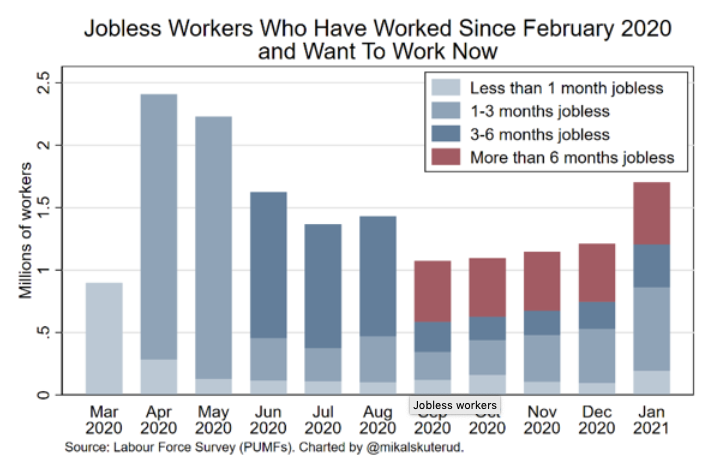
More than 1.7 million Canadians are looking for work, and the economists are warning that the Liberals’ aggressive new target of more than 400,000 new immigrants in 2021 will likely hurt the country’s low-skilled workers, particularly those who have recently become permanent residents.

Source: Douglas Todd: Economists question decision to boost immigration during pandemic