Key facts about the changing U.S. unauthorized immigrant population

Useful information and context:

Border Patrol apprehensions of migrants at the U.S.-Mexico border are on the rise again. Although the majority of people attempting to enter the United States illegally are stopped, this trend could foreshadow an increase in the U.S. unauthorized immigrant population after years of relative stability. Yet the activity at the southwestern U.S. border is only one part of the overall story of unauthorized immigration, as a growing share of this population came from regions other than Mexico or Central America and entered the U.S. legally but overstayed their visas.

The unauthorized immigrant population is always changing and churning. The total number in the country can remain stable or decline even as new immigrants enter illegally or overstay a visa, because some voluntarily leave the country, are deported, die or become lawful residents. In short, the dynamic nature and pace of migration patterns has resulted in an unauthorized immigrant population whose size and composition has ebbed and flowed significantly over the past 30 years.

Here are key facts about this population and its dynamics.

How we did this
Number of unauthorized immigrants in the U.S. has declined since 2007

The U.S. unauthorized immigrant population rose rapidly from 1990 to 2007 before declining sharply for two years and stabilizing at 10.5 million in 2017.Pew Research Center’s most recent estimate is well below a peak of 12.2 million in 2007, but roughly triple the estimated 3.5 million in 1990. The estimate includes 1.5 million or more people who have temporary permission to stay in the U.S. through programs such as Deferred Action for Childhood Arrivals (DACA) and Temporary Protected Status (TPS), as well as people awaiting decisions on their asylum applications; most could be subject to deportation if government policy changed.

U.S. unauthorized immigrant populations declined or held steady for most regions of birth since 2007

Mexican unauthorized immigrants are no longer the majority of those living illegally in the U.S. As of 2017, 4.9 million unauthorized immigrants in the U.S. were born in Mexico, while 5.5 million were from other countries, the first time since at least 1990 that those from Mexico (47% in 2017) were not a majority of the total. In 2007, an estimated 6.9 million unauthorized immigrants were Mexican, and 5.3 million were born in other countries. The population of Mexican-born unauthorized immigrants declined after 2007 because the number of newly arrived unauthorized immigrants from Mexico fell dramatically – and as a result, more left the U.S. than arrived.

The number of unauthorized immigrants from nations other than Mexico ticked up between 2007 and 2017, from 5.3 million to 5.5 million. The population of unauthorized immigrants born in Central America and Asia increased during this time, while birth regions of South America and Europe saw declines. There was not a statistically significant change among other large regions, including the Caribbean, Middle East-North Africa and sub-Saharan Africa.

A rising share of U.S. unauthorized immigrants apparently arrived in the country legally but overstayed their visas. Nearly all people apprehended while attempting to enter the country illegally at the U.S.-Mexico border are from either Mexico or Central America. This stands in contrast to the origins of visa overstays.

In recent years, immigrants from countries outside of Mexico and Central America accounted for almost 90% of overstays, and in 2017, there were more than 30 overstays for every border apprehension for these countries. Although the Census Bureau data Pew Research Center uses to estimate the size of the unauthorized immigrant population does not indicate directly whether someone arrived with legal status, the origin countries of immigrants in these sources provide indirect evidence. From 2007 to 2017, the share of newly arrived unauthorized immigrants (those in the U.S. five years or less) from regions other than Central America and Mexico – the vast majority of whom are overstays – increased from 37% to 63%. At the same time, the share of new unauthorized immigrants from Mexico fell from 52% to 20%.

Short-term residents decline and long-term residents rise as share of U.S. unauthorized immigrants

The decline in the arrival of new unauthorized immigrants in recent years has resulted in a population that is increasingly settled in the U.S. About two-thirds of unauthorized immigrants (66%) had lived in the U.S. for more than 10 years as of 2017, up from 41% 10 years earlier. Conversely, newly arrived unauthorized immigrants (those in the U.S. five years or less) accounted for 20% of the unauthorized immigrant population in 2017 versus 30% in 2007. For Mexicans, the pattern is even more pronounced. The vast majority (83%) of unauthorized immigrants from Mexico have been in the country more than 10 years, while only 8% have lived in the U.S. for five years or less.

Source: Key facts about the changing U.S. unauthorized immigrant population

#COVID-19: Comparing provinces with other countries 14 April Update

The latest charts, compiled 14 April as the third wave has started.

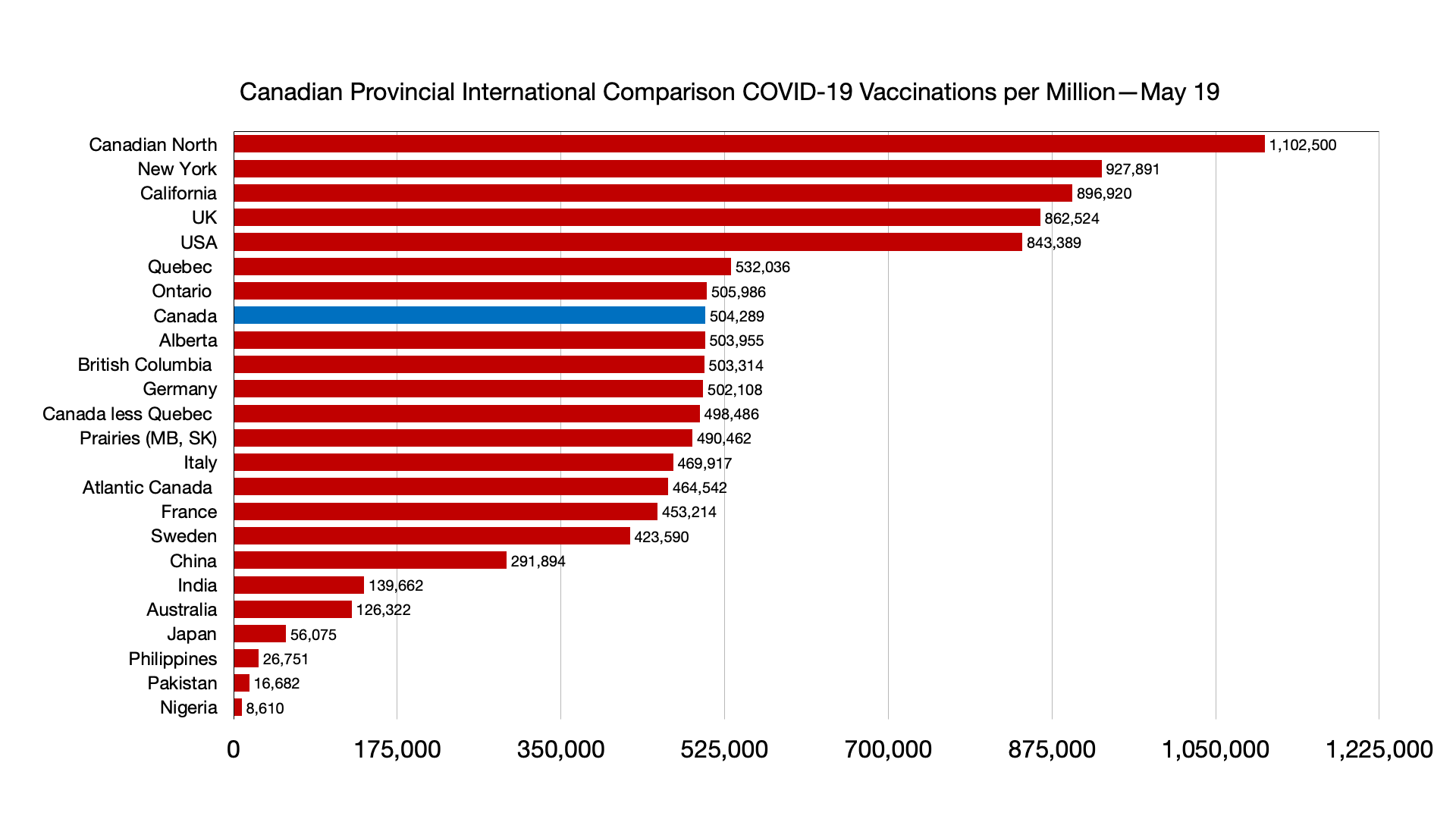
Vaccinations: Overall, Canada and most provinces ahead of or comparable to EU countries.

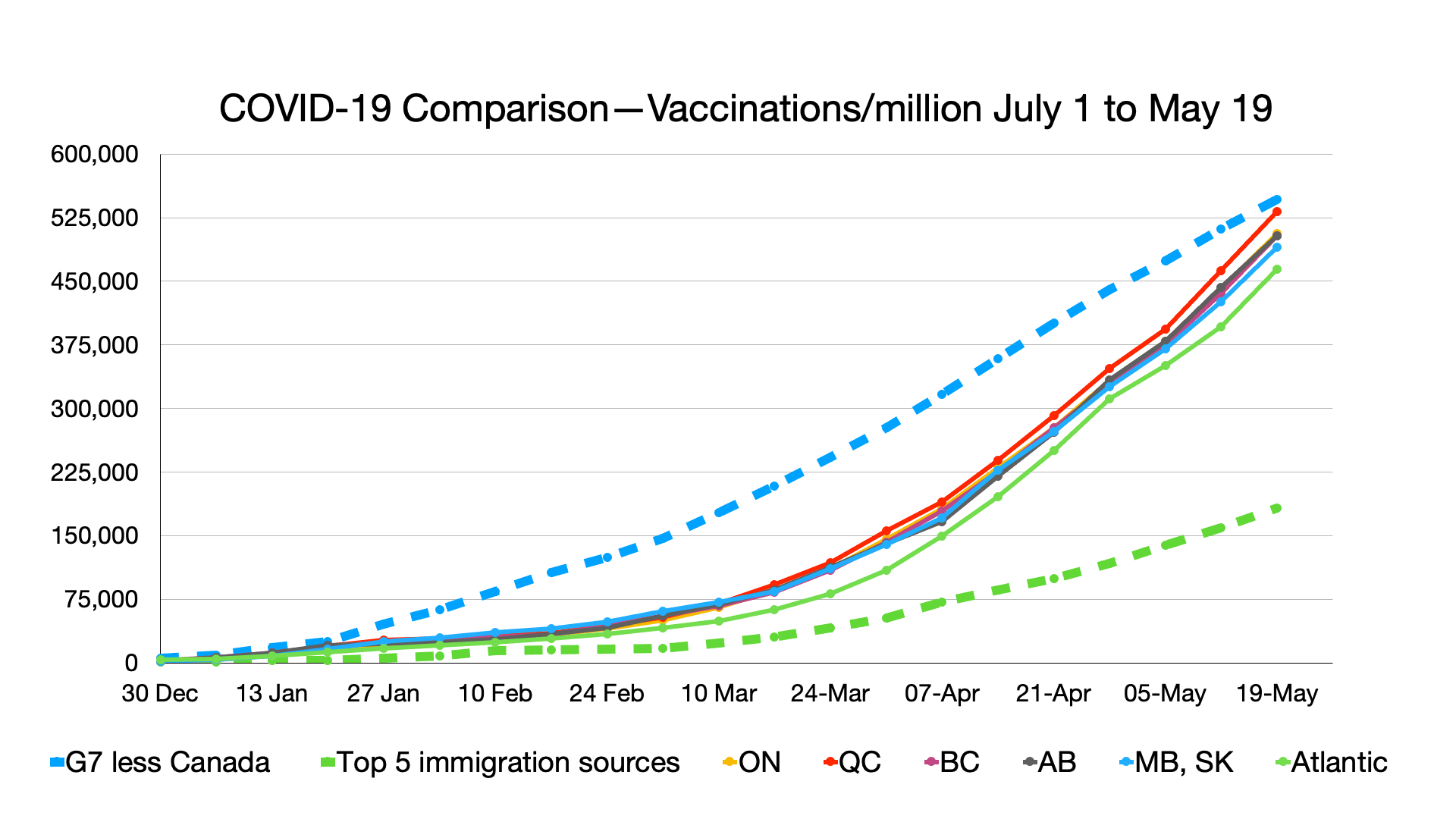
Trendline charts

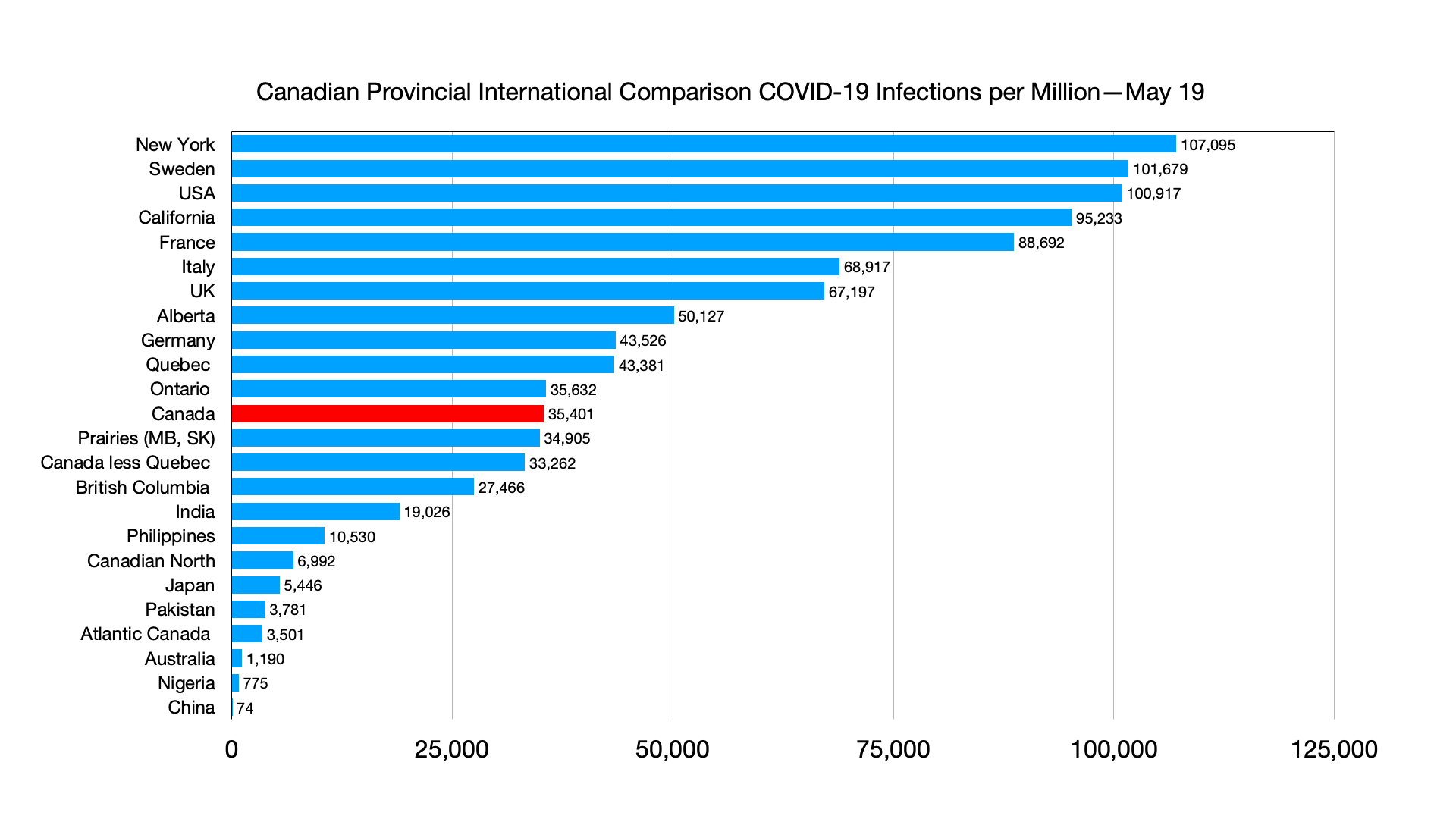
Infections per million: Overall steady increase of infections in most provinces with Alberta and Ontario showing steeper increases but still much better than G7 less Canada.

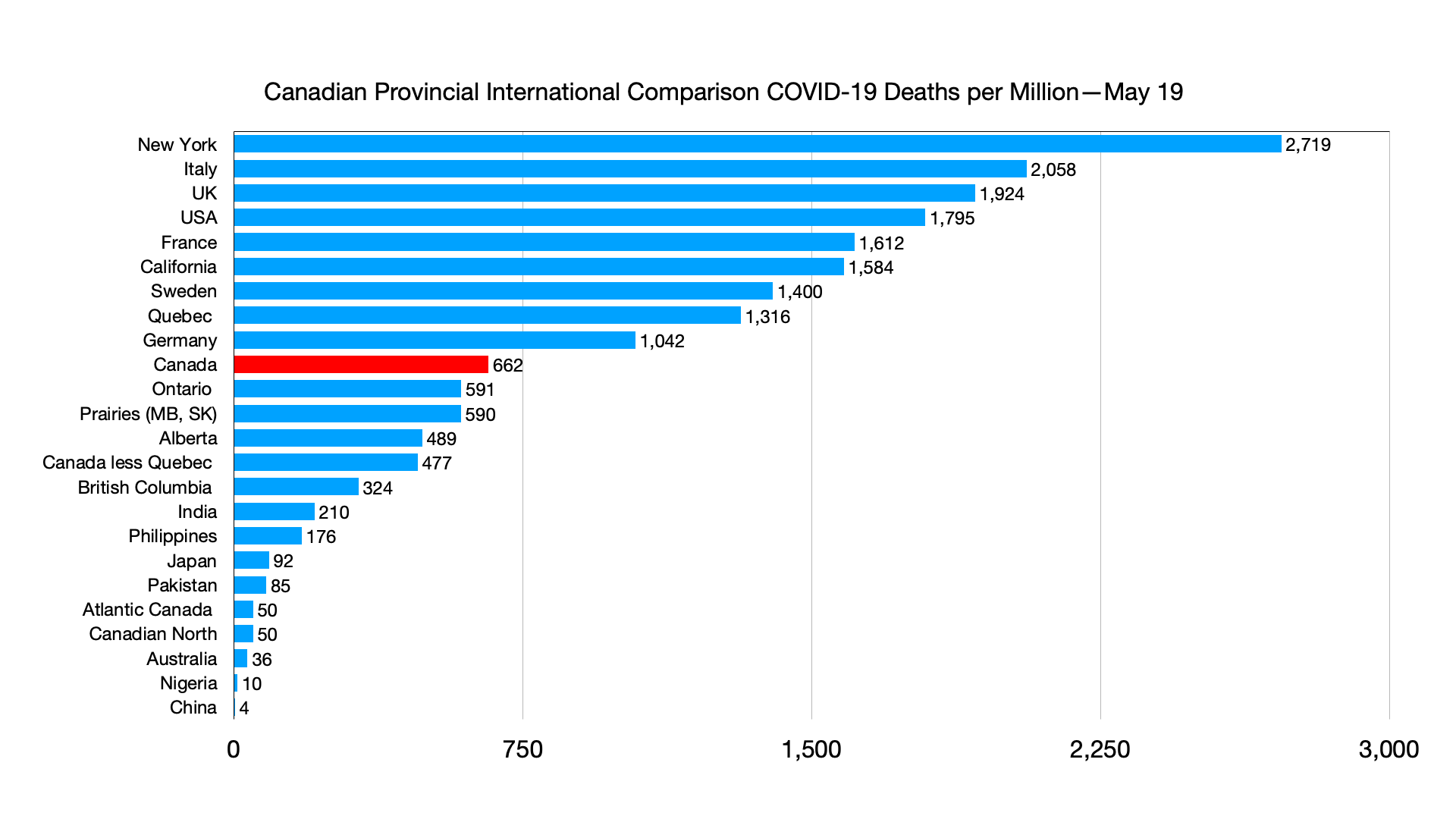
Deaths per million: No major changes.

Vaccinations per million: Significant shift with most Canadian provinces being slightly better than most EU countries.

Weekly

Infections per million: No relative changes.

Deaths per million: Philippines slightly ahead of India

Covid accelerates India’s millionaire exodus

Of note:

India’s wealthy have topped a list of people seeking to relocate abroad through visa programmes that offer citizenship or right of residence in other countries in return for investments.

There was very little Rahul (name changed) didn’t have going for him, when he made the tough call to leave India six years ago. He is the second generation scion of a well-heeled Delhi-based family. They have a flourishing exports business with a monopoly in what’s typically called a ‘sunrise sector’- an industry that has great future prospects.

But he left it all behind and moved to Dubai in 2015, to look after the company’s overseas expansion. He also got a citizenship by investment in one of the Caribbean nations. Harassment by tax authorities in India’s Enforcement Directorate was a key reason, he says.

“I could see it becoming a problem for someone who had businesses spread across the world,” he told the BBC. “With a foreign passport, the red-tape has reduced substantially. I am less worried about being slapped with a random tax demand.”

‘Tax terror’ has been a routine gripe among Indian corporate tycoons. When the founder and owner of India’s largest coffee chain, Cafe Coffee Day died in 2019, he accused a former director general of the income tax department of harassing him. But the government has continued to tighten its noose around business owners in recent years.

According to one report, tax searches by India’s income tax department have more than trebled in the last few years.

The government has argued this is being done to eradicate “black money – illegal cash, hidden from the tax authorities – and improve tax compliance. But critics say the overreach is also often on account of pressure on bureaucrats to meet revenue targets.

But hounding by the taxman was just one reason for his move, says Rahul. His decision was also prompted by a growing trend of “divide and rule politics” in India, he told us. He didn’t want his kids to grow up in India’s increasingly polarised environment.

Many others in his circle of wealthy friends were also renouncing their citizenship or resident status, he added.

These claims are borne out by figures from the wall-street investment bank Morgan Stanley. A 2018 bank report found that 23,000 Indian millionaires had left the country since 2014.

More recently, a Global Wealth Migration Review report revealed that nearly 5,000 millionaires, or 2% of the total number of high net-worth individuals in India left the country in 2020 alone. And Indians topped a list compiled by the London-headquartered global citizenship and residence advisory Henley & Partners (H&P), of those seeking citizenship or residency in other countries in return for monetary investments.

Covid-19 has been a big driver of what was an ongoing trend of wealthy Indians seeking to “globalise their lives and assets” according to H&P. So much so that the firm set up its office in India in the middle of the lockdown last year to cater to growing demand.

“I think they [clients] are realising they don’t want to wait for the second or third wave of the pandemic. They want to have their papers now that they are sitting at home. We refer to this as the insurance policy or Plan B,” Dominic Volek, Group Head of Private at Henley & Partners told the BBC on a video call from Dubai.

According to Mr Volek, the pandemic could be a game changer, because it is making the wealthy think about migration in a more holistic fashion. It is no longer just about visa-free travel, or ease of access to global markets, but about wealth diversification, better healthcare and education, to protect against the uncertainties brought about by the pandemic.

Countries like Portugal, which runs a ‘golden visa’ programme as well as countries like Malta and Cyprus are preferred destinations for India’s well heeled, according to H&P.

This exodus of big money is not necessarily permanent in nature – people merely invest money in another country as a fall-back option rather than take out all their money from their home country and cut business ties. But it doesn’t bode well for a developing nation like India, say experts.

“When this happens, they remove themselves, their entrepreneurial ability and their income and wealth from the tax base. This is likely to be detrimental in the long run. Their exit sends a poor signal about the ‘doing business climate’ in India,” says Rupa Subramanya, Distinguished Fellow at the Asia Pacific Foundation of Canada.

Andrew Amoils, Head of Research at New World Wealth, a Johannesburg-based wealth intelligence group, told the Business Standard newspaper: “It can be a sign of bad things to come as high-net-worth individuals are often the first people to leave – they have the means to leave unlike middle-class citizens.”

Source: Covid accelerates India’s millionaire exodus

Faut-il vraiment réduire les seuils d’immigration?

Taking issue with the PQ position on reduced immigration levels (similar to Lisée’s arguments posted earlier):

Dans une lettre parue le 9 avril, l’économiste et président du Parti québécois, Dieudonné Ella Oyono, affirmait que, devant la rareté de main-d’œuvre qui touche plusieurs secteurs de l’économie québécoise, « augmenter les seuils d’immigration n’est pas une solution soutenable à long terme, ni du point de vue économique (chômage élevé) ni du point de vue social (pression sur les services publics). » Cette conclusion nous semble toutefois fondée sur des prémisses erronées.

La position que défend M. Oyono se base sur un examen du taux de chômage des immigrants reçus au Canada entre 2016 et 2020. Or, on devrait plutôt faire remonter l’analyse à 2006, puisque les données publiées à cet égard par Statistique Canada remontent à cette année. Il en ressort un portrait plus complet et on évite ainsi la comparaison avec 2020, une année atypique en raison de la pandémie.

Entre 2006 et 2019, le taux de chômage des immigrants reçus âgés de 15 ans et plus a diminué de 45 % au Québec, passant de 12,8 % à 7 %. Cette diminution s’est observée chez toutes les catégories d’immigrants, des plus récemment arrivés aux plus anciennement établis. Le taux de chômage de la population née au pays a pour sa part diminué de 38 % durant cette période, passant de 7,4 % à 4,6 %.

La raison de cette embellie est fort simple : depuis la crise de 2008, la croissance de l’économie a été soutenue, les baby-boomers ont quitté par milliers la population active après avoir atteint l’âge de la retraite, et le nombre de postes vacants dans les entreprises du Québec s’est multiplié, dont une majorité pour des emplois requérant peu de formation ou d’expérience. Cette situation a profité aux personnes récemment entrées sur le marché du travail, dont les personnes immigrantes.

Dans ce contexte, pourquoi se priverait-on de la contribution de celles et ceux qui ont le projet de s’installer au Québec, notamment pour pouvoir y vivre en français ? Selon un argument souvent mis en avant, plus le nombre de personnes immigrantes augmente dans un pays, plus il deviendrait difficile de les intégrer. Dans une étude parue en 2019, l’IRIS montrait au contraire que les États qui affichent les proportions les plus grandes d’immigrants sont aussi ceux qui les intègrent le mieux sur le plan économique. On le voit d’ailleurs en Ontario où, comme le souligne M. Oyono lui-même, le taux de chômage des immigrants reçus est plus bas qu’au Québec, alors que la province de Doug Ford accueille, toutes proportions gardées, plus d’immigrants que celle de François Legault.

Quant à l’argument voulant que les personnes immigrantes représentent une charge pour les finances publiques, mentionnons au contraire qu’à mesure que les années passent et que leur participation au marché du travail s’accroît, leur contribution au Trésor public (et donc au financement des services publics) augmente elle aussi.

Certes, les inégalités persistantes entre travailleurs immigrants et natifs exigent, comme le souligne là encore M. Oyono, que l’on se donne les moyens d’y remédier. Augmenter le nombre de cours de francisation et faciliter la reconnaissance des diplômes et des expériences acquis à l’étranger sont bien entendu des mesures qui font partie de la solution, mais lutter contre la discrimination en emploi, qui touche particulièrement les personnes racisées, l’est tout autant.

L’immigration ne pourra à elle seule remédier au manque de main-d’œuvre que connaît le Québec et qui s’accentuera dans les années à venir, étant donné le vieillissement de la population. Par contre, réduire les flux migratoires en provenance de l’étranger ne fera qu’aggraver le problème. Inversement, il faut éviter de voir les personnes qui souhaitent s’installer au Québec comme une simple force de travail au service des entreprises et plutôt les considérer comme des citoyennes et des citoyens à part entière qui apportent beaucoup plus qu’ils ne coûtent à la société d’accueil. C’est là une des clés de leur intégration.

Peut-être y a-t-il des raisons politiques qui en poussent certains, à l’instar de M. Oyono, à rejeter l’idée d’une hausse des seuils d’immigration. Cependant, les raisons sociales et économiques le plus souvent invoquées pour défendre une telle position reposent sur une analyse inexacte de la situation des personnes immigrantes au Québec.

Source: Faut-il vraiment réduire les seuils d’immigration?

In Denmark, Fears Grow Among Syrian Asylum Seekers As Residence Permits Are Revoked

Of note:

In 2019, Danish authorities issued a report stating that the security situation in some parts of Syria had “improved significantly.” Last year, that report was used as justification to begin reevaluating hundreds of Danish residence permits granted to Syrian refugees from the area around and including the capital Damascus.

Now some of those refugees are being told, officially, that their time in Denmark is up.

Among those affected are Heba Alrejleh and Radwan Jomaa, a couple from Damascus. Jomaa left Syria in 2013, traveling first to Egypt and later making his way to Italy. Upon landing there, he says, the Syrians on his boat set off in different directions, with some heading for Sweden and others for France.

Jomaa chose Denmark, having heard about the country’s welcoming reputation.

He was soon joined by Alrejleh and the kids — Aya, who is now 11, and Mohamed, now 10. Their youngest, four-year-old Lilian, was born in Denmark.

The family lived for several years in the town of Skive, though it was far from Jomaa’s job at a pizzeria near Aarhus.

Meanwhile, in neighboring countries like Germany and the Netherlands, friends and family who had fled Syria around the same time were starting to get permanent residence and even citizenship. Surely, they thought, the same would soon be true for themselves.

So in December, with a mind to putting down roots, the couple found a small row house just outside the city of Silkeborg. Here, their three kids could go to a quieter school, Jomaa would have a shorter commute and Alrejleh would be able to continue her studies. She dreams of becoming a nurse.

On the day they were packing to move, a notification arrived from the immigration service informing the family that they were being sent back to Syria.

Jomaa was shocked.

“This decision means life or death,” he says. “The words ‘to send us back to Syria’ means to destroy our lives.”

Jomaa says his family has nothing and no one left in Syria. Because he participated in protests against the Assad regime, he fears he would be arrested upon return.

The couple has appealed the decision, but for now their lives are on hold. The walls of their new apartment remain bare, the living room almost empty.

Alrejleh, whose first husband was killed before her eyes in Syria, says this is not the new beginning she’d dreamed of.

“All I can think about is the decision from the immigration service,” she says. “Otherwise I would be doing many things: continuing my studies, raising my children, dreaming about their future. Lots of things. But it’s all at a standstill.”

Jomaa, who says he’s been having nightmares, doesn’t understand why Denmark would do this.

“The name Denmark used to be a shining example when it came to human rights. But now racism is ruining Denmark’s reputation in the whole world,” he says.

But scaring asylum seekers away seems to be the government’s goal, says Michala Bendixen, who heads the Danish advocacy group Refugees Welcome.

“We have a new expression now among migrant researchers called ‘negative nation branding,'” she explains. “We’re trying to scare people away from Denmark, deliberately, by telling stories about how bad life is as an asylum seeker is here, how very, very limited your rights will be if you are granted asylum — that you should never feel safe or secure about your future here, because even if you are among the lucky ones who are granted asylum, you will be kicked out sooner or later.”

Bendixen says Denmark has been moving in this direction for decades. But the country’s most recent hard turn on immigration is part of an attempt by the center-left government, voted into office in 2019, to capture the populist vote back from the far right.

It’s referred to as the “paradigm shift” and also underlies a current debate about whether to bring home Danish children of women who joined ISIS and are now stranded in refugee camps abroad.

Politically, this strategy has helped the Social Democrats. But Bendixen says it’s also putting Denmark on a cliff’s edge when it comes to international humanitarian law.

“They’re trying to find out where is the limit, actually,” she says. “They’re stepping as close to the limit or a little bit across it to see ‘how far can we go?'”

But even as organizations like Amnesty International and the United Nations criticize Denmark’s stance on refugees, Bendixen says international guidelines on repatriation are open to interpretation, making the government’s policy hard to challenge.

The irony is that because Denmark has not resumed diplomatic relations with Syria, rejected asylum seekers cannot actually be deported.

Of the 94 Syrian refugees who lost their Danish residence permits in 2020, some — like Jomaa and Alrejleh — are still under appeal. If they’re lucky, these people may be granted a more protected status and allowed to stay.

But Bendixen says some 30 people have already lost their appeals. The choice, at that point, is either to live indefinitely in a Danish deportation center, go back to Syria voluntarily — or go underground and try to start over in another European country.

When Denmark’s Integration Minister Mattias Tesfaye announced last June that the government would be reevaluating residence permits, he emphasized that Syrian refugees who choose to go back get a “bag of money” from Denmark in order to rebuild their lives in Syria.

The government will provide funds for travel costs, four years of medical coverage, plus a flat sum of about $23,000 per adult. But last year, only 137 of Denmark’s roughly 35,000 Syrian refugees took advantage of that offer — which Bendixen says speaks volumes about conditions in Syria.

When asked what will happen to his family if their appeal is denied, Jomaa sits quietly for a moment as his eyes fill with tears.

“I don’t have an answer,” he says.

He and Alrejleh have tried to protect their children from what’s happening, but it’s hard to hide the frustration.

Still, 11-year-old Aya knows she does not want to go back to Syria, which she remembers only vaguely as a place where “many people died.” Now, speaking in perfect Danish, she says that Denmark, her new home, is a good place.

Why?

“Because,” she says, “people don’t go around killing each other.”

Source: In Denmark, Fears Grow Among Syrian Asylum Seekers As Residence Permits Are Revoked

Australia: Foreign student enrolments 210,000 lower than expected

Steeper drop than in Canada (92,000 fewer international students, or 28 per cent):

Australia’s universities have enrolled 210,000 fewer international students this year than expected, with the loss of AU$1.8 billion (US$1.4 billion) in income. More than 17,000 jobs have already disappeared from campuses across the higher education sector.

To put the figure in context, according to government data, there were 442,000 international student enrolments in higher education in Australia in 2019, the latest figure available.

But Federal Education Minister Alan Tudge believes Australia’s COVID-19 vaccine rollout could pave the way to boost its intake of international students as early as the start of next year.

Tudge told a conference that Australia’s lucrative international student market could be given a much-needed boost by February 2022.

“With the vaccine rollout under way, I am increasingly hopeful that student arrivals in larger numbers will occur by semester one of next year,” Tudge said.

“We are looking forward to welcoming back international students who remain overseas, and we thank them for their patience to date.

“I hope they appreciate that we have closed the borders for a very good reason.” 

Tudge also raised the possibility of individual universities bringing international students to Australia this year if the nation’s chief health officers agreed and safe quarantine quarters were provided.

Billion-dollar market collapses

Australia’s AU$10 billion (US$7.6 billion) international student market collapsed after the federal government closed the nation’s international borders at the beginning of the pandemic.

Tudge claimed enrolments of foreign students at the end of 2020 were only down 7% on 2019, although universities estimate 140,000 students have since been stranded overseas.

Whoever is correct, the fact is that Australia has 210,000 fewer international student enrolments this year than would otherwise have been expected.

Universities Australia, the nation’s representative body, has released data showing the university sector had lost AU$1.8 billion in income from foreign students last year, with at least 17,000 jobs on campuses across the nation having disappeared.

Bringing students back

“Of course, there is still the opportunity to bring students back in small, phased pilots,” Tudge said.

“This could occur if an institution works with the state or territory government and presents a plan to us for quarantining international students.”

But he warned that university plans to bring more foreign students into the country would have to be approved by the chief health officer of each state or territory.

“There must also be quarantine space available above and beyond that presently used for returning Australians.”

Tudge has discussed various plans with state government and university leaders but to date has not received any concrete proposals.

He said he hoped the federal government would have a clearer idea later this year as to when international borders would re-open.

“We are expecting more clarity on these issues by mid-year, at which time we should be more certain on border openings,” he said.

No large numbers returning

Tudge believes it is unlikely that foreign students will be allowed to return in large numbers until 2022, although universities may be able to enrol limited numbers of students from overseas.

He admits the strong growth in onshore international student numbers in recent years was unsustainable, and universities need to rethink this business model. 

Specifically: Australia must “rethink the on-campus business model of international education, and more broadly the international education strategy for the nation as a whole”.

“By using international student fees to fund research, universities have undermined the learning experience of domestic students and failed to address skills shortages,” Tudge said.

Narrow focus on management

He noted that half of all international students were enrolled in management and commerce, which were not experiencing skills shortages in Australia.

Instead, the nation’s universities should look towards online rather than onshore education, Tudge said.

“This incredible growth has been good for our economy, but even before COVID hit, strains were appearing and the continued rate of growth of on-campus enrolments was not sustainable in my view.” 

Tudge said this was particularly true for the public universities, institutions which had “a broader mandate”. 

“Having up to 60% of a classroom with international students from just one or two other countries is not optimising the Australian student experience – or the international student experience,” he said.

“Can we use levers, including migration levers, to encourage more students to study in the areas where we know we have shortages?” he asked.

Source: https://www.universityworldnews.com/post-nl.php?story=20210409131414835

A new Windrush is in the making. Its victims are the most vulnerable of young people

Of note:

Three years on, the individual tales of Windrush injustice still have the power to catch my breath. Men and women who moved to Britain as children decades ago, who found themselves banished from the UK for the remainder of their life after a holiday abroad, wrongfully arrested, detained and threatened with deportation, and denied life-saving care on the NHS. So many stories of the British state ruining black lives, but one stands out for its exquisite cruelty: that of Jay, the son of a Windrush immigrant.

Jay was born in the UK and taken into care as a baby. When he applied for a passport as a teenager he was told he did not have enough information about the status of his estranged mother. After his third unsuccessful application, the Home Office threatened to deport him to Jamaica and forced him to declare himself stateless. He was only able to secure a passport years later, after the Windrush scandal broke and his case received significant media attention.

Source: A new Windrush is in the making. Its victims are the most vulnerable of young people

Lisée: Éloge de la pénurie de main-d’oeuvre

A contrarian view to what appears to be the general consensus in English Canada in favour of increased immigration:

On l’entend déjà, la musique de la pénurie de main-d’œuvre, avant même que la pandémie nous tourne le dos. On l’entend dans les questions posées par la cheffe libérale. Dans les déclarations patronales, chez quelques économistes et chroniqueurs. Il manque tellement de main-d’œuvre dans tellement de secteurs, va le refrain, qu’il faut de suite doubler, tripler, quadrupler l’immigration.

Si seulement on faisait venir 30 000 infirmières, on réglerait notre problème ! Mais 30 000, réparties sur le territoire, c’est l’équivalent de la population de Chambly. Les enfants de ces infirmières vont exacerber la pénurie d’enseignants, non ? Qu’à cela ne tienne. Faisons venir 30 000 enseignants. Mais ne devra-t-on pas bâtir des maisons pour loger ces 60 000 nouveaux Québécois ? Ce qui va accroître la pénurie dans la construction. D’accord pour ajouter 30 000 ouvriers (ne pas oublier les soudeurs). Mais on a maintenant dépassé la population totale de Repentigny. On vient d’aggraver la pénurie dans le secteur manufacturier, dans les technologies de l’information, dans les transports. Bon, je pense que vous saisissez. Une méta-étude (Longhi et coll.) montre qu’il faut 49 salariés pour répondre aux besoins générés par 50 nouveaux citoyens. Il en reste un, un seul, pour pourvoir un emploi jusque-là vacant. Ma calculatrice est formelle : en suivant cette équation, pour pourvoir par l’immigration les 150 000 postes vacants au Québec, il faudrait 7,5 millions d’immigrants.

Qu’on me permette de citer un de nos plus brillants économistes, Carlos Leitão : « Pour la pénurie de main-d’œuvre, la solution numéro un reste la formation de la main-d’œuvre. On peut toujours aller chercher des immigrants dans des domaines spécialisés, mais l’immigration ne réglera pas la pénurie de main-d’œuvre de façon générale. » Je note qu’il n’a pas répété cette vérité scientifique depuis qu’il a rejoint le Parti libéral du Québec.

L’immigration est un excellent moyen pour faire grossir l’économie en soi (mais pas pour enrichir les citoyens en moyenne), pour tirer légèrement les salaires vers le bas (un grand objectif patronal), pour montrer de la solidarité internationale. Dans une société dont la langue est en déclin rapide, une immigration de langue étrangère est un accélérateur, plutôt qu’un frein, de la chute.

Ce dont on parle trop peu, par contre, ce sont les avantages de la pénurie de main-d’œuvre.

Les salaires montent. Lorsque le chômage était à 8 %, en 2010, l’augmentation réelle des salaires ne fut que d’un demi pour cent. Dix ans plus tard, avec un chômage à 5 %, les salaires réels ont crû de 5 %, un record. La pénurie de main-d’œuvre renverse le rapport de force patrons-salariés en faveur des salariés. Une bonne chose.

N’avez-vous pas été frappés par le fait que plus de 10 000 Québécois ont répondu présents à une offre d’aller changer des couches d’aînés lorsqu’on leur a promis 26 $ l’heure ?

La pauvreté recule. En 2010 il y avait 365 000 adultes prestataires de l’aide sociale. Dix ans plus tard, ils ne sont plus que 130 000, une réduction sensationnelle des deux tiers, et dont seulement 83 000 ne présentant aucune contrainte à l’emploi. Du jamais vu. Et une preuve que lorsque les emplois sont disponibles et que les salaires montent, les assistés sociaux ne demandent pas mieux que d’aller au boulot. Cela a des conséquences sur la sortie de la pauvreté. Le nombre de Québécois à faible revenu (mesure du panier de consommation) est passé de 975 000 en 2006 à 705 000 en 2016, une réduction de près de 30 %.

La pénurie contribue à un cercle vertueux : moins de pauvreté signifie moins de problèmes de santé générés par cette pauvreté, moins de coûts sociaux, plus d’activité économique, plus de rentrées fiscales pour l’État, donc pour les dépenses publiques.

La discrimination à l’embauche recule. Il y a une décennie, le taux de chômage des immigrants arrivés chez nous depuis 5 à 10 ans était près du double (15 %) de celui des natifs québécois (8 %). Désormais à 6,1 %, ce taux s’approche de celui des natifs, à 4,5 %. C’est facile à comprendre : lorsqu’il y a des Mohammed et des Jean-Jacques dans les CV examinés, c’est Jean-Jacques qui gagne. Mais s’il n’y a plus que des Mohammed, le plus obtus des employeurs devra finir par l’appeler. Merci qui ? Merci la pénurie !

Elle fait aussi en sorte que les employeurs se tournent plus volontiers vers des salariés en situation de handicap, vers les programmes d’insertion de décrocheurs. Aucune politique d’insertion sociale n’est plus efficace que la pénurie. Aucune.

La productivité augmente. La clé de notre richesse collective repose sur notre capacité à augmenter la productivité par heure travaillée. Depuis des décennies, Québec cherche avec un succès mitigé à pousser nos PME à innover, à améliorer l’outil de travail, à hausser le niveau de formation des salariés. Longtemps, l’existence d’une main-d’œuvre abondante et à bon marché a nourri chez ces employeurs une désolante paresse. Mais s’il manque désormais d’employés pour répondre aux commandes, que font-ils ? Ils doivent se résoudre à automatiser, à robotiser, à former les salariés pour opérer ces technologies. Et puisque ces nouveaux procédés sont plus verts, ils contribuent à notre combat contre le réchauffement climatique. Aucune politique publique d’innovation n’est aussi efficace que la pénurie de main-d’œuvre.

On rattrape l’Ontario. C’est l’obsession de François Legault. Faire en sorte que le salaire moyen québécois brut rejoigne l’ontarien. (Je dis « brut », car, ajusté au coût de la vie, notre salaire moyen net a rattrapé l’ontarien depuis un bon bout de temps.) Ses amis patrons l’implorent d’ouvrir les vannes de l’immigration. car il leur manque un ingénieur ici, un soudeur là, des informaticiens un peu partout. Il doit leur résister. C’est la pénurie qui pousse tous les salaires vers le haut. On ne s’attend pas à ce que le premier ministre l’admette. Seulement à ce qu’il le sache et qu’il agisse en conséquence. Pour l’enrichissement, contre la pauvreté et la discrimination, la pénurie est son meilleur allié.

Source: Éloge de la pénurie de main-d’oeuvre

US Immigration Policy Has Always Been About Exclusion

Good long read with similarities to Canada’s past with increased divergence since the 80s:

When david dorado romo was a boy growing up in El Paso, Texas, his great-aunt Adela told him about the day the U.S. Border Patrol melted her favorite shoes. Romo’s aunt was Mexican and had a visa that allowed her to commute into South Texas for her job as a maid. Every week she had to report to a Border Patrol station, in accordance with a program that ran from 1917 into the 1930s requiring most Mexican immigrants to bathe in government offices before entering the United States. She would dress up in her nicest clothing, because those who looked dirty or were thought to have lice were bathed in a mixture of kerosene and vinegar. Years later, when Romo visited the National Archives outside Washington, D.C., he found photos and records of gas chambers where the belongings of the Mexican workers had been disinfected with the chemical Zyklon B, as well as a large steam dryer of the sort that had melted his aunt’s shoes. He discovered that a German scientist had taken note of the procedures being carried out at the American border and advocated for them to be implemented in Nazi concentration camps. Eventually, the Nazis increased the potency of Zyklon B in their gas chambers, and began using it on human beings.

Romo also learned that just as the bathing and gas-dousing program was winding down, the American government began using a different dangerous chemical to delouse Mexican immigrants: From the 1930s through the 1960s, border agents sprayed DDT onto the faces of more than 3 million guest workers as they crossed the southern border.

Romo was shocked that he hadn’t learned this earlier. He became a historian dedicated to exposing truths that have been buried along the borders. “We have deep amnesia in this country,” he told me when I spoke with him recently. “There’s a psychological process involved in forgetting that is shame from both sides—from both the perpetrator and the victim.”

This forgetting has allowed the racism woven into America’s immigration policies to stay submerged beneath the more idealistic vision of the country as “a nation of immigrants.” That vision has a basis in truth: We are a multiethnic, multiracial nation where millions of people have found safety, economic opportunity, and freedoms they may not have otherwise had. Yet racial stereotypes, rooted in eugenics, that portray people with dark skin and foreign passports as being inclined toward crime, poverty, and disease have been part of our immigration policies for so long that we mostly fail to see them. “It’s in our DNA,” Romo says. “It’s ingrained in the culture and in the laws that are produced by that culture.”

The first American immigration laws were written in order to keep the country white, a goal that was explicit in their text for more than 150 years. (Over time, the understanding of “whiteness” changed and expanded. Well into the 20th century, only those of Northern and Western European descent were considered white; Italians and Jews, for instance, were not.) Even after the laws were finally changed, allowing large numbers of immigrants from Latin America, Asia, and Africa into the country starting in the 1960s, the eugenic ideas that supported earlier versions of them remained embedded in our society, and still provide the basis of many modern restrictions.

President Joe Biden’s immigration plan would make citizenship available to millions of unauthorized immigrants. Democratic members of Congress rallying behind it have said it would establish a more inherently American system, arguing implicitly that the Trump administration’s often overtly stated preference for white immigrants, or no immigrants at all, was an aberration from the past. “To fix our broken immigration system, we must pass reforms that reflect America’s values,” Senator Amy Klobuchar of Minnesota, a co-sponsor of the proposed legislation, said in a statement introducing the bill. “For too long, our immigration system has failed to live up to the ideals and principles our nation was founded on,” said Senator Alex Padilla of California, another co-sponsor. But Donald Trump’s immigration agenda was executed without a single change to laws already passed by Congress, and his rhetoric and policies were consistent with most of American history. “The Trump era magnified the problem, but the template was there,” Rose Cuison-Villazor, a scholar of immigration law at Rutgers University, told me.

As the country moves forward from the past four years of harsh immigration policies, it must reckon with a history that stretches back much further, and that conflicts with one of the most frequently repeated American myths.

“This idea that somehow immigration was based on the principles stated on the Statue of Liberty? That never happened,” Romo said. “There has never been a color-blind immigration system. It’s always been about exclusion.”

Most american children are taught in school that the United States’ immigration policies help make the country special and, yes, great. A haven for outcasts who faced persecution in their home countries, the nation was founded, the story goes, on the principle of welcoming others who were treated similarly in their own homelands, with the idea that granting them individual rights and freedoms would allow distinct cultures and traditions to thrive together. This tale resonated in my own Central California school district, where I sat alongside classmates whose parents had come from Mexico, India, Laos, Vietnam.

But the cracks in that story began to show as soon as we hit the schoolyard, where kids of different backgrounds played together, but also hurled insults that stung because they had the weight of centuries of American law and rhetoric behind them.

When the Pilgrims crossed the ocean to settle in the New World, they brought with them ideas that would evolve into “manifest destiny,” which held that the United States was a land that had been bestowed by God on Anglo-Saxon white people. In 1790, the first American Congress made citizenship available only to any “free white person” who had been in the country for at least two years. In 1882, the Chinese Exclusion Act blocked Chinese immigrants—and in 1917, it was expanded to block most Asians living between Afghanistan and the Pacific. These laws were upheld numerous times by federal courts, including in a seminal Supreme Court case from 1922, in which the government prevailed by arguing that citizenship should be granted as the Founders intended: “only to those whom they knew and regarded as worthy to share it with them, men of their own type, white men.”

In the early 20th century, the term progressive became synonymous with preserving or improving the racial “stock” of the country—and that meant keeping it white. Harry Laughlin, whose work would provide a model for Nazi Germany’s sterilization laws, served as the House Committee on Immigration and Naturalization’s “expert eugenics agent.” In 1922, he presented evidence of the “hereditary feeble-mindedness” of nonwhite immigrants. Laughlin categorized the subjects of his research into overlapping subgroups that included “the criminalistic,” “the diseased,” and “the dependent.” Two years later, Congress passed the “progressive” Johnson-Reed Act, which established immigration quotas based on national origin. Adolf Hitler hailed the law as a model to emulate. “Compared to old Europe, which had lost an infinite amount of its best blood through war and emigration, the American nation appears as a young, racially select people,” he wrote.

Beginning during World War II, geopolitical and economic interests became important factors in the development of new immigration laws, but protecting the nation’s whiteness remained a priority.

The historic Immigration and Nationality Act of 1965 did away with the quotas based on national origin and instead allowed citizens of the United States to petition for family members to join them. But the overtly race-blind language in the new system belied its intent. For his book Dividing Lines, Daniel Tichenor, a scholar at the University of Oregon, scrutinized the Congressional Record and found that legislators designed the system the way they did because they believed that people of European origin, who made up the majority of the population at the time, would also make up the majority of those petitioning to bring in new immigrants. In the 1980s, the so-called diversity-visa program was created to help the thousands of Irish immigrants who were coming into the country illegally each year enter instead as legal residents.

However, since 1965 the flow of immigrants from Latin America, Asia, and Africa has, as ever, outpaced expectations—to the point where America is on track to become a majority-minority nation sometime in the next few decades. Various attempts have been made to acknowledge the enduring presence of immigrants of color by granting them legal status: In 1986, President Ronald Reagan ushered in an amnesty policy that allowed nearly 3 million undocumented immigrants, most of them Mexican, to become citizens. And in 1990, President George H. W. Bush amplified the demographic effects of the 1965 law by increasing the visa caps it had established. But by the time these efforts were made, racial tropes that had once painted Irish, Italians, and Chinese as unassimilable and prone to crime, poverty, and disease were already embedded in the nation’s culture, as well as in its laws.

As a reporter covering these issues for the past several years, I have seen how discrimination against immigrants of color has been meted out not just in the ways the laws are written but in the ways they are enforced, sometimes as a consequence of policies not explicitly tied to race. For example, Immigration and Customs Enforcement agents, under pressure to carry out more deportations, have at times prioritized Mexicans over other groups of unauthorized immigrants, in part because Mexico doesn’t generally require American authorities to obtain travel documents for deportees before they can be returned. Mexicans are “easy to find, easy to remove,” Jim Rielly, a retired officer from the agency’s Chicago field office, told me. Rielly and several of his colleagues told me that the direction they would get from their superiors was “No OTMs”—the ICE acronym for “other than Mexicans.” They told me they knew of Chicago workplaces where ICE could have easily picked up large numbers of undocumented Irish or Polish immigrants, but none of them could recall that ever happening.

Previous iterations of racialized enforcement practices were more explicit, putting the power of government behind stereotypes. At various points, immigrant groups were associated with specific illnesses, resulting in enhanced screenings by American authorities that were degrading and unnecessary. “Even germs were ethnicized,” David Dorado Romo told me. “Middle Easterners were said to have this terribly frightening disease that was trachoma, which made you blind. The Jews were seen as people that carried tuberculosis; the Chinese had cholera.”

Well into the mid-20th century, while Mexicans were being bathed in kerosene, sprayed with DDT, and subjected to Jim Crow laws in the American South, Northern and Western European immigrants were being given periodic opportunities to legalize their immigration status. One such program, called pre-examination, allowed tens of thousands of Europeans to gain residency. Their descendants could then claim that their families had entered the United States the “right way,” as a means to argue for the exclusion of others who could not make the same case.

Mexicans were ultimately not eligible for these programs. Instead, their communities were policed with increasing ferocity. Mae Ngai, a historian at Columbia University, notes that in the 1920s, the earliest Border Patrol agents were instructed to act with civility toward white immigrants only. Within a decade or so of the agency’s establishment, its officers were apprehending nearly five times more people along the Mexican border than along the Canadian border. By the 1980s, when Mexicans made up just over half of the undocumented population, they accounted for nine out of 10 immigration arrests.

This overpolicing of Latinos and other nonwhite immigrants by federal authorities continues to the present day as a result of policies implemented by prior administrations—both Republican and Democratic. Collaboration between police and immigration authorities, which began under Bill Clinton and was expanded under Barack Obama, compounded the racial biases of each. Sheriffs began to campaign on platforms arguing that keeping communities safe meant ridding them of immigrants. The supposed relationship between immigrant and crime has become implanted in the national psyche, even though evidence consistently shows that U.S. residents born outside the country commit fewer crimes than the native-born.

Several of Jim Rielly’s colleagues told me that Latinos were more likely to be questioned and arrested for being in the wrong place at the wrong time, such as during a workplace raid or street enforcement operation, whereas European immigrants were typically picked up only if they came onto the agency’s radar because of a serious criminal conviction. One former officer, Lorenzo Rivera, who was born in Mexico and worked in immigration for 30 years starting in 1986, told me he would often be asked to join in ICE’s workplace raids to help identify who was undocumented and who was not; he could distinguish among different groups of Latinos in ways that his white colleagues could not. He chafed, sometimes publicly, at what he called the “unwritten rule” that Mexicans should be singled out while European immigrants were effectively ignored. “I used to tell my supervisor, ‘You know, you’re basically profiling here.’ And he goes, ‘These are orders from Washington.’ ” Rivera suspected that the disparities he witnessed at work were due to more than just a difference in policy: “Most of the special agents were of European descent, and of course to them, going after one of their own—it was unheard of.”

the use of the phrase a nation of immigrants to describe America first appeared in the late 1890s, in the Congressional Record, according to Donna Gabaccia, a scholar at the University of Toronto. It was used only sparingly until the 1950s, when it was popularized during the movement to broaden the label of white to include a more diverse group of Europeans. Mae Ngai notes that in 1958 John F. Kennedy, himself the descendant of Irish immigrants, published a book called A Nation of Immigrants that included only two paragraphs on Asian and Latino immigration.

To call America a nation of immigrants is not wrong, either as a factual statement or an evocation of American myth. But that fact coexists with this one: Over the past century, the United States has deported more immigrants than it has allowed in. Since 1882, it has deported more than 57 million people, most of them Latino, according to Adam Goodman, a historian at the University of Illinois at Chicago. No other country has carried out this many deportations. This “challenges that simplistic notion of a long tradition where the United States has welcomed immigrants,” Goodman told me.

Moreover, though the United States accepts more immigrants each year than any other country, the percentage of its population that is foreign-born is lower than in countries like Norway, Gabon, Sweden, Switzerland, and the United Arab Emirates—none of which considers itself “a nation of immigrants.”

There are legitimate debates to be had about how to balance economic, geopolitical, and humanitarian concerns in formulating immigration policy. But too often, such concerns have been invoked as euphemisms to disguise arguments that are really about race.

One of the most insidious consequences of stereotypes about immigrants is that they have been used to justify punishments that outweigh their transgressions. Undesirable immigrants were a “double debit” against society, Harry Laughlin, the eugenicist, told Congress in 1922. “Not only do the inadequates not pull their own weight in the boat but they require, for their care, the services of normal and socially valuable persons who could well be employed in more constructive work.” In the 1920s the label LPC—“liable to become a public charge”—was “shaken on deportation cases as though with a large pepper shaker,” a political scientist wrote at the time, in order to rationalize deporting people who had committed only minor criminal offenses or perceived moral transgressions, such as having a baby out of wedlock. For years before President Trump came along, tens of thousands of people without criminal records were being deported every year—many of them leaving behind children who were U.S. citizens—after they were caught living in the country without legal status, which is a civil infraction. During Trump’s term, more than 5,000 children were taken from their parents, many of whom had committed only the misdemeanor offense of crossing the border without documentation a single time.pastedGraphic.png

In describing its own immigration plan as a racial-equity initiative, the Biden administration is nodding at a more complex view of our history. But opposition to the proposal, predictably, has echoed the past. Senator Tom Cotton of Arkansas called it “a disaster” that “does nothing to secure our borders, yet grants mass amnesty, welfare benefits … to over 11 million people.” On Fox News, Laura Ingraham said that Democrats pushing for the plan were “enticing illegals to bust through our borders, exploit our resources, and commit crimes.”

Once you begin to notice examples of how the past is still present, they become difficult to ignore. Trump enacted the most stringent border closure of his administration by citing the threat of disease, even though COVID‑19 outbreaks were far worse inside the United States than just outside its borders (in fact, Americans were actively deporting the virus abroad). His persistent blaming of the Chinese for outbreaks in the U.S. helped incite violence against Asian Americans that continues today, mirroring similar attacks from centuries past.

In moving toward the more inclusive system that some elected officials now say they want, the country would be not returning to traditional American values, but establishing new ones.

Source: US Immigration Policy Has Always Been About Exclusion

China Poised to Top US Economy Without More Immigration, FWD.us Says

Similar to Canadian calls by the Century Initiative, Business Council of Canada and others, highlighting that if most immigration destination countries pursue the same policies, the net relative effect among countries will likely be minimal. The Canadian dependency ratio of seniors is expected to increase to 42.7 per 100 in 2065 compared to 27.4 currently:

The U.S. risks losing its status as the world’s largest economy to China by the end of the decade if it doesn’t increase legal immigration, according to a study released Wednesday by a tech group [fwd.us] that favors admitting more foreign workers.

The report projects that the American economy will be three-quarters the size of China’s by 2050 under current U.S. population trends and immigration levels. FWD.us, an immigration advocacy group founded by tech industry leaders, conducted the study in conjunction with George Mason University.

The situation at the border has also emboldened those who support cutting immigration levels. They argue that allowing more migrants could displace American-born workers as the U.S. economy recovers from the pandemic.

“Immigration has basically become the fulcrum of nativist and nationalist politics, which is really about a concern for putting America first,” said Justin Gest, the study’s co-author and associate professor at George Mason University. “If you look at the numbers here, the best way that we can put America first is by welcoming newcomers.”

The report argues that without more immigrants, the U.S. population will become older in the coming years as the number of elderly rises at a faster rate than working-age adults. The expense of entitlements for those older Americans, such as Social Security and Medicare, risks outpacing taxes paid by younger workers, the report argues.

The report says that while higher levels of immigration alone would not ensure solvency for the Social Security trust fund, it would help delay its depletion, now anticipated in 2034, by a year or more depending on how many more visas are issued annually.

If legal immigration levels were doubled, an estimated 31 seniors would live in the U.S. in 2050 for every 100 working-age people compared to 37 under current immigration levels, the study shows. Under that scenario, U.S. gross domestic product is projected to rise to $46.8 trillion in 2050 compared to $49.9 trillion for China. China’s economy wouldn’t overtake the U.S. until closer to 2035.

Biden’s plan isn’t that expansive. It would raise the annual number of green cards the U.S. issues by about 35%.

The report says that increasing immigration while keeping the current mix of visas, which are mostly family-based, would result in a larger GDP increase than if the U.S. allowed in most immigrants through work visas. That’s because immigrants who come to reunite with spouses or relatives are more likely to put down roots in the U.S. than those who come for work.

Groups that favor lower levels of immigration argue that granting a pathway to citizenship to immigrants already here illegally, as Biden’s plan does, would strain programs like Social Security and Medicare by making those immigrants eligible for benefits.

President Joe Biden is pushing to overhaul the nation’s immigration laws to make them more “humane.” A proposal he sent to Congress would increase the number of people allowed to gain legal permanent residence each year by almost 375,000, according to a separate study by the immigration services group Boundless Immigration Inc.

Republicans have rejected Biden’s approach and have blamed a recent spike in irregular migration at the U.S. southwest border on the president’s rhetoric and policies.

Source: China Poised to Top US Economy Without More Immigration, FWD.us Says