#COVID-19: Comparing provinces with other countries 31 March Update

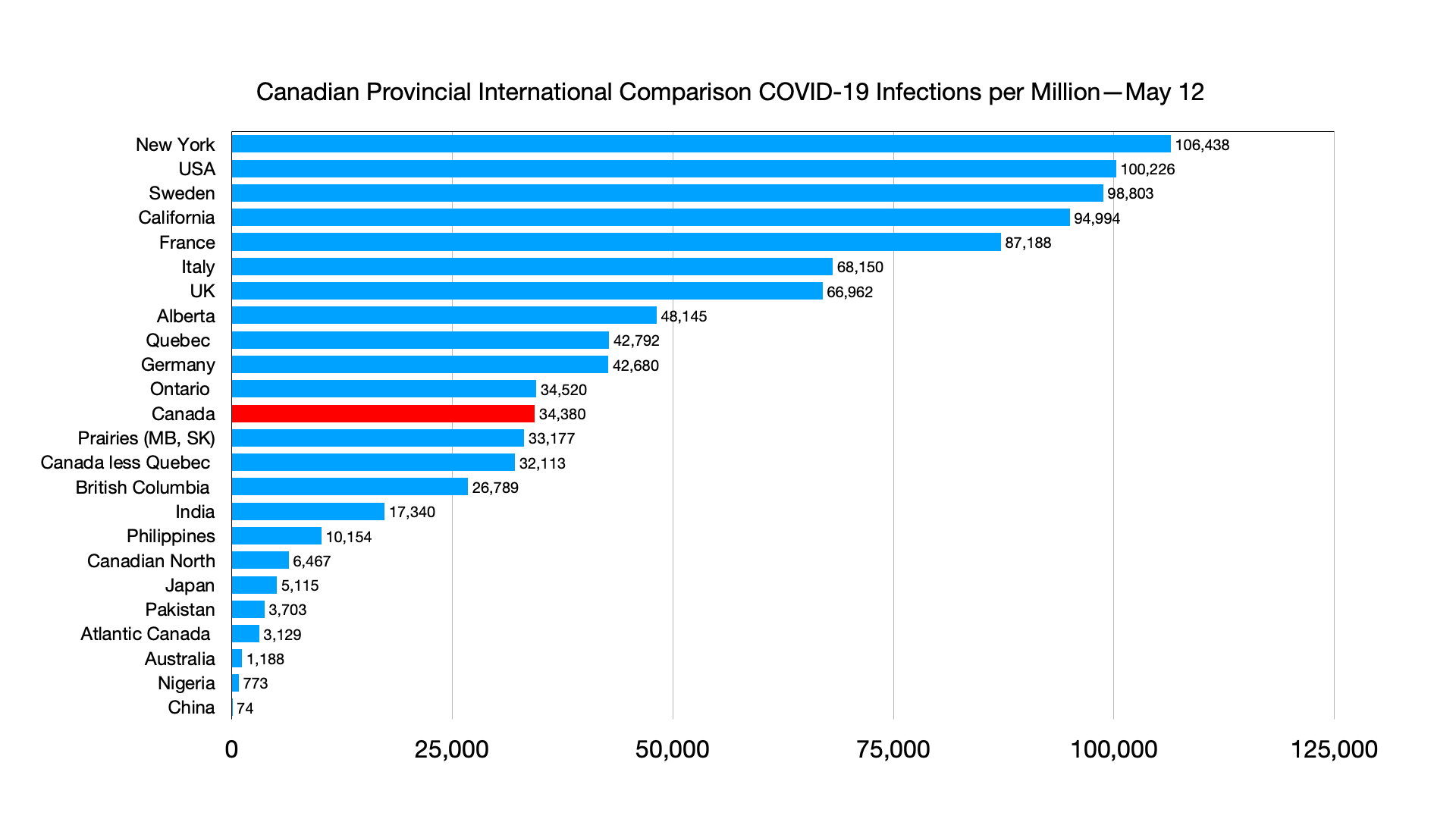
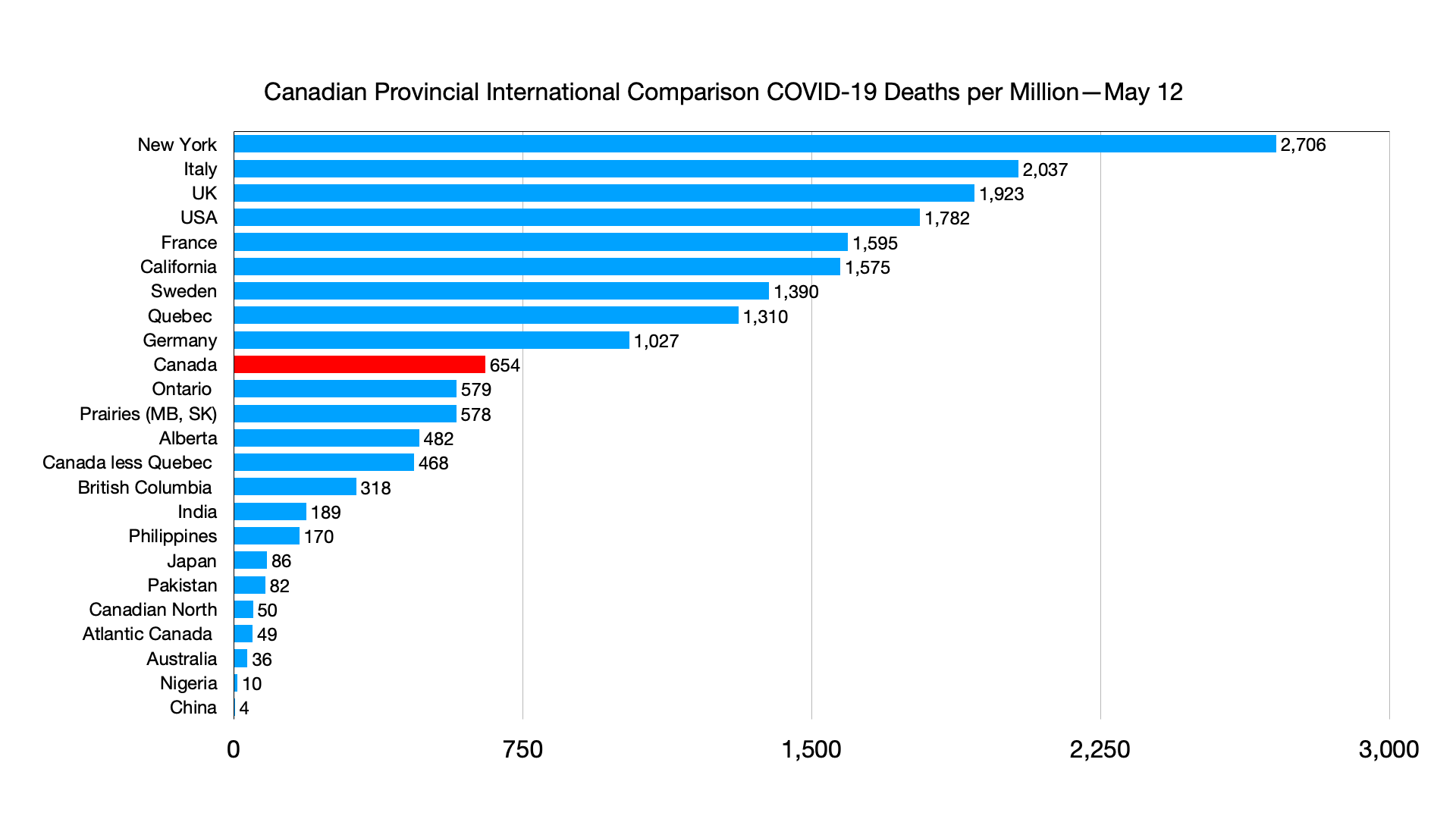
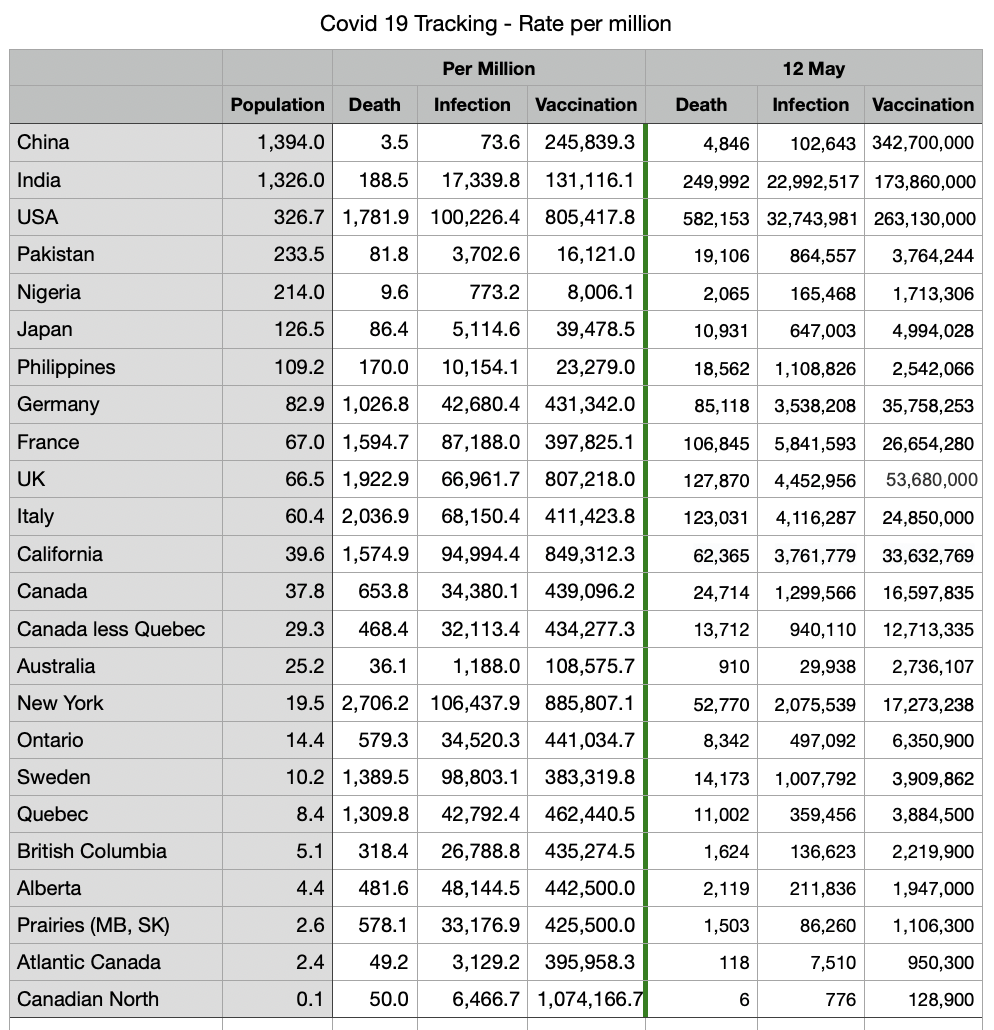
The latest charts, compiled 7 April as the third wave has started.

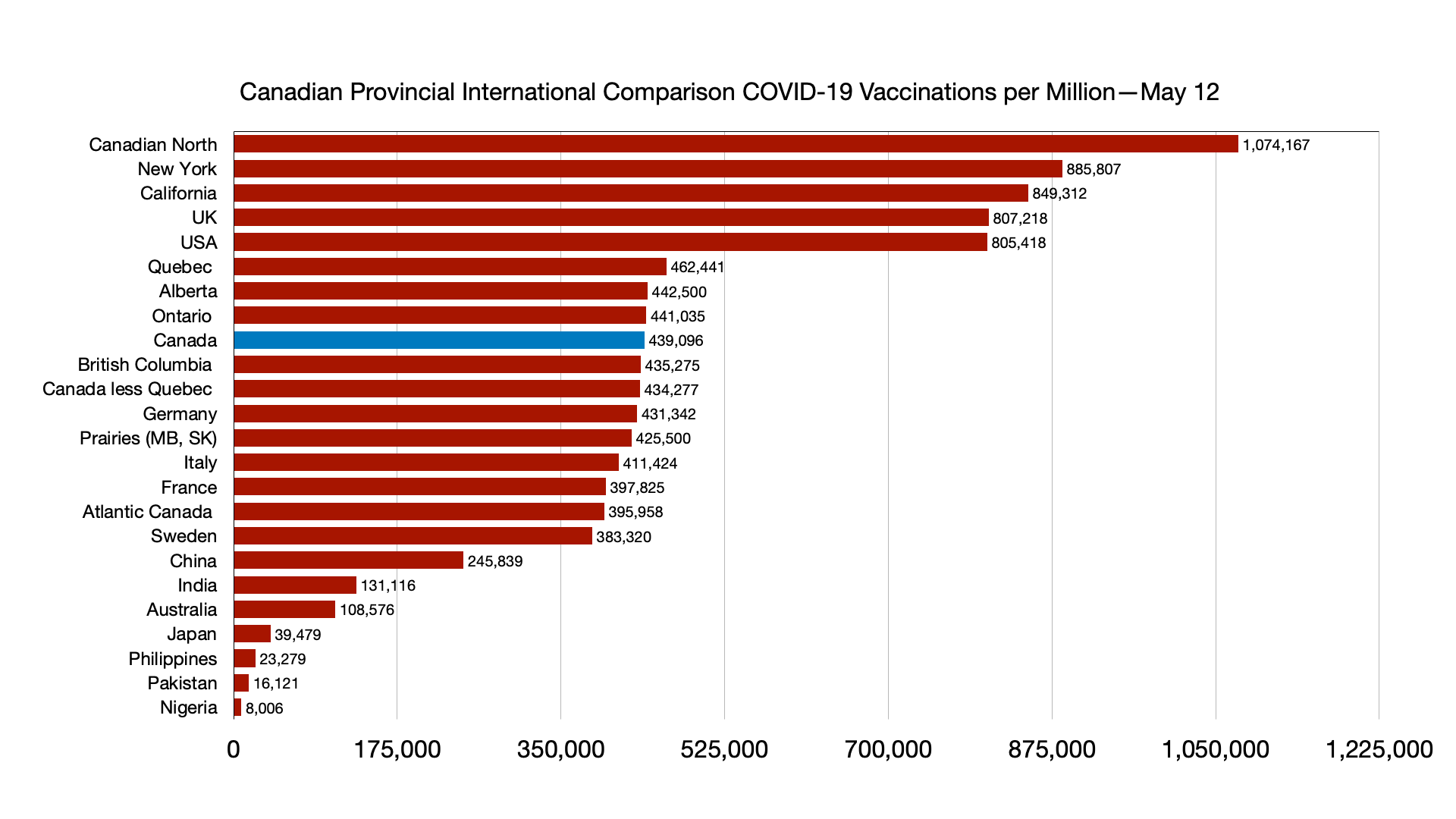
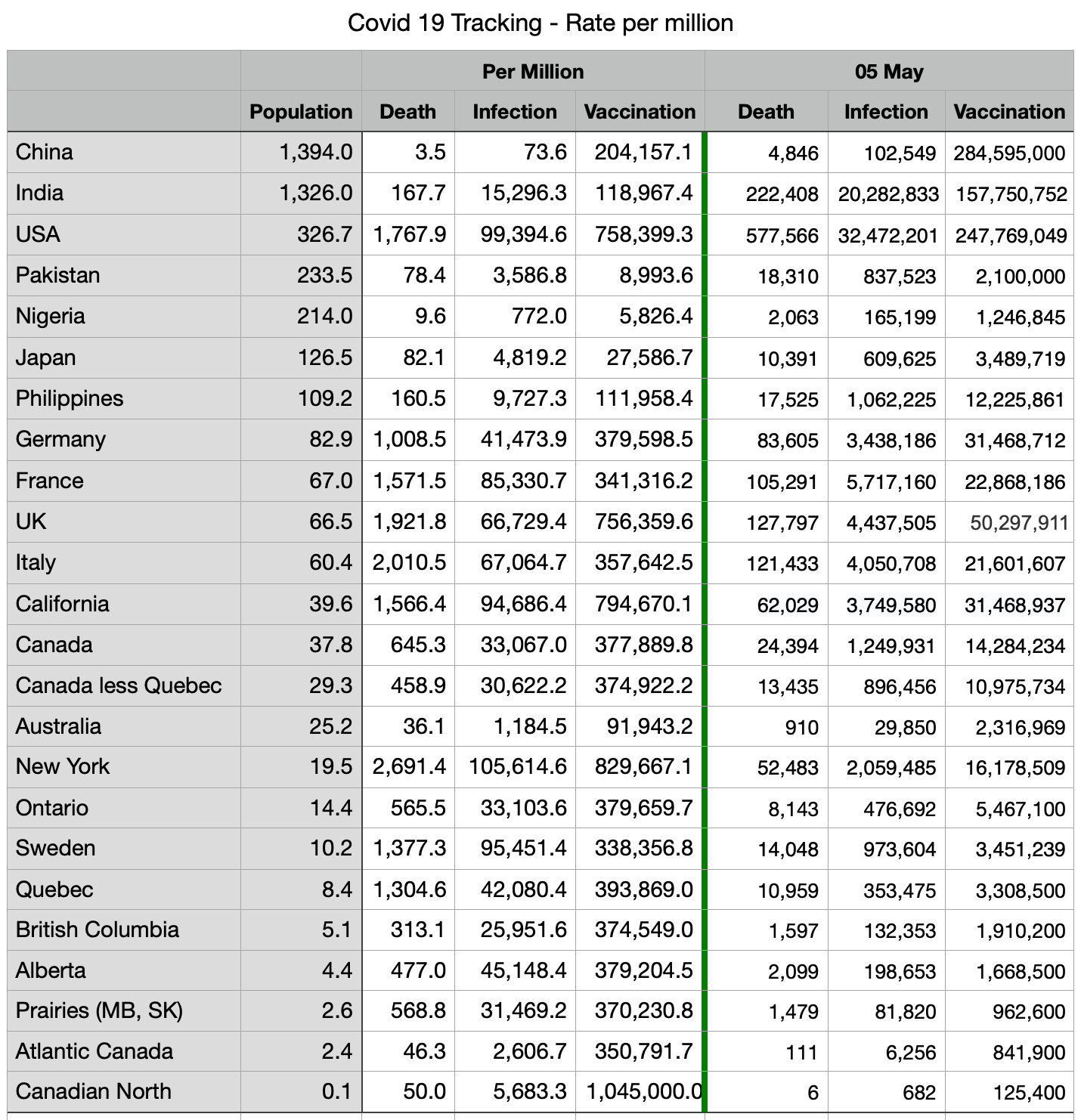
Vaccinations: Change from last week: Some Canadian provinces doing slightly better than EU countries. Quebec ahead of France, Ontario ahead of Germany, British Columbia and Canada ahead of Sweden,  Prairies ahead of Alberta.

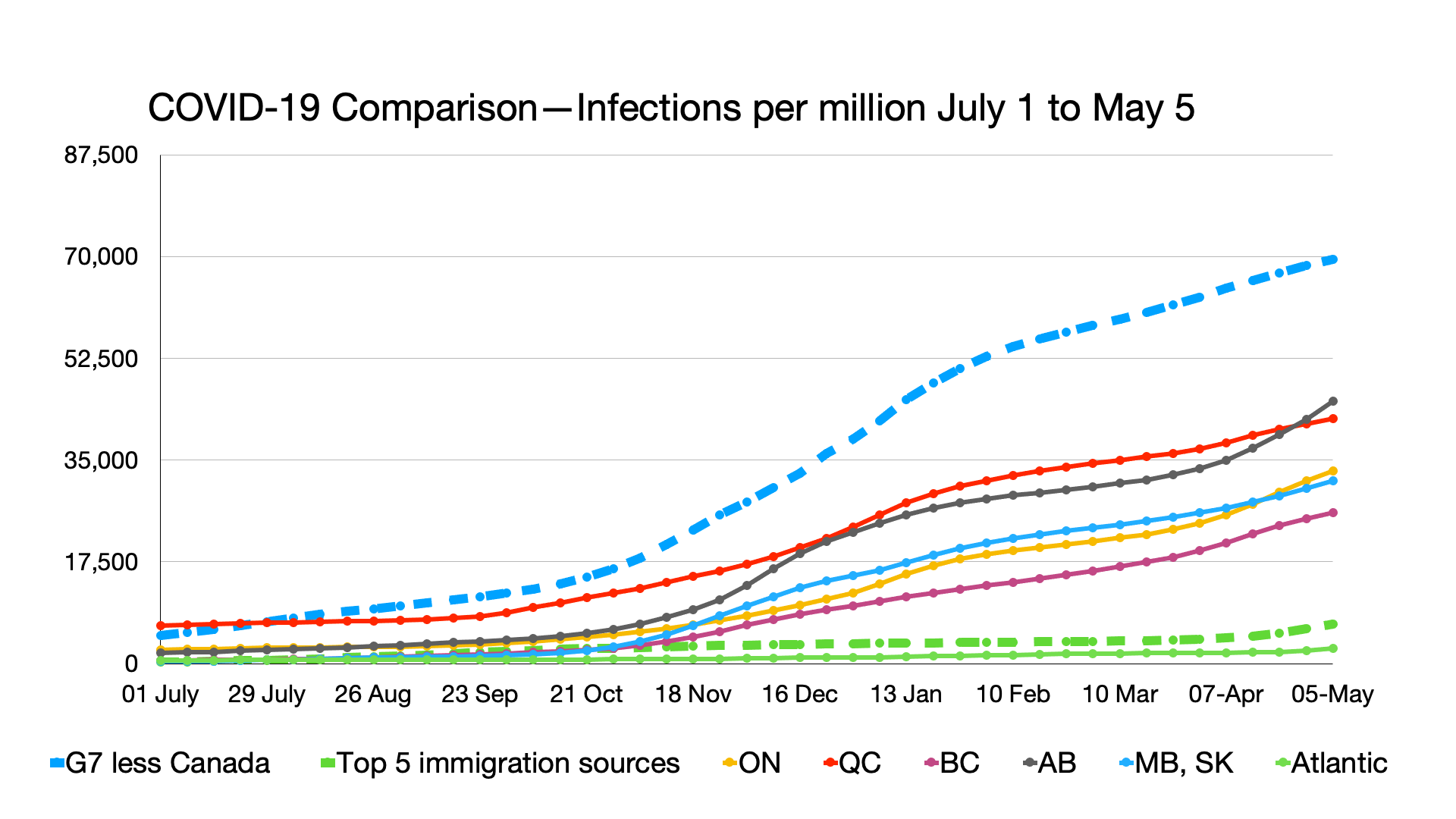
Trendline charts

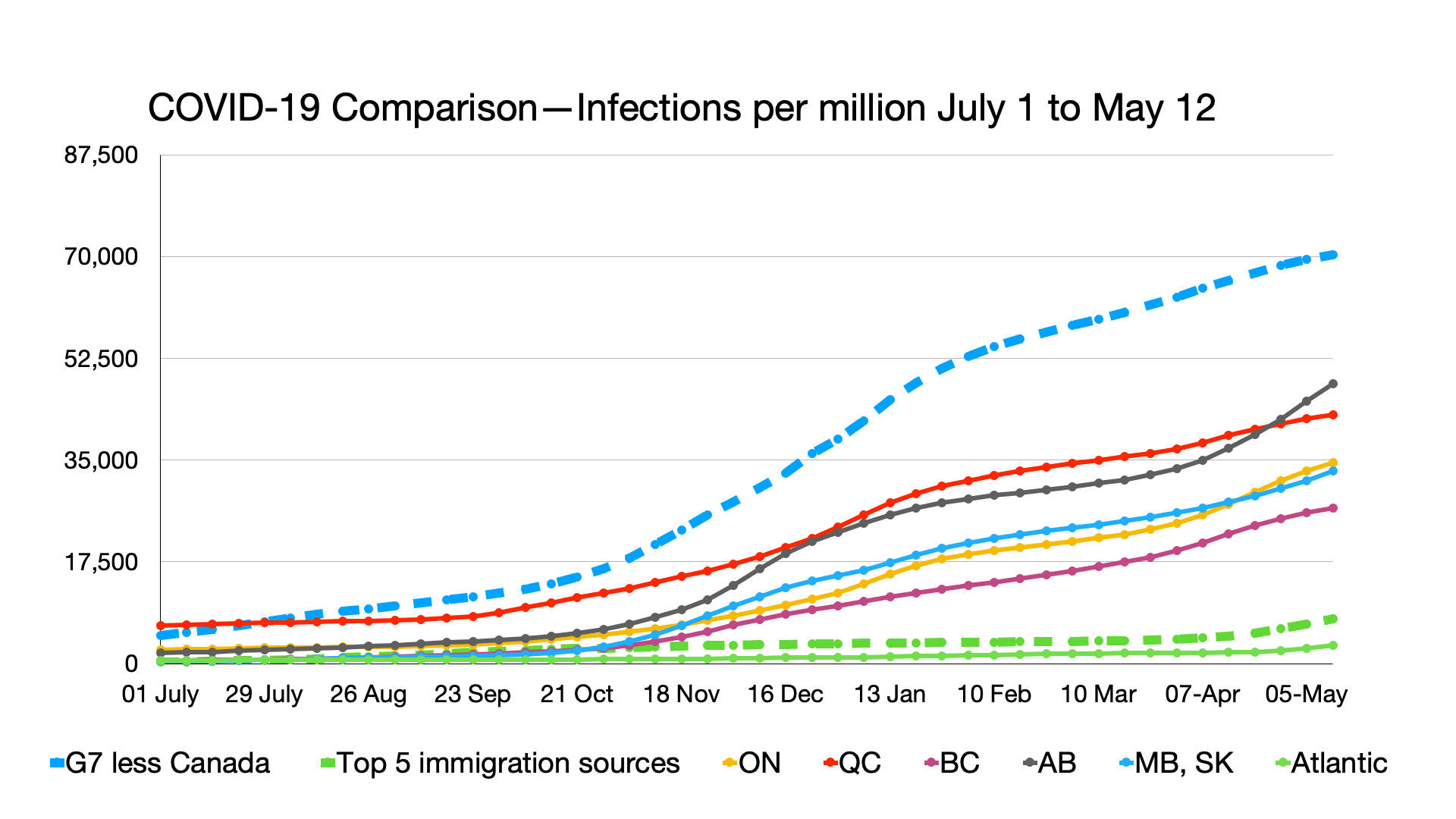
Infections per million: Overall steady increase of infections in most provinces but better than G7 less Canada.

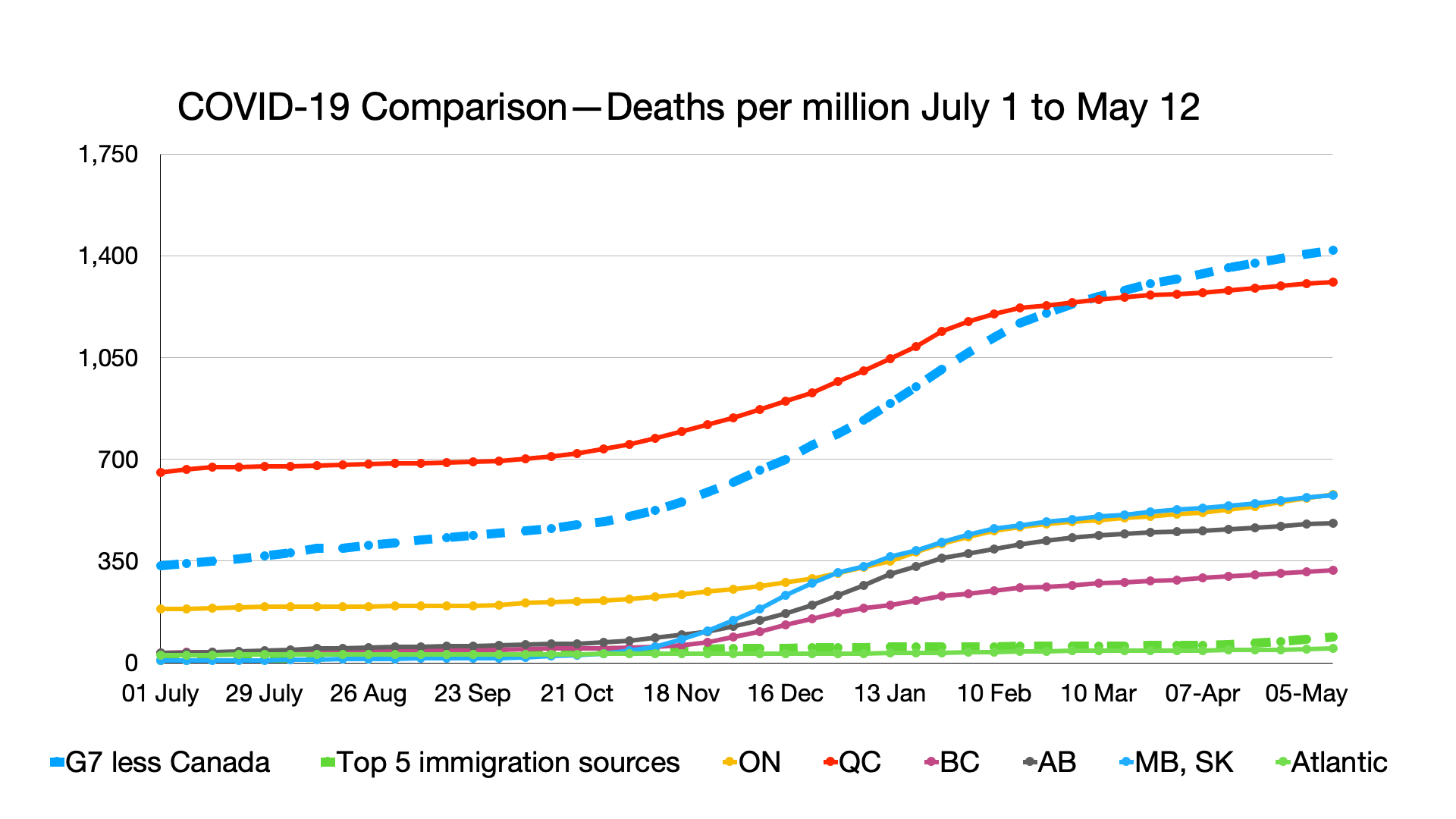
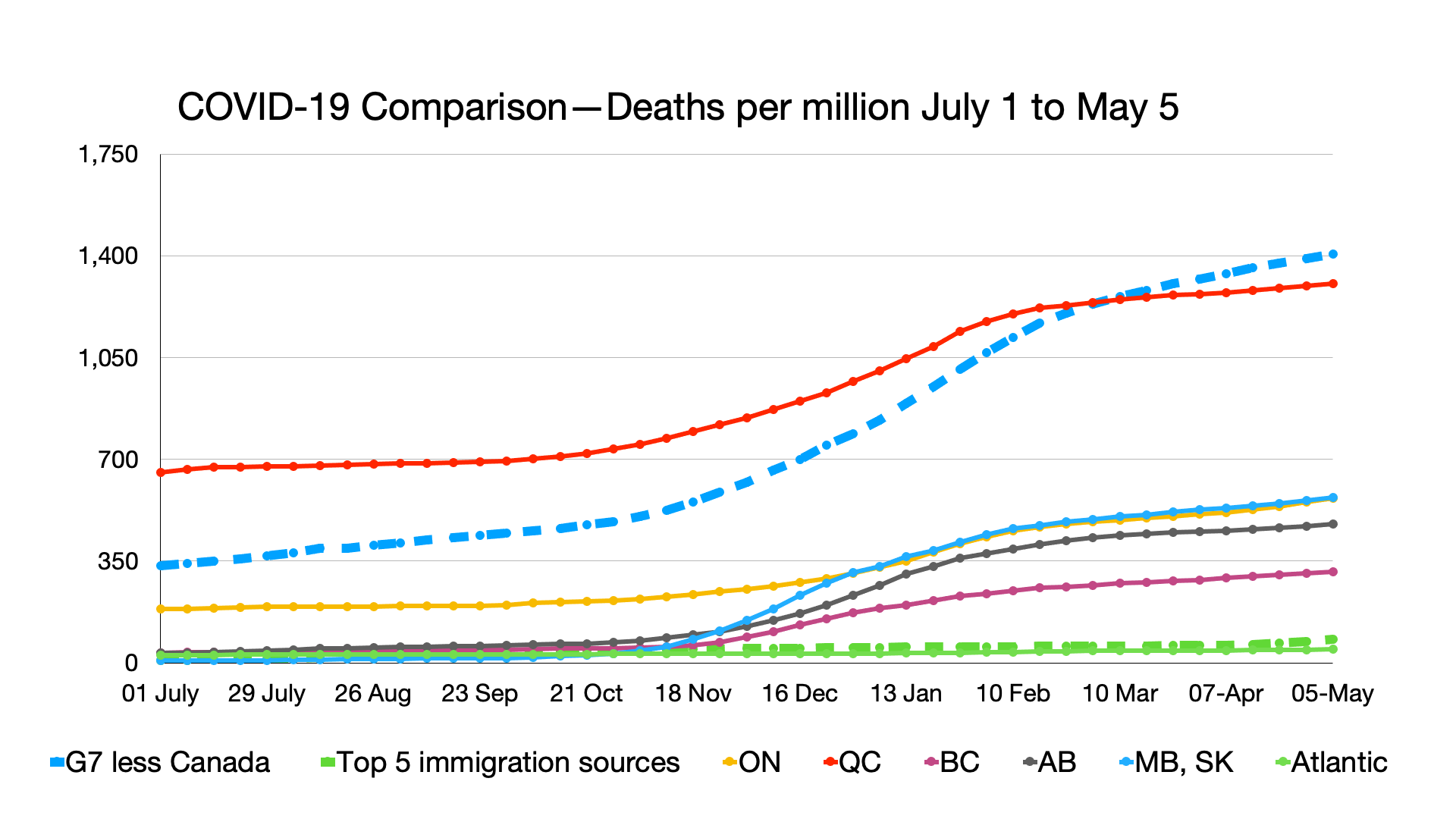
Deaths per million: No major changes.

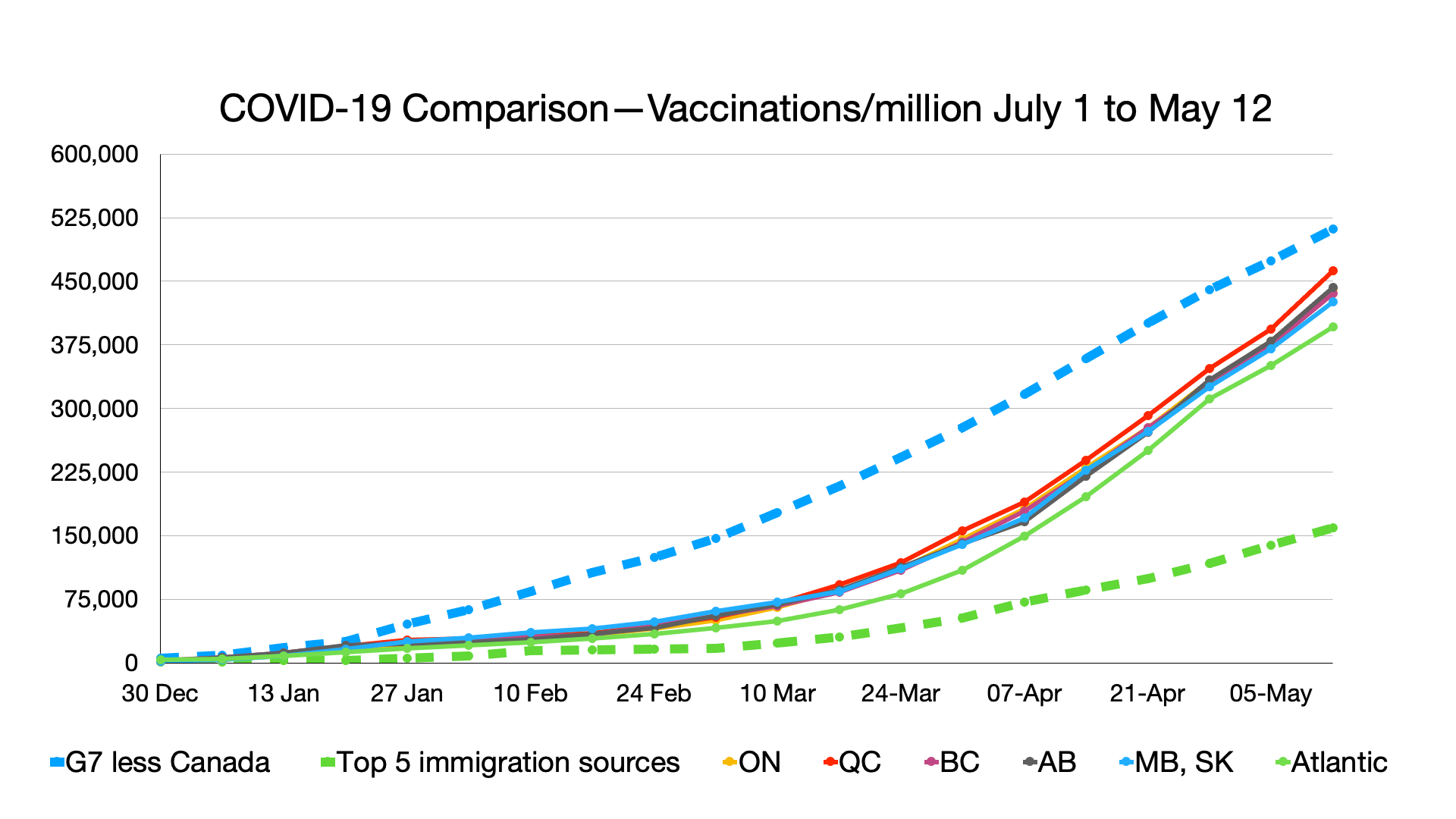
Vaccinations per million: While the gap between G7 and Canada remains, the rate has largely approached other G7 countries. Of note is the increase in vaccination rates of immigration source countries (China and India).

Weekly

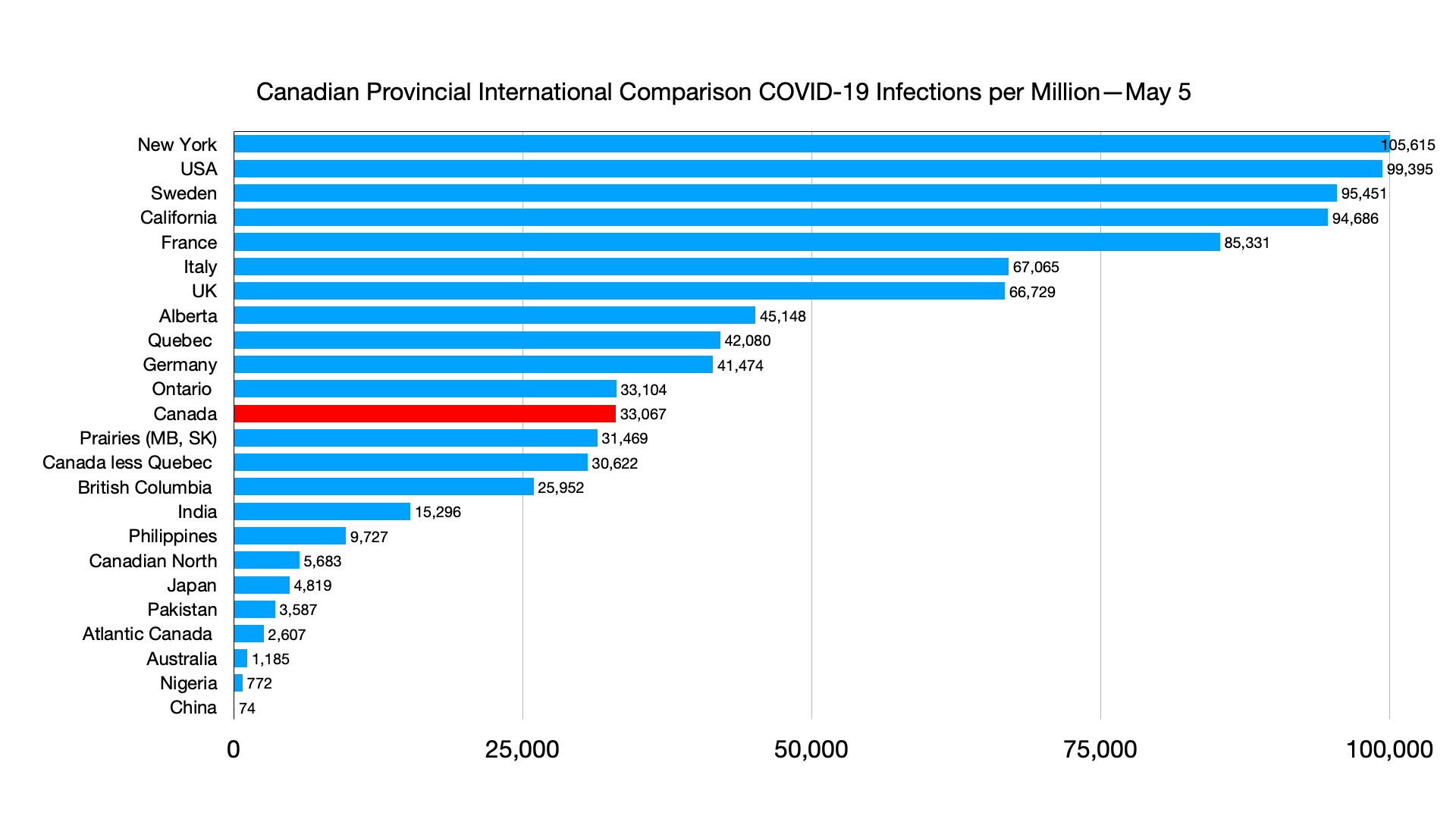
Infections per million: Some minor shifts: Alberta ahead of Germany, Canada ahead of Prairies.

Deaths per million: No relative change.

Un Français qui a échoué à un test de français pour immigrer au Québec dénonce un processus «trop sélectif»

Not aware of similar circumstances with English test but anecdotally I have heard immigrants with advanced English knowledge have bristled at having to pay for testing to become citizens:

Yohan Flaman est français et a fait toute sa scolarité en français. Arrivé au Québec en 2018, il a pourtant échoué à une partie du test de français pour obtenir sa résidence permanente. Il dénonce « un processus beaucoup trop sélectif », trop cher et « contre-productif », symptomatique selon lui des autres cafouillages récents du système d’immigration dans la province.

« Sincèrement, on dirait que c’est un examen qui est fait pour être raté », lance-t-il aujourd’hui après avoir réussi le test à son deuxième essai et déposé sa demande de résidence permanente. « Je m’étais dit que c’était dans la poche, mais les consignes sont tellement longues et certaines questions sont tirées par les cheveux. » Chaque section du test est également minutée de manière très serrée, ajoute-t-il.

Pour être sélectionné comme immigrant permanent à travers le Programme de l’expérience québécoise (PEQ), un candidat doit en effet démontrer sa maîtrise du français. Il y a plusieurs façons de le faire : en ayant une scolarité de trois ans en français de niveau équivalent au secondaire, en prouvant la réussite d’un cours de francisation de niveau 7 ou encore en passant l’un des tests reconnus par le ministère de l’Immigration, de la Francisation et de l’Intégration (MIFI).

Pressé par le temps

Le niveau 7 (sur un total de 12) est considéré par le MIFI comme un niveau intermédiaire. Il implique de pouvoir communiquer à l’oral dans des situations partiellement prévisibles à propos de besoins courants. Quant au test, le niveau à atteindre est « B2 », soit intermédiaire avancé, ce qui implique de pouvoir donner « des avis argumentés » et de converser ou de comprendre un discours « de façon claire et détaillée ».

La section mesurant la compréhension orale du français a particulièrement donné du fil à retordre à Yohan Flaman : il faut répondre à 60 questions en 40 minutes (y compris les consignes données à l’oral), ce qui équivaut à moins de 40 secondes par question. « Je n’imagine pas combien ça peut être difficile pour quelqu’un qui apprend le français en plus de son travail à temps plein, dit-il. Je comprends qu’il faut un minimum, mais la barre est trop haute. »

L’homme de 39 ans se porte ainsi à la défense d’autres collègues qui ne sont pas francophones. Si même un Français peut échouer, alors le Québec se met clairement « les bâtons dans les roues », dit-il. Il va sans dire qu’un échec à ce test, qui coûte 240 $, a un effet domino sur le reste du dossier.

Maintenant que sa demande est déposée, M. Flaman n’est tout de même pas au bout de ses peines. Le Devoir révélait la semaine dernière qu’il faut actuellement compter entre 27 et 33 mois pour obtenir sa résidence permanente. « Beaucoup d’amis et de collègues sont dégoûtés et retournent en France », raconte celui qui admet avoir lui-même songé à repartir avec sa femme québécoise.

Il déplore surtout le fait de n’avoir « aucun interlocuteur » pour faire le suivi de son dossier d’immigration. « La seule chose que l’agent d’immigration peut te dire, c’est que ton dossier est en traitement. Toi, tu as juste le droit de fermer ta gueule », laisse-t-il tomber.

Une question délicate

Le jeune homme met au défi les Québécois d’essayer de passer ce genre d’épreuve, tout en soulignant l’ironie que ces tests soient envoyés en France pour être corrigés. Les deux entités qui administrent la passation de ces examens sont en effet enregistrées de l’autre côté de l’océan, soit France Éducation internationale et la Chambre de commerce et d’industrie de Paris.

Camionneur de longue distance depuis son arrivée avec un permis de travail temporaire, Yohan Flaman fait régulièrement des voyages du Centre-du-Québec vers les États-Unis. « Je me débrouille en anglais et, même si c’est parfois limité, l’important est de se comprendre », explique-t-il.

Comme plusieurs autres travailleurs temporaires, il considère donc que de nombreux secteurs d’emploi ne nécessitent pas une connaissance aussi élevée du français pour fonctionner et s’intégrer.

En effet, Le Devoir rapportait jeudi que plusieurs travailleurs temporaires et associations d’employeurs demandent à Québec d’assouplir les exigences de français pour certains programmes d’immigration économique dans la province. « Ce n’est vraiment pas l’ouvrage qui manque », dit M. Flaman.

La protection du français fait l’objet d’un large consensus au Québec, mais les emplois occupés par les travailleurs temporaires ne nécessitent pas toujours un français avancé. « C’est presque tabou. Selon moi, c’est une forme d’aveuglement puisque les Québécois eux-mêmes tombent vite dans l’anglais dans certains milieux de travail », observe quant à lui Stephan Reichhold, directeur de la Table de concertation des organismes au service des personnes réfugiées et immigrantes.

Dans le cas où des immigrants temporaires ne parviendraient pas au niveau 7 en français, seul le ministère de l’Immigration, de la Francisation et de l’Intégration a le pouvoir de contourner cette règle.

Pour l’instant, seul un programme pilote pour les travailleurs en intelligence artificielle qui gagnent plus de 100 000 $ par année permet de déroger à cette règle du français.

Source: Un Français qui a échoué à un test de français pour immigrer au Québec dénonce un processus «trop sélectif»

English version below:

If someone from France can fail Quebec’s French test for immigrants, how hard is it for a non-francophone to pass?

Yohan Flaman, 39, a truck driver from Limoges, France, who came to Quebec in 2018 under the Quebec Experience Program, wasn’t too nervous about taking the French test set by the department of Immigration, Francization and Integration.

Source: Immigrant from France fails Quebec’s French test for newcomers

@JohnIbbitson: Canadians need to form a consensus on long-term #immigration policy [but what should that consensus be?]

John Ibbitson follows on this previous article, Politics It’s time for Canada to focus on expanding our population, highlighting former PM Mulroney’s call for increased immigration and a Canadian population around 100m by the turn of the century and the need for a white paper to help build the arguments to get us there.

However, before we get too caught up in the advocacy by the Century Initiative, the Business Council of Canada and the Globe and Mail, we should step back and ask some fundamental questions a white paper should ask beyond the basic demographic arguments:

  • Does more immigration increase or decrease inequality?
  • In the immediate post-COVID period, should immigration increase given what we know from previous downturns regarding how the most recent immigrants suffer short and some longer-term scarring?
  • How should we factor in the lower-paid “essential workers” and will increased immigration improve their working conditions or not?
  • Longer-term, what are the more likely affects of automation and AI on the labour market and the need for skilled and semi-skilled workers?
  • How realistic is it to improve settlement of immigrants outside of our major cities and regions given past and current experience?
  • Will Canada realistically invest in the needed public and private infrastructure needed to accommodate such growth, again given past and current experience?
  • Will Canada be able to do so in a manner that respects our current and likely future climate change commitments?
  • Will Indigenous peoples accept increased immigration and the focus on newcomers compared to their concerns?
  • Will the greater imbalance between immigration to Quebec and the rest of Canada place further pressures on the federation?

A white paper that largely replicates the group think of the Century Initiative and related players would be a disservice to Canadians, rather than the needed more thoughtful and balanced discussions:

Though progressives and conservatives in the United States disagree on practically everything, they do agree that Canada has a better immigration system.

But as a new paper in the magazine American Affairs points out, they think this only because neither side fully understands how the Canadian system works.

Right-wing Americans praise Canada’s ability to police its borders while focusing on economic migrants who can make an immediate contribution. No less an authority than Donald Trump declared, when he was president: “I think we should have merit-based immigration like they have in Canada” so that “we have people coming in that have a good track record.”

But American conservatives would be less impressed if they realized that Canada protects its border through a dense skein of rules and regulations, a so-called bureaucratic border wall.

The left, on the other hand, celebrates Canada’s robust commitment to diversity through immigration. But they would be appalled to learn that those same bureaucratic rules – such as requiring that all employees provide a social insurance number – make it virtually impossible for undocumented workers to live in this country, and that our system limits diversity by favouring immigrants from more-developed regions, such as South and East Asia, over less developed regions, including parts of Africa, Latin America and the Caribbean.

“Each side sees only what it wants to see, emphasizing those aspects of Canada’s system that align with their ideological predispositions, while excluding the others,” wrote Michael Cuenco, a Canadian writer based in Calgary.

“The most vocal elements of the Right and the Left are like the blind men grasping at different parts of an elephant. No one has bothered to offer to either side an honest description of the whole.”

Both the left and the right in the U.S. might be even more nonplussed were they to learn that former Progressive Conservative prime minister Brian Mulroney has joined a growing chorus calling for Canada to more than double its population to 100 million by 2100.

They might not understand that what truly distinguishes the Canadian immigration system from the American is that Canada’s reflects decades of increasing ideological convergence on immigration policy, even as America becomes ever-more polarized.

The question for Canadians is whether we are willing to converge on future immigration targets in the same way we have in the past.

Progressive Conservative prime minister John Diefenbaker first declared that immigration should be colour-blind. Lester B. Pearson’s Liberal government converted that principle into the points system. Liberal Pierre Trudeau married immigration to multiculturalism, while Mr. Mulroney tripled the intake. Liberals Jean Chrétien and Paul Martin converted a system that favoured the family-class category into one that favoured economic-class applicants, while Conservative Stephen Harper and Liberal Justin Trudeau further refined and expanded the program.

If future Liberal and Conservative governments were to choose to, say, (a) convert the temporary target of more than 400,000 immigrants a year recently established to overcome the cutbacks imposed by the pandemic into a permanent target; b) gradually move toward 500,000 a year over the course of this decade and c) reassess Canada’s needs as the population approaches 50 million at mid-century, that would be nothing out of keeping with the past six decades of immigration policy, which saw Canada’s population more than double from 18 million in 1960 to 38 million today.

Whether we want that future is something else. Proponents of population growth must convince skeptics that Canada can more than double in numbers while still meeting commitments on global warming, that cities can grow in population without increasing sprawl, that creativity and productivity require a young, dynamic populace.

But we need to remember: We got where we are by agreeing we should grow robustly, and that it didn’t matter where people came from, as long as they shared the values that ground the nation. That’s what brought the Irish and the Germans and the Ukrainians here in the 19th century, what brought the Italians and Portuguese and Greeks here after the war, what brought the Vietnamese boat people here and people from Somalia and Lebanon, the Hong Kongers and then Mainlanders and new arrivals from French West Africa and Haiti, the Sikhs and Hindus from India and the Sri Lankans and Filipinos and …

A hundred million? Why stop?

Source: Canadians need to form a consensus on long-term immigration policy

Fears that international student intake will keep falling

Not much new but nevertheless worth reading:

Canada suffered a year-on-year drop of between 20% and 30% in international student enrolment between the 2019-20 academic year and the 2020-21 academic year because of the COVID crisis.

The absence of 65,000 international students is already affecting local economies, university budgets and research in the STEM (science, technology, engineering and mathematics) fields.

But university and college administrators, and non-governmental organisations involved with bringing international students to Canada are concerned that travel rules introduced in February 2021 to restrict the spread of COVID-19 will further depress the numbers of international students coming to Canada, both this spring and in September.  

Since this February, international flights to Canada can land only in Montreal, Toronto, Calgary and Vancouver, and travellers have been required to be quarantined at designated hotels.  

According to Denise Amyot, president and CEO of Colleges and Institutes Canada, these new regulations have disproportionately impacted colleges and universities in smaller cities and rural and remote areas because students must serve the entirety of their quarantine at the government-approved hotels.  

“There’s no designated airport in Atlantic Canada,” she notes. International students destined for universities in this region must first quarantine in a hotel at one of the hubs at a cost of CA$2,000 (US$1,600).

“This is very costly, especially for an international student,” Amyot says.  

In addition, once the student travels to their destination university in, say, Halifax, Nova Scotia, or Quebec City, they will have to quarantine again. While the final tallies are not in, Amyot says, because of these two layers of quarantine, we are seeing a large number of deferrals for the spring, summer and upcoming fall intakes.

International students whose universities are near one of the designated airports must quarantine in the government-approved hotels for at least three days, the period it normally takes to receive COVID-19 test results. If they test negative, and if their school has a plan approved by the local health authority and the federal government, the student can be taken to a quarantine centre on his or her school’s campus.  

In an effort to lessen the financial burden on international students, the University of Waterloo in southwestern Ontario picks up the cost for days four through to 14 for students who quarantine on its main campus in Kitchener, Ontario. 

“The cost,” says University of Waterloo Associate Vice Provost Chris Read, “is about CA$2,000 and includes transportation from the airport, accommodation and food”. This programme explains why the university’s year-over-year enrolment of international students has remained stable at 8,861 in 2020-21 compared with 8,897 the year before. 

Concerns about international students’ mental health has prompted the University of Calgary to include a Zoom-based buddy system in its quarantine programme. The buddies are not counsellors, says Dean and Vice-Provost Dr Robin Yates, but are peer volunteers, “a friendly face who will keep them company”.

For its part, in addition to providing quarantine space in its dormitories, the University of Toronto has established a CA$9.1 million (US$7.2 million) fund to help international students pay for the period of time they have to quarantine in a hotel.

The financial impact resulting from the absence of international students is being felt across the country and is affecting the bottom line of universities and colleges, according to Professor Robert Falconer of the University of Calgary School of Public Policy.

“Across the country, with a few exceptions, universities are relying more and more on international students as a primary source of revenue. British Columbia is most exposed with over 50% of its tuition revenue coming from international students,” he says. 

The differential rates charged to international students varies, but, Falconer told University World News, “it is quite significant”. At Falconer’s university, tuition and fees for international students in the sciences is CA$8,000 (US$6,400) a year, while it is CA$3,000 for domestic students. 

The figure is even greater at the University of Waterloo. Tuition fees for domestic students enrolled in graduate studies in architecture are CA$10,900 as compared to CA$59,700 (US$47,600) for international students. In the faculties of applied health sciences and art, the tuition fees for each group are CA$7,700 and CA$40,900, respectively. 

According to Yates of the University of Calgary, the differential paid by international students is vital. “It helps institutions to be able to offer programmes, especially smaller institutions, that they would not have been able to afford otherwise, either because the schools did not have enough money or enough domestic students to be able to offer that programme.”

Marco Mendicino, minister of immigration, refugees and citizenship, could not have been blunter. “If we didn’t have international students, we would have a gaping hole in our economy. They contribute CA$21 billion [US$16.7 billion] to the Canadian economy as compared to CA$19 billion contributed by the automotive industry,” he says.

“This contribution might not be noticed in larger centres, but in small university towns like the University of Lethbridge [Alberta] or in Thunder Bay [Lakehead University], Ontario, they have a large impact through renting homes and buying goods and services,” says Falconer. 

Threat to STEM programmes

Falconer, Yates, Amyot and the other experts University World Newsinterviewed were especially concerned with how the decline in the number of international graduate students threatens Canada’s STEM programmes.

Of the 2,000 international graduate students at the University of Calgary, some 400 have requested deferrals and have remained in their home countries.  

According to Yates, about 200 are studying remotely. In his immunology lab, Yates told University World News that while certain tasks, such as data analysis, can be done remotely for a month or two, at some point you have to go back into the lab to generate more data.  

“Graduate students comprise a significant part of the workforce doing meaningful research that is pushing the research agenda forward for Canada. Anywhere between 20% and 80% of any given research group is composed of graduate students and on average a little more than one third of these students are international graduate students.”

Yates’ University of Calgary colleague, Falconer, is concerned that the brain drain in the STEM fields will hobble Canada’s post-COVID recovery. 

“The OECD countries are considering what a post-COVID industrial policy, and research and development policy looks like. We have to consider [whether without these students] we even have the staffing and personnel industrial base to facilitate a post-COVID industrial economy?” he asks.

To the question, especially in a pandemic, of why Canadian taxpayers should be funding graduate schools that educate international students, Yates answered: “To drive research agendas and move our research forward, we need the best and brightest from across the globe. The taxpayers deserve when they spend millions of dollars on research that that money be spent in the best way possible. And that is to get the best people here into Canada.”

It is important, Yates adds, that people understand that the pure or applied research that international graduate students undertake in labs like his undergirded the creation of the vaccines against COVID-19.  

“The PhDs that come out of these programmes are making and designing these vaccines. The workforces that are in AstraZeneca, Moderna and Pfizer are sourced from graduate programmes and these include international students,” he says.

Corridor kept open

Minister Mendicino, Falconer and Amyot each emphasised that unlike similar countries such as Australia, Canada has kept the corridor for international students open because of the long-term importance of international students to the country.  

At present 25% of Canadians are older than 65, which means that for each retired person there are fewer than three working and paying into the social insurance system and taxes.  

“Canada needs immigration. We need people to decide to live here because we have such a low [1.5] fertility rate,” says Amyot.  

“Despite the challenges of the pandemic,” says Mendicino, “we have kept the international programme open, and we have improved it.” 

The four improvements, Mendicino explained to University World News, amount to a ladder, at the top of which international students can apply for permanent residency and, ultimately, citizenship.  

The first improvement allowed international students to start their studies online in their home country. 

The second changed the international students’ work permits to give them the right to work in fields other than their course of study. 

The third was keeping open the corridor, which required planning with universities and colleges, and, negotiating agreements with the provinces; this last always a fraught activity in the fractious Canadian federation. 

The fourth improvement provides additional work permit flexibility to postgraduate students so as not to penalise them for starting their programmes online. Once they have graduated and found jobs, thousands of (former) international students apply for permanent residency.

“What I see as minister is an opportunity to broaden and accelerate the pathways that not only allow international students to come and study but also to stay in Canada and build the next chapter of their lives in Canada,” says Mendicino, who himself is the child of Italian immigrants.

Source: https://www.universityworldnews.com/post-nl.php?story=20210402091353306

AOC Expertly Breaks Down Why Words About Immigration Matter

Interesting reframing of the increase in asylum seekers at the Southern border:

Rep. Alexandria Ocasio-Cortez (D-NY) gave a compelling argument on immigration policy on Tuesday, dismissing the term “border crisis” and instead calling it an “imperialism crisis” and a “climate crisis.”

While answering questions from her Instagram followers Tuesday night, Ocasio-Cortez responded to someone who asked, “Why are you not addressing the border crisis and the kids in cages like you used to?”

“Are you for real?” Ocasio-Cortez responded. “So often people wanna say, ‘Why aren’t you talking about the border crisis?’ Or ‘why aren’t you talking about it in this way?’ Well, we’re talking about it; they just don’t like how we’re talking about it.”

Ocasio-Cortez continued, saying it’s not a border crisis but rather, “It’s an imperialism crisis, it’s a climate crisis, it’s a trade crisis.” The current immigration system is based on the U.S. carceral system, she said, and the solution should be “rooted in foreign policy.”

Last month, White House press secretary Jen Psaki confirmed that there had been an influx of people at the U.S.-Mexico border in recent months, overwhelming the facilities set up to house them. Psaki said factors including the pandemic creating “undue hardships,” natural disasters, and flight from violence or persecution has contributed to the rise in people.

Ocasio-Cortez attributed the United States’ outsized role in the climate crisis to the increase of natural disasters in regions including the global south, which has ultimately forced people in those regions to leave their homes.

“The U.S. has disproportionately contributed to the total amount of emissions that is causing a planetary climate crisis right now,” Ocasio-Cortez continued on Instagram. “But who is bearing the brunt of that? … It’s actually not us.”

She continued: “It’s South Asia, it’s Latin America that are gonna be experiencing the floods, wildfires and droughts in a disproportionate way, which ding ding ding, has already started a migration crisis.”

Ocasio-Cortez also denounced calling the increased number of people crossing the border a “surge,” because of the term’s militaristic and white supremacist connotations.

“This is not a surge. These are children,” Ocasio-Cortez said. “And they are not insurgents. And we are not being invaded — which by the way is a white supremacist idea, philosophy. The idea that if an other is coming in the population, that this is like an invasion of who we are.”

Last week, President Joe Biden addressed immigration at the U.S.-Mexico border during his first official press conference, including children being detained for long periods of time instead of being transferred to shelters. Biden said the increase in people migrating to the U.S. in the winter months occurs every year. (While the total number of people crossing the border is relatively similar to prior years during the same period, the number of unaccompanied children crossing the border between January and February 2021 is significantly up, government data shows.)

“The reason they’re coming is that it’s the time they can travel with the least likelihood of dying on the way because of the heat in the desert, number one,” Biden said.

He proposed “putting together a bipartisan plan of over $700 million to deal with the root causes of why people are leaving” their countries. Biden also said former President Trump eliminated funding for government agencies like Health and Human Services to provide proper care for migrant families, which has led to the influx of children being detained. (NBC reported that this claim is partially true.)

Source: AOC Expertly Breaks Down Why Words About Immigration Matter

Evidence Mounts That Reducing Immigration Harms America’s Economy

Some useful recent studies, particularly with respect to H1-B visas and skilled workers. Less convinced by some of the general demographic arguments, similar to those made in Canada by the Century Initiative and others. Shout-out to Canadian Darrell Bricker and John Ibbitson, authors of the book Empty Planet, making the same broader arguments (with some of the same fallacies):

Donald Trump’s immigration policies were harmful to America’s long-term economic future. That becomes clearer as one compares the Trump administration’s actions to the projected increase in the number of immigrants under recently introduced immigration legislation. The U.S. Citizenship Act, developed by the Biden administration, would aid long-term economic growth by increasing the number of legal immigrants by 28%. In contrast, Trump administration policies would have cut legal immigration in half. The immigration policy path America chooses in the long-term will make a significant impact on economic growth and future labor force growth, of which immigrants are a vital part.

Economic growth or growth in Gross Domestic Product (GDP) is necessary for a country’s inhabitants to improve their standard of living. “GDP growth [economic growth] is made up of growth in the workforce plus growth in labor productivity,” according to Robert S. Kaplan, president and CEO of the Federal Reserve Bank of Dallas. “Unless slower workforce growth is offset by improved productivity growth, U.S. GDP growth will slow.”

The Trump administration’s immigration policies harmed long-term economic growth by reducing labor force growth and potential productivity growth through restrictive policies.

High-skilled foreign nationals are important to productivity growth. Yet the Trump administration increased the denial rates of H-1B petitions, causing many long-time H-1B visa holders to leave the United States. The administration also blocked the entry of H-1B visa holders and published regulations that employers believed would make it nearly impossible for many foreign-born scientists and engineers to work in the United States.

“When we aggregate at the national level, inflows of foreign STEM [science, technology, engineering and math] workers explain between 30% and 50% of the aggregate productivity growth that took place in the United States between 1990 and 2010,” according to economists Giovanni Peri (UC, Davis), Kevin Shih (RPI) and Chad Sparber (Colgate University). Research by economist Britta Glennon found rather than saving jobs, H-1B restrictions “have the unintended consequence of encouraging firms to offshore jobs abroad.”

While the Biden-supported U.S. Citizenship Act may have a difficult time becoming law, it serves as a marker for changes to legal immigration by increasing both family and employment-based immigration. The bill would have a positive impact on labor force growth by raising immigration by 28% a year after a transition period.

“Increasing legal immigration by 28% a year would increase the average annual labor force growth in the United States by 23% over current U.S. projections, which would help economic growth and address a slower-growing U.S. workforce,” according to an analysis by the National Foundation for American Policy (NFAP). “The average annual labor force growth could be even more than 23% compared to a scenario of no immigration increases because the Bureau of Labor Statistics currently projects the U.S. labor force will grow by 800,000 a year, and that baseline growth may be lower after 2029 without the increase in immigration contained in the bill.”

“In contrast,” the analysis continues, “if the United States continued the Trump administration’s policies that administratively reduced legal immigration by approximately 49%, average annual labor force growth would be approximately 59% lower than compared to a policy of no immigration reductions, according to an NFAP analysis. Under policies that reduced legal immigration by half, in 40 years the United States would have only about 6 million more people in the labor force than it has today. Admitting fewer immigrants results in lower economic growth because labor force growth is an important element of economic growth and immigrants play a major part in both current and future labor force growth.”

A recent National Foundation for American Policy study by Madeline Zavodny, an economics professor at the University of North Florida, shows the positive impact of immigration.

“Analysis of U.S. Census Bureau data finds international migration was the only source of population growth in rural areas as a whole during most of the 2010s,” writes Zavodny. “International migration is strongly related to employment growth in both rural and metro counties. Each additional international migrant is associated with an additional 1.2 jobs in rural counties over 2010 to 2018. The estimate for rural areas suggests that international migration adds to total employment well beyond the jobs filled by international migrants. International migrants may have a larger impact on employment because of the jobs they fill. International migrants may work in jobs that otherwise would go unfilled by local residents and thereby enable businesses to expand.”

Due to declines in fertility, immigration keeps the United States from experiencing negative population growth, according to the U.S. Census Bureau.

New economic research finds that negative or falling population growth may yield harmful economic outcomes beyond slowing labor force growth. Fewer available minds may mean fewer solutions to our problems. What if the breakthrough advances in mRNA made by Katalin Karikó, an Hungarian-born immigrant to America, never happened or occurred years later because Karikó was never born? How would that have affected the development of vaccines and other potential solutions to medical problems?

In a recent paper, “The End of Economic Growth? Unintended Consequences of a Declining Population,” Charles I. Jones, a professor of economics at the Stanford Graduate School of Business, writes, “What happens to economic growth if population growth is negative? We show below—first in models with exogenous [external] population growth and then later in a model with endogenous (internal) fertility—that negative population growth can be particularly harmful.” He asks: “How do idea-based growth models behave when population declines?”

In sum, with fewer people, “knowledge and living standards stagnate.” Jones writes, “If knowledge were to depreciate at a constant exogenous [external] rate, it is easy to show in the simple models at the start of this paper that this would lead to declining living standards in the presence of negative population growth, an even more dire outcome.”

“We refer to this as the Empty Planet result,” writes Jones. “Economic growth stagnates as the stock of knowledge and living standards settle down to constant values.”

Immigration can prevent population decline in the United States and allow America to grow—if U.S. elected officials choose the right policies. “Among great powers, the coming population decline uniquely advantages the United States,” according to Darrell Bricker and John Ibbitson, authors of the book Empty Planet, the title to which Charles Jones referred. “For centuries, America has welcomed new arrivals, first from across the Atlantic, then the Pacific as well, and today from across the Rio Grande. Millions have happily plunged into the melting pot—America’s version of multiculturism—enriching both its economy and culture. Immigrants made the twentieth century the American century, and continued immigration will define the twenty-first as American as well.

“Unless. The suspicious, nativist, America First groundswell of recent years threatens to choke off the immigration tap that made America great by walling up the border between the United States and everywhere else. Under President Donald Trump, the federal government not only cracked down on illegal immigrants, it reduced legal admissions for skilled workers, a suicidal policy for the U.S. economy. If this change is permanent, if Americans out of senseless fear reject their immigrant tradition, turning their backs on the world, then the United States too will decline, in numbers and power and influence and wealth. This is the choice that every American must make: to support and open, inclusive, welcoming society, or to shut the door and wither in isolation.” It is a significant choice.

Source: Evidence Mounts That Reducing Immigration Harms America’s Economy

Ibbitson: It’s time for Canada to focus on expanding our population

As regular readers will know, I am not convinced that the arguments of the Century Initiative take into account the shorter-term impact of COVID on immigrant outcomes and the longer-term impact of automation and AI in their support of vastly increased immigration.

But the range of well-known people they have mobilized in their advocacy is impressive.

Their National Scorecard on Canada’s Growth and Prosperity is yet another approach to measuring how well Canada is doing with respect to overall socio-economic outcomes.

I do find it odd that a newspaper would take such a high profile advocacy role, essentially organizing a promotional event rather than a discussion more inclusive of diverse perspectives. Preaching to the converted rather than engaging those who need to be engaged.

That being said, the idea of a white paper makes sense, but its mandate needs to take a broader perspective on immigration, citizenship and multiculturalism than just justifying increased immigration levels.

And should we not also consider how to manage an aging population, not just focussing on increasing it?

On Brian Mulroney’s watch, Canada almost tripled the number of immigrants coming to Canada each year, from fewer than 90,000 people to more than 250,000.

Now Canada’s 18th prime minister is calling on Canadians to embrace what he calls “a new national policy” that would commit this country to achieving a population of 100 million by the end of the century.

“If we are going to maintain … our internal strength and our growth and our capacity and our outside influence, we need more people – a lot more,” Mr. Mulroney said Tuesday at a forum presented by The Globe and Mail and by Century Initiative, which champions the goal of a Canada that is 100-million strong by 2100.

Increasing the population by more than 60 million people would be “an historic and challenging initiative,” Mr. Mulroney acknowledged in an interview. After all, it took more than 150 years to get Canada’s population to 38 million. More than doubling it in about half that time would require much greater political and popular will than exists today.

Hence his proposal for “a white paper which indicates the need for 100 million people by the turn of the century.”

A white paper is a document through which a government puts forward a major policy proposal. If there is sufficient support, after consultation with experts, provincial governments and the broader population, it becomes settled policy, maintained by future governments whatever their partisan stripes.

Criticism of a white paper can be more important than the white paper itself. A deeply flawed white paper in 1969 that essentially called for the assimilation of First Nations into the general population helped give birth to Indigenous activism.

Conversely, a white paper on immigration produced three years earlier, which called for the final dismantling of racial barriers to accepting newcomers, led the Pearson government to invent the points system, which rated applicants based on how well they matched what the country was looking for, regardless of race.

High levels of race-blind immigration, embraced by both Liberal and Conservative governments, gave us the Canada we live in today. But the pandemic has restricted recruitment, and once the shortfall has been made up, there remains this vital question: How many people should live here?

A white paper on population, followed by a parliamentary committee travelling across the land, would encourage discussion, build momentum and, no doubt, focus opposition, which deserves to be heard.

Ideally, both Liberals and Conservatives at the federal level would express support for a target of 100 million through votes in the House and Senate.

If so, “that would become the new objective of Canada in this area,” Mr. Mulroney said, “and all governments would be bound to strive to achieve it.”

Such a goal would push Canada ahead of Germany and France and Britain in population, and probably ahead of Japan and South Korea and Vietnam as well.

That’s because the economic insecurity generated by the pandemic has exacerbated the decades-long trend of fertility decline. Low fertility, coupled with resistance to immigration, has led to population decline in dozens of countries.

Canada’s willingness to aggressively recruit newcomers leaves us better positioned to weather the demographic storms ahead than just about any other country. Taking immigration from 300,000 a people a year to a million, along with enhanced supports for child care and parental leave, would reduce labour shortages and help pay for the health care and pension needs of older Canadians, while boosting creativity and innovation. Imagine the contribution that a Toronto that was the size of New York or London or Tokyo would make to this country and to the world.

That said, the pandemic has completely disrupted how we live and work. The patterns of the past may never return. All sorts of assumptions – about downtowns and suburbs and rural areas, about commutes – may have to be rethought.

And as fertility continues to drop, the greatest obstacle to achieving a population of 100 million might be, not internal resistance, but a shrinking pool of available immigrants.

Nonetheless, Mr. Mulroney urges us to embrace “this indispensable cause.” For him, “this is a great dream of Canada, and it requires leadership to bring it true.”

Let the discussion begin, and let it begin with a new white paper on population.

Source: https://www.theglobeandmail.com/politics/article-its-time-for-canada-to-focus-on-expanding-our-population/

Ottawa to extend eligibility criteria for Yazidi refugees: Mendicino

Good:

Ottawa is adopting a new policy to help more Yazidis and other survivors of the Islamic State of Iraq and the Levant reunite with their families in Canada, Immigration Minister Marco Mendicino said Tuesday.

Mendicino said it will allow more Yazidi refugees to join extended family members, including siblings, grandparents, aunts and uncles.

The Yazidis and other groups who survived abuse, torture and even genocide at the hands of ISIL are among the most vulnerable refugees in the world, he said.

“Guided by compassion, we are now redoubling our efforts to reunite their families.”

The Immigration Department said the new policy will help Yazidis and members of other communities in Northern Iraq to start new lives in Canada.

These refugees were victims of threats or acts including sexual slavery, general enslavement, torture, inhuman or degrading treatment, family separation and forced displacement, the department said.

Canada has welcomed more than 1,400 survivors of ISIL from Northern Iraq since 2017.

This includes 1,356 government-assisted refugees and 94 privately sponsored ones. Women and girls comprise the vast majority.

The Yazidi newcomers have been primarily resettled to Toronto, London, Ont., Winnipeg and Calgary where Yazidi communities existed and adequate support, including medical, social and interpretation services, was in place.

Source: Ottawa to extend eligibility criteria for Yazidi refugees: Mendicino

#COVID-19: Comparing provinces with other countries 31 March Update

The latest charts, compiled 31 March, in the context of a likely third wave.

Vaccinations: Change from last week: Slight decline in gap between EU countries and Canadian provinces. USA overall ahead of California, New York, France and Quebec ahead of Germany, Ontario ahead of Sweden but Sweden ahead of Canada and Canada less Quebec, British Columbia ahead of Alberta and Prairies.

Trendline charts

Infections per million: The previous trend of a flattening curve is seen in G7 countries and most provinces appears to be changing for the worse.

Deaths per million: Most Canadian provinces continue to flatten the curve, Quebec most dramatically. Overall G7 death rate continue to surpass Quebec’s by an increasing margin.

Vaccinations per million: While the gap between G7 and Canada remains despite the arrival of more vaccines, one can see that Canadian provinces have been ramping up. The increase in vaccination rates of immigration source countries driven by China and India.

Weekly

Infections per million: Some minor shifts: New York ahead of USA and California, Germany ahead of Alberta.

Deaths per million: No relative change.

ICYMI: Canada’s schools draw fewer international students due to pandemic travel rules

Seeing this in the monthly stats:

Many international students have postponed or cancelled their plans to study in Canada since Ottawa decided last month to limit entry options to the country to just four airports and require international travellers to pay for a mandatory hotel quarantine.

Denise Amyot, the chief executive officer of Colleges and Institutes Canada, said a $2,000 hotel bill is the cost of half of a semester for many students.

“(They) don’t have that kind of means,” she said.

If a group of international students are heading to New Brunswick, for example, Amyot said they might arrive in Toronto, where they would go to a hotel for three days as part of a 14-day quarantine.

Then, because they will be moving to another province with its own rules, they will have to quarantine again for 14 days when they arrive in New Brunswick.

“This is nonsense. It just doesn’t make sense,” she said. “It means that for the spring and summer, we have a large number of deferrals.”

Amyot said the number of international students at Canadian colleges has declined by 20 to 30 per cent in the 2020-21 academic year compared to 2019-20.

“It has varied across the country, and we had larger declines in smaller cities and rural and remote areas.”

She said many international students are deferring their plans to study in Canada since the federal government funnelled all international flights to Toronto, Montreal, Calgary or Vancouver and began requiring travellers to quarantine at government-approved hotels.

“Those two measures that the government has put in place are jeopardizing the number of students arriving,” she said.

Amyot called on the government to exempt international students from the three-day stopover requirement.

The office of Transport Minister Omar Alghabra said in a statement that any decision to ease or modify border measures in Canada will be based on scientific evidence.

“Entry prohibitions, coupled with mandatory isolation and quarantine, continue to be the most effective means of limiting the introduction of new cases of COVID-19 into Canada at this time,” the statement said.

Even before the new entry restrictions were imposed, the total number of all international students in Canada had already declined by about 17 per cent last year, to 531,000 students at the end of 2020 from 639,000 in 2019, according to an analysis of Statistics Canada data.

Paul Davidson, the chief executive officer of Universities Canada, said the overall enrolment of international students at Canadian universities has declined by 2.1 per cent this year compared to last.

“It’s against a backdrop where typically the number of international students at universities has grown at over 10 per cent in each of the last five years, so it is quite a setback,” he said.

“We have 96 universities at Universities Canada, and 51 of those institutions saw a decline in the international students … Overall, 26 institutions saw a loss of over 10 per cent of their international students.”

Fewer international students in Canadian post-secondary schools means less revenue for these institutions, which will affect domestic students, said Amyot.

“It means that there will be less programs that can be offered,” she said.

“It’s not only a matter of dollars … There are some programs that are very popular with international students, but not so much for domestic students, and that’s especially in more technical areas linked to engineering or mining … Now (these programs) won’t be offered, because there’s not enough students.”

Amyot said the decrease in international student numbers will eventually create a gap in the labour force in Canada.

“(International students) also come with skills,” she said. “It means that there will be a gap because we won’t be able to count on those students, and who will suffer? The industry, because there will be a labor shortage.”

She said Canadian colleges and universities have used innovation to allow international students to complete their studies online.

Robert Falconer, a researcher at the University of Calgary School of Public Policy, said international students studying online at Canadian schools from their home countries might lose interest in immigrating to Canada.

“They might decide, after getting their Canadian degree, that they’re not going to really bother coming to Canada because they’ve never been, they don’t have prospects here and no social network or job opportunities.”

Amyot said education institutions had quarantine plans in the fall for their international students, letting them go to their quarantine locations safely. Local public health authorities and the provincial and federal governments approved.

“It was working very well for the fall intake, but now with this new measure that was taken in place, everything is in the air,” she said.

Davidson said all international students, from kindergartners to PhDs, contribute about $22 billion a year to Canada’s economy.

“It’s a major contributor to Canada’s economic growth,” he said. “The decline in international student numbers is having a widespread economic impact in Canada.”

A spokesman for Immigration Minister Marco Mendicino said the government has encouraged international students to stay in Canada during the pandemic.

“While other countries told international students to go home during the pandemic, we went to great lengths to support them and create a system that allowed them to continue their studies,” Alexander Cohen said in a statement.

The department has tried to make it easier for international students to apply for work permits after they graduate, including counting the time they spend studying online toward the period of time needed to make them eligible, for instance.

Davidson said the United States is reducing barriers to immigration for international students and the government of the United Kingdom is marketing to international students and expediting visa processing for them.

“This is a competitive landscape we’re working in,” he said. “The government of the U.K. is offering guaranteed visa approvals (for international students) in about three weeks, which is much faster than Canada.”

Source: Canada’s schools draw fewer international students due to pandemic travel rules