Immigration Minister promises to address concerns over new federal immigration program

Lots of commentary regarding the barriers encountered by temporary workers in “other essential sectors” given language proof requirements, computer skills and accessibility and the like (likely less significant for healthcare workers not clear, and not barriers to international students).

The initial application numbers, as of about 5:30 this morning, highlight the barriers:

  • Healthcare workers: 644 applications out of 20,000 slots;
  • Essential non-healthcare workers: 4,460 out of 30,000;
  • International graduates: 37,778 out of 40,000 (almost completely subscribed).

The federal Immigration Minister says he is working to address concerns about a program launching this week that is aimed at creating a pathway to permanent residency for 90,000 people.

Marco Mendicino said he is committed to working with stakeholders and that he is open to the criticisms of various migrant groups as the program begins Thursday.

Announced in April, the program is designed to grant permanent residency to thousands of temporary foreign workers and graduated international students.

Under the measures, 20,000 temporary foreign workers in health care, 30,000 workers in other occupations deemed essential and 40,000 international students who have graduated from a university or college will be able to apply to become permanent residents.

“Before we prematurely rush to make any judgments about the train being on the tracks, let’s see it pick up steam, and ensure it stays on track and gets to its final destination,” Mr. Mendicino said Wednesday, “which is to welcome 90,000 newcomers in a way that is unprecedented.”

In a news conference this week, the Migrant Rights Network, representing organizations across Canada, said current requirements for this program, the short timeframe and the arbitrary caps ensure that only those in the best situations will be able to apply.

Opposition parties have called for a broader opening to welcome many more than 90,000 people.

On Wednesday, the minister was asked about specific problems with the program. They included application guides only now being available, many people scrambling to get language tests required to apply, and essential workers facing challenges applying.

In response, Mr. Mendicino said the program is “unprecedented” and ambitious. It was not a forgone conclusion that the government would proceed with the effort during a pandemic, he said, but that it was launched because of feedback from economists and the immigrant and migrant-workers community.

“I also acknowledge that because it is a new program, we have a lot of legwork to do to make sure that it is communicated clearly and there will be access to the program,” he said.

He added that guidelines have now been posted online, clarifying application needs. and said language-instruction operations are working to meet the demand.

Despite the minister’s assurances, Syed Hussan, executive director of the Migrant Workers Alliance for Change, said in an interview that he remained concerned about what his group sees as flaws in the program

He said, based on the alliance’s research, that the 90,000 openings fall far short of meeting the needs of 1.6 million migrants and undocumented people in Canada. He also said only a estimated 470,000 people can apply for spaces under the current rules.

“This is a short-term window, which excludes most people. It prioritizes those with the highest earnings, the highest access, and excludes the essential, low-wage workers that the Prime Minister, the Immigration Minister and most of our society says we value.”

Source: Immigration Minister promises to address concerns over new federal immigration program

New Cato Survey Helps Reframe the Debate Over Legal Immigration

Cato Institute’s summary of the key takeaways of their survey that will inform their future work, featured earlier:

My colleagues Emily Ekins and David Kemp just released an excellent new survey on how Americans view immigration and identity. We all worked together on crafting the questions for several months prior to publication and the results are very interesting. Below are some findings and some lessons that folks who support immigration should take to heart.

First, the survey shows that most people know almost nothing about immigration. Even basic facts elude them. About 14 percent of the U.S. population is foreign‐​born but the average respondent thinks that 40 percent of the country’s population is foreign‐​born. Immigrants were the most likely to think that the immigrant population of the United States is high, estimating that 56 percent of the country is foreign‐​born, while third generation and higher Americans estimated 36 percent.

The differences likely result from where the respondents reside in the United States. Immigrants live close to other immigrants and native‐​born Americans live close to other native‐​born Americans. For instance, about 27 percent of California’s population is foreign‐​born compared to just 1.5 percent in West Virginia. Those who live closer to other immigrants are probably more likely to overestimate the immigrant percentage of the population. Using those two states as examples, immigrants in California overestimated the foreign‐​born share of the population by about a factor of two, while third generation and higher Americans in West Virginia were off by a factor of 24. Regardless, native‐​born Americans and immigrants both overestimate the share of immigrants.

Second, focusing on understandable metrics when communicating how the legal immigration system functions is more effective. Americans can better conceptualize the handful of years it takes to wait for a green card than the borderline abstract large quantity of visas issued per year. For example, one of the survey questions asked how long it should take to immigrate to the United States. Eighty percent of respondents said that it should take five years or less to immigrate, and they may have chosen that number because the question prompted them with a mention of a five‐​year average. However, 52 percent of respondents said it should take less than five years. However, responses to another question revealed that 61 percent of respondents said they wanted fewer than one million immigrants a year – probably because one million is a large and abstract number that is difficult to visualize even though it’s a relatively small number of people compared to the roughly 330 million people living in the United States. By comparison, everybody understands what five years feels like and 80 percent of respondents answered that immigrants should wait five years or less for a green card. One lesson is that we should talk about immigration restrictions in terms of waiting times rather than numbers of visas. On the policy side, a maximum wait time for a visa without regard to the numerical caps would increase the number of visas issued without increasing the numerical caps on paper and be more rhetorically appealing. Fortunately, Cato proposed just such a reform in 2020.

Third, Americans care much less about job protectionism than we all thought. Two‐​thirds of respondents said that businesses should be “allowed to hire whoever they believe is best qualified for the job regardless of nationality.” This is great news because wage and job‐​protection regulations are responsible for a large percentage of the regulatory costs for sponsoring immigrants for employment‐​based green cards and other temporary work visas such as the H-1B, H-2A, and H-2B. Removing those regulations would face less popular backlash than many of us assumed.

Fourth, most Americans think that restrictive immigration laws cause illegal immigration. Forty‐​one percent said illegal immigration is caused by the legal immigration system being too restrictive and 19 percent said illegal immigrants were ineligible to apply. Most respondents are primed to understand that restrictions and government bureaucracy are the causes of illegal immigration.

Fifth, 56 percent said that simplifying the legal immigration process is a better way to deal with illegal immigration than building a border wall or increasing border security. This is incredibly good news for those of us who want to expand and liberalize legal immigration. Some findings in the field of political psychology suggest otherwise, that perceptions of chaos along the border influence voters to oppose immigration liberalization. Apparently, most people see chaos and their instinct is to support more enforcement and government control rather than liberalization. This creates a Catch‐​22 because the only way to get sustainable control over the border is through liberalization but liberalization can only be politically sustainable if voters think the border is under control. On the contrary, this survey result indicates that respondents are more open to liberalization as a means of border control than the political psychology literature suggests.

There are many other fascinating findings in this Cato survey on immigration and identity and I recommend that you read and digest it all. However, the above findings are those that we will seek to most incorporate into our work.

Source: New Cato Survey Helps Reframe the Debate Over Legal Immigration

Le critère du français pourrait être abaissé pour certains immigrants au Québec

Of note (reality):

Pour être plus compétitif, Québec envisage de modifier sa grille de sélection et d’abaisser le critère de la connaissance du français pour les travailleurs qualifiés de certains secteurs. Rappelant que l’immigration doit répondre aux besoins du marché du travail, la ministre de l’Immigration, de la Francisation et de l’Intégration, Nadine Girault, a reconnu que pour attirer certains talents, les programmes devront s’ajuster.

« On va modifier une partie, car on veut aller chercher des spécialistes du marché. Dans certains secteurs, c’est extrêmement difficile [d’attirer des gens qui parlent français] », a-t-elle dit en répondant aux nombreuses questions de l’opposition lors de l’étude des crédits de son ministère mardi. « Le critère du français va être toujours là. On veut le faire en fonction des différents postes, mais on est en train de négocier là-dessus. »

Certains projets pilotes testent actuellement cette possibilité, a rappelé la ministre. « On va peut-être regarder pour ouvrir certains de ces postes de nos projets pilotes à des gens qui ne sont pas nécessairement francophones actuellement, mais qui auront l’obligation de se franciser », a-t-elle précisé, assurant que ces personnes devront « signer un engagement formel » pour se franciser.

Mme Girault a déclaré du même souffle que le français devait être encouragé chez les immigrants. « On ne baissera pas le niveau de français et c’est pour ça qu’on met tous les efforts en francisation. On a augmenté le nombre de ressources en francisation », a-t-elle dit, soulignant que jamais autant d’argent n’aura été mis en francisation que les 170 millions consacrés en 2019 par son prédécesseur, Simon Jolin-Barrette.

Un « recul majeur »

Cette déclaration de la ministre a fait grandement réagir les députés de l’opposition. « On a un recul majeur si on est en train de réviser pour certains secteurs professionnels le niveau de français exigé. Surtout que ça vient d’un gouvernement qui dit qu’il aurait le plan le plus costaud en matière de protection de la langue française », a déclaré au Devoir la députée péquiste Méganne Perry-Melançon. Selon elle, le niveau de français ne doit pas uniquement être déterminé par le cadre professionnel, le rôle qu’il joue dans l’intégration doit aussi être pris en compte. « Ces gens-là doivent pouvoir se sentir intégrés et ça passe certainement par la maîtrise du français. »

La députée libérale Christine St-Pierre a quant à elle dénoncé le double discours de la ministre Girault. « Il y a le discours comptable et économique de dire que dans certains secteurs, ce n’est pas grave si on réduit les critères de français, mais pour d’autres catégories, on va dire aux gens qu’ils seront soumis à des critères plus sévères et stricts. » Pour elle, les gens pour qui le critère du français sera abaissé se destinent à des emplois nichés, bien payés et visant des entreprises qui se concentrent à Montréal, alors que plusieurs études ont démontré que la métropole s’anglicise. « C’est deux discours. Ceux qui sont riches, vous êtes les bienvenus et ceux qui n’ont pas de bons salaires, ce sera plus difficile pour vous. »

À la défense de Legault

La ministre de Girault s’est également portée à la défense du premier ministre François Legault, en réaffirmant l’importance de sélectionner l’immigration en fonction des besoins du marché du travail. Lors d’une rencontre privée devant le Conseil du patronat, M. Legault avait parlé de son obsession pour augmenter le salaire moyen au Québec et réduire l’écart avec l’Ontario. « À chaque fois que je rentre un immigrant qui gagne moins de 56 000 [$], j’empire mon problème », peut-on entendre dans un enregistrement obtenu par Radio-Canada.

Les députés de l’opposition ont talonné la ministre sur cette question pendant l’étude des crédits. Le député de Québec solidaire, Andrés Fontecilla, a tenté en vain d’obtenir des données sur le type de qualification et les catégories « par lesquelles rentre l’immigration en ce moment. »

Nadine Girault a expliqué que la plateforme Arrima permet aux employeurs d’aller chercher des travailleurs qualifiés dont ils ont besoin, et ce, dans tous les domaines. « Les immigrants qu’on veut aller chercher, oui ils pourraient combler [ce type de] postes [à plus haut salaire] mais on a aussi des programmes pilotes pour des immigrants, comme des préposées aux bénéficiaires, en transformation agroalimentaire. Ces immigrants ne vont pas gagner 56 000 par année. »

Longs délais de traitement

La députée libérale a également tenu à rappeler à la ministre qu’à l’automne dernier, le secrétaire d’État chargé du Tourisme, des Français de l’étranger et de la Francophonie, Jean-Baptiste Lemoyne, s’était publiquement déclaré insatisfait de la façon dont étaient gérés les dossiers de résidence permanente de nombreux Français et que ce dossier devait être en tête de liste des discussions entre la France et le Québec. La semaine dernière, Le Devoir faisait état des longs délais de traitement des dossiers de résidence permanente, en rapportant des témoignages de nombreux immigrants qui attendent une réponse depuis parfois plus de deux ans. Plus de 50 000 personnes sont en attente d’une résidence permanente au Québec.

La ministre Girault a insisté sur le fait que l’octroi de ce statut relève du gouvernement fédéral et qu’elle a eu des discussions sur le sujet avec son homologue, Marco Mendicino, mardi matin. Elle aurait eu l’assurance que le traitement serait accéléré pour que les cibles de 2021 soient atteintes, de même que le rattrapage pour l’année 2020, où moins d’immigrants que prévu ont été admis.

Programme des anges gardiens

La ministre de l’Immigration n’entend pas élargir le programme l’admissibilité au programme spécial de régularisation des demandeurs d’asile ayant travaillé dans la santé. Depuis son annonce l’été dernier, elle subissait des pressions du milieu pour qu’il soit étendu à toutes personnes ayant occupé des emplois les mettant à risque de contracter la COVID-19, et non pas uniquement au cours de la première vague. « Le programme a été monté pour aider les gens de la première vague », a insisté la ministre Girault. « On voulait une façon spéciale de les remercier », a-t-elle ajouté, laissant entendre que les demandeurs d’asile ayant travaillé durant les 2e et 3e vagues avaient eu du renfort.

Selon les chiffres d’Immigration, Réfugiés et Citoyenneté Canada (IRCC) datés du 10 avril, à peine 7 % (94 sur 1400) des « dossiers » du Québec avaient reçu une « approbation en principe », contre près de 50 % pour ceux dans le reste du Canada. Le cabinet de la ministre de l’Immigration a assuré de son côté que la délivrance des Certificats de sélection du Québec (CSQ) allait bon train, en fournissant des statistiques plus récentes. En date du 3 mai, il aurait finalisé 377 dossiers de CSQ, ce qui correspond à 809 CSQ délivrés.

Source: Le critère du français pourrait être abaissé pour certains immigrants au Québec

Applicants to Canada’s special, one-time immigration program are being forced to navigate the system alone, critics charge

Will be an interesting and important test of IRCC’s modernization efforts. We will see whether the fears of immigration lawyers and consultants are overblown or whether IRCC can design pathways and processes that many can navigate on their own.

Not to be cynical, but simplification in any area or online tools (e.g., will and tax software) often prompt fears of lawyers, accountants and other professionals who benefit from complexity:

With Canada’s highly anticipated special immigration program set to open Thursday, experts say they’re worried about the potential for chaos.

Immigration lawyers briefed about the new program and its portal say they’ve been told applicants must create their own accounts, complete the online application and upload all required documents on their own — without professional legal help.

“There are different forms they need to fill out about family information, travel history, all the (previous) addresses, work history and study periods. They require all the forms and documentations upfront, just shy of the medical and police clearances,” said Toronto lawyer Barbara Jo Caruso.

“Everything needs to be labelled, uploaded and properly attached. If they are not done properly, they will be deemed incomplete and refused.”

The applications are being taken on a first-come, first-served basis. Even if an application is incomplete or an applicant is ineligible, once it’s logged into the portal, it’s counted toward the 90,000 cap under this new program. The system will stop accepting applications once that cap is reached.

Lawyers and consultants asked during the briefing if the portal would reopen if many applicants turned out to be ineligible, but they said immigration officials didn’t have an answer.

The one-time-only immigration pathway, announced in April, aims to grant permanent residence to 90,000 applicants comprising recent international graduates and temporary foreign workers with experience in health-care and essential occupations.

These already-in-Canada candidates have been prioritized to help the country meet its 410,000 annual immigration targets amid uncertainty given the ongoing COVID-19 border restrictions.

The new pathway has already created a buzz — and frenzy — among candidates who have found themselves scrambling to register for one of the two government-designated language tests required to prove language proficiency in their application. (Details about the application process have yet to be published.)

Authorized lawyers and consultants have previously had their own portals with the immigration department that they use to complete and submit applications on behalf of clients.

However, the new stand-alone portal for the new pathway only allows applicants to log in through their personal email and there’s no interface to link their account to their counsel.

“If your whole future depends on this whole process, you want to be fair, you want to be understanding, you want people to have experience in working in the government portal to assist you,” Caruso said.

“It’s tedious work. Government technology is not user-friendly at the best of times, let alone when you are under pressure. There’s a cap and you want to make sure you’re the first one in.”

Among the 90,000 spots of the new program, 20,000 will be dedicated for temporary foreign workers in health care; 30,000 for those in other selected essential occupations; and the remaining 40,000 for international students who graduated from a Canadian institution.

Many of the essential workers will likely have to take time off from work and spend hours to figure out the new pathway application process.

“They are the essential workers. They are the people driving trucks. They’re the people on the front line in the health-care system,” said Toronto immigration lawyer Ravi Jain.

“Many people will apply even if they don’t have their language test results. They are just going to ignore the instructions and hit the submit button. Every time you hit ‘submit,’ you take a spot.”

Last year, the federal government got rid of its first-come-first-serve system for Canadians to sponsor their parents and grandparents abroad as permanent residents after public outrage that the available spots were snapped up within minutes.

It prompted Ottawa to re-introduce a lottery system, in which interested sponsors are now required to first register to enter into the draw, then submit a full sponsorship application if they are selected after duplicate and incomplete forms are weeded out.

“The reality is there are always going to be people who are going to be harmed no matter what direction it goes. There’s a race to file. There are so many things that could go wrong. But then what are the alternatives?” said Mark Holthe, chair of the Canadian Bar Association immigration law section.

“There’s a lot of little nuances with the application that people won’t understand. I envision that we could have up to 20 per cent or even 30 per cent of spoiled applications that people are ineligible who are using up the capped spots.”

Holthe, who started an online course in April to help applicants manoeuvre the basics of the immigration portal, expects the application package for the new pathway to be comparable to the existing one for the immigration of skilled workers.

Anyone interested in applying should start compiling and scanning documentations such as copies of their passports, work permits, reference letters and employment records as these are likely what would be required in the application, he suggested.

There is still time for the immigration department to get the process “right,” says Kareem El-Assal, managing editor of immigration news site CIC News and policy director at CanadaVisa.com.

“Immigration, Refugees and Citizenship Canada deserves credit for trying to accommodate more essential workers and graduates during this crisis,” he said. “But they need to be careful about dotting their i’s and crossing their t’s before they launch the (pathway) streams.”

Alexander Cohen, Immigration Minister Marco Mendicino’s press secretary, said his office is aware of the concerns raised regarding the access to the new portal.

“We remain in close contact with several key stakeholders and are looking into this,” Cohen told the Star.

Source: Applicants to Canada’s special, one-time immigration program are being forced to navigate the system alone, critics charge

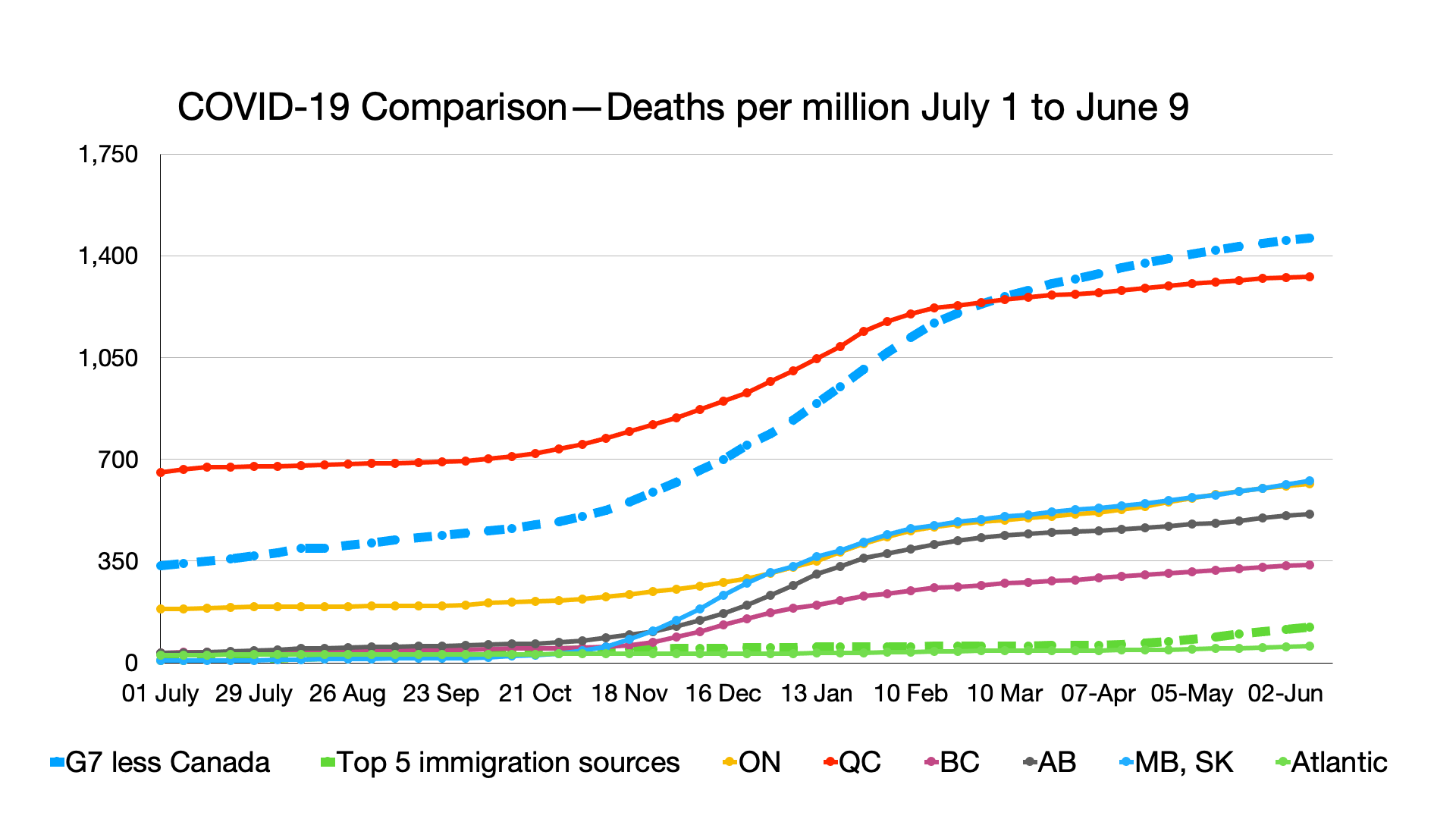
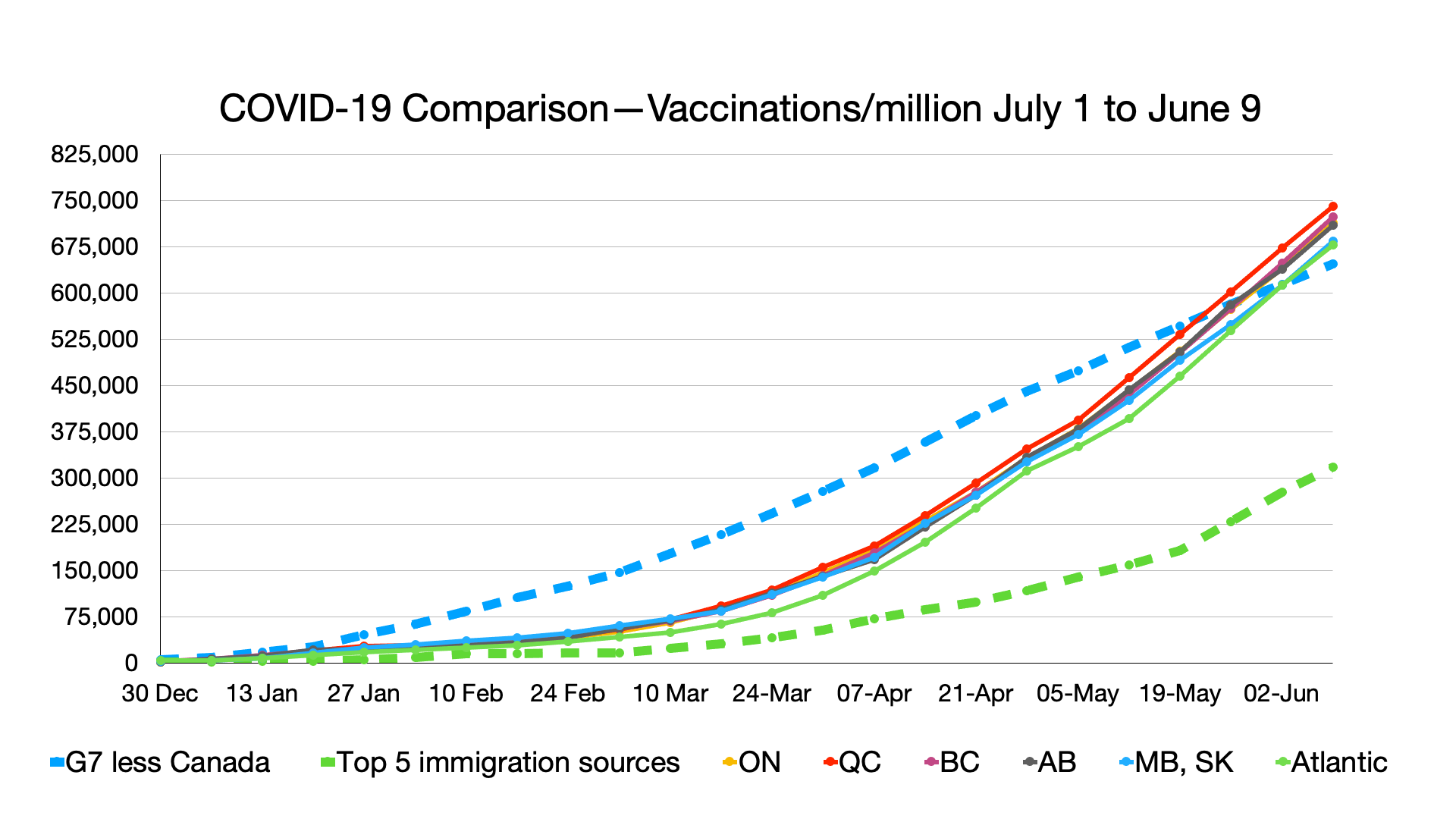
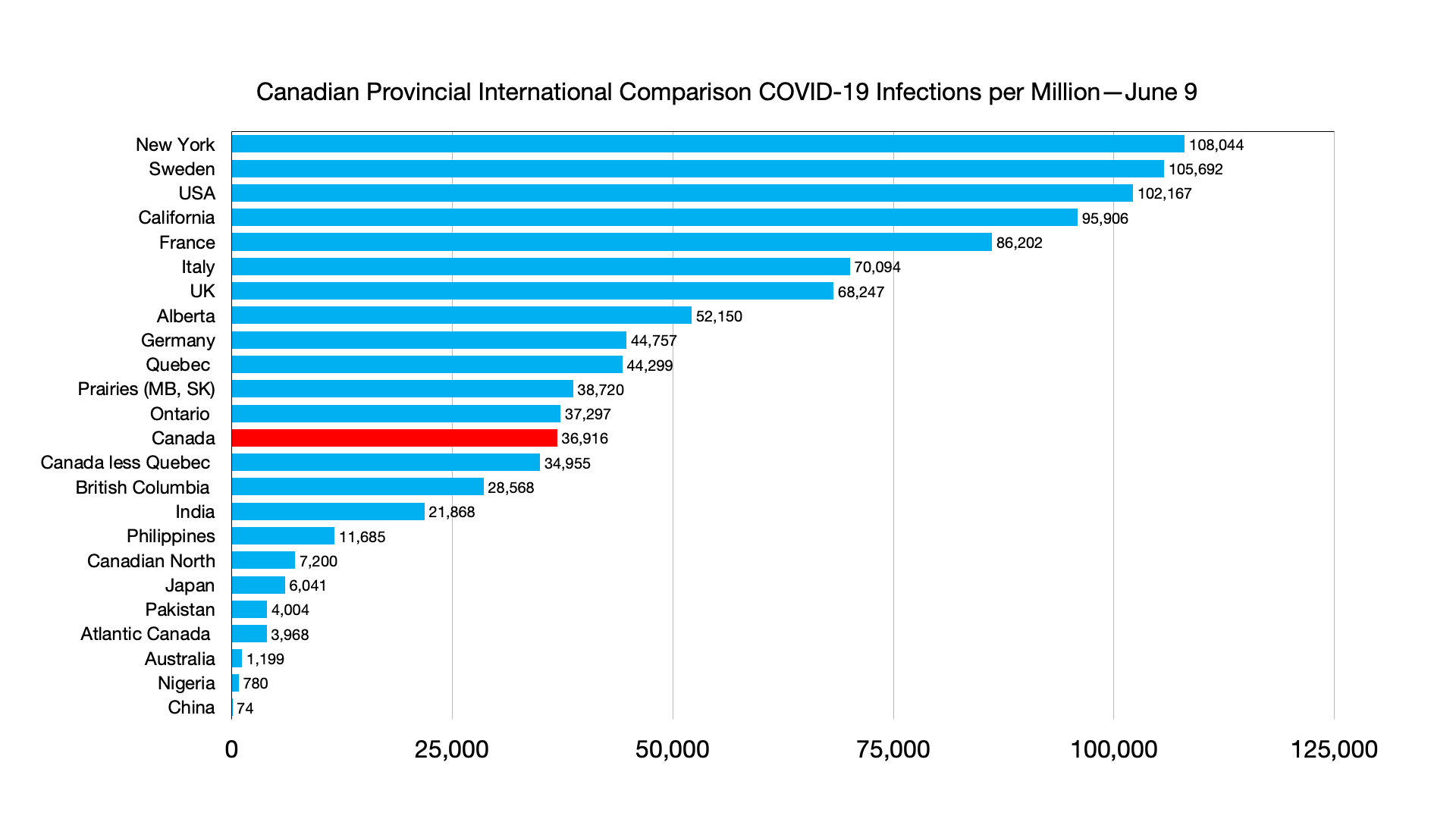
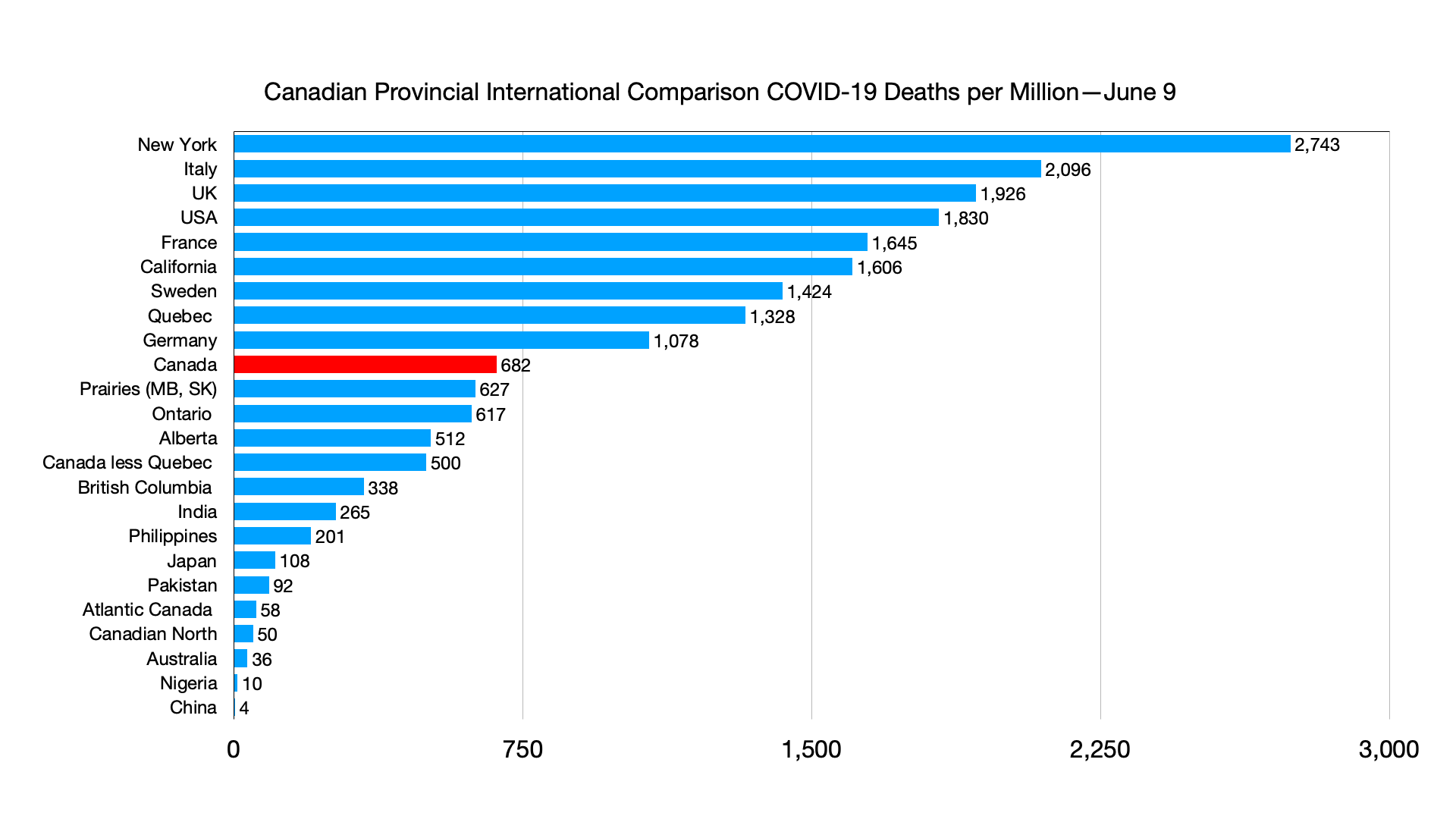
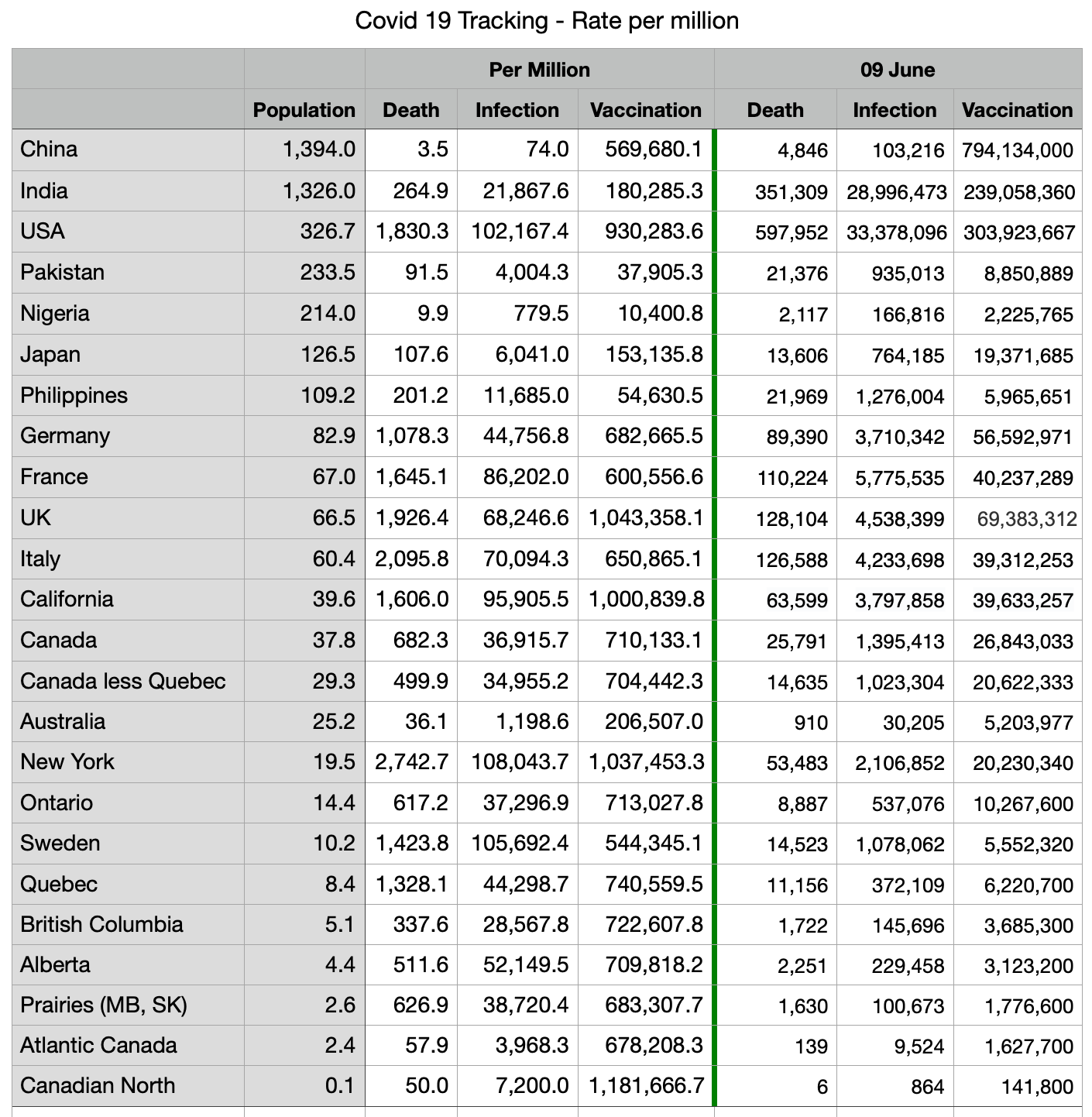
#COVID-19: Comparing provinces with other countries 5 May Update

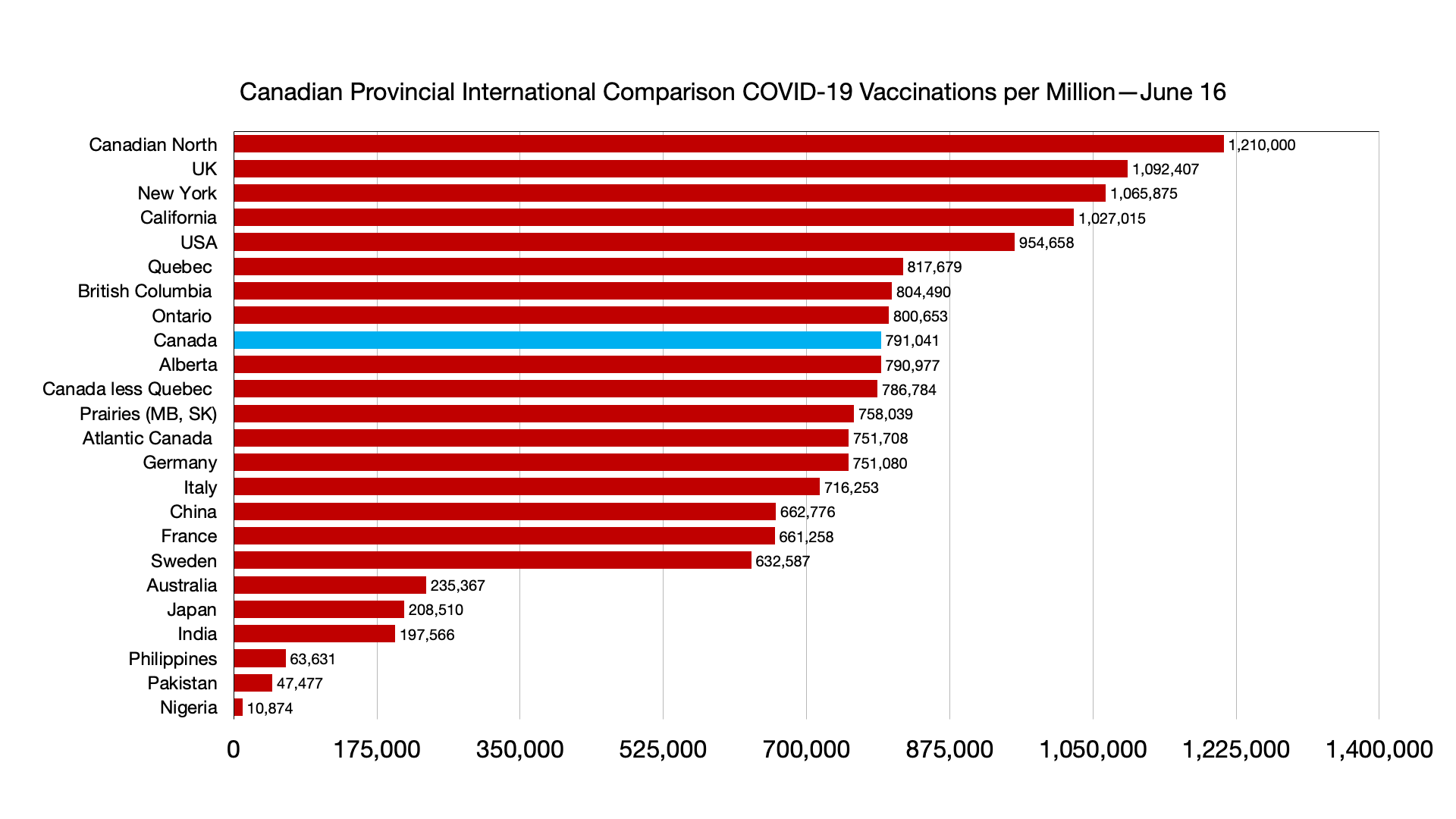
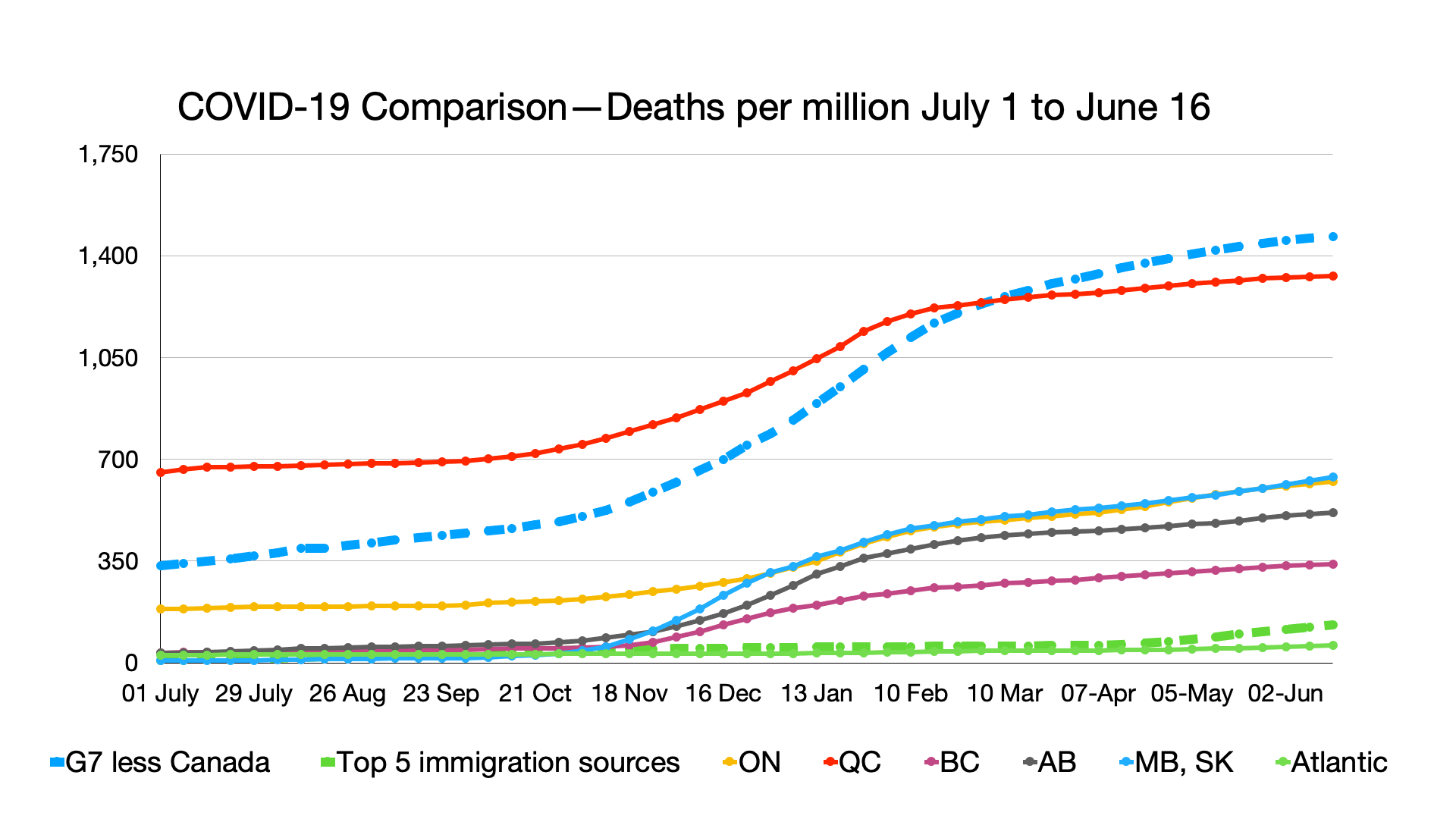
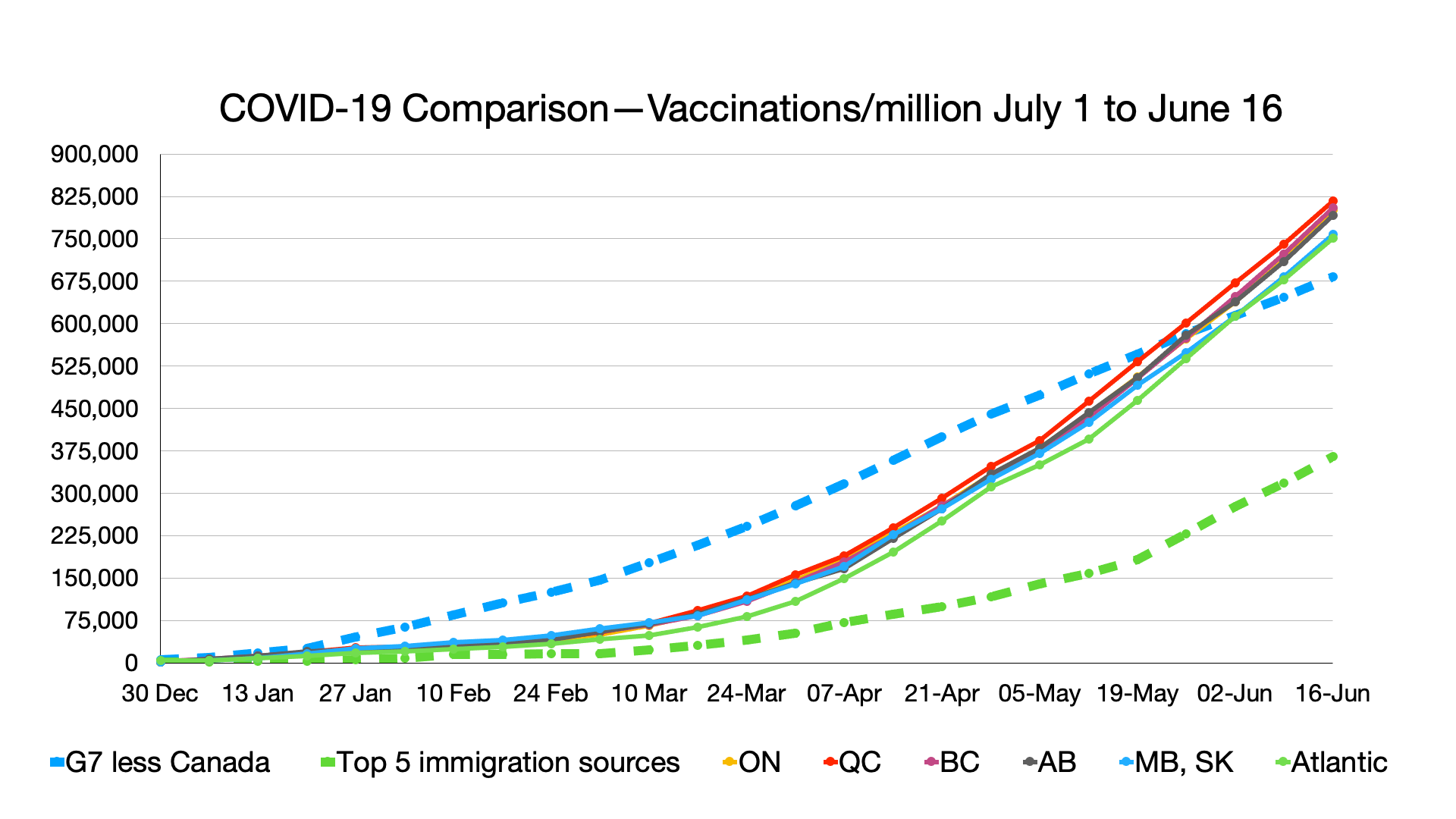
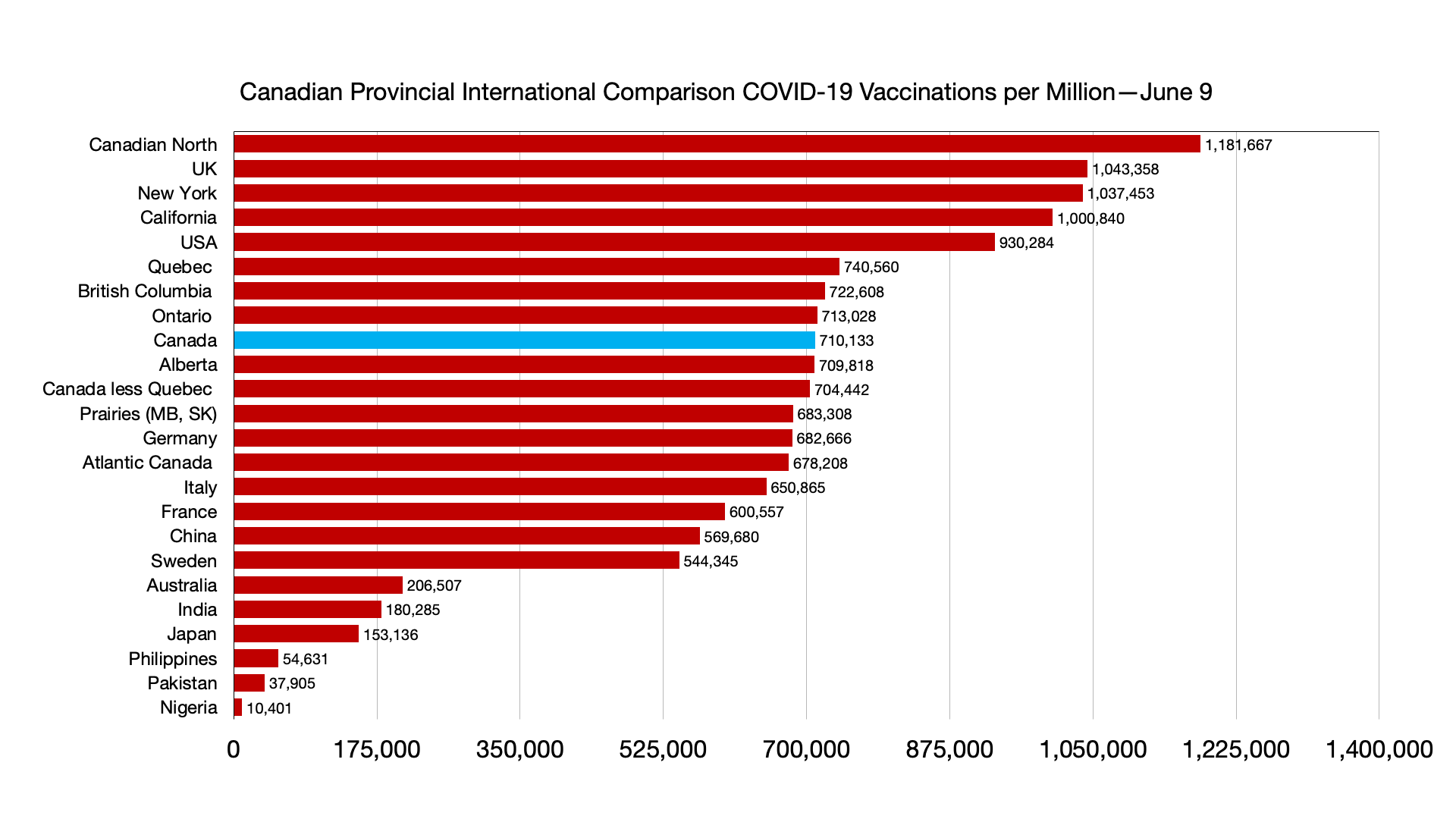
The latest charts, compiled 5 May as the third wave continues. The ongoing spike of infections and deaths in India per million still has not resulted in a change in the relative ranking given the size of India’s population.

Vaccinations: Overall, Canada and most provinces continue to be comparable or greater to EU countries.

Trendline charts

Infections per million: The ongoing spikes in Alberta and Ontario continue, with Alberta significantly ahead of Quebec, Ontario ahead of the Prairies.

Deaths per million: Gap between G7, Quebec and other provinces continues to grow.

Vaccinations per million: Vaccination rates in Canadian provinces continue to increase more quickly than overall G7 less Canada countries. Increases among immigration source country reflect China and India mass vaccination roll-out, but at lower rates of increase compared to Canadian provinces and G7.

Weekly

Infections per million: Sweden now ahead of California, Italy now ahead of UK, and Ontario ahead of Canada .

Deaths per million: France ahead of California, India ahead of Philippines

Rethinking the U.S. Legal Immigration System: A Policy Road Map

Of interest. Two ideas Canada could consider:

  • “a new “bridge” visa as the main route for admission for most foreign workers arriving on employment visas. This bridge visa would cut across occupations, allow for circularity and bridge the artificial dichotomy between temporary and permanent pathways.” Already happening to a certain extent in Canada given increased numbers of temporary to permanent resident transitions.
  • “creation of an independent expert body within government that makes recommendations on annual admissions based on careful, nonpartisan review of labor market, economic, demographic and immigration trends.”
  • New reporting by the Census Bureau that the United States saw the second slowest rate of population growth since the decennial census began in 1790 represents a warning sign for a country seeing rising shares of retirees and a declining child population. In fact, the Census Bureau is projecting that the United States will have more seniors than children in less than 15 years. In this context, immigration will become increasingly important for sustaining the growth of the U.S. labor force.

    Yet the legal immigration system, which was built on a scaffolding first established in 1952 and saw its last major legislative update in 1990, is profoundly misaligned with these demographic realities and other key factors shaping migration to the country. This misalignment is the principal cause for illegal immigration, with an unauthorized immigrant population estimated at 11 million people. It is also responsible for the mounting backlog in legal immigration streams, with some in the green-card queue scheduled to wait an impossible 223 years for an employment-based visa. 

    The consequences of the failure by Congress and past administrations to update immigration laws to match current realities have been enormous for the country and for its economy, as a new policy brief from the Migration Policy Institute’s Rethinking U.S. Immigration Policy initiative makes clear. In Rethinking the U.S. Legal Immigration System: A Policy Road Map, MPI analysts Muzaffar Chishti, Julia Gelatt and Doris Meissner sketch the broad contours of some of the most needed reforms in the legal immigration system.

    “Immigration policy should fundamentally be tailored to serve U.S. national interests,” they write. “As such, it should reflect factors inside the United States that create a need for immigrant workers and position the country well to benefit from immigration. The age structure of the U.S. population and shifts in the U.S. economy are two such factors, both of which clearly establish sustained immigration as an asset that benefits the country and the economy.”

    The policy brief offers a quick tour of the new framework that MPI is advancing through its Rethinking Immigration initiative. The vision includes:

    • A meaningful and responsible reform of the U.S. immigration system must begin with addressing the challenge of the country’s unauthorized immigrant population, 60 percent of which has been in the United States a decade or more, with legalizations that could be accomplished in incremental steps.
    • Restructuring the employment-based system to better reflect economic and demographic realities and the behavior of employers and workers with three streams: 1) seasonal/short-term workers on briefer stints than current H-2A or H-2B workers but with the same protections as comparable U.S. workers; 2) direct admission of immigrant workers recognized as the best and brightest in their fields as permanent residents; and 3) a new “bridge” visa as the main route for admission for most foreign workers arriving on employment visas. This bridge visa would cut across occupations, allow for circularity and bridge the artificial dichotomy between temporary and permanent pathways. It would more accurately reflect how immigration and labor markets already operate, given 80 percent of those getting an employment-based green card adjust from a temporary work visa in the United States. Under MPI’s proposal, the U.S. government would also pilot a points-based immigration system, similar to those used in Canada, Australia and other countries.
    • Retaining family-sponsored immigration as a major priority of the U.S. immigrant selection system, but with changes to some backlogged categories.
    • Reforming the humanitarian protection system, including U.S. asylum system reform that MPI has been championing for more than two years, to improve efficient and fair adjudication.
    • Injecting much-needed flexibility into immigration levels, with creation of an independent expert body within government that makes recommendations on annual admissions based on careful, nonpartisan review of labor market, economic, demographic and immigration trends.

    “Harnessing the benefits of immigration has long been a source of strength for the United States,” the authors conclude. “Redesigning immigration pathways to match with today’s realities—and building flexibility so that the system can evolve to match tomorrow’s as well—would allow the United States to better reap the advantages of immigration for its economy and society.”

    The road map is the latest in the multi-year Rethinking U.S. Immigration Policy Initiative. The initiative is generating a big-picture, evidence-driven vision for the role immigration can and should play in America’s future. Reports focusing on Department of Homeland Security (DHS) governance, the immigration detention system, the immigration courts and the bridge visa are among those that will be published in the coming weeks and months. 

    Read the legal immigration road map here: www.migrationpolicy.org/research/rethinking-us-legal-immigration-road-map.

    Le programme des anges gardiens tarde à prendre son envol

    Of note:

    Après un timide départ, le programme de régularisation des anges gardiens ne semble toujours pas avoir pris de réel envol : à peine quelques milliers de candidats ont déposé un dossier et seulement 216 ont obtenu une résidence permanente, dont aucun au Québec.

    À plus de la mi-chemin de la période des mises en candidatures, le nombre de dossiers déposés dans le cadre de ce programme spécial visant à régulariser les statuts des demandeurs d’asile qui travaillent dans la santé ne dépasse pas les 3200 au Canada. De ce nombre, un peu moins de la moitié (1400) proviennent du Québec, selon les données d’Immigration, Réfugiés et Citoyenneté Canada (IRCC) datées du 10 avril. Un dossier représentant deux personnes en moyenne, 7577 personnes au total convoitent actuellement la résidence permanente par l’entremise de ce programme.

    « C’est une goutte dans l’océan », a laissé tomber Stephan Reichhold, directeur de la Table de concertation des organismes au service des réfugiés et des immigrants (TCRI). « On ne parle pas de raz-de-marée, on parle d’un mini-programme d’immigration », a-t-il ajouté en rappelant les craintes du gouvernement Legault qui, contrairement à Ottawa, souhaitait un programme plus restreint qui ne toucherait que les demandeurs d’asile ayant travaillé en soins directs aux patients durant la première vague.

    À ce stade-ci du programme, le président de l’Association des avocats en droit de l’Immigration, Guillaume Cliche-Rivard, estime que la grande majorité des gens admissibles devraient avoir déposé une demande. Un avis que partagent les trois organismes communautaires québécois mandatés pour accompagner les candidats dans le processus. « On va parler de quelques milliers de personnes à travers le Canada, 10 000 personnes au maximum », dit-il, en soulignant que rien qu’au Québec, le gouvernement Legault cherche actuellement à pourvoir 14 000 postes en santé.

    Un programme trop restrictif

    Pour Marjorie Villefranche, directrice de la Maison d’Haïti, qui est l’un des organismes accompagnants, il ne fait pas de doute que le programme doit être élargi à plus de demandeurs d’asile. « Peut-on enlever la règle qui dit que 120 [des 750 heures de travail] accumulées doivent l’avoir été pendant la première vague, entre le 13 mars et le 14 août ? Il y en a plein qui ont travaillé tout aussi fort mais pendant les deuxième et troisième vagues », souligne-t-elle.

    Dans sa version actuelle, le programme est aussi jugé « trop restrictif » par les organismes, car il exclut plusieurs professions jugées essentielles. Par exemple, les aides de service, qui sont nombreux à avoir effectué des gestes de préposés aux bénéficiaires durant la crise de la première vague, sont exclus. « Selon leur description de tâches, plusieurs personnes ne devaient pas être en contact direct avec le patient, mais dans les faits, elles l’ont été », a dit Martin Savard, qui s’occupe du programme spécial pour le Centre social d’aide aux immigrants (CSAI).

    Lenteur de traitement

    Au Québec, seulement 94 de tous les dossiers déposés, soit 7 %, ont obtenu une « approbation de principe », ce qui signifie qu’il ne manque que les vérifications d’usage, notamment de sécurité, pour que les candidats soient admis par le gouvernement fédéral. Ailleurs au Canada, ce sont 48 % des dossiers qui sont à cette étape d’approbation. « À ce jour, certaines personnes n’ont même pas reçu d’accusé de réception de la première étape. C’est anxiogène pour elles », constate Yannick Boucher, directeur des services aux personnes chez Accueil liaison pour arrivants (ALPA).

    Marjorie Villefranche rappelle que le mouvement pour demander la régularisation des demandeurs d’asile travailleurs essentiels était parti d’ici. « En négociant un programme spécial, le Québec en a fait bénéficier tout le monde au Canada. Mais là, plus de personnes sont acceptées ailleurs, et c’est chez nous que ça bloque », dit-elle. « On ne comprend pas et on regarde les gouvernements se renvoyer la balle. » Avec les deux autres organismes, elle dit avoir fait part de ses doléances lors d’une rencontre proposée par le ministre fédéral de l’Immigration, Marco Mendicino.

    Selon Guillaume Cliche-Rivard, les deux ordres de gouvernements ont leur part de responsabilité dans les délais. « Avant qu’on reçoive l’accusé de réception et la lettre permettant de se tourner vers Québec pour demander le Certificat de sélection du Québec [CSQ], IRCC nous fait attendre deux bons mois. Ensuite, le Québec met encore deux ou trois mois à délivrer le CSQ », dit l’avocat, en se basant sur ce qu’il observe des dossiers de ses clients.

    Encore des obstacles

    Me Cliche-Rivard déplore surtout que le gouvernement du Québec n’ait pas changé son principal formulaire, qui semble toujours exiger une attestation de travail ou une lettre d’emploi dans leur version « originale », ce qui est difficile à obtenir en pleine pandémie. La ministre de l’Immigration, de la Francisation et de l’Intégration, Nadine Girault, avait pourtant annoncé en mars dernier des « mesures d’assouplissement » et des copies avec justification allaient pouvoir être acceptées.

    Joint par Le Devoir, le cabinet de la ministre a indiqué qu’il acceptait, comme promis, les copies des documents originaux. Quant aux délais de délivrance de CSQ, ils ne dépasseraient pas un mois et 339 demandes, sur un total de 651 reçues, ont été traitées en date du 26 avril, selon l’attachée de presse, Flore Bouchon. « Le nombre de dossiers traités et de CSQ délivrés est en évolution continue, ce qui démontre le succès du programme spécial », a-t-elle déclaré.

    Source: https://www.ledevoir.com/societe/600049/immigration-le-programme-des-anges-gardiens-tarde-a-prendre-son-envol?utm_source=infolettre-2021-05-04&utm_medium=email&utm_campaign=infolettre-quotidienne

    USA: Do immigrants harm native students academically?

    Interesting debunking:

    Over the past 50 years, the United States has experienced the second-largest wave of immigration in its history. As a result, the share of recent immigrants (either foreign-born or children of foreign-born) in public schools reached 23% in 2015, with concentrations over 70% in several school districts in high-immigration states. These trends have generated a policy debate about the effects of immigration on public education and the perceived costs that immigrants may impose on public schools, local governments, and educational outcomes of the U.S.-born student population.

    Better understanding the causal effects of immigrants on native students is therefore critical to inform these policy debates, yet there are two factors that complicate any effort to reveal this link. First, immigrant students are not randomly assigned to schools, and are more likely to enroll in schools educating students from disadvantaged backgrounds. Second, U.S.-born students, especially those from comparatively affluent families, may decide to leave when a large share of immigrant students move into their school district—a phenomenon commonly referred to as “native flight.” Both factors imply that simple correlations between immigrant exposure and native student outcomes will likely yield a more negative relationship than the true causal effect of immigrant exposure.

    In a recent paper, we show how immigrant exposure affects the academic achievement of U.S.-born students. We do this with an analytical strategy that addresses both concerns above. We make use of rich, longitudinal education and health microdata from Florida. These data are exceptionally detailed. For example, they identify students’ siblings in school records, which enables us to use the within-family, across-sibling variation in immigrant exposure to study the effects of immigrants. In other words, we can compare the learning of U.S.-born siblings when one of those siblings happened to have more immigrants in their school cohort than the other sibling(s).

    Figure 1, illustrating our main result, shows the relationship between immigrant exposure and native student math scores, and how this relationship changes when one accounts for native flight. We present the results for all U.S.-born students (black bars), along with the results for white (green bars) and Black students (blue bars) to demonstrate the effects for different student groups.

    Estimated Effects of Immigrant Exposure on U.S.-Born Student Math Scores: Overall and by Race

    The results on the left of the figure are from a common model that accounts for the non-random sorting of immigrants (by comparing U.S.-born students with their peers in the same school), yet does not address native flight. (That is, we compare the academic performance of native students with their peers in the same school who have different levels of exposure to immigrants because they are enrolled in different grades.) On the right of the figure, we present the results from our preferred model where we rely on sibling comparisons. Several findings are worth highlighting.

    First, when we move from our baseline model to sibling comparisons that account for native flight, we see that the relationship between immigrant exposure and U.S.-born student test scores changes from negative to positive.

    Second, we find that this trend is entirely driven by students from more advantaged backgrounds. For example, for white students, we find a negative relationship between immigrant exposure and math achievement in models that fail to account for native flight compared to a sizable positive relationship in our preferred model. In contrast, for Black students, the positive effect of immigrant exposure remains virtually unchanged between the two models. This is consistent with the expectation that native flight is a bigger issue when examining the effects of immigrants on students from more advantaged backgrounds who can afford alternative schooling options in the wake of an immigrant influx.

    In summary, we find no adverse effects of immigrant students on the academic achievement of U.S.-born students. This is true even when the immigrants’ academic achievement is lower than the U.S.-born students. In fact, we find significant benefits of having immigrant peers on the test scores of native students, especially among students from disadvantaged backgrounds.

    This does not necessarily mean that immigrant students do not require public resources initially as they acquire English proficiency and get accustomed to the school system and life in a new country, which could have adverse effects on native students in the short-term—especially in the aftermath of large migrant inflows. That said, our findings suggest that, in the long run, the benefits of exposure to recent-immigrant peers, who are typically higher performing academically and have higher educational aspirationscompared to more established immigrant generations, likely outweigh these potential short-term adverse effects.

    Source: Do immigrants harm native students academically?

    With Great Demographics Comes Great Power: Why Population Will Drive Geopolitics

    Same logic as with Canadian advocates for a much larger population such as the Century Initiative. But of course, should other countries adopt similar strategies, any “population race” will not change relative positions. And the geopolitical perspective is a limited one compared to broader perspectives of prosperity, quality of life and well-being:

    Demographics may not be destiny, but for students of geopolitics, they come close. Although conventional measures of economic and military power often receive more attention, few factors influence the long-term competition between great powers as much as changes in the size, capabilities, and characteristics of national populations.

    The United States is a case in point. In 1850, the United States was home to some 23 million people, 13 million fewer than France. Today, the U.S. population is close to 330 million, larger than the British, Dutch, French, German, and Italian populations combined. For more than a century, the United States has had the world’s largest skilled work force, and by measures such as mean years of adult schooling, it has long had among the world’s most highly educated populations. These favorable demographic fundamentals, more than geography or natural resources, explain why the United States emerged as the world’s preeminent economic and military power after World War II—and why it still occupies that position today.

    Yet past performance is no guarantee of future results. Thanks in large part to demographics, rival states such as China have become genuine great-power competitors over the past few decades. The United States, meanwhile, has eroded or squandered its demographic edge in a number of ways, even as its traditional allies in Europe and Asia have struggled with population stagnation or decline. So far, the damage to U.S. power has been limited by the fact that the United States’ main geopolitical rivals face serious demographic problems of their own. Gazing further into the future, however, population growth and rising levels of education may propel new countries toward great-power status.

    Demographics offer a clue to the geopolitical world of the future—and how Washington should prepare for it. To maintain the United States’ edge, American leaders must take steps to slow or reverse the negative demographic trends now eating away at the foundations of U.S. power. They must also begin to rethink Washington’s global strategy, recognizing that the future of the U.S.-led international order lies with the young and growing democracies of the developing world. With wise domestic policy and farsighted diplomacy, U.S. leaders can ensure that their country’s still considerable human resources reinforce American power long into the coming century.

    PEOPLE POWER

    For premodern empires and kingdoms, a larger population meant more people to tax and send off to war. But thanks to modern economic development, demographics are more important now than ever before. Since the Industrial Revolution, technological innovations and other improvements in human productivity have led to a long-term decline in the price of natural resources and basic commodities such as food. At the same time, they have greatly increased the returns to skilled labor. In fact, most global economic growth since World War II can be attributed to two factors: improvements in human capital—a catchall term for education, health, nutrition, training, and other factors that determine an individual worker’s potential—and favorable business climates, which allowed the value of those human resources to be unlocked. Human capital, in particular, has an extraordinary impact on economies. For each year of increased life expectancy today, for instance, a country sees a permanent increase in per capita income of about four percent. And for each additional year of schooling that a country’s citizens obtain, the country sees, on average, a ten percent increase in per capita GDP.

    Vast disparities between human capital development in different countries have produced gaps in economic productivity that are larger today than at any previous point in history. For example, in 2017, according to World Bank estimates, Ireland’s per capita GDP was roughly 100 times as high as that of the Central African Republic (when adjusted for relative purchasing power). Yet such disparities are not set in stone: thanks to technological breakthroughs, nations can now augment their human capital faster than ever before. It took Sweden from 1886 to 2003 to raise its life expectancy from 50 years to 80 years; South Korea accomplished the same feat in less than half the time, between the late 1950s and 2009.

    Despite the possibility of such rapid and often unexpected improvements in human capital, demography as a whole is a fairly predictable social science. Unlike economic or technological forecasts, population projections tend to be reasonably accurate for at least a few decades, since most of the people who will be living in the world of 2040, for example, are already alive today. And although such projections cannot predict the future, they can offer a rough guide to the emerging contours of international politics—the changing realm of the possible in world affairs. Policymakers who want to plan for the long term should be paying attention.

    POPULATION PROBLEMS IN THE PRC

    Today, the international arena is dominated by one superpower (the United States) and two great powers (China and Russia). Recent U.S. misadventures abroad and political turbulence at home have naturally led some to suggest that American power is on the wane. A look at demographic projections for China and Russia, however, suggests that fears that the United States will lose its position of primacy anytime soon are misplaced. 

    China is the United States’ main international rival, and at first glance, it is an impressive rival indeed. It is the world’s most populous country, with almost 1.4 billion people, and over the past four decades, it has seen the most rapid and sustained burst of economic growth in human history. Adjusting for relative purchasing power, the Chinese economy is now the largest in the world. China’s growth since the 1970s is usually attributed to the policies of Deng Xiaoping, who pushed the country in a more market-friendly direction after becoming the paramount leader in 1978. But demographics also played a critical role. Between 1975 and 2010, China’s working-age population (those aged 15–64) nearly doubled, and total hours worked grew even faster, as the country abandoned the Maoist policies that had made paid labor both less available and less appealing. Overall health and educational attainment rose rapidly, as well.

    Given this impressive record, many—apparently including China’s leadership—expect that China will surpass the United States as the world’s leading power sometime in the next two decades. Yet the country’s longer-term demographic prospects suggest otherwise. Over the past two generations, China has seen a collapse in fertility, exacerbated by Beijing’s ruthless population-control programs. The one-child policy, introduced in 1979, was ended in 2015, but the damage had already been done. China’s total fertility rate (TFR) has been below the replacement level of 2.1 children per woman since at least the early 1990s. According to the UN Population Division, China’s TFR now stands at 1.6, but some analysts, such as Cai Fang, a Chinese demographer and member of the Standing Committee of the National People’s Congress, believe it may be as low as 1.4—more than 30 percent below replacement. In major cities such as Shanghai, fertility may stand at one birth per woman or less.

    With decades of extremely low fertility in its immediate past, decades more of that to come, and no likelihood of mass immigration, China will see its population peak by 2027, according to projections by the U.S. Census Bureau. Its working-age population has already been shrinking for the past five years, and it is set to decrease by at least 100 million between 2015 and 2040. The country will see a particularly large decline in its working-age population under 30, which may plunge by nearly 30 percent over these years. Although this rising generation will be the best educated in Chinese history, the country’s overall growth in educational attainment will slow as the less educated older generations come to make up a larger and larger share of the total population. The Wittgenstein Centre for Demography and Global Human Capital estimates that by 2040, China’s adult population will have fewer average years of schooling than that of Bolivia or Zimbabwe.

    As China’s working population slumps, its over-65 population is set to explode. Between 2015 and 2040, the number of Chinese over the age of 65 is projected to rise from about 135 million to 325 million or more. By 2040, China could have twice as many elderly people as children under the age of 15, and the median age of China’s population could rise to 48, up from 37 in 2015 and less than 25 in 1990. No country has ever gone gray at a faster pace. The process will be particularly extreme in rural China, as young Chinese migrate to the cities in search of opportunity. On the whole, China’s elderly in 2040 will be both poor and poorly educated, dependent on others for the overwhelming majority of their consumption and other needs.

    Taken together, these unfavorable demographic trends are creating heavy headwinds for the Chinese economy. To make matters worse, China faces additional adverse demographic factors. Under the one-child policy, for instance, Chinese parents often opted for an abortion over giving birth to a girl, creating one of the most imbalanced infant and child sex ratios in the modern world. In the years ahead, China will have to deal with the problem of tens of millions of surplus men, mostly from disadvantaged rural backgrounds, with no prospects of marrying, having children, or continuing their family line. 

    China will also face a related problem over the next generation, as traditional Chinese family structures atrophy or evaporate. Since the beginning of written history, Chinese society has relied on extended kinship networks to cope with economic risks. Yet a rising generation of urban Chinese youth is made up of only children of only children, young men and women with no siblings, cousins, aunts, or uncles. The end of 2,500 years of family tradition will be a departure into the unknown for Chinese civilization—and Beijing is manifestly unprepared for this impending great leap.

    THE RUSSIAN PARADOX

    For Russia, the demographic outlook may be even worse. The Kremlin sees itself as helming a global power, yet its grandiose self-conception is badly mismatched with the human resources at its disposal. From the standpoint of population and human capital, Russia looks like a power in the grip of all but irremediable decline.

    In some respects, Russia is a typical European country: it has an aging, shrinking population and difficulties assimilating the low-skilled immigrant work force on which its economy increasingly depends. When it comes to human capital, however, Russia faces an acute crisis. After fully half a century of stagnation or regression, Russia has finally seen an improvement over the last decade in the overall health of its people, as evidenced by measures such as life expectancy at birth. But the situation is still dire. In 2016, according to the World Health Organization, 15-year-old Russian males could expect to live another 52.3 years: slightly less than their counterparts in Haiti. Fifteen-year-old Russian females, although better off than the males, had a life expectancy only slightly above the range for the UN’s roster of least developed countries.

    In addition to its health problems, Russia is failing in knowledge production. Call it “the Russian paradox”: high levels of schooling, low levels of human capital. Despite an ostensibly educated citizenry, Russia (with a population of 145 million) earns fewer patents each year from the U.S. Patent and Trademark Office than the state of Alabama (population: five million). Russia earns less from service exports than Denmark, with its population of six million, and has less privately held wealth than Sweden, with a population of ten million. And since Russia’s working-age population is set to age and shrink between 2015 and 2040, its relative economic potential will diminish, too.

    Ambitious revisionist states such as Russia can, for a time, punch above their weight in international affairs. Yet for all of Russian President Vladimir Putin’s foreign meddling and military adventurism, his country is facing demographic constraints that will make it extraordinarily difficult for him and his successors to maintain, much less seriously improve, Russia’s geopolitical position.

    THE AMERICAN ADVANTAGE

    Relative to its principal rivals, the United States is in an enviable position. This should come as no surprise: the United States has been the most powerful country in the world since World War II, and its demographic advantages—its large and highly educated population, relatively high fertility rates, and welcoming immigration policies—have been crucial to that success.

    The United States’ most obvious demographic advantage is its size. It is the world’s third most populous country, and it is likely to remain so until 2040. No other developed country even comes close—the second and third largest, Japan and Germany, have populations that are two-fifths and one-fourth the size of the U.S. population, respectively. Between 1990 and 2015, the United States generated nearly all the population growth for the UN’s “more developed regions,” and both UN and U.S. Census Bureau projections suggest that it will generate all of these regions’ population growth between 2015 and 2040. In fact, excluding sub-Saharan Africa—the only region where the rate of population growth is still increasing—the U.S. population is on track to grow slightly faster than the world population between now and 2040. 

    The United States benefits from what might be called “American demographic exceptionalism.” Compared with other developed countries, the United States has long enjoyed distinctly high immigration levels and birthrates. Between 1950 and 2015, close to 50 million people immigrated to the United States, accounting for nearly half of the developed world’s net immigration over that time period. These immigrants and their descendants made up most of the United States’ population growth over those decades. But U.S. fertility is also unusually high for an affluent society. Apart from a temporary dip during and immediately after the Vietnam War, the United States’ birthrates after World War II have consistently exceeded the developed-country average. Between the mid-1980s and the financial crisis of 2008, the United States was the only rich country with replacement-level fertility. Assuming continued levels of immigration and near-replacement fertility, most demographers project that by 2040, the United States will have a population of around 380 million. It will have a younger population than almost any other rich democracy, and its working-age population will still be expanding. And unlike the rest of the developed world in 2040, it will still have more births than deaths.

    Yet the United States’ demographic advantage is not merely a function of numbers. For over a century, the United States has benefited from a large and growing cadre of highly skilled workers. Research by the economists Robert Barro and Jong-Wha Lee on educational attainment suggests that between 1870 and 2010, Americans were the world’s most highly educated people in terms of average years of schooling for the working-age population. In 2015, by their estimate, 56 million men and women in the United States aged 25 to 64 had undergraduate degrees or graduate degrees: twice as many as in China and almost one-sixth of the global total. The United States leads the world in research and development, as measured by international patent applications and scientific publications, and in wealth generation, with Americans having accumulated more private wealth since 2000 than the Chinese have in recorded history.

    THE TASK AHEAD

    Despite these advantages, all is not well for the United States. Warning lights are flashing for a number of key demographic metrics. In 2014, U.S. life expectancy began slowly but steadily dropping for the first time in a century. This drop is partly due to the surge in so-called deaths of despair (deaths from suicide, a drug overdose, or complications from alcoholism), especially in economically depressed regions of the country. Yet even before the decline began, U.S. progress in public health indicators had been painfully slow and astonishingly expensive. Improvements in educational attainment have also been stalled for decades: as of 2010, American adults born in the early 1980s had, on average, 13.7 years of schooling, only fractionally higher than the average of 13.5 years for their parents’ generation, born in the early 1950s. Meanwhile, employment rates for American men of prime working age (25–54) are at levels not seen since the Great Depression.

    Further, it is possible that consensus projections for U.S. population growth are too optimistic. Such projections generally assume that U.S. fertility will return to replacement levels. But U.S. fertility fell by about ten percent after 2008 and shows no sign of recovering. According to the Centers for Disease Control and Prevention, in 2017, the United States’ TFR stood at 1.77, the lowest level since the 1970s and below those of European countries such as France and Sweden. Most demographic projections also assume that the United States will maintain net immigration at its current level of roughly one million per year. But immigration is an intrinsically political phenomenon. In the past, the United States has decided to all but shut off immigration in response to domestic turbulence, and it may do so again.

    Even with these troubling signs of decline, no rival is likely to overtake the United States in terms of raw human potential anytime soon. China and India, for instance, may have more college-educated workers than the United States does by 2040, but the superior quality of U.S. higher education will weigh heavily in the United States’ favor, and the United States will almost certainly still have the world’s largest pool of workers with graduate degrees. If U.S. demographic and human resource indicators continue to stagnate or regress, however, Americans may lose their appetite for playing a leading role in international affairs. Isolationism and populism could thrive, and the U.S. electorate could be unwilling to bear the considerable costs of maintaining the international order. There is also a nontrivial risk that the United States’ relatively disappointing trends in health and education will harm its long-term economic performance.

    To avoid these outcomes, the United States will need to revitalize its human resource base and restore its dynamism in business, health, and education. Doing so will be immensely difficult—a far-reaching undertaking that is beyond the powers of the federal government alone. The first step, however, is for Americans of all political persuasions to recognize the urgency of the task.

    AGING ALLIES

    Even as they try to put U.S. demographic trends back on track, American policymakers should also begin considering what U.S. strategy should look like in a world in which demographic advantages no longer guarantee U.S. hegemony. One appealing solution would be to rely more on traditional U.S. partners. Japan’s GDP is nearly four times as large as Russia’s on an exchange-rate basis, and although its total population is slightly smaller than Russia’s, it has a larger cadre of highly skilled workers. The current population of the EU is around 512 million, nearly 200 million more than that of the United States, and its economy is still substantially larger than China’s on an exchange-rate basis.

    The trouble is that many of Washington’s traditional allies face even more daunting demographic challenges than does the United States. The EU member states and Japan, for instance, all have healthy, well-educated, and highly productive populations. Yet the EU and Japan have both registered sub-replacement fertility rates since the 1970s, and their fertility rates began to drop far below the replacement level in the 1980s. In both the EU and Japan, deaths now outnumber births. Their working-age populations are in long-term decline, and their overall populations are aging at rates that would have sounded like science fiction not so long ago. The main demographic difference between the EU and Japan is that Europe has embraced immigration and Japan has not.

    Both approaches have their drawbacks. For EU members, immigration has postponed the shrinking of their work forces and slowed the aging of their populations. Yet the EU’s record of integrating newcomers, particularly Muslims from poorer countries, is uneven at best, and cultural conflicts over immigration are roiling politics across the continent. Japan has avoided these convulsions, but at the cost of rapid and irreversible population decline. As in China, this is leading to an implosion of the traditional Japanese family. Japanese demographers project that a woman born in Japan in 1990 has close to a 40 percent chance of having no children of her own and a 50 percent chance of never having grandchildren. Japan is not just graying: it is becoming a country of elderly social isolates, with rising needs and decreasing family support.

    Population decline does not preclude improvements in living standards, but it is a drag on relative economic and military power. According to the U.S. Census Bureau, the United States’ working-age population is set to grow by about ten percent between 2015 and 2040. Over the same period, Germany’s and South Korea’s working-age populations are expected to shrink by 20 percent, and Japan’s, by 22 percent. The number of young men aged 15 to 24, the group from which military manpower is typically drawn, is projected to increase over that period by three percent in the United States but to fall by 23 percent in Germany, 25 percent in Japan, and almost 40 percent in South Korea.

    This decline, combined with the budgetary politics of the modern welfare state—borrowing money from future generations to pay for the current benefits of older voters—means that most U.S. treaty allies will become less willing and able to provide for their own defense over the coming decades. The United States, in other words, will become ever more valuable to its aging security partners at the same time as they become less valuable to Washington—all while the United States’ own demographic advantage is beginning to erode.

    MAKING NEW FRIENDS

    Yet even as population trends sap the strength of traditional powers in Europe and East Asia, they are propelling a whole new set of countries, many of them potential U.S. allies and partners, toward great-power status. By courting these rising powers, U.S. policymakers can strengthen the international order for decades to come.

    Washington should begin by turning its attention to South and Southeast Asia. As Japan and South Korea lose population, for instance, emerging democracies such as Indonesia and the Philippines will continue to grow. By 2040, Indonesia could have a population of over 300 million, up from around 260 million today, and the Philippines’ population could reach 140 million—which would be possibly larger than Russia’s. Both countries, moreover, are young and increasingly well educated. In 2015, China had almost four times as many people aged 20 to 39 as Indonesia and the Philippines did combined; by 2040, it is projected to have only twice as many. Both Indonesia and the Philippines are likely to come into increasing confrontation with an expansionist China, and as they do, they may discover an interest in deeper security cooperation with the United States.

    Indonesia and the Philippines, however, pale in comparison to India. India is on track to overtake China as the world’s most populous country within the next decade, and by 2040, India’s working-age population may exceed China’s by 200 million. India’s population will still be growing in 2040, when China’s will be in rapid decline. By that time, about 24 percent of China’s population will be over 65, compared with around 12 percent of India’s. India has its own demographic and human resource problems—compared with China, it still has poor public health indicators, low average educational attainment, and egregiously high levels of illiteracy. Despite years of attempted reforms, India still ranks 130th out of 186 countries on the Heritage Foundation’s Index of Economic Freedom. Yet by 2040, India may have a larger pool of highly educated workers aged 20 to 49 than China, and its advantage will be increasing with every year. The United States and India have already begun defense cooperation in the interest of countering China; American leaders should make it a priority to deepen this partnership in the years ahead.

    The United States today has many advantages over its international rivals, thanks in no small part to its favorable demographics. Yet U.S. power cannot be taken for granted. It would be a geopolitical tragedy if the postwar economic and security order that the United States built really were to fade from the scene: no alternative arrangement is likely to promise as much freedom and prosperity to as many people as the U.S.-led international order does today. Thankfully, it is a tragedy that can be averted. If the United States can begin to repair its human capital base and forge new alliances for the twenty-first century, it can strengthen—with the aid of demographics—Pax Americana for generations to come.

    Source: https://www.foreignaffairs.com/articles/world/2019-06-11/great-demographics-comes-great-power?utm_medium=newsletters&utm_source=weekend_read&utm_content=20210501&utm_campaign=Weekend%20Read_050121_With%20Great%20Demographics%20Comes%20Great%20Power&utm_term=FA%20Weekend%20Read-012320

    Ibbitson: China’s population decline poses challenges and opportunities

    We need to broaden thinking beyond “more immigration is the solution” to how Canada could adapt to a world of population decline, where fewer higher-skilled Chinese and other groups may wish to come here:

    China is reportedly holding back census data because it shows the country’s population has started to decline, years ahead of even the most aggressive predictions.

    If so, every game changes: global warming projections, global population projections, geopolitical and economic projections.

    The world’s most populous nation is now a nation on the wane.

    The Financial Times reported Tuesday that China has delayed the release of its 2020 census, which was expected earlier this month, because the data reveals that China’s population has declined from a peak of more than 1.4 billion in 2019 to less than 1.4 billion now.

    If true, this is one of the most momentous events of our time. Many analyses of the geopolitical rivalry between China and the United States are predicated on the assumption of continued Chinese growth and relative American decline.

    But it now appears United Nations population projections, which had China’s population peaking in the 2030s before levelling off and gradually starting to decline, were off by more than a decade.

    The reason, according to a report this month by the Bank of China, is steadily falling fertility. Even after the ban on more than one child per family was lifted in 2015, China’s fertility continued to fall, to a level well below that needed to sustain the population.

    For that reason, Darrell Bricker and I, in our book Empty Planet, predicted that population decline would hit China sooner and harder than expected. The question was how soon and how hard. If the answer to the first question is right now, then China could lose nearly half its population by the end of the century – more if fertility continues to fall.

    The decline could have been accelerated by the COVID-19 pandemic, which has suppressed birth rates across much of the world, as couples put off having a child during this period of economic insecurity. A post-pandemic baby boom is unlikely: Past experience shows that once couples put off having a child, they don’t make up for it later on. Instead, they settle for having fewer children than they’d planned.

    Population decline will present both opportunities and challenges for China. Environmentally, the news is encouraging: There will be fewer new coal-fired generating stations needed, as the number of people on the grid goes down instead of up.

    The problem of labour shortages could be addressed by bringing in temporary foreign workers and improving productivity through automation.

    But preserving economic growth becomes difficult when there are fewer young people every year buying their first refrigerator, their first car, their first baby stroller. Fewer young consumers also means fewer taxpayers to sustain the pensions and health care costs of older people, and fewer adult children to look after the needs of aging parents.

    Countries that lose population every year stagnate economically: Italy, Spain, Japan. China is the new Japan. And that could lead to problems containing the discontent of an overtaxed, overworked, increasingly frustrated population. China announced this week that it planned to gradually raise the age of mandatory retirement, which is currently 60 for most men.

    This delivers a huge competitive advantage to the United States. That country’s fertility rate has also reached record lows. But despite the effort of former president Donald Trump to seal the country’s borders, the U.S. continues to let in immigrants, both legal and illegal.

    The U.S. needs to return, as quickly as possible, to its former practice of welcoming a million new permanent residents each year. That may be difficult, given rising nativism among conservatives, but if Americans want to stay ahead in the race for economic and political power, immigration is the not-so-secret weapon.

    In any event, as my colleague Doug Saunders noted Tuesday on Twitter, the news about the Chinese census “will help make immigration a seller’s market.” As fertility rates decline in China and other source countries, such as Philippines and India, and as labour shortages grow in China, Japan and elsewhere, the question for immigrant-friendly countries such as Canada will shift from “how many should we let in?” to “how many can we convince to come?”

    That is another reasons why former prime minister Brian Mulroney and others are right to maintain that Canada should greatly increase its immigration intake. We need to get them while we still can.

    Source: https://www.theglobeandmail.com/politics/article-chinas-population-decline-poses-challenges-and-opportunities/