NZ: Covid 19 coronavirus: Government targets rich investors as part of its ‘reset’ of immigration settings

Of note. Similar shift to “two-step” immigration and focus on the more highly skilled. Not convinced by the focus on “rich investors” as the experience with these programs is decidedly mixed:

Wealthy investors and “highly-skilled workers” will be the targets of New Zealand’s Covid-19 immigration “reset” to reduce the economy’s reliance on low-wage migrants.

In a speech setting out the Government’s intentions for immigration policy, Economic Development Minister Stuart Nash said that would include making it harder for employers to take on workers from overseas, other than in areas of genuine skills shortages.

But for many in the audience, including economists and employers, the long-signalled announcement lacked much detail, some labelling it “confusing”.

Nash, who was filling in for Immigration Minister Kris Faafoi, said once the borders fully opened again, it would not be returning to previous immigration settings.

“That path is a continuation of pressures on our infrastructure, like transport, accommodation, and downward pressure on wages.

“Since the borders closed, we’ve seen a reversal in the horticulture sector – for example – where there’s been a lift in wages to bring in local workers.”

Source: Covid 19 coronavirus: Government targets rich investors as part of its ‘reset’ of immigration settings

Diane Francis: Trudeau’s immigration scheme is just another way to redistribute Canada’s wealth

While Francis’ rhetoric is over the top, but her focus on per capita GDP growth versus overall GDP growth is valid:

It’s hard to imagine a bigger bungle by the Trudeau government than the vaccine fiasco and budget carnage, but now there’s immigration. Aims are to allow 1.2 million more permanent residents into Canada in the next three years when other, well-managed countries like Australia and New Zealand, are preoccupied with retaining the living standards of their existing populaces by trimming immigration.

“History teaches us that when we grow our immigration levels, we grow our economy,” Canadian immigration minister Marco Mendicino said earlier this year, a lawyer without economic credentials.

In March 2020, he announced a target of one million new permanent residents by 2022. Then in October, he bumped this up to 1.2 million from 2021 to 2023. This is more than triple the U.S. per capita immigration rate which has nearly nine times Canada’s population. (That doesn’t include the flow of illegal immigration into the U.S.)

The ravages of the pandemic have resulted in prudence elsewhere. The U.S. reduced its visa approvals a year ago, Australia lowered its immigration target to 160,000 (with 28 million people compared to Canada’s 37.7 million), and New Zealand said its priority was to train people already in the country for available jobs.

Source: Diane Francis: Trudeau’s immigration scheme is just another way to redistribute Canada’s wealth

#COVID19 #Immigration effects: March 2021

My regular monthly update. A few changes from earlier versions. 

Slides now have one-year and two-year comparisons, highlighting change from 2019 pre-COVID baseline as well as well as post-COVID 2020. Citizenship application numbers include first quarter 2021. 

Slide 3 summarizes the changes by program. 

In terms of trends and observations, the overall picture is that of a return to the 2019 baseline, partially for Permanent Residents but close to normal for IMP, TFWP and study permits except where noted below. No significant recovery in citizenship numbers. 

  • While still lower than 2019 baseline, PR admissions are recovering from their 2020 low. First quarter numbers of 70,000 suggest 280,000 for 2021 but government changes (lowering of Express Entry minimum score, Temporary resident to permanent resident pathway program, likely others to come) will result in higher numbers. 
  • TR to Permanent Residents transition continues to remain at about half of total Permanent Residents numbers. 
  • TRs, both IMP and TFWP, have all increased compared to 2019 save for IMP/Agreements.and TFWP/Caregivers. Most dramatic increase is with respect to “Other IMP Participants” which largely reflects open work permits for Hong Kong residents with HKSAR and BNO passports. 
  • Study permit holders have increased from the 2019 baseline. 
  • Asylum claimants remain significantly lower given border closures and travel restrictions. 
  • Citizenship numbers remain much lower than the 2019 baseline, reflecting the partial reopening and move to online testing and ceremonies. 
  • Visitor visas remain largely closed 

Canada announces new pathway to permanent residency for families of crash victims

Of note. Generous, given applies to extended families, and yet another contribution to meeting immigration levels:

Ottawa is launching a new policy to help the families of victims of two major airline disasters become permanent residents in Canada, Immigration Minister Marco Mendicino said Thursday.

The new policy will apply to relatives of anyone who died on board Ukraine International Airlines Flight 752 or Ethiopian Airlines Flight 302, so long as those victims were Canadian citizens, permanent residents or found eligible on their application for permanent residency.

The policy applies to people currently in Canada, and anyone who made a refugee claim after these two disasters happened is also eligible to apply under the new policy.

Mendicino said the federal government is introducing this public policy, which will remain in place until May 11, 2022, to demonstrate compassion and solidarity with the families in their efforts to seek justice.

“I’ve had the privilege of speaking with some of the families were related to the victims of flight PS752. Grief and anguish is real and ongoing,” he said.

“Families are in pain. They still ask questions.”

Kourosh Doustshenas, whose partner Forough Khadem died in the crash, said the association that represent the families of the victims welcomes the new policy.

“We appreciate the government of Canada is taking these steps to support the families,” he said in an interview with The Canadian Press.

Fifty-five Canadian citizens and 30 permanent residents were among the 176 people killed when a Ukrainian jetliner was shot down by an Iranian surface-to-air missile minutes after taking off from Tehran on Jan. 8, 2020.

The Ethiopian Airlines passenger plane crashed near Addis Ababa on March 10, 2019, claiming the lives of 157 people, including 18 Canadians.

Mendicino said the new program provides a pathway to permanent residency to people whose loved ones made Canada their home before being so suddenly taken.

He said a relative a relative could be spouse, common-law partner, child, grandchild, mother, father, grandmother, grandfather, brother, sister, aunt, uncle, niece or nephew.

Applicants may still be eligible even if they have entered Canada without the required visa or other documents, failed to comply with certain conditions or have worked or studied without being authorized under the Immigration and Refugee Protection Act, he said.

Doustshenas the government should allow family members outside of Canada to apply.

“We are hoping (the government) will expand (the new policy) to be more inclusive,” he said. “We want to make sure other people who are not in Canada also get the chance to travel here and apply for permanent residency.”

He said the policy should be expanded to include the families of Iranian students who where among the victims of the plane shootdown and had the intention to work and live in Canada after graduation.

Mendicino said his department is working on further measures to facilitate permanent residence applications for certain members of victims’ families who are currently outside Canada, and it will provide updates on this once those measures are in place.

Former Liberal public safety minister Ralph Goodale, who was named Canada’s special adviser on the response to the crash, released a report on the downing of Ukraine International Airlines Flight 752 in December concluding that it’s vital it is for the investigation into this air disaster to be transparent to ensure accountability.

Ten Iranian officials were indicted over the shootdown of a Ukrainian passenger plane by Tehran military prosecutor Gholamabbas Torki, who avoided naming those responsible when he announced the indictments last month.

Doustshenas the families of the victims can’t trust the Iranian justice system because the Tehran military prosecutor didn’t disclose the names of those charged, nor the alleged offences.

“We still don’t know what happened. We still don’t know the truth. We haven’t seen any kind of justice,” he said.

“We are hoping through an independent investigation by Canada and other countries, we can finally get to the bottom of that and find the truth.”

Prime Minister Justin Trudeau said last month that Canada would work with the international community to reform aviation standards and to ensure the families of victims “get closure, get compensation and mostly get justice from Iran.”

Source: Canada announces new pathway to permanent residency for families of crash victims

The Cesspool That Gave Rise to Stephen Miller

More background on some of the more prominent anti-immigration advocates:

Last August, the conservative writer David Horowitz, who mentored Trump’s former senior adviser Stephen Miller, emailed me. Subject: “Your book.” He wrote, “I was more than generous with you, and you repaid me by raping me and my reputation, which I assure you will survive your malicious drivel.”

The 82-year-old former Marxist was referring to my biography, Hatemonger: Stephen Miller, Donald Trump and the White Nationalist Agenda, which drew in part from email exchanges Horowitz had forwarded to me, showing conversations with Miller between 2012 and 2017, including those with him feeding Miller talking points for some of Trump’s most incendiary campaign speeches, which the reality TV mogul regurgitated. Horowitz met Miller as a Santa Monica high school student and shaped his career, introducing him to Tea Party Minnesota congresswoman Michelle Bachman, who gave him his first job as a press secretary, and later to then-Alabama Senator Jeff Sessions, who also hired him.

Horowitz had previously told me he was trusting me with his correspondence because he read a 2018 interview in which I discussed my aversion to labeling people: “When you label someone, you do violence to them.” He said he feared being labeled a “hatemonger,” a word that had been used to describe him, and believed I was unlikely to label him or Miller. It was a strange argument given that Horowitz has dedicated much of his life to labeling entire groups, calling the National Association for the Advancement of Colored People (NAACP) “fascists” and progressives “totalitarians.” After my book was published, he featured me as the top article on his site, calling me “an anti-American racist,” and in a separate email, called me “stupid, lazy or deranged.”

Horowitz’s art is projection, which he teaches to his disciples. People fighting racism are “Nazis.” Activists fighting inequality are “oppressors.” Classified as an anti-Muslim and anti-immigrant extremist by the Southern Poverty Law Center, he has for decades groomed young conservatives to adopt an incendiary, extremist approach through his “School for Political Warfare,” and connected prominent right-wing politicians and media personalities at expensive West Coast Retreats and Restoration Weekends. “The political left has declared war on America and its constitutional system, and is willing to collaborate with America’s enemies abroad and criminals at home to bring America down,” reads the mission statement for the David Horowitz Freedom Center.

Now, two writers who have known Horowitz for half a century, Ronald Radosh and Sol Stern, have written a piece in The New Republic calling for an investigation into his nonprofit’s “potential abuse of its tax-exempt status.” Per the Internal Revenue Code: “All section 501(c)(3) organizations are absolutely prohibited from directly or indirectly participating in, intervening in, any political campaign on behalf of (or in opposition to) any candidate.” They recount Horowitz’s visits to a “psychic healer” and his “relentless drive toward the violent fringes.” As a radical leftist, they added, their former friend “celebrated the burning of a bank by a student mob. Today, he’s an intellectual pyromaniac who honors the MAGA mob that attacked the U.S. Capitol on January 6.”

In a strategy paper Horowitz emailed Miller in December 2012, as the Republican Party was publicly reckoning with its failure to appeal to communities of color, Horowitz called for Republicans to launch a campaign of fear. He later said they “must begin every confrontation by punching progressives in the mouth.” His drive to intimidate and terrorize has compelled him to threaten lawsuits against reporters, including me, accusing me of “malicious and defamatory statements” in a letter from his lawyer that closely resembled those he has sent to others. It’s an echo of how he spent the ’90s, coordinating lawyers to threaten legal action on behalf of people accused of bigotry.

Horowitz, who casts himself as colorblind, has tweeted content such as “The Most Dangerous Social Problem in America Today: Anti-White racism,” and attacks women of color in positions of power, saying of Rep. Ilhan Omar, “This witch is part of a terrorist network… should be deported now.” He denies Palestinians their national identity. “There is no Palestine, there are no Palestinians,” he has tweeted.

His tirades caught the attention of John Tanton, an influential white supremacist who published an English translation of the virulently racist French novel Camp of the Saints—which describes the destruction of the white world by brown refugee “monsters,” a book that Miller recommended to Breitbart for an article pointing out its “parallels” with real life. Tanton, who died in 2019, featuredHorowitz on his website and highlighted his work through his journal, The Social Contract. He also wrote him and his colleague Peter Collier at least one letter, which The Daily Beast is reporting on here for the first time and is housed in the partially sealed archive of Tanton’s papers at the University of Michigan. In the letter, obtained from Virginia attorney Hassan Ahmad—who is suingto unseal the entire archive—Tanton rants about gay men and HIV and muses bizarrely about the rectum as “an ideal cultural medium: it is wet; its (sic) warm, it is chock full of nutrients, and has a rich blood supply to provide oxygen for those (aerobic) organisms that need this nutrient.” Horowitz did not respond to requests for comment about Tanton or the nature of their relationship, if any.

Tanton also shared Horowitz’s work with Dan Stein, the head of the Federation for American Immigration Reform (FAIR), which Tanton created with heiress Cordelia Scaife May to restrict the flow of brown and Black immigrants into the United States. Tanton wrote separately, “As whites see their power and control over their lives declining, will they simply go quietly into the night? Or will there be an explosion?” Later, in the White House, Horowitz’s protégé Miller would implement restrictive immigration policies that echoed recommendations issued by FAIR almost verbatim, including limiting family-based legal immigration and attacking sanctuary jurisdictions.

What people like Horowitz and Miller believe, although Miller is careful to phrase it differently, is that white men make America great. White European males created “America’s unique political culture… [which] led the world in abolishing slavery and establishing the principles of ethnic and racial inclusion,” Horowitz wrote in his book Hating Whitey, ignoring the central role of racialized people in the civil rights movement. “We are a nation besieged by peoples ‘of color’ trying to immigrate to our shores to take advantage of the unparalleled opportunities and rights our society offers them.”

It’s a view that has become mainstream in the radicalized Republican Party, which has surrendered to its once-fringe white supremacists. Miller’s recently launched nonprofit, America’s First Legal (White Men First Legal), is attacking efforts to help immigrants, non-white U.S. workers and the LGBTQ community. Soon it will be women. He is Horowitz 2.0, more powerful than his mentor, leading a full-fledged assault on the teaching of critical race theory and diversity in schools through litigation and regular appearances on Fox News and other right-wing media. People must understand the man who made him, who helped forge our era’s banality of extremism.

Horowitz was right when he guessed that I would be reluctant to label him or Miller a “hatemonger.” I’ve seen firsthand the damage that labels have done to people I love, such as my father, who immigrated here from Mexico. But I also believe journalists have a responsibility to use accurate words to describe the actions of people in power. Horowitz and Miller not only made careers of hatemongering—they’ve made it a centerpiece of modern right-wing ideology.

Source: The Cesspool That Gave Rise to Stephen Miller

Immigration Minister open to raise permanent residency caps

Of note, more signs of government determination to meet 2021 levels target of 401,000 (January-March 2021, 70,425 permanent resident admissions, or an annualized rate of about 280,000). Modernization remarks also of note:

Canada’s Immigration Minister says he’s not ruling out expanding a new program that would grant permanent residency to 90,000 temporary foreign workers and international student graduates as part of the country’s annual immigration goal.

“I am open to discussing whether or not to revisit the current caps,” Marco Mendicino said in an interview Wednesday.

He made his comment after delivering a speech on modernizing immigration earlier in the day. He said in the speech to the Canadian Club that more than 50,000 people have expressed interest in the spaces since last Thursday’s opening for applications.

He said the Immigration, Refugees and Citizenship department needs to carefully assess the early results of the program, including the quality of applications, and see how quickly the department hits the 90,000 target.

“At that point, I will certainly have a much greater line of sight on whether or not there may be a need to revisit the caps.”

Asked if he could secure cabinet approval for such a shift, Mr. Mendicino said, “Well, we got this far, didn’t we? I am open to revisiting the caps.”

In mid-April, the minister announced the plan to allow 20,000 temporary foreign workers in health care, 30,000 workers in other occupations deemed essential and 40,000 international students who have graduated from a university or college to apply to become permanent residents.

However, migrant groups have criticized the program, saying program exclusions and requirements shut out many refugees, undocumented people and thousands of migrants, with caps in application streams meaning few will be able to get their applications in before spots are filled.

In a statement, NDP immigration critic Jenny Kwan said Wednesday that the rollout of the new pathways to permanent residency for the 90,000 applicants has been problematic, adding it excludes many essential workers and does not recognize those who have lost status.

Also Wednesday, Mr. Mendicino called for moving toward a paperless immigration system that would offer prospective new Canadians more opportunities to file claims online and even be sworn in virtually.

“The reality is that our immigration system is one that has been bogged down by paper. We need to change that,” Mr. Mendicino said in the speech to the Canadian Club. “The technology is behind the times.”

As Canada has raised levels of immigration – the goal is 401,000 new permanent residents this year – Mr. Mendicino said there have been challenges in capacity and processing times exacerbated by the pandemic.

“We need to retire our systems that are long past their best-before date,” he said.

Mr. Mendicino said the recent federal budget commits more than $800-million to create a new digital platform to replace the existing Global Case Management System, which the department uses to process citizenship and immigration services applications.

In the interview, Mr. Mendicino said there is an online component to immigration now. “But what I would like to do is transform the entirety of our system,” he said.

“We still have many aspects of the system that have to be done in person or through paper-based applications. Transforming the system means that every aspect of that process will be an online application process with in-person meetings being substituted and replaced by digital and virtual meetings.”

He said he expects there will be a dedicated department team to look at the issue and drive it forward. “I think it’s a safe thing to say this will be a multiyear project, but not that long,” he said.

Ms. Kwan said that while digitizing the immigration application process is “long overdue,” the Liberals have been using this as an excuse to avoid talking about current delays.

“The process to move to a new system could take years and the government has failed to present a plan or provide resources to address current backlogs in a reasonable timeline,” she said.

But Mr. Mendicino said the department is well-advanced on its goals of meeting its target of 401,000 new permanent residents this year.

Jasraj Singh Hallan, the Conservative immigration critic, echoed Ms. Kwan’s concerns, saying the Tories have long called for the modernization of the immigration system. But he said Mr. Mendicino’s announcement does nothing to address thousands of applicants caught in backlogs.

“Because of the Liberal government’s poor management of the immigration system, outdated systems, and paper applications, families who have been trying to reunite with their loved ones have been stuck in massive backlogs and delayed processing times causing hardship,” he said in a statement.

Source: https://www.theglobeandmail.com/politics/article-immigration-minister-open-to-raise-permanent-residency-caps/

Australia Budget 2021-22: Update on immigration program, skilled migrants and international students

Sharp contrast with Canada’s budget and immigration plan:

Taking a cautious approach amidst COVID-induced restrictions, the Morrison government announced it will maintain its planned ceiling for the 2021-22 Migration Program at 160,000 places.

“Australia’s effective management of COVID makes us an even more attractive place for the best and brightest from around the world,” Treasurer Josh Frydenberg said in Parliament while delivering this year’s Budget.

“To take advantage of this, we are streamlining visas to target highly-skilled individuals when circumstances allow.”

‘A ceiling, not a target’

These planning levels include 79,600 skill and 77,300 family stream places, a measure that the government says, is “appropriate” for the current health and economic circumstances.

“Family and Skilled stream places will be maintained at their 2020-21 planning levels, with a continued focus on onshore visa applicants, including reducing the onshore Partner visa pipeline,” the Budget document states.

The government has also decided to maintain the Humanitarian Program at 13,750 places.

“The Humanitarian Program will be maintained at 13,750 places in 2021-22 and over the forward estimates, and the size of the program will remain as a ceiling rather than a target,” the Budget document reveals.

Melbourne-based migration agent Navjot Kailay says that tonight’s announcements indicate that the government’s plans for migration in the next year are largely based on “heroic assumptions”.

“There are so many factors and parameters that need to be met, including the vaccine rollout and crucial decisions like reopening Australia’s international borders to skilled migrants,” he told SBS Punjabi.

“Everything in the next program year for migration would depend upon the success of the COVID-19 vaccination strategy, the number of new COVID cases and a safe quarantine program — one that can accommodate more returning international arrivals, including skilled migrants and international students,” Mr Kailay added.

Impact on Skilled Migration

In context of visas, the Budget document states that the government will continue to prioritise Employer-Sponsored, Global Talent, Business Innovation and Investment Program visas within the Skilled Stream.

“The priority remains the same as last year when the government had tripled the allocation of the Global Talent Independent (GTI) Program to 15,000 places, which was a massive increase from the previous program year’s planning levels, as part of which, only 5,000 places had been granted. So, overall there will be no major change in the Skilled Stream,” explained Mr Kailay.

Phased return of international students

According to Budget Paper No 1, a key assumption in its economic forecast is that international students will only be able to return to the country as part of “small phased programs” later this year and student numbers will only “gradually increase” from 2022.

Flexibility for student visa holders

In yet another important announcement impacting foreign students, the government has provided flexibility to student visa holders in the hospitality and tourism sectors to work beyond the current 40 hours-per-fortnight limit, as they have been severely impacted by COVID-19 restrictions.

This measure builds on previous changes in response to COVID-19, which allowed international students working in critical sectors, such as agriculture, health and aged care, to work more than 40 hours per fortnight.

The Budget also includes an additional $53.6 million lifeline for international education providers that have suffered monumental economic losses owing to Australia’s border closures. These measures are targeted at independent English language and non-university higher education providers.

Temporary visa holders

The federal government has removed the requirement for applicants for the Subclass 408 Temporary Activity visa to demonstrate their attempts to leave the country in order to undertake agricultural work.

The period in which a temporary visa holder can apply for the Temporary Activity visa has also been extended from 28 days prior to visa expiry to 90 days prior to visa expiry.

Parent visa validity

In a new provision, the government will extend the validity period for Sponsored Parent (Temporary) visas by 18 months for individuals who are unable to use their visas due to COVID-19 travel restrictions.

The government has allocated $0.1 million to back this announcement.

Adult Migrant English Program

The government will introduce a new delivery model for the Adult Migrant English Program (AMEP) from 1 July 2023 to improve English language, employment and social cohesion outcomes for migrants by linking provider payments to student outcomes.

The cap of 510 hours will be removed and migrants will be able to study until they have reached the level of ‘vocational’ English.

Government’s net migration plans

In a major blow to Australia’s economy that is heavily reliant on immigration, the 2021-2022 Budget estimates reveal that the country will suffer yet another year of negative net overseas migration since the Second World War.

As previously noted, the Net Overseas Migration (NOM) is expected to fall from around 154,000 persons in 2019-20 to around -72,000 persons by the end of 2020-21.

Dr Liz Allen, a demographer at the Australian National University told SBS Punjabi that this could have far-reaching consequences for the nation’s future.

“Australian governments since World War II have relied on immigration to help build, and more recently, to maintain the economy. Despite what the current government has done in reducing the permanent overseas migration ceiling, behind the scenes, the Morrison government has indicated their reliance on migrants contributing to the nation.

“Much of the post-pandemic recovery is dependent on having the necessary workforce and migrants are vital to the nation’s success, over the next 20 years especially,” Dr Allen explained.

She added that without migrants, Australia’s COVID recovery is going to be a “painfully long process”.

“Net overseas migration will take around one to two years to return to pre-pandemic numbers, once borders are properly opened. This means Australia’s recovery will be a much longer process than countries like Canada or the US.

“I fear housing affordability is going to get much worse over the next few years because the nation doesn’t have the necessary workforce to build essential infrastructure,” she added.

Dr Harminder Singh, Associate Professor of Finance at Melbourne’s Deakin University, also suggests that Australia’s road to economic recovery is heavily reliant on its migration program.

“There are many industries that are suffering from labour shortages that could only be fulfilled by skilled migrants and international students. The government understands this but would need to wait and watch how the pandemic unfolds in the rest of the world, especially in countries like India and China which are the two top sources of skilled migrants and international students,” Mr Singh says.

“At this stage, the government is in no position to commit to opening international borders – a measure which has so far protected Australia,” he adds.

Source: Budget 2021-22: Update on Australia’s immigration program, skilled migrants and international students

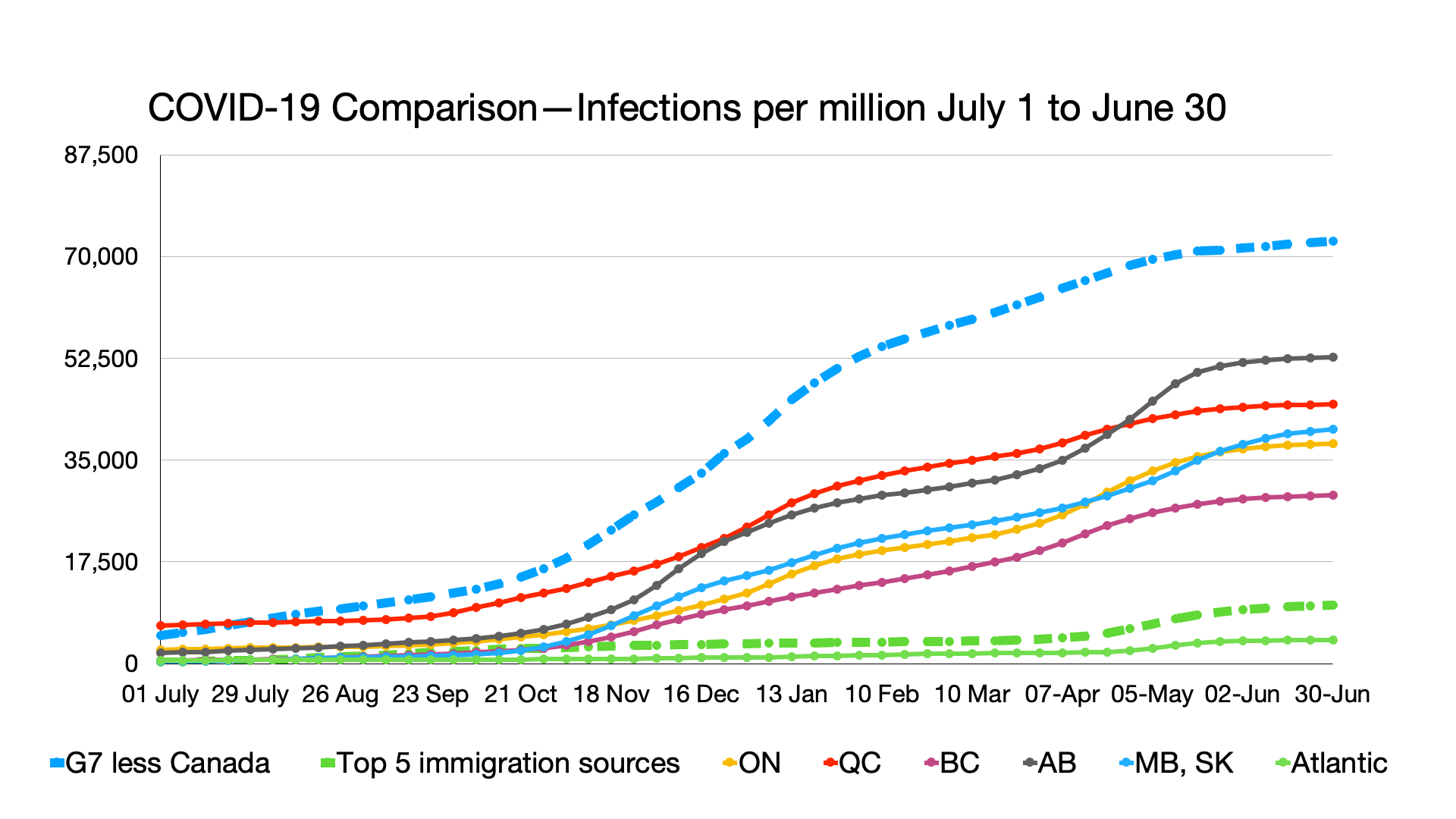
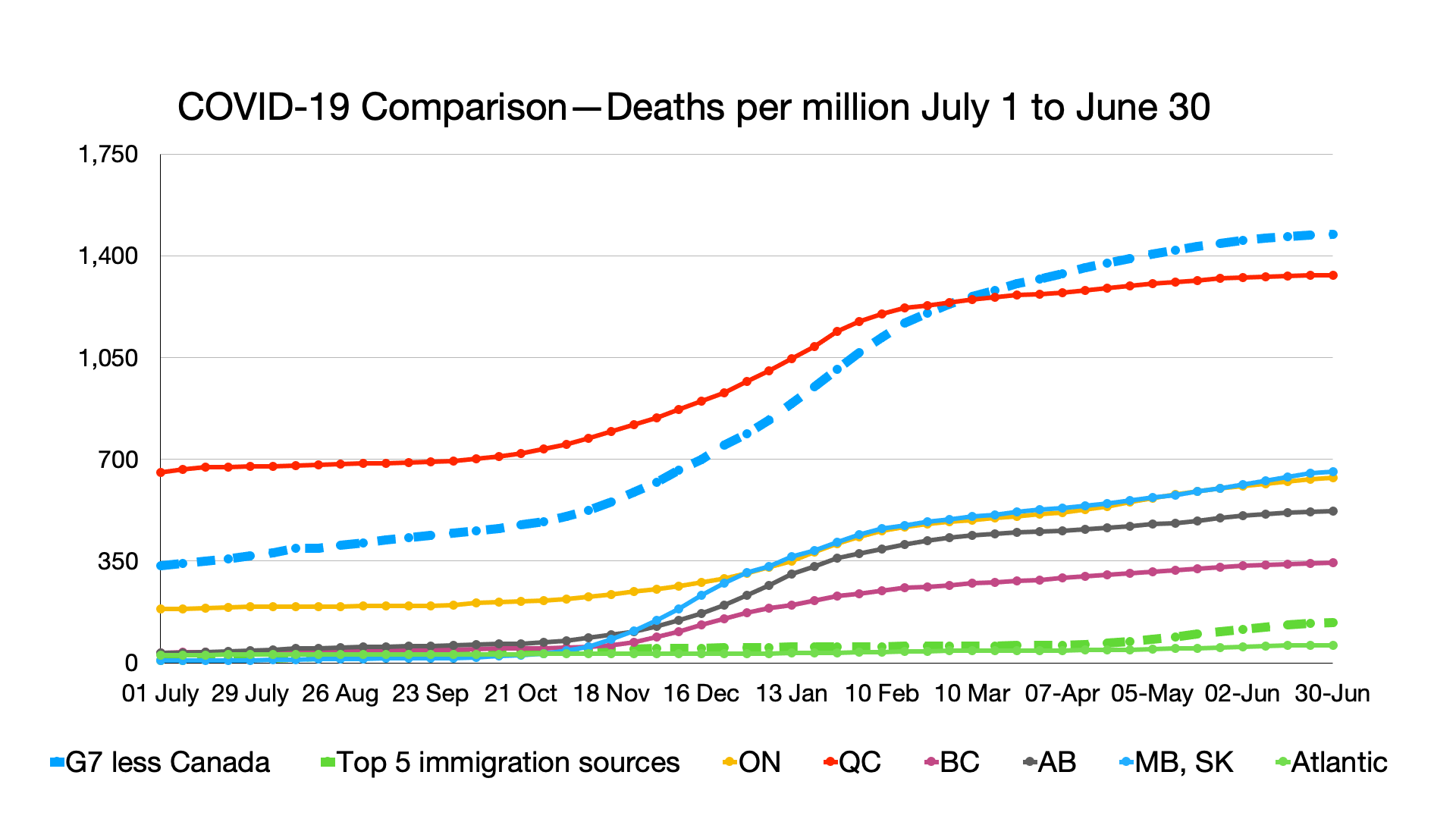
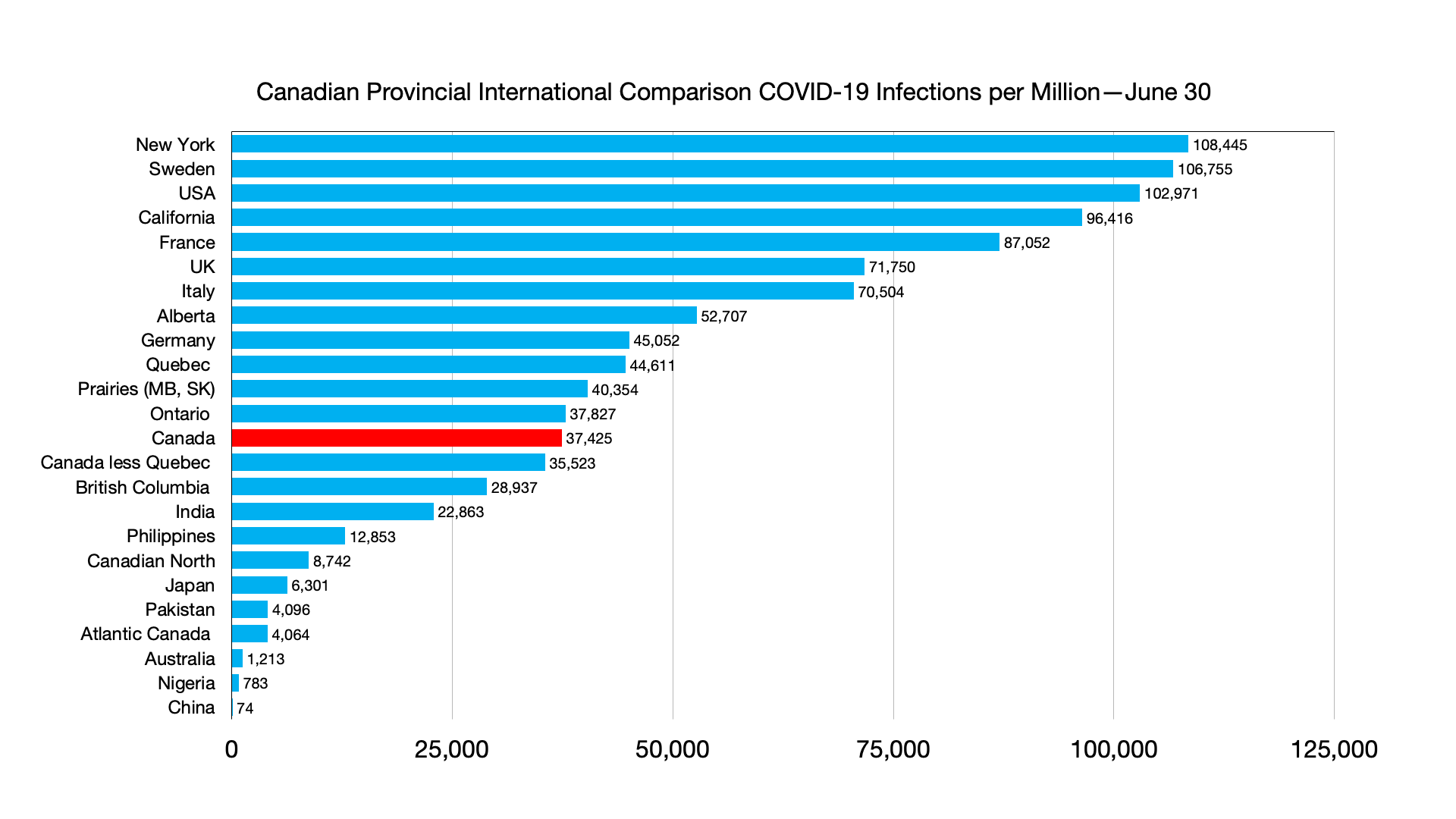
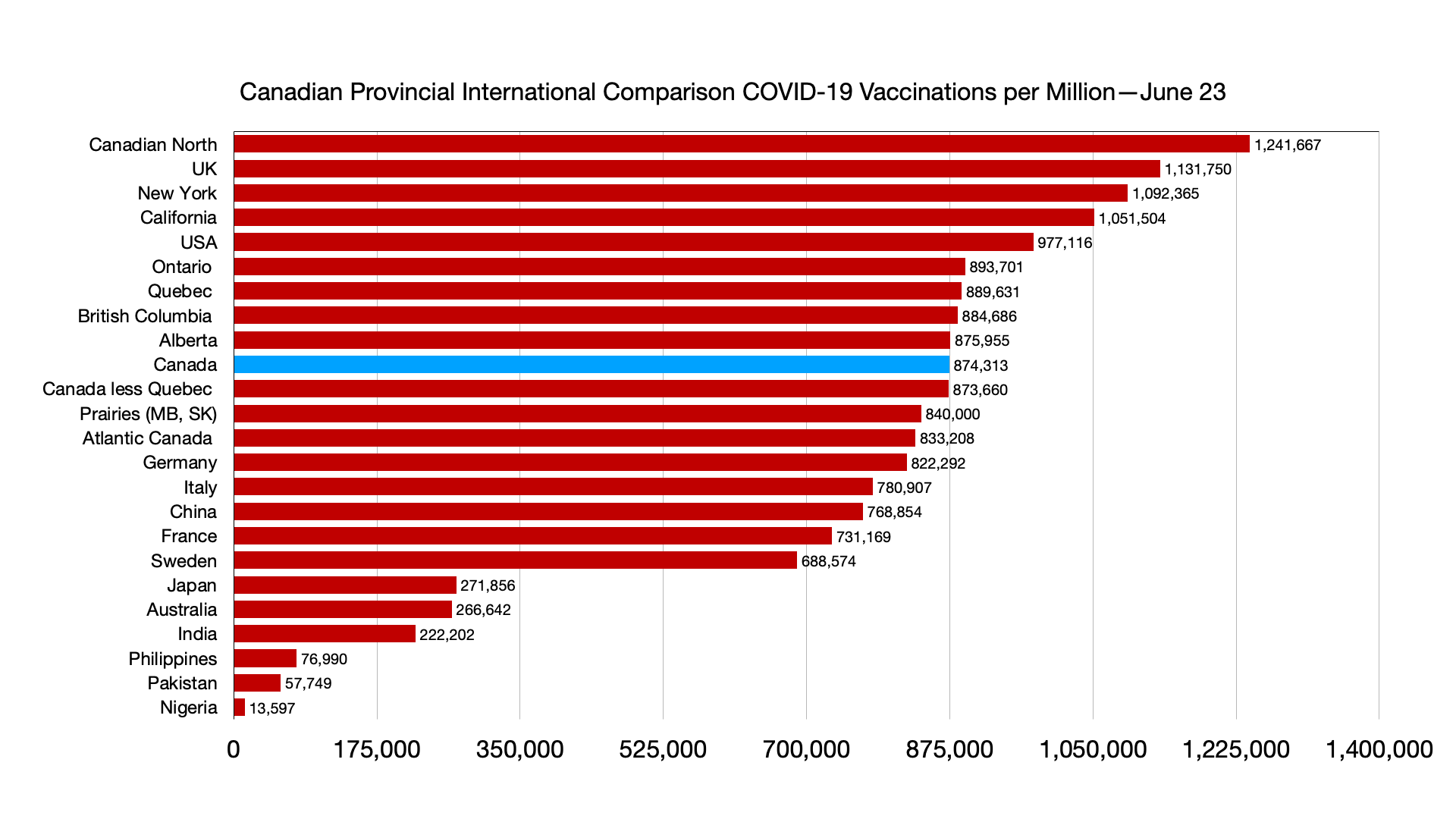
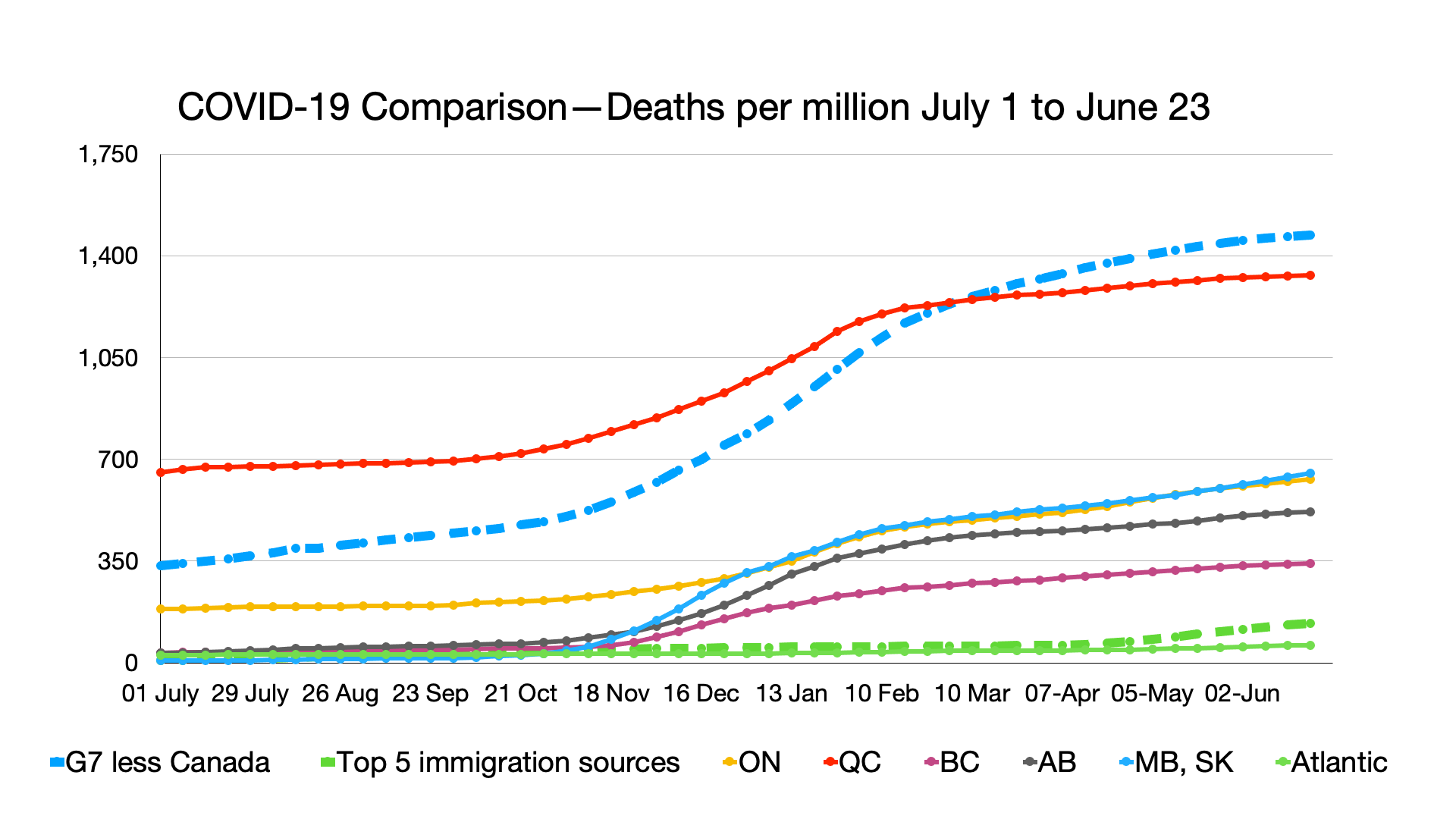
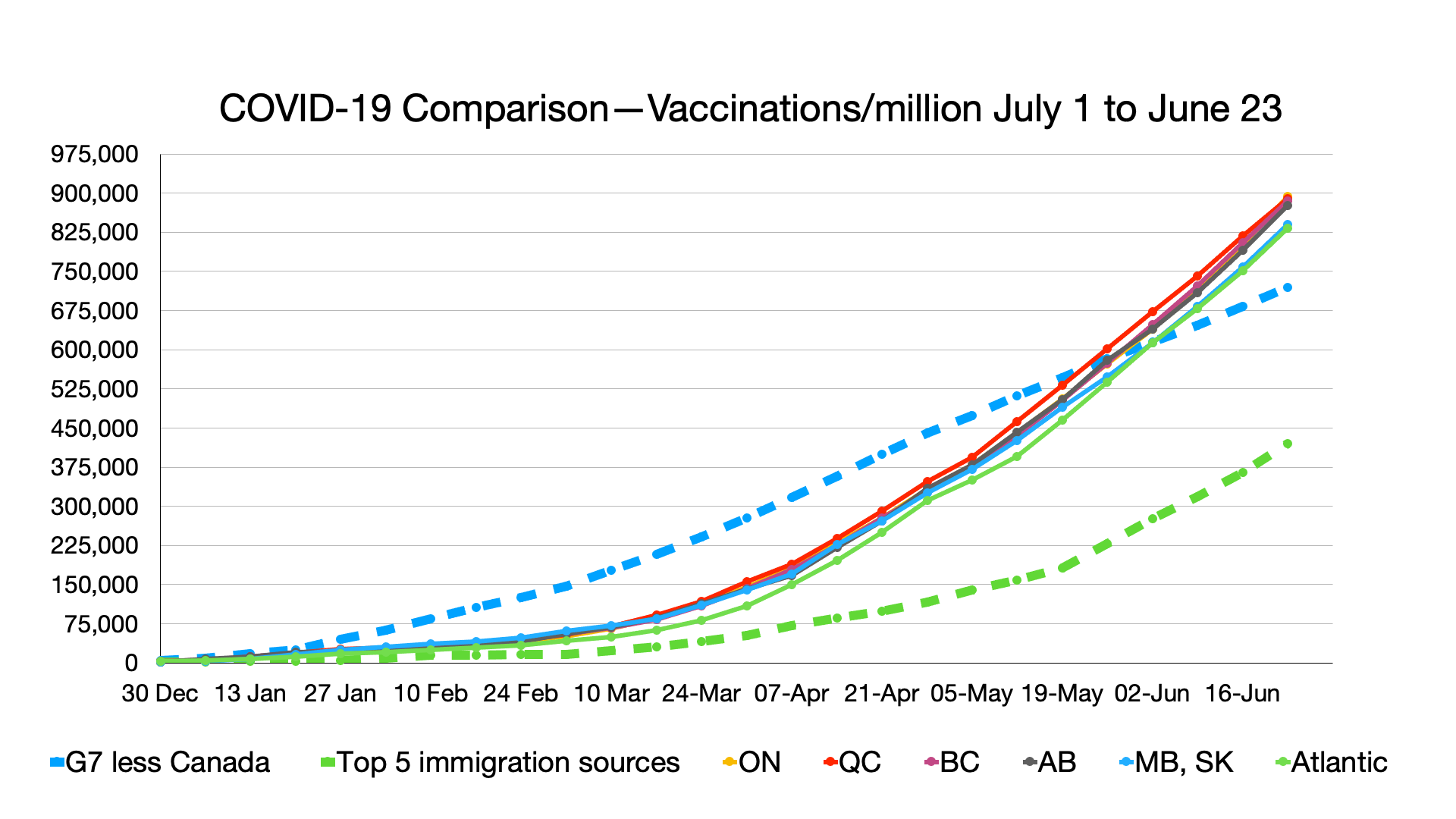
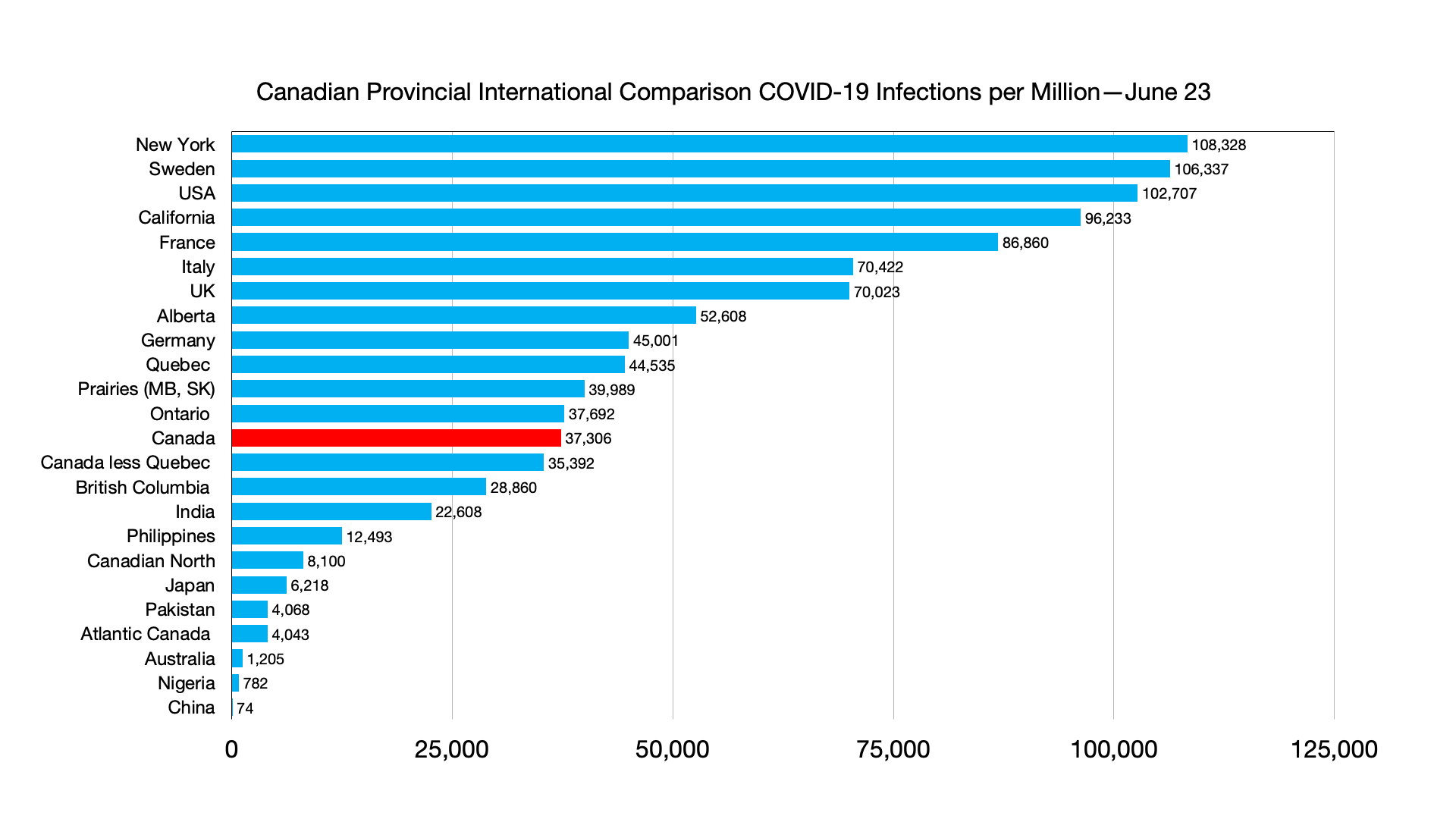
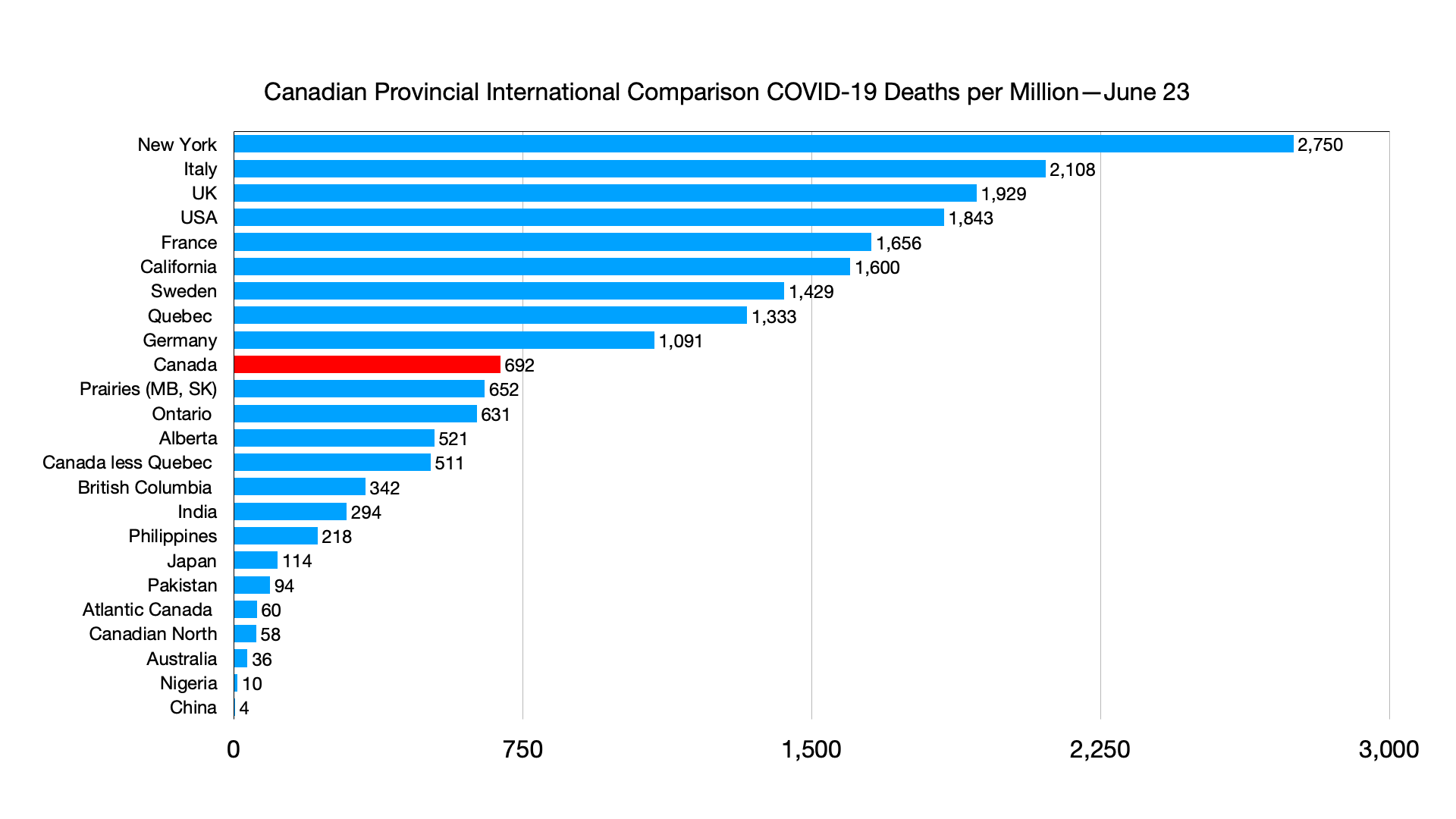
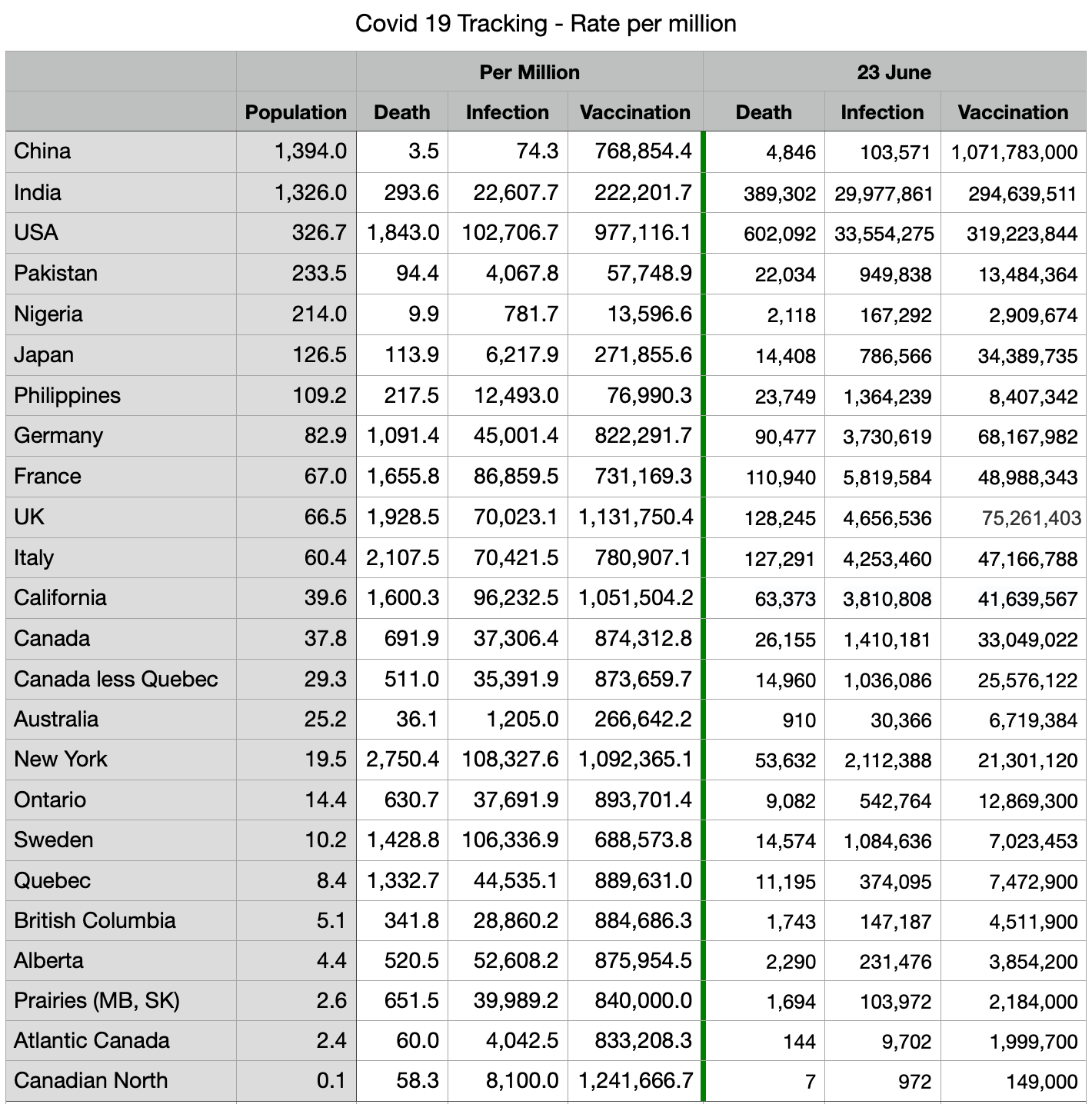
#COVID-19: Comparing provinces with other countries 12 May Update

The latest charts, compiled 12 May as the third wave continues. The ongoing spike of infections and deaths in India per million still has not resulted in a change in the relative ranking given the size of India’s population.

Vaccinations: Overall, vaccination rates in Canada and most provinces continue to be comparable or greater to those of EU countries.

Trendline charts

Infections per million: The ongoing spikes in Alberta and Ontario continue, with Alberta showing the highest growth rate.

Deaths per million: Gap between G7 and Canadian provinces continues to grow.

Vaccinations per million: Vaccination rates in Canadian provinces continue to increase more quickly than overall G7 less Canada countries. USA has moved ahead of the UK. Canada and the largest four provinces all ahead of Germany but Atlantic Canada behind France, while Australia and Japan have moved ahead of the Philippines. The Increases among immigration source country continue to reflect China and India mass vaccination roll-out, but at lower rates of increase compared to Canadian provinces and G7.

Weekly

Infections per million: Sweden moved ahead of California, Italy ahead of UK, and Ontario ahead of all Canada.

Deaths per million: Ontario ahead of Prairies.

Are the gaps in labour market outcomes between immigrants and their Canadian-born counterparts starting to close?

Another important and good analysis from Statistics Canada, highlighting some improvement in economic outcomes from “two step” immigrations (temporary residents transitioning to permanent residency):

Earlier studies have well documented the expanding earnings gap between new immigrant workers and their Canadian-born counterparts during the 1980s and 1990s. However, significant policy changes in immigration selection and settlement have been introduced since the early 2000s, and the employment rate and entry earnings among new immigrants have been improving in recent years.

Little research has been undertaken to examine whether the earnings gap between new immigrant and Canadian-born workers has recently started to close. This paper compares the employment rate and the weekly earnings of immigrant and Canadian-born workers throughout the 2000s and 2010s. It is based on information from the censuses from 2001 to 2016 and information from the Labour Force Survey from 2015 to 2019. Analyses are conducted for new immigrants (in Canada for 1 to 5 years), recent immigrants (in Canada for 6 to 10 years) and long-term immigrants (in Canada for over 10 years).

Over the 2000-to-2019 period, the employment rate for new and recent immigrant men grew faster than for Canadian-born men, and the relative employment position of new immigrant women also improved slightly. The earnings gap between immigrant workers and Canadian-born workers with similar sociodemographic characteristics widened between 2000 and 2015, with both years posting similar national unemployment rates.

In the late 2010s, there was some improvement in the earnings gaps for immigrant men and women relative to their Canadian-born counterparts. This improvement may be related to the rising demand for labour during these years, since relative labour market outcomes for immigrants tend to improve during expansions and to deteriorate during contractions. It may also be related, in part, to the increased tendency to select economic immigrants from the pool of temporary foreign workers. This has been shown to improve both entry earnings and longer-term earnings.

Source: https://www150.statcan.gc.ca/n1/pub/36-28-0001/2021004/article/00004-eng.htm

Ottawa to create new system to tackle delays in processing immigration applications

Needed modernization:

Ottawa says it will create a new digital platform to help process immigration applications more quickly after the COVID-19 pandemic underscored the need for a faster shift to a new system.

The federal government pledged in the 2021 budget to spend $428.9 million over the next five years to deliver the platform that would gradually replace the existing case management system.

The new platform will launch in 2023 to improve application processing and provide more support for applicants, the government said.

Alexander Cohen, a spokesman for Immigration Minister Marco Mendicino, said the new system is part of a wider shift towards digital platforms across the department and government.

“Alberta for a long time — my home province here — their provincial nomination system was purely paper-based. But then, in the past couple years, they decided to integrate their provincial nominee system with the Canadian federal government system.”

He said almost half of all immigrants who arrive in Canada under economic class programs come through sub-provincial programs.

“The actual larger issue here, I would say, is actually federalism, and maybe to align the provincial and federal governments on the issue of immigration,” he said.

Andrew Griffith, a former director of citizenship and multiculturalism at the Immigration Department, said it has tried to simplify the process recently by allowing more online transmission of documents.

“These changes are not that easy to implement overnight,” he said.

Griffith said Ottawa’s promise to spend close to a half billion dollars to put in place a new immigration application processing system will be an interesting one to watch because implementing big IT projects presents challenges for the government.

The department should find ways to get rid of any duplication and overlap that may exist in the current immigration system, he said.

“Do we need all those steps? Can some of these steps be automated? Can we use (artificial intelligence) to make determinations?”

Cohen said the immigration department launched in 2018 two pilot projects using computer analytics to help immigration officers triage some online visa applications.

“This computer analytics technology analyzes data and recognizes patterns in applications to help identify routine and complex cases,” he said.

“The goal is to help officers to identify applications that are routine and straightforward for thorough but faster processing, and to triage files that are more complex for a more extensive review.”

He said all decisions on every application are made by a visa officer in all cases and the department’s artificial intelligence tools are not used to render decisions.

“We’re always looking to leverage technology to improve the process for Canadians and those who wish to come here.”

Source: Ottawa to create new system to tackle delays in processing immigration applications