Ottawa says it only learned Chinese police ran visa centre this year

Appears to be lack of due diligence as should have been caught earlier:

Ottawa says it only learned in February that Canada’s visa-application centre in Beijing is managed by Chinese police, the same month The Globe and Mail reported the arrangement.

The federal government has trusted its visa centre in Beijing to a police-owned company since 2008, and has been required to conduct due-diligence screenings during renewals of the contract in subsequent years including 2018.

The government acknowledged its lack of awareness in documents tabled in the House of Commons this week in response to written questions from NDP immigration critic Jenny Kwan.

“In February, 2021, Public Services and Procurement became aware that Beijing Shuangxiong Foreign Service Company is ultimately owned by the Beijing Public Security Bureau,” the government said in an answer to Ms. Kwan that was signed by Steven MacKinnon, parliamentary secretary to the Minister of Public Services and Procurement.

The Globe reported the ownership structure of the company managing the visa-application centre on Feb. 8.

Ottawa said in the documents that government officials have conducted three site visits to visa-application centres in China “since becoming aware of the subcontractor ownership,” according to another response to Ms. Kwan signed by Immigration Minister Marco Mendicino.

Ms. Kwan said she’s surprised by the government’s admission. “That to me is absolutely shocking. … How on Earth did they not know about the ownership structure?”

She blamed both the Liberal government and previous Conservative government for failing to stop this arrangement and said she remains concerned about how Canada can safeguard visa applicants’ private and confidential information. “I fear for the applicants who use the Canadian government’s services there.”

Canada’s visa-application centre in Beijing is operated by Beijing Shuangxiong Foreign Service Company, which is owned by the Beijing Municipal Public Security Bureau, The Globe discovered. And at least some of the people working inside the centre are members of the Chinese Communist Party, recruited from a school that trains the next generation of party elite.

Beijing Shuangxiong is a subcontractor for VFS Global, a company headquartered in Zurich and Dubai that holds a wide-reaching contract to provide visa-processing services around the world for the Canadian government. VFS offices collect personal and biometric information that is then forwarded to Canadian immigration officials for decisions on who will be granted visas.

Prime Minister Justin Trudeau’s government has given no indication that it intends to end the Beijing arrangement.

Alexander Cohen, press secretary for Mr. Mendicino, said Wednesday that Immigration officials regularly audit and inspect visa-application centres for compliance, including through unannounced audits, and that video cameras are used for ongoing monitoring.

He said no privacy breaches have been reported at these centres by those operating them and that VFS Global has complied with all security requirements in its contract. “Since 2018, [the Immigration department] has conducted over 20 site visits to visa-application centres in China,” Mr. Cohen said.

The government had acknowledged earlier this year that it was unaware from the start of the contract that Chinese police ultimately owned the company that is the facilities manager of the Beijing visa-application centre. At the time, though, it did not reveal when precisely it learned of the matter.

Richard Fadden, a former director of the Canadian Security Intelligence Service, who served as national security adviser to two prime ministers, has said that Ottawa should end the visa situation in Beijing.

“An instrument of the Chinese government has access to a facility in China with connections to Immigration, Refugees and Citizenship Canada,” he said. “I cannot think of a more promising entry point for China’s cyberspies.”

The 2018 contract was not the first time VFS and affiliated companies had won federal contracts to operate visa-application centres, including the ones in China. Earlier contracts were awarded under the Conservative government of Stephen Harper. And during parliamentary hearings in February, MPs learned that Beijing Shuangxiong has actually provided facilities and staff for Canada’s visa-application centre in China’s capital since 2008.

VFS told the hearings it informed Ottawa in 2008 that it intended to use Beijing Shuangxiong as the local subcontractor, or as it calls the company, its local facility-management company.

However, two former Conservative immigration ministers Jason Kenney, now the Premier of Alberta, as well as Chris Alexander, have told The Globe that they were unaware the subcontractor for the visa-application centre in Beijing was a company owned by the Chinese police.

“There was a public tendering process, and as you know there can be no political interference in tendering. If this happened during my tenure and I had been made aware of it, obviously I would have stopped it,” Mr. Kenney told The Globe earlier this year.

Mr. Alexander, for his part, said: “I was never informed of this arrangement in Beijing: it should never have happened. No state body in any region should be controlling access to our immigration or any other programs.”

Jeremy McIntee, a spokesman for former Conservative immigration minister Diane Finley, who was in charge of the department in 2008, said she does not recall whether she was informed of the subcontractor’s ownership.

VFS has said it is obligated to use local partners under Chinese law. It has also said it conducts “deep identity, credit, criminal, residency, education and employment checks” on employees, uses encrypted systems to send application information to Canadian servers, and employs a raft of measures to secure information, including an obligation for employees to hand over mobile phones to managers inside the visa centre.

Beijing Shuangxiong also acts as a subcontracted facility manager for VFS in Beijing for other Western countries, including New Zealand, Britain and Ireland. Immigration New Zealand has said it knew “from the outset” that the Beijing police have ownership of Beijing Shuangxiong.

VFS spokesman Peter Brun has previously said the Chinese companies it works with “are managed by VFS Global and we ensure they operate entirely according to all VFS Global security processes and protocols, and according to the Canadian government’s visa-application process and data-protection requirements, which are audited regularly by the Canadian government.”

Source: https://www.theglobeandmail.com/politics/article-ottawa-says-it-only-learned-chinese-police-ran-visa-centre-this-year/

CATO Poll: 72% of Americans Say Immigrants Come to the United States for Jobs and to Improve Their Lives

The top level finding, with the report having a wealth of detail, with some of the same characteristics as in Canada such as age, education, political affiliation in terms of support or not for immigration:

The Cato Institute 2021 Immigration and Identity National Survey, a new national survey of 2,600 U.S. adults, finds that nearly three‐​fourths (72%) of Americans believe immigrants come to the United States to “find jobs and improve their lives” while 27% think immigrants come to obtain government services and welfare.

READ THE FULL SURVEY REPORT HERE

Support for More Immigration Is on the Rise

Support for more immigration has tripled from the mid‐​1990s when about 10% of the public supported more immigration and two‐​thirds wanted less. Today 29% of Americans want more, 38% want to maintain current levels, and 33% want less.

Chart 1


Democrats’ views largely account for this shift. Starting around 2008–2010, Democratic support for more immigration rose from about 20% to 47% today.

….

Source: Poll: 72% of Americans Say Immigrants Come to the United States for Jobs and to Improve Their Lives

#COVID-19: Comparing provinces with other countries 28 April Update

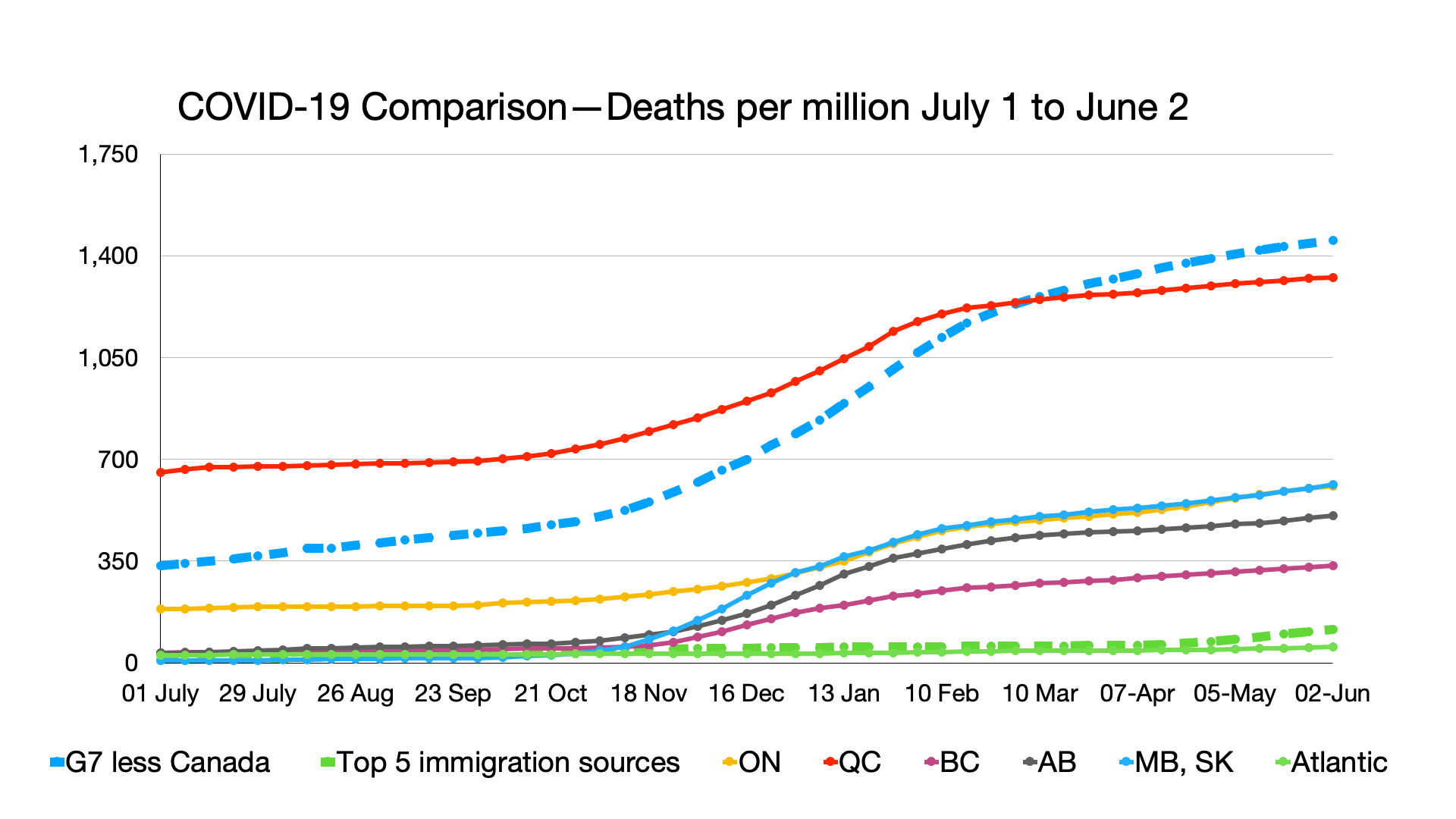
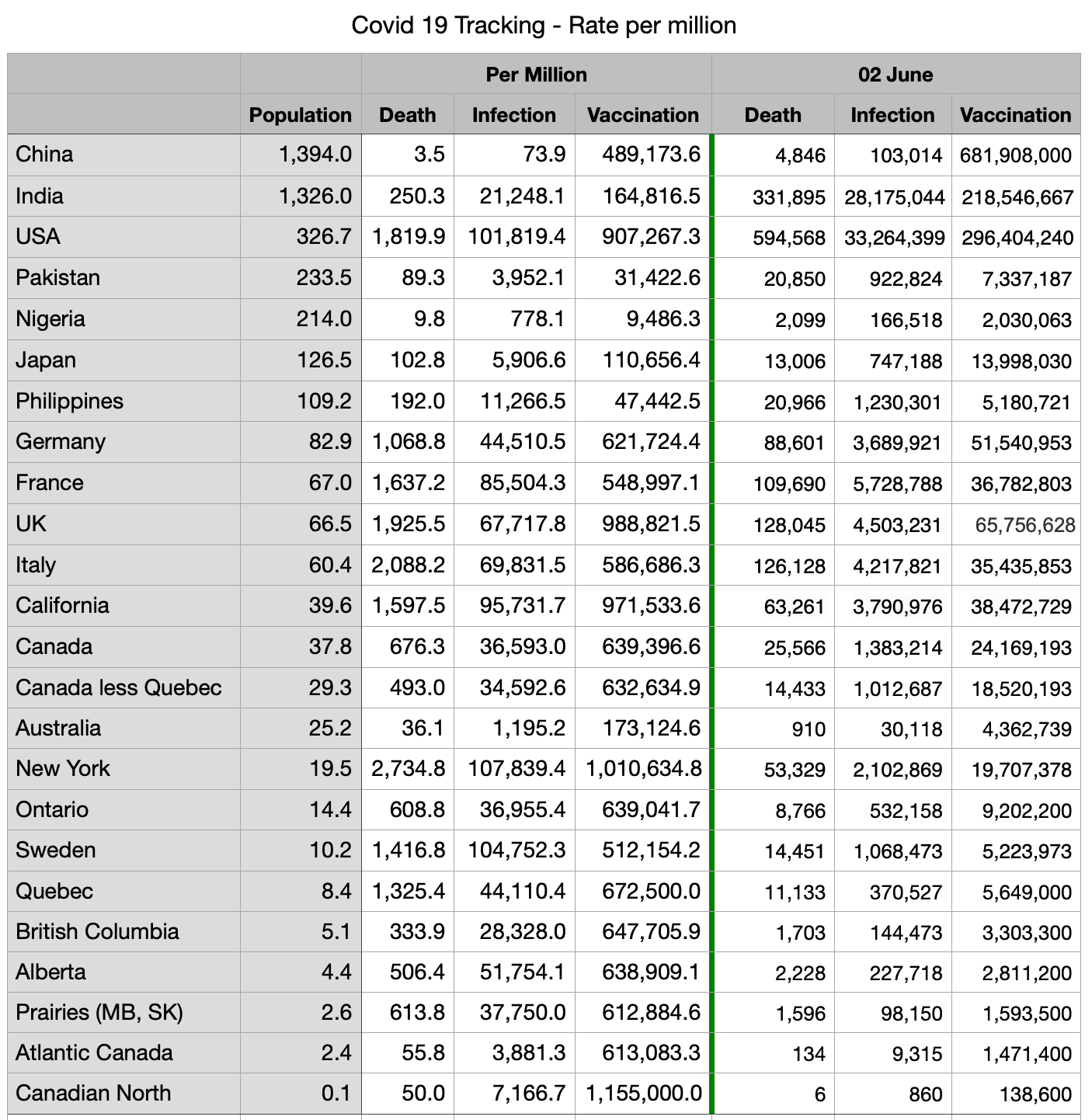
The latest charts, compiled 28 April as the third wave has started. The spike of infections and deaths in India per million, although dramatic, has not resulted in a change in the relative ranking given the size of India’s population.

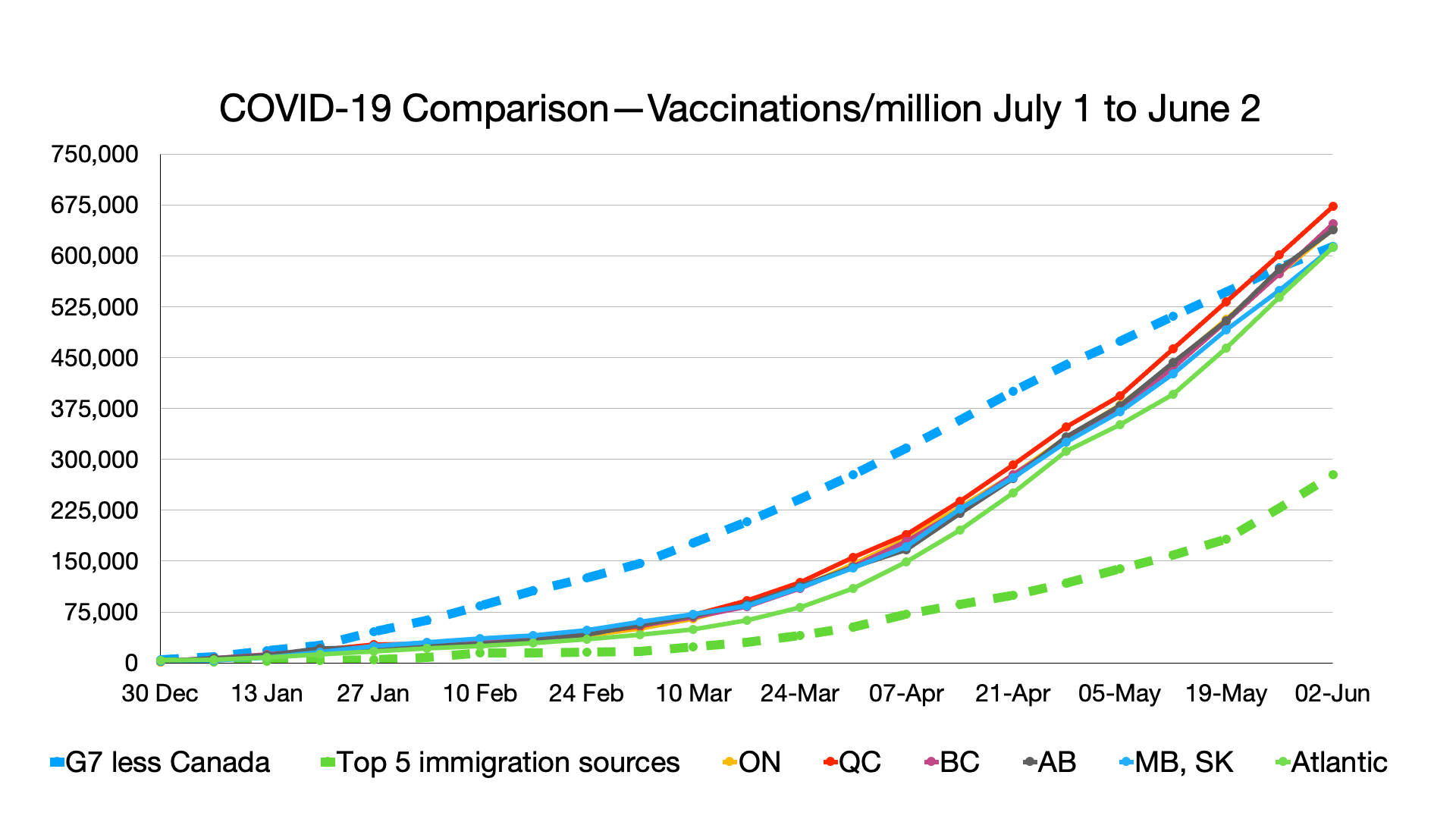
Vaccinations: Overall, Canada and most provinces continue to be comparable or greater to EU countries. On a personal note, received my vaccine last week.

Trendline charts

Infections per million: Recent spikes in Ontario and Alberta continue to be more apparent.

Deaths per million: Canadian North ahead of Atlantic Canada.

Vaccinations per million: Vaccination rates in Canadian provinces continue to increase more quickly than overall G7 less Canada countries. Increases among immigration source country reflect China and India mass vaccination roll-out.

Weekly

Infections per million: Surge in Ontario has not changed overall ranking but surge in Alberta has resulted in Alberta surpassing Quebec.

Deaths per million: As noted, Canadian North now ahead of Atlantic Canada.

India is in a COVID-19 crisis. South Asian-Canadians are weeping from afar, but also seeing devastating parallels for our people in Ontario

Captures well some of the dilemmas facing diaspora communities:

11,627 km.

That’s the distance from my house in Peel to Delhi, India, where the majority of my family lives.

This past week has been extremely difficult as a first generation Canadian born in India. I watch the devastation occurring in my hometown, and can’t help but see the parallels happening here in Ontario within the South Asian community. Immigrants like myself are fighting two pandemics – one here and one tens of thousands kilometres away, and it weighs heavily, each and every day.

On March 23, India had 40,000 COVID-19 cases. Fastforward to April 22, that number rose to 330,000. This is what exponential growth looks like. Experts believe these numbers are vastly under-reported by a margin of at least 10 times. Even if 10 per cent of these were hospitalized, with the average COVID-19 related hospital or ICU stay being 15 days, there is simply no healthcare system in the world that has the capacity to sustain such volume.

The situation in India is grave and complex. India saw a sharp decline in cases earlier this year, with around 10,000 cases on average per day in February. This unfortunately led to a sense of complacency, with some experts claiming preemptively that the country had achieved herd immunity. Subsequently, life returned to a form of “normalcy,” with weddings, religious festivals and political rallies being commonplace. Even Kumbh Mela, which is one of the largest gatherings in the world that sees upwards of 110 million people over the duration of the festival and up to 30 million people per day, went ahead as planned.

Complacency, however, wasn’t the only factor that led us to this situation. It’s a culmination of other factors. India has one of the lowest testing capacities per capita, with only 0.4 tests conducted per 10,000 people. India also has a much slower vaccination program. While India has manufactured large quantities of vaccines, it has distributed the majority of these globally. It is one of the largest suppliers into the COVAX program, accounting for 60 per cent of global vaccine supply. Meanwhile, less than 10 per cent of India’s own population has received one dose of the vaccine, with only 1 per cent fully vaccinated with two doses.

In addition, India now has a potentially concerning new variant, B.1.617, that amongst many mutations has two critical ones — L452R and E484Q — within the spike protein, making it more transmissible and possibly able to evade pre-existing immunity. It is still unknown whether vaccines are efficacious against this variant.

The stories, pictures and videos coming out of India are devastating. Scenes of people lying on the ground on the street with oxygen masks connected to empty tanks, dying outside of hospitals that did not have capacity to take them in, health care systems collapsing. There are make-shift outdoor hospitals, mass cremations sites, and reports of families having to keep dead bodies of relatives at home for two days because there was no wood left to build a funeral pyre. Hospital with mere hours left of oxygen supply.

Many in the South Asian diaspora are carrying the burden of knowing our own family members are amongst those affected. My father, who lives with me, spends his entire day calling each and every one of his family and friends. So many infected, many hospitalized, many searching for hospitals. Daily updates, sometimes hourly. Everytime he utters Hari Om Tat Sat (a sanskrit mantra) I wait with baited breath. I feel helpless remembering we are again, 11,627 km, apart — a number I can’t stop thinking about.

What hurts my heart even more is knowing that what is occurring to my people in India is also occurring here on Canadian soil. South Asians have been disproportionately impacted by COVID-19. The pandemic has been deeply inequitable, from support and protections to testing and now access to vaccines. Further, we are seeing additional stigmatization of South Asians due to this new variant now being found in Canada despite the fact that the primary reason for transmission remains to be structural barriers faced by our racialized communities. And like me, they are dealing with two pandemics — the one here and the one back home.

It really feels like because our skin is brown, our lives mean less. But we didn’t get to choose the colour of skin we were born into our socioeconomic status. We didn’t get to choose the country we were born in.

It was heartbreaking to see the world’s response to India’s crisis. Canada shut its borders. Simultaneously, our Premier’s office contacted the Indian high commissioner to request additional AstraZeneca vaccines in spite of the current crisis. The United States of America continues to sit on unused AstraZeneca vaccines and withhold raw materials required for India to manufacture more vaccines. This ‘me first’ strategy is not only inequitable, it is unwise because we know how the pandemic unfolds in one country will eventually happen in another.

And this is why vaccine nationalism is lethal. Your access to vaccines and subsequent right to life is dependent on factors that are out of your control. It is the stark inequities, the perpetuation of discrimination, the haves vs the have nots, the unfairness of it all that weighs heavily on me.

India gasps for air and burns with funeral pyres. But these lives don’t seem to matter. Because they’re brown.

I can’t stop crying. Because my heart can’t take it anymore.

Source: https://www.thestar.com/opinion/contributors/2021/04/24/india-is-in-a-covid-19-crisis-south-asian-canadians-are-weeping-from-afar-but-also-seeing-devastating-parallels-for-our-people-in-ontario.html?li_source=LI&li_medium=thestar_recommended_for_you

ICYMI: Retaking language test unfair during COVID-19: applicants to new residency pathway

Of note:

International graduates and essential workers eligible to apply for permanent residency under a new program say requiring them to retake language proficiency tests is unreasonable, especially during a global pandemic.

Akshay Aman, a law clerk graduate currently working as a security officer in Toronto, said international students have already passed language tests and proved their proficiency in English or French when they got their school admission and student visa.

“We all had our degrees from Canada and everything was in English,” Aman said.

“There is no sense (in taking) the test again and again.”

The new program announced last week aims to grant 90,000 essential workers and international graduates who are currently in Canada permanent status.

On May 6, the immigration department will start accepting up to 50,000 applications from health care and other essential workers and 40,000 applications from international students who graduated from a Canadian institution.

The government is requiring international graduates and essential workers to submit an official language evaluation that is less than two years old when the permanent residency application is received.

Aman, who graduated from Niagara College, said he has all the documents he needs in order to apply for permanent residency except a new English proficiency test.

He said the websites of the government-approved language tests have crashed since the announcement of the new program last week, leaving thousands of applicants struggling to register for an exam.

All the spots are booked until the end of September, he said, adding that after he failed to book a test in Toronto, he tried to find one in Alberta or British Columbia but all the exams are booked there too.

He added that it’s unsafe to require tens of thousands of people to take in-person tests during the COVID-19 pandemic.

“They should delay (this requirement) or they can drop that because we already have our degrees,” he said.

Alexander Cohen, a spokesman for Immigration Minister Marco Mendicino, said the department wants to assure prospective applicants that the process will be fair for everyone, but he didn’t say whether the department will drop the language requirement for those who have already passed proficiency tests.

“(The program) will allow far more international students to plan their futures in Canada,” Cohen said in a statement.

“The size, scope and speed of this new program is unprecedented.”

Morad Roohi, a third-year PhD student at Queen’s University, said he has been trying to book an English evaluation test with his partner, so they can apply for permanent residency under the new program.

He said they have spent days searching for an available test appointment, but they couldn’t find one.

Roohi described the application process, which also involves gathering many documents, as like hitting a “stone wall.”

“It is really, really unfair.”

He said they moved from Kingston, Ont., to Toronto during the early days of the COVID-19 pandemic when his partner found a job at a homeless shelter in the city.

“She risks her life all through these months of (the) pandemic and lockdown. She has not been at home for a single day,” he said.

“When it comes to this application, still you’re just bombarded by … different (reasons for) pressure and stress.”

Roohi said requiring international students to pass a general language test after they passed an academic exam is not understandable.

Newcomers are offering their skills and expertise to the Canadian society despite all the difficulties they are facing during the pandemic, he added.

“As international students, as newcomers, (we are) going through lots of stress, pressure, uncertainty and many, many difficult things,” he said.

He said the government should make changes to the application requirement to make it easier for international graduates and essential workers to apply.

“When there is a pandemic and where there is no exam available, what can we do? There should be some accommodation for us.”

Source: Retaking language test unfair during COVID-19: applicants to new residency pathway

Canada must process applications for children’s immigration in six months: advocates

Of note:

Ottawa should establish a standard of six months to reunite newcomers to Canada with their children, as many refugee and immigrant families now wait years, says a national advocacy group.

The long wait is unacceptable, especially for children who are separated from both parents, said Janet Dench, executive director of the Canadian Council for Refugees.

She said parents who have been forced to flee as refugees end up in many cases leaving their children with a grandparent, another family member or even a neighbour in their home countries.

Source: Canada must process applications for children’s immigration in six months: advocates

Home Office handling of Windrush citizenship claims ruled ‘irrational’

More on Windrush:

The Home Office’s handling of some Windrush citizenship applications has been irrational and unlawful, the high court has ruled in a judgment that will prevent the department from refusing citizenship to Windrush-generation applicants due to minor, historical convictions.

The court was ruling on the case of Hubert Howard, who was repeatedly denied British citizenship over the course of a decade, despite having lived in the UK since he arrived from Jamaica at the age of three in 1960.

The Home Office sought to deny him citizenship, despite the 59 years he had spent continuously in the UK, because of a number of minor convictions, most of them committed in the 1970s and 1980s – none were serious enough to trigger a jail sentence. He was still fighting for naturalisation from his intensive care bed as he was dying in hospital in October 2019.

Source: Home Office handling of Windrush citizenship claims ruled ‘irrational’

At a Vancouver forum, experts see immigration adding fuel to the overheated big-city housing market

No surprise:

Spring is in the air and the outlook is cheery for the next couple of years, according to pundits who spoke at the Vancouver Real Estate Forum held online last week

The opening remarks were delivered by Canadian Imperial Bank of Commerce deputy chief economist Benjamin Tal. His tone was far more encouraging than his talk last fall, in which he predicted the next six months would “not be very pretty,” with a housing market that would slow by winter. The housing market, however, did not slow. It only gained momentum. Last week, Mr. Tal said he sees a quick economic recovery – with Canadians sitting on piles of savings accumulated in the pandemic and immigration numbers greater than predicted, both of which will add more fuel to the already overheating housing market.

And he estimates around 60,000 to 70,000 non-resident Canadians, most of them living in Hong Kong, will return.

“We are starting to see this money coming into real estate in Vancouver and Toronto,” he said.

Anthem Properties chief executive officer Eric Carlson, who spoke as part of a panel, and other industry members also forecasted a roaring market thanks to increased immigration.

“[Immigration] numbers will be up in 2022, almost like the way they were pre-COVID. But it will take time to get up,” Mr. Carlson said. “In 2023, they will be higher; 2023 will be a rock concert of immigration. It’s going to be phenomenal. It’s going to completely mess up housing affordability.”

Mr. Tal says the economic fallout from the pandemic is deep, but narrow. Low-income jobs were wiped out, but high-income earning jobs actually increased.

“This is the first recession in Canadian history [in which] personal income has gone up. Crazy, but that’s exactly what we’ve seen.”

As a result, the income gap is even wider than it was prior to the crisis. That will increase the need for affordable housing.

“I see purpose-built rental as the solution,” Mr. Tal said. “I see a situation in which you are 35 years old and you are married with two kids, renting, and there is nothing wrong with [that]. When we develop this mentality, this way of thinking, I believe the affordability channel in the Vancouver market will be open in a very dramatic way.”

As for those who were lucky enough to make more money in the past year, the only obstacle getting in their way of spending it is access to the COVID-19 vaccine. A lot of people have saved a bundle, which will play a role in the recovery.

“This has major implications, because you have high-income individuals keeping their jobs and their income is rising, but they are not spending.

“We are sitting on a mountain of cash. I estimate that individuals are now sitting on roughly $100-billion of extra cash, more than they need. This is money that is sitting in chequing and savings accounts, collecting nothing, and those people are willing and able to spend that money the minute that they have the green light. Believe me, all those people are dying to go to restaurants but they are not willing to die doing so, and so they are waiting.”

The question becomes, what to do with all those savings? With interest rates as low as 1.3 per cent, mortgage broker Andrew Wade said borrowed capital is too cheap to even think about paying off the home. He’s seeing a “major surge” in Canadians buying vacation properties in Canada. However, he’s also seeing spending behaviours that are making him nervous. It’s common to see bidding wars on houses where people are making subject-free offers up to $300,000 above asking price, Mr. Wade said.

“This scares me,” he said. “I advise explicitly against this if the buyer is depending on borrowed funds.”

Mr. Wade is not so sure there is a “mountain of cash” available to most Canadians, who need to think about the high cost of future retirement and other costs. Also, the new stress test for uninsured mortgages goes up to 5.25 per cent on June 1, which will reduce a buyer’s borrowing amount by about 4 per cent, he says. That should help address a market that might not be sustainable, particularly on purchases of more than $1-million. Another trend he is seeing is homeowners tapping into their equity to afford their lifestyle. If there’s a market correction, he advises his clients to remember that, “cash is king.”

Real estate industry veteran Rudy Nielsen concurs. Mr. Nielsen, founder of the NIHO Land & Cattle Co. Ltd., says he always keeps available cash, even if it’s earning next to nothing. Mr. Nielsen generally agrees with Mr. Tal’s outlook, but he adds that there are a lot of people struggling, too.

“Some people do have a lot of money in their bank account, yes, and some are living month-to-month. Lots of people are hurting out there.”

For a long time, Mr. Nielsen was B.C.’s largest owner of private property, with about 500 properties at his peak. He started out logging properties, and then bought acres of ranch land and farms, office buildings, even entire towns. He’d sell properties in the towns on a lease-to-own basis.

In the 1970s, he’d built a real estate empire and then in 1981 he got caught in the crash, when interest rates soared to 17 per cent, and he owed $1.8-million. He rebuilt the empire, and he says he learned some lessons, such as not to over-leverage like he’d done when he was young. Today, at 80, the appraiser, developer, landowner and outdoorsman has downsized to about a dozen large properties, including 700 acres of farmland in the north only accessible by helicopter.

His advice is to invest for the long term.

“Some of the properties I’ve sat on for 30 years, but my returns are incredible, in the thousands of per cent,” Mr. Nielsen says.

He believes in investing in mortgage investment corporations, which he admits are “a little risky” because they are mostly investments in second mortgages, and foreclosures are always a possibility. But the returns he’s getting are 9 per cent to 10.5 per cent, he says.

“And I still keep some properties. I am patient and I sell as I see fit.

“The way I look at my land is, it’s my second bank.”

He advises people who’ve saved some money and who are starting out to buy recreational property that they will use, which will be worth a lot more by the time they retire. He tells the story of meeting a young family a decade ago in Williams Lake. They had sold off their Maple Ridge home to buy acreage with a few holiday cabins to rent out, with less income but less stress. He sees a trend like that happening now.

“I’ve always done good in land. Right now, I’ve been in business since 1964 and I’ve never seen more demand for land than I have right now. … We are selling everything we’ve got. We are getting good prices. There is a line up of people wanting the next piece.”

Source: https://www.theglobeandmail.com/real-estate/vancouver/article-at-a-vancouver-forum-experts-see-immigration-adding-fuel-to-the/

#COVID19 #Immigration impact: February update

My latest monthly update.

The trend of increased transitions from temporary to permanent residents continued in February and given recent policy and operational changes (lowering of Express Entry minimum CRS score, recently announced targets for healthcare and other essential workers, international students) this trend will likely continue for the balance of the year.

All of these changes, advisable or not, will help the government achieve (or partially achieve) its 2021 target of 401,000 new immigrants. 

Moreover, these changes should also address the imbalance between the higher skilled, who transition at a higher (and increasing rates) and the lower skilled, with lower transition rates).

Interestingly, IMP data now shows a large percentage of “Other IMP Participants.” Typically, this was less than 50 per month but jumped to over 3,000 in February, perhaps due to delayed coding against the individual programs.

In contrast to the relative return to traditional levels of new immigrants, the number of new citizens remains much lower than pre-COVID, from an average of about 21,000 in 2019 to an average of about 6,000 from June 2020 when the program was restarted.

Web statistics show an increase of interest compared to last year for all programs save citizenship. 

Douglas Todd: Quebec to get 10 times more than B.C. and Ontario to settle immigrants

Almost an annual event, criticism of the Canada-Quebec immigration accord’s unbalanced funding arrangement, one that becomes more unbalanced as immigration to the rest of Canada continues to outstrip immigration to Quebec:

Quebec will be handed roughly 10 times more taxpayer dollars from Ottawa to settle each one of its immigrants than B.C., Ontario, Alberta and the other provinces.

The pandemic is further distorting an already lopsided and increasingly bizarre three-decade-old accord with Ottawa that this year will provide Quebec with roughly $20,000 to support each new permanent resident to the province.

Meanwhile, each new permanent resident set to move to B.C. will be allocated only about $1,800 in settlement services, which include language training, assistance with housing and job counselling.

Immigration, Refugees and Citizenship Canada settlement allocations show, in addition, that Ontario will be handed about $2,000 this year to support each of its new immigrants.

“If I were the other provinces, I would be really, really angry about it,” says Stephan Reichhold, who heads the umbrella organization that oversees 150 settlement agencies in Quebec.

“The other provinces can complain. They can make public statements that it’s not fair,” Reichhold said, explaining that the ever-widening transfer disparity is rooted in a funding formula embedded in the 1991 Canada-Quebec immigration accord.

The upshot of the accord is that Quebec, despite reducing its immigration levels two years ago, will nevertheless be handed a whopping $650 million to help settle the 30,000 to 35,000 new permanent residents it expects in 2021.

Meanwhile, the settlement allocations show all the other provinces and territories combined are this year scheduled to receive $741 million to help integrate about 370,000 new permanent residents, based on Ottawa’s target, which is a record 401,000 immigrants for 2021.

B.C. is set to receive only about $109 million, even while it is projected to take in more than 65,000 new permanent residents, about twice as many as Quebec.

Ontario, which normally takes in 45 per cent of all immigrants to Canada, will be transferred just $372 million, far less than Quebec.

It all adds up to mean, said Reichhold, that Quebec, which accepts only one-tenth of the country’s new immigrants, will receive almost as much transfer money as the other nine provinces and three territories combined.

Vancouver-based Chris Friesen, chair of a national umbrella association that represents immigrant serving agencies across the country, said the gross imbalance in immigrant-support payments is yet another reason he and others are calling for a national dialogue, possibly a royal commission, into the country’s immigration policies.

Friesen, who is also director of the Immigrant Services Society of B.C. that supports refugees, said the Quebec-Canada formula constantly escalates the proportion of transfer funds going to Quebec. As a result the province will actually receive $58 million more to settle permanent residents this year than last year — despite taking in fewer  immigrants than it did in 2019 and 2020.

Even though the provinces have a moral right to protest their poor treatment, Quebec’s Reichhold doubted it would do much good.

That’s because the Canada-Quebec immigration accord, which prime minister Brian Mulroney signed in 1991, gave unique immigration powers and generous transfer payments to the province, mainly to appease a then-surging sovereigntist movement. The other provinces do not have anywhere near the same level of influence over immigration, which is constitutionally in the hands of Ottawa.

Quebec, because of the accord, has long raked in more money per immigrant from Ottawa than the other provinces. In 2019, Quebec received about $11,000 for each of the roughly 40,000 permanent residents it accepted. That compared to about $2,400 each for immigrants to B.C. and Ontario.

This year, because of both COVID-19 border restrictions and Premier Francois Legault’s campaign promise to further reduce immigration levels, the money gap continues to grow wider than ever. Quebec expects only about 30,000 to 35,000 new permanent residents in the province this year, said Reichhold, who noted that Legault’s government announced Wednesday it is considering upping its target to 50,000 in 2022.

Despite the unfairness of the transfer system, Reichhold said Quebec can always use the federal money. And he was pleased to see that Legault is directing two to three times more of Ottawa’s funding into immigration services than the previous Liberal premier, Philippe Couillard, who mostly shovelled it into general revenue.

“Legault has really raised the amount that goes into language training and other resources,” said Reichhold. Asked if he thought other provinces should get as much money per capita as Quebec for settlement services, Reichhold laughed and said, “Can you imagine the amount? It would cost three to four billion dollars.”

Quebec’s immigration program is unique in the world in the way it gives so much control to a regional jurisdiction, Reichhold said.

Quebec also has its own distinct immigrant-investor program, which had for years been bringing in about 4,000 rich newcomers from around the world, mostly Asia. Nine out of 10 don’t stay in Quebec, but instead move to Toronto or Vancouver. Reichold said the program, which critics call a “cash-for-passport scheme,” is not taking new applicants, as it deals with a backlog.

The media outside Quebec don’t often look at how the immigration system works, or its dramatic anomalies, because most English-language journalists show little interest in francophone Quebec, said Reichhold. For that matter, he said, most Quebeckers don’t understand immigration policy either.

The public’s overall ignorance is one of the reasons Friesen, along with Jean McRae of Victoria, B.C., and Victoria Esses of London, Ont., are calling for a national inquiry into Canada’s convoluted immigration policies, which are produced closed doors. That includes Ottawa’s announcement in October that its objective is to admit over 1.2 million new permanent residents between 2021 and 2023, the most ever.

Although a recent poll found Canadians are among the most welcoming people in the world to immigrants, Friesen, MacRae and Esses said the public’s “lack of control and generalized uncertainty can easily stoke anti-immigrant and anti-immigration sentiments. Involving Canadians in an informed consideration of how Canada’s  future immigration programs and policies should be structured will work to dampen these effects.”

It may be possible to forgive Canadians for not comprehending what’s actually going on in Quebec or elsewhere in regard to immigration policy. Still, it would be prudent to avoid being naive.

Source: https://vancouversun.com/business/douglas-todd-quebec-to-get-10-times-more-than-b-c-and-ontario-to-settle-immigrants