Long Slide Looms for World Population, With Sweeping Ramifications

One of the more significant articles I have seen recently, highlighting the need for countries and societies to adapt to declining populations. While traditional immigrant receiving countries like Canada, Australia and the USA can blunt the decline somewhat, they will also feel the effects on an aging population.

Just as in climate change where adaptation and reduction strategies are both needed, relying only on immigration, as Canada largely does, to mitigate (slow down) the decline, will not address successfully the longer-term trends.

Politicians, policy makers and stakeholders need to devote more attention to other policy responses beyond simply increased immigration. After all, declining populations in most of our source countries may make Canada relatively less attractive in economic terms:

All over the world, countries are confronting population stagnation and a fertility bust, a dizzying reversal unmatched in recorded history that will make first-birthday parties a rarer sight than funerals, and empty homes a common eyesore.

Maternity wards are already shutting down in Italy. Ghost cities are appearing in northeastern China. Universities in South Korea can’t find enough students, and in Germany, hundreds of thousands of properties have been razed, with the land turned into parks.

Like an avalanche, the demographic forces — pushing toward more deaths than births — seem to be expanding and accelerating. Though some countries continue to see their populations grow, especially in Africa, fertility rates are falling nearly everywhere else. Demographers now predict that by the latter half of the century or possibly earlier, the global population will enter a sustained decline for the first time.

A planet with fewer people could ease pressure on resources, slow the destructive impact of climate change and reduce household burdens for women. But the census announcements this month from China and the United States, which showed the slowest rates of population growth in decades for both countries, also point to hard-to-fathom adjustments.

The strain of longer lives and low fertility, leading to fewer workers and more retirees, threatens to upend how societies are organized — around the notion that a surplus of young people will drive economies and help pay for the old. It may also require a reconceptualization of family and nation. Imagine entire regions where everyone is 70 or older. Imagine governments laying out huge bonuses for immigrants and mothers with lots of children. Imagine a gig economy filled with grandparents and Super Bowl ads promoting procreation.

“A paradigm shift is necessary,” said Frank Swiaczny, a German demographer who was the chief of population trends and analysis for the United Nations until last year. “Countries need to learn to live with and adapt to decline.”

The ramifications and responses have already begun to appear, especially in East Asia and Europe. From Hungary to China, from Sweden to Japan, governments are struggling to balance the demands of a swelling older cohort with the needs of young people whose most intimate decisions about childbearing are being shaped by factors both positive (more work opportunities for women) and negative (persistent gender inequality and high living costs).

The 20th century presented a very different challenge. The global population saw its greatest increase in known history, from 1.6 billion in 1900 to 6 billion in 2000, as life spans lengthened and infant mortality declined. In some countries — representing about a third of the world’s people — those growth dynamics are still in play. By the end of the century, Nigeria could surpass China in population; across sub-Saharan Africa, families are still having four or five children.

But nearly everywhere else, the era of high fertility is ending. As women have gained more access to education and contraception, and as the anxieties associated with having children continue to intensify, more parents are delaying pregnancy and fewer babies are being born. Even in countries long associated with rapid growth, such as India and Mexico, birthrates are falling toward, or are already below, the replacement rate of 2.1 children per family.

The change may take decades, but once it starts, decline (just like growth) spirals exponentially. With fewer births, fewer girls grow up to have children, and if they have smaller families than their parents did — which is happening in dozens of countries — the drop starts to look like a rock thrown off a cliff.

“It becomes a cyclical mechanism,” said Stuart Gietel Basten, an expert on Asian demographics and a professor of social science and public policy at the Hong Kong University of Science and Technology. “It’s demographic momentum.”

Some countries, like the United States, Australia and Canada, where birthrates hover between 1.5 and 2, have blunted the impact with immigrants. But in Eastern Europe, migration out of the region has compounded depopulation, and in large parts of Asia, the “demographic time bomb” that first became a subject of debate a few decades ago has finally gone off.

South Korea’s fertility rate dropped to a record low of 0.92 in 2019 — less than one child per woman, the lowest rate in the developed world. Every month for the past 59 months, the total number of babies born in the country has dropped to a record depth.

That declining birthrate, coupled with a rapid industrialization that has pushed people from rural towns to big cities, has created what can feel like a two-tiered society. While major metropolises like Seoul continue to grow, putting intense pressure on infrastructure and housing, in regional towns it’s easy to find schools shut and abandoned, their playgrounds overgrown with weeds, because there are not enough children.

Expectant mothers in many areas can no longer find obstetricians or postnatal care centers. Universities below the elite level, especially outside Seoul, find it increasingly hard to fill their ranks — the number of 18-year-olds in South Korea has fallen from about 900,000 in 1992 to 500,000 today. To attract students, some schools have offered scholarships and even iPhones.

To goose the birthrate, the government has handed out baby bonuses. It increased child allowances and medical subsidies for fertility treatments and pregnancy. Health officials have showered newborns with gifts of beef, baby clothes and toys. The government is also building kindergartens and day care centers by the hundreds. In Seoul, every bus and subway car has pink seats reserved for pregnant women.

But this month, Deputy Prime Minister Hong Nam-ki admitted that the government — which has spent more than $178 billion over the past 15 years encouraging women to have more babies — was not making enough progress. In many families, the shift feels cultural and permanent.

“My grandparents had six children, and my parents five, because their generations believed in having multiple children,” said Kim Mi-kyung, 38, a stay-at-home parent. “I have only one child. To my and younger generations, all things considered, it just doesn’t pay to have many children.”

Thousands of miles away, in Italy, the sentiment is similar, with a different backdrop.

In Capracotta, a small town in southern Italy, a sign in red letters on an 18th-century stone building looking on to the Apennine Mountains reads “Home of School Kindergarten” — but today, the building is a nursing home.

Residents eat their evening broth on waxed tablecloths in the old theater room.

“There were so many families, so many children,” said Concetta D’Andrea, 93, who was a student and a teacher at the school and is now a resident of the nursing home. “Now there is no one.”

The population in Capracotta has dramatically aged and contracted — from about 5,000 people to 800. The town’s carpentry shops have shut down. The organizers of a soccer tournament struggled to form even one team.

About a half-hour away, in the town of Agnone, the maternity ward closed a decade ago because it had fewer than 500 births a year, the national minimum to stay open. This year, six babies were born in Agnone.

“Once you could hear the babies in the nursery cry, and it was like music,” said Enrica Sciullo, a nurse who used to help with births there and now mostly takes care of older patients. “Now there is silence and a feeling of emptiness.”

In a speech last Friday during a conference on Italy’s birthrate crisis, Pope Francis said the “demographic winter” was still “cold and dark.”

More people in more countries may soon be searching for their own metaphors. Birth projections often shift based on how governments and families respond, but according to projections by an international team of scientists published last year in The Lancet, 183 countries and territories — out of 195 — will have fertility rates below replacement level by 2100.

Their model shows an especially sharp decline for China, with its population expected to fall from 1.41 billion now to about 730 million in 2100. If that happens, the population pyramid would essentially flip. Instead of a base of young workers supporting a narrower band of retirees, China would have as many 85-year-olds as 18-year-olds.

China’s rust belt, in the northeast, saw its population drop by 1.2 percent in the past decade, according to census figures released on Tuesday. In 2016, Heilongjiang Province became the first in the country to have its pension system run out of money. In Hegang, a “ghost city” in the province that has lost almost 10 percent of its population since 2010, homes cost so little that people compare them to cabbage.

Many countries are beginning to accept the need to adapt, not just resist. South Korea is pushing for universities to merge. In Japan, where adult diapers now outsell ones for babies, municipalities have been consolidated as towns age and shrink. In Sweden, some cities have shifted resources from schools to elder care. And almost everywhere, older people are being asked to keep working. Germany, which previously raised its retirement age to 67, is now considering a bump to 69.

Going further than many other nations, Germany has also worked through a program of urban contraction: Demolitions have removed around 330,000 units from the housing stock since 2002.

And if the goal is revival, a few green shoots can be found. After expanding access to affordable child care and paid parental leave, Germany’s fertility rate recently increased to 1.54, up from 1.3 in 2006. Leipzig, which once was shrinking, is now growing again after reducing its housing stock and making itself more attractive with its smaller scale.

“Growth is a challenge, as is decline,” said Mr. Swiaczny, who is now a senior research fellow at the Federal Institute for Population Research in Germany.

Demographers warn against seeing population decline as simply a cause for alarm. Many women are having fewer children because that’s what they want. Smaller populations could lead to higher wages, more equal societies, lower carbon emissions and a higher quality of life for the smaller numbers of children who are born.

But, said Professor Gietel Basten, quoting Casanova: “There is no such thing as destiny. We ourselves shape our lives.”

The challenges ahead are still a cul-de-sac — no country with a serious slowdown in population growth has managed to increase its fertility rate much beyond the minor uptick that Germany accomplished. There is little sign of wage growth in shrinking countries, and there is no guarantee that a smaller population means less stress on the environment.

Many demographers argue that the current moment may look to future historians like a period of transition or gestation, when humans either did or did not figure out how to make the world more hospitable — enough for people to build the families that they want.

Surveys in many countries show that young people would like to be having more children, but face too many obstacles.

Anna Parolini tells a common story. She left her small hometown in northern Italy to find better job opportunities. Now 37, she lives with her boyfriend in Milan and has put her desire to have children on hold.

She is afraid her salary of less than 2,000 euros a month would not be enough for a family, and her parents still live where she grew up.

“I don’t have anyone here who could help me,” she said. “Thinking of having a child now would make me gasp.”

Source: https://www.nytimes.com/2021/05/22/world/global-population-shrinking.html?action=click&module=Spotlight&pgtype=Homepage

For more conventional thinking, see the Foreign Affairs article by , which is similar to the arguments of the Century Initiative, Irving Studin and others. Only at the end does the author acknowledge that “quality” (e.g., human capital, skills etc) matter as much if not more than numbers):

The United States’ global preeminence owes a great deal to demographics. After the collapse and fragmenting of the Soviet Union, the United States became the world’s third most populous country, behind the giants China and India. By comparison to other developed countries, the United States maintained unusually high levels of fertility and immigration—a phenomenon I termed “American demographic exceptionalism” in these pages in 2019. Since the end of the Cold War, the overall American population and its number of working-age people (between the ages of 20 and 64) have grown more rapidly than those of other developed countries—and faster, too, than those of rivals China and Russia. Growing working-age populations boost national productivity in economies run by governments that can successfully develop and tap human resources. For modern welfare states, the slower aging of the population forestalls some of the fiscal burdens built into current arrangements.  

To the extent that crude demographic trends matter in world affairs, they have been running to the United States’ advantage for some time. But big changes are underway. The initial returns from the U.S. 2020 census and the reports about last year’s birth totals offered sobering news: with the slowdown of population growth and steady declines in national fertility, the United States now seems to be charting a less optimistic demographic path, one leading to a grayer and less populous future.   

The United States may be losing its advantage and becoming less exceptional as Americans choose to have fewer children. To the degree that lower birthrates signal diminished popular confidence about the future, the drop-off in fertility warrants attention and perhaps concern. Slower population growth could also have troublesome longer-term implications for Washington’s pay-as-you-go entitlements for senior citizens and other social welfare programs. But a look under the hood of the latest population data and projections suggests that there is no immediate reason to be alarmed about the country’s prospective international standing. The United States will remain in a strong demographic position with respect to its competitors for decades to come.

DECELERATION AND DECLINE

The U.S. Census Bureau’s 2020 “headline” numbers formally ratify something demographers already knew: the United States’ population growth has been decelerating steadily since 1990—and is now at the slowest recorded tempo in the country’s history, apart from the Great Depression era. Between 2010 and 2020, the U.S. population grew by an estimated 7.4 percent. That is a distinctly slower rate of growth than that of the previous decade, when the United States’ population grew by just under ten percent.

Interestingly—some would say surprisingly—immigration does not seem to have much to do with this slowdown: indirect indications suggest net immigration amounted to about a million people a year over the 2010s, roughly the same level as in the previous decade. Rather, changes in birth and death trends explain the shift. “Natural increase”—the total number of births minus deaths—averaged 1.7 million annually for the decade between 2000 and 2009 but just 1.2 million between 2010 and 2019. In 2019, the year before the COVID-19 pandemic struck, it fell below 900,000, the lowest annual sum on record since at least 1933, when the United States’ nationwide birth and death registration system was completed.

The falloff in U.S. natural increase in the 2010s was partly due to an increase in annual deaths—an entirely predictable result of the aging of the overall population. But the slump in births played a greater role. Birth totals in 2019 were down by over half a million from their all-time high of 4.3 million in 2007, just before the Great Recession.

Total fertility rates—a measure of births per woman per lifetime—tell the American childbearing story on a more human scale. For the two decades leading up to the Great Recession, the United States’ total fertility rate averaged just over two births per woman. Between 2007 and 2019, however, the U.S. rate dropped from over 2.1 (just above the level for long-term population replacement) to 1.7, below replacement level. That was the lowest rate ever recorded for the United States—until now. The provisional birth figures for 2020 indicate another four percent drop, to about 3.6 million,  implying a 2020 national total fertility rate of around 1.64—more than 20 percent below replacement level.

The available data document a substantial and remarkably widespread fertility reduction since the Great Recession. Demographers are wary of supplying definitive reasons for such changes. Economic concerns may play a part, with some blamingthe high costs of child-rearing for their reluctance to have more children or any children at all. Younger generations may also have different priorities and cultural attitudes from those of their predecessors; the rising cohort of millennials, who make up most of today’s population of childbearing ages, is decidedly less religious and also less sanguine about the future.

AN ENDURING ADVANTAGE

But the demographic future remains relatively bright for the United States. The 2020 census results seem far from harbingers of doom, especially when placed in a broader context. Take, for instance, some of the low-end projections of future U.S. population growth. The UN Population Division’s “low variant” models are instructive: these assign the United States a total fertility rate below 1.4 for the second half of the 2020s—a nationwide average lower, in other words, than that of any single U.S. state in 2019—and an even lower rate during the 2030s and 2040s. Even with this strikingly low fertility rate, the projected U.S. population would still rise for the next generation, peaking in 2047 at just under 350 million people, where it would roughly remain through 2050. The number of working-age people would likewise rise modestly during the next quarter century in this scenario—to a projected 2050 level about five percent higher than the corresponding total for 2020.

As that exercise demonstrates, the 2020 census results should not cause a “depopulationist” panic. Even with extreme and unrelenting sub-replacement fertility levels, the United States’ total population and working-age population are on course to keep growing. Continuing migration and the “population momentum” built into the United States’ current demographic structure (as rising cohorts move into age groups currently occupied by comparatively smaller cohorts) would push the overall U.S. population and working-age population to higher totals for at least another generation.

As a result, the United States will likely retain a demographic edge over other great powers. China, Japan, Russia, and the countries of the European Union have all had sub-replacement fertility rates for much longer than the United States. Their current fertility levels are all lower than that of the United States. And their populations are all older than the U.S. population today. (China has the most youthful population of those other powers, but its median age has already exceeded that of the United States.)

The United States’ most recent year of achieving replacement-level fertility was 2008. By contrast, Japan and the EU fell into sub-replacement fertility in the 1970s, China and Russia in the early 1990s. Although the United States’ surfeit of births over deaths has been steadily dwindling for over a decade, deaths have outnumbered births in the EU since about 2012, and Eurostat projects the combined population of the 27 EU member states will begin shrinking around 2025. Japan has had a surplus of deaths over births since 2007 and a continuously shrinking population since 2011. Russia has seen nearly 14 million more deaths than births since the fall of the Soviet Union.

As for China (as I noted in Foreign Affairs back in 2019 and again this year), the working-age population is already in decline; depopulation is set to commence within the coming decade—perhaps much sooner—and the country is on a path toward extremely rapid population aging, with all that implies for economic performance and domestic social need. The particulars of China’s future demographic course will become clearer when the details of China’s 2020 census are divulged—but Beijing’s unexplained month-long delay in announcing even summary findings from the count suggests official displeasure with those results. Among other unpleasant demographic surprises, the Chinese Communist Party has seen births plunge since the suspension of the regime’s harsh one-child policy in 2015. China’s still imperfect vital registration system tallied almost 18 million births in 2016, but the 2020 census reports only 12 million births in 2020. That extremely low reading may reflect the shock of the COVID-19 pandemic (a crisis the regime insists it has always had well under control)—but as demographers learn more, they may find that China’s demographic slide is progressing even more rapidly than they thought.

Of all the presumptive great powers, only India stands to see greater and more rapid total population and working-age population growth than the United States over the coming generation and to remain a more youthful society than the United States. As is well known, in just a few years India will displace China as the world’s most populous country and will surpass China in working-age population shortly after that. But India is now entering sub-replacement fertility, too: UN estimates suggest India’s under 20 population is already declining, and India’s working-age population could peak before 2050.

QUALITY, NOT JUST QUANTITY

The dip in fertility in the United States does suggest that clear-cut U.S. demographic exceptionalism may be over, at least for the time being. The United States will likely surrender its place as the third most populous country in the world to Nigeria at some point before 2050. But it will remain a fairly young and vital society, at least with respect to other developed countries and to competitors such as China and Russia.

Nevertheless, U.S. strategists and policymakers should not take too much comfort in this fact. Raw population numbers won’t on their own strengthen the United States in its competition with others. The United States must also maintain its edge over competitors in developing human capital—a lead that has been dwindling for decades. Revitalizing health, education, and other facets of the country’s human resource base is an urgent task in its own right—and will pay geopolitical dividends.

Source: https://link.foreignaffairs.com/click/23941018.88243/aHR0cHM6Ly93d3cuZm9yZWlnbmFmZmFpcnMuY29tL2FydGljbGVzL3VuaXRlZC1zdGF0ZXMvMjAyMS0wNS0yNC9hbWVyaWNhLWhhc250LWxvc3QtaXRzLWRlbW9ncmFwaGljLWFkdmFudGFnZT91dG1fbWVkaXVtPW5ld3NsZXR0ZXJzJnV0bV9zb3VyY2U9ZmF0b2RheSZ1dG1fY2FtcGFpZ249QW1lcmljYSUyMEhhc24lRTIlODAlOTl0JTIwTG9zdCUyMEl0cyUyMERlbW9ncmFwaGljJTIwQWR2YW50YWdlJnV0bV9jb250ZW50PTIwMjEwNTI0/5e19405c52ba1e34bd567ea3Cc9732586

IRCC Evaluation of Language Training Services

Of interest, particularly the differences between settlement service language training clients and non-clients, the greater effectiveness of employment-focussed language training and the overall impact of the socio-demographic profile of clients and non-clients:

This report presents the findings of the evaluation of Immigration, Refugee and Citizenship Canada’s (IRCC) Language Training Services. The evaluation was conducted to provide an in- depth assessment of this major program and considered issues of program effectiveness, covering the period from 2015 to 2018.

The Evaluation of the Settlement Program (2018) highlighted the need to further assess the different success factors and approaches to language learning. While language training is helping newcomers improve their language ability, progression was shown to vary by skill (i.e., reading, writing, listening and speaking), as well as client characteristics, which pointed to the need for a greater understanding of progression across skills. As such, the evaluation recommended an in- depth examination and thorough analysis to provide fulsome outcomes results and specific recommendations for improvements to the Department with the aim of improving language training effectiveness.

The language learning services have been evaluated, focusing on two key areas. The main focus was to better understand language skills improvement – what works for whom and under what conditions, with a view to determining the specific characteristics that influence language skills improvement. The secondary area of focus was to examine whether the language learning framework is adapted to address newcomers’ needs.

Summary of conclusions and recommendations

Based on the evidence analyzed, it was found that language learning services are designed to be flexible and effective in meeting the diverse needs of newcomers and to support their progression. The findings also show that language progression for newcomers is mostly positive, but there are differences between clients and non-clients with respect to likelihood of progression. While clients were seen to progress at the same pace as non-clients when assessed in the short term, using an objective measure, clients appeared to progress more than their non- client counterparts when assessed on a longer timeframe using a subjective measure. It was also found that some components of language training are associated with a greater likelihood of newcomers improving their language skills, such as full-time language training and multi-level classes, while others lowered chances of progression, such as continuous intake classes.

Furthermore, when assessing other settlement outcomes, the evidence indicated that:

  •   clients of general formal language training use official languages less frequently than non- clients, while formal language training focused on employment were using it significantly more than non-clients.
  •   clients of formal language training, and clients who took both formal and informal language training, are more likely to report an increase in the frequency of use of official languages.Although not a direct objective of language training, employability remains a primary concern for clients. The evaluation carefully analyzed this theme and assessed the impact of language training on various labour market outcomes. Clients of general language training used English or French at work less frequently and were less comfortable using official languages than non-clients, however taking language training focused on employment contributed to making these gaps smaller. Also, clients often had poorer labour market outcomes than non-clients on the short to medium term. The analysis showed that a large part of the difference in employment outcomes between clients and non-clients could be attributed to socio-demographic profiles of individuals (e.g., education, age, gender, year of admission). This suggests that taking language training is not necessarily a cause of poorer labour market outcomes, but rather that clients and non-clients may have different characteristics that explain their outcomes on the labour market. Furthermore, the evaluation found that employment outcomes of clients do not vary greatly based on how language training is delivered, language training focused on employment generally had a positive impact on employment outcomes, and taking language training during core hours was associated with less favourable results.

While the client progression and their labour market outcomes show mixed results, it should be noted that language learning services correspond to the diversity in clients’ need and IRCC- funded language learning services are designed in a manner to be conducive to language improvement for newcomers.

In response to the findings from the evaluation, this report has grouped the recommendations into two main themes. First, the evaluation proposes three recommendations around the topic of outcomes measurement. Second, the evaluation recommends improvements to the program to foster success. To this end, the evaluation proposes seven additional recommendations to further support clients, instructors and program stakeholders.

Source: https://www.canada.ca/content/dam/ircc/documents/pdf/english/corporate/reports-statistics/evaluations/E4-2018_LanguageTrain_Eng.pdf

Hong Kongers are jumping at the chance to immigrate to Canada

Likely to increase further:

A Canadian government program to help Hong Kongers immigrate to this country in the wake of Beijing’s crackdown on the former British colony has received more than 5,700 applications in its first three months, roughly triple the number that usually apply in a full year.

The federal initiative to help Hong Kongers study and work in Canada was opened for applicants in February. It included a three-year open work permit for recent Hong Kong graduates or those with a history of work experience in areas Canada might value, as well as a new pathway to permanent-resident status for those who end up coming here.

Since then, there have been more than 5,640 applications for work permits and 86 applications to extend existing work permits, Immigration Minister Marco Mendicino’s office announced Thursday.

The applications represent a significant jump from the interest shown in recent years from Hong Kong through other programs. Alexander Cohen, press secretary to Mr. Mendicino, said Canada typically received about 1,500 to 2,000 work-permit applications from Hong Kongers annually in recent years through other comparable immigration programs.

An exodus from Hong Kong has been expected since the Chinese government imposed a national security law on Hong Kong in June, 2020, ostensibly to target secession, subversion and terrorism, but with vaguely defined offences that critics say effectively criminalize dissent and opposition to the Chinese Communist Party’s rule.

Canada and Western allies have criticized China’s clampdown as a violation of the international treaty it signed in which Beijing had pledged to allow local autonomy and civil rights to continue for 50 years after the 1997 handover.

“Canada shares the grave concerns of the international community over China’s national security legislation and strongly supports the right to peaceful protest, freedom of expression and freedom of assembly. At this difficult moment, we stand shoulder-to-shoulder with the people of Hong Kong,” Mr. Cohen said in a statement.

Vancouver-based immigration lawyer Richard Kurland said the applications represent a big uptake from Hong Kong.

“That’s an outstanding number of work permits. Hong Kongers are beginning to vote with their feet,” he said.

He expects a steady stream of out-migration from the Asian financial hub in the years ahead.

Records show Hong Kongers have already moved billions of dollars to Canada. Last year, capital flows out of Hong Kong banks and into Canada reached the highest level on record, with about $43.6-billion in electronic funds transfers recorded by FINTRAC, Canada’s anti-money laundering agency.

The United Kingdom has announced a pathway to British citizenship for Hong Kongers who were born before the 1997 handover and qualify for British national (overseas) status. Britain is offering them the right to live, study and work in the country for five years and eventually apply for citizenship. As many as 2.6 million Hong Kongers are eligible and British authorities have estimated as many as 200,000 will embark on this path to citizenship.

A crackdown on civil rights in Hong Kong that accelerated in 2020 amid the global pandemic has steadily eroded the territory’s political and social freedoms that were unique in China, a legacy of the territory’s years under British control. Earlier this year, Chinese lawmakers approved changes to Hong Kong’s electoral system, further reducing democratic representation in the city’s institutions and introducing a mechanism to vet and screen politicians’ loyalty to Beijing.

Cherie Wong, executive director of Alliance Canada Hong Kong, said the work-permit initiative has helped resettle many Hong Kongers but she also wants Canada to offer a dedicated path for political refugees from the former British territory.

She said only a select group will qualify for the Canadian work-permit program but there is a far bigger share of the population that wants to leave Hong Kong. Ms. Wong cited a September, 2020, poll by the Chinese University of Hong Kong’s Institute of Asia-Pacific Studies that found more than 43 per cent of Hong Kongers polled said they would be inclined to emigrate if given the opportunity.

Ms. Wong noted the Hong Kong government, under direction from Beijing, has passed new regulations coming into force Aug. 1 that give authorities the right to bar people from leaving the city. This, she warned, could lead to a humanitarian crisis.

“Authorities will have the ability to issue an exit ban on anyone and that’s a great opportunity for them to close the border,” she said.

“Hong Kong is in the second year of this humanitarian crisis. Canada has done little to support Hong Kongers fleeing persecution; rather we have only offered a work-permit program targeted at postsecondary graduates. It is not humanitarian relief, we need urgent actions prior to August.”

The Canadian government has resisted creating a special refugee stream for Hong Kong, saying applicants can use existing channels.

At last count, Canada has granted asylum to 18 Hong Kong prodemocracy activists, according to the New Hong Kong Cultural Club, a group of Canadian supporters of democracy in Hong Kong that has branches in Toronto, Calgary and Vancouver. These refugees are all people who travelled to Canada before COVID-19 pandemic travel restrictions hit.

Ms. Wong said many Hong Kongers who would like to seek refuge from the crackdown in Hong Kong are prevented by COVID-19 travel restrictions from journeying here to apply for asylum.

Source: Hong Kongers are jumping at the chance to immigrate to Canada

My latest: Increasing immigration to boost population? Not so fast.

In Policy Options:

Former prime minister Brian Mulroney recently called for a government white paper on immigration to support the Century Initiative’s advocacy in favour of a Canada of 100 million people by 2100. Immigration is seen as the most likely way to address Canada’s aging population and ensure there are a sufficient number of working adults to pay for increased health care and other costs of seniors, with calls for more than 80 per cent of Canada’s population growth to be due to immigration.

In many ways, this has parallels with the Royal Commission on the Economic Union and Development Prospects for Canada initiated under a Liberal government in the early 1980s that paved the way for the Canada-U.S. free trade agreement under the Conservative Mulroney government.

While a comprehensive and independent look at our immigration policies and programs is merited, any such review should take a critical look at Canada’s current and future needs, what fundamental questions need to be asked and the realities of what an increase would entail across Canadian society.

In the short term, we need to consider what the experience of past economic downturns tells us about immigrant economic outcomes. Statistics Canada’s Feng Hou gave a presentation in January of this year regarding the labour market outcomes during the COVID-19 lockdown and recovery. That presentation pointed out that following the 1990-91 recession, many recent immigrants were unemployed and under-employed, leading to criticism that Canada was overselling immigration. In contrast, immigrants arriving around the time of the 2008-9 recession were largely unscathed. It is too early to tell whether immigrant outcomes will resemble the deep and prolonged impact of 1990-91 or the minimal impact of 2008-9.

However, given what we know about which sectors (hospitality, travel, retail) and which groups (women, immigrants and visible minorities) have been most affected during COVID-19, how confident should we be that these sectors and groups will bounce back quickly? Will increased immigration exacerbate the difficulties these sectors and groups face? How likely is increased immigration to result in improved working conditions and equality for those we now recognize as “essential workers?”

In the longer term, it is striking the relative lack of attention regarding what sectors and workers are more likely to be vulnerable to automation, artificial intelligence (AI) and remote work, particularly in the context of setting a target some 80 years from now. Will professionals such as accountants, lawyers and other white-collar occupations become increasingly replaced in whole or in part? Will increased automation and AI result in “creative destruction” and new industry and job creation, or a further hollowing out of manufacturing? Will improved remote working technology lead to more offshoring and reduce the interest of moving and immigrating?

Only 8.7 per cent of recent immigrants settle outside our major urban areas. How realistic is the call for more immigrants to settle outside our major cities and urban areas? While the Provincial Nominee Program has had some success as have the various pilots (e.g., Atlantic, Northern and Remote), most new immigrants tend to settle in the larger provinces and urban centres. Government efforts to encourage immigration to francophone communities in English Canada continue to fall short of targets.

There are a number of other medium- and longer-term issues that will need to be addressed to successfully manage such growth.

To start, will governments invest in the public and private infrastructure needed to accommodate such growth, ranging from roads, transit, housing, health care, utilities and parks? Doug Saunders, in Maximum Canada, makes the convincing case that large-scale immigration requires these investments, along with other measures such as zoning to increase population density. However, experience to date suggests that Canadian governments have not done so, hampering growth and quality of life.

Canada already has difficulties meeting its climate change commitments. How likely is it that Canada will be able to do so with a significant increase in population creating further urban sprawl? Even if Canada manages to reduce emissions on a per-capita basis, a larger population will mean an overall increase in carbon emissions.

Will the general consensus among provincial governments in favour of more immigration increasingly confront the reality of Quebec’s reduced percentage of the Canadian population and the consequent increasing imbalance between population and representation in our various political and judicial institutions? How will Indigenous peoples, the fastest-growing group in Canada, perceive increased immigration, compared to addressing their socioeconomic and political issues?

The coalition that the Century Initiative is building in favour of increased immigration across the business community, non-governmental organizations, academics and others is impressive. The business community interest is clear: more immigrants mean more customers. But for any review or commission to be meaningful, it needs to engage with a broader group than those who already favour increased immigration and focus on per capita, rather than overall, growth.

Moreover, such a review has to question the fundamental premise that more immigration will “substantially alter Canada’s age structure and impending increase in the dependency ratio” when the available evidence suggests it will not.

A white paper that largely replicates the group think of the Century Initiative and related players rather than a much-needed more thoughtful and balanced discussion would be a disservice to Canadians.

Source: https://policyoptions.irpp.org/magazines/may-2021/increasing-immigration-to-boost-population-not-so-fast/

H-1B visa: American Silicon Valley veteran employs foreign workers in Canada for U.S. firms

Canadian competitive advantage:

When a client of Marc Pavlopoulos’ tech-recruiting company asked for help placing an engineer outside the U.S. four years ago, Pavlopoulos thought of a possible solution: Canada. It might be a long shot since he knew from his time getting an MBA and working there that immigration officials were wary of foreign citizens taking jobs from Canadians. It turned out things had changed up north.

Eager to build up its technology industry, Canada had just launched a pilot project to provide Canadian companies with fast, reliable access to skilled foreign workers by making visas quick and easy to obtain. “Sure enough, we got the person in,” recalled Pavlopoulos, who spent years in Silicon Valley watching companies and foreign workers struggle with U.S. immigration and work permit systems.

But it wasn’t until he responded to another request for help from a frustrated Bay Area startup founder, and ended up talking to a Canadian immigration officer who encouraged him to use the new “Global Talent Stream” program to bring in “a bigger volume” of tech workers, that Pavlopoulos realized he might be onto a budding new business: employing tech workers for U.S. companies in Canada.

His outsourcing startup, Syndesus, makes an end-run around a big problem plaguing U.S. businesses seeking top tech talent. Foreign workers are often out of reach because the H-1B visa, allocated by lottery and intended for jobs requiring specialized skills, is hard to get and the path to a green card and citizenship is long and uncertain. Syndesus, a small but growing part of Pavlopoulos’ tech-talent business, helps American companies obtain workers who can’t get a visa in the U.S.

“Same laptop, same job, but they’re sitting in Vancouver,” he said.

Pavlopoulos has found opportunity amid a confluence of thorny issues in a global tech market: competition for skilled workers, a shortage of American workers with specialized skills, high labor costs in Silicon Valley and other U.S. hubs, and underlying it all, dramatic differences between the American and Canadian processes for bringing in foreign workers. In Canada, permanent residency — the equivalent of a green card — usually comes after a year or two, and citizenship typically follows in three to four-and-a-half years, Pavlopoulos said. In the U.S., the average wait for a green card is nearly six years, according to a Cato Institute report, with another five years before citizenship is possible. Many foreign workers wait much longer.

At the root of the problem for U.S. employers is that their demand outstrips the supply of new H-1B visas allocated each year. Around 200,000 applications from employers typically pour in each year for 85,000 visas. When an employer’s candidate — or a worker already employed on an expiring student visa — has not won the H-1B lottery, firms like Pavlopoulos’ step in. They remotely employ the workers, pay them and provide benefits and legal compliance, while billing the U.S. company for their costs and services.

America’s furor over immigration has swept up the H-1B, which helps firms secure foreign workers but whose critics say is used to acquire cheaper labor. Uncertainty about lingering effects from a crackdown on the H-1B program by the administration of former President Donald Trump, combined with relatively onerous immigration and work permit processes and a pandemic-induced shift to remote work, have made the demand for Syndesus’ services stronger.

“Every day now, I’m on a call with someone whose H-1B didn’t get picked in the lottery,” Pavlopoulos said.

Pavlopoulos, who worked in the Bay Area in software sales before launching a recruiting firm, is now based in New York, employing a handful of skilled workers in Canada on behalf of U.S. companies through an outsourcing model known as a “professional employer organization.” Typically, PEOs provide a worker with the benefits of direct employment in a structure that resembles contract work.

Canada’s Consul General in San Francisco said the PEO industry is expanding rapidly, to his country’s benefit. “We’re in a global talent race right now,” Rana Sarkar said.

Canada, after relying for decades on logging, mining, hydroelectric power, and oil and gas to power its economy, has diversified rapidly and successfully into tech, leveraging a group of high-caliber universities and world-leading research centers. The country for nearly a decade has been smoothing the way for foreign workers to feed its boom, even buying billboard ads in Silicon Valley to woo workers at one point.

Pavlopoulos also believes the PEO industry is ripe to expand, in part because “most Silicon Valley tech companies do not know that this option exists.” In the first two years of his new business, Syndesus helped three tech workers who couldn’t stay in the U.S. get Canadian work visas. Pavlopoulos is applying for work permits for another six tech workers on expiring student visas and expects they’ll be living and working in Canada in four to eight weeks.

Companies whose work is done in Canada via a PEO also get the advantage of lower health insurance costs, and usually, lower salaries, Pavlopoulos said. But what many employers say they want most is good people, and quickly, he said.

Daniel Mandelbaum, a Toronto immigration lawyer who works with Pavlopoulos, added that Syndesus provides certainty for U.S. companies and employees. “The worker doesn’t have to be looking over their shoulder on temporary residence status,” he said.

Given Canada’s drive to bring in 1.2 million immigrants this year and the next two, and U.S. demand for skilled workers continuing to outstrip available visas, Mandelbaum expects he’ll continue to “feed this hungry beast south of the border” with tech workers located in Canada.

“This is the start of it,” Mandelbaum said. “We’re ramping up.”

Source: H-1B visa: American Silicon Valley veteran employs foreign workers in Canada for U.S. firms

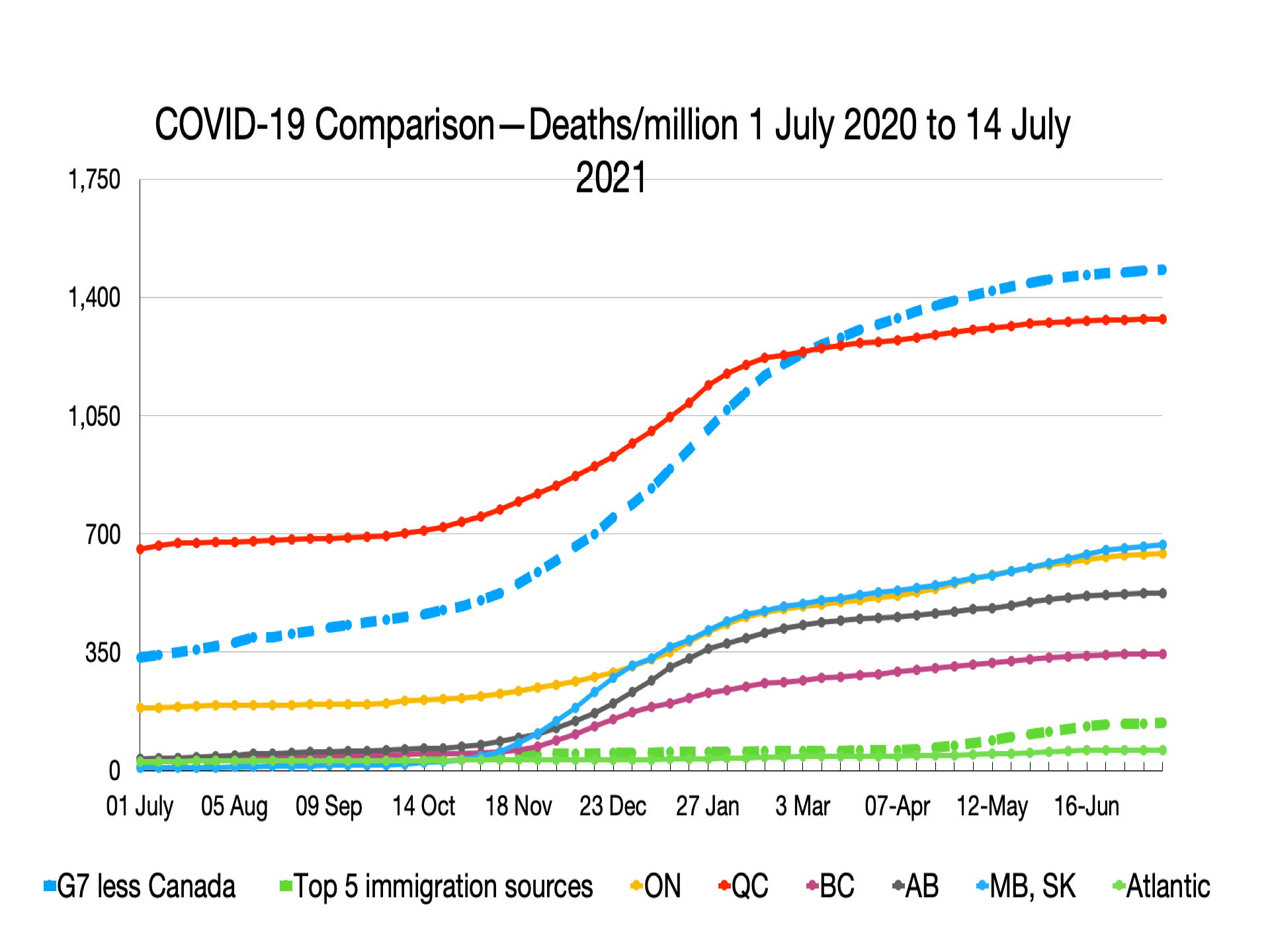
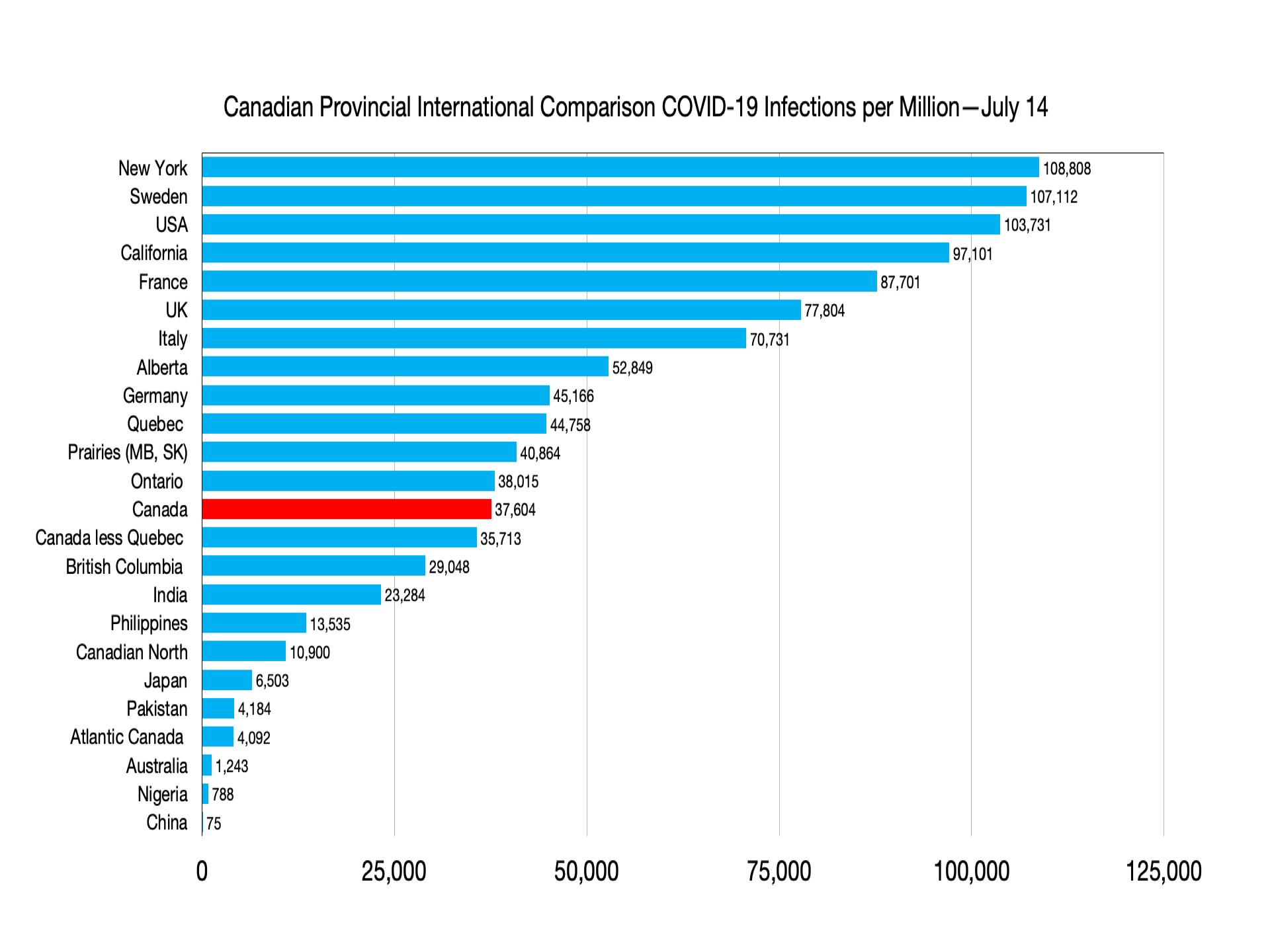
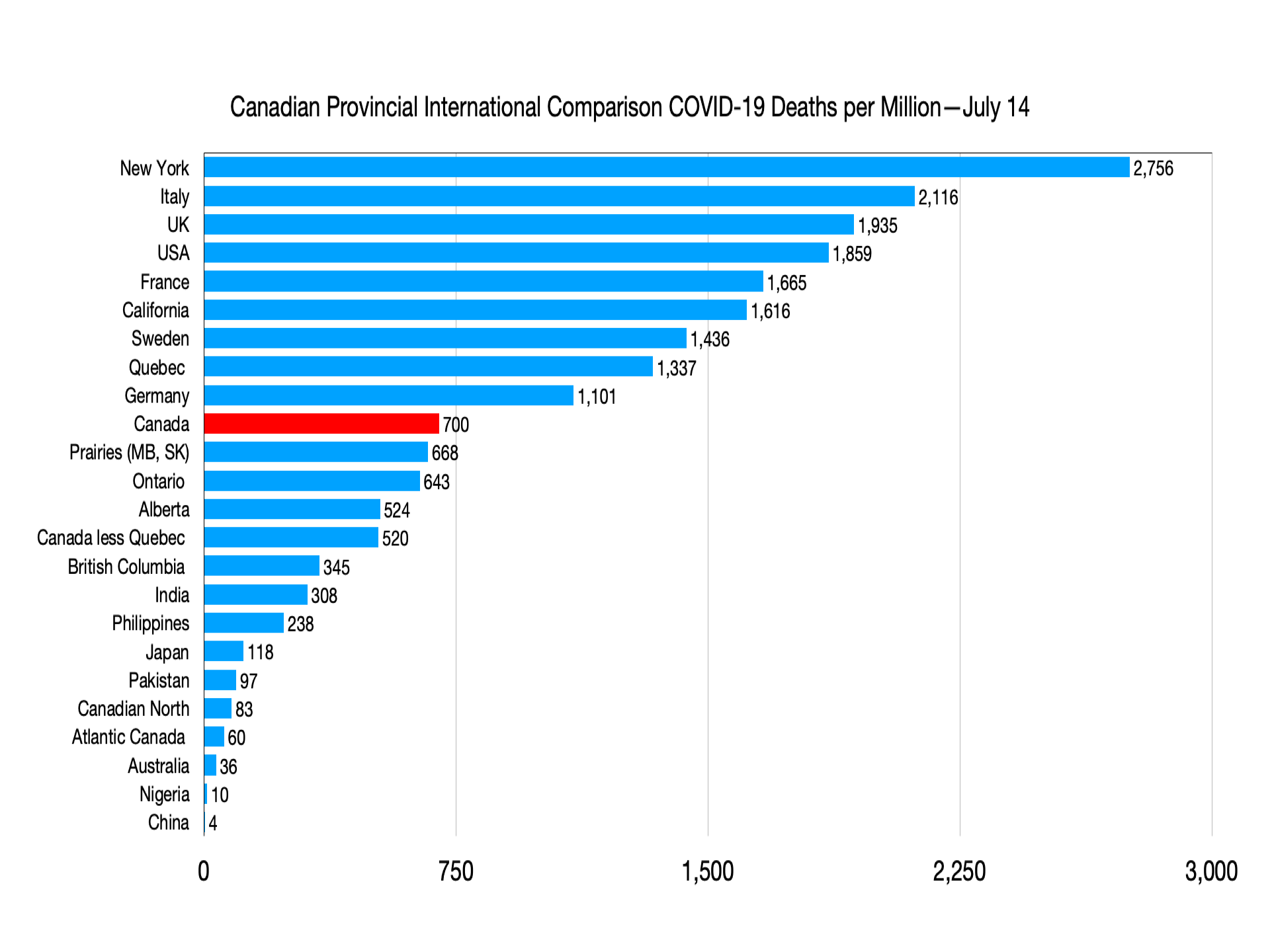
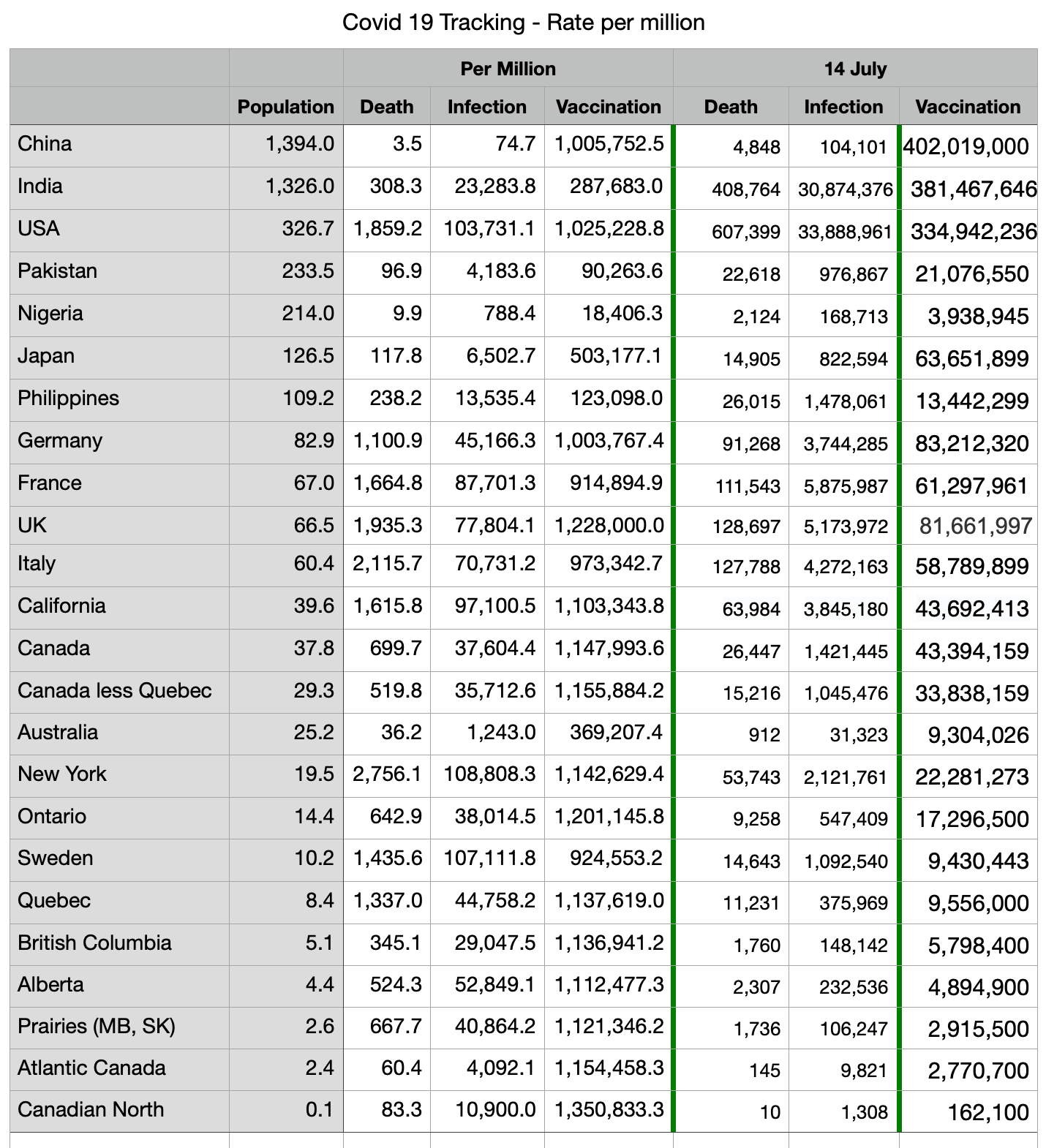
#COVID-19: Comparing provinces with other countries 19 May Update

The latest charts, compiled 19 May as the third wave continues.

Vaccinations: No significant relative changes

Trendline charts

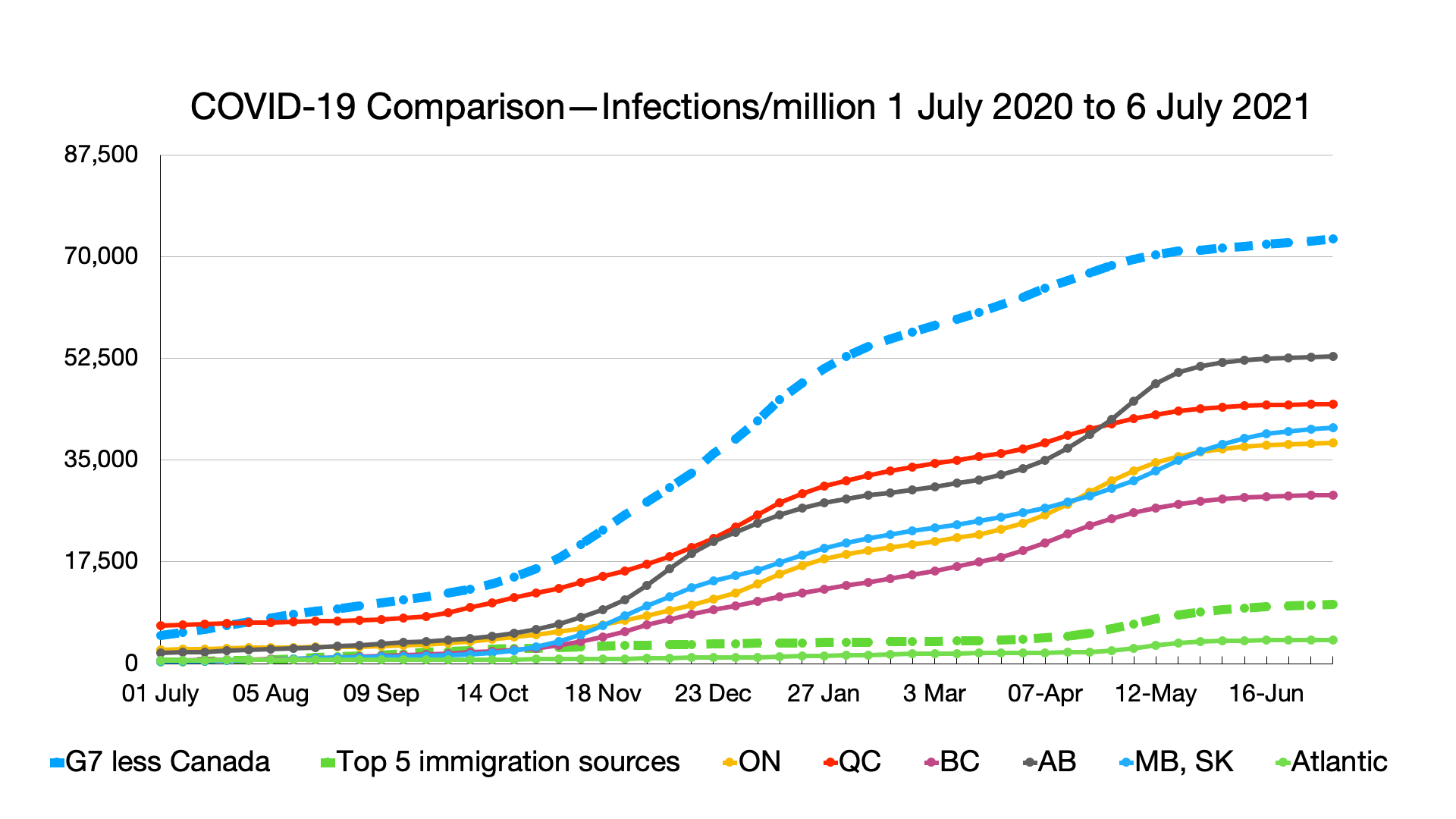
Infections per million: Alberta spike continues and upsurge in Manitoba is driving Prairie rates closer to Ontario.

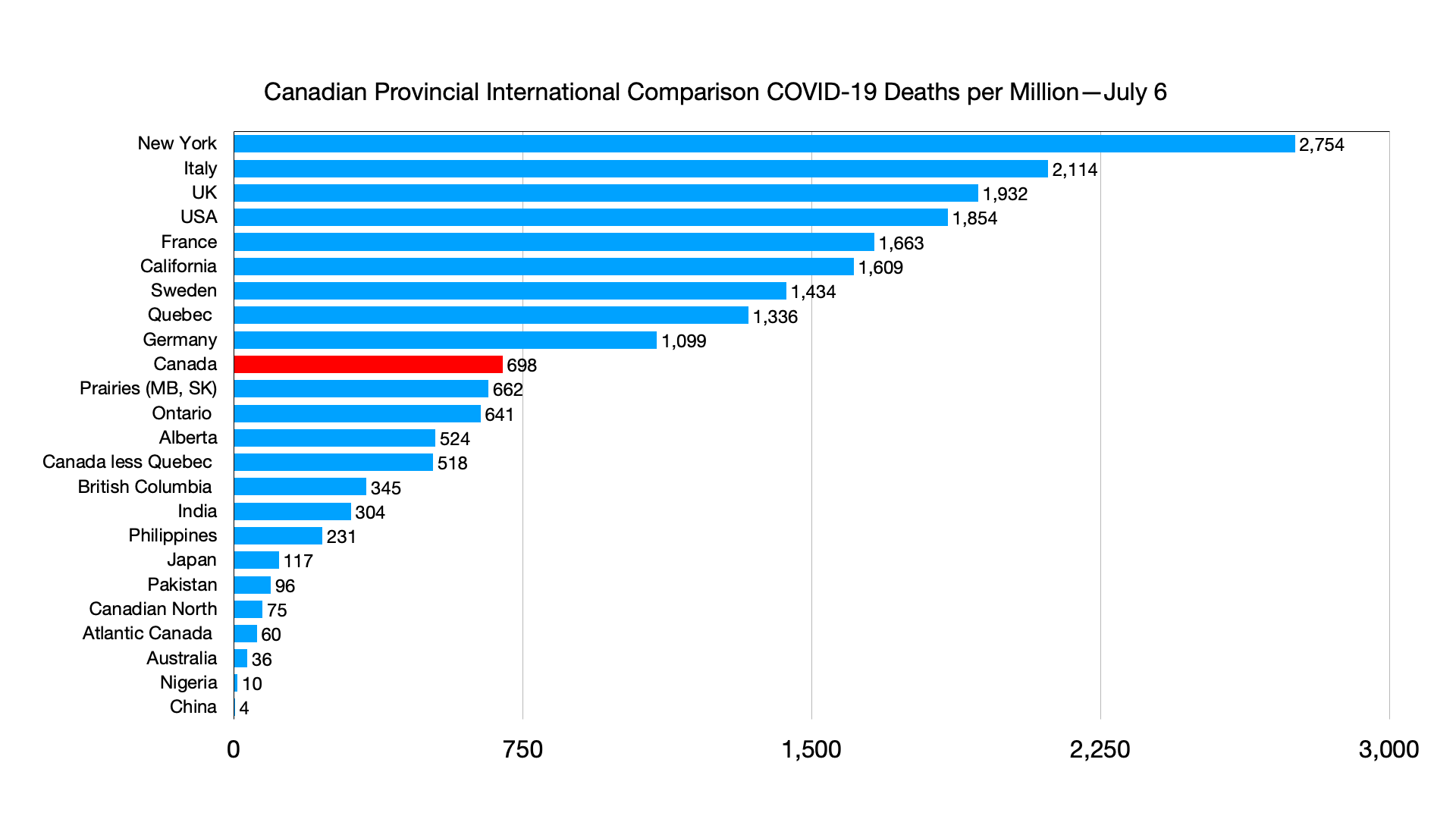
Deaths per million: Gap between G7 and Canadian provinces continues to grow.

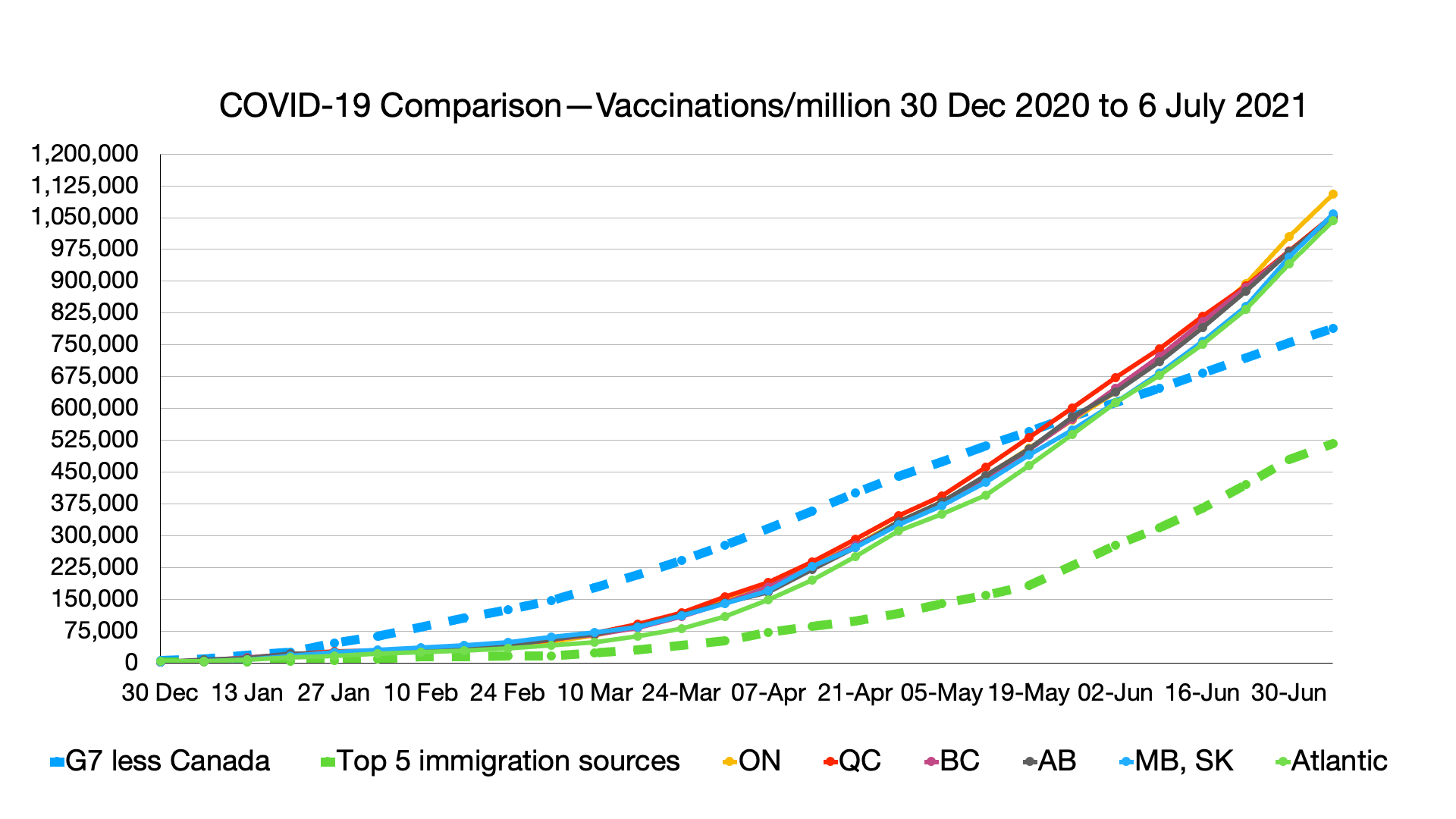
Vaccinations per million: Canadian vaccination rates continue to catch up to G7 less Canada and are likely to exceed G7 shortly (at least in some provinces).

Weekly

Infections per million: Minor shifts between some EU countries and Canadian provinces.

Deaths per million: Atlantic Canada ahead of the North.

Krugman: Learning to Live With Low Fertility

Interesting, rather than advocating for higher levels of immigration, Krugman takes the alternate take of adapting to lower fertility and population growth. Canadian governments, policy makers and advocates would be wise to also consider this alternate scenario:

Last week the Bureau of Labor Statistics reported much higher inflation than almost anyone predicted, and inflationistas — people who always predict runaway price rises, and have always been wrong — seized on the news as proof that this time the wolf is real.

Financial markets, however, took it in stride. Stocks fell on the report, but they soon made up most of the losses.

Bond yields rose only slightly on the news, then ended the weekright where they started — namely, extremely low.

Why so little reaction to the inflation news? Part of the answer, presumably, was that once investors had time to digest the details they realized that there was little sign of a rise in underlying inflation; this was a blip reflecting what were probably one-time rises in the prices of used cars and hotel rooms.

Beyond that, however, is what I think is the realization that while we’re achieving dramatic, almost miraculous success in defeating Covid-19, once the pandemic subsides we’re likely to be in an environment of sustained low interest rates as a result of weak investment demand. And the biggest reason for that low-rate environment is plunging fertility, which implies slow or even negative growth in the number of Americans in their prime working years.

This isn’t a new issue. Last month’s census report showing the lowest U.S. population growth since the 1930s only confirmed what everyone studying the subject already knew. And America is relatively late to this party. Japan’s working-age population has been declining since the mid-1990s. The euro area has been on the downslope since 2009. Even China is starting to look like Japan, a legacy of its one-child policy.

Is stagnant or declining population a big economic problem? It doesn’t have to be. In fact, in a world of limited resources and major environmental problems there’s something to be said for a reduction in population pressure. But we need to think about policy differently in a flat-population economy than we did in the days when maturing baby boomers were rapidly swelling the potential work force.

OK, let me admit that there is one real issue: An aging population means fewer active workers per retiree, which raises some fiscal issues. But this problem is often exaggerated. Remember all the panic about how Social Security couldn’t survive the burden of retiring boomers? Well, many boomers have already retired; by 2025 most of the growth in the number of beneficiaries per worker caused by retiring baby boomers will already have occurred. Yet there’s no crisis.

There is, however, a different issue with low population growth. To maintain full employment, a market economy must persuade businesses to invest all the money households want to save. Yet a lot of investment demand is driven by population growth, as new families need newly built houses, new workers require the construction of new office buildings and factories, and so on.

So low population growth can cause persistent spending weakness, a phenomenon diagnosed in 1938 by the economist Alvin Hansen, who awkwardly dubbed it “secular stagnation.” The term and concept have been revived recently by Larry Summers, and on this issue I think he’s right.

Secular stagnation can be a problem, because if interest rates are very low even in good times there’s not much room for the Fed to cut rates during recessions. But a low-interest-rate world can also offer major policy opportunities — if we’re willing to think clearly.

For what we’re looking at here is a world awash in savings with nowhere to go: Households are eager to lend money out, but businesses don’t see enough good investment opportunities. (Bitcoin doesn’t count.) Well, why not put the money to work for the public good? Why not borrow cheaply and use the funds to rebuild our crumbling infrastructure, invest in the health and education of our children, and more? This would be good for our society, good for the future, and would also provide a cushion against future recessions.

What about the burden of debt, you ask? Well, federal debt as a percentage of G.D.P. is twice what it was in 1990, but interest payments on the debt are only about half as high. That’s what low borrowing costs — largely a byproduct of demographic stagnation — do.

So, are the Biden administration’s infrastructure and family proposals the kind of things I have in mind? They’re a gratifying step in the right direction. But they aren’t nearly as ambitious as they’re often portrayed, and to my mind they’re too fiscally responsible — the administration is excessively concerned with paying for its plans.

The fact is that, like it or not, we’re going to be living for a long time with very slow population growth. And we need to start thinking about economic policy with that reality in mind.

Source: https://www.nytimes.com/2021/05/17/opinion/low-population-growth-economy-inflation.html

How Australia can benefit from low or no immigration

A critical look, one that the Australian government appears to have largely adopted, but not going so far as “no immigration”:

For years there has been an often heated debate about the impact of high immigration on the Australian economy.

It is clear that population growth driven by some of the highest immigration levels in the world have supported bottom line GDP growth – the new Australians work, eat, live and spend.

High immigration has also fuelled strong demand for housing and was, at least in part, one of the divers of the unrelenting rise in house prices for many decades.

At the same time, population growth outpaced infrastructure capacity, most notably the transport networks in the big cities where most immigrants settled. Congestion was also seen in productivity destroying traffic chaos, overcrowded schools, hospitals and other government services.

Immigration was also a source of labour for many businesses, which has seen the government slash trade training funding, made university costs oppressive and generally undermined the skills set of many Australians.

If workers were needed to pick fruit, work as highly skilled engineers in the mines or IT gurus for businesses, the government simply granted work visas and the problem was solved.

Resources to train and upskill the 2 million Australians unemployed and underemployed – many of who do not have the skills needed in today’s economy – were hopelessly inadequate which is why, with the borders closed, there is a widespread skills shortage.

The benefits of high immigration were being offset or at least diluted by the costs.

COVID-19 and the border closures

With the onset of the COVID-19 pandemic, the government effectively closed the international borders to immigrants.

Indeed, the latest figures from the Australian Bureau of Statistics show that more people are leaving Australia permanently than are arriving. This is the first time this has happened in 100 years.

A year after net immigration turned negative, there are some economic trends emerging that might give a few insights into the sort of immigration policy that is best for Australians after the COVID-19 pandemic is over or at least when we learn to live with the virus in an orderly way.

Perhaps the most obvious issue is a skills shortages among the current workforce which is sparking up opportunities for a long overdue acceleration in wages growth. Business are reporting it difficult to find suitable workers and for obvious reasons, this cannot be fixed by working visas and immigration.

A recent RBA survey of business shows expectations for wages growth is at its highest level in over a decade. Weak wages growth, for so long a problem for the Australian economy, is poised to turn with a substantial pick up in private sector wages unfolding.

It is well understood that rising wages growth will fuel household incomes and with that, consumer spending.

And the key thing about this wages growth is that firms are able to meet this higher wages bill given there has been solid growth in bottom line profits and margins as the economy expands.

Border closures are now linked to higher wages.

With the working from home phenomenon that has been experienced due to the COVID-19 restrictions, congestion in most CDBs and on public transport is less common. Again this is good news and if sustained, will ease the pressure on State budgets for future infrastructure spending. Fewer people are using existing public transport and roads.

While it is yet to be fully tested, there is tentative evidence that low immigration has reduced demand for residential property.

The mini-boom in house prices evident over the last 8 or 9 months has been driven by favourable affordability with first home buyers using stunningly low interest rates and a raft of financial incentives to get into the market and pay-up for their home.

New immigrants have, obviously, been absent from auctions of the queues for rental properties.

Immigration an election issue?

The next Federal election is less than a year away. It could even be in October as Prime Minister Morrison works to take advantage of the favourable economic news and as some of the measures in the budget start to impact on voters.

It is possible that immigration will be an election issue particularly if one side, or other, uses the good news from low immigration as part of a platform to improve the well being of Australians with strong per capita growth.

Of course, Australia needs to maintain its humanitarian immigration program, and when health conditions permit, this should resume.

But the bigger picture immigration program, which saw 1 million people arrive in the three years prior to COVID-19, needs to be scaled back even when the borders reopen.

If we go back to huge population growth in the years ahead, get set for weaker wages, further house price gains, pressure on infrastructure and higher unemployment.

Source: How Australia can benefit from low or no immigration

La balle est dans le camp de Québec, dit le ministre Mendicino

This “blame game” has been going on for some time:

Le gouvernement fédéral a beau être celui qui a le pouvoir d’octroyer la résidence permanente, Québec a sa part de responsabilité dans les dizaines de milliers de dossiers de travailleurs qualifiés en attente, croit le ministre de l’Immigration, Marco Mendicino. En entrevue au Devoir, il s’est dit « encouragé » par le fait que Québec a légèrement augmenté ses seuils pour 2021, mais estime que la balle est toujours dans son camp.

« Il faut comprendre très clairement que Québec établit ses propres seuils d’immigration annuels, et nous recevons plus de demandes pour le PTQQ [Programme des travailleurs qualifiés du Québec] que les [places] permis [es] par Québec. C’est la raison pour laquelle il y a plus d’applications dans l’inventaire », a dit le ministre dans une entrevue accordée en français au Devoir.

Il rappelle que 50 000 travailleurs qualifiés sont en attente d’une résidence permanente, mais que les cibles du Québec ne permettent pas d’absorber toutes les demandes traitées. « Les seuils d’immigration de Québec en 2021, cette année, sont de maximum 26 000 personnes. Ça, c’est la réalité », a déclaré le ministre Mendicino, qui a succédé à Ahmed Hussen à ce poste à la fin 2019.

Il ne cache pas que cette « réalité », soit les seuils trop bas du Québec pour écouler les dossiers en attente, est à l’origine d’une demande de la ministre de l’Immigration, Nadine Girault, enjoignant au fédéral de traiter en priorité les dossiers de travailleurs qualifiés déjà ici. Or, cela n’est pas sans conséquence sur les autres catégories d’immigration, souligne M. Mendicino. « Quand nous faisons l’exercice de priorisation du PTQQ, la réalité est que les autres applications ne sont pas priorisées. […] Ça va rester comme ça tant et aussi longtemps que la demande sera plus grande que les niveaux d’immigration établis par le Québec. »

Regarder vers l’avenir

Il y a deux semaines, Le Devoir avait révélé qu’Ottawa avait reconnu avoir ralenti le traitement des dossiers de travailleurs qualifiés et que c’était attribuable « aux restrictions imposées par le gouvernement du Québec quant aux admissions en raison d’un nombre limité de places dans les niveaux annuels », pouvait-on lire dans des documents gouvernementaux. Ces déclarations avaient agacé Québec, qui a continué de rejeter la responsabilité des délais de traitement sur le gouvernement fédéral, le seul à pouvoir délivrer des résidences permanentes.

Mais le ministre canadien dit qu’il ne souhaite pas « débattre du passé », mais plutôt assainir le climat entre lui et le Québec. « Je vais me concentrer sur aujourd’hui et l’avenir, et je vais livrer tous les travailleurs dont le Québec a besoin pour appuyer sa relance économique. C’est la chose la plus importante pour moi et mon gouvernement », a-t-il dit, en ajoutant qu’Ottawa est un « partenaire de bonne foi » dans cette affaire.

Marco Mendicino rappelle que son ministère a déjà octroyé une résidence permanente à plus de 7000 travailleurs qualifiés du Québec, soit une augmentation de 54 % par rapport à l’an dernier. Il aurait également contribué à fournir au Québec plus de 7000 travailleurs temporaires.

Plus d’anges gardiens

Quant au programme des « anges gardiens », qui vise à régulariser le statut des demandeurs d’asile ayant travaillé en soins directs aux patients pendant la première vague, le ministre fédéral de l’Immigration a dit continuer de talonner son homologue québécoise pour qu’elle élargisse le programme. « J’ai répété que la porte restait ouverte de notre côté pour revisiter les paramètres de programme », a-t-il indiqué, en évoquant une rencontre avec Nadine Girault il y a exactement deux semaines. « Je pense que le Québec veut attendre un peu plus pour regarder le progrès. Mais s’[il] veut élargir le programme, nous sommes prêts. »

En date du 10 avril, seulement 3200 dossiers (représentant 7500 personnes au total) avaient été reçus dans le cadre de ce programme, dont 1400 au Québec. Soucieux d’atteindre sa cible historique de 401 000 immigrants en 2021, le gouvernement fédéral a également lancé le mois dernier un programme permettant à plus de 90 000 étudiants et travailleurs temporaires d’obtenir la résidence permanente.

Source: La balle est dans le camp de Québec, dit le ministre Mendicino

Une véritable honte!

On family reunification between refugees and their children:

Les gouvernements du Québec et du Canada ont ratifié en 1991 la Convention relative aux droits de l’enfant, un instrument juridique international adopté par l’Assemblée générale des Nations unies en novembre 1989. Cette convention internationale stipule dans son article 10 que toute demande formulée par un enfant ou un parent pour entrer dans un État à des fins de réunification familiale doit être traitée « dans un esprit positif, avec humanité et diligence ».

Humanité et diligence ? Le ministre canadien de l’Immigration, Marco Mendicino, a beau dire à notre collègue Lisa-Marie Gervais que le Canada est un chef de file mondial en matière de réinstallation des réfugiés, les statistiques racontent une histoire déshumanisante et brossent un portrait qui fait honte. Des parents acceptés comme réfugiés au Canada, et ayant même obtenu leur résidence permanente, attendent plus de trois ans avant de retrouver leurs petits, restés au bercail au moment de la séparation.

Faut-il rappeler qu’Estelle, Sophie et toutes ces femmes et ces hommes qui pleurent des enfants laissés derrière eux n’ont pas plié bagage un matin de légèreté pour le plaisir du périple et le goût de l’aventure ? Ces réfugiés politiques, reçus parfois pour motifs humanitaires, ont fui leur pays natal pour sauver leur vie, et parfois celle de leur famille. Rien ne dit que les enfants restés derrière eux, privés d’un de leurs parents ou même des deux, ne sont pas eux-mêmes soumis à quelques périls, comme c’est le cas de Sophie, qui craint pour la sécurité de quatre de ses enfants restés en Afrique. Elle a quitté un mari violent, et les nouvelles que lui acheminent ses voisines la font frémir. Elle craint que ses enfants soient eux-mêmes coincés dans le cycle de la violence.

Le fait que les enfants puissent rejoindre leurs parents au Canada après 39 mois d’attente est une véritable honte. Impossible d’invoquer la pandémie pour cette longue pénitence dans les couloirs de la bureaucratie, car voilà des lustres que l’enjeu de l’attente interminable est noté au tableau des horreurs. L’action rapide et efficace fut pourtant possible en 2015, lorsque le Canada a ouvert ses portes à 25 000 réfugiés syriens dans un temps record.

Le Conseil canadien pour les réfugiés demande au Canada de fixer une limite maximale honorable de six mois pour que parents et enfants puissent être réunis à une même table. Ces délais exceptionnellement courts ne devraient pas constituer l’extraordinaire, mais plutôt le cours normal des choses. Sans cela, inutile de même prétendre au moindre titre de chef de file mondial.

Source: https://www.ledevoir.com/opinion/editoriaux/602222/reunification-familiale-une-veritable-honte?utm_source=infolettre-2021-05-18&utm_medium=email&utm_campaign=infolettre-quotidienne