Raise immigration levels to battle labour shortage: Quebec employers group

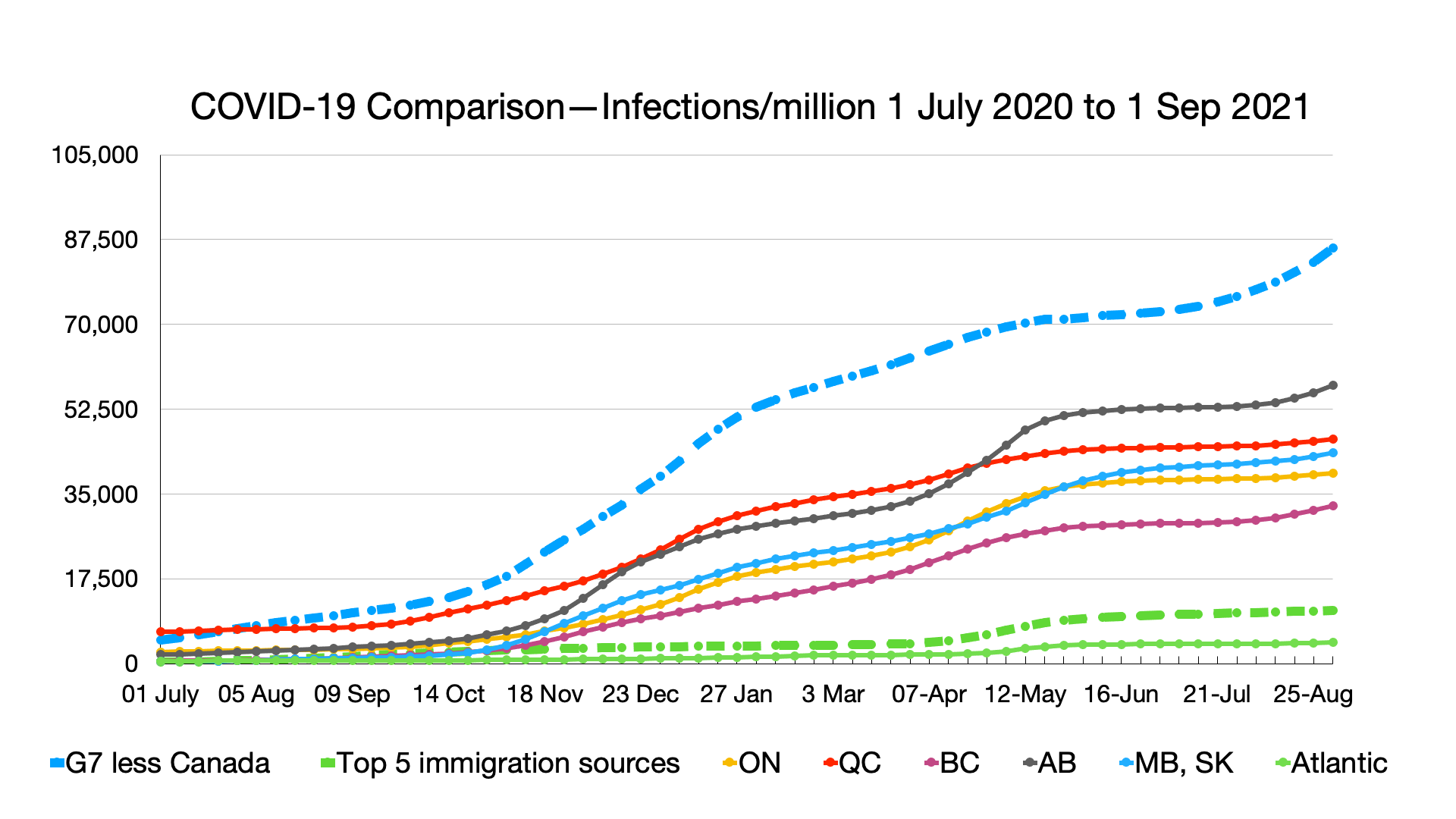
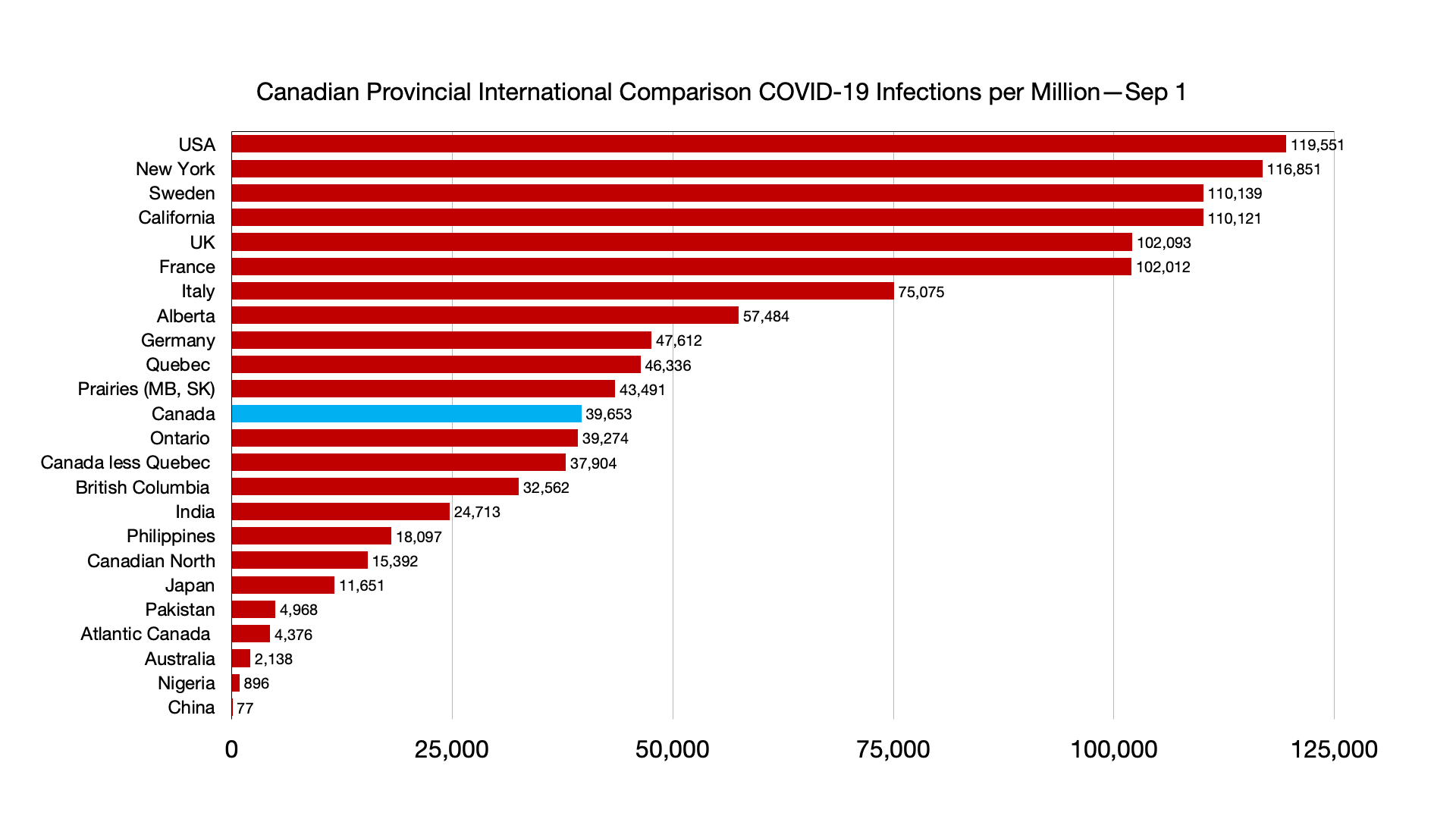
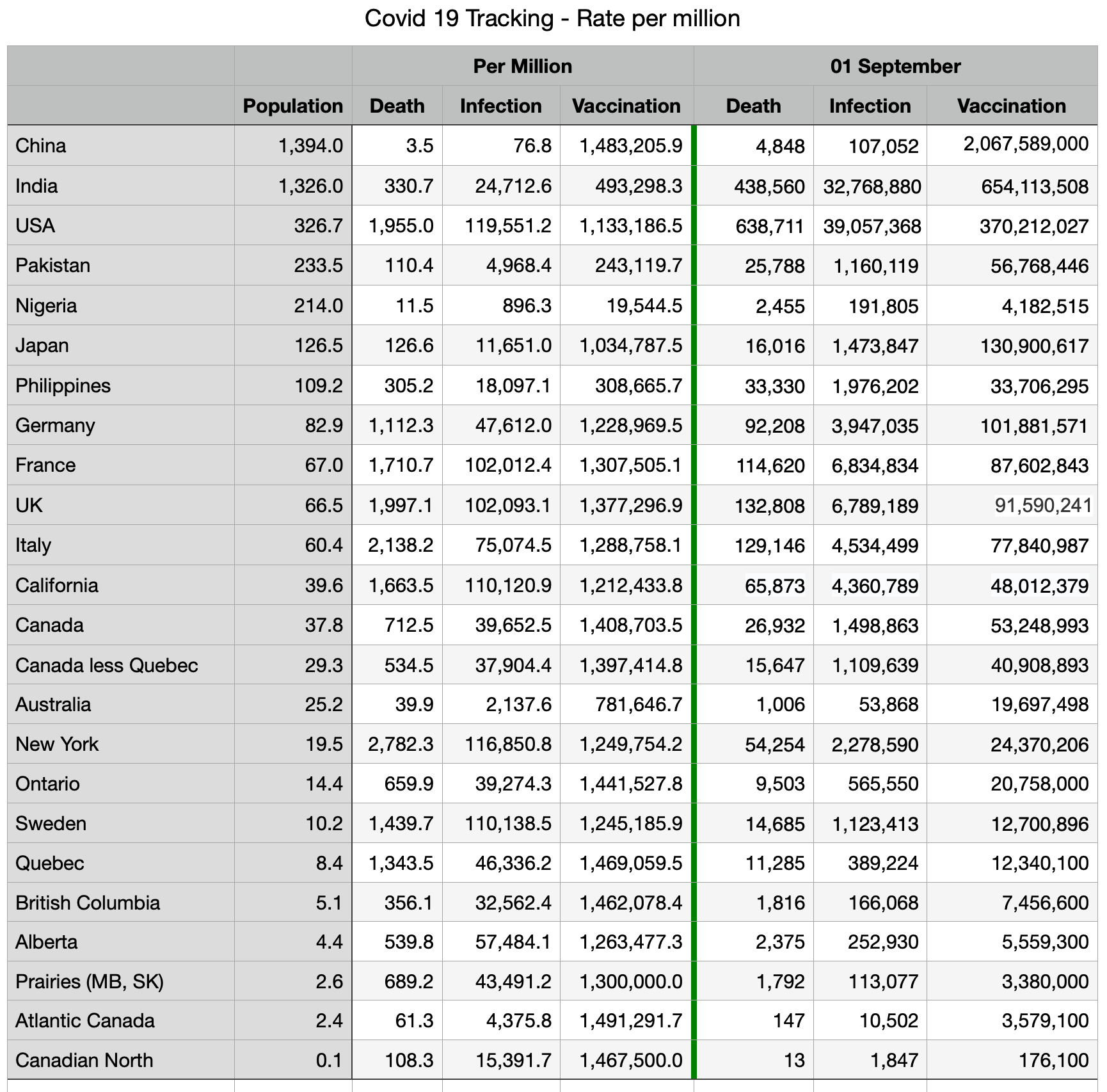
Of note, given lower levels than the rest of Canada:
The Conseil du patronat du Québec (CPQ), the province’s largest employers group, is urging the Legault government to tackle the labour shortage by rethinking immigration levels and encouraging older employees to stay longer in the workforce.
The recommendations are among 10 made public by the CPQ as 181,000 jobs went unfilled in the first quarter of 2021. The labour shortage in the same period in 2020 was 150,000.

Quebec immigration levels must be “quickly raised” to meet the province’s labour needs, CPQ president Karl Blackburn told Presse Canadienne, noting that since 2015, the number of immigrants to the province has never been higher than 53,000 when “the need is for 64,000.”

Blackburn said employers are not looking for “cheap labour,” although there are worker shortages in agriculture and food processing, where salaries are low. But he added there is also a need for workers in the health, education and information technology sectors, where the pay levels are higher.

“We have to avoid categorizing good job and jobs that are less good,” he said.Quebec Premier François Legault has said if an immigrant is earning a minimum salary of $56,000, it’s to the province’s advantage to bring them here. The CPQ thinks “salary should not be a limit to entry.”

Blackburn said the province’s economic recovery will depend on all kinds of jobs, and Quebec limiting its interest to only positions with higher salaries will slow down that recovery.

Another suggestion from the CPQ is to encourage workers between the ages of 60 and 69 to stay longer in the workforce. Blackburn said Quebec is being outperformed by Ontario in this area, and if the policy was adopted “we’d have 75,000 more workers.”

That encouragement could include tax credits for older employees remaining on the job and a revision of the contribution levels to the Quebec pension plan for workers 60 and over.

The CPQ also thinks there’s room for improvement in the area of job training, with Blackburn saying that “30 per cent of employers are ready to train their workforce themselves if given financial support.”

Source: Raise immigration levels to battle labour shortage: Quebec employers group

Australia still suffering critical skilled worker shortages despite decades of mass immigration

Of interest. Some similar policy fallacies such as favouring GDP growth over per capita GDP growth as in Canada:

Nades and Priya Murugappan made a fundamental mistake when they separately fled to Australia from Sri Lanka almost a decade ago.

The pair, who met at the meatworks in Biloela on Queensland’s Capricorn Coast and now have two children, lived in the town for four years.

They were on temporary protection visas before they were detained and sent to Christmas Island awaiting deportation.

Since 2019, they’ve existed in a guarded compound under 24-hour surveillance with daughters Kopika and Tharnicaa in an operation that has cost taxpayers more than $6 million.

Rather than flee their home country by boat, they instead should have applied for a skilled worker or student visa. It’s a pretty certain bet they would have received one.

A quick flick through the Skilled Occupation List for workers from abroad shows everything from carpenters to chief executives, chefs and composers, clothing trade workers. And that’s just the Cs.

The list seems to go on forever.

And even if your chosen occupation is removed, never fear.

“Pending nomination and/or visa applications will not be adversely impacted by the subsequent removal of any occupation from the skilled occupation list,” the Home Affairs department website says.

For decades, our politicians have batted up their tough border control credentials with threats to turn back boats and a promise of imprisonment.

In reality, the tough measures have been meted out to those with the least ability to defend themselves: a handful of the poorest and weakest, who now have become pawns in a macabre game of political brinkmanship.

At the same time as we’ve been tough on refugees, Australia has thrown open the doors, with one of the largest per capita immigration programs in the developed world.

It has enticed around 4,000 new arrivals a week, mostly into the two biggest cities, Sydney and Melbourne.

But even now, after decades of mass immigration, it appears we still are suffering critical “skills shortages”.

Fruit pickers, waiters and baristas are in short supply. Almost daily, there are calls to throw caution to the wind when it comes to COVID-19 and start importing workers again.

Low wages growth is hurting our economy

It has taken quite a while. But Reserve Bank governor Phil Lowe set himself on a collision course last week with big business and sections of the federal government by stating the bleeding obvious.

And that is, Australia has used immigration as a means for keeping the cost of labour subdued. Not that Dr Lowe put it so bluntly. But he made the point repeatedly that adding to the supply of workers keeps wages low.

It’s pretty basic economics, really.

For years now, one of the key factors undermining our economic performance has been low wages growth.

Economists love to call it anything but what it is. They’ll talk about underutilisation or excess capacity. But the graph below says it all.

A graph showing Australia's wage price index growth between 2001 and 2021.

In the past 12 months, there’s been almost universal agreement that stagnating wages pose one of the greatest dangers to derailing our recovery, particularly given our eye-watering levels of household debt.

But whenever wages start to rise, the calls to bring in more workers start immediately.

Interestingly, those making the most noise now are the ones who have benefitted the most from a constant influx of tourists, students and temporary workers.

The flood of overseas workers, particularly in hospitality, has left many with barely enough work upon which to survive. And it has opened the door to exploitation and wages theft on a grand scale.

Here is another graph, presented by Dr Lowe last week, showing data from the Reserve Bank of Australia and the Australian Bureau of Statistics.

Underemployment by industry graph

GDP growth doesn’t mean our lives are better

Australia has prospered greatly from immigration, particularly in the post-war period. It has enriched the nation in ways far more than can be measured by money.

Somewhere along the way, however, canny politicians figured out the great immigration con job: that by adding ever greater numbers of people, you automatically get GDP growth.

That’s because GDP is a crude yardstick. It simply measures the amount of stuff you produce. The more people you’ve got, the more you consume, and the more you produce.

Big business loves it too.

Not only does the influx of workers keep wages low, but all those extra people also end up consumers of your products. You sell more, your profits rise and so do your bonuses.

What GDP doesn’t measure is whether or not we all are better off as individuals.

As it turns out, we haven’t performed anywhere near as well as we’ve been told. Once you divide GDP by the number of people — to get a like for like comparison — the picture looks very different.

Remember how we were the “miracle economy” with 30 years or so without a recession?

The green bars below point out at least three recessions and quite a number of near misses.

Australia's quarterly GDP per capita growth

You’ve no doubt heard the grand visions: “This government will create a million new jobs over the next five years.”

And, bingo, just like that, it happens.

The thing is, when you are adding a million people over five years, you need to have a million extra jobs just to keep your head above water.

And the problem is that many of the new arrivals end up working part-time, in lower-paid jobs and in occupations that require far fewer skills than they possess. Doctors and engineers end up as Uber drivers.

Foreign workers are greatest victims of wage theft

The list is too long to compile. For years, revelations of wage theft within major Australian corporations became a blight on the nation.

But big, public organisations that are open to scrutiny are only a small part of the problem.

With such a huge influx, foreign workers, many of them desperate for employment and unaware of their rights, have been routinely exploited.

Students and temporary visa holders are the most vulnerable. But permanent arrivals share similar experiences.

Story after story of exploitation and sexual assault have littered newspapers, websites and current affairs programs.

Five years ago, a Senate inquiry released a report entitled: A National Disgrace. The Exploitation of Temporary Work Visa Holders.

Among other things, it concluded that temporary visa holders comprised around 10 per cent of the workforce and that the 457 visa program was impacting university graduates and depressing wages.  But it was the title that said it all.

The Fair Work Ombudsman has conducted raids, issued fines and published reports on deliberate underpayment and exploitation, particularly within the hospitality industry.

But for months now, almost every day brings forth a new claim of “skills shortages” and the need to start importing workers because firms have to pay more.

Source: Australia still suffering critical skilled worker shortages despite decades of mass immigration

Home Office ‘acting unlawfully’ in rush to deport asylum seekers

Yet again:

Hundreds of people arriving in England in small boats are being immediately detained in immigration removal centres, raising fears of a new, secret Home Office policy to deport them without their asylum claims being properly considered.

Among the detainees are apparent trafficking and torture victims from countries including Vietnam, Afghanistan and Iraq, who would normally be allowed asylum accommodation in the community while their claims are processed but instead are effectively imprisoned.

Children are also among those who have crossed the Channel and have been sent directly to immigration removal centres, with solicitors claiming the Home Office has classed minors as adults despite not age-assessing them in person.

Some small-boat asylum seekers have been denied access to a lawyer since early May after landing and being immediately detained in a removal centre.

Campaigners said the development was “not the act of a civilised and compassionate nation”.

The outcry follows the publication of home secretary Priti Patel’s nationality and borders bill on Tuesday. It claims to reform the asylum system but has been described by the UN as having an “almost neocolonial approach” in allowing the UK to shirk its international responsibilities to refugees.

Immigration lawyers say the apparent undisclosed policy change, which appears to have been introduced over the past two months, is unlawful and they are preparing to challenge it.

Toufique Hossain, director of public law and immigration at Duncan Lewis, described it as a potentially “grave abuse of power”.

Hossain added: “They have effectively started bypassing the asylum system and saying to individuals with strong claims that their claim is weak, that they may not get an appeal and that they intend to remove them quickly.

“The whole starting point is to disbelieve people arriving from places where the Home Office knows individuals have a well-founded fear of harm and persecution.”

The shift appears to have affected hundreds already, with Duncan Lewis receiving reports that the UK’s network of immigration removal centres is overwhelmed.

Harmondsworth removal centre near Heathrow airport – whose capacity is 670 – is understood to be “overwhelmed”. The Home Office is also filling Brook House at Gatwick airport and Colnbrook, near Heathrow – combined capacity 850 – with small boat arrivals.

“Detention centres are being filled with people who have just arrived but who are not being released into the community,” said Tom Nunn of Duncan Lewis.

He added they are aware of more than 50 Vietnamese nationals, a country which is one of the top sources for trafficking into the UK.

In addition, there is speculation that the Home Office has chartered a deportation flight to Vietnam at the end of July for small boat arrivals, although the government would not confirm this.

Nunn said the firm was aware of Iraqis and Afghans who had indicators of torture, but whom the Home Office had apparently detained in contravention of the established asylum process.

“There have been a few cases where medical advice from doctors in the immigration centre is that they are victims of torture,” said Nunn. “But we are seeing a lot of cases where the Home Office is pushing back on this, basically saying that: ‘You’re a victim of torture but we believe we can remove you quickly and therefore we’ll keep you in detention.”

Clare Moseley of charity Care4Calais said: “To detain and deport such vulnerable people in this way is not the act of a civilised and compassionate nation. If we fail to ensure that those who need our help are treated in a fair and decent manner we risk losing our reputation as a decent and honest society.”

Usually asylum seekers are placed in special accommodation while their claims are heard, a process that can often take longer than a year. Currently there is a record backlog of 109,000 cases in the system with over 79,000 being processed for more than a year.

This is not the first time that the Home Office appears to have quietly introduced measures that reduce the rights and protection of asylum seekers.

Last year the Home Office secretly shortened asylum screening interviews for arrivals in the UK, a move that meant torture and trafficking victims could be deported far more quickly.

Last week, however, the high court ruled that Patel should quickly bring back to the UK a small boat asylum seeker and Sudanese torture survivor who was removed to France.

The 38-year-old was tracked down by Liberty Investigates and the Observer in an investigation whose evidence paved the way for last week’s government defeat.

Called Omar in the investigation, he had nine of the 11 indicators of trafficking and torture yet was deported to France last August after just two months in the UK.

A Home Office spokesperson said: “We assess the suitability of all new arrivals and only detain people when there is a realistic prospect of their removal within a reasonable timescale, and evidence of their vulnerability is outweighed by immigration considerations.

“It is inaccurate to say unaccompanied minors are being classed as adults during age assessment interviews. The Home Office makes every effort to ensure people’s age is assessed correctly, in the interests of safeguarding and to avoid abuse of the system.”

They added that the government would “crack down on illegal entry and the criminality associated with it”.

The spokesperson said: “People should claim asylum in the first safe country they arrive in and we must ensure dangerous journeys are not incentivised.”

Source: Home Office ‘acting unlawfully’ in rush to deport asylum seekers

USA: The Skill Level of Immigrants Is Rising | Cato at Liberty Blog

Of note, despite a relative lack of programs to encourage skilled immigration. Same trend in Canada but more of conscious policy and program choices:

A major immigration debate over the last several years is whether the U.S. immigration policy should be more meritocratic by attracting higher educated workers. President Trump supported such a system if it were pared with many fewer legal immigrants coming in while Democrats are mostly supportive of increasing all types of immigration. Although Congress did not pass a law to create a more meritocratic immigration system, new immigrants to the United States are increasingly skilled. In other words, the U.S. immigration system is becoming more meritocratic on its own.

The United States is an increasingly attractive place for highly educated immigrants. From all regions except for Africa, the share of immigrants arriving with a college degree has risen since 1995 while the share arriving with a high school degree or lower has dropped. Figure 1 shows the change in the proportion of recently arrived immigrants, 5 years in the United States or fewer, in different education groups between 1995 and 2020. Persons under 30 are excluded, as they are more likely to have not completed their education.

Some of these changes are striking. The proportion of recent immigrants from Central America with graduate degrees increased by more than 350 percent in 35 years, from 2 percent of recent immigrants in 1995 to 9.5 percent of recent immigrants in 2020. The share of new immigrants who are high school dropouts has declined or every region or origin from 1995 to 2020.

The same trend is true when comparing individual countries. Figure 2 shows the change in educational attainment from four of the top sending countries in 1995 and 2020. Mexican immigrants, who are often criticized as being low‐​educated and low‐​skilled, are now 2.4 times more likely to have received a bachelor’s degree at arrival than they were just 35 years ago.

Figure 3 shows that immigrants have higher high school dropout rates than natives, but immigrants who come here at a younger age (younger than 10) typically end up getting more education eventually.

Native‐​born Americans are not the only ones who benefit from more highly educated immigrants. The children of immigrants consistently earn more education than their parents, and since 2010, more than native‐​born Americans (Figure 4). Again, persons under 30 are excluded from analysis to avoid over‐​counting individuals with less than a high school education.

Congress did not create a merit‐​based immigration system as President Trump wanted, but we seem to be getting one nonetheless as immigrants become more skilled over time.

Source: The Skill Level of Immigrants Is Rising | Cato at Liberty Blog

#COVID-19: Comparing provinces with other countries 6 July Update, Economist Normality Index

The latest charts, compiled 6 July as overall rates in Canada continue to decline along with increased vaccinations (still largely first dose, Canadians fully vaccinated 36.6 percent, comparable to or higher than most EU countries). Steep upward trend as per Globe chart below suggests gap between USA and UK fully-vaccinated will continue to narrow.

Vaccinations: All Canadian provinces ahead of USA, China now ahead of Germany and other EU countries.

Trendline charts

Infections: No significant change

Deaths: No significant change.

Vaccinations: Captured above.

Weekly

Infections: No relative change.

Deaths per million: No significant change.

Interesting integration of various data sources to develop a normality index (Canada is 63.4, slightly below the number for all countries, ranking 35, just ahead of UK):

Since the onset of the coronavirus pandemic in early 2020 many have wondered when the world will return to “normal”. But whether things will ever go back to the way they were is unclear: remote working looks set to continue, for example, and going to the movies may never be as popular as it used to be. 

The Economist has devised a “normalcy index” to track how behaviour has changed, and continues to change, because of the pandemic. Our index comprises eight indicators, split into three domains. The first grouping is transport and travel: public transport in big cities; the amount of traffic congestion in those same cities; and the number of international and domestic flights. The second looks at recreation and entertainment: how much time is spent outside the home; cinema box-office revenues (a proxy measure for cinema attendance); and attendance at professional sports events. The third is retailing and work: footfall in shops; and occupancy of offices (measured by workplace footfall in big cities). 

Our index covers 50 of the world’s largest economies that together account for 90% of global GDP and 76% of the world’s population. Our aggregate measure is the population-weighted average of each country’s score. The pre-pandemic level of activity is set at 100 for ease of comparison. The tracker is updated with new data once a week. 

Overall activity

The global normalcy index plummeted in March 2020 as many countries imposed draconian restrictions on their citizens. It fell to just 35 in April 2020, before improving gradually over the following months. Today it stands at 66, suggesting that the world has travelled roughly half of the way back to pre-pandemic life. Some indicators, such as traffic congestion and time spent outside, have recovered faster than others, particularly sports attendance and flights. The global average masks a lot of variation across countries. Click on the drop-down box to explore how behaviour has changed in each one.

Source:

Israel blocks law that keeps out Palestinian spouses

Of note, both the discriminatory substance as well as the identity politics:

Israel’s parliament early on Tuesday failed to renew a law that bars Arab citizens from extending citizenship or residency rights to spouses from the occupied West Bank and Gaza, in a tight vote that raised doubts about the viability of the country’s new coalition government.

The 59-59 vote, which came after an all-night session of the Knesset, marked a major setback for Prime Minister Naftali Bennett.

The new Israeli leader, who had hoped to find a compromise between his hard-line Yamina party and the dovish factions in his disparate coalition, instead suffered a stinging defeat in a vote he reportedly described as a referendum on the new government. The vote means the law is now set to expire at midnight Tuesday.

The Citizenship and Entry into Israel Law was enacted as a temporary measure in 2003, at the height of the second intifada, or uprising, when Palestinians launched scores of deadly attacks inside Israel. Proponents said Palestinians from the occupied West Bank and Gaza were susceptible to recruitment by armed groups and that security vetting alone was insufficient.

Under it, Arab citizens, who comprise a fifth of Israel’s population, have had few if any avenues for bringing spouses from the West Bank and Gaza into Israel. Critics, including many left-wing and Arab lawmakers, say it’s a racist measure aimed at restricting the growth of Israel’s Arab minority, while supporters say it’s needed for security purposes and to preserve Israel’s Jewish character.

The law has been renewed annually and appeared to have the support of a large majority in parliament, which is dominated by hard-line nationalist parties. But former Prime Minister Benjamin Netanyahu’s Likud Party and his allies decided to oppose it to embarrass Bennett and harm his coalition, which includes a collection of eight parties across the political spectrum, including a small Islamist Arab party.

Interior Minister Minister Ayelet Shaked, a member of Bennett’s Yamina party, said the opposition move to block the law’s renewal would lead to thousands more applications for citizenship. She accused Netanyahu and his allies of choosing “petty and ugly politics, and let the country burn.”

Amichai Chikli, a renegade member of Yamina who voted with the opposition, said the outcome was a sign of deeper issues.

“Israel needs a functioning Zionist government, and not a mismatched patchwork that is reliant on” the votes of Arab lawmakers, said Chikli. He was the only member of his party to oppose the new coalition-led government last month.

Netanyahu, ousted by the new coalition after 12 years as prime minister, made clear his political goals.

“With all due respect for this law, the importance of toppling the government is greater,” Netanyahu said Monday.

Bennett reportedly proposed a compromise with liberal members of the coalition that would have extended the law by six months while offering residency rights to some 1,600 Arab families, a fraction of those affected. But the measure was defeated, in part because two Arab members of the coalition abstained. The vote exposed the deep divisions and the fragility of the new government.

The decision, however, gave some hope to Arab families that have been affected by the law. The law has created an array of difficulties for thousands of Palestinian families that span the war-drawn and largely invisible frontiers separating Israel from east Jerusalem, the West Bank and Gaza, territories it seized in the 1967 war that the Palestinians want for a future state.

“You want your security, it’s no problem, you can check each case by itself,” said Taiseer Khatib, an Arab citizen of Israel whose wife of more than 15 years, from the West Bank city of Jenin, must regularly apply for permits to live with him and their three children in Israel.

“There’s no need for this collective punishment just because you are Palestinian,” he said during a protest outside the Knesset on Monday ahead of the vote.

The law has been continually renewed even after the uprising wound down in 2005 and the number of attacks plummeted. Today, Israel allows more than 100,000 Palestinian workers from the West Bank to enter on a regular basis.

Male spouses over the age of 35 and female spouses over the age of 25, as well as some humanitarian cases, can apply for the equivalent of a tourist permit, which must be regularly renewed. The holders of such permits are ineligible for driver’s licenses, public health insurance and most forms of employment. Palestinian spouses from Gaza have been completely banned since the militant Hamas group seized power there in 2007.

The law does not apply to the nearly 500,000 Jewish settlers who live in the West Bank, who have full Israeli citizenship. Under Israel’s Law of Return, Jews who come to Israel from anywhere in the world are eligible for citizenship.

Israel’s Arab minority has close familial ties to Palestinians in the West Bank and the Gaza Strip and largely identifies with their cause. Arab citizens view the law as one of several forms of discrimination they face in a country that legally defines itself as a Jewish nation-state.

Palestinians who are unable to get permits but try to live with their spouses inside Israel are at risk of deportation. Couples that move to the West Bank live under Israeli military occupation.

The citizenship law also applies to Jewish Israelis who marry Palestinians from the territories, but such unions are extremely rare.

Source: Israel blocks law that keeps out Palestinian spouses

Nearly 200,000 Asian Americans scramble for citizenship under aging-out visa policy

Hard to understand why she never applied for citizenship but no reason why these cases should not have a straightforward process:

Pareen Mhatre was 4 months old when she came to the U.S. from India under her mom’s student visa. Since before she could crawl, Iowa City has been her home.

But as her 21st birthday approached, anxiety began to set in. She was about to “age out.” Under the rules of her H4 visa — which she got after her parents graduated and started working — she was only a dependent until 21. After that, she’d have to find another way to stay in the only country she’s ever known. Failing to do so would mean that what should be a happy milestone could lead to deportation.

“My immigration status has been a conductor of my life,” Mhatre told NBC Asian America. “I lived in India for four months when I was a baby. And the thought of going back is very scary for me. This is our home.”

Mhatre is among about 190,000 kids and young adults in the U.S. today for whom aging out of their families’ visas is a real concern, according to the Migration Policy Institute. There’s no clear path to citizenship and no easy route to staying, other than jumping from temporary visa to visa as their peers with permanent residency or citizenship carry on with school, work and life. Over the last few years, a coalition of 300 of these young people, 70 percent South Asian, are appealing to lawmakers to create a clear path to citizenship.

Last week, representatives from the advocacy organization Improve the Dream met with senior Biden administration officials and several members of Congress to push for executive action, new legislation and an amendment to the DREAM Act to include them. (The DREAM Act only applies to children who are undocumented.) Last week, Reps. Deborah Ross of North Carolina and Ami Bera of California, both Democrats, wrote a letter urging Biden to protect children of visa holders seeking to stay in the country.

“It’s a very simple vision that every child who grows up in the United States should have a path to citizenship,” said Dip Patel, 25, founder of Improve the Dream. “Children of long-term visa holders who grew up here and complete their education here don’t have a path to stay after aging out and face self deportation.”

One reason for the increased pressure on this issue right now is the coming of age of the children who arrived with their parents from India in the 1980s and ’90s. This swell of immigration came as non-European migrants began to take jobs in the U.S. and move with their families under the 1965 Immigration Act, said Michelle Mittelstadt, director of communications at the Migration Policy Institute. From 1980 to 2019, the population of Indians in the United States grew 13-fold.

In school at the University of Iowa on the pre-med track, Mhatre applied for a student visa in June 2020. She submitted the application well in advance, and expected it to arrive by her 21st birthday in April. It didn’t. In limbo, a now-21-year-old Mhatre was forced to get a B2 visitor’s visa to avoid deportation. Her F1 student visa finally arrived only a couple of weeks ago.

The realities of her status also forced her to abandon her dream of being a pediatrician (only a few U.S. medical schools accept a small number of international students). It was a hopeless time in her life, she said.

“I felt like I had no purpose,” she said. “I didn’t know what I wanted to do with my life. I was diagnosed with clinical depression, generalized anxiety disorder and panic disorder.”

As a kid, she wasn’t fully conscious of how her status differed from her peers, but all at once, it was hitting her. She had to follow the path of least resistance and find a field where she was more likely to get a job and a visa. Even though she’s found a new path for her degree, her immigration status means she’s never had an internship or work experience.

She knows she’ll have a college degree in under a year, but the concept of failing to get a job and having to return to India is still a worry. And in order to stay for now, visa kids like Patel and Mhatre have to prove they don’t intend to stay forever. To qualify for several types of temporary visas, applicants have to show proof of ties to their “home” country and say they don’t plan to pursue permanent residency in the U.S.

“We’ve lived here all of our lives,” Patel said. “It’s really hard to prove nonimmigrant intent, which is something that’s required for student visas and a lot of other temporary statuses as well.”

After years of phone calls and visits to lawmakers, they say a new bill provides a bit of hope. It will be introduced by Ross on Thursday and would amend the Immigration and Nationality Act “to authorize lawful permanent resident status for certain college graduates who entered the United States as children, and for other purposes.”

“For me personally, it’s really exciting,” Patel said. “I’ve had something that’s never made sense growing up. It’s an idea that I’ve always had: Why don’t they just create this? It’s great to see.”

Source: Nearly 200,000 Asian Americans scramble for citizenship under aging-out visa policy

Pandemic Wave of Automation May Be Bad News for Workers

Interesting trend affecting lower skilled workers, one that will likely affect Canada and that needs to be taken into account by the immigration program in terms of levels and mix, particularly those in retail, hospitality, warehousing and manufacturing. This may also increase the productivity gap between Canada and the USA:

When Kroger customers in Cincinnati shop online these days, their groceries may be picked out not by a worker in their local supermarket but by a robot in a nearby warehouse.

Gamers at Dave & Buster’s in Dallas who want pretzel dogs can order and pay from their phones — no need to flag down a waiter.

And in the drive-through lane at Checkers near Atlanta, requests for Big Buford burgers and Mother Cruncher chicken sandwiches may be fielded not by a cashier in a headset, but by a voice-recognition algorithm.

An increase in automation, especially in service industries, may prove to be an economic legacy of the pandemic. Businesses from factories to fast-food outlets to hotels turned to technology last year to keep operations running amid social distancing requirements and contagion fears. Now the outbreak is ebbing in the United States, but the difficulty in hiring workers — at least at the wages that employers are used to paying — is providing new momentum for automation.

Technological investments that were made in response to the crisis may contribute to a post-pandemic productivity boom, allowing for higher wages and faster growth. But some economists say the latest wave of automation could eliminate jobs and erode bargaining power, particularly for the lowest-paid workers, in a lasting way.

“Once a job is automated, it’s pretty hard to turn back,” said Casey Warman, an economist at Dalhousie University in Nova Scotia who has studied automation in the pandemic.

The trend toward automation predates the pandemic, but it has accelerated at what is proving to be a critical moment. The rapid reopening of the economy has led to a surge in demand for waiters, hotel maids, retail sales clerks and other workers in service industries that had cut their staffs. At the same time, government benefits have allowed many people to be selective in the jobs they take. Together, those forces have given low-wage workers a rare moment of leverage, leading to higher pay, more generous benefits and other perks.

Automation threatens to tip the advantage back toward employers, potentially eroding those gains. A working paper published by the International Monetary Fund this year predicted that pandemic-induced automation would increase inequality in coming years, not just in the United States but around the world.

“Six months ago, all these workers were essential,” said Marc Perrone, president of the United Food and Commercial Workers, a union representing grocery workers. “Everyone was calling them heroes. Now, they’re trying to figure out how to get rid of them.”

Checkers, like many fast-food restaurants, experienced a jump in sales when the pandemic shut down most in-person dining. But finding workers to meet that demand proved difficult — so much so that Shana Gonzales, a Checkers franchisee in the Atlanta area, found herself back behind the cash register three decades after she started working part time at Taco Bell while in high school.

“We really felt like there has to be another solution,” she said.

So Ms. Gonzales contacted Valyant AI, a Colorado-based start-up that makes voice recognition systems for restaurants. In December, after weeks of setup and testing, Valyant’s technology began taking orders at one of Ms. Gonzales’s drive-through lanes. Now customers are greeted by an automated voice designed to understand their orders — including modifications and special requests — suggest add-ons like fries or a shake, and feed the information directly to the kitchen and the cashier.

The rollout has been successful enough that Ms. Gonzales is getting ready to expand the system to her three other restaurants.

“We’ll look back and say why didn’t we do this sooner,” she said.

The push toward automation goes far beyond the restaurant sector. Hotels, retailersmanufacturers and other businesses have all accelerated technological investments. In a survey of nearly 300 global companies by the World Economic Forum last year, 43 percent of businesses said they expected to reduce their work forces through new uses of technology.

Some economists see the increased investment as encouraging. For much of the past two decades, the U.S. economy has struggled with weak productivity growth, leaving workers and stockholders to compete over their share of the income — a game that workers tended to lose. Automation may harm specific workers, but if it makes the economy more productive, that could be good for workers as a whole, said Katy George, a senior partner at McKinsey, the consulting firm.

She cited the example of a client in manufacturing who had been pushing his company for years to embrace augmented-reality technology in its factories. The pandemic finally helped him win the battle: With air travel off limits, the technology was the only way to bring in an expert to help troubleshoot issues at a remote plant.

“For the first time, we’re seeing that these technologies are both increasing productivity, lowering cost, but they’re also increasing flexibility,” she said. “We’re starting to see real momentum building, which is great news for the world, frankly.”

Other economists are less sanguine. Daron Acemoglu of the Massachusetts Institute of Technology said that many of the technological investments had just replaced human labor without adding much to overall productivity.

In a recent working paper, Professor Acemoglu and a colleague concluded that “a significant portion of the rise in U.S. wage inequality over the last four decades has been driven by automation” — and he said that trend had almost certainly accelerated in the pandemic.

“If we automated less, we would not actually have generated that much less output but we would have had a very different trajectory for inequality,” Professor Acemoglu said.

Ms. Gonzales, the Checkers franchisee, isn’t looking to cut jobs. She said she would hire 30 people if she could find them. And she has raised hourly pay to about $10 for entry-level workers, from about $9 before the pandemic. Technology, she said, is easing pressure on workers and speeding up service when restaurants are chronically understaffed.

“Our approach is, this is an assistant for you,” she said. “This allows our employee to really focus” on customers.

Ms. Gonzales acknowledged she could fully staff her restaurants if she offered $14 to $15 an hour to attract workers. But doing so, she said, would force her to raise prices so much that she would lose sales — and automation allows her to take another course.

Rob Carpenter, Valyant’s chief executive, noted that at most restaurants, taking drive-through orders is only part of an employee’s responsibilities. Automating that task doesn’t eliminate a job; it makes the job more manageable.

“We’re not talking about automating an entire position,” he said. “It’s just one task within the restaurant, and it’s gnarly, one of the least desirable tasks.”

But technology doesn’t have to take over all aspects of a job to leave workers worse off. If automation allows a restaurant that used to require 10 employees a shift to operate with eight or nine, that will mean fewer jobs in the long run. And even in the short term, the technology could erode workers’ bargaining power.

“Often you displace enough of the tasks in an occupation and suddenly that occupation is no more,” Professor Acemoglu said. “It might kick me out of a job, or if I keep my job I’ll get lower wages.”

At some businesses, automation is already affecting the number and type of jobs available. Meltwich, a restaurant chain that started in Canada and is expanding into the United States, has embraced a range of technologies to cut back on labor costs. Its grills no longer require someone to flip burgers — they grill both sides at once, and need little more than the press of a button.

“You can pull a less-skilled worker in and have them adapt to our system much easier,” said Ryan Hillis, a Meltwich vice president. “It certainly widens the scope of who you can have behind that grill.”

With more advanced kitchen equipment, software that allows online orders to flow directly to the restaurant and other technological advances, Meltwich needs only two to three workers on a shift, rather than three or four, Mr. Hillis said.

Such changes, multiplied across thousands of businesses in dozens of industries, could significantly change workers’ prospects. Professor Warman, the Canadian economist, said technologies developed for one purpose tend to spread to similar tasks, which could make it hard for workers harmed by automation to shift to another occupation or industry.

“If a whole sector of labor is hit, then where do those workers go?” Professor Warman said. Women, and to a lesser degree people of color, are likely to be disproportionately affected, he added.

The grocery business has long been a source of steady, often unionized jobs for people without a college degree. But technology is changing the sector. Self-checkout lanes have reduced the number of cashiers; many stores have simple robots to patrol aisles for spills and check inventory; and warehouses have become increasingly automated. Kroger in April opened a 375,000-square-foot warehouse with more than 1,000 robots that bag groceries for delivery customers. The company is even experimenting with delivering groceries by drone.

Other companies in the industry are doing the same. Jennifer Brogan, a spokeswoman for Stop & Shop, a grocery chain based in New England, said that technology allowed the company to better serve customers — and that it was a competitive necessity.

“Competitors and other players in the retail space are developing technologies and partnerships to reduce their costs and offer improved service and value for customers,” she said. “Stop & Shop needs to do the same.”

In 2011, Patrice Thomas took a part-time job in the deli at a Stop & Shop in Norwich, Conn. A decade later, he manages the store’s prepared foods department, earning around $40,000 a year.

Mr. Thomas, 32, said that he wasn’t concerned about being replaced by a robot anytime soon, and that he welcomed technologies making him more productive — like more powerful ovens for rotisserie chickens and blast chillers that quickly cool items that must be stored cold.

But he worries about other technologies — like automated meat slicers — that seem to enable grocers to rely on less experienced, lower-paid workers and make it harder to build a career in the industry.

“The business model we seem to be following is we’re pushing toward automation and we’re not investing equally in the worker,” he said. “Today it’s, ‘We want to get these robots in here to replace you because we feel like you’re overpaid and we can get this kid in there and all he has to do is push this button.’”

Source: https://www.nytimes.com/2021/07/03/business/economy/automation-workers-robots-pandemic.html?action=click&module=Top%20Stories&pgtype=Homepage

A digitally modernized immigration ecosystem in Canada: Reflecting on the roundtable, Strengthening Canada’s Immigration Ecosystem

Summary of roundtable discussions based upon a Deloitte study on immigration modernization (I was one of the external experts consulted in their study, not yet posted on their website):

On June 18th, 2021, the Public Policy Forum brought together over 30 experts and practitioners in the immigration space in Canada. The roundtable, Strengthening Canada’s Immigration Ecosystem, focused on a digitally enabled modernized immigration system. The consensus was clear: A modernized immigration system is necessary, and any such modernizations must be inclusive, immigrant centred, and must not perpetuate biases within the system. Katie Davey, Policy Lead at Public Policy Forum and Fatemah Ebrahim, Policy Associate at Public Policy Forum reflect on the roundtable conversation: 


For a system to work, it must work for everyone using it. Technology is not a one size fits all approach to solutions; however, modernization efforts have the potential to leverage technology and digital solutions for the benefit of all. Implemented with the right considerations, a digitally modernized immigration system has the potential to significantly reduce pain points and become more responsive, and immigrant centred while also freeing up human resources to support the most challenging case work. While a digitally enabled system is part of the solution, it is not a panacea. Digital for the sake of digital risks leaving people out in the cold, and perpetuating issues and biases that exist.  

The Government of Canada recognized the importance of immigration in post-pandemic recovery and GDP growth in Budget 2021. The budget included reforms to the Express Entry Program, enhancements to the Temporary Foreign Worker Program, and extensions to the Racialized Newcomer Women Pilot initiative. It committed to accelerating pathways for permanent residency as well as enabling Statistics Canada to address the lack of data needed to support evidence-based decision making on social and racial inequities. Budget 2021 also included $430 million to modernize information technology infrastructure to allow for improved application processing, better security, and higher levels of future foreign national arrivals. These commitments create the opportunity for much needed transformation.  

COVID-19 has accelerated the case for transformation and has propelled many governments to expedite their digital and technology capabilities to respond effectively during this crisis. As it stands, Canada’s immigration system operates on outdated technology and remains largely paper based; although the pandemic resulted in some short-term technology enabled solutions creating a good foundation to build on. At the same time, these COVID capabilities also demonstrated that flexibility within the system will be needed to avoid an unintentional rigidness that leaves people out. The competition for global talent is only increasing as mature economies grapple with stalling birth rates and labour force demands.  

Although Immigration, Refugees and Citizenship Canada (IRCC) continues to set ambitious immigration targets, most metrics are highly unpredictable, including number of newcomers who become citizens each year. Focus has been placed on the supply side of immigration while labour force demands continue to be unmet. Conversations like foreign credential recognition have been on the agenda for years — especially in the healthcare sector; however little movement has been made. Digital modernization may provide new opportunities to address these persisting policy challenges by providing information and transparency. These brief examples are only two of many that provide a foundation for the case of modernization within the immigration sector. 

The focus of a modernized system should be a process that moves towards settlement supports and pathways to citizenship. At a fundamental level, digital modernization is a mindset shift and should offer an accessible, safe, and informative tool to enhance how a newcomer moves through the system.  

Canada’s Immigration and Refugee Protection Act (IRPA) sets out three classes of migrants: those entering for economic immigration, for family reunification, and as refugees. There is a prioritization of the economic class over the family or refugee class which is one example of the underlying and at times, explicit bias built into Canada’s immigration system. Bias also exists within the technology and tools often used to enhance modernization. Further, data protection remains a concern in most areas of technology, and some may have serious and founded concerns about the potential surveillance that could be empowered by a tool holding all their immigration data in one place. These realities are risks of digital modernization. 

Another risk present in the digital government literature is the 80-20 principle often inherent in technology and policy development. It would suggest that a technology build out may serve just one part of the immigration ecosystem and leave those with more complex paths outside of the modernization journey. Consideration should be given to inclusive and equitable modernization that builds for the margins. The most common use case should be replaced with the most complex use case – if the system builds for that, it will naturally also serve the most common case. At the same time, digital modernization presents the opportunity to reorient resources to supporting those with a higher level of need. 

Attracting, welcoming, and retaining immigrants are vital if Canada is to remain competitive on the world stage. Digital modernization is a key element of a broader policy modernization landscape. Canada’s immigration system focuses heavily on the economic class, and any steps toward digital modernization has a risk of building for that class alone. A modernized system must address biases present and reinforced through technology. More needs to be done to build an anti-racist immigration ecosystem; one that supports all categories of migrants and provides equitable access and support through the application and naturalization processes. There is a tremendous opportunity for Canada’s immigration system to continue being the envy of the world. Although the Canadian immigration conversation often centres economic growth and competitiveness, newcomers to Canada are people and deserve to be treated with dignity and respect – technology is a tool to help move us toward a system that prioritizes newcomers.  

Source: https://ppforum.ca/policy-speaking/a-digitally-modernized-immigration-ecosystem-in-canada/

#COVID-19: Comparing provinces with other countries 30 June Update, Canadian excess deaths

The latest charts, compiled 30 June as overall rates in Canada continue to decline along with increased vaccinations (still largely first dose, fully vaccinated 30 percent, comparable to most EU countries).

Vaccinations: Ontario ahead of USA, all provinces ahead of EU countries, China ahead of Italy in total vaccinations but lower than EU countries in terms of fully vaccinated (16 percent).

Trendline charts

Infections per million: Surge in delta variant has resulted in UK moving ahead of Italy.

Deaths per million: Canadian North now ahead of Atlantic Canada.

Vaccinations per million: Gap between Canada and other G7 countries continues to grow. Gap between China and India narrows (14.4% compared to 13.0%).

Weekly

Infections per million: UK ahead of Italy

Deaths per million: Canadian North ahead of Atlantic Canada, reflecting additional death in Yukon.

And the excess deaths report, indicating that Canadian COVID mortality has been understated (not unique to Canada):

A new study suggests Canada has vastly underestimated how many people have died from COVID-19 and says the number could be two times higher than reported.

Dr. Tara Moriarty, working group lead for the study commissioned by the Royal Society of Canada, said in an interview while most accounts have put the majority of deaths in long-term care, the new data analysis suggests the toll of COVID-19 was also heavily felt outside the homes in the community.

Many of those deaths likely occurred in lower income, racialized communities and affected essential workers, new immigrants and people living in multigenerational homes, as well as clinically frail seniors living at home, the study says.

“If we’d had some sense early on of who was dying where, if we had had a sense of just how many deaths were actually occurring … maybe people would have started looking sooner or listening sooner to people in communities who were saying, ‘It’s really really bad here, people are dying,'” Moriarty said.

“It might have provided support for those claims that might have caused some kind of action that would have saved lives.”

Moriarty said seeing Canada out of step with similar high-income countries on the proportion of long-term care deaths was a red flag that inspired the analysis by the society.

The new peer-reviewed analysis casts doubt on the widely accepted assumption that 80 per cent of Canada’s deaths due to COVID-19 occurred among older adult residents of long-term care homes.

Instead, it says at least two-thirds of deaths caused by COVID-19 in communities outside of long-term care may have been missed. That would put the proportion of deaths in long-term care at around 45 per cent, much closer to the average of 40 per cent reported by peer countries in the Organization for Economic Co-operation and Development.

The conclusion is based on a review of reports of excess deaths across Canada, the pattern of COVID-19 fatalities during the pandemic and cremation data showing a significant spike in deaths at homes versus hospitals in 2020. It also relies on antibody surveillance testing that collectively unmasked the likely broad scope of undetected COVID-19 infections.

The researchers adjusted the data to account for things like increased deaths due to the drug toxicity crisis and the expected drop in deaths linked to the pandemic because of things like reduced traffic accident rates.

The extent of “likely missed” fatalities varies by province and there are major data gaps in what was available, Moriarty said.

The knowledge gap is particularly acute in British Columbia, Saskatchewan, and Manitoba where cause-of-death data is only complete into February 2020, the report says. It was less of a problem in Quebec, where the virus accounted for all excess deaths, and Ontario.

Between Feb. 1 and Nov. 28, 2020, the study found COVID-19 deaths of about 6,000 people aged 45 and older appeared to have gone undetected, unreported or unattributed to the virus.

“This suggests that if Canada has continued to miss these fatalities at the same rate since last November, the pandemic mortality burden may be two times higher than reported,” the report says.

Eemaan Kaur Thind, a public health practitioner who looked at both detected and undetected COVID-19 deaths in racialized communities, said the results weren’t a shock given previous reports linking the communities and deaths or hospitalization rates.

The study suggests it’s likely many cases in those communities were never identified, and the resulting deaths were never counted.

“We know that a high-proportion of essential workers happen to be visible minorities,” she said.

“None of that surprised me, although it never really becomes any less hard to see the official numbers when you see something like this.”

Thind said she hopes the findings push policy-makers to listen to those most affected, many of whom raised alarms about things like the role language barriers played in access to COVID-19 testing and care.

“Data is very important but I think it’s more important to also listen to people and believe them.”

About 25 per cent of likely deaths occurred in people between 45 and 64, the study said.

The researchers make several recommendations, including mandating weekly preliminary reporting of deaths due to all causes to Statistics Canada, performing COVID-19 testing on all people who die in any setting, and immediately adopting methods used by the U.S. Centers for Disease Control for estimating excess mortality during the pandemic.

The group also calls for the creation of a national COVID-19 mortality task force with the provinces and territories, and independent advisers to investigate why so many Canadian COVID-19 cases and deaths have been missed or unreported, including examining demographic and employment data for those who died.

Source: COVID-19 deaths in Canada may be two times higher than reported: Study