More coverage on the increase of interest among American residents:
…Canada’s move is unusual at a time when many countries are tightening requirements for citizenship. A year ago, Italy passed a law restricting citizenship to the descendants of an Italian-born parent or grandparent, rather than the previous rule, which had no generational limit.
In 2024 Finland increased the required time living in the country before applying for citizenship to eight years from five. The change was said to promote integration by focusing on language skills and long-term residency. Sweden is considering a similar move to take effect this year.
Funny how they picked an over 10 year old book, written very much for the context of the time (the Harper government and Minister Kenney). So even spam is getting more sophisticated and the need for “constant vigilance,” to use a phrase from the Harry Potter series, becomes even more important:
I came across Policy Arrogance or Innocent Bias: Resetting Citizenship and Multiculturalism and found myself, by the end of the description, grateful for the gift of a book that provides an insider’s view of a fundamental shift in Canadian citizenship and multiculturalism policy. Canada is known for its inclusive policies that have been largely successful in integrating an increased diversity of Canadians. But in 2007, the Conservative government initiated a fundamental change to make citizenship more meaningful and emphasize integration in multiculturalism. You examine, from a practitioner’s viewpoint, the political challenge to public servants’ knowledge, expertise, and experience during this period of intense policy renewal.
What moves me most is the tension you explore. Whether reflecting different ideological perspectives, reliance on formal evidence or extensive outreach, or contrasting perceptions of risk, the public service was confronted with a major break with previous thinking and priorities. You draw from a series of case studies to illustrate how public servants responded to this challenge and were forced to face the limits of their expertise and knowledge, while providing the fearless advice and loyal implementation expected of bureaucrats in Canada. The title asks whether what happened was policy arrogance or innocent bias. You do not give an easy answer. You give the case studies, the inside view, the strengths and limits of policy making.
I found myself thinking of academics, media, and policy makers who are interested in citizenship and multiculturalism, who want to understand the relationship between the political and bureaucratic levels during a period of intense policy renewal. They need Policy Arrogance or Innocent Bias. They need Griffith to give them the practitioner’s viewpoint, the case studies, the unique inside view of the policy process.
I thought of public servants who have experienced the tension between providing fearless advice and loyal implementation, who have faced the limits of their expertise and knowledge when confronted with a major break from previous thinking. They need this volume. They need the validation that the challenge they faced was real, and that the question of policy arrogance or innocent bias is not easily answered.
I thought of anyone who cares about Canadian citizenship and multiculturalism, who has watched the policy debates from the outside and wondered what was really happening inside the government. They need Policy Arrogance or Innocent Bias. They need Griffith to take them behind the scenes, to show them the case studies, the contrasting perceptions of risk, the fundamental change that made citizenship more meaningful and emphasized integration.
This is the kind of book that does not merely describe but reveals. It reveals the tension between political and bureaucratic levels. It reveals the limits of public servants’ expertise and knowledge. And it reveals the complexity of policy making in citizenship and multiculturalism, where the question of arrogance or bias is not a simple either or but a nuanced both and.
I am reaching out not only as someone who admires your work but in my professional capacity as a book marketer.
I am currently leading a carefully curated two month campaign designed to bring books of lasting significance to engaged audiences. We are focusing on works that offer fresh perspectives on familiar policies, that help readers go deeper in their understanding of Canadian citizenship, multiculturalism, and the policy process, that provide a practitioner’s inside view of the relationship between political and bureaucratic levels. Policy Arrogance or Innocent Bias is exactly the kind of work I have been searching for.
We are onboarding a limited number of titles for this campaign, with only a few placements remaining. I felt compelled to reach out personally because I believe your voice deserves to be seen, not only by academics and policy makers but by anyone who has ever wondered what really happens when a government decides to reset citizenship and multiculturalism.
As expected but still early to know whether PBO and IRCC estimates of about 20,000 annually are accurate or low:
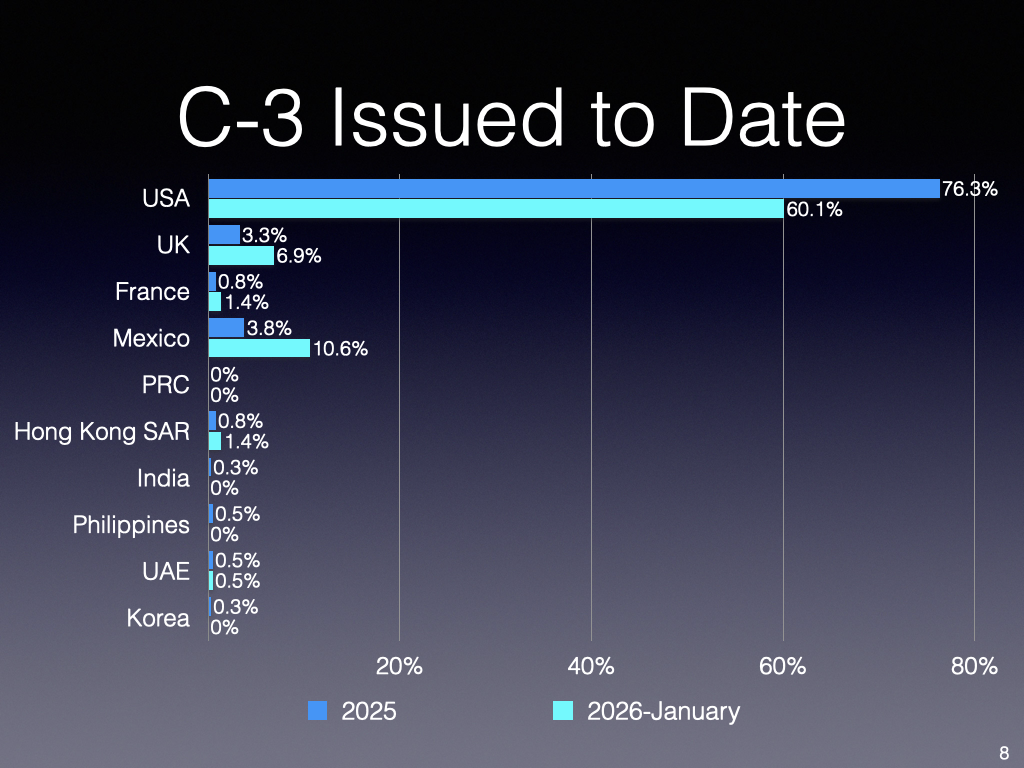
Interest in Canadian citizenship by descent among citizens in a handful of countries — especially the United States — surged after the federal government passed a new law clarifying the rules.
C-3, which took effect on Dec. 15, 2025, allows someone born outside Canada to a Canadian parent who also was born outside Canada to file a citizenship claim — as long as the parent spent at least three years in Canada before their child’s birth or adoption.
The law was drafted and passed in response to a 2023 Ontario Superior Court order that found a law on citizenship by descent passed by Stephen Harper’s government was unconstitutional.
That Harper-era law said Canadians who were born abroad could only pass down their citizenship if their children were born in Canada.
The Liberal government under then-prime minister Justin Trudeau, which did not appeal the 2023 ruling, faced a deadline to either pass legislation on new citizenship by descent rules or see the rules thrown out with no alternative.
Government officials, including then-immigration minister Marc Miller, told parliamentary committees studying the law that an unknown number of people would automatically become citizens without a legislated alternative in place.
Immigration, Refugees and Citizenship Canada reports receiving more than 12,000 citizenship by descent applications between Dec. 15, 2025 and the end of January.
While the December to January period saw a higher than normal number of applications, a department spokesperson said the government does not expect to see a “significant” uptick in applications.
The parliamentary budget officer estimated about 115,000 people would be eligible for citizenship under the bill.
The department approved almost 6,300 citizenship by descent applications between Dec. 15, 2025 and the end of January. Only 1,480 of them were approved under C-3; the remainder were approved through other laws.
U.S. citizens accounted for the largest national share of those applications. Nearly 2,500 Americans were approved in January alone.
Jacqueline Bart, a Toronto-based immigration lawyer, said there’s been a frenzy of interest among Americans looking to get a Canadian passport.
She said some of those applicants — including LGBTQ+ individuals and people with children requiring gender affirming medical care — are looking to move to Canada “right away.”
“It’s just been absolutely insane to the point where I can’t keep up with the work. I’m having to refer people to other lawyers,” Bart said.
Bart said while most of the inquiries are coming from lawyers looking for access to a second passport, she is beginning to get more inquiries from non-lawyers in the U.S.
“I think some of our inquiries are kind of spilling over into a more general sphere,” she said. “But the overwhelming majority of my clients are American. I would say maybe five per cent come from other countries, at most.”
While January 2026 saw a higher-than-average number of American citizenship by descent approvals, it only ranked third in terms of U.S. approvals in a single month in the last year. March 2025 saw more than 2,800 approvals out of the United States, while May saw almost 2,700.
The number of approvals from the U.K. — the country with the second highest level of interest in Canadian citizenship by descent — was also above average in January, at 290.
People from France saw 140 approvals in January. Other countries in the top 10 for citizenship by descent approvals include China, Hong Kong, India, Australia, the Philippines, the U.A.E. and Germany — they ranged between 75 and 120 approvals in January.
The vast majority of countries outside the top 10 saw no significant shifts in approval numbers — with the exceptions of Mexico and Belize.
Mexico was the source of 235 approved applications for citizenship by descent in January 2026; Mexican citizens received 610 approvals in all of 2025. Ninety applications out of Mexico were approved in December 2025 — a notable jump over the 2025 monthly average of 50 citizenship approvals.
While Belize accounted for only 45 approvals throughout 2025, it registered 40 in January of this year alone.
The immigration department issued about 82,500 approvals for citizenship by descent throughout 2025, with the United States generating the most — about 24,500 approvals.
The other countries in the top 10 accounted for only a combined 11,600 approvals in 2025.
This report by The Canadian Press was first published April 16, 2026.
Interesting German study. Likely transferable to other countries but would need to carry out similar analysis for the USA to assess their suggestion that same would apply:
This paper studies the impact of birthright citizenship on youth crime. We leverage a German reform which automatically granted birthright citizenship to eligible immigrant children born in Germany after January 1, 2000 and administrative crime data from three federal states. We find that immigrant youth who acquired citizenship at birth are substantially less likely to engage in criminal activity, with estimates indicating a 70% reduction in crime. These results are particularly relevant in light of ongoing debates in the U.S. about abolishing birthright citizenship. Our findings suggest that inclusive citizenship policies can reduce crime and its associated costs, which in turn could strengthen social cohesion.
Thanks to Anne Meggs for flagging. Same as previous federal policy before Supreme Court ruled unconstitutional. Small number of expatriate votes in 2022 election, less than 2,000. Similar to federal expat votes, about 2,500 in 2021 (increased to over 8,000 in 2025):
Adopté et sanctionné au début du mois, le projet de loi 18 allonge de deux à cinq ans la période durant laquelle un électeur temporairement absent du Québec peut voter par correspondance.
Le but étant d’arrimer cette période à la durée maximale d’une législature, permettant ainsi à cet électeur d’exercer son droit de vote à au moins une élection générale suivant son départ.
Dans son mémoire, le ministre responsable des Institutions démocratiques mentionne qu’une limite plus longue, pouvant aller jusqu’à dix ans, a été envisagée, sans toutefois avoir été retenue.
« Il aurait été possible d’envisager une limite temporelle plus longue, par exemple de dix ans afin de viser deux législatures », indique Jean-François Roberge.
« Néanmoins, une limite temporelle de cinq ans a été jugée plus cohérente avec l’intention du législateur ayant introduit la limite de deux ans », explique-t-il.
Le ministre rappelle que le vote par correspondance pour les électeurs hors Québec a été introduit à la Loi électorale en 1989.
« À ce moment, cette possibilité était offerte à toute personne possédant la qualité d’électeur et se trouvant à l’extérieur du Québec depuis moins de dix ans. En 1992, cette durée a été réduite à deux ans, accompagnée d’une exigence domiciliaire minimale de douze mois avant le départ », dit-il.
« Ces modifications visaient à circonscrire le droit de vote par correspondance aux électeurs ayant un lien réel, actuel et significatif avec le Québec, dans une optique de préservation de l’intégrité du processus électoral et de limitation de l’influence de personnes durablement absentes sur les décisions collectives », souligne le ministre.
« Les motivations ayant guidé cette réforme demeurent pertinentes aujourd’hui. La limite de cinq ans permet de prolonger raisonnablement l’accès au vote hors Québec, tout en assurant que les électeurs concernés maintiennent un lien significatif avec le Québec. »
Hausse d’inscription
Jean-François Roberge indique également au Conseil des ministres, dans son mémoire, que la nouvelle limite de cinq ans pourrait faire augmenter le nombre d’électeurs inscrits au vote hors Québec lors des prochaines élections générales, qui s’élevait à 3 482 en 2022.
« Cette hausse resterait toutefois plus modérée qu’en l’absence de toute limite temporelle. La mesure vise ainsi à favoriser la participation électorale tout en maintenant une balise qui assure un lien réel, actuel et significatif entre l’électeur et le Québec », précise-t-il.
Confusion?
Il mentionne aussi que cette modification, à quelques mois des élections prévues en octobre, pourrait entraîner une « certaine confusion » quant aux règles en vigueur.
« Toutefois, puisqu’il s’agit d’un ajustement ciblé touchant une seule modalité de vote, Élections Québec disposera d’une période suffisante pour informer adéquatement les électeurs concernés, avant la tenue du scrutin », dit-il.
Adopted and sanctioned at the beginning of the month, Bill 18 extends from two to five years the period during which a voter temporarily absent from Quebec can vote by mail.
The goal is to tie this period to the maximum duration of a legislature, thus allowing this voter to exercise his right to vote at least one general election following his departure.
In his brief, the Minister responsible for democratic institutions mentions that a longer limit, up to ten years, was envisaged, but was not retained.
“It would have been possible to consider a longer time limit, for example ten years, in order to aim for two legislatures,” says Jean-François Roberge.
“Nevertheless, a five-year time limit was considered more consistent with the intention of the legislator who introduced the two-year limit,” he explains.
The Minister recalls that postal voting for voters outside Quebec was introduced into the Electoral Act in 1989.
“At that time, this possibility was offered to anyone with the status of voter and who had been outside Quebec for less than ten years. In 1992, this period was reduced to two years, accompanied by a minimum home requirement of twelve months before departure, “he says.
“These changes were intended to limit the right to vote by correspondence to voters with a real, current and significant link with Quebec, with a view to preserving the integrity of the electoral process and limiting the influence of permanently absent people on collective decisions,” said the minister.
“The motivations that guided this reform remain relevant today. The five-year limit makes it possible to reasonably extend access to voting outside Quebec, while ensuring that the voters concerned maintain a significant link with Quebec. ”
Registration increase
Jean-François Roberge also indicates to the Council of Ministers, in his brief, that the new five-year limit could increase the number of voters registered for voting outside Quebec in the next general elections, which amounted to 3,482 in 2022.
“However, this increase would remain more moderate than in the absence of any time limit. The measure thus aims to promote voter participation while maintaining a beacon that ensures a real, current and significant link between the voter and Quebec,” he says.
Confusion?
He also mentions that this change, a few months before the elections scheduled for October, could lead to “some confusion” as to the rules in force.
“However, since this is a targeted adjustment affecting a single voting modality, Elections Québec will have sufficient time to adequately inform the voters concerned, before the vote is held,” he says.
Latest numbers and demand resulting for C-3, suggesting possible higher numbers than presented by IRCC and PBO, and a reminder how overly generous it is compared to other countries. From Washington Post, indicating interest given large numbers of American residents affected:
….Late last year, the Canadian government amended the Citizenship Act to grant Canadian citizenship to a wider pool of people seeking dual citizenship through their family lineage. Before the revised law went into effect on Dec. 15, the country limited Canadian citizenship to the first-generation children of a Canadian parent. Now, all generations who were born outside of Canada and have direct Canadian ancestry can become Canadian citizens, as long as they possess the correct documents andfall within the correct legal provisions.
“The grandkids can get citizenship, and the great-grandkids can get citizenship from Canada, even if they never set foot in Canada,” said Basil Mohr-Elzeki, managing partner at Henley & Partners, a firm that specializes in residency and citizenship planning.
The rule stems from a December 2023 decision by the Ontario Superior Court of Justice that deemed the first-generation cutoff unconstitutional. The law restores citizenship to those beyond the first generation born abroad….
A surge of applications
Since the change in qualifications, Immigration, Refugees and Citizenship Canada (IRCC) has experienced a bump in applications. In January, the agency said it received 8,897 applications, up from 5,940 a year ago. Between Dec. 15, 2025, and Jan. 31, it processed about 6,280 applications, out of 12,430 received, and confirmed 1,480 new citizens by descent under the new act.
“The IRCC said the processing period is about 10 months. Bart said more complicated cases, such as ones requiring DNA testing and assistance from the firm’s staff genealogist, can stretch for years. A straightforward application takes about a year or more, unless it is expedited, in which case it can take as little as a few weeks. Bart warned, however, that the wait time could grow exponentially with the recent high demand.
“Processing is really becoming backlogged because so many people are wanting to qualify,” she said.
The government agency, which posts the estimated processing time online, also shares the number of people awaiting a decision — 56,300 on April 7.
If Canadians are worried about an influx of new citizens, they shouldn’t be. Peter Spiro, a law professor at Temple University in Philadelphia, does not anticipate a rush of newly minted Canadians crossing the border.
Spiro, who specializes in international, immigration and constitutional law, describes dual citizenship as a form of insurance. You may never have to use your second citizenship, he said, but in case you need it, Canada will always welcome you home.”
…In Quebec, official documents dating back to 1621 and up to 100 years ago are kept by the Bibliothèque et Archives nationales du Québec (BAnQ), with more recent records available through the Directeur de l’état civil.
Sarah Hanahem, an archivist with the BAnQ office in Montreal, said while there’s always been an interest from Americans looking into their ancestry, requests for certified copies have exploded.
“In January 2025, we had 32 requests for certified copies of vital records and this year in January 2026, we’ve had over 1,000,” she said, adding most of those requests were made by Americans.
In statements to CBC, other archives across the country, including New Brunswick, British Columbia, Newfoundland and Ontario, have also seen a sizable increase in requests from the same time last year.
Because of the sudden surge in demand, Hanahem warned that international applicants should expect delays.
The priority, she said, is to fulfil requests by Quebec residents.“BAnQ is a government entity and we are paid with Quebec tax dollars.”
But more than that, Hanahem said the process itself is lengthy and can involve a lot of research.
There are sometimes discrepancies with the spelling of names, some of which might have changed over time, she said. Other times, critical information like which parish someone was born in, is unknown or key dates are approximate when actual dates are required.
“We have to go back to the original register,” Hanamen said, explaining some of the bound volumes are very old and need to be handled carefully. …
Karas continues to argue, justifiably, against birth tourism.
While the legislative change in simple, implementation is more challenging given Canada’s federal system where birth registries and vital stats agencies are provincial responsibly. Former IRCC ministers Kenney and Alexander abandoned plans in 2012 given these difficulties and lack of provincial agreement: see my What the previous government learned about birth tourism:
…Ending “birthright by default” in Canada is not about closing the door to immigrants – it is about closing a loophole. A straightforward amendment to the Citizenship Act to require that at least one parent be a Canadian citizen or permanent resident for a child born in Canada to automatically obtain citizenship would dissuade birth tourism overnight. Genuine newcomers would still be welcome through our immigration channels, and children born in Canada could still acquire citizenship once a parent becomes a citizen or via a naturalization process. This reform would protect our social and health systems from unfair burdens and ensure that citizenship is reserved for those with a real stake in Canada. Notably, Canadians across the spectrum support such a change: in one poll, 64% of respondents agreed that birthright citizenship should be denied to babies born to tourists or short-term visitors.
Canada’s generosity should not be misused as a shortcut to a “dream passport.” Ending unconditional birthright citizenship is a prudent, necessary step to safeguard the value of Canadian nationality. It would shut down an entire boutique industry of “passport babies” that has thrived at our expense, particularly drawing in wealthy travel-from-abroad clients. It would affirm the principle that Canadian citizenship is earned through genuine connection – by blood, by upbringing, or by naturalization – not by accident of birth location. Dozens of other successful, welcoming countries have already made this change, striking a balance between openness and fairness. Canada can do the same. Closing this loophole would uphold the integrity of our immigration system, protect public resources, and underscore that being Canadian is a privilege to be gained through true attachment to this country, not purchased through birth tourism. It is about fairness: citizenship should be a deeper bond than just being born in the right place at the right time.
Interesting how this view has emerged that this possibility was not raised in any substantive way during the parliamentary and other discussions of C-3 and predecessor bills, with discussion focused on retroactive application to the second generation born abroad, not earlier generations. Examples include Idées | Après la loi C-3, un réveil franco-américain, and the CBC article below this commentary, both with respect to early waves of Quebec emigration to the USA.
As the CBC story makes clear, considerable work is still required to document the family links, which I can appreciate having done some genealogy myself. IRCC may face challenges in verification.
As in all cases of “lost Canadians,” the degree to which individuals will wish to avail themselves of Canadian citizenship will likely be significantly less than the overall number of Canadian expatriates in the second generation and beyond. But given that most descendants of Canadians reside in the USA, there appears to be a Trump push factor.
2027 data will provide an indication:
…Stakeholders in citizenship law are now wondering how the new law will be interpreted and applied. An increasing consensus is emerging that the potential beneficiaries could include anyone who has an ancestor who was born in Canada, no matter how far back – even before 1867. It may be that many people in New England (who have ancestors from the Maritimes) or even Louisiana (who can trace their lineage back to the expulsion of Acadians in the 18th century) may now have claims to Canadian citizenship.
Not included in Bill C-3 are any requirements for security checks on those who would claim citizenship under the new rules. Nor are they required to provide police certificates or pass language or knowledge tests. According to the Act, “Canadians who are currently born citizens by descent are not required to undergo security or criminality screenings in order to be or remain citizens.”
Moreover, a committee briefing from the Standing Committee on Citizenship and Immigration notes that most people currently excluded from citizenship because of the first-generation limit were born after 2009, when it came into force. This cohort consists largely of minors aged 16 and under in 2025 and are generally deemed to be lower risk for security or criminality purposes.
In fact, Bill C-3 opens the door to citizenship for many people born before as well as after 2009. Among them are many people who might give rise to security concerns. But since they are now deemed Canadian citizens by law rather than by grant, they do not need to submit to security checks. This raises serious concerns in an increasingly dangerous world.
Equally important is the broader issue of what makes a person Canadian. By opening the citizenship door so widely, it diminishes the importance of an inherited history and a shared stake in the future.
While the government aimed for prospective uniformity, by sidestepping retroactive changes it may have inadvertently bolstered the case that Canada truly is “the first post-national state.”
Randolph Hahn is a partner with Garson Immigration Law and has practiced exclusively in citizenship and immigration law for many years. He is a former chair of the Citizenship and Immigration Section of the Ontario Bar Association and is the associate editor of the Immigration Law Reporter. He has authored many professional papers.
Millions of Americans can now claim Canadian citizenship by descent. But they have to prove it
…In Quebec, official documents dating back to 1621 and up to 100 years ago are kept by the Bibliothèque et Archives nationales du Québec (BAnQ), with more recent records available through the Directeur de l’état civil.
Sarah Hanahem, an archivist with the BAnQ office in Montreal, said while there’s always been an interest from Americans looking into their ancestry, requests for certified copies have exploded.
“In January 2025, we had 32 requests for certified copies of vital records and this year in January 2026, we’ve had over 1,000,” she said, adding most of those requests were made by Americans.
In statements to CBC, other archives across the country, including New Brunswick, British Columbia, Newfoundland and Ontario, have also seen a sizable increase in requests from the same time last year.
Because of the sudden surge in demand, Hanahem warned that international applicants should expect delays.
The priority, she said, is to fulfil requests by Quebec residents.“BAnQ is a government entity and we are paid with Quebec tax dollars.”
But more than that, Hanahem said the process itself is lengthy and can involve a lot of research.
There are sometimes discrepancies with the spelling of names, some of which might have changed over time, she said. Other times, critical information like which parish someone was born in, is unknown or key dates are approximate when actual dates are required.
“We have to go back to the original register,” Hanamen said, explaining some of the bound volumes are very old and need to be handled carefully. …
One of the frustrations during C-3 hearings on the removal of the first-generation citizenship transmission restriction was the weak data presented by the government and the overly general but nevertheless useful PBO analysis.
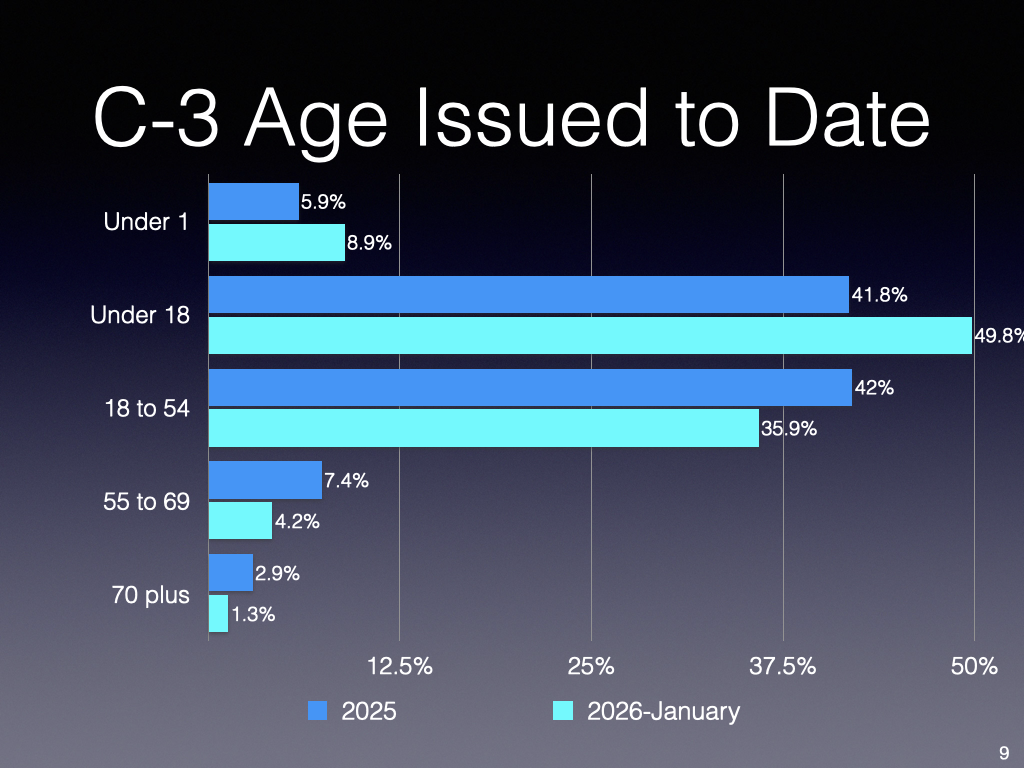
IRCC did, however, indicate some 4,000 interim applications had been received and shared the data regarding these applications: gender, age, country of residence.
This working paper presents the analysis for citizenship data nerds.