Tribal Judge Rules in Favor of Citizenship for Descendants of Creek Slaves

Of note:

A judge for the Muscogee (Creek) Nation in Oklahoma ruled that descendants of Black people who were enslaved by the tribe are eligible for tribal citizenship, nullifying a change to the tribe’s Constitution that had expelled Black members from the nation 44 years ago.

Judge Denette Mouser of the tribe’s District Court ruled on Wednesday in favor of two descendants of tribal slaves, known today as Freedmen, who had applied for citizenship in the Muscogee Nation but were denied because of their ancestry.

Judge Mouser reversed those decisions and ordered the tribe to reconsider the applications of the two plaintiffs, Rhonda K. Grayson and Jeffrey D. Kennedy, with the understanding that applicants with Black tribal ancestors are eligible for citizenship.

Geri Wisner, the attorney general for the Muscogee Nation, said in a statement that the tribe would appeal the decision to the nation’s Supreme Court, adding that the tribal Constitution “makes no provisions for citizenship for non-Creek individuals.”

The decision was a significant victory for Freedmen, who have been embroiled in a long political and legal battle to be recognized as tribal citizens.

Native American tribes in Oklahoma and the federal government have in recent years changed policies that discriminated against Freedmen, following a public pressure campaign by advocates, tribal officials and members of Congress. The Cherokee Nation in 2021 eliminated language from its Constitution that limited the rights of Freedmen in the tribe. And the Indian Health Service began providing care to Freedmen in the Seminole Nation of Oklahoma later that year.

In the Civil War era, many tribes in Oklahoma allied themselves with the Confederacy and fought to preserve the institution of slavery. After the war, a series of treaties in 1866 between the federal government and five tribes in Oklahoma — including the Muscogee Nation — abolished slavery and granted their former slaves “all the rights” of citizens in the tribal nations.

At the center of the dispute over tribal citizenship is a federal census of Native American tribes compiled in the early 1900s that divided members by race into Black and non-Black tribal rolls, respectively known as the Freedmen and “by blood” rolls.

In the 1970s, the principal chief of the Muscogee Nation at the time, Claude Cox, expressed fear that “blood” citizens of the nation would be outnumbered by Black citizens. At a meeting of the tribe’s National Council in 1977, he said that “full-bloods” had “lost control” of the tribe and that the nation needed “a Constitution that will keep the Creek Indian in control.”

Source: Tribal Judge Rules in Favor of Citizenship for Descendants of Creek Slaves – The New York Times

Racicot: J’en appelle aux chefs autochtones 

Quebec commentary on whether there is systemic discrimination or systemic racism. In some ways, more of a semantic distinction although systemic racism is arguably a deeper form of discrimination. But its use may contribute to greater polarization and may distract from addressing concrete issues as Racicot argues:

Dans ses deux derniers textes au Devoir, le pédiatre urgentiste et professeur à l’Université McGill Samir Shaheen-Hussain utilise l’expression « racisme systémique ». Ce faisant, il épouse la vision des chefs autochtones qui en font abondamment usage.

Or, il est important de rappeler que le juge à la retraite Jacques Viens, encore dans son récent témoignage devant la commission parlementaire sur le projet de loi 32 sur la sécurisation culturelle, a continué de s’en tenir à la notion de discrimination systémique et non à celle de racisme systémique, comme ce dernier l’avait prudemment mais rigoureusement fait dans le rapport de sa commission, en 2019.

Lors de son témoignage de la semaine dernière, le ministre responsable des Relations avec les Premières Nations et les Inuit, Ian Lafrenière, a rappelé l’importance des mots. Il a donc tenté d’obtenir du juge Viens un éclaircissement, à mon avis essentiel, sur son utilisation des expressions « discrimination systémique » et « racisme systémique ». Le juge n’y a pas répondu directement. Pourquoi ? Je ne sais pas. Il appelle plutôt le gouvernement du Québec à reconnaître « dès maintenant la discrimination systémique et le Principe de Joyce », a-t-il dit en visioconférence. Que comprendre de cette réponse sibylline ?

Essentiellement, j’y lis son refus du terme « racisme ». En effet, s’il était d’accord avec le diagnostic de racisme, il n’aurait eu qu’à inciter le gouvernement à reconnaître le Principe de Joyce, puisque ce dernier pose le constat de racisme comme prémisse… mais il a pris soin de préciser la discrimination systémique ET le Principe de Joyce.

La question ne se pose pas que sur le plan de la sémantique. Comme ne le serait pas, en cour de justice, un effort de choisir entre les termes « homicide involontaire » et « meurtre prémédité ». Les deux se distinguent par l’intention de l’accusé. L’effet est le même. Mais la justice demande de faire une distinction des intentions pour juger de la culpabilité et des mesures correctives à imposer.

C’est là toute la problématique engendrée par l’exigence des Attikameks que leur texte soit intégralement adopté comme condition préalable. Reconnaissons-le, la commission Viens l’a clairement exposé et conclu, les systèmes de santé, de justice et autres du gouvernement peuvent engendrer de la discrimination envers les Autochtones. Par exemple lorsque des lois destinées à protéger la langue commune du Québec ont pour effet indésirable de priver des communautés autochtones éloignées d’accès à des professionnels incapables de parler français. Reconnaissons tout de même qu’il y a alors discrimination systémique, mais pas racisme systémique.

Pour les Québécois soucieux de leur identité et fiers de leur histoire et de leur société, le fait qu’on affirme que leurs gouvernements successifs ont mis sur pied et entretiennent un système fondé sur une intention raciste est une insulte et une injure. Pour plusieurs, cette accusation injuste produit une colère qui ne peut que conduire à un blocage dans la résolution du problème dans le sens recherché par les six piliers du Principe de Joyce et par les 142 appels à l’action de la commission Viens.

J’en appelle aux chefs autochtones d’admettre que l’accusation de racisme à l’endroit du Québec est inappropriée et de modifier leur texte en conséquence. Ça ne pourra qu’aider à débloquer et à faire avancer les actions correctives concrètes, efficaces et durables réclamées par le juge Viens.

Source: J’en appelle aux chefs autochtones

The Political Impact of Increased Diversity: What the Census Shows with Respect to Indigenous peoples

As a companion piece to my earlier riding level analysis of visible minorities, The Political Impact of Increased Diversity: What the Census Shows, I performed the same analysis with respect to Indigenous groups, highlighting that the relative political importance of Indigenous groups is declining in relation to visible minorities in electoral terms. This draft was shared with the three national Indigenous organizations but no comments were received given their higher priorities. 

Blood-Quantum Laws Are Splintering My Tribe

US example but parallels in Canada:

Even though I am a citizen of the Jamestown S’Klallam Tribe, because of my blood I may also be the last tribal member in my family line.

My tribe requires that members be at least one-eighth Jamestown S’Klallam by blood. Because I am exactly one-eighth, unless I have kids with another citizen, my kids will be ineligible to join. Regulations like this, known as blood-quantum laws, are used by many tribal nations to determine citizenship. They do this in the name of preservation, fearing that diluting the bloodline could mean diluting the culture. However, by enforcing these laws, tribal governments not only exclude some active members of their communities, but also may be creating a future in which fewer and fewer people will be eligible for citizenship. Watching enrollment in my tribe dwindle, I’ve started to wonder: What if there were another way to think about the preservation of a community?

Blood-quantum laws were originally created by white settlers in the 18th century. They were used to prohibit interracial marriages, and to keep people deemed Native American out of public offices or on reservations—essentially to determine who would (and wouldn’t) benefit from the privileges of whiteness. By the time of the Indian Reorganization Act in 1934, tribal governments had begun implementing these laws themselves. In theory, the act was designed to preserve Native American identity. In addition to restoring Indigenous people’s fishing and hunting rights, it also offered funds and land to people who volunteered to move to reservations. This system cemented the importance of blood-quantum laws because many tribes that had previously relied on kinship and relationships to determine citizenship now used blood to determine who was allowed to settle on reservations

The act also split my own tribe, the S’Klallam, into three. The federal government paid tribal members to move to two new parcels of land in Washington State and start new tribes; they became the Port Gamble S’Klallam and Lower Elwha. Those who stayed in place on the Strait de Juan de Fuca, on the northern coast of the state, had to pool their money together to buy our ancestral land even though they lived on it already; they became the Jamestown S’Klallam. Now, because of the federal government’s requirements when it offered the land, legally we are separate tribes, even though we all share the same ancestors. Someone can be enrolled in only one of the three. Cousins of mine who have a grandfather in one tribe and a grandmother in another must choose to commit to only half of their family tree and leave behind part of their heritage. Even though they are one-quarter S’Klallam, they are only one-eighth Jamestown S’Klallam—and, unless they have children with another tribal citizen, their kids will be ineligible for citizenship, just like mine could be.

Despite these laws, the three tribes continue to gather to drum and sing together, and to host potlatches—feasts with giveaways that celebrate abundance—to welcome in canoes from other local tribes during their annual journey along the Washington coastline, a cultural tradition. Still, we have been splintered. We stand side by side at gatherings, but when we introduce ourselves, we separate ourselves by saying our family name, what tribe we are connected with, and, often, whether we are an official tribal citizen. I wish we would hold together the community the U.S. tried to splinter; instead, in moments like these, we break it apart.

Tribal citizenship is more than symbolic. It determines eligibility for educational assistance, medical care, and other social benefits. Plus, only members can attend citizen meetings and vote in tribal elections. If my future children don’t meet the blood requirements for my tribe, they could still participate in events, cultivate plants in the traditional-foods garden, and take Klallam-language courses. But no matter how much they served the community in love and time, they would be deemed a “descendant” and marked as separate.

Watching others in this situation now, I’ve come to realize that a community that doesn’t serve all of its members risks falling apart. I know young people who aren’t eligible for citizenship who believe they aren’t valued. They have begun to lose their drive, pulling back from attending events and helping with programs. In prioritizing blood purity, tribes lose out on another type of preservation that comes from being involved in and learning about the tribe. They lose out on opportunities for descendants to create new memories that could eventually become stories told to future generations—a more powerful, active form of preservation than blood.

We are facing cultural extinction if blood-quantum laws stay in place. The Jamestown S’Klallam Tribe has fewer than 600 members. A future in which no one will have enough Native blood to qualify for citizenship is not only possible, but imminent. Though descendants may continue to honor the memories of those who came before, and continue teaching lessons, they will be denied the hunting and fishing rights that past generations fought hard to keep. If there are no more citizens, tribes may even lose ownership of the land that their buildings sit on. Community is so much more than laws can ever capture, but without official recognition, we could lose the foundation we have built on. It’s hard for a community to hold itself together when, legally, people are slowly being cut out of it. Though memory and cultural practices can fan the flames of heritage, only a change in the laws defining citizenship can keep the fire bright for generations to come. Otherwise all that will be left is smoke.

If tribal communities came together instead of focusing on separation, we could help our culture to flourish. We might have to cast aside the old rules governing heritage, but we could do something more important: hold on to our identity and one another as the world changes around us. One way to do this would be to discard blood-quantum regulations and instead grant citizenship to anyone who could trace their lineage back to a full-blooded member. Such a policy would keep the thread of family kinship within the enrollment guidelines, but would not exclude the children of current tribal citizens. Providing benefits to more members might be more expensive for the tribe, but those costs would be outweighed by the longevity we’d gain; our tribe would still be around for members to engage in, rather than learn about from history books. Future generations could participate as much or as little as they would like, but all descendants would be engaging as equals.

In the meantime, I will do as I have always done to preserve memories of our community while also currently living in it. I will collect photographs, researching the names of the faces they show and noting them where I can. I will tell our stories to anyone who will listen and write them down to create a record for the future. If I have children, I will teach them everything I know about our culture so that they can keep the memory alive. I will tell our stories to anyone who will listen. Even if no one is left to claim citizenship, I want there to be a way to remember the Jamestown S’Klallam Tribe.

Leah Myers is a writer based in Alabama and the author of Thinning Blood.

Source: Blood-Quantum Laws Are Splintering My Tribe

Deputy minister left government weeks after Indigenous group privately called for his resignation, documents show

Cancel culture, Canadian government style…

A deputy minister’s recent departure from the federal public service occurred just weeks after a national Indigenous organization privately called for his resignation over an e-mail dismissing their description of colonialism as “a gross misreading of history.”

Timothy Sargent’s nearly three-decade career in the federal public service – which included representing Canada internationally on trade and finance files – ended without a public explanation in October when Prime Minister Justin Trudeau announced a shuffle of deputy ministers.

The news release named a new deputy minister of Fisheries and Oceans, but made no mention of Mr. Sargent, who had been in that job since early 2019. Normally such news releases thank senior officials for their service if they are retiring or leaving for another position.

Internal e-mails and letters obtained by The Globe and Mail through Access to Information – as well as additional details provided by government officials – reveal his departure followed months of behind-the-scenes controversy over an e-mail he wrote in May, 2022.

Government officials told The Globe that Fisheries Minister Joyce Murray became personally involved in the matter, apologizing to the recipient of the e-mail and raising her deputy minister’s actions with Janice Charette, the Clerk of the Privy Council and head of the public service.

The controversy began in May when Mr. Sargent received a letter of invitation signed by Dawn Madahbee Leach, chair of the National Indigenous Economic Development Board, a small organization based in Gatineau supported financially by the federal government that provides advice to Ottawa on policy and ministerial appointments.

The letter invited Mr. Sargent to attend a luncheon hosted by Deloitte Canada to launch a National Indigenous Economic Strategy for Canada. The letter said “one of colonialism’s most nefarious objectives was the deliberate exclusion of Indigenous people from sharing the wealth of our country. This strategy is a path forward towards economic reconciliation that is both inclusive and meaningful.”

The letter was e-mailed to Mr. Sargent by public affairs consultant Isabelle Metcalfe on May 30, 2022.

Mr. Sargent responded the next morning with a one-sentence e-mail to Ms. Metcalfe and Mario Iacobacci of Deloitte.

“I shall certainly not attend an event which is premised on a gross misreading of history,” he wrote.

Ms. Metcalfe promptly forwarded Mr. Sargent’s response to Ms. Madahbee Leach, who then e-mailed Mr. Sargent that evening to express regret regarding his position.

“In the spirit of reconciliation, I would welcome the opportunity to discuss with you your response in an effort to salvage the opportunity for you to attend the event and learn,” she wrote on May 31.

About a month later, Mr. Sargent sent a two-page letter of apology to Ms. Madahbee Leach, dated June 29.

“I fully acknowledge that my response was inappropriate and illustrated a lack of awareness of and sensitivity to the many challenges and barriers, past and present, faced by Indigenous people to fully and equitably participate in Canadian society and the economy,” the letter stated. “I would like to make restitution for the harm that this has caused, both to the Department’s reputation but also to the fact that is exactly the kind of thing that points to systemic racism at the highest levels of government.”

The letter ended with a request for a meeting.

The documents show Mr. Sargent e-mailed a copy of the letter to Ms. Charette, the PCO Clerk, as well as Daniel Quan-Watson, the deputy minister of Crown-Indigenous Relations, and Christiane Fox, the then-deputy minister of Indigenous Services.

“Colleague, you will find attached a letter I sent earlier today to Ms. Dawn Madahbee Leach expressing my sincere remorse over language used in a reply to an invitation to the launch of the National Indigenous Economic Strategy,” he wrote in the e-mail, which was released in a partly redacted form. “I also want to thank you for your support both over the past several years but also more recently through this time.”

On Sept. 9, the National Indigenous Economic Development Board (NIEDB) sent Mr. Sargent a new letter from Ms. Madahbee Leach, with copies to Mr. Trudeau, Ms. Charette, some federal ministers, the Assembly of First Nations, the Inuit Tapiriit Kanatami and the Métis National Council.

The letter acknowledged Mr. Sargent’s letter of apology but said his original comments appear to be at odds with the 2015 Truth and Reconciliation Commissioner’s Report, the Royal Commission on Aboriginal Peoples and many Supreme Court of Canada rulings.

“Your response to our invitation is particularly shocking in that, as a senior official, it appears that you do not agree with, or believe in, the findings of these vital and fundamental documents. The boldness with which you confidently and openly shared your thoughts that we were presenting a ‘gross misrepresentation of history’ is a prime example of systemic racism at the highest levels of government,” she wrote.

The letter said the sincerity of his letter of apology “is greatly diminished” by the fact that it was only received after his superiors had been informed of the e-mail. It said that after careful consideration and after receiving input from a variety of Indigenous leaders, the NIEDB “firmly believes that a senior official holding the views that you have expressed should no longer serve in any capacity in the federal public service, or in any other government or affiliated entity.”

Mr. Sargent declined to comment on the issue when reached by phone Thursday at the Centre for the Study of Living Standards, where he now works as the deputy executive director. He is also a Distinguished Fellow at the Centre for International Governance Innovation.

Prior to leading the Fisheries Department, he was the deputy minister of International Trade during the negotiation of the Canada-United States-Mexico Agreement. He has also worked as a senior Finance Department official with responsibility for the G7 and G20.

In response to questions from The Globe, Jeff Woodland, a spokesperson for the Fisheries Minister, provided a statement saying Ms. Murray was “deeply disappointed” to learn of Mr. Sargent’s e-mail.

“The comments were unacceptable and inappropriate,” the statement said, adding that Ms. Murray raised the issue with the PCO Clerk and spoke with Ms. Madahbee Leach “to apologize on behalf of the government and department.”

PCO spokesperson Stéphane Shank said an acting deputy minister assumed Mr. Sargent’s role as of late June, 2022, before a permanent replacement was named on Oct. 31. The PCO said Mr. Sargent submitted his resignation effective Oct. 12.

“PCO cannot comment on individual circumstances in accordance with the Privacy Act,” Mr. Shank said.

In an interview, Ms. Madahbee Leach said Mr. Sargent’s initial e-mail was unsettling and he never took up her invitation to discuss the issue directly. She said she felt Ms. Murray and her office handled the situation well.

“They were also very shocked,” she said. “When they see something in writing like this, it was quite something.”
Source: Deputy minister left government weeks after Indigenous group privately called for his resignation, documents show

ICYMI: How well is the government meeting its diversity targets? An intersectionality analysis

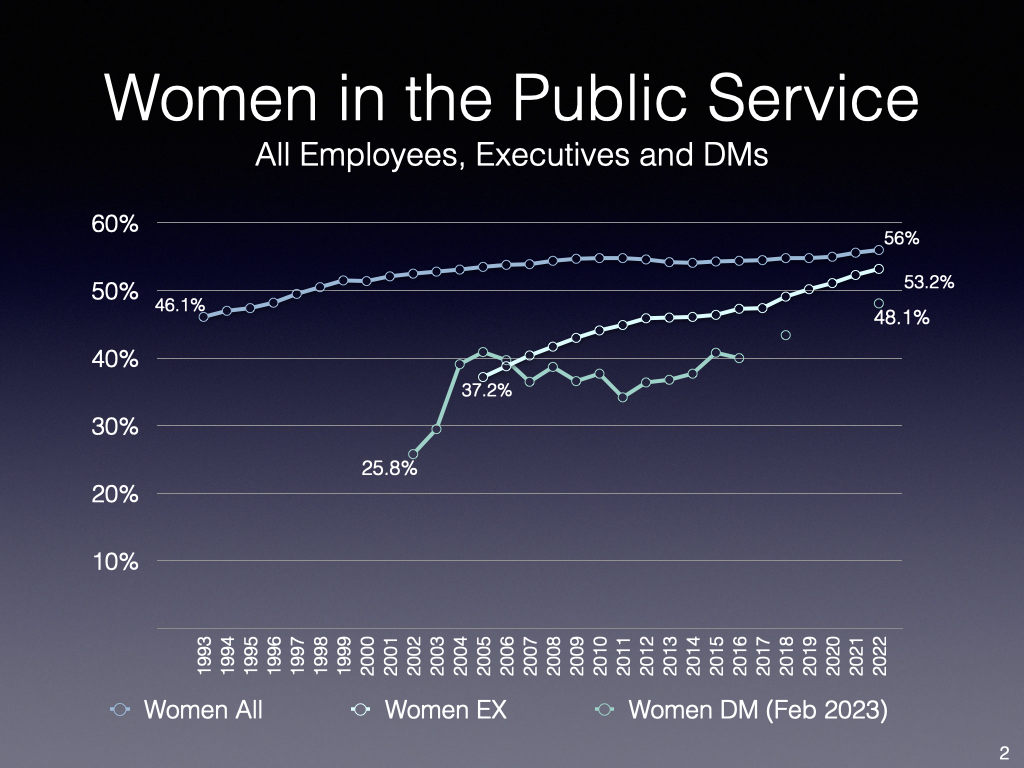
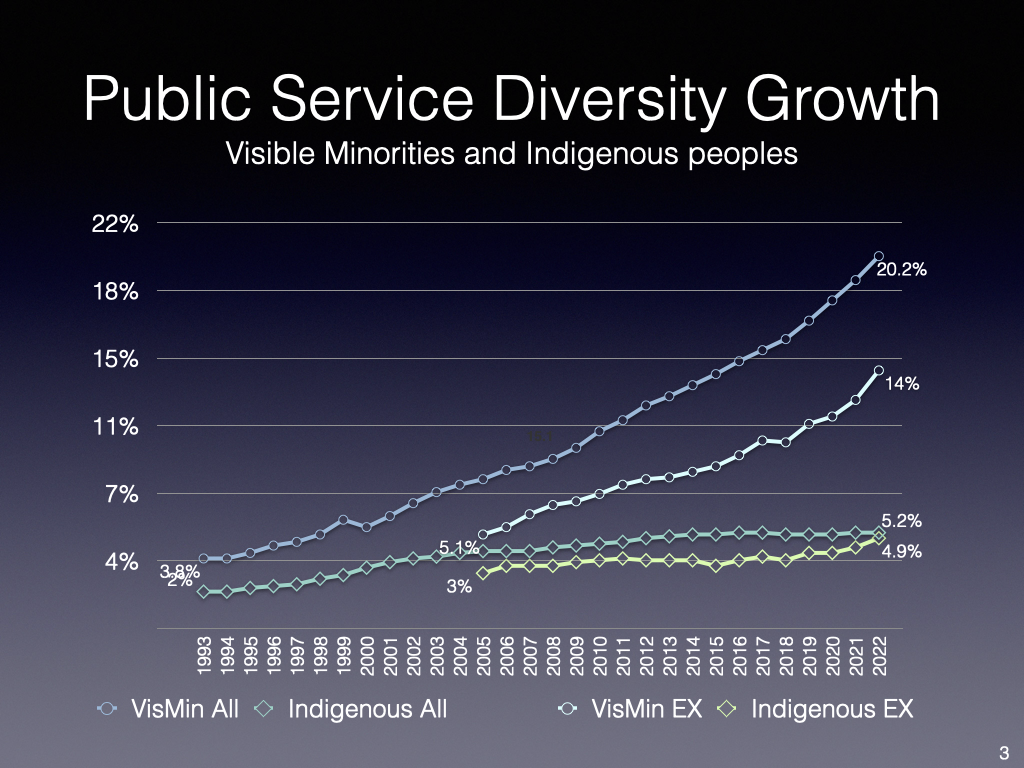
As you know, I have been looking for some time at how the diversity within the public service continues to evolve. The overall trend over the years demonstrates that the original policy objectives of improved diversity are being met but arguably too slowly for some.

For the past six years, TBS has provided disaggregated data for the various equity groups. In 2022, TBS also provided gender breakdowns within the disaggregated data. Following up on a suggestion from a member of Black Lives Matter, I looked at hiring, separation and promotion rates for visible minority and Indigenous groups, showing that visible minority representation is growing faster than non-visible minority, not indigenous, with a more mixed picture for Indigenous public servants.

When originally published by National Newswatch and subsequently posted on LinkedIn, the analysis received a range of commentary, ranging from this who appreciated the data and analyis to those who contested it. The latter ranged from those genuinely interested in discussing the approach I took while raising valid points (I learned more about disproportionately analysis), to those, “activists on a pension,” as we sometimes called them while working in the multiculturalism branch at Canadian Heritage.

The latter appeared to have not read the article or understood that I had used the same disproportionality approach to assess the differences between hiring, separation and promotion rates, highlighting the improvements over the past six years, particularly but not exclusively, for Black public servants. Media needs to be more careful in citing individual examples without this broader context (e.g., Sandra Griffith-Bonaparte has worked 22 years for the government. She’s never gotten a promotion):

Douglas Todd: Canadian Indigenous spirituality anything but monolithic 

Another good reminder:

“All First Nations believed their values and traditions were gifts from the Creator. One of the most important and common teachings was that people should live in harmony with the natural world and all it contained.”

That’s what the Canadian government’s educational resource for young people says every Indigenous person believed before settlers arrived. And today many continue to believe there is uniformity in contemporary Indigenous spiritual practice.

But the recent Canadian census reveals that Canada’s 1.8 million Indigenous people are anything but monolithic in regard to religion and spiritual practice. The range is extraordinary.

To begin with, the census, which every decade asks about religion, found a fast-rising number of Indigenous people, about 47 per cent, are checking off the box: “No religion, and secular perspectives.” That compares to only 20 per cent in 2011.

At the other end of the spectrum, a declining number of Indigenous people, also about 47 per cent, says they’re Christians.

And only four per cent of Canadian Indigenous people put themselves in the category of “traditional (North American Indigenous) spirituality.” This small group would be closest to the historic form of spirituality described in Ottawa’s educational resource for young people.

Indigenous religious diversity stretches surprisingly wide in 2023, flowing into unfamiliar streams.

The census, for instance, found 1,840 Indigenous Canadians who say they’re Muslim, while another 1,615 Canadians are Jewish.

I reached out to some Indigenous, Muslim and Jewish organizations to interview a First Nations, Inuit or Metis who is Jewish or Muslim, whereupon the Centre for Israel and Jewish Affairs introduced me to Cheyenne Neszo.

A status member of the Lheidli T’enneh First Nation based in and around Prince George, Neszo is deep into the process of converting to Judaism, the proud religion of her fiancé, Zach Berinstein.

Neszo, a 32-year-old lawyer, grew up in North Delta, where her extended family occasionally attended church and had in many ways lost touch with their Indigenous roots. That changed in recent years, as Neszo, her mother and grandmother applied for First Nations status and reconnected to those cultural origins.

Now, Neszo is three years into studying Judaism with Rabbi Dan Moscovitz at Vancouver’s Temple Sholom, where she and Berinstein will be married in September. “It’s just one of the most welcoming places I’ve come across,” said Neszo, who specializes in Indigenous law. Their wedding will be Jewish, with Lheidli T’enneh elements.

To understand the evolution in Indigenous religiosity over the years, I have frequently interviewed First Nations, Metis and Inuit elders and others who are Christians, who belong to one of the three denominations that ran Canada’s defunct federally funded residential schools.

Although the proportion of Indigenous people who belong to those denominations is declining, it remains that 485,000 Indigenous people today (27 per cent) still say they’re Catholic, 110,000 affiliate with the Anglicans and 42,000 are United Church members.

In addition, 28,000 Indigenous people belong to the Pentecostal Church, which did not operate a residential school. And what of the 6,515 who are Jehovah’s Witnesses and 5,035 who belong to the Church of Jesus Christ of Latter Day Saints (Mormons)?

Although he was not available for an interview, John Borrows, who is of Anishinaabe heritage and a committed Latter-day Saint, was recently profiled by Cardus, a Canadian think tank. Borrows is a professor specializing in Indigenous law, as well as head of the Victoria Multifaith Society.

Like other Anishinaabe people, Borrows went on a Vision Quest as a young man, fasting and being alone in the forest. Although he joined the Latter Day Saints when he was 19, he believes those experiences of encountering God’s presence in nature still inform his faith.

Ray Aldred, a member of the Cree Nation who directs the Indigenous studies program at Vancouver School of Theology, is not surprised more Canadian First Nations are classifying themselves under “no religion, and secular perspectives.”

They are essentially saying, Alder believes, that they don’t want to be associated with “one of those,” by which he means the Christians who are increasingly being condemned for their role in operating about 125 residential schools, which were almost all closed by the 1970s.

There was “no such thing as secular” in traditional Indigenous culture, said Aldred. “The category didn’t exist in the Indigenous mindset.”

He said Indigenous people are picking up the concept from attending college and university, where faculty tend to vilify Christianity and academic papers about the faith seem to only get published if the author can show they hate the religion.

“All that has an impact.”

At the same time, Aldred said many Indigenous people don’t see a contradiction between Christianity and their peoples’ ancient spiritual ways. “Their families have been part of the church for a couple of hundred years.”

For his part, Aldred, who is an Anglican priest, said he believes settler culture and religion has brought both positives and negatives.

Rather than Indigenous people zeroing in on their specific religious or non-religious identities, Aldred suggests they “try to focus on a communal identity,” which connects them to the land and to each other.

He talked about how Metis people, as well as the Nisga’a of northern B.C., follow many different denominations and religious traditions without fighting about it. He admires the Nisga’a creed: “One nation, one heart.”

And in an era when social media incites groups to feel contempt for the other, Aldred rightly encourages people of different faiths and no faith to engage in authentic dialogue.

“The important thing is people learn to speak heart to heart, so we hear one another.”

Source: Douglas Todd: Canadian Indigenous spirituality anything but monolithic 

ICYMI ‘It’s cultural genocide’: Native Americans shine a light on the epidemic of disenrollment

Of note, “blood quantum”:

For Kadin Mills, a first descendant of the Keweenaw Bay Indian Community, resources offered through his family’s tribe will always be just out of arm’s reach.

He will never be able to call himself a citizen of Keweenaw Bay — and with that comes limits on the sort of benefits, such as health, that he is able to receive. In desperate cases — like when Mills needs a prescription that would simply be too expensive at non-tribal pharmacies — he must depend on good timing, luck, and the generosity of his enrolled family members.

“If my mom has the same prescription, she gives them to me and refills hers,” he said.

Mills is just one of many Native American young adults and youths who are unable to enroll with their tribe, even when one or more of their immediate family members — such as a parent or a grandparent — are enrolled. Most, if not all, federally-recognized tribes rely on blood quantum and lineage requirements to determine whether an individual is eligible for citizenship.

The term “blood quantum” is exactly what it sounds like. It refers to the amount of “Indian blood” a person has — for example, if someone’s grandparent was fully Native, that person’s blood quantum would only be a quarter Native.

According to “American Indians without Tribes in the 21st Century,” a journal article published in the National Library of Medicine, one-third of mixed-race American Indians and one-sixth of single-race American Indians did not respond to questions regarding tribal affiliation or enrollment in the 2000 United States census.

In many tribes, including the Keweenaw Bay Indian Community, a minimum of one-fourth of Native American blood is required to enroll. These requirements ice out mixed-race Native Americans such as Mills, something that he said promises a decline in tribal membership and an uncertain future for traditional ways of life.

“I think it’s cultural genocide,” Mills said.

During the mid to late 1800s, the United States government began using the blood quantum measure in the hopes that “intermarriage would “dilute” the amount of “Indian blood” in the population,” according to an article by Maya Harmon published by the California Law Review at the UC Berkeley School of Law. The end goal was to breed out Native Americans and assimilate them into white society.

Other tribes, such as the Pokagon Band of Potawatomi Indians in southwestern Michigan, rely on a model of “lineal descendancy,” where a person’s citizenship is determined by their ancestry rather than blood quantum percentage.

Blood quantum, according to an article published by NPR, “What Exactly is ‘Blood Quantum’?”, refers to the amount of “Indian Blood” an individual possesses. The manner in which this is determined is through legal tribal documents issued by a tribal official or government official. The difference with lineal descendancy is when individuals acquire citizenship by proving they have ancestors previously part of indigenous groups.

While uncommon, Mills pointed out that this model has significant potential to reshape tribal communities.

“I think that that’s the future of our communities, at least in this area,” he said.

Native Americans who are enrolled with any of the 574 federally-recognized tribes in the United States have access to benefits such as free or low-cost healthcare, subsidized housing and universal basic income, which grants citizens consistent payment to support during any socioeconomic struggle. In most tribes, no such benefits are offered to lineal descendants, even when a child’s parent is an enrolled citizen.

For Mills, whose mother is an enrolled member of the Keweenaw Bay Indian Community, access to healthcare services has been a rocky journey, riddled with countless obstacles, financial barriers and disappointing dead-ends.

After his dad became unemployed and lost their health insurance over a year ago, Mills sheepishly explained that he hadn’t been to the dentist in over a year despite needing prescription toothpaste.

Even the primary care he once received as a student at Northwestern University was no longer accessible.

He believes that if Keweenaw Bay followed a citizenship model similar to the Pokagon Band of Potawatomi Indians, the quality of life for tribal members and their families would be much better.

“I think that it really hurts our ability to offer programs and services to people who are subject to ongoing cultural genocide that is blood quantum,” Mills said. “You keep them from actually accessing that culture and being able to be active participants in their communities.”

Even enrolled tribal members aren’t necessarily in the clear when it comes to citizenship. Such is the case with Summer Paa’ila-Herrera Jones, whose family was disenrolled from the Pechanga Band of Luiseño Indians in 2004.

At the time, Jones was only six years old; she said she still struggles to fully understand what led to the situation.

“I feel like I don’t have a whole grasp of the whole picture of what happened to our family or why,” Jones said. “That’s a really hard thing to grow up in. I knew the term disenrollment. But what does that mean to a six-year-old?”

Jones said that she believes that around 210 tribal members — about 25 percent of Pechanga’s membership — were disenrolled. She was one of 76 children who were impacted by the disenrollment.

“In the name of sovereignty, it happened,” she said.

Disenrollment, while uncommon, is a serious matter, as enrollment status holds power, security and privilege that an individual might not otherwise have. In the case of the Nooksack Tribe of Washington state, over 306 tribal citizens were disenrolled in 2018; 63 of these disenrolled citizens were evicted from federally-subsidized housing on tribal land.

In Jones’ case, her family was outcast socially by enrolled members of the tribe, who she said treated them poorly and discriminated against them due to their enrollment status.
“[This woman] had confronted my mom at the clinic and basically said, ‘you’re not welcome here. You’re not allowed to come here with your kids. You don’t get services here,” Jones recalled. “She [had known] me since I was born.”

After this encounter, Jones’ parents began taking her and her siblings to a health clinic on the Rincon Indian Reservation in San Diego, a 45-minute drive from the Pechanga reservation where Jones’ family lived. As an adult, Jones said that she still experiences significant anxiety and stress around making appointments for her health, even when it comes to primary care.

“To have [the disenrollment] at the forefront, when I’m literally just trying to get a teeth whitening appointment, it can be a struggle,” she said, chuckling.

“I feel like it’s still like really, I don’t know, kind of taboo or strange to talk about,” Jones said. “I do feel like my family has suffered this extra layer of trauma that is very much invisible to people in society, but also to people within the Native community.”

Source: ‘It’s cultural genocide’: Native Americans shine a light on the epidemic of disenrollment

Racism a major barrier for health care recruitment in Canada, report finds [Indigenous focus]

Of note:

More Indigenous practitioners are needed to address systemic racism, but that can’t happen without a supportive education system that also envisions them in leadership roles, says a report commissioned by Health Canada and touted as the first comprehensive review of the health-care workforce.

The report, released Tuesday by the Canadian Academy of Health Sciences (CAHS), includes an assessment of 5,000 studies done over the last decade on various issues, such as the retention of nurses and doctors and the impact of technology. Some of the research was from countries with similar care models, including Australia, the United Kingdom and Germany.

It outlines multiple hurdles in health care, including inadequate staffing, burnout, moral distress and dissatisfied patients. It also says the system should prioritize culturally safe workplaces, with a focus on team-based care and gender equity so women, who have been the main caregivers at home as well during the pandemic can stay in leadership roles.

The report, which includes surveys of 400 health leaders and professionals, also calls on governments and organizations to develop strategies to support Indigenous practitioners and trainees.

It says racism is a major barrier for many workers as recruitment and retention are among the biggest challenges to planning a health-care system for the future, including in rural and remote areas.

“There are substantial disparities between rates of Indigenous and non-Indigenous Peoples in every health profession, including nursing, medicine, midwifery, dentistry,” says the report, which calls for data collection on racialized trainees and workers.

Indigenous participants highlighted the legal and ethical need to advance the Indigenous health workforce, linking the labour gap to persistent social inequities among First Nations, Inuit and Metis Peoples.

“They also noted the legal obligations of our governments to the United Nations Declaration on the Rights of Indigenous Peoples, along with the ethical responsibility to fully implement the calls to action of the Truth and Reconciliation Commission of Canada,” the report says.mom was admitted to a storage room

Dr. Marcia Anderson, an internist at Grace Hospital in Winnipeg, was among the 15 people who assessed the scientific literature. She said that as part of Canada’s systemically disadvantaged populations, Indigenous Peoples face “really high levels of racism in the workplace or in the learning environment.”

“In some reports that could be 80 or 90 per cent of people who report experiencing racism,” she said, adding one of the key “pathways” forward is through Indigenous-led development of policies, safe reporting and investigation processes, as well as mandatory education and training for all employees.

“Even within Indigenous populations there is significant diversity. As a First Nations person, I need to know more about cultural safety and cultural humility so I can provide culturally safe care to Inuit people, for example,” said Anderson, who is Cree and Anishinaabe.

Anderson said the gap also compromises care for Indigenous patients, who have endured racism in the health-care system.

She cited the case of 37-year-old Indigenous patient Joyce Echaquan, who died in a Quebec hospital of pulmonary edema in 2020, shortly after filming herself being insulted by hospital staff, as an example of the need for Indigenous Peoples to be part of the health-care workforce and provide leadership in ensuring culturally safe care.

However, Indigenous Peoples face the additional burden of driving change, often on their own and without compensation, Anderson said.

That may involve using connections to their community to help build relationships, sometimes referred to as “cultural load” or a “minority tax,” she said.

“That’s not something my non-Indigenous colleagues are getting asked to do,” said Anderson, also vice-dean of Indigenous health, social justice and anti-racism at the University of Manitoba.

“There can be significant expertise, community connections and relationships and experience and those are really valuable to institutions but institutions haven’t always valued them. So, when we’re asking Indigenous members of our teams to do this extra work, the point is, it should be fairly compensated because it’s part of the value-add to the institution.”

Indigenous Peoples in remote areas are more likely to be employed in community care settings and in jobs that don’t involve advanced education, compared to their counterparts in urban locations, Anderson said.

“I think that has to do with educational inequities that make it harder for Indigenous Peoples to enter programs like nursing or medicine or pharmacy and then be in those positions.”

Health Canada said health-care workers — from family doctors to personal support workers, massage therapists, dental hygienists and dietitians are — “the backbone of our health-care system and they are currently experiencing unprecedented challenges.”

“The government of Canada is committed to protecting and strengthening Canada’s publicly funded health-care system, including by addressing the health workforce crisis,” it said in an emailed response.

“This evidence-based assessment report will inform ongoing collaboration between the government of Canada, the provinces and territories and key stakeholders to identify both immediate and longer-term solutions to address significant health workforce challenges.”

Serge Buy, CEO of the Canadian Academy of Health Sciences, said many Canadians, including himself, are regularly affected by health-care issues, including the lack of a family doctor.

“I don’t have a doctor. My father, who’s 85, doesn’t have a doctor, for two years,” said Buy.

“My doctor quit in the middle of the pandemic. He sobbed on my shoulder saying, ‘I can’t do this.”’

Buy said that while much of the report highlights issues unveiled during the pandemic, they have not previously been backed up by scientific evidence now available to governments, non-government organizations and other stakeholders.

For example, during the pandemic, women health-care practitioners have found it difficult to remain involved in leadership, administration or research due to increased caregiving responsibilities, the report says.

“These factors are rarely considered in workforce planning,” it says regarding gender equity.

Source: Racism a major barrier for health care recruitment in Canada, report finds

Lynn McDonald: Get the facts right before condemning the past

Worth noting:

The City of Toronto’s decision to rename Dundas Street probably helped the then Ryerson University administration to decide on its renaming — it was well along the way. The renaming forces at Ryerson, in turn, likely inspired a University of Toronto student to call for the renaming of Woodsworth College, founded in 1974 in honour of James Shaver Woodsworth on the centenary of his birth.

This proposed renaming, which appeared to go nowhere, appeared in a student newspaper, The Innis Herald. The 2020 opinion piece by Marloes Streppel denounced Woodsworth for his (supposed) support of residential schools and the “forced relocation of approximately 150,000 Indigenous children,” with their “severe neglect, sexual and physical abuse, and starvation.” Streppel’s op-ed, “James S. Woodsworth: A man to remember, never to glorify,” even had Woodsworth consider “cultural genocide” to be “satisfactory,” “from the white man’s standpoint.”

The trouble is that she based some of her remarks on an article by a different Woodsworth — Joseph Francis (J.F.) Woodsworth, principal of the Edmonton Residential School from 1925 to 1946. His article, “Problems of Indian Education in Canada,” appeared in a book, The North American Indian Today, 1939, which includes not a reference to J.S. Woodsworth, or Egerton Ryerson for that matter, in its 361 pages. Moreover, J.F. Woodsworth himself questioned the residential school system in his article:

“I have often been possessed of a sense of guilt in going into the Indian home or tepee and taking little children from that home, sometimes at bedtime hour, when the mother should be putting her child to rest for the night, and in rushing with my load of children into the night miles away, to put them into my school. It is true that they trusted me and were in a way willing for the children to go — but it was not essentially right. Yet the bulk of our Indian youth is at present in residential schools. These schools may be efficient, but we must not sacrifice the spirit and souls of these people, to say nothing of the joy of home and children, upon the altar of efficiency.”

Both Woodsworths were Methodist ministers, but had nothing else in common. J.S. Woodsworth was a leading advocate for welfare reform, the right of workers to unionize, and the first leader of the Co-operative Commonwealth Federation, later called the New Democratic Party. In the 1919 Winnipeg General Strike, he went to jail briefly for seditious libel, notably for quoting the Book of Isaiah: “They will build houses and inhabit them.” What a subversive housing policy!

Streppel went on to describe J.S. Woodsworth as “racist” for his book “Strangers Within Our Gates: or, coming Canadians,” 1909, for classifying people according to their “race and country of origin.” Given that the book is about immigrants, that would seem to be the point. It gives a sympathetic account of the difficulties non-British immigrants experience in Canada.

It is troubling to see a university student so inept at reference checking, but the president of Victoria University (University of Toronto), Dr. William Robins, was just as inaccurate in 2021 in calling for the renaming of Victoria University’s Ryerson residence and Ryerson scholarships. Robins had Ryerson proposing “residential schools,” a term he never used, “to “train students to become agricultural labourers.” Yet Ryerson’s proposal was for “industrial schools” to teach Indigenous youth who wanted to learn farming. He looked to their becoming “overseers of some of the largest farms in Canada,” or “industrious and prosperous farmers on their own account.” He also set out an academic program far beyond what “agricultural labourers” would require: English, arithmetic, elementary geometry, geography, general history, natural history, agricultural chemistry, writing, drawing, vocal music, religion, morals and book-keeping (for farm accounts). The summer program would have more reading and vocal music, with the natural history of the plants, vegetables, trees, birds and animals of the country, with its geography and history.

The year 2024 will mark the 50th anniversary of the founding of Woodsworth College. Might we hope for a real celebration there, and the continued running of Dundas streetcars? The one Dundas name I would like to see removed — and it would not be costly — is Dundas Square. It should be renamed “Ryerson Square,” which could not happen until people realize how they were hoodwinked into blaming Ryerson for what others did in the residential school system. He supported rather the voluntary, bilingual schools Indigenous leaders and parents wanted. He was honoured by an Ojibway chief, who called him “brother” and gave him an Ojibway name. Dundas Square is close to where Canada’s first teacher training college stood, established by Ryerson, the founder also of free public education in Canada, when it was a revolutionary idea.

Source: Lynn McDonald: Get the facts right before condemning the past