Trudeau set a high bar on diversity in appointments. Will Carney match it?

I started collecting this data in early 2016 as I was curious to see how the “because its 2015” cabinet gender parity and the “government’s commitment to transparent, merit-based appointments, to help ensure gender parity and that Indigenous Canadians and minority groups are better reflected in positions of leadership” in ministerial mandate letters would translate in practice. This analysis demonstrates that this is one area where the Trudeau government delivered:

The Trump administration’s assault on diversity in government appointments is undoing years of progress in the United States toward more equitable representation in key positions of power. It stands in sharp contrast to the trend established by the Trudeau government over the last 10 years, which saw diversity in Senate, judicial, governor-in-council and heads-of-mission appointments increase dramatically.

Given this tension, it is fair to wonder what approach Prime Minister Mark Carney will adopt when it comes to diversity in government appointments. What is clear, as we explore below, is that the Trudeau government has given Carney an impressive challenge to match. But will he?

Trudeau delivered on diversity

Nearly a decade after the Trudeau government came to office promising gender parity in cabinet and a commitment to diversity, the data clearly shows that this was a promise largely kept.

Diversity as currently defined and measured by the Government of Canada includes women, Indigenous, visible minorities and persons with disabilities. They also increasingly report on LGBTQ+. Here’s an overview of the Trudeau government’s key contributions to improving diversity in government appointments:

  • Women formed the majority of Trudeau Senate, judicial, and governor-in-council (GIC) appointments.
  • Visible minority representation quintupled among judicial appointments and more than doubled among GIC appointments, tripling for deputy ministers.
  • Senate visible minority appointments only increased slightly compared to the Harper government.
  • Indigenous representation more than quintupled among Senate appointments, more than doubled among judicial appointments and tripled among deputy ministers.

Where readily available, this analysis also shows dramatic increases for LGBTQ+ and moderate increases for persons with disability.

The general benchmark comparisons are the overall percentages of the population: 50.9 per cent women, 26.5 per cent visible minorities, and five per cent Indigenous Peoples. For appointments requiring Canadian citizenship (Senate, judges, the majority of governor-in-council, heads of mission), the benchmark for visible minorities who are citizens is 19.5 per cent.

The following series of tables contrast the 2016 baseline with 2024 data….

Source: Trudeau set a high bar on diversity in appointments. Will Carney match it?
Aaron Pete: An Indigenous chief’s honest take on unmarked graves and residential school ‘denialism’ 

Of interest, synthesis rather than dichotomy:

…From my perspective as a First Nations Chief, the impending danger stemming from this recent experience is twofold. If mere skepticism is met with censorship, the accusation of being a residential school denier, or the stupidity of criminalizing critics, reconciliation risks becoming performative and brittle.

Meanwhile, if critics ignore the documented harms of residential schools, they alienate Indigenous people and trivialize generational trauma.

My own family’s history—my grandmother’s abuse at St. Mary’s Indian Residential School in B.C., her attempts to cope with the trauma through alcohol, and my mother’s fetal alcohol syndrome—reflects the long shadow of these institutions. These realities are not erased by asking for evidence about specific claims.

We should expect detailed public statements from Indigenous nations about potential graves to be supported by widely available public evidence, and met by a media that respectfully verifies the facts.

At the same time, Canadians skeptical of the Kamloops findings should grapple with survivor testimony and the TRC’s record, which make clear that many children never came home. Based on this Angus Reid polling, that’s exactly where most Canadians appear to be.i

Bridging the divide

The phrase “Truth and Reconciliation” begins with the word truth for a reason—reconciliation cannot survive selective truth-telling. Suppressing questions breeds mistrust. Downplaying history deepens wounds.

A healthier national conversation requires both transparency and empathy—recognizing the sovereignty of Indigenous nations while understanding that withholding evidence will leave some unconvinced. Canadians are ready for a more nuanced conversation: one that honours survivors’ pain, demands accuracy from media and politicians, and resists the urge to criminalize debate.

The truth about Kamloops may remain unresolved until excavation occurs. But the truth about residential schools—the abuse, the cultural erasure, the thousands of confirmed deaths—has been established beyond a reasonable doubt. If we can hold both facts in mind, we might replace mistrust with understanding and make reconciliation more than just a slogan.

Aaron Pete is a graduate of the Peter A. Allard School of Law at the University of British Columbia. He is also a council member with Chawathil First Nation, the manager of strategic relationships with Metis Nation British Columbia, and the host of the Bigger Than Me Podcast.

Source: Aaron Pete: An Indigenous chief’s honest take on unmarked graves and residential school ‘denialism’

Court strikes down Indian Act provisions that exclude descendants of those who gave up their status

Different but has some parallels with the first generation cut-off for citizenship transmission (that C-3 will replace):

The B.C. Supreme Court has given the Canadian government until April 2026 to change the Indian Act to bring it into compliance with the Charter of Rights and Freedoms after a successful legal challenge by descendants of people who renounced their status under the law.

The court ruled that provisions of the act that denied status to people with a “family history of enfranchisement,” where their parents or grandparents gave up their status and the benefits it entails, infringed upon the plaintiffs’ Charter rights.

The ruling says the Canadian government agreed with the plaintiffs that the registration provisions of the act perpetuated “disadvantage, stereotyping, prejudice and discrimination” tied to enfranchisement by denying people the benefits of Indian status due to their family history.

Source: Court strikes down Indian Act provisions that exclude descendants of those who gave up their status

Hayden Taylor: What happens if you don’t have Indigenous actors for a play about Indigenous people? It doesn’t get produced

Ironic and sad collateral damage:

…Thus, the conundrum. Obviously it would be pretty nice for my play to be produced. After all, Daddy needs a new pair of shoes … or, in my case, moccasins. In today’s world, hiring a non-native isn’t even considered. So the whole potential production has to suffer, being thrown out with the theatre water.

For me, the play is a loving tip of the hat to our elders, showing their perspective on the world and presenting a vision of the First Nations community that is seldom seen. I consider it a warm and humorous play about elder love in a fish-out-of-water context. This, I believe, explains the interest in the play. The characters are native but they don’t have to be. The story and characters are easily relatable by all people.

Crees in the Caribbean has been produced a few times already, but alas, the reservoir of Indigenous actors is quite low, especially ones who might be interested in doing theatre. The artistic director of the cancelled production told me that she contacted some of the more well-known television actors with little luck, and in one case, an agent actually laughed at her when she pitched her proposal. The budgets of theatre run shallow while television/movie resources run substantially deeper.

My real fear is that this could set a bad precedent. Do not write any First Nation characters older than, for the sake of argument, 55. Unless you know many out-of-work television actors. Or the theatre company has a makeup department skilled in aging people. But nobody wants that. Again, all part of the conundrum. 

The scariest possibility is that, at 63, I may have to start acting to fill this vacancy. And nobody wants that! 

Source: What happens if you don’t have Indigenous actors for a play about Indigenous people? It doesn’t get produced

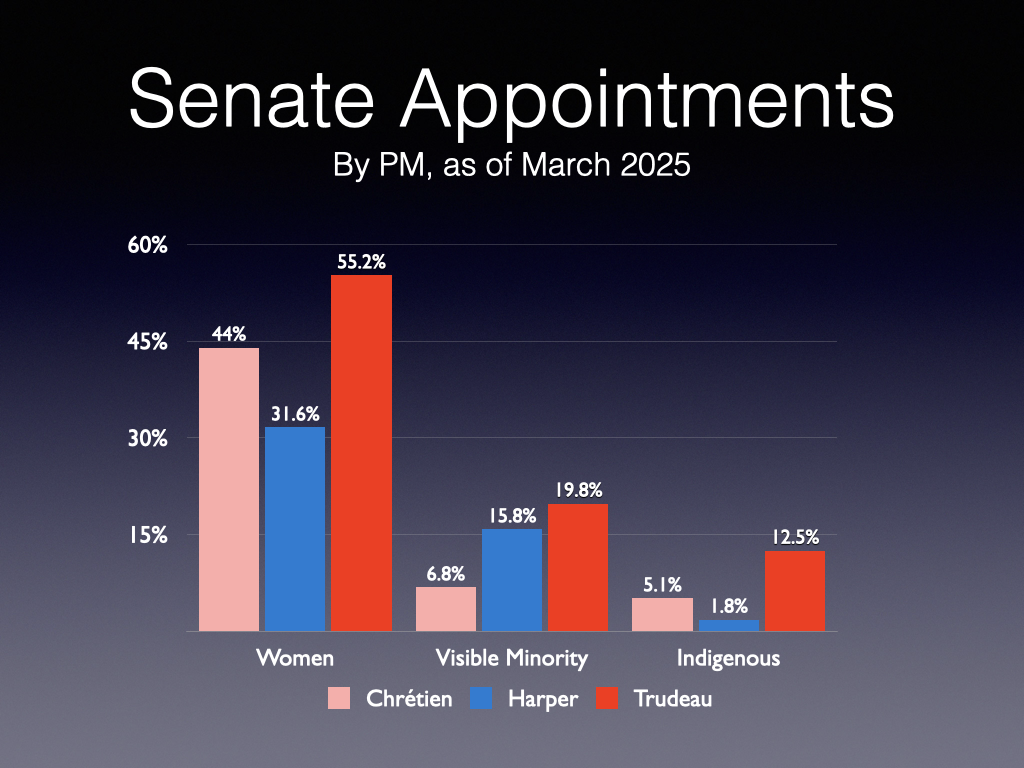
ICYMI: Trudeau radically overhauled the Senate — will Carney keep his reforms?

We shall see. Chart below contrasts Chrétien, Harper and Trudeau appointments:

…In an interview with CBC Radio’s The House, House leader Steve MacKinnon signalled there may indeed be more changes coming.

“I think the Senate is very much a work in progress,” he said.

“We continue to work constructively with the Senate in its current configuration and as it may evolve. I know many senators, the various groups in the Senate and others continue to offer some constructive thoughts on that.”

Asked if Carney will appoint Liberals, MacKinnon said the prime minister will name senators who are “attuned to the vagaries of public opinion, attuned to the wishes of Canadians and attuned to the agenda of the government as is reflected in the election results.”

Carney is interested in senators who “are broadly understanding of what the government’s trying to achieve,” MacKinnon said.

As to whether he’s heard about efforts to revive a Senate Liberal caucus, MacKinnon said: “I haven’t been part of any of those discussions.”

Alberta Sen. Paula Simons is a member of the Independent Senators Group, the largest in the chamber and one mostly composed of Trudeau appointees (she is one of them, appointed in 2018).

Simons said she knows the Conservatives would scrap Trudeau’s reforms at the first opportunity. What concerns her more are those Liberals who are also against the changes.

“There’s a fair bit of rumbling about standing up a Liberal caucus again. And I am unalterably opposed to that,” she said.

When the last Liberal caucus was disbanded, some of its members regrouped as the Progressive Senate Group, which now includes senators who were never Liberals.

“To unscramble that omelette, whether you’re a Liberal or a Conservative, I think would be a betrayal of everything that we’ve accomplished over the last decade,” Simons said.

“I think the Senate’s reputation has improved greatly as a result of these changes. I think the way we are able to improve legislation has also increased tenfold. It would be foolish and wasteful to reverse that.”

Still, she said there’s been pushback from some Trudeau appointees.

Senate debates are now longer, committee hearings feature more witnesses and there’s more amendments to legislation than ever before, she said.

Not to mention Independent senators can’t be whipped to vote a certain way. All of that makes the legislative process more difficult to navigate.

“Partisan Liberals don’t like the new independent Senate because they can’t control it as easily,” she said.

Marc Gold, Trudeau’s last government representative in the Senate who briefly served under Carney before retiring, said his advice to the new prime minister is to keep the Senate the way it is.

“The evolution of the Senate to a less partisan, complementary institution is a good thing. I think it’s a success, and I certainly hope that it continues,” Gold said….

Source: Trudeau radically overhauled the Senate — will Carney keep his reforms?

McWhorter: A Term So Outdated, Even President Trump Wouldn’t Use It

Good take:

On Sunday, President Trump, still on the ropes because of the controversy over the government’s Jeffrey Epstein files, ventured a distraction. With all the usual exclamation points and eccentric capitalization, he sounded the alarm on an issue a reader might have mistaken for a national crisis: the names of professional sports franchises. In particular those franchises that had cast off names that no longer felt culturally appropriate: the Washington Commanders, formerly the Redskins, and the Cleveland Guardians, formerly the Indians.

“The Washington ‘Whatever’s’ should IMMEDIATELY change their name back to the Washington Redskins Football Team. There is a big clamoring for this. Likewise, the Cleveland Indians, one of the six original baseball teams,” — by the way, it wasn’t — “with a storied past. Our great Indian people, in massive numbers, want this to happen. Their heritage and prestige is systematically being taken away from them.”

With typical subtlety, Trump concluded, “OWNERS, GET IT DONE!!!”

The controversy dates back more than a half-century. It was formalized in 1968, when the National Congress of American Indians embarked on a campaign to fight negative stereotypes of native people in American culture.

For a while, however, the evidence on the word “redskin” seemed equivocal. Polls by the Annenberg Public Policy Center, in 2004, and again by The Washington Post, in 2016, reported that a vast majority of actual Native Americans had no problem with the term. Was the whole thing just a politically correct tempest in a teapot, an effort to fix something that wasn’t actually a problem?

In 2020, a new poll was conducted. This one asked respondents for more finely grained responses and gave them more opportunity to consider their answers. The outcome was very different: Almost half of 1,000 Native Americans surveyed indeed found the term “redskin” to be offensive. Organized college athletics had long since forsworn team mascots that were based on caricatures of Indians. Amid the national climate of racial reckoning that George Floyd’s death and the Black Lives Matter movement brought on, the Washington football franchise announced it would change its name.

When Trump claims that “our great Indian people, in massive numbers, want this to happen,” there is no reason to wonder if he commissioned his own secret polling. But you don’t need a poll to understand why he’s wrong.

I doubt even Trump himself would be comfortable using that contested term to address a human being. Imagine him inviting a tribal leader to join him at some White House ceremony and introducing him as “my honored guest, a respected redskin.” At best, the term sounds like an artifact from some century-old stage play. To most ears, it simply sounds like a slur.

My grandmother was a laundress for a very wealthy white family, who would grant their staff a lovely week at their Maine island getaway every summer. Grandmom took us there with her for two summers in the mid-1970s. The white staff members there, while at least outwardly kind to my Black family, were acridly unfond of the local Native Americans. I had occasion to hear them late at night hissing about “those redskins.” That’s what we want as the name of a football team?

But even those who agree with me on that point might still quite reasonably ask what was wrong with “Cleveland Indians.” The term “Native American” may sound more respectful, but a vast majority of people who trace their ancestry to America’s tribal nations prefer being called Indians.

That might seem odd, given that “Indian” was a term imposed on them by Christopher Columbus when he mistakenly thought he had reached India. But it’s not that unusual.

As I wrote recently, quite a few Black Americans prefer “Black” over “African American,” despite the fact that “Black” was a term imposed on people with dark skin by people with light skin, and it sure wasn’t meant as a compliment. At the turn of the previous century, even educated Black people such as Sylvester Russell, an editorialist at the Indianapolis newspaper The Freeman, reportedly approved of the usage of “darkey.” In 1908 the doughty Black opera diva Sissieretta Jones asked, “Is there a soul so insensible that it cannot be stirred to the very depths by the heartbroken cry of the poor old homesick darkey?”

The problem with the Cleveland Indians isn’t “Indian.” The Cleveland Native Americans would be just as wrong. The problem isn’t the word choice; it’s the choice to use a human group as a mascot at all. Even if the members of that group are celebrated as brave warriors. No one today would be debating the merits of a team called the Boston Blacks or the New Jersey Negroes. How about the New York Jews or the Pittsburgh Polacks? Shifting to a more seemly Pittsburgh Poles would do nothing to solve the glaringly obvious problem. People are not pets.

Trump is right that the heritage and prestige of American Indians have been “systematically taken away from them,” but that is the work of the United States government, which pursued an explicit policy of dehumanization and dispossession and achieved it with horrifying success. Going back to antique stereotypes only continues the process.

Source: A Term So Outdated, Even President Trump Wouldn’t Use It

Before the cuts: a bureaucracy baseline from an employment equity lens 

As this article is behind the Hill Times paywall, am sharing this analysis on my blog (have added Indigenous hiring, separation and promotion tables):

Christopher Dummitt: Canada’s long-standing tradition of sweeping its British roots under the rug

Good reminder of the need for a broader historical understanding:

….Canadian schools got rid of the Lord’s prayer a generation ago. It didn’t fit with a modern diverse Canada. It has been replaced by land acknowledgments.

There was a time, not too long ago, when the school system didn’t operate this way — when Indigenous history and contemporary concerns were not a major focus. There has been a lot of progress to rethink how we approach the Canadian past.

But there’s also the Canadian tradition of turning a good thing into a stupid mess.

These young children know that they need to respect Indigenous cultures — and know that these cultures were sophisticated and fascinating. That’s what they’ve learned.

But what they don’t have are the lessons from an earlier time that would balance out this new appreciation. Instead, their lessons speak against an earlier way of thinking about the country. Without that earlier knowledge, what these kids are getting is the now off-balanced focus on reconciliation, relationships to the land, and inclusivity.

What they lack is the broader story of the settler societies that created Canada — about the dynamism of centuries of progress from the Scientific Revolution to the Enlightenment to the creation of modern forms of democracy, liberalism, and parliamentary institutions. Yet, this isn’t part of the elementary curriculum.

This isn’t the fault of any individual teacher (many of whom are wonderful).

It is, though, about the excesses of a cultural shift — well-intentioned — but also clueless as to its unintended consequences.

This Canada Day, perhaps it’s time to take a lot of the knowledge that’s baked into those pioneer villages dotted across the country and put it back into the curriculum.

Source: Christopher Dummitt: Canada’s long-standing tradition of sweeping its British roots under the rug

Dimitri Soudas: Quebec City’s foolish decision to erase history

Of note, Quebec’ history wars?

Last week, the mayor of Quebec City made a decision that should concern every Canadian who still believes that history matters.

A historic mosaic, installed at city hall, depicting the moment Samuel de Champlain meets a First Nations chief, is being removed. Why? Because, and I quote, it was deemed to be “offensive.” That’s it. That was the only criterion. One of the most important figures in the founding of Quebec — and, by extension, of Canada — is now considered too problematic to be shown to the public.

Let’s be honest: the mosaic depicts a painful truth. Yes, the Indigenous chief is shown in a posture of submission. Yes, it reflects the colonial lens through which history was often portrayed. But the role of history is not to make us comfortable. It is to show us what happened. The moment we begin to edit the past to make it easier to look at, we stop telling the truth, and we begin to create fiction.

Seventeen years ago, in 2008, I wrote the speech delivered by Prime Minister Stephen Harper for the 400th anniversary of the founding of Quebec City. It was one of the proudest moments of my life, because it was a moment of unity, between French and English, between past and present, between our country and the city that gave birth to it.

In that speech, Prime Minister Harper honoured our collective memory: “1608 is a historic date for you, for Quebec, and for all of Canada. Because it was beginning on July 3, 1608, exactly 400 years ago today, that we really started becoming what we are today.”…

Let that sink in. The very language, culture and political existence of modern Quebec, and of Canada, can be traced to the moment Champlain arrived and established a settlement on the shores of the St. Lawrence. And today, that very moment is being removed from the walls of the city he founded.

This is not reconciliation. This is revisionism. This is not respect. This is erasure.

We have a duty to teach our full history, including the injustices. Including the imbalances of power. Including the painful truths about colonization and its lasting effects on Indigenous peoples. But we cannot do so by pretending the past did not happen. We cannot do so by tearing down mosaics instead of building understanding.

When we erase history, what comes next? Language? Identity? Memory?

Source: Dimitri Soudas: Quebec City’s foolish decision to erase history

A Traveler Waits in the Stars for Those Willing to Learn How to Look

Interesting long read and a reminder that the constellations we know are not the only ones we see and recognize, in this case those of the Dene and Inuit:

…In the past, Dr. Cannon’s collaborators told him, only those curious enough to take their own participatory journeys, and have a personal relationship with the stars, were meant to find this out. Only then could people recognize that the Traveler they knew from childhood stories was in the stars overhead, an ancient cosmic guardian watching over the world to this day.

Among the culture bearers who contributed to the book, many agreed to help commit this intimate knowledge to paper because Dr. Cannon was approaching the subject in the traditional hands-on way. Others were motivated because they recognized that they were among the few remaining people in their subcultures or languages to hold this knowledge.

Then he found it, visible only on clearer nights, an obscure star Western astronomers call 27 Lyn.

It had taken him three and a half years.

But whose heart really was it? The more Dr. Cannon learned, the more he became convinced again that the Traveler and the man-animal constellation were the same across many Northern Dene cultures.

Eventually he posed the relationship again to Mr. Herbert, underlining his own deeper convictions and the work he had put in. This time, Mr. Herbert gave a yes: The Gwich’in Traveler figure and Yahdii were one and the same.

In the past, Dr. Cannon’s collaborators told him, only those curious enough to take their own participatory journeys, and have a personal relationship with the stars, were meant to find this out. Only then could people recognize that the Traveler they knew from childhood stories was in the stars overhead, an ancient cosmic guardian watching over the world to this day.

Among the culture bearers who contributed to the book, many agreed to help commit this intimate knowledge to paper because Dr. Cannon was approaching the subject in the traditional hands-on way. Others were motivated because they recognized that they were among the few remaining people in their subcultures or languages to hold this knowledge.

“I have not spoken about this in 20 years,” Mr. Engles told Dr. Cannon in an interview. “I’m just grateful for the opportunity to put back what my grandfather gave me.”

Looking up at the Milky Way in the night sky. Trees line the bottom of the frame.
The Milky Way, seen from central-interior Alaska.Credit…Chris Cannon

Dr. Cannon’s book aims to fill what he considers a yawning gap. Although every civilization experiences the night sky, thorough studies of how people conceptualize the cosmos have been attempted for fewer than 1 percent of human languages, Dr. Cannon estimates.

“I felt a sense that this is needed,” said John MacDonald, who conducted a survey of astronomy with Inuit Elders in the 1990s, and served as an academic reviewer for Dr. Cannon….

Source: A Traveler Waits in the Stars for Those Willing to Learn How to Look