Number of federal executives grew by 42% since 2015 under Trudeau Liberals

Not sure whether this reflects time-challenged journalist that simply report what an organization says, or whether this reflects synergies between Postmedia and right leaning organizations.

The percentage of executives in the public service is largely unchanged since 2015, the last year of the Harper government: 3 percent:

The Trudeau Liberals added thousands of executives to the ranks of Canada’s public servants since 2015, government documents reveal.

According to human resources statistics published online by the Treasury Board of Canada Secretariat, Canada currently employs 9,155 public servants in the executive categories, responsible for interpreting policy and managing government departments and agencies.

That’s up from the 6,340 executives recorded in 2015….

Source: Number of federal executives grew by 42% since 2015 under Trudeau Liberals

Biden-Harris Administration Approving Citizenship Applications at Fastest Rate in a Decade

Legitimate priority to ensure more timely processing of citizenship applications beyond the politics of doing so. In Canada, both liberal and conservative governments have done the same. Should be viewed positively in terms of government service delivery:

According to the Los Angeles Times, once in office, the Biden-Harris Administration immediately took steps to prioritize naturalization applications. U.S. Citizenship and Immigration Services (USCIS) hired more staff for processing applications, made it easier for immigrants to apply for free, and expanded its public relations efforts surrounding the naturalization process to reduce the flood of applications around election years.

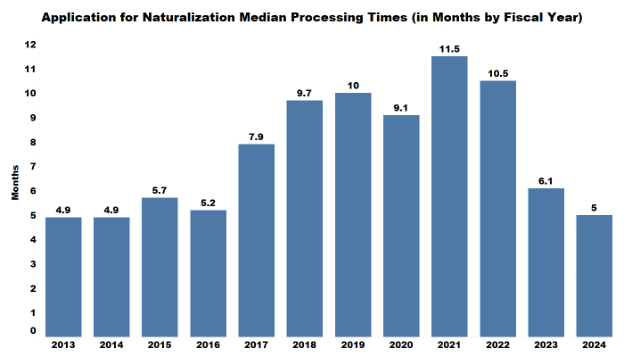
These efforts reduced the time it takes to process naturalization applications to an average of 5 months in FY 2024—half the processing time in FY 2021, its fastest rate in a decade. Processing times increased during the Trump Administration due to a surge in citizenship applications and slowed even more during the Covid-19 pandemic. With the changes made by the Biden-Harris Administration, however, processing times have returned to their lowest level in a decade.

The Biden-Harris Administration denies that the rush to approve citizenship applications is politically motivated. When asked about the rapid approvals of citizenship applications, a spokesman for the Department of Homeland Security said, the Department “does not take actions based on electoral politics or upcoming elections. Period.”

However, a recent poll of new citizens conducted by a coalition of open-borders groups showed that new citizens disproportionately identify as Democrats (43.3. percent) rather than Republicans (30.4 percent). The same poll found that a greater share of newly naturalized citizens would vote for Vice President Kamala Harris (53.6 percent) over former President Donald Trump (38.3 percent). The remaining 8 percent said they would vote for another candidate or not vote at all.

Indeed, 3.5 million new voters have the potential to change the outcome in elections, especially if they live in swing states. In 2020, President Biden won Arizona by about 10,457 votes and Georgia by 12,670 votes. He won Wisconsin by 20,682 votes and Nevada by 33,596 votes. In 2016, former President Trump won Michigan by 10,704 votes and Wisconsin by 22,748 votes. Trump won Pennsylvania by 44,280 votes and Arizona by 91,234 votes.

Last year (FY 2023) USCIS data show that a large number of naturalizations took place in California, New York, Texas, Florida, and New York. But naturalizations occur across the country on a regular basis, and USCIS is now approving citizenship applications at about the rate of 2,500 per day. It seems Americans will just have to wait until November 6 to see what impact this wave of new citizens has had on the election.

Source: Biden-Harris Administration Approving Citizenship Applications at Fastest Rate in a Decade

ICYMI LILLEY: Trudeau has broken every aspect of our immigration system

Sample of some of the language being used. While the lion’s share of the blame lies with the federal government, other levels of government, business and educational institutions are also complicit:

If it wasn’t clear already, this past week showed there isn’t a single facet of the immigration system the Liberals haven’t broken.

A man on a student visa was in court on terrorism charges, a TD bank report showed temporary workers are harming the economy, and the Trudeau government started talking about moving tens of thousands of asylum seekers across the country.

“We could open a hotel in any particular province and ship people there,” Immigration Minister Marc Miller said at the Liberal caucus retreat.

He was reacting to news that some premiers don’t want the federal government to ship thousands of asylum seekers their way from Ontario and Quebec. Rather than fix the problem, Miller and the rest of Trudeau’s team are trying to spread it around.

We’ve gone from a few thousand people showing up at airports and declaring asylum to a few thousand a month.

The problem is that the Trudeau government relaxed the visa requirements, in some cases waiving them. That has resulted in people who would otherwise be denied entrance to Canada being given permission to fly here and claim immediate asylum.

India is currently the top source country for people claiming asylum with more than 15,000 claims in the first six months of this year, claims from Mexico are at nearly 9,000. People coming here from India and Mexico, with rare exception, are not refugees, they are economic migrants abusing a system meant to protect people from persecution.

The Liberals could fix this problem by fixing the visa system, but they’d rather talk about building hotels, busing people across the country and be arguing with premiers than looking for solutions.

When it isn’t letting the visa system rot, we have questions about how well we vet people coming into the country.

On Friday, Muhammad Shahzeb Khan was in court on terrorism charges. Khan was arrested last week after the FBI uncovered a plot, they say would have seen Khan travel to Brooklyn, New York to carry out an attack on the Jewish community there.

Khan was living in the Toronto area for a little over a year but is a Pakistani national who was admitted to Canada in June 2023 on a student visa. The arrest came just five weeks after Ahmed Eldidi was arrested on terrorism charges with a plot allegedly targeting Toronto’s Jewish community.

Eldidi had come to Canada on a visitor’s visa in 2018, claimed refugee status a few months later and was granted Canadian citizenship in May 2024 just before he was arrested.

Prime Minister Justin Trudeau was asked about the strength of our vetting system during a news conference in Montreal. To listen to Trudeau, there are no problems with the system.

“First of all, this is an extraordinarily serious situation, and it highlights just how effective our security services and institutions are that we were able to interdict these, these very, very potentially devastating situations,” Trudeau said.

The arrests are one thing, but why are we not catching people before they enter the country. One of the charges against Eldidi is due to what police say was his participation in an ISIS terror and torture video in 2015.

Our asylum claims are off the charts, the visa system is broken, we can’t properly vet people coming into Canada and now a report from TD Bank that says the over reliance on temporary foreign workers is hurting the economy.

All of these problems have been created by the Trudeau Liberals and their mismanagement of the system.

Source: LILLEY: Trudeau has broken every aspect of our immigration system

ICYMI Mason: Immigrants are this country’s best friend. Don’t forget it

One of the counter narratives to the current critique of immigration levels (which I share). And of course the equally simplistic rationales used to justify increased levels of permanent residents, and uncontrolled growth of temporary residents, have also come home to roost:

According to a study in The Lancet, by 2050, 155 of 204 countries (75.9 per cent) measured (including Canada) will not have high enough fertility rates to sustain population size over time. This will increase to 97 per cent of these same countries by 2100. “The new fertility forecasts underscore the enormous challenges to economic growth in many middle- and high-income countries with a dwindling workforce, and the growing burden on health and social security systems of an aging population,” the report states. “These future trends in fertility rates and live births will completely reconfigure the global economy and the international balance of power, and will necessitate reorganizing societies.”…

This brings me back to Canada and our national debate around immigration. Blaming a “radical, out-of-control NDP-Liberal government,” for current immigration numbers – as Mr. Poilievre has done – is nothing more than cheap sloganeering that ignores the complexity of the problem.

Source: Mason: Immigrants are this country’s best friend. Don’t forget it


ICYMI: Nicolas | L’autoritarisme qui épuise

A lire:

Vendredi dernier, Gabor Maté, médecin canadien de renom et expert de l’impact du traumatisme sur la santé, a publié une lettre ouverte fascinante dans The Guardian : « Nous avons tous un nazi en nous. Nous devons comprendre les racines psychologiques de l’autoritarisme. » L’auteur de plusieurs succès de librairie internationaux est aussi un survivant de l’Holocauste : son titre retient l’attention.

Le texte est un condensé d’un des chapitres de son plus récent essai, The Myth of Normal: Trauma, Illness and Healing in a Toxic Culture. La lettre ouverte comme le chapitre nous offrent une comparaison des traits psychologiques de Donald Trump et d’Adolf Hitler. Maté nous parle de leur propension au mensonge, leur méfiance proche de la paranoïa, leur opportunisme crasse, leur penchant pour la cruauté, leur mégalomanie, leur impulsivité sans borne et leur mépris pour la faiblesse.

Ce qui est intéressant, c’est qu’au-delà de l’opinion, on s’appuie sur les dernières études en santé mentale pour voir dans ces traits les signes caractéristiques d’une enfance marquée par le trauma.

En s’appuyant sur l’expertise de plusieurs collègues, Gabor Maté nous apprend notamment que plus un enfant aura été exposé à un style parental autoritaire et punitif, plus il sera prompt à soutenir des options politiques autoritaristes et violentes une fois adulte. Particulièrement s’il n’est jamais passé par une psychothérapie — et s’il est un homme.

L’auteur nous indique aussi que l’amygdale, soit la région du cerveau responsable de la peur, a tendance à être plus grosse et plus active chez les gens qui sont plus à droite, qui sont attirés par des figures autoritaires « fortes » et qui affichent une méfiance marquée pour les étrangers et la différence. Et, bien sûr, le développement du cerveau est influencé par le contexte dans lequel un enfant évolue.

Si je peux résumer dans mes mots : un enfant qui a été méprisé et ridiculisé, voire violenté pour sa « faiblesse » et son besoin de protection, aura tendance, à moins d’une guérison, à se transformer en adulte qui méprise la vulnérabilité — la sienne et celle des autres — et à se protéger de toute forme d’humiliation future en devenant lui-même l’intimidateur en chef, ou en gravitant autour de leaders qui opèrent avec une vision du monde similaire.

Ce plongeon dans les écrits de Gabor Maté m’a aidée à écouter le débat présidentiel américain de mardi avec une attention particulièrement… « clinique ». Parce des notions de neurosciences peuvent certes nous aider à comprendre Donald Trump, son admiration pour des figures autoritaires comme Viktor Orbán ou Vladimir Poutine ainsi que son attrait pour sa base. Elles peuvent aussi nous donner des pistes pour mieux saisir ce qui se passe en nous-mêmes lorsque nous l’écoutons. Le mot-clé, ici, c’est une sensation d’épuisement.

Nous sommes plusieurs ces temps-ci à évoquer la « loi de Brandolini », soit l’idée qu’il est bien plus énergivore de réfuter des sottises que d’en débiter. Trump ment pratiquement par automatisme : il invente une réalité dont il est le héros, au fur et à mesure, pour éviter de faire face au réel. Répondre à ses mensonges suscite à la fois un épuisement, un dégoût, mais aussi une fascination — un mélange d’émotions qu’on pouvait d’ailleurs lire sur le visage de Kamala Harris mardi. Raconter que des immigrants dévorent les animaux de compagnie des Américains, par exemple : vraiment, il faut le faire. Toute personne saine d’esprit prendra un moment pour se demander comment c’est possible. Cette stupéfaction nous tirera de l’énergie.

L’univers de paranoïa dans lequel nous plonge le trumpisme, ainsi que les droites autoritaires de manière plus générale, est tout aussi énergivore. Si l’on croit fondamentalement que toute « faiblesse » est à refouler, mépriser, écraser et éliminer, on ne viendra jamais à bout de l’ennemi, puisque le monde ne cessera jamais de produire de la vulnérabilité et de la différence.

C’est une vision du monde qui explique le mépris des femmes — associées dans l’imaginaire à la sensibilité — et de leurs droits fondamentaux. Et on le sait, la suprématie blanche a aussi profondément marqué l’Amérique : si l’on tient à imaginer la majorité de l’humanité comme barbare, « sauvage », on se sent nécessairement constamment en danger, assiégé par la figure de l’étranger, de l’immigrant, du racisé.

Dans le mode de pensée autoritariste, on croit sincèrement qu’un leader « fort », c’est-à-dire violent envers un Autre qu’on imagine capable de ne comprendre que la violence punitive, est notre seul rempart contre le chaos et l’insécurité. On a là affaire à une lointaine descendance de la pensée politique de l’influent philosophe Thomas Hobbes, qui imaginait comme d’autres avant lui que « l’homme est un loup pour l’homme » dans « l’état de nature ». C’est un univers psychologique qui est profondément dangereux pour ceux qui en font les frais, mais aussi angoissant pour ceux qui y adhèrent.

On aura tellement dit de choses sur Donald Trump depuis 2016. Mais je crois qu’on sous-estime encore comment son existence publique agit comme un vortex énergivore de classe mondiale. Nous sommes nombreux à avoir côtoyé dans nos vies personnelles des personnes blessées, restées émotionnellement immatures, et qui ne guérissent pas. Dans les cas extrêmes, elles deviennent des trous noirs d’attention qui absorbent les forces vitales de leur environnement et qui nous enferment dans la gestion de leur volatilité. Mais lorsque ce type de profil est celui de l’un des hommes les plus puissants du monde, c’est la planète qui risque de voir son niveau d’échanges rabaissé à celui de ce tyran et de ses sautes d’humeur.

Mardi soir, 90 minutes de télévision nous ont réexposés à un homme qui affiche une peur morbide de grands pans du réel, et qui se défend en niant le réel par le mensonge ou en promettant d’écraser le réel par la violence politique. Si 90 minutes suffisent à générer un profond sentiment d’épuisement, je n’ose pas imaginer quatre autres.

Source:  Chronique | L’autoritarisme qui épuise

Urback: A hard diversity quota for medical-school admissions is a terrible, counterproductive idea

Lot’s of (negative) commentary on the latest TMU initiative.

…All of this is in service to a genuinely noble goal. But the school’s execution – it’s practically boasting of its lax admission requirements – is clumsy, short-sighted and does a disservice to its own prospective students. The unintended consequences are obvious: Canadian patients will start Googling their physician’s educational background and wonder if the resident doctor performing their next procedure was one of the TMU students who got into med school with an art-history degree, a 3.3 GPA and a compelling personal essay. Indeed, the school’s quota system will inevitably condemn all of its graduates to public skepticism about their qualifications and capabilities, even if the physicians TMU produces are in fact very capable, qualified and skilled. It’s a bias of the school’s own making that it will have to fight to counter, and probably lose anyway….

Source: A hard diversity quota for medical-school admissions is a terrible, counterproductive idea

What is striking about most of the similar commentary I have seen, is that most do not look at what the data says about med school diversity. Earlier and the most recent study I found show largely an issue for Blacks and Indigenous; Chinese and South Asians are over-represented, whites under-represented.The latest analysis of diversity among medical students (English universities) that I found shows that:

A total of 1388 students responded to the survey, representing a response rate of 16.6%. Most respondents identified as women (63.1%) and were born after 1989 (82.1%). Respondents were less likely, compared to the Canadian Census population, to identify as black (1.7% vs 6.4%) (P < 0.001) or Aboriginal (3.5% vs. 7.4%) (P < 0.001), and have grown up in a rural area (6.4% vs. 18.7%) (P < 0.001). Respondents had higher socioeconomic status, indicated by parental education (29.0% of respondents’ parents had a master’s or doctoral degree, compared to 6.6% of Canadians aged 45–64), occupation (59.7% of respondents’ parents were high-level managers or professionals, compared to 19.2% of Canadians aged 45–64), and income (62.9% of respondents grew up in households with income >$100,000/year, compared to 32.4% of Canadians). [2016 census]

Source: Demographic and socioeconomic characteristics of Canadian medical students: a cross-sectional study

McWhorter: Ta-Nehisi Coates and the Myth of Black Fragility

Of note (McWhorter continues his contrarian views to mainstream discussion):

…That’s as it should be. Acting as though Black people can’t hold their own in a challenging discussion — as though they can’t speak up for themselves and therefore need others to speak up for them — isn’t antiracist, it’s demeaning. Blackness is not weakness. We need to stop coddling sane, self-sufficient Black people — like Coates — and move on.

Source: McWhorter: Ta-Nehisi Coates and the Myth of Black Fragility

Québec a dépensé 865 millions en cinq ans pour les étudiants français

Of note. Other countries also benefit from lower fees are listed in this Quebec government table:

Année après année, le contingent le plus nombreux d’étudiants étrangers arrive de France. Puisque ceux-ci paient les frais les moins élevés parmi les étudiants venus d’ailleurs, c’est Québec qui ramasse la facture : en cinq ans, 865 millions de dollars sont sortis des coffres de l’État pour eux. Les experts remettent néanmoins peu en question les ententes bilatérales qui établissent ce traitement de faveur, vu tantôt comme une politique d’immigration, tantôt comme une grâce diplomatique.

Entre 2019 et 2024, les Français ont formé autour du tiers des étudiants étrangers dans les cégeps et les universités du Québec, sauf en 2020, quand ils ont été surpassés par les Indiens. Les ententes avec la France ne datent pas d’hier : celle qui les exempte de droits de scolarité supplémentaires dans les cégeps a été signée en 1978 et n’a pas été renégociée depuis.

Les tarifs préférentiels ont été reconduits pour les étudiants universitaires en avril dernier. Les Français continuent de payer environ 9000 $ par année au premier cycle universitaire, contre un minimum de 20 000 $ pour les étudiants d’autres nationalités, et les mêmes droits de scolarité que les Québécois à la maîtrise et au doctorat.

Le ministère de l’Enseignement supérieur indique au Devoir que la « subvention nette » aux étudiants français se chiffrait à 187 millions en 2023-2024, et à entre 146 et 186 millions pour les années précédentes : ce qui donne un total de 865 millions depuis 2019. Mais l’on ne sait pas quel montant reviendrait dans les coffres sans les ententes bilatérales, car personne à Québec n’est en mesure de chiffrer précisément combien cette faveur coûte réellement au gouvernement….

Source: Québec a dépensé 865 millions en cinq ans pour les étudiants français

In Memory: Yehuda Bauer (6 April 1926-18 October 2024) 

Impressive man and had the pleasure of having a number of conversations with him when I headed the Canadian delegation to the International Holocaust Remembrance Alliance:

…Yehuda Bauer was born in Prague in 1926 and in 1939 immigrated with his parents to Palestine. In 1960, Bauer received a Doctor of Philosophy degree from the Hebrew University for his dissertation on the Haganah and the Palmach. He began his academic career a year later at the Institute of Contemporary Judaism at the Hebrew University. Between the years 1973-1975 and 1979-1977 he served as the head of the Institute for Contemporary Judaism and in the years. Bauer also founded and headed the Vidal Sasson International Center for the Study of Anti-Semitism at the Hebrew University. Between 1996-2000, Professor Bauer was the head of the International Institute for the Study of the Holocaust at Yad Vashem. He also served on the Yad Vashem Council and was an academic advisor to the International Task Force for Holocaust Education, Remembrance and Research (IHRA).

Source: In Memory: Yehuda Bauer (6 April 1926-18 October 2024) 

Immigration is key to ensuring the vitality of French in Canada 

A reminder that immigration has more than economic objectives although legitimate debate regarding impact on skill levels and expected economic outcomes and impact on productivity:

Francophone immigrants, many of whom are “young, gifted and Black,” are les forces de l’avenir that will ensure the future of French outside Quebec – a future that reverberates with the splendour of French with intonations of Franglais, Lingala, Wolof, Arabic and all other tongues of our shared reality.

Francophone immigrants are not just rebuilding our declining demographics; they are reweaving the tapestry of our Francophonie. What is “top talent,” after all, if not the people who rebuild a culture?

Source: Immigration is key to ensuring the vitality of French in Canada