David: L’aide fédérale à mourir [immigration impact]

Of note. Quebec and rest of Canada’s widely diverging immigration levels, and the ongoing diminution of Quebec’s share of the Canadian population:

Quoi qu’il en ait dit, le ministre de la Langue française, également responsable de la Francophonie canadienne, Jean-François Roberge, n’a pas dû être surpris de constater que le nouveau plan d’action pour les langues officielles du gouvernement Trudeau prévoit de consacrer 137,5 millions de dollars à la communauté anglo-québécoise, mais pratiquement rien à la protection du français au Québec.

Depuis son adoption en 1969, la Loi sur les langues officielles repose sur le principe erroné d’une symétrie entre la situation des francophones hors Québec et celle des anglophones au Québec. Après avoir défendu cette vision hypocrite pendant plus d’un demi-siècle, Ottawa a finalement admis qu’il n’en est rien, mais cela ne change pas grand-chose en pratique.

Même s’ils sont minoritaires au Québec, on persiste à traiter les anglophones comme une espèce menacée, alors qu’ils font partie d’une majorité écrasante au Canada et en Amérique du Nord.

Les députés libéraux anglophones du Québec qui se sont indignés de voir que la nouvelle mouture (C-13) de la loi fait référence à la Charte de la langue française, toujours présentée comme un monument d’iniquité, ont voulu s’assurer que cela demeure ainsi.

Jean-François Roberge, qui ne manque pas d’humour, a expliqué que son gouvernement ne comptait pas sur Ottawa pour sauver le français au Québec. « Par contre, on s’attend à ce qu’il ne nuise pas », a-t-il ajouté.
• • • • •
Il est vrai qu’en acceptant d’harmoniser les dispositions de la Loi sur les langues officielles régissant les entreprises sous autorité fédérale avec celles de la loi 101, le gouvernement Trudeau a fait preuve de bonne volonté.

Les meilleures intentions du monde ne pourraient malheureusement pas inverser une dynamique démographique qui conduit inexorablement à une diminution accélérée de la proportion de francophones dans l’ensemble du pays au Canada, y compris au Québec.

Qu’on le veuille ou non, toute contribution fédérale à la valorisation de l’anglais au Québec ne peut que renforcer l’attraction qu’il exerce chez les immigrants, qu’on a déjà du mal à convaincre de s’intégrer à la majorité francophone.

M. Roberge, qui s’affaire à son propre plan d’action, qui doit être présenté à l’automne, suggère que l’argent destiné aux groupes qui font la promotion de l’anglais soit consacré à la francisation. Cette proposition risque d’être accueillie assez froidement par ceux qui trouvent que la loi 96 est déjà trop exigeante, notamment en ce qui concerne la francisation des entreprises.

Sans grande surprise, le Parti libéral du Québec semble prêt à se porter au secours de la communauté anglophone. Jeudi, à l’Assemblée nationale, il a empêché la mise aux voix d’une motion présentée par le Parti québécois, qui dénonçait l’importance des sommes qui lui sont destinées, par rapport à ce qui est prévu pour la protection du français, alors qu’elle bénéficie d’un réseau d’institutions qui garantissent amplement sa vitalité.
• • • • •
Si le Québec est resté sur sa faim, les communautés francophones hors Québec ont généralement bien accueilli le plan d’action fédéral, notamment les 221 millions qui serviront à stimuler l’immigration francophone.

On ne peut que souhaiter voir arriver des renforts qui les appuieront dans leur lutte pour préserver leur identité, mais une certaine perplexité est de mise. Depuis 20 ans, on a atteint une seule fois l’objectif d’une immigration francophone représentant 4,4 % de l’ensemble des nouveaux arrivants hors Québec.

La Fédération des communautés francophones et acadienne (FCFA) estime qu’il faudrait atteindre le chiffre de 12 % dès l’an prochain et de 20 % en 2036 simplement pour revenir au niveau de 2001. Or, le plan d’action ne propose ni objectif précis ni échéancier.

Simplement empêcher la proportion de francophones de continuer à chuter sera encore plus difficile si le gouvernement Trudeau ouvre les vannes de l’immigration pour faire en sorte que le Canada compte 100 millions d’habitants en 2100, comme le suggère l’influent groupe « L’initiative du siècle ».

Le gouvernement Legault annoncera vraisemblablement à la fin de l’été son intention de hausser les seuils d’immigration pour les prochaines années, mais ceux-ci devront inclure une plus grande proportion de francophones.

Il faudra cependant les trouver quelque part, et l’expérience enseigne que ce n’est pas si facile. Ceux qui viendront au Québec n’iront pas grossir les rangs des communautés francophones ailleurs au pays, et vice-versa.

En réalité, face à un mal incurable, le plan d’action fédéral ressemble davantage à un programme d’aide à mourir dans la dignité, dont les Québécois devront bien se demander s’ils veulent vraiment s’en prévaloir.

Source: L’aide fédérale à mourir
U.S. asks Canada to reimpose visa requirements for Mexico to stem surge of crossings at northern border

Request was bound to happen:

The Biden administration has been asking Ottawa to consider reimposing visa requirements for Mexican nationals visiting Canada, CBC News has learned.

At issue is the sharp increase in illegal crossings from Canada into the United States: Mexicans don’t need a visa to travel to Canada, while the U.S. requires a visa for Mexicans to enter. American border officials say some Mexican nationals are using Canada’s visa-free rule to fly into the country and then cross south illegally into America.

The Conservative government under Stephen Harper created a visa requirement in 2009 for Mexicans to stem the flow of asylum claims from Mexico. The Trudeau government relaxed it in 2016.

Source: U.S. asks Canada to reimpose visa requirements for Mexico to stem surge of crossings at northern border

Palme McGuinness: Australia not immune to immigration anxiety, but we have no need to worry

Another interesting article from Australia with some similar issues and some similar optimism (although tatters may be too strong a term for Canada but some may not agree). And Canada would benefit from an independent review or commission to review the objectives and their implementation:

Fashion, ideology and political expedience have left Australia’s immigration system in tatters. Now, finally, we have a solid review of the immigration system, embraced by responsible minister Clare O’Neil. There are still details left to be finessed, but implementing the principles of the Martin Parkinson-led review will be the hard reset our visa system needs.

Not before time. Immigration anxiety is escalating around the world as countries struggle to manage the inflows of refugees and economic migrants keen to share the protection and opportunities of liberal democracy. The European Union is bickering over who should take the migrants that keep coming and who should pay. Italy, an immigration inflow frontier, elected a prime minister tasked with firming its borders. Britain brexited the discussion at great cost to its economy. In the US, migrants walking over the border are bussed around to make a political point. Immigration anxiety has moved more elections than climate anxiety.

Australia, protected by its geography, has been spared much of this. But not all. We have many problems of our own making that feed into what the Transatlantic Council on Migration identifies as the key drivers of immigration anxiety.

Our anxiety in this area, the Council finds, is caused by common factors, including some we’re facing in Australia right here, right now.

One of these is a sudden large flow of immigrants – and Australia is expecting at least 650,000 over two years. Another is the perception that new arrivals will compete with the existing population for scarce resources and opportunities – such as housing, medical care, welfare, and jobs. And then there’s the level of trust in the ability of policymakers to control inflows and deliver successful integration policies. Australia has scraped by, though fissures regularly appear on asylum seeker policy and integration. But our infrastructure, housing and services are groaning at a time when immigration is about to spike.

In the circumstances, we needed the Parkinson review a couple of decades ago. But since we have it now, now will have to do.

The review won’t build the new houses, roads or hospitals we already needed yesterday. But it might just be able to help us agree on how we can become a better nation, with the help of the people that business and the care sector need today.

That is perhaps the most important part of this review. It starts out by stating the purpose of our immigration system. Because, as the review panel writes, “clear objectives are part of the story Australians tell about why the country is taking certain action” and “when that story is lost sight of or stops being told, trust and confidence is weakened”.

The purpose laid out in the review might be expressed in modern language, but goes back to the core principles of what makes nations strong and citizens confident of their collective sovereignty.

The first principle is that immigration should build Australia’s prosperity. This should be a no-brainer, but as usual somehow partisan politics from the left and the right got in the way. So let’s say it straight: bringing in clever people adds bodies, yes, but it also raises the national IQ. Smart people generate ideas, create businesses, or win overseas business for Australian companies, which creates more jobs right here onshore. Keeping an eye on national prosperity doesn’t mean forgoing humanitarian intake (sometimes doing the right thing is just the right thing to do), but it means evaluating the overall effect of the combined intake against one very important objective: that we all benefit. This is why recent migrants are sometimes not wild about untargeted new intakes. They want to know that the country they’ve invested themselves in is going to get richer and better.

The next is enabling fair labour markets. This principle has had some less than savoury incarnations, including the White Australia policy, which limited immigration from non-European countries. Along with a large dollop of racism, the purpose of the Restricted Immigration Act of 1901 was to keep out people who would work for lower wages. It is a considerable improvement that we can now say our immigration system is designed to protect people in our society who need lower paid jobs as a step into the labour market and dispense with the racist excuse.

The review also, refreshingly, prioritises “building a community of Australians”. It recognises the importance of giving migrants the ability to set down roots and become Australian. One of the most corrosive ideas in immigration here and abroad has been the notion that a country is acting in its best interests when it treats migrants who want to stay as temporary, or guest workers. If decency doesn’t tell you people who spend their productive years in a country might find that they and their children have built a life there, not just a career, then international experience can.

Guest worker programs, like the Turkish workers Germany brought in after WWII to rebuild bombed out cities, lead to parallel societies. The children of the guest workers still wanted to stay, but spoke poor German and felt no sense of belonging. Guests don’t, to return to the housing shortage, build new accommodation for themselves and their kin. Terms like “assimilation” have gone out of style, but the review emphasises the importance of “democratic resilience and social cohesion” – a nation in which nationality is a bond is stronger and happier.

Finally, and I have to say I like this as much as the other principles which underpin the review, it puts an Orwellian caveat on all the above: break any of these rules rather than be outright barbarous. Some of the migrants we want, want to be temporary. We have to be OK with that too.

A hard reset to principle and purpose is what our immigration system desperately needs. Like all the best policy work, once it’s clearly articulated it seems just to state the bleeding obvious.

Parnell Palme McGuinness is managing director strategy and policy at strategic communications firm Agenda C. The company was engaged to work for a Liberal Party MP during the federal election. She has also worked for the German Greens.

Source: Australia not immune to immigration anxiety, but we have no need to worry

Bouchard: D’où viennent nos valeurs?

Always interesting to read Bouchard’s analysis and this is a particularly strong response to Premier Legault’s tweet stressing the Catholic heritage:

Le tweet de M. Legault début avril nous invite à nous interroger sur l’origine des valeurs prédominantes dans notre société. Quelles en sont les racines dans notre histoire ? Deux thèses se présentent, l’une privilégiant la religion catholique, l’autre, la culture populaire.

Le catholicisme

Une première difficulté posée par cette thèse, c’est qu’elle est contredite de plusieurs façons par l’histoire. Le catholicisme prêchait l’austérité, la soumission, la quête de spiritualité, la chasteté. Ce sont là, on en conviendra, des valeurs qui s’accordent mal avec l’esprit du temps présent. Mais l’Église enseignait aussi la liberté, l’entraide, la solidarité, l’éthique du travail. À première vue, on est ici en terrain plus sûr.

Ce n’est pas le cas : nos valeurs ont émergé malgré l’opposition de l’Église. Nous accordons une large place à la démocratie et à l’éducation. Sur ces deux points, le dossier de l’Église est en souffrance. L’autorité venait d’en haut et on ne croyait pas nécessaire de prolonger l’éducation du peuple au-delà du secondaire et même du primaire. L’Église a longtemps combattu les projets d’instruction obligatoire et gratuite jusqu’à 14 ans.

L’égalité sociale, qui nous est chère, s’est longtemps heurtée à la vision hiérarchique de la société professée par l’Église. Le statut de chacun était fixé par la Providence. L’Église s’est opposée aussi à l’émancipation de la femme (travail salarié, autonomie juridique, droit de vote, contraception…). Enfin, nos élites laïques ont fortement encouragé l’entrepreneuriat et l’insertion d’une élite francophone dans le domaine des affaires. Encore là, il y avait incompatibilité. L’Église avait envers l’industrialisation une tradition de méfiance, et même d’opposition.

Quant à la liberté, confrontée à une moralité tatillonne et à la pratique de la censure, elle a eu fort à faire jusqu’à la fin des années 1950. L’Église était aussi loin du compte en matière d’ouverture à l’autre. Elle prêchait l’antisémitisme, était hostile aux autres religions, interdisait les mariages mixtes au nom de la race pure et a longtemps fait preuve de racisme envers les Autochtones. Elle a par ailleurs beaucoup tardé à composer avec la modernité, le changement, le progrès, les droits de la personne. L’État-providence, avec ses politiques sociales généreuses, fut l’une des grandes réalisations de la Révolution tranquille. Une bonne partie du haut clergé a vu d’un mauvais oeil cette initiative de l’État.

Pendant longtemps, l’émancipation économique, sociale et politique des Canadiens français a compté parmi les objectifs principaux de notre nation. L’émancipation, c’est-à-dire la levée des contraintes imposées par le colonialisme anglophone. Or, à des moments clés de notre histoire, l’Église s’est mise au service du colonisateur contre les Canadiens français — pensons à la Conquête, aux rébellions de 1837-1838, aux deux crises de la conscription.

Voici une autre difficulté. Des catholiques de renom comme Jean Hamelin, Pierre Vadeboncoeur et Fernand Dumont ont soutenu que la foi de nos ancêtres était très superficielle. Ils y ont vu la conséquence d’une pastorale autoritaire trop centrée sur le rituel et la routine, qui ne tenait que par la « coutume ». Sous l’effet des nouvelles coutumes introduites dans les années 1945-1960, l’ancienne serait disparue. Fernand Dumont : « On s’est débarrassé de la religion comme d’un vieil appareil de radio qu’on jette pour acheter une télévision. » Comment imaginer que les fidèles, ces « robot[s] télécommandé[s] », « ces chrétiens sans anticorps » (J. Hamelin) aient pu être profondément imprégnés des valeurs en cause ici ? F. Dumont encore, dans une conférence de 2003, reprochait à l’Église d’avoir failli à faire passer dans la culture civique les valeurs du christianisme.

Enfin, le Québec est une petite nation minoritaire qui est née et a grandi sous deux colonialismes et qui s’est toujours inquiétée de sa survie. C’est plus qu’il n’en fallait pour inspirer des réflexes d’autoprotection qui font d’abord appel à la solidarité.

La thèse de la culture populaire

Il est plus vraisemblable que nos valeurs soient nées dans la culture populaire. L’héritage de valeurs comme la solidarité, le travail, l’esprit communautaire et la liberté peut en effet être rattaché à une tout autre expérience que la religion catholique. Cette thèse comporte deux volets.

Il y a d’abord notre passé lié au défrichement. Nos ancêtres lointains étaient des défricheurs. Ils ont façonné le territoire originel et ont édifié une société. Après la mise en valeur de la vallée du Saint-Laurent, ce travail s’est poursuivi jusque dans les années 1940 dans les espaces péri-laurentiens, où, en un siècle, une quinzaine de régions ont été fondées. Nous avons été longtemps un peuple de défricheurs.

Or l’expérience des défrichements inculquait profondément le goût de la liberté. Elle faisait appel aussi à l’éthique du travail, à l’esprit d’entreprise (les colons, isolés, étaient laissés à eux-mêmes). S’ajoutait à cela, par nécessité, la solidarité communautaire, dans un contexte de vide institutionnel où la survie était un défi constant.

Le deuxième volet, c’est celui du travail industriel. La culture robuste née de l’expérience pluriséculaire des défrichements s’est ensuite transmise dans le cours de l’urbanisation. Car les Canadiens français étaient aussi un peuple de lutteurs, cette fois dans la sphère du travail. L’historien Jacques Rouillard a bien montré la vigueur et l’ampleur des luttes ouvrières menées depuis longtemps au sein du syndicalisme, sans compter la fréquence et la dureté des conflits là où il n’existait pas de syndicats.

On connaît les valeurs forgées dans ces luttes : équité, égalité, solidarité, émancipation sociale, entre autres. Or, elles résultaient de pratiques conflictuelles, souvent agressives, que le clergé, en grande partie, a longtemps condamnées, s’employant plutôt à diffuser l’idée que le patron devait être traité comme un père par ses employés.

On voit que l’origine de nos valeurs reste une question complexe. Mais on voit bien aussi que, sur des points essentiels, elles ont pris le contre-pied de l’héritage de l’Église plutôt que de s’en nourrir.

Source: D’où viennent nos valeurs?

Australia: Uncapping work hours forged ‘Ponzi scheme’ in student visas

Uncapping student work hours, as the Canadian government recently did, will likely generate further abuse by education agents and immigration consultants:

The Morrison government’s allowing people on student visas to work unlimited hours created a ‘Ponzi scheme’ that was exploited ruthlessly by some education agents, an international education conference was told on 19 April, writes Julie Hare for AFR .

The move also heaped pressure on the Department of Home Affairs, which is trying to process a backlog of one million visas, with the more complicated ones linked to questionable applications being shunted to the back of the queue, said Labor backbencher Julian Hill. Speaking at an international education conference, Hill said it was clear the Morrison government’s decision to uncap work hours was irresponsible because it “distorted student choice and corrupted the market”.

Phil Honeywood, chief executive of the International Education Association of Australia, described the uncapping of work hours as creating a ‘Ponzi scheme’ in student visas. Before the removal of caps, international students were restricted to working 40 hours a fortnight.

Source: Uncapping work hours forged ‘Ponzi scheme’ in student visas

Australia/New Zealand agreement: Citizenship celebration turns sour in record time

Always interesting to see the reactions when a long-standing irritant is resolved, provoking in the smaller country:

For 22 years, media stories regularly bemoaned Kiwis treated as second class citizens across the ditch. This week, the problem finally got resolved, only for coverage to turn to fears of a ‘Great Exodus’ within hours.​

In November last year 1News correspondent Andrew MacFarlane asked Australian home affairs minister Clare O’Neill why her government was treating New Zealanders as “second-class citizens”.

“That’s a really good question and that’s something that’s been bothering me for a long time,” she said.

Her frank concession came after years of reports about the perilous legal status of New Zealanders living long-term across the ditch.

They have been denied disability payments, jobseeker support and student loan services in Australia since the introduction of a 2001 law limiting their pathways to citizenship.

That has resulted in hardship and complaints about unequal treatment.

Back in 2011, Kiwis living in Australia were denied government assistance after being caught up in the Queensland floods.

Stuff story at the time picked up on the plight of Jayde Fuli, who was facing financial ruin due to a lack of assistance from the Australian government.

In 2014, Stuff reported on a sick toddler who was denied healthcare in Australia because his parents were Kiwis, despite him having never set foot in New Zealand.

It also published an investigation on what it called discrimination across the ditch in 2018, highlighting the case of a woman who fell into depression and drug addiction after being unable to access support following the death of her child.

This coverage has been matched in other media, which have consistently called out the Australian government for collecting New Zealanders’ taxes but failing to offer them the same rights as other citizens.

Given that, prime minister Chris Hipkins was probably expecting a glowing reception and a run of good press when he stepped up to a media scrum last weekend to announce a new citizenship pathway for Kiwis living in the lucky country.

“It is a very significant day for the trans-Tasman relationship, a very positive day for the relationship between New Zealand and Australia,” he said.

There was some positive coverage for the move on the front pages of the Weekend Herald, The Press and The Dominion Post.

But as it turns out, putting an end to a 22-year problem only wins you about six hours of good headlines.

By early Saturday afternoon, a less celebratory angle was starting to cut through on the websites of our major news organisations.

Both the Herald and Stuff ran stories about a potential “exodus” of New Zealand workers to Australia following the citizenship change.

Those worries amped up the following day.

The Sunday Star-Times carried two profiles of New Zealanders packing their bags and moving across the ditch.

Its editor Tracy Watkins accompanied those with a stinging editorial about the “big fish hook” in the Australia citizenship deal, which ended: “Will the last one to leave please turn off the lights?”.

On Wednesday TVNZ’s Seven Sharp joined the chorus warning that Australia is stealing our workers, just like they did with our best horse and our sweet treats.

“We’re used to Australia taking things from us: Phar Lapp, pav, Crowded House, and don’t forget lamingtons,” said presenter Jeremy Wells.

“Well it turns out they’re at it again: this time it’s Aussie employers trying to poach hard-working Kiwis,” added Hilary Barry.

That may have been a bit tongue in cheek, and Seven Sharp’s story delivered a useful comparison of the wages and conditions workers can expect in New Zealand and Australia.

In The New Zealand Herald commentator Richard Prebble was less constrained by facts, figures, or indeed reality, writing that New Zealand is “becoming a third-world country”, and Australia is only changing its citizenship rules to “strip this country of our best”.

The overarching theme of the coverage was that getting a better deal in Australia might leave some New Zealanders with little reason to stay here, and the rest of us worse off as a result.

There’s one small problem with that assertion: it doesn’t appear to have much – if any – real data underpinning it.

The economist Shamubeel Eaqub noted emigration to Australia peaked in 2013, and has since dropped off.

Infometrics chief executive Brad Olsen told AM a pathway to citizenship probably won’t be the biggest draw for New Zealanders thinking of heading across the Tasman.

“I don’t know if it moves the dial considerably on Kiwis wanting to move over to Australia. There are already a lot of reasons why people have been considering doing so.” he said.

At the least it’s too early to say whether there is – in Stuff’s words – a Great Exodus underway.

Other commentators criticised the negativity of the coverage.

The media isn’t a behemoth with a unified perspective, but politicians and news audiences could be tempted to feel like they’ve been the victim of a bait and switch after seeing 20 years of stories highlighting a pressing human rights issue, only to immediately see lines like about the government being “played like a didgeridoo” when it gets resolved.

At Newstalk ZB, afternoon host Heather du Plessis said she couldn’t get behind the backlash.

“There are a bunch of commentators who are seeing negative in Australia’s immigration announcement. I totally disagree with them. This is one of the most positive and significant changes for New Zealand in the ANZAC relationship. I don’t believe it’s going to lead to a significant brain drain. That brain drain’s already happening,” she said.

In The Guardian, commentator and former Stuff political reporter Henry Cooke took aim at those trying to paint the deal as a bad thing, saying their arguments “do New Zealand a disservice”.

He said people should focus on making New Zealand better for workers, rather than making sure Australia is worse.

“The answer to this challenge shouldn’t be just trying to build the walls up higher or guilt Kiwis into staying. It should be making New Zealand as good a place to live as Australia with comparable (or better) incomes and working conditions,” he wrote.

Cooke noted that Australia consistently pays out a higher proportion of its GDP in wages.

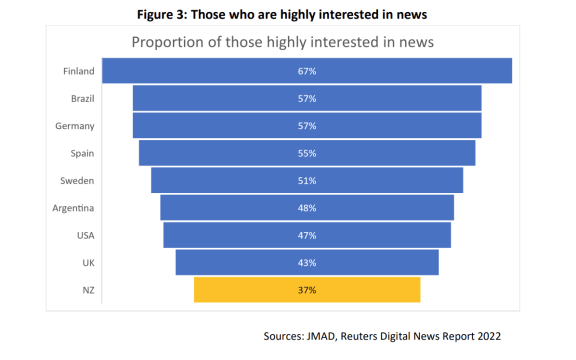
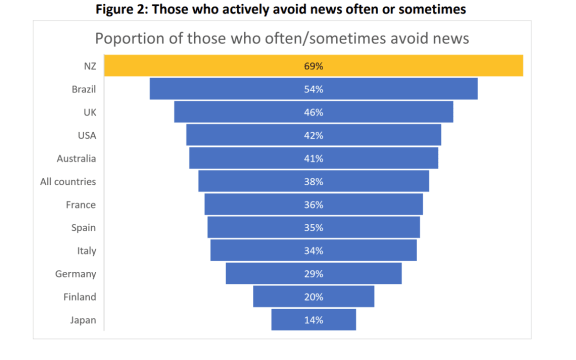
Figures produced by AUT's 2023 survey on trust in media.

Figures produced by AUT’s 2023 survey on trust in media. Photo: AUT

But analysis of why that is – and how to put New Zealand on par – has been limited, and the media bemoaning the trans-Tasman wage discrepancy might have done more to look at what’s actually behind it.

For instance, Australia has better productivity than New Zealand’s, lower taxes on low and middle income workers, a higher minimum wage, and a longstanding Modern Awards System similar to the Fair Pay Agreements legislation recently introduced here.

A deep dive into those topics might have been more useful than articles on whether we got played by making sure sick and otherwise out-of-luck New Zealanders can access support from the Australian government.

Maybe the quick turn toward pessimism was predictable.

Negativity bias in the news is an extensively studied phenomenon.

It’s pervasive, and not only in stories on Australian citizenship. For instance, this story isn’t focusing on the hundreds of worthy and informative stories published by the New Zealand media this week, and is instead honing in on a criticism of some coverage.

Even if – in the words of one 2001 review paper – “bad is stronger than good”, that bias comes at a cost.

A recent trust in media survey by AUT produced a startling finding: New Zealanders are world-leaders in tuning out the news, with 69 percent of respondents saying they actively avoid it at least some of the time, and just 37 percent of us taking high interest in what’s being reported.

When asked why they were switching off, a common response was that the coverage is depressing and divisive.

The potential for an increase in people moving to Australia is a worthy topic to cover.

New Zealand does have a skills shortage, and workers leaving for greener pastures is a genuine concern.

But this week’s coverage could feel like a little bit of a slap in the face to the New Zealanders who’ve spent more than 20 years living as – in the media’s own words – second class citizens.

Perhaps our news organisations could do a little better at reporting and contextualising how their lives have improved in real terms, rather than just fretting over as-yet unrealised scenarios where their gain might be our loss.

Source: Citizenship celebration turns sour in record time