Liberals to restore and expand Court Challenges Program

This used to be part of my former Multiculturalism and Human Rights Branch at Canadian Heritage. But the decision to scrap had been made before my time, with only the official languages component being spared given possible constitutional issues with its cancellation:

The Liberal government’s revival of the controversial Court Challenges Program will be expanded to include additional charter rights on top of equality and language rights.

The new program to fund court challenges will include cases based on freedom of religion, freedom of democratic rights, and right to liberty and security.

According to a department official, who briefed reporters Tuesday, all funding decisions will be made by two independent bodies, whose members will be selected through an “open, transparent, and merit-based” model that mirrors governor and council appointments.

Speaking at a press conference on Parliament Hill Tuesday, Heritage Minister Mélanie Joly said the new approach will ensure its “independence, integrity and longevity” of the program.

Justice Minister Jody Wilson-Raybould said the renewed program will ensure that the government “promotes access to justice for Canadians who need it the most,” adding that Canada’s justice system will need to continue to evolve.

The promise to restore the program, which was scrapped by the Stephen Harper Conservatives in 2006, was included in the 2015 Liberal campaign platform and the mandate letters for Joly and Wilson-Raybould.

Wilson-Raybould noted past successes from the scrapped program.

“The previous Court Challenges Program supported people from vulnerable and marginalized groups and official language-minority communities to challenge the compliance of Canadian laws with the constitution. It gave them a voice in defining what their constitutional rights mean.

“It was, in part, responsible for such landmark decisions as Daniels which clarified the relations of Métis and non-status Indians with the federal government,” Wilson-Raybould said.

Pardeep Singh Nagra, a boxer who successfully fought a ban against competing with a beard in court, told reporters that the Court Challenges Program isn’t just about the individual, but all of Canada as well.

“It wasn’t about me, it was about making my country, Canada, better. As athletes, when we represent Canada, we represent the maple leaf. We are ambassadors of those values, the values of diversity and equity,” he said.

Singh Nagra said the court access the programs grants allows marginalized people and groups to “get off the sideline and into the game.”

The program, which dates back to 1978, also played a role in the fight for same-sex marriage.

The 2016 budget earmarked $12 million in new funding over five years, which would bring the annual program budget up to $5 million annually when combined with existing spending on ongoing cases that the Conservatives had committed to fund through completion.

During Tuesday’s briefing, the department official noted that in the first year of the new program, a maximum of 20 per cent of the budgeted $5 million will go to administrative costs.

Before being shut down, the program’s budget was $2.8 million.

Source: Liberals to restore and expand Court Challenges Program – Politics – CBC News

An example of where the CCP could have assisted from the “Lost Canadian” crowd:

Are you familiar with the story of Lost Canadian Joe Taylor?    When I learned that I had become one of the group of LC made up of Children of War Brides,   Joe, the son of a Canadian soldier, was already involved in actively trying to get his citizenship back.    He did get as far as a Federal Court ruling in which he was found to be a Canadian citizen, with the judge warning the government officials that,  if he found Joe to be a citizen, the rest of us would also regain that status. However,  by that time Joe had practically bankrupted his family in the legal battle for citizenship.    Two weeks later,  the government under Diane Finley as Minister appealed the ruling.      Just prior to that,   the government had got rid of the Court Challenges (seemed too convenient).    Joe could not afford to go any further,  he felt he was almost financially and, I think, emotionally depleted.    So he accepted the offer of a 5.4 Grant which gave him citizenship from that day forward but did not help, of course, with anyone else.

For a contrary view of its value, see Ian Broadie’s piece in Policy Options, where he argues for a broader approach to the cases funded by the CCP:

The political agenda of the CCP and the idea of the federal government funding only one side in contentious litigation soon sapped the program’s political support.  In 1992, the Mulroney government was looking for ways to reduce government spending and closed it.  But the Liberals promised to re-establish the program during the 1993 election, turning it into a political football. The resurrected program was even more firmly married to progressive social reform groups, and it therefore ended up back on the scrap heap when the Stephen Harper Conservatives took office.  During last fall’s campaign, Justin Trudeau promised to re-resurrect the program, and discussions are now underway about how to design it.

Before the details of the new CCP are ironed out, Trudeau’s ministers should ask some fundamental questions.  Will it just be cancelled again by the next Conservative government?  Is it fated to be a political football?  Or could the Trudeau government do the country a service and set it up to survive future changes of government?  After all, the protection of human rights is supposed to be above partisan politics.  Shouldn’t a program to fund human rights litigation also be above partisan politics?

The new government’s challenge is to make the CCP less partisan than it has been in the past.

The new government’s challenge is to make the CCP broader and less partisan than it has been in the past.  The new CCP will certainly subsidize the equality rights litigation of socialreform groups. It will fund a new generation of test cases about equality rights, drawing the courts into issues around the rights of transgender Canadians.  And it will continue to finance cases about minority language rights.  But the Charter covers more than equality and language rights.  The new CCP should benefit more than just social-reform and minority-language groups.

Why not let the CCP finance free speech litigation by journalists like Ezra Levant and Mark Steyn?  After all, they have both paid a high price to highlight the oppressive provisions of federal and provincial human rights codes.  Why not let the CCP help traditional religious groups protect the rights of religious minorities in court?  Going beyond Charter issues, why not let the program finance challenges to interprovincial trade barriers?  If the CCP 3.0 had a board of directors and management team with a broader view of rights litigation, it should be able to survive a future change of government.

Whatever the Trudeau government decides about the scope of the program, it should be careful to keep it out of cases that pit one Charter right against another.  In the 21st century, human rights issues are not always as clear cut as they were in the early years after the Charter.  Back then, most rights litigation was trying to roll back oppressive government policies.  These days, the courts are often called upon to decide between two competing Charter claims in a single case.  The federal government should not be weighing in to finance one side or the other in cases like that.

Just such a case will likely come before the CCP as soon as it opens for business.  Trinity Western University, a private, evangelical university in British Columbia, is suing three provincial law societies over its right to have a law school.  Trinity Western, as befits a religious institution, expects its students to abide by traditional religious rules regarding marriage and sexuality.  Some law societies are refusing to recognize the credentials of its graduates, because they cannot tolerate an institution that does not embrace same-sex marriage.  In 2001, when ruling on a similar case about Trinity Western’s teacher training program, the Supreme Court said that neither freedom of religion nor equality on the basis of sexual orientation is absolute.  Since then, same-sex marriage became the law of the land.  The issue is therefore being litigated over again.

The new cases are on the way to the Supreme Court.  Will the resurrected CCP fund the equality rights side or the freedom of religion side?  Better to instruct the CCP to avoid this kind of case altogether.  Since the Supreme Court has recognized that in a conflict between equality rights and freedom of religion, neither side can make an absolute claim.  That, along with a broader set of directors and mandate, could relaunch the CCP without making it a political football again.

The Court Challenges Program rises once again – Policy Options
Laïcité: Couillard reçoit froidement un appel de l’opposition, Philippe Couillard rejette l’accusation de racisme systémique lancée par QS (appointments)

Two articles of interest. First, despite the Quebec shootings, the opposition parties continue to play identity politics, deliberately or inadvertently:

M. Couillard a déclaré dans un point de presse que l’enjeu du port de ces symboles est un phénomène inexistant dans le cas des fonctionnaires qui disposent d’un pouvoir de coercition.

«On est encore une fois en train de mettre sur la table un débat pour un enjeu inexistant, a-t-il dit. Je l’avais dit il y a quelques années: à ce que je sache, il n’y a pas de policier qui porte de signes religieux au Québec. Il n’y en a pas plus aujourd’hui. On est en train d’entreprendre un débat sur un enjeu qui est plus qu’hypothétique, qui est inexistant.»

Selon le premier ministre, l’attentat qui a fait six morts dans une mosquée de Québec, la semaine dernière, ne doit pas faire dévier le débat vers la place de la laïcité dans les services publics.

«Le problème d’horreur qu’on a vécu au Québec, la semaine dernière, c’est le racisme et la xénophobie poussés à la violence extrême, a-t-il dit. C’est ça l’enjeu. Il ne faut pas le retourner et voir qu’on va régler le problème en restreignant les droits de certaines personnes dans la société.»

M. Couillard a tout de même affirmé qu’il sera possible pour l’opposition de discuter de ses propositions lors de la commission parlementaire qui étudie le projet de loi 62, proposant l’obligation du visage découvert dans les services publics.

«On aura des arguments importants, mais je pense que personne ne s’attend à ce qu’on mette nos principes de côté ou qu’on marchande nos principes», a-t-il dit.

Source: Laïcité: Couillard reçoit froidement un appel de l’opposition | Alexandre Robillard | Politique québécoise

Same story in the Globe:  Debate over wearing religious symbols returns to Quebec 

Secondly, the Quebec government comes under attack for the tiny number of visible minority government appointments (the provincial equivalent to GiC federal appointments, where visible minorities form 6.1 percent – see Governor in Council Appointments – 2016 Baseline):

Le gouvernement rejette les accusations de racisme systémique dans ses nominations, mais reconnaît qu’il y a un problème.

Le premier ministre Philippe Couillard estime en effet qu’«il y a beaucoup de progrès à faire au Québec».

C’est Québec solidaire qui a accusé lundi le bureau du premier ministre de racisme systémique dans ses nominations. Selon le parti de gauche, les personnes issues de minorités constituent seulement 2 % des 400 à 500 nominations par année effectuées par le Conseil exécutif.

Dans un point de presse mardi en ce jour de rentrée parlementaire, M. Couillard a dit qu’il ne pensait pas que c’était le cas.

Il a toutefois ajouté qu’il y a beaucoup de progrès à faire et que c’est clair quand on regarde les chiffres d’accès à la fonction publique des communautés culturelles.

La ministre de l’Immigration, de la Diversité et de l’Inclusion, Kathleen Weil, a réagi à l’accusation. Selon elle, il ne s’agit pas de racisme systémique, mais elle a admis qu’il y avait un problème.

Source: Philippe Couillard rejette l’accusation de racisme systémique lancée par QS | Patrice Bergeron | Politique québécoise


Michael J. Donnelly and Peter Loewen: Canadians’ feelings about immigration are mixed at best

Interesting new study by political scientists and Peter Loewen, reinforcing in part some of the conclusions of the earlier Angus Reid poll (CBC-Angus Reid poll: Canadians want minorities to do more to ‘fit in’) and subject to some of the same critiques (Angus Reid’s survey actually shows high level of support for our diverse society: CardozoHow Angus Reid, CBC got it wrong about multiculturalism: Jedwab).

That being said, their policy conclusions – our political system reduces the risk, politicians and others should avoid pandering or cultivating xenophobic attitudes – are sound:

Our core conclusion:? Canadian attitudes are not exceptionally pro-immigrant or racially enlightened. Instead, Canadian society contains the potential for the same kinds of hate that we see elsewhere.

One question we asked was whether respondents would support, oppose, or neither support nor oppose cutting off all immigration to Canada. Not surprisingly, only 19 per cent of respondents supported such a step. However, only 46 per cent expressed opposition, with the rest on the fence. How does this compare to our southern neighbours? In 2010, the same question was asked of the American public. There, a similar 42 per cent expressed opposition. When asked about allowing immigrants from poor countries, the Canadian public answered more positively than 9 and less positively than 11 European countries where the same question was asked in 2014 and 2015. In other words, Canadian attitudes are normal for a developed country. Canada is not exceptional on that score.

The study, a project of the McGill Institute for the Study of Canada (MISC), also found that while attitudes among Canadians towards refugees and immigrants range largely from positive to benign, those views are not necessarily strongly held.

Study author Michael Donnelly, a political science professor at the University of Toronto, concludes that, as a result, there is potential for intolerant, anti-immigrant, and anti-refugee sentiment to increase.

None of this means that Canadian politics will inevitably go the way of populist rhetoric and action. Canadian institutions and — especially — Canadian leaders have the ability to guide politics, to maintain the norms of non-racism and to pursue policies of inclusion and cooperation. Attitudes do not lead inexorably to policies or even to politics. As two of the three largest Canadian political parties choose new leaders, those party elites and activists who have a say in the process have a duty to avoid the mistakes of the U.S. Republican Party. There, a fractured elite and the use of primary elections meant that Donald Trump could use racist demagoguery to capture the leadership of a party that contains many for whom such rhetoric was not attractive. That, in turn, meant that when the normal processes of partisanship and retrospective voting took over in the general election, he had a roughly 50/50 chance of capturing the presidency.

To see if this could happen in Canada, we asked respondents who expressed support for one of the four largest parties to choose between hypothetical candidates for leadership, based only on their names, ages, province of residence and positions on the CPP, immigration and refugees. What we found is, in some ways encouraging, but contains hints of danger for the Canadian model of openness and multiculturalism. We saw no evidence of discrimination against candidates with Indian or Francophone names, and no evidence of discrimination against female names. However, among none of the parties was there clear evidence of an electoral benefit to more open immigration or refugee policies. Indeed, among Conservatives, accepting zero Syrian refugees is a “winning” strategy, and among NDP partisans, a candidate that called for increasing economic immigration appears to suffer a large electoral penalty.

We do not write this to encourage candidates to pursue such policies in their respective leadership contests. After all, public surveys offer little insight into the opinions of the small slice of Canadians who will select leaders in both parties. Rather we offer this as evidence of two claims. First, Canadian institutions of leader selection may lead to better, less divisive leaders. Second, politicians and those selecting them have a responsibility to avoid xenophobic pandering and to reinforce the norms of behavior that have allowed the Canadian model, for all its faults, to create the open, exciting and peaceful society we enjoy.

Source: Michael J. Donnelly and Peter Loewen: Canadians’ feelings about immigration are mixed at best | National Post

Another poll from Pew provides a slightly different picture:

Most Canadians don’t care where residents are born, but they do care about whether they speak English or French.

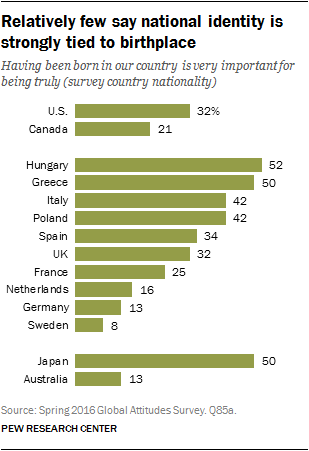
A global study of national identity by Pew Research has discovered that Canadians are among the least inclined to think place of birth defines whether someone is an authentic citizen.

Only 21 per cent of Canadians said place of birth is important. That compares to 32 per cent of those in the U.S. and more than 50 per cent of the population in Greece and Japan who believe birthplace is crucial to national identity.

The Pew Research study was done in the wake of growing concerns in the U.S. and Europe about globalization, high migration rates and protectionism, factors that have contributed to the rise of Donald Trump and immigration-skeptic parties.

pew-graph-identity-place-of-birth

Canada under the Liberals has gone a different direction, with Prime Minister Justin Trudeau talking about this being the world’s “first post-national country.”

Even though Canadians did not emphasize place of birth in the Pew poll, they did care about whether residents can speak English or French, the official languages.

Three in five Canadians agreed that “being able to speak our national language(s) is very important for being truly Canadian.”

Canadians’ language expectations, however, were still quite a bit lower than they are the Netherlands, the United Kingdom, Germany, Japan and the U.S. (See chart below.)

In Canada, one out of five people do not have English or French as their mother tongue.

Source: ‘True’ Canadians don’t need to be born here, but language matters: Poll

RCMP commissioner worries ‘caustic political discourse’ is radicalizing extremists

Sensible observations and words, applying to Canadian and foreign political discourse:

Canada’s top cop says he’s concerned that the “caustic tone” of “political discourse” in Canada may be a contributing factor in radicalizing “criminal extremists” like the shooter in Quebec City last week.

RCMP Commissioner Bob Paulson appeared Monday at the Senate standing committee on national security and defence and was asked for an update on the terrorism threat in Canada in the wake of the Quebec City massacre at the Ste-Foy mosque.

Paulson refused to provide specific numbers of individuals or groups under investigation. Yet asked whether authorities detect a rise in what Paulson had called “non-classic” terrorist activity such as the offender in Quebec City, he said, “there’s not an increase in that particular type of activity but there is, I think everyone would agree, a more sort of caustic tone to the political discourse that seems to attract and agitate and radicalize people of all persuasions, particularly those who know hardly anything about it, to engage.”

“And that represents a concern for us. And I think everybody’s concerned about that including the Service (Canadian Security Intelligence Service, or CSIS) and us and other police forces. And we are doing everything we can to get our heads around it.”

In the wake of the shooting, he said, the Canadian Association of Chiefs of Police convened its counter-terrorism committee to compare notes and reach out to Muslim community leaders, in part to ensure they were aware of any risk to them.

“We are doubling our efforts down with our police partners to make sure that we have a full sense of the picture there.” he said.

Drawing a distinction between classic jihadist-inspired terrorism and other kinds of radicalization, Paulson gave the example of Freemen of the Land “out in the West,” referring to followers of a movement who refuse to acknowledge police authority and believe only laws they consent to are applicable to them. Paulson said police have had “numerous encounters with that kind of criminality and other instances.”

“I wouldn’t say it’s overtaking the classic terrorism threat but it’s something we shouldn’t lose sight of as we pursue these other threats.”


…But Paulson did not back down from his clear warning there are lessons to be drawn from the case of Alexandre Bissonnette, charged with first-degree murder after six Muslim men died in the Ste-Foy shooting on Jan 29.Bissonnette’s social media activity showed he “liked” a wide range of pages that did not fall under a specific ideology, including those of U.S. President Donald Trump, far-right French politician Marine Le Pen, the federal NDP and former NDP leader Jack Layton.

“This offender needs to be understood, what was driving him to have acted in the way that he did,” said Paulson. “And sometimes there’s a political backdrop to that. And you know it seems to me more broadly some of the conversations that are taking place in some of those chats, on the Internet, on Twitter and those kinds of forums, approach — and I’ve been asked several times how come we’re not pursuing hate crime investigations in some areas — so we need to make sure we’re being thoughtful about doing that.”

Paulson said police continue to investigate whether terrorism charges are warranted in Bissonnette’s case. “If at some point in the view of the police and the prosecutor there is a compelling public interest dimension and the evidence is sufficiently developed to make the sensible argument that a terrorism prosecution is in order, then that’s what will happen.”

Source: RCMP commissioner worries ‘caustic political discourse’ is radicalizing extremists | Toronto Star

FBI Reports Show Terror Suspects Coming From Canada While Trump Stares at Mexico – The Daily Beast

Expect this story and data to have some legs in the current political context (has in the past, and is always an ongoing challenge with our American neighbours):

Donald Trump keeps talking about the threat from the U.S.-Mexico border. But he may be looking in the wrong direction. FBI reports reviewed by The Daily Beast reveal that far more suspected terrorists try to enter the country from the northern border with Canada than from the south.

Seven FBI Terrorist Screening Center “monthly domestic encounter reports” dating from April 2014 to August 2016 detail the number, type, and location of encounters with known or suspected terrorists across the United States. The encounters are based on information in various watchlist databases. In all seven reports, the numbers of encounters at land border crossings were higher in northern states than southern.

“We are looking the wrong direction,” said a senior DHS official familiar with the data. “Not to say that Mexico isn’t a problem, but the real bad guys aren’t coming from there—at least not yet.”

On Monday, press secretary Sean Spicer told reporters he would not disclose evidence behind the President’s claims that jihadis are “pouring” into the country. “I’m not going to get into specific information that the president has,” he said.

The FBI reports obtained by The Daily Beast provide data on known or suspected terrorists attempting to enter the country, or who are already in the United States.

These reports show hundreds of watchlisted passengers encountered on domestic flights—meaning they are already in the country—and a smaller percentage crossing the border over land.

Those encounters are reported back to the FBI’s Terrorist Screening Center and used to compile the monthly domestic encounter overview reports, which are classified “Law Enforcement Sensitive.”

Newly installed Department of Homeland Security Secretary John Kelly traveled to Texas last week to survey the border in the Rio Grande Valley with local law enforcement. He is scheduled to testify Tuesday morning at a House Homeland Security Committee hearing on threats to the southern border.

But the FBI data shows concerns about terrorists crossing into the U.S. from Canada may be a more immediate concern, or is at least worthy of considerable attention, according to border and congressional officials.

Source: FBI Reports Show Terror Suspects Coming From Canada While Trump Stares at Mexico – The Daily Beast

The Data That Turned the World Upside Down – Motherboard

While much of this is alarming and disturbing – particularly voter suppression – I would love to see some psychometrics complement conventional polling with respect to immigration issues to test different ways of posing questions:

But to what extent did psychometric methods influence the outcome of the election? When asked, Cambridge Analytica was unwilling to provide any proof of the effectiveness of its campaign. And it is quite possible that the question is impossible to answer.

And yet there are clues: There is the fact of the surprising rise of Ted Cruz during the primaries. Also there was an increased number of voters in rural areas. There was the decline in the number of African-American early votes. The fact that Trump spent so little money may also be explained by the effectiveness of personality-based advertising. As does the fact that he invested far more in digital than TV campaigning compared to Hillary Clinton. Facebook proved to be the ultimate weapon and the best election campaigner, as Nix explained, and as comments by several core Trump campaigners demonstrate.

Many voices have claimed that the statisticians lost the election because their predictions were so off the mark. But what if statisticians in fact helped win the election—but only those who were using the new method? It is an irony of history that Trump, who often grumbled about scientific research, used a highly scientific approach in his campaign.

Another big winner is Cambridge Analytica. Its board member Steve Bannon, former executive chair of the right-wing online newspaper Breitbart News, has been appointed as Donald Trump’s senior counselor and chief strategist. Whilst Cambridge Analytica is not willing to comment on alleged ongoing talks with UK Prime Minister Theresa May, Alexander Nix claims that he is building up his client base worldwide, and that he has received inquiries from Switzerland, Germany, and Australia. His company is currently touring European conferences showcasing their success in the United States. This year three core countries of the EU are facing elections with resurgent populist parties: France, Holland and Germany. The electoral successes come at an opportune time, as the company is readying for a push into commercial advertising.

Kosinski has observed all of this from his office at Stanford. Following the US election, the university is in turmoil. Kosinski is responding to developments with the sharpest weapon available to a researcher: a scientific analysis. Together with his research colleague Sandra Matz, he has conducted a series of tests, which will soon be published. The initial results are alarming: The study shows the effectiveness of personality targeting by showing that marketers can attract up to 63 percent more clicks and up to 1,400 more conversions in real-life advertising campaigns on Facebook when matching products and marketing messages to consumers’ personality characteristics. They further demonstrate the scalability of personality targeting by showing that the majority of Facebook Pages promoting products or brands are affected by personality and that large numbers of consumers can be accurately targeted based on a single Facebook Page.

In a statement after the German publication of this article, a Cambridge Analytica spokesperson said, “Cambridge Analytica does not use data from Facebook. It has had no dealings with Dr. Michal Kosinski. It does not subcontract research. It does not use the same methodology. Psychographics was hardly used at all. Cambridge Analytica did not engage in efforts to discourage any Americans from casting their vote in the presidential election. Its efforts were solely directed towards increasing the number of voters in the election.”

The world has been turned upside down. Great Britain is leaving the EU, Donald Trump is president of the United States of America. And in Stanford, Kosinski, who wanted to warn against the danger of using psychological targeting in a political setting, is once again receiving accusatory emails. “No,” says Kosinski, quietly and shaking his head. “This is not my fault. I did not build the bomb. I only showed that it exists.”

Source: The Data That Turned the World Upside Down – Motherboard

Le PQ suggère des mesures pour améliorer l’intégration des immigrants | Politique québécoise

The PQ appears to be stepping back from identity politics post Quebec mosque killing and proposing some positive and concrete integration measures:

Dans la foulée de l’attentat au Centre culturel islamique de Québec, le 29 janvier, le chef du Parti québécois (PQ), Jean-François Lisée, a présenté, lundi, une série de mesures destinées à améliorer l’intégration des immigrants et à combattre le racisme et la discrimination au Québec.

«Au cours de la dernière semaine, il y a eu une prise de conscience nationale extrêmement forte des difficultés d’intégration de plusieurs Québécois d’origines diverses – particulièrement, mais pas exclusivement maghrébine -, une prise de conscience très forte qu’il y avait dans notre société des traces de racisme et de discrimination qu’il convient de faire reculer», a affirmé M. Lisée en conférence de presse à Montréal.

Le plan d’action comporte une vingtaine de mesures touchant l’emploi, le logement, l’éducation et la francisation, notamment.

On y retrouve, entre autres, des propositions pour assurer une meilleure reconnaissance des diplômes et des compétences des immigrants, qui sont aux prises avec des taux de chômage beaucoup plus élevés que la moyenne des Québécois. Ces propositions impliquent le déblocage de goulots persistants que l’on retrouve chez certains ordres professionnels et dans les institutions d’enseignement, par exemple.

Certaines mesures visent aussi à contrer la discrimination à l’embauche, notamment en interdisant l’exigence d’une première expérience de travail canadienne, qui crée un cercle vicieux auquel il est impossible d’échapper lorsqu’un candidat nouvellement arrivé se cherche un premier emploi.

Le PQ propose également d’instaurer des amendes salées dans les cas de discrimination pour l’obtention d’un emploi ou d’un logement, parallèlement à des mesures de soutien financier pour l’incitation à l’embauche d’immigrants et à l’offre de stages.

«Il n’existe aucune amende pour quelqu’un qui est pris en flagrant délit de discrimination à l’embauche. Ça n’a pas de sens», a soutenu le chef péquiste.

De plus, il suggère de donner plus de mordant au programme d’embauche des minorités par l’État québécois en insistant sur les objectifs à atteindre, notamment par le biais de la discrimination positive.

Le PQ, qui a déjà fait part de son intention de mettre au rancart le cours d’éthique et culture religieuse, veut remplacer celui-ci par un cours sur la citoyenneté qui toucherait un ensemble de notions sociales, incluant, entre autres, le fait religieux, l’égalité entre les hommes et les femmes, la démocratie, la sexualité et autres.

«Ce cours doit avoir comme objectif de promouvoir une culture de l’antiracisme et contre la discrimination», a dit M. Lisée.

Le Parti québécois insiste également sur les mesures de francisation et l’intégration d’un plus grand nombre d’immigrants dans les conseils d’administration d’organismes publics et parapublics, parmi les candidats et employés des partis politiques et dans les manifestations culturelles.

Source: Le PQ suggère des mesures pour améliorer l’intégration des immigrants | Pierre Saint-Arnaud | Politique québécoise

It will take more than a tragedy to recast the accommodation debate: Hébert

Good advice from Chantal Hébert on Bill 62:

It will take more than a tragedy to recast the accommodation debate along lines more respectful of minority rights.

Consider, on this score, Quebec’s Bill 62. It is the latest legislative proposal designed to bring closure to the religious accommodation debate. It will do anything but that.

The bill would require anyone offering or receiving public services in the province to uncover his or her face, a disposition that could hardly apply to anyone except to a minority of Muslim women.

Quebec’s opposition parties do not feel that goes far enough. The PQ would impose a secular dress code on members of the police force, judges, prison guards and Crown attorneys. The CAQ would also include teachers and child-care workers. If the Liberal bill passes as is, the opposition parties will campaign on expanding its dispositions in next year’s provincial election.

The national assembly was expected to shortly resume debate on Bill 62. The attack on the Quebec mosque will result in a pause. But sooner rather than later the parties will pick up where they left off before this week’s events.

After a decade, it may be overdue to seek the input of people less inclined to play football with the rights of religious minorities, or at least to bring a referee unto the field.

If premier Couillard decided to refer his bill and the opposition’s proposals to the courts to find out how well if at all they sit with the Quebec and Canadian charters of rights, he would render this debate a much needed service

Source: It will take more than a tragedy to recast the accommodation debate: Hébert | Toronto Star

Don’t be deaf to the threat of dog whistle politics: Collenette

Good piece by Penny Collenette, former senior PMO staffer under Jean Chrétien:

So what can we do to stop the spread of this inflammatory and destructive force? How do we halt the powerful right wing of Trump’s America from spilling over our borders with their vicious messages? There are a number of ways.

Canadian politicians who use coded messages of race-baiting or values testing should be “named and shamed” by political opponents. Already this is thankfully happening in the Conservative leadership race.

Strategists and pollsters who practise this type of dangerous communication must think twice before posing questions designed to whip up prejudice. Clients and investors may equally become concerned about provocative behaviour.

Civil society and individuals are watch dogs for truth and fairness. Don’t allow friends or colleagues to discriminate against others or to disseminate hateful information. Whether a message is in a tweet, during a conversation, or on Facebook, point out errors or bias.

Main stream media and social media equally have responsibility to verify facts and to report without bias.

And never forget the power of words. Quebec Premier Philippe Couillard noted that “Words can hurt. Words can be knives slashing at people’s consciousness.” But words can also heal and soothe, especially when they are spoken with great sensitivity by a member of the community, which has just been devastated.

“What the Daesch is doing in the name of Islam is an affront to Islam, decency and humanity. What took place in Quebec was criminal and horrible. But the response of Canadians with love and solidarity represents Canada at its best and offers us pride and hope,” said Mohammed Azhar Ali Khan, a former journalist and Order of Canada recipient.

Let’s not let our communities and ourselves down. Let’s support each other with understanding and strength.

And while we are it, let’s throw those dog whistles in the garbage.

Source: Don’t be deaf to the threat of dog whistle politics: Collenette | Toronto Star

Des musulmans demandent une meilleure intégration sur le marché de l’emploi

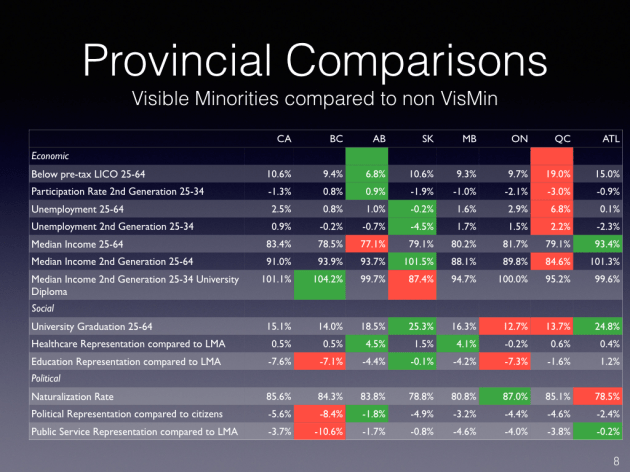
Multiculturalism - Implementing Diversity and Inclusion - Dec 2016.008.pngQuebec has the poorest economic outcomes for visible minorities:

Plus tôt cette semaine, le vice-président du Centre culturel islamique de Québec, Mohamed Labidi, a évoqué les efforts vains d’une des victimes de l’attentat, Azzaddine Soufiane, à trouver un emploi à son arrivée dans la province. Celui qui a tenté d’arrêter le tireur, au moment de la fusillade, avait donc décidé d’ouvrir un magasin, avait dit M. Labidi aux journalistes.

« Allez aux présentoirs de chauffeurs de taxi et vous verrez des post-doctorants et des personnes détenant des maîtrises puisque nous ne trouvons pas d’emplois ici », avait-il lancé.

Un programmeur informatique de formation qui est arrivé d’Algérie en 2011, Bachreir Ikhlef, était au départ « plein d’énergie » quand il est arrivé dans sa province d’accueil, a raconté le chauffeur de taxi de 37 ans alors qu’il attendait son prochain passager à quelques kilomètres de la Place d’Youville.

Un conseiller en orientation lui avait suggéré d’obtenir un diplôme au Québec afin d’agrémenter son curriculum vitae.

« Nous étions 25 à avoir commencé le programme, a dit celui qui avait alors opté pour un certificat en programmation. Et à la fin, seulement 12 d’entre nous l’ont fini. »

« Ni moi ni un type venant de la Tunisie n’avons pu obtenir un stage. Aucun d’entre nous n’a trouvé un travail dans notre domaine », a ajouté M. Ikhlef.

Selon l’Institut de recherche et d’informations socio-économiques (IRIS) — un groupe de réflexion connu pour ses positions plutôt portées à gauche du spectre politique —, 43 % des immigrants étaient surqualifiés, en 2016, pour l’emploi qu’ils occupaient.

« Mêmes démons »

Jeudi, lors de la cérémonie funéraire qui se tenait à Montréal, le premier ministre Philippe Couillard a souligné que la société québécoise « a les mêmes démons auxquels d’autres font face », mentionnant notamment la xénophobie, l’exclusion et le racisme.

Il a appelé les employeurs à engager des personnes en se basant sur leurs compétences et non leur nom de famille, demandant tout haut pourquoi le taux de chômage était plus élevé parmi les immigrants.

Le chauffeur de taxi Taoufik Essekkouri — arrivé du Maroc en 2010 — espère de son côté que ces mots mèneront à des actions concrètes, faisant valoir en entrevue que la surqualification des nouveaux arrivants par rapport à leur emploi est un problème connu depuis longtemps, mais qui tarde à être résolu.

Source: Des musulmans demandent une meilleure intégration sur le marché de l’emploi | Le Devoir