This [US EB-5] visa program is a path to citizenship for the rich

The US equivalent to the debate in Canada over investor immigration, essentially bad programs that distort local economies with little long-term benefit to the economy:

Big, high-profile real estate developments in America are scooping up funding from an unusual and controversial source: foreign investors angling to become Americans. The EB-5 visa program offers a path to citizenship to those rich enough to invest at least half a million dollars here. But there’s a growing debate about the program, with fierce defenders and critics who cut across traditional partisan lines.

Hudson Yards, a massive complex of office, retail, residential and park space coming together on Manhattan’s far west side, is one current project that benefits from these investments. The $25 billion project—the largest private development in American history—has brought in $600 million from EB-5 visa investors. That number could double by the time the whole project finishes in the middle of the next decade. Related Companies, which is developing Hudson Yards, said the EB-5 money was a “critical component.”

“Think back to when we started this,” said Jeff Blau, Related’s CEO. “In 2009-2010 the economy wasn’t so strong and so that EB-5 capital filled that gap for us.”

Supporters of the program, like Blau, point to the jobs and economic impact their developments create. The buildings at Hudson Yards will house private equity firms and luxury shops, but their bones are steel, manufactured in Virginia and welded into place by workers earning middle-class pay.

The program began in the early 1990s with the goal of bringing in job-creating investments from abroad. For many years it was tiny, well below its annual cap of 10,000 visas. But after the financial collapse, the program exploded, with a wave of Chinese applications.

As the program has grown, critics say too much money is going to real estate projects that benefit the wealthy, such as Manhattan skyscrapers and Vegas hotels.

“It is a program with a lot of flaws,” said Audrey Singer, a senior fellow at the Brookings Institution who has studied EB-5 financing. “It is easy to exploit.”

Foreigners who invest in high-unemployment areas get a break on how much money they have to put in: $500,000 versus $1 million. But developers have found ways to use that money for projects in wealthy areas, through creative drawing of districts called targeted employment areas (TEAs). By creating TEAs that include ritzy neighborhoods along with struggling ones, developers make it easier for foreign investors, but can still build in rich areas. Though legal, critics see this kind of gerrymandering as against the spirit of the law.

Singer says the EB-5 program can be a positive force, but it needs to tighten rules so more benefits go to neighborhoods that need them most. A bipartisan attempt to make changes recently failed, beaten down by the real estate lobby and Congressional supporters in both parties.

So for now, a pricey express lane to American citizenship remains open and the argument will rage on over whether it’s the right way to go.

Source: This visa program is a path to citizenship for the rich

ISIS Targets American Imams for Believing Muslims Can Thrive in U.S. – Also in Canada

Does undermine the American right’s characterization of American Muslims:

Three American imams got put on ISIS’s hit list for promoting the idea that Islam and the West can coexist.

The terrorist group’s latest issue of propaganda Dabiq attempts to theologically justify an attack on the religious leaders in an article titled “Kill the Imams of Kufr in the West.” The men are worse than hypocrites, ISIS says, because they say Muslims can thrive in America.

“The person who calls himself a ‘Muslim’ but unapologetically commits blatant kufr [disbelief] is not a munafiq [hypocrite], as some mistakenly claim. Rather, he is a murtadd [apostate],” Dabiq claims.

The Daily Beast will identify two of the Americans with pseudonyms because of the direct threats on their lives. A third, who gave The Daily Beast permission to use his name, responded with dark humor.

“Nothing like a death threat with a danish and a latte in the morning,” Suhaib Webb told The Daily Beast.

This is the first time ISIS has put out a direct hit on U.S. imams.

Webb is treated with contempt by jihadists who call him “the joke of al-Azhar,” a reference to his time at the esteemed Islamic university in Egypt.

“I mean, it’s certainly concerning,” he said, adding that he’s been contacted by the Department of Homeland Security about the threat. “They maybe want to brief me on things to look for, to be cautious of,” he said.

The irony of being on the most extremist group’s hit list isn’t lost on Webb, who for years has been accused of Islamic extremism by the far right in America.

“In a way, [Dabiq]’s attacking what many of us think makes our country awesome. And at the same time, it repudiates people on the right,” he said. “If people like myself are radical extremists, then why is ISIS putting a death threat on us?”

Meanwhile in Canada:

Just days after celebrating cultural bridges, a Toronto imam has been targeted in a Daesh hit list.

The self-declared Islamic State called out Shaykh Abdullah Hakim Quick along with other Muslims in the West, urging followers to kill them for speaking out against the group and betraying their interpretation of Islam.

Quick works with the Canadian Council of Imams, which hosted its first annual dinner on Monday night, honouring political leaders and community members.

“It was a really good vibration that came out of that meeting, a lot of unity between people of different faiths,” Quick told the Star.

“So here comes the devil, as we would say, screaming out against us the next day.”

Quick first learned of the threat on Wednesday from a fellow imam in the council, but though he says he has contacted law enforcement and is taking precautions, he will not be intimidated.

“I will continue to do what I have to do,” he said. “Putting my trust in God. This is what Muslims do when they find themselves in difficulty, and continue on to do what’s right.”

Michael Zekulin, a terrorism researcher at the University of Calgary, says the threat is typical of Daesh’s propaganda tactics, but not necessarily legitimate.

Daesh has implored its followers to go after others in the past, he says, like Calgary-based cleric Syed Soharwardy and UFC fighter Tim Kennedy.

“It never resonated,” Zekulin said. “It’s not something you dismiss and laugh off, but at the same time I’m not sure that simply because they mentioned this individual all of a sudden (he) is a serious immediate target.”

He says more than anything the threat demonstrates the sophisticated, extensive nature of Daesh’s communication network.

US cautions Caribbean countries offering economic citizenship | Caribbean360

Cautious wording but the message is clear:

The United States Government has cautioned Caribbean countries offering a Citizenship by Investment Programme (CIP) to be extra cautious about who they give their passports to, and ensure that recipients have no terrorist or crime links.

It gave the advice, in a statement issued by the US Embassy in Barbados yesterday, even as it made it that it was not advising regional countries on whether or not they should offer economic citizenship.

Under the CIP offered by countries like Antigua and Barbuda, St. Kitts and Nevis and Dominica, foreign nationals are granted citizenship in exchange for a substantial investment in the country.

“The United States does not approve or disapprove individual aspects of citizenship by investment programmes,” the US statement said. “The United States strongly believes that all countries have an inherent responsibility to their citizens and the international community to review fully all applicants who seek a nation’s citizenship.”

“While the United States Government is willing to consult with governments on their citizenship investment programmes, the ultimate decisions to offer and how to operate such a programme, including the issuance of citizenship and related identifying documents, such as passports to applicants, lie with each individual government and not with the United States.”

But, the statement added, the US Government encourages and expects governments to be confident, beyond a reasonable doubt, that applicants are bona fide and their identities have been fully validated, and they have no ties to transnational criminal or terrorist organizations, before handing over citizenship.

The US Embassy did not identify any specific country in its statement.

However, there has been concern in Antigua and Barbuda about the government’s recent decision to remove Iraq from the list of countries whose nationals are barred from obtaining citizenship under the twin-island nation’s CIP.

The main opposition United Progressive Party (UPP) is strongly against it. Political leader Harold Lovell said late last month that given the entrenchment of Islamic State in Iraq and Syria (ISIS) in the Middle Eastern country, that move and the decision by the Gaston Browne administration to establish a presence in Iraq, expose Antigua & Barbuda to danger and compromise the integrity of the country’s passport.

Last November, the St. Kitts and Nevis Government announced an immediate suspension of the processing of new CBI applications from citizens and residents of Syria.

The announcement came less than two weeks after ISIS carried out attacks in Paris, and also followed the arrest of Syrian nationals with fake passports in Honduras and St. Maarten, although the government did not publicly identify those developments as contributing to its decision.

Source: US cautions Caribbean countries offering economic citizenship | Caribbean360

Key Question on U.S. Citizenship Test Changed — Charisma News

While the US Citizenship and Immigration Services likely had to make this ruling, it appears that the complainant wants religious rights to trump other rights, as seen in many of the US state initiatives against LGBT and other rights:

At issue was a segment of the exam’s study guide that suggested the First Amendment protects the citizens’ right to “freedom of worship,” rather than freedom of religion. Lankford, who is co-chairman of the Congressional Prayer Caucus and the first senator to join it, first learned of the incorrect wording in June of last year, which prompted a letter to CIS Director Leon Rodriguez.

Lankford explained his issue with the wording again Friday in his announcement applauding the change:

“At first glance, it appears like a small matter, but it is actually an important distinction for the Constitution and the First Amendment. The ‘freedom of religion’ language reflects our right to live a life of faith at all times, while the ‘freedom of worship’ reflects a right simply confined to a particular space and location.”

In a letter sent to Lankford’s office Friday, Rodriguez explained the reversal, saying that “upon further consideration,” CIS determined the change could be made because it didn’t involve adding or deleting content. Approximately 40 web-based and printed materials will be changed as a result of the decision.

“In accordance with agency policy, if the applicant’s answer to a civics question is ‘an alternative phrasing of a correct answer,’ U.S. Citizenship and Immigration Services officers will continue to accept both ‘freedom of religion’ and ‘freedom of worship’ as correct answers to question 51 when administering the naturalization exam,” Rodriguez wrote.

Question 51 reads, “What are two rights of everyone living in the United States?” The study guide originally offered the following correct answers:

  • freedom of expression,
  • freedom of speech,
  • freedom of assembly,
  • freedom to petition the government,
  • freedom of worship and
  • the right to bear arms.

The study materials will now read ‘freedom of religion’ as the correct response. Based on reprinting schedules, they expect all materials to be updated by the end of 2016.

“I applaud the Department of Homeland Security for listening to me and deciding to change their material to reflect our First Amendment right of freedom of religion,” Lankford said after receiving the notification. “We live in a great nation that allows individuals to live out their faith, or have no faith at all. To protect freedom and diversity, we must carefully articulate this right throughout the federal government.”

Source: Key Question on U.S. Citizenship Test Changed — Charisma News

USA: A Diverse Teaching Force? This Search Firm Can Help, But It’ll Cost You : NPR

Interesting market niche:

More than half of public school students are members of minority groups, but 83 percent of their teachers are white. Half of students are boys, while three-quarters of teachers are women.

Students can benefit in many ways from having teachers who look like them, but in many schools around the country the math doesn’t add up.

In recent years, attention to the issue has been increasing, with national teachers’ unions and the U.S. Education Department, among others, trying to raise awareness and drum up more diverse recruits.

One man working in the private sector to address this problem — or at least a slice of it — is a former elementary school teacher named Orpheus Crutchfield. He’s the president of Stratégenius LLC in Berkeley, Calif (yes, it’s spelled with the accent over that first e). It’s been around for 15 years. And to his knowledge, it’s the only search firm in the country that specializes in placing underrepresented candidates in schools.

If your school is looking for a male kindergarten teacher, a female physics teacher or a person of color in any position, Crutchfield says, he can help.

But it’s going to cost. The firm typically works with between 55 and 65 schools at a time, charging each one a $1,650 annual retainer. If you happen to call upon their help between December and June, when most schools are hiring, there’s an additional “high season fee” of $750. And, if they present you with a successful candidate, the one-time fee is 14 percent of that person’s annual salary up front — paid by the school, not by the teacher, of course.

In July, Courtney Martin, a Stratégenius candidate who is African-American, will become head of lower school at Hawken, a progressive private school in Cleveland. It’s a promotion over her previous position, and she’ll be the first person of color to be hired at that level at the school. “He knew who I was and what I believed as an educator,” Martin says. “Anything he suggested, I trusted his advice.” Since Crutchfield started working with Hawken a year ago, he’s matched them with candidates for three separate positions who have each become finalists.

The vast majority of Crutchfield’s clients over the years have been private schools like Hawken, with the occasional charter school. The obvious reason would seem to be the price tag, but Crutchfield says there’s also the matter of who is empowered to make the call to use a firm like his.

“Independent schools are very nimble. Decisions get made immediately,” he explains. “Whereas dealing with districts is very complicated. I’ve tried.”

Source: A Diverse Teaching Force? This Search Firm Can Help, But It’ll Cost You : NPR Ed : NPR

Islam Makes Stronger Patriots, US Study – The Atlantic

American_Faith_GroupsWorth noting:

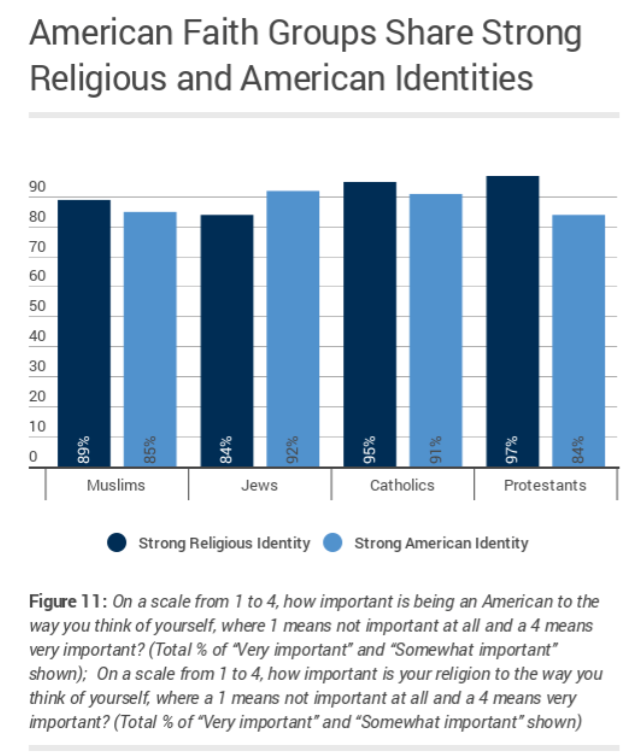
Donald Trump’s calls for a ban on Muslim immigration and the closing of American mosques seem to reflect suspicion that Islam and American citizenship are incompatible. But religion and patriotism are not opposing forces for American Muslims; in fact, they’re strongly correlated.

That’s one of the key findings of a first-of-its kind poll conducted by the Institute for Social Policy and Understanding, a non-profit focused on studying this section of the American population. The poll compares Muslims to American Jews, Protestants, and Catholics with respect to their levels of religiosity, patriotism, activism, and general outlook on the state of the country and on their lives. “In this election cycle, specifically, Muslims have been a topic of debate but seldom participants in that discussion,” said Dalia Mogahed, ISPU’s research director.

“We found that there was no correlation between mosque attendance and support of violence,” Mogahed said. On the contrary, she suggested, the results indicate that mosques are ideal places where community organizers might start engaging people because those who attend regularly “are more receptive to a message of civic engagement.”

“The research shows that mosques are actually a force for moderation. Muslims frequent a religious service as much as Protestants, and those who do go more frequently are not in any way more likely to condone violence,” Mogahed said. Muslims who said they attend services more frequently were more likely not to condone violence, with 65 percent saying “it is never justified,” compared to 45 percent of similarly devout Jews, 43 percent of Catholics, and 40 percent of Protestants.

The survey also found that American Muslims were more likely than members of other faith communities to reject attacks on civilians by the military, and as likely as any other group to also reject attacks on civilians by an individual or a small group, Mogahed said. They are “at least as likely as other faith communities to reject violence unequivocally,” she said.

Source: Islam Makes Stronger Patriots – The Atlantic

Trump Voters’ Aversion To Foreign-Sounding Names Cost Him Delegates | FiveThirtyEight

Not surprising, given the focus of his campaign and the demographics of those who support him:

If Donald Trump somehow falls three delegates short of reaching the magic 1,237 delegates needed for the Republican nomination, he may be haunted by an obscure outcome from the primary voting in Illinois on Tuesday. There’s clear evidence that Trump supporters in Illinois gave fewer votes to Trump-pledged delegate candidates who have minority or foreign-sounding names like “Sadiq,” “Fakroddin” and “Uribe,” potentially costing him three of the state’s 69 delegates.

This pattern appears to be a phenomenon unique to Trump’s supporters.

Illinois Republicans hold a convoluted “loophole” primary: The statewide primary winner earns 15 delegates, but the state’s other 54 delegates are elected directly on the ballot, with three at stake in each of the state’s 18 congressional districts. Each campaign files slates of relatively unknown supporters to run for delegate slots, and each would-be delegate’s presidential preference is listed beside his or her name. As a result, the top presidential candidate in each congressional district usually claims all three of the district’s delegates.

Except on Tuesday, a handful of congressional districts split their delegates in ways that cast doubt on voters’ racial motivations. Did voters have genuine personal preferences for the mostly anonymous individuals running for these slots, or was it a case of “what’s in a name?”

A FiveThirtyEight analysis of the dozen highest vote differentials within district-level Trump slates reveals a startling pattern: In all 12 cases, the highest vote-getting candidate had a common, Anglo-sounding name. But a majority of the trailing candidates had first or last names most commonly associated with Asian, Hispanic or African-American heritages. Of the 54 Trump delegate candidates in the state, two of the three worst-trailing candidates were the only two Trump candidates with Middle Eastern-sounding names.

Source: Trump Voters’ Aversion To Foreign-Sounding Names Cost Him Delegates | FiveThirtyEight

US election 2016: What does ‘Islam’ think of America? – BBC News

Useful summary of what some of the polling data indicates:

The Pew Research Centre, which surveys global attitudes, said anti-Americanism was strong around the word around the time of the US invasion of Iraq.

However, currently there is little evidence of profound anti-American sentiment except for in a handful of countries, it says.

Bruce Stokes, director of global economic attitudes at Pew, says sentiment towards the US varies widely between Muslim-majority countries.

“We tend to see more negative sentiment among Muslims in the Middle East, such as those from Egypt and Jordan,” he says.

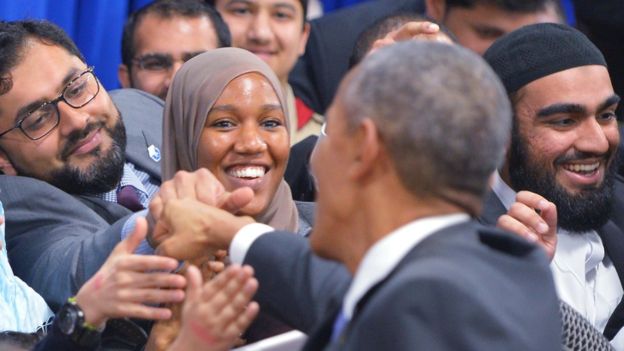
Barack Obama meeting American MuslimsImage copyrightGetty Image
“But Muslims outside the Middle East generally have a more positive outlook,” he adds.

In Indonesia, the world’s most populous Muslim country, 62% of people hold a favourable opinion of the US, Pew’s latest data suggests.

That figure rises to 80% in Senegal, a country which is over 90% Muslim. Mr Stokes points out that this is a stronger approval rate than Germany.

“Attitudes have also been changing over time. We’ve seen a gradual rise in positive sentiment since President Barack Obama came to power,” Mr Stokes says.

“Even in the Palestinian Territories, where sentiment is 70% unfavourable, that’s an improvement on 82% in Barack Obama’s first year.”

The BBC World Service commissioned its own poll of global attitudes in 24 countries in 2014.

Among other things, it asked respondents if they thought the US “had a mainly positive or mainly negative influence in the world”.

Pakistanis generally held the worst view of the US, with 61% saying the US had a negative influence.

But both China and Germany were not far behind, scoring 59% and 57% respectively.

Turkey, almost 98% Muslim, was split between 36% positive, 36% negative and 28% neutral.

Source: US election 2016: What does ‘Islam’ think of America? – BBC News

When Integrating A School, Does It Matter If You Use Class Instead Of Race?

Interesting article on the latest US thinking on integration:

Stronger Together is not the name of the latest social-media fitness app. It’s a grant proposed in President Obama’s new budget, reviving an idea that hasn’t gotten much policy attention in decades: diversity in public schools. If the request is approved, $120 million will go to school districts for programs intended to make their schools more diverse.
As a new pair of reports from the progressive Century Foundation shows, integration policies have seen a resurgence: In 2007, 40 districts pursued integration. Today that number has more than doubled, to 83, plus nine charter schools or networks. That adds up to a total of 4 million students in classrooms that are more diverse than they’d otherwise be.

This new wave of integration has come with one big difference that sets it apart from the busing battles of the past. These programs rely on family income, not race, as the driver.

To be clear, there’s evidence that socially as well as racially integrated schools benefit all students. When a school reaches a stable level of about 30 percent middle-class students, the lower-income students achieve at higher levels and the privileged students do no worse, says Halley Potter, the author of one of the Century Foundation reports. Similarly, the racial achievement gap shrinks in schools that have less than a “supermajority” of 60 percent of any one race.

But the real case for diverse schools is a lot bigger than test scores, says Amy Stuart Wells, who teaches at Teachers College, Columbia University, and is the author of the second report. “The qualitative and quantitative evidence is powerful enough to say, ‘We should do this.’ ”

It’s worth pointing out that because of the legacy of discrimination and institutionalized segregation in the United States, in most communities mixing up students by class also means mixing them up by race.

“Diversification by socioeconomic status also means by race,” says Mercedes Ebanks, an associate professor in the school of education at Howard University. “The movement towards socioeconomic integration will lead to racial integration and educational equality.”

http://www.npr.org/sections/ed/2016/02/29/466543209/when-integrating-a-school-does-it-matter-if-you-use-class-instead-of-race?utm_medium=RSS&utm_campaign=news

Fewer Asians Need Apply by Dennis Saffran, City Journal Winter 2016

While I tend to favour some degree of affirmative action to foster diversity and inclusion, this piece makes valid comparisons between previous discrimination of American Jews and current measures to restrict Asian Americans:

“Asians are typecast in college admissions offices as quasi-robots programmed by their parents to ace math and science tests,” Golden observes. A Yale student commenting on the Princeton OCR complaint put it more bluntly: “[T]here can be good reasons for the disproportionately low acceptance rates for many Asians. . . . Top-tier schools . . . look not only for good grades but for an interesting student who will bring something of value to the community.” A Boston Globe columnist noted that the comment “sounds a lot like what admissions officers say, but there’s a whiff of something else, too.”

The something else smells a lot like the attitude toward Jews 90 years ago. Now, as then, an upstart, achievement-oriented minority group has proved too successful under objective academic standards. And so, as Jews were in the 1920s, Asians today are deemed deficient in the highly subjective and discretionary “personal estimate of character” favored long ago by Harvard president Lowell. But while anti-Semitic elites of the 1920s were forthrightly reactionary, their grandchildren’s anti-Asian bigotry is concealed under a veneer of modern progressivism. This is not merely because it rechristens Lowell’s arbitrary criteria with the New Agey term “holistic” but more fundamentally because it is based on a stereotypical view of Asians as out of sync with liberal culture. The image of Asian students as one-dimensional test-taking robots, short on creative thinking, all too often resonates with modern liberal educators, with their disdain for testing and “rote” learning, which they see as inimical to a “frolic in the fields” concept of creativity. As former neoconservative-turned-leftist culture warrior Diane Ravitch articulated this philosophy: “I don’t care if my two grandsons . . . have higher or lower scores than children their age in . . . Japan [or] Korea. . . . [I] care that [they] are . . . curious about the world; are loved; learn to love learning; [and] are kind to their friends and to animals; . . . Let’s all read Walden, read poetry, listen to good music, visit a museum, look at the stars.”

The bias against a group seen as having a learning approach that rebukes this romantic idyll is reflected in the concern of liberal college administrators that their institutions not become majority Asian. As Golden told the New York Times, “The schools semiconsciously say to themselves, ‘We can’t have all Asians.’ ” It may be more than semiconscious. A former admissions officer at Wesleyan, Brown, and Columbia warns ominously in the same Times article that “if affirmative action is overthrown . . . our elite campuses will look like U.C.L.A. and Berkeley.” Golden recounts the experience of Princeton professor Uwe Reinhardt in raising the discrimination issue with university officials: “They would say . . . ‘You wouldn’t want half the campus to be Chinese.’ ” Reinhardt had a good answer: “Well, why not?” As the director of Asian-American studies at Northwestern put it, “In the 1920s, people asked: will Harvard still be Harvard with so many Jews? Today we ask: will Harvard still be Harvard with so many Asians? Yale’s student population is 58 percent white and 18 percent Asian. Would it be such a calamity if those numbers were reversed?” It’s ironic that the same progressives who exult at the prospect of the United States becoming a majority-minority country fret at the far less disruptive prospect of Harvard or Yale becoming majority Asian.

Liberal discomfort with Asians can shade into outright hostility. Browbeating affirmative-action opponent Abigail Thernstrom in the wake of the passage of Prop. 209, Crossfire cohost Bob Beckel asked angrily, “Would you like to see . . . UCLA Law School 80 percent Asian? . . . . Will that make you happy?” The hostility is exacerbated by the unavoidable reality that affirmative action puts Asians in competition with African-Americans and Hispanics. Another study by Espenshade found that racial preferences for blacks and Latinos at elite colleges come almost entirely at the expense of Asian-Americans rather than whites. He and a colleague determined that if affirmative action were eliminated, “[n]early four out of every five places . . . not taken by African-American and Hispanic students would be filled by Asians.”

Racial-preference supporters argue that Asian students are harmed just as much by admissions preferences for legacies and athletes, which disproportionately benefit whites. Indeed, OCR dismissed the 1988 Harvard complaint based on a finding that any discrimination against Asians was explained by such preferences. The current Harvard lawsuit also attacks legacy preferences but for a different reason, arguing that their elimination would be a “race-neutral alternative” that would allow Harvard to admit more blacks and Latinos without resorting to race-based selection. I think that the plaintiffs are right, as a matter of fairness, to oppose legacy preferences (even though my daughter and I are both Harvard graduates, so our family may have benefited from them). However, Espenshade’s data show that their abolition would do little to benefit blacks, Latinos—or Asians.

Thus, this case necessarily brings into stark relief the ironic impact of race-based admissions preferences in today’s multiracial society. Whatever the justification for racial favoritism in the essentially biracial era of 1978, when Bakke was decided, the burden now falls largely on another historically marginalized racial minority—a group that is heavily foreign-born and that, while generally prosperous, still has large pockets of immigrant poverty. (See “The Plot Against Merit,” Summer 2014.) Affirmative action, the flagship policy of multiculturalists, has foundered on multiculturalism itself—and it’s time to pull the plug on it. The Harvard lawsuit provides the courts with a good opportunity to do so.

Source: Fewer Asians Need Apply by Dennis Saffran, City Journal Winter 2016