H-1B Denials Remain High, Especially For IT Services Companies

Some good analysis here (and more on the “Canadian advantage”:

New U.S. Citizenship and Immigration Services (USCIS) data show denial rates for new H-1B petitions increased from 6% in FY 2015 to 21% in FY 2019. Companies that provide information technology (IT) and other services to U.S. businesses had the highest denial rates due to Trump administration policies.

“In FY 2019, USCIS adjudicators denied 21% of H-1B petitions for “initial” employment (which is primarily for new employees) and 12% of H-1B petitions for “continuing” employment (mostly for existing employees),” according to a new National Foundation for American Policy (NFAP) analysis. “The 12% denial rate for continuing employment was the same in both FY 2018 and FY 2019, indicating there has been little change in USCIS policies over the past year.”

USCIS explains that H-1B petitions for “initial” employment are primarily cases that would count against the H-1B annual limit (i.e., new employment). H-1B petitions for “continuing” employment are mostly extensions for existing employees at the same company but could also be for an H-1B visa holder changing to a new employer.

As the NFAP analysis notes, this is the first time that data for all four quarters of FY 2019 are available and can be separated into initial and continuing employment, which provides a clearer picture of USCIS adjudications. The analysis found the 12% denial rate for continuing employment in FY 2019 was four times higher than the 3% rate as recently as FY 2015. The 21% denial rate for initial employment in FY 2019, while lower than the 24% rate in 2018, was still much higher than the 6% denial rate for such cases in FY 2015.

The statistics bear out what immigration attorneys have said for more than a year: “USCIS has raised the legal standard they use to decide whether enough evidence has been presented with petitions to approve them, without any legal authority to do so and without any notice to the public,” William Stock, a founding member of Klasko Immigration Law Partners, LLP, told me in an interview.

The analysis found H-1B denial rates have risen for nearly all major companies. However, it is clear USCIS has used a different standard to adjudicate cases for IT services companies. “The denial rate for H-1B petitions (initial employment) for at least 9 major companies that provide IT services or other consulting services reached over 30% in FY 2019,” according to the analysis, “In comparison, technology product companies, such as Apple, had far lower denial rates for initial employment, ranging between 2% and 7%, although these rates were generally higher than in FY 2015.”

The denials seem focused on H-1B employees who will perform work at customer sites to service contracts. Employers that keep employees primarily in a single location, such as product companies, have much lower denial rates.

Attorneys say there is plenty of evidence that USCIS changed the standards without a change in the law or new USCIS regulations. Between FY 2015 and FY 2019, the denial rate for initial employment increased by 20 percentage points or more for at least 10 major companies that provide information technology or other business services.

For continuing employment, the denial rate for H-1B petitions was 3% between FY 2011 and FY 2015 but increased to 12% in FY 2018 and FY 2019. A USCIS memo that told adjudicators not to provide deference to prior determinations has forced long-time employees waiting for green cards to leave the United States because their cases were denied.

It should not be surprising that the most successful technology companies have needed to hire highly skilled people to grow. The leading employers for H-1B petitions for initial employment in FY 2019 included Amazon, Google and Apple, all of which have passed $1 trillion in market capitalization. When companies recruit at U.S. universities, they find 80% of the full-time graduate students in computer science and electrical engineering are international students.

In contrast, other companies are sponsoring fewer workers. “New H-1B petitions (for initial employment) for the top 7 Indian-based companies declined by 64% between FY 2015 and FY 2019,” according to the NFAP analysis. “The 7 companies had only 5,428 H-1B petitions for initial employment approved in FY 2019. Denials may have contributed to this decline but the primary reason for the drop in H-1B visas is a choice by companies to build up their domestic workforce in the United States and rely less on visas. Moreover, these and similar companies are part of an industry trend when servicing clients to use more digital services, such as cloud computing, bots and artificial intelligence, which require fewer workers.”

The supply of H-1B petitions has been gone before the end of the past 17 fiscal years. The demand for tech talent across industries and the low number of H-1Bs relative to the size of America’s economy are the major reasons. The annual limit of 65,000 H-1B petitions and the 20,000 exemption from that limit for individuals with an advanced degree from a U.S. university comes to 85,000 new H-1B petitions each year – only 0.05% of the U.S. labor force of 164 million people.

High denial rates are not the only problem for companies under Trump administration policies. The percentage of completed cases with Requests for Evidence (RFEs) increased from 22.3% in FY 2015 to 40.2% in FY 2019, according to USCIS, which increases costs and processing time for employers.

Given the problems in the United States, it’s not surprising companies, international students and foreign-born engineers are looking to the north. In Canada, the number of Indians who became permanent residents increased from 39,340 in 2016 to 85,585 in 2019, a rise of more than 117%, according to a National Foundation for American Policy analysis of Immigration, Refugees and Citizenship Canada data.

Under Canada’s Global Skills Strategy, adjudicators approve many applications for high-skilled workers within two weeks with a low number of denials. “Canada is benefiting from a diversion of young Indian tech workers from U.S. destinations, largely because of the challenges of obtaining and renewing H-1B visas and finding a reliable route to U.S. permanent residence,” said Peter Rekai, founder of the Toronto-based immigration law firm Rekai LLP, in an interview. (See here.)

In the United States, we often ignore the positive role technology professionals, both native-born and foreign-born, play in making U.S. companies more competitive. “Digital transformations and digital platforms are just starting to take off and, as we look into the near future, the current skill shortages are going to grow as the demand for digital and IT skills explodes,” said Everest Group CEO Peter Bendor-Samuel. “If this administration wanted to harm U.S. competitiveness, then restricting access to this vital labor would be an excellent approach.”

The situation may grow worse for employers and high-skilled foreign nationals. The Trump administration has pledged to publish a new H-1B visa rule in 2020 to “revise the definition of specialty occupation . . . and revise the definition of employment and employer-employee relationship.”

The rule would put into regulation many of the current USCIS practices that have resulted in higher denial rates – or may be a source of new ways for USCIS to restrict the employment of foreign nationals.

Meet the Reocons

New term for me, although the characters are familiar:
On the American right, a growing group of intellectuals are using acute cultural fears to secure an illiberal future. It’s reactionary politics at its most explosive and unpredictable.

On September 7, 2016, Rush Limbaugh–who averages 15 million listeners a week–spent most of his show reading from a pseudonymous essay in The Claremont Review of Books. “2016 is the Flight 93 election,” he announced. “Charge the cockpit or you die. You may die anyway. You—or the leader of your party—may make it into the cockpit and not know how to fly or land the plane. There are no guarantees. Except one: if you don’t try, death is certain.” Death, you will have guessed by now, is a stand-in for a Hillary Clinton presidency–which, according to the Claremont author, would have meant “pedal-to-the-metal on the entire Progressive-left agenda, plus items few of us have yet imagined in our darkest moments.”

Rush is exuberant: “The piece is so good. It is just a home run, every paragraph.”

We know what happens next. Limbaugh was elated at the election outcome (“There are so many vibrantly great feelings to share. We have not lost our country”).Michael Anton dropped his pseudonym and stepped into the White House. Intellectual Trumpism was born.

Today, a growing number of prominent conservative intellectuals have joined Anton and are planning openly for America’s illiberal future. Though they typically maintain a genteel collective persona – Anton actually wrote a book called The Suit: A Machiavellian Approach to Men’s Style – there is an ugliness to their anti-liberal message and a deceptive vagueness to their political vision that make for a destabilizing brew. And unlike Trump, their influence among conservatives is likely to continue and grow regardless of what happens in the election. I call them reactionary conservatives, or Reocons, and they are only getting started.

Know thy Reocon

If Michael Anton’s essay marked the first wave of Trumpy conservative intellectualism, Patrick Deneen’s 2018 book, Why Liberalism Failed, marks the second. Deneen is a political theory professor at Notre Dame, and the book (which was reviewed by pretty much everyone, and even made Obama’s 2018 reading list) explains why liberal democracy is doomed to fail. His basic argument is that in modern democracies, liberal individualism leads to inevitable social decay, which leads in turn to vast state expansion. The book offers a useful articulation of some of the worst pathologies of neoliberalism – one perfectly timed to Trump – but, as a rebuttal to liberal modernity, it’s a vast overreach.

But the Trumpists kept coming. In 2019, the New York Post’s op-ed editor Sohrab Ahmari emerged as another forceful anti-liberal critic. Ahmari launched a much-discussed personal crusade against conservative David French, who he considers too civil and accommodating of liberal views. When the two eventually tangled in person, they garnered quite a lot of attention, largely thanks to Ahmari’s polemical style.

Then, in the summer of 2019, the growing group of anti-liberals gathered together formally under the inauspicious banner of National Conservatism. The conference was organized by Yoram Hazony, an Israeli-American scholar whose book The Virtue of Nationalism came out last year. The meeting was consecrated to “the revival of the unique national traditions that alone have the power to bind a people together and bring about their flourishing.” A similar group met up again in Romeearlier this month.

Finally, rounding out our reactionary squad, we have Attorney General William Barr – no doubt the most powerful and controversial of the Reocons. Barr delivered twoparticularly controversial speeches last fall. Both were explicitly anti-liberal.

These reactionaries may not see eye to eye on everything, but they tend to be glad that the old GOP consensus has collapsed, and clearly want to turn back the clock. What specifically characterizes them as reactionaries, however, is their insistence that the American Left poses an existential threat, combined with serial vagueness about the future.

There are other ways to define ‘reactionary.’ Corey Robin makes a powerful casefor the idea that all conservatism is essentially reactive. To me, the term necessarily implies something about the degree of opposition to political change: it’s not just nostalgia and resistance to hierarchy that unite the Reocons, it’s a galvanizing sense of fear and paranoia. This sentiment is not new on the Right, but it’s this, in combination with a cagey, unaccountable view of the future, that sets the Reocons apart.

The reactionary core: animus against the left 

As with most of the Reocons, and judging strictly by his public demeanor, Bill Barr does not seem like a paranoid man. He speaks slowly and quietly, conveying a mood of quiet reluctance, in a slightly bumbling, and even appeasing manner. This, of course, is a stark contrast to the president’s vulgarity and bombast.

What Barr actually says, however, tells a different story. His public speeches convey acute moral panic about the dangers posed by liberals and secularists.

In his November speech at The Federalist Society about executive power, Barr offered an astonishing display of crude partisanship. Drawing on hackneyed old tropes about liberal excess, Barr argued that “it is the Left that is engaged in the systematic shredding of norms and the undermining of the rule of law.” He then expounded a more general theory:

“In any age, so-called progressives treat politics as their religion. Their holy mission is to use the coercive power of the State to remake man and society in their own image, according to an abstract ideal of perfection. Whatever means they use are therefore justified because, by definition, they are a virtuous people pursuing a deific end. … They never ask whether the actions they take could be justified as a general rule of conduct, equally applicable to all sides.”

Barr’s sweeping generalities are unprecedented for the office of Attorney General. He is referring not just to a few radicals, but to everyone on the left, whom he characterizes as  fanatical idealists that never consider the implications of their conduct. This is the highest ranking official in the Department of Justice, speaking in terms of “them” and “us” about entire swaths of the American populace.

When Barr gave a speech at Notre Dame on the subject of religious liberty last October, his target was very much the same. The liberals and secularists, he implied, are out for blood:

“This is not decay; it is organized destruction. Secularists, and their allies among the “progressives,” have marshaled all the force of mass communications, popular culture, the entertainment industry, and academia in an unremitting assault on religion and traditional values.”

He goes on to explain that the campaign of destruction against traditional morality has already brought “immense suffering, wreckage, and misery,” and laments how the secularists just turn a blind eye to the tragedy, pressing on “with even greater militancy.” He warns that this is all just another form of tyranny, where we are enslaved by our appetites, and “the possibility of any healthy community life crumbles.”

Patrick Deneen was present at Barr’s Notre Dame speech, calling it a “masterful, learned, and extremely important speech that should be widely read and pondered.”

This, at least, is unsurprising. Much of what Barr says might as well have been lifted straight from Why Liberalism Failed – the first chapter of which, for example, echoes an old trope, traceable to Alasdair MacIntyre and popular on the reactionary right, about rising liberal “barbarism.”

Bill Barr and Patrick Deneen are, by a good measure, the most rhetorically clement of the Reocons. The others are less cautious. For example, while Barr and Deneen often use scare quotes to refer to modern liberal causes ( it’s always “pluralism,” “diversity,” “multiculturalism,” and “social justice”), they don’t openly refer to these things as inanities. Michael Anton does. And whereas Barr and Deneen will make passing reference to liberal barbarians and cultural destruction, Anton is comfortable talking about the “ceaseless importation of Third World foreigners with no tradition of, taste for, or experience in liberty”; he considers American immigration policy as “insane” evidence of “a society, a country, a people, a civilization that wants to die.”

Hazony, for his part, believes that multiculturalism is an “evil” Marxist doctrine that forces the “equalization of all tribes”; he equates it to “destruction for the sake of destruction.”

And Sohrab Ahmari explicitly holds that leftists are secret authoritarians who want everyone to bend to their radical will:

The libertines take the logic of maximal autonomy to its logical terminus. They say, in effect: For us to feel fully autonomous, you must positively affirm our sexual choices, our transgressions, our power to disfigure our natural bodies and redefine what it means to be human, lest your disapprobation make us feel less than fully autonomous.

He goes on to admit that, for him, all politics boils down to “war and enmity.” The tone differs from Barr’s, but the message is the same. Taken together, the Reocons offer up a relentless barrage of paranoid fear-mongering about social and political change. Leftists are the enemy: they out to destroy our culture and control our lives.

Rightful concern or myopic paranoia? 

Of course, it’s not paranoia if the crisis is real. And it is doubtless true that cultural norms and demographics are changing quickly. The question we need to ask is whether the result has been oppression in the opposite direction.

Sohrab Ahmari’s go-to example of leftist cultural oppression is Drag Queen Story Hour. In a now-infamous tweet, he labeled these events “demonic” and called for cultural civil war: “To hell with liberal order. Sometimes reactionary politics are the only salutary path.” Why Ahmari equates the existence of something he considers bad with cultural tyranny is not at all clear. Drag Queen Story Hour is entirely voluntary, and not particularly widespread. What is more, as David French was quick to point out, its existence hinges on the same laws that continue to protect religious minorities.

But there are many challenging cases, in which sincerely held religious beliefs do come into real conflict with increasingly progressive social norms. There’s theMasterpiece Cakeshop case, where an artist’s faith came up against equality rights for homosexuals. There’s the case of the Little Sisters, who have fought for an exemption to the contraception mandate under the ACA. There are ongoing disputes over accommodations for medical staff who oppose abortion.

Each of these instances involve delicate matters of conscience and difficult, competing moral claims. In each case we see individuals’ traditional beliefs come up against rapidly-transforming social norms and laws.

The Reocons, however, tend to conflate these newly emergent forces with totalizing forms of coercion. To hear them tell it – and please forgive my glibness here – you would think that liberals were requiring people to marry against their sexual orientation, mandating universal contraception, or forcing women to have abortions against their will. The fact that such suggestions sound so outrageous gives the lie to their paranoid fear-mongering: the Reocons hold that “liberalocratic” tyranny is upon us, but the best they can show for it is a series of legal cases in which the concerned parties are treated with basic dignity and respect by the state.

Meanwhile, it’s worth recalling that far more overt traditions of inequity and oppression – of women, people of color, and the LGBTQ community – continue to exist in our present, to say nothing of the past. For example, it took until 1993 to outlaw marital rape in this country, and it’s still a complicated area of the law. Gay marriage has only been legal for four years.

The distortions of the Reocon mind were fully laid bare with the Kavanaugh case, which both Anton and Ahmari describe as personal flashpoints for their outrage. Ahmari said in May that “Kavanaugh snapped something in me.” And Anton exclaims how the Left’s “disgraceful calumnies” against Kavanaugh radicalized him even more: “I always expect the Left to behave badly—very badly—but their treatment of this fine man shocked even me.”

Here again, a difficult, protracted situation is taken by the Reocons as an obvious affront. It makes perfect sense that Kavanaugh’s supporters would be upset by his ordeal. But how hard is it at the same time to imagine that Dr. Christine Blasey-Ford could have been speaking the truth? Or to fathom that a credible allegation of attempted rape might make someone less entitled to a place on the Supreme Court of the United States?

The Reocon tinderbox

Justice Kavanaugh was confirmed in October, 2018. Bill Barr became Attorney General in February 2019. Rush Limbaugh now holds a Presidential Medal of Freedom.

And to date roughly 158 federal judges have been appointed under Trump. In Trump’s first years in office, we’ve seen major roll-backs of Obama-era policy, and serious efforts are underway to dismantle the so-called “administrative state.” Bill Barr seems to be involved in the overt politicization of the Department of Justice. At the highest levels of our government, and at the most concrete level of action, it’s not the GOP that is under threat. So what more are the Reocons after? What is their ultimate vision for the future?

If one thing is certain, it’s that the paranoid reactionary attitude has explosive justificatory power, and the Reocons plan to use it. In the abstract, they have different emphases and orientations – there are, as Zach Beachamp observes, formal differences between localists like Deneen, nationalists like Hazony, and religious integrationists like Ahmari – but, as a general matter, the reactionaries aim to create and conserve sealed-off enclaves of homogenous traditional culture.

What might such a trajectory actually look like? Here is where the Reocon phenomenon is most chilling, especially given the tinderbox of paranoia they’ve been drumming up. The problem is that they leave so much unclear, and, I worry, unspoken.

For example, someone like Ahmari is upfront about his desire for a theocratic future, and a reordering of the state towards the “the Highest Good.” But what does this actually mean? What specifically does he actually desire and intend? The debate with French does not prove clarifying.

Patrick Deneen is a case study in this kind of circumvention. As others have noted, it’s hard to decipher what exactly Deneen has in mind for America’s post-liberal future, besides his advocacy of retreatist experiments in living. Towards the end of his book, though, he does acknowledge that, in order to take part in his new cultural experiments, modern people will want some guarantees against autocracy and theocracy:

“Demands will be made for comprehensive assurances that inequalities and injustices arising from racial, sexual, and ethnic prejudice will be preemptively forestalled and that local autocracies or theocracies be legally prevented.”

His reply is dismissive. And disturbing:

“Such demands have always contributed to the extension of liberal hegemony, accompanied by simultaneous self-congratulation that we are freer and more equal than ever, even as we are more subject to the expansion of both the state and market, and less in control of our fate.”

At this crucial moment, Deneen quietly discloses the fact that, for him, the basic rights of democratic citizens are not a concern. Would Deneen protect womens’ rights in the local enclaves? Who knows.

Similarly, what does it mean when Deneen pays a flattering visit to Viktor Orban of Hungary, a self-styled “illiberal democrat”? It’s hard to say.

What does it mean when he implies that he’d like to see a “dramatic shift” in American’s current demographic trajectories? Again, it’s quite unclear.

Or take the Attorney General. William Barr isn’t a professor, of course, he’s the Attorney General of the United States. And he may have willfully misrepresentedthe work of Robert Mueller’s team. He may have insinuated that black and brown communities are less deserving of protection under the law. And he may have compromised the legitimacy of the entire Department of Justice. What kind of precedent does all this set for the future? It’s awfully hard to say.

And that, I worry, is the obfuscating point. The reactionaries’ end-game is awfully vague. They’d like the limits on their power to be too.

Explosive illiberalism, in power 

We shouldn’t be under any illusions: the rise of the Reocons isn’t just a battle for the future of conservatism, as it is sometimes described. It’s about the future of our democratic freedoms.

That means it’s also fundamentally a moral fight. Probably the biggest mistake we can make about the Reocons is to suppose that they are power-hungry grifters like Trump. On the contrary, they’ve cast themselves at the center of an epochal,international, fight for redemption. These redemptive ends – however vague, however unaccountable – are what, in their minds, justify an illiberal approach.

In the fall of 2016, Michael Anton wrote a pseudonymous essay that exploited the tragic heroism of Flight 93 to help put Donald J. Trump into the White House. Today, the Reocons are out there in the open, and in power. We don’t need Anton’s ugly metaphor to see all that’s at stake.

Source: Meet the Reocons

Reducing immigration will not stop America’s rising diversity, Census projections show

Good long analysis:

Immigration has become a dominant issue in America, as the Trump administration continues to curtail the flow of both legal and undocumented immigrants. Now, newly released Census Bureau population projections through the year 2060 provide an assessment of what differing levels of immigration would mean for the nation’s demographic future. These are the first projections in more than a decade that lay out how changing immigration flows would impact the nation’s future population size, its race-ethnic makeup, and its age structure.

The projections show that the current level of immigration is essential for our nation’s future growth, especially in sustaining the younger population. Moreover, despite suggestions to the contrary from the administration, lowering immigration levels further will not keep the nation from becoming more racially and ethnically diverse. Even if the number of migrants was reduced to zero, the percentage of the population that identifies as a nonwhite race or ethnic group would continue to rise.

IMMIGRATION IS ESSENTIAL TO COUNTER SHARP DECLINES IN GROWTH

Just how much do different immigration levels affect future U.S. population growth? The new census projections through 2060 provide four scenarios about immigration [1]. The one used in existing census projections is termed the “main” scenario, and assumes that immigration to the U.S. will follow the trends seen from 2011 to 2015. The other three scenarios are: 1) a “high immigration” scenario, which assumes a 50% increase in immigration going forward; 2) a “low immigration” scenario, which assumes a roughly 50% decrease; and 3) a “zero immigration” scenario, which assumes no new immigration to the U.S., but does allow for out-migration from the country.

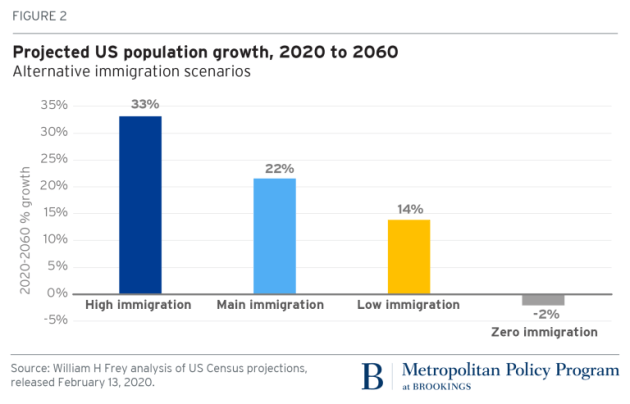
The projected populations over the 40-year period between 2020 and 2060 indicate a wide range of outcomes. The “main” immigration scenario would lead to population growth of 22%, from 333 million to 404 million. This is less than half of the 46% growth observed over the previous 40-year period, and reflects the fact that—compared to the past—the nation’s aging population will be experiencing higher death rates and more modest fertility rates.

Fig1

Fig2

The results of the three alternative scenarios are varied. The 2060 U.S. population size in the high-, low-, and zero-immigration scenarios is 447 million, 376 million and 320 million, respectively—representing growth rates of 33%, 14%, and -2%. In the zero-immigration scenario, the population begins to decline in 2035 due to a combination of more deaths than births and that emigration from the U.S. would not be countered by immigration into it.

Zero immigration would be demographically unsustainable and unlikely to occur. However, even the low-immigration scenario would lead to tepid population growth rates—in the range of 0.2% to 0.3%—over the final 20 years of the projection period.

DIVERSITY WILL RISE UNDER ALL IMMIGRATION SCENARIOS

Much of the current political discourse equates immigration with a rise in racial and ethnic diversity. While it is true that a large share of immigrants are people of color (especially those arriving from Latin America, Asia, and Africa), the new projections show that the U.S. will continue to become more racially diverse under all migration scenarios, even with zero additional immigration.

A major reason for this is the aging and projected decline of the population of whites who do not identify with another race or ethnic group. In 2018, the median age of this population was 44, compared to 38 for the nation as a whole, 29.5 for the Latino or Hispanic population, and 21 for those of two or more races. With a rising number of deaths compared to births, the older white population will experience a natural decrease in all projection scenarios, which immigration flows will not counter.

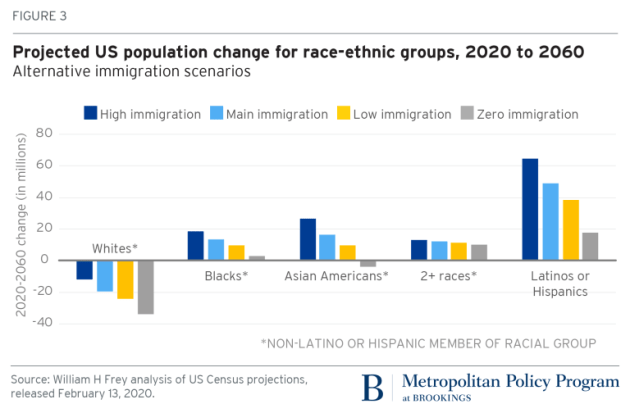
Fig3

The other race-ethnic groups will show mostly positive population contributions over each projection scenario. The largest will occur for the Latino or Hispanic population, which will increase between 18 million and 64 million over the 40-year period, depending on the scenario. Births from existing Latino or Hispanic residents will lead to a natural increase in this population even under low- and zero-migration scenarios.

All other race and ethnic groups contribute to projected population gains with the exception of Asian Americans, whose size is reduced under the zero-immigration scenario. In this case, Asian emigration from the U.S. is not countered by a natural increase. It is noteworthy that in both the low- and zero-immigration scenarios, persons identifying with two or more racial groups contribute more to projected population gains than Black or Asian American residents.

No matter the scenario, the U.S. will experience a rise in the share of the total population that identifies as a nonwhite race or ethnic group.

Fig4

Table 1

Fig5

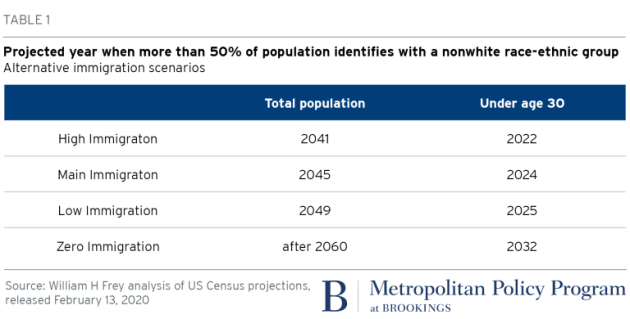
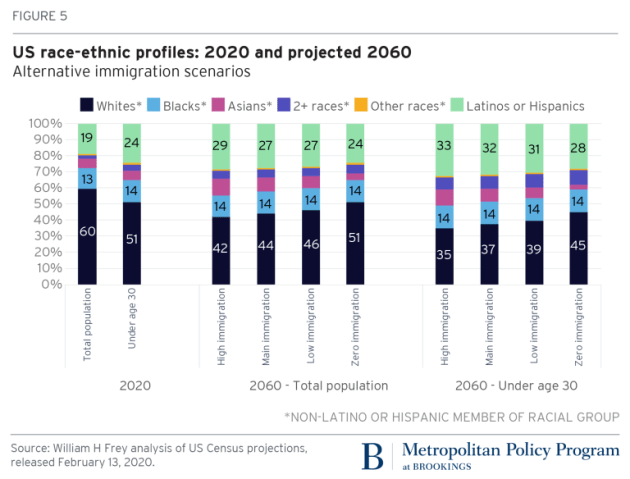
As previously reported, the “main” immigration scenario shows that in 2045, more than 50% of the U.S. population will identify as a nonwhite race or ethnic group, rising to 56% in 2060. In the high-immigration scenario, the 50% tipping point occurs in 2041; in the low-immigration scenario, it is 2049. Even in the zero-immigration scenario, the share of the U.S. population that identifies as a nonwhite race or ethnic group will rise to 49% by 2060.

Because all nonwhite race and ethnic groups are, on average, younger than white residents, their shares of the under-30 population are even larger than for the population as a whole. More than half of the under-30 population is projected to identify with a nonwhite group by the year 2024 in the main immigration scenario; in 2022 for the high-immigration scenario; and in 2025 for the low-immigration scenario. In the zero-immigration scenario, the share of the under-30 population that identifies as a nonwhite race or ethnic group exceeds 50% in 2032 and all years thereafter.

While shrinking in size, the white population is projected to comprise a larger share of the total population than any other single racial or ethnic group in all scenarios. The next largest group in all projections is the Latino or Hispanic population, which is projected to comprise around a quarter of the total population and roughly 30% of the under-30 population by 2060. 

IMMIGRATION IS NEEDED TO BOLSTER YOUNGER POPULATION GROWTH

The aging of the U.S. population over the next decade will be propelled by the large baby boomer generation entering its senior years. Meanwhile, the younger population will be growing far more tepidly. This aging will be especially acute over the 2020 to 2035 period—as a result, immigration will make an important difference in how much the nation’s youth (under-18) and primary labor force (ages 18 to 64) populations grow.

Fig5

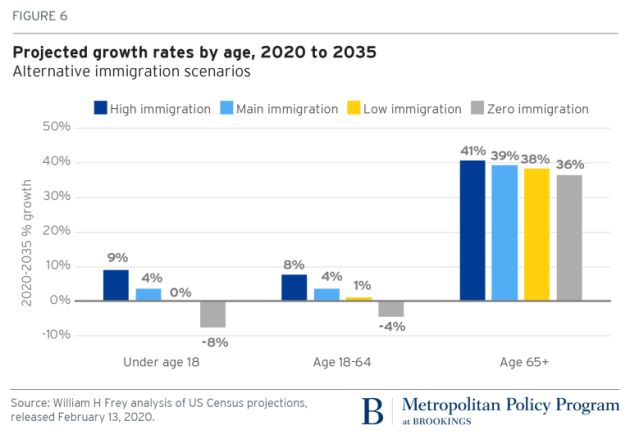
Under the high-immigration scenario, the youth population would grow by 9% and the labor force population would grow by 8% from 2020 to 2035. Both populations would grow by a modest 4% if current immigration patterns persist. A low- or zero-immigration scenario, however, would lead to stagnating growth or declines for these populations, while the 65-and-older population experiences a projected growth rate exceeding 36%.

The short-term implications of lower immigration levels could lead to noticeable labor force shortages. The longer-term impact is increased age dependency: the extent to which the retirement-age population will be dependent on younger workers for support. In 2020, the old-age dependency ratio (a measure of age dependency found by dividing 65-and-older population by the 18- to 64-year-old population) is 28. But as the population ages over the next 40 years, and age dependency rises, immigration will make a difference. In 2060, the dependency ratio can vary from 39 (under the high-immigration scenario) to a whopping 48 under the zero-immigration scenario. The latter would mean there would be only two working-age persons for every retiree.

THE NECESSITY OF IMMIGRATION TO THE NATION’S FUTURE

The Census Bureau’s alternative population projections make plain that continued immigration at current levels—at a minimum—is necessary to maintain the nation’s growth. With a rapidly aging native-born population, immigration will ensure growth—especially among the youth and labor force populations. Any appreciable lowering of immigration levels will lead to tepid national population growth, potentially negative growth in the youth population, and extreme age dependency.

It is also important to note that the nation will continue to become more racially and ethnically diverse under all immigration scenarios. This is a function of the country’s already large and youthful nonwhite populations, and the projected aging and decreased size of the white population.

Any political rhetoric suggesting that reduced immigration will make the nation “whiter” flies in the face of demographic evidence. In fact, the main reason the United States is growing more rapidly than most other industrialized counties stems from its healthy immigration levels over the past four decades. The Census Bureau’s projections suggest that similar or higher immigration levels will be necessary for the nation to grow and prosper in the decades ahead.

Source: Reducing immigration will not stop America’s rising diversity, Census projections show

Denver’s government doesn’t hold citizenship ceremonies anymore because the federal government won’t share

Petty and counterproductive:

Taking an oath to America is the last step of a complex journey to naturalization — one that Denver has been happy to show off at public libraries and other government buildings in the past during so-called naturalization ceremonies.But several months ago, the federal government blacklisted the city government from holding the feel-good ceremonies that showcase new citizens of the United States in Denver. The U.S. Citizenship and Immigration Services stopped working with the city on the ceremonies after June of 2019, about two years after the city council made it illegal for Denver government employees to share information with federal immigration authorities.

New citizens don’t need a public ceremony to become citizens. They can take oaths at federal offices, which still occurs every day. But naturalization ceremonies are symbolic shows of patriotism as well as bows on a bureaucratic process, and local governments cannot hold the events without citizenship status and other information from federal immigration officials — information that they’ve stopped sharing with the Hancock administration.

“The mission of USCIS is to both celebrate American citizenship through naturalization ceremonies as well as protect the homeland by ensuring the integrity of our immigration system. Unfortunately, the City and County of Denver chooses not to work with USCIS on investigations of potential fraud, which negatively impacts USCIS’ ability to fairly and accurately adjudicate cases involving national security concerns and fraud,” said Jessica Collins, USCIS spokesperson. “Given the situation, USCIS will not be able to collaborate with the City and County of Denver to hold naturalization ceremonies until the City and County of Denver cooperates on the overall USCIS’ mission.”

City Councilwoman Jaime Torres, who formerly headed the Denver Office of Immigrant & Refugee Affairs before taking office, called the decision by USCIS “deeply disappointing.”

“We had been so intentional about celebrating naturalization and citizenship,” she told Denverite.

The blackout has so far gone unannounced.

“If we complain every single time (the Trump) administration did something that is contrary to what this city’s values are, you guys would get sick of us,” said Rowena Alegría, the city’s chief storyteller (that’s her real title).

July 6, 2019 marks the last time USCIS partnered with Denver on a ceremony, a spokeswoman for the federal immigration department said. However at least one ceremony has been held in the city on private property since then. Suburbs around Denver are still hosting the ceremonies.

Denver has partnered with USCIS on these ceremonies for years, developing cross-governmental relationships along the way, Alegría said. And then one day, they had to cut ties. She said the city continues to support and celebrate immigrants in different ways, like My Civic Academy, a leadership program to teach new citizens about Denver.

Source: Denver’s government doesn’t hold citizenship ceremonies anymore because the federal government won’t share

‘What Part of Illegal Don’t You Understand?’

Really good long read by Sonia Nazario, mix of personal account and policy discussion (excerpt):

My family has been running from danger for nearly 100 years. The Nazarios are refugees; their remnants have scattered around the world to survive. My Jewish mother fled Poland in 1933. My Christian father fled Syria two years earlier. They met and married in Argentina, whose right-wing dictatorship imprisoned and almost killed my sister. By giving us a home, the United States saved our lives.

Would it do the same today?

The Trump administration has barred those seeking refuge from our borders and turned our immigration courts into a joke. This is a betrayal of America’s decades-long role as a world leader in refugee protection. It also breaks our own laws and treaty commitments, which say we will take people in, give them a fair court hearing and not return them to harm.

But it is not a total historical anomaly. America has gone through spasms of nativism before. In 1939, Congress tabled a bill to take in 20,000 Jewish children, and the SS St. Louis, which carried 937 Jewish refugees, was turned away from the docks; hundreds aboard were murdered in the Holocaust.

Then, as now, many on both the right and the left have argued that the choice Americans face on immigration and asylum is between zero tolerance and opening the floodgates. But this is a false choice. We can have an immigration policy that is sane and humane.

….

The American government generally does not allow innocent people to be imprisoned, raped and shot in the back. These are the kinds of experiences refugees who come here seeking safety are fleeing.

We can have a pragmatic, compassionate refugee policy. We don’t have to choose between letting everyone in and no one in.

Conservatives may not like this, but we have to let through people who say they are afraid. Allow applicants into the United States and monitor them until their court hearings (which nine in 10 do show up for). Don’t lock them up, as we are doing with some 60,000 immigrants a night, in places where they get inadequate medical care. At least seven migrant children have died in immigration custody since 2018. This simply didn’t happen before. Our government is killing children through neglect.

Make the court process fair; make it fitting of our country. Take our increasingly politicized immigration courts out of the Department of Justice and make them independent. Make sure that immigrant children have a government-funded lawyer, since most cannot afford representation, which basically guarantees they will lose. From October 2017 to June 2018, 70 babies went to court alone.

Liberals might not like this, but we also have to deport migrants who lose their cases. President Trump refers to asylum as a “loophole” in our system. That’s bogus. Yet there is another loophole that must be addressed: A vast majority of those who lose their asylum cases don’t leave the country. They stay and blend into the woodwork. This rightfully riles Americans who believe these unsuccessful asylum-seekers are thumbing their noses at our legal process. Require Immigration and Customs Enforcement to focus on deporting people who have just lost their asylum cases, not the parent who has been here 30 years.

Democrats need to get woke and realize that any immigration reform plan has to show they believe in the rule of law. I’ve lived in a country with no laws. Democrats don’t want that. We cannot take in everyone, so we need to prioritize those fleeing harm. Stop talking about idiotic things like open borders. Or liberals will keep losing on this issue.

There’s something ready-made for Americans who care about this travesty to lobby for: the Refugee Protection Act, introduced in Congress in November. It would require the United States to take in far more refugees, including at least 100,000 a year from El Salvador, Guatemala and Honduras alone. It would prevent the government from forcing people to apply for asylum in other countries they passed through on the way here, and prohibit ports of entry from pleading overcrowding as an excuse to turn people away. It would exempt migrants from criminal prosecution for crossing without documents, and allow asylum-seekers to be released temporarily in the United States if they pose no risk to public safety. It would reverse a Trump administration decision that bars people fleeing domestic or gang violence from obtaining asylum. And it would require our government to appoint lawyers for migrant children.

Americans need to stop whining and to ride Congress to pass this bill. Every one of my fellow Jews in this country should have their hair on fire over this — especially folks like Jared Kushner, whose Polish family, like mine, found safety here.

I often get asked: What part of “illegal” don’t you understand? Well, our laws say we have to help people who are running for their lives. Take it from a Nazario: President Trump is the one who has broken the law.

Mexican, Canadian engineers avoid US due to living expenses, immigration policy

Of note:

  • Thirty-nine percent of Canadian and Mexican engineers would prefer not to move to the U.S., according to report from Terminal released Feb. 11. The Terminal survey comprised 483 engineers.

  • Ninety percent of those who would refrain from a U.S. move cited high cost of living. Others said traffic and parking (45%), their current communities (46%) and immigration issues (40%) stop them from moving to the U.S.

  • “Tech companies can no longer ignore that the once-sacrosanct dream of moving to the U.S. to lead the next generation of innovation is fading,” said Clay Kellogg, CEO of Terminal, in a media release. “Moreover, the tech talent shortage means it’s harder to innovate and makes life harder on engineers who are already in the trenches.”

Dive Insight:

Tech professionals in a CompTIA survey shared concerns over living expenses with the Canadian and Mexican engineers. CompTIA found that 78% of the tech professionals it polled said they would relocate, with many citing affordability and the economy.

It’s not surprising that immigration would pose a barrier for Canadian and Mexican engineers. The Trump administration has restricted the number of H-1B visas available for highly skilled foreign nationals, leaving employers in need of these workers feeling short-changed. An October 2019 Indeed study found that, as immigration policies tightened and visa approvals dropped, there was a 673% increase in work visa job searches.

Source: Mexican, Canadian engineers avoid US due to living expenses, immigration policy

Rethinking politics: A better path to faithful citizenship [on Catholics and politics]

On Catholics, politics and partisanship:

For the last 44 years, the United States Conference of Catholic Bishops has published Faithful Citizenship, a “teaching document on the political responsibility of Catholics.” There is much in Faithful Citizenship to recommend it. Yet, it has begun to seem to me like it is time for something new. I say this only partly because the bishops proved unable to offer a new version of the document for this election that would revise the document, last re-written in 2007 before Pope Francis had begun his ministry. I say it also because there are persuasive signs that the whole approach of Faithful Citizenship has failed.

The Pew Research Center released figures last year that paint a devastating picture of how Catholics approach politics. On issue after issue, whether we discuss extending the border wall or whether climate change is caused by human activity, there was no measurable difference between Republicans and Catholics who identify as Republicans, between Democrats and Catholics who identify as Democrats. The discouraging picture is clear: 44 years of “Forming Consciences for Faithful Citizenship” has left Catholics looking just like non-Catholics in American political life. Being Catholic makes no discernible difference. In politics, we are not Catholics. We are partisans, just like everybody else.

Considering how much effort the bishops have devoted to Faithful Citizenship, the scale of this calamity should stop us dead in our tracks. Especially as we look around at our world and the role Catholics have played in fueling our polarized political climate, now seems like a good time to re-think how we engage with politics as faithful citizens from the ground up. In fact, I think we are obligated to do that. For that reason, I am asking readers to join me on a journey for the next six months. In these next six columns, I will take some space to reflect on a better way to be faithful citizens. My hope is that I can raise some good questions and provoke some thought.

I’d like to begin by asking an elemental question: What is politics?

The question seems simple. Politics is familiar. We use the word all the time. The Corpus of Contemporary American English places politics at 954th out of more than 170,000 words in frequent usage (top 1 percent). There is little that could be more familiar to us. And yet, we use the word politicsincorrectly almost every time.

The study of politics began in the ancient Greek polis. The best way I can translate the original sense of what politics meant (politeia) is to say that it refers to “what the people share in common.” This is the sense that is closest to how Catholic social teaching understands politics, as well. Too often when we say politics, we mean partisanship, taking sides in a divisive conflict. But narrow self-interest is the opposite of what politics really means. When we misuse the word, we are cheating ourselves. We are depriving ourselves of the best hope we have against narrow self-interest: a sense that politics calls us out of ourselves, toward something greater.

When President Kennedy established the Peace Corps in 1961, he called on young people “to sacrifice their energies and time and toil to the cause of world peace and human progress.” He was calling them away from individual self-interest toward a greater common good. We do not need to sacrifice our consciences or our convictions. But we must sacrifice our certainty that other people are proceeding from bad motives. Politics in this better sense is about learning together how to disagree together, while still working together toward justice, peace, and the common good. Somehow, we Americans became captives to a different idea. And, because we are indistinguishable from other Americans, Catholics became captive to that idea too.

If our politics ever is going to be something better than a football game, it falls on Catholics to bear witness to a real alternative, a different way to think about politics that focuses on the common good instead of endless conflict. And the best way to approach this is by living our Catholic faith in politics less like a checklist of issue positions and more like an ongoing invitation to dialogue and engagement. We must recognize that we share the community with everyone, and everyone belongs to the community. We can—and, must—dialogue with those who disagree with us. After all, we cannot expect them to listen to us if we will not hear out their deepest concerns, too.

If Catholics want to shape a public conversation more concerned with protecting the most vulnerable, then we must change ourselves and how we engage the conversation. We must experience a conversion. We must offer something different, instead of reflecting back the partisanship our politics already offers. We must do better.

Source: Rethinking politics: A better path to faithful citizenship

ICYMI: Trump Got His Wish. Mexico Is Now the Wall.

Just like the STCA between Canada and the USA largely made the US the Canadian wall at official border crossings (with the irregular arrivals elsewhere being the loophole:

Mexico is now the wall. President Trump got his wish.

The heart-wrenching images documenting a recent confrontation in the state of Chiapas, near the border with Guatemala, are evidence of this. Dozens of Mexican National Guard troops equipped with helmets, batons and transparent shields coalesced on the highway connecting the Mexican cities of Ciudad Hidalgo and Tapachula to stop a caravan of migrants heading to the United States from Central America.

The guardsmen used pepper spray on the caravan, which as of mid-January included about 4,000 people, many of them women and children. In the end, hundreds were detained, sent back to Guatemala or deported to Honduras. A spokeswoman for the U.N. High Commissioner for Human Rights condemned the actions of the National Guard, saying that the use of force to stop and disperse immigrants should be avoided.

Mexico has effectively turned into an extension of Mr. Trump’s immigration police beyond American territory. And this is the case on multiple fronts: On the southern border with Guatemala, they prevent Central American migrants from coming into Mexico; on the northern one, they block those seeking entry to the United States from leaving. The decision of Mexico’s President Andrés Manuel López Obrador, also known as AMLO, to follow this approach is misguided. He should let migrants continue their journey north.

Under the Migrant Protection Protocols program, which the Trump administration introduced in January 2019, asylum seekers who attempt to enter the United States at the U.S.-Mexico border may be required to stay in Mexico while the authorities make a decision regarding their case. As of November 2019, over 56,000 people had been sent back to Mexico to wait for the outcome of their applications, according to Human Rights Watch.

This is a radical change in immigration policy for the United States. In the past, Central American asylum seekers were allowed to remain on American soil while waiting for their cases to be processed.

Central American immigration has always been a source of frustration for the United States. But the most powerful country in the world holds a certain degree of responsibility for what goes on in its hemisphere, and it is perfectly capable of accepting the most vulnerable people on the continent. It has done it before, and can still do it.

So when did the United States’ problem become Mexico’s problem? Everything changed because of Donald Trump. By mid-2019, a number of Central American caravans were traveling across Mexico. The president, comparing them to an invasion, warned Mexico that they should do something to stop them, and that he would slap tariffs on all Mexican imports if it didn’t.

“Their right to make a living, to not be abused, to be protected, helped, and supported should be safeguarded,” Mr. López Obrador, then president-elect, said in October 2018 of the Central American migrants heading north. Unfortunately, he has since backtracked, pulling back on his promises to the migrants.

When a journalist asked him during one of his daily news conferences about the harassment and intimidation of Central American migrants in southern Mexico, AMLO refused to take the victims’ side. And Kenneth T. Cuccinelli II, acting deputy secretary of Homeland Security, said that the Trump administration had seen more cooperation from Mexico “than anyone thought was possible.”

Mr. Cuccinelli is right. Over a year ago, few would have thought that a leftist president like AMLO (author of a critical book titled “Oye, Trump” and defender of Central Americans crossing Mexico) would suddenly become Mr. Trump’s main ally in immigration matters.

Mr. López Obrador has said that he favors a “peace and love” policy toward the United States and will avoid confrontation with Mr. Trump. There’s nothing wrong with wanting a good relationship with a powerful neighbor who also happens to be your main trade partner. But we should also remember that Mexico has been exporting immigrants to the United States for decades. Millions of us live on American soil.

That’s why I am surprised by the indifference shown by so many Mexicans over the abuses of the National Guard and the vicious attacks on social media aimed at Central Americans. Those xenophobic comments remind me of those I have been hearing for decades here in the United States, and of the appalling mistreatment of Mexican immigrants in recent years. Such abuses should not be forgotten or used to justify a similar treatment of migrants in Mexico.

Northward migration is hardly a new phenomenon. For decades it has provided the United States with a much-needed labor force, and the migrants and refugees who put everything on the line to make the journey with an opportunity to improve their lives. I am fully aware that the American immigration system is far from perfect. It is in dire need of a complete makeover. But Mexico shouldn’t be an extension of the Border Patrol. That makes things worse for everybody.

What should Mexico be doing with migrants from Central America? Just let them go through and protect them as they do so, instead of repressing them. They are fleeing extreme poverty and gang violence. Their only hope is to get to the United States. The Trump administration, not the López Obrador administration, should be receiving them and deciding whether they should be granted political asylum.

How a simple computer game simulated the dizzying U.S. immigration process

Neat experiment:

People fear and mistrust what they don’t know—including people of other racial and ethnic backgrounds. That lack of trust causes social and political divisions in the US and around the world, especially when it comes to immigrants.

Inspired by research in Hungary that found computer games could help players reduce their prejudice toward immigrants, my colleague Patrick Stewart devised a role-playing game as part of an American national government course at the University of Arkansas. I helped to develop survey measures for tracking changes in trust during the game.

Our hope was that by playing the game over the course of a semester, students would come to understand a bit more about what immigrants go through in the US, and as a result, perhaps trust could develop.

We found that it was possible for a role-playing game to help simulate shared experiences with immigrants, even in a group of mostly white, conservative students. This helped trust in immigrants to grow.

Creating an identity

The game, called “Citizenship Quest,” was played in an online learning platform for the fall 2018 and spring 2019 semesters. Most of the students were freshmen and sophomores.

At the beginning of each semester, the students completed a survey about their interest in politics, while also answering questions about how much they trusted immigrants. They completed the same survey at the end of the semester, after the game was over, which allowed us to track changes in immigrant trust over time.

Once we had their initial results, we assigned each student to role-play as a character from Mexico, India or China, origins of the three largest immigrant groups in America. The students got to pick their character’s gender, and a gender-appropriate name was assigned to them on the basis of the most popular names in their character’s country.

Next, the students created fuller back stories for their characters, fleshing out their work history, past residences and even physical characteristics such as hair and eye color.

Learning about paperwork

For the next phase of the game, each student applied for permission to live and work in US on behalf of their character. We had them complete the proper paperwork, including the 18-page I-485 form “Application to Register for Permanent Residence or Adjust Status” and the seven-page I-765 form “Application for Employment Authorization.” They signed their character’s name to the forms as well.

We also asked them to submit a photograph of their hands, to imitate the fingerprinting process.

Finally, we had them simulate applying for U.S. citizenship. This meant filling out the 20-page N-400 form “Application for Naturalization” and submitting another photograph of their hands.

All paperwork was uploaded to us through the course website—not to actual immigration authorities. And of course, we didn’t ask them to pay the $2,445 in federal fees associated with filing those forms.

Economic progress

The game used a scoring system that functioned sort of like a currency, so we called it “coin.” All the players started with a modest sum, and they could earn more coin by completing weekly assignments such as chapter quizzes on time. The game included random positive events as well, like having their character receive a new letter of reference or being profiled in the local newspaper as a volunteer. These added to the player’s coin.

Players could also earn coin by either buying or preparing food from their character’s country and writing 150 words about their experience with the food and what they thought of it. They took a picture of the food as well, with at least one of their hands being clearly visible in the shot—as a means of reinforcing their personal connections to characters.

The students could elect to spend some of their coin on in-game advantages like an immigration attorney to help speed their applications along. Attorneys could also help to defend against the random negative events, such as application files getting lost in the mail or finding out a character’s name was on a list of people judged to be security threats. If students didn’t spend coin to defend against these possibilities, they ran the risk of losing some of their coin to the perils of the system.

At the end of the game, students took the U.S. citizenship exam, before retaking the survey about trust in immigrants. Their ability to complete the paperwork, do well on the citizenship exam, and accumulate coin became part of their overall grade in the course.

Trusting over time

We found that students came to trust more in immigrants in general, and in immigrant groups they role-played as more specifically, by playing the game.

Student comments further suggest they came to grasp the frustrating nature of the citizenship process, even if unwillingly. One white male wrote, “Just because you want to show us how in real life there are unexpected factors that occur and cause setbacks doesn’t mean you should take away class points.” Another white male wrote that we should delete the game, because “it has nothing to do with U.S. Government. Role-playing is disgusting and busywork.” He reported that playing the game did not change his view of U.S. immigration policies either.

On the other hand, a Latina student mentioned that she had obtained citizenship herself in the past year, and said she “loved the thought process” at work behind the game. She pointed out that the game was still “much easier” than the real thing, but we were heartened to hear her recognize and appreciate its value.

In the end, we find evidence that role-playing as immigrants applying for citizenship is related to trusting them. Games can be used to acquaint citizens with the trials and tribulations immigrants go through, as a set of shared experiences upon which to build connections and trust in the future.

Source: How a simple computer game simulated the dizzying U.S. immigration process

White supremacist propaganda spreading, anti-bias group says [ADL]

The latest from ADL. Correlates with the Trump presidency and the license it provides:

Incidents of white supremacist propaganda distributed across the nation jumped by more than 120% between 2018 and last year, according to the Anti-Defamation League, making 2019 the second straight year that the circulation of propaganda material has more than doubled.

The Anti-Defamation League’s Center on Extremism reported 2,713 cases of circulated propaganda by white supremacist groups, including fliers, posters and banners, compared with 1,214 cases in 2018. The printed propaganda distributed by white supremacist organizations includes material that directly spreads messages of discrimination against Jews, LGBTQ people and other minority communities — but also items with their prejudice obscured by a focus on gauzier pro-America imagery.

The sharp rise in cases of white supremacist propaganda distribution last year follows a jump of more than 180% between 2017, the first year that the Anti-Defamation League tracked material distribution, and 2018. While 2019 saw cases of propaganda circulated on college campuses nearly double, encompassing 433 separate campuses in all but seven states, researchers who compiled the data found that 90% of campuses only saw one or two rounds of distribution.

Oren Segal, director of the League’s Center on Extremism, pointed to the prominence of more subtly biased rhetoric in some of the white supremacist material, emphasizing “patriotism,” as a sign that the groups are attempting “to make their hate more palatable for a 2020 audience.”

By emphasizing language “about empowerment, without some of the blatant racism and hatred,” Segal said, white supremacists are employing “a tactic to try to get eyes onto their ideas in a way that’s cheap, and that brings it to a new generation of people who are learning how to even make sense out of these messages.”’

The propaganda incidents tracked for the Anti-Defamation League’s report, set for release on Wednesday, encompass 49 states and occurred most often in 10 states: California, Texas, New York, Massachusetts, New Jersey, Ohio, Virginia, Kentucky, Washington and Florida.

Last year’s soaring cases of distributed propaganda also came as the Anti-Defamation League found white supremacist groups holding 20% fewer events than in 2018, “preferring not to risk the exposure of pre-publicized events,” according to its report. That marks a shift from the notably visible public presence that white supremacist organizations mounted in 2017, culminating in that summer’s Charlottesville, Va., rally where a self-described white supremacist drove into a crowd of counterprotesters.

About two-thirds of the total propaganda incidents in the new report were traced back to a single white supremacist group, Patriot Front, which the Anti-Defamation League describes as “formed by disaffected members” of the white supremacist organization Vanguard America after the Charlottesville rally.

The Anti-Defamation League, founded in 1913 to combat anti-Semitism as well as other biases, has tracked Patriot Front propaganda using messages such as “One nation against invasion” and “America First.” The report to be released Wednesday found that Patriot Front played a major role last year in boosting circulation of white supremacist propaganda on campuses through a push that targeted colleges in the fall.

Segal said that his group’s research can equip community leaders with education that helps them push back against white supremacist groups’ messaging efforts, including distribution aimed at students.

University administrators, Segal said, should speak out against white supremacist messaging drives, taking the opportunity “to demonstrate their values and to reject messages of hate that may be appearing on their campus.”

Several educational institutions where reports of white supremacist propaganda were reported in recent months did just that. After white supremacist material was reported on campus at Brigham Young University in November, the school tweeted that it “stands firmly against racism in any form and is committed to promoting a culture of safety, kindness, respect and love.”

The school went on to tweet a specific rejection of white supremacist sentiment as “sinful” by its owner, the Church of Jesus Christ of Latter-day Saints, without naming the identity of the group behind the propaganda.

While some of the propaganda cataloged in the Anti-Defamation League’s report uses indirect messaging in service of a bigoted agenda, other groups’ activity is more openly threatening toward Jews and minority groups. The New Jersey European Heritage Association, a smaller white supremacist group founded in 2018, “contains numerous anti-Semitic tropes and refers to Jews as ‘destroyers’” in its most recent distributed flier, according to the report.

The Anti-Defamation League’s online monitoring of propaganda distribution is distinct from its tracking of white supremacist events and attacks, and that tracking does not include undistributed material such as graffiti, Segal explained.

Source: White supremacist propaganda spreading, anti-bias group says