Le Devoir Éditorial | De droit et de dignité et Nicolas | Terrains propices
2024/08/16 Leave a comment
Starting with Le Devoir’s measured response to the UN special rapporteurs report on “contemporary forms of slavery:”
Un rapporteur spécial de l’ONU persiste et signe dans sa description du Programme des travailleurs étrangers temporaires du Canada. Il s’agit là d’une mesure qui « alimente les formes contemporaines d’esclavage ». Le constat est brutal, bien qu’il soit en droite ligne avec les premières observations formulées il y a près d’un an par le rapporteur, Tomoya Obokata. Reste à savoir ce que les gouvernements fédéral et provinciaux sont prêts à faire pour corriger le « déséquilibre de pouvoir » entre les travailleurs temporaires et leurs employeurs.
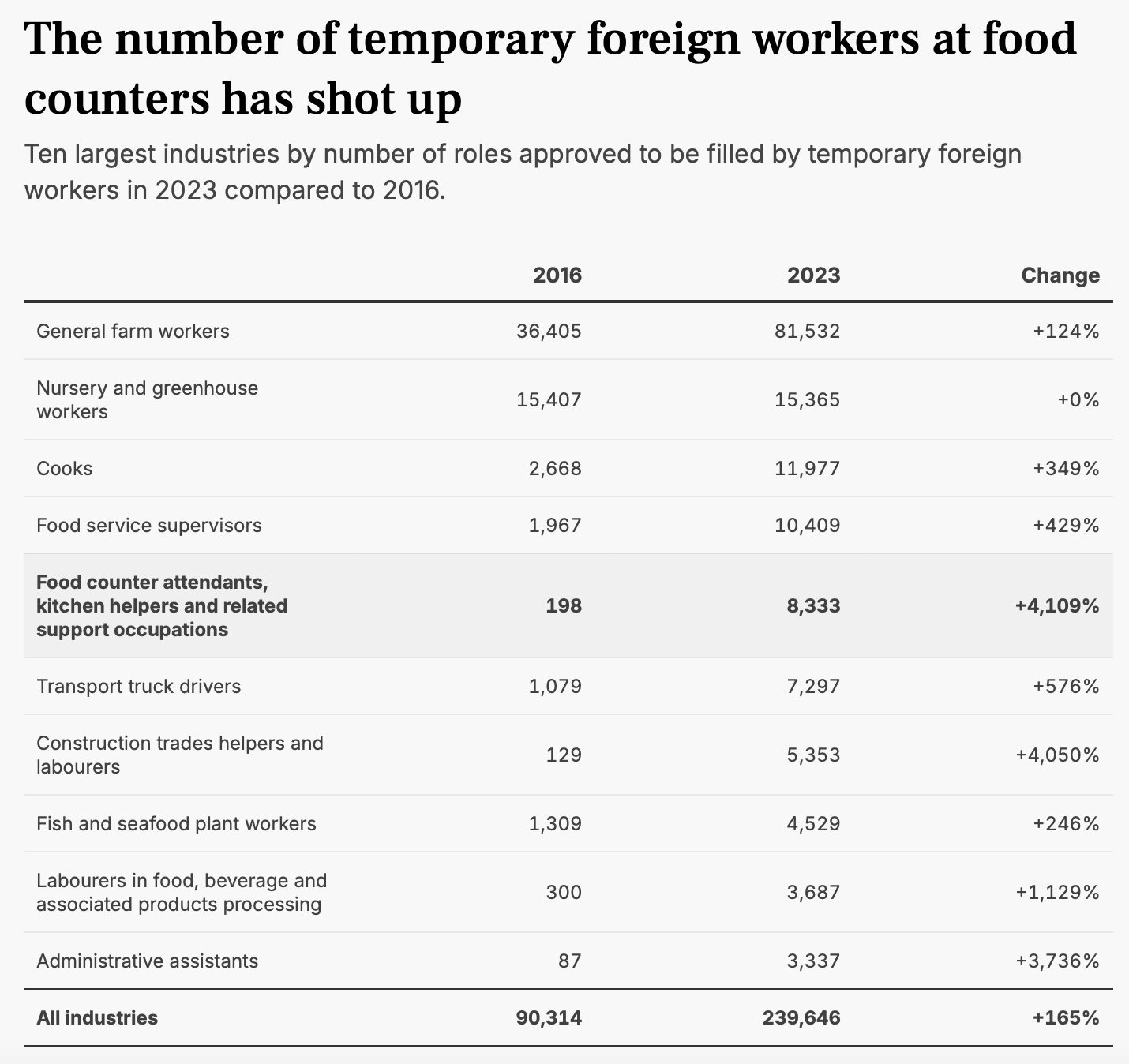
Le rapporteur des Nations unies souligne de nombreux facteurs de risques dans le programme fédéral, géré en partenariat avec les provinces, en vertu duquel les employeurs font venir de la main-d’oeuvre bon marché, en majorité dans le secteur agricole au temps des récoltes. Celles-ci prennent les allures d’une corvée peu inspirante pour les populations locales dans un contexte de pénurie de main-d’oeuvre et de transformation du marché de l’emploi vers une économie du savoir. Nous pouvons en dire autant pour d’autres secteurs névralgiques pour notre confort ou nos habitudes de consommation au rabais, tels que la transformation des aliments, l’aide en cuisine, les soins aux aînés. Sans les travailleurs étrangers temporaires, bien des chaînes de production seraient enrayées.
Les inquiétudes du rapporteur de l’ONU portent sur la grande précarité dans laquelle se retrouvent les travailleurs étrangers puisqu’ils séjournent au Canada sur la base d’un permis « fermé » les liant à un employeur exclusif. Si les conditions de travail et d’hébergement ne remplissent pas leurs attentes ou le minimum de la décence, il leur est presque impossible de dénicher un autre boulot, au risque d’être expulsés. Cette situation de dépendance est la mère de tous les abus potentiels relevés par le rapporteur spécial : maltraitance, retenues salariales, horaires excessifs, carences dans la sécurité, l’alimentation et l’hébergement, voire des violences physiques ou sexuelles dans les pires cas.
L’enjeu, qui déborde les frontières du Québec, demeure relativement contenu. Le rapporteur spécial constate avec satisfaction que la majorité des employeurs (94 %) respectent les règles et agissent de bonne foi à l’égard de leurs travailleurs étrangers temporaires. Dans les dernières années, les employeurs et les gouvernements ont multiplié les initiatives pour protéger les droits de cette main-d’oeuvre vulnérable et lui garantir l’accès aux soins de santé.
Il n’en demeure pas moins que le processus d’inspection est pour le moins incomplet. Selon les données du gouvernement fédéral, près de sept inspections sur dix ont été menées en ligne en 2023 et 2024. Moins d’une inspection sur dix a été menée de manière impromptue. Par ailleurs, les freins dans l’accès aux soins de santé, aux conseils syndicaux et à des sites d’hébergement appropriés demeurent d’importantes sources de préoccupation.
Le rapporteur de l’ONU ne s’y trompe pas. La situation décrite dans son rapport est conforme à de nombreux reportages d’enquête, entre autres dans Le Devoir, et aux observations des groupes communautaires qui viennent en aide aux travailleurs temporaires étrangers.
Une des solutions évoquées dans le débat public, soit accorder des permis « ouverts » ou sectoriels aux travailleurs étrangers (des permis qui ne sont pas reliés à un employeur en particulier), ne va pas assez loin aux yeux du rapporteur spécial. Tomoya Obokata suggère plutôt de faciliter le passage vers la résidence permanente, afin de mettre un terme à la « précarité structurelle » de cette main-d’oeuvre particulière. Cela marquerait la fin des permis fermés ou même ouverts.
Le rapporteur spécial justifie son approche en soulignant la contradiction entre le caractère théoriquement temporaire des emplois et le caractère permanent de la demande de main-d’oeuvre. Les programmes de travailleurs étrangers temporaires ont par ailleurs dépassé le cap de la cinquantaine, une autre preuve de leur apport indispensable au marché du travail. Seulement, rien n’indique qu’une accélération du processus menant à la résidence permanente produirait les effets escomptés, autant pour combler les besoins temporaires de main-d’oeuvre que pour assurer un traitement respectueux des droits et de la dignité des travailleurs. Sans compter qu’il s’agit d’un enjeu explosif par les temps qui courent dans les relations intergouvernementales.
Les questions de droit et de dignité devraient tout de même inciter les gouvernements à en faire plus en prévention, en inspection et en sanctions pour les employeurs fautifs, et à sevrer les employeurs des permis fermés là où ils sont encore en vogue. Nous ne pouvons fermer les yeux sur une situation indigne d’un État qui a l’habitude de se contempler dans le miroir de la réussite en matière de respect des droits et libertés fondamentaux. L’esclavage contemporain ne devrait pas faire partie des préoccupations des instances de l’ONU lorsqu’il est question d’ausculter nos pratiques à l’égard des ressortissants précaires et vulnérables.Translation (Mac)
A UN special rapporteur persists and signs in his description of the Canada Temporary Foreign Worker Program. This is a measure that “feeds contemporary forms of slavery”. The observation is brutal, although it is in line with the first observations made almost a year ago by the rapporteur, Tomoya Obokata. It remains to be seen what the federal and provincial governments are ready to do to correct the “power imbalance” between temporary workers and their employers.
The United Nations rapporteur highlights many risk factors in the federal program, managed in partnership with the provinces, under which employers bring in cheap labor, mostly in the agricultural sector at harvest time. These take on the appearance of an uninspiring chore for local populations in a context of labour shortage and transformation of the job market towards a knowledge economy. We can say the same for other neural sectors for our comfort or discounted consumption habits, such as food processing, kitchen help, care for seniors. Without temporary foreign workers, many production lines would be stopped.
The UN rapporteur’s concerns relate to the great precariousness in which foreign workers find themselves since they stay in Canada on the basis of a “closed” permit linking them to an exclusive employer. If the working and accommodation conditions do not meet their expectations or the minimum of decency, it is almost impossible for them to find another job, at the risk of being expelled. This situation of dependence is the mother of all the potential abuses noted by the special rapporteur: abuse, wage deductions, excessive hours, deficiencies in safety, food and accommodation, or even physical or sexual violence in the worst cases.
The issue, which goes beyond the borders of Quebec, remains relatively contained. The special rapporteur notes with satisfaction that the majority of employers (94%) respect the rules and act in good faith towards their temporary foreign workers. In recent years, employers and governments have multiplied initiatives to protect the rights of this vulnerable workforce and guarantee them access to health care.
The fact remains that the inspection process is incomplete to say the least. According to federal government data, nearly seven out of ten inspections were conducted online in 2023 and 2024. Less than one in ten inspections was conducted impromptuly. In addition, barriers to access to health care, trade union councils and appropriate accommodation sites remain important sources of concern.
The UN rapporteur is not mistaken. The situation described in his report is consistent with many investigative reports, including in Le Devoir, and the observations of community groups that help foreign temporary workers.
One of the solutions mentioned in the public debate, namely to grant “open” or sectoral permits to foreign workers (permits that are not linked to a particular employer), does not go far enough in the eyes of the special rapporteur. Rather, Tomoya Obokata suggests facilitating the transition to permanent residence, in order to put an end to the “structural precariousness” of this particular workforce. This would mark the end of closed or even open permits.
The special rapporteur justifies his approach by highlighting the contradiction between the theoretically temporary nature of jobs and the permanent nature of the demand for labour. Temporary foreign worker programs have also exceeded the fifties, another proof of their essential contribution to the labour market. Only, there is no indication that an acceleration of the process leading to permanent residence would produce the desired effects, both to meet the temporary needs of the workforce and to ensure treatment respectful of the rights and dignity of workers. Not to mention that this is an explosive issue in the current times in intergovernmental relations.
Issues of law and dignity should still encourage governments to do more in prevention, inspection and sanctions for at fault employers, and to wean employers from closed permits where they are still in vogue. We cannot close our eyes to a situation unworthy of a state that is used to contemplating itself in the mirror of success in respect for fundamental rights and freedoms. Contemporary slavery should not be one of the concerns of UN authorities when it comes to ausculting our practices towards precarious and vulnerable nationals.
Source: Éditorial | De droit et de dignité
Émilie Nicolas on the limits of reporting abuse:
T’as juste à porter plainte. C’était le titre du documentaire de Léa Clermont-Dion sur le parcours des victimes d’agressions sexuelles au sein du système de justice. Ça pourrait tout aussi bien être le titre d’un autre documentaire, qui porterait plutôt sur les travailleurs étrangers temporaires qui voudraient dénoncer le mauvais traitement d’un employeur.
Les victimes d’agressions sexuelles et les travailleurs temporaires étrangers maltraités correspondent bien sûr à deux groupes différents, vivant des réalités sociales et politiques qui leur sont propres. Le rapprochement que je fais ici, c’est que dans un cas comme dans l’autre, nous avons affaire à des situations où, en théorie, sur papier, tout le monde a des droits ; mais où, en pratique, s’en prévaloir est extrêmement complexe. Partout dans la société, lorsqu’on a affaire à des systèmes où tout va bien jusqu’à preuve du contraire, et où c’est à une personne socialement précaire de faire la démonstration du contraire, on s’expose à des risques élevés de violence et d’injustice systémiques.
Le titre T’as juste à porter plainte m’est revenu en tête cette semaine alors que je prenais connaissance du rapport final du rapporteur spécial de l’ONU sur les formes contemporaines d’esclavage, y compris leurs causes et leurs conséquences, à la suite de sa visite au Canada. Les conclusions de Tomoya Obokata sont claires : les programmes des travailleurs étrangers temporaires du Canada sont un terrain propice aux formes contemporaines d’esclavage. Lorsqu’une une déclaration aussi choc est lancée par l’ONU, il est important de chercher à la comprendre. Soulignons deux principaux éléments :
1. Le rapporteur spécial dénonce un régime déficient d’inspection du travail. « De manière générale, les inspections sont menées après le dépôt d’une plainte, explique Obokata, et certains lieux de travail où des abus commis peuvent échapper à toute inspection. » Mais le problème va plus loin : 69 % des inspections sont menées de manière virtuelle, et seulement 9 % des inspections sont exécutées sans que l’employeur ait été prévenu. En bref, t’as juste à porter plainte, sans quoi il n’y a pas vraiment en place de système qui permet de prévenir et d’intervenir en cas d’abus. Et même si tu portes plainte, la manière dont la plainte sera traitée sera très probablement tout à l’avantage de l’employeur.
2. Si porter plainte est vain, t’as juste à changer d’emploi, pourrait-on dire. Sauf que là aussi, la réalité est plus complexe. Le système de permis de travail rattaché à un employeur est dénoncé depuis des années, mais il subsiste. Si un travailleur peut être menacé d’expulsion vers son pays d’origine par un employeur, on crée nécessairement un climat propice aux abus.
Bien sûr, il existe certains recours qui permettent de changer d’emploi même avec un permis dit « fermé ». Encore faut-il être capable de bien naviguer, avec ses délais de traitement, ses coûts, sa paperasse. Une personne peu scolarisée, qui maîtrise mal le français, qui connaît peu ses droits ou qui n’a simplement pas les ressources pour faire face au système est plus à risque d’être intimidée par un employeur abusif. C’est beaucoup ça, la fonction publique canadienne, lorsqu’on est dans le pays avec un statut temporaire : lorsque nos droits ne sont accessibles qu’après avoir passé par des étapes bureaucratiques dignes des Douze travaux d’Astérix, nos droits restent théoriques.
Pourquoi, donc, le rapporteur de l’ONU parle de « terrain propice aux formes contemporaines d’esclavage » ? Imaginons une travailleuse domestique qui connaît mal le système canadien et qui vit du harcèlement ou même d’autres formes de violence sexuelle de la part de son employeur, lequel la menace de déportation. Cette femme a une famille qui dépend financièrement d’elle dans son pays d’origine. T’as juste à porter plainte, t’as juste à changer d’emploi. C’est plus facilement dit que fait. Un travailleur agricole qui serait mal logé ou mal nourri par son employeur peut se retrouver dans un terrain tout aussi « propice » aux sérieux dérapages, pour reprendre les mots du rapport de l’ONU.
La situation n’est pas nouvelle, et des organismes de défense de droit dénoncent le problème année après année. Si bien que le gouvernement fédéral envisage désormais différentes réformes à ses programmes. Alors que nous amorçons une année électorale, et que les libéraux sont au pouvoir depuis 2015, permettez-moi d’avancer que si Ottawa tenait tant que ça à ces réformes, elles seraient déjà en place.
De manière générale, parler de terrain propice à l’esclavage moderne au Canada en 2024 met en lumière la manière dont les systèmes d’exploitation se sont raffinés au fil des décennies. Dans un passé pas si lointain, et encore aujourd’hui dans bien d’autres pays dans le monde, on a affaire à des lois qui normalisent des formes de maltraitance. Ici, nous avons une Charte des droits et libertés de la personne, des codes du travail, un système de justice qui devraient, en théorie, protéger les gens. En pratique, ce sont les inégalités de pouvoir monstre entre les personnes qui rendent le droit inaccessible pour les uns et manipulable pour les autres.
Si ton droit de vivre au Canada dépend de la volonté d’un autre citoyen canadien, tu avances sur un « terrain propice à l’exploitation ». Si les institutions se lavent les mains de ta sécurité à moins que tu aies l’assurance et les ressources nécessaires à une dénonciation, les institutions n’existent pour ainsi dire pas pour toi.
La même logique s’applique à d’autres éléments de la société, dont la question des victimes de violence familiale. Lorsque les femmes dépendent financièrement de leur conjoint, les probabilités qu’elles portent plainte ou quittent leur foyer en cas d’abus diminuent radicalement. Structurellement parlant, les inégalités de statut et les inégalités économiques créent des problèmes d’accès à la justice. Tant que ces inégalités subsisteront, et même s’accroîtront dans certains cas, on se retrouvera avec des situations où l’exploitation — sous différentes formes — est tout à fait possible. Et ce, même dans un pays où, sur papier, les droits de la personne sont protégés.Translation:
You just have to file a complaint. This was the title of Léa Clermont-Dion’s documentary on the journey of victims of sexual assault within the justice system. It could just as well be the title of another documentary, which would rather focus on temporary foreign workers who would like to denounce the mistreatment of an employer.
Victims of sexual assault and abused foreign temporary workers of course correspond to two different groups, living in their own social and political realities. The connection I make here is that in either case, we are dealing with situations where, in theory, on paper, everyone has rights; but where, in practice, taking advantage of them is extremely complex. Everywhere in society, when we are dealing with systems where everything goes well until proven otherwise, and where it is up to a socially precarious person to demonstrate the opposite, we expose ourselves to high risks of systemic violence and injustice.
The title You just have to file a complaint came back to my mind this week as I read the final report of the UN Special Rapporteur on contemporary forms of slavery, including their causes and consequences, following his visit to Canada. Tomoya Obokata’s conclusions are clear: Canada’s temporary foreign workers’ programs are a breeding ground for contemporary forms of slavery. When such a shocking declaration is launched by the UN, it is important to seek to understand it. Let’s highlight two main elements:
- The special rapporteur denounces a deficient labour inspection regime. “In general, inspections are carried out after the filing of a complaint,” explains Obokata, “and some workplaces where abuses committed can escape inspection. But the problem goes further: 69% of inspections are carried out virtually, and only 9% of inspections are carried out without the employer having been notified. In short, you just have to file a complaint, otherwise there is not really a system in place that allows you to prevent and intervene in the event of abuse. And even if you file a complaint, the way the complaint will be handled will most likely be to the advantage of the employer.
- If filing a complaint is vain, you just have to change jobs, we could say. Except that here too, the reality is more complex. The work permit system attached to an employer has been denounced for years, but it remains. If a worker can be threatened with expulsion to his country of origin by an employer, a climate conducive to abuse is necessarily created.
Of course, there are certain remedies that allow you to change jobs even with a so-called “closed” permit. It is still necessary to be able to navigate well, with its processing times, its costs, its paperwork. A person with little education, who has a poor command of French, who knows little about his rights or who simply does not have the resources to cope with the system is more at risk of being intimidated by an abusive employer. That’s a lot, the Canadian public service, when we are in the country with a temporary status: when our rights are only accessible after going through bureaucratic stages worthy of the Twelve Works of Asterix, our rights remain theoretical.
Why, then, does the UN rapporteur speak of “land conducive to contemporary forms of slavery”? Imagine a domestic worker who is not familiar with the Canadian system and who lives from harassment or even other forms of sexual violence from her employer, who threatens her with deportation. This woman has a family that is financially dependent on her in her country of origin. You just have to file a complaint, you just have to change jobs. It’s easier said than done. An agricultural worker who would be poorly housed or poorly fed by his employer may find himself in land just as “conduitive” to serious skids, to use the words of the UN report.
The situation is not new, and law defense organizations denounce the problem year after year. So the federal government is now considering various reforms to its programs. As we begin an election year, and the Liberals have been in power since 2015, let me say that if Ottawa cared so much about these reforms, they would already be in place.
In general, talking about the ground conducive to modern slavery in Canada in 2024 highlights how operating systems have been refined over the decades. In the not-so-distant past, and still today in many other countries around the world, we are dealing with laws that standardize forms of abuse. Here, we have a Charter of Human Rights and Freedoms, labor codes, a system of justice that should, in theory, protect people. In practice, it is the inequalities of monster power between people that make the law inaccessible for some and manipulable for others.
If your right to live in Canada depends on the will of another Canadian citizen, you are moving forward on a “land conducive to exploitation”. If institutions wash their hands of your safety unless you have the assurance and resources necessary for a denunciation, institutions do not exist for you.
The same logic applies to other elements of society, including the issue of victims of domestic violence. When women depend financially on their spouse, the likelihood of them filing a complaint or leaving their home in the event of abuse decreases radically. Structurally speaking, inequalities in status and economic inequalities create problems of access to justice. As long as these inequalities persist, and even increase in some cases, we will find ourselves with situations where exploitation – in different forms – is quite possible. And this, even in a country where, on paper, human rights are protected.
Source: Chronique | Terrains propices

 Multicultural Meanderings