Falice Chin: Is Canada quietly becoming like the Arab Gulf States when it comes to relying on foreign labour? 

Just asking the question highlights some of the issues:

…Canada’s version is more humane. Our laws offer more protections, and the “low” wages are higher. Foreign workers also don’t make up the bulk of our labour force, but the direction of travel is uncomfortably familiar. The Temporary Foreign Worker Program (TFWP) has grown from a seasonal stopgap into a structural pillar for industries from agriculture to warehousing.

And, like in Qatar or the UAE, it’s creating a permanent underclass of workers who are essential to our economy but never fully part of our society.

By design or not, the program gradually reinforces Canadians to devalue the work itself—treating certain jobs, and the people who do them, as disposable.

As Canada tweaks its immigration system, pressure is coming from multiple sides: labour advocates pushing for stronger protections, and a growing anti-immigrant sentiment accusing these workers of “stealing” domestic jobs.

The temptation is to abolish the system entirely, a move that would affect some 140,000 foreign workers across Canada.

But that would be disastrous for the economy….

The harder part to fix

Policy tweaks can improve conditions for both employers and employees, but they won’t touch the deeper problem.

As long as we see certain work as “someone else’s job”—fit only for people from “somewhere else”—we will keep importing workers to do it.

That mindset breeds disposability, the quiet assumption that people doing this work are interchangeable and less deserving of full belonging.

“If you have served tables, you’ll be nice to your server later when you have a different job, right?” Connelly explained. “Or if you’ve had a job cleaning up a campground, you’re going to be very tidy next time you camp there as a customer, right? So, yeah, I think there’s value in all this work. I think there’s something to be said for all of us having this type of job.”

On this point, the two experts agree.

“Fundamentally as a society, when we’re doing our workforce development strategies—whether it be the provincial or federal—consider the fact that we do need individuals in the restaurants…We do need builders as well as engineers as well as IT,” Santini said.

“I don’t know where this current government is going with AI and clean technology,” she continued. “But that element still requires the plumbers, still requires the electricians, still requires the machinists and the cleaners.”

A little self-awareness is needed

In 2022, I returned to Qatar a decade after my stint ended—not as a foreign worker, but as a soccer fan cheering for Canada’s men’s World Cup run.

Scanning headlines and social media posts from afar, I couldn’t help but notice the self-righteous tone in how Canadians condemned the Qatari government for its treatment of foreign workers, particularly the predominantly South Asians who built the country’s shiny stadiums.i

Officially, about 40 workers died, but other estimates range from the hundreds to as high as 6,500.

It’s true that Canada’s workplace fatality rates are much lower, regardless of which stat you believe.

But they’re not zero.

There’s no public tally isolating work-related deaths among TFWs in Canada. Given that these workers are heavily concentrated in agriculture, it’s reasonable to assume that some are among the roughly 62 farm-related fatalities per year recorded nationally.

And when I hear the callous way some Canadians talk about TFWs, it’s hard not to think of the attitudes I saw among some Qatari nationals.

Connelly pinpointed the sentiment perfectly.

“They would have this expectation that these workers should be grateful,” she said. “It wasn’t enough that they just work and be good workers and finish their work and then get a different job. They wanted them to be grateful for this opportunity.”

There is a way forward that keeps the TFWP, treats workers with dignity, and meets employers’ needs. But the most urgent reform is in how we value the work itself, and the people who do it.

Source: Falice Chin: Is Canada quietly becoming like the Arab Gulf States when it comes to relying on foreign labour?

Immigration temporaire« Je prie tous les jours »

A really nice series in La Presse capturing the regional realities of Temporary Foreign Workers in Quebec regions, this one being Mont-Tremblant and the Fairmont employees:

Située au cœur des Laurentides, Mont-Tremblant est la troisième destination touristique du Québec. Réputée pour sa station de ski, son village piétonnier, son parc national et ses nombreuses activités de plein air, la ville attire chaque année plus de trois millions de visiteurs.

Derrière cette vitrine, une réalité plus fragile : l’économie locale repose en partie sur une main-d’œuvre immigrante.

Au Fairmont Tremblant, quelque 60 des 277 employés détiennent un statut temporaire. L’hôtel loge plusieurs d’entre eux dans des maisons qu’il loue à Saint-Jovite, un secteur de la ville.

« Quand on fait venir des personnes de l’étranger, on est capables de les loger dans nos maisons de manière temporaire, explique Julie Labelle, directrice adjointe aux ressources humaines. On les accompagne de A à Z. »

Mais depuis que le gouvernement fédéral a imposé une nouvelle règle limitant à 10 % le nombre d’employés temporaires à bas salaire – soit ceux payés moins de 34,62 $ l’heure – que chaque entreprise peut embaucher, tout est paralysé.

« On dépasse déjà ce ratio, souligne Julie Labelle. On ne peut donc pas renouveler leurs permis. »

« Un petit coin de paradis »

Adelina Rebelo, 55 ans, est arrivée du Brésil en juillet 2023. Son fils Lucas, 29 ans, l’a rejointe quelques mois plus tard. Tous deux ont été embauchés à l’hôtel : elle comme femme de chambre, lui comme équipier à l’entretien ménager.

« Quand j’ai vu Mont-Tremblant, je me suis dit : mon Dieu, on va travailler dans un petit coin de paradis », dit-elle dans un français impeccable.

Avant de venir au Québec, elle a vécu huit ans en Suisse, puis est retournée au Brésil, où la violence l’a rattrapée. « On a subi trois vols à main armée à la maison. J’ai vu les bandits avec un revolver sur la tête de mon fils, comme ça. »

Convaincue par des amis brésiliens installés à Montréal, elle a quitté São Paulo. Aujourd’hui, elle se sent bien et souhaite rester au Québec pour de bon.

Le Fairmont Tremblant, comme d’autres employeurs de la région, se retrouve dans une impasse. La limite fédérale empêche de renouveler les permis… et d’embaucher à nouveau.

Est-ce que l’hôtel pourrait fonctionner sans ces employés temporaires ?

« Non, répond Julie Labelle. Il faudrait fermer des restaurants, restreindre des heures d’ouverture, peut-être réduire des chambres, nos disponibilités. »

Pour elle, leur contribution dépasse largement la logistique.

« C’est ça qui enrichit l’environnement de travail. Ils apportent tous leur petite touche. » 

Ça apporte une richesse dans l’hôtel pour le service à la clientèle. On a des employés qui parlent plusieurs langues. Des fois, c’est pratique.

 Julie Labelle, directrice adjointe aux ressources humaines du Fairmont Tremblant

Julie Labelle est catégorique : « On veut les garder, et eux veulent rester. »

Adelina, elle, garde espoir. « Je vais rester ici jusqu’au dernier jour », dit-elle.

Source: Immigration temporaire « Je prie tous les jours »

Located in the heart of the Laurentians, Mont-Tremblant is the third tourist destination in Quebec. Renowned for its ski resort, pedestrian village, national park and many outdoor activities, the city attracts more than three million visitors every year.

Behind this showcase, a more fragile reality: the local economy is partly based on an immigrant workforce.

At Fairmont Tremblant, some 60 of the 277 employees have temporary status. The hotel houses several of them in houses that he rents in Saint-Jovite, an area of the city.

“When we bring people from abroad, we are able to house them in our homes on a temporary basis,” explains Julie Labelle, Assistant Director of Human Resources. We accompany them from A to Z. ”

But since the federal government imposed a new rule limiting the number of low-wage temporary employees to 10% – those paid less than $34.62 per hour – that each company can hire, everything has been paralyzed.

“We already exceed this ratio,” says Julie Labelle. We cannot therefore renew their permits. ”

“A little corner of paradise”

Adelina Rebelo, 55, arrived from Brazil in July 2023. Her son Lucas, 29, joined her a few months later. Both were hired at the hotel: she as a maid, he as a housekeeping team member.

“When I saw Mont-Tremblant, I said to myself: my God, we are going to work in a little corner of paradise,” she said in impeccable French.

Before coming to Quebec, she lived eight years in Switzerland, then returned to Brazil, where violence caught up with her. “We suffered three armed robberies at home. I saw the bandits with a revolver on my son’s head, like that. ”

Convinced by Brazilian friends living in Montreal, she left São Paulo. Today, she feels good and wants to stay in Quebec for good.

The Fairmont Tremblant, like other employers in the region, finds itself at an impasse. The federal limit prevents you from renewing permits… and hiring again.

Could the hotel operate without these temporary employees?

“No,” answers Julie Labelle. We should close restaurants, restrict opening hours, maybe reduce rooms, our availability. ”

For her, their contribution goes far beyond logistics.

“This is what enriches the work environment. They all bring their little touch. ”

It brings a wealth in the hotel for customer service. Sometimes it’s convenient.

Julie Labelle, Assistant Director of Human Resources at Fairmont Tremblant

Julie Labelle is categorical: “We want to keep them, and they want to stay. ”

Adelina, on the other hand, remains hopeful. “I will stay here until the last day,” she says.

This Ontario resort can’t find enough employees. Businesses say cuts to Canada’s temporary foreign worker program are to blame

Predictable business lobbying. Valid critique by economists below:

…Economists and worker advocates say the call for more foreign labour by employers points to a deeper problem.

“This whole idea of a labour shortage is an employer-driven narrative,” said Katherine Scott, a senior researcher at the Canadian Centre for Policy Alternatives.

Many employers have grown accustomed to the ceaseless supply of temporary foreign labour and international students to fill low-wage jobs in fast-food restaurants, retail, warehouses, factories and gig work.

The number of foreign workers in Canada’s $100-billion food service sector shot up by more than 4,000 per cent between 2016 and 2023.

Scott argued that while some businesses in rural areas are indeed struggling to find staff, many employers seeking to hire temporary foreign workers are multimillion-dollar corporations like McDonald’s and Tim Hortons.

These employers have not changed up their business model to offer higher wages, better working conditions and more training.”

The workers’ temporary work permits tie the employee to a single employer, making it challenging for the worker to switch jobs or speak out against abuse in the case of exploitation as it could cost the worker their job and status in Canada.

Chris Ramsaroop, an activist with Justicia for Migrant Workers, said without permanent status, the threat of deportation still hangs over any worker who complains about abusive conditions, making workers vulnerable.

Both Kelly from CFIB and Higginson from Restaurants Canada agree that clearer and faster pathways to permanent status for temporary foreign workers are essential to ensure they receive the same protections as other Canadian workers and to retain much-needed labour.

“We’ve been calling on the fact that we need to look at faster, more efficient ways to issue permanent residency to people that are brought in on a temporary basis because we want them to stay,” Higginson said. 

Ramsaroop argues employers must address labour needs by improving wages and conditions for all workers.

“Precarious immigration and precarious workers should never be the solution or the business model of any employer, of any boss.”

Source: This Ontario resort can’t find enough employees. Businesses say cuts to Canada’s temporary foreign worker program are to blame

Immigration | Dans certains secteurs, « il n’y aura plus personne pour travailler » Quebec

Of note, business lobby pressures:

Ce chiffre est tiré d’une note transmise à La Presse, qui présente les grandes lignes du mémoire que la FCCQ soumettra à Québec, en prévision des consultations pluriannuelles sur la planification de l’immigration 2026-2029.

Selon les données du ministère de l’Emploi, 1,4 million de postes devront être pourvus d’ici 2033, notamment en raison des départs à la retraite, de la création de nouveaux emplois et d’un nombre insuffisant de jeunes arrivant sur le marché du travail.

En répartissant ces besoins sur une base annuelle, et après avoir tenu compte des gains de productivité et d’une hausse du taux d’activité, la FCCQ estime qu’il faudra au moins 106 000 nouveaux travailleurs immigrants chaque année, permanents et temporaires.

La proposition de la FCCQ, qui regroupe 120 chambres de commerce représentant plus de 40 000 entreprises, s’éloigne nettement des cibles évoquées par le gouvernement Legault.

Dans son cahier de consultation, Québec propose un maximum de 45 000 nouveaux résidents permanents par an, accompagné d’une réduction importante de l’immigration temporaire.

Pour Véronique Proulx, présidente-directrice générale de la FCCQ, l’écart est préoccupant.

« Les scénarios présentés nous apparaissent catastrophiques, et bien en dessous des besoins du marché du travail, déclare-t-elle. Le chiffre de 106 000, c’est vraiment le minimum pour répondre aux besoins des entreprises dans toutes les régions du Québec. »

« Le scénario optimiste du gouvernement, c’est 45 000 permanents et zéro temporaire. Nous, ce qu’on leur dit, c’est 67 000 permanents, plus 39 000 temporaires, en plus de ceux qui sont déjà au Québec », précise Mme Proulx.

Selon les estimations de la FCCQ, 445 000 immigrants temporaires occupent actuellement un poste au Québec.

À défaut d’un rehaussement des seuils, la FCCQ prévoit des conséquences économiques graves.

« S’ils vont de l’avant avec leur scénario optimiste, ou pire, le pessimiste, ce sont des entreprises qui vont fermer. Il n’y a plus personne pour travailler dans ces entreprises-là, dans le secteur public, dans le secteur des services. C’est un non-sens. Il y a une inadéquation complète et totale entre les besoins du marché du travail, des entreprises, et les scénarios qui sont présentés. »

Les limites du recours à la technologie

Certains avancent que la technologie pourrait compenser ce manque de main-d’œuvre. La FCCQ estime toutefois que cela ne sera pas suffisant.

« Bien sûr qu’il faut continuer à investir, qu’il faut accélérer l’intégration de nouvelles technologies, assure la PDG. Mais quand on parle de la coupe, de la découpe, il n’y a pas de robot qui est capable de le faire aussi bien que des humains. La technologie n’existe pas. »

Elle donne l’exemple de Meloche, une entreprise de l’aérospatiale située sur la Rive-Sud de Montréal, qui a automatisé une partie de sa production, mais qui dépend encore largement de travailleurs étrangers temporaires spécialisés.

« On a un retard, c’est connu, c’est documenté, dit-elle. Mais il n’en demeure pas moins qu’on manque cruellement de main-d’œuvre. Et de compétences, ici au Québec. »

La FCCQ admet que l’accueil d’un plus grand nombre d’immigrants posera des défis d’intégration. Mais elle insiste : le gouvernement doit partir des besoins économiques et adapter ses services en conséquence.

Mme Proulx affirme que plusieurs entreprises sont prêtes à collaborer pour accroître la capacité d’accueil. « Elles mettent déjà la main à la pâte au niveau de la construction de logements, dit-elle. Elles sont prêtes à faire partie de la solution, mais on ne leur parle pas, on ne s’assoit pas avec elles. »

Source: Immigration | Dans certains secteurs, « il n’y aura plus personne pour travailler »

This figure is taken from a note sent to La Presse, which outlines the brief that the FCCQ will submit to Quebec City, in anticipation of the multi-year consultations on immigration planning 2026-2029.

According to data from the Ministry of Employment, 1.4 million positions will have to be filled by 2033, in particular due to retirements, the creation of new jobs and an insufficient number of young people entering the labor market.

By spreading these needs on an annual basis, and taking into account the gains in productivity and an increase in the activity rate, the FCCQ estimates that at least 106,000 new permanent and temporary immigrant workers will be required each year.

The FCCQ’s proposal, which brings together 120 chambers of commerce representing more than 40,000 companies, is far from the targets mentioned by the Legault government.

In its consultation book, Quebec proposes a maximum of 45,000 new permanent residents per year, accompanied by a significant reduction in temporary immigration.

For Véronique Proulx, President and CEO of the FCCQ, the gap is worrying.

“The scenarios presented seem catastrophic to us, and well below the needs of the labor market,” she says. The figure of 106,000 is really the minimum to meet the needs of companies in all regions of Quebec. ”

“The government’s optimistic scenario is 45,000 permanent and zero temporary. We, what we tell them, is 67,000 permanent, plus 39,000 temporary, in addition to those who are already in Quebec, “says Ms. Proulx.

According to the FCCQ estimates, 445,000 temporary immigrants currently occupy a position in Quebec.

In the absence of an increase in thresholds, the FCCQ foresees serious economic consequences.

“If they go ahead with their optimistic scenario, or worse, the pessimistic one, they are companies that will close. There is no one left to work in these companies, in the public sector, in the service sector. It’s nonsense. There is a complete and total mismatch between the needs of the labor market, of companies, and the scenarios that are presented. ”

The limits of the use of technology

Some argue that technology could compensate for this lack of labour. However, the FCCQ believes that this will not be enough.

“Of course we must continue to invest, we must accelerate the integration of new technologies,” says the CEO. But when we talk about cutting, cutting, there is no robot that is able to do it as well as humans. Technology does not exist. ”

She gives the example of Meloche, an aerospace company located on the South Shore of Montreal, which has automated part of its production, but which still depends largely on specialized temporary foreign workers.

“We have a delay, it’s known, it’s documented,” she says. But the tall remains that there is a severe shortage of manpower. And skills, here in Quebec. ”

The FCCQ admits that welcoming more immigrants will pose integration challenges. But she insists: the government must start from economic needs and adapt its services accordingly.

Ms. Proulx says that several companies are ready to work together to increase reception capacity. “They are already putting their hands to the dough in housing construction,” she says. They are ready to be part of the solution, but we don’t talk to them, we don’t sit with them. ”

Todd: The summer job is threatened by Canada’s misguided migration strategy

Good op-ed, featuring comments by David Williams of Business Council of British Columbia, David Green of UBC, Pierre Fortin, Anne Michèle Meggs and food service data compiled by me.

The search for a summer job is a rite of passage.

Filled with anxiety and reward, the quest in Canada offers young people an introduction to the marketplace, where they will spend a large portion of their lives, hopefully leading to independence and self-confidence.

But this summer in Canada, opportunities for people between the ages of 15 and 24 are abysmal. Their hunt is full of dead ends and discouragement. Talk about making hope-filled young people feel unwanted.

What can we make of the contradictory economic signals? Young Canadians are increasingly facing an employment brick wall. But at the same time many corporations say they’re struggling with “labour shortages.”

For clarity, we should listen to the economists, business analysts and migration specialists who say a big part of the problem for young job seekers is Canadian industries are increasingly addicted to low-wage foreign workers, especially of the temporary kind.

There are now 2.96 million non-permanent residents in the country, most of whom work. And that doesn’t count more than half a million who are undocumented or have remained in the country after their visas expired.

In a typical summer of the recent past, young people would look for jobs in the restaurant, hospitality, tourism, retail, landscaping and food and beverage industries.

But Postmedia reporters Alec Lazenby and Glenda Luymes are among those who have noted that unemployment among people between 15 and 24 is at a record 20 per cent across the country. That’s nine percentage points higher than three years ago.

And the real numbers could be worse. In B.C. in the month of June, for instance, more than 21,000 young people simply dropped out of the job market from discouragement.

The Liberal government has been doing young people a terrible disservice through its stratospheric guest worker levels, says David Williams, head of policy for the Business Council of B.C.

“If the government intends to expand the labour supply explicitly to fill low-skill, low-experience, low-paying job vacancies,” like those sought by young people, Williams said, “it is helping to keep Canada on the dismal path” to the lowest income growth among the 38 countries of the OECD.

Rather than trusting in the labour market to resolve wage and price imbalances on its own, Williams said the federal government’s high-migration strategy “is like believing Christmas dinner will be made easier if you invite more people because they can help with the washing up.”

Ottawa’s approach to migration is setting young people up not only for early job disappointment, he said, but long-term stagnant wages.

UBC economics professor David Green, who specializes in labour, is among many who say Canada’s immigration program is moving away from raising all Canadians’ standard of living.

“The research shows that immigration tends to lower wages for people who compete directly with the new immigrants, who often consist of previously arrived immigrants and low-skilled workers” — such as young people, Green says.

As the UBC professor makes clear, high migration rates “can be an inequality-increasing policy.” They hurt inexperienced workers and “improve incomes for the higher-skilled, and business owners who get labour at lower wages.”

To illustrate, it’s worth looking at migration numbers related to the food industry, where many young people in Canada used to find summer jobs.

Figures obtained by a former director in the Immigration Department, Andrew Griffith, reveal a rise in temporary foreign workers in Canada’s food industries since 2015, when the Liberals were first elected.

There has been a 666 per cent jump in a decade in the number of temporary foreign cooks, as well as a 970-per-cent hike in “food service supervisors.” There has also been 419 per cent increase in “food counter attendants” and “kitchen helpers.”

Ottawa approved a 419% jump in foreign “food counter attendants” and “kitchen helpers” in a decade. Those are decent starting positions for inexperienced job seekers. (Source: IRCC / Andrew Griffith)

The problem extends beyond summer jobs, says Pierre Fortin, past president of the Canadian Economics Association. Too many Canadian bosses who don’t find it easy to hire staff, he said, now think it’s their “right” to hire non-permanent migrants.

“But immigration is a public good, not a private toy,” Fortin said. “The employer gets all the benefits and the rest of society is burdened with all the time and costs for the successful integration of the newcomers, in the form of housing, services and social and cultural integration.”

B.C. and Ontario have the highest proportion of temporary residents in Canada. The rate is 9.3 per cent in B.C.; 8.6 per cent in Ontario. The national average is 7.1 per cent. And that level is far above what it was before 2020, when it was just three per cent. 

Canada’s temporary foreign worker, and international experience, programs were initially supposed to provide employers with short-term relief during a specific labour shortage, says Anne Michèle Meggs, a former senior director in Quebec’s immigration ministry who writes on migration issues.

But too many employers now rely on the programs as a long-term strategy, including to keep wages low. Meggs is surprised, for instance, the food-services industry relies so heavily on migrants.

“I admit I was shocked that Tim Hortons would be hiring through the temporary foreign workers program.”

Meggs is also taken aback that so many food chains even find it profitable to hire foreign workers over local ones. “It costs a lot, and there’s considerable bureaucracy,” she said. That includes spending more than $5,000 on each visa worker’s labour market impact assessment, to convince Ottawa a local worker isn’t available for the position.

To make matters worse, guest workers themselves often get exploited by employers, said Meggs. “Many are still expecting to be able to settle in Canada, obtain permanent residency and bring their families. But for those with limited education and language skills, that is very unlikely.” She points to how last year a U.N. report said Canada’s temporary guest worker programs are a “breeding ground” for contemporary slavery.

It’s hard to say if Prime Minister Mark Carney is ready to revise the Liberal party’s long-standing strategy of handing industries what they want: large volumes of low-skilled foreign labour.

Since its peak at the end of last year, the proportion of temporary residents in Canada this June has gone down only slightly, by less than three per cent.

Unless Carney orchestrates a bigger drop, it suggests he is ready to maintain his party’s record migration rates. That will mean young Canadians unable to find summer work will continue to suffer.

And, since migration policies have ripple effects on wages throughout the economy, they won’t be the only ones.

Source: The summer job is threatened by Canada’s misguided migration strategy

Rempel Garner: For youth, AI is making immigration cuts even more urgent.

Will be interesting to see if the annual levels plans makes any reference to expected impacts of AI. Valid concerns and need for further thinking about appropriate policy responses, shorter and longer-term:

…So at writing, the only consensus on what skills will make someone employable in a five to ten year period, particularly in white collar jobs, are advanced critical thinking and problem solving ability acquired through decades of senior level managerial and product creation experience. So the question for anyone without those skills – read, youth – is, how can someone acquire those skills if AI is taking away entry level research and writing jobs? And how can they do that while competing with hundreds of thousands of non-permanent foreign workers?

While many parts of that question may remain without clear answers (e.g. whether current public investments in existing modalities of education make sense), there are some that are much more obvious. Where Canadian employers do have a need for entry level labour, those jobs should not be filled by non-Canadians unless under extremely exceptional circumstances, so that Canadian youth can gain skills needed to survive in a labour market where they’re competing against AI for work.

And translating that principle into action means that the Liberal government must (contrary to Coyne’s column) immediately and massively curtail the allowance of temporary foreign labour to continue to suppress Canadian wages and remove opportunity from Canadian youth. It’s clear that they haven’t given the topic much thought. Even their most recent Liberal platform only focused on reskilling mid-career workers, not the fact that AI will likely stymie new entrants to the labour market from ever getting to the mid-career point to begin with. While older Liberals may be assuming that the kids will be alright because they grew up with technology, data suggests AI will disrupt the labour market faster and more profoundly than even offshoring manufacturing did. Given that context, immediately weaning Canadian businesses off their over-reliance on cheap foreign labour seems like a no brainer.

But on that front, Canada’s federal immigration policy, particularly its annual intake targets, fails to account for the anticipated labor market disruptions driven by artificial intelligence. This oversight may have arisen because many of those setting these targets have had the luxury of honing their skills over decades in an economic landscape where life was far more affordable than it is today. Or, because it’s easier to listen to the spin from lobbyists who argue that they have the right to cheap foreign labour than to the concerns of millions of jobless Canadian youth. Nevertheless, the strategy of allowing Canadian youth to languish in this hyper-rapidly evolving and disruptive job market, while admitting hundreds of thousands of temporary low-skilled workers and issuing work permits to an equal number of bogus asylum claimants, demands an urgent and profound rethink.

Indifference to this issue, at best, will likely suppress wages and opportunities as the economy transitions to an AI integrated modality. At worst, it may bring widespread AI precipitated hyper-unemployment to an already unaffordable country, and all the negative social impacts associated with the same: debt, crime, and despair.

So the Liberals can either immediately push their absurdly wide open immigration gates to a much more closed position while they grapple with this labour market disruption out on behalf of Canadians, or pray that Canadians forgive them for failing to do so.

Source: For youth, AI is making immigration cuts even more urgent.

Rempel Garner: 50K+ jobs to foreign workers in Q1. Why?

Interesting list of which companies and organizations, and for which occupations, had approved LMIAs (Rempel Garner neglects to mention Kenney’s earlier mistake and rhetoric regarding expanded access for Temporary Foreign Workers but his correction was both quick and efficient).

The chart below shows the overall shift to lower skilled occupations, particularly a greater shift to the lowest skill levels, with some correction in the latter half of 2024:

The Q1 List of Shame

To illustrate the dysfunction, consider these (few) examples (there are many, many more, and I encourage you to look through the list yourself):

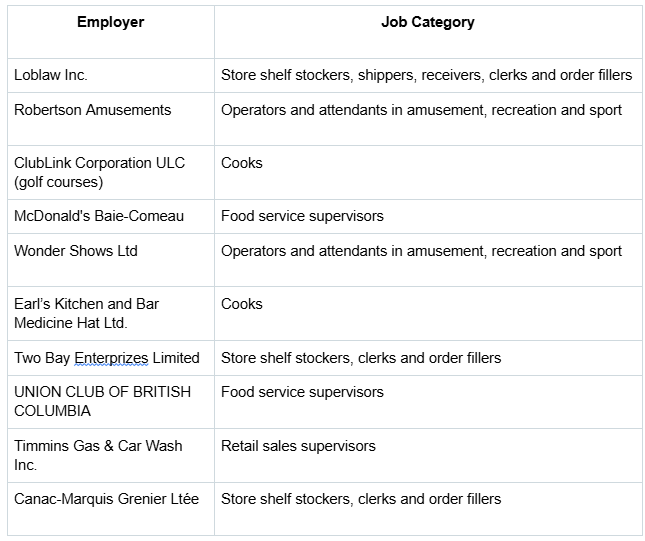
Companies and public sector entities that got approved to hire entry-level and food services labour:

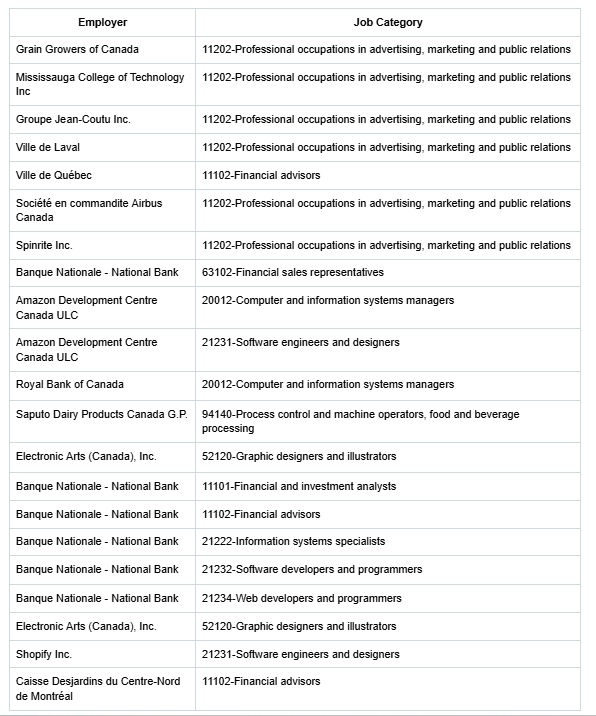
Companies and public sector entities that got approved to hire white collar jobs with TFWs (my personal favourite here is the Grain Growers of Canada(a lobby group) receiving a positive LMIA decision for a communications position….come on guys, for real??):

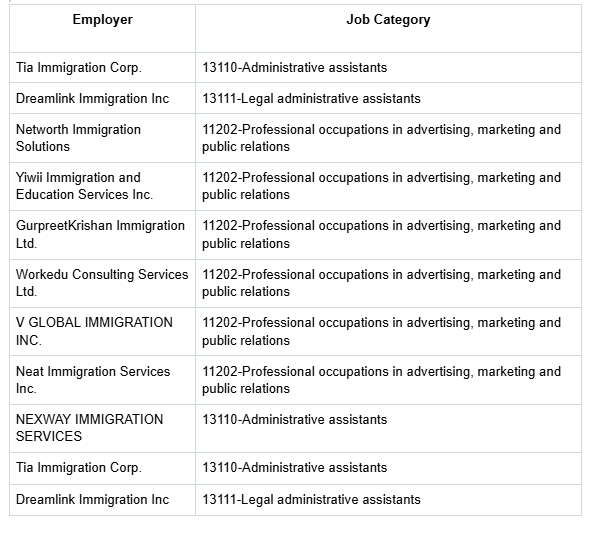
Immigration consulting firms that often help companies get approved for TFWs got approved for TWFs too:

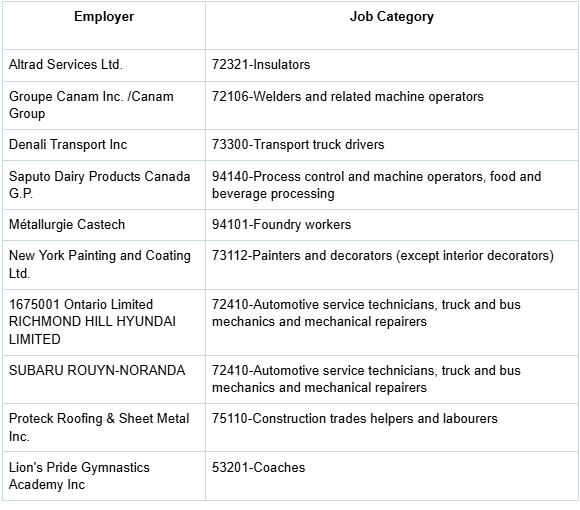
Companies that got approval to fill trades jobs with TFWs:

The arguments that many companies most commonly use to justify their use of the TFW program (particularly the low-skilled stream) are that:

  • Canadians don’t want to do the work
  • That only a foreigner could do the job, or
  • That government benefit programs often prevent people from taking jobs. 

In many cases, these arguments wouldn’t pass the smell test for an ordinary Canadian, so they shouldn’t for the Liberal government either.

In reality, outside of a very few regions where unemployment levels significantly defy the current national rate of 6.9%, and in certain segments of the seasonal agricultural industry, many of these jobs can and should go to available Canadians. And, there won’t be change unless the Liberals stop buying into bunk arguments for temporary foreign labour and find ways to reform the program, or, as the case may be, incent Canadians to work. Wages that aren’t suppressed by an open floodgate of low skilled temporary foreign labour would probably be a good place to start.

Ironically, on that front, all the Liberals had to do upon taking office in 2015 was not bend to the will of powerful corporate lobbyists clamouring for the reversals of program changes made by the former Harper Conservative government. I was in cabinet at the time and remember the gnashing of teeth and wailing from employers that were accused of seriously abusing the program.

Nonetheless and to his credit, Jason Kenney, as Minister of Employment and Social Development, introduced major reforms to the TFW program and LMIA process in 2013 and 2014. In 2013, key changes included requiring employers to pay temporary foreign workers at prevailing wages, introducing processing fees for LMIA applications, extending job advertising periods to recruit Canadians first, and adding scrutiny on outsourcing impacts. The 2014 overhaul was more comprehensive: it imposed a 10% cap on low-wage foreign workers per worksite (phased in from higher limits), barred low-wage hires in regions with unemployment above 6%, limited low-wage worker stays to two years, introduced moratoriums in sectors like food services, boosted inspections and fines for violations, and split the TFW program from the International Mobility Program to reduce overall reliance on foreign labor, leading to an 80% drop in low-skilled approvals.

Source: 50K+ jobs to foreign workers in Q1. Why?

Poilievre says Canada needs ‘more people leaving than coming’

Of note:

Conservative Leader Pierre Poilievre says for the next couple of years “we need more people leaving than coming” into Canada.

On Monday, Poilievre was asked by Global News to clarify his June comments calling for “severe limits on population growth.

“In order to fix the problem we’ve got to put very hard caps on immigration levels. We need more people leaving than coming for the next couple of years,” said Poilievre at a news conference in Ottawa. “So our country can actually catch up.”

 Poilievre said this move could help housing, health care and jobs “catch up,” but he did not elaborate on how he would ensure more people leave the country.

“We’ve had population growth of roughly a million a year under the Liberals while we barely built 200,000 homes. Our job market is stalled and yet we are adding more people to the workforce,” said Poilievre.

“Our young people are facing generational highs in unemployment because the jobs are, multinational corporations are giving jobs to low wage temporary foreign workers.”…

Source: Poilievre says Canada needs ‘more people leaving than coming’

And the Globe editorial commenting on his remarks:

…Mr. Poilievre would take a different approach by applying a “hard rule” in which population intake does not exceed the growth in the housing stock, the job market and the availability of doctors.

There is merit to that approach, although the emphasis should be on using permanent residency as a tool to ease shortages of specific skills, such as doctors. The focus of any effort to reduce the weight of migration on housing and social services should be squarely on temporary residents. 

Re-establishing public confidence in the immigration system means restricting temporary foreign workers to areas where there simply aren’t Canadians able and willing to take a job, such as in the agriculture sector. Permits for other businesses should, for the most part, be denied. If those firms cannot operate without the subsidy of indentured labour, then they do not have a viable business model.

Federal and provincial governments must return the international student program to its former role of recruiting highly qualified students from around the world who will make excellent candidates to become permanent residents once they graduate. As this space has repeatedly argued, those students should be limited to on-campus work.

And the government must follow through on its proposals to end the abuses of the asylum system.

Mr. Poilievre’s proposed formula needs work, but the idea is at least a recognition that immigration targets in recent years have been arbitrary – and a big part of the reason that Canadians are losing faith in the system.

Source: Let’s focus on the right fix for immigration

Québec impose finalement une connaissance du français aux travailleurs temporaires

A noter:

Un an et demi après l’avoir annoncé, le gouvernement de François Legault a finalement déposé jeudi un règlement pour exiger une connaissance minimale du français chez les travailleurs temporaires — ce qui pourrait « avoir un impact indirect sur la compétitivité des entreprises au Québec », convient-il.

Le 1er novembre 2023, la ministre caquiste Christine Fréchette, alors à l’Immigration, avait soutenu en conférence de presse qu’elle demanderait aux immigrants participant au Programme des travailleurs étrangers temporaires (PTET) de démontrer au renouvellement de leur permis de travail une maîtrise du français de niveau 4 à l’oral.

À l’époque, la ministre, qui est aujourd’hui responsable du portefeuille de l’Économie, avait décrit ce niveau de connaissance du français comme la capacité à « discuter avec [son] entourage » de « sujets familiers ». Selon les documents officiels du gouvernement, les immigrants qui maîtrisent le niveau 4 à l’oral comprennent « le sens général de conversations brèves liées à des activités ou à des situations courantes ».

Jeudi matin, environ 19 mois plus tard, le projet de règlement du gouvernement Legault a finalement été publié dans la Gazette officielle du Québec. Il impose comme prévu la connaissance du niveau 4 pour les participants au PTET, le programme de travailleurs temporaires géré par Québec.

Une exception est toutefois accordée aux employés du secteur de l’« agriculture primaire ».

Une mesure appliquée à compter de 2028

Même si le règlement doit entrer en vigueur cet automne, l’exigence ne sera toutefois imposée qu’à partir de 2028. Le projet de règlement prévoit des mesures transitoires qui feront en sorte de reporter de trois ans les premières évaluations de la compétence en français. L’actuel ministre de l’Immigration, Jean-François Roberge, s’est inspiré de la durée maximale d’un permis de travail, qui est de 36 mois, pour offrir ce coussin aux travailleurs.

Dans son projet de règlement, le ministre de la Coalition avenir Québec convient que ces « modifications […] pourraient avoir un impact indirect sur la compétitivité des entreprises au Québec ». « Comme les autres provinces canadiennes n’imposent pas d’exigence linguistique aux travailleurs étrangers temporaires, ceux qui voudront, après un séjour de trois ans, occuper des emplois dans les entreprises québécoises auront une exigence de plus à satisfaire », a-t-il indiqué.

« En revanche, une meilleure connaissance du français favoriserait l’intégration en milieu de travail et de vie des travailleurs, contribuant ainsi à pourvoir durablement les postes vacants tout en soutenant l’activité économique au Québec », a ajouté l’élu.

Le gouvernement québécois exige déjà une certaine connaissance du français de la part des immigrants économiques permanents….

Source: Québec impose finalement une connaissance du français aux travailleurs temporaires

A year and a half after announcing it, François Legault’s government finally filed a regulation on Thursday to require a minimum knowledge of French among temporary workers – which could “have an indirect impact on the competitiveness of companies in Quebec,” he agrees.

On November 1, 2023, the Caquist Minister Christine Fréchette, then at Immigration, argued at a press conference that she would ask immigrants participating in the Temporary Foreign Worker Program (PTET) to demonstrate a mastery of oral level 4 French at the renewal of their work permit.

At the time, the minister, who is now responsible for the Economy portfolio, described this level of knowledge of French as the ability to “discuss with [her] entourage” “familiar subjects”. According to official government documents, immigrants who master level 4 orally understand “the general meaning of brief conversations related to routine activities or situations”.

Thursday morning, about 19 months later, the Legault government’s draft regulation was finally published in the Official Gazette of Quebec. As expected, it requires knowledge of level 4 for participants in the PTET, the temporary worker program managed by Québec.

However, an exception is granted to employees in the “primary agriculture” sector.

A measure applied from 2028

Even if the by-law is due to come into force this fall, the requirement will not be imposed until 2028. The draft regulation provides for transitional measures that will ensure that the first assessments of French proficiency are postponed by three years. The current Minister of Immigration, Jean-François Roberge, was inspired by the maximum duration of a work permit, which is 36 months, to offer this cushion to workers.

In his draft by-law, the Minister of the Coalition avenir Québec agrees that these “changes […] could have an indirect impact on the competitiveness of companies in Quebec”. “As other Canadian provinces do not impose a language requirement on temporary foreign workers, those who want, after a three-year stay, to occupy jobs in Quebec companies will have one more requirement to meet,” he said.

“On the other hand, a better knowledge of French would promote the integration of workers in the workplace and life, thus helping to permanently fill vacancies while supporting economic activity in Quebec,” added the elected official.

The Quebec government already requires some knowledge of French from permanent economic immigrants….

Peter Csillag: Is ending the Temporary Foreign Worker Program a good idea? 

More reasonable assessment and approach than that of MP Jivani’s call to abolish the program complemely save for agriculture workers. And good question for policymakers and politicians to ponder and influence policy changes:

…A question for government policymakers would be how to incentivize the private sector to make large-scale training investments for underemployed Canadians, and just as importantly, how to make in-demand professions appealing for young adults and underemployed Canadians? There’s no single answer given that needs would vary across regions and sectors.

There are international examples that serve as a useful start. Germany has a dual education system integrating school-based learning with work-based practice. Approximately 52 percent of young Germans complete dual vocational education and training apprenticeships, and in many instances, they are offered long-term positions at the same companies where they trained. It maintains the country’s status as an industrial powerhouse while proactively addressing youth unemployment. Adopting such an approach would mean a longer timeline to wind down the TFW program, transitioning employers only gradually away from the program to minimize economic disruption.

For regional priority sectors, the answer may be a provincial role. Last year, the Government of Alberta launched a program specifically to transition temporary foreign workers in the tourism and hospitality industry to permanent residency. To support the province’s ambitious tourism growth agenda, the program allows qualified candidates, foreign workers already living and working in Alberta with a job offer from an Alberta tourism and hospitality employer, to apply under the provincially nominated immigration stream.

The unique challenges facing different regions and sectors mean that ending the TFW program cannot be done overnight, and not without a clear path for training workers and addressing regional economic challenges. But after decades of the program swinging between a “more and faster” and “Canadians first” pendulum, only to be left with the same structural problems and displaced Canadian workers, the time to have this discussion is now.

Source: Peter Csillag: Is ending the Temporary Foreign Worker Program a good idea?