Rempel Garner: 50K+ jobs to foreign workers in Q1. Why?

Interesting list of which companies and organizations, and for which occupations, had approved LMIAs (Rempel Garner neglects to mention Kenney’s earlier mistake and rhetoric regarding expanded access for Temporary Foreign Workers but his correction was both quick and efficient).

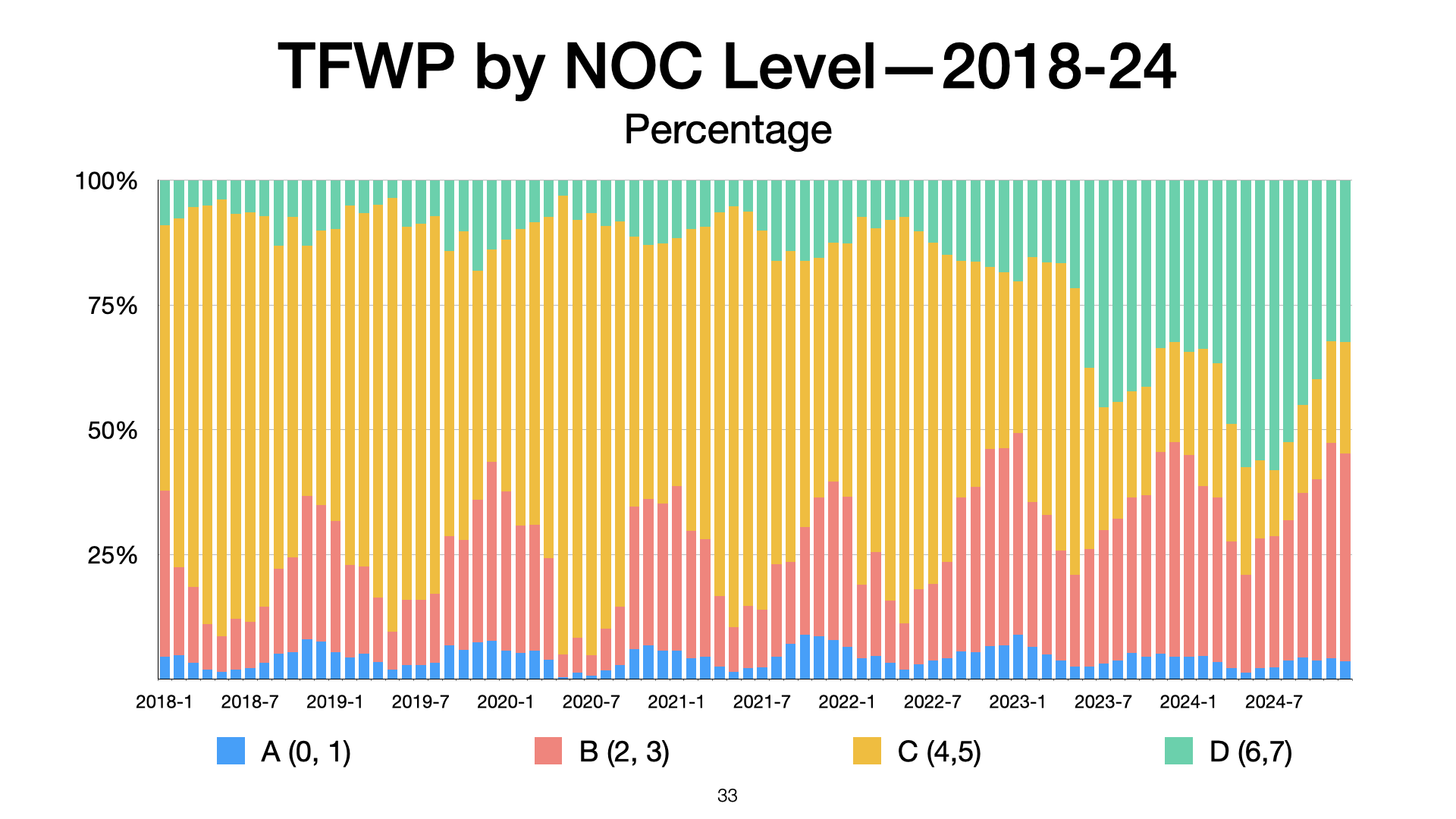
The chart below shows the overall shift to lower skilled occupations, particularly a greater shift to the lowest skill levels, with some correction in the latter half of 2024:

The Q1 List of Shame

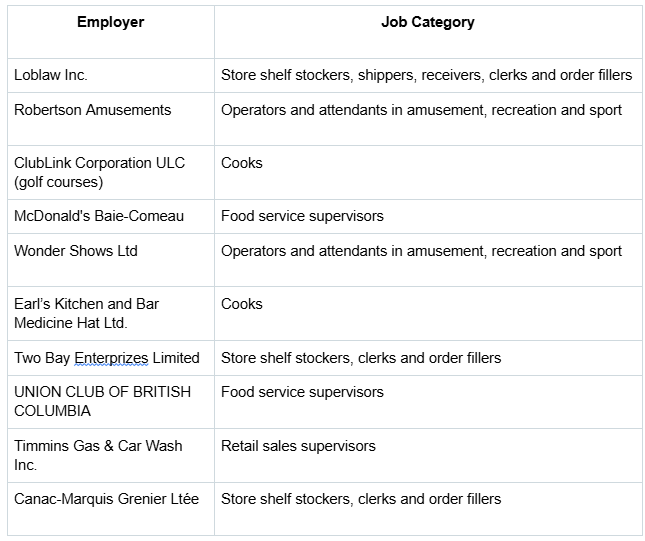
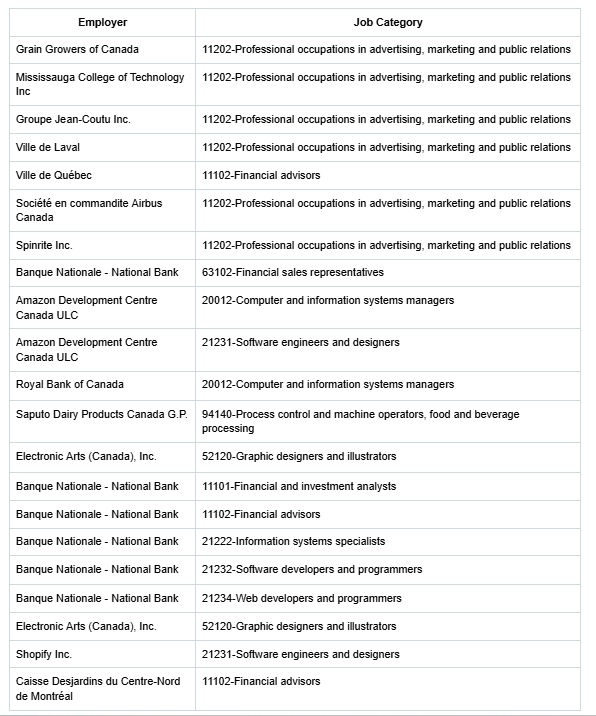
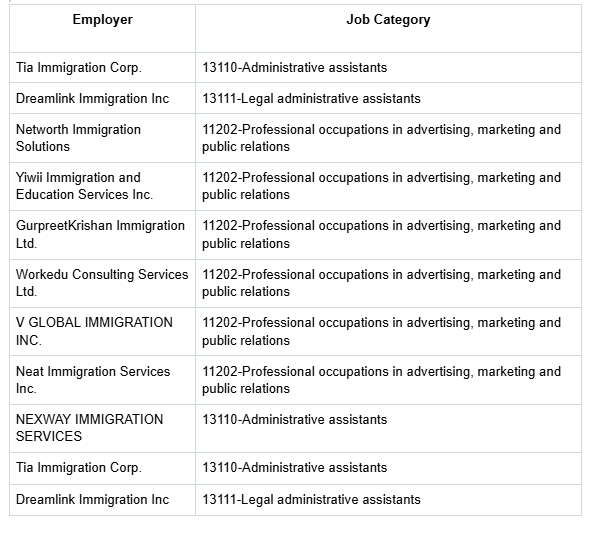
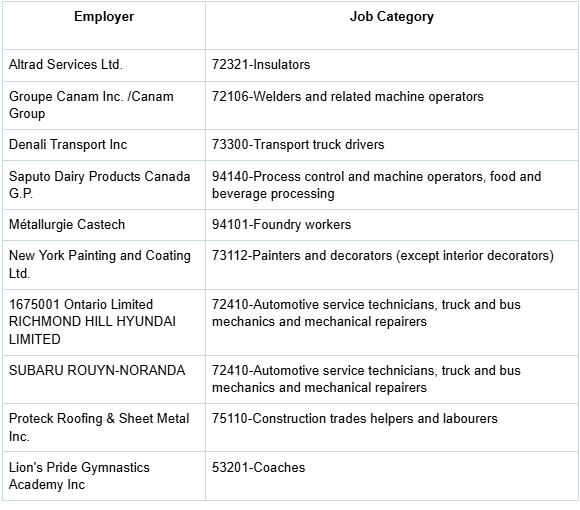
To illustrate the dysfunction, consider these (few) examples (there are many, many more, and I encourage you to look through the list yourself):

Companies and public sector entities that got approved to hire entry-level and food services labour:

Companies and public sector entities that got approved to hire white collar jobs with TFWs (my personal favourite here is the Grain Growers of Canada(a lobby group) receiving a positive LMIA decision for a communications position….come on guys, for real??):

Immigration consulting firms that often help companies get approved for TFWs got approved for TWFs too:

Companies that got approval to fill trades jobs with TFWs:

The arguments that many companies most commonly use to justify their use of the TFW program (particularly the low-skilled stream) are that:

  • Canadians don’t want to do the work
  • That only a foreigner could do the job, or
  • That government benefit programs often prevent people from taking jobs. 

In many cases, these arguments wouldn’t pass the smell test for an ordinary Canadian, so they shouldn’t for the Liberal government either.

In reality, outside of a very few regions where unemployment levels significantly defy the current national rate of 6.9%, and in certain segments of the seasonal agricultural industry, many of these jobs can and should go to available Canadians. And, there won’t be change unless the Liberals stop buying into bunk arguments for temporary foreign labour and find ways to reform the program, or, as the case may be, incent Canadians to work. Wages that aren’t suppressed by an open floodgate of low skilled temporary foreign labour would probably be a good place to start.

Ironically, on that front, all the Liberals had to do upon taking office in 2015 was not bend to the will of powerful corporate lobbyists clamouring for the reversals of program changes made by the former Harper Conservative government. I was in cabinet at the time and remember the gnashing of teeth and wailing from employers that were accused of seriously abusing the program.

Nonetheless and to his credit, Jason Kenney, as Minister of Employment and Social Development, introduced major reforms to the TFW program and LMIA process in 2013 and 2014. In 2013, key changes included requiring employers to pay temporary foreign workers at prevailing wages, introducing processing fees for LMIA applications, extending job advertising periods to recruit Canadians first, and adding scrutiny on outsourcing impacts. The 2014 overhaul was more comprehensive: it imposed a 10% cap on low-wage foreign workers per worksite (phased in from higher limits), barred low-wage hires in regions with unemployment above 6%, limited low-wage worker stays to two years, introduced moratoriums in sectors like food services, boosted inspections and fines for violations, and split the TFW program from the International Mobility Program to reduce overall reliance on foreign labor, leading to an 80% drop in low-skilled approvals.

Source: 50K+ jobs to foreign workers in Q1. Why?

Poilievre says Canada needs ‘more people leaving than coming’

Of note:

Conservative Leader Pierre Poilievre says for the next couple of years “we need more people leaving than coming” into Canada.

On Monday, Poilievre was asked by Global News to clarify his June comments calling for “severe limits on population growth.

“In order to fix the problem we’ve got to put very hard caps on immigration levels. We need more people leaving than coming for the next couple of years,” said Poilievre at a news conference in Ottawa. “So our country can actually catch up.”

 Poilievre said this move could help housing, health care and jobs “catch up,” but he did not elaborate on how he would ensure more people leave the country.

“We’ve had population growth of roughly a million a year under the Liberals while we barely built 200,000 homes. Our job market is stalled and yet we are adding more people to the workforce,” said Poilievre.

“Our young people are facing generational highs in unemployment because the jobs are, multinational corporations are giving jobs to low wage temporary foreign workers.”…

Source: Poilievre says Canada needs ‘more people leaving than coming’

And the Globe editorial commenting on his remarks:

…Mr. Poilievre would take a different approach by applying a “hard rule” in which population intake does not exceed the growth in the housing stock, the job market and the availability of doctors.

There is merit to that approach, although the emphasis should be on using permanent residency as a tool to ease shortages of specific skills, such as doctors. The focus of any effort to reduce the weight of migration on housing and social services should be squarely on temporary residents. 

Re-establishing public confidence in the immigration system means restricting temporary foreign workers to areas where there simply aren’t Canadians able and willing to take a job, such as in the agriculture sector. Permits for other businesses should, for the most part, be denied. If those firms cannot operate without the subsidy of indentured labour, then they do not have a viable business model.

Federal and provincial governments must return the international student program to its former role of recruiting highly qualified students from around the world who will make excellent candidates to become permanent residents once they graduate. As this space has repeatedly argued, those students should be limited to on-campus work.

And the government must follow through on its proposals to end the abuses of the asylum system.

Mr. Poilievre’s proposed formula needs work, but the idea is at least a recognition that immigration targets in recent years have been arbitrary – and a big part of the reason that Canadians are losing faith in the system.

Source: Let’s focus on the right fix for immigration

Québec impose finalement une connaissance du français aux travailleurs temporaires

A noter:

Un an et demi après l’avoir annoncé, le gouvernement de François Legault a finalement déposé jeudi un règlement pour exiger une connaissance minimale du français chez les travailleurs temporaires — ce qui pourrait « avoir un impact indirect sur la compétitivité des entreprises au Québec », convient-il.

Le 1er novembre 2023, la ministre caquiste Christine Fréchette, alors à l’Immigration, avait soutenu en conférence de presse qu’elle demanderait aux immigrants participant au Programme des travailleurs étrangers temporaires (PTET) de démontrer au renouvellement de leur permis de travail une maîtrise du français de niveau 4 à l’oral.

À l’époque, la ministre, qui est aujourd’hui responsable du portefeuille de l’Économie, avait décrit ce niveau de connaissance du français comme la capacité à « discuter avec [son] entourage » de « sujets familiers ». Selon les documents officiels du gouvernement, les immigrants qui maîtrisent le niveau 4 à l’oral comprennent « le sens général de conversations brèves liées à des activités ou à des situations courantes ».

Jeudi matin, environ 19 mois plus tard, le projet de règlement du gouvernement Legault a finalement été publié dans la Gazette officielle du Québec. Il impose comme prévu la connaissance du niveau 4 pour les participants au PTET, le programme de travailleurs temporaires géré par Québec.

Une exception est toutefois accordée aux employés du secteur de l’« agriculture primaire ».

Une mesure appliquée à compter de 2028

Même si le règlement doit entrer en vigueur cet automne, l’exigence ne sera toutefois imposée qu’à partir de 2028. Le projet de règlement prévoit des mesures transitoires qui feront en sorte de reporter de trois ans les premières évaluations de la compétence en français. L’actuel ministre de l’Immigration, Jean-François Roberge, s’est inspiré de la durée maximale d’un permis de travail, qui est de 36 mois, pour offrir ce coussin aux travailleurs.

Dans son projet de règlement, le ministre de la Coalition avenir Québec convient que ces « modifications […] pourraient avoir un impact indirect sur la compétitivité des entreprises au Québec ». « Comme les autres provinces canadiennes n’imposent pas d’exigence linguistique aux travailleurs étrangers temporaires, ceux qui voudront, après un séjour de trois ans, occuper des emplois dans les entreprises québécoises auront une exigence de plus à satisfaire », a-t-il indiqué.

« En revanche, une meilleure connaissance du français favoriserait l’intégration en milieu de travail et de vie des travailleurs, contribuant ainsi à pourvoir durablement les postes vacants tout en soutenant l’activité économique au Québec », a ajouté l’élu.

Le gouvernement québécois exige déjà une certaine connaissance du français de la part des immigrants économiques permanents….

Source: Québec impose finalement une connaissance du français aux travailleurs temporaires

A year and a half after announcing it, François Legault’s government finally filed a regulation on Thursday to require a minimum knowledge of French among temporary workers – which could “have an indirect impact on the competitiveness of companies in Quebec,” he agrees.

On November 1, 2023, the Caquist Minister Christine Fréchette, then at Immigration, argued at a press conference that she would ask immigrants participating in the Temporary Foreign Worker Program (PTET) to demonstrate a mastery of oral level 4 French at the renewal of their work permit.

At the time, the minister, who is now responsible for the Economy portfolio, described this level of knowledge of French as the ability to “discuss with [her] entourage” “familiar subjects”. According to official government documents, immigrants who master level 4 orally understand “the general meaning of brief conversations related to routine activities or situations”.

Thursday morning, about 19 months later, the Legault government’s draft regulation was finally published in the Official Gazette of Quebec. As expected, it requires knowledge of level 4 for participants in the PTET, the temporary worker program managed by Québec.

However, an exception is granted to employees in the “primary agriculture” sector.

A measure applied from 2028

Even if the by-law is due to come into force this fall, the requirement will not be imposed until 2028. The draft regulation provides for transitional measures that will ensure that the first assessments of French proficiency are postponed by three years. The current Minister of Immigration, Jean-François Roberge, was inspired by the maximum duration of a work permit, which is 36 months, to offer this cushion to workers.

In his draft by-law, the Minister of the Coalition avenir Québec agrees that these “changes […] could have an indirect impact on the competitiveness of companies in Quebec”. “As other Canadian provinces do not impose a language requirement on temporary foreign workers, those who want, after a three-year stay, to occupy jobs in Quebec companies will have one more requirement to meet,” he said.

“On the other hand, a better knowledge of French would promote the integration of workers in the workplace and life, thus helping to permanently fill vacancies while supporting economic activity in Quebec,” added the elected official.

The Quebec government already requires some knowledge of French from permanent economic immigrants….

Peter Csillag: Is ending the Temporary Foreign Worker Program a good idea? 

More reasonable assessment and approach than that of MP Jivani’s call to abolish the program complemely save for agriculture workers. And good question for policymakers and politicians to ponder and influence policy changes:

…A question for government policymakers would be how to incentivize the private sector to make large-scale training investments for underemployed Canadians, and just as importantly, how to make in-demand professions appealing for young adults and underemployed Canadians? There’s no single answer given that needs would vary across regions and sectors.

There are international examples that serve as a useful start. Germany has a dual education system integrating school-based learning with work-based practice. Approximately 52 percent of young Germans complete dual vocational education and training apprenticeships, and in many instances, they are offered long-term positions at the same companies where they trained. It maintains the country’s status as an industrial powerhouse while proactively addressing youth unemployment. Adopting such an approach would mean a longer timeline to wind down the TFW program, transitioning employers only gradually away from the program to minimize economic disruption.

For regional priority sectors, the answer may be a provincial role. Last year, the Government of Alberta launched a program specifically to transition temporary foreign workers in the tourism and hospitality industry to permanent residency. To support the province’s ambitious tourism growth agenda, the program allows qualified candidates, foreign workers already living and working in Alberta with a job offer from an Alberta tourism and hospitality employer, to apply under the provincially nominated immigration stream.

The unique challenges facing different regions and sectors mean that ending the TFW program cannot be done overnight, and not without a clear path for training workers and addressing regional economic challenges. But after decades of the program swinging between a “more and faster” and “Canadians first” pendulum, only to be left with the same structural problems and displaced Canadian workers, the time to have this discussion is now.

Source: Peter Csillag: Is ending the Temporary Foreign Worker Program a good idea?

Canada sees surge in temporary foreign workers applying to escape abusive employers

The positive news is that this pathway appears to be responding to the unfortunate need:

The number of temporary foreign workers applying for open work permits to escape abusive employers has jumped more than 800 per cent year over year, a surge advocates say highlights a growing crisis of abuse as immigration cuts and economic uncertainty deepen migrant workers’ vulnerability.

To address exploitation, the federal government in 2019 introduced the Vulnerable Worker Open Work Permit, allowing temporary foreign workers — whose status in Canada is tied to a single employer — to leave abusive jobs and apply for an open permit.

To qualify for one of these permits, migrant workers must show evidence of abuse.

In Ontario, open work permits for vulnerable workers soared to 435 in the first quarter of 2025, up from just 45 during the same period last year, according to the most recent data from Immigration, Refugees and Citizenship Canada — an 867 per cent increase.

In British Columbia, 650 permits were issued in the first quarter of 2025, a sharp rise from just 40 during the same period in 2024. Quebec and Alberta each saw 465 permits issued in early 2025, up from 65 and 30, respectively, during the same period last year.

As Canada increasingly relies on migrant workers to fill gaps in key sectors like agriculture, construction and health care, the surge in vulnerable worker open work permits underscores how the temporary foreign worker program leaves workers open to exploitation. Tied to a single employer, many are afraid to speak out for fear of losing their status or being deported.

Advocates say a looming recession and government efforts to cut immigration levels are exacerbating that precarity, and while more migrant workers are now seeking help, they warn the true scale of abuse is likely far greater than what’s being reported….

Source: Canada sees surge in temporary foreign workers applying to escape abusive employers

Canada increasingly dependent on low-wage migrant workers, says report

Confirmation what many have been noting (chart below highlights shift before more recent reversal_:

The share of native-born Canadians in the labour force has dropped nearly 10 percentage points since 2006, according to a new Bank of Canada report documenting how the country’s economy is becoming increasingly reliant on low-wage migrant workers.

“Not only has Canada experienced an unprecedented surge in immigration, but the composition of recent newcomers has been markedly different than in the past,” reads a discussion paper published May 9 by the bank’s Economic Analysis Department.

The paper found that, driven largely by a surge in temporary migration, the average Canadian immigrant has now become younger, lower-skilled and more likely to hail from poorer regions such as India, sub-Saharan Africa or the Middle East.

They’re also paid less. Particularly among Canada’s surging ranks of temporary migrant workers, wages have “reduced significantly relative to Canadian-born workers,” reads the paper.

Since 2015, “the average nominal wage gap between temporary and Canadian-born workers has more than doubled,” it read.

The authors calculated that the average migrant worker in Canada is now paid more than one fifth (22.6 per cent) less than a comparable Canadian-born worker. Prior to 2014, that gap was only 9.5 per cent.

The paper, entitled The Shift in Canadian Immigration Composition and its Effect on Wages, is one of the most definitive official documents as to the massive surge of migrant workers brought to Canada in the immediate wake of the COVID-19 pandemic.

Starting in 2022, Canada began accepting more than one million newcomers per year, mostly in “non-permanent” categories of immigrants ranging from international students, who are among those admitted under the international mobility program, to temporary foreign workers.

The Bank of Canada document shows that this wasn’t just unprecedented for Canada, but it went well beyond the pale of any comparable advanced economy.

Between 2019 and 2023, Canada charted population growth of more than six per cent. This was triple the rate seen in the United States, and double the rate seen in Switzerland, the only other developed economy analyzed by the paper whose demographic shift came anywhere close to those of Canada’s….

Source: Canada increasingly dependent on low-wage migrant workers, says report

$4.1 million fines for violations of Canada’s temporary foreign worker program a ‘drop in the bucket’

Of note, an increase but still small number:

The federal government issued more than $4.1 million in penalties to employers violating the rules of the temporary foreign worker program in 2024, according to data from Immigration, Refugee and Citizenship Canada. This is a 55 per cent increase from the $2.67 million handed out in 2023.

Ottawa levied 154 fines against non-compliant companies over the last calendar year, averaging $26,917 per decision, according to the Star’s analysis of the data — almost double the $13,917 average in 2023.

Use of the temporary foreign worker program by Canadian businesses has surged in recent years, particularly in low-wage sectors like construction and hospitality. Along with the increase, there have also been growing allegations of worker exploitation and abuse.

A Toronto Star investigation into the program’s application process found that in January 2022, the government directed staff to implement “streamlining measures” when evaluating the legitimacy of applications by employers seeking temporary foreign workers. Routine checks meant to ensure the system is not abused by unscrupulous employers were suspended in an effort to process applications faster.

“Workers in Canada deserve and expect to feel safe and protected in the workplace. That’s why we’re taking steps to further protect temporary foreign workers and hold bad actors accountable,” said Labour Minister Steven MacKinnon in a statement last week.

From April to September, Employment and Social Development Canada (ESDC) — responsible for processing applications for temporary foreign workers — said it conducted 649 employer compliance inspections. Of these, 11 per cent were found to be non-compliant. 

Inspections in this six month period also resulted in 20 employers being banned from the temporary foreign worker program, a fivefold increase compared to the same time the previous year, ESDC said.

“Eleven per cent — one in 10 companies misusing the program — is extremely high,” said Catherine Connelly, a professor at McMaster University’s DeGroote School of Business, and an expert on the temporary foreign worker program.

The government’s data underscores the need for stronger oversight of the program and for more investigations and greater deterrents than current fines, Connelly says, noting that several employers remain listed as having an “unpaid monetary penalty.”

Source: $4.1 million fines for violations of Canada’s temporary foreign worker program a ‘drop in the bucket’

Canada tightens immigration point system to curb fraud tied to job selling

Further tightening:

Temporary foreign workers who apply to become permanent residents through Canada’s immigration system will no longer get additional points if they have a job offer that’s supported by a Labour Market Impact Assessment (LMIA), Immigration minister Marc Miller said Tuesday.

The move will reduce fraudulent activities in Canada’s Express Entry System, which is an online platform that manages Canada’s skilled immigration programs, the minister said at a press conference.

“We are implementing further measures that will reinforce program integrity and reduce potential LMIA fraud, such as removing additional points that candidates receive under Express Entry for having a job offer,” he said. “This measure is expected to remove the incentive for candidates to purchase an LMIA resulting in increased fairness and integrity in the system.”

The latest move seems to be a continuation of the steps taken by the federal government to reduce the number of newcomers entering the country amidst rising unemployment and a housing crisis. The move was announced on the same day that Statistics Canada reported the country’s slowest quarterly population growth estimate since the first quarter of 2022.

Employers can use Canada’s temporary foreign worker program to hire foreign workers, but they often need to prove that they aren’t able to find a worker for that specific position in Canada. In order to do that, they must receive a federal government document called the Labour Market Impact Assessment (LMIA).

About 71,300 LMIAs were approved by the government in the first quarter of this year, compared to 63,300 during the same period last year. Most applications were for farm workers, cooks, food-counter attendants, truck drivers and construction labourers.

Some groups, however, illegally sell LMIA-approved jobs at extremely high rates to foreigners who are either outside the country or are already in Canada and are looking for ways to boost their immigration score in order to transition from temporary to permanent resident status…

Source: Canada tightens immigration point system to curb fraud tied to job selling

Colby Cosh: Lululemon’s sweetheart deal for temporary foreign workers

Of note. The vast majority of those hired under the TFWP are low-wage workers:

…It is easy to imagine that the decision to approve the permits was a no-brainer for B.C., Ottawa, and the federal ministers who quarterbacked the exemption. And, yes, Lululemon is a brand Canadians surely feel positive about, leaving aside that little blip with the terrible Olympics outfits.

But, you know, those positive feelings are surely strained just a tad when you hear about those jobs Lululemon couldn’t fill from the vast reservoir of educated and enterprising humanity that is the Lower Mainland of B.C. The company’s TFW exemption is allowing it to hire people for positions that no Canadian could conceivably fill, to wit: “graphic designers, advertising and marketing managers, computer systems managers, retail wholesale buyers, pattern-makers and industrial engineers.” This list includes some jobs I’ve seen friends move to Vancouver to do! Either things have changed a lot human-capital-wise out on the coast, or Lululemon just wanted a backdoor subsidy in exchange for maintaining its visible connection with Canada.

To be sure, companies have to fight their corner ferociously against the perpetual efforts of governments to drink their blood, but Vescera’s story observes that Lululemon also battled his team’s efforts to obtain documents about the exemption through the province’s freedom of information law. The company half-successfully tried to invoke the “harmful to third-party business interests” provision that is present in B.C.’s FOI law, along with those of most provinces. This, to me, is genuinely irksome practice—made worse because, although the Investigative Journalism Foundation received redacted documents, nobody will explain what third party’s interests are being protected, or why.

Indeed, I cannot fathom a reason for any “business interests” provision in any FOI law at all. The inherent danger in all dealings between businesses and governments are an overwhelmingly important reason for freedom of information law to exist. Allowing suppression of information on the grounds that some teat-sucking client of the state might be embarrassed or compromised is simply a license for the concept of FOI to be nerfed to death

Source: Colby Cosh: Lululemon’s sweetheart deal for temporary foreign workers

Angus-Reid – Temporary Foreign Workers: Canadians support reduced program; few want workers to have path to citizenship

Although not covered in the summary, the data tables highlight that non-white are more critical than white (I would have preferred an immigrant, born in Canada comparisons):

Part One: Views of Temporary Foreign Workers program

  • Canadians say they hear more negative things than positive ones
  • Most say number of workers too high
  • Plurality say program should continue with changes

Part Two: Who benefits and loses from TFW program

  • Most see a boon for business at the cost of labour market and housing
  • Liberal supporters most positive, cross-partisan concern about impact on housing

Part Three: Concerns about treatment of workers, but little support for citizenship

  • Majority say businesses that can’t afford to pay wages Canadians will take should close
  • Many also say Canadians don’t want to do the jobs TFWs perform
  • Majority say businesses treat TFWs unfairly; half say government exploits them
  • Citizenship for TFWs not supported by many

Source: Temporary Foreign Workers: Canadians support reduced program; few want workers to have path to citizenship