Trudeau to fill Senate vacancies before retiring: source

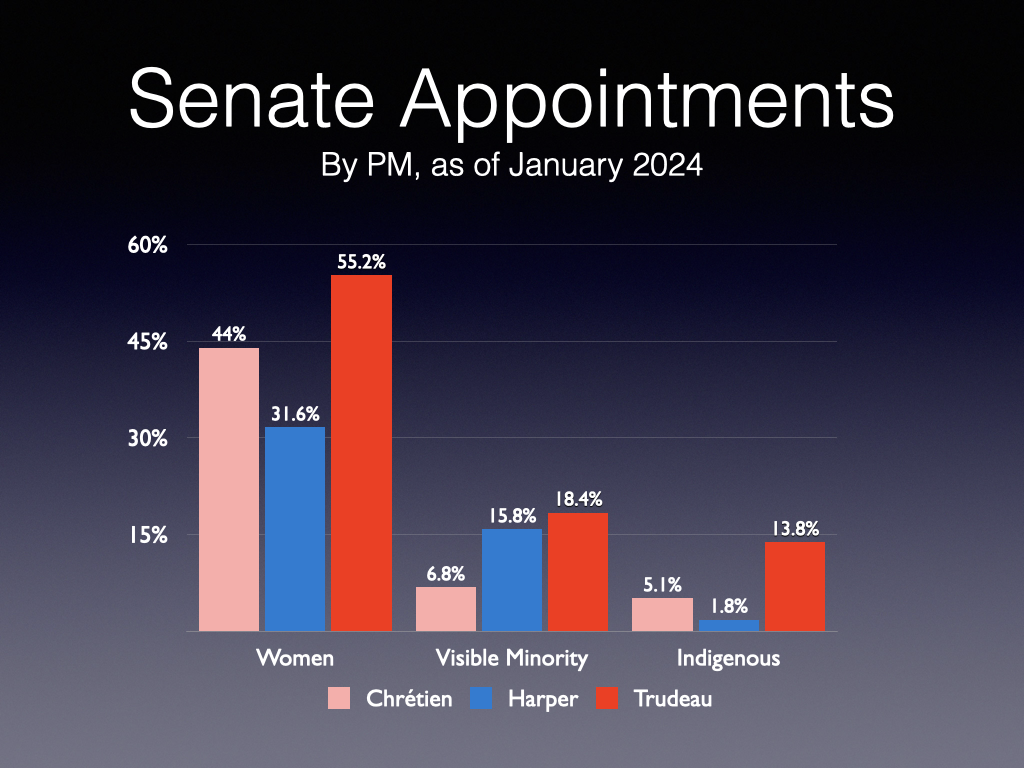
Diversity stats of appointments by PM (last minute senate appointments can be a poisoned chalice for governments):

…Prime Minister Justin Trudeau is planning a final wave of appointments to fill the 10 vacancies in the Senate before he retires in March, Radio-Canada has learned.

The move would allow him to leave a mark on Parliament for years to come, as these unelected legislators will be able to sit until the age of 75.

A source familiar with the matter says that the selection process for the future senators is already underway and should be completed before his departure. After proroguing Parliament earlier this month, Trudeau announced that he will leave power after the Liberal Party chooses a new leader on March 9.

In a written response, the Prime Minister’s Office confirmed that the advisory board for Senate appointments is at work to propose candidates for all vacancies.

“Prorogation did not affect the ability of the Governor General to make appointments to the Senate based on the advice of the prime minister,” said PMO spokesman Simon Lafortune. “The prime minister takes his responsibility to appoint senators seriously and will do so as long as he remains in office.”

The prime minister likes to praise the independence of the senators he has appointed since 2016, but he has nonetheless picked several high-profile Liberals to sit in the Senate in recent years.

The Conservative Party of Pierre Poilievre, which is leading in national polls, has long been critical of Trudeau’s choices of senators. The Conservatives now fear that Trudeau-appointed senators will try to block their agenda if the party wins the next election, which is expected in the spring.

There are currently 12 senators affiliated with the Conservative Party in the 105-seat chamber.

“For someone who advocated an independent Senate, [Trudeau] will have ended up filing the Senate with a large majority of Liberals or people who support his policies,” said Conservative Senator Claude Carignan….

Source: Trudeau to fill Senate vacancies before retiring: source

Clark: Trudeau’s only mistake in admitting a mistake is not doing it sooner

Making the mistake, of course, is more serious than the timing of admitting that the government made the mistake in the first place:

…Mr. Trudeau spent a portion of the video shifting blame onto business lobbies screaming for foreign workers to reduce labour shortages – with a clip of Mr. Ford doing the same – and “bad actors” and colleges charging rich fees to booming numbers of foreign students. All that’s true, but it was the federal government’s job to control the numbers, and they didn’t. But Mr. Trudeau now concedes that.

Mr. Arnold said he wouldn’t advise the Prime Minister to make a speech about 10 mistakes. But this is a specific case.

“There’s a place for a politician to admit they haven’t gotten things right,” he said. “Because then it makes the solution feel like real change.”

Mr. Arnold noted that’s not the kind of thing the Liberals will put into their television ad campaigns. This is an attempt to shield against damage.

But the Liberals want voters to hear about it. The video includes news clips emphasizing what a big course change the government has just made on immigration – playing it up, not down. Mr. Trudeau needs Canadians to know about it, even if it means admitting a mistake.

Source: Trudeau’s only mistake in admitting a mistake is not doing it sooner

Trudeau says he could have acted faster on immigration changes, blames ‘bad actors’

Apart from the largely dodging responsibility by the PM, Conservative leader Poilievre comments of note:

….When reached for comment, Conservative Leader Pierre Poilievre’s spokesperson Sebastian Skamski referred The Canadian Press to an interview Mr. Poilievre did with CKNW 980’s The Jas Johal Show in Vancouver where Mr. Poilievre discussed immigration.

In that interview, Mr. Poilievre said much of his criticism of the current immigration system is coming from what Mr. Trudeau himself has said since enacting these recent changes.

“Now, he’s basically denouncing his entire immigration policy and expecting us to believe that he can fix the problems that he caused,” Mr. Poilievre said.

“The bottom line is we have to fix our immigration, get back to the best system in the world, the one that brought my wife here as a refugee legally and lawfully, the one that brought so many people here to pursue the Canadian promise and that’s what I’m going to do as prime minister.”

Mr. Poilievre has previously said he would tie immigration rates to available housing while considering other factors such as access to health care and jobs….

Source: Trudeau says he could have acted faster on immigration changes, blames ‘bad actors’

Travailleurs étrangers temporaires: Ottawa va resserrer les règles et les critères d’admissibilité 

The most comprehensive report I have seen so far (no doubt various commentaries will emerge in coming days). As the saying goes, better late than never but the Liberal government’s (mis)management of immigration has to rate as one of its biggest policy failures, substantively and in political terms.

But this policy reversal, one among a number, has the advantage that it demonstrates that restrictions cannot be automatically portrayed as xenophobic, nor can criticism of any proposed immigration restrictions in the Conservative 2025 platform be labelled as such by the Liberals and NDP.

We should expect to see the impact starting in October, with the final quarter numbers providing a good indication of their effectiveness:

Le premier ministre Justin Trudeau a annoncé lundi des changements au Programme des travailleurs étrangers temporaires (PTET) lundi matin, alors que le cabinet ministériel effectue sa retraite à Halifax. 

« Nous allons réduire l’utilisation du programme pour faire entrer des travailleurs étrangers temporaires faiblement rémunérés », a-t-il dit. 

« Nous regardons également les modifications au volet des postes à haut salaire. » 

Le premier ministre a justifié cette décision en expliquant qu’en raison de l’inflation, la situation n’était plus la même qu’il y a deux ans et que le Canada n’avait plus autant besoin de main-d’œuvre étrangère. Il a ajouté que le temps était à la formation et à l’investissement dans la technologie, et non plus à une dépendance croissante à la main-d’œuvre étrangère, parfois « exploitée » et « maltraitée ». 

Il a invité les entreprises à engager leur personnel parmi la population canadienne. « À ceux qui se plaignent de la pénurie de main-d’œuvre, voici mon message : il n’y a pas de meilleur moment pour investir et pour embaucher des travailleurs canadiens. » 

Les domaines de la santé, de la construction et de la sécurité alimentaire sont exemptés des nouvelles mesures du PTET qui seront appliquées dès le 26 septembre.

Selon les changements mis de l’avant, les employeurs ne devront pas dépasser un apport de travailleurs étrangers temporaires équivalent à 10 % de leur effectif. Ce seuil s’appliquera aux postes à bas salaires seulement.

Les travailleurs embauchés dans cette proportion pourront être employés pour une période maximale d’un an plutôt que de deux.

Par ailleurs, Ottawa signale qu’il ne traitera pas les études d’impact sur le marché du travail qui sont nécessaires pour justifier l’embauche de travailleurs étrangers temporaires si ces demandes sont faites pour des postes à bas salaire dans des zones métropolitaines où le taux de chômage est d’au moins 6 %.
Selon le ministre de l’Emploi, Randy Boissonnault, les changements entraîneront une réduction d’environ 65 000 travailleurs étrangers temporaires.

« Le PTET a toujours été conçu pour s’ajuster à l’économie et c’est ce que nous faisons : nous regardons les données économiques et nous y répondons », a-t-il affirmé.

Un « premier pas »

M. Trudeau a présenté l’annonce de lundi comme une « première étape » en réponse à l’importante hausse d’immigrants temporaires. 

Cet automne, nous allons présenter, pour la première fois, un plan de niveaux d’immigration qui ne parle pas juste de résidents permanents, mais aussi de résidents temporaires, qu’il s’agisse de travailleurs étrangers ou d’autres [catégories d’immigration].

 le premier ministre Justin Trudeau

L’objectif est de « s’assurer que l’ensemble a le plus de sens possible en fonction des besoins des Canadiens et de notre économie », a fait valoir le premier ministre. 

Les niveaux pancanadiens annuels de nouveaux résidents permanents – 485 000 en 2024 et 500 000 en 2025 ainsi qu’en 2026 — incluent des cibles chiffrées de dossiers à être approuvés par Ottawa dans des programmes économiques et de regroupement familial, par exemple, mais pas pour les volets d’une immigration dite « temporaire » et marquée, selon Statistique Canada, par une croissance fulgurante depuis 2022. 

« Je pense que l’époque des voies d’entrée au Canada qui ne sont pas plafonnées en vient à être révolue. C’est une question de planification et de prévision appropriées », a déclaré le ministre de l’Immigration, Marc Miller.

Parmi les nouveaux arrivants non permanents exclus des cibles actuelles, on compte les étudiants internationaux et les travailleurs étrangers qui peuvent vouloir, à plus long terme, élire domicile au Canada. On y retrouve aussi tous les demandeurs d’asile se trouvant déjà au pays qui attendent, face à de longs délais, une décision de la Commission de l’immigration et du statut de réfugié du Canada (CISR) sur leur requête ou la conclusion de leur appel après avoir essuyé un refus. 

En tout et pour tout, Statistique Canada évalue qu’il y avait 2 793 594 résidents non permanents partout au pays au deuxième trimestre de 2024. Au Québec seulement, l’agence estime qu’il y en avait 597 140, mais la CISR, qui s’en remet à une définition moins large et une méthodologie différente, en dénombrait plutôt 388 959, a précisé l’équipe du ministre fédéral de l’Immigration, Marc Miller. 

Ottawa a signalé en mars qu’il prévoit réduire le nombre de résidents temporaires à 5 % de la population au cours des trois prochaines années, contre 6,2 % au moment de l’annonce. 

M. Miller a ouvert la porte lundi à ce qu’Ottawa considère de réduire ses cibles de nouveaux résidents permanents dès 2025. « Je dirais que toutes les options sont en ce moment sur la table », a-t-il dit.

Des annonces au Québec

Le Québec, qui détient certains pouvoirs en matière d’immigration, a aussi annoncé récemment des changements au PTET. 

À compter du 3 septembre, le gouvernement imposera un moratoire de six mois concernant les demandes et les renouvellements en lien PTET sur l’île de Montréal. Le gouvernement de François Legault a présenté l’initiative comme une façon de protéger le français. 

Cette décision visera des emplois dont le salaire offert est inférieur au revenu médian du Québec, soit 57 000 $ par an ou 27,47 $/heure. Le gouvernement prévoit des exceptions qui touchent les secteurs de la santé, de l’éducation, de la construction, de l’agriculture et de la transformation alimentaire. 

Le premier ministre Legault a aussi indiqué qu’un projet de loi sera déposé cet automne afin de donner au gouvernement le pouvoir de limiter le nombre d’étudiants étrangers dans certains établissements d’enseignement « où il y a eu des abus ». 

Depuis plusieurs mois, Québec réclame au fédéral une baisse « significative et rapide » du nombre d’immigrants temporaires sur son territoire, plaidant que la province a dépassé sa capacité d’accueil. 

Source: Travailleurs étrangers temporaires Ottawa va resserrer les règles et les critères d’admissibilité

Translation:

Prime Minister Justin Trudeau announced on Monday changes to the Temporary Foreign Workers Program (TFTP) on Monday morning, as the ministerial cabinet is retiring in Halifax.

“We will reduce the use of the program to bring in low-paid temporary foreign workers,” he said.

“We are also looking at the changes to the aspect of high-wage positions. ”

The Prime Minister justified this decision by explaining that because of inflation, the situation was no longer the same as two years ago and that Canada no longer needed foreign labor as much. He added that the time was for training and investment in technology, and no longer for a growing dependence on foreign labor, sometimes “exploited” and “mistreated”.

He invited companies to hire their staff among the Canadian population. “To those who complain about the labor shortage, here is my message: there is no better time to invest and hire Canadian workers. ”

The areas of health, construction and food safety are exempt from the new PTET measures that will be applied from September 26.

According to the changes put forward, employers will not have to exceed a contribution of temporary foreign workers equivalent to 10% of their workforce. This threshold will apply to low-wage positions only.

Workers hired in this proportion may be employed for a maximum period of one year rather than two.

In addition, Ottawa reports that it will not deal with labour market impact studies that are necessary to justify the hiring of temporary foreign workers if these applications are made for low-wage positions in metropolitan areas where the unemployment rate is at least 6%.

According to the Minister of Employment, Randy Boissonnault, the changes will result in a reduction of about 65,000 temporary foreign workers.

“The PTET has always been designed to adjust to the economy and that’s what we do: we look at economic data and respond to it,” he said.

A “first step”

Mr. Trudeau presented Monday’s announcement as a “first step” in response to the significant increase in temporary immigrants.

This fall, we will present, for the first time, an immigration level plan that is not just about permanent residents, but also about temporary residents, whether foreign workers or other [immigration categories].

Prime Minister Justin Trudeau

The objective is to “ensure that the whole makes the most sense possible according to the needs of Canadians and our economy,” said the Prime Minister.

The annual pan-Canadian levels of new permanent residents – 485,000 in 2024 and 500,000 in 2025 and 2026 – include quantified targets of files to be approved by Ottawa in economic and family reunification programs, for example, but not for the components of so-called “temporary” immigration and marked, according to Statistics Canada, by meteoric growth since 2022.

“I think the days of entry routes into Canada that are not capped are over. It is a question of appropriate planning and forecasting, “said Immigration Minister Marc Miller.

Among the non-permanent newcomers excluded from current targets are international students and foreign workers who may want, in the longer term, to take up residence in Canada. It also includes all asylum seekers already in the country who are waiting, in the face of long delays, for a decision by the Immigration and Refugee Board of Canada (IRB) on their request or the conclusion of their appeal after being refused.

In all, Statistics Canada estimates that there were 2,793,594 non-permanent residents across the country in the second quarter of 2024. In Quebec alone, the agency estimates that there were 597,140, but the IRB, which relies on a smaller definition and a different methodology, counted 388,959, said the team of the Federal Minister of Immigration, Marc Miller.

Ottawa reported in March that it plans to reduce the number of temporary residents to 5% of the population over the next three years, from 6.2% at the time of the announcement.

Mr. Miller opened the door on Monday for Ottawa to consider reducing its targets for new permanent residents by 2025. “I would say that all the options are currently on the table,” he said.

Announcements in Quebec

Quebec, which has certain immigration authorities, has also recently announced changes to the PTET.

As of September 3, the government will impose a six-month moratorium on PTET-related applications and renewals on the island of Montreal. The government of François Legault presented the initiative as a way to protect French.

This decision will target jobs whose salary offered is lower than Quebec’s median income, i.e. $57,000 per year or $27.47/hour. The government provides for exceptions that affect the health, education, construction, agriculture and food processing sectors.

Prime Minister Legault also indicated that a bill will be tabled this autumn to give the government the power to limit the number of foreign students in certain educational institutions “where there have been abuses”.

For several months, Quebec City has been demanding from the federal government a “significant and rapid” decrease in the number of temporary immigrants on its territory, arguing that the province has exceeded its reception capacity.
Meeting between Trudeau and Muslim leaders in Quebec called off after many refuse to attend

Of note (counterproductive IMO):

A meeting between Muslim leaders in Quebec and Prime Minister Justin Trudeau planned for this afternoon north of Montreal — weeks ahead of a critical byelection in the city — was cancelled after many of those invited refused to attend, CBC News has learned.

“Many members of our community continue to feel angry and frustrated with a government that in their view simply hasn’t operated with integrity in relation to what is happening in Gaza, or in addressing the steep rise of Islamophobia in Canada,” the National Council of Canadian Muslims told CBC News in a media statement.

“While our community is not a monolith, this sentiment is widespread.”

It’s not clear how many people were invited to the event but the NCCM said “many members” who were invited, including “leaders and imams, declined to meet.”

Invitations were issued verbally by the office of Fayçal El-Khoury, the MP for Laval-les-Iles, according to two members of the Quebec Muslim community who spoke to CBC News….

Source: Meeting between Trudeau and Muslim leaders in Quebec called off after many refuse to attend

Devant les annonces prébudgétaires d’Ottawa, Legault rebrandit le référendum en immigration 

Sigh although his concern regarding the excessive increases in temporary workers is legitimate and likely more political positioning. But a referendum on immigration, even if narrowly focused, will likely not be conducive to reasoned discussion:

Le premier ministre François Legault n’en peut plus d’entendre son homologue à Ottawa, Justin Trudeau, faire un « feu d’artifice d’annonces » prébudgétaires à l’intérieur des champs de compétence du Québec. Il invite le fédéral à se concentrer plutôt sur la hausse du nombre d’immigrants temporaires et ravive l’idée d’un référendum sectoriel en immigration.

« Au lieu de faire des annonces dans les champs de compétence du Québec, occupez-vous de vos propres responsabilités, en particulier l’immigration », a lancé l’élu caquiste, mardi, lors d’un point de presse tenu quelques minutes avant la période des questions, à l’hôtel du Parlement.

M. Legault réagissait à une série d’annonces effectuées dans les dernières semaines par lesquelles le gouvernement de Justin Trudeau a fait connaître ses intentions de débourser des milliards de dollars pour le logement. Il y a deux semaines, l’annonce de la création d’une Charte canadienne des locataires et de l’équivalent d’un bail uniforme pour tout le Canada avait fait fulminer les ministres du gouvernement Legault.

« Ce que je dis à M. Trudeau, c’est : écoutez les Québécois. Puis, au lieu de […] dire “on va vous donner de l’argent en santé, on va vous donner de l’argent pour le logement”, allez donc à la racine du problème. Il y a trop d’immigrants temporaires », a soutenu le premier ministre caquiste.

M. Legault reproche à son homologue au fédéral d’avoir « laissé exploser leur nombre à 560 000 », selon le dernier décompte. Après l’avoir écartée en février, le premier ministre revient donc avec l’idée d’un référendum sectoriel en immigration, en fonction du « résultat des discussions » avec son homologue, qui aboutiront à une rencontre au sommet sur le sujet d’ici la fin juin.

« On va rentrer dans le détail. Est-ce que les immigrants temporaires devraient être préapprouvés par le Québec ? Si c’était le cas, ça voudrait dire qu’un, on contrôlerait le nombre, et deux, on contrôlerait les exigences en français », a-t-il dit mardi. « Est-ce qu’on fait un référendum là-dessus éventuellement ? Est-ce qu’on fait un référendum plus large sur d’autres sujets ? »

Exclu, puis considéré

En février, pourtant, François Legault avait écarté un éventuel référendum sectoriel en immigration. « Je ne pense pas qu’on a besoin de faire un référendum pour demander aux Québécois s’ils souhaiteraient qu’on rapatrie les pouvoirs à Québec », avait-il dit.

Or, Justin Trudeau a une « obligation de résultat » en vue de sa réunion de juin, a fait valoir M. Legault mardi. Après une rencontre le mois dernier, le premier ministre québécois avait affirmé ressentir chez M. Trudeau une ouverture à ce que le Québec puisse décider du nombre de travailleurs temporaires admis sur son territoire et qu’une « partie » d’entre eux se voient refuser le renouvellement de leur permis de travail.

Sans quoi, « il faut voir, là, est-ce qu’on a besoin de faire un référendum pour s’assurer que la majorité des Québécois appuient », s’est interrogé M. Legault à voix haute.

À Ottawa, mardi, le ministre fédéral de l’Immigration, Marc Miller, a assuré que les discussions avec Québec allaient bon train. « J’ai vraiment senti dans les dernières semaines de la ministre [québécoise de l’Immigration Christine] Fréchette une ardeur au travail, une volonté de vraiment trouver des solutions à nos défis », a-t-il dit.

S’il convient avoir des « points de divergence » avec le gouvernement Legault, l’élu libéral entend oeuvrer sur « la langue commune du Québec » et sur le désir de Québec « de réduire les gens qui sont ici de façon temporaire ». L’idée de confier tous les pouvoirs en immigration au Québec comme l’avait demandé le gouvernement caquiste le mois dernier n’est toutefois pas sur la table.

« Un pays qui donne tous ses pouvoirs à quelqu’un d’autre n’est plus un pays », a-t-il maintenu.

Québec demandera des compensations sans conditions pour l’ensemble des programmes fédéraux s’immisçant dans les pouvoirs du Québec, a indiqué M. Legault mardi. « Il n’est pas question d’accepter ça. » Le dépôt du budget fédéral est prévu le 16 avril.

Source: Devant les annonces prébudgétaires d’Ottawa, Legault rebrandit le référendum en immigration

English version:

Premier François Legault on Tuesday threatened to hold a referendum on immigration if he doesn’t get what he wants from Prime Minister Justin Trudeau.

Legault is pressing Ottawa for more power over immigration. Trudeau slammed the door on giving the province full control last month. “Will we hold a referendum on (getting full power over immigration) eventually? Will we do it more broadly, on other subjects?” Legault said. “It will depend on the results of discussions” with the federal government. “Don’t forget, Mr. Trudeau promised me a meeting by June 30 at the latest. So, I expect results there.”

Speaking to reporters in Quebec City, Legault complained the province has received more than 500,000 temporary foreign workers and asylum seekers over the past eight years.

“The federal government has allowed the number of temporary immigrants to explode to 560,000,” he said.

“This causes enormous problems for Quebecers. We lack teachers, nurses, housing, and (immigrants and asylum seekers) pose a real challenge for the future of French, particularly in Montreal.”

Legault said a referendum is “not in our plan, short term.”

However, he added: “Do we need to hold a referendum so that Mr. Trudeau is convinced that a majority of Quebecers are saying that it doesn’t make sense (to allow) 560,000 immigrants” to come to Quebec.

He said Quebecers “have always been welcoming, will always be welcoming” toward immigrants. “But now we can’t do it anymore. Our capacity to receive has been exceeded.”

He said Trudeau recently admitted Canada has welcomed too many immigrants.

“It’s the first time he’s said that,” Legault noted.

Last week, Trudeau said temporary immigration has to be brought “under control.” He said the number of temporary foreign workers and international students has ”grown at a rate far beyond what Canada has been able to absorb.”

Legault said the problem could be solved if Ottawa granted Quebec the power to pre-approve all temporary immigrants. That way, Quebec could control the number of arrivals and set French language requirements, he said.

After a March 15 meeting with Legault, Trudeau said: “No, we are not going to give more power (to Quebec) on immigration. Quebec already has more powers over immigration than any other province because it’s very important to protect the French language.”

At the time, Legault said Trudeau has privately expressed openness to discussing the idea of giving Quebec a say on the admission of temporary workers and would consider new rules ensuring more workers speak French.

The Coalition Avenir Québec government is under pressure to crack down on immigration. The party’s most significant rival is the poll-leading Parti Québécois.

After last month’s Legault-Trudeau meeting, PQ Leader Paul St-Pierre Plamondon said Trudeau’s response proves Legault is unable to win more powers for Quebec.

“This resounding No is evidence of a completely absent level of bargaining power,” the leader of the pro-sovereignty party said at the time. “It’s embarrassing for Quebec. We deserve more than this perpetual humiliation.”

Source: Legault threatens immigration referendum if Trudeau doesn’t relent

Speer: Justin Trudeau critiques Justin Trudeau’s immigration policies

More on the PM’s non-mea culpa:

The strangest story this week was Prime Minister Justin Trudeau’s acknowledgement that his government has overseen an uncontrolled increase of temporary immigration into the country “far beyond what Canada has been able to absorb.” 

It’s an extraordinary admission for various reasons including the seeming detachment from his government’s ultimate responsibility for the massive spike in non-permanent residents. His comments sounded like those of an incoming prime minister condemning the policy failures of his or her predecessor. 

Yet these developments are neither inadvertent nor the fault of a past government. A combination of the Trudeau government’s untightening of its predecessor’s 2014 reforms to the Temporary Foreign Worker program and its own expansion of the international student visas are what’s ultimately behind the 93 percent increase in non-permanent residents since 2021 alone. 

Another way to put it is: Canada’s population grew faster in 2023 than any year since 1957 and of that year-over-year growth, 63 percent came from non-permanent residents. It was the second consecutive year in which temporary immigration has driven the country’s population growth. These are unprecedented numbers.  

Their demand-side implications for housing and shelter and other basic infrastructure had up until recently gone essentially unrecognized by the Trudeau government. It has now only recently started to shift its messaging and policies in light of growing public concerns and plummeting poll numbers. 

Immigration Minister Marc Miller has described the spike in temporary resident permits as a “byproduct of a lack of integrity in the system.” He recently announced plans to cut them in order to restore a more “sustainable level.” Prime Minister Trudeau’s uncharacteristically pointed comments this week must be understood in this evolving political context in which his government is effectively running against itself.  

There’s a strong case however that the prime minister shouldn’t have been surprised by the rise of temporary immigration or its negative effects. He actually forewarned about them as the then-third-party leader in a prescient Toronto Star op-ed ten years ago next month.

Trudeau called the (relatively moderate) growth of temporary residents under the Harper government a case of “mismanagement” that represented “serious damage” to the public’s ongoing support for high levels of permanent immigration. 

In particular, he warned that temporary immigration depresses wages and displaces Canadian workers. He effectively argued for eliminating the Temporary Foreign Workers program altogether (“I believe it is wrong for Canada to follow the path of countries who exploit large number of guest workers”) and instead putting a priority on permanent immigrants who have a path to citizenship. He argued that this approach was rooted in the principle of fairness for Canadians who need work and temporary immigrants themselves. 

It seems somewhat unfair to hold his near-decade-old arguments against him today. Opposition politicians understandably tend to get a bit of leeway for such policy adjustments. A lot has also happened in the intervening time. 

But the difference here is that the prime minister knew what would happen if we continued to steadily increase temporary immigrants. We know because he persuasively wrote about it. Trudeau anticipated the political economy risks and yet upon getting elected he opted to do nothing about it—or more precisely rather than “dramatically scale back” the country’s temporary resident population, he inexplicably chose to dramatically scale it up. 

If the Trudeau government loses the next federal election, which at the moment seems quite likely, it may be in large part because when it came to temporary immigration, the prime minister failed to heed his own well-considered advice. 

Source: Justin Trudeau critiques Justin Trudeau’s immigration policies

Trudeau says temporary immigration needs to be brought ‘under control’

Better late than never (who let it get out of control?) One of the bigger policy and program fails of this government, one than is damaging the overall consensus in favour of immigration:

Prime Minister Justin Trudeau says the government wants to rein in the number of temporary immigrants coming to the country, saying the situation needs to be brought “under control.”

“Whether it’s temporary foreign workers or whether it’s international students in particular, that have grown at a rate far beyond what Canada has been able to absorb,” Trudeau said at a housing announcement in Dartmouth, N.S.

“To give an example, in 2017, two per cent of Canada’s population was made up of temporary immigrants. Now we’re at 7.5 per cent of our population comprised of temporary immigrants. That’s something we need to get back under control.”

The prime minister then said that this is driving mental health challenges for international students and that more businesses are relying on temporary foreign workers, driving down wages in some sectors.

“We want to get those numbers down. It’s a responsible approach to immigration that continues on our permanent residents, as we have, but also hold the line a little more on the temporary immigration that has caused so much pressure in our communities,” Trudeau concluded.

Immigration Minister Marc Miller said on March 21 Ottawa would set targets for temporary residents allowed into Canada to ensure “sustainable” growth in the number of temporary residents entering the nation. Over the next three years, Miller said the goal is to reduce the amount of temporary residents to five per cent of Canada’s population.

For permanent residents, Canada has a target of 485,000 new immigrants, increasing to 500,000 in both 2025 and 2026.

In their last immigration plan update, the government said there are plans to “recalibrate” the number of temporary admissions to Canada in order to ensure the system is sustainable.

In January, Miller announced a cap on student visa admissions to Canada at 360,000 permits, a 35 per cent decrease from 2023.

Source: Trudeau says temporary immigration needs to be brought ‘under control’

Biden’s Unlikely Better on Immigration: Canada’s Trudeau

Funny to see American conservatives using Trudeau to attack Biden on Mexican migration:

While President Biden was engaging last week in border-security political theater on the Rio Grande, Canada actually took concrete measures to stem the flow of Mexican asylum seekers. Even Prime Minister Justin Trudeau can act to protect his country’s national interest from out-of-control migration. Meanwhile, the immigration and border policies of the Biden administration are reaching new lows.

Like the United States, Canada is overwhelmed with economic migrants who are exploiting a poorly designed national asylum process. Our northern neighbor’s asylum system is currently at its breaking point with about 144,000 claims filed in 2023. This number might seem modest, even negligible, compared to the backlog the United States is facing, but, in the context of Canada’s population size, the equivalent number for the United States would be well over a million claims.

Remarkably, Trudeau ordered his government to return to the sensible policy that requires Mexicans to qualify for a Canadian visa before simply buying an airplane ticket, flying to Canada, and filing an asylum claim.

Trudeau, although rhetorically committed to his own version of open-borderism, is for the moment retreating in the face of political reality. Of the 144,000 asylum claimants in Canada in 2023, some 24,000 were Mexicans. In 2016, the corresponding number of Mexicans was just 260. Even our easy-going neighbors to the north know when enough is enough.

Trudeau was facing pressure from Canadian conservatives as well as from provincial authorities in Quebec, where his own family is rooted and easy immigration, particularly from the francophone world, has always been encouraged. Quebec province is about as politically conservative as is New York City, but as Mayor Eric Adams has discovered, basic common sense is rearing its head everywhere these days—except in the White House.

Even abstract open-border ideology melts in the face of trying to actually accommodate, in winter, tens of thousands of uninvited “newcomers,” who arrive with their elderly parents and children, speaking a different language, adhering to different mores, with limited capacity to work and little financial means.

Americans are still waiting for Biden to act a la Trudeau as our national crisis spins out of control. Amazingly, after his recent visit to Brownsville, Texas, it seems that the U.S. open-border lobby, whose smiling face is DHS Secretary Alejandro Mayorkas, still controls the waning political judgment of our aging 81-year-old president. …

David | Crier au loup

Interesting commentary on Quebec immigration politics, criticism of CAQ contradictions and the relationship with federal politics:

Le gouvernement Legault réussit si rarement à obtenir quoi que ce soit d’Ottawa que près d’un an après la fermeture du chemin Roxham, le premier ministre n’en finit plus de s’en féliciter et de fustiger ceux qui doutaient qu’il arrive à convaincre Justin Trudeau.

Il est vrai que les sceptiques étaient nombreux, mais il y en avait autant qui pensaient que cela n’empêcherait pas les migrants de continuer à affluer au Québec, à commencer par sa propre ministre de l’Immigration, Christine Fréchette.

« Le chemin Roxham, s’il est fermé, il va simplement s’en recréer un autre quelques kilomètres plus loin. Ça ne règle absolument rien, de le fermer », disait-elle, avant d’effectuer un virage à 180 degrés après s’être rendu compte qu’elle contredisait son patron.

M. Legault peut toujours continuer à se péter les bretelles, mais le problème demeure entier. Les demandeurs d’asile ont découvert qu’il est encore plus simple de prendre l’avion. « Finalement, la fermeture du chemin Roxham n’a pas donné grand-chose », relevait déjà l’automne dernier le ministre responsable des Relations canadiennes, Jean-François Roberge.

Cela a donné si peu de résultats que M. Roberge en est rendu à dire non seulement que les services publics sont saturés, au point qu’une « crise humanitaire » serait imminente, mais aussi que l’identité québécoise elle-même est menacée. Bien entendu, le grand responsable demeure le gouvernement fédéral, qui a fait des aéroports canadiens, surtout celui de Montréal-Trudeau, de véritables passoires.

***

On peut discuter de la proportion exacte de demandeurs d’asile qui se retrouvent au Québec et de la compensation qu’Ottawa devrait verser au gouvernement provincial, mais le fardeau qu’il doit supporter est indéniablement excessif et inéquitable.

Le moins qu’on puisse dire est que ce nouveau cri de détresse n’a pas semblé inspirer à Justin Trudeau un plus grand sentiment d’urgence que la précédente lettre de M. Legault, datée de la mi-janvier, dans laquelle il évoquait une situation devenue « insoutenable » et un « point de rupture ».

Pour toute réponse, Québec a eu droit à 100 millions sur les 362 millions qu’Ottawa a accordés à l’ensemble des provinces pour loger les demandeurs d’asile, alors que le gouvernement Legault présente maintenant une facture d’un milliard.

Il a peut-être raison de s’alarmer, mais ce n’est pas la première fois qu’il crie au loup sans prendre les mesures qui s’imposent si le danger est aussi grand. Devant une telle urgence, les fins de non-recevoir à répétition d’Ottawa devraient l’avoir convaincu que ses réclamations sont peine perdue. Sinon, ce ne sont que des paroles en l’air et Ottawa a raison de l’envoyer paître.

Au printemps 2022, le premier ministre soutenait qu’accueillir plus de 50 000 immigrants entraînerait la « louisianisation » du Québec. L’automne dernier, son gouvernement a pourtant prévu admettre environ 65 000 immigrants au Québec en 2024. Quand le Parti québécois en proposait 35 000, dont il exigerait une connaissance suffisante du français à l’arrivée, M. Legault disait la chose impossible, mais cela est apparemment possible s’ils sont 65 000. Il y a de quoi être perplexe.

***

Chercher un bouc émissaire sur lequel rejeter la responsabilité de ses échecs est un réflexe naturel en politique. Un gouvernement qui détient 89 sièges sur 125 peut difficilement faire porter la faute à l’opposition. Bien sûr, il y a les syndicats, les médias, Trump… mais cela a aussi ses limites.

Mardi, M. Legault a trouvé un autre coupable. « À quoi ça sert, le Bloc québécois ? » a-t-il demandé. Que doit-on lui reprocher au juste ? Les demandes du Québec en matière d’immigration semblent plutôt bien défendues par ses soins à la Chambre des communes.

Pas plus tard que la semaine dernière, il y a fait adopter une motion réclamant la convocation d’une réunion des premiers ministres des provinces et des ministres de l’Immigration pour qu’ils fixent des seuils tenant compte de la capacité de paiement et d’accueil du Québec et des autres provinces.

M. Legault n’en est pas encore à unir sa voix à celle de Pierre Poilievre, qui accuse régulièrement le Bloc d’être le complice de Justin Trudeau, mais faut-il comprendre qu’il croit le Parti conservateur plus apte à représenter les intérêts du Québec à Ottawa ?

M. Poilievre a déclaré mercredi que « le Québec est au point de rupture à cause de la décision de Trudeau d’enlever le visa du Mexique que les conservateurs avaient mis en place ». Quelle coïncidence, n’est-ce pas ?

Il est vrai qu’avec la montée du Parti québécois, qui peut compter sur l’appui du Bloc, et vice versa, la Coalition avenir Québec et le Parti conservateur ont des ennemis communs aussi menaçants pour l’un que pour l’autre. Aux yeux de bien des Québécois, Pierre Poilievre est cependant un loup au moins aussi dangereux que Justin Trudeau.

Source: Chronique | Crier au loup