Jena: As an immigrant, I’ve experienced Canada’s promise — a promise now at risk

Another legitimate warning:

…Despite these mounting crises, the federal government fixates on arbitrary immigration targets. It’s clear that the government needs to invest more in its health-care system, and in getting more homes built to meet the needs of a growing population. But it should also slow immigration growth until these investments take hold. Each year, more than half a million new permanent residents and hundreds of thousands of temporary workers and students arrive. This relentless, poorly planned surge deepens our crises. With 97 per cent of Canada’s population growth driven by newcomers. In 2023, Canada’s population growth rate was higher than the average of the world’s top 38 economies, the OECD countries….

Dr. Debakant Jena is a first-generation immigrant, an Orthopaedic Surgeon in Medicine Hat, Alberta, and an assistant professor at the University of Calgary. 

Source: As an immigrant, I’ve experienced Canada’s promise — a promise now at risk

Moffatt: Ontario experienced a decade’s worth of population growth in just three years. We can’t support that growth without building way more homes

More on housing pressures and noting the importance of curbing demand in terms of numbers of immigrants, permanent and temporary and current government changes (further reductions needed IMO):

…On the population growth side, the federal government has committed to lowering the number of non-permanent residents (NPRs), including international students and temporary foreign workers, living in Canada. They have committed to reducing the proportion of non-permanent residents to under 5 per cent of Canada’s population over the next three years, a reduction of nearly one million people. If achieved, it would ease pressure on rents and ensure that the students we are inviting to the country have the best possible experience while here. However, the Bank of Canada recently called into question the federal government’s commitment to their non-permanent resident growth targets, stating  “it will take longer for planned policies to reduce NPR inflows to achieve the 5% target”. The federal government must release a credible plan, or risk having Ontario’s population grow faster than the housing supply.

Ontario’s housing crisis can be fixed. We have the solutions on both the supply and demand sides, many of which governments have already committed to implementing. They simply need to do so.

Source: Ontario experienced a decade’s worth of population growth in just three years. We can’t support that growth without building way more homes

Don Kerr: Canada’s population growth is exploding. Here’s why

Good analysis but late to the party like a number of others:

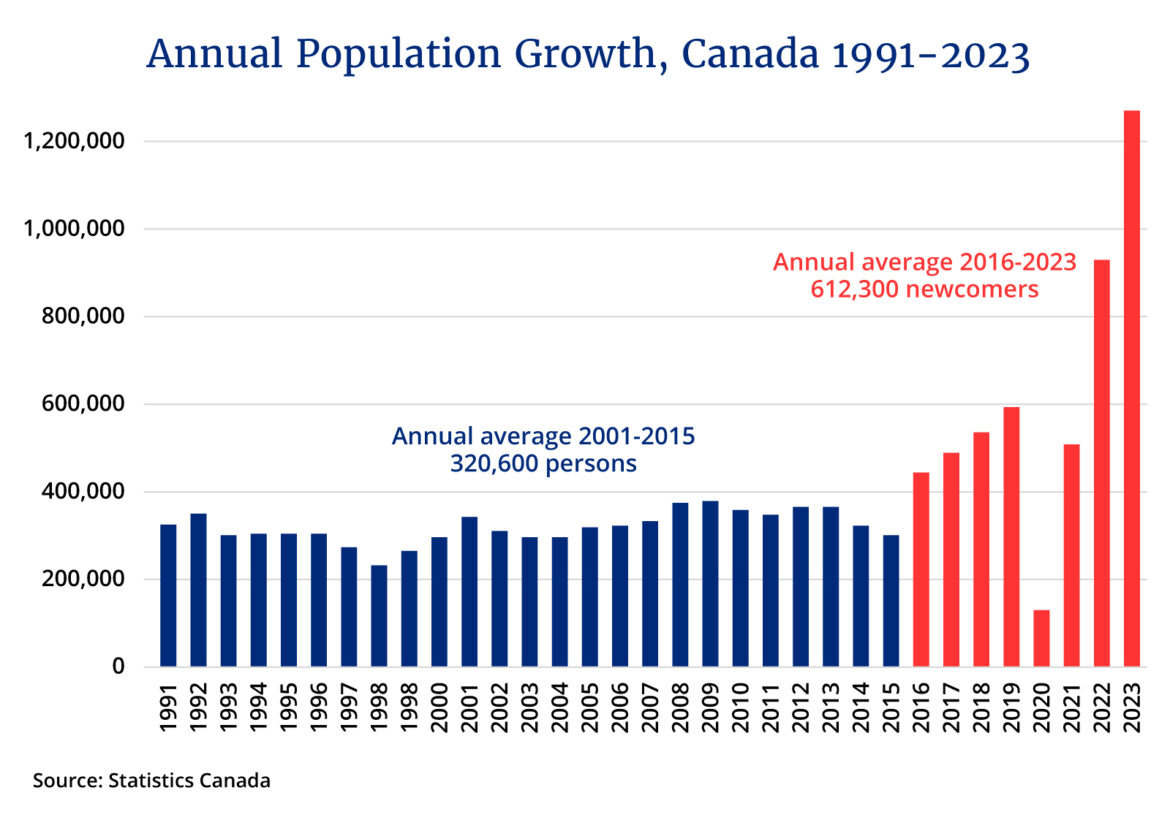
As a professional demographer who has carefully followed Canada’s demographic evolution over the past three decades, I am shocked by some of the most recent demographic data released by Statistics Canada. From 1991 through to 2015, the year in which the current government was first elected, the annual growth in Canada’s population grew in a predictable manner at an average of roughly 320,000 persons per year. 

Following 2015, that growth has rapidly accelerated. Following a temporary dip in population growth due to the outbreak of the COVID-19 pandemic in 2020, Canada’s population growth reached just over half a million in 2021 (509,285 persons), close to a million in 2022 (930,422), and then an astronomical 1.27 million persons in 2023. 

Put another way, whereas for several decades Canada’s population growth rate hovered at about 1.0 percent annually, this rate has more than tripled in a few short years, up to 3.2 percent in 2023. 

In even starker terms, the 2023 rate of population growth is like adding a new Saskatchewan to Canada’s total population in slightly less than a single calendar year. As of 2023, there is not a single country in the G7 or in the OECD that has a population growth rate even close to Canada’s. Population growth in the U.S., for comparison, is currently at about 0.5 percent. Even prior to the recent upturn, Canada’s rate of population growth was actually the highest in the G7 and among the highest in the OECD. 

Most astoundingly, in making international comparisons, Statistic Canada now points out that Canada in 2023 is among the 20 fastest-growing countries in the world, ranked beside several very high fertility countries, largely situated in sub-Saharan Africa. While Canada’s current population growth of 3.2 percent is obviously not sustainable, a constant growth rate of 3.3 percent would imply a doubling in Canada’s total population in under 25 years.

The last time Canada saw a growth rate comparable to this was fully 67 years ago. In 1957, Canada was close to the height of its baby boom, with a birth rate close to four births per woman. Slowly over decades this growth rate gradually declined as fertility rates fell (no abrupt shifts here).1  

Most recently, Canada’s growth has almost entirely been the result of international migration (97.6 percent) as the rate of natural increase (births minus deaths) has continued to decline steadily. Hence, the pace at which Canada’s population grows, in a predictable manner, can be seen as a function of Canada’s immigration policy—meaning, then, that this is a policy problem that the federal government, in consultation with the provinces, can solve itself by setting and regulating immigration targets. This includes both permanent immigration (economic, family, and refugee classes) as well as the increase in non-permanent residents (international students, temporary work permits, and asylum claimants). 

The question remains as to how we have gotten into this situation in the first place. When Sean Fraser was first appointed to the Trudeau cabinet as immigration minister in the fall of 2021, Canada’s growth rate was roughly 1 percent. By the time he was shifted from immigration to housing and infrastructure in the summer of 2023, Canada’s growth rate had climbed to its current heights. As many commenters have pointed out, it is somewhat ironic that the minister appointed to fix the issue of housing affordability was the minister of immigration who allowed this unprecedented growth in population. 

In the summer of 2023 when Canada’s population was growing at a rate that had not been seen for almost 70 years, Fraser attempted to downplay the link between population growth and rising housing costs, saying that the solution to the country’s housing woes should not involve closing the door to newcomers. 

The data from both Statistics Canada and the Canadian Housing and Mortgage Corporation (CMHC) belie the minister’s baffling assertion. Canada’s demographic growth has clearly outpaced its housing stock. Coming out of the pandemic, housing starts climbed to 271,000 in 2021, the highest number recorded for half a century, only to drop slightly in 2022 and 2023. In total, Canada witnessed about 800,000 housing starts over the 2021-2023 period, whereas over this same period, Canada’s population grew by over 2.5 million. The fact that the CMHC forecasts fewer than 224,000 starts in 2024 and only 232,000 in 2025 does not bode well for housing affordability in Canada, particularly in the context of continuing rapid population growth. 

Having said all this, it seems that the federal government has finally woken up to this issue and is now committed to reducing this growth. Current immigration minister, Marc Miller, has made overtures towards slowing Canada’s population growth—even potentially back down to historically sustainable levels. Most importantly, Miller recently announced that the proportion of “non-permanent residents” (NPRs) in Canada will be reduced from its current level of fully 6.2 percent of the total Canadian population down to 5.0 percent over the next three years. For context, NPRs were only about 3.1 percent of Canada’s population in 2021. [mfnBy NPRs, the federal government is referring to international students, persons in Canada on temporary work permits, as well as asylum claimants.[/mfn]

As the government has already capped and reduced the number of international students, a sizeable share of this reduction will occur among persons with temporary work permits. Over 60 percent of Canada’s population growth in 2023 was a by-product of the increase in the number of NPRs. If immediately implemented, Canada could shift from admitting an additional 800,000 NPRs in 2023 to seeing a decline in the number of NPRs by perhaps -160,000 in 2024 (serving to reduce Canada’s rate of growth). Merely with this reform, and continuing with its current commitment to welcoming roughly half a million landed immigrants yearly over the next several years, Canada’s growth rate could return to sanity. The issue remains as to how successful the government will be in implementing this reform.

The dramatic shift in Canada’s rate of population growth has inevitably had important consequences, and not all of them positive. Take, for example, the increasing strain on the country’s already-burdened health and social services. In policy terms, a steady, gradual upturn in population growth is far better for planning future labour force, housing, and infrastructure needs.

Overall, Canada will be well served into the future by returning to and maintaining a predictable rate of population growth and avoiding the rather abrupt shifts experienced most recently. A majority of Canadians have long been supportive of Canadian immigration policy. The recent mishandling of this file has jeopardized this consensus. Hopefully not irreparably. 

Don Kerr is a demographer who teaches at Kings University College at Western University. From 1992-2000 he worked in the demography division at Statistics Canada.

Source: Don Kerr: Canada’s population growth is exploding. Here’s why
Keller: The Liberals broke the immigration system at high speed. They’re repairing it by baby steps

Hard not to agree:

…In all of this, the Trudeau government is caught in a bind of its own making. It found, to its evident delight, that sharply ramping up the number of people arriving on notionally temporary permits was easy. To govern is to choose, but the government discovered that the less choosing it did – and the more rubber-stamping of visas it encouraged – the easier governing appeared to be.

It is now discovering that unwinding things, even a little, is more difficult. It will be lobbied heavily to eviscerate its modest promises, and to quietly reverse this course reversal.

That is also where Liberal predilections reside. They didn’t just break the immigration system. They broke it with great enthusiasm. And their repair job is still mostly blueprints, drawn up haltingly and under the duress of public opinion.

Compared with Europe and the United States, Canada has long had a wider immigration door, but also far more control – an aspect of the “order” in peace, order and good government – over who enters. That is what underpinned public support for immigration.

And controlling the door was important because once somebody gets into Canada, whether as a temporary worker, student or even tourist, it isn’t easy to get them to leave. Not if they don’t want to. Ottawa decides who gets in but has much less control over, or information about, how many people whose visas have expired, and who are no longer legally allowed to reside in Canada, nevertheless remain.

In the months and years to come, that is likely to be the final aftershock of Liberal immigration policy.

Restoring sense and sanity to the system won’t be easy. Breaking is easier than repairing.

Source: The Liberals broke the immigration system at high speed. They’re repairing it by baby steps

Article of interest recap

For the 1st time, Canada will set targets for temporary residents After trimming growth in Permanent Residents, imposing caps on international students, Minister Miller reverses course again and reduces the number of temporary foreign workers. Taken together, marks a significant repudiation of previous decisions and ministers, ironically making it easier for a possible future conservative government to impose further limits should it choose to do so. And including temporary foreign workers and international students in the annual levels plan is long overdue.

The Coalition for a Better Future’s report Fragile Growth: An Urgent Need to Get the Basics Right reiterated productivity and related economic challenges.

Scotia Bank’s Raising the Bar, Not Just Lowering the Number: Canada’s Immigration Policy Confronts Critical Choices makes the case for a charter focus on economic immigration and increasing productivity.

Parissa Mahboubi’s Canada’s immigration system isn’t living up to its potential. Here’s how to fix it provides a familiar list of recommendations, along with the puzzling one for more business immigrants given that government is notoriously bad is assessing entrepreneurship as previous programs have indicated.Life in Canada is ‘more expensive’ than most immigrants expected, new poll finds. Not surprising findings from Leger, highlighting a declining value proposition for immigrants.

Daniel Bertrand of the ICC argues Stop undervaluing the contributions that international students make to Canada, noting the need for “a much more strategic approach, modelled after the economic immigration process, with a points system that prioritizes these more valuable areas of study.”

No surprise that Trudeau rules out Quebec’s request for full control over immigration (Trudeau dit non à confier les pleins pouvoirs en immigration au Québec) with Michel David noting the Les limites du bluff. More detailed explanations of the reason behind the refusal in Marc Miller émet de fortes réserves sur les demandes de Québec en immigration, my favourite being, with respect to family class, « C’est très difficile de légiférer l’amour, [et de] demander à quelqu’un d’épouser quelqu’un qui parle uniquement français ».

Citizenship

Using coercion, Russia has successfully imposed its citizenship in Ukraine’s occupied territories, horrific example of citizenship as an instrument of war and denial of identity.

India’s new citizenship law for religious minorities leaves Muslims out, confirms the Modi governments overall approach of Hindu nationalism.

Omar Khan, in Ramadan heralds a political awakening for Canadian Muslims, notes the need for political responsibly among Muslim and other Canadians “it’s a responsibility to recognize that proper understanding between communities comes through dialogue, not ultimatums. There should be no litmus tests for elected officials wishing to address Muslim congregations. Those with divergent opinions should be engaged, not frozen out.”

David Akin assesses A closer look at the growing diversity of Conservatives under Poilievre, highlighting the party’s recruiting efforts (and quoting me).

Other

John McWhorter continues his contrarian streak in No, the SAT Isn’t Racist, making convincing arguments in favour of standardized testing.

Marsha Lederman highlights the increased censorship in the Exodus from literary magazine Guernica reveals the censorship the Israel-Hamas war has wrought in terms of free and honest artistic expression.

Ottawa pourra contourner les seuils de Québec en réunification familiale [Ottawa says it will bypass Quebec’s immigration cap to speed up family reunification]

Provocative move but understandable given the impasse:

Impatient devant les retards en réunification familiale, le fédéral menace maintenant de contourner les seuils imposés par Québec. Un « affront direct » à la nation québécoise et à l’Accord Canada-Québec sur l’immigration, rétorque le gouvernement de François Legault.

Le ministre fédéral de l’Immigration, Marc Miller, a envoyé dimanche une lettre à son homologue québécoise, Christine Fréchette, pour l’avertir de ses intentions. Affirmant avoir « le devoir moral de trouver une solution à cet enjeu », il écrit que les fonctionnaires d’Immigration, Réfugiés et Citoyenneté Canada (IRCC) auront désormais l’autorisation de traiter les demandes en réunification familiale, même si le plafond de 10 400 personnes appliqué par Québec pour 2024 est dépassé.

« J’aurais idéalement souhaité trouver une solution en collaboration avec votre gouvernement », souligne l’élu libéral dans sa missive. « Cependant, étant donné que nous n’avons pas trouvé un terrain d’entente à la suite de votre refus de revoir vos seuils à la hausse pour réunir les familles plus rapidement, […] j’ai décidé de donner l’instruction à mon ministère de traiter les demandes de résidence permanente des demandeurs du regroupement familial ayant reçu un CSQ [certificat de sélection du Québec] émis par votre ministère. »

Environ 20 500 personnes correspondent actuellement à cette description. Marc Miller assure pouvoir traiter leurs dossiers en concordance avec les quotas de Québec, mais seulement si le gouvernement Legault n’augmente pas le fardeau du fédéral en émettant de nouveaux CSQ….

Source: Ottawa pourra contourner les seuils de Québec en réunification familiale, Ottawa says it will bypass Quebec’s immigration cap to speed up family reunification

Près de 60 000 dossiers d’immigration approuvés s’empilent à cause des cibles de Québec

A noter:

Alors que les ministres de l’Immigration se défient et se déchirent, la pile de dossiers d’immigration déjà approuvés pour la résidence permanente ne cesse de s’épaissir à Ottawa. Créé par la divergence entre les demandes acceptées et les seuils de Québec, le goulot d’étranglement s’épaissit aussi de plus en plus vite.

La mécanique peut paraître complexe entre les deux ordres de gouvernement, mais il reste que le ministère fédéral de l’Immigration, des Réfugiés et de la Citoyenneté (IRCC) s’efforce « de respecter les demandes du Québec quant au nombre de nouveaux résidents permanents », nous écrit-on. Une personne qui a été jugée éligible à la résidence permanente par toutes les instances est donc en attente d’une place parmi les seuils de la province.

Il y a ainsi 38 000 réfugiés déjà reconnus qui vivent au Québec pour un seuil maximum de 3700 places fixé par le gouvernement de François Legault pour 2024 et 2025. Au rythme actuel, il leur faudra donc plus de 10 ans pour avoir accès à la résidence permanente pleinement. Entretemps, ces personnes ont accès aux services et peuvent travailler, mais elles ne peuvent pas demander de carte de résidence permanente. Ces années compteront-elles avant d’obtenir la citoyenneté ? IRCC reste muet sur ces éléments malgré nos questions.

« Il n’existe aucun délai maximal », nous écrit aussi ce ministère.

Il ne s’agit plus d’une simple antichambre de l’immigration, puisque la personne a déjà vu sa demande d’asile acceptée par Commission de l’Immigration et du statut de réfugié (CISR). Après une décision favorable, le demandeur d’asile approuvé se tourne vers le ministère provincial de l’Immigration, qui lui décerne un certificat de sélection du Québec.

La personne est donc ironiquement « sélectionnée » par Québec, mais sa demande de résidence stagne à Ottawa, car le ministère respecte les maximums établis par la province. Cet arriéré de résidents permanents en attente a aussi augmenté de 8000 individus en six mois, selon les chiffres déjà publiés par Le Devoir en août dernier….

Source: Près de 60 000 dossiers d’immigration approuvés s’empilent à cause des cibles de Québec

John Ivison: Poilievre signals he’s willing to take a hatchet to runaway immigration levels

Still vague but signals. But as I have argued, a Conservative government will face some of the constraints and pressures that have resulted in the current mess, What changes a Conservative government might make to Canada’s immigration policies:

…Poilievre, on the other hand, has resisted pressures to demonize immigrants, even as Canada has witnessed a significant increase in the number of people who think the country accepts too many newcomers.

That said, at a press conference in Kitchener, Ont. on Wednesday, Poilievre gave his clearest indication yet that he will crack down on the number of new immigrants if he forms government.

He said a Poilievre government would apply a “mathematical formula” that links population growth to the growth in the supply of housing. “It’s the only way to eliminate the housing shortage — adding homes faster than we add population,” he said.

It’s not clear what he means exactly, but the facts are that Canada brought in nearly 1.3-million newcomers last year: 471,550 permanent residents and around 800,000 new non-permanent residents (students and temporary foreign workers). At the same time, Canada built 223,513 new homes, a 10-per-cent drop from the previous year thanks to expensive materials and a shortage of labour.

A logical mathematical formula would be two newcomers for each house built, given units usually accommodate two adults. That would almost account for the Liberal immigration target of 500,000 new permanent residents in 2025, but it would mean a new government would have to freeze work and student visas — unlikely, given the economic constraints.

One way or another, Poilievre is going to have to dramatically reduce the number of immigrants far beyond the 364,000 new student visa cap imagined by the Liberal government….

Source: John Ivison: Poilievre signals he’s willing to take a hatchet to runaway immigration levels

Mike Moffatt and Cara Stern: Bold solutions to the housing crisis must be front and centre in budget 2024

On immigration, sensibly propose a reduction to 2022 levels (arguably, might need further reduction given housing construction timelines, healthcare capacity and the like):

Address demand while waiting for supply

Canada’s housing crisis was largely caused by our housing stock not keeping up with population growth. Supply-side reforms are needed to increase the absorptive capacity of the housing system to support the newcomers that contribute so much culturally and economically to the fabric of this country. However, that will take time, so demand-side measures are needed while the country builds that capacity.

In the last 18 months, the number of non-permanent residents in Canada nearly doubled, from 1.37 million to 2.5 million. This rapid growth led to a crisis for international students and other non-permanent residents who did not have the housing or supports needed to thrive in Canada. The federal government has responded by capping international student visas, but there is more work to be done.

They could develop a plan to reduce the number of non-permanent residents to 2022 levels of roughly 1.5 million. This one-million-person reduction can happen through attrition by slowing the intake of non-permanent residents (as with the international student visa cap) to levels that are exceeded by the outflow. This includes those both leaving the country and those gaining permanent residency. The purpose of this would not be to close the border to those who contribute so much to Canada but rather give the country time to increase its absorptive capacity. This would then create the conditions for both newcomers and existing residents to thrive.

Source: Mike Moffatt and Cara Stern: Bold solutions to the housing crisis must be front and centre in budget 2024

Yakabuski: Australia’s centre-left Labor government points the way for Canada’s Liberals on immigration

Lots more to Australian changes but this is one of the major ones, with lessons for the current Canadian government:

…In December, the current Labor government headed by Prime Minister Anthony Albanese slammed on the brakes. It unveiled a plan to “reform Australia’s broken migration system” and “bring migration back to sustainable levels.” Net migration will be reduced to 375,000 this year and to 250,000 in 2024-25.

“People my age in my city and anyone younger right now think that owning their own home is a pipe dream. They can’t get into a rental,” said Clare O’Neil, Australia’s 43-year-old Home Affairs Minister and a Melbourne MP. “[W]e’ve got a housing crisis in our country that is not being helped by what is a very large migration intake.”

While Australia’s centre-left federal government has finally moved – however reluctantly – to fix a “broken” immigration system, Canada’s is still in denial. Liberal Immigration Minister Marc Miller last month announced a 35-per-cent reduction in student visas this year. But that timid move was typical of a government that still refuses to admit its immigration-policy mistakes.

Mr. Miller has not taken any action to reduce the number of temporary foreign worker visas Ottawa hands out. Prime Minister Justin Trudeau has insisted his government has no intention of scrapping its plan to increase the number of new permanent residents Canada accepts to 500,000 in 2025, from 485,000 this year, 341,000 in 2019 and 272,000 in 2015.

In short, the Liberals still seem wedded to Big Canada, despite its increasingly obvious pitfalls.

Source: Australia’s centre-left Labor government points the way for Canada’s Liberals on immigration