Ministry asks $30 per minute for data, despite Brison’s order to drop ATIP fees

As a reasonably heavy user of IRCC data, that released on Open Data as well as specific requests, I understand and appreciate both the cost recovery (takes time and resources) and public interest aspects (data helps inform discussion and debate).

But $30 per additional minute of search time? Hard to justify on cost recovery given it is only staff time that should be counted: $100 for the first 10 minutes and $30 per minute thereafter is $1,600 per hour!

The federal immigration ministry is asking up to $30 per minute to process a public request for immigration data, despite the Liberal government’s directive last year to waive extra fees for access to information requests and commitment to making government information open by default.

One advocate of government transparency said the $30-per-minute proposed charge thwarts the intent of Treasury Board President Scott Brison’s fee-waiving directive, and another said such fees could work as a “deterrent” to members of the public looking for government information.

The request related to information that factored into a change in the government’s visa policy that allowed the passage of Canada’s trade deal with Europe.

Immigration, Refugees, and Citizenship Canada officials initially declined to make public the rate at which visa applications from Bulgaria and Romania were refused, unless the requester—The Hill Times—agreed to pay $100 for a 10-minute search of the department’s records, plus $30 for each additional minute it would take IRCC employees to find the data.

Mr. Brison (Kings-Hants, N.S.) instructed all government entities last year to waive fees associated with access to information requests—used by businesses, media, and the general public to obtain government information—beyond an initial $5 filing fee, as part of the government’s transparency platform.

The Hill Times used the Access to Information Act to request the most recent three-year visa refusal rate for Romania, Bulgaria, and Mexico, countries for which the Liberal government has scrapped or has pledged to scrap visa requirements since it came to power in 2015. The government has been criticized, including by the opposition Conservatives, for deciding to drop those requirements to grease the wheels of international relations, despite evidence that in the months leading up to the visa-lifting decisions none of the three countries satisfied some of the government’s formal criteria for eliminating a visa, including high rates of refused visa and asylum claims.

The immigration ministry provided some data for Mexico, but none for Romania and Bulgaria, citing a clause in the Access to Information Act that says the access law does not apply to “material available for purchase by the public.” The ministry’s response also cited regulations, specific to that department, which allow it to charge large sums for “statistical data that have not been published by the department.”

In effect, the data—which should be at the fingertips of decision makers in IRCC—was considered to fall outside of the scope of the Access to Information Act because the Immigration and Refugee Protection Regulations allow the department to charge money for data searches.

“It’s obviously an illegitimate interpretation of the act,” said Toby Mendel, executive director of the Centre for Law and Democracy in Nova Scotia, and an advocate for government transparency.

The Access to Information Act clause excluding material available for purchase “means material that you are selling, like a book,” not government data, said Mr. Mendel, who called it a “dishonest” interpretation of the act by the department.

The three-year visa refusal rate is a key figure used by the government to decide whether or not citizens of a particular country need to apply for a visa before travelling to Canada. Canada decided last year to waive the visa requirement for Romania and Bulgaria by December 2017 as part of what is widely seen to be a quid-pro-quo for support from those two countries for supporting the Comprehensive Economic and Trade Agreement with Europe.

The government has not disclosed the latest visa refusal rate for those countries, but an April 2015 report from the European Commission, citing Canadian statistics, said the refusal rates in the first half of 2014 had been 16 per cent for Bulgaria and 13.8 per cent for Romania, which made hitting the target of four per cent over three years “quite difficult.”

…The fee starts at $100 for the first 10 minutes departmental employees spend searching for the requested information in their databases. After that, it increases to $30 per minute.

After being initially contacted by The Hill Times on April 20, the immigration department’s media relations team promised to provide the visa refusal rate for Romania and Bulgaria and respond to a series of questions about the fees charged under the Immigration and Refugee Protection Regulations in relation to requests under the Access to Information Act. The department had not responded by filing deadline May 2.
Source: Ministry asks $30 per minute for data, despite Brison’s order to drop ATIP fees – The Hill Times – The Hill Times

Terrorism concerns lead to changes at passport offices in bid to boost security

Prudent. But odd that focus is with respect to the receiving agent function at Service Canada centres, rather than the full service offices of Passport Canada, the responsibility of IRCC (but ATIP documents were from ESDC, not IRCC):

The federal government has been quietly making changes to passport offices in a bid to improve security and address concerns that the facilities could be easy targets for a terrorist attack.

Civil servants in passport and other government offices have for years faced bomb threats, and hostility from individuals who are disgruntled, drunk or suffering mental illnesses.

Internal government documents show that senior officials have more recently worried that someone with extremist views might see a passport office as prime target for an attack, particularly if the federal government revoked their passport privileges because they wanted to go abroad to join a terrorist group.

The briefing note to senior officials at Employment and Social Development Canada says the offices could now more easily become targets, or be collateral damage.

“ESDC Passport offices may be considered targets of symbolic value in future attacks,” reads part of the 2015 briefing note marked, “Canadian Eyes Only.”

The Canadian Press obtained a copy of the documents under the Access to Information Act.

Those concerns were stoked after two separate domestic terrorist attacks in October 2014.

In the first case, Martin Couture-Rouleau hit two soldiers with his car at a strip mall just outside St-Jean-sur-Richelieu, Que., killing Warrant Officer Patrice Vincent, 53. Officials seized his passport that July after police prevented him from flying to Turkey.

Michael Zehaf-Bibeau killed Cpl. Nathan Cirillo at the National War Memorial in Ottawa before storming Parliament Hill. He had come to Ottawa from Vancouver after he ran into problems getting a Canadian passport so he could travel to Libya.

Both attackers were subsequently killed.

The second incident prompted ESDC officials to call in the Mounties to review threats for every passport office in the country. Assessments were also carried out to see what could be done to the physical configuration of spaces, or the layout of services, to better protect the workers inside the office.

The RCMP report from April 2015 concluded that the offices face terrorist and criminal threats, although nothing direct or immediate.

A spokesman for ESDC, which oversees the 151 Service Canada offices that issue passports, said the department has and continues to make changes at existing and soon-to-be-opened facilities in response to the assessments.

Along with physical changes to the offices to increase security there have been operational changes that federal officials hope will lower the risk of an attack. Among the measures was extending the passport renewal period to 10 years from five years and letting Canadians renew their passports online to reduce the number of people who had to go to an office.

Source: Terrorism concerns lead to changes at passport offices in bid to boost security – The Globe and Mail

IRCC Departmental Plan 2017-18 – Citizenship section ignores the main issue of declining naturalization

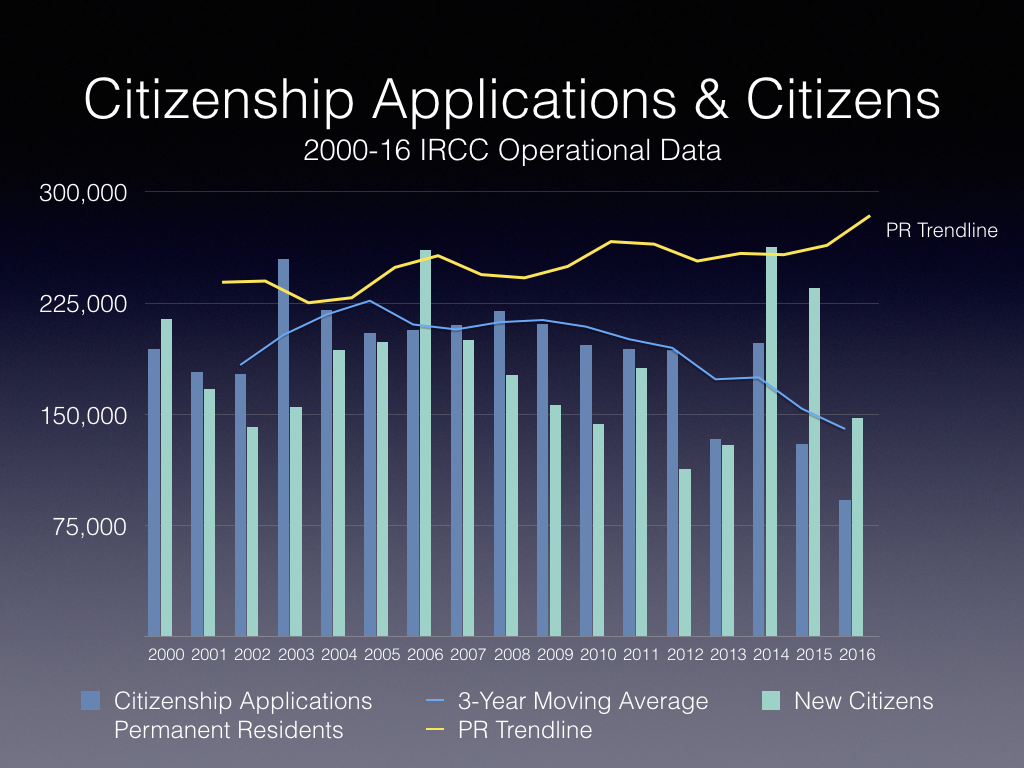
I have been holding off these comments on the IRCC Departmental Plan until the final 2016 citizenship statistics were released. The above chart now includes these showing a steady decline in applications:  198,000 in 2014 (about the historical norm), 130,000 in 2015 and 92,000 in 2016. The number of new citizens, reflecting the additional funding to clear up the backlog of some 300,000 applications, rose to 263,000 in 2014, then dropped somewhat to 235,000 in 2015, with a sharper drop to 148,000 in 2016.

With the number of permanent residents close to 300,000, over time this will mean fewer immigrants taking up citizenship, a major break with the immigrant-to-citizen model.

This “elephant in the room” is mentioned nowhere in the IRCC Departmental Plan (or Performance Report), nor is there any discussion of the societal risks of fewer immigrants taking up Canadian citizenship.

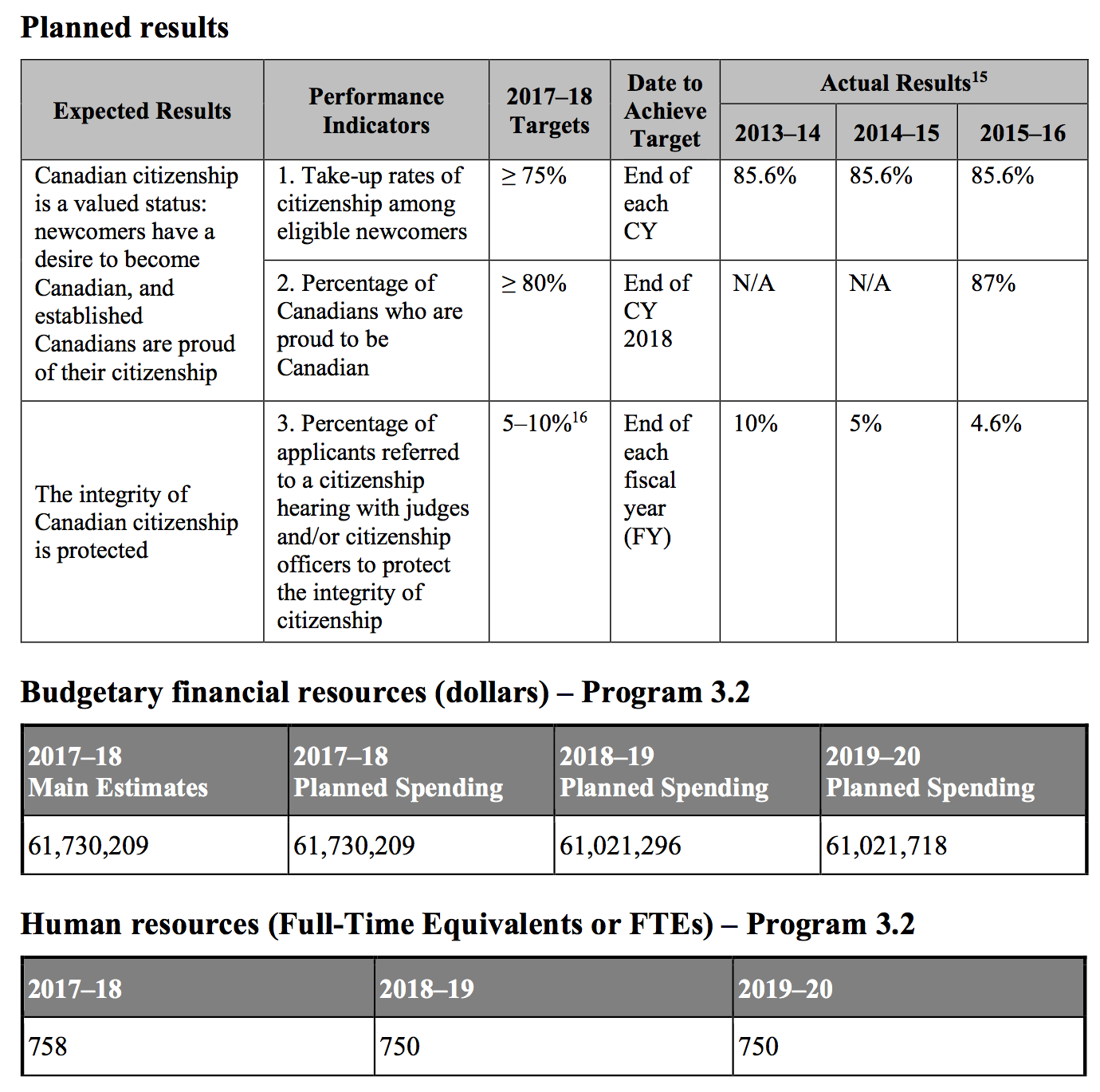
IRCC maintains a meaningless performance management standard: IRCC uses the benchmark of  the overall naturalization rate of all immigrants, no matter how long ago they came to Canada, rather than the more relevant number who have become citizens in the last 6 to 8 years.

Planned spending is $62 million, projected to remain flat for the next three years (three percent of departmental spending).

Priority: Diversity and attachment

The Department provides newcomers with access to Canadian citizenship and promotes the rights and responsibilities associated with Canadian citizenship, thus fostering a sense of belonging for newcomers and Canadians.

  • Provide support for proposed legislative changes to the Citizenship Act (Bill C-6) which seek modifications to provisions such as revocation as well as residency and language requirements for citizenship applicants.
  • Continue to promote citizenship awareness, including through Canada 150 celebrations, and update the citizenship study guide, Discover Canada: The Rights and Responsibilities of Citizenship to be more reflective of Canada’s diversity.

Priority: Efficient processing

The Department aims to ensure that its screening processes are faster for clients and more effective for Canadians.

  • Expand the eligibility for the new Electronic Travel Authorization (eTA) with proposed expansion for certain travellers from Brazil, Bulgaria and Romania. As well, explore further opportunities to facilitate travel to Canada by lower-risk foreign nationals, such as the increased use of automation to make visitor screening faster, more secure and effective for both travellers and Canadians.
  • Implement innovative approaches to increase efficiencies and reduce processing times, including reducing the processing time for spousal applications by half, to 12 months. Improve the citizenship application process, enabling qualified permanent residents to obtain citizenship more quickly. The Department will also target citizenship application backlogs and develop tools to improve how work is distributed and handled across its service delivery network.

Program 3.2: Citizenship for Newcomers and All Canadians

The purpose of the Citizenship Program is to administer citizenship legislation and promote the rights and responsibilities of Canadian citizenship. IRCC administers the acquisition of Canadian citizenship by developing, implementing and applying legislation, regulations and policies that protect the integrity of Canadian citizenship and allow eligible applicants to be granted citizenship or be provided with a proof of citizenship. In addition, the program promotes citizenship, to both newcomers and the Canadian-born, through various events, materials and projects. Promotional activities focus on enhancing knowledge of Canada’s history, institutions and values, as well as fostering an understanding of the rights and responsibilities of Canadian citizenship.

Planning highlights

  • Implement changes to the Citizenship Act following Royal Assent of Bill C-6, including corresponding updates to the Citizenship Regulations.
  • Update the citizenship study guide, Discover Canada: The Rights and Responsibilities of Citizenship, in support of Canada 150 celebrations.
  • Continue to collaborate with federal partners and national Indigenous organizations to explore options to respond to the Truth and Reconciliation Commission recommendations.

2017–2018 Departmental Plan

The 2015-16 IRCC Departmental Performance Report does not provide any meaningful reporting on citizenship but states:

The Department, through its regular performance reporting processes, has developed specific performance indicators to cover the Citizenship Program’s key outcome areas, including awareness of the responsibilities and privileges associated with Canadian citizenship; desire and successful uptake of Canadian citizenship by newcomers; the integrity of the Citizenship Program; and the value attached to Canadian citizenship. As data are not available at this time, results will be reported in the future.

Canadians have different attitudes on immigrants versus refugees: poll

Two contrasting polls released: the annual IRCC tracking survey and a SOM poll of attitudes in Quebec  (methodologies and questions vary).

Canada-wide results show 52 percent believe the current levels are about right, down from 58 percent a year earlier. The Quebec poll asks this question differently, showing 55 percent are opposed to an increase in immigration levels while 36 percent support an increase.

Starting with the tracking survey:

A newly released federal survey on attitudes towards immigration suggests Canadians are somewhat more enthusiastic about accepting economic migrants than they are about refugees.

While 52 per cent of those polled in the Immigration Department’s annual tracking study felt the right number of immigrants were coming to Canada, 23 per cent thought it was too high.

Meanwhile, 40 per cent felt the right number of refugees was being admitted and 30 per cent thought that figure was too high.

The 2016 survey was done long before immigration and refugee policy became a centrepiece of the U.S. presidential campaign and the eventual new administration of Donald Trump, and before the question of what values immigrants to Canada ought to hold became a centrepiece of Conservative leadership politics here.

So while the data might not reflect how attitudes have shifted since those developments, it’s telling for what it was probing for in the first place, suggested Jack Jedwab, the executive vice president of the Association for Canadian Studies and co-chairman of an upcoming conference on integration and immigration.

“I think what the government is trying to get at is the issue of the extent to which people are more preoccupied by the increase in refugees that’s happening in a lot other places in the world,” he said.

While the survey did suggest some differences in viewpoints on refugees versus other classes of immigrants, Jedwab said they aren’t substantial.

“Right now, we’re seeing globally an effort on the part of elected officials to try to make those distinctions – refugees bad, economic migrants good, that’s the distinction that’s being made in the States to some extent,” he said.

“And I don’t think, based on what we’re seeing now in this poll, that we’re seeing that idea take effect here.”

Pollsters were in field between August 11 to 31, 2016, asking 1,598 Canadians for their opinions on immigration. The survey has a margin of error of 2.45 per cent, 19 times out of 20.

The survey was done ahead of the release of the immigration levels plan, published in October, and also before the federal government received a report from its economic advisory council that would recommend a massive increase in the number of immigrants to Canada, from what had been about 260,000 a year to 450,000.

The survey did probe Canadians’ appetite for an increase. Respondents were asked to what extent they’d support boosting levels of economic immigration by 100,000 people over the next five years and 42 per cent exhibited some level of support for the idea. If the number ratcheted up further to 200,000 over five years, support fell to 38 per cent.

The Liberals eventually nixed any major increase, going instead with a modest uptake in admissions to around 300,000.

While the survey is done annually, not all the questions are repeated each year, making it difficult to compare attitudes over time unless the questions are exactly the same.

There was some crossover between this year and last year’s study.

Fifty-two per cent of those polled in 2016 thought the government is accepting the right number of immigrants, down from 58 per cent of those polled in 2015.

Meanwhile, about 46 per cent of those polled in 2016 felt that refugees have a positive impact on the Canadian economy, up from the 41 per cent who felt that way in the survey done last year.

Source: Canadians have different attitudes on immigrants versus refugees: poll – The Globe and Mail

The Quebec poll:

Une majorité de Québécois est défavorable à l’idée d’accueillir davantage d’immigrants au Canada à la suite des mesures anti-immigration du président américain Donald Trump.

Un sondage SOM publié mercredi par Cogeco Nouvelles précise que 55 % des répondants croient que le Canada ne devrait pas accueillir davantage d’immigrants à la suite des mesures anti-immigration du président américain.

En revanche, 36 % des gens approuvent l’idée d’en accueillir davantage, alors que 9 % se disent indécis.

Les catégories de personnes qui sont les plus favorables à l’idée d’accueillir davantage d’immigrants à la suite des mesures adoptées par l’administration Trump sont les 18-24 ans, dans une proportion de 55 %, ceux qui ont une langue maternelle autre que le français, dans une proportion de 49 %, et ceux qui ont une scolarité de niveau universitaire, dans une proportion de 49 %.

De même, 75 % des personnes interrogées se disent d’accord avec l’idée de resserrer la surveillance aux frontières pour empêcher l’arrivée d’immigrants illégaux.

Les personnes ayant le français comme langue maternelle sont encore plus nombreuses à le penser, soit 79 %.

Seulement 19 % s’opposent à l’idée.

De plus, moins du tiers des Québécois interrogés jugent que le premier ministre du Canada, Justin Trudeau, gère correctement le dossier de l’arrivée au pays des immigrants illégaux, soit 29 % d’entre eux.

La majorité des Québécois dit non à plus de migrants, selon un sondage

Canadian immigration website crash started hours before Trump victory, documents show

Well, that destroys one of the smug Canadian narratives!

An immigration website that was supposedly overwhelmed by Americans wanting to flee to Canada because of a Trump presidency was more likely brought down by foreigners scrambling to get a basic travel document before a deadline.

CBC News has learned that the website for Immigration, Refugees and Citizenship Canada was already in trouble hours before Donald Trump’s victory became clear on Nov. 8, the day of the U.S. presidential election.

That’s because foreign travellers faced a Nov. 10 deadline to obtain so-called “electronic travel authorizations” online before they could fly into Canada. They apparently flooded the website before that deadline to pay $7 online for electronic delivery of the mandatory travel documents, known as eTAs.

Immigration and Citizenship Canada website

Technicians took more than 32 hours on Nov. 8-9, 2016 to fix Canada’s immigration website, which was flooded with applications from travelers looking for transit documents before a key deadline.

The rush seemed to catch Canada’s immigration officials off guard. By about 2 p.m. ET on Nov. 8 — even as Americans were still casting their ballots — the high volume of eTA traffic left the main website “degraded” with “temporary outages.”

Technicians with Shared Services Canada were alerted to the problem, but didn’t act immediately. It eventually took more than 32 hours to repair the website, by doubling the number of servers to six and increasing the processing capacity. The fix came less than two hours before the Nov.10 eTA deadline, likely frustrating eTA applicants for more than a day.

CBC News obtained internal reports and emails, through the Access to Information Act. They undermine the official version that the website “started to experience difficulties” only at 11 p.m. ET, when Trump’s victory had become clear.

“It looks like the eTA is starting to experience significant volumes a few days earlier than planned,” said a Shared Services Canada official, in an email written before any U.S. polling stations had even closed.

“The surge to the site seems to have happened sooner than planned,” she repeated in a later email.

Although Shared Services Canada technicians were officially told about the web troubles at about 2 p.m. on Nov. 8, they did little to resolve the problems that afternoon.

Source: Canadian immigration website crash started hours before Trump victory, documents show – Politics – CBC News

2017 Cabinet Shuffle

election-2015-and-beyond-implementation-diversity-and-inclusion-024The above chart contrasts the original 2015 Cabinet with the changes announced Tuesday by the Prime Minister (will update when parliamentary secretary changes are announced to replace those who were promoted to minister).
Gender parity remains, visible minority representation increases to 20 percent, no change in the number of persons with disabilities, with only one Indigenous minister compared to two in the original Cabinet (Hunter Tootoo was later removed).

The choice of a neophyte Minister for Immigration, Refugees and Citizenship, Ahmed Hussen, is not without risk given the complexities and politics of the department’s issues (as Monsef’s difficulties attest).

Hussen is the third immigration minister to have been an immigrant, the first visible minority and non-European. (Joe Volpe, born in Italy,  and Sergio Marchi, born in Argentina but of Italian ancestry, are the previous ones). As most of Canada’s current immigrants are visible minorities, he will bring that perspective and experience with him to the portfolio, as well his experience on security and radicalization issues.

Like McCallum, his riding is majority visible minority (54 percent compared to McCallum’s 82 percent) but with a different mix: York South-Weston is 21 percent Black, 9 percent Latin American whereas Markham-Thornhill is 35 percent Chinese, 31 percent South Asian.

Look forward to seeing the mandate letters for Minister Hussen (and others) to see if any new commitments compared to former Minister McCallum (largely achieved or in progress – list below):

  • Lead government-wide efforts to resettle 25,000 refugees from Syria in the coming months.
  • As part of the Annual Immigration Levels Plan for 2016, bring forward a proposal to double the number of entry applications for parents and grandparents of immigrants to 10,000 a year.
  • Give additional points under the Entry Express system to provide more opportunities for applicants who have Canadian siblings.
  • Increase the maximum age for dependents to 22, from 19, to allow more Canadians to bring their children to Canada.
  • Bring forward a proposal regarding permanent residency for new spouses entering Canada.
  • Develop a plan to reduce application processing times for sponsorship, citizenship and other visas.
  • Fully restore the Interim Federal Health Program that provides limited and temporary health benefits to refugees and refugee claimants.
  • Establish an expert human rights panel to help you determine designated countries of origin, and provide a right to appeal refugee decisions for citizens from these countries.
  • Modify the temporary foreign workers program to eliminate the $1,000 Labour Market Impact Assessment fee to hire caregivers and work with provinces and territories to develop a system of regulated companies to hire caregivers on behalf of families.
  • Lead efforts to facilitate the temporary entry of low risk travelers, including business visitors, and lift the visa requirement for Mexico.
  • Work with the Minister of Justice and the Minister of Public Safety and Emergency Preparedness to repeal provisions in the Citizenship Act that give the government the right to strip citizenship from dual nationals.
  • Eliminate regulations that remove the credit given to international students for half of the time that they spend in Canada and regulations that require new citizens to sign a declaration that they intend to reside in Canada.

Canadian immigration applications could soon be assessed by computers

Makes sense that IRCC is exploring this as a means to improve efficiency and processing times, along with greater consistency of decision-making Richard Kurland, Vic Satzewich and I comment on some of the advantages as well as cautions on the proposed approach:

Ottawa is quietly working on a plan to use computers to assess immigration applications and make some of the decisions currently made by immigration officers, the Star has learned.

Since 2014, the Immigration Department has been developing what’s known as a “predictive analytics” system, which would evaluate applications in a way that’s similar to the work performed by officials today.

The plan — part of the government’s modernization of a system plagued by backlogs and delays — is to use the technology to identify the merits of an immigration application, spot potential red flags for fraud and weigh all these factors to recommend whether an applicant should be accepted or refused.

At the moment, the focus of the project is on building processes that would distinguish between high-risk and low-risk applications, immigration officials said.

“Predictive analytics models are built by analyzing thousands of past applications and their outcomes. This allows the computer to ‘learn’ by detecting patterns in the data, in a manner analogous to how officers learn through the experience of processing applications,” department spokesperson Lindsay Wemp said in an email.

“The goal is to improve client service and increase operational efficiency by reducing processing times while strengthening program integrity.”

The project was approved by the former Conservative government cabinet in February 2013. Wemp said there is no firm timeline on when automated decisions might be a viable option.

“To ensure the accuracy of decisions, models undergo extensive testing prior to being used. Once in service, quality assurance will be performed continually to make sure that model predictions are accurate,” she explained.

 “The novelty of the technology and the importance of getting it right make it imperative that we do not rush this project.”

With the proliferation of artificial intelligence in people’s day-to-day lives, from IBM’s Watson (the supercomputer that defeated Jeopardy! champions) to Google’s self-driving cars, immigration experts said they were not surprised by the move toward automation.

“This is the greatest change in immigration processing since the Internet. What requires weeks if not months to process would only take days with the new system. There are going to be cascades of savings in time and money,” said immigration lawyer and policy analyst Richard Kurland.

“A lot of countries have used predictive analytics as a tool but not for immigration processing. Canada Revenue Agency also uses the techniques to identify red flags. It uses artificial intelligence. It is decision-making by machines. The dividends of this exercise are huge.”

The Immigration Department’s Wemp, however, said the department’s plans shouldn’t be classified as artificial intelligence because a predictive model cannot exercise judgment in the same way as a human and officers will always remain central to the process.

“We would be able to catch abnormalities in real time, which would then help us to identify fraud and threats more quickly,” noted Wemp. “Some immigration programs are better suited for predictive analytics than others. The department envisions a phased approach, one program at a time.”

Calling the government’s move evolution rather than revolution, Andrew Griffith, a retired director general of the Immigration Department, said applying the technology to immigration processing is a big deal for the public mostly because of border security concerns.

For Griffith, however, the bigger worry is what algorithms officials use to codify the computer system.

“The more you can bring the government to the 21st century, the better. But we should be using the tools intelligently and efficiently. The challenge is not to embed biases into the system and create extra barriers for applicants,” said Griffith, adding that an oversight body is warranted to constantly monitor the automated decisions.

McMaster University professor Vic Satzewich, author of a research project on decision-making by immigration officers, agreed.

“My concern is how they are going to operationalize the different factors officers use in weighing their decisions and program a decision-making algorithm. There are no real formulas they use,” said Satzewich.

“Two officers look at an application in different ways. A machine is going to miss things that an officer picks up. I still feel better to have an officer look at every immigration file. Public confidence is important. If Canadians lose confidence in the system, their support for immigration goes down.”

Immigration officials said no job losses are anticipated, as officers who are no longer working on low-risk applications would be reassigned to “higher value-added activities” such as reducing backlogs elsewhere.

Wemp would not reveal how much was budgeted for the project, but said the department has received “modest amounts of funding” to develop proofs of concept by a small team of analysts and no major informational technology investments have been made.

Source: Canadian immigration applications could soon be assessed by computers | Toronto Star

Citizenship Applications: Third Quarter Continues to Show Decline

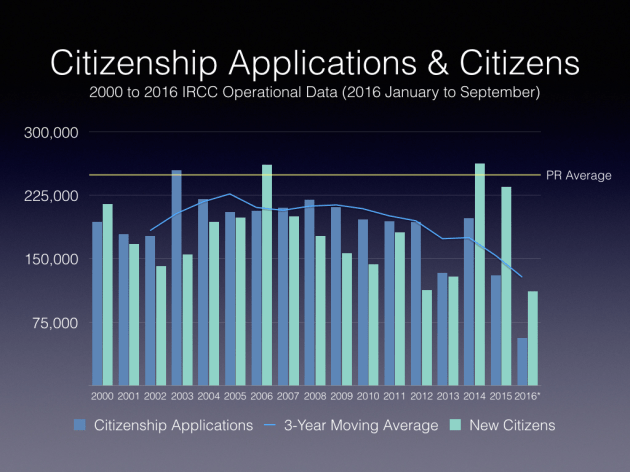
citizenship-data-slides-010Further to my earlier analysis of the half-year numbers showing a dramatic decline (The impact of citizenship fees on naturalization – Policy Options), the third quarter numbers issued this week confirm the overall trend: only some 56,000 applications were received, compared to 112,000 for the same period in 2015, just about half.

This quarter is the first quarter one year after minimum residency requirements were changed to four years from three and so one might have expected some increase. Indeed, the July-September numbers show an increase for the quarter from 12,000 in 2015 to 20,000 in 2016. But this does not change the overall picture: the total number of applications this year is likely to be around 75,000 compared to 130,000 in 2015, a drop of over 40 percent.

Nor does it change my overall argument that the likely major factor responsible for this decline was the steep increase in adult citizenship processing fees in 2015 to $530.

Of course, the one bright spot in this decline is that the backlog has been reduced: the current inventory is just over 55,000 compared to about 250,000 at the beginning of 2015. Processing time has also declined, from 21 months for the same period in 2015 to 16 months currently.

The most recent approval rate is 91 percent, slightly down from 93 percent.

But reducing the backlog and reducing processing times by reducing demand for citizenship through higher fees and other barriers runs against the government’s overall diversity and inclusion agenda.


Trudeau government revoking citizenship at much higher rate than Conservatives

The lack of procedural protections for citizenship revocation in cases of fraud or misrepresentation, flagged as a concern in both hearings on the Harper government’s C-24 and the Trudeau government’s C-6, continues to draw attention, given both the increased number of revocations and the Monsef case (although I would argue misrepresentation of her birthplace by her mother is not material in the way that misrepresenting residency).

And while the Trudeau government continued use of this power is questionable, the higher rate reflects in part the increased number of investigations following implementation of this provision in C-24 on 28 May 2015.

IRCC data shows 24 investigations initiated before this provision came into force, and 324 in the seven months after. The number of cases in the pipeline increased, and thus normal that more revocations would result, as the government applies the law:

The Trudeau government used powers granted by the Harper government’s controversial citizenship law to make 184 revocation decisions without legal hearings between November 2015 and the end of August. About 90 per cent of the decisions resulted in a negative finding and the loss of a person’s citizenship.

The numbers show that the Trudeau government has used the law far more aggressively than the Harper government itself.

But in a Federal Court filing late Friday, the government said it would not grant a moratorium on revocation cases, and added that claims by some that the system was revoking large numbers of citizenship are speculative.

Liberal Leader Justin Trudeau made the sanctity of citizenship an issue in last year’s federal election.

“A Canadian is a Canadian is a Canadian,” Trudeau said in a leaders’ debate three weeks before storming to victory.

He used it to dress down Stephen Harper for passing Bill C-24, a law that aimed to strip dual citizens of their Canadian passports if they were convicted of crimes of terrorism, treason or espionage against Canada, or took up arms against Canada.

Immigrant communities rallied to the Liberal Party, concerned that Canadians born overseas would be reduced by C-24 to an insecure second-class status.

Once elected, one of the Liberals’ first acts was to repeal the parts of C-24 that applied to those convicted of terrorism-related crimes, ensuring that they can keep their Canadian passports.

But the Trudeau government left intact other parts of the law that allow the government to strip citizenship from other holders of Canadian passports for misrepresentation.

The 184 revocation decisions of the first 10 months of the Trudeau government nearly match the total number of decisions over a 27-year period between 1988 and the last month of the Harper government in October 2015.

Revocations increase as Trudeau takes office

Although the powers being used come from a law passed by Stephen Harper’s Conservatives, the law has been used much more aggressively under Trudeau.

In the first full month of the law’s operation, June 2015, only three revocation decisions were made. None were made in July or August, two in September and two more in October.

The Trudeau cabinet was sworn in on Nov. 4, 2015. That month saw 21 revocation decisions. The following month there were 59. The year 2016 averaged 13 decisions a month up to Aug. 31, the latest data CBC News has been able to obtain.

The monthly average under the Harper government from 2013 to 2015 was only 2.4 cases a month, some under the auspices of C-24 and some under rules that existed previously.

Citizenship revocation decisions by year (in persons)

2013 2014 2015 2016 (8 months)
January 13
February 4 7 25
March 17 7
April 5 14
May 5 16 18
June 4 1 3 7
July 10
August 10
September 4 2
October 1 2
November 4 21
December 7 59
Total 15 15 132 104

Source: Immigration, Refugees and Citizenship Canada

Liberals accused of hypocrisy

In recent days, following revelations that the birthplace of one of its own cabinet ministers was misrepresented on her passport documents, the government has said it is open to reforming the system.

But in the preceding months, it had used the revocation measures at an unprecedented rate.

“The Liberals criticized these provisions when they were in opposition,” says Laura Track of the B.C. Civil Liberties Association. “They said they were going to fix it. And yet they have been using it even more than the Conservatives did.”

The government says the revocation decisions are being taken to protect the integrity of the citizenship system and are aimed at cases of fraud.

Nancy Caron of Immigration, Refugees and Citizenship Canada said “many cases that are being processed for revocation are as a result of large-scale investigations into possible residence fraud.”

The department carried out those investigations with Canada Border Services Agency and the RCMP. Investigations led by those agencies have resulted in the conviction of immigration consultants who helped individuals obtain citizenship illegally.

“The revocation process is then undertaken to determine whether the individuals associated with these investigations, fraudulently obtained their Canadian citizenship through having intentionally misled the government of Canada about key aspects of their citizenship application such as concealing past criminal activities or submitting false documents to demonstrate residence in Canada when in fact they were not living in Canada‎. Many of the decisions to revoke citizenship that have been made since May 2015 directly result from those investigations,” Caron said in an email to CBC News.

Source: Trudeau government revoking citizenship at much higher rate than Conservatives – Politics – CBC News

Directing MPs through new call centre for immigration cases disastrous, say critics

This has been raised at CIMM (the immigration committee):

Opposition MPs say they are incredibly frustrated with a new method for MPs to get information from the government about immigration case files, quietly introduced by the Liberals in April.

Both NDP MP Jenny Kwan (Vancouver East, B.C.), immigration critic for her party, and Conservative MP and immigration critic Michelle Rempel (Calgary Nose Hill, Alta.), say a new system of making immigration inquiries, which has their staff asking questions about immigration cases through a call centre, is creating a backlog of cases for their staff.

Prior to the change, which both MPs referred to as being “quietly” implemented by the government in April, MPs’ offices had two lines they could call: one was a direct Ottawa phone number that connected them to the Ministerial Enquiries Division within the immigration minister’s office, when they had complex or urgent cases and needed a ministerial intervention. The other was a line for simple inquiries, like updates.

With the new general line, information they are expecting to get back in the outlined two business days can easily turn into five days, the opposition MPs suggested. Ms. Rempel said in her office the two days has turned into 10, sometimes 15 days.

This article is the second in a series examining the challenges that Members of Parliament experience in their constituency office. In the first of the series, The Hill Times looked into the challenges associated with helping constituents with passport applications.

Remi Lariviere, a spokesperson for Citizenship and Immigration Canada, responding to questions about the concerns of Ms. Rempel and Ms. Kwan, said the new system has been set up “in order to streamline and enhance services to parliamentarians.” To do so, “a single point of contact dedicated for MPs has been implemented…to ensure that Members of Parliament receive the most expedient and informative service possible to assist them in helping their constituents and managing their cases,” he wrote in an email.

According to Mr. Lariviere, the Ministerial Enquiries Division is still providing the information, just by way of what he called the “information centre,” which is based in Montreal.

Ms. Rempel and Ms. Kwan said calling the Ministerial Enquiries Division directly for complex cases was an efficient and effective way of getting information for their constituents. The new call centre, however, is anything but that, they said.

“In this system, we’re put on hold. Calls can take up to an hour and a half for us to get the information, whereas before we were never put on hold, they had the information, and we were going to get the information expeditiously…[in] a far quicker turnaround time with way less bureaucracy,” Ms. Kwan said. The new system is frustrating she said, not only for her, but for her staff, and “most importantly,” her constituents.

Responding to complaints about delays in getting information, Mr. Lariviere wrote that the “service standard for simple case inquiries is to respond within two days, whereas more complex inquiries are responded to within 10 days. Those have not changed since the implementation of the new line.”

Source: The Hill Times