Express entry economic immigration timelines a ‘joke,’ say lawyers as processing times increase

Further to the IRCC departmental results report and its failure to meet its service standards (see https://multiculturalmeanderings.com/2021/01/21/immigration-program-ircc-results-highlights/ :

Canada’s “express entry” approach to key economic immigration programs isn’t working, immigration lawyers say, following a recent report showing that none of them are meeting the six-month service standard.

That failed grade was among 17 missed performance targets the Immigration, Refugees, and Citizenship Canada (IRCC) reported for the 2019-20 fiscal year, or 31 per cent of the 54 total targets. It said none of the government’s business lines for permanent residents adhere to service standards during a time period that had yet to feel the pandemic’s full impact. 

Launched in 2015, the express entry process is described by Canada as its “flagship” system for various federal skilled worker programs, and a portion of the provincial nominee program, as a pathway to permanent residence for skilled workers in Canada and overseas. IRCC has said it plans to increase permanent-resident admissions, setting a target of 341,000 for 2020 and 350,000 for 2021, with most of the uptick expected from economic immigration streams.

Evelyn Ackah, founder of Ackah Business Immigration Law in Calgary, laughed when she repeated the program’s name.

“Express entry, that’s a joke. When they first launched that program a few years ago, it was incredible. It was three months, four months,” she said, but now she warns clients it can take more than a year.

She said it’s disappointing the government hasn’t been able to keep up with the high volume of applications. To her, it’s a clear resourcing and staffing problem that doesn’t line up with Canada’s stated goals to increase immigration levels. 

“It’s not working as an express process, absolutely not. It’s the same as the old process, as far as I’m concerned, and it’s lost its credibility with people,” she said. “The trend is getting slower and slower.”

Over the last three years, and before COVID-19 interruptions, processing times have increased, and in some cases, doubled the time it takes to deal with 80 per cent of applicants. The federal skills trade stream jumped from six months in 2017 to one year for the majority of applicants, while the federal-skilled worker and provincial-nominee programs increased from six to nine months in that same time frame. The Canadian Experience Class increased from four to seven months. Across all programs, only 60 per cent of the applications met the standard by the end of 2019.

According to the department’s latest plan, its overall spending is set to increase from $1.92-billion in 2017-18 to the peak last fiscal year at $3.46-billion, before going back down this fiscal year to $2.84-billion, $2.6-billion in 2021-22, and $2.56-billion in 2022-23.

The stretching timelines reflect an increase in applications to express entry, with the 332,331 submissions in 2019 amounting to a 20 per cent jump from the number of applications in 2018. Among the 2019 profiles submitted in 2019, 72 per cent were eligible for at least one of the business programs, according to the program’s year-end report.

https://flo.uri.sh/visualisation/5180771/embed

Still, the government promises to those searching for information online about the express entry system that it “will result in fast processing times of six months or less.

“I can’t even bring up that number [to clients],” said B.C.-based  immigration lawyer Will Tao of Heron Law, saying more transparency is needed. 

It’s “misleading” and can “give the wrong impression” to applicants, he said, especially now with the pandemic posing even more of a challenge to processing times.

“I think they pretty much internally abandoned it, so from my perspective, if you’ve done that, then you probably should … let clients know,” he said, calling for better transparency so that people can get more certainty about their situations. 

Even though it’s supposed to be an automated system, based on points, both lawyers said the process gets bogged down during the authentication stage, as officials check over and verify the many documents submitted. Eligible candidates in the pool are given a score based on their skills and experience, with top-ranking candidates invited to submit an application for permanent residence. As of June 2017, IRCC added extra points to candidates with strong French-speaking skills.

Both Mr. Tao and Ms. Ackah acknowledged it can be a complicated process, but Ms. Ackah said that’s all the more reason to match up resourcing.

In IRCC’s report on performance targets, the department said “substantial efforts” have been made to reduce applications that took longer than six months to process in the express entry system.

“While service standards are being met for a higher number of applications compared to previous years, this was offset by an increase in applications and the processing of older applications,” the report said.

The department noted early results show “progression towards higher admission targets” and efforts to increase the intake are having an impact on service standards, in this case, the promise to have the majority completed within six months. The department doesn’t control intake for provincial nominee program’s paper applications and Quebec-selected skilled workers.

By email, IRCC spokesperson Lauren Sankey said the government remains committed to reducing application processing times and improving the department’s service delivery. 

IRCC misses a third of 2019-20 targets

In 2019-20, the department met 37 of 54 performance targets, and missed 17, or 31 per cent. The express-entry delay was the worst among several performance targets the department didn’t reach. Canada’s backlogged asylum system again failed to make the cut, with the department reporting only 32 per cent of asylum claims were referred to the Immigration and Refugee Board of Canada within service standards, compared to target of 97 per cent.

A couple of targets found language-development delays for people settling in Canada. In one case, only 37 per cent of IRCC’s settlement clients reported improved official language skills compared to the target of 60 per cent, while 19 per cent of people reported receiving language-training services compared to target of 25 per cent.

Ms. Sankey said every newcomer’s experience is unique, including their participation in settlement services, which is managed by IRCC and delivered by more than 500 service provider organizations across the country, outside of Quebec. Federally funded language training is “a key component” said Ms. Sankey, who noted there’s been a proportionate increase in newcomers with limited knowledge of English or French over the past few years.

In 2019-20, IRCC also reported 2.82 per cent of permanent residents outside Quebec identified as French speaking, compared to the target of 4.4 per cent. Ms. Sankey said under the Francophone Immigration Strategy, IRCC is “pursuing year-round targeted promotion and recruitment” to attract more qualified French-speaking candidates, and noted under the express entry program, the government increased invitations to French-tested candidates from 4.5 per cent in 2018 to 5.6 per cent in 2019.

These results suggest issues with respect to service standards, language training, and refugee claims, said Andrew Griffith, a fellow of the Canadian Global Affairs Institute who was once a director general at the department’s Citizenship and Multiculturalism Branch.

While many reflect perennial problems and backlogs, given these markers IRCC seems to be “systematically” missing the standards it sets to monitor how well it’s delivering its services, he said.

“So if they’re consistently their targets it says there’s either a management problem, an operational problem, a resource problem, or some combination of those,” he said. 

Even so, he noted a contrasting target the department met: a 91 per cent satisfaction rate from visitor, international students, and temporary worker applicants who reported they were satisfied overall with the services they received. While he doesn’t advocate for lowering targets, Mr. Griffith questioned why the government reports on aspirational or unrealistic goals. 

“Personally, I favour realistic standards for public departmental reports, with aspirational more appropriate for internal use,” he said. 

IRCC’s targets are based on factors like historic trends, program objectives, resourcing levels, client service goals, and evolving influences such as the impact of increasing temporary resident and permanent resident immigration levels, said Ms. Sankey.

“Targets are reviewed regularly, and in some cases, the department establishes ambitious targets that serve to stretch program vision and encourage innovation. In other cases, they are based on baselines and historic trends where achievement is more certain,” said Ms. Sankey, noting following a 2020 departmental review how IRCC tracks performance will change.

Distilling service performance down into two tracks—one for permanent residents (PR) and one for temporary residents (TR)—is not a true representation of the department’s performance, she said, given the disparate programs under the two umbrellas. Instead, IRCC will report on the service standard for each individual program, which Mr. Griffith called a “significant change” given the “overly simple” approach before.

“This change will capture more accurate service standard performance for the many lines of business which make up the temporary and permanent resident programs,” Ms. Sankey said. 

Source: https://hilltimes.us10.list-manage.com/track/click?u=a90bfb63c26a30f02131a677b&id=4ac92e0ed3&e=685e94e554

Immigration Program: IRCC Results Highlights

Further to yesterday’s highlighting of the citizenship program results, reviewed results for the other programs. As always, it is the commitments not met that are more interesting than the ones met (perhaps unfairly).

I have thus focused on those commitments that IRCC did not meet by a margin of five percent or more, with the exception of francophone immigration outside Quebec.

The ones I find most concerning pertain to language skills, adherence to service standards in a number of areas, and earnings of immigrants:

Only 37 percent of settlement clients improved their official language skills compared to the target of 60 percent.

“The November 2017 Evaluation of the Settlement Program showed that higher-need clients progress at a slower pace. The growing number of clients in basic settlement language training classes who have low language and literacy skills is due in part to the Department’s goal to reduce waitlists for priority clients at basic levels and to the increase in admissions of vulnerable newcomers. There are many learners in part-time classes who, compared to those in full-time classes, may not progress as quickly. This could explain why the number of clients who improved one of their skills (listening, speaking, reading, and writing) by one level has declined.”

0 percent of permanent resident business lines that adhered to service standards compared to the target of 100 percent

“Substantial efforts were made to reduce Express entry (EE) applications that took more than 6 months to process. While service standards are being met for a higher number of applications compared to previous years, this was offset by an increase in applications and the processing of older applications. Early results showed progression towards higher admission targets in EE and efforts to encourage higher intake caused slowing in the processing continuum, having an impact on service standards. IRCC remained committed to finalizing the higher number of cases and made adjustments to the production environment, but cases near finalization were older than expected and the time to train employees and adjust the workflow did not produce results as planned. IRCC does not control intake for Provincial Nominee Program (paper applications) and Quebec-selected Skilled Workers (QSW) and inventories remain larger than can be accommodated within standards; and for QSW, IRCC does not control output.”

2.82 percent of permanent residents admitted to Canada, outside Quebec, who identify as French-speaking compared to the target of 4.4 percent

“Recent changes to selection tools, including changes in 2017 to assign additional points to candidates with strong French-language skills under Express Entry, have been increasing French-speaking admissions outside of Quebec. The Department is also pursuing year-round targeted promotion and recruitment support activities to attract a growing number of qualified French-speaking candidates. As of 2019, a more accurate and inclusive definition has been used to count French-speaking immigrants outside Quebec, resulting in a notable impact on admissions data. The new definition moves away from the concept of “mother tongue” and focuses instead on first Canadian official language for which they are most at ease.”

32 percent of asylum claims made in Canada that are referred to the Immigration and Refugee Board of Canada within service standards compared to target of 97 percent

“To provide the Government greater flexibility to manage volumes at the border, the requirement to complete the eligibility assessment within three days was repealed in June 2019 as part of the Budget 2019 Implementation Act. The intent remains to determine claim eligibility as fast as possible. Once a claim is received, an acknowledgement of claim letter is issued to the claimant within three days, which can be provided as proof of Interim Federal Health Program coverage until an eligibility decision is made, and a refugee protection claimant document is issued.”

44 percent of provincial nominee principal applicants with employment earnings at or above the Canadian average, five years after landing, compared to target of 50 percent

“Five years after landing, about 44% of provincial nominee immigrants had employment earnings at or above the Canadian average. This is a drop from almost 48% in 2016 and about 51% in the previous year. While this figure still continues to demonstrate the ability of provincial economic immigrants to earn employment income on par with, or above, the Canadian average, it has been below the target of 50% for the last 2 years. This might be attributed to a number of factors, such as growth in the provincial economic immigration program allowing for greater diversity in the types of occupations (and associated wage levels) being filled by provincial nominees. This indicator is an important factor in assessing an immigrant’s capability to integrate into the economy. Note: The result is subject to change as the Pandemic has affected data reporting capabilities by our partners.”

19 percent of clients who received language training services compared to target of 25 percent

“In 2019–20, approximately 105,000 unique clients accessed language training services, which is relatively the same as in 2018–19. However, the percentage of clients who received language training services, as a proportion of all settlement clients, has declined year over year, decreasing from about 20% in 2018–19, 24% in 2017–18, and 26% in 2016–17. The admission of vulnerable populations with lower language and literacy levels has resulted in a greater number of clients who have complex needs and require additional support which could impact the timing and their ability to appropriately access services. Since there is high demand for language training, the Department has prioritized clients at basic levels who, compared to learners at higher levels, may occupy seats for a longer period of time. The Department also provides other options to newcomers to improve their official language skills, such as employment-related language training and workplace-based communication workshops.”

80 percent of temporary resident business lines that adhere to service standards compared to target of 100 percent

“In the past fiscal year, the Department met targeted service standards for eight out of ten (80%) temporary resident business lines. Service standards were not met for temporary resident visas and work permit applications for International Experience Canada. The Department continues to implement and explore measures to respond to higher volumes, and improve services and processing times.”

Source: https://www.tbs-sct.gc.ca/ems-sgd/edb-bdd/index-eng.html#orgs/dept/123/infograph/results

Citizenship Program: Results Highlights

A quick look at the IRCC citizenship program results posted on the TBS site indicates the following:

  • 95 percent satisfied with the service received;
  • Only 65 percent of applications processed within the 12 month service standard (target is 80 percent). Don’t believe IRCC has ever met this standard, reflecting perennial structural and financial issues with the program.
    • Departmental explanation: “In 2019–20, a total of 65% of citizenship grant applications were processed within the 12-month service standard. The absolute volumes of citizenship applications continue to increase year after year. The number of citizenship applicants who became Canadian citizens has increased by 118%, from 112,969 in 2017–18 to 247,139 in 2019–20. Growing application volumes have strained the operational processing model causing increased processing times. The citizenship applications process is heavily paper-based and relies on manual data entry. The program is also facing a large increase in demand and the current funding levels are outpaced by application volumes. The program is exploring ways to transform the processing model to increase speed and efficiency and develop digital tools for improved client service.”
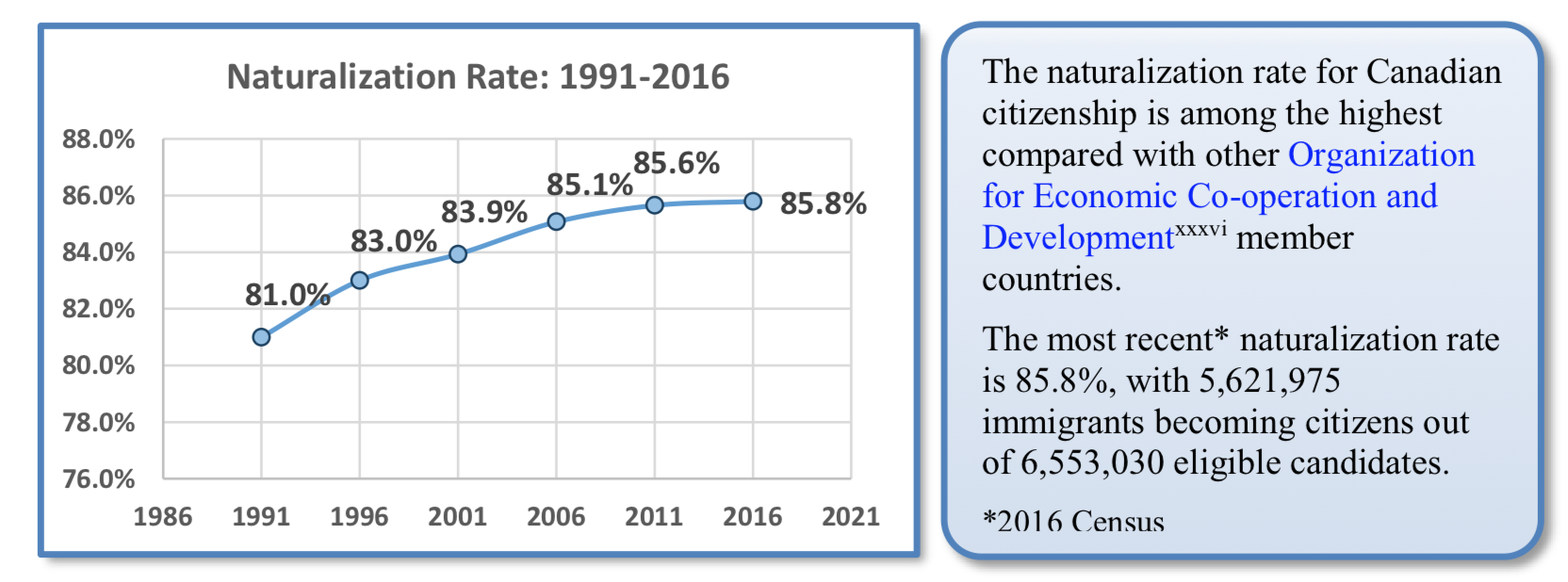
  • 86 percent of eligible permanent residents have become Canadian citizens. As I have mentioned repeatedly, the performance measure is based upon the total number of immigrants who became citizens, whether they arrive 5 or 50 years ago, and hence is meaningless as a performance indicator. A real performance indicator would use the percentage of recent immigrants who have become citizens, those who immigrated to Canada in the past Census period (5 to 9 years):
    • “Rationale: Canada’s immigration model encourages newcomers to naturalize (become citizens) so that they can benefit from all the rights of citizenship and fully assume their responsibilities, thereby advancing their integration. Take-up rates are considered a proxy that illustrates to what extent permanent residents value Canadian citizenship. Calculation / formula: Numerator: Permanent residents in Canada who are eligible to acquire Canadian citizenship and self-report on the Census that they have acquired Canadian citizenship. Denominator: Permanent residents in Canada who are eligible to acquire Canadian citizenship. Data Source: Statistics Canada’s Census Baseline: 2016: 85.8% Definitions: Naturalization: The Census instructs individuals who have applied for, and have been granted, Canadian citizenship (i.e., persons who have been issued a Canadian citizenship certificate) to self-report their citizenship as “Canada, by naturalization”. Notes: In the performance narrative, IRCC administrative data could be used to tell the story of citizenship from an operational and policy perspective. Information on age, gender, immigration stream, and country of origin of new citizens would be considered in order to explain changing trends. It is also important to note that calculations using IRCC’s administrative data will be based on the number of people admitted as permanent residents who took up citizenship. Figures from Statistics Canada indicate that in 2011, about 6,042,200 foreign-born people in Canada were eligible to acquire citizenship. Of these, just over 5,175,100, or 85.6%, reported that they had acquired Canadian citizenship. This naturalization rate in Canada was higher than in other major immigrant-receiving countries. In telling the story of the naturalization rate, it will be important to explain the reasons why some people choose not to naturalize.”

Source: https://www.tbs-sct.gc.ca/ems-sgd/edb-bdd/index-eng.html#orgs/dept/123/infograph/results

Departmental Plans: Canadian Heritage (multiculturalism), IRCC (citizenship)

Relevant highlights from the departmental plans. No real surprises.

The campaign and mandate letter commitment to eliminate citizenship fees is worded as “to bring forward a plan to eliminate fees for citizenship for those who have fulfilled the requirements for obtaining it.” This suggests that it will take some time which the financial projections, which do not include any impact from elimination of fees, confirm.

The previous mandate commitment to revise the citizenship guide, Discover Canada, remains part of the plan:

Canadian Heritage (multiculturalism) Planning highlights

Canadians value diversity.

In 2020-21, the Department will undertake the following activities towards achieving this departmental result by:

  • Supporting the new Anti-Racism Secretariat, which will demonstrate leadership in overseeing a coherent whole-of-government approach on combating racism and discrimination, ensuring comprehensive and coordinated actions with measurable impact, and fostering continuing dialogue with provinces, territories and our diverse communities.
  • Implementing a new data and evidence approach to promote a better understanding of the barriers faced by racialized communities, religious minorities and Indigenous Peoples; and collecting data and information and conducting research as a means of informing policy and program development and performance reporting on “what works” in anti-racism programming.
  • Delivering more targeted community-based projects to communities, which address systemic barriers to employment, justice and social participation for Indigenous Peoples, racialized communities and religious minorities.
  • Consulting civil society representatives of LGBTQ2 communities to lay the groundwork for an LGBTQ2 action plan that would guide the work of the federal government on issues important to LGBTQ2 Canadians.

Youth enhance their appreciation of the diversity and shared aspects of the Canadian experience.

In 2020-21, the Department will undertake the following activities towards achieving this departmental result by:

  • Supporting projects, exchanges, and forums that allow youth throughout Canada to connect with one another, have a better understanding of what they have in common, and learn new things about Canada’s diverse cultural expressions, history, and heritage, with special emphasis on reconciliation, diversity and inclusion, and official language minority communities.
  • Working towards breaking down barriers to participation and providing more opportunities for diverse youth, such as youth from official language minority communities, racialized and Indigenous communities, and rural, remote and Northern communities.
  • Advancing the government-wide priority of inclusivity by involving young people in federal decision making through its work in 2020-21. For example, the Youth Secretariat will continue to manage the operations of the Prime Minister’s Youth Council, including the recruitment of a diverse and representative cohort of new members in 2020; as well as working with the Privy Council Office to implement the commitment to have 75% of all Government of Canada Crown Corporations include a youth member, as mandated by the Canada Youth Policy.

Planned spending is about $130m. Source: https://www.canada.ca/en/canadian-heritage/corporate/publications/plans-reports/departmental-plan-2020-2021.html#a4d

Immigration, Refugees and Citizenship (citizenship) Planning highlights

Departmental Result 7: Eligible permanent residents become Canadian citizens

In 2018–2019, more than 207,000 people were granted Canadian citizenship, an 84% increase over the previous fiscal year. A significant reason for this increased demand for citizenship was the coming into force of Bill C-6, which amended the Citizenship Act to make it easier and give more flexibility to permanent residents in becoming Canadian citizens. In 2020–2021, the Department will continue updating the citizenship grant operating model and client service tools with the aim of reducing processing times, improving service delivery and client experience, and enhancing system efficiency while maintaining program integrity. The Department will also bring forward a plan to eliminate fees for citizenship for those who have fulfilled the requirements for obtaining it.

The Department remains committed to revising the citizenship guide and Oath of Citizenship to better reflect Canada’s diversity and, in particular, to include more Indigenous perspectives and history. In 2020–2021, the Department will continue to engage with stakeholders, including Indigenous organizations, minority populations, women, Francophones, LGBTQ2 individuals and persons with disabilities, on the content of the revised citizenship guide to support newcomers in studying for the citizenship test. IRCC also remains committed to completing the legislative work on changes to the Oath of Citizenship to reflect the Truth and Reconciliation Commission’s Calls to Action.

IRCC will engage in a proactive communications campaign to encourage eligible permanent residents to become Canadian citizens by showcasing the value and pride of Canadian citizenship and highlighting the benefits of active and engaged citizenship to all Canadians, especially young Canadians.

Citizenship funding

For the citizenship component, resources are mainly used for assessment activities, administration of tests, criminal record checks, activities to detect and prevent fraud, citizenship ceremonies and development of tools such as citizenship tests and guides. Citizenship planned spending from 2020–2021 to 2022–2023 ranges between $69.2 million and $71.7 million.

Source: https://www.canada.ca/en/immigration-refugees-citizenship/corporate/publications-manuals/departmental-plan-2020-2021/departmental-plan.html#core3

Responsibly deploying AI in the immigration process

Some good practical suggestions. While AI has the potential for greater consistency in decision-making, great care needs to be taken in development, testing and implementation to avoid bias and to identify cases where decisions need to be reviewed:

In April, the federal government sent a request for information to industry to determine where artificial intelligence (AI) could be used in the immigration system for legal research, prediction and trend analysis. The type of AI to be employed here is machine learning: developing algorithms through analysis of wide swaths of data to make predictions within a particular context. The current backlog of immigration applications leaves much room for solutions that could improve the efficiency of case processing, but Canadians should be concerned about the vulnerability of the groups targeted in this pilot project and how the use of these technologies might lead to human rights violations.

An algorithmic mistake that holds up a bank loan is frustrating enough, but in immigration screening a miscalculation could have devastating consequences. The potential for error is especially concerning because of the nature of the two application categories the government has selected for the pilot project: requests for consideration on humanitarian and compassionate grounds, and applications for Pre-Removal Risk Assessment. In the former category of cases, officials consider an applicant’s connections with Canada and the best interests of any children involved. In the latter category, a decision must be made about the danger that would confront the applicant if they were returned to their home country. In some of these cases, assessing whether someone holds political opinions for which they would be persecuted could be a crucial component. Given how challenging it is for current algorithmic methods to extract meaning and intent from human statements, it is unlikely that AI could be trusted to make such a judgment reliably. An error here could lead to someone being sent back to imprisonment or torture.

Moreover, if an inadequately designed algorithm results in decisions that infringe upon rights or amplify discrimination, people in these categories could have less capacity than other applicants to respond with a legal challenge. They may face financial constraints if they’re fleeing a dangerous regime, as well as cultural and language barriers.

An algorithmic mistake that holds up a bank loan is frustrating enough, but in immigration screening a miscalculation could have devastating consequences.

Because of the complexity of these decisions and the stakes involved, the government must think carefully about which parts of the screening process can be automated. Decision-makers need to take extreme care to ensure that machine learning techniques are employed ethically and with respect for human rights. We have several recommendations for how this can be done.

First, we suggest that the federal government take some best practices from the European Union’s General Data Protection Regulation (GDPR). The GDPR has expanded individual rights with regard to the collection and processing of personal data. Article 22 guarantees the right to challenge the automated decisions of algorithms, including the right to have a human review the decision. The Canadian government should consider a similar expansion of rights for individuals whose immigration applications are decided by, or informed by, the use of automated methods. In addition, it must ensure that the vulnerable groups being targeted are able to exercise those rights.

Second, the government must think carefully about what kinds of transparency are needed, for whom, and how greater transparency might create new risks. The immigration process is already complex and opaque, and with added automation, it may become more difficult to verify that these important decisions are being made in fair and thorough ways. The government’s request for information asks for input from industry on ensuring sufficient transparency so that AI decisions can be audited. In the context of immigration screening, we argue that a spectrum of transparency is needed because there are multiple parties with different interests and rights to information.

If the government were to reveal to everyone exactly how these algorithms work, there could be adverse consequences. A fully transparent AI decision process would open doors for people who want to exploit the system, including human traffickers. They could game the algorithm, for example, by observing the keywords and phrases that the AI system flags as markers of acceptability and inserting those words into immigration applications. Job seekers already do something similar, by using keywords strategically to get a resumé in front of human eyes. One possible mechanism for oversight in the case of immigration would be a neutral regulatory body that would be given the full details of how the algorithm operates but would reveal only case-specific details to the applicants and partial details to other relevant stakeholders.

Finally, the government needs to get broader input when designing this proposed use of AI. Requesting solutions from industry alone will deliver only part of the story. The government should also draw on expertise from the country’s three leading AI research institutes in Edmonton, Montreal and Toronto, as well as two new ones focused specifically on AI ethics: the University of Toronto’s Ethics of AI Lab and the Montreal AI Ethics Institute. Another group whose input should be included is the immigration applicants themselves. Developers and policy-makers have a responsibility to understand the context for which they are developing solutions. By bringing these perspectives into their design process, they can help bridge empathy gaps. An example of how users’ first-hand knowledge of a process can yield helpful tools is the recently launched chatbot Destin, which was designed by immigrants to help guide applicants through the Canadian immigration process.

The application of AI to immigration screening is promising: applications could be processed faster, with less human bias and at lower cost. But care must be taken with implementation. Canada has been taking a considered and strategic approach to the use of AI, as evidenced by the Pan-Canadian Artificial Intelligence Strategy, a major investment by the federal government that includes a focus on developing global thought leadership on the ethical and societal implications of advances in AI. We encourage the government to continue to pursue this thoughtful approach and an emphasis on human rights to guide the use of AI in immigration.

Source: Responsibly deploying AI in the immigration process

‘Anything would be better:’ Critics warn Ottawa’s family-reunification lottery is flawed, open to manipulation – The Globe and Mail

Almost comical if it were not for the impact on people. And it should not be surprising, given our immigration system’s emphasis on high skilled economic immigrants, that some of them should have the mathematical and technical smarts to point out the lack of randomness:

Canada’s family-reunification program is using a common spreadsheet application to select candidates as part of a process critics say is flawed and open to manipulation.

As the first step in the program, the federal government uses Microsoft Excel to randomly pick applications in its lottery, The Globe and Mail has learned. Experts have warned that using Excel to conduct such a sensitive lottery could be problematic, and that the lottery process itself may make the system less fair over all.

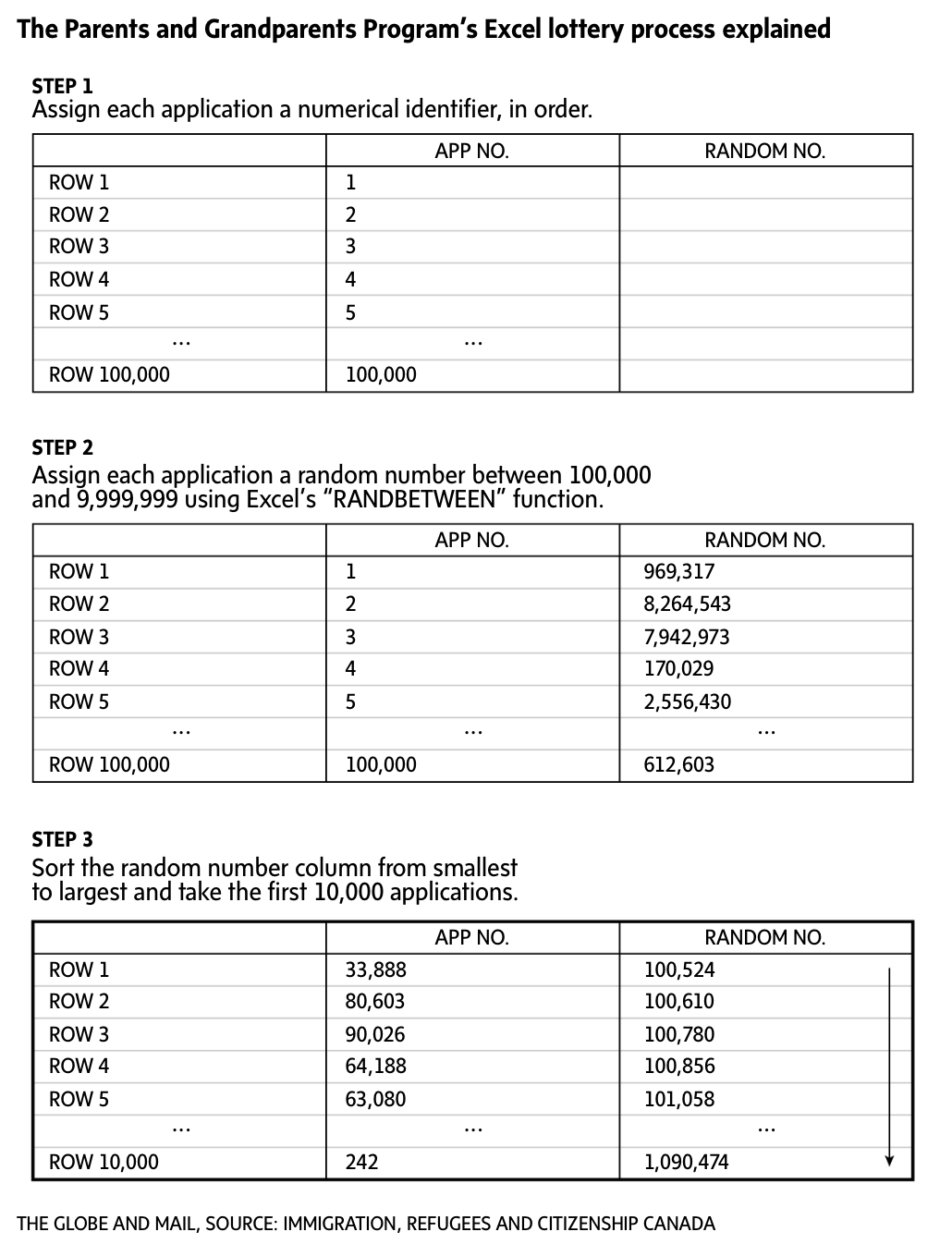
The Parents and Grandparents Program allows Canadians to sponsor family members for permanent-resident status. The Liberals introduced a lottery in 2017 in an effort to make the system fairer – previously, applications were accepted on a first-come, first-served basis. The program receives roughly 100,000 applications each year and selects 10,000.

Details on the lottery, obtained through an Access to Information request shared with The Globe, show a procedure carried out in just a few steps: Immigration, Refugees and Citizenship Canada (IRCC) uses Excel to assign each application a random number, then takes the first 10,000 numbers.

Excel’s method for generating random numbers is “very bad,” according to Université de Montréal computer-science professor Pierre L’Ecuyer, an expert in random-number generation. “It’s a very old generator, and it’s really not state-of-the-art.” Prof. L’Ecuyer’s research has shown that Excel’s random-number generator doesn’t pass certain statistical tests, meaning it’s less random than it appears. Under the current system, “it may be that not everybody has exactly the same chance,” Prof. L’Ecuyer said.

Excel uses pseudo-random number generators, a class of algorithms that rely on formulas to generate numbers. These generators have a key flaw – they rely on a “seed” number to kick off the mathematical process. In the case of Excel, this seed is generated automatically by the application. “If you know one number at one step,” Prof. L’Ecuyer explained, “you can compute all the numbers that will follow.”

This means the process could be exploited by someone with the right skills. It’s happened before: In 1994, IT consultant Daniel Corriveau discovered a pattern in a keno game – which uses a random numbering system – at the Casino de Montréal and won $620,000 in a single evening. An investigation later determined the game was using the same seed number at the start of each day.

Using more robust generators, such as the ones used for cryptography, may not cost the government much, either. “Cryptographic generators are free. They are on the internet,” Prof. L’Ecuyer said. “Just pick one, you need to know about it and that’s all. It’s not complicated.

“Anything would be better.”

For its part, IRCC is satisfied with its use of Excel, spokeswoman Shannon Ker said in an e-mailed statement. “We stand by this randomized selection process as a sufficient means of equal opportunity for all who look to express an interest in sponsoring their parents and grandparents.”

Others would rather see the lottery scrapped altogether. For the past two years, Igor Wolford, a data-analytics manager at Loblaws, has applied to sponsor his parents in Russia. He hasn’t made it past the lottery stage, and recently started a website to petition the federal government to abandon the system.

Mr. Wolford has corresponded with members of Parliament about his concerns. “I actually prepared an Excel sheet showing how random processes work,” Mr. Wolford said. “After 10 years of selection, only half of people who were eligible 10 years ago would be selected.”

Number of people from an original pool of 95,000 applicants who haven‘t made it past the lottery stage
Assuming 20,000 new applicants each year and 10,000 applicants selected each year

https://s3.amazonaws.com/chartprod/cZByyEpAhKuPixSBk/thumbnail.png 

Although the lottery selects roughly one in 10 applications, the number of people who pass additional vetting and ultimately make it into the program is far lower.

“Last year, they selected the original 10,000 people [during the lottery], but only 6,000 people actually [made it into the program],” Mr. Wolford said. This is partly be cause the lottery is the first step in the process, meaning anyone can fill out the form.

IRCC responded to these complaints in 2018 by including a self-assessment screening for applicants. However, the questions are still optional, as one Twitter user noted.

When told the lottery was conducted in Excel, Mr. Wolford wasn’t surprised. “That’s a very sad process. It’s easily manipulatable,” he warned. According to IRCC, the process is double-blind, and to date there is no indication the system has been manipulated.

“The process has become unpredictable,” Mr. Wolford said. “Before, you knew that it would take seven years from start to finish, and you could plan your life. Right now, you don’t know if it will happen this year, in five years, in 15 years.”

“Because it’s a lottery, you might never be selected.”

via ‘Anything would be better:’ Critics warn Ottawa’s family-reunification lottery is flawed, open to manipulation – The Globe and Mail

IRCC Departmental Plan 2018-19: Citizenship

The new framing of citizenship places citizenship outside of integration in the 2018-19 Departmental plan, viewing citizenship as more operational in nature rather than key to integration.

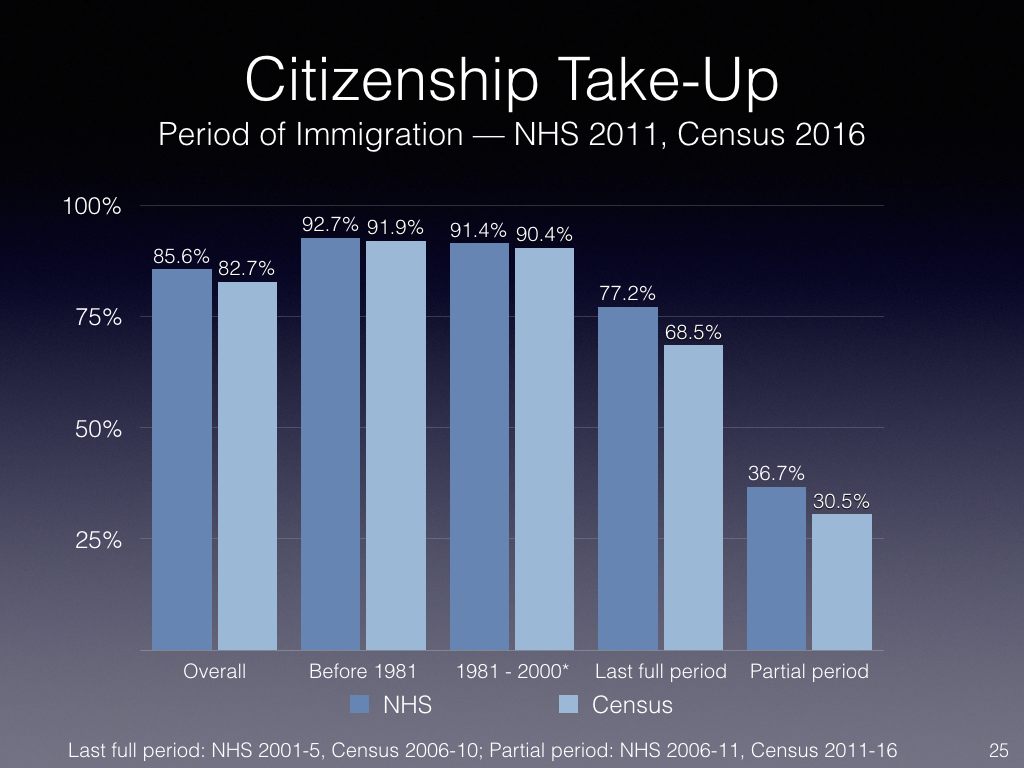
Moreover, the plan includes an incorrect naturalization rate of 85.8 percent for the 2016 Census rather than a more accurate rate of 30.5 percent, given their methodology using the four-year residency requirement for the full 2011-16 period without accounting for the fact that the three-year residency requirement was in effect  until May 28, 2015 (my detailed analysis in my article, What the census tells us about citizenship).

This will likely come back to haunt IRCC and StatsCan in 2021 as using the same methodology would mean assuming a three-year residency period for the entire 2016-20 period, despite the four-year period being in effect for 649 days, or about 35 percent of the time.

And of course by overstating naturalization rate now, and understating in 2021 (assuming they are consistent in their methodology), the decline will appear larger.

I look forward to doing the analysis then!

Summary chart below:

Metropolis 2018 - Citizenship.025.png

Core Responsibility 3: Citizenship and Passports

IRCC promotes the rights and responsibilities of Canadian citizenship, and issues secure and internationally recognized Canadian citizenship and travel documents so that Canadians can participate fully in civic society and so that travel is facilitated across borders while contributing to international and domestic security.

 The Department is consulting with Indigenous organizations and Crown-Indigenous Relations and Northern Affairs Canada to update in 2018–2019, through a legislative amendment, the Oath of Citizenship to include reference to respecting treaties with Canada’s Indigenouspeoples. This is also in response to the Truth and Reconciliation Commission’s Calls to Action.

To improve the client experience, the Department is also working in collaboration with the Canadian Digital Service to improve flexibility in accessing citizenship tests and ceremonies. Furthermore, the Department is considering additional enhancements in 2018–2019 which could allow more electronic accessibility options.

Planned result: Eligible permanent residents become Canadian citizens

Departmental Result Indicators

Targets

Date to achieve targets

2014–15 Actual results

2015–16 Actual results

2016–17 Actual results

Percentage of permanent residents who become Canadian citizens

≥ 85%

2021 (every five years)

85.6% (2011)

85.6% (2011)

85.8% (2016)

Percentage of citizenship applications that are processed within service standards18

≥ 80%

End of each FY

N/A

N/A

90%

Percentage of citizenship applicants who report they were satisfied overall with the services they received19

≥ 90%

page23image2913264

End of each CY

page23image2908672

Multiculturalism and related posts of interest

Last of my ‘catch-up’ series.

Starting with the Environics Institute’ Canada’s World Survey, which highlights the degree to which Canada has a more open and inclusive approach than most other countries, as highlighted in the Executive Summary:

Canadians’ views on global issues and Canada’s role in the world have remained notably stable over the past decade.

In the decade following the first Canada’s World Survey (conducted early in 2008), the world experienced significant events that changed the complexity and direction of international affairs: beginning with the financial meltdown and ensuing great recession in much of the world, followed by the continued rise of Asia as an emerging economic and political centre of power, the expansion of global terrorism, increasing tensions with North Korea and risks of nuclear conflagration; and a growing anti-government populism in Western democracies. Despite such developments, Canadians’ orientation to many world issues and the role they see their country playing on the international stage have remained remarkably stable over the past decade. Whether it is their perception of top issues facing the world, concerns about global issues, or their views on the direction the world is heading, Canadians’ perspectives on what’s going on in the world have held largely steady.

As in 2008, Canadians have maintained a consistent level of connection to the world through their engagement in international events and issues, their personal ties to people and cultures in other countries, frequency and nature of their travel abroad, and financial contributions to international organizations and friends and family members abroad. And Canadians continue to view their country as a positive and influential force in the world, one that can serve as a role model for other countries.

This consistency notwithstanding, Canadians have been sensitive to the ebb and flow of intenational events and global trends.

While Canadians’ perspectives on many issues have held steady over the past decade, there have also been some shifts in how they see what’s going on in the world and how they perceive Canada’s role on the global stage, in response to key global events and issues. This suggests Canadians are paying attention to what happens beyond their own borders, and that Canadian public opinion is responsive to media coverage of the global stage.

Canadians today are more concerned than a decade ago about such world issues as terrorism, the spread of nuclear weapons, and global migration/refugees. And the public has adjusted its perceptions of specific countries as having a positive (e.g., Germany) or negative (e.g., North Korea, Russia) impact in the world today. Canadians are also shifting their opinions about their country’s influence in world affairs, placing stronger emphasis on multiculturalism and accepting refugees, our country’s global political influence and diplomacy, and the popularity of our Prime Minister.

Canadians increasingly define their country’s place in the world as one that welcomes people from elsewhere.

Multiculturalism, diversity and inclusion are increasingly seen by Canadians as their country’s most notable contribution to the world. It is now less about peacekeeping and foreign aid, and more about who we are now becoming as a people and how we get along with each other. Multiculturalism and the acceptance of immigrants and refugees now stand out as the best way Canadians feel their country can be a role model for others, and as a way to exert influence on the global stage.

Moreover, Canadians are paying greater attention to issues related to immigration and refugees than they did a decade ago, their top interest in traveling abroad remains learning about another culture and language; and they increasingly believe that having Canadians living abroad is a good thing, because it helps spread Canadian culture and values (which include diversity) beyond our shores. Significantly, one in three Canadians report a connection to the Syrian refugee sponsorship program over the past two years, either through their own personal involvement in sponsoring a refugee family (7%) or knowing someone who has (25%).

Young Canadians’ views and perspectives on many aspects of world affairs have converged with those of older cohorts, but their opinions on Canada’s role on the world stage have become more distinct when it comes to promoting diversity.

It is young Canadians (ages 18 to 24) whose level of engagement with world issues and events has evolved most noticeably over the past decade, converging with their older counterparts whose level of engagement has either not changed nor kept pace with Canadian youth. Young people are increasingly following international issues and events to the same degree, they are as optimistic about the direction of the world as older Canadians, and they are close to being as active as travelers. At the same time, Canadian youth now hold more distinct opinions on their country’s role in the world as it relates specifically to diversity. They continue to be the most likely of all age groups to believe Canada’s role in the world has grown over the past 20 years, and are now more likely to single out multiculturalism and accepting immigrants/refugees as their country’s most positive contribution to the world.

Foreign-born Canadians have grown more engaged and connected to world affairs than native-born Canadians, and are more likely to see Canada playing an influential role on the global stage.

Foreign-born Canadians have become more involved in what’s going on outside our borders over the past decade, opening a noticeable gap with their native-born counterparts. They continue to follow international news and events more closely than people born in Canada, but have developed a much greater concern for a range of issues since 2008, while native-born Canadians’ views have not kept pace. Canadians born elsewhere have grown more optimistic about the direction in which the world is heading, while those born in the country have turned more pessimistic. And Canadians born in other countries have also become more positive about the degree of influence Canada has on world affairs, and the impact the country can have on addressing a number of key global issues.

Source: Canada’s World Survey 2018 – Executive Summary, Canadians believe multiculturalism is country’s key global contribution: study 

Some other stories that I found of interest:

The very different pictures of how well integration is working for visible minority and immigrant women between Status of Women Canada (overly negative) and Immigration, Refugees and Citizenship Canada (not enough granularity between different visible minority groups, captured by Douglas Todd: Secret immigration report exposes ‘distortions’ about women  .

Todd continues with some of his interesting exploration immigration issues, including regarding different communities (Douglas Todd: Canadian Hindus struggling with Sikh activism) and highlighting the work of Eric Kaufmann (Douglas Todd: Reducing immigration to protect culture not seen as racist by most) who, in my view, overstates “white flight” and related ethno-cultural tensions and has an overly static view of society.

Timothy Caulfield asks the questionIs direct-to-consumer genetic testing reifying race?:

From a genetic point of view, all humans are remarkably similar. Indeed, when the Human Genome Project was completed in 2003, it was confirmed that the “3 billion base pairs of genetic letters in humans [are] 99.9 percent identical in every person.” There are, of course, genetic differences that occur more frequently in certain populations — lactose intolerance, for example, is more common in people from East Asia. But there is simply no reason to think that your genes tell you something significant about your cultural heritage. There isn’t a lederhosen gene.

More important, we shouldn’t forget that the concept of “race” is a biological fiction. The crude racial categories that we use today — black, white, Asian, etc. — were first formulated in 1735 by the Swedish scientist and master classifier, Carl Linnaeus. While his categories have remained remarkable resilient to scientific debunking, there is almost universal agreement within the science community that they are biologically meaningless. They are, as is often stated, social constructs.

To be fair, DTC ancestry companies do not use racial terminology, though phrases like “DNA tribe” feel close. But as research I did with Christen Rachul and Colin Ouellette demonstrates, whenever biology is attached to a rough human classification system (ancestry, ethnicity, etc.), the public, researchers and the media almost always gravitate back to the concept of race. In other words, the more we suggest that biological differences between groups matter — and that is exactly what these companies are suggesting — the more the archaic concept of race is perceived, at least by some, as being legitimate. A 2014 study supports this concern. The researchers found that the messaging surrounding DTC ancestry testing reifies race as a biological reality and may, for example, “increase beliefs that whites and blacks are essentially different.” The authors go on to conclude that: “The results suggest that an unintended consequence of the genomic revolution may be to reinvigorate age-old beliefs in essential racial differences.”

Other research has found that an emphasis on genetic difference has the potential to (no surprise here) increase the likelihood of racist perspectives and decrease the perceived acceptability of policies aimed at addressing prejudice.

Some less-than-progressively-minded groups have already turned to ancestry testing as a way to prove their racial purity. White supremacists in the United States, for example, have embraced these services — often with ironic and pretty hilarious results (surprise, you’re not of pure “Aryan stock”!).

But I am sure most of the people who use ancestry companies are not thinking about racial purity, the reification of race or antiracism policies when they order their tests. And I understand that these tests are, for the vast majority of customers, providing what is essentially a bit of recreational science. In fact, I’ve had my ancestry mapped by 23andMe (I am, if you believe the results, almost 100 percent Irish — hence my love of Guinness). It was a fun process. Still, as the research suggests, the messaging surrounding this industry has the potential to facilitate the spread and perpetuation of scientifically inaccurate and socially harmful ideas about difference. In this era of heightened nationalism and populist exceptionalism, this seems the last thing we need right now.

So, don’t believe the marketing. Your genes are only part of the infinitely complex puzzle that makes “you uniquely you.” If you feel a special connection to lederhosen, rock the lederhosen. No genes required.

Lack of diversity in highlighted is sectors as varied as entertainment (The Billion-Dollar Romance Fiction Industry Has A Diversity Problem) and education (Lack of diversity persists among teaching staff at Canadian universities, colleges, report finds). Chris Selley: Granting Sikh bikers ‘right’ to ride without helmets only adds to religious freedom confusion provides a good critical take on whether religious freedom extends to riding motorcycles (Ontario does not allow, British Columbia and Alberta do).

Kim Thúy on how ‘refugee literature’ differs from immigrant literature provides an interesting perspective:

“Refugee and immigrant are very different,” she says in an interview. “A refugee is someone ejected from his or her past, who has no future, whose present is totally empty of meaning. In a refugee camp, you live outside of time—you don’t know when you’re going to eat, let alone when you’re going to get out of there. And you’re also outside of space because the camp is no man’s land. To be a human being you have to be part of something. The first time that we got an official piece of paper from Canada, my whole family stared at it—until then, we were stateless, part of nothing.”

Letters from Japanese-Canadian teenagers recount life after being exiled from B.C. coast enriches our understanding of the impact of their uprooting and exile under Japanese wartime internment (similar to Obasan):

“I don’t know of any other archival collections that are like this,” she said. “They might exist, but I don’t know of any. The combination of young people’s letters and letters to a non-Japanese Canadian person is just incredible to me. This is really special.

“One of the things I love about them is that they’re so clearly ordinary people. I think sometimes when the story gets told, that gets missed — that these are teenagers who are bored, and curious. It’s just really touching.”

And a variety of interesting articles on Islam and Muslims: Why so many Turks are losing faith in IslamCan Muslim Feminism Find a Third Way?  Ursula Lindsey and Gender parity in Muslim-majority countries: all is not bleak: Sheema Khan.

One of the most interesting is The Conversion/Deconversion Wars: Islam and Christianity using Pew Research data to assess respective trends:

It turns out that (American) Islam is losing Muslims at a pretty high rate. About a quarter of adults raised Muslim deconvert.

The problem is, from a secularist’s point of view, is that just as many convert to the religion. It has a high conversion rate, especially when compared to Christianity. Islam is growing by about 100,000 per year.

Per Research recently released a report that said:

“Like Americans in many other religious groups, a substantial share of adults who were raised Muslim no longer identify as members of the faith. But, unlike some other faiths, Islam gains about as many converts as it loses.

About a quarter of adults who were raised Muslim (23%) no longer identify as members of the faith, roughly on par with the share of Americans who were raised Christian and no longer identify with Christianity (22%), according to a new analysis of the 2014 Religious Landscape Study. But while the share of American Muslim adults who are converts to Islam also is about one-quarter (23%), a much smaller share of current Christians (6%) are converts. In other words, Christianity as a whole loses more people than it gains from religious switching (conversions in both directions) in the U.S., while the net effect on Islam in America is a wash.

A 2017 Pew Research Center survey of U.S. Muslims, using slightly different questions than the 2014 survey, found a similar estimate (24%) of the share of those who were raised Muslim but have left Islam. Among this group, 55% no longer identify with any religion, according to the 2017 survey. Fewer identify as Christian (22%), and an additional one-in-five (21%) identify with a wide variety of smaller groups, including faiths such as Buddhism, Hinduism, Judaism, or as generally “spiritual.”

The same 2017 survey asked converts fromIslam to explain, in their own words, their reasons for leaving the faith. A quarter cited issues with religion and faith in general, saying that they dislike organized religion (12%), that they do not believe in God (8%), or that they are just not religious (5%). And roughly one-in-five cited a reason specific to their experience with Islam, such as being raised Muslim but never connecting with the faith (9%) or disagreeing with the teachings (7%) of Islam. Similar shares listed reasons related to a preference for other religions or philosophies (16%) and personal growth experiences (14%), such as becoming more educated or maturing.”

There is perhaps an interesting explanation for some of this deconversion data:

“One striking difference between former Muslims and those who have always been Muslim is in the share who hail from Iran. Those who have left Islam are more likely to be immigrants from Iran (22%) than those who have not switched faiths (8%). The large number of Iranian American former Muslims is the result of a spike in immigration from Iran following the Iranian Revolution of 1978 and 1979 – which included many secular Iranians seeking political refuge from the new theocratic regime.”

How does this compare to people who converted to Islam?

“Among those who have converted to Islam, a majority come from a Christian background. In fact, about half of all converts to Islam (53%) identified as Protestant before converting; another 20% were Catholic. And roughly one-in-five (19%) volunteered that they had no religion before converting to Islam, while smaller shares switched from Orthodox Christianity, Buddhism, Judaism or some other religion.

When asked to specify why they became Muslim, converts give a variety of reasons. About a quarter say they preferred the beliefs or teachings of Islam to those of their prior religion, while 21% say they read religious texts or studied Islam before making the decision to switch. Still others said they wanted to belong to a community (10%), that marriage or a relationship was the prime motivator (9%), that they were introduced to the faith by a friend, or that they were following a public leader (9%).”


Immigration Department makes major headway on spousal sponsorship backlog | Toronto Star

Cute timing but the reduction in backlogs welcome:

Immigration Canada has worked hard to play Cupid in the past year by reuniting Canadians with their significant others abroad.

To celebrate Valentine’s Day, Immigration Minister Ahmed Hussen hosted a news conference at a Mississauga dessert shop to update his department’s dramatic reduction of the spousal sponsorship backlog.

According to Hussen, the number of spousal immigration applications in the queue has dropped to 15,000 from 74,900 a year ago, and the average processing time has also been sharply reduced to 12 months from 26 months.

“The Government of Canada is committed to family reunification. We understand how important it is to reunite couples. It also makes for a stronger Canada,” said Hussen.

“Canadians who marry someone from abroad shouldn’t have to wait for years to have them immigrate or be left with uncertainty in terms of their ability to stay.”

The minister attributed the success to a focused working group, dubbed the “Family Class Tiger Team,” that was created in spring 2016 to develop innovative mechanisms and redesign application kits and workflow to reduce processing times.

The special team reviewed spouse and partner related forms, guides, websites, tools and processes in order to improve the client experience and achieve faster processing times for most applicants. The team wrapped up in December 2016.

Since then, the Immigration Department’s spousal application package has been revised. At the time Hussen’s predecessor, John McCallum, announced the government intended to reduce the backlog of spousal sponsorship cases by 80 per cent and shorten processing times to 12 months.

Changes to the application kit were made following the announcement, condensing the previous 14 checklists down to four new ones.

On Wednesday, the department said the process will be streamlined further next month.

Starting on March 15, officials said spousal applicants will be asked to submit their background form and police certificates as part of their initial paper application package, instead of later in the application process to help move the process “quickly and efficiently and avoid unnecessary delays.”

The government’s spousal backlog reduction has surprised many, including veteran immigration lawyer Lorne Waldman.

“In my experience, there has been some reduction but it has not been as noticeable as the numbers suggest,” he told the Star. “I do not doubt the numbers but simply note that there are still cases that are taking a long time and it depends a lot on the offices.”

Spousal applications from countries such as Haiti, Mexico, Pakistan, Qatar and Sri Lanka still face wait times ranging from 14 to 19 months, above the 12-month global average, according to the Immigration Department website.

Vancouver immigration lawyer Steven Meurrens said one important reason the backlog was reduced was the increased annual quota for sponsored spouses and children coming into the country, allowing more applications to be processed.

Ottawa increased its annual target for spousal reunification by one-third to 64,000 last year from 48,000 in 2014. The quota is even higher for this year and through 2020, at 70,000 a year.

“The Liberals increased targets, which would increase the number of applications that they process in a year, meaning faster processing,” Meurrens noted.

Waldman pointed out that the government’s time frames for processing do not take into account the delays associated with applications that are returned because they are deemed incomplete.

“If my clients sends in a sponsorship and some officer wrongly decides it is incomplete and sends it back, this adds three or more months to the processing but is not included (in the backlog),” he said. “We have had lots of files wrongfully returned and this has caused a lot of hardship to our clients.”

via Immigration Department makes major headway on spousal sponsorship backlog | Toronto Star

Douglas Todd: Immigrants’ children, Canadians of colour most educated

A further nuance to the data presented in the two studies mentioned can be seen in the above chart showing unemployment rates for 25-34 year olds for visible minority groups compared to non-visible minorities by level of education showing generally higher unemployment rates for college and university educated visible minorities (I don’t yet have the data table by generation).

The gender gap between non visible minority men and women with university education (12.8 percent for 25-34 year olds) is also characteristic, to varying levels, among visible minority groups:

….Contrary to widespread claims that white males are “privileged” in Canada, an earlier study by Picot and Feng Hou, of the University of Victoria, found that Canada’s 3.2 million women of colour are the most educated group in the country.

“The children of immigrants from many Asian countries, such as China and India, register remarkably high educational outcomes, with 50 of Chinese and 60 per cent of those from India holding university degrees,” Picot says.

When Jedwab zeroed in on the education levels of middle-aged adults in Metro Vancouver, he found 46 per cent of immigrant men and 48 per cent of immigrant women in the city had university degrees. That ratio was 41 per cent for Canadian-born females (between the ages of 35 and 44), and only 31 per cent for Canadian-born males.

As well as being accomplished at universities, a high portion of children of immigrants tend to find success once they venture out to work in Canada.

“On average, the children of immigrants are doing as well or better (as adults) in the labour market than the children of the Canadian-born,” said Picot. “Furthermore, because of their higher educational attainment, the children of immigrants are more likely to be in professional occupations and less likely to be in blue collar jobs than children with Canadian-born parents.”

The results do not offer good news for all immigrants and their children, though. The studies by Picot and Jedwab show that immigrants to Canada are tending to divide into two polarized groups: Some are unusually strong at the high end of the economic spectrum, others are over-represented at the low end.

Jedwab found immigrants and visible-minority Canadians are far more likely than the Canadian-born and whites to report low incomes. In Metro Vancouver, for instance, Jedwab found almost 15 per cent of immigrants had low incomes, compared to just 9.4 of non-immigrants. In addition, 24 per cent of Metro’s ethnic Chinese reported low incomes, compared to 10 per cent of non-visible minorities.

In an era where some North American academics, activists and media commentators are emphasizing “white male privilege,” the census data raises questions about the usefulness of such a broad concept. It highlights contradictions and disagreements over which groups are privileged and which are disadvantaged.

Jedwab, for instance, does not think much of the arguments of those who worry that males who are “non-visible-minority Canadians” (a Statistics Canada category that is largely made up of whites, but also includes aboriginals) are disadvantaged, or under performing. He says many are simply going into blue-collar work.

“In the case of the non-visible-minority male population,” Jedwab said, “there is a growing trend we see towards getting trade certificates, where there is a sense that job opportunities are better.”

Picot’s emphasis is on maintaining the success of immigrants’ children. “Taking steps to maintain the positive attitude of Canadians towards immigration can help, since a population backlash can negatively affect second generation outcomes,” he writes. “Canada is one of the few western where researchers, policy developers and the public are little concerned about immigrants ‘stealing the jobs of Canadians.’ This is a prominent issue in most western nations.”

While economists like Collier and educators such as Bennett also appreciate the many positive achievements of immigrants and people of colour, they don’t necessarily want Western societies to abandon the domestic-born population.

Bennett, a university instructor who maintains the website Educhatter, is concerned about the “lack of motivation” among average students of Canadian background, including whites and Aboriginals. His research has found many are languishing.

Collier says high-immigrant Western countries such as Britain, the U.S. and Canada have never figured out how to address the problems of the under-achieving domestically born. Such countries, he said, have developed either universal programs for everyone, or affirmative-action plans for immigrant, ethnic or other minority groups perceived as vulnerable.

No Western country, he suggests, has ever designed a way to respond to the more nebulous needs of those in the mainstream domestic population — whom many consider to be privileged, but who are under-achieving.

Is there any chance policy-makers in Canada will be the first to take up the challenge they offer?

via Douglas Todd: Immigrants’ children, Canadians of colour most educated | Vancouver Sun