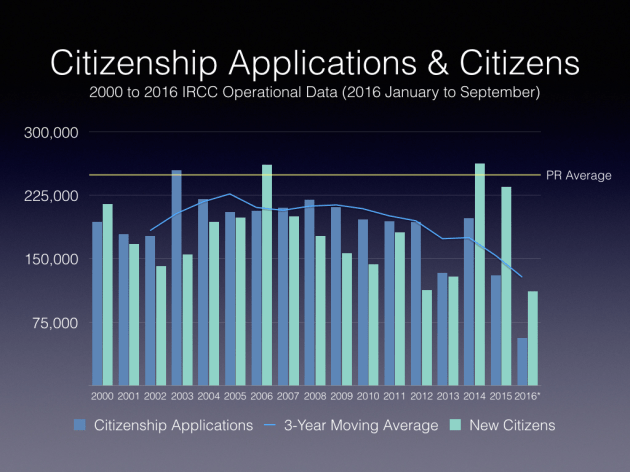
Citizenship Applications: Third Quarter Continues to Show Decline

citizenship-data-slides-010Further to my earlier analysis of the half-year numbers showing a dramatic decline (The impact of citizenship fees on naturalization – Policy Options), the third quarter numbers issued this week confirm the overall trend: only some 56,000 applications were received, compared to 112,000 for the same period in 2015, just about half.

This quarter is the first quarter one year after minimum residency requirements were changed to four years from three and so one might have expected some increase. Indeed, the July-September numbers show an increase for the quarter from 12,000 in 2015 to 20,000 in 2016. But this does not change the overall picture: the total number of applications this year is likely to be around 75,000 compared to 130,000 in 2015, a drop of over 40 percent.

Nor does it change my overall argument that the likely major factor responsible for this decline was the steep increase in adult citizenship processing fees in 2015 to $530.

Of course, the one bright spot in this decline is that the backlog has been reduced: the current inventory is just over 55,000 compared to about 250,000 at the beginning of 2015. Processing time has also declined, from 21 months for the same period in 2015 to 16 months currently.

The most recent approval rate is 91 percent, slightly down from 93 percent.

But reducing the backlog and reducing processing times by reducing demand for citizenship through higher fees and other barriers runs against the government’s overall diversity and inclusion agenda.


Trudeau government revoking citizenship at much higher rate than Conservatives

The lack of procedural protections for citizenship revocation in cases of fraud or misrepresentation, flagged as a concern in both hearings on the Harper government’s C-24 and the Trudeau government’s C-6, continues to draw attention, given both the increased number of revocations and the Monsef case (although I would argue misrepresentation of her birthplace by her mother is not material in the way that misrepresenting residency).

And while the Trudeau government continued use of this power is questionable, the higher rate reflects in part the increased number of investigations following implementation of this provision in C-24 on 28 May 2015.

IRCC data shows 24 investigations initiated before this provision came into force, and 324 in the seven months after. The number of cases in the pipeline increased, and thus normal that more revocations would result, as the government applies the law:

The Trudeau government used powers granted by the Harper government’s controversial citizenship law to make 184 revocation decisions without legal hearings between November 2015 and the end of August. About 90 per cent of the decisions resulted in a negative finding and the loss of a person’s citizenship.

The numbers show that the Trudeau government has used the law far more aggressively than the Harper government itself.

But in a Federal Court filing late Friday, the government said it would not grant a moratorium on revocation cases, and added that claims by some that the system was revoking large numbers of citizenship are speculative.

Liberal Leader Justin Trudeau made the sanctity of citizenship an issue in last year’s federal election.

“A Canadian is a Canadian is a Canadian,” Trudeau said in a leaders’ debate three weeks before storming to victory.

He used it to dress down Stephen Harper for passing Bill C-24, a law that aimed to strip dual citizens of their Canadian passports if they were convicted of crimes of terrorism, treason or espionage against Canada, or took up arms against Canada.

Immigrant communities rallied to the Liberal Party, concerned that Canadians born overseas would be reduced by C-24 to an insecure second-class status.

Once elected, one of the Liberals’ first acts was to repeal the parts of C-24 that applied to those convicted of terrorism-related crimes, ensuring that they can keep their Canadian passports.

But the Trudeau government left intact other parts of the law that allow the government to strip citizenship from other holders of Canadian passports for misrepresentation.

The 184 revocation decisions of the first 10 months of the Trudeau government nearly match the total number of decisions over a 27-year period between 1988 and the last month of the Harper government in October 2015.

Revocations increase as Trudeau takes office

Although the powers being used come from a law passed by Stephen Harper’s Conservatives, the law has been used much more aggressively under Trudeau.

In the first full month of the law’s operation, June 2015, only three revocation decisions were made. None were made in July or August, two in September and two more in October.

The Trudeau cabinet was sworn in on Nov. 4, 2015. That month saw 21 revocation decisions. The following month there were 59. The year 2016 averaged 13 decisions a month up to Aug. 31, the latest data CBC News has been able to obtain.

The monthly average under the Harper government from 2013 to 2015 was only 2.4 cases a month, some under the auspices of C-24 and some under rules that existed previously.

Citizenship revocation decisions by year (in persons)

2013 2014 2015 2016 (8 months)
January 13
February 4 7 25
March 17 7
April 5 14
May 5 16 18
June 4 1 3 7
July 10
August 10
September 4 2
October 1 2
November 4 21
December 7 59
Total 15 15 132 104

Source: Immigration, Refugees and Citizenship Canada

Liberals accused of hypocrisy

In recent days, following revelations that the birthplace of one of its own cabinet ministers was misrepresented on her passport documents, the government has said it is open to reforming the system.

But in the preceding months, it had used the revocation measures at an unprecedented rate.

“The Liberals criticized these provisions when they were in opposition,” says Laura Track of the B.C. Civil Liberties Association. “They said they were going to fix it. And yet they have been using it even more than the Conservatives did.”

The government says the revocation decisions are being taken to protect the integrity of the citizenship system and are aimed at cases of fraud.

Nancy Caron of Immigration, Refugees and Citizenship Canada said “many cases that are being processed for revocation are as a result of large-scale investigations into possible residence fraud.”

The department carried out those investigations with Canada Border Services Agency and the RCMP. Investigations led by those agencies have resulted in the conviction of immigration consultants who helped individuals obtain citizenship illegally.

“The revocation process is then undertaken to determine whether the individuals associated with these investigations, fraudulently obtained their Canadian citizenship through having intentionally misled the government of Canada about key aspects of their citizenship application such as concealing past criminal activities or submitting false documents to demonstrate residence in Canada when in fact they were not living in Canada‎. Many of the decisions to revoke citizenship that have been made since May 2015 directly result from those investigations,” Caron said in an email to CBC News.

Source: Trudeau government revoking citizenship at much higher rate than Conservatives – Politics – CBC News

Directing MPs through new call centre for immigration cases disastrous, say critics

This has been raised at CIMM (the immigration committee):

Opposition MPs say they are incredibly frustrated with a new method for MPs to get information from the government about immigration case files, quietly introduced by the Liberals in April.

Both NDP MP Jenny Kwan (Vancouver East, B.C.), immigration critic for her party, and Conservative MP and immigration critic Michelle Rempel (Calgary Nose Hill, Alta.), say a new system of making immigration inquiries, which has their staff asking questions about immigration cases through a call centre, is creating a backlog of cases for their staff.

Prior to the change, which both MPs referred to as being “quietly” implemented by the government in April, MPs’ offices had two lines they could call: one was a direct Ottawa phone number that connected them to the Ministerial Enquiries Division within the immigration minister’s office, when they had complex or urgent cases and needed a ministerial intervention. The other was a line for simple inquiries, like updates.

With the new general line, information they are expecting to get back in the outlined two business days can easily turn into five days, the opposition MPs suggested. Ms. Rempel said in her office the two days has turned into 10, sometimes 15 days.

This article is the second in a series examining the challenges that Members of Parliament experience in their constituency office. In the first of the series, The Hill Times looked into the challenges associated with helping constituents with passport applications.

Remi Lariviere, a spokesperson for Citizenship and Immigration Canada, responding to questions about the concerns of Ms. Rempel and Ms. Kwan, said the new system has been set up “in order to streamline and enhance services to parliamentarians.” To do so, “a single point of contact dedicated for MPs has been implemented…to ensure that Members of Parliament receive the most expedient and informative service possible to assist them in helping their constituents and managing their cases,” he wrote in an email.

According to Mr. Lariviere, the Ministerial Enquiries Division is still providing the information, just by way of what he called the “information centre,” which is based in Montreal.

Ms. Rempel and Ms. Kwan said calling the Ministerial Enquiries Division directly for complex cases was an efficient and effective way of getting information for their constituents. The new call centre, however, is anything but that, they said.

“In this system, we’re put on hold. Calls can take up to an hour and a half for us to get the information, whereas before we were never put on hold, they had the information, and we were going to get the information expeditiously…[in] a far quicker turnaround time with way less bureaucracy,” Ms. Kwan said. The new system is frustrating she said, not only for her, but for her staff, and “most importantly,” her constituents.

Responding to complaints about delays in getting information, Mr. Lariviere wrote that the “service standard for simple case inquiries is to respond within two days, whereas more complex inquiries are responded to within 10 days. Those have not changed since the implementation of the new line.”

Source: The Hill Times

Shaping the future of Canada’s immigration system

A number of opinions on the issues set out in the current immigration consultations (see earlier Collacott: Immigration ‘conversation” is public relations exerciseIRCC Discussion guide on immigration: What about citizenship?).

In addition to my comments below, views of Debbie Douglas (faster processing of family reunification), Harald Bauder (more funding for settlement, pathways from temporary to permanent residency), Jeff Reitz (greater efforts on employment) and the Conference Board (increased immigration levels, spread across the country):

Having inherited an immigration system plagued with backlogs and heavy-handed enforcement, the Liberal government says it’s keen to hear what you think needs to be done about Canada’s immigration future.

Since the beginning of the summer, Immigration Minister John McCallum and his parliamentary secretary, Arif Virani, have held more than two dozen roundtable meetings across Canada with settlement services organizations, businesses and community groups to get their thoughts.

Although the meetings are by invitation only — more are coming in August — the public can submit ideas by email to the minister. Since early July, more than 2,500 online submissions have been received. Submissions end Aug. 5.

“Immigration, Refugees and Citizenship Canada will be reviewing the feedback from Canadians to help guide decisions on how many people we will welcome in the coming years and the future of immigration in Canada,” said a department spokesperson.

While the final report won’t be ready till at least the fall, the Star interviewed a group of immigration experts to weigh in on the national dialogue by identifying gaps in the system and offering solutions.

Meaningful and accessible citizenship:

Andrew Griffith, a former director general at the immigration department, said Canada largely has its immigration policies and programs right, but an independent review by a royal commission would be helpful.

He said the consultation questions are biased towards economic class immigrants and miss out on important areas such as citizenship.

“Most immigrants choose to become citizens as part of their integration into Canadian society. If we believe in immigration integration, we should support political integration, in addition to economic, social and cultural,” said Griffith.

“The main instrument for doing so is citizenship, given that allows for full participation in the political process.”

Canada’s naturalization rate has been declining, from the peak of 93.3 per cent for immigrants who came before 1971, to just 36.7 per cent among those who arrived between 2006 and 2007.

Griffith said Ottawa must set targets for naturalization as a benchmark, to assess whether its policies strike the right balance in making citizenship accessible and meaningful.

Officials must also regularly review citizenship requirements to ensure that different ethnic groups and immigration classes (economic, family and refugees) have comparable outcomes. Reducing the hefty application fee from the current $530 would make citizenship more financially accessible.

Source: Shaping the future of Canada’s immigration system | Toronto Star

The Hill Times has the political reaction to the (trial balloon?) of differential immigration fees:

The federal government is seeking public feedback on letting some immigration applicants pay more for faster processing.

That idea is one of many put forward in an online consultation document the government is asking members of the public to fill out as it gears up for an overhaul of the immigration processing system.

The NDP’s immigration critic and a pair of Liberal and NDP MPs say bringing in a two-tiered Canadian immigration system is out of the question.

“I wouldn’t support it,” said NDP immigration critic Jenny Kwan (Vancouver East, B.C.). “By doing that, effectively you’re saying you can buy your way into the system and bypass everybody.”

“They’re absolutely creating a two-tiered system if that were to proceed,” she said.

However, Liberal MP Peter Fonseca (Mississauga East-Cooksville, Ont.) and a Toronto immigration lawyer say such a system could help to improve immigration processing.

The issue is one close to MPs’ hearts as much of their constituency work is tied up in helping constituents with immigration questions, including application processing.

Many MPs have two staffers in their riding offices and at least one attends to constituents’ immigration needs. The most common complaints of constituents about immigration issues are related to long delays in the processing times of applications for family reunification, refugees, spousal sponsorship, temporary foreign workers, visitor visas, and Canadian citizenship applications.

Immigration reform

Collacott: Immigration ‘conversation” is public relations exercise

While I disagree with much of what Collacott argues – the European examples come from too different histories and geographies, the costs of immigration cited are based on the flawed Grubel-Grady study – I do share some of his cynicism with respect to the announced consultations.

It would be better to appoint an independent panel or commission to review the full range of citizenship, immigration and multiculturalism issues to have a serious and independent study to help guide longer-term policy (see my previous IRCC Discussion guide on immigration: What about citizenship?):

Canada has probably worked harder and had relatively more success than any other country in welcoming and integrating people of different backgrounds from around the world. The “national conversation’s” assertion that “Canada’s strength lies in its diversity” however does not correspond with reality.

While a well-managed and moderate increase in diversity can enrich a society in various ways, it is also clear that unlimited diversity has a negative effect on societal cohesion and national identity. This has been well-documented by scholars such as Harvard professor Robert Putnam, whose research found that, as urban communities become more and more diverse, the levels of social cohesion decline and there is less trust among residents.

This has been amply demonstrated in Europe, where the social as well as economic integration of many immigrants with very different cultural values and traditions from those of the host nations has been impeded as their numbers grew and they became heavily concentrated in urban areas.

The suggestion that Canada’s strength lies in its diversity, nevertheless, implies that our society  will endlessly benefit from becoming more and more diverse.

The question then has to be asked why the Government is promoting its “national conversation” based on a slogan that doesn’t make sense.

The answer becomes clear from other sections of the conversation’s press release when it states that the government is committed to an immigration system that supports diversity and helps to grow the economy.

The fact is that, while immigration makes the economy larger, it doesn’t improve the standard of living of the average Canadian: it simply creates a larger pie that is divided into more, and usually somewhat smaller, pieces. Indeed the latest research indicates that recent immigration is very costly to Canadian taxpayers — to the tune of around $30 billion a year — in addition to raising house prices beyond the reach of most young Canadians in large cities such as Vancouver and Toronto, increasing congestion and commute times and putting heavy pressure on health care services. 

While there been periods in our history when we have benefitted from large-scale immigration, this is not one of them. Canada does not face major labour shortages and has sufficient human capital and educational and training facilities to meet almost all of our needs  from our existing resources.

The “national conversation” is clearly a public relations exercise designed to convince members of the public that they are providing serious input into how immigration can benefit Canada.  The terms of reference, however, leave no doubt that its real purpose is to promote large-scale immigration and diversity in order to increase political support for the Liberal Party of Canada rather than to serve the interests of Canadians in general.

We very much need a comprehensive, well-informed and balanced review of immigration policy — but not the phony “national conversation” the government is attempting to foist on the public.

Source: Opinion: Immigration ‘conversation” is public relations exercise | Vancouver Sun

‘Barbaric cultural practices’ tip line dead, but other snitch lines have continued

Interesting. More smoke than fire in terms of the number of leads followed up and acted upon:

A small team in a secretive government office in the nation’s capital stands ready, 24/7, to hear from Canadians who want to squeal on their neighbours.

Working in 12-hour shifts, between two and four Canada Border Service Agency employees are assigned every day to monitor the agency’s Border Watch Tip Line, a creation of the Paul Martin Liberal government that gives Canadians a chance to report “suspicious immigration activity” to the government around the clock, in either official language.

“No information, however trivial it may seem, is too small,” according to the CBSA webpage for the tip line.

Most of those tips end up being deleted or filed away in government archives, as do those made to two of the government’s other immigration-related tip lines, according to statistics provided to The Hill Times by the federal government.

Many of the communications via the tip lines have actually been questions about how to file paperwork for visas or other routine and unrelated matters. Some are reports of illegal activity that falls outside of the CBSA’s jurisdiction—for example, financial fraud. Others simply don’t include enough information, or do include information “not substantiated” by database searches of CBSA officials, the agency says.

Many of the tips come from members of the public who suspect a business is employing illegal workers, a neighbour may be in Canada with an expired visa, or someone they know might be perpetrating marriage fraud, according to records from earlier this year obtained by The Hill Times.

Others read like the plot from an immigration-themed soap opera.

“Tipster called to report that her friends [sic] husband has sponsored another woman,” reads the summary of one tip received by the Border Watch Tip Line in January.

“Subject is legally divorced in Canada…but she believes that she is still married to her husband [censored] and would like to know if that is legal and if divorce in Canada also means divorce in the original country of marriage.”

That tipster was “advised that [the Border Watch Line] does not offer advice or information” on such matters and told to contact the federal Immigration Department.

Round-the-clock monitoring

Calls to the Border Watch Tip Line—1-888-502-9060—are fielded by officials at the CBSA’s Warrant Response Centre, a “24/7 operation” of 34 full-time CBSA employees who help officers from the CBSA’s regional offices and other law enforcement partners “throughout North America” to execute immigration warrants or look for previously deported persons, according to CBSA spokesperson Line Guibert-Wolff.

The Warrant Response Centre is located on the first floor of a CBSA building in the southeastern corner of Ottawa, but is not open to the public and does not receive tips in-person. The CBSA only confirmed the location of the centre, which it originally declined to disclose and which draws a $2.6-million annual budget, when it was identified by The Hill Times.

The Border Watch Tip Line yielded about 12,000 tips in 2015, though the CBSA took no action in response to about 65 per cent of those tips, according to information obtained through an access-to-information request.

When asked why the agency did not take action on those tips, Ms. Guibert-Wolff wrote that the tip line receives calls “that do not contain sufficient information, calls which are not substantiated by database queries, calls that contain duplicate information that were already referred to the appropriate section, and calls not pertaining to legislation enforced by the CBSA.”

Useful tips are forwarded to regional Immigration Department or CBSA offices for further action, and the CBSA does not track the results, wrote Ms. Guibert-Wolff.

Those regional offices determine the best course of action, which can include further checks of government databases, or referral to other authorities for investigation, in which case “it may be several years” before any results are achieved, wrote Ms. Guibert-Wolff.

Different lines, same tips

Immigration, Refugees, and Citizenship Canada and Employment and Social Development Canada each operate their own online tip-reporting systems; one is intended for suspected citizenship fraud and the other for misuse of the Temporary Foreign Worker Program.

Of 457 tips emailed to IRCC’s citizenship fraud email address during the month of January 2016, 37 were forwarded to the CBSA or Immigration Department offices for further action, while 59 that were classified as spam or duplicates were deleted, and 355 were filed away with no action taken. The six remaining were still pending review as of May, according to information obtained through an access-to-information request. An access-to-information official did not respond to a follow-up question seeking information on why no action was taken on many of the emails.

The 37 tips that were forwarded for further action were split between the 18 government offices or departments, including the CBSA, immigration case processing centres and visa offices everywhere from Lima, Peru to Islamabad, Pakistan.

Subject lines of those emails—the only portion the department disclosed—suggested that tips to the citizenship fraud email address were very similar to those made through the Border Watch Tip Line, including suspicion of people working in Canada illegally, living in Canada illegally, marriage fraud, as well as a handful of emails unrelated to the purpose of the tip line.

“Person currently harbouring an alien immigrant/illegal temporary foreign worker,” reads one; “victim of fraud after marriage,” reads another.

Employment and Social Development Canada also operates a tip line and online fraud reporting tool for people who want to report suspected abuses of the Temporary Foreign Worker Program.

A July, 2015 press release from ESDC said the department had received “thousands of complaints” at that point since the tip line and online reporting tool were launched in April and June 2014 respectively.

A sample of the TFWP tips received online during the months of October and November of 2015, acquired through an access-to-information request, shows that ESDC was acting on about 23 per cent of the tips it had received.

Source: ‘Barbaric cultural practices’ tip line dead, but other snitch lines have continued

IRCC Discussion guide on immigration: What about citizenship?

Some things never change. IRCC launches consultations on immigration and leaves out any questions on the related issues of citizenship policy. Sigh…Immigration consultations are welcome and needed. They can and should help better inform future level plans and I would hope that there will be  widespread participation with diversity of views.

It may well be that the Government believes with C-6 it has no need to consult on citizenship as hard to believe that this is a mere oversight.

But consulting on immigration while being silent on where and how citizenship is part of the picture is, at best, a missed opportunity.

Also interesting to note the question of “Canadian values and traditions” which should provoke some interesting discussion, and which is horizontal to immigration, citizenship and multiculturalism.

Were there to be citizenship-related consultation questions is below, my initial list is below. Feedback and other suggestions of course welcome:

  1. What percentage of newcomers should we expect to become Canadian citizens? In what time frame?
  2. Does citizenship play an important role in integrating and participating in the Canadian economy and society? In which way?
  3. Do we have the balance right between facilitating and encouraging citizenship and ensuring a meaningful connection to Canada?

The questions:

Opening Questions

  1. How many newcomers should we welcome to Canada in 2017 and beyond?
  2. How can we best support newcomers to ensure they become successful members of our communities?
  3. Do we have the balance right among the immigration programs or streams? If not, what priorities should form the foundation of Canada’s immigration planning?
  4. How should we balance encouraging mobile global talent to become citizens with physical presence residency requirements?

Questions: Unlocking Canada’s diverse needs

  1. How can immigration play a role in supporting economic growth and innovation in Canada?
  2. Should there be more programs for businesses to permanently hire foreign workers if they can’t find Canadians to fill the job?
  3. What is the right balance between attracting global talent for high-growth sectors, on the one hand, and ensuring affordable labour for businesses that have historically seen lower growth, on the other?
  4. How can immigration fill in the gaps in our demographics and economy?
  5. What Canadian values and traditions are important to share with newcomers to help them integrate into Canadian society?

Questions: Modernizing our immigration system

  1. Currently, immigration levels are planned yearly.  Do you agree with the thinking that planning should be multi-year?
  2. What modernization techniques should Canada invest in for processing of applications?
  3. What should Canada do to ensure its immigration system is modern and efficient?
  4. Is there any rationale for providing options to those willing to pay higher fees for an expedited process?

Questions: Leadership in global migration and immigration

  1. Is it important for Canada to continue to show leadership in global migration? If so, how can we best do that?
  2. How can Canada attract the best global talent and international students?
  3. In what ways can Canada be a model to the world on refugees, migration and immigration?

Submit your views

Source: Discussion guide on immigration

Gloomier future seen for Canadian immigration

IRCC analysts are asking many of the right questions:

With 35 per cent of male newcomers returning home and a growing middle class in developing countries less inclined to migrate, an internal government review is calling the future of Canadian immigration into question.

The report by Immigration Refugees and Citizenship Canada also points to the challenge of reconfiguring an immigrant-selection system in a rapidly changing labour market where a growing number of jobs are temporary and there’s “increasing mismatch” of available skills and the skills in demand.

“What changes, if any, does Canada want to make to its current ‘managed migration,’ ” asked the 23-page study, titled Medium-Term Policy: Balanced Immigration and stamped “for internal discussion only.” “To what extent is the current overall immigration level appropriate and/or necessary?”

With major changes made in the last decade under the former Conservative government, legal and immigration experts are calling on Immigration Minister John McCallum to have a “national conversation” on the future of Canadian immigration.

“Ottawa must take a step back to do a review of the whole immigration program and reach a national consensus in moving our country forward as a nation-building exercise rather than as an economic imperative,” said Debbie Douglas of the Ontario Council of Agencies Serving Immigrants.

“The Liberals have good political instincts and like to be seen as doing more on the immigration front. It’s the right time to take a look at what is working and what is not working in the system.”

The new government has already announced reviews of certain immigration programs involving temporary foreign workers and the Express Entry processing system, but critics say such reviews must be done in a holistic manner rather than a piecemeal fashion.

“This is the most thoughtful brief (on Canada immigration) I’ve seen in 10 years,” said Queen’s University immigration law professor Sharry Aiken. “It’s asking all the right questions that are useful starting points for a wide-ranging discussion of the future of our immigration system.”

The internal report, obtained by the Star, also devotes attention to the estimated 2.8 million Canadian citizens — 9 per cent of the population — who live abroad, including a million people in the United States, 300,000 in Hong Kong and 75,000 in the United Kingdom.

Some 35 per cent of male immigrants to Canada return home, many within the first year. Between 1996 and 2006, the annual exit rate for citizens born in Canada was 1.33 per cent compared to 4.5 per cent for naturalized citizens.

“There has been a rather negative view of these expatriate Canadians, as they have been regarded as evidence of ‘brain drain,’ Canada’s lack of competitiveness in retaining high-skilled professionals and business leaders, and our insufficient success in integrating new arrivals,” the report noted. “Canada could choose to take a more proactive stance with expatriates.”

Measures implemented by other countries include: extending voting right to expats, providing non-resident representation in the national legislature, facilitating business and research networks, doing outreach to communities abroad to promote ties as well as creating tax treaties with other countries to facilitate work abroad.

The report also points to the greater emphasis the former Tory government put on selecting economic immigrants based on in-demand occupations in a so-called “project economy” marked by limited length of employment based on the duration of a contract or project.

“This environment makes it a significant challenge to target occupations and industries that are priorities for addressing through immigration,” it said.

While the report forecast does mean potentially lower immigration to Canada in the longer term, University of Toronto professor Jeffrey Reitz said global migration is still driven by “inequality” from poor to rich countries.

Although Ottawa introduced the Express Entry system in 2015 to let employers pick prospective immigrants from a pool of candidates to ensure newcomers are quickly employed, Reitz said the uptake of candidates outside the country has been small.

“Anything that improves the employment situation contributes to immigrant retention, but there is an aspect of retention in the family class. When you lose your job and you have no family, you move. A support group gives people a reason to stay,” explained Reitz, the director of ethnic, immigration and pluralism studies at U of T.

Hence, the immigration report raised the question over the strict differentiation of “economic” and “social” immigration in the current system, which channels applicants into the skilled and nonskilled streams.

“Regardless of how their application was accepted, immigrants make many contributions to Canadian society; economic migrants make social contributions; social immigrants make economic contributions,” it said.

“Given the somewhat artificial distinction between social and economic immigration, there may be grounds for giving greater weight to ‘non-economic’ criteria and on criteria related to the success of subsequent generations.”

Ryerson University professor John Shields said recent immigrants are caught up in the same “new economy” faced by young Canadians entering the workforce.

“All immigrants including the refugee class contribute to the society economically. They pay dividends economically in five, ten years as integration is a long-term process that can take a lifetime,” said Shields, whose research focuses on labour markets and immigrants.

“Recent immigrants and young Canadians face a different kind of roadblock from those who are already established in Canada. The issue we need to deal with is creating higher quality employment in Canada and educate Canadian employers of the values of one’s work experience from somewhere else.”

Source: Gloomier future seen for Canadian immigration | Toronto Star

Gaps in Ottawa’s detection of citizenship fraud, auditor finds

I did not find this OAG study all that surprising, particularly the challenges of maintaining accurate and consistent database records (e.g., spelling of addresses) and the lack of consistent follow-up to any cases flagged.

One of the lasting legacies of the Conservative government was increased attention to the integrity of the program, beyond the issues identified in the OAG report (e.g., rotating citizenship test questions, more rigorous and consistent language assessment, and the integrity measures of C-24).

But like many OAG reports, it is weak with respect to the materiality of fraud and the gaps it uncovered.

Six addresses out of 9,778 that IRCC officials missed is 0.06 percent. Other aspects are more problematic, multiple versions of addresses in particular, as well as lack of follow-up to warning flags and coordination between IRCC and RCMP or CBSA.

IRCC’s own number of revocation cases pending is 700, again a relatively small number (0.14 percent) compared to  the large numbers of new citizens in the past two years (500,000). And of course there is no comparative data in the report on permanent residency, EI, CPP or other program fraud to relate compare these numbers with.

So while any fraud is by definition unacceptable, the realities of large programs means that some degree, as small as possible, is inevitable, and ongoing attention to reducing its incidence is necessary:

Canada’s immigration department did not properly detect and prevent citizenship fraud, resulting in the review of some 700 citizenship cases as of January, according to Auditor-General Michael Ferguson’s spring report.

The report, tabled in the House of Commons Tuesday morning, found a number of concerns in the citizenship program affecting the department’s capability to prevent citizenship fraud, including the absence of a method to identify and document fraud risks.

“We concluded that Immigration, Refugees and Citizenship Canada’s (IRCC) efforts to detect and prevent citizenship fraud were not adequate,” said Mr. Ferguson in a prepared statement. “These gaps make it difficult for Immigration, Refugees and Citizenship Canada to assess the impacts of its efforts to combat citizenship fraud.”

…According to the report, the most common reasons for revoking citizenship are residency and identity fraud, and undeclared criminal proceedings.

The report found that citizenship officers did not consistently apply their own methods to identify and prevent fraud when dealing with suspicious immigration documents, such as altered passports. For example, in one region, citizenship officers did not seize any suspicious documents for in-depth analysis since at least 2010, while they did in another.

It was also found that citizenship officers did not have the information they needed to properly identify “problem addresses” when making decisions to grant citizenship. Problem addresses are those known or suspected to be associated with fraud, and used by citizenship applicants to meet residency requirements for citizenship.

“For example, one address was not identified as a problem even though it had been used by 50 different applicants, seven of whom were granted citizenship,” said Mr. Ferguson.

The problem was further complicated by poor sharing of information with the RCMP, which provides information about criminal behaviour among permanent residents, and the Canada Border Services Agency, which leads investigations of immigration fraud, said the report.

While the department did not track the exact number of citizenship fraud risks, it reported 700 pending revocation cases as of January. According to the report, revoking citizenship after fraud is discovered is “time consuming and costly.”

Source: Gaps in Ottawa’s detection of citizenship fraud, auditor finds – The Globe and Mail,

Dozens of fraudsters and suspected criminals became Canadian citizens, watchdog says in damning report

Liberals order investigation into possible citizenship fraud

Canadian Language Benchmark Test Nightmare – Immigroup

One of the implications of the change in to pre-application assessment of language introduced in 2010 or 2011 as a means of streamlining processing based on advice from the Operations people.

I didn’t fully grasp the implications at the time (my bad!) but since then a number of these anecdotes have emerged (a Danish friend of mine, having worked in Silicon Valley and Ottawa for many years, had to pay $200 or so for his test despite obviously being fluent given his work history).

The end result is that for a number of people, Canadian citizenship costs $630 in government fees plus about $200 or more for language assessment, higher than comparator countries like Australia:

IRCC is asking that I take either a French exam which would cost me $460 or an English exam which would cost me $299. Why the difference in price? Why is it that I have to take a French exam when I graduated with a BA Honours French from a recognised university in Canada? The test is plainly highway robbery! Not only am I fully bilingual, I have also studied French since kindergarten and the best part of it is that I am a French teacher who has been working in a language school for a year and seven months now, teaching government employees the language (oral, written and comprehension at all levels)! On top of this $460 for the exam, I will also be required to pay $475 for the PR fee.

Source: Canadian Language Benchmark Test Nightmare – Immigroup – We Are Immigration Law