Marche: ‘Acute, Sustained, Profound and Abiding Rage’: Canada Finds Its Voice

Good op-ed. But more needed in right and Trump-leaning media…:

The mind-set of Canada is changing, and the shift is cultural as much as economic or political. Since the 1960s, Canadian elites have been rewarded by integration with the United States. The snipers who fought with American forces. The scientists who worked at American labs. The writers who wrote for New York publications. The actors who made it in Hollywood. Mr. Carney himself was an icon of this integration as chair of the board of Bloomberg L.P., the financial news and data giant, as recently as 2023.

As America dismantles its elite institutions one by one, that aspirational connection is dissolving. The question is no longer how to stop comparing ourselves with the United States, but how to escape its grasp and its fate. Justin Trudeau, the former prime minister, used to speak of Canada as a “post-national state,” in which Canadian identity took second place to overcoming historical evils and various vague forms of virtue signaling. That nonsense is over. In several surveys, the overwhelming first choice for what makes the country unique is multiculturalism. This, in a world collapsing into stupid, impoverishing hatreds, is the distinctly Canadian national project.

Even after Covid and the failure to create adequate infrastructure for new Canadians, which lead to a pullback on immigration, Canada still has one of the highest rates of naturalization in the world. This country has always been plural. It has always contained many languages, ethnicities and tribes. The triumph of compromise among difference is the triumph of Canadian history. That seems to be an ideal worth fighting for.

Canada is now stuck in a double reality. In a recent Pew Research Center survey, 59 percent of Canadians identified the United States as the country’s top threat, and 55 percent of Canadians identified the United States as the country’s most important ally. That is both an unsustainable contradiction and also a reality that will probably define the country for the foreseeable future. Canada is divided from America, and America is divided from itself. The relationship between Canada and America rides on that fissure.

Margaret Atwood was, and remains, the ultimate icon of 1960s Canadian nationalism and also one of the great prophets of American dystopia. “No. 1, hating all Americans is stupid,” she told me on “Gloves Off,” a podcast about how Canada can defend itself from America’s new threats. “That’s just silly because half of them would agree with you,” and “even a bunch of them are now having buyers’ regret.”

Large groups of people in Canada, and one assumes in America, too, hope this new animosity will pass with the passing of the Trump administration. “I can’t account for the rhetoric on behalf of our president,” Gov. Janet Mills of Maine said recently on a trip to Nova Scotia. “He doesn’t speak for us when he says those things.” Except he does. The current American ambassador to Canada, Pete Hoekstra, is the kind of man you send to a country to alienate it. During the first Trump administration, the State Department had to apologize for offensive remarks he made, which he had at one point denied. He has also said the administration finds Canadians “mean and nasty.” Such insults from such people are a badge of honor.

But it’s the American system — not just its presidency — that is in breakdown. From the Canadian side of the border, it is evident that the American left is in the middle of a grand abdication. No American institution, no matter how wealthy or privileged, seems willing to make any sacrifice for democratic values. If the president is Tony Soprano, the Democratic governors who plead with Canadian tourists to return are the Carmelas. They cluck their disapproval, but they can’t believe anyone would question their decency as they try to get along.

Canada is far from powerless in this new world; we are educated and resourceful. But we are alone in a way we never have been. Our current moment of national self-definition is different from previous nationalisms. It will involve connecting Canada more broadly rather than narrowing its focus. We can show that multiculturalism works, that it remains possible to have an open society that does not consume itself, in which divisions between liberals and conservatives are real and deep-seated but do not fester into violence and loathing. Canada will also have to serve as a connector between the world’s democracies, in a line that stretches from Taiwan and South Korea, across North America, to Poland and Ukraine.

Canada has experienced the second Trump administration like a teenager being kicked out of the house by an abusive father. We have to grow up fast and we can’t go back. And the choices we make now will matter forever. They will reveal our national character. Anger is a useful emotion, but only as a point of departure. We have to reckon with the fact that from now on, our power will come from only ourselves.

Source: ‘Acute, Sustained, Profound and Abiding Rage’: Canada Finds Its Voice
Lisée: Identité canadienne, après l’éclipse [change of emphasis and tone, citizenship ceremonies]

Lisée also notes Poilievre’s commitment to restore in person citizenship ceremonies, a welcome change given that the vast majority are virtual:

….Poilievre a dégainé le premier, dans son discours de refondation de ses thèmes électoraux, le 15 février, sous le slogan « Canada d’abord ». Il fut question de pipelines et de baisses d’impôt, mais pas seulement de ça. Il a annoncé la fin de « la guerre contre notre histoire », en particulier la guerre contre le fondateur du pays, John A. Macdonald, qui a eu le grand mérite d’être conservateur. Son successeur, s’il est élu, veut « renforcer les sanctions contre ceux qui détruisent ou dégradent nos symboles ». Il annonce aussi le retour des héros et des symboles canadiens sur les pages de notre passeport, évincés comme on le sait par l’équipe postnationale de Justin.

Il peste, avec raison, contre l’introduction par le désormais ancien régime de cérémonies d’assermentation à la citoyenneté à distance. Non seulement il rétablira l’obligation de se présenter en personne, mais il ajoutera un passage au serment. Le voici : « Je témoigne ma gratitude à ceux qui ont travaillé, se sont sacrifiés et ont donné leur vie pour défendre la liberté dont je me réjouis aujourd’hui et pour bâtir le pays que j’appelle maintenant mon chez-moi. Comme eux, je m’engage à remplir mes devoirs de citoyen canadien. »

Pour mémoire, car c’est difficile d’y croire, le serment actuel est : « Je jure que je serai fidèle et porterai sincère allégeance à Sa Majesté le roi Charles III, roi du Canada, à ses héritiers et successeurs ; que j’observerai fidèlement les lois du Canada, y compris la Constitution, qui reconnaît et confirme les droits ancestraux ou issus de traités des Premières Nations, des Inuits et des Métis, et que je remplirai loyalement mes obligations de citoyen canadien. »

Avouez que cette simple lecture fait douter de l’existence d’une identité canadienne, du moins autre qu’indigène et royale.

Mark Carney n’a pas voulu être en reste. Dès son premier jour, il a créé un ministère de l’Identité canadienne. Pour un pays qui n’en avait officiellement aucune la veille, la chose est immense. Parmi ses premiers mots prononcés, notre nouveau chef de gouvernement a affirmé que « notre identité bilingue et la langue française enrichissent notre culture », car le Canada est « un pays construit sur le roc de trois peuples : indigène, français et britannique ». Le mot « multiculturalisme » ne fut pas prononcé. C’est à peine si fut mentionnée, au passage, la diversité. On sent donc une réelle volonté de se recentrer sur les fondamentaux. D’autant que Carney a de suite pris l’avion vers les trois pôles identitaires désignés : Paris, Londres et Iqaluit.

Mais à part nous annoncer que nous avons désormais une « identité bilingue », en quoi consiste celle-ci ? Il a choisi un Québécois, Steven Guilbeault, pour chapeauter le nouveau ministère, qui n’a pas dans son intitulé la responsabilité des langues officielles, mais qui y gagne au change, car il obtient la gestion des parcs du Canada. Le lien avec l’identité vous échappe ? Pas au premier ministre, qui explique que « la question de l’identité canadienne est beaucoup plus large que seulement les langues officielles. C’est beaucoup plus que notre héritage. Nous construisons l’identité canadienne, et c’est vraiment la clé ». Oui, car, dit-il, elle « inclut la nature ». Le ministre Guilbeault est chargé de « mettre ensemble toutes les responsabilités qui concernent la nature, les océans, la biodiversité, et de s’assurer que toutes ces choses sont protégées et promues ».

Résumons. Notre identité est bilingue, assise sur un roc, alliage de riches veines françaises, britanniques et indigènes, mais inclut la nature, les océans et la biodiversité. Cela fait un peu bouillabaisse, convenons-en. Mais on campe résolument dans l’anti-postmoderne, ce qui est archinouveau, non ? Reste à insérer le tout dans le serment.

On sent que Steven Guilbeault va bientôt s’ennuyer d’un dossier bien plus simple : rendre vert un pays producteur de pétrole.

Source: Identité canadienne, après l’éclipse

…. Poilievre drew the first, in his speech of refoundation of his electoral themes, on February 15, under the slogan “Canada first”. There was talk of pipelines and tax cuts, but not only that. He announced the end of “the war against our history”, in particular the war against the founder of the country, John A. McDonald’s, who had the great merit of being conservative. His successor, if elected, wants to “strengthen sanctions against those who destroy or degrade our symbols”. He also announces the return of Canadian heroes and symbols on the pages of our passport, ousted as we know by Justin’s post-national team.

He rightly plagues against the introduction by the now old regime of ceremonies of oathing to remote citizenship. Not only will he reinstate the obligation to appear in person, but he will add a passage to the oath. Here it is: “I express my gratitude to those who worked, sacrificed themselves and gave their lives to defend the freedom I look forward to today and to build the country that I now call my home. Like them, I am committed to fulfilling my duties as a Canadian citizen. ”

For the record, because it is hard to believe, the current oath is: “I swear that I will be faithful and pledge sincere allegiance to His Majesty King Charles III, King of Canada, to his heirs and successors; that I will faithfully observe the laws of Canada, including the Constitution, which recognizes and confirms the ancestral or treaty rights of First Nations, Inuit and Métis, and that I will faithfully fulfill my duties as a Canadian citizen. ”

Admit that this simple reading makes us doubt the existence of a Canadian identity, at least other than indigenous and royal.

Mark Carney didn’t want to be left behind. From his first day, he created a Canadian Ministry of Identity. For a country that officially had none the day before, the thing is immense. Among his first words, our new head of government said that “our bilingual identity and the French language enrich our culture”, because Canada is “a country built on the rock of three peoples: indigenous, French and British”. The word “multiculturalism” was not pronounced. It is hardly if diversity was mentioned, in passing. We therefore feel a real desire to refocus on the fundamentals. Especially since Carney immediately flew to the three designated identity poles: Paris, London and Iqaluit.

But apart from announcing that we now have a “bilingual identity”, what does it consist of? He chose a Quebecer, Steven Guilbeault, to oversee the new ministry, which does not have responsibility for official languages in its title, but which wins in exchange, because it obtains the management of Canada’s parks. Does the link with identity escape you? Not to the Prime Minister, who explains that “the issue of Canadian identity is much broader than just official languages. It’s much more than our legacy. We’re building Canadian identity, and that’s really the key.” Yes, because, he says, it “includes nature”. Minister Guilbeault is responsible for “putting together all the responsibilities that concern nature, the oceans, biodiversity, and ensuring that all these things are protected and promoted”.

Let’s summarize. Our identity is bilingual, sitting on a rock, an alloy of rich French, British and indigenous veins, but includes nature, oceans and biodiversity. It’s a little bouillabaisse, let’s agree. But we camp resolutely in the anti-postmodern, which is arch-new, right? It remains to insert everything into the oath.

We feel that Steven Guilbeault will soon get bored of a much simpler file: making an oil-producing country green.

Canadian, and then Some: Landmark Study Maps the Multicultural Reality of Canadian Identity. 84% of Canadians are comfortable expressing their cultural identity while still feeling Canadian.

Of interest, more from a general and multicultural marketing perspective:

What it means to be ‘Canadian’ isn’t what it used to be; it’s so much more, according to a new study commissioned by AV Communications (AVC) and Ipsos. The research reveals a seismic shift in the demographic makeup and cultural complexities of Canada, in which previous conceptions about dominant ethnicities no longer control the narrative. For the majority of Canadians (84 per cent), their Canadian identity coexists alongside their cultural identity – it’s not about one or the other.

The findings show that cultural connections and diversity now run deep across multiple generations of Canadians, demanding a fundamental rethinking of how communities and organizations engage with audiences in the years ahead.

“Today’s multicultural Canada is about so much more than ethnicity or ‘newcomer’ narratives – it is about a population that is comfortable moving between layers of cultural norms and identities while remaining steadfastly Canadian,” said Joycelyn David, Owner and CEO of AV Communications. “Success in today’s market requires navigating these layered perspectives and fostering a multicultural mindset.”

A New Kind of Canada

Younger and first generations are setting the cultural tone and agenda as they move into adulthood and establish themselves. Fifty-four per cent of Gen Z (18–27-year-olds) and 67 per cent of first-generation Canadians are predominantly not White, compared to 78 per cent of boomers and 83 per cent of third generation Canadians, signaling a massive shift in the country’s demographic landscape – and future.

This transformation runs deeper than demographics alone; in fact, what the data tells us is that being more than Canadian is what makes us Canadian. The study reveals 77 per cent of Canadians view cultural diversity as core to national identity, with distinct patterns of cultural engagement emerging:

  • Cultural Fluidity: 83% of Canadians feel comfortable expressing their cultural identity while feeling part of Canadian society. They see themselves as Canadian, and then some.
  • Multi-Generational Impact: Second-generation Canadians (46%) show the highest rates of cross-cultural relationships, emerging as crucial bridges and connectors between cultural communities.
  • Language Layer: While 97% of third+ generation Canadians speak English and/or French only at home, 51% of first-generation Canadians and 35% of Gen-Z maintain multilingual households, signaling ease in moving between worldviews through linguistic/cultural norms.
  • Content Consumption: 86% of Gen Z actively engage with international content, signaling a new era of global connectivity and cross-cultural appreciation.

“This groundbreaking study marks a significant departure from traditional siloed approaches to cultural research in Canada,” said Grace Tong, Vice President, Ipsos Canada. “Instead of studying ethnic groups in isolation, we’ve uncovered the complex web of cultural connections that span generations. The data reveals that viewing multicultural consumers as a niche market fundamentally misses how cultural diversity has become embedded in the mainstream Canadian experience.”

Source: Canadian, and then Some: Landmark Study Maps the Multicultural Reality of Canadian Identity. 84% of Canadians are comfortable expressing their cultural identity while still feeling Canadian.

Tara Henley: What happened to Canada?

Tara Henley, who left the CBC over concerns over its overly “woke” approach to stories, continues her critique of narrow identity focused analysis rather than more universal class-based approaches:

…During the same decade or so that housing affordability was tanking in Canada, an ideology arrived that took a radical posture on social issues while maintaining the economic status quo. 

This new line of thinking originated at elite American universities and spread to Canada through social media. It presents itself as leftist but eschews key leftist concepts such as class analysis, universalism, and the importance of free speech. Instead, it views politics through the lens of identity, focusing on equalizing outcomes between identity groups, as well as on problematizing language, criticizing social, cultural, and interpersonal norms, and building up a vast administrative class to advance such efforts.

Critically, it presents its ideas as moral imperatives, trading persuasion for campaigns of public shaming.

It is a political project that’s been widely embraced by economic elites in Canada, from individuals to corporate and governmental leaders, including Justin Trudeau. Though clearly well-intentioned in some instances, in practice it serves to assuage the guilt of the haves and to signal their virtue to the have-nots. (See the prevalence of Indigenous land acknowledgments at public events in Canada. This exercise makes participants look and feel good but does nothing to improve the living conditions of Indigenous people.)

Identitarian moralism, as it happens, has also appealed to a vocal and understandably pessimistic segment of the have-nots—chiefly a class of young, educated knowledge workers, whose economic prospects have markedly declined. As other writers have pointed out in the past, this ethos provides a low-effort outlet for feelings of powerlessness. The causes of Canada’s decline are multifold, complex, and difficult to address. Calling someone a bigot online is relatively easy….

Source: Tara Henley: What happened to Canada?

The French far right’s ‘outdated’ definition of identity

Of note:

The question of French identity sat at the heart of a play rehearsed at a theater in Sartrouville, a northwestern suburb of Paris, on a recent Tuesday afternoon.

Half a dozen actors sat or stood on the planks of a cross-section of a wooden ship.

“On crée la sous-France — des Fatimas, des Mohameds,” (they are creating the under-France, of the Fatimas and the Mohameds) one female actor shouted out loud. “Sous-France” is a pun on the word “souffrance”, which means suffering.

The play “Kaldûn” tells the story of how insurgents were taken to the French territory of New Caledonia, located in the South Pacific, after the government cracked down on uprisings in Paris and French-ruled Algeria in the 19th century. Algeria gained independence in 1962 after it won an eight-year armed conflict against France, which had ruled the country for over a century by the end of the war.

Director Abdelwaheb Sefsaf’s parents moved from French Algeria to the southern city of Saint-Etienne just after World War II.

‘Repairing our collective memory’

The 53-year-old director, who has both French and Algerian nationality, says remembering largely forgotten parts of the country’s history is crucial to getting to the bottom of French identity and his own.

“Telling these stories helps repair our collective memory as we suffer from the traumas of the parts of our history which we have forgotten,” Sefsaf told DW. “I am 100% French. But I also need to own my personal history. As the son of immigrants, I am proud of this legacy and the culture I have inherited.”

France’s far-right National Rally party (RN), however, seems to prefer to ignore such aspects of the country’s identity. Its 2022 presidential election manifesto featured a proposal to ban bi-nationals — like theater director Sefsaf — from jobs in the civil service.

Marine Le Pen, the RN candidate in the past two presidential elections, reached the decisive run-off vote for the presidency for the second time in a row last year.

She lost against now re-elected centrist President Emmanuel Macron, but the portion of the French population who voted for her rose more than five percentage points from her previous run at the presidency — from just under 34% in 2017 to over 41%.

Back on the campaign trail for next June’s European Parliament elections, the party is once again championing its idea of French identity.

“I’ll defend the original France, its identity and borders,” RN president and lead candidate Jordan Bardella said at the party’s first EU campaign meeting in the southern town of Beaucaire in September.

The party did not reply to requests for an interview.

One-third of French people have foreign origins

But is the party’s version of French identity too simplistic? A recent study by France’s National Institute for Statistics found that at least a third of French people have foreign origins. That figure will likely increase in the coming years.

At a recent conference at the anthropology museum Musée de l’Homme in western Paris, researchers discussed how French history has been marked by immigration and colonization, emphasizing that many in France, especially the far right, adhere to a bygone definition of the country’s identity.

Historian Naima Huber-Yahi, who specializes in colonial history, told DW that a number of far-right French politicians promote this outdated vision.

“They pretend being French only includes white people … This narrative stems from the 19th century and has not been updated since. It does not take into account other aspects such as our history of slavery, colonization or migration, nor does it include people of color such as many French living in overseas territories,” she said. “It just doesn’t correspond to today’s reality.”

Ahmed Boubeker, a sociology professor at the University of Saint-Etienne, spoke at the conference of a “hegemony of far-right ideas” in France.

“There’s a whole group of reactionary intellectuals who believe that the France of the past was better than today’s France and reject multiculturalism,” he told DW.

“But these people seem to forget that the country was founded based on a political project. Everybody who concurs with it has the right to become French we need to stop retreating into nationalist ideas,” Boubeker added.

Some French experience racism in daily life

Ghislaine Gadjard, an 87-year-old conference attendee, told DW she immigrated to mainland France from French overseas territory Guadeloupe in 1949.

“When I arrived at the age of 12, we were seen as French despite our black skin, but that’s no longer the case I’m now subjected to racist treatment almost every day,” she said.

“France no longer sticks to its founding principles of liberty, equality and fraternity I am scared that our civil rights will be taken away from us if the far right came to power,” she added.

Lobna Mestaoui, another attendee of the conference, was more optimistic. The 45-year-old immigrated to France from Tunisia 22 years ago to study French. She is now a French citizen and teaches at a school in an ethnically diverse area just outside of Paris.

“I know it’s not easy to integrate into French society as an immigrant especially with far-right ideas gaining momentum,” she told DW. “But I’m living proof that a black immigrant can find her place in France and trying to set a good example for my pupils.”

What ‘being French’ means in New Caledonia

Back at the rehearsal, one actor represented yet another angle of French identity.

Simanë Wenethem belongs to New Caledonia’s Kanak indigenous people. New Caledonia is still a French overseas territory. In the play, he portrays rebel chief Ataï, who leads a revolt against French colonial rule.

Nowadays, he said, being New Caledonian and thus being French means many things.

“I am French – that’s just the way it is. But in our part of the country, we wonder about our identity as New Caledonians. What does it actually mean?” he told DW. “Many communities form a part of our people Indonesians, Vietnamese etc. They are well integrated into our society and we see them as brothers.”

Trying to bridge rifts

Theater director Sefsaf said France needs a new, more inclusive narrative of identity. He said he believes that cultural initiatives like his play represent one way to further that narrative.

“France is our country. We need to construct it together and participate in defining its identity without denying our own. A shared identity is so much richer, as it includes parts of each one of us,” he said.

Sefsaf’s play will soon be shown in Sartrouville, Paris and other parts of France. The director told DW he’s already working on his next, in hopes of bridging some of the rifts the far right is trying to deepen.

Source: The French far right’s ‘outdated’ definition of identity – DW (English)

Moreau: Être ou ne pas être, les impasses de l’auto-identification

Self-identification and identity. Recently, most of the cases have been with respect to Indigenous identity, As ancestries become mixed over time, challenges for self-identification, and for organizations, will continue to increase:

Les mesures de « discrimination positive » imposées aux universités pour leur recrutement de professeurs-chercheurs soulèvent bien des questions en lien avec la justice, le caractère égalitaire, la transparence des processus d’embauche, sans compter le rôle de l’excellence dans le choix des meilleurs candidats. Ces enjeux, fondamentaux dans une démocratie, ont été mentionnés et analysés par de nombreux commentateurs. Il en est un, en revanche, qui n’a pas encore faire l’objet de toute l’attention qu’il mérite : celui qui entoure le principe de l’auto-identification.

On demande en effet aux postulants, dans le cadre de ces mesures d’action positive, de s’auto-identifier comme étant des Autochtones, des personnes en situation de handicap, des femmes, ou encore comme appartenant à l’une ou l’autre des minorités racisées ou de genre.

Or, au fur et à mesure que les demandes d’auto-identification du genre vont se multiplier (et on peut être certain qu’elles se multiplieront), tout en devenant de plus en plus impératives pour l’obtention d’une chaire du Canada, puis d’un poste à l’université, dans les institutions culturelles, dans les diverses administrations, etc., elles vont immanquablement donner lieu à de fausses déclarations.

On a déjà vu, ces dernières années, au Canada, au moins trois femmes se faire passer pour autochtones, alors que, semble-t-il, elles ne l’étaient pas : la cinéaste Michelle Latimer, en 2020 ; la prétendue « gardienne du savoir » Suzy Kies, également coprésidente de la Commission des peuples autochtones du Parti libéral du Canada et, accessoirement, instigatrice d’autodafés en Ontario ; et, plus récemment, la chercheuse Carrie Bourassa, de l’Université de la Saskatchewan, qui était aussi directrice scientifique de l’Institut de santé des Autochtones.

« Autoautochtonisation »

Et on peut être absolument certain qu’il y en aura d’autres, tout comme on verra monter en flèche le nombre de candidats à des postes ici ou là qui feront valoir leur appartenance à une minorité racisée ou de genre, puisque ces auto-identifications deviendront des sésames recherchés.

Si l’on en doute, il suffit pour s’en convaincre de considérer qu’un mot a déjà été inventé pour définir le premier phénomène : « l’autoautochtonisation ». Selon la Loi sur l’équité en matière d’emploi, il suffit d’avoir un parent issu d’une « minorité visible » pour être réputé appartenir à une « minorité visible », ce qui ouvre la porte à des recherches généalogiques intéressées. Tandis que le fait de se déclarer non binaire ou bisexuel, par exemple, n’engage à rien de très précis en termes de comportement ou de relations amoureuses.

À leur tour, ces auto-identifications frauduleuses obligeront évidemment les institutions concernées à se livrer à des vérifications de plus en plus poussées. Mais comment ? D’ores et déjà, à la suite de ce qu’il est convenu d’appeler « l’affaire Carrie Bourassa », l’Université de la Saskatchewan a modifié ses règles d’embauche. L’auto-identification ne suffit plus, il faut désormais prouver son identité, ce qui ne manque pas d’engendrer d’autres imbroglios.

Ainsi, cette université a rejeté il y a quelque temps la candidature de Réal Carrière, un professeur d’études autochtones qui avait été sélectionné par un jury unanime et lui-même composé de professeurs autochtones, car il ne pouvait pas fournir de preuves écrites de son identité supposée.

Faudra-t-il alors remettre à l’honneur ces « statuts de pureté du sang » qui avaient cours autrefois dans l’empire espagnol et exiger de chaque candidat qu’il prouve, arbre généalogique en main, la fiabilité de son identité à travers l’exposé public de ses origines ? Faudra-t-il également que l’État remette son nez dans les chambres à coucher de ces mêmes candidats pour s’assurer qu’ils appartiennent bien à une minorité sexuelle ou de genre ?

Ce genre d’immixtion dans la vie privée risque de devenir inévitable dans la vérification de ces identités revendiquées. D’autant plus que les litiges qui ne manqueront pas de surgir à ce sujet aboutiront inéluctablement devant les tribunaux, qui auront donc la charge délicate de trancher ces questions identitaires, de décréter qui est vraiment autochtone, réellement racisé, authentiquement non binaire, etc. Bonne chance !

Pour régler cette question de façon définitive, on pourrait aussi faire en sorte, comme on le fait sous d’autres cieux pour l’appartenance religieuse, que cette identité se voie inscrite dans les documents officiels et les pages intérieures de nos passeports. Nul besoin alors de continuer à s’auto-identifier. Le problème serait enfin résolu. Mais à quel prix ? Et serait-ce vraiment un progrès ?

L’auteur est professeur de littérature à Montréal, rédacteur en chef de la revue Argument et essayiste. Il a notamment publié Ces mots qui pensent à notre place (Liber, 2017) et La prose d’Alain Grandbois. Ou lire et relire Les voyages de Marco Polo (Nota bene, 2019).

Source: Être ou ne pas être, les impasses de l’auto-identification

Diversity and Racism in Canada: Competing views deeply divide country along gender, generational lines

Summary of latest Angus Reid survey, with the usual clever segmentation. Glass half full or half empty?:

These are times of deep reckoning over issues of race and identity, hatred, and violence in Canada.

Against the backdrop of the London, ON, attack that targeted and killed a Muslim family, the deep pain associated with revelations about the hundreds of children buried on the grounds of former residential schools, and ongoing reports of discrimination against Canadians of Asian origin, many are attempting to reconcile the realities of the nation’s attitudes towards diversity and equality with national mythologizing about multiculturalism.

The second report from a comprehensive research series from the non-profit Angus Reid Institute in partnership with the University of British Columbia dives deeply into the sentiments of those living in this country – to illuminate perceptions and attitudes towards diversity and racism.

For 85 per cent of the population, that Canada is home to people from different races and ethnicities betters the nation. Canadians of all regions of the country, age groups, political ideologies and ethnic backgrounds agree on this point.

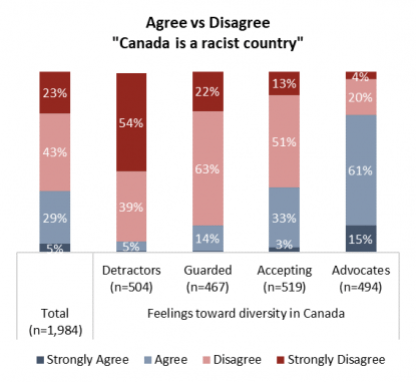
But does everyone feel it? Contradictions abound. Fully one-in-three (34%) say “Canada is a racist country.” Among those who believe this most keenly: visible minorities (42 per cent of whom say so) and women, particularly those under the age of 35, who are much more likely than men to hold this view (54%).

On the other hand, however, fewer than one-in-eight (12%) say they believe some races are superior to others. Further, 41 per cent of Canadians say that people seeing discrimination where it does not exist is a bigger problem for the country than people not being able to see where it does.

These perspectives coalesce to form four mindsets with which Canadians view diversity. This report analyzes each – the Detractors, Guarded, Accepting and Advocates – to better understand the expectations of Canadians heading into the second half century of official multiculturalism.

More Key Findings:

  • Three-quarters of Canadians over the age of 55 disagree that Canada is a racist country, while 54 per cent of women between the ages of 18 and 34 say that it is
  • One-in-five Canadians (21%) say that they feel like they are treated as an outsider in Canada. This proportion is 17 per cent among Caucasians, 30 per cent among Indigenous respondents and 29 per cent among visible minorities.
  • The Advocates, one-quarter of Canadians, are very concerned about racism and discrimination, to the point that they are twice as likely as visible minorities themselves to say that police are prejudiced or racist toward the latter demographic (83% vs 42%)
  • The Detractors, made up of older and more conservative Canadians, are also one-quarter of the population. This group is distinct in that it is more likely than others to say that immigration levels are way too high, and that racism is not a problem in Canada
  • One-quarter of Canadians feel “cold” toward Muslims, more than any other group asked about in the survey. Men over the age of 55 (42%) and Quebecers (37%) are among the most likely to say that.
  • Most Albertans (54%) and Saskatchewanians (57%) believe exaggerating racism is a bigger problem in Canada than not seeing racism where it exists.
  • Yet residents of Saskatchewan (44%) were the most likely to agree that Canada is a racist country. Residents of Quebec (24%) were the least likely.

Source: Diversity and Racism in Canada: Competing views deeply divide country along gender, generational lines

Full survey: click here

Salutin | Can you build a country without a dominant identity? We’re finding out

Thoughtful reflections:

Throughout my working life as a Canadian writer, I’ve wondered if it’s possible to create a cohesive national identity without some widely accepted basic content: a language, a mythology, a shared history, a revered cultural inheritance, a cuisine. In general I was dubious, even as claims for a tolerant multiculturalism as Canada’s ID kept growing.

I was influenced by living, in my formative years, in the U.S. and Israel — countries which, like most modern nations, cohered around shared cultural “glues.”

Something beyond hockey and butter tarts. I’m no longer dubious. Yes, I think you can build a hardy national identity with no central content except, paradoxically, the shared commitment to imposing no central content. What persuaded me was the impassioned, energized memorial at a London, Ont. mosque this week, which I attended onscreen. Whether building that kind of national reality is worth the heinous price paid for it is a separate question.

The event was organized and run by a youthful group of Muslim women and men entirely relaxed and in charge, though leaders from every level sat before them. That was a message itself: the creation of this kind of Canada is a historical process that unfolds through generations.

Their parents’ generation came, I’d say, based on the promises of multiculturalism — and were often disappointed and dismayed. (“What my dad didn’t prepare us for,” said one, “was being name-called and having the crap beaten out of us on the way to and from school every day.”) They don’t waste time being surprised, but they’re angry because they know they’re Canadian. They began the memorial with an acknowledgment of Indigenous land claims, since they have the right to apologize for being occupiers, like everyone else.

They’re now attacked mainly on religious grounds versus national, which as a Jew I find ridiculous. I’d call Islam the most universal and accessible of the three “Abrahamic” religions. Any specific charges (misogyny, violence) are absurd, since the major religions are so multifarious that you can find examples of anything and its opposite in all of them. They’re protean.

To state the obvious: these eruptions of hate and carnage are a sign of response to change. This is not the country it was, and they are not a sign of things getting worse. Rather, the hate is a terrified reaction to things getting better, in the sense of inclusive (or, put neutrally, significant) change. We’ve learned, quite brutally, that there will be a price paid for transforming the meaning of being Canadian, but it’s those who won’t accept the changes who now seem most marginalized. They lurk in the shadows, darting out furtively to murder others who walk in sunlight.

As I say, I’ve long wondered if you can build a society able to help people through hard times on what amounts to the absence of a core culture, since that’s what Canada seems to be trying: accept everyone, impose nothing. (With reasonable exceptions.) In fact at this point, efforts to impose tend to stink of racism and exclusion, like Maxime Bernier’s call for a “values test to screen out potential immigrants who share this barbarian [Islamic] ideology.”

Source: Opinion | Can you build a country without a dominant identity? We’re finding out

For immigrants like me, the ‘Great Pretend’ doesn’t work anymore

Good reflective piece:

My journey began 8,290 miles away, in India. I grew up in Mumbai, completed my studies, and first set foot in the United States as a young woman in my 20s. When I boarded that flight to California, I did so with my sister’s advice booming in my head: wear long sleeves to hide the henna ink from a recent wedding. But she was really making a bigger point: hide who you are, because they won’t understand you.

My sister’s advice was jarring but well-intentioned. The truth was, I didn’t even need the warning: already, for months, standing in front of my mirror practicing each night, I’d worked to stifle my Indian accent. It was the start of my journey as a performer –learning when and how to shed my identity, and trying to anticipate when it was safe to let my guard down and reveal my true self. I call it “the Great Pretend.”

I feel lucky that I’ve made America my home for many reasons. I’m blessed because I’ve been embraced by so many American mentors, leaders, colleagues and friends. I’m also blessed because only here would my story be possible. My naturalization ceremony 13 years ago was a deeply emotional experience, a moment of incredible belonging. But like so many immigrants, I have always cherished the fact that America wasn’t just a place but also an idea: unmatched possibilities ever in search of their own perfection, for new and next generations to write.

America, by definition, isn’t a finished product — it’s a high ideal purposefully set just out of reach so we can all, — generation by generation, help to pull the country ever closer to its founding ideals.

And for my daughters’ generation if not for mine, I’ve realized that I have some work to do, myself.

It starts with a confession. For all my years in America, I’ve been acting out “the great pretend” — the code-switching, concealing, and compromising that women like me have subjected ourselves to for decades, voluntarily. After 20 years, I wish I could say this daily ritual of cultural camouflage is gone, but it’s not. My Indian code-switching is now as much a part of my identity as the henna ink I’d once tried to hide from passersby in my new home.

But now I realize how important it is for all of us to shed those masks, to recognize the unique situations and unconscious biases experienced by multi-hyphenated professionals, so that we can all be better, do better and work together better.

The bottom line: empowering others begins by empowering yourself.

“The Great Pretend” doesn’t just encapsulate the actions many immigrants take to avoid making others uncomfortable. It’s the often unconscious and unintended– but nonetheless injurious –interactions with peers and even allies that we let go or let slide because we don’t want to rock the boat.

Act I. A cherished colleague compliments my work and my leadership, by suggesting “it must stem from” my “service-oriented culture.” Another colleague assumes I was skilled at math because I’m Indian. A new acquaintance mentions how “polite” Asian cultures are. And of course, there are the many times I walk into a meeting as a senior executive, and a stranger assumes that my younger and more junior, white male colleague is the senior leader and my boss.

Act II. I am invited to be among the feted at a summit celebrating powerful women. I enter the big ballroom to meet my fellow honorees. I feel instantly like a tiny drop of cocoa in a frothy blonde latté. The organizers have assembled us to celebrate a future which is decidedly female, but the participants are dominantly white and native born. How does this continue to happen in the United States when women of color will outnumber white women 53% to 44% by 2060?

Act III. I’m in a meeting of my peers, discussing a vexing issue, working to form a consensus. We think we’ve arrived at an answer. One of my colleagues invokes the old LIFE Cereal ad: “He likes it! Hey Mikey!” The room erupts in laughter, and I join in too. But in my head, unspoken, all I can think is: Who the heck is Mikey? Growing up in India, television was a once or twice a month luxury, usually a chance to see movies released years before in the United States.

1970s, nostalgic commercial pop culture is lost on me, as it is to many of the 17% of the American workforce who are foreign-born and raised. Isn’t it time our shorthand and colloquialisms evolve to include the nearly one in five workers who have lived something approximating my immigrant experience?

I want Act IV of my story to wrap up the plot with a twist: it’s time to stop acting — acting surprised, acting oblivious, or acting like someone else — to blend in.

Empowering ourselves means ending “the great pretend” and pointing out our perspectives to well-intentioned people—because it’s the only way we will all learn.

Empowering ourselves means incorporating the reality of intersectional identities — among increasingly heterogenous workplaces — into the core human relations and culture-building functions of any organization. Not because it’s politically correct, but because it benefits productivity and morale. Not just because it’s the right thing to do, but because it’s the smart thing to do.

It shouldn’t take a tragedy like the mass shooting in Atlanta and the many other recent examples of anti-Asian violence for us to recognize that some life lessons need to be discussed openly — every day. Why? Very simply, because I want my Indian-American daughters to grow up knowing that pretending is never normal. And when the day comes, I don’t want them to wear long sleeves to cover the Henna drawing. I want them to write their story in bold ink the whole world can see and understand. That’s what we owe each other — and that’s what we owe the America we love.

Source: For immigrants like me, the ‘Great Pretend’ doesn’t work anymore

Semotiuk: What Is The American Identity And How Should Immigrants Be Absorbed?

From Canadian immigration lawyer practicing in the USA, ending his commentary on a Canadian note:

It is no exaggeration to say that the United States always was, is now and always will be a nation of immigrants. From the first migrants who crossed the Bering Strait to Alaska and migrated down the West coast, possibly as early as around 20,000 years ago, to today’s immigrants coming from all the four corners of the earth, America was built by immigrants. In a sense, America is like a huge puzzle, completely finished on one end, but continually growing as new pieces are added to the other, representing newly arriving immigrants.

American Identity

These new immigrants are continually changing America’s identity. It is often said that America is a melting pot in which newly arrived immigrants merge with those already here to produce a new breed of Americans. To draw an analogy, the idea is that integrating new immigrants is like baking a cake. The ingredients of flour, shortening, eggs and sugar are mixed together to bake the American cake. Contrast that view, with say that of Canada’s, that sees itself as a cultural mosaic of brightly colored bits of ethnicity, culture, racial identity and language embedded side by side. These visual metaphors attempt to portray each country’s policies and how they incorporate new immigrants into their societies. Critics of these older formulations advance the notions of diversity and inclusion as better views on how immigration and cultural policies should deal immigrants to their societies.

Personal Identity

Just as immigrants are changing the identity of America, however, the country is also changing the identity of immigrants. Consider that on the first day of arrival on American soil, immigrants bring with them their identities forged back home. These identities may include a different language, culture, religion, dress and values – differences that are not ‘normal’ in North America. In time, many immigrants adapt and take on the ways of the majority in America. An example is that male Sikhs sometimes abandon their turbans and clothes and cut their hair. Externally they may look more like other typical Americans, but inside they may still identify with the Sikh faith and customs. By and large, such immigrants love America and are glad they were allowed to come here. Yet many also love their former homeland as well. There is nothing strange or wrong here: just as one can love her mother and father at the same time, she can also love America as well as Italy, for example, if that is where she is from.

What’s In A Name?

An interesting portrayal of how America influences personal identity is in former President Barack Obama’s book A Promised Land. While he was native born, as he grew up he was called Barry Obama. It was only later in life, as he came to grips with his identity that he changed his name to Barack Obama. This is a common identity experience – many Chinese immigrants adopt English first names to better cope with life in English-speaking America. I myself vacillate between Andy in everyday settings, and my native Andriy, related to my Ukrainian origins.

Being True To Yourself

The underlying question is can you live in America as your true self and still be an American? Or is America the kind of country that expects you to change your identity to ‘fit in?’ In other words, do you have to surrender your cultural identity to become an American? More importantly, is America welcoming when it comes to speaking other languages, or does America expect you to effectively forget your native tongue and just speak English? There are Americans with very different answers to these questions and different expectations related to newcomers to this country. This is what needs to be settled for America to find her way in these troubled times.

A Different View of America

Never was this difference in views about America more evident than in the presidency of Donald Trump. His evident hostility to Mexican and Muslim immigrants, and his apparent empathy, or at least tolerance, for those who want a White America, resulted in clashes on the streets of many cities and in Washington D.C. that seriously tarnished America’s image abroad. The efforts of historic figures like Abraham Lincoln and Ulysses Grant to eradicate white supremacists, not to mention the American civil war fought in part to put the legacy of slavery behind it, appeared to be forgotten. Even the efforts of more modern political leaders, like those of President Kennedy, Bobby Kennedy, President Johnson and Dr. Martin Luther King Jr. were all set back by the recent policies of the Trump administration. It may take years for America to heal and return to honoring its founding creed.

A Return To America’s Founding Creed

But return it must. The days of a country with a single race, single religion and a single culture are gone. They disappeared with the end of World War I and the collapse of the great empires that dominated world politics back then: Tsarist Russia, Austro-Hungary, and the Ottoman and German empires. Today America has no choice but to transform itself into the multi-ethnic, multiracial and diverse country it needs to be to play a leading role in the modern, multinational, multilingual and secular world. It is time for Americans to return to their founding principles in that regard.

Source: What Is The American Identity And How Should Immigrants Be Absorbed?