Hollywood Diversity Study Finds ‘Mixed Bag’ When It Comes To Representation

The latest report:

The global box office success of Black Panther is no surprise to UCLA sociologist Darnell Hunt. His annual report on Hollywood diversity argues that movies and TV shows with diverse casts and creators pay off for the industry’s bottom line.

Hunt says Black Panther, for example, “smashed all of the Hollywood myths that you can’t have a black lead, that you can’t have a predominantly black cast and [have] the film do well. It’s an example of what can be done if the industry is true to the nature of the market. But it’s too early to tell if Black Panther will change business practices or it’s an outlier. We argue it demonstrates what’s possible beyond standard Hollywood practices.”

The fifth annual diversity report is subtitled, “Five Years of Progress and Missed Opportunities,” suggesting that America’s increasingly diverse audience prefers diverse film and television content. The study reports that people of color bought the majority of movie tickets for the five of the top 10 films in 2016, and television shows with diverse casts did well in both ratings and social media.

Hunt’s team crunched the numbers for Hollywood’s top 200 films and 100 TV shows from 2015 to 2016. What they found, according to Hunt, was a “mixed bag” that over time shows a pattern: “Two steps ahead, one step back. But at the end of five years, we see there’s not much progress.”

The report states that people of color make up nearly 40 percent of the U.S. population, yet they remain underrepresented on every front on all platforms, including lead roles, writers, directors and showrunners. It finds the same for the talent agents who serve as important industry gatekeepers.

The report also shows that despite making up more than half the population, women remain underrepresented. They gained some jobs in film and TV, but as film directors, they were outnumbered seven to one.

Hunt says there are a few bright spots in television: Broadcast TV and children’s series are increasingly diverse and do well in the ratings. “Most babies born in America today are not white,” Hunt notes, “so if you look at children’s programming, it’s unmistakable that you must have diversity, otherwise the show fails.”

John Ivison: Senate amendments to gender diversity bill set to test Trudeau’s feminist principles

Find Ivison overly alarmist here. Requiring companies to have diversity plans but allowing them to set their own targets, with annual reporting, is a reasonable balance between doing virtually nothing and moving the yardstick.

There are likely some changes that may be needed (e.g., size of companies that are covered).

Bu is meritocracy really at risk as Ivison argues? Seem to recall same argument being used each time organizations want to increase diversity:

Are there any limits to how far Justin Trudeau will go to foster diversity and inclusion? We may be about to find out.

While he was in Davos, the prime minister made a big deal about the representation of women on corporate boards.

“Companies should have a formal policy on gender diversity and make the recruitment of women candidates a priority,” he said in his speech to the World Economic Forum.

To this end, the Liberal government has introduced a bill (C-25) to amend the Canada Business Corporations Act, which (among other things) requires companies to place their diversity policy before their shareholders, and if they fail to do so, to explain why (the widely adopted “comply or explain” approach).

Even that level of intervention has some free marketers wondering what business it is of the government to interfere in the running of private corporations.

But the current proposal is tame compared to amendments being proposed by a group of influential senators that will have many executives choking on their Porterhouse steak.

The six senators — Serge Joyal, Frances Lankin, Paul Massicotte, Lucie Moncion, Ratna Omidvar and André Pratte — have written to their colleagues saying they believe the current bill “lacks teeth.”

They would like to add amendments that would force the 270,000 companies incorporated under the CBCA to adopt diversity policies that set numerical goals and timetables on female, indigenous, disabled and visible minority board representation. Companies would have to report their progress not just to their shareholders but, “for the purposes of monitoring,” to the government. Ministers would be required to prepare and publish a report on the data – a clear indication that further corrective action could one day be taken.

“To be clear: our amendment would not set quotas,” the senators say.

Nonetheless, quotas would be set, even if, at this stage, by the companies themselves.

The senators are now rallying their colleagues and if they have the votes, bill C-25 will be sent back to the House of Commons. One source said there appears to be a critical mass of senators in favour of the amendments, which will likely be introduced next week.

At that point, Trudeau will have a decision to make. While the government has not looked kindly on Senate amendments, Trudeau charged senators to use their independent judgment to improve government legislation. He is unlikely to want to shirk what he sees as his moral duty to promote diversity and inclusion.

Carol Hansell, senior partner at the Toronto law firm Hansell LLP, is critical of the bill in its existing form for a number of reasons, principally because it will force companies to hold annual elections of individual directors — the concept of majority voting. She said she believes governance should flow from securities regulation, not corporate statute, which she deems too rigid to respond to changing circumstances.

Hansell thinks the same is true of the diversity issue and that many people would find the imposition of government oversight “objectionable.”

“I think everyone is uncomfortable with quotas. It’s too blunt a tool,” she said.

Even Trudeau shied away from anything that resembled a quota in the legislation. When Economic Development Minister Navdeep Bains introduced the bill, he said it would “contribute to an inclusive economic growth agenda” but would not unduly burden business.

The bill was deemed sufficiently benign by the Conservatives that they supported it – pointing out much of it was based on their economic action plan.

The “comply or explain” model has already been adopted by the Canadian Securities Administrators, covering most of Canada’s publicly traded companies.

The dissenting senators point out the results have been unspectacular over the past few years — 14 per cent of board seats are now occupied by women, up from 11 per cent in 2015.

Only 1.1 per cent of board members are Indigenous, 3.2 per cent have disabilities and 4.3 per cent belong to visible minorities.

As a share of the population, all four groups are under-represented (women and girls make up 50.4 per cent of the Canadian population; three per cent are Indigenous; 19.9 per cent are visible minorities and 13.7 per cent report some kind of disability).

Smart companies are moving toward board representation that more accurately reflects their shareholders and customers.

But we are veering into dangerous territory when we reject the notion of meritocracy as a mechanism that merely re-inforces male privilege.

Change is happening before our eyes, even if it is not as rapid as some might like.

But it is simply not the role of government to dictate who should be running the nation’s businesses.

Source: John Ivison: Senate amendments to gender diversity bill set to test Trudeau’s feminist principles

Le Conseil des arts du Canada partage plus d’argent, selon des critères d’inclusion

More implementation of the diversity and inclusion agenda:

Inclusion de la relève, des arts autochtones et de la diversité. Augmentation générale des « subventions de base » — celles qui assurent, pour un cycle de quatre ans, le fonctionnement des compagnies artistiques. Le Conseil des arts du Canada (CAC) passe aux actes : ses nouvelles valeurs se reflètent dans l’attribution de ses subventions. En dévoilant les premiers bénéficiaires d’une subvention de base depuis qu’il a adopté, en 2015, son nouveau modèle, le CAC incarne sa nouvelle manière, et affirme son désir de moduler le paysage artistique.

Les changements sont nombreux dans la liste des « Bénéficiaires d’une subvention de base », dont Le Devoir a obtenu copie. À travers le pays, 1154 organismes ont reçu une subvention de base, ventilant quelque 117 millions en 2017-2018, comparativement à 92 millions en 2016-2017. Cent dix organismes reçoivent cette subvention pour première fois — soit 10 % des organismes — et accèdent ainsi à une possible pérennité. Environ trois organismes sur cinq voient leurs subventions augmenter pour ce cycle. Les arts autochtones, des artistes de la diversité, des sourds et handicapés, ou des communautés des langues officielles en situation de minorité sont fort encouragés. Quelque 62 % des organismes axés sur ces pratiques ont reçu des subventions à la hausse ; 24 nouveaux organismes en reçoivent pour la première fois.

Le CAC « vient d’attribuer à peu près 60 % de l’argent frais aux organismes », explique Simon Brault, directeur. « En ce moment, il reste encore 57 millions à dépenser d’ici le 31 mars. Ça va avoir beaucoup d’effets. Dans les prochaines semaines vont sortir les résultats par projet — par exemple, ceux du Fonds numérique, très importants sur le plan des investissements. » C’est donc seulement l’automne prochain, après une année entière, qu’un premier bilan pourra se faire de manière éclairée.

« Les compagnies les plus augmentées sont en général les plus pointues dans leur discipline », estime M. Brault, citant la compagnie Marie Chouinard et le Centre canadien d’architecture. « On voit apparaître de nouvelles disciplines : le cirque contemporain, avec le Cirque Éloize, qui entre pour la première fois au fonctionnement, ou des compagnies spécialisées en arts et handicap », telles Corpuscule Danse et Des pieds et des mains. Art Souterrain, qui propose des expositions temporaires en des lieux inusités, comme le métro, est aussi un des nouveaux financés. « De nouvelles pratiques sont soutenues. On fait des choses surprenantes ! » se réjouit le directeur. « Il y a une capacité de renouvellement importante. J’ai hâte de voir ce que va produire ce signal dans le soutien des autres conseils des arts, ce qu’ils vont donner ou pas à ces compagnies, au Québec et à Montréal. Le CAC a eu la chance de vraiment aligner ses investissements avec les principes annoncés. C’est rare qu’un conseil des arts qui reçoit de l’argent frais ces temps-ci, peu importe où dans le monde, décide de le distribuer autrement que de façon égale à tout le monde. Nous, on a choisi une voie différente. »

Pics et plateaux

David Lavoie, coprésident du Conseil québécois du théâtre, a salué « l’avancée des investissements : il y a dix ans, on ne l’imaginait même plus. Oui, il y a des attentes importantes des milieux artistiques, nourries par les crises de la succession, par la pression sur la nécessaire inclusion de la diversité et de la réalité autochtone. Il reste des investissements à venir. Il y a des gagnants ; présentement, on ne semble pas voir grand perdants, mais je pense qu’il est trop tôt pour faire un bilan. Il peut y avoir rééquilibrage des forces ».

Quelque 34 % des organismes n’ont pas reçu d’augmentation. En théâtre, l’Espace Go et le Nouveau Théâtre Expérimental sont de ceux dont les sous stagnent. Isabelle Gingras, directrice administrative de ce dernier, ne se l’explique pas. « On est extrêmement déçu. On revendique la création, la recherche, et ça veut dire parfois que les résultats ne sont pas artistiquement parfaits. Peut-être. Mais vraiment, je ne sais pas pourquoi on n’est pas augmenté. »

À l’inverse, le Théâtre de Quat’Sous voit sa subvention de base augmenter de plus de 100 000 $ par an. « Il y avait dans les critères le souci de représenter davantage la mosaïque culturelle de notre société », note Olivier Kemeid, directeur artistique, parlant de l’inclusion de la diversité. « Dans notre cas, ça n’a pas demandé d’effort particulier, c’est au coeur de notre démarche. Comme rayonner dans la cité, prendre des risques. Alors, on est choyé d’avoir un montant semblable pour les trois prochaines années. »

Au Regroupement québécois de la danse, on demandait plus de temps d’analyse avant de commenter. Les premiers calculs effectués laissent entendre, pour la danse, une augmentation en 2017-2018 de 22 % du financement et de 18 % du nombre d’organismes admis, a avancé Virginie Desloges, responsable des finances.

Alors que Québec attend la version définitive de sa nouvelle politique culturelle, son plan d’action et l’argent qui devrait permettre d’en appliquer les mesures, certains s’inquiètent que la province ne s’appuie trop sur l’investissement supplémentaire du fédéral en arts. « Si le Québec sait si bien tirer son épingle du jeu, c’est aussi parce que c’est la province qui investit le plus en arts, répond M. Brault. Quand je parle avec les ministres de la Culture, je rappelle que si le Québec fléchit dans son investissement, il n’ira pas ensuite chercher la même part au CAC, plus haute que la proportion de sa population. J’espère l’effet contraire : que nos investissements incitent le Québec à maintenir ses choix, et à continuer à investir dans les arts, au lieu de se retirer pour un même montant. »

via Le Conseil des arts du Canada partage plus d’argent, selon des critères d’inclusion | Le Devoir

Senate proposal would force companies to set diversity targets for board of directors

Clear from current data that a nudge needed, with annual reporting to provide accountability:

In an effort to bolster the number of women, Indigenous people and racial minorities sitting on corporate boards, a group of senators is poised to amend government legislation that would force companies to set internal diversity targets.

Independent Ontario Sen. Ratna Omidvar, one of six members of the Red Chamber backing the amendment, said the Liberal government’s current approach in Bill C-25, which would simply encourage companies to boost gender diversity without applying any sort of target, is too timid.

The amendment would compel all publicly traded Canadian companies — roughly 600 on the Toronto Stock Exchange (TSX) — to set targets for increasing underrepresented groups, but would leave it up to each company to decide on what the target should be.

“The bill, as it currently stands, is just a tap on the shoulder, whereas our amendment turns the tap into more of an intentional nudge in the right direction,” Omidvar, an expert in diversity, said in an interview with CBC News. The amendment is expected to be introduced by Independent Sen. Paul Massicotte on Thursday, some 18 months after the bill was first tabled in the House of Commons.

Voluntary approach not good enough: senator

Under the government’s bill, a diversity policy is not mandatory. If a company does not develop one, they would simply have to tell their shareholders why, the so-called “comply or explain” approach adopted by other regulators in Canada.

“For us, that’s too soft a nudge,” Omidvar said. “What we may well get, as a result of this bill, is corporations developing diversity policies and putting them on the shelf and no action.”

Omidvar points to research from the Canadian Securities Administrators (CSA), an umbrella group of provincial securities regulators, which suggests a voluntary approach to diversity has led to little improvement.

Only 14 per cent of board seats are occupied by women, a three-percentage-point progress from 11 per cent in 2015. Forty-five per cent of all publicly listed companies do not have a single woman sitting on their board of directors. As for senior management, only 15 per cent of positions are filled by women, a proportion that has not progressed at all since 2015.

The research found that 1.1 per cent of board members are Indigenous, 3.2 per cent are persons with a disability and 4.3 per cent are members of a visible minority.

CSA also found that only 9 per cent of companies have internal targets for women on their boards, with a mere 2 per cent having targets for women in executive positions.

Omidvar said targets are not “quotas” per se as each company would be able to decide how many diverse candidates should be added to a board, but, at the very at least, they will have to commit to doing more.

Those targets, and a company’s success in meeting them, would then have to be reported to the federal government on an annual basis.

In turn, the minister responsible, the innovation minister, would prepare a public report documenting how well companies in Canada, writ large, have done in adding women and minorities to the seats of power at these companies. The company would also have to disclose progress to shareholders at their annual meetings.

Importantly, the amendment would actually define what exactly “diversity” is as the government’s bill, as currently written, is vague on that question.

If passed, the amended bill would compel companies to replicate definitions used by the federal government, namely that “diverse” candidates would include women, visible minorities, Indigenous people and those with disabilities. Notably, LGBTQ people would be excluded under such a definition.

Innovation Minister Navdeep Bains is unconvinced amendments are necessary and will not support this move to alter his bill.

“The minister has been clear that the act and the forthcoming regulations are an appropriate and balanced approach that will facilitate a conversation on diversity between shareholders and the management and boards,” a spokesperson said in a statement to CBC News.

The spokesperson pointed to the success of the “comply or explain” model in the United Kingdom and Australia, where the number of women on boards stands at more than 20 per cent in both jurisdictions.

“Given this, we believe Bill C-25 is a good bill for corporations, stakeholders, shareholders, and all Canadians, and hope for its quick passage through the Senate,” he said.

Opposition to quotas

There is a reluctance from some in the business community to set hard quotas — as has been done in Norway, for example, where 40 per cent of all seats must be occupied by a woman.

Paul Schneider, a senior executive at the Ontario Teachers’ Pension Plan Board, one of the largest institutional investors in the country, told the Senate committee studying Bill C-25 last month that he’d like to see a culture shift rather than the imposition of quotas.

“To be truly impactful, boards must take ownership of diversity. With a quota, they can abdicate ownership to the government,” he said.

“In the short run, quotas can indeed lead to greater diversity, but we fear that while establishing a quota incents boards to hit a specific number, it may hinder any progress over and above that target … Diversity should be achieved because it is good, sound business, not because it is a rule,” he said.

Omidvar said many companies are naturally sceptical of more regulation. “Generally, this is not particular to this bill, business leaders feel the less encumbered they are, the more capacity they will have to succeed in their business goals … but, as I’ve pointed out, [the amendment] just takes the bill from a tap to a nudge.”

And yet the proposed reporting regulations have the potential to be onerous as the more than 600 companies would have to take stock of how each of their board members (some have more than 20) identify, and then report that information to the government where the data would then be analyzed and catalogued, taking up time, money, and other resources.

Others, including Conservative Sen. Betty Unger, have said appointments should simply be based on who is best for the business.

“People invest in corporations to get a return on their investment, and this is best accomplished by appointing merit-based people to boards … As a woman — and, as you can see, I am not young — I could never feel good about myself if I knew that I got a position simply because I am a woman,” she said at a Nov. 30 committee meeting on the bill.

via Senate proposal would force companies to set diversity targets for board of directors – Politics – CBC News


Reports urge more diversity in tech sector to bridge ‘digital divide’

Canada catches up to the Silicon Valley conversation on the lack of diversity in tech (to be fair, there has been discussion that led to these reports):

The tech and innovation sector needs to do a better job of recruiting visible minorities to boost Canada’s economic output, two forthcoming studies say.

On Wednesday, the MaRS Discovery District, a Toronto-based innovation hub, will release Talent Fuels Tech, a report that found most job seekers in the region are visible minorities and argues for the development of a sector-wide strategy to build and retain a more diverse work force.

And the Ontario Incubator Diversity Report, an independent study by non-profit advocacy group Innovate Inclusion, examined four prominent organizations with incubator and accelerator programs – including MaRS – finding leadership and mentorship teams lacked African-Canadian, Latin-Canadian and Indigenous leaders. This, the report finds, can create a “digital divide” in the province that holds members of those communities back from contributing to the innovation economy.

While the pair of studies highlight that innovation hubs tend to unfairly leave crucial demographics of Canadians behind, they also chart pathways to more equitable recruitment strategies for hiring underrepresented visible minorities.

“As much as we celebrate diversity in Canada, diversity even more so in technology often starts and stops with gender,” says Jessica Yamoah, executive director of Innovate Inclusion. “Diversity within an organization will bring you perspective and new ways of doing things. A lot of times, there’s not enough credit given to our immigrant community.”

Innovate Inclusion’s report will be published later this month. It applauds Ontario’s well-known incubators and accelerators for “rising to the challenge” of gender diversity, and invites them to take further steps to get more members of the three underrepresented minority groups into their leadership teams. Examining publicly available information about various leadership groups – including boards and executive teams – at MaRS and Ryerson University’s DMZ in Toronto, Kitchener-Waterloo’s Communitech and Invest Ottawa, the report found only five people of African, Latin or Indigenous descent among the dozens of leaders. (Invest Ottawa and DMZ told The Globe and Mail that some of the report’s figures are incorrect, but applaud its intent.)

Ms. Yamoah, who is Ghanaian-Canadian, says the report is not intended to scold the organizations, but rather to set a starting point from which they can improve inclusion, which would only serve to benefit everyone involved. “As we evolve in the innovation economy, certain communities are being excluded, creating a larger digital divide,” she says. “If the numbers aren’t established as starting point, how do we measure success?”

Canada loses when underrepresented communities aren’t included in the broader conversation, she says. “That can definitely be reflected in the bottom line. Look at how the African-Caribbean community affects buying decisions in popular culture. Instead of just being musicians and artists in front of the mic, why can’t they be the executives behind the deals, and the technology that’s used?”

The report’s suggestions include that governments provide more support to incubators and accelerators that strongly demonstrate diversity in their ranks, and to earmark funds and procurement opportunities for entrepreneurs of underrepresented backgrounds. Incubators, it suggests, should design strategies to build more diverse leadership teams and better target underrepresented groups.

MaRS’s report also sought ideas to better tap into tech talent in the Greater Toronto Area – and found the answer in seeking a more diverse range of candidates. “We need to build a pipeline of talent so companies can stop going through a closed loop of referrals,” says Lekan Olawoye, one of the report’s authors and the lead executive of Studio Y, a talent development and leadership program at MaRS.

The report surveyed nearly 600 technology workers, finding that 63 per cent of job seekers were visible minorities, while 56 per cent were born outside of Canada. “Either they’re looking for work because their current environment is not conducive to them, or they are overqualified for their current role and raising their hand and saying, ‘Hey, I have more skills to provide,’ ” Mr. Olawoye says.

The report recommends developing a “sector-wide diversity-and-inclusion working group” to develop a comprehensive system of talent attraction and retention for Toronto’s tech sector. And one major key unlocking this talent, Mr. Olawoye says, is by dismantling biases ingrained in hiring. One such bias is the need for cultural fit, which the report suggests is less important than hiring talent with a mindset for growth. “The best person might not be the person you like the most that you’ll take for a beer, but it’s the person who will help your company grow,” Mr. Olawoye says.

Ryerson’s DMZ has incorporated a diversity guidebook, TechGirls Canada and TWG’s Change Together, into its membership process. “I think it comes to no surprise that the Ontario ecosystem, in terms of diversity, is lacking – there’s a lot of work to be done,” says Abdullah Snobar, its executive director. Mr. Snobar underlines the importance of incorporating the value of diversity into incubators, rather than treating it as a series of boxes to check off. “We want to see it rooted into the culture of an organization,” he says.

Spokespersons for both Communitech and MaRS said they aim to seek diverse leadership, though they seek primarily to reflect the communities around them in attaining ethnic diversity. “To be diverse, our boards and our executive should mirror our population,” says Jodi Marner, Communitech’s head of diversity and talent initiatives, who suggested that Kitchener-Waterloo region does not have a large African-Canadian or Latin-Canadian communities to hire from. “I agree we’re not mirroring our population, but we need to understand our population better, and what it’s made up of.”

Ms. Yamoah warns that suggestions playing down the need for more African, Latin and Indigenous leaders are why the report was done in the first place. “This sentiment is concerning as it would never be expressed in the context of certain sports, entertainment, or the criminal justice system where these communities are often over-indexed,” she say

via Reports urge more diversity in tech sector to bridge ‘digital divide’ – The Globe and Mail

Canada’s special forces want to attract women for a job that’s more than kicking down doors

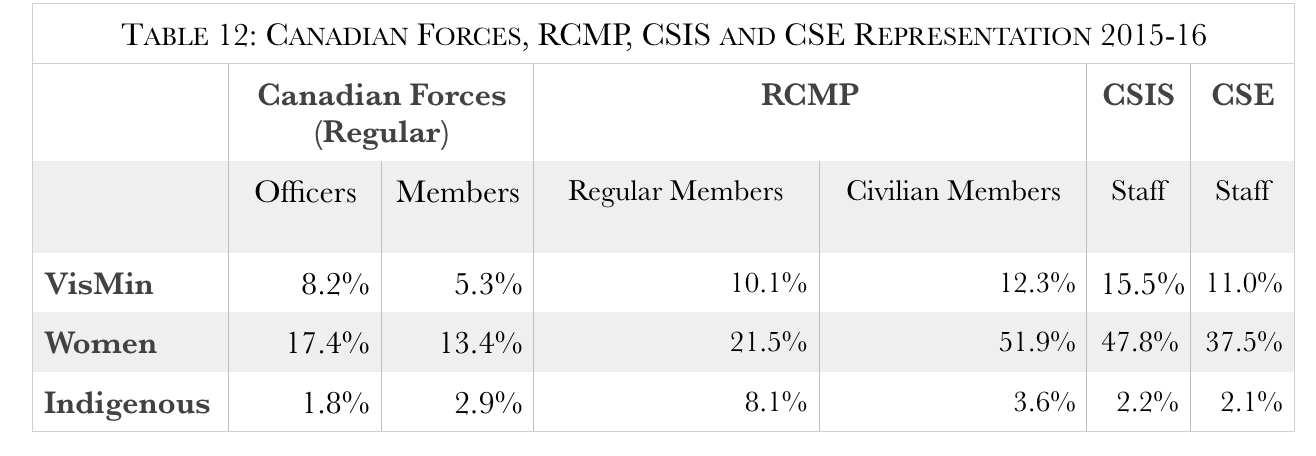
The above table  contrasts the overall representation of the Canadian Forces, RCMP, CSIS and CSE. The latter two organizations, more intelligence-driven than the CF and RCMP, indicate some hope for the strategy:

Canada’s special forces hope to recruit more than just a few good women in the coming years, says the commander of the elite force.

Maj-Gen. Mike Rouleau said the special forces, the highly trained military units that hunt terrorists and conduct covert operations, are considering how they can recruit more women.

More than just a nod toward society’s growing demand for gender balance, having more women in the unit would make it more effective, he said.

This is the future, and it is a bit of James Bond, but if you want to defeat a [terrorist] cellular-based network, you need to be in front of that cell– Steve Day, former commander of counterterrorism unit

“Having female operators would allow us to be more flexible in the battlespace,” Rouleau said in a recent interview. “It would allow us to be more under the radar in certain cases.”

In certain countries, two men walking down the street might draw attention, but having a man and woman conduct the same mission might be less noticeable, Rouleau suggested.

A former commander of the country’s elite counterterrorism unit, JTF-2, which is part of the special forces command, said the need for such mixed gender teams is something Canada’s allies have already recognized.

The more special forces are called on to fight terrorists, the more they will have to act and fight like intelligence agents, rather “door-kicking” commandos, said retired colonel Steve Day, who is now president of Reticle Security.

“Our closest allies routinely deploy male and female alongside each other to do the softer, intelligence-gathering, sensor-type operations,” he said.

“This is the future, and it is a bit of James Bond, but if you want to defeat a [terrorist] cellular-based network, you need to be in front of that cell, and at the moment, we’re not there.”

Clear criteria

Up to 14 per cent of the more than 2,200 Canadian special forces personnel are women, a percentage Rouleau said he wants to increase to 25 per cent.

That figure would be in line with the overall direction of the Canadian military, which has set the same goal.

“We’re an equal opportunity employer,” said Rouleau. “We’d love to have more women in the force.”

It is, however, easier said than done.

Rouleau noted a handful of women currently serve in both the special forces command and the unit that responds to chemical, biological and radioactive incidents.

A few have even tried out for JTF-2, but none have gone on to take the training course, because they failed to qualify, he said.

In order to be successful, Day said, a cultural change is needed within the special forces that recognizes not only the value of women in the field, but the fact that the elite troops are capable of doing more than assaulting a target.

The very first introduction of women into the special forces ranks in 2003-2004 “didn’t go over that well because organizationally we were quite immature when it came to understanding what the selection process would be,” said Day.

“There was a lot of pushback and no end of short-term grief.”

The problem is not simply gender bias, he added.

The selection process of an “assaulter” — a soldier well-suited to combat — is well documented, he said, but the criteria for choosing the best people for more intelligence-based operations is not as well defined. That needs to change, Day said.

Rouleau acknowledged his organization can do more to get out the message that “female operators are not only welcome, but in many cases, they would make us operationally more successful.”

Army under strain

The Liberal government’s defence policy, released last spring, mandated the expansion of special forces by up to 605 personnel, presenting all sorts of challenges beyond the gender issue.

At the moment, troops can only join the elite unit through the regular forces, and up to 94 per cent of those transfers come from the army.

The wider military is having its own problems.

The army currently sits at 47,000, which includes regular and reserve soldiers, as well as Canadian Rangers, who patrol the Arctic. But the regular force is short up to 1,500 troops from its allotted strength of 23,100, according to Department of Defence statistics.

Members of Canadian Forces Special Operations JTF-2 unit storm a ship during a training mission off the shores of Churchill, Man. in 2012. The nature of operations for special forces is changing to include more intelligence gathering. (Adrian Wyld/Canadian Press)

Senior defence officials insist they’re hitting recruiting targets, but retention of highly skilled members is a problem.

Drawing from an army that is struggling to keep qualified soldiers “is a concern,” said Rouleau, who acknowledged he and his staff are looking for a direct-entry model similar to a program introduced by the U.S. Army, known as 18-Xray.

“You can’t come from the street to be a special forces operator,” said Rouleau. “But that doesn’t mean in the future we won’t have a model that you can come from the street.

“I’m not saying that’s where we’re going. I’m saying we’re looking at alternate options to today’s model to make sure that we’re both capturing the talent that’s out there, but also try, if we can, to alleviate some of the pressure from the services.”

The American system gives recruits the opportunity to “try out” for special forces right away.

U.S.officials say it does not guarantee a recruit will be accepted, only that they will be given the opportunity to demonstrate they have “the right stuff.”

Source: Canada’s special forces want to attract women for a job that’s more than kicking down doors

Fighting Bias With Board Games : Code Switch : NPR

Interesting and innovative approach:

Quick, think of a physicist.

If you’re anything like me, you probably didn’t have to think very hard before the names Albert Einstein and Isaac Newton popped up.

But what if I asked you to think of a female physicist? What about a black, female physicist?

You may have to think a bit harder about that. For years, mainstream accounts of history have largely ignored or forgotten the scientific contributions of women and people of color.

This is where Buffalo — a card game designed by Dartmouth University’s Tiltfactor Lab — comes in. The rules are simple. You start with two decks of cards. One deck contains adjectives like Chinese, tall or enigmatic; the other contains nouns like wizard or dancer.

Draw one card from each deck, and place them face up. And then all the players race to shout out a real person or fictional character who fits the description.

So say you draw “dashing” and “TV show character.”

You may yell out “David Hasselhoff in Knight Rider!”

“Female” and “olympian?”

Gabby Douglas!

Female physicist?

Hmm. If everyone is stumped, or “buffaloed,” you draw another noun and adjective pair and try again. When the decks run out, the player who has made the most matches wins.

It’s the sort of game you’d pull out at dinner parties when the conversation lulls. But the game’s creators says it’s good for something else — reducing prejudice. By forcing players to think of people that buck stereotypes, Buffalo subliminally challenges those stereotypes.

“So it starts to work on a conscious level of reminding us that we don’t really know a lot of things we might want to know about the world around us,” explains Mary Flanagan, who leads Dartmouth University’s Tiltfactor Lab, which makes games designed for social change and studies their effects.

Buffalo might nudge us to get better acquainted with the work of female physicists, “but it also unconsciously starts to open up stereotypical patterns in the way we think,” Flanagan says.

In one of many tests she conducted, Flanagan rounded up about 200 college students and assigned half to play Buffalo. After one game, the Buffalo players were slightly more likely than their peers to strongly agree with statements like, “There is potential for good and evil in all of us,” and, “I can see myself fitting into many groups.”

Students who played Buffalo also scored better on a standard psychological test for tolerance. “After 20 minutes of gameplay, you’ve got some kind of measurable transformation with a player — I think that’s pretty incredible,” Flanagan says.

Buffalo isn’t Flanagan’s only bias-busting game. Tiltfactor makes two others called “Awkward Moment” and “Awkward Moment At Work.” They’re designed to reduce gender discrimination at school and in the workplace, respectively.

“I’m really weary of saying things like, ‘Games are going to save the world,'” Flanagan says. But she adds, “it’s a serious question to look at how a little game could try to address a massive, lived social problem that affects so many individuals.”

Buffalo.

Maanvi Singh for NPR

Scientists have tried all sorts of quick-fix tactics to train away racism, sexism and homophobia. In one small study, researchers at Oxford University even looked into whether Propranolol, a drug that’s normally used to reduce blood pressure, could ease away racist attitudes. Unsurprisingly, it turns out that there is no panacea capable of curing bigotry.

There are, however, good reasons to get behind the idea that games or any other sort of entertainment can change the way we think.

“People aren’t excited about showing up to diversity trainings or listening to people lecture them. People don’t generally want to be told what to think,” explains Betsy Levy Paluck, a professor of psychology at Princeton University who studies how media can change attitudes and behaviors. “But people like entertainment. So, just on a pragmatic basis, that’s one reason to use it to teach.”

There’s a long history of using literature, music and TV shows to encourage social change. In a 2009 study, Paluck found that radio soap opera helped bridge the divides in post-genocide Rwanda. “We know that various forms of pop-culture and entertainment help reduce prejudice,” Paluck says. “In terms of other types of entertainment — there’s less research. We’re still finding out whether and how something like a game can help.”

Anthony Greenwald, a psychologist at the University of Washington who has dedicated his career to studying people’s deep-seated prejudices, is skeptical. Like Flanagan, he says, several well-intentioned researchers have proved a handful of interventions — including thought exercises, writing assignments and games — can indeed reduce prejudice for a short period of time. But, “these desired effects generally disappear rapidly. Very few studies have looked at the effects even as much as one day later.”

After all, how can 20 minutes of anything dislodge attitudes that society has pounded into our skulls over a lifetime?

Flanagan says her lab is still looking into that question, and hopes to conduct more studies in the future that track long-term effects. “We do know that people play games often. If it really is a good game, people will return to it. They’ll play it over and over again,” Flanagan says. Her philosophy: maybe a game a day can help us keep at least some of our prejudices away.

via Fighting Bias With Board Games : Code Switch : NPR

ICYMI – Immigration: Gérard Bouchard plaide pour des quotas d’embauche | Réjean Bourdeau | Actualités

Interesting. Personally, I favour the federal approach of transparency and annual reporting for the public service and federally-regulated sectors, which has worked reasonably well over the last 25 years or so but Quebec numbers, last time I checked, are particularly low:

Que faut-il faire pour voir grandir le sentiment d’appartenance des immigrants à l’égard du Québec?

Il faut réussir leur intégration économique et sociale. Quelqu’un d’exclu et victime de discrimination ne développera jamais de sentiment d’appartenance. Pour sensibiliser quelqu’un et pour le faire vibrer à nos valeurs, il faut d’abord lui donner un travail. Et là-dessus, on a vraiment mal joué nos cartes. Le sous-emploi chez les immigrants bouge peu parce qu’on ne fait pas ce qu’il faut. Le gouvernement pourrait mettre en oeuvre des programmes. Une espèce d’affirmative action, comme ils ont fait aux États-Unis pour créer une classe moyenne afro-américaine. Ça prendrait quelque chose de massif, de déterminé. Qui serait soutenu par la population. Qui serait enveloppé dans un discours. Mais nous, on ne le fait pas.

Pourquoi on ne le fait pas?

Il n’y a pas de volonté politique pour ça. Quand il y a eu la tuerie dans la mosquée de Québec en janvier dernier, le premier ministre Couillard a dit : «Il y a eu un avant et il y aura un après.» Ça laissait entendre que cet événement avait été d’une horreur telle que plus rien n’allait se passer de la même manière. Qu’on allait changer les choses en profondeur. Mais il n’y a rien eu. Ce n’est pas la loi 62 (respect de la neutralité religieuse de l’État) qui va régler les problèmes. Et la Consultation sur la discrimination systémique et le racisme n’a pas levé. Ça s’est transformé en Forum sur la valorisation de la diversité et la lutte contre la discrimination qui a lui-même commencé à branler.

Quel type de politique d’intégration faut-il mettre en oeuvre pour offrir des emplois aux immigrants?

Il faut créer des conditions favorables pour réparer le retard social qu’ils ont accusé. Alors, ça va prendre un discours politique qui a beaucoup d’autorité pour faire accepter ça à la population. Parce que plusieurs pourraient dire : «Non, non, l’égalité, ce sont les mêmes conditions pour tout le monde.» Mais il va falloir faire plus que ça, parce que là, c’est quelque chose de structurel.

Que proposez-vous?

Il faut instituer des quotas. Un peu comme on l’a fait pour l’égalité hommes-femmes. Ça, ce sont des choses très concrètes. On fixe la barre. Par exemple, il faut qu’il y ait la moitié des femmes dans les conseils d’administration. Et il y a des organismes de surveillance pour voir comment ça se passe. Pour les travailleurs immigrants, on pourrait soumettre les entreprises à certaines règles pour l’embauche. Bref, il y a plein de mesures qui pourraient être appliquées. Mais il faudrait que ce soit enveloppé dans un discours politique qui rend la chose acceptable à l’ensemble de la population. Autrement, ça va passer pour une injustice, pour des privilèges aux immigrants. Et ce discours-là est déjà présent.

Pourquoi les travailleurs immigrants sont-ils moins recherchés?

D’abord, il y a une forme de corporatisme quand vient le temps de reconnaître les diplômes obtenus à l’étranger. De plus, il y a, étrangement, certaines résistances syndicales à l’embauche d’immigrants dans la fonction publique. Ensuite, du côté des PME, on se tourne souvent vers des connaissances, des parents (appelons ça «le facteur cousin»), quand vient le temps d’engager. Ce facteur est beaucoup moins présent dans les multinationales.

Quels sont les impacts de ce type de discrimination?

Je me suis souvent fait dire par des immigrants, ou par des membres des minorités, qui étaient sans emploi : «M. Bouchard, votre modèle d’interculturalisme, ça a du bon sens, mais pourquoi ce serait très important pour nous… on n’a pas d’emplois. Nos enfants nous regardent et nous demandent pourquoi on ne travaille pas.» Si quelqu’un n’a pas d’emploi, il ne peut pas rêver. Le sensibiliser à nos symboles, à nos valeurs, à nos combats, ça ne marche pas. Il faut d’abord qu’il retrouve un sens de la dignité. Un grand nombre d’immigrants sont humiliés de ne pas avoir d’emploi et de vivre aux crochets de la société dans laquelle ils vivent.

via Immigration: Gérard Bouchard plaide pour des quotas d’embauche | Réjean Bourdeau | Actualités

ICYMI: How the federal government is slowly becoming as diverse as Canada

Good overview article by Aaron Wherry of CBC on diversity in government, both public service and political appointments. Some of my analysis quoted and used:

Campaigning in 2015, Justin Trudeau’s Liberals promised to “build a government as diverse as Canada.”

That job might’ve seemed nearly done on Day One. Of the 31 ministers sworn in on Nov. 4, 2015, 15 were, famously, women. Five ministers were visible minorities and two others were Indigenous.

A cabinet ratio of 48.3 per cent women, 16.1 per cent visible minorities and 6.5 per cent Indigenous comes close to matching a Canadian population that was 50.9 per cent women, 22.3 per cent visible minorities and 4.9 per cent Indigenous.

But a prime minister and his government are responsible for far more than a few dozen cabinet positions. The cabinet oversees more than 1,500 appointments, including chairs and members of boards, tribunals and Crown corporations, deputy ministers, heads of foreign missions, judges and senators.

On that much larger scale, progress has been made, but the ideal of a government that looks like Canada is still a ways off.

A new appointment process

When the government was sworn in, just 34 per cent of federal appointees were women, 4.5 per cent were visible minorities and 3.9 per cent were Indigenous.

Two years later, according to data from the Privy Council Office, 42.8 per cent of appointees are women, 5.6 per cent are visible minorities and 5.8 per cent are Indigenous.

In February 2016, the Liberal government announced a new appointment process for boards, agencies, tribunals, officers of Parliament and Crown corporations. It specified diversity as a goal and opened applications to the public.

According to the Privy Council Office, 429 appointments were made via that process through Dec. 5, 2017. Of those, 56.6 per cent were women, 11.2 per cent were visible minorities and 9.6 per cent were Indigenous.

A total of 579 appointments — including deputy ministers, heads of mission and appointments for which requirements are specified in law — were made through existing processes. Of those, 43.7 per cent were women, 3.8 per cent were visible minorities and 5.2 per cent were Indigenous.

“Mr. Trudeau has been more intentional on these issues than his predecessors and has made great progress in opening up the process. He has also clearly made great strides on gender,” says Wendy Cukier, director of Ryerson University’s Diversity Institute.

But, says Cukier, the government’s efforts toward transparency and equal opportunity need to be accompanied by “proactive outreach and recruitment as well as retention strategies” in order to “address some of the barriers historically disadvantaged groups have faced.”

Eleanore Catenaro, press secretary for the prime minister, says, “Our aim is to identify high-quality candidates who will help to achieve gender parity and truly reflect Canada’s diversity.”

She says, “We know there is more work to do to achieve these goals, and we continue to do outreach to potential qualified and diverse candidates to encourage them to apply.”

Rigorous reporting of demographic data across federal appointments could presumably drive change — or at least give the  government something to answer for — but most of these numbers have not been made public.

“It is crucial that the government tracks, measures and reports on diversity in all areas,” says Sen. Ratna Omidvar, the founding director of Ryerson’s Global Diversity Exchange. “By doing so, we are able to see where we are making progress and where we need to improve.”

Beneath those top-line numbers, there are a few other points of reference.

According to Global Affairs Canada, the government made 87 heads-of-mission appointments — ambassadors, consul generals and official representatives — in 2016 and 2017. Forty-eight per cent were women and 13.8 per cent were visible minorities. There were no Indigenous appointees.

Senate and court appointments

Andrew Griffith, a former official at the department of citizenship and immigration who has been tracking diversity in federal appointments, has counted 18 women, six visible minorities and three Indigenous Canadians among Trudeau’s 31 Senate appointments.

As a result of an initiative to track judicial appointees, the Office of the Commissioner for Federal Judicial Affairs has published a tally of court appointments from Oct. 21, 2016 through Oct. 27, 2017. Between those dates, 74 judicial appointments were made, of whom 50 per cent were women, 12.1 per cent were visible minorities and four per cent were Indigenous.

But that data also suggested the pool of candidates was limited: of the 997 applications received, just 97 applicants identified as a visible minority and 36 were Indigenous.​

At some point, it might be charged that diversity is being inappropriately prioritized ahead of merit or competency — as Kevin O’Leary once alleged of Trudeau’s cabinet. But such suggestions assume that achieving diversity must come at the expense of merit.

Ideally, diversity would also amount to more than a numerical value.

3 benefits of diversity

Griffith, for instance, suggests three potential benefits of diversity in appointments: that it allows Canadians to see themselves represented in government institutions, that it brings a range of experience and perspectives to government policies and operations and that it reduces the risk of inappropriate policies (for example, an RCMP interview guide that asked asylum-seekers about their religious practices).

“It has been proven over and over that more diversity in the workplace leads to better outcomes,” says Omidvar, who is also pushing to tighten the standards included in a proposed government bill that would require corporate boards to report on diversity.

But the most profound impact could conceivably relate to Griffith’s first potential benefit. A nation that values diversity and pluralism might want its institutions to reflect those principles — and institutions that reflect those principles might advance the building of a multicultural society.

“It normalizes diversity,” Omidvar said of public appointments. “At this point, diversity is still sort of not the norm, which is why we focus on it.”

via How the federal government is slowly becoming as diverse as Canada – Politics – CBC News

The growing diversity within federal ridings: Policy Options

My latest:

Increased political representation of visible minorities in Canada makes it virtually impossible for any major political party to take explicit anti-immigration positions.

via The growing diversity within federal ridings

For those interested, the full table of all 338 ridings can be found here: C16 – Visible Minority – Ridings