Skuterud et al: How We Subverted our Skills Based Immigration System

Valid critique:

In 2023, with little fanfare and no political opposition, the federal government gave itself the power to subvert Canada’s world-renowned skilled immigration system.

That system was formerly centred on the “points system,” called the Comprehensive Ranking System (CRS) in its most recent incarnation. 

Under the CRS, applicants for permanent residency were evaluated on their education, work experience, and language proficiency and the highest scoring applicants were admitted. The result was a continuous inflow of top talent chosen without political influence that benefited the Canadian economy and was admired by many countries (and emulated by some).   

But in 2023, the government created a new category-based feature in the system. That feature gave the immigration minister the power to prioritize categories of immigrants and move them to the front of the line. A rules-based system was replaced with a discretion-based system. 

The result is an opaque system that is exposed to political lobbying, looks like a lottery to prospective migrants, and squeezes out highly skilled candidates. In 2025, the leading category of immigrants under the new category-based system are francophones applying to live outside Quebec. 

Contributing to Canada’s patchwork immigration system, provincial nominee programs, which give provinces the ability to prioritize groups unable to meet the standard of the points system, account for an ever-increasing share of immigrant admissions. 

Admitting fewer skilled immigrants reduces our country’s productivity and tax revenue making it harder to fund social programs. It also affects Canada’s ability to attract the world’s best and brightest students to our post-secondary institutions, which are collectively reeling from plummeting international enrolment. 

Under the Canadian Experience Class (CEC) program, former international students with a Canadian postsecondary credential and one year of work experience in a skilled occupation are eligible to transition to permanent resident status without leaving the country. 

The CEC program’s intention is a good one – we attract whiz kids from around the world and provide them with an education that Canadian employers can easily evaluate. When this path works, it works well. International students pay high fees, lowering tuition costs for Canadians, and those who stay end up doing well in Canada’s labour markets. 

However, this approach can be abused when postsecondary institutions use immigration, not education, to lure foreign students. This has contributed to the growth of low-quality programs and distorted incentives on all sides. The problem lies in policy design.

In response to unsustainable growth in Canada’s non-permanent resident population and worries about housing, healthcare and labour market effects, the government has cut international student admissions for 2026 by 50 percent. 

The reduction is facing criticism from the postsecondary sector, but critics are overlooking that universities and colleges are not even reaching the quotas they have been given under the already reduced caps. New foreign student arrivals are on track to reach less than 160,000 in 2025, far below the government’s cap of 305,900. 

Foreign student applications to Canada’s universities and colleges have declined dramatically because prospective students no longer see a clear path to staying in Canada. Graduate students in computer science who want to stay are being told that learning French is their best option. And they fear that when they graduate, a different arbitrary category will be the priority. The current system discourages the best foreign students from applying to Canadian postsecondary institutions and blocks many of those who graduate from remaining in Canada.  

What should be done?

First, turn back the clock. Return to the immigration system that existed as recently as 2019 when immigrants were admitted through a single selection system that prioritized candidates with the highest future Canadian earnings. That system was transparent, predictable, and not easy for lobbyists to manipulate.  

Second, send a clear message that Canada welcomes foreign students. At a time when our goods exporting industries face major challenges, we should promote one of our most valuable services exports – educating international students. Education is an export that is uniquely dependent on trust, as students must live in Canada to consume the product.

Third, refine the points system to better target international graduates with the best earnings prospects. This would lead to increased demand by international students for programs with high post-graduate earnings and benefit our immigration program. Demand for programs that offer low earnings returns would moderate attracting only those international students who are coming solely for the education, since these programs would provide no realistic pathway to PR status.  

Canada needs immigration reform now. What we have now is a bungled system that prioritizes lobbying effort over the very real contribution that immigration can make to the Canadian economy.

David Green is a professor at the Vancouver School of Economics, Philip Oreopoulos is distinguished professor in economics at the University of Toronto. Craig Riddell is emeritus professor at the Vancouver School of Economics. Mikal Skuterud is economics professor at the University of Waterloo, and the Rogers Phillips Scholar of Social Policy at the C.D. Howe Institute and Christopher Worswick is professor of economics at Carleton University and a research fellow at the C.D. Howe Institute.

Source: How We Subverted our Skills Based Immigration System

Un an plus tard, certaines «communautés francophones accueillantes» hors Québec ne sont pas encore en place

Of note. Has drawn criticism given dilution of Express Entry CRS along with other speciality draws:

L’expansion du réseau des communautés francophones accueillantes devait donner un coup d’accélérateur à l’intégration des nouveaux arrivants francophones à l’extérieur du Québec. Un an plus tard, des dix nouvelles communautés désignées, quatre n’ont toujours pas officiellement lancé leurs programmes en la matière.

Une CFA, c’est un endroit pointé par le fédéral comme une région toute désignée pour accueillir des immigrants qui veulent obtenir, dès leur arrivée au Canada, des services en français, sans nécessairement s’installer au Québec.

Parfois, « les personnes ont des projets d’immigration au Canada sans avoir une idée précise d’où ils désirent s’installer », explique Benjamin Mulaji Mukadi, coordonnateur de la CFA de Cornwall (Ontario). Les CFA agissent alors à titre de guides. Mais leur mandat va au-delà de cet accueil initial. Les CFA visent aussi à offrir aux nouveaux arrivants une gamme de services adaptés, comme le soutien à la recherche de logement et d’emploi, l’accompagnement scolaire pour les enfants, des activités communautaires en français et des occasions de réseautage.

Leur objectif est donc double : faciliter l’intégration dès les premiers mois, mais aussi inciter les familles à s’établir durablement dans des régions moins connues, plutôt que dans de grands centres urbains, comme Toronto ou Vancouver, pour ainsi renforcer la présence francophone un peu partout au pays.

24 CFA au pays

Il y a un an, Marc Miller a annoncé qu’en plus des 14 « communautés francophones accueillantes » déjà en activité dans le cadre d’un projet pilote, 10 autres municipalités allaient recevoir des fonds pour établir une structure d’accueil propre à l’immigration francophone. Il a alors nommé Nanaimo, Rivière-Rouge, Chéticamp, Belle-Baie, Caraquet, la région de Restigouche-Ouest, Prince Albert, Cornwall, le district de Cochrane et London comme nouvelles CFA.

Depuis, six d’entre elles ont officiellement lancé leurs programmes. Elles ont des pages Web, elles offrent des services avant et après l’installation des immigrants chez eux et elles organisent régulièrement des activités. Parmi elles, les CFA de Prince Albert (Saskatchewan) et de Cornwall ont donné le coup d’envoi de leurs activités à la fin juin, ce qui marquait la fin de plusieurs mois de préparation et la mise en place d’outils concrets dans leurs régions respectives, ont-elles relaté au Devoir.

Quatre autres communautés, elles, sont encore en phase de préparation : Rivière-Rouge (Manitoba), la région de Restigouche-Ouest (Nouveau-Brunswick), le district de Cochrane (Ontario) et London (Ontario). Officiellement désignées comme CFA il y a un an, elles n’ont toutefois pas encore lancé leurs programmes ni commencé à offrir de services.

Dans chacune de ces communautés, la mise en place d’une équipe, la conclusion de partenariats locaux et la planification des premières activités sont toujours en cours. Les acteurs impliqués affirment vouloir prendre le temps nécessaire pour bâtir des structures solides, capables de soutenir l’intégration francophone sur le long terme. Ils prévoient des lancements très prochainement.

Francophonie canadienne

L’annonce d’août dernier s’inscrivait dans l’effort du gouvernement libéral d’encourager l’immigration francophone hors Québec. L’objectif était alors d’octroyer 6 % des résidences permanentes à des personnes dont le français est la première langue officielle. Depuis, cette cible a évolué, Mark Carney ayant notamment lancé en campagne électorale vouloir atteindre 12 % d’immigration francophone hors Québec d’ici 2029. Cet objectif a ensuite été repris par la nouvelle ministre fédérale de l’Immigration, Lena Metlege Diab.

Ces politiques font partie d’une stratégie à long terme visant à stabiliser, voire à faire croître, le poids démographique des communautés francophones en milieu minoritaire, affirme le gouvernement fédéral. Les prochains mois devraient donc montrer si le déploiement des nouvelles CFA suivra le rythme nécessaire à l’atteinte des cibles souhaitées par Ottawa.

Source: Un an plus tard, certaines «communautés francophones accueillantes» hors Québec ne sont pas encore en place

Alicia Planincic: We know the one thing Canada could be doing to select better economic immigrants. So why aren’t we doing it? 

Some useful ideas but all ranking systems are imperfect predictors of success. And wages only work for two-step immigration as numbers from other countries are not easy to compare. And there are risks in changing criteria and priorities too quickly without sound evidence and data:

…Candidates receive CRS points for things like language abilities, number of years of schooling, and whether they have a sibling in Canada. But factors like what their degree was in, or where they got it from, are not reflected. Meanwhile, the biggest limitation of the points system is that it ignores labour market information. It therefore tells us little about how valuable someone’s skills are to the Canadian economy.

To go back to hockey analogies, this way of assigning CRS points is like ranking players based on the number of games they have played in the NHL, whether they have a brother in the league, and whether they speak French—while neglecting things like how many points they tend to get every year. The evaluation would not be meaningless, but it’s easy to see how some of the best players wouldn’t be ranked at the top.

To improve the CRS, Canada needs to better capture the value of the skills a candidate brings. As it turns out, the best-known way to do so is pretty simple: have the points system reflect their current earnings.

Why is that? Wages reflect both the needs of the economy (demand) and the relative availability of labour (supply). Generally speaking, if demand for a certain occupation or skillset is strong, or few are willing or able to do this work, wages will be high.

There are other ways to improve the CRS, too.

One is to remove the variables that don’t influence an individual’s economic potential. These factors not only muddy the ranking of candidates but also can unfairly bias certain people or groups. For instance, individuals can earn points for having a sibling in Canada even though the math shows this has no direct impact on economic success. Family in Canada may be a legitimate reason to consider someone for immigration, but is not an economic one, and it is being used in the economic stream. At the same time, favouring people who already have family in Canada puts individuals from smaller countries, or those with less immigration to Canada, at a disadvantage.

Another way to improve the CRS is to regularly refine it as new and better information—including the type and quality of skill (e.g., field of study, program of education) most highly valued—becomes available and can be incorporated. The CRS cannot reflect the economy of 50 years ago. It has to be the latest and greatest of today.

The recruitment of skilled talent globally is big, exciting, and holds much potential. But Canada should not lose sight of the power of the points system, nor the talent that is in plain sight. Before marketing the country to individuals around the world, Canada should do more to select the best among those who have already put their name in the hat—to support greater prosperity for all.

Alicia Planincic is the Economist & Manager of Policy at the Business Council of Alberta. She regularly provides insight and analysis on the Canadian economy, public finances, labour markets, equity and social mobility, and public policy.

Source: Alicia Planincic: We know the one thing Canada could be doing to select better economic immigrants. So why aren’t we doing it?

Mahboubi, Skuterud – The Unintended Consequences of Category-Based Immigrant Selection

Valid critique:

From: Parisa Mahboubi and Mikal Skuterud

To: Sean Fraser, Minister of Immigration, Refugees and Citizenship Canada

Date:  February 6, 2023

Re: The Unintended Consequences of Category-Based Immigrant Selection

Immigration, Refugees, and Citizenship Canada (IRCC) recently held consultations on plans aimed at giving the department more flexibility in how it prioritizes economic-class applicants for permanent residency.

The new rules will, in effect, free the immigration minister to bypass the existing system for selecting candidates, known as the Comprehensive Ranking System (CRS), to target applicants with particular “attributes” such as work experience in a particular occupation.

This may alleviate some labour shortages, but we see significant unintended consequences.

Leveraging immigration to boost average living standards in the population requires selecting immigrants whose Canadian earnings exceed average earnings in the pre-existing population, thereby pulling up average incomes and per capita GDP.

The CRS aims to achieve this by ranking and cream-skimming economic class candidates who have the highest expected Canadian earnings. This is estimated using data on the earnings of previous cohorts of immigrants who arrived with similar human capital characteristics. Of particular importance in the CRS calculation are education, age, language abilities, and Canadian work experience.    

Recent analysis using Statistics Canada survey and census data, as well as our own examination of immigrants’ income tax records (see Figure below,) provides encouraging evidence that the CRS has contributed to rising earnings for newcomers since its launch in January 2015.  

By prioritizing applicants’ occupations, IRCC hopes it can be more responsive to employer needs, as well as address Canada’s chronic labour shortages.

But accurately identifying labour market requirements and being sufficiently responsive is difficult, if not impossible. Tight labour markets can quickly become slack. By the time targeted immigrants arrive, their skills may no longer align with employer needs, thereby exacerbating long-standing mismatch issues between immigrant skills and job openings. For this reason, the CRS does not use specific occupational information in its calculation.

The raison d’être of the Temporary Foreign Worker Program, which allows Canadian businesses to employ guest workers on limited-term contracts, is to meet temporary labour-market shortages. The objective of our permanent immigration system, on the other hand, should be to drive new employment growth in high-productivity sectors that are intensive in their use of skills and new technologies.

Unfortunately, we increasingly have a system where our temporary and permanent immigration systems are focused on the same objective – satisfying employers’ current labour needs. The risk is that the overall immigration system fails to do anything well.

An important advantage of the CRS is its transparency. Candidates can determine their own scores using a simple online tool and IRCC reports cutoff scores in their bi-weekly draws allowing unsuccessful candidates to identify what’s needed to be selected. The category-based selection system that IRCC is proposing compromises this transparency by leaving screening criteria to the whims of the minister of the day. This risks increasing applicant confusion and frustration and increases the need for immigration consultants and lawyers to help applicants navigate the system. At worst, it drives applicants with the best outside options to other countries.

Allowing the ministers to determine which candidate attributes are prioritized also risks politicizing the process. Research shows that while temporary worker inflows in Canada are responsive to the intensity of corporate lobbying, the same has not been true for permanent immigration. One explanation is that ‘point systems’ like the CRS remove immigrant selection decision making from the political realm in the same way that the Bank of Canada’s inflation mandate keeps its interest rate decisions from being politicized. Look for that to change.  

In our view, prioritizing candidates’ occupational work experience in immigrant selection makes most sense in sectors where the competitive market mechanism to address labour shortages does not exist, such where wages are set by collective agreements or government regulation.

In these settings, labour shortages are less likely to induce the wage adjustments necessary to encourage job switching and training and education investments within the existing population. Chronic shortages of nurses and other healthcare workers are an important example.

Nonetheless, we question if it makes sense to prioritize applicants for permanent residency whose foreign work experience is in an occupation where credential recognition in Canada is problematic. It doesn’t really matter if credential recognition problems reflect genuine skill and competence issues, or the self-interested behaviour of professional associations. Either way, we are prioritizing applicants who will contribute relatively little to Canadian economic growth, thereby compromising the key objective of our economic immigration system.

In our view, IRCC’s planned reform of how it selects economic-class immigrants is just one step in a series of pandemic-era policies compromising the prioritization of skilled immigrants. The CRS has come to be seen by IRCC as a constraint rather than an effective quality-control mechanism. In prioritizing employers’ short-term labour needs, IRCC is being forced to lower the average CRS score of selected immigrants and, in turn, average expected earnings. The hard reality is that Canada’s newcomers continue to experience labour market challenges that are longstanding and exceptional. The risk is that the last decade’s significant gains will be undone.

Parisa Mahboubi is a senior policy analyst at the C.D. Howe Institute and Mikal Skuterud is professor of economics at the University of Waterloo. 

Source: Mahboubi, Skuterud – The Unintended Consequences of Category-Based Immigrant Selection

Express Entry: The case for resuming invitations to FSWP and CEC candidates

Good assessment by Kareem El-Assal:

It is in Canada’s policy interests to resume Express Entry invitations to FSWP and CEC candidates in short order.

Upon its launch in 2015, Express Entry sought to invite the highest scoring candidates to apply for permanent residence. Its dynamic nature sought to end backlogs since IRCC only needs to process the applications of those it invited rather than processing every application it receives. Unfortunately, IRCC has departed from inviting the highest scoring candidates and backlogs have grown due to it shifting its resources to prioritizing permanent residence applications submitted within Canada as well as the processing of Afghan refugee applications.

Back in 2015, IRCC argued that using the Comprehensive Ranking System (CRS)to score and rank candidates was the best way to identify new immigrants most likely to successfully integrate into Canada’s economy. The CRS was informed by many decades of Statistics Canada research and hence is meant to be a scientific way of selecting the Canadians of tomorrow. Thus, it is in Canada’s best interests to use the CRS as the main determinant for Express Entry invitations. One may even argue a stronger case can be made to stick with the CRS now, during an economically turbulent period, since Statistics Canada research also shows immigrants who land during a recession have weaker economic outcomes throughout their careers in Canada than those who land during stronger economic times.

An argument to stick to the CRS can also be made on grounds of fairness. Between 2015 and the end of 2020, IRCC had been overwhelmingly issuing Express Entry invitations based on CRS score but departed from this approach in January 2021 without warning. Many candidates entered the Express Entry pool after taking steps to maximize their CRS score or have taken steps since entering the pool to improve their CRS score. Such efforts have gone for naught through no fault of their own due to IRCC shifting the goalposts on them with no advanced notice (IRCC remains quiet on its Express Entry plans for 2022).

The growth in the Express Entry backlog was avoidable since IRCC made the deliberate choice to expedite CEC application processing while holding off on processing FSWP and other applications. In the second half of 2021 it was processing about 14,000 CEC applications per month and just 600 FSWP applications monthly.

The backlog of FSWP and other applications of skilled workers abroad is proving costly since it is resulting in weaker population, labour force and economic growth. Canada’s population growth is the weakest since 1915/16 and the country is currently grappling with the highest job vacancy rate on record with nearly 1 million jobs currently unfilled. Crucial industries across the Canadian economy from health care, to transportation, to agri-food, and many others are in dire need of more workers. It goes without saying then, it is in Canada’s economic interests for IRCC to get the application processing of skilled workers abroad back on track so they can soon arrive to alleviate the labour shortages that are slowing the country’s economic recovery.

Finally, the pause in CEC draws since September is also concerning from both economic and fairness perspectives. CEC candidates tend to work for Canadian employers and are able to remain with them indefinitely after getting permanent residence via Express Entry. Many CEC candidates risk losing their legal status due to the absence of Express Entry invitations which may force them to leave the country. This would result in less economic activity in Canada and contribute to additional labour shortages and pressure for Canadian employers. From a fairness point of view, it would not be right to also shift the goalposts on such individuals with no advanced notice, and ask them to leave the country, after they have spent years contributing to Canada’s economy and society.

Source: Express Entry: The case for resuming invitations to FSWP and CEC candidates

Douglas Todd: Economists question decision to boost immigration during pandemic

Good and needed questioning:

Canadian economists are questioning why Ottawa is setting record immigration targets in the middle of unprecedented unemployment caused by the pandemic.

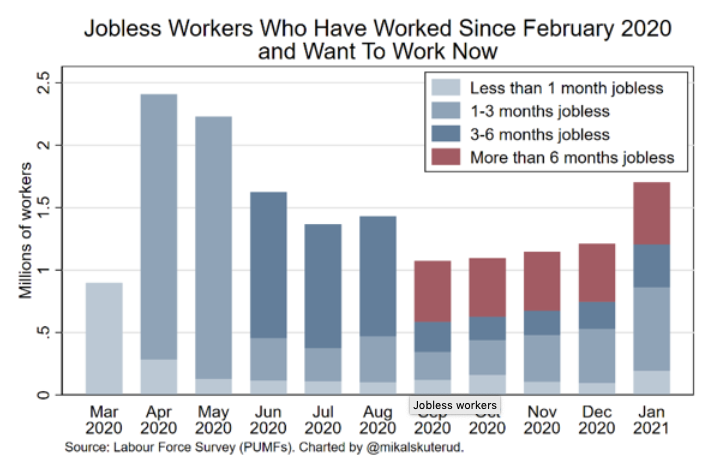
More than 1.7 million Canadians are looking for work, and the economists are warning that the Liberals’ aggressive new target of more than 400,000 new immigrants in 2021 will likely hurt the country’s low-skilled workers, particularly those who have recently become permanent residents.

Source: Douglas Todd: Economists question decision to boost immigration during pandemic

Law firms scramble to help clients capitalize on shift in Canada’s immigration policy

Money quote: “it doesn’t speak favourably of the integrity and predictability of our immigration system:”

Law firms are urging their clients to get in Canada’s express pool of immigration candidates as soon as possible after the federal government invited a record number of people in that system to apply for permanent residency to help hit ambitious targets.

On Feb. 13, Immigration Canada issued the invitations to more than 27,000 people in the Express Entry system, which is aimed at expediting the intake of skilled workers. That round of invitations – known as a draw – focused on those who had at least one year of recent work experience in Canada.

The number was more than five times larger than the previous record. To hit that mark, the federal government had to drastically reduce the immigration scores needed for an invitation to apply.

The decision sent a jolt through the legal community, with initial confusion giving way to a flurry of phone calls. Many lawyers had steered clients away from Express Entry because it was unlikely they could get a high enough score.

The situation has prompted a rethink. Several law firms contacted by The Globe and Mail are now telling clients that anyone who can get into the Express Entry pool should do so, given the potential for the federal government to surprise again.

“At this point, it seems like all bets are off, and we have no predictability in terms of who’s going to be selected and who’s not,” said Meika Lalonde, partner at McCrea Immigration Law in Vancouver. “We do know that the government has some ambitious immigration targets that it wants to fill this year. So there is a possibility that they’ll draw again at a remarkably low score.”

Owing to the pandemic, Canada has just had an exceptionally weak year for immigration. About 184,000 new permanent residents were added in 2020, well short of the 341,000 target. To make up for that, Immigration Canada raised its targets for the next three years, starting with an intake of 401,000 in 2021.

With border restrictions still in place, Ottawa is focused on foreign workers and students already here. Most of the invitations issued on Feb. 13 were to people in Canada, the federal government said.

Launched in 2015, Express Entry is one of several pathways for immigration. When people go into that pool, they’re assigned a score in points based on age, education, work experience and other factors. Draws are usually held every two weeks and have a cut-off score for who gets invited.

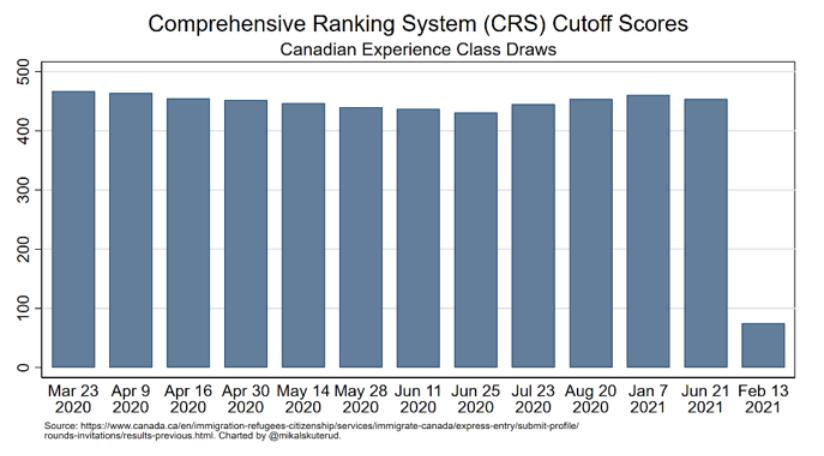
The cut-off is usually at much more than 400 points. Successful candidates in the category of people with Canadian work experience have often been under 30 years old and had advanced degrees and strong English or French skills.

This time, the cut-off score was slashed to 75. That meant nearly everyone in the Canadian-experience stream of Express Entry got an invitation, all but depleting that source of candidates.

“I actually thought it was a mistake,” said Adrienne Smith, partner at Battista Smith Migration Law Group in Toronto. “I was completely shocked.”

Once she learned it was real, Ms. Smith advised clients to try to get into the express pool. “I just don’t want to have another client that misses out on this potential draw,” she said.

The message was the same from Sonia Matkowsky, an immigration lawyer in Toronto: “I do advise individuals [who would get] lower scores to enter the pool,” she said. “Especially this year. Anything can happen.”

It’s unclear how the coming months will play out. While the Canadian-experience stream was nearly emptied, it’s undoubtedly starting to grow again. The question is whether the cut-off score will be low in future draws.

Several lawyers say they think the federal government will eventually shift its focus outside the country. Thousands of Express Entry candidates are abroad and lack Canadian work experience, but otherwise have desirable credentials. Their entry is complicated by border restrictions.

“A lot of our clients overseas were also contacting us,” Ms. Smith said. “I think the hope and the anticipation is that in order to meet the 400,000-person target, that [the government is] going to have to move to overseas applicants next.”

Even then, the 2021 target should be tough to hit. In a recent report, RBC Economics estimated that Canada would add only 275,000 new permanent residents this year.

Some lawyers said the recent draw undermined the purpose of the Express Entry system, which is intended as a way to fast-track the top candidates rather than send a blanket invitation to virtually everyone.

“It’s a very good news story for a lot of individuals,” Ms. Lalonde said. “But I would say it doesn’t speak favourably of the integrity and predictability of our immigration system.”

Source: https://www.theglobeandmail.com/business/article-immigration-strategies-take-u-turn-after-surprise-government-decision/

Canada’s record-setting invitation to immigrants after COVID shortfall an ‘absolute shock’

More reaction to the minimal Express Entry score of 75 and essentially opening to all with work experience in Canada. Money quote: “The draw transforms a well-structured and predictable system into a lottery ticket,” said [immigration lawyer Sergio] Karas. “It makes the system look worthless and game-able.”:

If you’re an immigrant living in Canada and looking for permanent residency, this might be your lucky year.

Canada has set a record for the number of skilled migrants invited to apply for permanent residence on a single day, as the government scrambles to make up for an immigration shortage caused by COVID-19 and the resulting travel restrictions.

On Saturday, Feb. 13, the immigration department held its latest draw from a pool of candidates and issued 27,332 invitations — five times more than its previous high of 5,000 people — to hopeful candidates already living in the country.

The news caught immigration experts and applicants by surprise and created a buzz on social media, with pundits tagging it #SaturdaySurprise from Canada.

“It was an absolute shock to everyone. We all thought there was a glitch on our screens and the numbers were incorrect,” said Kareem El-Assal, managing editor of immigration news site CIC News and policy director at CanadaVisa.com.

The plan is not without its critics, however, who say the strategy could open up the program to people with limited qualifications who would have been out of luck had it not been for Ottawa’s attempt to meet its immigration targets in the middle of a pandemic.

Applying for permanent residency is usually a long and competitive process.

Skilled immigrants who are interested must create a profile in a government management system called Express Entry, where they score points for things such as age, language skills, educational attainments and work experience.

The highest rankings are then invited via routine draws to apply for immigration. While an individual typically needs a minimum score of 400 points or above to make the cutoff, the lowest-ranked person invited in the latest round only had a score of 75. (The immigration department posts the results of each draw on its website.)

This latest draw applies to people in what’s called Canadian Experience Class, meaning they’ve worked in the country.

The instance of requirement loosening means some applicants, with scores too low to normally be considered, are now being encouraged to create a profile and try their luck, experts say.

“Between now and the next draw, you are going to have more Canadian Experience Class candidates entering the pool,” said El-Assal.

“If I’m in Canada right now and I meet the minimum requirements, I will be rushing to submit my profile ASAP because there’s a very good chance that I will be invited.”

Given the challenges presented by the travel restrictions and reduced processing capacity, El-Assal expects the immigration department will continue to prioritize immigration candidates from within Canada before it looks further abroad.

Canada had set to bring in 340,000 new permanent residents in 2020, but ultimately only 180,000 landed here, the lowest annual immigration intake since 1998, according to El-Assal.

This year, Immigration Minister Marco Mendicino planned to bump up immigration levels to 401,000 in order to make immigration part of Canada’s economic recovery post-COVID-19.

But as the pandemic continues, international travel remains slow, and immigration with it.

“They’ve got these massive (immigration) levels that they have to hit and they took a real beating last year. They thought the border would be more open now but they are not. They’re scrambling to find a way to meet those targets,” said Alberta-based immigration lawyer Mark Holthe, chair of the Canadian Bar Association’s immigration section.

“This was a really wonderful development. So many people have invested so much time and effort in getting here in the first place, whether it’s the hundreds of thousands of dollars that (foreign) students have paid and worked here. They’re paying taxes. They’re contributing. It’s not like they’re on handouts.”

In a news release, the immigration department said 90 per cent of the 27,332 people invited in this round are already living in Canada, with at least one year of Canadian work experience.

“This means they’re unaffected by current travel restrictions and won’t face the same barriers as overseas applicants when gathering the required documentation and undergoing criminality and medical screening,” it said.

“Those invited to apply who are not currently living in Canada will be able to travel once restrictions are lifted.”

However, Toronto immigration lawyer Sergio Karas said trying to meet the immigration target by lowering the bar is a “terrible” way to make policies.

The latest draw unfairly rewards the low scorers, who “took a flyer” and entered the pool, he said, even if they have poor qualifications, poor language skills and poor job prospects while qualified applicants who are still collecting documentation and not yet in the system lose out.

“The draw transforms a well-structured and predictable system into a lottery ticket,” said Karas. “It makes the system look worthless and game-able.”

Since immigration employees are still working from home, he questioned whether the department has the processing capacity for the flood of applications coming from this draw without compromising the processing time or quality of decisions.

Independent immigration policy analyst Richard Kurland said the system is nimble and flexible as it’s supposed to in adapting to the challenging environment under the pandemic.

“Due to COVID, fewer people registered in the system, resulting in a lower pass mark,” he said. “Now, the publicity (of this news) will flood the system with new candidates. You’ll likely see a lot more people registering just in case immigration lightning strikes twice, increasing the pass mark again.”
Source: Canada’s record-setting invitation to immigrants after COVID shortfall an ‘absolute shock’

Express Entry: 4346 CEC candidates invited

Meeting the levels target at any cost: score of 75 compared to normal average in the high 400s.

To put this into context, essentially any one 18 and 35 or anyone with a one-year degree, diploma or certificate from  a university, college, trade or technical school, or other institute, will obtain a score of 75, irrespective of any other factors.

Hard to see that this represents a merit-based appoach to selecting immigrants but does have the political advantage of helping meeting target immigration levels:

Canada invited 27,332 candidates to apply for permanent residence in its latest Express Entry draw— you read that right.

Immigration, Refugee and Citizenship Canada (IRCC) invited candidates from the Canadian Experience Class (CEC) on February 13. This unprecedented Express Entry invitation round only required candidates to have a Comprehensive Ranking System (CRS) score of at least 75— the lowest CRS requirement ever.

Today’s draw was almost six times larger than the largest Express Entry draws ever (5,000 ITAs were issued in four straight draws between November 18 and December 23 last year). Prior to today, the lowest CRS cut-off requirement ever was 199 points in the May 16, 2017 draw which only invited Federal Skilled Trades Program candidates. Express Entry was launched in January 2015.

On Wednesday, Canada also held an Express Entry draw inviting 654 Provincial Nominee Program (PNP) candidates to apply for permanent residence, that makes a total of 27,986 Invitations to Apply (ITAs) issued this week.

IRCC implemented the tie-break rule, meaning candidates who had the minimum score of 75 were only included if they submitted their Express Entry profile before September 12, 2020 at 15:31 UTC.

Today’s draw goes to show IRCC’s commitment to achieving its target of 401,000 new immigrants in 2021. Of those, IRCC is aiming to welcome 108,500 newcomersthrough Express Entry-managed programs, according to its 2021-2023 Immigration Levels Plan. Next year that target increases to 110,500, and then to 113,750 in 2023. Canada has given Federal High Skilled programs— which are managed by the Express Entry system— the largest share of new immigrant allocations for the next three years. This means the Express Entry system will continue to be Canada’s main source of new immigrants for the foreseeable future.

Canada’s immigration minister, Marco Mendicino, recently said that IRCC will make efforts to achieve the ambitious immigration targets by transitioning more temporary residents to permanent residents during the pandemic.

The unprecedented draw today seems to indicate that IRCC is aiming to issue as many invitations as it can at the beginning of this year so that it can complete the permanent residence landings of successful Express Entry candidates later in 2021. This would provide IRCC with a greater opportunity to achieve its immigration levels target amid ongoing coronavirus disruptions across the world. At the same time IRCC and Mendicino continue to stress that they will also look to global talent including those currently outside of Canada to support the country’s post-pandemic recovery.

Source: Express Entry: 4346 CEC candidates invited