UK: Say one thing, do another? The government’s record rise in net migration

Highlights the difficulties and how parties get captured by their political promises, and then later pay the political price:

Think back to the 2019 election campaign. Quite reasonably, you may not remember every detail of the Conservatives’ manifesto – but perhaps you do recall one promise: to reduce immigration.

Think back further, to 2016 and the Brexit referendum. Then there was a promise to “take back control” of the UK immigration system. And since it left the EU in 2020, the UK does have more control.

But the numbers of people who’ve moved here didn’t go down, they went up.

Since the Brexit vote and the Conservatives’ victory in 2019, the 12 months to June 2022 saw the fastest population growth since the 1960s. Current projections from the Office for National Statistics put the UK on course for 74 million people by 2036 – six million more than there are today.

You’d be well within your rights to ask how that could be? The answer, according to the ONS, is largely immigration.

And one aspect of immigration has received huge amounts of attention from the government and the media. Statement after statement, story after story, has focused on migrants crossing the Channel in small boats – and the government’s efforts to stop them.

Indeed you’d be forgiven for thinking small boats are a major part of why immigration is up. But they aren’t.

No doubt, small boats are an important issue – on a human and national level. Prime Minister Rishi Sunak has made “stopping the boats” one of his five priorities.

His government’s flagship Rwanda plan aims to send some asylum seekers who arrive on small boats there – and Mr Sunak is still trying to get the bill through parliament.

But it’s not small boats that are driving an increase in immigration – it’s choices made by the government.

Almost 30,000 people arrived in the UK on small boats last year – something the prime minister has vowed to crack down on

There are a number of ways to measure immigration.

Let’s start with one: net migration. That’s the difference between the number of people arriving and leaving the UK each year.

In 2022, it’s estimated to have reached an all-time record of 745,000.

Then, there’s the number of visas issued to people relocating to the UK. Last year there were more than 1.4 million.

For context, last year almost 30,000 people arrived by small boat.

After the UK left the European Union, the government launched a new visa scheme for most people who don’t have a UK passport.

The government decides the criteria for the different visas it issues – these can be for studying, for working, for humanitarian reasons – and other purposes too.

In the words of Prof Brian Bell, who chairs the government’s independent Migration Advisory Committee, the rise in immigration is “the inevitable consequence of government policy”.

We can see how this is the case by breaking down that 1.4 million figure.

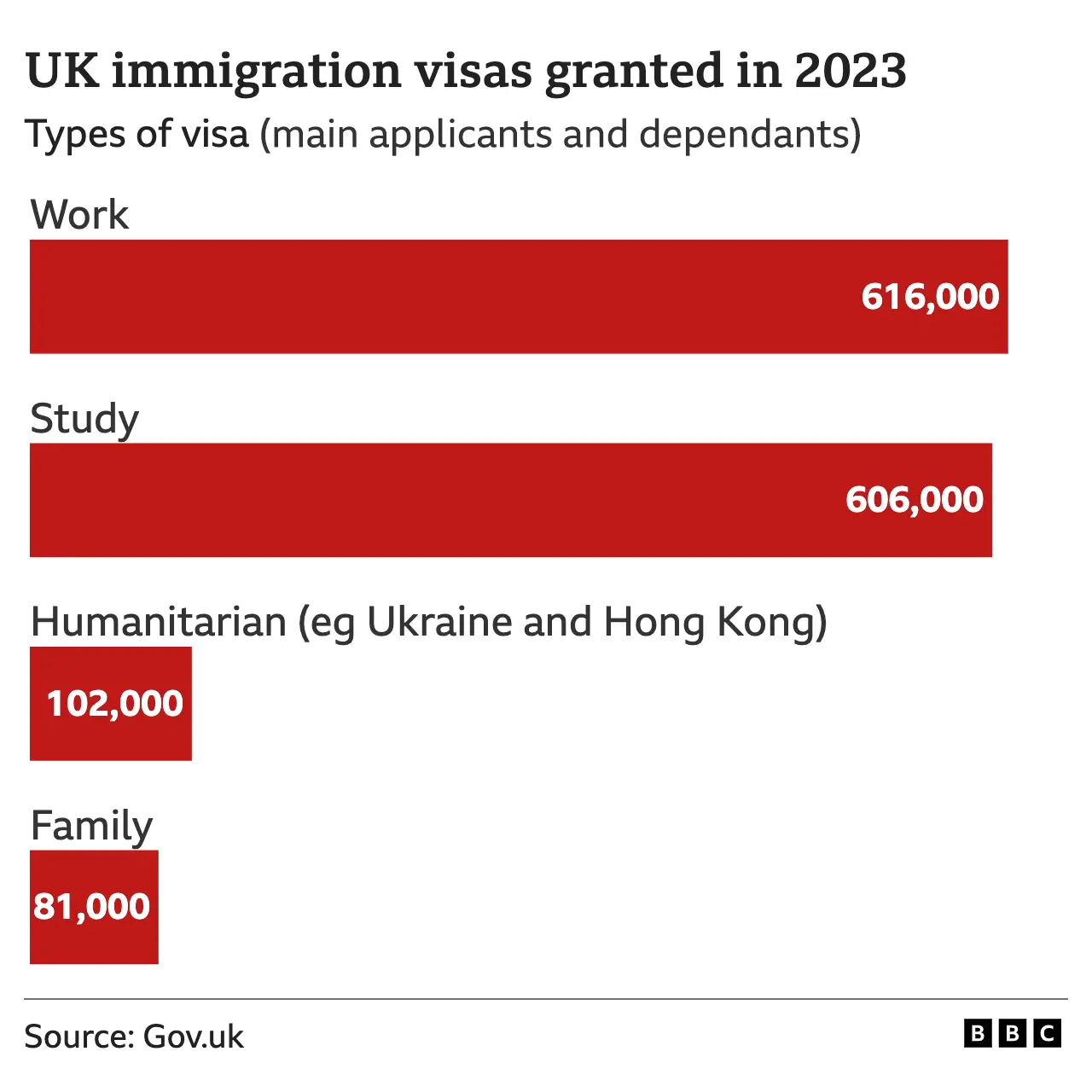
UK immigration visas granted in 2023

In 2022, the government issued almost 300,000 humanitarian visas. But last year the number was 102,000 – that’s just 7% of the 1.4 million visas issued.

The government has been consistent in its response when asked about the record levels of net migration.

Tom Pursglove MP, the Legal Migration Minister, told me: “We’ve seen incredible generosity in our country to people from Ukraine, people from Afghanistan, people from Syria, and other conflict zones. That is an important part of why we’ve seen the figures as they are.”

It is important, no doubt. And there was political consensus that issuing visas to people from Hong Kong, Ukraine and elsewhere was the right thing to do.

But the numbers show that this isn’t the full story.

The government has made other choices that have pushed up immigration.

Brexit and the pandemic added to existing recruitment problems in the social care sector. Care home owners responded by asking the government to make it easier to employ overseas care workers.

Those calls were echoed by the Migration Advisory Committee, which also suggested the government should fund higher wages to attract more British workers into the sector.

The Westminster government agreed more visas could be issued but did not raise wages.

A number of consequences followed.

For care home owners like Raj Sehgal, the changes helped. He filled almost all vacancies in his five Norfolk care homes, with 40% of staff coming from abroad.

“If we didn’t have international recruitment, I think we would probably be closed by now,” he told me.

More overseas staff arrived to work across the sector. But more may be needed. Last year, there were around 150,000 vacancies in England, and recruiting British workers remains difficult.

Let’s look at that 1.4 million figure again. Of all of those visas, more than 146,000 went to health and social care workers, another 203,000 went to their dependants.

This month, the government stopped overseas care workers from bringing dependants, describing the numbers as “disproportionate”. Mr Sehgal says this has already reduced the number of applications he is receiving.

This seems certain to reduce net migration numbers, but it’s not certain how the care sector will find the staff it needs.

If the government’s decisions on social care have driven up immigration, then so have its decisions on overseas students.

First of all, let’s consider the context here.

Tuition fees for domestic undergraduates at English universities are capped at £9,250 a year. That hasn’t risen for seven years – but during the same period, costs have. That has left universities facing financial challenges.

Some of them, like Coventry University, have targeted higher-paying overseas students to help cross-subsidise UK undergraduates. Forty per cent of the students at its campuses across the UK are from overseas.

If domestic tuition fees were raised, it could reduce the need for overseas students. But that would cost a lot. And it hasn’t happened.

Prof Brian Bell argues “that’s a choice of the government not to fund education in a particular way. The inevitable consequence is more immigration.”

The government couldn’t have been clearer about its ambition to attract more overseas students.

In 2019, it even set a target to increase the UK’s overseas student population to 600,000 – by 2030. It achieved that goal nine years early.

On top of that, in 2021, the government reintroduced a post-study work visa which allows overseas postgraduate students to work for two years after their courses finish – or three years if studying for a PhD.

It took the decision despite the Migration Advisory Committee suggesting that it shouldn’t.

All of this did what it was designed to do – attract lots more students. Last year the government issued almost 458,000 sponsored study visas. And almost 144,000 for dependants of postgraduate students.

Together, they made up almost 42% of the more than 1.4 million visas issued last year.

Again, the government was choosing immigration.

Now at this point, we should emphasise that while the government was putting in place policies that promoted immigration, knowing their precise impact was hard.

Dr Madeleine Sumption leads the Oxford Migration Observatory at the University of Oxford. She also sits on the Migration Advisory Committee that advises the government.

Predicting immigration numbers is “incredibly difficult”, Dr Sumption says. “Sometimes it’s much larger than the government expects.”

As the consequences of the government’s own policies became clear, it slammed on the brakes.

In May last year it announced that, from January 2024, most overseas postgraduate students would no longer be able to bring dependants.

This March, the government took further action – it ordered a review of the visa that allows overseas students to stay on and work. This, let’s remember, is the scheme the government had introduced only three years ago.

Legal Migration Minister Tom Pursglove explains: “The government took a view that we thought that that was the right thing to do to support the university sector. But when you consider the dependant numbers that have come with students, that has been very, very challenging.”

The government’s measures appear to be making a difference already. According to Universities UK, some universities are seeing a sharp drop in applications from overseas students for postgraduate courses.

But there’s a risk that as applications go down, so does the income of some universities.

A British Future poll suggests 69% of respondents are dissatisfied with the government on immigration

All of these government decisions have contributed to the record rise in net migration, and along with the rise we’re also seeing a shift in public opinion.

The think tank British Future, which tracks UK attitudes to immigration and describes itself as non-partisan, has shared its latest opinion poll with Panorama.

For the first time in four years, the poll suggests a majority of 3,000 respondents – 52% – want overall immigration to fall.

On top of that, 69% of those polled say they are dissatisfied with the government on immigration – that’s the highest since its polling began in 2015.

And this is where we come back to where we started – to the government’s emphasis on the issue of small boats.

The opinion poll also suggests that a little over half of those who say they are dissatisfied with the government’s handling of immigration pointed to small boats – and those concerns are coinciding with concerns about overall immigration.

Dr Sumption told me the media’s focus on small boats has probably created the impression that almost all migration comes that way, “which obviously it doesn’t”.

To reiterate – almost 30,000 people came by small boats last year and 1.4 million visas were issued by the government for people to come to the UK legally.

Some argue that the government has overemphasised the issue of small boats.

When I put that to Tom Pursglove, he countered that the government has a “moral imperative” to “grip that issue”. But he said that shouldn’t stop them, “delivering on the mission around legal migration, which is to get a better balance to bring those numbers down”.

At the moment, by the prime minister’s admission, that balance is off. In November, Rishi Sunak acknowledged, “immigration is too high and needs to come down”.

But his former Home Secretary Suella Braverman made a series of striking claims when I talked to her about Mr Sunak’s approach.

“I think the prime minister has not necessarily assumed that it’s an important issue for the British people,” Ms Braverman says.

“‘I struggled myself as home secretary, even to have a meaningful conversation with him about it. I was left to written correspondence on several occasions throughout a period of 12 months, putting forward policy proposals. But he refused to talk to me.”

I was taken aback by this. I know there is little political love lost since Mr Sunak sacked Ms Braverman last year – but this is the home secretary during the time of one of the sharpest rises in net migration in the UK’s history – claiming the prime minister wouldn’t talk to her about it – at all – for a year.

I double-checked I had heard right. I had.

“We talked about the boats every week, twice a week. We talked to each other a lot about policing and security. On legal migration, I was unable to get a hearing with the prime minister for 12 months.”

Given the importance of this issue to so many people, it is an extraordinary claim.

When we asked No 10 about this, it did not comment.

At the end of last year, the government announced plans to cut net migration by reducing the number of people coming to the UK by 300,000.

Remember, the latest estimate for net migration is 672,000 for the year to June 2023.

The estimate published just before the Brexit referendum – and which, at the time, Boris Johnson called “scandalous” – was 333,000. That estimate has now been revised down to 303,000.

So if the government meets its new target, that would take the numbers back towards where they were… just before the Brexit vote.

The government emphasises that Brexit has given the UK greater control and flexibility to adapt immigration policy to circumstance

Some observers watching the government’s statements and actions on immigration are gently raising their eyebrows.

Prof Anand Menon, who leads the independent think-tank UK in a Changing Europe, told us: “I think there is an element of dishonesty in the government at one and the same time implementing these policies and bemoaning them. Or bemoaning their impact.”

There seems little doubt the government’s latest measures will make a difference. Net migration is expected to fall. But if it does, the longer-term challenges that immigration has been easing may come into sharper focus.

Paul Johnson of the Institute for Fiscal Studies, which says it operates on a “non-political basis”, has an uncompromising message on this.

“If you want universities to have as much money as they have at the moment without these foreign students, you need to find some money from British students or the British taxpayer. If you want care homes to be staffed without bringing people in from elsewhere, you’re going to have to pay more. You have to make choices here.”

I’d hoped to ask Labour some questions about how it would approach these choices, but it declined.

This month, the Shadow Home Secretary Yvette Cooper said, “We are very clear that net migration needs to come down” and that a practical plan to tackle skills shortages in the UK is needed.

But are politicians of all parties being straight with us about what these choices involve?

For this government, for any government, these choices will involve difficult and sometimes expensive trade-offs.

Legal Migration Minister Tom Pursglove argues “issues have arisen” and it has “responded to those issues”. It emphasises that Brexit has given the UK greater control and flexibility to adapt immigration policy to circumstance.

Others point to recent data showing that one in five working-age adults are off work in the long-term, with record numbers recorded with long-term sickness.

In the Spring Budget, the Chancellor Jeremy Hunt said it would be easy to fill the 900,000 job vacancies with higher migration, but with 10 million adults not in work, it would be “economically and morally wrong”.

It’s inescapable though, that while the UK now has more control of its immigration system, the government has used that control to allow more people to come to the UK.

To come back to the question I posed earlier: how did that happen?

We can answer that by listing the government’s decisions and by acknowledging that there are powerful long-term factors that appear to encourage higher immigration. Our population is ageing, our birth rate is falling and our economy is struggling to grow.

The government though still insists the numbers will and must come down.
However, despite all the promises, this government chose more immigration. It is unlikely to be the last to do so.

Source: Say one thing, do another? The government’s record rise in net migration

When ‘conservatives pounce’: The right finds its cautionary tale of subtle media bias

Always find MacDougall’s comments reasonable and balanced:

“I can think of no reporters I’ve ever dealt with who had it out for a party or a worldview. Most were trying to do the job in the fairest way possible,” said Andrew MacDougall, who was director of communications for former prime minister Stephen Harper and is now a director at Trafalgar Strategy.

“But like all biases, you’re not really aware of them until somebody points them out. If you’re university-educated and urban-living, you tend to have a worldview that is different from somebody who isn’t — and it takes a lot of effort to open your eyes up,” said MacDougall….

While MacDougall agrees that conservatives generally have to work harder to get a fair shake from the media, he also warned people on the right not to get too caught up in playing the victim. He pointed to the current controversy around Prime Minister Justin Trudeau’s recent free luxury holiday in Jamaica as proof that, above all, the media craves juicy stories.

And when conservatives govern, he said, there are times when the negative reporting targeting them is just proper reporting.

“The hardest thing in government to do is to distinguish between the fact that you’re getting heat for being in government versus for being the party that you are in government,” he said.

Source: When ‘conservatives pounce’: The right finds its cautionary tale of subtle media bias

Liberals, NDP urge Conservatives not to stall citizenship rights for ‘lost Canadians’

The original bill, S-245, focused on the narrow remaining group and small number of “lost Canadians”, born between 1977 and 1981 who failed to reaffirm their citizenship by the age of 28.

The NDP and Liberals abused the regular process by expanding to the scope to essentially gut the first generation cut-off, without the committee being able to go through the normal review process for effectively was a new bill, with far vaster implications for citizenship given the larger number of people affected.

The Conservatives are right to engage in delaying tactics on process as well as substantive grounds given that the government and the NDP initiated “playing political games” by using this backdoor shortcut:

But the NDP’s immigration critic Jenny Kwan accused the Conservatives of stalling its progress and “playing petty political games,” including filibustering debate at committee, to reduce its chances of becoming law.

She accused the sponsor of the Senate bill in the Commons, Conservative MP Jasraj Singh Hallan, of slowing the bill’s passage in the House by twice switching its scheduled third reading debate with another bill. Mr. Hallan and Tom Kmiec, the Conservative immigration critic, would not comment.

“Canada needs to fix the lost Canadians issue once and for all. The Conservatives were wrong to strip the right of parents to pass on their Canadian citizenship to their second-generation-born-abroad children 14 years ago,” she said. “In the case of William and Jack Cowling, it means they do not have the legal status to work in Canada and the family farm that has been in their family for six generations is now in jeopardy.”

Source: Liberals, NDP urge Conservatives not to stall citizenship rights for ‘lost Canadians’

‘It’s a new party’: How Conservatives try to rebuild trust among Muslim communities

Of note. Repeat of the Bricker-Ibbitson and Jason Kenney arguments, but targeted towards a group traditionally less inclined to vote Conservative. But opportunistic given the controversies among some members of religious groups regarding LGBTQ+ and gender issues in the school system:

When Pierre Poilievre pitches the Conservative party to Muslim Canadians, he talks about “faith, family and freedom.”

For months he has been pointing out what he sees as their overlapping values during visits to mosques, at community celebrations, with businesses and in conversations with ethnic media outlets.

It’s part of an effort to grow the party’s presence, particularly in larger cities that are home to many racialized Canadians whose support for the Conservatives plummeted during the final months of Stephen Harper’s government and his divisive 2015 campaign.

Poilievre has also fine-tuned his message to appeal to growing concerns from some parents, echoed by several prominent Muslim organizations, about what their children are learning about LGBTQ+ issues in schools.

He is gaining some traction with his acknowledgment of such worries, but whether he will take action through party policy remains unclear, given his firm view that education is a provincial matter.

Some also wonder what he would do to address the Islamophobia that many feel his party exacerbated the last time it was in power. “This is where we have that sort of cautious optimism,” said Nawaz Tahir, a lawyer who chairs Hikma, an advocacy group for Muslims in southwestern Ontario. Tahir met Poilievre with other community leaders this summer.

“While it might be resonating in the short term, there are long-term questions about whether or not people will continue to listen, or latch on, in the absence of some concrete policy proposals.”

Poilievre has chosen to walk a careful path on the issue of “parental rights.” The term, which speaks to the desire by parents to make decisions regarding their children, has been popularized by people with wide-ranging concerns about efforts to make schools more inclusive for LGBTQ+ students, such as by raising Pride flags or including discussion of sexual orientation and gender identity in the curriculum.

New Brunswick and Saskatchewan now require parental permission for transgender and nonbinary students to use different names or pronouns at school. Court challenges have ensued, with teachers’ unions and provincial child advocates saying the policies put vulnerable students at risk.

The Conservative leader has said that Prime Minister Justin Trudeau should “butt out” of the issue and “let parents raise kids,” but otherwise Poilievre has stayed mum on how he might respond.

At last month’s policy convention in Quebec City, Conservative party members voted overwhelmingly in favour of a policy change to prohibit minors experiencing gender dysphoria from receiving “life-altering” pharmaceutical or surgical treatment.

A video posted online shows that Poilievre said during a Punjabi media event in Surrey, B.C., several days later that he was “taking some time to study that policy to come to the right solution.”

He said the party would have to consider “jurisdictions,” in the sense of “which level of government is responsible for it” — but ultimately, “I will be making my position clear.”

Poilievre’s office did not respond to a question about whether he has come to any conclusions.

His office was also silent in July when a photo circulated online that showed Conservative finance critic and Calgary MP Jasraj Singh Hallan with two men who wore T-shirts that read “leave our kids alone.” The shirts featured an image of stylized figures beneath an umbrella shielding them from the rainbow of colours associated with LGBTQ+ Pride flags.

One of the men in the photo, Mahmoud Mourra, a Muslim father of five, has for months been protesting school policies and activities that acknowledge students’ sexual orientation and gender identity.

As he and thousands of others took to the streets in recent countrywide demonstrations against “gender ideology” in schools on Sept. 20, Trudeau posted on X, the platform previously known as Twitter, that “transphobia, homophobia, and biphobia have no place in this country.”

Poilievre’s office, meanwhile, instructed MPs to keep quiet.

Two days later, Poilievre also posted on X, accusing Trudeau of “demonizing concerned parents” with his statement about the protests.

The Muslim Association of Canada also condemned Trudeau’s remarks, saying Muslim parents who participated in protests showed up “to be heard, not to sow division.” The organization said it feared Muslim kids would face “increased bullying and harassment” at school —a statement Poilievre and many of his MPs shared online.

Dalia Mohamed, who leads public affairs at the Canadian chapter of the Islamic Society of North America, said her organization has heard from parents who worry their children face pushback when opting out of certain lessons or activities related to LGBTQ+ issues.

“What they’re seeing more and more is that their kids are facing repercussions,” she said.

An audio recording surfaced online in June alleged to be an Edmonton school teacher chastising a Muslim student about missing class to avoid Pride events. The unidentified teacher says respect for differences “goes two ways,” adding that if the student thinks same-sex marriage should not be legal, then he “can’t be Canadian” and does not “belong here.”

The National Council of Canadian Muslims called it “deeply Islamophobic, inappropriate and harassing behaviour.” The school board said it was dealing with the issue.

Tahir, with Hikma, said it comes down to respecting religious freedom, adding that it is “not part of our faith teaching” to hate the LGBTQ+ community. “We condemn that,” he said.

Tahir said he and other community leaders told Poilievre the Conservatives have an opportunity to regain the support of Muslim Canadians.

He argued that the “vast majority” of Muslims voted for Brian Mulroney’s Progressive Conservatives in the 1980s and early ’90s.

“There was a lot of alignment on a number of issues. And that seems to have gone by the wayside,” he said.

Still, while there is frustration that the governing Liberals have failed to take enough action against Islamophobia,including within its own government agencies, Poilievre faces an uphill battle against long memories.

“He was around the table during the Harper years when there were some things that happened that were not well received by the Muslim community,” said Tahir.

In 2011, then-immigration minister Jason Kenney brought in a rule requiring Muslim women to remove face coverings, such as niqabs, when swearing the oath during citizenship ceremonies. During the 2015 federal election campaign, the Conservatives asked the Supreme Court to hear a request to appeal a court decision to overturn that policy, and Harper mused about extending it to all public servants. The Conservatives also promised to create a tip line to enforce a law against “barbaric cultural practices,” which they said at the time included forced marriages.

Eight years later, Conservatives are still apologizing.

“Mistakes were made. No doubt about that,” Conservative MP Garnett Genuis said in August of the 2015 campaign at a Greater Toronto Area breakfast meeting with members of the Pakistani community.

“There’s rebuilding of trust,” he said in a video shared online. “And I understand people saying, ‘Well, we’re not sure yet because of some of the things that happened in the past.'”

He described a “deep fundamental connection” between the Conservative party and the wider Muslim community. He said a “renaissance” of that relationship is underway.

“We’re trying to reach out to the community and tell them, ‘It’s a new party, that was eight years ago,'” Conservative Sen. Salma Ataullahjan said at the same event. Her office did not respond to a request for comment.

In a written statement, Genuis said the party’s message around lower prices, affordable housing and safer communities is “resonating with Canadians of all walks of life.

So is its defence of “faith, family and freedom,” he added.

Poilievre addressed the criticism of the Conservatives’ unsuccessful 2015 campaign during last year’s leadership race. Rival candidate Patrick Brown, who at the time was counting on heavy support from Muslim communities, accused Poilievre of having never “publicly stood against” the divisive policies, such as a “niqab ban.” Poilievre pushed back by noting the policy was limited to swearing the citizenship oath.

Since winning the leadership, Poilievre has travelled extensively to meet with immigrant and racialized communities that Conservatives had long ago credited with delivering them a majority victory in 2011.

Historically, the party has believed that many in these groups tend to be more religiously conservative, that they will prioritize public safety and that they are looking for policies, such as lower taxes, that can help them gain an economic foothold in Canada.

Tahir said Poilievre was told during his meeting this summer that if he comes back with concrete plans to address Islamophobia, there would be “a strong willingness” from the community to vote Conservative.

In 2017, Poilievre voted alongside other Conservative MPs against a motion from a Liberal MP to condemn Islamophobia, citing concerns it could infringe on free speech.

During Ramadan this spring, Poilievre said in an interview with Canada One TV that he believes the country must “combat bad speech with good speech, not with censorship, but with good speech.”

He also spoke of bolstering a security fund for mosques and talked about combating Islamophobia through a stronger criminal justice response, part of a broader push by the Conservatives for tough-on-crime policies.

Earlier this year, Poilievre addressed long-standing allegations that the Canada Revenue Agency is discriminating against Muslim charities.

The agency “has been abusing our Muslim charities and the immigration system has been discriminating against our Muslim immigrants,” he said in a video shared by the Muslim Association of Canada.

The National Security and Intelligence Review Agency announced in March it would be investigating allegations of bias and Islamophobia at the CRA.

Saleha Khan said she believes Poilievre is using the debate around LGBTQ+ issues in schools to his advantage. She also worries the surrounding rhetoric could ultimately bring more harm to the community.

The London, Ont., woman and nearly 700 other people, many of whom are members of the Muslim Canadian community,have asked in an open letter that their leaders “help separate fact from fiction” by speaking out about misinformation they see fuelling a lot of the discourse, placing both Muslim and LGBTQ+ students at risk, as well as those who identify as both.

She said the debate is “gut-wrenching” and risks making life even more dangerous for average Muslim families and their children, who already experience Islamophobia and live their life under high alert.

“We will become the poster children for transphobia and homophobia when we are not the poster children for homophobia and transphobia.”

In the Ramadan interview with Canada One TV, Poilievre acknowledged that his party has done a lousy job of fostering better ties.

He pledged to be different.

“I’m coming here with my hand extended in a spirit of friendship,” he said. “It’s not the duty of the Muslim community to come to us. It’s our duty to come to you.”

Source: ‘It’s a new party’: How Conservatives try to rebuild trust among Muslim communities

Integrity of immigration system at risk as international student numbers balloon, minister says

Smart communications to link to integrity issues but test will be what he and the government does about it. Too late for the upcoming academic year and the education associations are already protesting:

Immigration Minister Marc Miller says the concern around the skyrocketing number of international students entering Canada is not just about housing, but Canadians’ confidence in the “integrity” of the immigration system itself.

Canada is on track to welcome around 900,000 international students this year, Miller said in an interview that aired Saturday on CBC’s The House. That’s more than at any point in Canada’s history and roughly triple the number of students who entered the country a decade ago.

That rapidly increasing number of international students gained increased attention this week when the country’s new housing minister, Sean Fraser, floated the idea of a possible cap on the number of students Canada brings in.

Fraser framed a cap on international students as “one of the options that we ought to consider” during a cabinet retreat earlier this week in Prince Edward Island.

Miller, who took over from Fraser at Immigration, Refugees and Citizenship Canada, told guest host Evan Dyer that the rising number of students was a concern for housing, though he says it is important not to overstate that challenge.

“It is an ecosystem in Canada that is very lucrative and it’s come with some perverse effects: some fraud in the system, some people taking advantage of what is seen as a backdoor entry into Canada, but also pressure in a number of areas — one of those is housing,” he said.

But Miller shied away from committing to the idea of a hard cap on the number of students entering Canada.

“Just putting a hard cap, which got a lot of public play over the last few days, is not the only solution to this,” he said.

“Core to this is actually trying to figure out what the problem is we’re trying to solve for. It isn’t entirely housing, it’s more appropriately the integrity of the system that has mushroomed, ballooned in the past couple of years.”

Miller said there were a number of “illegitimate actors” who were trying to exploit the system, which was eventually having a negative effect on people trying to come to Canada for legitimate reasons. Miller referred to one high-profile instance last month of an international student found sleeping under a bridge.

He said he would not get involved with “naming and shaming,” but said his focus was on some private colleges. Work would need to be done to tighten up the system, he said, to make sure institutions actually had space and suitable housing for people who are being admitted. Miller also said closer collaboration with provinces was key to solving the problem.

Cap opposed by major universities

In a statement to The House, the National Association of Career Colleges said “regulated career colleges provide efficient, high-quality, industry-driven training for domestic and international students to produce the skilled workers Canada most desperately needs.” That includes workers in the construction trades that build housing, they said.

Philip Landon, interim president and CEO at Universities Canada, also pushed back on the idea of a cap, seeking to position major universities as part of the solution to the problem.

“I think we can say that the housing situation is a crisis for Canadians broadly,” Landon said in a separate interview with The House. “I do not think that the blaming newcomers or international students … is the right way to go.”
With Canada facing an acute shortage of affordable housing, the federal government is considering putting a limit on the number of international students it allows in each year.

Speaking to The House, a number of international students in Ottawa pushed back on the idea that people like them are making housing unaffordable. In fact, said Rishi Patel, a student from Zambia, international students often have a more difficult time finding housing than domestic students as they often lack credentials.

“I just came to Canada. I don’t have any credit checks yet. I don’t have any employment references,” he said.

Mike Moffatt, an assistant professor at the Ivey Business School who specializes in housing policy, agreed with that sentiment when he spoke in P.E.I. earlier in the week.

“This is a systemic failure, I would say, of both the federal and provincial government and as well that the higher education sector in which I work to ensure that there’s enough housing for both domestic and international students.”

“Domestic and international students are the biggest victims of this, not the cause of it,” he said.

Housing has become a top political issue federally, with the Tory opposition hammering the government as Canadians struggle with the cost of living.

“We as Conservatives will make sure that international students have homes, health care and when they want it, jobs so that we can get back to a system that supports our universities, attracts the world’s brightest people, helps the demographics of our country but does not leave people living in squalor,” Conservative Leader Pierre Poilievre said.

Talking with Dyer, Miller said the focus of his department was on ensuring the system was working properly for those trying to come to Canada.

“What we don’t want to see is hopes dashed based on a false promise,” Miller said.

Source: Integrity of immigration system at risk as international student numbers balloon, minister says

Poilievre says Canada’s immigration system is broken, sidesteps target cut questions

Not surprising that he ducked the levels question as he would be tarred as xenophobic. But his relentless focus on housing, and the increased discussion on the link between high levels of immigration and housing availability and affordability, are increasingly untenable.

Suspect if he had the political courage to advocate for a pause at current levels to allow housing and healthcare to start catching up (or not falling further behind), he might gain some political support in both immigrant and non-immigrant communities.

But I’m not a political strategist!

Canada’s immigration system is broken, Conservative Leader Pierre Poilievre charged Tuesday, as he sidestepped questions about whether he would change current targets.

Appearing before reporters on Parliament Hill, Poilievre criticized Prime Minister Justin Trudeau’s recent comments on housing and pledged to speed up entry for immigrants skilled in the building trades.

The federal government has set a target of welcoming 500,000 immigrants per year by 2025, although some worry about the pressure that could add to the country’s housing crisis, driven by what experts agree is a supply shortage.

Ottawa has defended its ambitious target as necessary given the labour shortage and thousands of job vacancies that employers continue to experience since the COVID-19 pandemic, which triggered widespread lockdowns.

Poilievre slammed the Liberal target as driven by Trudeau’s “ideology,” but he did not answer repeated questions about whether he would consider reducing the number.

He said a Conservative government would base its immigration policy on the needs of private-sector employers, the degree to which charities plan to support refugees and the desire for family reunification.

“I’ll make sure we have housing and health care so that when people come here they have a roof overhead and care when they need it,” he said Tuesday.

“I’ll make sure that it’s easier for employers to fill genuine job vacancies they cannot fill.”

Statistics Canada reported last month the country is facing a little more than 781,000 job vacancies.

Poilievre’s comments come as the Conservatives try to increase their support in newcomer communities in some of the country’s largest cities and suburbs, selling the party as pro-immigration.

The Tories have struggled to rebuild such support since losing government in 2015, when they campaigned on a pledge to set up a tip line for so-called “barbaric cultural practices.”

A review of the party’s 2021 election loss called for recruitment of more diverse candidates and better outreach to cultural communities.

Besides appearing at numerous ethnic media roundtables, attending different cultural events and meeting with various business groups, Poilievre has championed cost-of-living issues in his outreach, from a lack of affordable housing to high food prices.

Rather than discussing immigration targets, the Conservative leader has focused on the system’s shortcomings.

His opponents, however, have been carefully watching his position. The federal NDP attacked Poilievre back in May for supporting a Bloc Québécois motion that condemned the government’s immigration goals for not properly considering their impact on the French language in Quebec, as well as housing, schools and health-care.

In his outreach, Poilievre has also honed in on concerns about the number of international students to die by suicide since the pandemic, with more relying on food banks.

He has promised to speed up licensing processes for doctors and nurses who come to Canada, saying Tuesday the Conservatives would ensure “that immigrants who come here as professionals get a chance to work in their profession.”

He also took aim at new Housing Minister Sean Fraser, who served in the immigration portfolio before the recent cabinet shuffle.

Calling Fraser “the worst immigration minister in Canadian history,” Poilievre blamed him and Trudeau for refugee claimants sleeping on Toronto’s streets due to a lack of spaces in the city’s shelter system.

The federal government recently announced it would give the city almost $100 million to help find housing.

Source: Poilievre says Canada’s immigration system is broken, sidesteps target cut questions

Chris Selley: In Canada, even Muslims can be conservatives

As can any group. Ibbitson and Bricker made the point about many immigrant-origin communities being more socially conservative in their 2014 book, The Big Shift but this has not hampered the Liberal government in the three subsequent elections, suggesting less important than other issues.

But valid that all parties need to be more careful in their ethnic and religious vote targeting to avoid greater divisiveness just as they also need to ensure inclusive messaging. Not an easy balance…:

Canada’s media-political universe continues to indulge one of the more fascinatingly insulting ideas in recent memory: That some socially conservative Muslims are lining up in opposition to LGBTQ- and especially gender-related school activities — drag queen story times are a prominent example — because they’ve been duped or manipulated into it by non-Muslim conservatives, especially those awful Americans.

There’s a far simpler explanation, of course: Muslim conservatives are leery-to-outraged by such things for the same reason non-Muslim conservatives are, namely some combination of religious and cultural norms, the shock of the new, and good old-fashioned gut instinct.

In addition, many Muslim-Canadians have their roots in countries where homosexuality is forbidden, never mind celebrated at elementary schools. It would be downright shocking if they had arrived pre-installed with Trudeauvian social values.

But some Canadian liberals just can’t seem to accept this.

“To some, the recent protests have been an example of conservative Muslims pushing back against causes championed by the left — which have in the past included standing against Islamophobia — amid concerns that prevailing progressive ideals conflict with their religious teachings,” the Toronto Star reported this week. “To others, it has tones of political manipulation, with members of a minority group being used to mask a larger push toward intolerance.”

“For white supremacists, expanding their base this way, or even appearing to grow support for their ‘causes’, offers (an) advantage,” Star columnist Shree Paradkar observed. “(I)mages with visibly Muslim people in their midst make for an effective cover.”

Paradkar called the situation “heartbreaking,” which epitomizes the condescension inherent in this narrative: After all Canada has done for these people, they take up with … with … conservatives? Woe!

Prime Minister Justin Trudeau has ushered this idea from the country’s faculty lounges and opinion pages into the mainstream, lately lecturing real live Muslim Canadians in the flesh about the error of their ways. “Misinformation” about school curriculums and activities is “being weaponized by people who are not doing it because of their interest in supporting the Muslim community,” he recently admonished parishioners at a Calgary mosque. “These are people on the far-right who have consistently stood against Muslim rights and the Muslim community.”

There it is again — this idea that Muslims are defaulting on some kind of debt.

It’s an Upper Canadian twist on the narrative that’s taken hold in Quebec in recent years: Where Quebec nationalists and conservatives would rather Muslims abandon their hijabs and embrace French-style secularism (because it’s such a success!), liberals in the Rest of Canada are happy for Muslims to worship and dress as they please, just so long as they don’t fraternize with social conservatives or take up social-conservative causes.

This is not the multiculturalism that the Liberals market to potential immigrants — the freedom to believe and worship and influence Canadian society as they choose. It’s more akin to blackmail: “We support you. We stand with you. It’d be a shame if we stopped, wouldn’t it?”

I’m using a very loose definition of “social conservative” here, incidentally. A Léger poll for the Conservative Party of Quebec, published in May, found 38 per cent of Quebecers felt drag queen story times were inappropriate for children. Many if not most would bristle at being called socially conservative. And most would not show up outside a school to protest about it.

But there’s no good reason Muslims shouldn’t pursue so-con causes in Canada unabashedly. And if they make “unlikely allies” with their non-Muslim so-cons, as the media often put it, I submit that’s for one very bad reason: The paranoia over Islamic terrorism and mass Muslim migration that took hold in some quarters after 9/11, which thankfully in Canada has proven unfounded. If that’s now far enough behind us that conservative Muslims and non-Muslims can make common cause in pursuit of common interests, I dare say we might even be looking at a good-news story.

Surely Canada would be better off if its parties and candidates stopped courting ethnic and religious voters en bloc, as if membership in a certain community ought to determine one’s position on housing policy, or the GST, or carbon pricing, or all the other things that affect our day-to-day lives. It would be a big change for Conservative strategists as well as Liberal ones, but we would be much stronger for it as a nation.

Source: Chris Selley: In Canada, even Muslims can be conservatives

Leith: UK Immigration and a government in a state of post-hypnotic suggestion

Nice sardonic commentary:

Hurrah! The government, it was reported yesterday, is working on getting some more migrants. To plug a million-strong post-Brexit labour shortage in the hospitality sector, Suella Braverman and Robert Jenrick have been instructed by Downing Street to start talks to open the doors to young French, German, Spanish and Swiss nationals. 

If it goes well, the plan is to perhaps invite a few more to help out with farming, fish processing and all sorts of other sectors of the economy that are looking a bit peaky. ‘European baristas and au pairs could return to Britain under government scheme’, read the headline. Just like the good old days, eh?  

What’s wrong with, say, Lithuanian au pairs and Polish hospitality workers? It remains a mystery

This seems eminently sensible to me, as I expect it will to many people. It’s a win-win. Brexit, whatever its many-splendoured virtues, has given a bit of a knock to our national supply of handsome, olive-skinned twentysomething Europeans prepared to make flat whites, sling croissants and serve chicken nuggets to the children of overstretched North London liberals. Meanwhile, our own pallid, knock-kneed twentysomethings, who didn’t have the maturity and long-term vision to vote for Brexit, have reportedly been feeling bitter that it has put a dent in their own chances of living and working in Europe.  

This is a move that will reverse that and make everyone a bit happier. It’s a much-needed boost to a struggling sector of the labour market; and a sop, reciprocally, to the wanderlust of our own young. 

It doesn’t even – calm down back there – need be seen as an example of how a demented national act of self-harm is being quietly, shamefacedly dismantled piece by piece without any of the people responsible admitting it. Rather, we could say, it’s a piece of fine-tuning: it’s an adjustment, of the sort we’re making and were always going to make, as a newly sovereign nation, to fit our interests. It’s an example, indeed, of just what the evangelists of Brexit promised they were going to do – to control our borders and decide for ourselves who we were going to let in (foxy Spanish baristas) and who we were not (drug-peddling Albanian dog-bangers). 

But isn’t it wearying that we don’t say that, and that we can’t say that? Isn’t it a demonstration of how hard it is to do actual real-world politics these days that you can’t, simply, say: ‘Here’s a sensible policy that’s a win for all of us.’ It needs to be sold it to the opinion-strong, complexity-intolerant ideologues whose anger the Tory leadership still fears. That is, it’s being hedged around with all sorts of fudges and tripwires to keep it within broad-brush metrics that don’t, in themselves, tell us much about whether a policy is a good one.  

There are two things that Braverman and Jenrick, at least in the way that this is reported, seem to be anxious about. The first is finding a way to let lots of young Europeans in in such a way that they don’t affect the net migration figures. The argument – which, as I’ve said, is as respectably a Brexity argument as could be made – was never about ‘keeping migrants out’: it was about taking back control as to which ones to let in. 

There are two things that Braverman and Jenrick, at least in the way that this is reported, seem to be anxious about. The first is finding a way to let lots of young Europeans in in such a way that they don’t affect the net migration figures. The argument – which, as I’ve said, is as respectably a Brexity argument as could be made – was never about ‘keeping migrants out’: it was about taking back control as to which ones to let in. 

Then there’s the idea that they might, as would seem perfectly sensible, want to open such a reciprocal youth mobility scheme to any of our former EU partners who had youth willing to travel. Thus, our potential pool of available labour would expand and, in turn, so would the number of places to which our own young people might be able to travel in search of work. 

That would require us to do a deal with the whole EU – which would certainly be easier, it being a bloc, and might be the only way to do it at all – but heaven forbid it look like we’re backsliding and going cap in hand to Brussels. So instead, we’re told ‘Braverman and Jenrick are said to prefer agreements with individual countries. In particular, they want to negotiate agreements which would result in large numbers of French au pairs and Spanish hospitality workers’. What’s wrong with, say, Lithuanian au pairs and Polish hospitality workers? It remains a mystery.  

It puts me in mind, a little, of a running joke from The A-Team. You might remember that B A Baracus – the beefy, gold-festooned, mohawk-sporting character played by Mr T – had an Achilles heel: he’d happily leap from a trench to knock the heads of two armed baddies together like coconuts, but he was terrified of flying.

He’d freak out as soon as someone tried to get him airborne. So when they needed to get him on a plane, they used post-hypnotic suggestion. Hannibal had ‘programmed’ him under hypnosis so that when he heard the word ‘eclipse’ he’d fall instantly fast asleep, and they could load him aboard as cargo. (He’d wake up ornery, but in the right place.) Anyway, of course there’d be a firefight, and someone would shout to him: ‘B A! I’m out of ammo! Gimme clips!’ and zonk, out he’d go right in the middle of the fighting. 

Here we are, bullets whizzing around us. We’re in a tight spot. But the Conservative government is in a state of post-hypnotic suggestion. If the words ‘more net migration’ or ‘EU-wide migration deal’ are said out loud, there’s a danger that they’ll pass clean out. So they are going through quite the contortions to avoid using forms of words that even hint at such a thing. I pity the fool.

Source: Leith: Immigration and a government in a state of post-hypnotic suggestion

Conservative MPs furious after e-mails show federal officials worked on ways not to answer their questions

Understandable (but have been guilty myself when in government):

Federal public servants worked on ways not to answer directly opposition MPs’ parliamentary questions, admitting that doing so raised a communication risk, internal government documents obtained under access to information show.

Civil servants in the Natural Resources Department recommended the use of “limitation language” to answer the written Commons questions from Conservative and NDP MPs, internal e-mails show.

The revelation prompted Commons Speaker Anthony Rota to issue a rebuke Tuesday over the failure to fully answer written questions, saying more and more MPs were complaining about the quality of replies.

He said all MPs, regardless of which party they are from, have a right to expect full and factual responses to requests for information from the government.

MPs deserved accurate answers “regardless of their name, reputation or political affiliation,” Mr. Rota said. “Written questions and the responses to them are central parts of the process of accountability,” he added.

MPs often table written questions to get information from the government, which has to respond within 45 days. But this week Tory MPs expressed dismay after internal e-mails, obtained through access to information, suggested politically neutral public servants had used evasive tactics when replying to their questions.

Calgary Conservative Michelle Rempel Garner tabled an access request after one of her questions to the Natural Resources Department was not completely answered. She asked for details about the U.S. military funding mining projects.

One Natural Resources official approving the response to Ms. Rempel Garner wrote: “Response does not answer questions directly, but provides a response to the spirit of the questions. PAU has confirmed that this approach is appropriate.”

The MP says she was shocked to discover that dozens of federal officials had been consulted in drawing up the response, including those from the communications department. Her question was branded “high risk” and the reply was framed using existing “media lines” used to respond to journalists.

The internal e-mails showed public servants referred to her position as a former opposition critic when framing the reply, saying because she was an “effective communicator” it raised a risk of her highlighting their failure to fully answer her question.

“There is some communications risk resulting from the use of high-level limitation language that does not answer the written question from an MP who is an effective communicator and former Natural resources critic,” says the communication assessment of Natural Resources’ response to Ms. Rempel Garner’s question.

The e-mails also discuss the prospect of the Speaker of the House of Commons ruling on the issue of her unanswered question.

“I’m expecting the Speaker to tut tut and then say it is not for him to judge the quality of a response but we will see,” said an e-mail from Kyle Harrietha, who is deputy chief of staff to the Natural Resources Minister.

Ms. Rempel Garner said the documents made it “very clear they factored in my partisan position” when preparing the reply to her question.

The internal e-mails include a table of questions to the Natural Resources Minister from MPs, including Conservatives Garnett Genuis, Dan Albas and NDP MP Blake Desjarlais, who asked about funding for First Nations. The communication assessments reveal that “limitation language” was used in framing their replies.

Mr. Albas told The Globe that replies are meant to be “fact-based” and it was wrong for government officials to apply a “communications lens” to responses.

One Natural Resources document discusses its response to the question from Mr. Albas.

“NRCan [Natural Resources Canada’s] answer uses limitation language and does not disclose specific cancelled contracts from the time period requested,” it says. “Communications risk appears low and depends on whether NRCan stands out among all departments answering.”

Conservative MPs Shannon Stubbs and Brad Redekopp also raised concerns Tuesday in the Commons about incomplete replies from government departments to their written questions, including those seeking facts to help their constituents.

Mr. Rota said the comments of public servants involved in replying to MPs’ questions, disclosed under access to information, were “troubling.”

The Speaker said he had noticed that MPs are questioning more and more the quality of answers to their questions. He urged ministers “to find the right words to inspire their officials to invest their time and energy in preparing high-quality responses, rather than looking for reasons to avoid answering written questions.”

A spokesman for Natural Resources Minister Jonathan Wilkinson said he had responded to Ms. Rempel Garner’s question about mineral projects active in Canada.

“The Minister did so in a way that adhered to the advice provided to him by officials with respect to sensitive information involving international affairs and defence, scientific and technical information, commercial sensitivity, and ongoing negotiations,” saidKeean Nembhard, the minister’s spokesman.

In the Senate, Conservative Leader Don Plett said he has been waiting since 2020 for answers to some of his written questions. He accused the government of a disregard for “proper parliamentary process.”

Source: Conservative MPs furious after e-mails show federal officials worked on ways not to answer their questions

Conservatives clarify opposition to Bill 21 following vote for notwithstanding clause

Not sure that they will be able to appease all the various groups, whether community or regional, with this approach of trying to have it both ways:

The federal Conservatives are trying to reassure the World Sikh Organization of Canada that the party remains opposed to Quebec’s secularism law after its MPs voted in support of a provision the province used to make it into law.

On Monday, the Conservatives voted en masse in favour of a Bloc Québécois motion recognizing that provinces have a “legitimate right” to use the notwithstanding clause, including pre-emptively.

In Tuesday’s letter to Balpreet Singh, a spokesman for the Sikh association, deputy Conservative leader Tim Uppal said the Liberals are trying to spin a narrative that the Conservatives explicitly support the “pre-emptive use” of the clause.

The clause is a provision in the Charter of Rights and Freedoms that allows provincial and federal governments to pass laws that circumvent parts of the Charter for a period of up to five years.

When the clause is invoked pre-emptively, it effectively prevents anyone from launching a legal challenge in court.

“We’re talking about the suspension of human rights and the erosion of the charter,” Singh said. “And that’s a huge hit. Not just for minorities, but for all Canadians.”

The Sikh organization is among groups vocally opposed to Quebec’s secularism law, which bans some public servants in positions of authority from wearing religious symbols such as turbans at work.

Premier Francois Legault’s government invoked the notwithstanding clause to usher in the law, as well as Bill 96, which reforms provincial language laws.

In 2021, the Ontario government used the notwithstanding clause to restore parts of the Election Finances Act. It also invoked the clause last year to impose a new contract on education workers, but quickly backed down from the measure.

In his letter, Uppal says the notwithstanding provision is a “long-standing part” of the Charter of Rights and Freedoms and the ability of provinces to use it is “the legal reality.”

He goes on to say Trudeau’s government has “not made any attempts to change it,” despite having been in power since 2015.

“Since Bill 21 was introduced in March of 2019, the Liberal government has taken no action in the courts to oppose it,” Uppal said.

Uppal says that Conservative Leader Pierre Poilievre has been clear he is against the Quebec law, and while he respects the province’s ability to pass its own legislation, he hopes it is repealed.

Singh said Tuesday that he appreciates the clarification, but is disappointed with the Conservatives choosing to vote for a motion that appears to be “empowering” provinces to use the clause.

“You can’t say that they can use the notwithstanding clause willy-nilly,” he suggested, while also arguing against Bill 21.

Source: Conservatives clarify opposition to Bill 21 following vote for notwithstanding clause