PM’s ‘Tiger Team’ meant to address diversity, inclusion in Canada’s national intelligence and security community hasn’t met since 2018

Of note. Yet another initiative without apparent follow-up.

Although somewhat dated, this overall picture is unlikely to have changed significantly (in process of requesting updated reports for the CF (non-civilian), RCMP (non-civilian), CSIS and CSE as not covered in the TBS report):
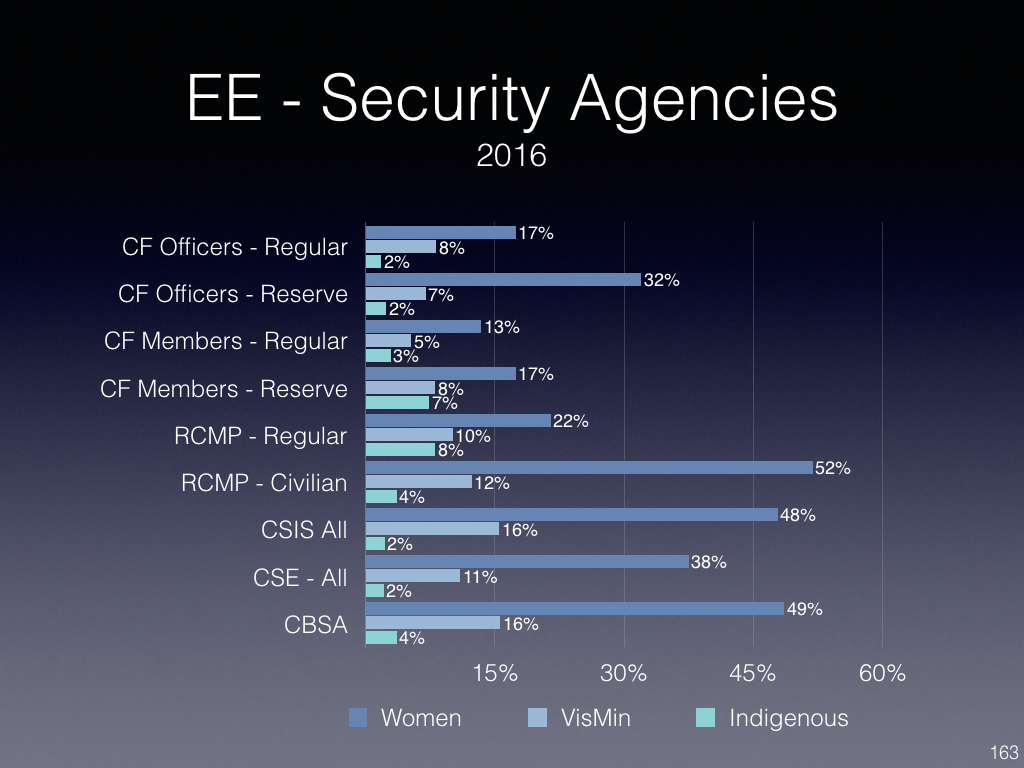

The federal government still has “much work to be done” on addressing diversity and inclusion issues within its intelligence and security apparatus, according to a recent parliamentary committee report, with one leading intelligence expert suggesting more senior leadership within the Privy Council Office with “power and clout” is needed to oversee the problem—and questioning why Prime Minister Justin Trudeau’s launch of the “Tiger Team” in 2017 meant to address diversity and inclusion issues hasn’t met since July 2018.

In their lengthy 2019 annual report, which was tabled in Parliament only a few days before the nation-wide COVID-19 lockdown began in March, the National Security and Intelligence Committee of Parliamentarians, composed of 11 MPs and Senators and chaired by Liberal MP David McGuinty (Ottawa South, Ont.), focused considerable attention on the issue of diversity and inclusion in the security and intelligence community.

The review was conducted for several reasons, according to the report, most importantly because “challenges to increasing diversity and inclusion persist in the security and intelligence community even after decades of legislation, multiple reports and repeated calls for change.”

“These issues are particularly important for organizations responsible for protecting the national security of Canada and the rights and freedoms of Canadians.”

The report also notes that the “Tiger Team” established in 2017, created “with the stated aim of ‘exploring, advancing and implementing joint efforts to learn from one another and share best practices to enhance diversity and inclusion within and across [their] organizations through a variety of activities and initiatives,’” has not met since July 2018.

In January 2017, The leaders of the Canadian Armed Forces, the Canadian Coast Guard, Canadian Border Services Agency, CSIS, Canadian Security Establishment, Department of National Defense and the RCMP established the Tiger Team.

National security expert Wesley Wark, a professor at the University of Ottawa, told The Hill Times that the initiative to create a Tiger Team was a product of a push by Prime Minister Justin Trudeau (Papineau, Que.) in late 2016, and ultimately resulted from a meeting Mr. Trudeau requested with the heads of agencies in the security and intelligence community as well as with the Privy Council Office.

“Sadly, the tigers seem ultimately to have gone to sleep,” according to Prof. Wark’s April 2020 working paper addressing the NSICOP’s findings. “It is time, perhaps, for the prime minister to crack the whip again.”

“This kind of Tiger Team concept moved into the lane of deliverology, in the sense that it was overseen by the deputy secretary to the cabinet, but I’m not sure that was the original idea—that’s just where it ended up in terms of maintaining some momentum and producing reports for a period of time,” according to Prof. Wark.

When it comes to the specifics of diversity and inclusion in the security and intelligence community, it was “probably a mistake to move it into that lane or allow it to be moved into that lane,” said Prof. Wark.

“If an initiative of this kind was going to be sustained and picked up by all the different elements of the security and intelligence community, it needed to be overseen by senior leadership in the PCO [outside] of the deliverology mechanism,” said Prof. Wark. “In other words, it should have been taken up as a priority by the national and security and intelligence advisor, and it’s that senior officer in PCO who would have the power and clout to really make sure that something significant happened in this way.”

“I don’t understand why the national security and intelligence adviser himself did not take this up, and the committee of parliamentarians notes that although it doesn’t attach any explicit criticism to this, the whole Tiger Team effort obviously just faded away all together after a period of time,” said Prof. Wark.

The deputy secretary to the cabinet resides within the PCO, underneath the Clerk, and the national security and intelligence advisor is a very senior deputy minister position that ranks almost as an equivalent position to the clerk of the Privy Council, according to Prof. Wark.

According to PCO spokesperson Pierre-Alain Bujold, the work of the Tiger Team is ongoing, and currently chaired by the Department of National Defense (DND).

“The Government of Canada appreciates the work undertaken by [NSICOP],” according to Mr. Bujold, [and] sees diversity and inclusion as an important means to making its national security and intelligence community even more effective in protecting Canadians,” according to Mr. Bujold in an emailed statement to The Hill Times.

“We have been working for a number of years to improve diversity and inclusion in the security and intelligence community. This is critical, not just in terms of better representing Canadian communities, but in making security and intelligence agencies more effective at doing their job.”

‘Diversity is particularly important inside security and intelligence organizations’

Mr. McGuinty, the committee’s chair, was not available for an interview, but in an emailed statement to The Hill Times, the executive director of the committee, Rennie Marcoux, wrote that although the report did not make any findings or recommendations as to the national security and intelligence adviser’s role within the Tiger Team, the committee recognizes the merit of the community approach to address diversity and inclusion issues—and that its recommendations reinforce the value of the coordinated effort.

“The security and intelligence community is best placed to determine which individual or office is best suited to lead or direct this work,” according to Ms. Marcoux.

In its conclusions, the report notes that “building diverse and inclusive workforces is essential to the effectiveness of the security and intelligence community.”

When asked to expand, Ms. Marcoux noted that in addition to the “well-documented” benefits of a diverse workplace and inclusive workforce across a large body of research, as well as the committee’s belief that Canada’s public service should reflect the population it serves, “a more diverse workforce ensures that organizations are benefitting from the broad range of perspectives and talent that Canada has to offer.”

“Finally, the committee notes that diversity is particularly important inside security and intelligence organizations because it allows them to leverage language skills, community contacts and cultural competencies, and protects against groupthink mindsets that permeate more homogeneous organizations,” according to Ms. Marcoux.

Tim McSorley, national coordinator with the International Civil Liberties Monitoring Group, told The Hill Times that “there needs to be a level of accountability and transparency in terms of what the words on paper mean.”

“I think a big question is that we see, year-after-year, whether it’s three-year plans or five-year plans or in line with Treasury Board recommendations, it seems like there’s a plan and then the next plan seems to repeat very similar issues around the importance of lowering barriers [around] increasing diversity and inclusion within these organizations,” said Mr. McSorley. “While it does seem that the numbers have gotten slightly better over the last 10 or 11 years, it doesn’t seem like anything new is coming out, it seems that it remains the same question each time a new plan is put together.”

“So what are they doing on the ground to actually change and to increase diversity and inclusion in the security and intelligence community,” said Mr. McSorley. “Who is accountable if they don’t meet those goals, and what kind of consequences are there?”

When asked about the Tiger Team, Mr. McSorley said that looking at some of the critiques within the report, the fact that it was concentrated solely of members from HR departments was part of the problem.

According to the report, the committee noted several shortcomings with this initiative, including the lack of specific objectives for diversity and inclusion as well as the development of a performance measurement framework to assess the success of its initiatives.

“The representatives from each organization were all from human resources departments and organizations did not seek out members of employment equity groups for membership or participation on the Tiger Team,” according to the report. “[Throughout] its discussions, the Tiger Team focused on short-term initiatives without considering systemic challenges raised in various organization-specific studies or class-action lawsuits (the CAF and the RCMP), such as workplace culture and discrimination.”

‘Things won’t change on their own’

The Abella Commission, which led to the creation of the Employment Equity Act, unfolded in 1984, said Noa Mendelsohn Aviv, director of the equality program at the Canadian Civil Liberties Association.

“The first Employment Equity Act was in 1986. The current [act] is 25 years old, and that act calls for serious accountability measures, serious long-term and short-term goal setting, serious monitoring and reviews for organization accountability,” said Ms. Aviv.

“So we always need to be optimistic and hopeful and try to move things forward, but we’ve also been working on these issues for a very long time,” said Ms. Aviv. “There are clear obligations there, obligations that, according to this report, have simply not been met.”

Ms. Aviv said she believes that there is a notion that things are getting better, they get better on their own, and that patience is required to change organizational culture.

“But if you actually look at the trajectory and the amount of time that’s passed, and the amount of harm that’s been done to people in these organizations, and the ill-effect it’s having on the effectiveness of the organizations themselves, then you understand that things won’t change on their own,” said Ms. Aviv.

According to RCMP spokesperson Catherine Fortin, the RCMP has implemented a number of initiatives to increase the ratio of women, visible minorities, and Indigenous people within their ranks, with objectives to include 30 per cent women, 20 per cent of people from visible minority groups, and 10 per cent Indigenous people.

“We intend to reach these goals through a targeted approach to recruiting, using advertising and marketing to position the RCMP as the employer of choice to people who may not have considered a career in policing,” according to Ms. Fortin. “The RCMP is committed to inclusiveness and diversity of all types within the organization. We believe that the more diverse we are when it comes to gender, ethnic background, religion or sexual orientation, the better we are able to serve all Canadians.”

According to DND spokesperson Major T.A. Smyth, “DND and the CAF place unprecedented emphasis on ensuring diversity and gender equality in military human resource management as part of efforts to strengthen the operational force and to position DND and the CAF as inclusive organizations. Diversity is viewed as a source of strength and flexibility to build the capacity of the CAF and the civilian workforce.”

“DND and the CAF are working with other government departments as a community and considering the findings and recommendations of this report to inform future decision making,” according to Mr. Smyth. “Various experiences, knowledge, and skillsets contribute to our operational effectiveness. By increasing the representativeness of our Forces and our civilian personnel to reflect Canadian society, diversity enables DND and CAF to be forward-looking, resilient, and relevant.”

—-

The National Security and Intelligence Committee of Parliamentarians made the following recommendations in it’s 2019 Annual Report, released in March 2020:

1. The committee conduct a retrospective review in three to five years to assess the security and intelligence community’s progress in achieving and implementing its diversity goals and inclusion initiatives.

2. The security and intelligence community adopt a consistent and transparent approach to planning and monitoring of employment equity and diversity goals, and conduct regular reviews of their employment policies and practices.

3. The security and intelligence community improve the robustness of its data collection and analysis, including GBA+ assessments of internal staffing and promotion policies and clustering analyses of the workforce.

4. The security and intelligence community develop a common performance measurement framework, and strengthen accountability for diversity and inclusion through meaningful and measurable performance indicators for executives and managers across all organizations.
Source: PM’s ‘Tiger Team’ meant to address diversity, inclusion in Canada’s national intelligence and security community hasn’t met since 2018

Almost 35,000 people pegged for removal from Canada evade border agency

Overall, pretty devastating report.

One aspect that I found particularly of interest is that the numbers have largely remained the same over the past three years. Unfortunately, the OAG report did not include earlier years in its analysis:

Canada’s border agency has failed to promptly remove most of the people under orders to leave the country, and in tens of thousands of cases it has simply lost track of them, the federal auditor general says.

In a report tabled Wednesday in Parliament, the auditor said the Canada Border Services Agency’s efforts were hampered by poor data quality and case-management flaws, resulting in avoidable delays in thousands of cases.

Problems in information-sharing with immigration officials also slowed things down.

The border agency is responsible for carrying out removal orders to ensure public safety and the integrity of the immigration system.

The report noted the federal government had made significant investments over the last decade to improve the efficiency of the asylum system, including removals.

However, the level of enforceable removal orders — those involving people who have exhausted or waived all legal avenues to stay in Canada — remained largely unchanged, even for priority cases.

As of April 2019, there were about 50,000 people in Canada with enforceable removal orders. Two-thirds of these — 34,700 cases — involved individuals whose whereabouts were unknown. Of these, 2,800 had criminal histories.

Still, the border agency was often not conducting regular follow-ups to try to find them by opening each file at least every three years, or once a year for people with criminal issues.

Data integrity shortcomings limited the agency’s ability to know which removal orders to enforce, the report said.

“Without a reliable inventory of removal orders, the agency could not effectively prioritize removals according to risk and complexity. We also found cases in which the agency was unaware that removal orders had been issued,” it said.

“Many cases we examined were also stalled because officers had done little to overcome impediments like missing travel documents.”

The auditor noted that many countries, mostly in Europe, offer assistance programs that promote the voluntary return of foreign nationals to their countries of origin. Some operate through independent third parties and are not limited to failed asylum claimants, the report said.

“All recognize that voluntary returns are preferred to enforced removals, are more cost-effective, and facilitate rapid departures.”

The government will do a better job of ensuring the integrity of the system, Prime Minister Justin Trudeau pledged at a news briefing Wednesday.

Public Safety Minister Bill Blair, the cabinet member responsible for the border agency, said the government accepts the auditor’s recommendations to fix the various problems.

In addition to improving its removals strategy, the border agency will enhance the way it tracks and triages cases to ensure priority ones are addressed promptly, Blair said in a statement.

“This includes continuing to implement a data integrity strategy to ensure that it can quickly identify the stages all cases are at so they can move forward in a timely fashion.”

The border agency is taking steps to find foreign nationals whose whereabouts are unknown by reviewing all outstanding cases, prioritizing criminal cases and focusing investigations on the most serious ones, Blair added.

Finally, the agency will develop an “incentive program” to increase voluntary compliance, he said.

The agency’s problems with managing removals date back more than a decade, long before the Liberals took the government reins from the Conservatives.

But Conservative Leader Andrew Scheer said it was another example of the Liberal government being unable to ensure a fair, orderly and compassionate immigration system. “We need a government that takes this kind of thing seriously.”

NDP public safety critic Jack Harris said the Liberals must make sure the border agency “has sufficient resources to perform their duties.”

Source: Almost 35,000 people pegged for removal from Canada evade border agency

ICYMI: The number of detainees held in Canada’s immigration holding centres is declining amid COVID-19 fears

Of note, and addressing some of the concerns:

Dozens of people who were held in Canada’s immigration detention facilities have been released over the last week as advocates and lawyers have called for their release amid the COVID-19 pandemic.

According to data obtained from the Canada Border Services Agency (CBSA) by Global News, the total number of immigration detainees held in all three of Canada’s immigration holding centres dropped to 64 as of April 1 from 98 on March 25.

There are three immigration holding centres in Canada: one in Laval, Que., one in Toronto, and one in Surrey, B.C. However, hundreds of immigration detainees are held in provincial jails across the country — sometimes indefinitely.

The Toronto immigration holding centre, which has 198 beds, had the biggest drop in detainees, dropping to 21 detainees on April 1 from 41 on March 25. The Laval centre, which has 109 beds, went from 48 detainees to 35. And the Surrey centre went from having nine to eight in that timespan. CBSA said that no minors were in the facilities on those dates.

Earlier this week, TVO reported that an employee at the Toronto centre tested positive for COVID-19 and has been in isolation since March 18. So far, no detainees are confirmed to have contracted COVID-19.

A number of legal and advocacy groups have been calling for the release of people in immigration detention “unless they pose a danger to the public.” Canada’s immigration law allows CBSA officers to detain foreign nationals if they believe the person is unlikely to appear for an immigration proceeding like a hearing, if the person is deemed a threat to public safety, or if the person’s identity is under question.

Jenny Jeanes, the detention coordinator with Action Refugies, an NGO that works with people detained in the Laval immigration holding centre, said that she’s pleased that people are being released, and that the COVID-19 pandemic makes the situation even more urgent. She said that even more detainees at Laval have been released since April 1.

“Releases are picking up. And we were so relieved that after asking for a few weeks, finally some of the [detained] fathers who were separated from their families were released this week on an expedited basis,” Jeanes said in a phone interview.

“If people are released, it’s either because whatever issues there were that were leading them to be detained are resolved. So that’s been the case for some people. Some people were released in the past days because their identity was confirmed, (and) they were able to get the information that the CBSA needed to confirm their identity.”

Last month, detainees at the Laval centre started a hunger strike after sending a petition to the federal ministers of public safety and immigration, asking to be released from the centre over fears of contracting the virus in the facility.

Jeanes said that the hunger strike there was suspended earlier this week “but the distress of those inside has not ended.” Though her group previously conducted visits and work inside the centre multiple times a week, she and her colleagues recently moved to conducting their work remotely because of COVID-19, and have been communicating with Laval detainees over the phone.

“I’ve had people hang up in tears, sobbing with me on the phone this week because they see other people getting released. But they know that that doesn’t mean that they’re going to be released and they’re scared,” Jeanes said.

“At the best of times, detention can create anxiety, depression and other negative mental health effects. And I think right now, everybody, we’re all under strain. And so imagine that you’re in detention. It’s that much worse.”

“As this situation is fluid and evolving rapidly, the CBSA is continuing to closely monitor and assess the state of those in detention. All options are being considered at this time,” a CBSA spokesperson said in an email. “As always, should a detainee in CBSA care be seriously ill and in need of immediate medical attention, they would be referred to the appropriate local or emergency health authority for medical assessment without delay.”

Last week, Legal Aid Ontario said on its website that it was expanding its detention review hearing representation services for immigration detainees.

“We are pleased that in many cases CBSA is cooperating with detainees and their counsel to develop viable safe release plans; we think all involved recognize the personal and public health issues raised by detention during a pandemic,” Alyssa Manning, manager of Legal Aid Ontario’s immigration detention duty counsel project, said in a statement to Global News.

According to CBSA data, around 7,706 people were held in immigration holding centres in Canada last year, and around 2,249 people were detained by CBSA and held in provincial jails. The average time spent in detention was around 12 days.

Coronavirus outbreak: UN launches global appeal for $2 billion in aid to fight COVID-19

On Friday, Prime Minister Justin Trudeau was asked why civil servants are still going into work at places like immigration detention facilities when that could increase the risk of spreading COVID-19 to those held in the facilities and among employees and their families.

“We’re going to continue to ensure that essential services get done. Wherever possible, civil servants are encouraged to work remotely from home. We know there are significant things that need to be worked on to deliver for Canadians, to keep Canadians safe at this particular time,” Trudeau said.

When asked whether the federal government would be releasing non-violent offenders in general, Trudeau said that “action has been taken” and that the government has been working with Corrections Canada and “detention facilities of all types” to reduce the vulnerability to the spread of COVID-19.

“We continue to look at other measures that can be taken and we will take those measures in due course.”

Source: The number of detainees held in Canada’s immigration holding centres is declining amid COVID-19 fears

Critics question why Canada’s border officers need bulletproof vests to work with migrants

I would have more confidence in CBSA’s policy rationale and justification had they not earlier made officers within Canadian airports wear bullet proof vests within the arrivals area security envelope (i.e. people who have already passed departure security and flown to Canada):

Canada’s border-security agency will soon require all border-security officers working with detained migrants to wear defensive gear that includes batons, pepper spray and bulletproof vests — a policy that is drawing concern over a perceived “criminalization” of asylum seekers.

A new national policy on uniforms was adopted internally last year after the Canada Border Services Agency (CBSA) began moving what it deems “higher-risk immigration detainees” from provincial jails, where they were being held for security purposes, into one of the agency’s three “immigration holding centres.”

The agency decided all officers working in these centres must be outfitted in protective and defensive equipment to ensure a “common operational approach” in light of the fact that these migrants previously were held in jails, according to a briefing note obtained by The Canadian Press through access-to-information law.

“This will require greater CBSA officer presence in managing detainee populations at the IHCs, including the ability to de-escalate and intervene physically if necessary,” the briefing note says.

“Ensuring that IEOs [inland enforcement officers] wear their defensive equipment will enable officers to protect/defend themselves and others if necessary in the IHC.”

The defensive gear they are to wear includes steel-toed boots, “soft body armour,” a defensive baton, pepper spray and handcuffs. They will not carry firearms.

The changes have sparked concern this will create an environment within immigration detention centres akin to jail conditions and encourage the perception that detained migrants in Canada, including some children, are criminals worthy of punishment.

Same tools as maximum-security facilities

A group of doctors, lawyers, legal scholars and human rights organizations wrote two letters last year to Public Safety Minister Ralph Goodale urging him to cancel the policy — calls they say have been ignored.

“We applaud your efforts to reduce the number of immigration detainees held in provincial jails. But raising security measures in an administrative detention centre to mirror those of a criminal institution defeats the purpose of transferring immigration detainees from jails to IHCs,” says one letter, dated June 22, 2018.

“The proposed policy would arm CBSA officers with some of the same tools as correctional officers in maximum-security facilities … [which] is clearly disproportionate to any potential risk and is not warranted.”

Concerns have also been raised internally by the union that represents the security officers themselves, who are worried about the increased risks of having weapons in the mix if a high-risk situation or confrontation does arise.

Anthony Navaneelan, a lawyer with Legal Aid Ontario who also works with the Canadian Association of Refugee Lawyers, said it’s not every day the border-security union and migrant-advocacy groups agree.

Wearing defensive gear when dealing with refugees is “inappropriate and unnecessary,” Navaneelan said.

He pointed to a 2012 report by the UN special rapporteur on the human rights of migrants, François Crépeau, that said detention of migrants on the grounds of their irregular status should “under no circumstance be of a punitive nature” and should never involve prison-like conditions or environments.

“The idea of getting them out of jails is to recognize the fact that it can re-traumatize refugee claimants to be putting them in detention to begin with when they’ve committed no crime,” Navaneelan said.

“Also in terms of necessity, CBSA hasn’t identified for us any incidents that have happened at the immigration holding centres that would warrant these types of measures. Certainly I’d, at best, call this a proactive measure in anticipation of some future concern … but we certainly think escalating or creating an environment where officers are equipped with these types of measures is almost a solution in search of a problem.”

‘Balance’ between safety of officers and detainees

In a statement, CBSA spokeswoman Rebecca Purdy said the agency’s operating procedures say officers “must” wear the protective and defensive equipment issued to them while on duty.

The decision to equip officers working in migrant detention centres with uniforms and defensive gear was made “to ensure national alignment of CBSA standards for its operations and is consistent with practices implemented domestically and internationally as it relates to detention,” Purdy said.

As for the concerns raised by the lawyers, doctors, human-rights groups and the officers’ union, CBSA “ensured that there is a balance reflected between the safety and security of officers and other detainees,” Purdy added.

Asylum seekers in Canada can be detained for a number of reasons, including if CBSA officers have reason to believe they would be deemed inadmissible on grounds of security, criminality or records of violating human or international rights themselves.

A migrant also can be detained simply if a CBSA officer believes the person might be a no-show for his or her refugee-determination hearing. The vast majority of migrants detained by Canada are held for this reason, according to government statistics posted online. Last year, 81 per cent of detained migrants were held because they were deemed unlikely to appear for their hearings, including 40 children, most of whom were travelling with adults.

Janet Dench, executive director of the Canadian Council for Refugees, said her organization was assured that migrants detained for administrative reasons such as this would be separated from those suspected of criminality when held in Canadian detention centres.

She questioned why CBSA officers will be required to wear defensive gear in all areas of these centres, rather than only in wings where migrants suspected of being security or criminal threats are being held.

She also echoed concerns that wearing this gear is akin to treating refugees like criminals

“The CBSA should very much reduce the criminalization of those people who are detained,” Dench said.

Source: Critics question why Canada’s border officers need bulletproof vests to work with migrants

Bias at the border? CBSA study finds travellers from some countries face more delays

Appears more evidence-based than only bias in the examples and countries highlighted but the CBSA review and analysis of the technology and possible bias or limitations encouraging. And the kiosks are such a vast improvement over the old paper forms that always left me scrambling for a pen:

The Canada Border Services Agency is conducting a series of tests to learn if its human agents, and its passport-reading machines, are prone to discriminating against certain kinds of travellers.

The CBSA’s research to date, obtained by CBC News through Access to Information requests, suggests that most of the discrepancies in the treatment of different nationalities and ethnicities at Canada’s international airports are driven by procedures, rather than prejudice.

But border service officers did use their discretion to order secondary inspections for travellers from the Middle East, Africa and the Caribbean at far higher rates than for travellers from the U.S. or Western Europe.

The surveys also confirmed that border officers are more likely to look twice at the customs declaration of a returning Canadian traveller than that of a U.S. visitor.

And internal CBSA communications suggest that the new Primary Inspection Kiosks (PIK) that read passports at some Canadian airports may have higher error rates when processing people with certain ethnic backgrounds.

One analysis obtained by CBC News was undertaken by the border agency in response to a CTV News report in May 2018.

“The news report implied that referrals for secondary inspection were biased with respect to travelers from certain countries and regions,” says the analysis report. “As a result of the news report, the CBSA formed a task force to analyze the accuracy of these findings.”

The Air Traveler Referral Analysis was delivered to Citizenship and Immigration Minister Ahmed Hussen in July of last year.

The results seemed to bear out the news report, says the document: “The CBSA determined that the conclusions drawn by the media could be inferred from the assessment of the information provided through the ATIP (access to information) request.”

In 2017, about 3,500,000 travellers arriving at Canadian airports were flagged for secondary inspections — for immigration purposes, for customs, to pay taxes and fees or to meet other requirements regarding health or imports.

The analysis report reveals that very few travellers are selected randomly for secondary inspection — just 70,000 out of 4.2 million in 2017, less than 2 per cent of the total.

Iranians v. Icelanders

The CBSA analysis found that the rates at which travellers were referred to secondary inspection differed wildly depending on their countries of origin.

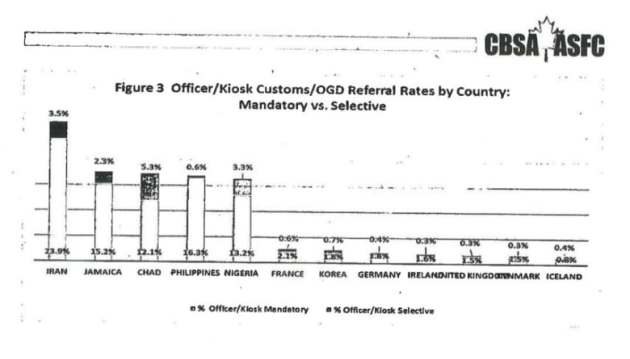
For example, Iranian travellers arriving in Canada in 2017 were on average about twenty times as likely to be referred to secondary inspections for Customs purposes — and about six times as likely to be referred for immigration purposes — as were visiting Icelanders.

A Jamaican visitor was about ten times as likely as a Dane to face a secondary inspection for Customs purposes, and almost ten times as likely to be followed up for immigration purposes.

A CBSA graph compares the rates at which air travelers of different nationalities were ordered into secondary inspection for customs purposes or to satisfy requirements of other government departments (“OGD”) such as the Canadian Food Inspection Agency. (CBSA)

Canada openly treats travellers differently depending on their passports, of course. Iranians and Jamaicans require a visa to visit Canada as tourists. Icelanders and Danes do not.

But CBSA’s analysis suggests that the discrepancies in the rates of secondary inspections are not a matter of policy.

“While Jamaican and Iranian nationals were referred more often for inspection than some other foreign nationals, looking at a macro level analysis, this report found no systematic evidence of bias,” says the CBSA analysis.

It notes that about 10 per cent of all travellers are referred and, of the 4.2 million referrals it examined, “the vast majority of referrals were for mandatory reasons, with the largest proportion having been referred by a kiosk.

“The percentage of individuals referred as a result of an ‘on the spot’ exercise of judgement by a border services officer was low in comparison.”

Many of the referrals were triggered automatically because of something in the traveller’s documents, declarations or immigration status.

A graph showing how different nationalities were referred to secondary inspection because of questions on their immigration status. (CBSA)

For example, a permanent resident arriving in his or her new country of residence for the first time is automatically referred to a secondary immigration inspection in order to confirm residency, and is also subject to a customs referral to document the personal effects they are bringing to Canada. A tourist or business traveller is not subject to either of those requirements.

Iranians travelling to Canada are more likely than Icelanders to be coming here to settle. Icelanders also are more likely to be tourists on short-term visits.

Booths flagging more people

Only about 140,000 out of two million secondary customs inspections were actually ordered by human agents acting on their own discretion. The rest were automatic, mostly ordered by machines.

The primary inspection booths flag any traveller who presents a customs declaration with irregularities — such as a person who checks the box saying they are bringing in food.

Because CBSA is aware of the tendency of kiosks to refer people to secondary inspection unnecessarily, a human officer is given the task of “referrals management”. For example, the referrals management officer might let through the passenger who checks the food box because of a candy bar, while ensuring someone bringing in raw meat is inspected.

The analysis found that those human officers overrule six out of every ten machine referrals for customs purposes.

Last spring, CBSA began adding more questions about food and plants at the automated booths — a step that the report credits with reducing by half the number of passengers being sent to secondary inspections for those reasons.

Immigration stops more ‘selective’

The 2.2 million immigration-related secondary inspections were far more likely to be ordered on a “selective” basis than customs-related cases, which were mostly “mandatory” orders for things like food inspections or payment of duties.

But even the “selective” immigration inspections were more likely to be ordered by machines (88 per cent) than by human agents (12 per cent). The main reasons booths order inspections are problems like incomplete information, stays of more than six months’ duration, or permanent resident cards close to their expiry dates.

CBSA found that an Iranian or Jamaican flagged for secondary inspection was no more likely to have been selected for a secondary inspection by a human officer exercising discretion than a French or South Korean passenger (in fact, they were more likely to have been picked by a machine).

But when looking at the total number of people arriving from each of those countries, the French and Korean travellers were much more likely to sail through the airport without being flagged — by either an automated kiosk or a CBSA officer — than their Iranian or Jamaican counterparts.

Machines bias-free?

“Officer selective referral is the only type of referral that requires ‘on the spot’ officer discretion or judgement which could potentially involve personal bias,” says the CBSA analysis.

But internal CBSA communications hint at problems that may affect kiosk machines’ even-handedness in dealing with different ethnicities.

Emails obtained by CBC News through Access to Information discuss the roll-out of electronic inspection booths at Canadian airports and early efforts to measure their accuracy.

CBC News also obtained a report entitled “Facial Matching at Primary Inspection Kiosks” that discusses ‘false match’ rates. False matches include ‘false positives’ — innocent travellers incorrectly flagged as posing problems — and ‘false negatives’ — a failure by the machine to detect such problems as fake documents or passport photos that don’t match the individual.

The documents released were heavily redacted, with entire pages blanked out. “The CBSA will not speak to details of this report out of interests of national security and integrity of the border process,” the agency’s Nicholas Dorion said.

‘I thought maybe it was just the press’

While all discussion of Canadian findings was redacted from the documents CBSA released, the documents do include some revealing emails in which the evaluation team discusses U.S. findings.

Referring to articles that suggested facial recognition technology had serious problems reading darker-skinned faces, one of the evaluation team wrote:

“I thought maybe it was just the press making a fuss and actually it’s not an issue. However … you do see that (U.S. agency) NIST has found a similar bias.

“The false match rate shows a massive increase for visa images when the imposter is from South Asia region, etc.”

“I never thought it was just press,” responds a colleague, sharing a link with another U.S. study that shows that facial recognition algorithms are wildly more inaccurate when dealing with dark-skinned travellers than with light-skinned travellers, and are also worse at assessing women.

That study found that two of the main facial recognition technologies available — from Microsoft and IBM — misidentify gender in dark-skinned individuals at 18 and seven times the error rate the two technologies experience, respectively, when assessing light-skinned individuals.

The MIT study evaluated three commercial face-scanning systems and found that while the maximum error rate for classifying the gender of light-skinned men was 0.8 per cent, the same systems produced error rates of up to 34 per cent for dark-skinned females.

Source: Bias at the border? CBSA study finds travellers from some countries face more delays

Canada set to begin collecting data on travellers leaving country

Long overdue for the reasons listed in the article as well as other benefits:  better data on immigrant retention and compliance with residency requirements for medicare:

Ottawa will soon start collecting data on every person leaving Canada by land and air in a bid to identify and track anyone from potential terrorists to snowbirds who lie about their residency to claim government benefits.

The new measures, expected to take effect later this year, aim to strengthen border security, enforce residency requirements for permanent residents and pinpoint those who fail to leave the country as required.

It is not known how many visitors who’ve overstayed their welcome, failed asylum seekers and criminals the new “exit” system will catch, but both Employment and Social Development Canada and the Canada Revenue Agency, which will have access to the data, are expected to nab many Canadians who are outside of the country and ineligible to receive further benefit payments.

The estimated savings for the government in employment insurance and old age security over 10 years could add up to $206 million, plus another $151 million in family and child tax credits and other benefits, according to an analysis of the proposed changes to the Customs Act published Saturday.

The Canadian Snowbird Association has been following the exit control changes closely and warns its 100,000 members against breaking U.S. immigration law by overstaying beyond the six-month limit and risking the loss of their federal benefits such as old age security and guaranteed income supplements.

“The move between the U.S. and Canada is inevitable and we are reminding our members to be mindful of the limitation on their time travelling abroad,” said Evan Rachkovsky, the association’s spokesperson.

Canada Border Services Agency does not currently collect exit information from commercial air carriers on travellers and only has access to U.S. records of foreign nationals and Canadian permanent residents arriving from Canada at land ports of entry.

The new reporting scheme — a final phase of what’s known as the “Entry/Exit Initiative,” similar to programs in Australia, New Zealand and parts of Europe — will allow Canadian officials to track the 97 per cent of all outbound travellers who leave the country by land and air. The effort will ultimately be expanded to travel by rail and sea. Officials will start collecting land exit data this summer, followed by air-travel data within 12 months.

“The government cannot easily determine who is inside or outside the country at any given time, which adversely impacts Canada’s ability to manage the border and support pressing and substantial public policy objectives related to national security, law enforcement and federal program integrity,” the border agency said in its 35-page report published in the Canada Gazette.

“By implementing a new regulatory framework that prescribes the source, time, manner and circumstance related to the collection of information, the CBSA would have access to reliable, timely and accurate information that could be effectively safeguarded and managed.”

Immigration policy analyst and lawyer Richard Kurland said this marks a shift to a “continuum tracking” system, where people’s movements are going to be monitored by the government.

“People do not know, generally, that by consenting to Canada, they also consent to having their personal information donated to other countries, such as the U.S.A., due to the many information-sharing agreements between Canada and other countries,” said Kurland.

“Canadians cannot fix information that goes to other countries, and it is a real issue. You may be wrongly netted by the system. Mistakes are going to happen, and there is no oversight, monitoring, or control over the system.”

Right now, commercial air carriers are required to provide Canadian border officials with advance information that identifies air travellers and flight crew arriving on international flights. Officials rely on passengers to provide the information on customs declaration cards or electronically via the primary inspection kiosk, with travellers self-declaring the date they originally left Canada.

The proposed exit control measures will operate similarly with Canadian officials collecting basic biographic information — name, nationality, date of birth, gender and time and place of departure — from airlines on all passengers leaving Canada, in the form of electronic passenger manifests.

Canada already receives information from the U.S. on departures of foreign nationals and permanent residents at land ports of entry. The new rules will expand to include records of Canadian citizens entering the U.S. by land.

The federal auditor general’s office has in the past highlighted a number of security concerns stemming from the absence of reliable exit data, the border agency report says.

“In recent years, the Government of Canada has seen a number of individuals travelling to foreign destinations to engage in terrorist activities,” the report says.

“These individuals often pose a danger to countries in which they operate and may become a direct threat to Canadians upon their return to Canada through acquiring combat experience and training and potentially establishing terrorist networks and recruitment capabilities,” the report adds.

Ottawa said the exit data will help officials:

  • Identify outbound movement of known high-risk travellers;
  • Track visitors who overstay their visa and remain in Canada illegally;
  • Verify travel dates to assess applicable duties, tax exemptions and benefits for returning residents;
  • And check if permanent residents returning to Canada have fulfilled their physical residence requirement to maintain their status or qualify for citizenship.

Data collection on air travellers is expected to take longer to implement because it requires commercial air carriers to register, test and certify that they meet the government-specific IT requirements. The whole scheme is expected to cost about $110 million, with almost $80 million assumed by the federal government and the rest by the commercial air industry. Airlines failing to provide the information will face fines.

Once fully implemented, personal information collected under the Entry/Exit Initiative will be retained for up to 15 years, after which it will be purged — unless it is otherwise required to be retained under Canadian law.

Meghan McDermott, a staff counsel of the B.C. Civil Liberties Association, said Canadians should be concerned about the sharing of the personal data among government agencies and with foreign partners. “It’s a vast new collection of data … I don’t know what recourse we have and where to go,” when inaccurate personal information has to be corrected, she said.

Both the Office of the Privacy Commissioner and the Security Intelligence Review Committee must constantly monitor the program and provide independent oversight to prevent abuse and breach of privacy and civil liberties, McDermott said.

Changes to the Customs Act received royal assent in December. The public has until mid-April to submit feedback.

Source: Canada set to begin collecting data on travellers leaving country

Conservatives call for audit of immigration system after gangster twice released in Canada

His case should not have fallen through the cracks, suggesting communications issues between CBSA and the IRB, particularly in terms of timeliness. While in the end, the system did work, the issues should have been caught and acted upon earlier.

But it is somewhat ingenuous for Conservative immigration critic to state that the Liberal government is undermining public confidence in the immigration system while ignoring the contribution that some of her over-the-top language and positions (e.g., opposition to the Global Compact on Migration) also play. Fine line between legitimate criticism and stoking the fires:

Abdullahi Hashi Farah had an extensive criminal record, ties to a violent gang, and a long history of breaching probation. But Canadian immigration officials still released him after he crossed illegally into Canada in October 2017. (Supplied)

Conservative immigration critic Michelle Rempel is again calling for a complete review and audit of the immigration screening system in response to a CBC News investigation that revealed a Somali gang member with an extensive criminal record was twice released in Canada.

“The government has to acknowledge that there are serious flaws in the process and commit to fixing the system,” the Calgary MP said in a telephone interview Thursday.

In an earlier scrum outside the House of Commons, Border Security Minister Bill Blair was asked about the case of Abdullahi Hashi Farah.

Blair conceded Farah would not have been released had the full extent of his gang ties and criminal record been known. But he said he took “some comfort in the fact that the system has worked and we’ve identified the individual, and he is subject to deportation.”

Rempel said Blair’s response will only serve to further undermine public faith in the system.

‘This is pretty bad’

“People will read [the CBC News story] and they will look at the minister’s response and go, ‘This is somebody who is not taking this situation seriously, and it is a serious situation,’ ” Rempel said.

“And I worry that by doing this, the Liberals are actually eroding public confidence writ large. And that is not where we want to be in a pluralism like Canada. They need to restore order to the system. This [case] is pretty bad.”

As CBC News first reported Thursday, Farah was fleeing an arrest warrant and deportation in the U.S. when he crossed illegally into Canada at Emerson, Man., in late October 2017.

Then 27, Farah told Canada Border Services Agency (CBSA) officials about his criminal record and gang ties. The agency wanted him held for a few more days until it could retrieve his full criminal record from the U.S.

But an Immigration and Refugee Board (IRB) hearing officer, impressed with Farah’s seeming honesty, ordered his release.

As a condition of release, Farah surrendered his cellphone to the CBSA so that it could be checked for evidence of criminal activity

Six days after Farah was set free in Winnipeg, he breached his release conditions and was arrested again.

That same day, the CBSA gained access to Farah’s cellphone. They found recent photos and videos of Farah playing with loaded handguns, doing cocaine, concealing cocaine, and flashing wads of cash. There were also photos of what authorities believed was a stolen credit card.

Released despite evidence of criminal activity

The CBSA has declined to explain why the evidence from Farah’s cellphone was not immediately provided to the IRB.

Without that evidence, another IRB hearing officer again released Farah in March 2018 and allowed him to move to Calgary.

In June, Edmonton police arrested Farah as a suspect in a string of armed convenience store robberies after a CBSA officer in Winnipeg picked him out of robbery photos taken from store security camera footage.

Edmonton police have declined to say why Farah is no longer a suspect in the robberies. He is now jailed in the Edmonton Remand Centre, awaiting deportation to Somalia.

The CBC News investigation revealed Farah had lied repeatedly about the extent and seriousness of his criminal record and the length of his involvement with the Somali Outlaws gang in Minneapolis and Nashville.

The investigation also revealed Farah had breached immigration and parole conditions more than 30 times in the U.S and in Canada. He had also been imprisoned for contempt after he reneged on a promise to testify against his former gang in relation to a major sex-trafficking case in Nashville involving girls as young as 12.

Rempel stressed her party is pro-immigration but said this case, and others like it, show the system can’t handle the volume of immigrants while ensuring adequately rigorous screening.

“While certainly not every case is going to be like this, even one is unacceptable, and even one puts the integrity of the system — and the perception of the integrity of the system — at risk.”

Source: Conservatives call for audit of immigration system after gangster twice released in Canada

Revealed: how Canada border agency tried to conceal Chinese immigration mega-fraud files from tax collectors

More good reporting from Ian Young of SCMP:

Last year, Canadian tax collectors and border officers were hailing their cooperation on the biggest immigration fraud case in Canadian history – that of unlicensed consultant Xun “Sunny” Wang, who helped Chinese millionaires fabricate evidence needed to maintain residency and obtain citizenship in Canada.

“The CRA [Canada Revenue Agency] works closely with other law enforcement agencies and departments, including the CBSA [Canada Border Services Agency], to help maintain the integrity of the tax system,” said Elvis Dutra, Assistant Director of Criminal Investigations for the CRA, in a press release about the sentencing of Wang’s staff for their role in the scam. “Tax evasion costs all of us,” Dutra added.

But in contrast to that depiction, a 2013 court ruling reveals how the CBSA resisted the CRA, and tried to conceal the vast haul of evidence about Wang and his wealthy clients, hundreds of whom have since been blacklisted from the country for fraudulent behaviour.

The failed effort to impede the tax collectors is described in a judgment by Associate Chief Justice Austin Cullen; listed as the applicant in pursuit of the files in the Supreme Court of British Columbia is the CRA, while the CBSA is listed as a respondent alongside Wang himself and his firm, New Can Consultants.

Cullen’s April 8, 2013, ruling describes the respondents attempting to withhold from the CRA 90 boxes of files and 18 computers that were seized from Wang by the CBSA in 2012 raids. The CRA’s demand for the material was an invasion of privacy, the respondents said, and the tax agents should be required to demonstrate probable grounds for suspicion of an offence – but not based on the contents of the actual documents being sought.

The respondents also offered an alternative argument – that handing over the files would amount to a breach of a sealing order imposed on “records pertaining to [the] search warrant”.

Cullen was dismissive.

“I conclude that the CRA is not obliged to demonstrate the existence of reasonable and probable grounds to be permitted to examine the materials seized by the CBSA pursuant to a valid warrant. Nor do I find that the provision of information from CBSA to CRA implicates a reasonable expectation of privacy on the part of the respondents in the circumstances.”

Cullen also said the sealing order on the search warrant did not cover the actual material seized in the searches, which were conducted on Wang’s home and offices on April 17, 2012. “It is apparent from reading the sealing order that what it refers to is ‘the records’ comprising the basis for obtaining the search warrant and the search warrant itself, not the fruits of the search,” he said, as he ordered the CBSA and Wang to relinquish the files to the CRA within 14 days.


‘Protecting taxpayer information’

In response to questions lodged separately with the CRA and CBSA, the agencies issued a joint statement to the SCMP, saying that “the opposition of an action does not reflect on the level of cooperation between the two agencies.”

“Federal partners must exercise due diligence when exchanging information with each other, and ensure they do so in accordance with the legislation and policies in place,” the response said. “At times, requests for information exchanges will not be covered by these policies and as such, could be subject to specific rules or require that requests be made to the courts to support transparency and to protect taxpayer information.”

It added: “In cases in which another Government Department or entity are seeking access to evidence seized through a warrant execution it must apply for a court order to obtain copies.”

In a response to a follow-up question, the CRA refused to describe what actions it was taking against Wang’s clients, saying “the CRA does not comment on other compliance actions related to this case that it may or may not be undertaking”.

However, a large number of possible tax offences are outlined in court cases and immigration hearings resulting from the demise of Wang’s scam (Wang was sentenced to seven years’ jail in 2015 but was freed late last year after serving a third of his time).

“In fact, 146 [of Wang’s] clients received a total of almost C$188,000 in Working Income Tax Benefits meant for working taxpayers with low incomes,” wrote immigration tribunal panellist Susy Kim in a November 2017 ruling, that imposed an exclusion order against Wang’s client Rui Zhang, husband Zhe Li and their minor son.

Other cases involving Wang’s clients feature immigration tribunalists loudly flagging a core problem – the clients’ failure to properly declare worldwide income.

One such client was Ying Wang, who was deemed “vague and evasive” about her millionaire husband Pi Long Sun’s business activities and earnings in China.

Sun’s “nominal income tax returns in Canada” did not represent his global income” and “he was evasive about his actual income,” wrote tribunalist Craig Costantino in a 2017 ruling that the couple be excluded from Canada for five years. “On a balance of probabilities, Mr Sun was not reporting his worldwide income to the Canada Revenue Agency,” Costantino added.

Another Wang client – whose exclusion order was overturned last year, and who the SCMP has therefore decided not to name – lived in a C$10million Vancouver mansion, on which he was paying a C$2 million mortgage on his son’s behalf. But he too was deemed to have filed “only nominal” tax returns in Canada.

“[These] I find do not represent his global income. I find that he was evasive about his actual income,” wrote the tribunalist. “I find that it is clear that his business activities in China generate significant income as nothing he or his family have done in Canada can account for the value of their properties in Canada, let alone the C$6 million worth of assets that the appellant stated he currently holds in China.”

Current and former CRA auditors have previously complained to the SCMP about a historical lack of cooperation from immigration officials. CBSA was carved off from the immigration department and other agencies in 2003.

In 2016, one former veteran auditor, who acted as a go-between for the SCMP and a current auditor, said “there was/is no cooperation between CRA and Citizenship and Immigration Canada [the former name of Immigration and Refugees Canada] that we are aware of.

“If there is, then a memorandum of understanding would have to exist. There may in fact be one – but no one I talked to knows of it,” the ex-auditor said. “And even if there is then you have to go through an intergovernmental affairs officer to get anything – red tape and time. There is no bulk data that we ever knew of, no database easily accessible by an auditor.”

Both the current and former auditor requested anonymity to discuss CRA matters without authorisation.

This month, the SCMP reported that 860 of Wang’s clients had already either lost immigration status – resulting in expulsion and five-year bans from entering the country – or been reported for inadmissibility. The CBC has separately reported that more than 200 others face the potential loss of their Canadian citizenship.

Source: Revealed: how Canada border agency tried to conceal Chinese immigration mega-fraud files from tax collectors

Asylum-seeker surge at Quebec border choking Canada’s refugee system, data show

Good in-depth analysis of the numbers:

The wait time for a refugee claim hearing in Canada increased more than a third over the past two years, to 19 months, as more than 30,000 asylum seekers arriving via unauthorized border crossings placed significant pressure on the system.

Overwhelmed by the number of migrants, the Immigration and Refugee Board (IRB) has only managed to finalize 15 per cent of the 27,674 asylum claims made by people who illegally entered Quebec – where the majority of the crossings took place, mostly at a single location near St. Bernard-de-Lacolle – between February, 2017, and this June.

The resulting backlog has created a growing queue for any and all asylum seekers. Under the Supreme Court’s landmark 1985 Singh decision, all refugee claimants on Canadian soil are entitled to an oral hearing.

Asylum seekers who cross illegally at the U.S.-Canadian border eventually face the same questions as all other refugee claimants: Are they genuine refugees, fearing persecution in their home countries? Data from the IRB show that less than half of the claimants in finalized cases – 1,885 – have been accepted as legitimate refugees in Quebec, significantly lower than the proportion for all refugee cases in Canada.

Canada has only deported a small number of the nearly 30,000 asylum seekers who
illegally entered Quebec through unauthorized border crossings since last year, accord-
ing to statistics from the Canada Border Services Agency.

The majority of border crossers have entered Canada through Quebec, mostly at an
unauthorized port of entry in St. Bernard-de-Lacolle. While a breakdown of adjudicated
cases was not available for Quebec, national statistics paint a picture of a refugee deter-
mination system that has been slow to finalize asylum claims.

But a separate data set from the Canada Border Services Agency shows that only a handful of those who have been denied refugee status have been deported. The CBSA said it had removed just 157 people who entered Quebec through unofficial border crossings since April, 2017 – about one in every 200. It said another 582 are being processed for deportation.

Canada-wide, the CBSA said it has deported 398 of the 32,173 people who crossed into Canada illegally since April, 2017. Of those, 146 were sent back to the U.S., while the rest were deported to 53 other countries, including Haiti (53), Colombia (24), Turkey (19) and Iraq (15).

Refugee lawyer Lorne Waldman said the relatively low number of deportations is simply an indicator of the system.

“It doesn’t surprise me because it takes a while for cases to make their way through the system. So people who came a year ago, if the system works efficiently, they should be at the end of the system and subject to removal if their claims are rejected,” he said.

But the situation at the border has put pressure on Canada’s already-strained refugee determination system. The projected wait time for a refugee claim hearing is currently 19 months, up from 16 in September, 2017, and 14 in September, 2016 – just before the influx of asylum seekers.

Tens of thousands have flooded the Canada-U.S. border since last year. Initially, many of the border crossers were Haitians who had been living in the U.S. under a temporary protected status (TPS) they had been given after the massive 2010 earthquake in Haiti. When the Trump administration announced its intention to end the TPS for Haitians, word spread among the community there that they could apply for refugee status in Canada if they headed north and found a way into the country.

But it wasn’t as simple as showing up at the border and claiming asylum. The Safe Third Country Agreement between Canada and the U.S. requires both countries to refuse entry to asylum seekers who arrive at official border crossings, as both countries are considered safe for refugees. However, since the agreement applies only to people who arrive at official points of entry, asylum seekers can avoid being turned away by entering between official border crossings – a loophole thousands have taken advantage of.

This year brought a new wave of asylum seekers in St. Bernard-de-Lacolle: Nigerians travelling on valid U.S. visas. It’s not exactly clear why Nigerians choose to travel on U.S. visas instead of Canadian ones, but Mr. Waldman said the U.S. visa system is seen as more generous than Canada’s. Many of the Nigerian asylum seekers obtain visitor visas and use them to fly into the U.S. They then head north to the Quebec border, cross into Canada and apply for asylum.

Earlier this year, Immigration Minister Ahmed Hussen and senior government officials travelled to Nigeria to raise their visa concerns directly with U.S. officials there. Mr. Hussen said the Nigerian government also pledged to discourage its citizens from claiming asylum in Canada after crossing between official points of entry along the U.S. border.

The IRB has finalized just 4,181 asylum claims made by border crossers in Quebec between February, 2017, and June of this year (more current data were unavailable), of which only 45 per cent – 1,885 – were accepted. Another 1,614 claims were rejected, and 682 were abandoned or withdrawn.

That number of accepted claims is significantly lower than the Canada-wide acceptance rate for all refugee claims. As of June, the IRB had approved 7,831 of 13,687 – 57 per cent – of all processed asylum cases made since Dec. 15, 2012, including claims made by asylum seekers who crossed illegally into Canada. Another 55,567 claims were still pending. A small number of refugee claims made before 2012, when the refugee determination system underwent significant changes, are documented separately.

As a part of the 2018 federal budget, the government invested $72-million in the IRB, which will be used to hire 64 new decision-makers in an effort to improve processing times.

Montreal refugee lawyer Mitchell Goldberg said he is optimistic processing times will start to decrease as the government dedicates more resources to the matter.

The deportation process can take even longer, especially if an asylum seeker chooses to exhaust all their appeal options – a source of concern for the Conservative opposition.

“It’s completely unreasonable for our asylum system to be backlogged for years and then for us to not have a functioning system to remove people who don’t have a legal reason to be in Canada,” said Conservative immigration critic Michelle Rempel.

However, NDP immigration critic Jenny Kwan said the former Conservative government, in which Ms. Rempel served as a cabinet minister, is also to blame for the delays at the IRB.

“There’s been pressure on the system for many, many years, from the Conservatives to the Liberals. Successive governments have not resourced the IRB accordingly so that they can get the job done,” Ms. Kwan said.

Asylum seekers waiting for their cases to be heard have had to find accommodation, with thousands heading to Toronto, where the city has paid to house them in hotel rooms, dormitories and shelters for the homeless. Ottawa has pledged $50-million to defray the costs incurred by the provinces, with Quebec receiving $36-million, Ontario $11-million and Manitoba $3-million. But Toronto and Ontario have been pressing the federal government to pay much more, with the provincial Progressive Conservative government demanding a reimbursement of $200-million.

Mr. Waldman also said the government must do more to address the IRB delays, as the long wait times serve as a “magnet” for illegitimate asylum claimants who know they can potentially spend years in Canada while their cases linger in the system.

Source: Asylum-seeker surge at Quebec border choking Canada’s refugee system, data show

ICYMI: Canada slammed for ‘culture of secrecy’ over immigration detention

Useful guarding against Canadian smugness:

Canada has come under fire for a lack of transparency in its immigration detention system and its practice of detaining vulnerable groups, including children and those with mental health conditions.

“The lack of independent national and international oversight bodies significantly contributes to the culture of secrecy surrounding the Canadian immigration detention system,” said a report by the Geneva-based Global Detention Project, an international research group that promotes the human rights of migrants in detention.

“There remain critical gaps in public information, including concerning which prisons are in use at any given time for immigration-related reasons.”

Immigration detention in Canada has been in the spotlight over the last two years with a series of deaths of migrants held in facilities for immigration violations. As of last November, the report said at least 16 people have died in immigration detention while in the custody of the Canada Border Services Agency since 2000.

On Wednesday, more than 2,000 Canadian health-care organizations and health-care providers, including doctors, nurses, social workers, psychologists and midwives, signed an open letter calling on Ottawa to stop detaining children and end the Canada-United States bilateral agreement that restricts refugees to seeking asylum in the first country of their arrival.

Although public pressure has prompted Ottawa to implement a new immigration detention framework to decrease the number of long-term detainees, reduce the use of maximum-security jails and expand the use of alternatives to detention, the report said there is no mention of limiting the length of time people are detained, or to establish formal and independent monitoring of detention conditions.

Citing statistics from the border agency, the report said 371 children were detained in the last two years, accompanying their detained parents or guardians, mostly for reasons of identity or because they are considered a flight risk. In other cases, they are separated from detained parents and placed in foster care.

Even when there are no grounds for detention, children may be “housed” in detention at federal immigration holding centres instead of jails. Nevertheless, they would still be housed separately from their fathers because family rooms are restricted to mothers and children, the report noted.

“These de facto child detainees are subject to the same detention conditions as those under formal detention orders. However, often resembling medium security prisons, detention facilities have been described by numerous rights groups as ‘woefully inadequate and unsuited for children,’” said the 39-page report.

“Children in detention with their parents have been ‘invisible’ to the law as they are not officially considered detained and thus cannot benefit from detention review hearings. The only path for considering the best interests of the child in these situations is through review hearings of their parents.”

The Canada Border Services Agency works to ensure that it is exercising its responsibility for detentions to the highest possible standards with regard to physical, mental health and overall well-being of detainees as well as the safety and security of Canadians as the primary consideration, a spokesperson said.

In November, Public Safety Minister Ralph Goodale issued a ministerial direction to CBSA to, as much as humanly possible, keep children out of detention and keep families together. The ministerial direction makes it clear that the best interests of the child must be given primary consideration.

The border services agency’s new guidelines say every effort should be made to reduce the number of vulnerable persons placed in detention, but the report criticizes the framework, saying it “is not a concrete plan as much as it is a general set of intentions (and) stops short of specifying precisely how the government plans on achieving this goal.”

Source: Canada slammed for ‘culture of secrecy’ over immigration detention