How AI is helping Canada keep some people out of the country. And why there are those who say it’s a problem

Well, that’s what filtering, whether human or AI-based does. With high levels, AI needed to maintain applicant service. Yes, more transparency and accountability needed, but this applies to both human and artificial intelligence and decision-making:

Artificial intelligence is helping authorities keep some people out of Canada.

“Project Quantum,” as it’s been dubbed, is a largely unknown AI-assisted pilot project that’s been undertaken by the Canada Border Services Agency.

It essentially screens air travellers before they take off for Canada. In thousands of cases in recent years, it has led the CBSA to recommend a traveller be stopped before even getting on their flight.

Authorities say the program is meant to flag people who could be a threat to this country.

But just who the government is stopping at international airports — and the criteria used to select them — isn’t clear. That has led critics to question how we know the AI-assisted program is targeting the right people, and that discrimination isn’t somehow baked into its process.

Language on the CBSA’s website also says the program is meant to address the issue of irregular migration. Some are concerned it’s having the effect of making asylum — already restricted under Canada’s Safe Third Country Agreement with the U.S.— even harder to gain in this country.


Officials say the pre-departure risk-assessment matches passengers’ personal information from commercial air carriers with pre-established indicators of risk identification models that are designed by border officials.

The risk identification models have been developed, they say, based on passenger information sent from commercial carriers to CBSA.

Between its inception in 2019 and the end of last year, Project Quantum referred 13,863 travellers to its overseas liaison officers for further assessments. In total, CBSA recommended to air carriers that they refuse boarding 6,182 travellers on flights to Canada.

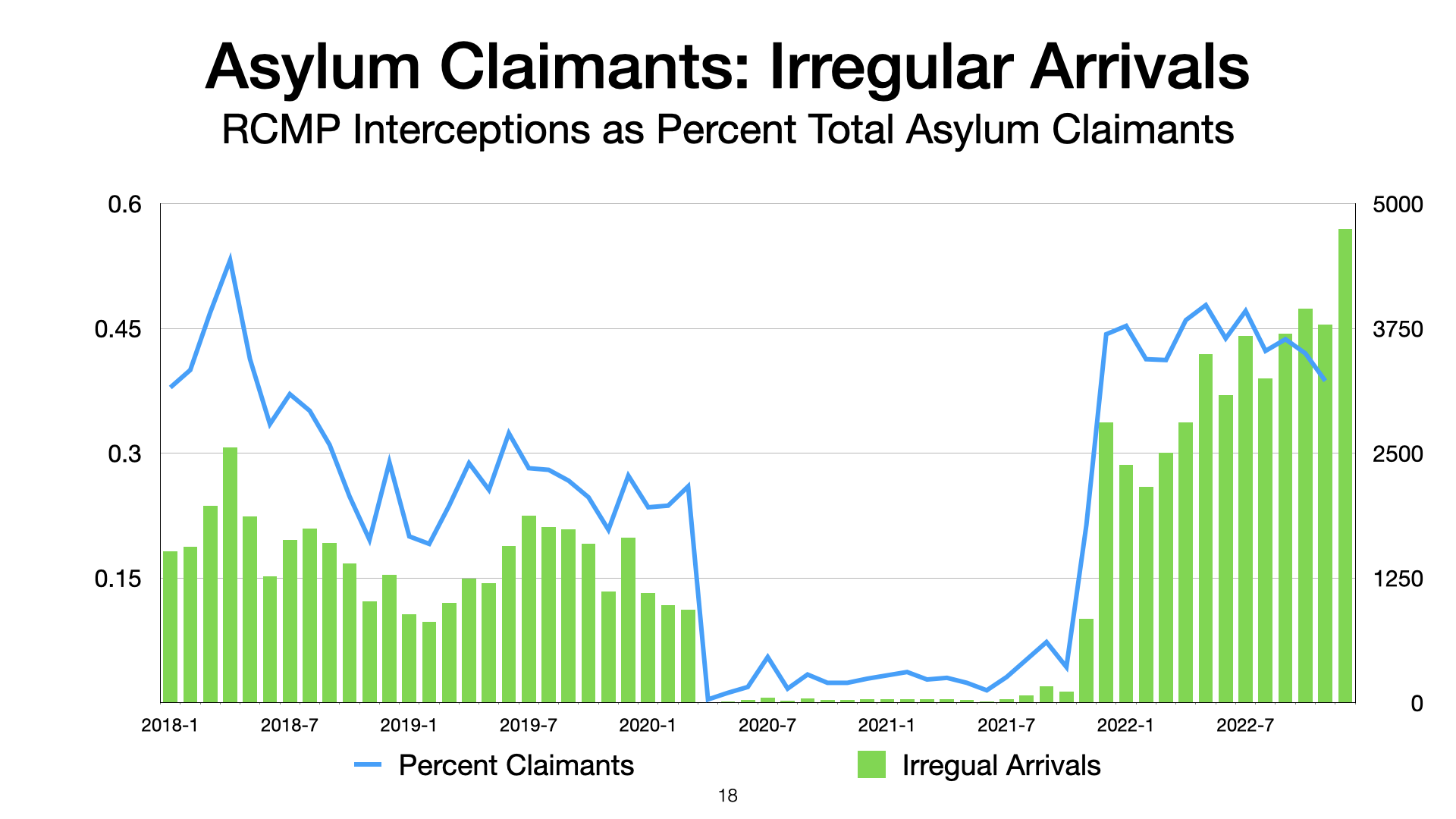
The program comes against the backdrop of increasing constraints on irregular migration to Canada. Earlier this year, Ottawa and Washington expanded a bilateral agreement to deny foreign nationals access to asylum across the entire Canada-U.S. border — not just at the official ports of entry. As a result, the number of irregular migrants to Canada has plummeted.

Given Canada’s unique geography and how it is buffered by the U.S., the new interdiction tool against air travellers further limits asylum seekers’ options.

“The objective of this strategy is to push the border out as far as possible, ideally outside of Canada, to where a person lives,” contends University of New Brunswick law professor Benjamin Perryman, who represents two Hungarian Roma families in fighting the CBSA cancellation of their electronic travel authorizations.

“This new technology comes with substantial risks of human rights violations. We’ve seen that in other areas. When we don’t have transparency and oversight in place, it raises some pretty big concerns.”

The CBSA, established in 2003 as the immigration enforcement arm, is the only public safety department without an outside civilian oversight body, despite the border officers’ power to carry firearms, arrest and detain — authorities similar to those of police officers.

Since being elected in 2015, the Liberal government has promised to establish a watchdog for the CBSA, but a bill has yet to be passed to set up such an infrastructure for accountability.

In an email to the Star, CBSA spokesperson Jacqueline Roby said the pilot program seeks to “detect illicit migration concerns” for air travellers at the earliest point.

“It is a targeting approach, i.e. an operational practice, that supports and guides the CBSA officers to identify high-risk and potential illegal activity,” Roby explained.

Those activities, she added, include terrorism or terror-related crimes, human-smuggling or trafficking and other serious transnational crimes.

However, advocates are concerned that the risk indicators of these models could be rife with unintended biases and that they are being used to detect and interdict undesirable travellers, including prospective asylum seekers in search of protection in Canada.

‘Based on quantum referral’

Gabor Lukacs, founder and president of Air Passenger Rights, an advocacy group for travellers, says there’s been very little public information about the pilot program. He only came across Project Quantum through a recent court case involving two Roma travellers who were refused boarding an Air Transat flight in London.

Immigration documents showed the couple were flagged “based on quantum referral.”

The two were to visit a family member in Canada, who arrived previously and sought asylum and who is now a permanent resident. Both travellers had their valid electronic travel authorization — an entry requirement for visa-exempt visitors — cancelled as a result.

The case raises questions, in Lukacs view, of whether an ethnic name, such as the Roma’s, or information about connections to a former refugee in Canada, were among the indicators used by the program to flag passengers. The CBSA declined to answer questions about these concerns, saying to do so could compromise the program’s integrity.

“The problem with AI is it has very high potential of unintended racial and ethnic biases. It’s far from clear to me if there’s a proper distinction in the training of this software between refugee claimants and criminals,” he noted.

Lukacs’s concern is partly based on a written presentation in 2017 by the immigration department about the application of advanced and predictive analytics to identify patterns that enable prediction of future behaviours, and how combinations of applicant characteristics correlate with application approvals, refusals and frauds.

“In the future, we aim to predict undesirable behaviours (e.g. criminality or refugee claims),” said the document released in response to an access-to-information request by Perryman.

The border agency would not say whether potential refugees are flagged, but it said Project Quantum is part of its National Targeting Program, which identifies people and goods bound for Canada that may pose a threat to the country’s security and safety.

Assisted by human intelligence, it uses automated advance information sources from carriers and importers to identify those risks.

The number of quantum referrals for assessments has grown with the number of “flights” tested with the modelling — from 18 in 2019 to 32 by February 2022. The border agency would not say if the “flight” refers to route or participating air carrier, but said the pilot project is “ongoing.”

The National Targeting Centre will alert the relevant CBSA liaison officer abroad to assess the referral if a traveller matches the criteria set out in the risk identification models. The officer, if warranted, engages with the air carrier and/or traveller before making a “board” or “no-board” recommendation.

Opened in Ottawa 2012, the targeting centre, among other responsibilities, runs the liaison officer network, which started with more than 60 officers in 40 countries.

Roby declined to reveal how the flights or routes were selected, in what regions the modelling assessment was deployed or what indicators travellers were measured against, saying that “would compromise the integrity of the program.”

Critics call the lack of information and transparency troubling, given the complaints of alleged ethnic profiling against CBSA in recent years, including an ongoing court case by a Hungarian couple, who were denied boarding to visit family members who were former refugees.

“If CBSA considers association with refugees an indicator of the person allegedly intending to do something nefarious like overstaying or worse, that’s in and of itself a problem,” said Lukacs.

“The bigger issue is what data sets and indicators have been used for teaching and training the algorithms to decide who to flag.”

Roby of the CBSA says the agency takes these concerns seriously in developing a new targeting tool to ensure compliance with the Canadian Charter of Rights and Freedoms.

“The Agency works to eliminate any systemic racism or unconscious bias in its operations, its work and policies, which includes addressing instances where racialized Canadians and newcomers have faced additional barriers, and ensuring that minority communities are not subject to unfair treatment,” she said.

Officials must follow strict guidelines to protect the privacy of passengers and crew members and the data is stored in a secure system accessible only by authorized personnel, she added. The use of this data is subject to an audit process and users are liable for any misuse.

However, Project Quantum is not governed by the federal oversight required under the directive on automated decision-making.

The Treasury Board’s “Algorithmic Impact Assessment (AIA) would not apply here. The CBSA relies on the knowledge, training, expertise, and experience of border officers to make the final determination on what or who should be targeted,” Roby explained in an email.

“The CBSA provides advice to an air carrier, however, it is then up to the air carrier to decide whether or not to follow the recommendation.”

The initiative also raises legal questions about Canadian officials’ authority to engage in extraterritorial enforcement and their compliance with the Charter of Rights and international human rights law, said Perryman.

Perryman said he’s open to claims by law enforcement that certain aspects of the CBSA investigation techniques need to be kept confidential to be effective but said there needs to be sufficient transparency and oversight.

“This claim of racial profiling as a legitimate technique is something that we’ve seen police rely on initially in Canada. And when the full spectrum of that racial profiling became public, we decided as a society that it was not a legitimate law enforcement tool,” he said.

“We’ve taken steps to end that type of racial profiling domestically. I’m not completely hostile to that argument, but I think it’s one that has to be approached with some degree of scrutiny and care.”

The border agency said travellers who are refused boarding may file a complaint in writing using the CBSA web form or by mail to its recourse directorate.

Source: How AI is helping Canada keep some people out of the country. And why there are those who say it’s a problem

U.S. border agents give rides to Quebec-bound migrants as side hustle, sources tell Radio-Canada

Hard not to see how this story, and the higher numbers, will not encourage the government to act (not just pretend to act?):

U.S. Customs and Border Protection (CBP) is investigating reports that some of its border patrol agents are driving Quebec-bound asylum seekers to the irregular border crossing on Roxham Road in exchange for money, picking up groups of people in nearby Plattsburgh, N.Y., while off duty.

Sources have told Radio-Canada the practice “has been known for a few months,” adding that several agents are involved, but the exact number is unknown.

The CBP’s Office of Professional Responsibility (OPR) said Friday it “is in receipt of these allegations and is conducting an investigation” but “the commencement of an OPR investigation is not indicative of wrongdoing or the substantiation of alleged misconduct.”

This situation has been reported to Canadian authorities, according to Radio-Canada sources.

Many people looking to cross into Canada use a regular bus line to get to Plattsburgh,which is about 30 minutes away from Roxham Road.

From there, they walk through a wooded passage, enter Canada and seek asylum.

CBSA says it’s ‘aware of situation

When first contacted by Radio-Canada, the Canada Border Services Agency (CBSA) confirmed twice in writing that it was aware of the transportation situation involving U.S. border patrol agents and migrants.

“We are aware of the information you are reporting,” said spokesperson Jacqueline Roby. She added that the CBSA “is in contact with the United States regarding irregular migration issues.”

In another written exchange, the CBSA repeated the same message while instructing Radio-Canada to contact its American counterparts, the CBP.

Source: U.S. border agents give rides to Quebec-bound migrants as side hustle, sources tell Radio-Canada

One in four border officers witnessed discrimination by colleagues: internal report

Of note:

One-quarter of front line employees surveyed at Canada’s border agency said they had directly witnessed a colleague discriminate against a traveller in the previous two years.

Of these respondents, 71 per cent suggested the discrimination was based, in full or in part, on the travellers’ race, and just over three-quarters cited their national or ethnic origin.

The figures are drawn from a survey conducted as part of an internal Canada Border Services Agency evaluation that looked at how the agency processed travellers, using a lens of gender, race, ethnicity, religion, age, and mental or physical disability, and the interaction between these factors.

The agency recently posted the results of the evaluation, which focused primarily on people flying into Canada, on its website.

As part of the research, 922 border services officers and superintendents were surveyed from March 2 to 22, 2020.

Of those who said they saw a colleague engage in discrimination, just over two in five did not report what they observed. Some mentioned fear of reprisal or simply feeling uncomfortable.

Sixteen per cent of those who witnessed discrimination reported what they saw. However, some of these respondents indicated that they faced challenges in doing so or that their reports were not taken seriously or acted on, the evaluation report says.

The CBSA’s traveller processing activities do not intentionally set out to target people based on perceptions around their race or ethnicity, the report says. The agency uses a combination of information sources, such as global trends and reports, in the development of scenarios, which are systematically reviewed for human rights and other considerations.

“However, certain practices can have unintended consequences that result in the overrepresentation of racialized communities in the law enforcement context,” the report says.

For example, when targeting rates are higher for certain origin countries, there could be unintended consequences for travellers of specific racial or ethnic groups when those groups make up a larger proportion of incoming travellers from those countries, it adds.

The reviewers found the agency could conduct only “very limited analysis” based on travellers’ racial or ethnic identities when using operational data.

“If faced with public complaints or claims of racial discrimination, the agency can neither prove nor disprove with its data whether its policies or practices discriminate against travellers, due to the complexity of this issue. If the agency were to attempt this type of analysis in the future, it would have to consider and develop new approaches on data collection, storage and analysis.”

The CBSA People Processing Manual provides personnel with guidance concerning awareness of a traveller’s culture, a prohibition on racial profiling and services provided to those with disabilities.

A large majority of survey respondents said they agreed or somewhat agreed that in order to do their jobs effectively, they need to recognize their personal and implicit biases.

The evaluation makes several recommendations, including a call to develop and implement a plan to improve the awareness and reporting of mistreatment and discrimination of travellers witnessed by border agency personnel, without fear of reprisal.

In a response included with the evaluation report, the border agency agreed to devise such a plan and set out a timetable to put changes in place this year.

Source: One in four border officers witnessed discrimination by colleagues: internal report

B.C. ending immigration detention arrangement with CBSA, citing human rights

Will be interesting too see if Quebec and Nova Scotia follow suit:

British Columbia is ending an agreement with Canada Border Services Agency to hold immigration detainees in provincial correctional centres, saying the arrangement doesn’t align with its stance on human rights.

Public Safety Minister Mike Farnworth said in a statement Thursday the province conducted a review that analyzed its contract with the agency, including public safety, and consulted with advocacy groups.

“The review brought to light that aspects of the arrangement do not align with our government’s commitment to upholding human rights standards or our dedication to pursuing social justice and equity for everyone,” he said.

The report said the number of immigration detainees in provincial custody is declining but provincial jails are used to holding “high risk detainees.” It also noted that while CBSA compensates BC Corrections to hold detainees, it does not cover the total cost.

“This is a trend that is likely to continue given the overall reduction in the number of detainees in provincial custody. If the arrangement ended, these are resources that could be used to support BC Corrections’ clients, including individuals in custody with complex needs and behaviours,” it said.

The move comes following calls from the groups Human Rights Watch and Amnesty International for B.C. to terminate its immigration detention contract with the federal government.

The groups released a report in June 2021 saying immigrants with no criminal charges against them are detained in holding centres, federal prisons or provincial jails for “indeterminate amounts of time.” They launched a campaign calling on B.C. to end its contract last October, and later expanded their push to Quebec and Nova Scotia.

“Canada is among the few countries in the global north with no legal limit on the duration of immigration detention, meaning people can be detained for months or years with no end in sight,” the groups said in a joint news release following the announcement. “British Columbia’s decision is a major milestone on the path to ending immigration detention in provincial jails in Canada.”

Ketty Nivyabandi, secretary-general of Amnesty International Canada, said in the statement that she commends B.C. on being the first province to make the decision, calling ita “momentous step.”

“This is a true human rights victory, one which upholds the dignity and rights of people who come to Canada in search of safety or a better life,” she said.

Farnworth said BC Corrections will be providing CBSA with 12 months’ notice as is required under its current contract.

The human rights groups said BC Corrections has told them the province will give the agency official written notice to terminate the contract next week.

Source: B.C. ending immigration detention arrangement with CBSA, citing human rights

5 asylum bids. 17 aliases. Why a judge says one man showed ‘blatant disrespect’ for Canada’s laws

Good characterization:

He used an alias to get asylum in Canada 30 years ago and allegedly cheated the welfare system and committed fraud by using as many as 16 other names before exhausting all appeals and being deported in 2012.

Officials say they still don’t know who he is — but they know where he is.

In February, Chris Osho Oko-Oboh — a.k.a. Andrew Ighiehon, James Aigbe, Friday Adun, Okojie Lugard and Marek Orszula among others — whose true identity is still unknown, according to court, returned to Canada from Nigeria with a “modified” travel document and made yet another asylum claim. It was his fifth over the past three decades.

This time, the man, believed to be 63 now, was immediately nabbed by border-enforcement agents upon arrival in Montreal through fingerprint matching. He has remained in detention, though not without drama.

In March, a tribunal ordered his release but he was sent back into custody after the Canada Border Services Agency appealed to the Federal Court, based on his unconfirmed identity and the fear that he might not reappear for his removal.

In quashing the tribunal decision to release him, Justice B. Richard Bell made an unusual move to order Oko-Oboh to pay $3,000 to cover the costs of the government in the proceedings, saying his conduct “greatly undermines” the integrity of Canada’s immigration, law enforcement, social welfare and judicial systems.

“The respondent has shown a blatant disrespect and disregard for Canadian law. It is apparent the criminal-law procedures have been unsuccessful in deterring the respondent’s unlawful conduct. … There is an evident need to deter the respondent’s unlawful conduct in relation to immigration matters,” Bell wrote in a ruling last month.

“Canadian taxpayers should expect Canada to take all steps necessary to discourage those who would tarnish its generous immigration system. Canadian taxpayers should expect Canada to take all means necessary to recoup a portion of the costs it incurs in relation to its participation in court proceedings.”

Although refugees often rely on fraudulent travel documents for their escapes and many do spend years here as their cases wind through the arduous asylum system and myriad appeal mechanisms, few would have amassed such a long history with Canadian immigration and law enforcement, or have raised such ire in a judicial ruling.

According to the Federal Court, Oko-Oboh first arrived in Canada on March 12, 1991, via the United States under the name of Andrew Ighiehon, and he was convicted of fraud over $1,000 in Toronto less than four months later. In February 1992, he made a refugee claim under that name and was granted asylum in a month.

He was again convicted of fraud in 1993 and a deportation order was issued against him in 1997 based on “serious criminality,” said the court.

While he was fighting the revocation of his refugee protection status and subsequent removal, his rap sheet just got longer: attempted fraud, personation, uttering forged documents, false pretences, possession of credit card, counterfeit mark, mischief and assault. He was deported with the escort of border agents to Nigeria in February 2012.

“During his 21-year tenure in Canada, the respondent committed multiple crimes, for which he was convicted. The respondent’s refugee status was revoked in 2007. He was deported in 2012,” the court said.

“In February 2022, the respondent returned to Canada using a fraudulent travel document. He alleged, without any evidence, that Canadian officials working at the Canadian Embassy in Ghana perpetrated the fraud.”

During one of the detention reviews since returning to Canada, Oko-Oboh revealed he was once in the military in Nigeria and has five children, including three in Canada.

He also explained to the tribunal that his fraud charges stemmed from the “Money Mart” business he opened in 1998. He claimed people would come in with fake cheques and police would come and investigate but ended up charging him when they couldn’t find the actual culprits.

“He ended up always pleading guilty because he ended up taking the blame,” according to the tribunal in a hearing transcript.

Oko-Oboh’s son in Oakville, who works at a Dollarama, offered to put up a $3,000 bond for the man’s release and to supervise him along with an older woman they all call “grandma.”

“If I am released today, I will not disappoint you, the judge, the lawyer, the immigration officer, even God, and even myself. And I will listen to everything that I will be told to do, and I will do it,” he pleaded with the tribunal at a hearing on Feb. 18.

In a hearing in March, the adjudicator presiding over his case ordered him released in part due to the concern over the time it previously took — 15 years — for the border agency to remove Oko-Oboh following the issuance of his first deportation order in 1997.

The agency then challenged the release in court.

“Given the various identities of the respondent that I have already mentioned and what follows, I fail to see how the (Public Safety) Minister can be responsible for any of the 15 years necessary to process the removal,” chided Justice Bell in sending Oko-Oboh back to detention.

“The respondent, who most recently entered Canada with a counterfeit travel document, was prepared to allege that Canadian officials working at the Canadian embassy in Ghana committed the fraud. Asserting such fraud on the part of Canadian officials without any evidence speaks volumes to the trustworthiness of the respondent and his willingness to abide by any orders.”

Meanwhile, over the past few months, border officials have been trying to confirm Oko-Oboh’s real identity with help from Nigerian officials in Ottawa.

In May, a longtime friend of Oko-Oboh in Brampton, who works in real estate, also vowed to put down a $10,000 bond for the man’s release.

“Osho is a good person. He had that long dark stretch that is even difficult for me to explain even to members or people from back home if they were to ask me,” Gordon Isioroaji testified before adjudicator Sophie Froment-Gateau.

“I believe that he is a changed man from that period of time. So, I would plead … that you give him that chance.”

Oko-Oboh’s lawyer, Idorenyin E. Amana, said detention should only be used as “an exception” and the tribunal must explore other alternatives and consider his release under supervision.

“The gentleman in front of this tribunal has been known to the Canadian authority since 1991. His fingerprints and his biometrics, his blood group, everything about his unique, inalienable identity is in the Canadian database,” said Amana.

“I appreciate that the name or the date of birth is an issue. To say that Mr. Oko-Oboh or the individual is not known at all is not entirely correct.”

Border officials have already deemed Oko-Oboh safe to return to Nigeria, a decision that’s currently being challenged in court.

Froment-Gateau said she was not satisfied with either Oko-Oboh’s friend or “alleged son” being his bond person, raising concerns over their ability to ensure he complies with the release conditions

“I understand that you are being deprived of your liberty, and that every day in detention must feel like a long one for you,” the adjudicator said in her decision in May to keep the man detained.

“However, from a legal perspective, it is not considered yet as a long detention.”

Neither Amana, the man’s lawyer, nor the border agency would comment.

Source: 5 asylum bids. 17 aliases. Why a judge says one man showed ‘blatant disrespect’ for Canada’s laws

National security agencies’ relationship with racialized communities marred by a ‘trust gap:’ report

Not surprising and not one easy to reduce. And yes, my experience while in government with respect to the Cross-Cultural Roundtable on Security was that the information flow tended to be more one-way than a conversation:

The relationship between “racialized” groups and Canada’s national security and intelligence institutions —  like the Canadian Security Intelligence Service, the Royal Canadian Mounted Police and the Canada Border Services Agency  — continues to be bogged down by mistrust, says a new external report prepared for the federal government.

“We frequently heard about the trust gap between the country’s national security institutions and Canadians, and in particular with racialized Canadians,” says the report drafted by the National Security Transparency Advisory Group (NS-TAG) — an independent and external body first set up in 2019 to advise the deputy minister of Public Safety and the national security and intelligence community.

“At times, these relations have been marred by mistrust and suspicion, and by errors of judgment by these institutions, which impacted communities have perceived as discriminatory.”

The NS-TAG group, made up of 10 members from legal, civil society and national security backgrounds, warns that the emergence of artificial intelligence and data-driven intelligence poses a threat to racialized communities.

“Systemic biases in Artificial Intelligence (AI) design can have perverse impacts on vulnerable individuals or groups of individuals, notably racialized communities,” they found.

“These biases reflect not only specific flaws in AI programs and organizations using them, but also underlying societal cleavages and inequalities which are then reinforced and potentially deepened.”

CSIS responds

The report, published earlier this week, also calls on national security agencies to have better two-way conversations with communities.

“Too often engagement involves, in practice, government officials offloading a prepared message and failing to listen to the concerns of stakeholders,” says the report.

“Constructive engagement should instead be based on dialogue; government officials should be attuned to the questions and concerns of stakeholders, listen to them, and be prepared and willing to respond.”

The report also calls on agencies like CSIS to engage with communities on an ongoing basis — and not just when there’s a crisis.

The authors pointed to CSIS’s contact with the Iranian-Canadian community after the destruction of Flight PS752 in January 2020 and with the Muslim community following an attack on a mosque in Mississauga, Ont.

“Such engagement was important, but it was prompted by specific incidents. In our view, CSIS will not succeed in building long-term trust with racialized communities as long as its engagement is primarily reactive,” says the report.

CSIS responded to the report’s findings Friday by acknowledging the problem.

“We know that the voices of racialized communities and Indigenous peoples have not been heard as clearly as they should in conversations around policy, legislative and operational deliberations on national security matters,” CSIS wrote in a response published Friday.

“We are committed to changing this.”

Source: National security agencies’ relationship with racialized communities marred by a ‘trust gap:’ report

Canada’s backlog of Nexus applications balloons to nearly 300,000 despite downturn during pandemic

Yet another unfortunate fail. While not personally affected given our cards are valid until 2024, can understand the frustration of those affected:

Canada’s backlog of Nexus applications has ballooned into the hundreds of thousands, despite a sharp downturn in applicants during the pandemic, prompting blowback from frustrated travellers as clogged airports continue to overflow.

The Canada Border Services Agency (CBSA) says 295,133Nexus applications have yet to be processed due to ongoing office closures prompted by COVID-19.

Would-be cardholders in the program, which allows pre-approved Canadians to pass through separate, speedy lines when travelling to and from the United States, must be risk-assessed by both the CBSA and U.S. Customs and Border Protection.

The American agency reopened its Nexus enrolment centres for applicant interviews on April 19, but centres in Canada remain closed after shuttering in March 2020.

The resulting backlog means some Nexus members are struggling to book sit-downs before their cards expire, as Canadian residents hoping to renew their status can only schedule interviews in fewer than a dozen border community offices where slots are few.

Travelling retirees are among those exasperated by the standstill.

“A lot of snowbirds go to the U.S. frequently. They often go back and forth, and a fair number of them would be Nexus card holders, including myself,” said Jill Wykes, editor of Snowbird Advisor, an online resource for snowbirds.

Wykes questioned why enrolment centres remain closed when many other government offices have been open for months.

“The airports are chaotic, and if you have Nexus you can get through so much more quickly coming and going, whether it’s at the border or the airport,” she said.

“The whole situation is very frustrating, that the government did not anticipate this pent-up demand, which as been anticipated for two years.”

The CBSA said in an e-mail that Canada and the U.S. are in discussions about when to reopen Canadian enrolment centres.

“Although the extent of the backlog in 2019 is not known, I can tell you that the backlog has significantly increased over pre-pandemic levels due to the closing of the enrolment centres in March 2020 for public health reasons,” spokeswoman Rebecca Purdy said.

Meanwhile the Fast program for cross-border commercial truck drivers now sports a backlog of 11,018, the CBSA said.

Jacques Roy, a professor of transport management at HEC Montreal business school, says the backlog is affecting business and leisure travellers. It also adds pressure to airports already struggling with security staff shortages and endless queues.

“I really am having a hard time understanding why nothing was done or processed during that period,” Roy said of the ongoing office closures.

The CBSA said it continues to carry out risk assessments remotely within its standard 30-day timeline for new applicants or those seeking to renew a soon-to-expire card.

However, once both countries have pre-approved the application, “the onus is then on the applicant to schedule an interview at a Nexus/Fast EC (enrolment centre) using the online portal,” the agency said.

It has not set a date for when Canadian enrolment centres will unlock their doors.

Nexus memberships are typically valid for five years, after which they must be renewed. The process involves a risk assessment and a screening interview – for both first-time applicants and long-time card holders – the CBSA said.

Nexus membership declined by 170,814, or nine per cent, to 1.73 million enrollees between 2020 and 2021, according to agency figures.

Between 2018 and 2019, the number of new applications had risen by nearly a third to 262,125. They then plunged to 172,125 in 2020 and 29,705 in 2021. Nonetheless, with enrolment centres shuttered, the pile of partially processed applications continued to mount.

Source: Canada’s backlog of Nexus applications balloons to nearly 300,000 despite downturn during pandemic

How Canada uses personal information collected at the border on immigration applications

Useful overview. Entry/Exit will improve data collection (e.g., visa overstays) and allow for simplification and better client service (e.g., automatic completion of citizenship application residency information):

Since February 2019, the Entry/Exit Program has allowed the Canadian border to collect basic traveller information and share it with Immigration, Refugees and Citizenship Canada (IRCC).

IRCC uses the information to verify residency requirements for applications for permanent residence, work permits, study permits, and Canadian citizenshipapplications. Some programs require applicants to be in Canada for a certain number of days. For example, in order to apply for citizenship, permanent residents need to have been physically present in Canada for 1,095 days out of the five years prior to the date of their application.

With the Entry/Exit Program, IRCC can inquire about traveller information from the Canadian Border Services Agency (CBSA) via the Global Case Management System (GCMS), which is the system IRCC uses to process immigration applications.

What information is available

For now, the Entry/Exit program is only open to travellers to come to Canada by land and air. It is not yet available for marine and rail travel to Canada. The information that IRCC can access through the Entry/Exit program includes:

  • given and family names
  • aliases
  • date of birth
  • gender
  • country of birth
  • country of citizenship
  • passport details
  • date of entry/exit

CBSA stores the information in the GCMS, which IRCC can use as needed to administer the Immigration and Refugee Protection Act (IRPA), the Citizenship Act, and the Canadian Passport Order.

How IRCC uses Entry/Exit data

According to the government website, IRCC can use Entry/Exit data to:

  • verify residency requirements in support of applications for grants of citizenship (CIT) or permanent resident cards;
  • verify if a temporary residence applicant may have previously overstayed their allowable period of admission in Canada;
  • assist in an investigation of an individual’s entitlement to a Canadian travel document;
  • verify that sponsors are residing in Canada;
  • verify the residency of spouses and partners under the spouse or common-law partner in Canada class;
  • verify whether or not a refugee claimant entered Canada using their travel documents; and
  • support investigations of possible fraud in relation to immigration, citizenship, and passport/travel document programs.

IRCC does not need client consent in order to query traveller entry and exit information. They are allowed to access the information if it is relevant to an IRCC officer’s decision in relation to a specific program. Only IRCC roles that make decisions on applications can access Entry/Exit information in the GCMA.

IRCC officers are not allowed to disclose entry and exit information unless it is necessary to administer the IRPA and is covered under an information-sharing agreement. Any disclosure not covered under a memorandum of understanding or other information-sharing agreement must be governed by CBSA.

As CBSA is the owner of the data, all authorized CBSA employees have access to it.

Travellers can request a copy of their personal travel history through an access to information request under the Privacy Act. To request a correction, travellers can contact the CBSA.

Temporary residence applications

IRCC can request Entry/Exit information for the following application types:

The Entry/Exit data can be used to check whether a foreign national has previously exceeded their authorized period of stay in Canada. The government calls this “overstay monitoring.” It begins when a traveller enters Canada and ends upon their exit. If the applicant has overstayed their visit, an “overstay indicator” will appear as a checked box in the GCMS once queried.

IRCC expects overstay indicators for temporary residents will begin appearing in Entry/Exit search results in November 2022, once a sufficient number of air carriers are on-boarded.

Permanent residence applications

Entry/Exit information is available to IRCC for the following permanent residence application types:

The data can be used to outline the periods of time spent in and outside Canada, and will allow IRCC to see if residence has been maintained. In addition to residency requirements, IRCC may make an Entry/Exit query to investigate misrepresentation, or revocation of Canadian documents.

For family sponsorship applications, Entry/Exit data can be used to determine if a sponsor is residing in Canada.

Citizenship applications

Exit/Exit data can be used in citizenship applications to:

  • verify compliance with physical presence requirements for grants of citizenship;

  • assist in the verification of other requirements, such as, flagging of potential loss of permanent resident status, the need for applicants to submit foreign police certificates, or misrepresentation;

  • verify compliance with physical presence requirements for resumption of citizenship; and

  • assist in cases of revocation of Canadian citizenship.

Source: How Canada uses personal information collected at the border on immigration applications

Pandemic likely to drive a surge in immigration fraud, border agency warns

Not all that surprising:

The COVID-19 pandemic is likely to drive an increase in immigration fraud and human smuggling as desperate migrants try to get into Canada, says a strategic intelligence report prepared by the Canada Border Service Agency.

The report warns that economic downturns and increased poverty abroad caused by the pandemic will prompt more people to resort to irregular methods to come to Canada.

“With more people looking to immigrate, there is likely to be an increase in fraud in all immigration streams via the use of fraudulent supporting documentation to bolster visa or permanent resident applications, fraudulently acquired travel documents to be able to board flights to Canada and misrepresentation,” says the report, dated June 2020.

Source: Pandemic likely to drive a surge in immigration fraud, border agency warns

Canada’s federal security and intelligence establishment encouraging employees to self-identify

Further to the earlier Hill Times story. Having gone through some of the recent reports (still awaiting a few), my general observation is the lower the representation numbers, the longer the reports and the more words describing the various initiatives underway). That being said, their cultures are different from elsewhere in the public service and thus the challenges greater:

A number of organizations in Canada’s security and intelligence establishment, including the Communications Security Establishment, the Canadian Security and Intelligence Community, the Department of National Defence, and the Canada Border Services Agency have been conducting campaigns to encourage employees who belong to one of the four designated groups listed in the Employment Equity Act—women, Indigenous people, members of a visible minority, and people with a disability—to self-identify, as part of their efforts to improve data collection and hiring practices.

The National Security and Intelligence Committee of Parliamentarians, composed of 11 MPs and Senators and chaired by Liberal MP David McGuinty (Ottawa South, Ont.), focused on diversity and inclusion issues in the security and intelligence community in its most recent annual report.

The report notes that one of the challenges in the security and intelligence committee surrounds voluntary self-identification.

But the report also notes that “self-identification campaigns and internal communications are [a] way organizations try to increase awareness on these issues,” and that the Canada Border Services Agency (CBSA), the Canadian Security Intelligence Service (CSIS), the Communications Security Establishment (CSE), and the Department of National Defence (DND) have conducted campaigns to “demystify the self-identification process and encourage employees to self identify.”

The Hill Times reached out to the four organizations noted in the report for more information on how they have done that.

Communications Security Establishment

Diversity and inclusion is an important element in ensuring that the Canadian security and intelligence community can effectively protect Canada, said Ryan Foreman, a media relations representative with the Communications Security Establishment (CSE).

Mr. Foreman outlined a number of initiatives undertaken by the CSE to encourage self-identification, including a 2017 push to increase organizational awareness of the requirements of the Employment Equity Act, and to explain how a diverse workforce strengthens CSE’s ability to deliver on its mandate.

“This included providing data to managers, and developing strategies to attract job applicants from underrepresented groups,” said Mr. Foreman, who also noted that CSE launched a self-identification campaign called “Show us what CSE is made of,” which was designed to encourage employees to self-identify.

“The messaging for this campaign communicated the importance of employment equity data and its impact on other organizational initiatives, such as recruitment and training,” said Mr. Foreman. “Both the 2017 initiative and the self-identification campaign started in 2018 are on-going.”

Canadian Security and Intelligence Community

“As Canada’s security and intelligence service, it is critical that CSIS reflects the communities it protects, wrote CSIS spokesperson John Townsend in an email to The Hill Times. “To this end, CSIS has implemented an ongoing internal communications campaign to encourage employees who belong to one of the four designated groups listed in the Employment Equity Act to self-identify.”

“The campaign includes an annual Employment Equity questionnaire among other tools to advise employees on the importance of self-identification.”

Ninety per cent of CSIS employees have engaged with these tools, according to Mr. Townsend.

“The work of making CSIS more representative of Canada is never finished but our commitment is steadfast and our efforts continue,” wrote Mr. Townsend.

Department of National Defence and the Canadian Armed Forces

Staff at the Department of National Defence and members of Canadian Armed Forces have returned self-identification forms at a greater rate this year than in the past, thanks to organizational efforts to spread the word about the importance of self-identification, according to Major Smyth, spokesperson for DND.

The Employment Equity Act requires that every member be provided the opportunity to self-identify as a member of a designated group, but it remains voluntary to do so.

As such, employment equity representation rates are based on a voluntary process and may not represent the actual employment equity representation in CAF, according to Mr. Smyth.

“Overall, the CAF continues to improve upon its self-identification return rates,” said Mr. Smyth. “The first part of the self-identification form is a personal identification portion. For this portion, the regular force achieved its highest return rate yet with 97.5 per cent of [members] having had the opportunity to self-identify as a member of a designated employment equity group.”

“While the return rates are lower in the primary reserve units, the CAF saw an overall increase in self-identification as designated group members from both regular force and primary reserve members compared to 2017/18.”

“Current representation rates, as of July 2020, for the regular force and the primary reserves combined, were as follows: women, 16 per cent; visible minorities, 9.3 per cent; and Indigenous Peoples, 2.8 per cent.”

DND/CAF did not identify the representation of persons with disabilities as of July 2020 in their response to The Hill Times.

The CAF works closely with Statistics Canada to ensure that “labour market data they provide, and upon which the CAF sets its employment equity representation rate goals, is reflective of the unique occupations and employment criteria of the CAF.”

“DND/CAF is committed to reflecting the Canadian ideals of diversity, respect and inclusion. Both long and short term goals have been created, based on the labour market analysis provided by Statistics Canada. We review our progress regularly to ensure that we are always working towards increasing representation rates,” said Mr. Smyth.”

Canadian Border Services Agency

The Canada Border Services Agency’s campaign encouraging self-identification began in 2017 and was repeated in 2018, according to Jacqueline Callin, spokesperson with the agency.

“They stressed the importance of understanding our workforce composition and reinforced that employee information would be protected. Recognizing that the Agency’s manual process might be contributing to response rates of 61 per cent, an online form was piloted with success in 2019 and was set to be launched in March 2020 as part of our ‘Your Voice Matters’ campaign. It has been postponed due to the current COVID-19 pandemic and current efforts are focused on how best to virtually promote self-identification,” she said.

Employment Equity Act ‘has served Canada and the public service well,’ says expert

Andrew Griffith, who is the former director general for Citizenship and Multiculturalism and has worked for a variety of government departments in Canada and abroad, told The Hill Times that the Employment Equity Act has served Canada and the public service well, and that the diversity of virtually every group has increased since the act was introduced.

“So the basic structure of the act, I think, has worked in the reporting structure and the data collection, and the publicity that comes with the results,” said Mr. Griffith, who is a fellow of the Canadian Global Affairs Institute and Environics Institute.

“But if you re-open the act, I’m just not sure that it’s worth all that much effort, time, and invariable divisiveness and controversies that it will raise,” said Mr. Griffith. “I’m thinking that if you want to use government time wisely, it would be more effective, I would think, [to look] at specific anti-racism initiatives and look at some of the specific barriers rather than a wholesale of revision of the act, because I think the challenge is less with the act and more with some of the practical stuff.”

Source: Canada’s federal security and intelligence establishment encouraging employees to self-identify