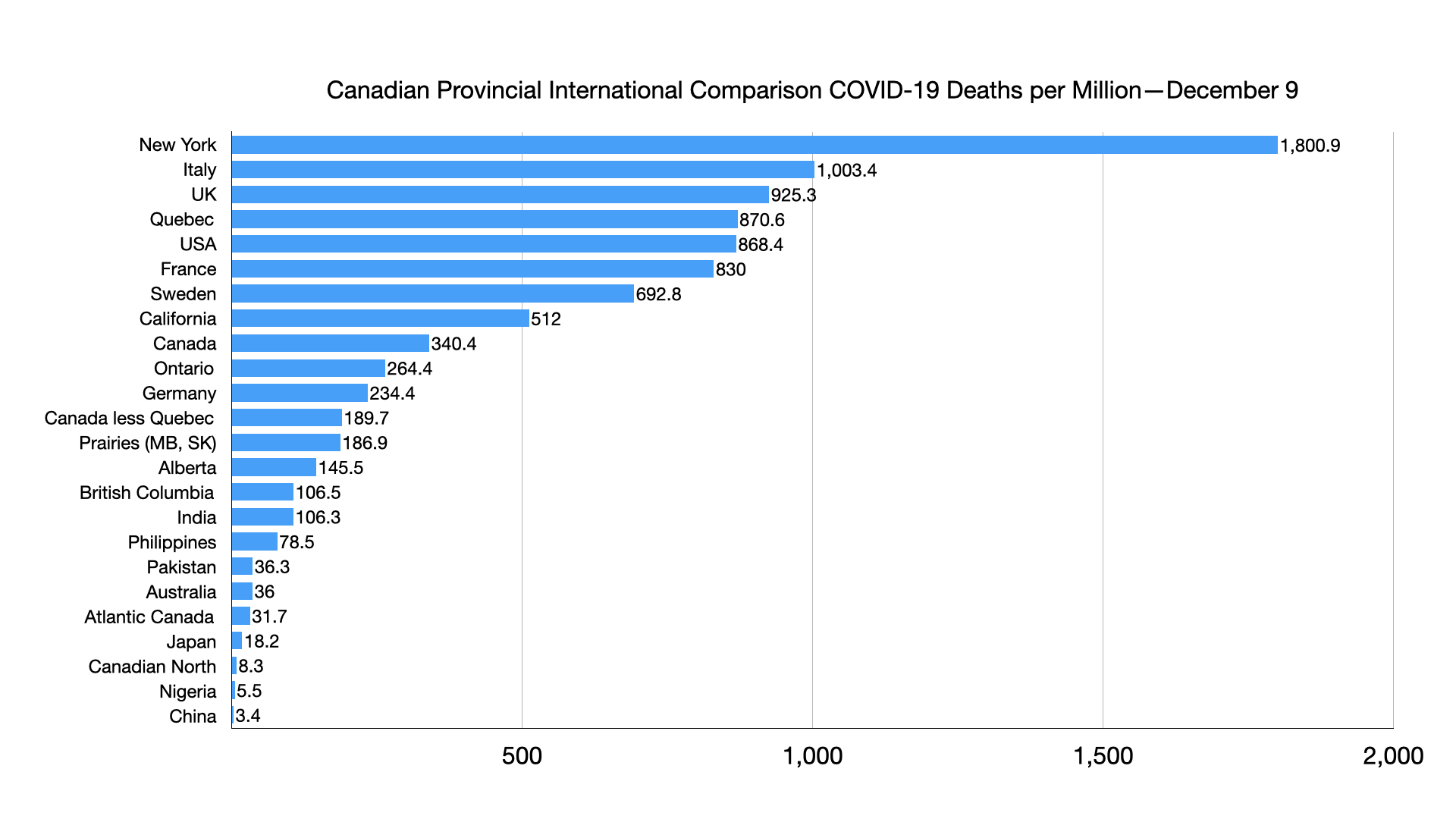
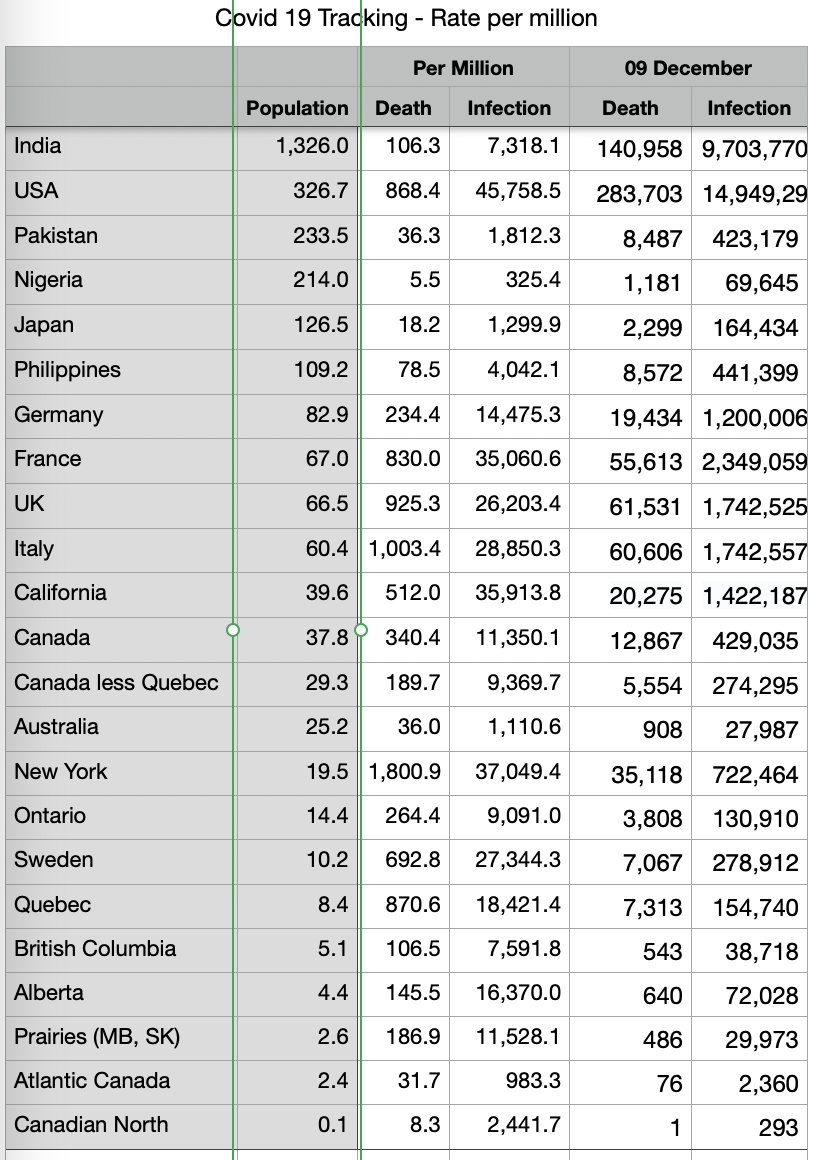
#COVID-19: Comparing provinces with other countries 9 December Update

Main news continues to be with respect ongoing sharp spike in infections along with death rate increases:

 
Weekly:
 
Infections per million: New York and California ahead of France, Sweden ahead of UK, Prairies ahead of Canada, Canada less Quebec ahead of Ontario, British Columbia ahead of India
 
Deaths per million: British Columbia ahead of India, Pakistan ahead of Australia
 
 
COVID Comparison Chart.002COVID Comparison Chart.003

And good commentary on Alberta Premier Kenney’s belated recognition of reality:

After months of pleading with Albertans to take “personal responsibility” to stop the spread of COVID-19, Premier Jason Kenney has finally taken personal responsibility himself.

On Tuesday, he reluctantly announced the kind of sweeping COVID-19 restrictions he had been tersely rejecting for weeks.

He is now ordering everyone to wear a mask in public spaces everywhere in Alberta. And nobody is allowed to hold any social gatherings outside.

You can say “hi” to your neighbour walking the dog but stay two metres apart and don’t dawdle. Starting Sunday, you can only get take-out from restaurants and pubs. No in-person dining. Casinos are closing as are bingo halls, raceways, bowling alleys, pool halls, fitness centres, spas, gym, indoor skating rinks.

Retail stores can stay open but only allow in 15 per cent capacity at a time.

The list goes on. Odds are, if you enjoy doing it, it’s cancelled, postponed or diminished.

As Kenney recited the new restrictions, he must have felt like he was reading the Riot Act to Albertans.

And, in a sense, he was.

As the pandemic grew in the past month from bonfire to wildfire, Kenney had tried to argue his way through the crisis by ignoring pleas from physicians, ridiculing the NDP opposition, and insisting Albertans would bring the crisis under control by taking “personal responsibility.”

In the end he was done in by the might of two factors: freedom-loving Albertans who didn’t take the COVID-19 virus seriously; and the COVID-19 virus that didn’t take freedom-loving Albertans seriously.

Adding those two together gives you the inescapable math of a pandemic.

“The recent surge in COVID-19 hospitalizations will threaten our health-care system and the lives of many vulnerable Albertans unless further action is taken now,” said Kenney.

“With the promise of a vaccine early in 2021, we can see the end of this terrible time. But all Albertans must take this more seriously than ever by staying home whenever possible, and following these new measures.”

Even though Kenney was speaking to all Albertans, he focused particular attention on those who will resent the new measures. They’re more likely to live in rural areas, reject government interference in their lives, and preach self-sufficiency. In other words, United Conservative supporters. By refusing to introduce tougher restrictions for weeks, Kenney was bending over backwards to placate his political base.

But the inexorable math of COVID-19 has forced Kenney to demonstrate he has a spine.

“To many people, these policies, these restrictions seem unjust,” said Kenney. “I’ve made no secret of the fact that Alberta’s government has been reluctant to use extraordinary powers to damage or destroy livelihoods in this way. It is why we have stressed education together with personal and collective responsibility from the very beginning and it’s why we tried to balance the protection of lives and livelihood rather than resorting to damaging measures as a first resort.”

Kenney also announced more money to help small businesses survive the new measures. That is a great idea but it was a great idea when critics suggested it weeks ago, along with the very restrictions Kenney announced Tuesday.

Better late than never?

Understandably, Kenney bristled at questions from journalists about whether he might be responsible for the COVID deaths of Albertans because he didn’t lock down the province sooner. Kenney said it would be a “mistake” to draw simple conclusions during such a complicated time.

But it is a question that will dog him. And NDP MLAs will no doubt be helpfully re-asking the question whenever a microphone or TV camera is within hailing distance.

“The lockdown announced today comes late,” said NDP Leader Rachel Notley after Kenney’s news conference. “We could have acted four weeks ago. Since then, an additional 317 people have died.”

Notley will be wielding this rhetorical knife through the next election.

Kenney might be thinking “better late than never” and while that might be great when talking about filling a pothole or repairing a school roof, it’s not so great when talking about enacting more precautions during a pandemic that’s killing people daily.

Kenney’s new restrictions will last four weeks. That will take us through the Christmas holiday and into the new year.

During Tuesday’s news conference, Doug Schweitzer, the minister of jobs, economy and innovation, happily declared “a vaccine is almost here” as if the pandemic will suddenly end Jan. 5 when Alberta is scheduled to start inoculations against COVID-19.

The reality is that, because of logistics and supply issues, during the first three months of 2021 only about 10 per cent of Albertans will receive vaccinations, mainly health-care workers and the elderly.

The rest of us will have to wait and continue to wear masks, wash our hands, and practise social distancing for many more months. Perhaps by then enough Albertans will know how to practise “personal responsibility” without Kenney having to read us the Riot Act.

Source: https://www.cbc.ca/news/canada/edmonton/opinion-thomson-covid-kenney-blinks-1.5833751?cmp=rss

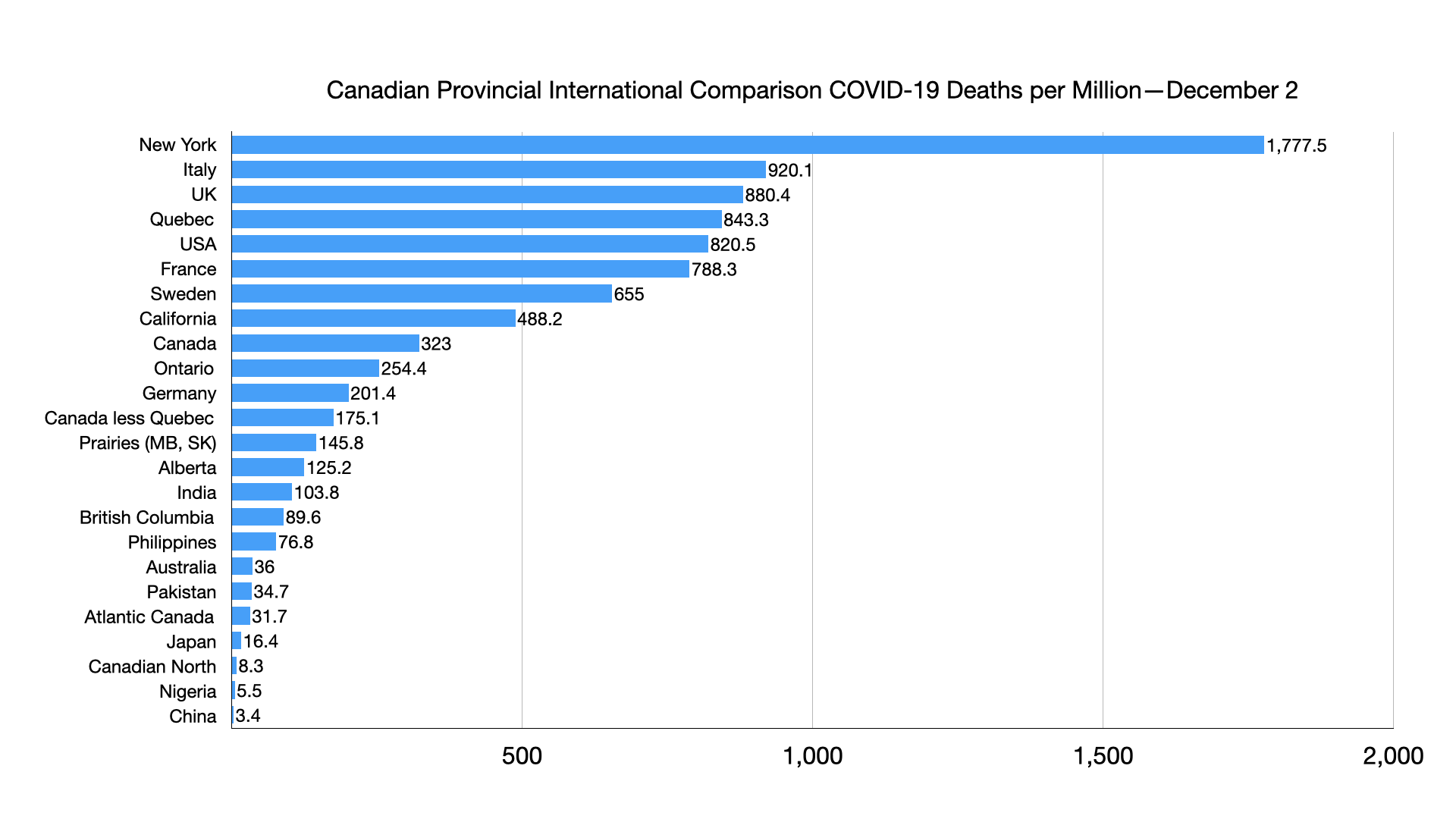
#COVID-19: Comparing provinces with other countries 2 December Update

Main news continues to be with respect ongoing sharp spike in infections along with death rate increases:
 
Weekly:
 
Infections per million: Alberta ahead of Germany, Japan ahead of Australia
 
Deaths per million: British Columbia ahead of Philippines, Canadian North ahead of Japan
 
COVID Comparison Chart.002COVID Comparison Chart.003
 

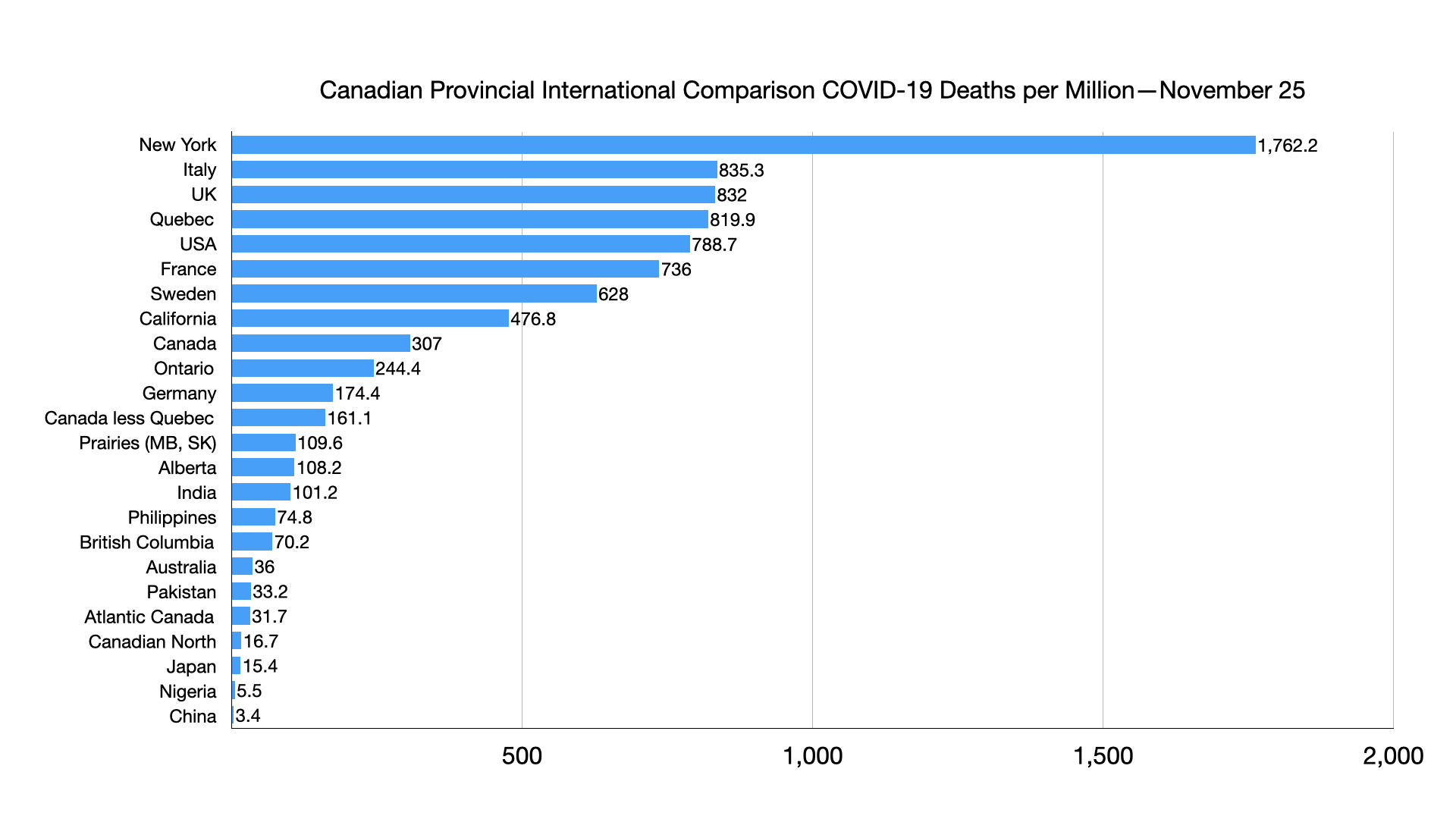
#COVID-19: Comparing provinces with other countries 25 November Update, Picard on Alberta

Main news continues to be with respect ongoing sharp spike in infections along with death rate increases:
 
Weekly:
 
Infections per million: Italy ahead of UK, Prairies ahead of Ontario, Canada less Quebec ahead of India, Canadian North ahead of Pakistan
 
Deaths per million: Italy and UK now ahead of Quebec, Prairies and Alberta ahead of India, Pakistan ahead of Atlantic Canada, Canadian North ahead of Japan
 
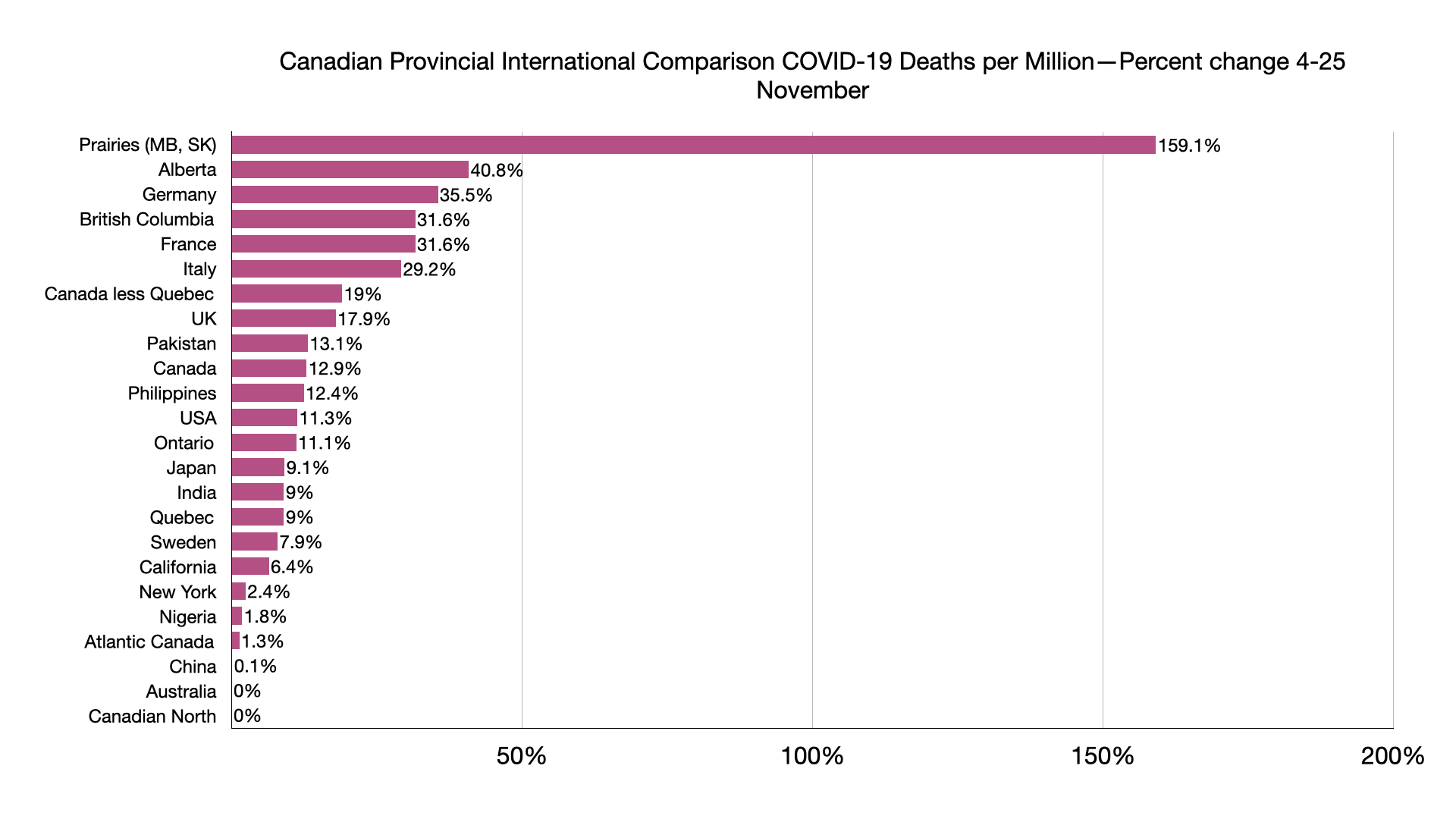
November 4-25 increase:
 
Infections per million: Greatest increase in Canadian North and Western provinces, moving ahead of many European countries
 
Deaths per million: Similar pattern with respect to deaths


André Picard’s critique of Premier Kenney and his government’s response to the pandemic:

Feckless.

That’s the only way to describe Alberta’s “tough” new measures.

In response to the soaring number of COVID-19 cases in the province, Premier Jason Kenney declared a “state of public health emergency” on Tuesday.

He started out with a little muscle flex, saying “no indoor social gatherings will be permitted, period.” Outdoor gatherings will be limited to 10 people.

But then we learned that restaurants will be open for in-person dining, bars will remain open, and so will casinos, gyms, stores, primary schools (Grades 7-12 are going to remote learning).

Heck you would be hard-pressed to find anything that will be closed.

Places of worship are allowed to hold services with one-third of capacity, just as they are now but “we are moving from recommendations to rules.”

Mr. Kenney also earnestly announced that masks would now be mandatory in the province’s two big cities, Calgary and Edmonton. But they already are mandatory because municipal governments have been a lot more pro-active and sensible than the province.

What we saw Tuesday was inaction posing as action, a quasi-libertarian Premier bending over backward to do nothing while pretending otherwise.

But Mr. Kenney’s true nature was revealed when he began prattling on about how he has resisted a lockdown because it would be an “unprecedented violation of constitutional rights.” He once again heralded the importance of “personal responsibility” while, at the same time, announcing rules that clearly suggest people don’t have to be very responsible.

Acting forcefully to protect citizens from the ravages of a global pandemic is not a violation of their rights. Quite the opposite.

Just hours before Mr. Kenney spoke, Nova Scotia Premier Stephen McNeil announced the closing of all restaurants, fitness and recreational facilities, libraries, museums, casinos and more for at least two weeks.

Why? Because the province had a “surge” of 37 cases. Thirty-seven. Business owners actually demanded the lockdown, saying severe rules are the only way to retain consumer confidence.

Alberta recorded 1,115 coronavirus cases on Tuesday, along with 16 deaths. And that was the lowest rate in a while, because testing is way down. In recent days, Alberta has had more cases than Ontario, which has more than three times the population.

The testing system is overwhelmed. The contact tracing system has collapsed. Hospital beds, and all-important intensive care beds in particular, are filling up fast. There are dozens of outbreaks in hospitals and care homes and schools.

Alberta’s pandemic response was great for many months – the Premier was right to underline that fact. But the harsh reality today is that public health and hospitals alike are dangerously close to losing control of the situation.

Mr. Kenney said it himself: “If we don’t slow the ER and ICU admissions, it will threaten our health system.”

But then, in the next breath, he was back to talking about how it’s essential to keep businesses open.

Who knows what the public will make of this Jekyll and Hyde discourse? The between-the-line message seems to be: It’s business as usual.

Yes, the pandemic is a blow to the economy; yes, it’s taking a toll on our mental health; yes, there is a lot of collateral damage.

But if there’s one thing we have learned – or should have learned – is that all that will continue, along with the harm of COVID-19, unless you go all-in to slow the spread of the virus.

Mr. Kenney said the “balanced approach” he has chosen will ensure that the spread of the coronavirus is interrupted while allowing businesses to remain open. But you can’t have it both ways.

The evidence from around the world is crystal clear: This approach is a fast-track to failure. Not only will the virus continue to spread, but the economy won’t flourish because people will still be scared.

Quebec has been in lockdown for more than two months – with rules that are way more strict that what Alberta is imposing – and it’s barely able to keep its COVID-19 numbers static, never mind lower them.

Does anyone seriously believe Alberta will be able to do better by essentially doing nothing?

Albertans should brace themselves because they’re in for a world of hurt in the coming weeks.

Source: https://www.theglobeandmail.com/canada/article-jason-kenneys-balanced-approach-is-a-fast-track-to-failure/

Quebec immigration minister skips federal human rights meeting addressing systemic racism (along with Alberta, Saskatchewan)

Sigh:

Quebec’s immigration minister Nadine Girault pulled out of a virtual meeting among provinces about human rights, drawing criticism from federal government officials who say it is because of the province’s refusal to acknowledge systemic racism.

Girault sent a bureaucrat to observe, instead of participate in the meeting, citing scheduling issues. Alberta and Saskatchewan also sent observers, rather than participating.

But Canadian Heritage Minister Steven Guilbeault says he was told by Quebec provincial officials Girault’s absence was because of the meeting’s portion on systemic racism, which Premier François Legault has refused to say exists in Quebec.

Source: Quebec immigration minister skips federal human rights meeting addressing systemic racism

Alberta’s Little History War

From Chris Champion, the Conservative staffer I worked with developing the Canadian citizenship guide, Discover Canada, and who is playing a similar role with respect to the Alberta education curriculum, providing context for the controversies over the proposed approach:

JASON KENNEY, SWORN in as Alberta Premier on Apr. 30, should not only cancel the revised social studies curriculum drafted under Rachel Notley since 2016. He should scrap the extant 2005 curriculum too, and do what he can to shift the teaching philosophy behind it.

Kenney re-entered the History Wars with finely-calibrated counterattacks in 2016-17, renewed this year on Feb. 16, against “social engineering and pedagogical fads.” He should now bring forward the reserve guns.

Mandatory testing to the end of Grade 12 is laudable and should continue. The deeper problem lies in the current thematic approach to history and civics, in which a series of disjointed topics displaces sequential narrative. As against narrative history, too difficult for most academics, the teaching establishment prefers “‘issues-centred,’ interdisciplinary Social Studies courses,” beloved of two of Kenney’s antagonists, University of Alberta educationists Lindsay Gibson and Carla Peck. But even they admit that educators have been “over-privileging thematic approaches and disregarding chronology.”(1)

Thematic history is lazy, dispensing with the need to juggle sequence and analysis and put people and events in context. True understanding absolutely requires narrative, a discipline that forces teacher and student to interpret and explain, as they should be able to do both orally and in writing (but most of course cannot). A bundle of isolated topics — last week women’s suffrage, tomorrow divestment from Israel, next week Oka — half-fills the student’s head with random happenings, creating the illusion of insight, whose only glue is the social-justice temperament that left-wingers equate with good citizenship.

Just look at the “themes” of 2005. Grade 4 socials is about “analyzing various actions taken to address historical injustices.” Say again? This implies that current fads of the left are the engine of history, turning 9-year-olds into little SJW’s. In Grade 5 it’s “examining Canadian identity,” an inappropriate, post-secondary sociological approach. Grade 7 covers “origins, histories and movement of people” (dry social history). Grade 9 offers “a few isolated topics in Canadian history” such as the Indian Act and local Treaties. It gets worse, with “multidisciplinary investigations” of “globalization” in Grade 10, “nationalism” in Grade 11, and “ideology” in Grade 12. The problem is not that this stuff is, as Notley asserted, “out of date”; it is too up to date: it’s a curriculum designed by a committee, it would seem by some childless educratic clerisy.

It’s deadly stuff! When Kenney accused Notley’s experts of omitting military history, her minister countered that wars would continue to be studied in the context of “ideology.” But that’s the problem. To reduce war to a byproduct of ideology is reminiscent of Lenin’s deterministic “highest and last stage of capitalism.” 

Nor should “Nationalism” be taught as a tedious “-ism” with sermons about equality, discrimination, and the menace of ideology. Instead, tell the story of Cardinal Richelieu putting the state ahead of the church; of Napoleon, his wars, and the nations’ backlash. Tell the romance of Bolívar and the South American Republics; Garibaldi vs. the Pope in the Risorgimento; or, more ominously, Bismarck and German unification. Teach that ideas have consequences; that peace comes at a high price; that all of this lay in the background when Canada was cobbled together and mounted its own make-or-break colonial adventures in the West. “Ideology” be damned!

‘A.J.P. Taylor believed that if you sacrificed narrative, you opened the floodgates to laziness, for it was no longer necessary to take enormous pains organising a moving structure into which everything fitted’

— Paul Johnson

The ongoing fad is that we need “more” First Nations “perspectives.” Far from being new, this must date from at least the 1970s if my own repetitive West Vancouver experience with oolichan, cedar masks, and trickster stories is any guide. The plug must be pulled on the deplorable agitprop of the “KAIROS Blanket,” which brainwashes children into thinking  of themselves as “settlers” stealing the land — the kind of “truth and reconciliation” that is not evidence-based but relies on “knowledge keepers” to “foster truth.” The scientific tradition is that truth is discovered and authenticated. By contrast, the “truth” of Indigenous Elders sometimes contradicts the evidence.

Thematic history seems ideally suited to transmitting left-wing dogma. Is this fair to students? Better to equip them with the great stories and give them a key life-skill by the end of high school: the capacity to think critically about men and ideas and their place in history, as opposed to imposing sterile doctrines of race and “gender.” As my old Latin teacher was fond of saying, “He who marries the Spirit of the Age will be a widower in the next.”

If more proof were needed that educational approaches are in crisis, it is that today’s publicly-schooled millennials have negative impressions of the role of capitalism in history. They seem never to have been exposed to the idea that markets are probably the only system that has ever lifted the mass of people out of poverty. Instead the kids accord high notional support to — of all things — socialism.

Talk about turning the clock back! Oddly that is what CBC Edmonton reporter Alexandra Zabjek now accuses Kenney of doing in Alberta Views magazine. She sees a conspiracy to “grow the privatization movement … to encourage more Albertans to educate outside the traditional public system.”(2) But surely it’s an overly-powerful public monopoly that should be made a thing of the past.

The CBC fired a dud rocket when they called for a “focus on competencies” and “inquiry and discovery — not just the dissemination of information and recall of facts.”(3) Yet contrary to the CBC, one has the impression that facts and recall have been passé for decades.

They shouldn’t be. Elementary-age minds are sponges for memorizing poetry, stories, songs — and yes, dates. Canadian children have a right to know our stories, and by heart. Elementary graduates should also take home with them their own compendious time-line of European and North American history with hand-coloured maps and drawings, from something like 2500 BC to 2000 AD. This could be a project begun in Grade 4 and attentively improved and revised up to the end of Grade 7. Canadians especially need Classical, European, and US history because North American societies are offshoots of Europe’s, particularly those of Britain and France. Of course there is value in other cultures but we can never truly appreciate or evaluate foreign cultures without first knowing our own.

When it comes to content, part of the solution may be to film Ted Byfield’s Alberta in the Twentieth Century, an illustrated series of twelve oversize books, published between 1991 and 2006, that is already approved for use in schools. It’s a comprehensive analytic narrative of the Province in the context of historians’ debates and Canadian and world history. As Byfield told me when he recruited me in 1994 to work on Vol. 5, his dream was that the set would one day become a Ken Burns-style documentary like “The Civil War” on PBS. I’m sure the books could be spun into a few compelling Netflix dramas too, if competent directors can be found.

Once filmed, the documentary could be required for mandatory testing, perhaps in Grade 11. Watch Episode one at home, discuss with your peers, take a supervised test at school. Test the teachers while you’re at it. If you fail, you get to watch the video again and retake until you pass with 85%. Watch Episode 2, repeat. This alone would increase students’ knowledge of the past and provide counterbalance to the prevailing, politicizing social justice tendency that has already gone too far.

— C.P. Champion

Source: https://nuzzel.com/subscriptionstory/08282020/dorchesterreview/albertas_little_history_war?e=6707902&c=6ZpMrqxwRZjsQ21ty4Q3ZNz5DgUMIGhgcRJEW6skW9&u=davidakin&utm_campaign=newsletter_subscription&utm_medium=email&utm_source=nuzzel

Senator criticizes Alberta proposal to shield younger students from lessons on residential schools

One of the better articles soon the Alberta proposed revised curriculum, reminding me of some of the internal discussion regarding the citizenship guide, Discover Canada, steered by the same political staffer to Jason Kenney:

The former chair of the commission on residential schools says a proposal from government-appointed advisers in Alberta to shield younger children from that dark history would be a “terrible mistake” that would leave them with a distorted view of the mistreatment of Indigenous people in Canada.

Senator Murray Sinclair, who led the Truth and Reconciliation Commission, said children can handle information about the difficult topic of residential schools when it is presented in an appropriate way. If the education system waits until they are older, as contemplated in a leaked curriculum proposal, he said that will perpetuate a “wall of mythology” about Indigenous people and their history that will be next to impossible to undo.

“It’s not only a terrible mistake, but it would be an act of discrimination against the Indigenous people,” Mr. Sinclair told The Globe and Mail.

“It would be, in fact, a continuation of the white supremacy which the residential schools and the public schools have historically perpetrated against the Indigenous people of this country. And we should call it what it is and we should fight it when we can.”

An advisory panel appointed by the United Conservative Party government has presented the Education Minister with a package of recommendations, published Wednesday by the CBC, for the kindergarten-to-Grade 4 social studies curriculum. The document argues that information about residential schools should not be taught to children in Grade 3.

Instead, the document says that material should wait until students are older, potentially in Grade 9, and with residential schools presented as one example of “harsh schooling.”

“The ugliness of Dickensian schooling, boarding schools, 19th-century discipline methods, and residential schooling that applied to some Indigenous kids can probably best be saved for later when learners are more mature and are less emotionally vulnerable to traumatic material,” the document says.

“For example, there could be a Grade 9 unit about benign vs. harsh schooling in the past, inclusive of all cultures not only Indigenous, but with regard to the particular problematic of residential schooling even if it applied only to a minority of Indigenous children.”

Mr. Sinclair rejected that idea, and said it is possible to present the history of residential schools in a way that that is appropriate for young children.

“We’re not asking them to start holding up bloody pictures and demanding that they cry,” he said. “What we’re saying is, talk about it from the perspective of children. Talk about it in ways that they can understand, that they can utilize. It can easily be done.”

Mr. Sinclair, who has called on provincial education ministries to ensure students learn about residential schools, said young children already learn about potentially upsetting topics, such as wars.

Education Minister Adriana LaGrange stressed the ideas in the document are merely recommendations. She said residential schools would be taught in elementary school but she declined to say at what age that would start or how that information would be presented.

“We are absolutely committed to truth and reconciliation and to ensuring that the truth about residential schools is in our K-6 curriculum. That is non-negotiable,” she told reporters at the provincial legislature in Edmonton.

She noted that a larger working group that will include teachers will examine the curriculum this fall and a draft will be ready for public feedback next year.

Richard Feehan, the Opposition New Democrats’ critic for Indigenous relations, said teaching all students about residential schools should be non-negotiable.

“They worry that young children can’t hear that story, and yet here we are approaching Nov. 11, when we go into every grade in school and talk about the history of World War One and the history of World War Two,” he said.

“But somehow, when we talk about Indigenous children being harmed or being killed, it’s somehow too much for children to handle. It doesn’t make sense to me.”

The Truth and Reconciliation Commission’s report in 2015 described the Canadian government’s long-running policy of removing Indigenous children from their communities as cultural genocide.

The report also found that abuse was rampant within the residential school system.

“Child neglect was institutionalized, and the lack of supervision created situations where students were prey to sexual and physical abusers,” the report said.

The commission called on ministers of education across the country to include the history and legacy of residential schools in kindergarten-to-Grade 12 curriculums. In 2014, the Progressive Conservative government of the day publicly committed to ensure students at all grade levels learn about the legacy of residential schools.

When it comes to First Nations, the proposed curriculum document focuses on teaching young children about the life and customs of Indigenous people, particularly before contact with Europeans. Topics include the structure of First Nations leadership, farming, hunting, Arctic survival and “warfare.”

While the document argues lessons about residential schools would be traumatic, it also proposes that students in Grade 3 be taught about ancient Rome, battles of the Middle Ages and slavery in the Ottoman Empire.

Source: https://www.theglobeandmail.com/canada/alberta/article-senator-criticizes-alberta-proposal-to-shield-younger-students-from/

The RCMP’s atrocious response to racism in Alberta

Good commentary by Gary Mason:

A couple weeks ago, a group marching under the banner of the Black and Indigenous Alliance Alberta organized a demonstration in Ponoka, Alta. But it didn’t go so well: People drove by and called the protesters names, accusing them of belonging to “antifa.” Some reportedly told them to go back to where they came from. And then, the group alleges that a truck intentionally swerved into them, striking a protester. He was taken to hospital with an injury to his eye and later released.

When they reported the alleged hit-and-run, an RCMP spokesperson said that police didn’t have the video footage needed to investigate.

A few days later, on Sept. 14, alliance members, including the man who was allegedly struck by the truck, held a news conference at the RCMP detachment to alert media to what happened. As they tried to begin, a small group of counterprotesters began shouting the alliance members down. One of the men brought a megaphone to drown out anything the group was saying to reporters. They also hurled vicious epithets at the alliance members who were there.

It was an ugly scene. But it got uglier.

Rachelle Elsiufi, a reporter with CityNews Edmonton, asked the head of the Ponoka detachment, Sergeant Chris Smiley, why nothing was done to deter those who arrived to disrupt the news conference. “Are you suggesting one side’s voice is more important than the others? Because it’s not,” he replied.“So we let everybody say what they need to say as peacefully as they can and that’s how this country works.” According to Ms. Elsiufi, two men “with connections to hate groups in Alberta” were standing beside her, and “celebrated” the officer’s response.

But as disconcerting as that moment was, things would get even worse.

The following weekend, the alliance decided to hold a demonstration in a park in Red Deer, Alta. Soon after they arrived to begin their rally, so did a convoy of trucks carrying a group of men that appeared to be looking for trouble. Again, many were identified by reporters as wearing the symbols of hate groups such as the Soldiers of Odin.

It didn’t take long for things to turn violent. The men walked up to the alliance demonstrators, many of whom were people of colour, and screamed into their faces, telling them to go home. Video from the scene shows a couple of clear assaults on alliance demonstrators, one of whom was punched in the face. Footage later shows three RCMP officers standing off to the side monitoring the situation.

Initially, the RCMP said there would be no investigation into what happened at the park. When video from the scene went viral on social media, the RCMP changed its tune, saying it would open a criminal investigation into two alleged assaults. The police defended their initial decision, saying the violence happened before their officers had arrived.

It sure looks like the RCMP has a problem here. The fact that people with racist ties can disrupt a peaceful news conference and be defended by police is outrageous. No one’s voice is more important than another’s? Are you kidding me? When one of those voices is that of a bigot and white supremacist, it is not as important as someone peacefully advocating against racism.

Alberta Justice Minister Kaycee Madu, who is Black, seemed genuinely upset by what happened in Red Deer. But I don’t think it’s enough to simply say it’s “unacceptable” and that it should never happen. He needs to have a conversation with senior officials in the RCMP about the type of people it has representing the force in the province and whether or not they are part of the problem here.

It sure sounds like they are.

It shouldn’t take long for the RCMP to lay criminal charges in the Red Deer incident. The people responsible for the assaults are clearly visible in the footage. But beyond that, the RCMP has to do a far better job of ensuring the safety of people who are demonstrating for a cause that police know will upset some who will then come looking for trouble.

The idea of a convoy of trucks arriving and disgorging a group of angry white men with menace in their eyes brings back terrifying images of the American South in the 1950s.

I realize police have a difficult job. But trust in the RCMP is undermined when some among them exhibit behaviour that makes us question whose side they’re on.

Alberta Teachers’ Association president calls for curriculum advisor to be dismissed after racist articles surface

The adviser in question, Chris Champion, was the lead staffer under then IRCC minister Kenney on citizenship and the point person on the citizenship guide, Discover Canada, which remains in use.

My account of the development of the guide and some of the issues and challenges can be found in ch 2 of Policy Arrogance or Innocent Bias: Resetting Citizenship and Multiculturalism. While discussions were at times intense, we had the opportunity to provide our advice and comments and maintained a good working relationship.

Although Discover Canada improved coverage of Indigenous history compared to the earlier vapid, A Look at Canada, the unreleased draft guide will have more in-depth discussion of Indigenous peoples. Hard to know why, almost five years since then Minister McCallum promised a revision, still not released.

Equally hard to imagine one making such a comment about Indigenous histories being a “fad” in 2019, both substantively and politically:

On Wednesday August 27, 2020 the Alberta Teachers’ Association (ATA) called for the resignation of a Dr. Chris Champion from the Alberta Curriculum Review Panel.

It was recently brought to light that the member of the Alberta Curriculum Review Panel – which was made in order for the UCP Government to overhaul and review the previous NDP school curriculum – was a writer of racist articles which was titled “Alberta’s Little History War,” which called the inclusion of First Nation perspectives in school lessons a “fad.”

This particular article was written just last year, and it was written by Dr. Champion who is advising the social studies curriculum of Alberta.

The ATA, as the professional organization of teachers, promotes and advances public education, safeguards standards of professional practice and serves as the advocate for its 46,000 members.

In a news release by the ATA, an advisor who has called the inclusion of First Nations perspectives in school lessons a fad needs to be dismissed from his role in advising on Alberta’s social studies curriculum, says ATA President Jason Schilling.

“Minister LaGrange, Chris Champion has got to go,” said Schilling.

Given the well-documented writingsand publications that have recently surfaced, Schilling says that Chris Champion has no place advising the curriculum writing work currently under way in Alberta.

“Champion’s appointment to advise curriculum is in direct opposition to the Joint Commitment to Action that both Alberta Education and the ATA signed in 2016. The minister must either dismiss Champion or rescind its endorsement of the Joint Commitment.”

In June 2016, the Joint Commitment to Action was signed by representatives of the Government of Alberta, the National Centre for Truth and Reconciliation and five Alberta education stakeholder organizations as part of an enduring commitment to respond to the calls to action from the Truth and Reconciliation Commission.

Schilling says that in his school re-entry meeting with Minister LaGrange on August 19, he told the minister that they needed another meeting dedicated to discussing curriculum and that Champion had to go.

Acknowledging that the Association has been almost exclusively focused on a safe return to schools in September, Schilling says the Association regrets not issuing an earlier statement on this important matter.

This is just the latest in the story of the Albertan Government’s racist employees. There is not only Dr. Chris Champion, but there is still Jason Kenney’s racist speechwriter Paul Bunner. The ATA is just the latest to call for the firing of either of the racist state employees; the Sixties Scoop Indigenous Society of Alberta (SSISA), Grand Chiefs of Treaty 8, Chiefs of Treaty Six, the Blackfoot Confederacy, and the Assembly of First Nations regional chief for Alberta have also voiced their concerns.

Source: https://www.theglobeandmail.com/canada/alberta/article-alberta-teachers-association-president-calls-for-curriculum-advisor-to/

Alberta’s COVID-19 crisis is a migrant-worker crisis, too

More on temporary foreign and immigrant workers in relation to COVID-19 working conditions:

The 500 confirmed cases of COVID-19 and one death tied to an Albertan meat-packing plant are unquestionably tragic. The Cargill plant in High River, Alta., temporarily ceased operations last week following the most serious COVID-19 outbreak in Canada, with cases linked to that plant constituting about a quarter of all cases in the province.

But it must also be understood in its broader context, beyond this pandemic. While this tragedy seems unique to this crisis, this outbreak has only exposed Canada and Alberta’s dependence on temporary labour migration and immigrant workers, the particular vulnerabilities they face, and the deep inequities in Canada’s occupational health and safety system.

Media reports and accounts from community advocates have indicated that most of the workers at the meat-packing plant came here from abroad, including many as temporary foreign workers. This is in line with what the Canadian Centre for Policy Alternatives recently found, which is that workers who have been deemed “essential” are also disproportionately racialized. Immigrant workers earn less than the Canadian average and lack access to basic protections, including paid sick leave. These workers are systematically disadvantaged with respect to workplace safety, despite the rights due to them under the Employment Standards and the Occupational Health and Safety Act.

The current OHS system relies on the “internal responsibility system,” which means it is driven by complaints and thus requires that workers have to be the one to assert their rights to workplace safety. This system disadvantages low-wage and precarious immigrant workers who may be unable to exercise these rights, or fear reprisal for speaking out about unsafe work conditions. This is borne out in data which shows that, in their first five years in Canada, immigrant men are at increased risk of work-related injuries that require medical attention compared to their Canadian-born counterparts.

The crisis has also revealed the way public policy intersects with an unequal labour market to exacerbate those vulnerabilities that temporary workers in particular face. While policies around temporary foreign workers change depending on prevailing political sentiments and public attitudes, the fundamentals of the program remain largely unchanged: Workers are recruited for labour that Canadians are unwilling to do.

Much of it, including meat packing, is “3D work” – difficult, dangerous and dirty. Research published in 2014 found that in Alberta, meat-packing employees have the highest probability of a disabling injury of all manufacturing employees, at a rate that is more than double the manufacturing average.

Temporary workers enter Canada on a time-limited work permit that is tied to their employer. The program is divided by skill level: Those in “high-skill” occupations have greater access to Canadian permanent residence than “low-skill” workers, including meat packers. What few pathways exist are largely dependent on a referral from employers, making it less likely for those workers to push for their rights.

Temporary migrant workers in occupations classified as low-skilled are structurally disadvantaged when it comes to workplace health and safety. They pay taxes and contribute to the employment insurance program, but if they become sick or injured, they can be laid off and sent back to their home country without access to the Canadian benefit system. Research shows that temporary migrant workers hide illnesses and injury for fear of being fired, and we cannot rule out that this influenced the Cargill workers who continued to do their job despite being sick.

It is deeply unjust that workers deemed “essential” in this pandemic are the same workers who are unable to access pathways to Canadian citizenship and to equitable workplace health and safety. The temporary foreign worker program is meant to address short-term and geographically specific needs in the labour market, yet as advocates and researchers have noted for years, “temporary” migrant workers often work in jobs that are not temporary at all.

As evidence of the inequities in workplace safety, the last inspection at the Cargill plant happened over video rather than through an in-person inspection. This begs important questions about the actual safety afforded those working in the plant. Workers have disclosed to the media that their concerns over safety and the coronavirus that causes COVID-19 went largely unheeded by management.

And yet, Alberta designated Cargill an essential service. That only ensured that one of the largest and most profitable companies in the world continued operations – while workers suffered the consequences.

Source: Alberta’s COVID-19 crisis is a migrant-worker crisis, too: Bronwyn Bragg

Critics say more action needed from Alberta government on immigration issues in wake of public opinion survey

Reflects the overall more conservative rural base and while the difference with other provinces is significant, there is less polarization than portrayed in the article. The UCP government, like most provincial governments, is generally pro-immigration:

Almost half of Albertans feel that there is too much immigration, a major increase over the national average. But advocates say the Alberta government has not done enough to curve that discrimination.

According to the Canadian Public Opinion on Immigration survey conducted in 2019 by the Environics Institute, 42 per cent of Albertans feel there is too much immigration. This is nine per cent more than the national average, with British Columbia at 30 per cent and Saskatchewan at 34 per cent.

The survey was based on telephone interviews conducted via landline and cell phones with 2,008 Canadians between Oct. 7 and Oct. 20, 2019. The results are accurate to within plus or minus 2.2 percentage points in 19 out of 20 samples.

These results don’t come as a surprise, as Alberta has made headlines for its anti-newcomer sentiments.

In 2016, an article from the National Post reported that a Calgary school was vandalized with anti-Syrian and anti-Trudeau graffiti. These messages included “real Canadians hate Syrians” and “burn all mosques.”

A similar story happened later in 2016 when a Calgary man spray-painted anti-Syrian graffiti to a Calgary LRT station because he was “mad at ISIS.” According to the CBC, the man later apologized in court and stated he had “changed his views.”

Two years later, a video of a woman shouting at a group of men in a Lethbridge Denny’s was uploaded to Facebook. The video shows the women yelling things such as, “Go back to your own f–ing country. We don’t need you here,” and “You’re not Canadian.”

The group of men she was yelling at were of Afghan background.

That anti-immigrant sentiment continues to this day. Dina Farman – an immigrant who moved to Alberta in 2006 – says she still faces discrimination.

“I worked in retail. I know how some people don’t like immigrants,” she says. “And even with me actually, I have black hair and [an accent], and some people give you that look like you’re not welcomed or something.”

One group that has been accused of making newcomers feel unwelcome is the Yellow Vests, a movement that has members in Calgary. The group was inspired by the “gilet jaunes” protests that began in France in 2018 as a result of high gas prices and the rising cost of living there. The movement there has been linked with outbursts of racism and anti-semitism.

But, in Canada, the Yellow Vests Facebook page says the group was created to “protest the CARBON TAX, Build That Pipeline and Stand Against the Treason of our country’s politicians who have the audacity to sell out OUR country’s sovereignty over to the Globalist UN and their Tyrannical policies.”

This movement is also known for opposing the presence of some newcomers in Canada and have been associated with racist and xenophobic behaviour and comments. In Calgary, members advocate for an end to what they describe as illegal migration while supporting immigration of “people who share our democratic values.”

One member of Yellow Vests Calgary — who wished not to be identified to prevent media scrutiny — says that for her, migration and immigration are different. Migrants and refugees have created some negative experiences for her, while the immigrants who “are willing to integrate are a joy.”

“I would consider immigration to be something that’s embedded, that we are choosing people that are going to help us economically, that are going to contribute and integrate and that they’re going to become Canadian. That’s a good thing for this country.”

“But then you have a large faction of people that come, that aren’t integrating and they’re clinging to a nation for which they’ve kind of turned away from but haven’t really [given up],” she says.

“If there’s an idea that they’re bringing with them [from] wherever they’ve come from, and it doesn’t fit with the morals and values of the country that you’ve chosen to come to, then that’s the challenges you face as an immigrant.”

Abdie Kazemipur, a professor at the University of Calgary who studied the socio-economic experiences of immigrants in Canada, says this is a very common argument. However, he says every time there is a pressure by mainstream institutions or populations to force immigrants to adopt their mainstream values, it actually backlashes.

“Even if immigrants [integrating] into the mainstream values and cultures is the desired outcome, the way to achieve that is by opening the society to them and giving them their space and allowing them to have interactions,” he says

Meanwhile, some governments in Canada are trying to reduce discrimination against refugees and immigrants.

In Manitoba, that led to the creation of their Advisory Council on Citizenship, Immigration and Multiculturalism in 2015.

Their council is similar to Saskatchewan’s multicultural council, which was founded in 1975 to raise awareness of the benefits of cultural diversity and the dangers of racism.

More recently, the United Nations Refugee Agency created the campaign #WithRefugees in order to invite cities and local authorities all over the world who are working to promote inclusion, support refugees and bring communities together to sign a statement of solidarity.

While 16 cities across Canada have signed onto this campaign to show support, no cities in Alberta signed on.

But, at a provincial level, Alberta has taken some action. In 2018, the government released a long-delayed report on anti-racism activities. At the time, Global News published an article in which Greg Clark, the now-former MLA for Calgary-Elbow, said “it just fell off the radar and we’ve heard nothing about it. So obviously there is action needed.”

After that release, the Anti-Racism Advisory Council was created as the first government organization to fight the increase of racism in Alberta. A $2 million anti-racism community grant was also introduced to do the same thing.

However, since the UCP government has come into power, there has been no update found on the Anti-Racism Advisory Council’s webpage.

The UCP government has also eliminated the Alberta Human Rights Commission’s human rights education and multiculturalism fund as of November 2019 under the recent budget cuts. This $1-million grant has helped fund anti-racism and anti-discrimination in Alberta since 1988.

Additionally, the $2-million anti-racism community grant was replaced with the multiculturalism, indigenous and inclusion grant program with a budget of $1.5 million under the UCP government. In other words, less money is now being used to address a lot more problems – just one of which would be anti-immigrant sentiment.

Sam Nammoura, the co-founder of the Calgary Immigrant Support Society, says the government of Alberta can be doing more to bring awareness towards the discrimination of immigrants.

“Instead of making a one-week event to create awareness, it should be addressed constantly,” he says.

Kazemipur, who wrote his PhD thesis on the economic experiences of immigrants and ethnic minorities in Canada, also says the Government of Alberta is taking too minimal of an approach.

“They can actually try to encourage the population to develop better views and better experiences of immigrants and minorities,” he says.

“After this happens and after this population blends into one larger population, then this distinction between immigrant and non-immigrant becomes basically meaningless. So all these negative feelings towards immigrants will disappear as a result.”

Kazemipur thinks that the best way to encourage this solution would be through educational programs that bring people together.

“Educational programs are definitely a starting point to emphasize the cultural competence and to expose people to different lives despite different cultural orientations and the values that are embedded in any of these alternative lifestyles,” he says.

“I think there could be more education in order to move people from their own comfort zones so that they can engage with people from other cultural backgrounds.”

Nada Bodagh, who moved to Canada from Iraq in 2009, agrees.

“People just don’t understand yet because they need answers to their questions,” she says. [Immigrants need to] feel they are involved so they are not isolated because the worst feeling when they are new here is feeling lonely and isolated.”

Kazemipur says that the government needs to make improvements to strengthen the bond between the population.

“The provincial government could be more proactive and could make this a priority knowing that without [social interaction] in the population, the economic plans and political plans wouldn’t succeed,”

“I think there’s a lot more work that needs to be done,” says Nammoura.

To better understand the work that is being done by the Alberta government, the Calgary Journal attempted to contact Leela Aheer, the minister of culture, multiculturalism and status of women for an interview involving the lack of programs in place that create inclusiveness for immigrants and refugees.

Instead, we received a statement from the press secretary, Danielle Murray.

“Our government is working to build a province where all people feel safe, welcome and valued. We are working with the Alberta Anti-Racism Advisory Council to determine how they can support our work to address racial and multicultural barriers in Alberta,” the statement read.

We did not receive any further response after a second request for an interview with Aheer.

Source: Critics say more action needed from Alberta government on immigration issues in wake of public opinion survey