Canada to admit nearly 1 million immigrants over next 3 years

Good overview with some of the preliminary political reaction. Will be interesting to see how this plays out, but the Conservative focus on integration issues and border controls suggests that the increase itself is not a concern:

Canada will welcome nearly one million immigrants over the next three years, according to the multi-year strategy tabled by the Liberal government today in what it calls “the most ambitious immigration levels in recent history.”

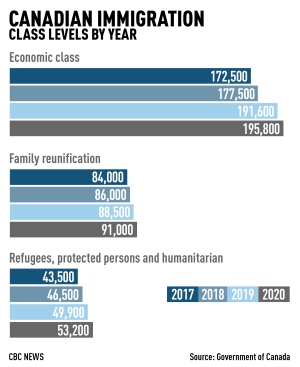
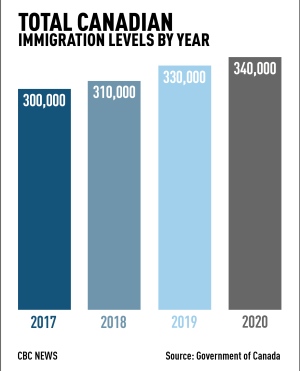
Canadian immigration levels by year

The number of economic migrants, family reunifications and refugees will climb to 310,000 in 2018, up from 300,000 this year. That number will rise to 330,000 in 2019 then 340,000 in 2020.

The targets for economic migrants, refugees and family members was tabled in the House of Commons Wednesday afternoon.

Hussen said the new targets will bring Canada’s immigration to nearly one per cent of the population by 2020, which will help offset an aging demographic. He called it a historic and responsible plan and “the most ambitious” in recent history.

“Our government believes that newcomers play a vital role in our society,” Hussen said. “Five million Canadians are set to retire by 2035 and we have fewer people working to support seniors and retirees.”

In 1971 there were 6.6 people of working age for each senior, Hussen said, but by 2012 that ratio had gone to 4.2 to 1 and projections show it will be at 2 to 1 by 2036, when almost 100 per cent of population growth will be a result of immigration; it stands at about 75 per cent today.

Hussen said immigration drives innovation and strengthens the economy, rejecting some claims that newcomers drain Canada’s resources and become a burden on society.

He said the government is also working to reduce backlogs and speed up the processing of applications in order to reunite families and speed up citizenship applications.

Canadian immigration class levels by year

The federal government’s own Advisory Council on Economic Growth had recommended upping levels to reach 450,000 newcomers annually by 2021. Hussen said the government is taking a more gradual approach to ensure successful integration.

“At arriving at these numbers we listened very carefully to all stakeholders who told us they want to see an increase but they also want to make sure that each and every newcomer that we bring to Canada — bringing a newcomer to Canada is half of the job. We have to make sure that people are able to be given the tools that they need to succeed once they get here,” he said.

Focus on integration: Rempel

Conservative immigration critic Michelle Rempel was critical of the plan, suggesting the government needs to do a better job of integrating newcomers.

“It is not enough for this government to table the number of people that they are bringing to this country. Frankly the Liberals need to stop using numbers of refugees, amount of money spent, feel-good tweets and photo ops for metrics of success in Canada’s immigration system.”

She said the Liberals need to bring Canada’s immigration system “back to order” by closing the loophole in the Safe Third Country Agreement that has seen migrants cross into Canada at unofficial border crossings only to claim refugee status.

She also said the immigration system should focus on helping immigrants integrate through language efficiency and through mental health support plans for people who are victims of trauma.

Dory Jade, the CEO of the Canadian Association of Professional Immigration Consultants, welcomed the news although he suggested the numbers should be higher.

“Canada will greatly prosper and grow once the 350,000 threshold has been crossed,” he said. “Nevertheless, we are witnessing a very positive trend.”

The Canadian Council of Refugees also welcomed the news, but wanted more, saying the share for refugees was only increased slightly from 13 per cent this year to 14 per cent in each of the next three years.

Calls for longer-range forecast

In past, there has been a one-year figure for how many immigrants will be permitted into the country, but provinces and stakeholders have called for longer-range forecasts.

A statement from Ontario’s Immigration Minister Laura Albanese, before the announcement, said the province supports the introduction of multi-year levels plans “to provide more predictability to the immigration system and inform program planning.”

“Significant variation in year-to-year immigration levels can dramatically impact the requirement for provincial year-to-year resources. A longer term outlook would help in planning for appropriate service levels and use of resources.”

The statement said Ontario supports growth in immigration levels, particularly in economic immigration categories to support the growing economy.

Diversity drives innovation

During the government’s consultation period, the Canadian Immigrant Settlement Sector Alliance presented “Vision 2020,” what it called a “bold” three-year plan to address growing demographic shifts underway in the country, calling for increased numbers in the economic, family and refugee categories.

It recommended a target of 350,000 people in 2018, which climbs to 400,000 in 2019 and 450,000 by 2020.

Chris Friesen, the organization’s director of settlement services, said it’s time for a white paper or royal commission on immigration to develop a comprehensive approach to future immigration.

“Nothing is going to impact this country [more] besides increased automation and technology than immigration will and this impact will grow in response to [the] declining birth rate, aging population and accelerated retirements,” he told CBC News.
Source: Canada to admit nearly 1 million immigrants over next 3 years – Politics – CBC News

Justin Trudeau rolls the dice on immigration

Cam Clark’s take on the multiculturalism-year immigration levels planned increases:

Justin Trudeau’s Liberal government is doing something no Canadian government has done for decades: It is gambling on a lot more immigration.

There should be no doubt that it is a gamble. On the day that U.S. President Donald Trump was responding to a terrorist attack in New York by blaming the immigration system, exploiting resentment there, the Liberals were saying Canada needs more immigrants. And don’t think that’s because it’s a slam-dunk political winner with new Canadians: Polls show first-generation immigrants are not much keener on expanded immigration than those born here.

Mr. Trudeau’s government is making a statement that it is going in a different direction. In fact, that’s the statement that Immigration Minister Ahmed Hussen made. “We are emphatically and unapologetically taking the opposite approach,” he said at a press conference in Toronto.

The numbers that the Liberals are shooting for are nowhere near the massive, 450,000-a-year level proposed by the Liberal-appointed Advisory Council on Economic Growth headed by McKinsey and Co. guru Dominic Barton and backed by some big-business voices and the Conference Board of Canada. Mr. Barton had suggested more newcomers could foster economic growth and mitigate the aging of Canadian society. But that would be a huge expansion, and for politicians, that’s not just a gamble but going all in.

Yet Mr. Hussen’s numbers are still large increases. Under Stephen Harper’s Conservatives, there were typically about 260,000 immigrants each year. The Liberals have increased the target to 300,000 this year, and will keep increasing to 340,000 by 2020 – that’s a 30-per-cent increase over a typical Conservative year, and a 21-per-cent increase over the Conservative 2010 high mark. When compared with the size of the population, the Liberals are planning a rate of immigration not seen since Brian Mulroney was in power.

Immigration levels dropped substantially for two years under Jean Chrétien, and levels have fluctuated from year to year, but no government since Mr. Mulroney’s has made any sustained, substantive change to immigration rates – the number of immigrants as a percentage of the population. The Liberals plan to move the rate upward significantly.

It’s a plan to keep increasing immigration steadily. Mr. Hussen even revived the Liberal target of increasing immigration to 1 per cent of the Canadian population – a promise made by Mr. Chrétien in 1993 but ignored once he was in power.

Politically, it’s not the specific number that matters. The government has done polls that show that most Canadians don’t have the foggiest notion how many immigrants come to Canada. But Canadians still have opinions on whether there are too many immigrants, or too few.

A survey commissioned in March by the Association for Canadian Studies found that 38.4 per cent of Canadians think there are too many immigrants, while just 10.4 per cent said there are too few. But a lot, 41.1 per cent, said that the number’s about right. Perhaps that’s one reason recent governments haven’t risked changing things much.

Jack Jedwab, the association’s president, said the number of people who think there are too many immigrants is generally pretty stable, between 30 per cent and 40 per cent; it’s near the high end of the range now. (The March survey was conducted by web panel that used a sample of 2,559 people.)

People born outside of Canada are a little less likely to think there’s too much immigration, but not much. There is a substantial political divide: People who consider themselves on the right are far more likely to think there are too many immigrants than people on the left.

That may be one reason Mr. Trudeau’s Liberals are willing to take a political gamble on immigration. It emphasizes a difference that plays better with left-leaning voters. And it represents a contrast with Mr. Trump. But it’s still a gamble.

Even Mr. Trump is calling for a “merit-based” immigration system, which sounds similar to Canada’s “high-skilled” class, rather than the United States’s current visa lotteries. He won’t end immigration; the Trump culture war is mostly about Mexicans and Muslims, and he has portrayed both as dangerous.

In Canada, Mr. Jedwab said, the resentment of immigration was once driven by economics – the sentiment that immigrants take Canadian jobs or cost the treasury – but now, it is clearly driven by perceived security concerns and fears immigrants are changing Canadian culture and values.

No wonder then, that Mr. Hussen emphasized the economic reasons for expanding immigration, noting, for example, that there will be fewer workers to support retirees in coming years. His plan also includes more family reunification, asylum-seekers and resettled refugees. People like the notion of hard-working economic immigrants, but not everyone is as positive about the rest. That’s probably a very big reason why governments have not signalled a sustained change in immigration levels for a quarter century. Until now, they didn’t want to take a risk.

Source: Justin Trudeau rolls the dice on immigration – The Globe and Mail

Link to government background info: Backgrounder, 2018-2020 Immigration Levels Plan

Singapore’s young view multiracialism differently, says Janil Puthucheary, Singapore News & Top Stories – The Straits Times

Always interesting to follow developments in Singapore given the historic tensions and how they have largely overcome them, and how the issues have shifted from security to inclusion and representation:

The way today’s young view multiracialism and multiculturalism is different from how they were envisioned 50 years ago, said Senior Minister of State Janil Puthucheary on Wednesday (Nov 1).

Still, it is important to understand how the younger generation feels about these values, he added.

Though racism today is talked about more in terms of stereotypes and representation rather than about safety and security, it is no less an important issue, he added.

Dr Janil, who is chairman of OnePeople.sg, a charity that promotes racial harmony, made the point at its 10th anniversary dinner.

He said people no longer worry whether they can walk safely through different parts of town because of their race. But they worry about jokes and how many actors are representing their race on television.

“It’s an aspiration to a higher type of inclusion, and that shift of aspiration speaks about how much we’ve done and about far we’ve come as a country,” he said.

Although the anger and outrage the young feel when those aspirations are not met may initially look trivial compared with the dangers of the past, these new issues cannot be ignored, said Dr Janil, who is Senior Minister of State for Communications and Information as well as Education.

“If not, the next generation will feel disenfranchised and will not believe in our model of multiculturalism or multiracialism. We must treat their aspirations for a deeper harmony with the same vigour and respect as the social issues of the past. We must tackle them and do something about them.”

He added: “We have come a long way as a country and as OnePeople.sg over the last 10 years, but our need to tackle racism and our model of multiculturalism and multiracialism – to make sure the next generation understands why we place so much emphasis on this and on getting this right – this mission has not changed.”

Dr Janil was speaking to more than 500 people, including community and religious leaders, volunteers and donors at Shangri-La Hotel.

His organisation, previously known as the Central Singapore Joint Social Service Centre, was set up in 1997 to coordinate the resources of the community development councils and self-help groups.

It took on the role of promoting racial harmony in 2001 with the People’s Association and in 2007, was renamed OnePeople.sg.

It has since been working with schools to build shared values and grow a pool of youth ambassadors and facilitators to spread the message of religious harmony and lead programmes. The group has grown to about 160 facilitators, up from 10 in 2007.

It also works with community groups and ethnic and religious institutions to foster community cohesion. Dr Janil said the organisation will continue to widen its network and build partnerships with more groups, especially youth groups, and work to create safe spaces for people to discuss difficult issues.

The dinner raised about $501,000 to fund the charity’s programmes and activities.

Prime Minister Lee Hsien Loong, the dinner’s guest-of-honour, launched a commemorative book of research articles on ethnic diversity in Singapore.

The 504-page book, titled “The Singapore Ethnic Mosaic: Many Cultures, One People”, covers aspects of the history, religion, language, value systems and diet, for instance, of various sub-ethnic groups.

Excerpts may be made available as a resource for schools and community and religious groups, through exhibitions or digital e-books.

Mr Thomas Liew, 35, a volunteer for the past 10 years at the charity, facilitating small group discussions, said it is heartwarming to see young people today are well-read and concerned about race and ethnicity issues and about Singapore.

“Raising awareness about these issues is important because we cannot be complacent about our peace and stability brought about by racial harmony,” he said.

Polytechnic student Nurul Fatimah, 18, said she has been on the receiving end of distasteful jokes in school, which came as a culture shock after studying in a madrasah for many years before that.

The youth advocate at OnePeople.sg, who plans events for other students, said she does so because she believes racial harmony is something fragile that should be protected.

“We don’t have racial riots and people may take racial harmony for granted. A problem no matter how small can build into a bigger problem, so we can’t ever let our guard down,” she said.

Source: Singapore’s young view multiracialism differently, says Janil Puthucheary, Singapore News & Top Stories – The Straits Times

Dalhousie student criticizes ‘anti-Canadian’ student-union motion – The Globe and Mail

The alternative, and IMO more balanced view, to the activists featured in ’Our existence is our resistance’: How young women of colour took to the forefront of social activism in Halifax:

A student at Dalhousie University is speaking out against what she calls an “anti-Canadian” motion passed by the school’s student union, saying it has ignited racial tensions on campus.

Mehak Saini said Monday she’s standing up for voices silenced during an acrimonious debate that engulfed the Halifax university after the student union pulled out of Canada 150 celebrations in solidarity with Indigenous Peoples.

 “As an immigrant, I celebrate this country and its values and the freedom of speech,” said Saini, who immigrated to Brampton, Ont., from northern India when she was nine years old. “I’m proud of this country.”

Student leader Masuma Khan tabled a motion to opt out of Canada Day festivities, calling the celebration an act of ongoing colonialism.

In response to criticism, the student council executive said on social media she would not stand with “privileged white people,” or be proud of “over 400 years of genocide,” with the hashtag “whitefragilitycankissmyass.”

Khan’s comments sparked controversy and prompted a complaint against her, which the university has since dropped, in part due to concerns about violent and hateful messages she was receiving.

Many people on campus and beyond defended Khan’s freedom of expression and political speech, including the Ontario Civil Liberties Association and a group of 25 law professors from Dalhousie’s Schulich School of Law.

But Saini said some students disagreed with Khan but refrained from voicing their dissent out of fear of being labelled a racist.

“She’s using discrimination and power as a tool to silence us,” she said in an interview. “There is no place for racism, period. Not from a minority, not from a majority.”

Saini added: “We should criticize the past and colonialism. But to criticize a whole race and say they can kiss your ass is not the way to go about it.”

The second-year physics student is calling on the Dalhousie Student Union to hold a new election for the position of vice-president academic and external, which Khan currently holds.

Saini has penned an open letter to the university ombudsman entitled “Not My VP,” which now has 42 signatures.

The letter outlines her position against Khan, who she says “blatantly insulted the entire race of white people.”

“Not only did she disrespect the student body by suggesting an anti-Canadian motion, but also she then attacked an entire race of students by implying that all white people are fragile in nature,” Saini said in the letter.

“Being an immigrant, I found the ban on celebrating Canada Day a violation of the rights of students to celebrate the country that has provided them with a great life, an excellent education, world-class facilities, and their individualistic freedom of expression.”

Khan said she already went through an impeachment process in September and the council voted to keep her.

“I’m not going to say a student can’t do this because I want to encourage students to hold their representatives accountable,” she said.

However, Khan said she is baffled that the student union’s support of Indigenous People could be construed as “anti-Canadian.”

“Standing in solidarity with Indigenous People is the last thing from being anti-Canadian,” she said. “What I have said is anti-white supremacy.”

As a daughter of immigrants, Khan said she recognizes that she has been afforded privileges in Canada and that “this land has given me so much.”

“But it’s important to recognize that immigrants themselves are given more privileges than the Indigenous People of this land,” she said. “We flee from war, we flee from unsafe places. We come here to find safety but there is a whole community that doesn’t have safety.”

While Saini said she is open to criticism about Canada’s past, she said she worries that the tone of the debate could legitimize racist speech or create division between students of different backgrounds.

“There is no compassion, there is no unification, there is just division between us,” she said. “I want to be on the side of love and compassion and unification. I don’t want to be on the side of division and hatred and bigotry or discrimination.”

Saini added: “This fight is for equality for all regardless of your colour, ethnicity or religion.”

Source: Dalhousie student criticizes ‘anti-Canadian’ student-union motion – The Globe and Mail

Andrew Coyne: The federal government can’t stand by when minority rights are being trampled

Coyne on Bill 62 and the need for a federal challenge (I understand the government’s prudence):

By now Quebec’s Bill 62 has been fairly comprehensively discredited, in all its nastiness, its contradictions and its dishonesties. A law passed in the name of the secular state would leave intact such overtly religious symbols of the state as the cross on Quebec’s flag, or the crucifix on the wall of the National Assembly. In the name of religious neutrality, it bans the wearing of some religious symbols — those that obscure the face, like the niqab or burka some Muslim women wear — while ignoring others.

At the same time, to avoid accusations of religious discrimination, it extends to other face-coverings, e.g. sunglasses, that have nothing to do with religion — though it is explicitly called an “act to foster adherence to state religious neutrality.” Yet for all its emphasis on the state, it applies not only to providers of public services, but also recipients, which is to say not the state or its employees but ordinary citizens.

Far from defending religious freedom, then, it would radically restrict it. Far from protecting women from oppression by their own religion, as its apologists argue, it not only limits what they may wear in public, but in so doing arguably makes them more vulnerable than ever. Perhaps some women who wear the niqab or the burka do so involuntarily, but if so it is hard to see how denying them access to such life-expanding options as going to school or even taking the bus will help.

The right to go to school or to take the bus: in the history of civil rights in North America, these have a certain resonance. For all the belated attempts by the province’s Liberal government to clarify — women would, it now says, only be required to show their faces when getting on the bus, not for the duration of the trip, while those wishing to attend class could apply for special accommodation, on a case-by-base basis — the stark reality is a bill that, at best, needlessly singles out members of a religious minority for petty harassment and humiliation. Members of the same minority, you will recall, were just months ago victims of a mass murder in a Quebec City mosque.

The bill has met with its share of opposition in Quebec, though for different reasons: while civil libertarians, civic leaders and university administrations have denounced its excesses, the province’s two main opposition parties, the Coalition Avenir Quebec and Parti Québécois protest only that it does not go nearly far enough. It seems unlikely, then, that the remedy for this injustice will be found in Quebec.

The question is what other means might be found. Are we content, those of us living outside Quebec, that our fellow citizens should be treated in such a demeaning fashion, on the grounds that what happens in Quebec is none of our business? Or does living in the same country imply certain common understandings, however few, among them basic guarantees of equal rights?

To be sure, the law will quite certainly be challenged in court, under both the Canadian Charter of Rights and Freedoms and its Quebec analogue, and will in all likelihood end up before the Supreme Court of Canada. It is difficult to see how it could withstand such scrutiny; whatever watery purpose might be conjured up as a rationale, it would be a challenge to show how the law was likely to achieve it, still less that it did so in the least harmful way possible.

Should it be left at that? Wait for some member of the public to object at her mistreatment, then wait years more while the case grinds through appeal after appeal? Or does the federal government have an obligation to intervene in some way? In the early years after Confederation, that was exactly how the federal government’s role was conceived: to protect minorities from local majorities, if necessary by setting aside provincial legislation, under a power known as disallowance.

It’s been a long time since any federal government has exercised that power, of course: the Charter and the Supreme Court might seem to make it unnecessary. Yet it was not only by the rulings of the U.S. Supreme Court that minority rights were upheld in the southern states: the offices of the federal government also proved necessary.

The feds would not have standing to challenge the law directly in court, but they could join a case brought by a private citizen as intervenors. More aggressively, they could refer the law directly to the Supreme Court for an opinion on its constitutionality, as they did in the matter of a previous Quebec law claiming the right to secede unilaterally.

I understand the arguments against this: that it would inflame federal-provincial tensions, perhaps even revive separatist sentiment. But we should understand what it means when we invoke such fears as reasons for inaction, as we have in the past. We are saying that the rights of the minority can be sacrificed in the name of “social peace,” or “national unity,” or whatever other euphemism we might devise for “we haven’t got the stomach for it.”

And however much we might prefer the courts to do the heavy lifting for us, we might not have that luxury. Already the opposition is pushing the Couillard government to invoke the notwithstanding clause in the event the law is ruled unconstitutional; the government, for its part, has not ruled it out. And what would we do then?

Source: National Post

’Our existence is our resistance’: How young women of colour took to the forefront of social activism in Halifax

Will be interesting to see where they end up in a number of years and the degree to which their activism and views evolves as they grapple with how best to effect institutional and social change (easy to protest, hard to implement):

They are young. They are women. And they are racialized.

Young women of colour are at the vanguard of Halifax’s social justice movement, part of a new generation of social activists.

Kati George-Jim is a 21-year-old Indigenous student and member of Dalhousie University’s board of governors.

Masuma Khan is a 22-year-old Muslim student leader at the Halifax university.

Rebecca Thomas is a 31-year-old Dalhousie graduate and Mi’kmaq poet laureate.

Together, they are unapologetically standing up for social justice and refusing to back down in the face of controversy. They are harnessing an ethos of social unrest emanating across the country and beyond, impatiently working to dismantle white privilege, patriarchy and heterosexism.

And they are not going away.

“Racialized women have always been at the forefront of civil rights movements,” said Margaret Robinson, Dalhousie University assistant professor of sociology and social anthropology. “What’s changed is the broader society’s ability to recognize them for their leadership and work.”

Social media and growing up with a black president in the United States has also shifted the social justice movement, she said.

“The new wave of activists grew up seeing a black president for eight years,” Robinson said. “They’ve had access to instantaneous online information and communication that I couldn’t have dreamed of as a child. That changes everything.”

Thomas, Halifax’s aboriginal poet laureate, said young women are being empowered by higher education.

“The more you start to understand and learn, the more you want to do something,” she said. “Education is very empowering. We’re being told that our voices matter, and we’re standing up to be heard.”

Thomas, originally from New Brunswick, said women of colour have always had strong voices, and that civil rights movements in the past have helped pave the way for the new generation.

Young women are now starting to “punch through power structures” once reserved for white men, Thomas said.

“We’re recognizing the strength we have, and it’s really great when you get the community’s backing,” said Thomas, who has a master’s degree in social anthropology from Dalhousie.

Last spring, she appeared before Halifax council with a poem chiding councillors for shutting down debate last year over how the city commemorates its controversial founder.

Edward Cornwallis issued a bounty on the scalps of Thomas’s Mi’kmaq ancestors, but is still honoured with a park, statue, and even a street within a stone’s throw of the city’s Mi’kmaq friendship centre.

Moved by her poem, a rookie councillor decided council needed to revisit the issue, and the city has since created a panel to examine how Halifax should pay tribute to Cornwallis.

Thomas said her official role with the city allows her to work for change from the inside, but at times she feels the need to self-censor.

“I find myself in this torn and unfortunate position to make my arguments palatable, so I keep getting invited back, so I can still continue to poke and prod,” she said. “I have a duty and responsibility to keep access to these people in power.”

While Thomas may take a more poetic and amicable approach to social activism, she applauds the more militant actions of others.

Khan, a Dalhousie Student Union executive, stood firmly in solidarity with Indigenous protests against Canada 150 celebrations. She refused to back down, even under threat of sanctions as the university investigated her for a profane Facebook post that criticized “white fragility.”

Dalhousie dropped the complaint against Khan last week, in part due to mounting concerns about violent and hateful messages she was receiving.

“It’s a matter of life and death. Standing up against white supremacy is not an easy thing,” said Khan, who wears a hijab and was born and raised in Halifax.

“There are times I get frustrated. But I don’t have a choice,” the fourth-year international development studies student said. “People shoving supremacist ideologies in my face make me want to dismantle those structures even more.”

Khan added: “Our existence is our resistance. I’m going to exist, I’m going to keep going. It doesn’t stop here.”

That sense of urgency is shared by George-Jim of the T’Sou-ke First Nation in British Columbia.

“Racialized women are taking control of the conversation,” the fourth-year political science student said. “With my identity comes responsibility. As an Indigenous woman, I have a responsibility to speak up and use my voice.”

George-Jim took on Dalhousie’s board of governors for what she called institutionalized racism, prompting an apology from the board’s chairman who insisted Dalhousie is not led by racists.

“To me, it just feels like everyday life. It doesn’t feel like social activism,” she said.

It’s a sentiment all three share.

“We don’t stop being women of colour at the end of the day when it’s comfortable and time to relax,” Thomas said. “We don’t get to take a break from our own oppressions.”

Source: National Post

Erreur dans le recensement linguistique: Statistique Canada s’explique

Not an easy time before parliamentarians:

Statistique Canada avait «détecté certains changements» dans les données sur la langue à l’étape de la validation, mais «n’a pas, à ce moment-là, capté» qu’il aurait fallu procéder à une révision avant de diffuser les données linguistiques qui ont provoqué un tollé au Québec.

«Je sais ce qui s’est produit. Mais comment on a manqué cette erreur-là, c’est cette partie que je ne sais pas encore», a lâché devant les députés du comité permanent sur les langues officielles Marc Hamel, directeur général du programme du recensement.

L’agence fédérale avait déjà fait son mea culpa en août dernier, expliquant que l’erreur avait été causée par le logiciel de compilation de données. Celui-ci a inversé les réponses dans des formulaires en français d’environ 61 000 personnes, dont environ 57 000 au Québec.

La bourde avait eu pour conséquence de surestimer la croissance de l’anglais dans la province et dans certaines de ses régions, tant pour la langue maternelle que pour la langue parlée à la maison, ce qui avait inquiété politiciens et défenseurs de la langue française.

«Ce n’est pas le système qui n’a pas détecté (l’erreur). Ce sont les gens qui ont testé le système qui n’ont pas détecté que le système ne lisait pas le questionnaire de façon conforme», a spécifié Marc Hamel aux élus.

Le député conservateur Alupa Clarke lui a demandé si des têtes allaient rouler chez Statistique Canada, déplorant que «de plus en plus, aujourd’hui, on vit dans une société où on ne met jamais au banc des accusés les responsables».

«Dans un cas comme celui-là, on ne parle pas des individus, on parle des processus. Si à chaque fois que quelqu’un faisait une erreur, il était congédié, on en congédierait peut-être plusieurs. Les erreurs sont rares», lui a répondu M. Hamel.

«On a fait les correctifs appropriés pour éviter que ce genre de situation comme ça se reproduise encore. Est-ce que je peux vous dire aujourd’hui que dans les 100 prochaines années, ça n’arrivera pas encore? Absolument pas. L’erreur est humaine», a-t-il ajouté.

Au haut fonctionnaire, qui s’est défendu de «prêcher par nonchalance», Alupe Clarke a suggéré d’envoyer une «lettre diplomate» aux 5000 employés de l’agence pour leur dire de faire gaffe à l’avenir, établissant un parallèle avec son expérience dans les Forces armées.

«Moi, j’ai fait l’armée, puis nous, ça ne niaise pas, là. Il y a une discipline (…) puis quand on fait la guerre, ça marche», a-t-il lâché.

Un peu plus tôt, son collègue néo-démocrate François Choquette s’était étonné que l’agence ait diffusé les données linguistiques alors que certaines d’entre elles, en particulier dans certaines villes à forte majorité francophone, étaient clairement suspectes.

«Attendez que je comprenne comme il faut: 164 pour cent d’augmentation de la population anglophone à Rimouski, 115 à Saguenay, 110 à Drummondville. Vous avez eu ces chiffres-là, qui n’étaient pas normaux, et vous avez quand même décidé de les sortir?», a-t-il questionné.

Le directeur adjoint de la division de la statistique sociale, Jean-Pierre Corbeil, a répondu que ce n’était «pas aussi simple» et qu’il «fallait être prudent quand on faisait des comparaisons historiques», surtout compte tenu des changements survenus sous les conservateurs en 2011.

Ces données contenues dans la livraison initiale de données du 2 août dernier étaient passées sous le radar jusqu’à ce que le président de l’Association d’études canadiennes, Jack Jedwab, lève un drapeau rouge après avoir passé les chiffres au peigne fin.

Les données revues et corrigées publiées quelques jours après ont confirmé que le français avait effectivement perdu du terrain au Québec, mais moins qu’annoncé initialement, et que l’anglais n’avait pas progressé, mais plutôt reculé, dans la province.

En présentant les nouveaux chiffres, l’agence fédérale avait fait acte de contrition et reconnu que cette erreur était d’autant plus regrettable qu’elle concernait un enjeu fort délicat au Québec.

«Nous sommes très conscients de l’aspect très sensible de cette question, de ces enjeux, et Statistique Canada va corriger le tir, simplement», affirmait Jean-Pierre Corbeil, directeur adjoint de la division de la statistique sociale et autochtone, qui était aussi au comité, mardi.

Source: Erreur dans le recensement linguistique: Statistique Canada s’explique | Mélanie Marquis | National

Barbara Kay: The Jewish blindspot to the horrors of the niqab

Interesting thought experiment regarding the Jewish equivalent of the niqab, but with Kay’s usual lack of nuance in discussing the issues and rants about cultural Marxism:

Sir Salman Rushdie spoke at Montreal’s Jewish Public Library last week. We were two of an estimated 700-strong (mostly Jewish) audience.

Rushdie’s insightful and entertaining address on “literature and politics in the modern world” was excellent, but the evening’s most noteworthy moment arrived with the Q&A, when, inevitably, his response was solicited regarding Quebec’s new Bill 62, which bans face coverings in the realm of public services. Rushdie gracefully sidestepped any comment on the law itself, but did express a robust opinion on the niqab.

His own family, Rushdie said, ranged from atheism to full Islamic practice, but “Not even the religious members would accept wearing a veil. They would say it is an instrument of oppression.” My husband and I applauded loudly, but few others did. Rushdie added, “Muslim women in the West who see it as an expression of identity are guilty of what Karl Marx called ‘false consciousness.’ A lot of women are forced to wear the veil. To choose to wear it, in my view, assists in the oppression of their sisters in those parts of the world.”

At this point I clapped even more enthusiastically and (alone) bellowed, “Bravo!” But most of the audience continued to sit on their hands. To say I was disappointed in my fellow Jews is an understatement. Here, after all, is a man who knows Islamic fundamentalism and oppression first hand, having endured 20 years of tense vigilance following fatwas against his life for the alleged crime of insulting Islam.

The tepid reaction to Rushdie’s statements thus struck me as a rebuke both to Rushdie’s personal ordeal and to the wisdom he brings to the face-covering debate as a critical insider. It’s also proof that even someone of Rushdie’s moral authority is powerless to shift liberal Jews’ reflexive instinct to identify with a perceived underdog, whatever the actual stakes at issue. I even had the sneaking suspicion that if a niqab’d woman in the audience had risen to shake her fist at Rushdie, she would have sparked an approving ovation.

I understand why young people are loath to criticize any cultural practice by the Other. They’ve long been steeped in cultural Marxism, which encourages white guilt and forbids criticism of official victim groups, including Muslims (but not Jews). But how did so many of my pre-Marxist, classically liberal Jewish contemporaries, who were, age-wise, disproportionately represented in the audience — especially the women, feminists one and all — fall for what public intellectual Phyllis Chesler calls a “faux feminism” that is “Islamically correct”?

I had assumed that my opinion on Bill 62 — that it is a fair law that privileges socially-level communications over a misogynist tribal custom — had solid, if minority, support in my community. The Rushdie evening disabused me of that illusion. Yet, I remain bewildered that Rushdie’s words don’t ring as true to my peers as they do to me. And not just Rushdie. Many Muslims are as “triggered” by the niqab as I am, and for better reason: they came to Canada to escape what it represents in those Islamic countries where it is customary (or obligatory) to wear it. They’re eager to speak up, but most media are too busy romancing the niqab-wearers to hear them.

Here’s a thought experiment I’d put to my progressive Jewish friends: How do you feel about the “frumqa”? “Frum” means religious in Yiddish. A frumqa is the Jewish burqa, worn by a few hundred Haredi women in Jerusalem who are sometimes called the “Taliban women.” The frumqa’s creator, Bruria Keren says she wears it “to save men from themselves. A man who sees a woman’s body parts is sexually aroused … Even if he doesn’t sin physically, his impure thoughts are sin in themselves.”

I’m glad the frumqa exists for one reason: I can say I find it disturbing in itself and abusive to girls without being called Islamophobic. I can freely say that Haredi fundamentalism and the obsessive gender extremism it incubates is a blot on the Jewish halachic and cultural landscape. Please don’t speak to me of a Jewish woman’s “right” to wear such a travesty of “tzniut” (modesty in dress and behaviour). Indoctrinated women, like inebriated women, are not competent to give informed consent to practices that reduce them to sexual and reproductive “things.”

I’d wager there isn’t a single Jewish woman in that Rushdie audience who wouldn’t privately express her visceral disgust with the frumqa, and who furthermore wouldn’t turn a hair if it were banned in Israel (it can’t be: the Haredim hold too much political power there). But over the Other’s burqas they draw a politically correct veil. Forgive me if I conclude it isn’t just Muslim women in the West who are guilty of false consciousness.

Source: Barbara Kay: The Jewish blindspot to the horrors of the niqab | National Post

Poll: 6 In 10 Black Americans Say Police Unfairly Stopped Them Or A Relative : NPR

More interesting polling data confirming what we already know or suspect. Will be interesting to compare these findings with those of other groups that NPR will report on in coming weeks:

A new poll out this week from NPR finds that 60 percent of black Americans say they or a family member have been stopped or treated unfairly by police because they are black. In addition, 45 percent say they or a family member have been treated unfairly by the courts because they are black. The poll is a collaboration between NPR, the Robert Wood Johnson Foundation and the Harvard T.H. Chan School of Public Health.

The poll reveals the consequences of these stops for black Americans personally and across society — 31 percent of poll respondents say that fear of discrimination has led them to avoid calling the police when in need. And 61 percent say that where they live, police are more likely to use unnecessary force on a person who is black than on a white person in the same situation.

Previous polls have asked similar questions, but ours is unique in that it’s the first to ask about lifetime experiences with policing. It’s part of NPR’s ongoing series “You, Me and Them: Experiencing Discrimination in America.”

A Pew Research poll in 2016 asked whether people had been unfairly stopped by police because of race or ethnicity in the previous 12 months and found that 18 percent of black people said yes. A 2015 CBS News/New York Times poll asked whether this had ever happened and found 41 percent of black people said yes.

Our poll differs from Pew in that we asked not only about a much longer period but also whether people had been unfairly stopped or treated because of their race or ethnicity. We differ from CBS in that we included the word “unfairly.” We also differ from both the Pew and CBS polls because we asked whether a person or a family member had had this experience, which gives us a better sense of the presence of these experiences in respondents’ life and surroundings.

The black American data from our poll, released Tuesday, were compiled from 802 black Americans as part of a large national representative probability survey of 3,453 adults from Jan. 26 to April 9. The margin of error for the full black American sample is plus or minus 4.1 percentage points.

NPR will be reporting and releasing the results of the poll over the next several weeks for several groups, including Latinos, whites, Native Americans, Asian-Americans and LGBTQ adults.

Source: Poll: 6 In 10 Black Americans Say Police Unfairly Stopped Them Or A Relative : Code Switch : NPR

Liberal government not always appointing top recommended judges

Good analysis by Sean Fine. Greater transparency leads to more questions, but commendable that the government is releasing this data. Will do more analysis once I have reviewed the report but relieved that I will no longer have to review judicial announcements and compile my own data:

The Liberal government is not always appointing judges from a pool of “highly recommended” candidates, raising questions about whether partisan political considerations or diversity concerns are trumping merit.

Under a ranking system brought back last October by the Liberals – who said it would “highlight truly outstanding candidates” – advisory committees identify the best as “highly recommended.” Second best are “recommended.” A third group is “unable to recommend.” The Conservatives had dropped the “highly recommended” category in 2007, drawing criticism from the legal community.

But the Liberals have appointed a number of judges from the “recommended” list, according to a federal agency that supports the appointment process. Justice Minister Jody Wilson-Raybould would not reveal how many when contacted by The Globe and Mail. Neither would the Office of the Commissioner for Federal Judicial Affairs, which collects data on the process.

New statistics released as part of Ms. Wilson-Raybould’s stated effort toward transparency and diversity show a large surplus of the truly outstanding: 129 highly recommended candidates, for just 74 appointments made since last October. The rankings come from 17 non-partisan advisory committees across the country, who review the candidates’ applications and check each individual out with lawyers they know in the community.

Ms. Wilson-Raybould, who had instructed the judicial affairs commissioner to collect and publish the statistics, says it is her prerogative to appoint from the recommended list.

“I take care to consider a number of factors, such as each candidate’s expertise, the needs of the court, and the strength of their application,” she said in an e-mail to The Globe. “Whether someone is recommended or highly recommended is one factor that I take into account, among many important considerations, in exercising my prerogative to appoint the best candidates to the judiciary.”

The highly recommended category is the key to a merit system of appointments, says Peter Russell, a political science professor emeritus at the University of Toronto. “If you just appoint people who are merely qualified, that is not looking for the best-qualified people for the positions.”

In an interview, he questioned whether some appointed from the recommended group were chosen for their affiliation with the Liberals. “I think we should know – is it politics?”

The return of the “highly recommended” category was part of the Liberals’ new appointments process in which candidates are now asked to self-declare their sexual orientation, ethnicity and other background factors. That information is kept private.

On Friday, for the first time in Canadian history, the judicial affairs commissioner published data on the diversity of candidates and appointments.

Commissioner Marc Giroux’s office said revealing the number of appointees from the “recommended” list could be damaging to the legal process.

“We have considered whether providing a further breakdown regarding appointees and the ‘rating’ of recommended or highly recommended should be provided,” spokeswoman Caroline Masse said. “However, if such were disclosed, litigants or others could determine whether or not a particular judge was recommended or highly recommended by simply referring to their biography and comparing it to these statistics.

“This prevents our office from distinguishing between the number of appointees that were highly recommended vs. recommended,” Ms. Masse said in her e-mail.

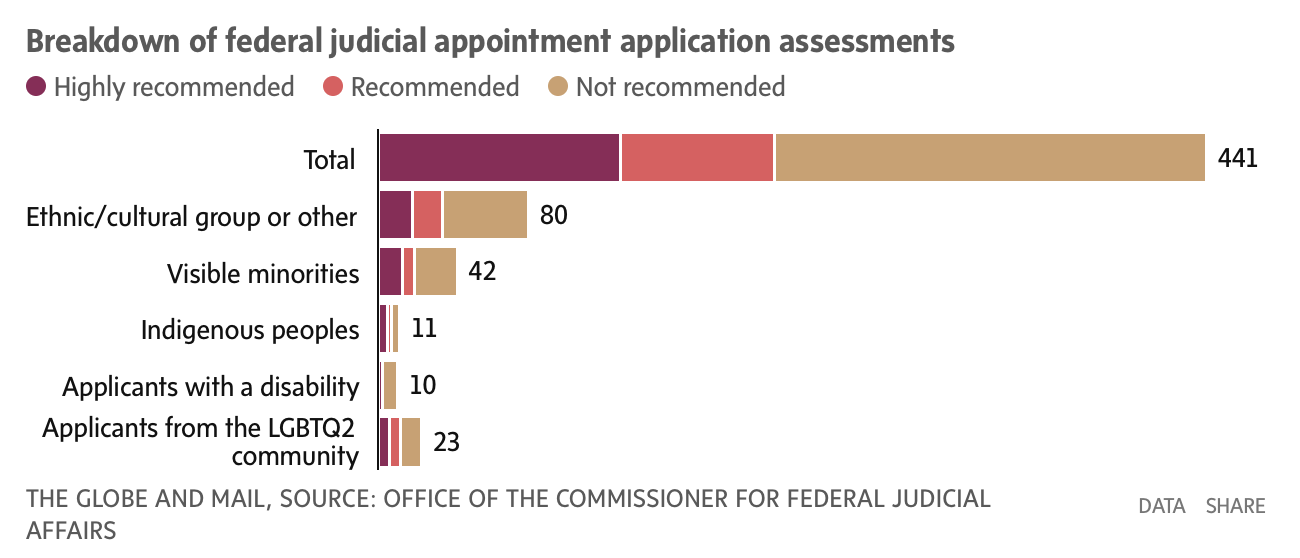
Just short of 1,000 applications have been received since last October, of which the committees got around to assessing 441. Of those 441, 129 candidates were highly recommended, 82 were recommended and 230 were not recommended.

The data also show that, of the 74 appointments under the new process, 37 were men and 37 were women. (An additional 12 were of judges who moved from trial courts to appeal courts; of these, five were men and seven women.) Men, however, made up a much larger proportion of assessed and highly recommended candidates; there were 75 highly recommended men compared with 54 highly recommended women.

For years, the federal government had been urged by lawyers’ groups to collect data on applications and appointments by race. The new data show that, in the “visible minority” category, 97 applied (or roughly 10 per cent of all applicants) and 42 were assessed. Thirteen were highly recommended, six recommended and 23 not recommended. The government appointed nine visible minority judges.

Toronto lawyer Ranjan Agarwal, past president of the South Asian Bar Association, said the numbers show that there is more work to be done in mentoring and encouraging visible minority lawyers to apply. “Maybe there’s just not enough candidates applying from minority communities, which I think was the point of having the data – we could then focus in on the problem areas.”

There were 36 Indigenous candidates who applied and 11 who were assessed. Five of the 11 were ranked highly recommended, two were recommended and four not recommended. Three Indigenous judges were appointed.

f those lawyers who described themselves as belonging to an “ethnic/cultural group or other,” there were 190 applications, and 80 assessed; of those, 18 were highly recommended, 16 recommended and 46 not recommended. Fifteen were appointed.

There was one person with a disability appointed out of 10 assessed candidates (two highly recommended and eight not recommended). There were four judges appointed from the LGBTQ2 community, out of 23 candidates assessed. Six were highly recommended.

There were more “highly recommended” candidates in every category of diversity (women, ethnic minorities, LGBTQ, Indigenous and disabled) than judges appointed from each group.

Source: Liberal government not always appointing top recommended judges – The Globe and Mail