Religion, multiculturalism and the public square: Shachi Kurl, Angus Reid

See the article for the charts:

The inclusion of “God” in the preamble to Canada’s 1982 Constitution Act was a last-minute addition by Pierre Trudeau.

Thirty-three years later, as his son Justin presided over the swearing in of a new Liberal cabinet, over half of its members chose to drop the words “so help me God” from their oath of office. In a little more than a generation, the religious beliefs that were once the central tenets of Canadian society have been swept aside, as the courts and Parliament moved to assert a person’s individual liberty over their body, their identity and their relationships, from birth to death. And Canadian public opinion — sometimes leading, at other times following — has marched largely kept pace with this transformation.

The era when churches and religious leaders held sway over public policy in Canada has come to an end. There are important pockets of religious opposition to abortion, assisted dying and gender neutralization, but in the final analysis secularism seems to have won the day.

Religion and religious influence declined in Canada after the Second World War. (In Quebec during the 1960s the process accelerated, and the province moved from being the most to the least churched society in the modern world.) In the 1980s, not long after Pierre Trudeau wrote the word “God” into the constitutional preamble, regular church attendance in Canada was at around 40 percent. When Justin Trudeau formed his first cabinet in 2015, regular attendance had decreased to around half that….

With this decline in influence, the era of religious dominance in the public square has come to an end. But this is not the end of the story. The role of religion in setting public policy has been replaced by a new issue: religion itself as a topic for public policy.

The highest-profile example is the controversy over the clothing worn by some Muslim women. In Quebec — once more at the centre of a religion-versus-state tangle — Bill 62 would require citizens to show their faces when receiving public services. Squarely aimed at niqabs and burkas, this legislation is wildly popular in Quebec but less so in the rest of Canada, where such moves have failed to garner majority support…

The niqab/burka issue is part of a larger drama playing out in Canada concerning rising levels of religious diversity, how Canada should adapt to this multifaith reality and the importance Canadians place on religious freedom guarantees enshrined in the Constitution.

The current debate over religious freedom isn’t limited to the Muslim religion. Indeed, major issues of religious freedom that have recently been before the courts involve Christian organizations attempting to assert their rights: for example, in British Columbia, Trinity Western University’s policies that impose moral standards on their students; in Ontario, the fight with the College of Physicians and Surgeons over exempting health care workers from activities related to abortion or assisted dying; and in Quebec, Loyola College’s demand to be able to set its own religious instruction curriculum, independent of the one established by provincial education authorities.

Beyond the legal aspects, the fate of religion in Canada ultimately depends on public attitudes. On this, the results of surveys by the Angus Reid Institute in 2017 reveal there is cause for concern among religious communities and faith groups. The most startling finding is the relatively tepid support for the very concept of religious freedom. Asked whether the inclusion of religious freedom in the Constitution makes Canada a better or worse country, only slightly more than half (55 percent) of 1,500 respondents in an October 2017 poll said “better.” A sizable minority — roughly 1 in 7 — said “worse”….

These findings, which reflect deep division in Canada over the country’s increasing religious diversity, follow decades of immigration from non-Christian countries. Canada may prize its multiculturalism, but when it comes to the religious roots of this diversity, Canadians are divided.

When asked if religious diversity in Canada is good or bad, 26 percent said “good” and 23 percent “bad,” and the rest were unsure or felt the impact is “mixed.” (Not surprisingly, Quebec is the outlier on this question, with those who said “bad” outnumbering those who said “good” by nearly 2 to 1.) This finding is supported by another from our polling, which asks Canadians if they think the country does too much to accommodate different religious and faith groups… Here we find opinions massively on the side of doing too much (53 percent think the country does too much to accommodate religion, only 9 percent say it doesn’t do enough, and the rest think it strikes the right balance).

The lack of deep support for religious freedom and religious diversity suggests that faith communities could come under increased scrutiny in the future, especially if political leaders sense an advantage in limiting the special status enjoyed by these organizations in taxation, education and health care.

On taxation, recent polling shows Canadians divided — 55 percent in favour and 45 percent against — on special tax status for religious organizations; in Quebec, the percentages are reversed…. The same pattern is evident on opinions about religious schools and about regulations that would curtail the right of faith-affiliated hospitals to opt out of assisted dying.

Starting with the election of Stephen Harper, and continuing into Justin Trudeau’s government, there has been an increasingly politicized debate over religion. Although Harper appointed a special ambassador for religious freedom, he also voted against a motion proposed by members of his own caucus to set up a parliamentary committee to study when life begins. Trudeau, in contrast, did not hesitate to ban pro-life candidates from running for the Liberal Party. When the Governor General he appointed used her maiden speech to disparage those who believe in “divine intervention,” he was quick to jump to her defence.

It’s still early days in this political chapter, where leaders are seeking to change public expression and institutional arrangements associated with religious belief. Ironically, the diversity that is at the heart of this emerging debate may impose the greatest limits on those who would seek to limit religious expression: Canadian immigration policies favour vibrant Islamic, Sikh, Hindu and Christian communities.

The late Richard Neuhaus, one of the 20th century’s great activists and thought leaders on matters of religion and the public square, was born a few miles down the Ottawa River from Canada’s parliament. He understood better than most that politics is a function of culture, and culture is ultimately a function of religion. Canada, which so proudly celebrates its multiculturalism, is witnessing a growing debate over religious diversity that eventually will have far-reaching political consequences. How the debate evolves depends on whether the different religions and traditions can cooperate and have sufficient impact in the political sphere to withstand the forces of secularism that are driving large elements of public policy in Canada.
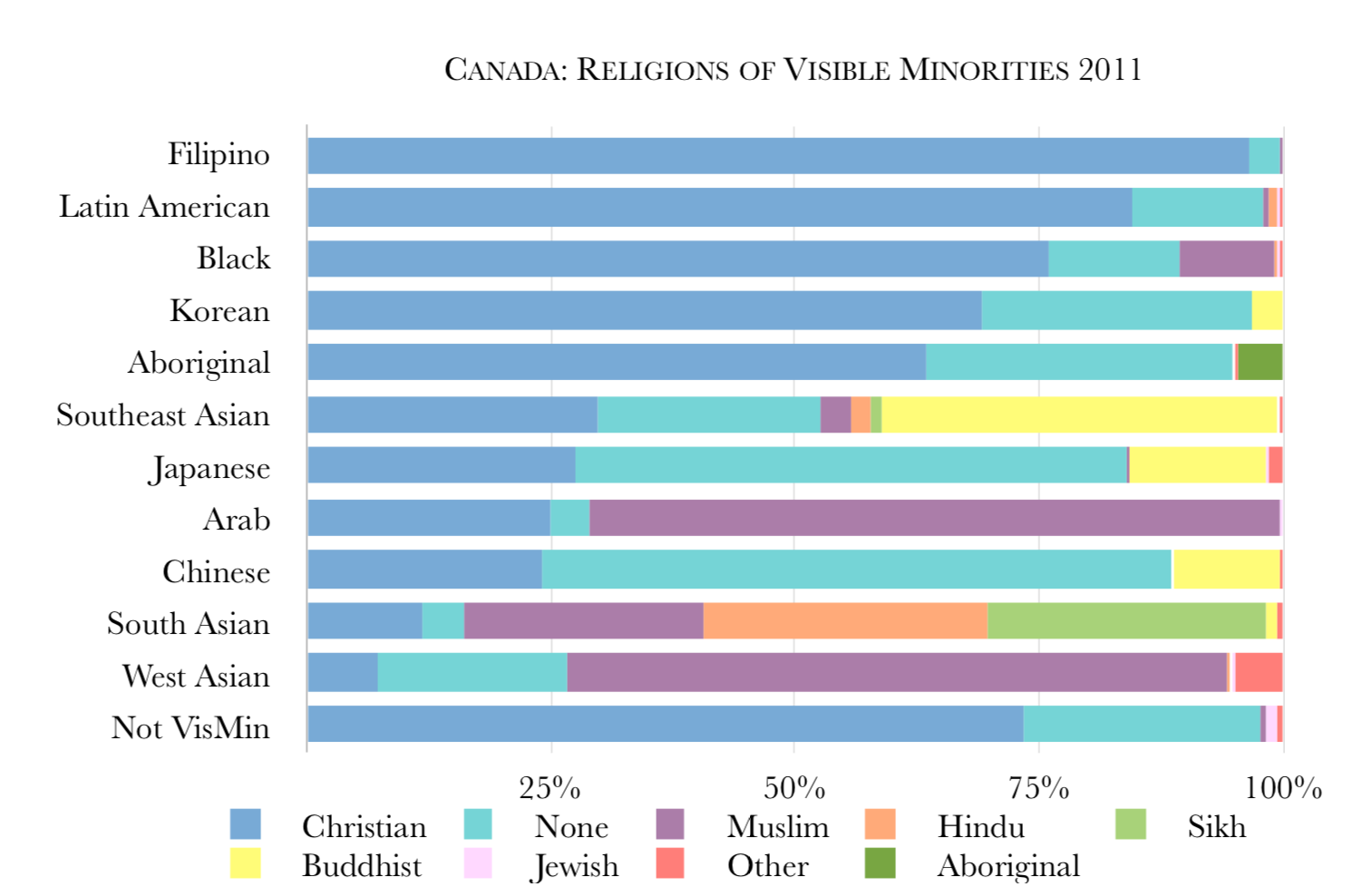
via Religion, multiculturalism and the public square

Breaking The Bubble Of Food Writing: Cultivating Diverse Stories : NPR

Another way to look at food writing:

The first, and probably most pervasive, challenge is that writers of color are often limited to writing about their traditional foods, while white writers are given much more latitude to explore a wide variety of cuisines beyond their immediate expertise. This not only applies to writing assignments from an employer or freelance work, but to getting a food media job. An established food writer of color, speaking on the condition of anonymity for fear of jeopardizing her ability to get assignments from editors, shared with me a failed attempt to get a senior-level editing job at a major food magazine. Despite an excellent resume featuring this person’s work experience as a trained chef, author and ghost-writer of several successful and award-winning cookbooks and freelance pieces on several types of cuisines, this person was turned down for the position. Why? Because the magazine’s gatekeeper making the hiring decision said that the applicant’s expertise in ethnic cuisine wasn’t transferable to a mainstream publication.

My personal “favorite” is the pervading and persistent belief that the only appropriate time for disseminating African-American food stories is on the Martin Luther King Jr. federal holiday or during “Black History Month,” which happens in February. I thought the word was out by now that black people, just like everyone else, cook and eat all year long. Perhaps not. Yet, other ethnic groups aren’t so arbitrarily constrained. Imagine mostly reading about Chinese food around the lunar New Year celebration, about French food on Bastille Day, about Italian food on Columbus Day and about Mexican food on Cinco de Mayo. I have pitched stories that offered a roundup of black-owned restaurants in a particular city in order to highlight the diverse culinary expressions of African-heritage cuisines in that city’s dining scene. In order to get a “hook” for their readers, editors have suggested running the piece in February. There’s an entire world of food out there waiting to be explored, but we tend to hear about the same cuisines over and over again. This happens despite growing evidence that Americans are more curious about different cuisines than ever before. For the moment, diverse food writers take comfort that stories are getting published at all.

Another mystifying occurrence is the ongoing invisibility of African-Americans in food stories that have an obvious African-American connection. How many more “Best Southern Chef,” “Best Southern Restaurant” or “Best Barbecue” articles (particularly ones with lists) and television shows must we read and watch that overwhelmingly feature white people? With 46 million black people living in the United States, isn’t it possible that there’s one African-American who can cook and has a good story to tell?

The final head-scratcher comes when media outlets finally choose to feature an African-American food story, and a white writer gets the assignment. Am I arguing that only people of a certain race should write food stories about their culture? No. I’m arguing for more balance in who gets the writing assignment. Depending upon the angle sought, an African-American writer may be able to tell a story with more dimension than someone unfamiliar with the culture. At the very least, that writer will avoid the kinds of mistakes that get people in a lot of trouble on social media.

I could go on, but one must ask, “Why does this stuff keep happening?” Having worked with a lot of these gatekeepers, I don’t think that the main problem is overt racism. We’re seeing the end product of an industry full of people living in a bubble. The gatekeepers tend to be cut from the same cheesecloth in terms of race, class and culture, and their professional and social circles are filled with similar people. This mix leads to a very narrow view of what’s possible and interesting in the food universe, and an echo chamber in terms of what’s trendy. Thus, the gatekeepers believe that their customers want stories from a certain range of subjects, and we readers and viewers get those stories ad nauseum. The gatekeepers may believe that they are casting a broad net, but it’s actually fairly limited when diverse perspectives are taken into account.

via Breaking The Bubble Of Food Writing: Cultivating Diverse Stories : The Salt : NPR

Canadian think tanks have a problem with transparency on funding: Yakabuski

Agree that there is an issue here. Beyond the issue of funding, some think tanks provide more nuanced analysis (e.g., Conference Board) than others (e.g., Fraser Institute):

Between 2000 and 2015, representatives from Canada’s 10 leading think tanks appeared at least 216 times before parliamentary committees and were cited in the Canadian media almost 60,000 times. It gave them and their research priceless exposure and influence in shaping government policy.

But at what price to Canadian democracy?

There is little doubt that the research conducted by Canadian think tanks often enriches public-policy debates. While they claim to be independent, however, most think tanks rely on funding from wealthy benefactors, corporations, unions or lobby groups seeking to push their own causes.

Yet, few Canadian think tanks will tell you who exactly is funding them, or, if they do, how much they get from such benefactors. Indeed, think tanks here lag well behind their peers in the United States and Britain in providing detailed disclosure on their sources of funding. That’s according to the first-ever report on Canadian think tank transparency by Transparify, a non-profit initiative that has been scrutinizing these organizations in other countries since 2014.

“This presents a clear danger to Canadian democracy,” Transparify executive director Hans Gutbrod says of the spotty disclosure standards at Canadian think tanks. “At their best, think tanks are capable of strengthening public debate, developing policy solutions and highlighting little-discussed problems. However, they can also distort public discourse.”

Just ask Donald Abelson, a political-science professor at the University of Western Ontario, whose 2016 book Northern Lights examines the policy-making role think thanks play in Canada.

“Although those who labour at think tanks often claim to serve the public interest, they do not represent parliamentary ridings or congressional districts, nor do their names appear on ballots,” writes Prof. Abelson, who worked on the Transparify report set to be released on Tuesday. “They are policy experts who interact regularly with policy-makers and the public for the purpose of shaping public opinion and public policy in ways that satisfy their institutional interests and those of their generous benefactor.”

The Transparify report, an advance copy of which was obtained by The Globe and Mail, reveals that the most active and influential Canadian think tanks provide little or no disclosure about their funding. Transparify ranked the Conference Board of Canada, the Fraser Institute and the Pembina Institute as “highly opaque.” The Conference Board and Pembina were awarded zero out of five stars, while the Fraser Institute earned a single star.

That contrasts with the Centre for International Governance Innovation, which received five stars and was deemed “highly transparent” by Transparify. CIGI was set up in 2001 with a $30-million endowment from BlackBerry founders Jim Balsillie and Mike Lazaridis and matching funding from Ontario and federal governments. That makes it unique in that most think tanks do not accept or receive public funding. But at least CIGI is upfront about where it gets its money.

There is hope that others will follow. A few of the top 10 Canadian think tanks (based on parliamentary committee appearances and media citations) moved to improve their disclosure between the time Transparify initially contacted them in April and completed compiling its data in September. In April, the average transparency score among the top 10 was a miserable 1.5 stars. But by September, the average rating had risen to 2.4 stars. To earn a two-star rating, think tanks must at a minimum disclose a list of their largest donors, but not necessarily the amounts given.

The Canadian Centre for Policy Alternatives, for instance, got two stars from Transparify. But the think tank has committed to disclosing its funding to a four-star standard by 2019. To meet that standard, it would need to disclose the names of all donors who provided at least $5,000 (U.S.), or about $6,400 (Canadian), and the broad amount given by each.

Even so, there is no way for Transparify or anyone else to determine whether think tanks that appear to be highly transparent really are. The International Institute for Strategic Studies had been rated “broadly transparent” in Transparify’s 2016 report on British think tanks. But Bahrain Watch, a group that promotes democracy in the Middle Eastern kingdom, subsequently obtained documents showing the IISS had received £25-million ($44-million) from the Bahraini royal family that the think tank had not disclosed.

That led Transparify to create an entirely new category. IISS now gets a “deceptive” rating and zero stars from Transparify.

So, the bottom line for Canadians looking for policy guidance from think tanks? Caveat emptor.

via Canadian think tanks have a problem with transparency on funding – The Globe and Mail

When Hitler’s Henchman Called the Shots in Hollywood

Fascinating:

When Germany, Japan, and Italy formed the Axis alliance in November 1937, four months after Japan invaded China, the Berlin-Rome-Tokyo partnership appeared poised to take on the rest of the world.

With the Reich on the move, propaganda minister Joseph Goebbels tightened his command over his government’s image at home and abroad. In April 1937, he transferred control of all German film companies to the government and appointed himself as overseer of all productions. Henceforth, the content of domestic films would “fulfill with distinction the National Socialist idea.” As Fritz Wiedemann, now vice president of the Reich Film Chamber, boasted, “There is no such thing as public taste; we can shape that as we will. We have determined political taste; we can do the same with artistic taste.”

Goebbels wanted to keep the United States neutral for as long as possible. That meant stopping Hollywood from producing films intended to sway American public opinion against the Hitler regime. The propaganda chief knew there were many kinds of battles to be fought during the course of war, and he considered the battle to control the mind among the greatest. Goebbels understood a basic truth about the power of cinema: Movies matter the most about the things that people know the least. Many Americans got their first glimpse of what a Nazi rally or storm trooper looked like by watching movies or newsreels. Whether they thought of these people and their ideas as good or bad might well be determined by what they saw and heard on the screen.

By shaping the content of American films, Goebbels hoped to shape the ways in which Americans thought about Hitler and his policies.

With movies being seen by 88 million Americans a week in 1937, and by 150 million people throughout the world, Goebbels feared that a powerful anti-Nazi campaign by Hollywood studios could prove disastrous to German ambitions. Consequently, the propaganda minister turned to Georg Gyssling, German general consul in Los Angeles, for help in manipulating the American psyche. Gyssling cajoled, threatened, and did everything in his power to ensure that the Jewish-dominated studios followed Production Code Administration (PCA) regulations and made no film attacking Hitler or his government.

By 1937 the motion picture business reigned as the nation’s fourth largest industry, with over $2 billion in capital investments. Lavishly paid movie industry leaders accounted for 40 of the 63 Americans earning more than $200,000 in 1937. Topping the list was Louis B. Mayer at $1.3 million, making him the highest paid employee in America. The MGM head earned more in salary that year than the entire U.S. Senate combined. As the number of American films shown in Germany steadily dropped from 61 in 1933–34 to 36 in 1936–37, the moguls were forced to deal with Gyssling if they wanted to protect their studios’ bottom lines and their own high salaries.

During his first three years as consul, Gyssling repeatedly used the threat of imposing Article 15, which refused permits for any film deemed “detrimental to German prestige,” to hammer the moguls into compliance. As German military aggression increased after the 1936 Berlin Olympics, Gyssling became even more aggressive with Hollywood, intimidating individual actors and studio employees. When he heard that Malvina Pictures was preparing to release I Was a Captive of Nazi Germany in July 1936, Gyssling contacted the Motion Picture Producers and Distributors Association and demanded they stop the filming. Based on a true story, the movie recounts the harrowing experience of American journalist Isobel Steele, who was arrested and imprisoned by Nazi authorities on charges of espionage in August 1934. Steele spent four months in solitary confinement at Berlin’s infamous Moabit prison and was deported only after the intervention of the U.S. State Department. Upon her return home, the celebrated journalist wrote numerous stories describing her experiences in Nazi Germany.

via When Hitler’s Henchman Called the Shots in Hollywood

US expat groups vow to continue fight to end citizenship-based tax regime, repeal FATCA

Despite the efforts, too small an interest group, and not domestically-based, to effect change to date:

After the US Senate voted early on Saturday morning to approve a version of a major tax reform bill that failed to include certain fiercely-fought-for changes that would have benefited expatriate Americans, spokespeople for some of the organisations that lobbied on behalf of these changes said they didn’t regard the battle as over – and that in any event, the fight would go on.

They also stressed that much had been achieved in terms of educating Americans at home and abroad to the issues, and organising and building groups that will continue to work for a change. Said Marylouise Serrato, executive director of the American Citizens Abroad, one of the organisations at the centre of the campaign: “Thanks to everyone’s efforts, the awareness and interest in the topic of residency-based/territorial taxation for Americans overseas is the highest its ever been.”

As reported,  the ACA, along with such other organisations as the Republicans Overseas, the Democrats Abroad, Americans for Tax Reform, the Heritage Foundation and a number of American chambers of commerce have fought hard for months to convince US lawmakers to do away with the current US system of citizenship-based taxation.

Some of these and others, including the Campaign to Repeal FATCA, and certain members of Congress such as Republican Senator Rand Paul of Kentucky, have been campaigning for the US to get rid of the Foreign Account Tax Compliance Act, which has made life difficult for expatriate Americans since it was signed into law by president Obama in 2010.

Saturday’s Senate vote saw 51 Republican lawmakers vote to approve the Senate version of the so-called Tax Cuts and Jobs Act, and 49 senators – all Democrats – voting against it.  Neither a proposal to replace the current citizenship-based tax regime nor one that would have called for the repeal  of FATCA was included in the version that was passed, even though, as reported, such key lawmakers as the Republican head of the House Ways and Means committee, Kevin Brady, had publicly indicated that Washington officials were taking “seriously” the call for a shift away from the citizenship-based income tax system.

via US expat groups vow to continue fight to end citizenship-based tax regime, repeal FATCA

Australia: Minister tells principals to throw One Nation senator’s anti-Islam letters in the bin – The Guardian

While I generally favour more respectful dialogue, in some cases a more direct response is appropriate:

The New South Wales education minister, Rob Stokes, has urged school principals to throw anti-Islamic letters from One Nation in the nearest recycling bin, saying “perhaps then some good may still come from it”.

Stokes is the latest to denounce One Nation senator Brian Burston for letters he sent to NSW schools last week, warning principals their children risked becoming “terror-endorsing Islamists” whose religion required the killing of westerners.

The letters, obtained by Guardian Australia, drew immediate condemnation for their wild inaccuracies, divisiveness and tendency to incite hatred against Muslims.

Stokes condemned Burston’s letter as “hate mail”. He said it ran contrary to two hallmarks of western liberal civilisation Burston purported to protect: tolerance and inclusion.

“I strongly suggest to principals that they place all correspondence from the One Nation senator in the nearest recycling bin when it arrives,” Stokes said. “Perhaps then, some good may still come from it.”

Burston’s letter claims Islam is incompatible with the Australian way of life, and attaches a brochure titled Islam Exposed.

The security and intelligence expert John Blaxland warned the letter would simply serve to fuel the messages of Islamic State and help the terror group’s recruitment efforts.

The letter came to the attention of the NSW Greens MP Mehreen Faruqi last week. She has now written to the Australian Human Rights Commission requesting an investigation.

“The letter is divisive and offensive and has no place in our communities and schools,” Faruqi wrote.

“I am referring this letter to you and would be grateful for your advice as to whether or not the letter breaches any federal human rights laws.”

The letter used the Senate letterhead. No reference to One Nation was made.

Stokes said the letter was a waste of taxpayer funds, and would not help to deradicalise students.

“The best way to suppress the potential for extremism is not to divide us, but to promote the Australian values we all share,” he said.

“By celebrating our history and the culture of our country, we want to focus our young minds on values such as upholding democracy, the rule of law, individual liberty, equality and mutual respect and tolerance of those with different faiths and beliefs.”

via Minister tells principals to throw One Nation senator’s anti-Islam letters in the bin | Australia news | The Guardian

Sensitivity framing is crucial in the classroom

Sensible suggestion on greater awareness and appropriate framing by Mitu Sengupta of Ryerson University. But students also need to learn how to speak up; if not in the class, then after with the instructor, prior to filing a complaint:

The panel convened to respond to this complaint shouldn’t have rebuked Ms. Shepherd for failing to voice disagreement with Jordan Peterson, the professor in the controversial video. She was under no obligation to do so. What the panel might have done was to simply advise her to show more regard in the future for students who might feel distressed by any aspect of a difficult class discussion. This might involve nothing more than uttering a few short sentences at the start of the session, such as, “For some of you, our discussion today might feel very personal. If you feel upset by the conversation, please come speak to me after class.”

I do this quite often, taking my cue from the eminent Canadian philosopher, Charles Taylor, who was my favourite undergraduate professor at McGill University more than 20 years ago. I remember we were discussing colonialism, and Prof. Taylor read out the following excerpt from British historian Thomas Macaulay’s Minute on Indian Education: “A single shelf of a good European library [is] worth the whole native literature of India.” Prior to doing so, however, Mr. Taylor went red in the face and said, “This is embarrassing and a horrible thing to repeat.”

I was the only Indian in the room. I remember feeling acknowledged, grateful. It wasn’t much, but Prof. Taylor had given me relief from the weight of Macaulay’s scathing, racist remarks. I felt better able to listen and more willing to engage.

We are taught to have the highest regard for free speech, the cornerstone of our liberal democracy. We receive less instruction, however, in understanding that free speech is still an ideal, not a reality.

We should recognize speech is usually more “free” for some people than for others. This may not be due to any tangible constraint, and may even occur despite our best efforts. In my classes, for example, I try to provide a supportive environment for everyone, but find that men consistently speak up more often than women. This is unsurprising. People who command social power – derived from their class, race or gender – tend to have more confidence while speaking, and are better at getting themselves heard. While I’m not recommending that anyone be shut down, we do need to be wary of how the ideal of free speech plays out in practice, in our very non-ideal world that is rife with deeply rooted inequalities.

We have a problem when the ideal of free speech imposes a heavier burden on some more than others – women, people of colour, sexual minorities – who constantly find themselves on the defensive in discussions about class, race and gender. This can be an extraordinarily taxing, alienating experience, and sometimes the safest option for the person involved is to mentally exit the conversation. This, of course, is terrible for the “debate” in progress, not least because you do not, in fact, get to hear “the other side.”

To me, the power and privilege of being an educator comes with the special responsibility of keeping an eye on the well-being of students who are likely to find certain conversations especially stressful, and taking a few extra steps to ensure that they feel recognized and included. Far from snuffing out debate, doing so enriches the conversations that follow.

I think that our younger generations actually have a better grasp of the complexities and challenges surrounding free speech than do our older generations. I remain astounded by the compassion with which my students treat each other. They are creating a kinder and more open learning environment than the one that was thrust upon me during my undergraduate years. And, if students are pushing back against any perceived insensitivity on part of their instructors, I applaud them for taking ownership of their education, and for having the courage to actively protect their self-esteem.

via Sensitivity framing is crucial in the classroom – The Globe and Mail

Douglas Todd: How religion cuts into politics in B.C.

Tend to agree that more studies needed with respect to visible minorities and religion (some obvious links, Canadian Sikhs, evangelical or more fundamentalist Christians among Chinese Canadians), and the political impacts:

Did Christy Clark increase her popularity by 10 percentage points when she stopped attending Vancouver’s giant Pride parade?

That’s one of the more spicy possibilities raised in a new book that delves into how religion makes a big difference in politics in Canada, even in unusually secular B.C.

The authors of Religion and Canadian Party Politics, from UBC Press, devote a chapter to the ways conservative Christians have been a crucial factor in B.C.’s political dogfights, with a glance also at Sikh influences.

The University of Toronto’s David Rayside and Carleton’s Jerald Sabin and Paul Thomas explain how Clark, who had been happily attending Pride parades, abruptly stopped doing so in 2012.

With Clark painting herself as more socially conservative, her polling numbers went up and those of the then-robust B.C. Conservative party plummeted by 10 percentage points.

The ex-premier did more than snub Vancouver’s Pride parade to cement the “religious vote” in the pivotal 2013 B.C. election, however.

Clark’s advisers obtained an endorsement from Stockwell Day, a preacher and former Conservative cabinet minister. Clark also appeared on the evangelical TV show of David Mainse, host of 100 Huntley St. In addition, the book cites my report on her speech to the Christian organization, City in Focus, in which she said it’s “tragic” more people don’t worship God.

Perhaps most importantly, Clark aggressively propped up private religious schools, and not only because her son attended Vancouver’s St. George’s, an upper-class, nominally Anglican institution.

Religion and Canadian Party Politics cites how B.C.’s private schools, which are mostly conservative Christian, with some Sikh and Muslim, are growing to the point they now educate 13 per cent of all the province’s young students.

The tactics of Clark, an Anglican, were not only aimed at white Christians, but also B.C. Filipinos (95 per cent of whom are Christian), Koreans (64 per cent Christian) and ethnic Chinese (22 per cent Christian, 59 per cent not religious).

As for the B.C. NDP, Religion and Canadian Party Politics points to polls suggesting they appear to disproportionally rely on non-religious voters.

That is significant since the portion of British Columbians who are atheists, or unaffiliated, is arguably the highest of anywhere in North America, at 44 per cent.

It should be noted, though, that despite the tendency of B.C. Liberals to attract religious voters and the NDP to do the opposite, polls suggest all the province’s parties are capable at different times of drawing support from across the ethnic and faith spectrum.

It’s too bad, in an era when almost all politicians are going out of their way to court minority religious and ethnic groups, the book touches only briefly on Clark’s early success with Sikhs.

It quotes a source saying 30 per cent of the B.C. Liberal party’s membership was made up of Sikhs, even though they comprise just five per cent of the B.C. population. Metro Vancouver’s Sikhs number almost 200,000 and their large gurdwaras often host political gatherings.

Unfortunately, since Religion and Canadian Party Politics was published in 2017, it was not able to report on the way many Sikhs seemed to feel betrayed by Clark during this year’s B.C. election.

The NDP this May won all eight Metro Vancouver ridings with significant Sikh/South Asian populations.

An even more recent overlap of Sikhism and politics in B.C. occurred with the October election of Jagmeet Singh, an orthodox Sikh, as leader of the federal NDP. Singh won in part because he signed up 10,000 new members in B.C., many of them Sikhs.

It’s paradoxical that Singh is now leading a progressive, morally liberal party, even while he’s a baptized Sikh loyal to a faith devoted to conservative sexual ethics.

Even though Singh, 38, is unmarried, the Sikh religion emphasizes orthodox males are expected to be married, emphasizing they should not have sex until then.

Homosexuality is also not accepted in Sikh teaching, and abortion is seen as generally wrong.  Nevertheless, Singh appears to express the kind of tolerance promoted by Sikh teachings about not hating anyone based on their race or sexuality.

How do Canadian Muslims vote?

That question may not be quite as significant in Metro Vancouver, where the Muslim population is three per cent, as it is in places such as Montreal and Toronto, where Muslims make up eight per cent of the population.

Even though Religion and Canadian Party Politics doesn’t delve into it, polls suggest many Canadian Muslims support patriarchy, reject homosexuality and discourage mixed unions.

So it initially appears contradictory that 65 per cent of Canadian Muslims supported Prime Minister Justin Trudeau, (a Catholic) who frequently shows solidarity with feminists and LGBQT people.

The paradox is partly explained by Stephen Harper’s campaign, however. The federal Conservative party took a stand against the face-covering niqab worn by some Muslim women and, as Rayside said in an interview, showed “very one-sided support for Israel.”

Such is the complicated world of religion and politics in Canada.

While Religion and Canadian Party Politics is strong in critically assessing the influence of conservative white Christians on politics, sometimes by stealth, it’s not as useful on the impact of minority ethnic and religious groups.

Rayside acknowledged many scholars are reluctant to appear to criticize ethnic-based faiths.

But whites are now a minority in Metro Toronto and Vancouver. And about 17 per cent of Metro Vancouver residents, and 22 per cent of Torontonians, follow a non-Christian religion.

As scholar Reginald Bibby points out in his new book, Resilient Gods (UBC Press), in the decade leading up to 2011 more than 478,000 immigrants arrived who were Catholic (mostly Filipino and Chinese), 442,000 had no religion (mostly Chinese and Europeans), 388,000 were Muslims (mostly Iranians and Pakistanis), 154,000 were Hindus (from India) and 107,000 were Sikhs (India).

Scholars may have to overcome their cautiousness and more seriously study the impact of such fast-growing ethnic and religious groups.

It’s not just conservative Christians who have been quietly changing the face of Canadian partisan politics. So have Sikhs and Muslims: Many would expect they would be the hot new thing in political research.

via Douglas Todd: How religion cuts into politics in B.C. | Vancouver Sun

ICYMI: John Cho on Race, Representation, and the Most ‘Meaningful’ Role of His Career

Interesting interview:

Columbus is one of the year’s very best films—and, in all likelihood, one you haven’t yet seen. Premiering in August to critical acclaim (and earning just over $1 million at the limited-release box-office), writer/director Kogonada’s indie debut is a work of meticulous formal beauty and subtle emotional power, so assured and graceful that it immediately marks its creator as a legitimate auteur in the making. It’s a small, heartfelt, aesthetically remarkable gem that announces itself with little fanfare but strikes a lasting chord, digging deeply into a thicket of personal issues that are at once timely and universal. Now available on VOD, Kogonada’s drama is primed for discovery, especially as it gets set to appear on various critics’ top 10 lists.

Among its many virtues, Columbus boasts the most accomplished big-screen performance yet by John Cho, known to most as Harold in the Harold and Kumar movies and Sulu in the J.J. Abrams-rebooted Star Trek franchise. In the role of a Korean-American book translator named Jin who is compelled to visit Columbus, Indiana, after his esteemed architect father falls ill—a trip that leads to an unlikely friendship, and long chats at some of the city’s striking buildings, with local architecture-loving Casey (Haley Lu Richardson)—Cho is a marvel of understatement. As a man grappling with tumultuous feelings about his dad, his Korean-American heritage, and the tension between individual desire and familial/cultural obligation, Cho delivers a turn that’s as unaffected as it is multilayered, and which accomplishes what few others do: It treats race as a natural—if far from defining—aspect of a complex identity.

“In America, we’re so obsessed with race, and as it relates to the way characters are written, generally characters of color fall into two categories,” Cho says shortly after Columbus’ digital bow. “One is a character who’s very expressly whatever—black, or Asian, or Latino—and they’re The Latino Character, or The Black Character. And the other way is to completely ignore race, and have a character who’s essentially white, but then cast with a person of color. Neither of those feels particularly true to life.

“This character [Jin], who’s Korean-American—obviously his culture affects who he is. However, it’s maybe not one of the top five adjectives that describe him. I think that’s how I feel. I know I’m Asian, and Korean, and I know that these things are an important part of me. And yet I don’t go around feeling it. It’s just a fact about me. If anything, I would say I’m a father first. I’m a husband second. I’m a man, third. Maybe I’m an actor, fourth. All these things kind of rank above race, and yet our national hang-ups about race always vault race to the top. That’s always felt false to me.”

Still, Cho—who recently joined the second season of Fox’s TV series The Exorcist—acknowledges that, when choosing roles, he does carefully consider issues of representation. “I’m very sensitive to that. I think I’ll give more consideration to a part that has a full character history than a character that doesn’t have a specific character history. That is to say, most of my career has been parts that are not written for Asian-Americans, and then I was cast. So I have made an effort to be open to parts that were written specifically Korean. That is a tough thing to find, so when this came along, it was that much more special.”

According to Cho, it was clear from the get-go that Columbus was a project he had to do. “I knew it as soon as I read it. And it was confirmed by some very brief research into the director. I was like, this guy is a person of intelligence and feeling, and someone I want to know, and someone I want to work with. Then, when I met him, I was doubly convinced I had to do the movie. And even more than that, I think the greatest compliment I can pay to a filmmaker is, not only do I want to work with them but, beyond that, I just want to see them do their film, with or without me. This was one of those scripts, I was like, if he wants me, great. And if not, hats off and best wishes, and I’m going to see it when it comes out.”

via John Cho on Race, Representation, and the Most ‘Meaningful’ Role of His Career

Technology will make today’s government obsolete and that’s good

Sunil Johal of the Mowat Centre on the challenges to government with the coming IT/AI/Automation transformation.

With the government’s poor record in recent large scale IT projects (e.g., Shared Services Canada, Phoenix pay system), hard to be optimistic:

A 2016 study by Deloitte and Oxford University found that up to 850,000 jobs in the United Kingdom’s public sector could be lost as a result of automation by 2030, in administrative roles as well as jobs for teachers and police officers.

Merely applying these same projections to the Canadian public sector would mean over 500,000 jobs at risk out of 3.6 million public sector roles. But collective agreements could impede any attempts to pivot away from employees performing routine administrative tasks and towards workers with digital skills.

If the economy at large continues to wring efficiencies out of human labour and substitute technological approaches where possible, it becomes hard to imagine the public sector trundling along as it always has.

Quite simply, the public sector will need to develop a more efficient workforce and adopt more agile structures and strategies in order to maintain relevance in a digital world.

So, what’s the right path forward? While it’s promising to see governments and other public sector organizations move forward with digital service agendas, we can’t expect them to simply overlay digital solutions onto existing processes and reap the real benefits of technology.

Blockchain, AI, virtual government

The public sector, ranging from the core civil service to health care to education, must fundamentally transform how it operates.

Do we need countless contribution agreements, contracts and reimbursements to be physically vetted by clerks in multiple offices when blockchain technology could instantly verify all of those same transactions?

Do policy units need 30 advisers to prepare advice for government ministers, or can much of their work be done automatically with a select few adding high-value insights? Can we employ telepresence to reach students in remote communities with high-quality teachers? Will medical diagnostics be transformed by neural networks that can more accurately detect cancers and other diseases?

Countries like Estonia, widely regarded as the most advanced digital society in the world, demonstrate that it’s possible to rethink government as a digital platform.

Whether and how quickly Canada’s public sector can leverage technological advancements to radically increase the efficiency and effectiveness of programs and services will be perhaps its greatest challenge in the years to come.

Delays and missteps will only continue to put the public service further behind mainstream business and consumer trends, and risk a continued decline in relevance for our public institutions.

via Technology will make today’s government obsolete and that’s good