While many fixate on swastikas, insidious hatred is increasingly normalized: Oliver Schmidtke

Good piece by Schmidtke, a professor of history and political science at University of Victoria:

Across North America and Europe, we’re being confronted with a striking increase in hate crimes and symbols of intolerance toward minorities and migrants.

The University of Victoria and the University of British Columbia have both seen racist posters and activities on their campuses in recent weeks. “This brazen outburst of far-right anti-semitism at a Canadian university is a serious concern,” noted B’nai Brith Canada CEO Michael Mostyn to media after white-supremacist posters surfaced at UVic in October.

We are understandably shaken by the growing prominence of a symbol that ought to have been irreversibly discredited by history: the swastika. Penned on walls in our cities, scribbled on desks in libraries and on campus whiteboards, left on public display in parks, exhibited endlessly on the internet – the hakenkreuz (hooked cross) as the symbol of Hitler’s National Socialists and the Holocaust has made an eerie comeback.

How should we react to these intolerable displays of anti-Semitism? Is the public informed by the subsequent media attention, or does it merely provide visibility to acts of hate? Does the reappearance of the swastika in our public spaces indicate a rise in anti-Semitic and racist ideologies?

Clearly in many cases, the use of this symbol simply reflects ignorance. Let’s presume the vast majority of those drawing the swastika in public places would be hard-pressed to explain what they’re trying to invoke, let alone reflect on the symbol’s relation to the myth of Aryan racial superiority and genocide orchestrated by Germany’s fascist regime.

Yet this ignorance does not take away from the viciousness with which the swastika is used as an instrument of hatred.

One of the key challenges for those alarmed by this trend is the anonymity of those spreading an ideology of race-based hatred. The people behind the incidents at UVic and UBC remain invisible.

The internet is an ideal tool for disseminating messages of hate with little fear of repercussion. Legal instruments such as the prohibition of hate propaganda in Canada’s Criminal Code remain difficult to apply to online hate sites.

Germany recently introduced a “social media law” in an effort to provide more robust investigative and legal means to address hate speech on internet platforms. The jury is still out on the effectiveness of such approaches.

STORY CONTINUES BELOW ADVERTISEMENT

What we must keep in mind amid the resurgence of hate crimes and overt displays of racism is that ugly posters celebrating white supremacy and swastikas in our public spaces are only the most obvious examples of a much subtler and troubling shift.

The most organized groups employing fascist messaging are in fact moving toward a more cautious use of direct references to Nazi-era fascism. Across Europe and North America, nationalist groups seek to gain respectability in mainstream politics and media. French politician Marine Le Pen sacked her father and founder of the Front National from the party after he described the Holocaust as a “mere detail” in history.

Similarly, organizers of the Unite the Right march in Charlottesville, Va. – or Germany’s new party, the Alternative for Germany – carefully avoid conspicuous references to Hitler’s regime.

Claims of white supremacists and extreme nationalists are now primarily framed in terms of protecting one’s culture or identity, reflected in slogans such as “They won’t replace us” or “Patriotic Europeans Against the Islamization of the West,” which conceal overt reference to ideas of racial superiority.

With issues of migration and refugees looming large in public discourse, extreme nationalists have sensed the opportunity to spread their message to parts of society that once would have rebuffed the rhetoric of exclusion. We are confronted with a deliberate and insidious attempt to muddy the waters regarding what constitutes intolerable racism, especially when political elites accept this gradual normalization of exclusionary nationalism.

When U.S. President Donald Trump comments on the “fine people” among the white supremacists in Charlottesville, or when Polish Interior Minister Mariusz Blaszczak describes as “a beautiful sight” the Nov. 11 march of 60,000 extreme nationalists advocating for an exclusively Catholic and white Poland, it shakes the foundations of an inclusive and pluralistic society.

Such statements normalize and legitimize beliefs of cultural homogeneity that provide the breeding ground for race-based hate.

Recent history has demonstrated how vulnerable democratic practices and norms are to authoritarianism and extreme nationalism. We are currently at a critical threshold, as those with lived memory of fascist dictatorships and the Holocaust are aging and dying.

The role of our educational institutions, political leadership, media and civil society has never been more essential for educating coming generations of the threat that xenophobia and authoritarianism pose to the viability of a democratic and inclusive society.

Yes, images that call up the Nazi era rightly repel us. But the most insidious forces for racist hatred are among us, with no swastika in sight.

via While many fixate on swastikas, insidious hatred is increasingly normalized – The Globe and Mail
Poll: Asian-American Discrimination Marked By Individuals’ Prejudice : NPR

Latest in NPR polling on discrimination:

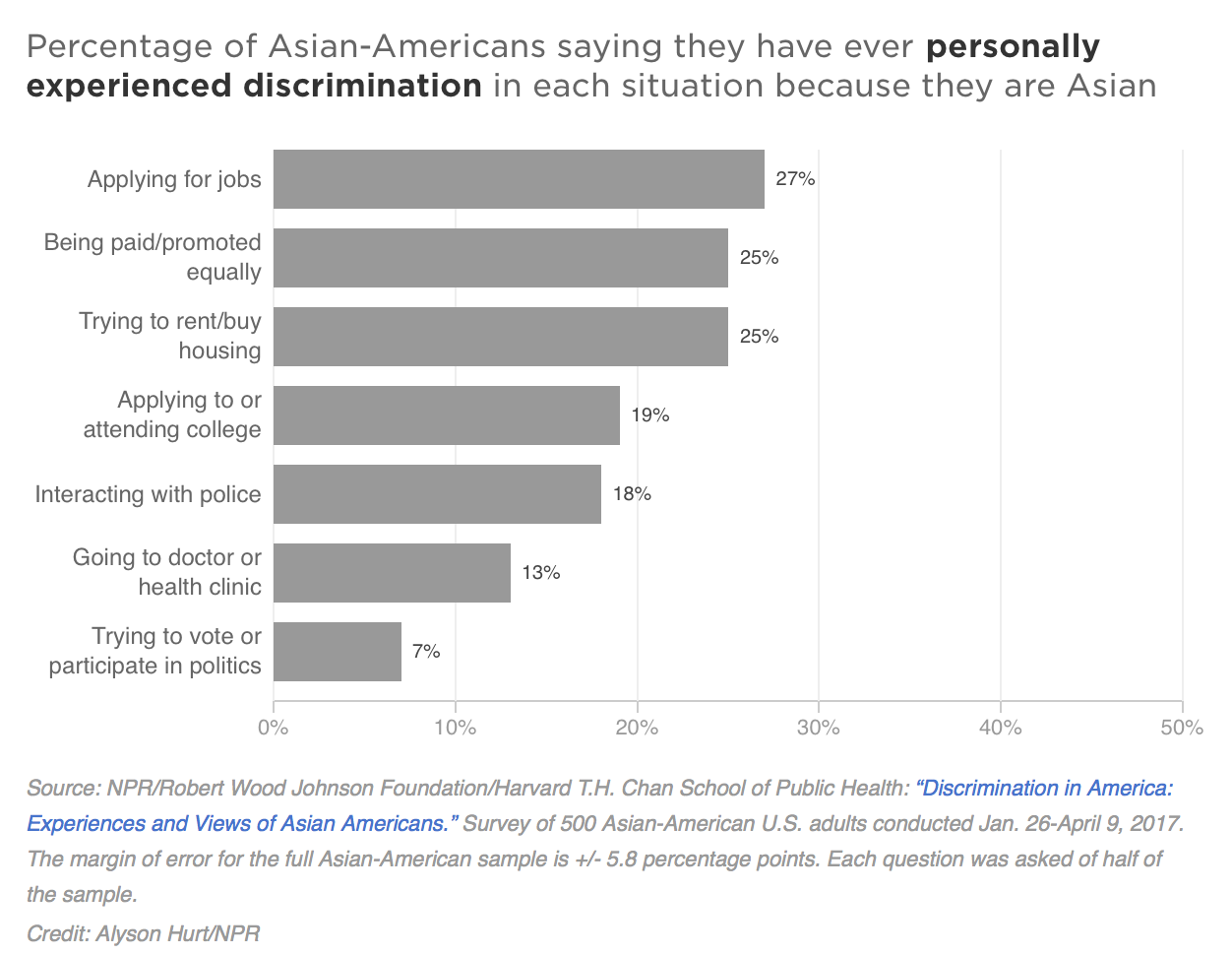
New results from an NPR survey show that large numbers of Asian-Americans experience and perceive discrimination in many areas of their daily lives. This happens despite their having average incomes that outpace other racial, ethnic and identity groups.

The poll, a collaboration among NPR, the Robert Wood Johnson Foundation and the Harvard T.H. Chan School of Public Health, also finds a wide gap between immigrant and non-immigrant Asian-Americans in reporting discrimination experiences, including violence and harassment.

“Our poll shows that Asian-American families have the highest average income among the groups we’ve surveyed, and yet the poll still finds that Asian-Americans experience persistent discrimination in housing, jobs and at college,” says Robert Blendon, professor of health policy and political analysis at the Harvard Chan School who co-directed the survey. “Over the course of our series, we are seeing again and again that income is not a shield from discrimination.”

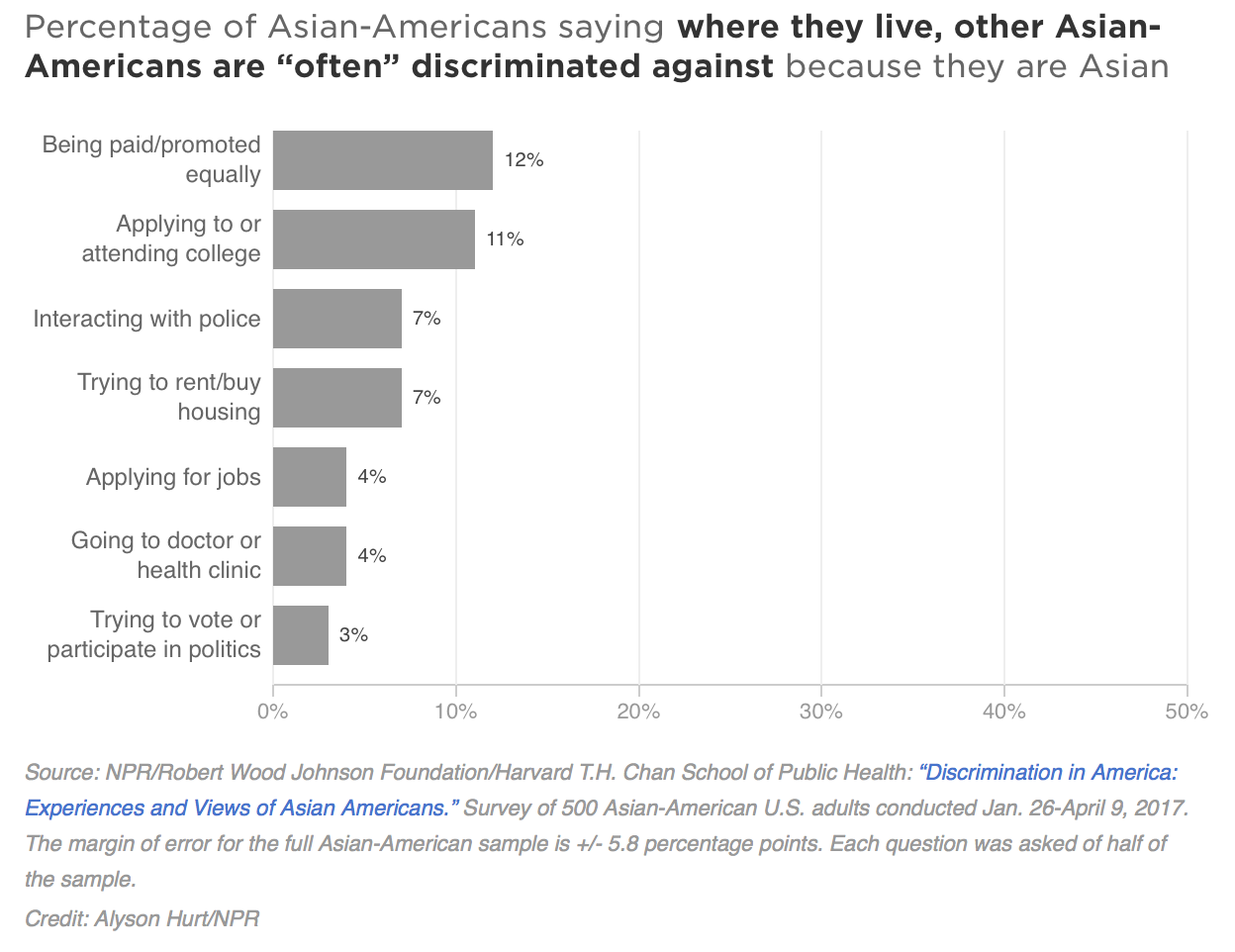
In addition to asking about personal experiences with discrimination, we also wanted to find out what people’s perceptions are of discrimination within their own neighborhoods. The numbers for Asian-Americans were lower on this measure than for personal experiences but still show that a notable level of discrimination exists in everyday life.

The survey was conducted among a nationally representative probability-based telephone (cell and landline) sample of 500 Asian-American adults. The margin of error for the total Asian-American response is 5.8 percentage points at the 95 percent confidence interval. Interviews were conducted in English, Mandarin, Cantonese and Vietnamese. Complete methodological information is in the full poll report.

Looking at the split according to immigration status, we found that nonimmigrant Asian-Americans are more than three times as likely to say they’ve experienced violence because they are Asian and more than twice as likely to say they’ve been threatened or non-sexually harassed because they are Asian.

We also saw a similar gap based on immigration status in terms of experiencing sexual harassment. But it’s important to note that our poll was done earlier this year, before the country’s widespread discussions of sexual assault and harassment in the fall. “These national conversations may have affected how people viewed or responded to their own experiences, or on their willingness to disclose these experiences in a survey,” Blendon says.

via Poll: Asian-American Discrimination Marked By Individuals’ Prejudice : NPR

Ex-StatsCan chiefs make last-ditch appeal to fix ‘egregious flaw’ in stats agency governance bill

Tend to agree with Smith and Fellegi:

A pair of former chief statisticians made a last-ditch plea to Senators last week to fix what one said was an “egregious flaw” that “fundamentally undermines” a government bill’s aim to give Statistics Canada more independence.

In an appearance in front of the Senate’s Social Affairs, Science, and Technology Committee Nov. 30, Wayne Smith and Ivan Fellegi restated the case they made in front of the House of Commons committee that studied Bill C-36: that the changes to the Statistics Act that purport to give the chief statistician more independence, should come with a more-stringent hiring process.

“I’m very conscious of the fact this is the 23rd hour in terms of this legislation,” said Mr. Smith, who served as the chief statistician from 2010 until he resigned in September 2016 in protest over the role Shared Services Canada plays in handling Statistics Canada’s information technology.

Mr. Smith called a lack of specificity in the bill over how the chief statistician is selected the “one egregious flaw in the legislation that fundamentally undermines the achievement of its objective.” The bill would change the chief statistician’s term to a fixed five years served under good behaviour, instead of the current term that lets them stay on as long as the government wants them to.

Both Mr. Smith and Mr. Fellegi—who served as the country’s chief statistician from 1985 to 2008—are calling for the creation of a three-person non-partisan selection committee to create a shortlist of candidates for the governor-in-council appointment (which would ultimately be decided by cabinet), as well as for the bill to clearly define what requirements a chief statistician should have.

“The new proposed bill gives a great deal more authority on professional issues to the chief statistician,” Mr. Fellegi said. “That makes it that much more important that he or she should be properly qualified. And an appropriately composed search committee should have that task.”

But Liberal Senator Jane Cordy (Nova Scotia), a member of the Social Affairs Committee and the bill’s sponsor in the Senate, told The Hill Times she doesn’t think the bill needs changing.

Sen. Cordy, who said she was first approached about sponsoring the bill in the spring by the government’s representative in the Senate Peter Harder (Ottawa, Ont.), pointed to comments made by Independent Senator Tony Dean (Ontario) during the Nov. 30 committee meeting that selection committees don’t eliminate potential bias.

“I’m a fan of search committees,” Sen. Dean told the former chief statisticians, but added he didn’t think the bill necessarily required changing. Instead, the recommendation could be rolled into an observation for the minister to consider.

There is precedent for choosing the chief statistician by committee, according to Mr. Fellegi, who said the appointment of his predecessor, Martin Wilk, was conducted that way. Mr. Wilk’s appointment came after a period in the late 1970s when Statistics Canada didn’t have the stellar reputation it enjoys today, Mr. Fellegi said, and needed a “transformative” leader.

“We found a transformative chief statistician who wouldn’t have applied because he was vice-president of AT&T, being paid probably five times as much, at least, as the offer from the government of Canada,” Mr. Fellegi said, adding that the search committee “basically appealed to his conscience” to have him return to Canada from the United States to take the job from 1980 to 1985.

Conservative Senator Linda Frum (Ontario), the official opposition critic for the bill in the Senate, said during her second-reading speech on Oct. 5 that the chief statistician should also be subject to approval by both houses of Parliament.

“If this government wants to demonstrate its sincere desire for a more arm’s-length relationship between the agency and the government of the day, it should support such an amendment, that parliamentary approval must be required before appointing a new chief statistician,” Sen. Frum said.

On Dec. 1, Sen. Frum’s office told The Hill Times that following the start of the committee’s study of the legislation, she still saw this as a shortcoming, but that there were no proposed amendments yet formalized.

via Ex-StatsCan chiefs make last-ditch appeal to fix ‘egregious flaw’ in stats agency governance bill – The Hill Times – The Hill Times

Facebook COO warns women that male executives may stop hiring them because of sexual harassment scandals

Header misleading – Sandberg’s comments quite different:

The chief operating officer of Facebook, has warned of a potential backlash against women in the workplace following recent high-profile sexual harassment scandals. Sheryl Sandberg, one of the most powerful businesswomen in the world, said she had already heard “rumblings” that male leaders of companies may be increasingly reluctant to hire female employees because they feared their firms becoming involved in disputes.

Sandberg urged companies to put policies in place on how to handle allegations. Writing on Facebook, she said: “I have already heard the rumblings of a backlash: ‘This is why you shouldn’t hire women.’ Actually, this is why you should.” She added: “The percentage of men who will be afraid to be alone with a female colleague has to be sky high right now.

“So much good is happening to fix workplaces right now. Let’s make sure it does not have the unintended consequence of holding women back.”

Outlining her own experiences Sandberg, 48, said she had suffered sexual harassment in the past, and continued to do so despite the power she now wields. On one occasion, early in her career, a man at a conference came to her hotel room late at night and banged on her door until she had to call security. She said: “Like almost every woman – and some men – I know, I have experienced sexual harassment in the form of unwanted sexual advances in the course of doing my job.

“A hand on my leg under the table at a meeting. Married men – all decades older than I – offering ‘career advice’ and then suggesting that they could share it with me alone late at night.”

She made clear that none of the harassment was by men she had worked for, and all of her male bosses during her career had been “not just respectful, but deeply supportive”. But in each case the harasser had more “power” than her.

A hand on my leg under the table at a meeting. Married men – all decades older than I – offering ‘career advice’ and then suggesting that they could share it with me alone late at night

She said: “That’s not a coincidence. It’s why they felt free to cross that line.

“As I’ve become more senior, and gained more power, these moments have occurred less and less frequently. But they still happen every so often.”

Sandberg said the current movement against sexual harassment was a “watershed moment” and an “opportunity that must not be lost.”

via Facebook COO warns women that male executives may stop hiring them because of sexual harassment scandals | National Post

Feds should switch to points system for parent, grandparent visas: Ghazy Mujahid

Interesting alternative.

But any new system would also likely result in criticism and questioning the relative weighting of the factors being accorded points, as well as likely longer processing times:

Equally important, the lottery system fails to meet the family-reunification goals to which Prime Minister Justin Trudeau alluded during the last election campaign: “Making it easier for families to be together here in Canada makes more than just economic sense. When Canadians have added supports like family involvement in child care, it helps productivity and drives economic growth and it brings in skilled workers we need so badly.”

These objectives can’t be met through an open lottery system. They must take into account differences in relevant capabilities of the sponsored family members and the needs of their sponsors.

For instance, grandparents who have no grandchildren needing child care would not have the same impact on the Canadian economy as those who can contribute to child care of grandchildren that may enable the non-working parent to re-enter the labour force. Giving them an equal chance of being selected is neither fair for the family nor is it in the best interests of Canada.

To fix this drawback, Canada could base the parents and grandparents selection on a points system similar to the one the country pioneered in the mid-1960s for selecting applicants eligible for applying as economic migrants.

Those wishing to apply as economic migrants are given points according to characteristics such as education, age, and language proficiency. Those planning to apply are advised not to if their total score falls below a certain minimum.

Similarly, for the parent/grandparent program, prospective applicants can be given points for relevant individual and family circumstances. In March, the Immigration Committee’s report on family reunification documented the positive and negative impacts of PGP immigration. This assessment could serve as the basis for a points system.

Here are some main characteristics of the sponsored to be taken into account, and the rationale for including them:

  • Age (as a general indicator of active status);
    Proportion of offspring in Canada (will entry really contribute to family reunification?);
  • Number of grandchildren under six years old in Canada (possibilities of contributing to child care);
  • Proficiency in official language (extent of risk of isolation in Canada);
  • Assets and pension transferable to Canada (likelihood of financial independence).

The government should consider setting up a multi-disciplinary expert panel to devise a comprehensive points system. A minimum score should be specified and prospective applicants advised not to apply if their score falls below it. This would reduce the application load.

The highest scoring 10,000 above the specified minimum should then be invited to submit completed applications.

An added advantage would be that if in any year some applicants are not approved for entry, the next highest scorers could be immediately invited to submit applications to fill the gap. This would avoid the long process of those in the waiting list being put through another round of lottery, as was done this year.

via Feds should switch to points system for parent, grandparent visas – The Hill Times – The Hill Times

Veiling is compulsory in Islam, debate unacceptable: Al-Azhar – Egypt Independent

Speaks for itself – “any debate on the topic is unacceptable”:

Egypt’s Al-Azhar, the Sunni Muslim world’s main religious institution, asserted on Monday in a fatwa, or religious decree, that it is compulsory for women in Islam to wear the veil, while those who deny this are “extremist” and “abnormal”.

Through a statement released by The International Electronic Center for Fatwas of Al-Azhar, the institution said the veil, or hijab, is an obligatory duty imposed by the teachings of Islam, and any debate on the topic is unacceptable.

“It is not acceptable that anyone from the public or non-specialized people, regardless of their culture, to voice their opinions on the matter. The hijab […] aims to preserve [women’s] feminine nature, ” the statement read.

It went on to say that the fact that the veil is compulsory in Islam helps women to become successful and productive in society while preventing them from just being seen as a body.

It added adding that in different countries around the world such as India, China and Japan women wear clothes similar to Islam’s veil as they are keen to follow the nature’s of their nations.

The statement concluded by calling on all who deny that the veil is compulsory in Islam to stop spreading their opinions or issuing fatwas on the matter as they are not specialized or authorized to speak on the issue.

via Veiling is compulsory in Islam, debate unacceptable: Al-Azhar – Egypt Independent

Governor in Council Appointments – PCO data

Governor in Council Appointments 2016 Baseline

Following the skimpy information provided in both the mandate checker and PCO’s Departmental Performance Report (DPR), I had asked PCO for more details and they were reasonably quick in getting back to me.
The correspondence below indicates that this is very much a work in progress. Hopefully, future reporting will include an annual table of GiC appointments by the four employment equity groups. Hard to the logic, for a government committed to diversity and inclusion, and one that has improved dramatically the diversity of judicial, ambassadorial and senatorial appointments, not to take this next step of more comprehensive reporting:

PCO response:

“…In February 2016, the Prime Minister announced a new approach to Governor in Council—or GIC—appointments that supports open, transparent, and merit-based selection processes for GIC appointments.
 
Significant progress has been made in making appointments.  Since March of this year, the number of appointments made under the new approach has increased approximately 300%.  To date, over 19,000 applications have been received and over 400 appointments made following an open, transparent, and merit-based selection process and approximately 740 appointments made through other selection processes.
 
Of the appointments following an open, transparent, and merit-based selection process, nearly 60% were women.  Most notably, women have been appointed for the first time to a number of leadership positions, including the Chief Science Advisor, the Chief Commissioner of the Canadian Grain Commission, the Chair of Via Rail, and the Chairperson of the Infrastructure Bank.  Over 10% are visible minorities, 10% are Indigenous peoples, and persons with disabilities are well represented.  The total representation of women serving as GIC appointees has increased by over 5% and is now over 40%.”

My reply to PCO:

“I prepared this little summary table for appointments under the new approach:
Women
VisMin
Indigenous peoples
Total
Number
236
40.4
40
400
0.59
0.101
0.1
Obviously, this is approximate but provides a basis for comparison with other EE data.
In terms of the other selection processes, I assume this would include position such as judges, heads of mission and the like and would appreciate confirmation your end. [PCO later advised that it does not include judges.]
Looking at the total number of GiC appointments (1182 in the index as of today, 40 percent women would mean about 473 women or more.
I would hope that in the future PCO would be able to provide annual tables similar to the EE reports for the public service (simplified) that would essentially tell what is a good news story more effectively and consistently. And that future DPRs are more informative.
But nevertheless this information is welcome, represents progress. Thanks for getting back to me.”

Australia’s citizenship saga resurfaces ‘legacy of pain’ for Indigenous MPs | The Guardian

Interesting wrinkle to Australia’s s 44 dual citizenship prohibition for parliamentarians (some Indigenous Canadians have likely also had citizenship issues given lack of documentation):

Requiring Indigenous politicians to prove their Australian citizenship has been an upsetting and anger-inducing process that resurfaced a colonial “legacy of hurt and pain”, two federal parliamentarians have said.

Some were unable to say when or where their family members were born because the Australian government never registered the births or recognised them as citizens.

Linda Burney, a Wiradjuri woman, was not considered an Australian citizen until she was 10 years old, and in her maiden speech described her experiences of “racism and exclusion”.

Being forced to justify her place in Australia again, as the federal parliament sought clarity on everyone’s citizenship status, was “gut-wrenching”, Burney told Guardian Australia.

In an attempt to end the continuing parliamentary chaos over breaches of section 44 of the constitution, all parliamentarians have been required to lodge declarations and evidence of their citizenship. The forms request the date and place of birth for parliamentarians, their parents and their grandparents, as well as any evidence required to show any citizenships to other nations were renounced.

“I have been made to feel quite angry about what I had to go through to find out about my father and his parents,” said Burney. “The only way that we could find out anything was to go to what was left of the old Aboriginal Protection Board records, and there was a document written by my grandfather to the mission manager on Brungle reserve, requesting permission to build a home.

“To go and have to do that, to go to the old Protection Board records, to realise the best they could do was a letter requesting permission to build a roof over their heads, it really stirred up a lot of deep emotions. Some of that was just disgust and an understanding of the way our people were treated.”

Burney said she understood there had to be a “circuit breaker” in the citizenship crisis and she hoped this process would achieve it. “Somehow or other this issue needs to be dealt with, intelligently and sensitivity, because I suspect there are people – not just Aboriginal people – who are going to find out some very difficult family histories.”

The NT Labor senator Malarndirri McCarthy told Guardian Australia there were “moments of outrage” as she sat in her office trying to complete the questionnaire. “Because just a simple act of filling out this document reminded me of how far our country still has to go in recognising First Nations people in our country, and the legacy of previous policies and the impact they still have today,” she said.

“It brings up a lot of hurt, the legacy of hurt and pain, because we reflect on very real circumstances on the past that impact on the present.”

McCarthy was raised on Yanyuwa country, near Borroloola in the Gulf of Carpentaria, to an Indigenous mother and a father of Irish descent. She is a traditional owner of Yanyuwa land and uniquely has declared as much on the parliamentary registry.

“The difficulty for my maternal side of the family is that we don’t know the dates of when my grandparents were born on Yanyuwa country and Garawa country, or even the dates of my mother’s birth, although we’ve always guessed it was around 1950,” she said. “My maternal grandmother we guessed around 1930.

“I don’t know [details for] my maternal grandfather and that’s largely because statistics and birth certificates were just not part of the way of Australia and the policies of the time didn’t include us.”

McCarthy said she had no concerns about an unknown second citizenship in her background, but added the Labor party’s vetting was strict.

Other parties appeared to be more lax. Among those to have been found ineligible is Jacqui Lambie. The former Tasmanian senator is Indigenous, but her father’s Scottish heritage bestowed upon her dual citizenship, overriding her place as a First Nations Australian.

Western Australian senator and Yawuru man Pat Dodson declined to be interviewed but in a speech to farewell Lambie he decried the system which “put to one side” her Indigenous heritage. “It’s an absolute tragedy that our constitution was written by all these white folks that never bothered to consider and incorporate the First Peoples in it,” he told the Senate.

McCarthy said: “This is what the non-Indigenous men of the day, when they wrote this constitution, this is what they determined for this country.

“The question is do we want to change that?”

To change it would require a referendum. Referendums are difficult to win – something Malcolm Turnbull recently cited to justify his total rejection of an Indigenous voice to parliament.

McCarthy said constitutional recognition of First Nations people must come before any changes to section 44. “If there is a genuine approach to [the concerns of First Nations people], and if First Nations people can see and will believe that, then any steps towards changing the constitution would probably follow suit,” she said.

via Australia’s citizenship saga resurfaces ‘legacy of pain’ for Indigenous MPs | Australia news | The Guardian

Racist cyberattacks at U of T highlight barriers to addressing anti-Blackness: Shree Paradkar

Good long read by Paradkar on the ongoing use of the n-word among some at UofT:

Justice Huyer of BSA said, “There is a list of penalties (in the code of student conduct) that was not created by us. We demand they be upheld. That’s what is acceptable for us. And going forward we will accept nothing but a safe space for Black people on campus and to do better in terms of dealing with cases of racism.”

An adequate space where Black students can feel supported is one of the other demands of the BSA, which is also seeking funding toward an anti-Black racism campaign and for the National Society of Black Engineers program, which has no physical space at all. Its members are contactable only by email, Huyer said.

“We have LGBTQ positive spaces that have signs and invitations,” she said. “We have a First Nations House for Indigenous students to come together.

“But the Black Students’ Association, we have the third-largest student association on campus. We have a cubicle that is semi-private with glass windows in a basement that can hold approximately five people and we serve hundreds.”

The students say when they tried to raise the other issues at the meeting, the faculty didn’t engage with them. “We were just met with blanks stares. And kind of silence,” said Mark.

Then the faculty suggested another meeting, a move Mark sees as a “derailing tactic” to tire them out.

“There certainly have been discussions around (office) space issues for Black students,” Welsh said. “I think these are things we are talking about right now.”

It’s past time to still be in the discussion phase of these changes. And the university could extend some of its own solutions used for other marginalized groups.

At an orientation for international students on campus, the complainant who is anonymous, says, “We were taught about how the university is an LGBTQ-friendly space and we were made very aware of the fact that we needed to use neutral pronouns, that we needed to not be transphobic, not be queer phobic because a lot of our backgrounds are countries where homophobia is unfortunately the culture.

“There shouldn’t be a reason they can’t do that as well with anti-Blackness,” she said.

There shouldn’t be a reason they can’t do that with all students. An Asian Canadian, a South Asian Canadian and a white Canadian were involved in the N-word and digital Blackface messages, she said.

“We know anti-Black racism exists on our campuses and I know there is more that we can do to address it,” said Welsh. “We need to continue to listen — and hear — what are the concerns of our students, our faculty and our staff.”

“More than anything else, students are saying, we want to see change,” said Bain.

“We’re asking for something fundamental, something concrete. We want to see the institution itself start looking at the way it functions on a day-to-day basis.”

via Racist cyberattacks at U of T highlight barriers to addressing anti-Blackness | Toronto Star

A Chinese-Canadian to his parents: ‘Privately, I yearned for your love’

Powerful personal story:

….We fought often. If I tripped on my laces, I was clumsy. If I scored below an A, I was stupid. If I wanted to hang out with my friends, I was wasting my time. I grew to resent the pressure you put on me, resolving to make your lives as difficult as you were making mine. I ran away from home in 2005 after a particularly bad fight, staying at a different friend’s house every day for a week. I spoke dismissively about you, told you I hated you, and that I couldn’t wait to leave the house. But privately, I yearned for your love and affection. I often fantasized about having the family I saw in the movies—the ones where everyone would talk like best friends and hug each other hello and goodbye.

I grudgingly continued down the path you laid out for me—getting into a prestigious business school and landing a stable nine-to-five job—until I couldn’t anymore. My job after graduation was at a top accounting firm, and it could not have been a worse fit for me. My superiors eventually caught on – in 2012, barely eight months into the job, I was laid off.

I was so embarrassed as I cleaned out my things in front of the entire office, but worse to me was the shame of having to tell you what happened. I considered throwing myself off my balcony to avoid facing you. Instead I made the decision to forge a path I could be proud of. I promised myself I would face you when I knew what that path would be.

That month, through a well-timed Craigslist ad, I found my way onto the set of a Guillermo del Toro movie as a minimum-wage extra and instantly fell in love with acting and filmmaking. I checked Craigslist every morning afterwards, applying for anything and everything I could. A few months later I booked my first national commercial and, unable to keep my new life from you any more, I finally came out to you as an actor. Five years later, serendipitous as it may seem, I am now playing myself on TV: a troubled kid, burdened by his relationship to his parents, trying to find his place in the world.

Today, although our relationship is the best it’s ever been, we still rarely talk about the past. I often catch myself replaying some of our worst confrontations in my head; it’s the unfortunate byproduct of a life spent mostly in conflict with you. But something is changing in me too, and I’m finding myself looking at the events of my childhood not through my lens, but through yours.

Liu, flanked by his parents, at his graduation from Western University.

In hindsight, I know that you were doing the best you could. Money was always tight, and so you worked hard and often; the alternative would have meant all of us going hungry. You pushed me as hard as you could so that I would never have to know the struggle of not knowing where my next meal would come from. And when I seemed to be squandering all that you had worked towards, you became frustrated. I would have been too. All I wanted as a child was a safe space, but there was no such thing for you—the threat of poverty was too great for you to risk taking your foot off the gas.

Despite some bumpy roads along the way, I believe that you have succeeded at everything you’ve set out to do. You built a better life for me. You made sure that I never had to worry about things like student debt or spending money. You instilled in me the idea that nothing could be taken for granted in this world, and that if I wanted something badly enough, I had to earn it through work. You made me into everything I am today—hardworking, ambitious, resilient—and I wouldn’t trade that for anything.

In November, you attended a screening of Kim’s Convenience at the Glenn Gould Theatre in Toronto. It was the first time you had attended any of my shows or events, and although I tried to downplay it, I was giddy with excitement on the inside. It was a perfect night: I was surrounded by the love of my friends and family, and it was better than anything I saw in those movies with the parents I dreamed of having. It took 28 years, but I finally realized that was the kind of relationship that I want with you every day. No more damaged kid. No more anger.

So it’s with a full heart that I want to tell you that I am grateful for all the gifts and privileges you bestowed upon me. I am so proud of everything you have achieved in your careers, despite overwhelming odds. You are my heroes and my inspirations, and I work hard every day not because it’s what you expect of me, but because it’s what you taught me to expect of myself.

via A Chinese-Canadian to his parents: ‘Privately, I yearned for your love’ – Macleans.ca