‘Weaponization’ of free speech prompts talk of a new hate law

One to watch:

The climate for hate speech regulation in Canada appears to be shifting.

Traditional free speech advocates are reconsidering the status quo they helped create, in which hate speech is only a Criminal Code charge that requires political approval, and so is rarely prosecuted. There is even talk of resurrecting the defunct and much maligned ban on internet hate speech, Section 13 of the Canadian Human Rights Act.

The latest example was a lecture this week by Omar Mouallem, an Edmonton journalist and board member of free expression group PEN Canada, in which he argued online racists have “weaponized” free speech against Muslims, and Canada should consider a new anti-hate law to stop them.

Mouallem told a University of Alberta audience that public discourse is “fatally flawed,” and overrun with hate propagandists who traffic in lies and provocations in order to pose as censorship victims.

The far right has “co-opted” the issue of free speech, and their activism is not a principled defence of a Charter value, but “a sly political strategy to divide opponents on the left, humiliate them and cast them as hypocrites and unconstitutional, to clear a way for unconstitutional ideas,” Mouallem said in an advance email interview.

The traditional liberal response of public censure and rebuttal is no longer effective because it just “devolves into a pissing match that goes nowhere and only makes people double down on their opinions,” he said. “Given that Facebook groups and social media are the meeting point for hate groups to organize, and that online hate speech has a great ability to spread wider and faster, I think special regulation is worth considering.”

It is striking to hear that from a board member of PEN Canada, which is devoted to fighting censorship and defending freedom of expression, and was instrumental in the legislative repeal of Section 13, a law in the Canadian Human Rights Act that banned repeated messages, by phone or internet, that were “likely to expose” protected groups to hatred or contempt.

The lecture follows news that the federal Liberal government is openly mulling bringing back Section 13, which was repealed by Parliament in 2014, but later found by courts to be constitutionally valid. It allowed for legal orders banning offenders from engaging in further hate speech, on pain of criminal contempt charges, and provided for fines of $10,000.

It also follows the backtracking of another press freedom group, Canadian Journalists for Free Expression, which launched a petition for Prime Minister Justin Trudeau to “disinvite” U.S. President Donald Trump from a G7 Summit on the grounds that his administration’s attacks on press freedom have harmed American democracy. That petition was deleted soon after it was announced, amid criticism that it hypocritically also violated the principles of free expression.

Even libraries have illustrated the shift. A memorial held in a Toronto library last year for Barbara Kulaszka, a prominent lawyer for Canadian hate propagandists, led the Toronto Public Library to change its room-booking policy, allowing officials to refuse bookings that are “likely to promote, or would have the effect of promoting, discrimination, contempt or hatred of any group.”

Tasleem Thawar, executive director of PEN Canada, said she encourages diverse perspectives on the board. There has been no change to the group’s official position “that an educated, thoughtful, and vibrantly expressive citizenry is the best defence against the spread of hateful ideologies,” she said.

“If the federal government were to propose a new law (against hate speech), we would certainly comment on the specifics and its possible effects,” she said. “However, PEN is also committed to dispelling hatreds, as stated in the PEN International Charter, including on the basis of identity markers like class, race, gender, and nationality. And it is true that hateful, marginalizing and even demonizing speech can chill the freedom of expression of the groups who are being subjected to such public bigotry.”

All this might be evidence that the culture war over Canada’s uniquely balanced approach to hate speech is set to flare up again. Old arguments are being repurposed to fit modern media. Laws that were written in the age of telephone hotlines and printed newspapers are being reconsidered in the context of Twitter, Facebook and Google.

As ever, religion — especially Islam — is at the core of the debate, according to Richard Moon, the University of Windsor law professor who authored an influential 2008 report for the Canadian Human Rights Commission that urged it to stop regulating online hate via Section 13.

In his forthcoming book Putting Faith in Hate: When Religion is the Source or Target of Hate Speech, Moon describes the traditional distinction between speech that attacks a belief, which is typically protected by law, and speech that attacks a group, which can rise to the level of banned hate speech. He argues that our understanding of religion complicates this distinction, because religion is both a personal commitment and a cultural identity. Hate speech, then, often works by falsely attributing an objectionable belief to every member of a cultural group.

“Most contemporary anti-Muslim speech takes this form, presenting Islam as a regressive and violent belief system that is incompatible with liberal democratic values. The implication is that those who identify as Muslims – those who hold such beliefs – are dangerous and should be treated accordingly. Beliefs that may be held by a fringe element in the tradition are falsely attributed to all Muslims,” Moon writes.

Mouallem, who does not identify as Muslim, is a former rapper, freelance writer, and co-author of a book on the Fort McMurray wildfire. He said he does not advocate the return of Section 13 exactly as it was. It often worked, he said, but it is “too tainted.”

Section 13 was a “messy, if not farcical process,” he said, made more so by the “manipulation” of Richard Warman, the lawyer and former Canadian Human Rights Commission staffer who effectively monopolized the law, filing nearly every case and eventually winning them all, sometimes after posing online as a neo-Nazi to gather evidence. It was also “misused,” he said, by Canadian Muslim leaders on the “wishy-washy” case of alleged anti-Islam hate speech in Maclean’s magazine.

But Canada should have some kind of “online clause” that addresses both the “uniqueness of online content” and this current historical moment in which there is “widespread vilification” of Muslims and “rapid mobilization of extremist groups.”

Now there are “flagrant” examples that would be caught by such a law, he said, such as Ezra Levant’s use of the term “rapefugees.”

“Allowing hate speech to remain in the public sphere actually signals that it’s socially acceptable, which gives licence to perpetuate it, and eventually can make it mainstream,” Mouallem said.

The expression that “sunlight is the best disinfectant,” meaning hate speech is best countered by more and better speech is “ineffective when you’re dealing with majority tyranny and certain discrimination is widely accepted. This is the unique moment of hate speech in Canada and much of the ‘West’ right now,” he said. “Society has made an exception for Islam.”

Source: ‘Weaponization’ of free speech prompts talk of a new hate law
Some of Congress’s Fiercest Immigration Critics Lead Groups That Celebrate Immigrants – Mother Jones

Fun article, with the time old nostalgia for older waves of immigrants in contrast to anti-immigration views for newer non-European waves:

Rep. Andy Harris (R-Md.) thinks President Donald Trump’s immigration framework goes too easy on undocumented immigrants. Appearing last week on a Baltimore radio program, he blasted Trump’s proposed pathway to citizenship for Dreamers—undocumented immigrants who came to United States as children—as an “amnesty” plan. Instead, along with 87 colleagues, he supports a more extreme House Republican proposal that would sharply curtail legal immigration and treat Dreamers as criminals if they fall into poverty.

So it might come as a surprise that Harris is a leader of a group that celebrates an immigrant tradition. The son of immigrants who fled Hungary and Ukraine after World War II, Harris co-chairs the Congressional Hungarian Caucus, a bipartisan group that aims to “represent interests of Hungarian American constituents.”

Harris is not alone among immigration hardliners in his advocacy for existing immigrant populations. He is just one of 11 co-sponsors of the House Republican bill who chair one of the more than 60 congressional caucuses that advocate on behalf of other nations, their immigrants, and those immigrants’ descendants. These lawmakers celebrate their own immigrant heritage as they voice support for ending the legal immigration practices that helped bring most of those immigrants to America in the first place.

Congressional caucuses are informal bodies that direct policy activity around a particular issue and serve as forums for information exchange, says Matt Glassman, a senior fellow at Georgetown University’s Government Affairs Institute who studiedcaucuses for the Congressional Research Service. The ethnic- and country-focused groups, like the Congressional Italian American Caucus and the Congressional Friends of Ireland Caucus, are typically bipartisan, serving to highlight immigrants’ contributions while also strengthening diplomatic ties with their countries of origin. Members of Congress might join one because of their own personal heritage, or to show support for an ethnic group that dominates their districts. Unlike powerful legislative blocs like the House Freedom Caucus or the Congressional Black Caucus, however, these caucuses typically serve as “interest group box-checking,” says Glassman. “I think of the vast majority of caucuses as signals to voters, more so than influencing the legislative processes.”

Some of the fiercest critics of immigration are among the most vocal cheerleaders of immigrant heritage, including their own. Rep. Lou Barletta (R-Pa.)—a grandson of Italian immigrants and member of the Congressional Italian American Caucus, who has supported legislation to celebrate Italian Heritage Month—recently wrote an op-ed urging an end to “chain migration,” a term used by immigration opponents to describe the practice of allowing immigrants to join their families in the United States. Rep. Glenn Thompson (R-Pa.), a co-chair of the German-American Caucus who has said Pennsylvania is “proud of its German heritage,” called Trump’s immigration plan “reasonable” and said in 2009 that “if they [immigrants] are here illegally, it may be a good time for them to go home.” And Rep. Jim Sensenbrenner (R-Wis.), a co-chair of both the Congressional Friends of Norway Caucus and the Congressional Friends of Liechtenstein Caucus—roles his office says stem from diplomatic efforts, cultural interest, and family relations—introduced his own hardline immigration bill in 2005, which would have criminalized living in the United States as an undocumented immigrant. All three are co-sponsors of the House Republican immigration bill, which has little chance of becoming law.

GOP hardliners have attempted to reconcile this conflict by separating the past from the present. “If people coming into the United States don’t have a job, that weighs on local resources,” says an aide to Barletta, arguing that today’s 327 million Americans strain land and economic opportunity more than ever before. Barletta, who previously served as mayor of Hazleton, Pennsylvania, passed the nation’s first local ordinance that punished employers and landlords for hiring or leasing to undocumented immigrants, a response to Central American immigrants settling in the small city. The aide said these measures help keep revenue and population growing at the same rate.

Thomas Guglielmo, a scholar of American immigration history at George Washington University, says the tendency to celebrate old immigrant populations while demonizing new ones has a long history. In the 1920s, Congress established a policy that set quotas based on the number of immigrants already in the United States from each country. The system significantly restricted southern and eastern European immigrants while favoring those from northern and western Europe, which had sent the first mass wave of immigrants to the United States in the mid-19th century. As the second wave of immigrants—who came from eastern and southern Europe in the early 20th century—gained political power, they advocated for a new system that prioritized family ties, giving immigrants from their homelands a leg up over those from elsewhere in the world.

After the 1965 Immigration and Nationality Act curtailed immigration from Europe, Irish- and Italian-American lawmakers led the push to establish the diversity immigrant visa lottery, which provides visas to people from countries with low rates of immigration to the United States. Thanks in part to the lottery, the share of immigrants from outside Europe has increased from one out of eight in 1960 to nine out of 10 in 2010. Republicans are now trying to end the diversity lottery.

Guglielmo says many lawmakers fail to recognize the similarities in the struggles of the European immigrants of the past and the immigrants from elsewhere in the world today. “These folks who revel in their Euro-ethnic heritage don’t really understand that history at all,” he says. “To the extent that they see difficulty in the past, it’s held up as this badge of honor.”

via Some of Congress’s Fiercest Immigration Critics Lead Groups That Celebrate Immigrants – Mother Jones

TPS solution for Haitians not a priority in immigration debate | Miami Herald

Implications for ongoing flows across the Canada US border:

The U.S. Senate isn’t seriously considering a path to permanent residency or citizenship for more than 300,000 Temporary Protected Status recipients as part of an immigration deal to keep 689,000 Dreamers from being deported.

Two senators involved in ongoing immigration talks, Florida Democrat Bill Nelson and Arizona Republican Jeff Flake, said there aren’t active serious discussions about the fate of TPS holders from Haiti, El Salvador, Nicaragua and Honduras.

“The bipartisan group is trying to get some consensus of what can pass that will protect the DACA Dreamers,” Nelson said. “What I expect is within two weeks we are going to get a DACA solution. I would hope it includes TPS, but if it messes up getting votes in order to pass the Dreamers, I think that would not be considered then and would be held for more comprehensive immigration.”

Flake said a proposal did exist at one point to take some visas from the diversity lottery and apply them to TPS recipients. But the idea, part of an immigration proposal by Sens. Lindsey Graham, R-S.C., and Dick Durbin, D-Ill., was rejected by President Donald Trump.

TPS has been discussed at recent Senate immigration meetings, according to Flake, but the topic isn’t under serious consideration as Senate Democrats and Republicans try to negotiate an immigration proposal that will receive 60 votes in the upper chamber, along with the approval of the GOP-controlled House of Representatives and Trump.

“It’s been discussed but nothing firm,” Flake said, adding there’s “no serious discussion” about TPS.

The Senate stance on TPS comes after Trump reportedly blasted TPS recipients in a White House meeting, saying, “Why do we need more Haitians? Take them out,” and “Why are we having all these people from shithole countries come here?” — in reference to immigrants living and working legally in the United States under TPS and to making changes to the diversity lottery system.

Several senators, including Florida Republican Marco Rubio, have said in recent weeks that any immigration bill should focus on finding a solution for DACA recipients in exchange for stronger border security measures, though Trump has said he wants to end the diversity lottery and cut legal immigration as part of any deal to give DACA recipients and DACA-eligible unauthorized immigrants a path to citizenship. Trump’s proposal is a non-starter for most Democrats.

“Legal status for those currently in DACA & stronger Border Security has overwhelming support & is ideal starting point for Senate debate,” Rubio tweeted on Tuesday.

South Florida is home to the nation’s largest concentration of Haitians, along with a sizable number of Salvadorans, Hondurans and Nicaraguans.

Nelson said “you have to create a different kind of category” for current TPS recipients, because a mass exodus of 60,000 Haitians from the U.S. would have ripple effects on the economies of both South Florida and Haiti. Multiple bills that would provide a path to permanent residency or citizenship for some or all TPS recipients have been proposed in the House of Representatives, but a vote on any TPS bill isn’t imminent.

“In solving immigration problems you really have to also solve what are you doing with TPS because … there’s going to be cases where, for example Haiti, you can’t return 60,000 people all at once to Haiti,” Nelson said. “The economy of Haiti could not swallow that, but that’s more for immigration reform.”

Miami Republican Rep. Ileana Ros-Lehtinen has signed on to multiple bills that would give TPS recipients a path to permanent citizenship and complained that most members of Congress were unaware of the issue. On Wednesday she said there would be more of an appetite to find a solution for TPS recipients if DACA recipients and DACA-eligible immigrants had already been protected from deportation by Congress.

“There just isn’t room in people’s hearts right now,” Ros-Lehtinen said.

Senate Majority Leader Mitch McConnell said last month he would agree to debate and vote on an immigration bill in the Senate, though he didn’t agree on a specific proposal. House Minority Leader Nancy Pelosi gave a lengthy speech on Wednesday opposing a massive budget deal that would keep the government open because “the package does nothing to advance bipartisan legislation to protect Dreamers.”

The Department of Homeland Security canceled TPS for Haiti, El Salvador and Nicaragua in recent months and extended Honduras’ TPS designation until July in order to formulate a final decision. Nearly 60,000 Haitians, 200,000 Salvadorans, 2,500 Nicaraguans and potentially 57,000 Hondurans could be forced to leave the country in 2019 unless Congress passes legislation.

“I think that we really have to knuckle down and bring our nation into a 21st century immigration system. It’s ridiculous the way we are operating right now,” said Rep. Yvette Clarke, D-N.Y., who has also proposed multiple bills to prevent TPS recipients from being deported.

“The lack of compassion, the demonization of immigrants, it’s not healthy for our country.”

via TPS solution for Haitians not a priority in immigration debate | Miami Herald

Gender persecution the top reason women seek asylum in Canada

More from the CBC analysis of IRB data (see Acceptance rate for asylum seekers in Canada at a 27-year high – Canada – CBC News):

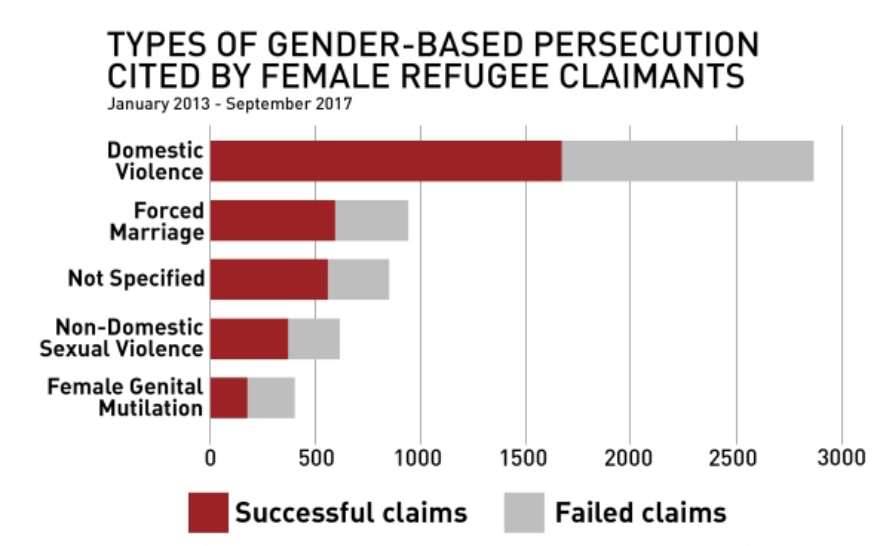
A CBC News investigation reveals more than 15 per cent of female asylum seekers who arrived in this country in the past five years said they did so to escape persecution for being a woman. It’s the most common reason women seek refuge in Canada, ahead of religious, ethnic or political persecution.

Gender persecution includes practices such as forced marriage and female genital mutilation, as well as domestic abuse at the hands of a partner or family member, which accounted for half of the claims in the data obtained by CBC.

The Immigration and Refugee Board (IRB) decided on nearly 3,000 domestic violence claims between 2013 and 2017, accepting 58 per cent of them.

Claims based on domestic violence are, like all refugee claims, assessed based on two elements: the risk an individual faces and to what degree they can be protected in their home country, said Catherine Dauvergne, dean of the University of British Columbia’s Peter A. Allard Law School and an expert in refugee and migration law.

“In cases of domestic violence, or really any persecutory harm which happens in the private sphere, the analysis almost always ends up focusing on what kind of state protection is available,” she said.

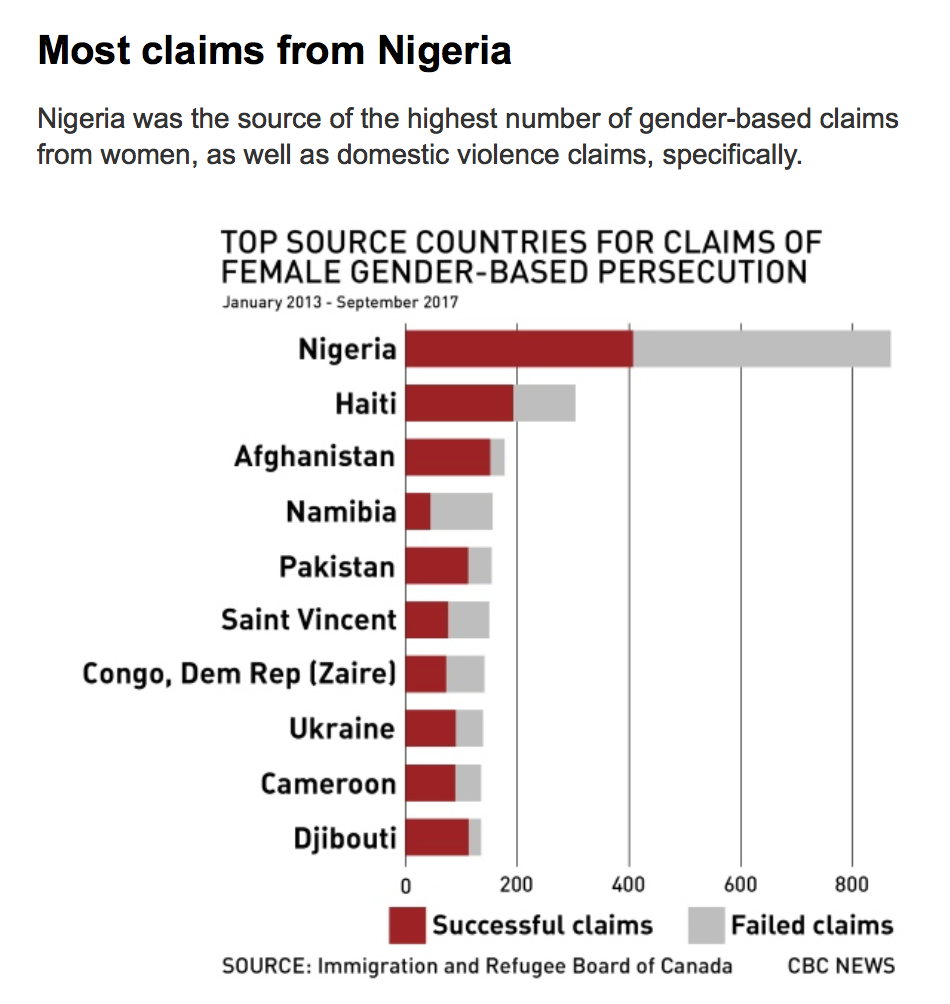
“The high number of claims that you’re seeing in this dataset is really reflective of the lack of organized, regular, reliable, dependable protection for women in all sorts of places around the world.”Nigeria was the source of the highest number of gender-based claims from women, as well as domestic violence claims, specifically.

In many parts of Nigeria, people believe women should be subservient to men, said Comfort Ero, a Nigerian-Canadian author and women’s rights advocate.

A woman who goes to the police to report domestic abuse would typically be sent home, Ero said, and even chastised by police for betraying her husband.

via Gender persecution the top reason women seek asylum in Canada – Canada – CBC News

Taking Back the Language | Noah Rothman

Nice reminder that language can but both ways by Rothman:

Canadian Prime Minister Justin Trudeau stumbled into controversy this week, although it was perhaps unwarranted. Trudeau became the subject of derision and mockery when he interrupted a woman at a town hall to correct her use of the term “mankind,” suggesting that she replace this dated designation with the more inclusive “peoplekind.” He only offered his proposal after enduring several minutes of a rambling new-age monologueregarding the chemical composition of “maternal love.” Trudeau’s interjection was probably flippant, but neither his interlocutor nor his critics seemed to notice. It’s hard to blame them.

When it comes to subservience to the many demands that identity politics makes on language and behavior, Canada’s prime minister takes a back seat to no one. It’s only prudent to assume Trudeau’s mawkishness is earnest. What’s more, the fact that “gendered” nouns and pronouns, including “mankind,” find themselves in the censors’ crosshairs isn’t exactly news. The popular grammar-checking program Grammarly flags “mankind” for “possible gender-biased language” and suggests more neutral substitutes like “humankind” or “humanity.” Learning to love unidiomatic expressions and consigning gender-specific language to history is a fixation of political activists posing as academicians, even if legitimate etymological scholars cannot support these arguments by citing linguistic corpora. Those who resent an increasingly overbroad definition of what constitutes offensive language are primed for a fight.

Language policing has been the stock-in-trade of a particular type of activist for decades, much to the consternation of both conservatives and liberals interested more in clarity than conformity. Recently, though, the intramural debate on the left over the limited utility of scrutinizing potentially objectionable speech rather than the ideas conveyed by that speech has been relegated to the back burner. That’s for a good reason.

Donald Trump’s presidency, much like his candidacy, is a brusque counterattack against “PC culture.” Often, what Trump and his supporters call “politically incorrect” language is just plain rudeness. The value of the kind of speech they find delightfully provocative isn’t its concision but its capacity to offend the right people. Thus, some self-styled arbiters of linguistic enlightenment might be tempted to dismiss Trump’s campaign against ambiguous semantics as nothing more than a brutish primal scream. If so, they would have failed to properly appreciate the threat Trump and the presidential pulpit he commands represent to their capacity to shape the terms of the debate through language. Trump isn’t limited to displays of rhetorical brute force. Sometimes, he and his speechwriters are capable of compelling eloquence.

Amid a blizzard of FBI texts, dueling intelligence committee memos, and legalisms regarding the oversight of America’s necessarily secretive espionage courts, the State of the Union address has all but been forgotten in Washington. It’s less likely, though, that a well-received speech watched by at least 46 million Americans will be so quickly forgotten across the country. And that should concern liberals because if there was any single line in that speech that won’t be overlooked, it was one that cuts at the heart of the Democratic Party’s ability to lay claim to the moral high ground. “My duty and the sacred duty of every elected official in this chamber is to defend Americans, to protect their safety, their families, their communities and their right to the American dream,” Trump said. “Because Americans are dreamers, too.” This was a masterful line. Its potency has been underestimated, and not just by those who resent the restrictive immigration policies it was designed to advance.

The name of the bipartisan 2001 “Development, Relief, and Education for Alien Minors Act” transgressed a little in order to achieve a lot for the children of illegal immigrants brought into the U.S. as minors. Referring to this demographic as “alien” is taboo, and an offense against modern sensibilities. But to describe them as “DREAMers” yields a windfall of sympathy for this already deserving group of largely naturalized non-citizens. Trump’s turn of phrase spreads the dreaming around, thus diluting the designation DREAMer of much of its unique sympathy.

Democrats might have missed the significance of this expression amid their irritation over another set phrase in that speech: “chain migration.” Trump’s use of this term during the State of the Union Address to describe the process by which legal immigrants sponsor members of their extended family to become American citizens elicited boos from Democrats. Many implied the phrase is a new invention with racist connotations, but the term has been used by policymakers (including some of these same Democrats) for decades. Maybe it was the self-evident hypocrisy, or maybe it was the contrived effort to move the goalposts. For whatever reason, the Democrats’ campaign to label “chain migration” a racist term landed with a thud. Time was that the left could dictate the terms of a debate by controlling the language of its participants, but their grip on the national dialogue may be slipping. The power of the presidency—you’ll forgive the expression—trumps the braying of the pedantic opposition.

The energy expended by political activists on policing speech is not wasted; dictating the boundaries of what constitutes acceptable discourse is a profitable and productive enterprise. If the right is getting into the game, they’re only following a course forged by their political adversaries.

via Taking Back the Language | commentary

After the ‘Trump effect’ slowed illegal immigration, numbers rise again as Central Americans fear conditions at home

Good reporting of the fluctuations and the push factors:

Illegal crossings along the U.S.-Mexico border, after declining in early 2017, began an unexpected upturn last spring that only recently receded, according to new government figures.

The figures reflect the up-and-down nature of illegal immigration and are reminders that multiple factors — from politics to weather to conditions in home countries — influence who tries to come to the United States and when.

Apprehensions on the southern border in October 2016, a month before Donald Trump’s election, topped 66,000. After Trump’s victory, the number of migrants trying to enter the U.S. illegally reached a 17-year low.

Monthly apprehensions continued to drop into 2017, hitting 15,766 in April, when the downward trend reversed. Apprehensions rose each month to 40,513 in December. Migrant advocates said the “Trump effect” discouraging illegal immigration might be wearing off.

But last month, apprehensions decreased again. It’s not clear whether the post-holiday decrease is seasonal, or whether it will continue.

There were 35,822 migrants apprehended on the southern border in January, according to figures released Wednesday by U.S. Customs and Border Protection. That’s not as many as in December, but it’s more than were apprehended each month last February to October.

 
  ()


The number of families and unaccompanied children caught crossing the border, which rose nearly every month since last spring, also dropped slightly last month to 25,980, but remained more than twice April’s total, 11,127.

In releasing the numbers Wednesday, Homeland Security spokesman Tyler Houlton noted the apprehension figures for children and families were still high.

“Front-line personnel are required to release tens of thousands of unaccompanied alien children and illegal family units into the United States each year due to current loopholes in our immigration laws. This month we saw an unacceptable number of UACs [unaccompanied children] and family units flood our border because of these catch and release loopholes,” he said. “To secure our borders and make America safer, Congress must act to close these legal loopholes that have created incentives for illegal immigrants.”

In Texas’ Rio Grande Valley, so many migrant families with small children arrive daily — more than 15,500 family members so far this fiscal year — that volunteers at a local shelter set up a play area in the corner.

When the number of unaccompanied migrant children caught crossing began to increase in April, fewer than 1,000 were apprehended a month. By last month, that had grown to 3,227. The number of family members caught crossing grew even faster during that time, from 1,118 in April to 5,656 last month.

When Elvis Antonio Muniya Mendez arrived at the shelter last month from Honduras with his 15-year-old son, the playpen was packed with the children of 100 fellow Central American migrants caught crossing the border illegally and released that day. Muniya, 36, had fled a gang that killed his 26-year-old brother the month before. He was hoping to join another brother in Indiana. He and his son were released with a notice to appear in immigration court, which he planned to attend.

“I want to live here legally, without fear,” he said.

Trump administration officials have proposed detaining more families, but that’s not happening in the Rio Grande Valley, where many are released like Muniya with notices to appear in court. The border shelter where Muniya stopped, Sacred Heart, saw the number of migrants arriving drop at the end of last year only to increase recently, said the director, Sister Norma Pimentel.

“I’ve never seen so many children be part of this migration,” Pimentel said as she surveyed the shelter, which had welcomed 60 migrants the day before.

Children who cross the border unaccompanied by an adult are sheltered by the federal Office of Refugee Resettlement and placed with relatives or other sponsors in the U.S. The agency has about 9,900 shelter beds spread out at various facilities. As of this week, the agency was sheltering 7,800 youths.

Children who cross the border with a parent may be released with notices to appear in court or held at special family detention centers. Trump administration officials have proposed detaining more of the families. But space is limited. As of Monday, the detention centers held 1,896 people. Only one of them can hold fathers, and attorneys said it’s always full, so men who cross with children are often released with a notice to appear in court.

Advocates for greater restrictions on immigration say more needs to be done to hold parents who cross with their children accountable. They say such parents put their children at risk by making the dangerous journey. Andrew Arthur, a former immigration judge now serving as a resident fellow in law and policy at the conservative Washington-based Center for Immigration Studies, said the way migrants are treated on the border encourages family migration.

“The reason the children are there to begin with is this belief that a parent with a child will not be detained,” Arthur said. That assumption, he said, is wrong.

He said Congress and the Trump administration’s unwillingness to end the Deferred Action for Childhood Arrivals program has also encouraged migrant families to make the trip now in hopes of benefiting from a “DACA amnesty,” even though the program is limited to those who grew up in the U.S.

But migrants and advocates said they were driven to cross the border more by conditions in Central America — gang violence and economic downturns — than by U.S. policies.

Ruben Garcia is director of Annunciation House, an El Paso shelter for recent migrants that saw arrivals spike at the end of last year into early January, then dip recently.

“Until there is a greater capacity to detain everyone who comes in, you’re going to see these periodic surges, waves,” Garcia said. “Many of these countries, you just cannot live in them. People will tell you ‘It’s just dangerous to walk around in our neighborhood, you can’t make a living, you’re afraid someone’s going to extort you, you’re afraid to send your kids to school.’ “

For women of colour, there’s a gap within the pay gap: Melayna Williams

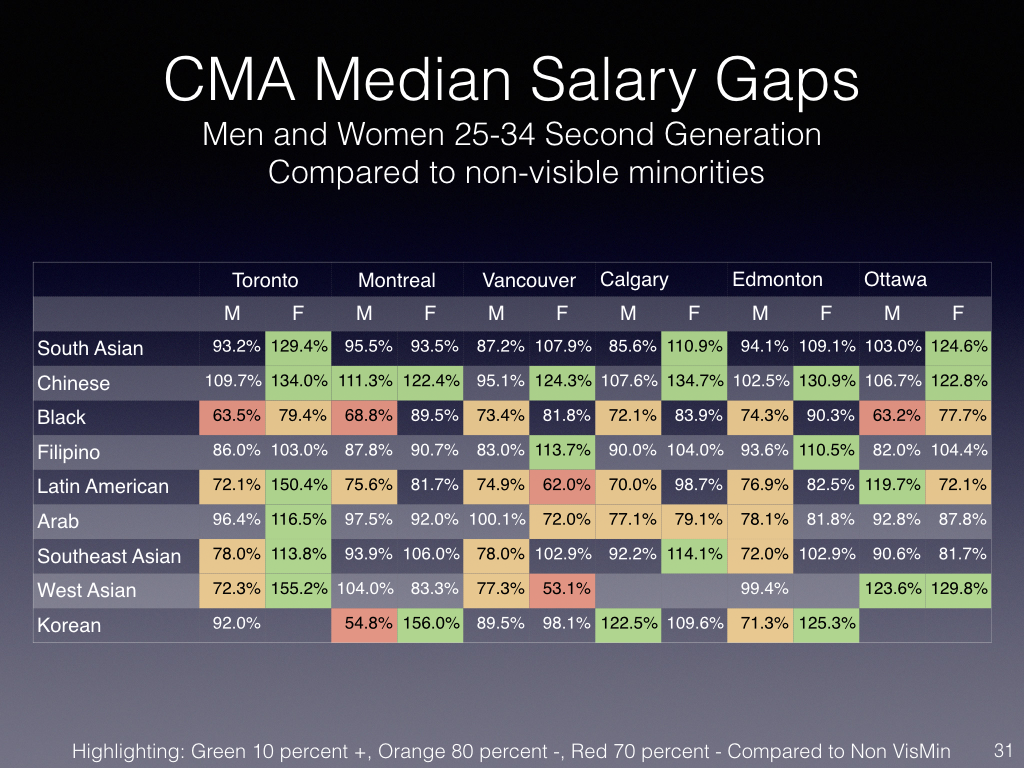
Have been working through some of the Census data and the gender gap works both ways depending on the group as the above chart indicates.

Given Williams’ focus on the Black community, which the data supports, her perspective is understandable but the data shows a more complex reality among the different minority groups and gender:

The gender wage gap remains a pertinent issue in Canada, despite how long women have been lending their labour to the workforce. And we often hear statistics that contrast two categories: men and women. On this, the numbers are stark.

But that data doesn’t incorporate filters around identity and background of women, an omission that effectively erases the compounding discrimination faced by non-white women in Canada. A lens that compares only men and women sets up women’s rights as a replica of patriarchy, where one group is favoured over everyone else; in doing so it reinforces the rigid power structures that have brought us to this point. But including race in the analysis reveals a different kind of gender gap that’s perhaps even more alarming than the broader issue.

In a 2011 Canadian Centre for Policy Alternatives report examining census data from 2006, Sheila Block and Grace-Edward Galabuzi found dire income disparities for racialized Canadians. They earn 81.4 cents for each dollar white Canadians make, and the jobs are typically less desirable: low wages, precarious, non-permanent. Add the filter of gender, though, and a much wider, more worrisome gulf appears: “Racialized women earned 55.6 cents for every dollar non-racialized men earned in 2005 . . . Racialized men made 77.9 cents for every dollar non-racialized men earned,” wrote Block and Galabuzi. “The gap narrows even further when comparing racialized and non-racialized women. Racialized women earned 88.2 cents for every dollar that non-racialized women earned.”

Research has been done to identify the core issues and advance solutions around the position of Indigenous and Canadian women of colour in the work market. “Inequality, discrimination and a segmented labour market have left women of colour with earnings at just 64 per cent of men’s, and Aboriginal women’s earnings at just 46 per cent of men’s,” wrote Lisa Lambert in a 2010 paper titled “Gender wage gap even more pronounced for Aboriginal women.” For women of colour and Indigenous women in Canada, she writes, “the earnings situation is inexcusable.”

How are we closer to gender parity in Canada when the gender gap we often think about ignores the unique struggles of women of colour and Indigenous women? If white men are still making more money than white women, can this be acknowledged while addressing the fact that women of colour fall far below both? If we actually believe in the principles of equality with which Canada so proudly associates itself, we must acknowledge both crises: the gap between men and women, and that between racialized women and everyone else.

Source: For women of colour, there’s a gap within the pay gap

Trump immigration plan could keep whites in majority for up to 5 more years – Washington Post

Another example of good data-based analysis:

President Trump’s proposal to cut legal immigration rates would delay the date that white Americans become a minority of the population by as few as one or as many as five additional years, according to an analysis by The Washington Post.

The plan, released by the White House last month, would scale back a program that allows people residing in America to sponsor family members living abroad for green cards, and would eliminate the “diversity visa program” that benefits immigrants in countries with historically low levels of migration to the U.S. Together, the changes would disproportionately affect immigrants from Latin America and Africa.

Currently, the Census Bureau projects that minority groups will outnumber non-Hispanic whites in America in 2044. The Post’s analysis projects that, were Trump’s plan to be implemented, the date would now be between 2045 and 2049, depending on how parts of it are implemented.

(The Post’s methodology for estimating the annual impact of Trump’s proposed cuts is explained in more detail at the bottom of this story. Projecting this far into the future based entails certain assumptions that could alter the range, but demographic experts said The Post’s approach was reasonable.)

All told, the proposal could cut off entry for more than 20 million legal immigrants over the next four decades. The change could have profound effects on the size of the American population and its composition, altering projections for economic growth and the age of the nation’s workforce, as well as shaping its politics and culture, demographers and immigration experts say.

“By greatly slashing the number of Hispanic and black African immigrants entering America, this proposal would reshape the future United States. Decades ahead, many fewer of us would be nonwhite, or have nonwhite people in our families,” said Michael Clemens, an economist at the Center for Global Development (CGD), a think tank that has been critical of the proposal. “Selectively blocking immigrant groups changes who America is. This is the biggest attempt in a century to do that.”

Trump’s plan calls for eliminating all family-based visa programs that are not used for sponsoring either minor children or spouses. That means several current family-based visa programs – including those that allow sponsorship for siblings, adult parents and adult children – would be canceled. It also calls for the elimination of the diversity visa lottery, and the reallocation of its 50,000 visas to reduce the number of immigrants already on a backlog and to go to a new visa based on “merit.”

The Post analyzed a low-end and high-end estimate for cuts to legal immigration under the Trump plan. The low-end estimate, provided by Numbers USA, a group that favors limiting immigration, suggests that about 300,000 fewer immigrants will be admitted legally on an annual basis. A high-end estimate from the Cato Institute, which favors immigration, suggests as many 500,000 fewer immigrants would be admitted. Cato bases its number, in part, on assumptions that more family visa categories will be cut.

Last August, Trump endorsed a Senate bill written by Sens. Tom Cotton , R-Ark., and David Perdue, R-Ga., that would cut legal immigration levels by close to 500,000 people annually, according to estimates by the bill’s authors. The White House has not released any estimates of its own plan.

If Trump’s plan is not implemented, the white share of the population is expected to fall from above 60 percent in 2018 to below 45 percent in 2060. The Post’s lower estimates of the impact of Trump’s proposal show whites staying the majority group until 2046.

To its defenders, the White House proposal offers a reasonable compromise. Trump would move America to an immigration system based less on bringing families together or encouraging diversity and more on bringing in those with skills proven to the economy. (He also proposes protecting about 1.8 million young immigrants known as “dreamers” in exchange for a significant boost to funding for border enforcement and a border wall.)

“It is time to begin moving toward a merit-based immigration system – one that admits people who are skilled, who want to work, who will contribute to our society, and who will love and respect our country,” Trump said in his State of the Union address last week.

But by reducing the country’s overall population, the plan would eventually reduce the overall growth rate of the American economy. Under Trump’s plan, the American economy could be more than $1 trillion smaller than it would have been two decades from now. That’s largely because the economy would have fewer workers.

The plan could also raise the median age of the American worker. About four of every five immigrants is projected to be under the age of 40, while only half of the country’s overall population is that young, according to Census Bureau data. A demographic crunch is already expected due to millions of upcoming retirements from the aging “baby boomer” generation, raising concerns about the long-term solvency of programs such as Social Security and Medicare that rely on worker contributions.

The plans could have long-term ramifications for America’s political system, given that about 54 percent of all immigrants are naturalized within 10 years and thus able to vote, although naturalization rates vary widely based on immigrants’ country of origin, according to the latest data from U.S. Citizenship and Immigration Services.

Hispanic immigrants who are registered voters favor Democrats over Republicans by a 70 to 18 margin, and registered voters who are Asian immigrants favor Democrats by a 50 to 33 margin, according to the most recent data available from the Pew Research Center. (Similar data was not available for African immigrants.) Approximately 78 percent of immigrants from Africa and 65 percent of immigrants from Asia were naturalized within 10 years.

But while these effects of delaying America’s diversification would be significant, they would not fundamentally change the country’s demographic destiny. Experts say the main driver of diversification in America is the native-born Hispanic population, which grew by about five million from 2010 to 2016, just as the native-born white population shrank by about 400,000 over the same time period, according to Census Bureau data.

Among young Americans, the share of the non-Hispanic white population is already under 60 percent – a number that falls close to 50 percent among newborns and toddlers.

“You can shut the door to everyone in the world and that won’t change,” said Roberto Suro, an immigration and demography expert at the University of Southern California. “The president can’t do anything about that. If your primary concern is that the American population is becoming less white, it’s already too late.”

But if Trump’s plan were put in place, many of the family immigrants who would eventually be exposed to the cuts come from Latin America. In fiscal year 2017, about 28,000 Mexicans received family-based visas, with immigrants from Asia receiving almost 90,000 and immigrants from Central America and the Caribbean receiving more than 60,000, according to State Department data.

The changes to legal immigration could vary widely depending on unforeseeable events, including increased economic development in Asian and African countries, dislocation caused by climate change or decisions made by future administrations.

William Frey, a demographer at the Brookings Institution , produced a separate estimate of the impact of Trump’s proposed cut to legal immigration. He found that the plan would delay the arrival of a “minority-majority” nation by three years, to 2047, and stressed his projections were the best possible with the publicly available information.

Another big factor is what happens to the population of roughly 11 million undocumented immigrants, including the “dreamers,” currently in the country. The Post’s calculations (like the Census Bureau’s) currently assume they will stay. But their future status is unresolved, and if any significant number of them are forced to leave the country, it could push back the minority-majority date as well.

“The President has laid out a reasonable framework that addresses the key security issues identified by the frontline men and women” of the Department of Homeland Security, said Tyler Houlton, an agency spokesman, in a statement. “It secures the borders and ensures we can remove those we apprehend, including criminal aliens. It also seeks to protect nuclear family migration while ending two problematic visa programs that do not meet the economic or security needs of the country.”

Trump’s proposal is unlikely to be implemented in its current form. It requires congressional approval, and Democratic leadership opposes it.

“These historically high levels of legal immigration only date back a few decades,” said Chris Chmielenski, director of content and activism at NumbersUSA. “The numbers we’ve seen recently are abnormal, and Trump’s proposal would eventually return us closer to historical levels.”

Immigration advocates say the percentage of the foreign-born population has been higher at several points in American history, even if the overall number of incoming immigrants has increased. Looking at the share of the population, which accounts for overall population growth, recent levels of legal immigration appear roughly in line with historical averages, with a decrease after World War II an outlier, according to Migration Policy Institute statistics.

“Recent immigration flows have been a small fraction of historical levels,” said Clemens of CGD.

Others who favor immigration restrictions have pointed to the necessity of reducing what they call the social disruption of high levels of immigration, which strikes some liberal critics as code for keeping America’s white population in the majority.

“We can’t restore our civilization with somebody else’s babies,” Rep. Steve King, R-Iowa, an immigration restrictionist in Congress, said on Twitter last year.

One of the biggest unknowns is how long new immigrants will identify as racial minorities.

Some academics, as Duke Professor William Darity Jr. wrote in The American Prospect, argue that many Latino immigrants “identify less as Hispanic and more as non-Hispanic white” the longer they stay in America – a phenomenon similar to the absorption of Irish and Italian immigrants into the idea of “whiteness.”

Other demographers say a real and important shift is underway, with important consequences for American politics. They note that many Hispanics already identify as white and yet still vote like a minority group. “The contention that [Hispanics] will think of themselves as white in the future is unsettled,” said Ruy Teixeira, a senior fellow at the Center for American Progress and author of a book about how demographic changes will affect American politics. “It definitely seems like they’re a different breed of cat.”

But perhaps the most lasting impact of Trump’s policies would be not to America, but to the millions of immigrants from poor and developing countries that the United States would be denying entry to, said Angélica Cházaro, a law professor at the University of Washington who specializes in questions of immigration.

“We’re talking about susceptibility to pain and violence and economic and social instability for millions of black and brown people,” Cházaro said. “People have organized their lives around the possibility of legal immigration, and this forecloses that route.”

Methodology

In 2014, the Census Bureau projected the U.S. population by race, ethnicity, sex, age and nativity. Those projections, the most recent available, are the basis for the prediction that the country will become “majority minority” in 2044.

To adjust those forecasts, we assumed cuts of between 300,000 and 500,000 per year and we assumed the cuts would be applied proportionally to each race and ethnicity based on their forecast representation in the immigrant population. The 300,000 estimate from NumbersUSA comes from projections of the Trump administration’s plan to cut several kinds of family-based immigration visas – those for siblings (65,000 visas annually), those for adult children (another 50,000) and those for adult parents of immigrants (another 125,000). NumbersUSA also projects a 55,000 reduction in annual visas awarded from the elimination of the diversity visa lottery.

The high estimate of Trump’s proposal found by the Cato Institute starts with all of the cuts found by NumbersUSA. But Cato also says other family-based visa programs are likely to be cut under Trump’s plan. For instance, Cato says a program for visas for children of non-citizens will be cut, because a Senate proposal similar to the White House framework eliminates it. That accounts for an additional 95,000 fewer visas annually between the groups’ projections. Cato also projects the annual impact of cutting visas for adult parents will be far greater than NumbersUSA does, because Cato looked at the number of these visas awarded in 2016, whereas NumbersUSA took a 10-year average of these visas. That accounts for an additional difference of 50,000.

We projected children that the lost immigrants would have had based on Census Bureau estimates of their female population of childbearing age, plus Pew Research projections of first-generation immigrant fertility by race and origin. In some cases, when it was the only data available, we used Census Bureau figures for “black only” and “Asian only” as a rough analog for “black, non-Hispanic” and “Asian, non-Hispanic.” Other groups were treated similarly.

The Census Bureau made no distinction between documented and undocumented immigrants. Our estimates only include the policy’s direct effect on legal immigration, but our models of the race, age and sex of immigrants are based on the full immigrant population. We found that more complicated models produced similar results.

We arrived at rough estimates of GDP growth by comparing our predictions for the country’s entire population under various scenarios with forecasts of per-person economic output by PwC , a global consulting firm. The estimates don’t account for how the exclusion of certain groups of immigrants would change the overall age, education and skill level of the labor force.

via Trump immigration plan could keep whites in majority for up to 5 more years – Chicago Tribune

Trump’s Chain-Immigration Plan Takes Aim at Asia – Bloomberg

Noah Smith provides a detailed analysis of Asian “chain migration,” nicely contrasting the negative narrative with respect to Mexico and Central Americans with the strong economic outcomes of Asian immigrants admitted under the US equivalents to family class:

“Chain migration.” It’s a term that’s on the lips of lots of people in the immigration debate. Stephen Miller, the Trump aide who has been the most forceful proponent of immigration restriction, uses the term constantly. Originally, “chain migration” referred to the repeated use of family-reunification immigration — a man brings in his wife, who brings in her sister, who brings in her husband, who brings in his brother, and so on. Now, though, restrictionists have begun to use the term to refer to any and all family-reunification immigration.

Reducing legal family-based immigration is such a huge priority for the Trump administration that President Donald Trump offered to give unauthorized immigrants a path to citizenship — something Republicans have long opposed — in exchange for cuts to family reunification. Restrictionists’ primary target is shifting from those who enter illegally to those who enter to be with their families.

Family reunification has been one of the main ways to enter the U.S. since the reforms of 1965. Whether you want to label it “chain migration” or not, there’s no doubt that it has changed the face of the country. One of those big changes has been the creation of an important new group — Asian Americans.

In 1960, before the immigration reform, there were fewer than 1 million people of Asian descent in the U.S. — less than half a percent of the population. As of 2016, there were more than 21 million, representing almost 7 percent of the population. That’s about three times the number of Jewish Americans, and about half the number of black Americans. In states such as California and Hawaii, the Asian percentage is even larger.

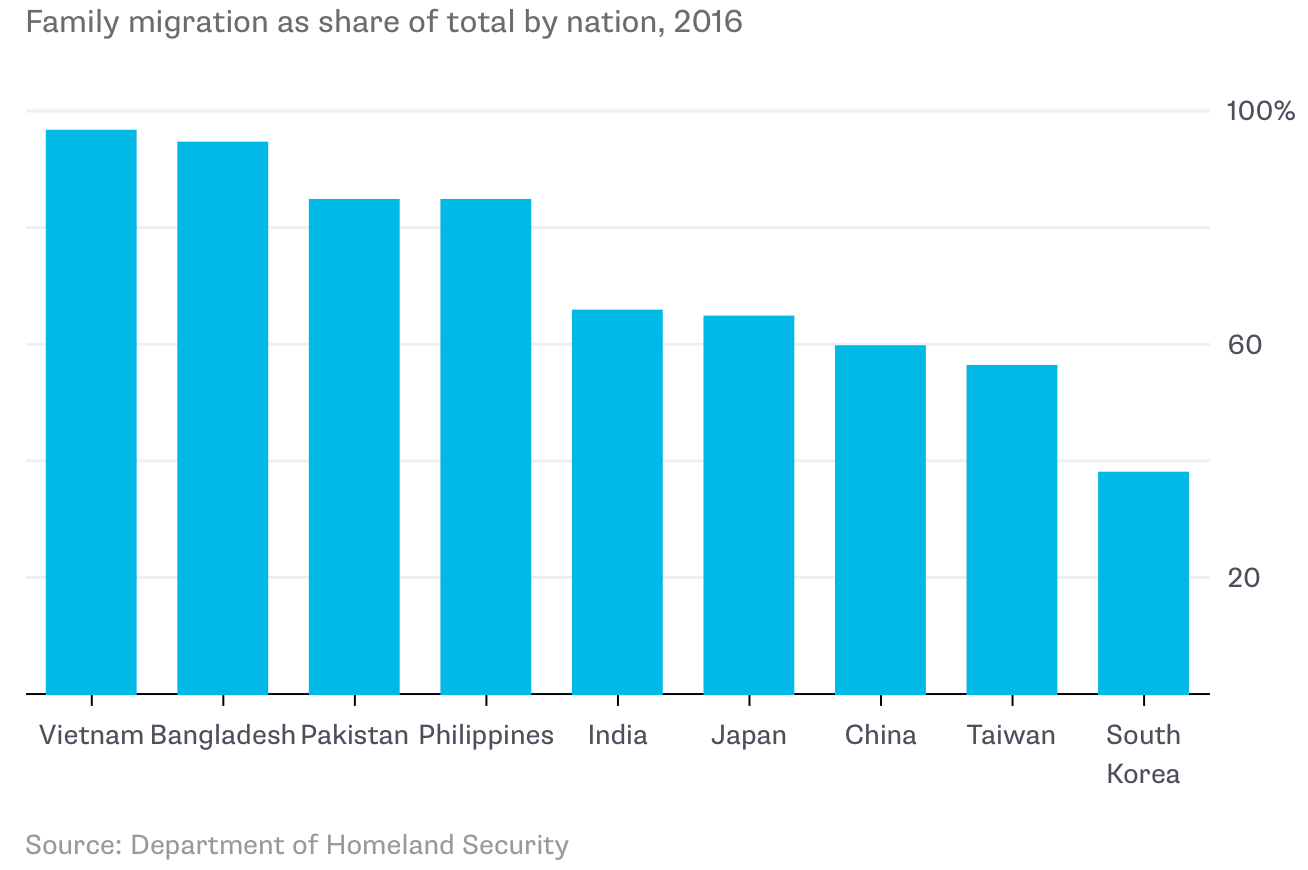
Unlike Mexico, Asian countries don’t share a land border with the U.S. This means that there are two main ways for Asians to move to the country — employer-sponsored visas like the H-1B, or family reunification. In 2016, Asians were the biggest users of family preference immigration — one kind of legal immigration that Trump would mostly do away with:

Family Planning

Without family-reunification immigration, there would still be many Hispanic Americans and black Americans, but there wouldn’t be nearly so many Asian Americans. Combined, family preference and immediate family immigration (which includes spouses, minor children, and parents) accounts for a very large percent of the growth of Asian minorities:

Almost All in the Family


If adult children, parents and siblings of U.S. citizens were barred from immigrating, as under Trump’s plan, the growth of Asian America would slow dramatically. The slowdown would be even worse than these graphs show, because some highly skilled employer-sponsored immigrants would refuse to come work in the country if they couldn’t bring their elderly parents with them.

That would certainly be a slap in the face to Asian Americans, since many would take the restriction as a declaration that they are undesirable as a group. What’s more, to repudiate family-based immigration is tantamount to wishing that Asian America as we now know it had never come into existence.

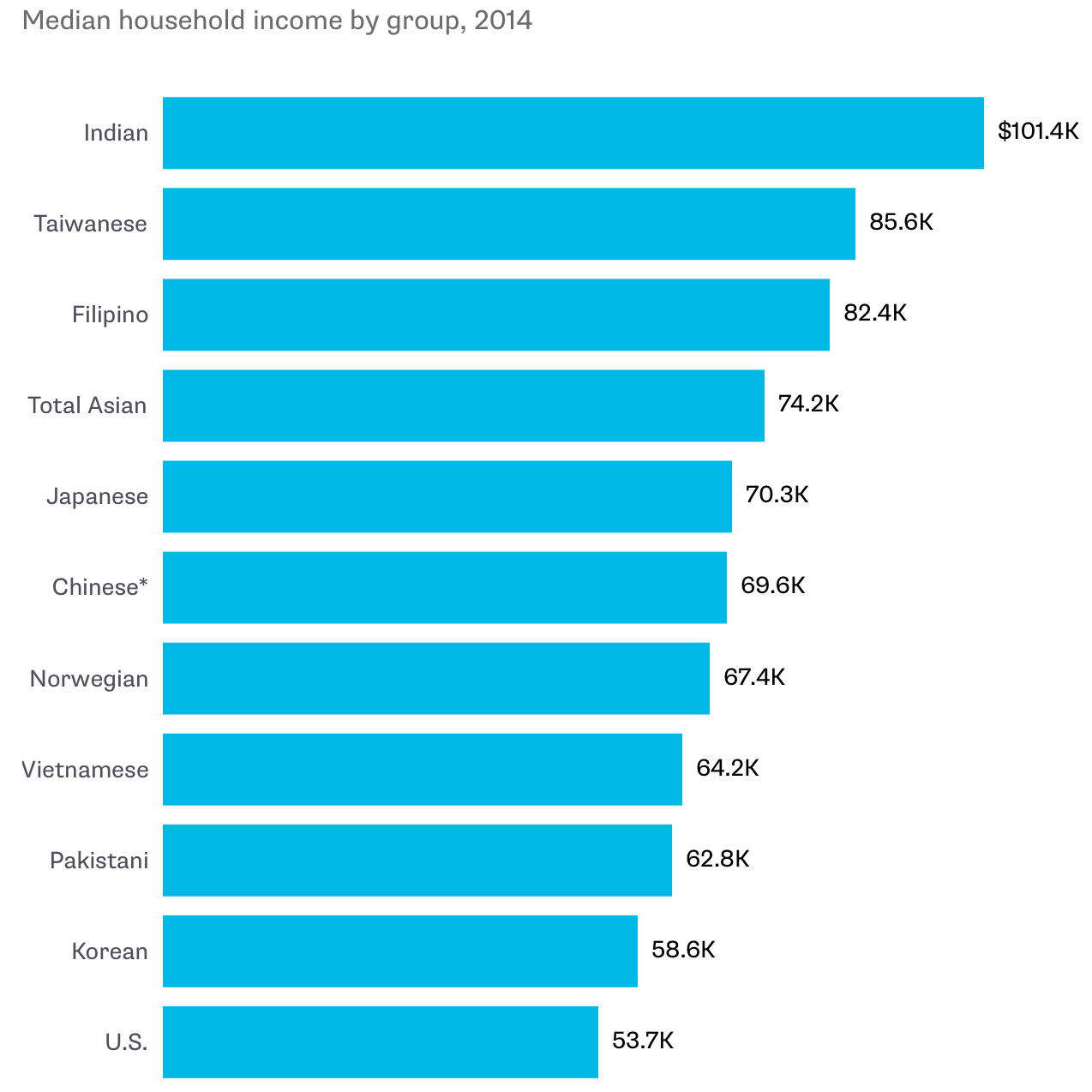
Though high-skilled immigrants come from all regions of the globe, and all have been successful in the U.S., the achievements of Asian Americans are particularly well-known. Despite language barriers and lack of local ties, Asian Americans tend to be economically successful, comparing favorably to the Norwegian immigrants Trump declared he wanted:


*Excludes Taiwanese
Asian Americans also have persistently lower unemployment rates than white Americans, and their average wealth has been increasing rapidly. Beyond these blunt economic statistics, Asian Americans have contributed to the fabric of American society in countless key ways — starting companies such as YouTube, Yahoo and NVIDIA; inventing the birth control pill and AIDS treatment; directing Hollywood movies; serving in the U.S. Senate; and helping defeat the country’s enemies on the battlefield. And those are only a few famous individuals — there are many more, in addition to the countless less famous Asian Americans who have added in a million small positive ways to the fabric of the country. Meanwhile, this new group of people been integrating rapidly and deeply into American society — 46 percent of U.S.-born Asian Americans intermarry with Americans of other backgrounds.

The point here is not to glorify Asian Americans over other immigrant groups, or to imply that only famous or high-earning individuals contribute to America. The point here is merely to illustrate one clear example of a case where “chain migration” added something special to the U.S. that wouldn’t even exist otherwise.

When Miller and Trump say the words “chain migration,” you shouldn’t imagine a faceless horde of invaders coming to claim welfare benefits and live off of the largesse of the native-born. Instead, you should imagine all the good and noble human beings who have made America what it is today — the mothers and fathers, the workers and inventors, the good neighbors and friends. Before changing the country’s immigration system, we should stop and reflect on all the real benefits we wouldn’t have without it.

via Trump’s Chain-Immigration Plan Takes Aim at Asia – Bloomberg

Acceptance rate for asylum seekers in Canada at a 27-year high

Nice to see this data driven analysis:

Canada is accepting a higher proportion of asylum seekers than it has at any time in nearly three decades, a CBC News investigation has found.

CBC obtained almost 90,000 asylum claim decisions made by the Immigration and Refugee Board of Canada between January 2013 and September 2017.

The decisions indicate where each asylum seeker comes from, why they said they had to flee their homeland and whether their bid to stay in Canada was successful.

Download the raw data and see CBC’s full analysis here

The acceptance rate increased significantly in the past five years, to 70 per cent in the first nine months of 2017, up from 44 per cent in 2013.

The last time acceptance rates were this high was in 1991.

When asked what’s behind the increase, IRB spokeswoman Melissa Anderson said each refugee claim is reviewed on its own merits and decided on the basis of the facts and evidence presented.

Many asylum seekers say they were forced to flee criminals or gangs.

Most immigration experts who spoke with CBC News agree an important factor was likely changes to the IRB system introduced at the end of 2012.

The result was that, in most cases, a claim had to be heard within 60 days of being accepted by the IRB. Before that, cases wouldn’t be heard for about 18 months, said Vancouver refugee lawyer Douglas Cannon.

Because lawyers had so much lead time, board members expected to see considerable evidence in order to approve a claim, he said.

But with the drastically shortened timelines, those expectations became unreasonable, he said, and board members had to make a call based on the evidence that could be gathered within two months.

Before the changes, for example, it may have been possible to get a police statement from Colombia documenting a reported assault, but likely not within 60 days.

Because refugee law requires board members to give the claimant the benefit of the doubt, acceptance rates went up, Cannon said.

“It’s not a judgment of the board lowering its expectations in order to render a positive. It’s a board doing the job that it needs to do in a much more efficient manner. And that is a good thing.”

Catherine Dauvergne, dean of the University of British Columbia’s Allard Law School, said it’s also possible a new training program for board members introduced in 2013 contributed to the bump in approvals.

The more comprehensive program gave board members a better understanding of all the factors that go into deciding a refugee claim and the obstacles the claimants face, she said.

Dauvergne said another factor could be an infusion of new board members replacing old ones who may have been suffering from “compassion fatigue.” A rule change in late 2012 scrapped the appointment system to allow any qualified federal civil servant the opportunity to apply for a spot with the IRB.

Reasons for fleeing

The data obtained by CBC also showed the top reason for seeking asylum was to flee criminals or gangs, but individuals who made such claims were among the least likely to be approved by the IRB.

One of the criteria for a successful refugee claim is to what degree a claimant fits the United Nations definition of a convention refugee: Having a well-founded fear of persecution for reasons of race, religion, nationality, political opinion or membership in a particular social group.

Those fleeing criminals or gangs often do not meet these criteria.

Political and religious refugees were the most likely to be accepted.

Source countries

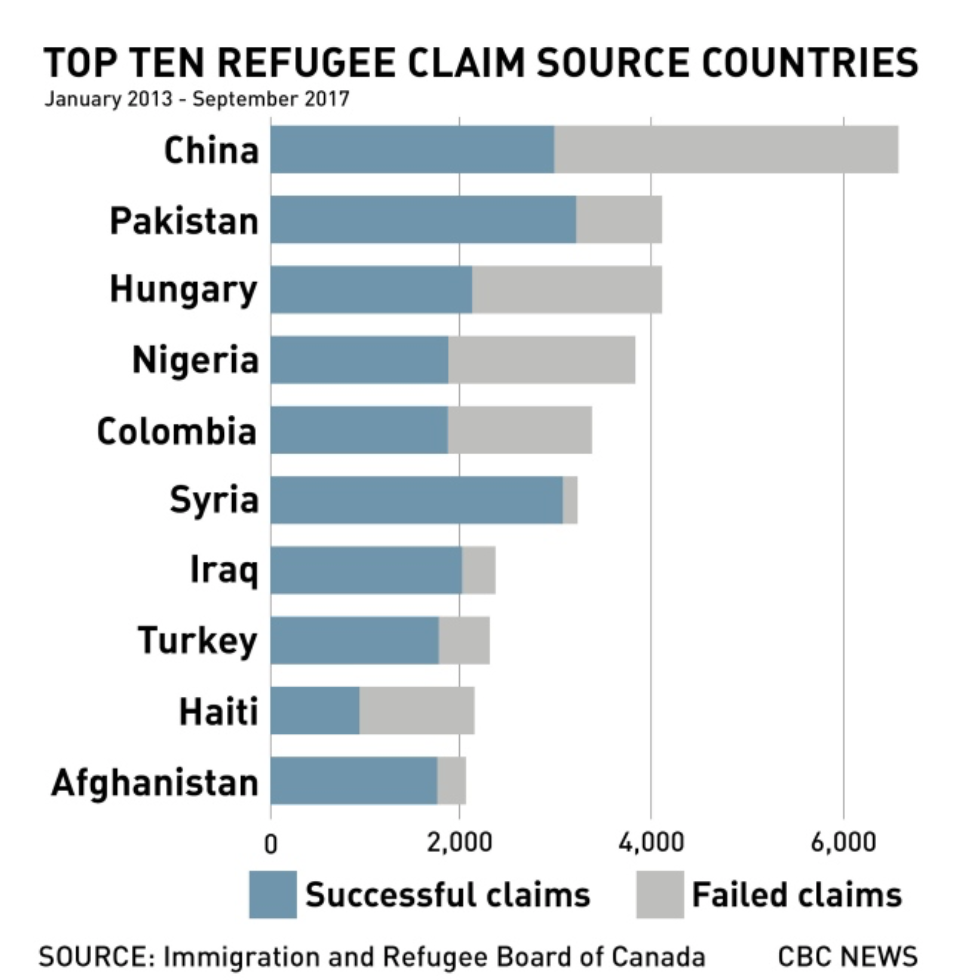
Another key finding was that asylum seekers from China had the highest number of refugee claim decisions over the five-year period, but that number began dropping significantly in 2015.

The drop was attributable to two factors unique to that country: fewer claims from the Falun Gong spiritual group and the end of the one-child policy in 2016.

Decisions on claims from Hungary also dropped from almost 2,000 in 2013 to about 400 in the first nine months of 2017. This was due to substantially fewer claims from members of the Roma ethnic group.

Meanwhile, Nigeria surpassed China as the country with the most refugee claim decisions in Canada last year. Many of the claims from Nigerians relate to sexual orientation and gender persecution.

Claims from Turkey have also increased significantly, making that country Canada’s second-largest source of asylum seekers. These claims were mostly political in nature, or from members of the Kurdish ethnic group.

via Acceptance rate for asylum seekers in Canada at a 27-year high – Canada – CBC News