Adrian Karatnycky: Ukraine, anti-Semitism, racism, and the far right

Interesting analysis and commentary placing the legitimate fears regarding the rise of the far right and antisemitism in Ukraine in context. Look forward to comments from others who know Ukraine better than me:

October 14 saw the latest in a string of annual mass marches by the far right in Ukraine. As many as 10,000 people participated, mainly young men, chanting fiercely. A nighttime torchlight parade with signs proclaiming “We’ll return Ukraine to Ukrainians,” contained echoes of Nazi-style symbolism.

Lax law enforcement and indifference by the security services to the operations of the far right is being noticed by extremists from abroad who are flocking to Ukraine. German media reported the presence of the German extreme right (JN-NPD, Dritte Weg) at the rally. According to Ukrainian political analyst Anton Shekhovtsov, far-right Norwegians, Swedes, and Italians were supposed to be there too. And on October 15, they all gathered in Kyiv for the Paneuropa conference organized by the Ukrainian neo-Nazi National Corps party. “Kyiv,” says Shekhovtsov, “has now become one of the major centers of European far-right activities.”

Such activism, naturally, unnerves liberals as well as Jews, and national minorities. And they often result in alarmist headlines in Western and Israeli newspapers.

Coming in a year in which the white supremacist C14 group engaged in savage beatings at a Roma encampment near Kyiv, one could draw the conclusion that the far right is on the rise in Ukraine.

But such a reading would be mistaken. Far-right sentiments exist in Ukraine, but these ultranationalist groupings attract little public support. As the March 2018 presidential election approaches, recent polls show that the combined vote of far-right presidential candidates amounts to around 4 percent. A similarly paltry level of support is to be found for the far-right Svoboda and National Corps parties. Compared to the support of far-right parties such as the AfD in Germany (12.6 percent support), Marine Le Pen’s Rally for the Nation (13 percent) and Italy’s Northern League (17.4 percent), Ukraine’s public has little sympathy for the far right.

Nor can these fringe Ukrainian parties be labeled pro-Nazi, though their leaders initially were drawn to proto-fascist ideas.Ukraine is a country on whose territory two million Jews died in the Holocaust. It is also a country in which five million non-Jewish Ukrainians perished in combat as a result of Nazi occupation. Virtually every family has the memory of Nazi brutality etched into its memory. Ukraine’s nationalists of the 1930s and 1940s, who advanced anti-Semitic and proto-fascist ideas, were also eventually hunted down for extermination by the Nazi regime.

To be sure, casual anti-Semitism and Jewish stereotypes persist in everyday life. And anti-Semitic graffiti appears with regularity near Jewish synagogues, cemeteries, and cultural institutions. Even still, this regrettable phenomenon is widespread in most advanced industrial democracies.

At the same time, in the last two years there has been not a single recorded violent attack against a Jewish person. The last such attack occurred on October 7, 2016, against a Hasidic rabbi visiting the city of Zhytomyr.

Between 2016 and 2017, acts of vandalism against Jewish targets increased from 19 to 24, but were still far below those reported in many European countries. While an Israeli government report issued in January 2018 alleged a doubling of anti-Semitic incidents in Ukraine, it failed to provide detailed answers about its methodology or sources.

Unlike two decades ago, when Silski Visti, an anti-Semitic newspaper reached millions of readers, today there is no mass circulation periodical spilling out anti-Semitic bile.

Moreover, in comparison with its Central and East European neighbors, Ukraine remains a remarkably tolerant society, even as it faces Russian occupation in part of its territory. A 2016 Pew Research Center poll found that among South, Central, and East European countries, Ukraine had the highest level of acceptance of Jews as fellow citizens, with only 5 percent of the public disagreeing.

The leadership role of Jews in the country’s economic and political life is rarely a topic of public discourse and is accepted as normal.

The country has a Jewish Prime Minister, Volodymyr Groisman.The president’s chief of staff is Jewish, as was his last chief of staff, Borys Lozhkin, who now heads the Ukrainian Jewish Confederation and is a vice president of the World Jewish Congress.

According to the Ukrainian Jewish Confederation, more than thirty of 427 members of parliament are Jewish. And the Committee on Interparliamentary Relations with Israel is the largest of all such groupings in the Ukrainian Rada, numbering nearly 140 deputies, a third of the legislature.

Ukraine’s religious leaders have regular access to key government leaders. And Ukrainian government and state leaders routinely take part in commemorative ceremonies of remembrance of the Holocaust.

All this is not to say that there are serious problems.

Ukraine’s memory politics reflect too much heroization of a complex past and not enough acknowledgment of such issues as indigenous anti-Semitism and collaboration with the Nazi occupation. More, too, needs to be done in restoring the killing fields in which Jews were murdered in the Holocaust.

More ominously, Ukraine’s far-right, para-military formations and their penchant for vigilantism remain a problem that must be more vigorously countered by the state and their sources of funding investigated thoroughly.

Anti-Semitic vandalism needs to be rooted out and hate speech handled in accordance with Ukrainian law. Government reactions to acts or expressions of anti-Semitism remain far too slow. And incidents of violence against Roma by members of far-right groups such as C14 must be swiftly prosecuted.​

However, Western and Israeli governments, media, and NGOs should be sensitive to Russia’s hybrid warfare and disinformation around the topic of anti-Semitism and the far-right in Ukraine. Russia’s deployment of actors who wittingly or unwittingly are encouraged to engage in hate speech, incite anti-minority tensions, commit vandalism, and employ violence is another phenomenon that must be better understood. In a poor country, it is easy to buy or win the allegiance of alienated youth and enlist them in fringe politics either by far-right operatives or Russian agents.

Ukraine’s far right may not be a rising force. But in a poor country facing external aggression, it is a force that cannot be ignored.

Adrian Karatnycky is a senior fellow with the Atlantic Council, and co-director and board member of the Ukrainian Jewish Encounter.

Source: Adrian Karatnycky: Ukraine, anti-Semitism, racism, and the far right

The six countries 300000 immigrants must return to with end of TPS program

Potential future waves of asylum seekers via irregular arrival border points (e.g., Roxham Road):

The Trump administration has been eliminating the Temporary Protected Status (TPS) program, which has allowed more than 300,000 people from countries hit by war and natural disasters to legally stay in the U.S. for decades.

To end TPS protections for 98 percent of those recipients, the Department of Homeland Security has claimed that conditions in those countries are now suitable for thousands of their residents to return home.

A federal judge this month ordered a temporary halt to the administration’s actions – a ruling the Justice Department is appealing – leaving TPS holders facing an uncertain future as they weigh their options.

Here’s a look at the current conditions in the six countries that have lost their TPS status, listed in order of their deadlines for immigrants to leave the U.S. All TPS populations are estimates from the Congressional Research Service.

Sudan

TPS ends: November 2, 2018

TPS first granted: 1997

Reason for TPS designation: Civil war

Estimated number of TPS recipients: 1,040

TPS was first granted to Sudan as the country was being torn apart by a decades-long civil war. When the country officially split in two in 2011, the U.S. granted TPS status to the newly-created South Sudan as well.

In the years since, deadly fighting has continued throughout South Sudan. Based on that ongoing conflict, the Trump administration announced in September that TPS status would be extended for that country.

But Sudan was cut off, with the administration arguing that armed factions are largely honoring cease-fire agreements that have been brokered in recent years. In its justification for ending TPS, the administration said armed conflict “is limited to” two southern provinces and the western province of Darfur, which rose to international prominence in the early 2000s when hundreds of thousands were killed and millions forced to flee as refugees.

The United Nations Security Council paints a more dire picture. A December report on the Darfur region found that food insecurity remains at crisis levels, human rights abuses continue, and the region is being flooded by people fleeing violence in South Sudan, with 89,000 refugees arriving in Darfur in 2017, further hindering the region’s recovery efforts.

Muna Ndulo, a law professor and director of the Institute for African Development at Cornell University, said the safety of returning Sudanese will depend on what specific corner of the country they’re from. If they go to the capital city of Khartoum or northern provinces, they should be fine.

“But if they’re from Darfur, they have nowhere to go,” Ndulo said. “The situation there is still very precarious. And my assumption would be that most of these (TPS holders) would be from that conflict area.”

Nicaragua

TPS ends: January 5, 2019

TPS first granted: 1999

Estimated number of TPS recipients: 2,550

Reason for TPS: Hurricane Mitch

The Inter-American Commission on Human Rights estimates that since April, at least 322 people have been killed in the violence, and hundreds more have been arrested. The White House even issued a round of sanctions in July against three Nicaraguan officials, accusing them of human rights abuses, and suspended the sale of any U.S. vehicles or equipment “that Ortega’s security forces might misuse.”

That nationwide dysfunction has sent the country’s economy, which was meager but had been one of the most stable in the region, into a free-fall. That combination makes Nicaragua a dangerous place for anybody to return to, according to Geoff Thale, vice president of the Washington Office on Latin America.

Thale recently spoke with a group of Nicaraguan priests who have been using churches and other buildings to hide protesters who have become targets of the regime. Thale said those are the very same priests who would help returning Nicaraguans safely reintragrate into society. But now, with the country beset by so much chaos: “They’re a little busy with other things.”

Nepal

TPS ends: June 24, 2019

TPS first granted: 2015

Estimated number of TPS recipients: 8,950

Reason for TPS: Earthquake

Sitting atop the Himalayas, Nepal was rocked in 2015 by a magnitude-7.8 earthquake that led to an avalanche on Mt. Everest and a major aftershock weeks later. The combination left nearly 9,000 dead and millions displaced.

The Nepalese government, with the help of more than $4 billion in international aid that has been pledged by donors, has taken many strides to rebuild the country, but conditions remain far from normal.

More than 270,000 homes have been rebuilt, but more than 800,000 are still listed as undergoing reconstruction from the quake, according to a May update from Nepal’s National Reconstruction Authority, a government task force created to oversee rebuilding.

The country has rebuilt more than 3,800 schools, about half of the agency’s target of 7,500. The country has only rebuilt 49% of its medical facilities, 21% of its security buildings, 18% of its drinking water systems, and 13% of its cultural heritage sites, which form the basis of much of the country’s tourism industry.

Prabha Deuja, president of the Virginia-based America Nepal Society, visited the region in January and said she saw construction efforts all around. But she said the country’s isolated location, and it’s limited government resources, has made it difficult to complete reconstruction and prepare Nepal for an influx of new residents.

“This is a third-world country. We have to get sand and supplies from different countries,” she said. If TPS holders had to return, “I can’t tell you what they will do. The job market, where they’re staying, it’s a really gray area.”

Haiti

TPS ends: July 22, 2019

TPS first granted: 2010

Estimated population: 46,000

Reason for TPS: Earthquake

Rioting in the Haitian capital of Port-au-Prince grew so intense in July that the U.S. sent in the Marines to secure U.S. interests there, according to CNN.

That unrest forced the nation’s prime minister to resign, just the latest step in a seemingly never-ending series of calamities plaguing the country.

First designated for TPS following the catastrophic earthquake in 2010 that killed more than 200,000, the country has since been hit by a cholera outbreak, an island-wide drought, and a direct hit by Hurricane Matthew in 2016 that created, in the words of the U.S. State Department, “a new humanitarian emergency.”

Frank Mora, director of the Kimberly Green Latin American and Caribbean Center at Florida International University, said all of those ensuing problems have exacerbated Haiti’s earthquake recovery and cannot be treated as separate, individual crises. “Haiti is still living with the consequences of the earthquake,” he said.

Throwing tens of thousands more Haitians back to the island right now, Mora said, will only strain the government’s limited resources and endanger the Haitians who will be returning to a country with problems at every turn. The majority live in South Florida and New York.

“They’ll have to face the constant political uncertainty, the energy crisis, the food distribution challenges that still exist,” Mora said. “If there’s any country in the Western Hemisphere where these people will be going into a near humanitarian disaster, it would be to Haiti.”

El Salvador

TPS ends: Sept. 9, 2019

TPS first granted: 1991

Estimated number of TPS recipients: 195,000

Reason for TPS: Earthquake

Using any metric, El Salvador is considered one of the most dangerous, deadly countries on the planet.

In 2016, the Central American nation was deemed the murder capital of the world with a homicide rate of 104 people per 100,000, the highest for any country in nearly 20 years, according to data from the World Bank. The homicide rate reportedly fell in 2017, but crime remains so rampant that only 12% of Salvadorans believed that drop, according to InSight Crime.

In July, the U.S. State Department issued a Level 3 Travel Warning (on a scale of 1 – 4) urging Americans to reconsider traveling to El Salvador. “Violent crime, such as murder, assault, rape, and armed robbery, is common,” the advisory read.

Yet that is where the Trump administration has decided to send the largest group of TPS recipients, nearly 200,000 of them.

Mora said the situation only becomes worse as the U.S. continues deporting gang members from the U.S. back to El Salvador, bolstering the ranks of the gangs and drug cartels that control so many aspects of day-to-day life.

“That situation is difficult for people who live in El Salvador, who’ve been living that situation day in and day out,” Mora said. “So you take someone who has lived in Miami or New York, and you’re going to throw them into that situation. No one has the tools to prepare themselves for that.”

Honduras

TPS ends: Jan. 5, 2020

TPS first granted: 1999

Estimated number of TPS recipients: 57,000

Reason for TPS: Hurricane Mitch

The homicide rate in Honduras dropped significantly in 2017, down to 42.8 per 100,000 inhabitants, the country’s lowest in a decade. But the country remains one of the most dangerous and politically unstable in the hemisphere.

The re-election of President Juan Orlando Hernandez to a second term in November led to violent protests that were met by intense government crackdowns.

Thale says the country remains in the grip of drug cartels who use kidnappings as a standard way to generate income. He said that makes any returning Honduran a “walking invitation for extortion.”

He said gangs will undoubtedly know who is returning to their neighborhoods, and will target people who are returning with cash after selling off their homes, cars, businesses and other goods before leaving the U.S. So how, Thale wondered, could anyone think that Honduras is in a position to successfully, and peacefully, welcome an influx of 57,000 people.

“No sane person thinks they can,” he said.

Source: The six countries 300000 immigrants must return to with end of TPS program

‘Would you like to come to Canada?’ What officials are doing for Canadians held in Syria over ISIS allegations

While I suppose the Canadian government has to offer some form of consular assistance, never seen anything to indicate that “Jihadi Jack” had any substantive connection to Canada except for the genes from his father as he spent most of his life in the UK and thus substantively, if not legally, is the UK’s responsibility.

So while I remain opposed to revoking citizenship in cases of terrorism or treason, no great efforts should be expended on consular support in such cases even if I understand that parents will explore all opportunities for their child:

“I’m from the government of Canada. Do you want assistance from us?”

“Yes,” Jack Letts, replied.

“If so, what kind?”

“Please get me out of this place.”

With that, a Canadian consular official began an hour-long online exchange with Letts, a British 22-year-old with Canadian citizenship who is imprisoned by Kurdish forces in Syria.

A transcript of the conversation, which Global Affairs Canada sent to his parents, who then shared it with Global News along with other documents, offers a rare look at how Ottawa is handling such cases.

They show that Canadian consular officials have been trying to find out where the Canadians are being detained in order to give them consular assistance.

The officials have communicated with the Kurdish authorities over concerns about torture allegations and medical attention for the detainees, the documents show.

But they also told the parents in an email that while they would try to get Letts to a third country, likely Turkey, they could not make any promises.

Jack Letts, who is British but has Canadian citizenship through his father, is being held by Kurdish forces in northeast Syria.

Hundreds of ISIS foreign fighters, as well as ISIS wives and their children, have been captured by the U.S.-backed Syrian Democratic Forces.

The Canadian government has said little about how it is assisting at least 13 Canadian detainees, who are being held in prisons and camps in northeast Syria.

But the transcript of a January 10 conversation between Letts and Global Affairs Canada shows that while officials have reached out to some of the detainees, they have also cautioned there’s not be much they can do.

“If it would be possible, would you like to come to Canada? Back to the U.K.?” the consular official asked.

“I want to live a normal life. I want to come to Canada,” Letts replied.

A Muslim convert, Letts traveled to Syria in 2014, leading the British press to dub him Jihadi Jack. But while he was in ISIS-controlled territory, he has denied being an ISIS member and his parents said there was no evidence he ever joined the terrorist group. Because the U.K. has shown no interest in assisting him and he is Canadian through his father, Ottawa has taken on the case.

Jack Letts said he was imprisoned near Qamishli, the hub of the Syrian Democratic Forces.

“Can u help me,” Letts wrote to the consular official.

He said he was imprisoned near Qamlishi, the hub of the Kurdish-controlled region of Syria known as Rojava. He said he had been there 10 months.

“We have limited capacity to provide consular service in Syria but we will try to help you,” the official responded.

The consular official asked Letts whether he had been charged, how he spent his days, what he ate, when he last saw a doctor, whether he was taking medications and had access to the Internet.

“Are they going to kill us,” Letts wanted to know.

“As I said, we have no access in Syria at the moment, but are working on your case.”

Letts asked the official if he intended to get him to Canada.

“I promise not to blow anyone up with fertaliser [sic] or however they do it,” Letts wrote, adding “that was a joke.”

“We have the intention to help you,” the official wrote.

“Obviously I’m not going to blow anyone up.”

“Canada is an option,” said the official.

Letts then said he was “going insane” and had tried to hang himself. He said he was experiencing kidney problems but had not seen a doctor in seven months.

“I made a mistake coming here, I know that. If you want to put me in prison, I understand that I do not mind,” Letts told the official.

“I have made mistakes, probably prison is good for me. But just not here. The situation here is terrible.”

“Tell my mum I am sorry. Tell my dad I am sorry. Tell them if I ever get out of this place I am going to try and be a better person.”

Towards the end of the exchange, the official assured Letts the government was working on his case, but within limits.

“We don’t have people in Syria and it is a complex environment so I can’t give you definitive timelines, but we are working on your case.”

Global News revealed last week that high-profile Canadian ISIS member Muhammad Ali had been captured by Kurdish forces. His wife, former Vancouver resident Rida Jabbar, and their two kids were also detained, along with women from Toronto and Montreal who married ISIS foreign fighters, and their five children.

Letts and a Montreal man are also being held.

A Kurdish official told Global News there had been “dialogue” with Canada over the detainees, including a meeting in Iraq, but that “suddenly the Canadian government stopped this process and we don’t know why.”

Asked to comment on the transcript, Global Affairs Canada said it was aware that Canadians were detained in Syria but its “ability to provide consular assistance in any part of Syria is extremely limited.”

In a podcast, national security law expert Craig Forcese said that because the Canadians were detained abroad, the government could not facilitate their return to Canada.

The best they could do was negotiate the conditions of their detention, he said, adding the matter was complicated because the Canadians were held by insurgents rather than a state.

But even engaging with their captors diplomatically could cause problems for Canada, he said. Turkey views the Kurdish forces as part of the PKK terrorist group. “So it’s a very difficult consular dance.”

Conservative foreign affairs critic Erin O’Toole said the government’s primary focus should be public safety.

“I’m very, very reluctant to repatriate known ISIS fighters, unless they’re charged and imprisoned in conjunction with their return,” he said.

He also said he supported the revocation of citizenship for terrorism and treason.

“You know, unfortunately these people made very bad decisions and demonstrated that they were a risk to the public and that’s how they should be treated.”

But NDP public safety critic Matthew Dubé said that while public safety is paramount, Canada was obliged to take responsibility for its citizens.

“As much as we may loathe what these people stand for and what they’re doing in some cases, I think that putting them into prisons here and having them go through the Canadian justice system is obviously at the core of a society that’s rules-based and respects the rule of law,” he said.

“Again, it’s not to condone in any way these atrocities. Quite the contrary. I believe that if we truly believe that this is wrong then we should be making sure that they are seeing justice through the Canadian system.”

Dubé also said Ottawa should bring back Canadian wives of ISIS fighters and their children. “It doesn’t sound like that’s the case at the moment, but I would hope that they would make every effort to bring the women and children back.”

Source:‘Would you like to come to Canada?’ What officials are doing for Canadians held in Syria over ISIS allegations

Italian town saved by refugees fights government anti-immigration policy

Contrast between the local integration approach of a small Italian town in southern Italy and the “separation” approach of the current Italian government:

The alleyways of the Italian town of Riace are adorned with dozens of murals that show its long-standing relationship with migration.

But the country’s new populist government is threatening a project locals say successfully integrated hundreds of refugees and migrants into the town of just over 2,000 people.

Mayor Domenico Lucano, the project’s figurehead, was placed under house arrest earlier this month on charges of involvement in organising “marriages of convenience” for asylum seekers.

On Saturday Italy’s interior minister, Matteo Salvini, ordered all migrants in Riace be transferred to refugee centres next week.

Mr Salvini hailed the arrest as proof that the country’s new government was serious about ending the “immigration business”.

“What will all the do-gooders who want to fill Italy with immigrants say now?” Mr Salvini wrote on Twitter.

Mr Lucano, who was also accused of skipping a tender process in order to award a waste-management contract to cooperatives with ties to migrants, spearheaded Citta Futura – Future City – in 1999.

For almost two decades the project welcomed migrants to the sparsely populated Calabrian town in a bid to boost jobs and development. Known as the Riace model, the programme led to abandoned houses being restored and craft workshops being reopened, providing work for locals and foreigners alike.

The project was lauded by many as a model of integration.

But Riace’s efforts risk being dismantled by Mr Salvini as it runs out of money due to the interior ministry’s block on funds.

As a result, Riace’s local government accumulated a debt of €2 million (Dh8.49mn).

Before his arrest, Mr Lucano – known as Mimmo – could be found on the steps of the Donna Rosa restaurant in the town’s central square.

“They are destroying the area. We risk everything being closed down, even the kindergarten,” he said. “We might have continued even without European funds as an independent self-sustaining project, but two years has been too long and we have accumulated too many debts.”

On Saturday protesters gathered outside Mr Lucano’s window to demand the release of their mayor, chanting “keep strong, continue fighting”. The mayor could be seen raising a fist in support.

The political differences between Mr Salvini’s anti-immigration, hard-right Lega Nord and left-leaning Mr Lucano has compounded the widening rift.

Riace’s residents claim Mr Salvini is purposefully sabotaging the project. In response they gathered in a collective hunger strike since July and shut down all of the workshops tasked with creating embroidery items, ceramics, kites and glass crafts. The sign “I, too, support Riace” can be seen hanging in many shop windows.

“The funding blockage is like having suffered a bereavement,” said grocery shop owner Mimma. “The migrants have taught us to live. When new ones arrive they feel immediately at home, and it is as if they have always lived here with us.”

Because of its location Italy is a gateway into northern Europe – but the country’s weak economy and inadequate help from the European Union has aided Mr Salvini’s propaganda about a so-called “invasion” of the country.

Although current and past governments increased their popularity by tapping into a widespread fear of foreigners, Riace often put itself forward to host new arrivals, especially those most in need.

Mohammed is a 64-year-old Iraqi of Palestinian origin. He fled Iraq after the fall of Saddam Hussein in 2003 and today has both a home and a monthly stipend of €260.

This may end if Mr Salvini succeeds in relocating Riace’s guests to a camp.

Bayram, a 65-year-old Kurd, arrived in 1998 from Turkey. He helped reconstruct hillside terracing and is currently working as a carpenter and driver.

“Whoever is blocking this model should see how Riace was twenty years ago,” says 29-year-old Antonio, who works as an assistant in Bayram’s carpentry shop.

“There was absolutely nothing and the only event was the annual patron saint festival. Young people were forced to emigrate, which I will probably have to do next year,” he says, sitting nervously amid other protesters.

Next year Mr Lucano’s second and last term will end. Meanwhile Mr Salvini is rallying to win local elections in the country’s south, despite his northern secessionist movement’s hostility towards them.

“In the past we were the ones who left for the cities in the north of Italy or for Australia, but now there are new people coming here, the new migrants,” says Raffaele, a local farmer who sells home-grown fruit.

Far from Italy’s growing isolationism, residents of Riace hope they can overturn Mr Salvini’s decision to relocate their guests. But the future remains unclear.

And as the children of immigrants chase each other on Riace’s football pitch, shouting at each other in the Calabrian dialect, they are oblivious to the fact they could soon lose everything their parents risked their lives for – and so are their Italian peers who, amid the south’s interminable afternoons, have, at last, found someone to play football with.

Source: Italian town saved by refugees fights government anti-immigration policy

Le Centre de prévention de la radicalisation en péril

Was fortunate enough to attend a briefing on their activities, where their approach was interesting.

But the one thing that struck me was just how glossy was their information package, violating one of my first rules of government publications: use obviously recycled non-glossy paper:

Le Centre de prévention de la radicalisation menant à la violence (CPRMV) traverse des difficultés financières importantes au point de mettre sa survie en jeu, a admis le président de son conseil d’administration à La Presse.

«Il est minuit moins cinq», a affirmé Richard Filion au cours d’une brève conversation téléphonique. L’homme dit travailler «pour assurer la pérennité des opérations du centre».

Le versement des salaires des employés a été suspendu pendant quelques semaines, plus tôt cette année, et cette situation risque de se reproduire à court terme, selon nos informations.

En cause : le non-renouvellement d’une entente de financement avec le ministère de la Sécurité publique et la rétention de certains versements par la Ville de Montréal, qui presse l’organisme de «réviser son modèle d’affaires à la lumière de sa capacité financière». Le Ministère et la Ville étaient les deux bailleurs de fonds du CPRMV depuis sa création.

«Je confirme que [les problèmes financiers] sont une préoccupation sur laquelle travaille le C.A. pour trouver des solutions définitives», affirme M. Filion.

Dans les couloirs du centre, selon trois sources, on attribue ces problèmes à des tensions avec les milieux policiers, ainsi qu’à l’embauche controversée de Sabrine Djermane et El Mehdi Jamali juste après leur acquittement d’accusations de terrorisme, l’hiver dernier.

Défaut de paiement

Du côté du ministère de la Sécurité publique (MSP), on indique que «des démarches ont été entreprises en vue d’élaborer une nouvelle entente visant à octroyer à l’organisme un soutien financier». La dernière est arrivée à échéance en mars, mais le dernier paiement a seulement été effectué il y a trois semaines, à la fin de septembre, a ajouté Patrick Harvey, responsable des communications du MSP.

À la Ville de Montréal, on se fait plus clair : la municipalité est devenue le seul bailleur de fonds du CPRMV depuis la fin de son entente avec le MSP et elle «ne peut soutenir des interventions à l’extérieur de son territoire». Celles-ci représentaient 50% du travail du centre jusqu’à maintenant.

En outre, la Ville de Montréal a expliqué qu’elle retenait actuellement un versement de 400 000 $ destiné au centre parce que celui-ci est en défaut de paiement. Il «doit à la Ville des loyers et le remboursement d’un salaire à hauteur de 58 000 $», a indiqué Linda Boutin, chargée des communications.

«La Ville de Montréal, à titre de bailleur de fonds unique, veut s’assurer que le financement municipal soit utilisé pour accomplir des actions auprès de la clientèle montréalaise en fonction des champs de compétence municipale.»

Lancé en grande pompe par Denis Coderre et le ministre Pierre Moreau en 2015, le centre constituait alors «une première en Amérique du Nord», de l’avis du maire de Montréal. «Le vivre-ensemble requiert un équilibre entre l’ouverture et la vigilance», avait-il affirmé, reprenant le mantra de son administration et de ses ambitions sur la scène internationale.

Un projet d’expansion du centre à Québec, exprimé l’année dernière, avait été accueilli très négativement par le maire Régis Labeaume. «On n’a pas besoin de ça à Québec», avait-il réagi, excluant toute possibilité de financer un tel projet.

349 demandes d’assistance

Contrairement à d’autres services du genre dans le monde, le Centre travaille de façon indépendante de la police et refuse de partager les informations obtenues des individus radicalisés ou de leurs proches, sauf autorisation ou danger imminent.

L’organisation compte 18 employés. Selon son dernier rapport annuel, il a reçu 349 demandes d’assistance en 2017.

Le recrutement par le centre du couple Djermane-Jamali comme «consultants en prévention» avait causé la controverse, l’hiver dernier. Ils auraient été chargés de contribuer à la rédaction d’un guide sur la prise en charge des accusés de terrorisme et auraient apporté leur vision du «processus d’endoctrinement des jeunes au Québec». Ils ont toutefois démissionné rapidement après que leur embauche a été dévoilée par La Presse.

Source: Le Centre de prévention de la radicalisation en péril

Douglas Todd: Will the new leader of Quebec kill its immigrant-investor program?

Good sharp and pointed commentary:

The new premier of Quebec has promised to reduce immigration to his province by 20 per cent, require newcomers to learn French in three years and restrict some public servants from wearing religious symbols.

Premier-designate Francois Legault won a majority on Oct. 1 in large part because he professed to be committed to better “integrating” newcomers into the francophone province. But so far Legault has not hinted at ending Quebec’s divisive immigrant-investor program, one of the world’s biggest wealth migration schemes.

The Quebec Immigrant Investor Program — which attracts nine out of 10 of its millionaire applicants from Asia, mostly China — does the opposite of integrating immigrants into a distinct culture. Only one in 10 of the well-to-do migrants who take advantage of Quebec’s investor program choose to live in that province.

Most of the roughly 5,000 migrants a year who exploit Quebec’s buy-a-passport program immediately move to Metro Vancouver and Toronto, where their foreign-sourced dollars pump up the cities’ already high-priced real estate. The decades-old Quebec Immigrant Investor Program is a cynical scheme that doesn’t do what it claims.

And it’s made possible because Quebec is the only Canadian province allowed to set its own immigration policies. (The country’s other premiers in 2016 asked Ottawa for the right to also establish their own immigration rules, but so far their plea has gone nowhere. That could be unfortunate.)

Everyone who signs up for Quebec’s investor program has to hand over an $800,000 interest-free, five-year loan to the government and sign a document citing their firm intention to make their home in Quebec. But only 10 per cent of the 58,000 people who used the program, and remain in Canada, live in the province.

Half of Quebec’s investor immigrants who remain in Canada (many just return to their homeland, with their second passport safely in hand) have set up in the Vancouver region, with most of the rest in Greater Toronto.

Despite Quebec politicians’ oft-professed dedication to Quebec culture, they have for decades shown no signs of caring about the millionaire migrants’ lack of loyalty. The bizarre unintended consequence is that, since Canada’s charter gives everyone mobility rights, the Quebec program has become a key contributor to the unaffordability that is devastating so many residents of Metro Vancouver and Toronto.

One of the many perplexing things about the program is that Quebec’s media, which is normally ruthless at exposing political deception, has almost entirely ignored the province’s farcical investor program since it was instituted in 1986.

Many countries have brought in similar investor schemes, but immigration lawyers say Quebec’s program remains the world’s easiest and most generous, since it asks so little of investors and they get a tremendous amount in return. As a popular website founded by immigration lawyer Colin Singer says: “Successful candidates get permanent residency, which offers access to Canada’s social support network and the right to live anywhere in the country.”

Will Quebec’s new premier, Francois Legault, cancel his province’s immigrant-investor program? He wants immigrants to better integrate. But only 10 per cent of the 58,000 investors who used the program and still remain in Canada actually reside in La Belle Province. Half end up in Metro Vancouver.

Why has the program not been cut? Why is it not on the agenda of the new Coalition Avenir Quebec government or even of most of the French and English-language media, where Quebec news this month has been dominated by Legault’s more symbolic intention to stop allowing judges, police officers, teachers and other key public servants to wear religious symbols?

Part of the explanation for the near-complete silence must be that the program serves the self-interest of Quebec’s business sector. The immigration website of Singer, a longtime booster of investor programs, boasts that the program has made it possible for Investment Quebec, a provincial government corporation, to provide $714 million to 4,737 businesses in Quebec from 2001-2016.

In other words, Quebec’s businesses get the migrants’ cash, but the province doesn’t get the immigrants. Nor does Quebec bear the cost of providing their families with education or other social programs. Is that what Quebeckers want? And is that acceptable to Legault, who came into power on his promise to help immigrants better integrate into the province of which he is so proud?

It gets worse. In a rare exception by Quebec’s media, Radio Canada journalists last month teamed up with the South China Morning Post’s Vancouver-based Ian Young and reported that fraud, forgery, money laundering and corruption is rife in the Quebec Immigrant Investor Program. Their investigative piece revealed that the trans-national subterfuge often begins with shady immigration lawyers in Hong Kong who mostly serve clients from China.

The influential Economist magazine last month published an extensive feature exploring the widespread corruption inherent in many immigrant investor programs, which often make it possible for so-called high-net-worth individuals to evade taxes and in many cases the law-enforcement officials trying to track dirty fortunes.

It’s hard to know what Legault and his party will do. As the co-founder of Air Transat and a gung-ho entrepreneur, he may hold his nose and convince himself that offshore millionaires’ handouts to Quebec businesses are needed to boost the economy. Or he could live up to his commitment to integration. On the surface, he seems a man of integrity, comfortable with adopting pragmatic policies from both the right and left. So British Columbians could end up pleasantly surprised.

It wouldn’t be unprecedented for Quebec’s premier to kill the province’s investor scheme, since they’re under attack around the globe. After all, the federal Conservatives cancelled Canada’s program in 2014, noting few investors paid significant income taxes in Canada and most didn’t want to permanently settle in the country anyways. Most rich investors are seeking a Canadian passport as an insurance policy in case things go sideways in their country of origin.

Deciding the future of the Quebec Immigrant Investor Program will be a profound test of Legault’s character. Will he hypocritically take millionaire migrants’ money and let them run to English-speaking regions of the country? Or will he stand up for his vision and the dignity of his beloved province?

Source: Douglas Todd: Will the new leader of Quebec kill its immigrant-investor program?

‘BEACON OF HOPE’: Fifth annual Tea Fest celebrates multiculturalism in Manitoba

After all the hysteria over M-103 and Islamophobia, and the erroneous reporting that all of the increased funding for the multiculturalism program was going towards anti-Islamophobia programming (FATAH: Islamist groups eligible for share of $23M in federal funding? | Toronto Sun Corrrection), one example of how some of the funding is being spent.

Very much in the spirit of the former Conservative government’s reorientation of the program to activities that bring different communities together:

Tea was the central figure in a celebration of culture Sunday at the Centre Culturel Franco Manitobain in St. Boniface.

The Islamic Social Services Association, together with the Canadian Muslim Leadership Institute, hosted its fifth annual Multicultural Tea Fest, aiming to bring people together with 20 kiosks of different cultures and faiths serving tea, goodies and sweets, as well as ceremonies and cultural performances.

H. Kasem serves tea during the fifth annual Multicultural Tea Fest at the Centre Culturel Franco Manitobain in Winnipeg on Sunday.Kevin King / Kevin King/Winnipeg Sun

“Canadian multiculturalism is a beacon of hope for harmonious and respectful co-existence,” organizer Shahina Siddiqui, ISSA president, told the crowd. “I can tell you, I’ve traveled across the world on invitation to speak about why we have it so good in Canada, and my response is always multiculturalism.”

Tea Fest is funded in part by the federal government and the province, and forms part of the city’s Islamic History Month Canada (IHMC) activities. Manitoba was the first province to proclaim IHMC in 2013, with MLA Andrew Smith (Southdale) on site Sunday to declare October 2018 as IHMC.

“At a time where politics and the media often divides people, it’s so good to have an event like this one that’s all about bringing people together and showing unity across many different cultures,” New Democratic Party leader Wab Kinew said on stage. “What a great example of Manitobans coming together across cultural lines to do something we all love, which is to enjoy a cup of tea.”

Performances included Bosnian and Kurdish dance, Chinese and Japanese tea ceremonies, an origami workshop and a children’s multicultural fashion show.

Source: ‘BEACON OF HOPE’: Fifth annual Tea Fest celebrates multiculturalism in Manitoba

Harvard and the Myth of the Interchangeable Asian

Thoughtful reflections on being Asian American and the commonalities with other groups:

“I’ve got your letter here, Christina.”

My high school guidance counselor gave me a college recommendation for a girl named Christina Chin. I’d been meeting with him for four years. There were fewer than 20 Asian-Americans in my New Jersey public high school of about 700 students, and our teachers frequently mistook us for one another. One of my teachers, who lived near me and had known me since I was a child, received a call during class one day and said I was wanted in the principal’s office. When I arrived, the principal said he’d called for a student named Jane Tawara.

“I’m Lisa, not Christina,” I told my counselor, though later I joked that I should have passed for Christina. She had better grades.

On Monday, in Federal District Court in Boston, plaintiffs will argue that Harvard discriminates against Asian-American applicants. This lawsuit contends that the school gives these applicants lower scores for personality traits like “humor” and “grit” and that it rejectsqualified Asian-Americans in favor of African-Americans and Latinos. The case, which has been supported by the Justice Department and led by an anti-affirmative action group called Students for Fair Admissions and a group of Asian-American applicants who were rejected by Harvard, has the potential to threaten all colleges that consider an applicant’s race in the admissions process. Eliminating race as a consideration in admissions would cause egregious harm to people of color, including Asian-Americans.

As I read about this lawsuit, I am reminded of my own college application experience, in the mid-1990s. At the heart of my anger at being seen as interchangeable with other Asian-American students — and later, at being mistaken for other female Asian-American co-workers in every job I’ve had — was that we were seen as lacking individuality, and by extension, humanity. My exchange with the guidance counselor was far from the first time this happened, but it still stung: You are invisible. You don’t matter.

This narrative is a familiar one in our Asian-American lexicon. My parents, Chinese immigrants from the Philippines, came to the United States on student visas in the 1960s. The first in their families to attend college, they met in New York City and sponsored their siblings’ migration to North America. They moved from the city to a middle-class white commuter suburb and raised me there. For many children of immigrants who came to the United States as beneficiaries of the 1965 Immigration and Nationality Act, our origin stories have centered on our relationships to whiteness and class assimilation. We’re too American, or not American enough. We’re tired of this story being the dominant one.

In high school, I internalized anti-Asian stereotypes by rejecting them. I was bad at math and science. I liked art and film. We didn’t all look the same, and I was Not Like Them — not like the Asians who would go to Ivy League schools and be pre-med. But as Mark Tseng-Putterman has written, this fervent insistence at being the “right” kind of Asian is still invested in a preoccupation with how others see us.

The 1965 law gave preference to highly educated Asian immigrants, which then gave rise to stereotypes of Asians as more economically successful than other people of color in the United States because we supposedly work harder and have stronger educational values: the model-minority myth leveraged by both whites and Asians to justify racism against blacks and Latinos. It’s a stereotype that is harmful and myopic, used to erase larger truths about systematic racism and unjust policies. It’s also false. In recent years in New York City, Asians have consistently ranked as the minority group with the highest poverty rate.

While Asian-Americans have benefited from affirmative action, we continue to be used as a strategic tool by white conservatives who are opposed to it. The anti-affirmative action lawsuit against Harvard is a result of a campaign by the conservative strategist Edward Blum, who was also responsible for Fisher v. University of Texas, as well as a lawsuit that resulted in gutting the Voting Rights Act.

When Mayor Bill de Blasio of New York proposed eliminating the Specialized High School Admissions Test to diversify New York City’s specialized high schools — which are generally majority Asian and have relatively few black and Latino students — some Asian-American parents criticized the proposal as anti-Asian.

Ethnocentric views of “Asian pride” can be seductive for those who have historically felt disempowered. To acknowledge our collective anger and pain, how we are both targeted by racism from whites and perpetuators of racism against blacks and Latinos, may feel vulnerable and dangerous.

My family’s story is far from being the only kind of Asian-American story, though it’s the one that has largely been told, particularly in mainstream media. That’s partly because of who has access to that media and partly because it’s a story white Americans feel more comfortable with, because it still puts them at the center.

There are pitfalls to hearing — or investing in — only one type of story. Though the Asian-American population increased by 72 percent from 2000 to 2015 and is continuing to rise, on track to become the largest immigrant group in the United States by 2055, we’ve been here since the 18th century. We have been driven from towns, banned and interned; and we continue to be incarcerated, profiled, murdered and deported at alarming rates. The touted success of the model minority has not resulted in true political or cultural power. Asian-Americans remain scapegoats for economic anxieties, from the immigrants blamed for taking away good-paying jobs from white Americans to the Asian students blamed for taking college acceptance spots away from white students.

Asian-American, a political identity formed in the 1960s and consisting of Americans with roots in more than 20 countries, is a label that can be both empowering and exclusionary. Asian-Americans aren’t just East Asian, heterosexual and middle class. They’re queer and working class and poor and undocumented;South Asian and Southeast Asian and Filipino and Central Asian. A narrow definition of Asian-American does a disservice to all of us.

Asian America is changing. While new immigrants continue to expand our communities, so do the grandchildren of post-1965 immigrants, born to parents who were also born in the United States. Will these third-generation Asian-Americans be less concerned with the white gaze — with the guidance counselors and college admissions officers who refuse to see them fully — than previous generations have been?

Mari Matsuda wrote in 1996 about how important it is for Asian-Americans to resist becoming what she calls the racial bourgeoisie. We can choose, falsely, to believe that if we try hard enough, we’ll be accepted by whiteness and gain its privileges, at the expense of other people of color — the myth of exceptionalism. Or we can work to be in solidarity across racial, ethnic and class differences, to refuse to be used to uphold white supremacy.

By looking more closely at our history, at what we have gained and at what and whose expense, we can better inform our futures. Bobby Jindal and Nikki Haley may be prominent Asian-American Republicans, but our political histories are shaped by activists like Larry Itliong, Grace Lee Boggs, Yuri Kochiyama and Pauline Park. Our Asian-American future is also informed by our present: all-Asian suburbias; multiethnic Chinatowns; success that’s less defined by Hollywood representation and the breaking of the corporate ceiling and more by pushing for equity for all Americans, not only a select few. As America moves away from whiteness as its norm, it’s crucial to imagine, and fulfill, our own radical futures.

Home on break from college, where I was receiving a new sort of political education, I told my parents they were wrong about who we were. We were Asian-American, not Asian, and we were definitely not Oriental.

“We’re not American,” they said. “We’re Asian.” At least they didn’t laugh me out of the house for my arrogance.

“Asian-American,” I said. “Not Asian Asian.”

That was more than 20 years ago. On a recent visit to New Jersey, I asked my parents, former Reagan Republicans turned staunch Obama Democrats who voted for Bernie Sanders in the 2016 primary, if they felt American now that they’ve been in the United States for half a century.

“Of course,” my mother said. “What else would I be? Even though other Americans don’t see me as American.”

“Well, who cares how they see us,” my father said. “They can think what they want, but it doesn’t matter to me.”

I hope he’s right. Regardless of how we are seen by others, we are the ones who can best see ourselves.

Source: Harvard and the Myth of the Interchangeable Asian

There’s Been a George Soros for Every Era of Anti-Semitic Panic

Good long read and historical reminder:

It’s been largely forgotten, but when Russian military intelligence created online cutouts in 2016 to manipulate the American electorate, the Democratic Party wasn’t its only target.

The most prominent of those fake digital identities was Guccifer 2.0, which took credit for hacking the Democratic National Committee and then provided the pilfered information to WikiLeaks. The other was called DCLeaks. On Aug. 29, 2016, two months after the DNC hack became public, DCLeaks’ now-banned Twitter account told its followers to check out another of its projects: “Find Soros files on soros.dcleaks.com.”

Visitors to the now-shuttered site could find purported documents from the billionaire philanthropist’s Open Society Foundations, which promote liberal values and democratization. They had file names like “public health program access to medicine” and “youth exchange my city real world.” But before those curious about the leaks got there, the Russians wanted to put George Soros in a particular context.

The homepage displayed a photo illustration of a smug-looking Soros in the midst of four scenes of street chaos whose apparent perpetrators were conspicuously nonwhite. They were taken from the Ferguson, Missouri, protests in 2014, the birthplace—to the consternation of many white Americans whom the Kremlin sought to cultivate—of the contemporary civil rights movement. In both the image and the accompanying text, the Russians portrayed Soros as the puppet master.

“Soros is named as the architect and sponsor of almost every revolution and coup around the world for the last 25 years. Thanks to him and his puppets USA is thought to be a vampire, not a lighthouse of freedom and democracy,” the website proclaimed. The “oligarch” who sired the U.S. vampire, and whose “slaves spill blood of millions and millions people just to make him even more rich” [sic], had a particular background the Russians highlighted in the very first sentence: Soros is “of Hungarian-Jewish ancestry and holds dual citizenship.”

More than two years later, the president of the United States gave a similar portrayal of Soros, though Trump left Soros’s background unsaid. Soros, Trump said on Friday, Oct. 5, had paid for “professionally made identical signs” in the hands of women objecting to Brett Kavanaugh’s Supreme Court justiceship. On Tuesday, he followed up by implying that Soros had stiffed these hired “screamers.” In Trump-like fashion, his accusations were a form of mirror-imaging, as Trump himself had paid for people to support his presidential announcement and denied them payment for months, and he appears to have misunderstood a Fox News guest who spoke sarcastically about Soros paying the protesters.

But it was not Trump’s first time making sinister allegations about Soros. He did so in the final advertisement from his campaign, run at the time by the blood-and-soil nationalist Steve Bannon. Its message was reminiscent of the darker periods of European history: the virtuous future of the forgotten, salt-of-the-earth people has been stolen by a predatory elite. As a shot of the Capitol Dome faded into a Wall Street sign, Trump narrated a message to “those who control the levers of power in Washington” right as the camera showed an image of Soros, giving way to a shot of then-Federal Reserve chairwoman Janet Yellen, who is also Jewish, as Trump continued speaking about “global special interests.” This followed months of the so-called alt-right transforming “globalism” into an anti-Semitic euphemism, and preceded Trump stocking his cabinet with ultra-rich financiers, Jew and gentile alike.

In the 1980s and 1990s, George Soros was hailed as an anti-communist and post-communist hero. His philanthropy helped smooth democratic transitions from the Soviet orbit in central and Eastern Europe. Alongside that track record was a different one: Soros was a ruthless currency speculator who benefited from, among other things, the 1992 British financial disaster and who once blithely dismissed second thoughts over the world-moving power of his investments, saying, “I am engaged in an amoral activity that is not meant to have anything to do with guilt.” In a 60 Minutes interview from 1998—one that Glenn Beck would famously butcher to paint Soros, who as a boy lived through Nazi occupation, as a Nazi collaborator—Jim Grant of Grant’s Interest Rate Observer, remarked that Soros was “Donald Trump without the humility.”

The current portraiture of Soros, now ascendant if not dominant online, isn’t interested in that sort of complexity. For the far right, from Russia to central Europe and increasingly, America, Soros is the latest Jewish manipulator whose extreme wealth finances puppet groups and publications to drain the prosperity of the Herrenvolk. This cannot be dismissed as the preoccupation of ignorable fools on the internet, nor as the equivalent of liberal criticism of the Koch Brothers. Instead, the attack on Soros follows classic anti-Semitic templates, grimly recurrent throughout western history, and some of the most powerful geopolitical figures in the world are pushing it. It’s fueled by Soros’s political activism against a revanchist right eager to view the world in zero-sum racial terms that is on the march across Europe, America and beyond.

“The attack on Soros follows classic anti-Semitic templates, grimly recurrent throughout western history, and some of the most powerful geopolitical figures in the world are pushing it.”

Other Jewish bogeymen may haunt the fever dreams of the vicious, but the scale and intensity of the attacks on Soros are unrivalled. They reveal what the global nationalist right believes is at stake in this present moment. We may one day look back on this era as the Soros Age of anti-Semitism.

“It’s important to distinguish between intent and effect. Of course a person who shares a conspiracy theory about George Soros may not intend to promulgate anti-Semitism, and of course not every Soros conspiracy theory is anti-Semitic. But the image of the rich, powerful Jew who manipulates social and political movements around the world for his own agenda is an ancient anti-Semitic trope,” said Aryeh Tuchman, the associate director of the Anti-Defamation League’s Center on Extremism.

“Because Soros’s Jewish identity is so well known, we are concerned that conspiracy theories about George Soros may have the effect of reinforcing this trope and spreading it throughout the broader population,” Tuchman added. “This is especially true when other anti-Semitic tropes are woven in, such as claims that Soros controls the media or the banks, or when he is described using terms that harken back to medieval claims that Jews are evil, demonic, or agents of the Antichrist.”

There will always be this sort of tentacular George Soros figure. There have been many before. One was said to have profited off the bloodshed at Waterloo.

Thirty years after the pivotal battle capping the end of the Napoleonic Wars, a pamphlet circulated across Europe claiming that Nathan Rothschild, a London banker and scion of the Jewish mega-financier family, sped from the battlefield to parlay his insider knowledge of the French defeat into a windfall on the London stock exchange. “This family,” charged an author writing under the nom de plume “Satan,” “is our evil genius.”

It was the fake news of its era. Nathan Rothschild was never at Waterloo. He died five years before the pamphlet’s publication in 1841, leaving him unable to rebut it. But the lie, after a series of adjustments to explain away its baseline factual mistakes, would reach escape velocity. One subsequent version, according to Brian Cathcart of Kingston University London, claimed Rothschild “deliberately provoked a collapse in stock market confidence by encouraging rumors that Wellington had been defeated.”

The form of conspiracy theories follows their function. Here was a Jewish family whose fortune was said to derive from exploiting European carnage. As Jews, they were considered a foreign presence on the continent, one that had taken advantage of their adopted countries’ naive openness to establish a shadowy power that could determine the fate of nations. Accordingly, European publics would not have to look to their distant autocratic governments for their political disenfranchisement, nor would they have to look to a confusing system of capitalist finance to explain obscene discrepancies in wealth. In place of a systemic critique was a Jewish face. More recently, you can find Rothschild references in the QAnon conspiracy theory, alongside, of course, Soros.

A recurrent theme of 19th-century anti-Semitism is that it finds substantial currency at moments when old regimes appear exhausted and fear about revolutionary dislocation intensifies. A tutor to Russia’s final two tsars demonstrated the utility of using Jews as an omnibus explanation for the anxieties of his age. Jews in Russia endured repression of their civil and economic rights—but they only appeared powerless.

“Yids,” wrote Konstantin Pobyedonostsev in August 1879, have “invaded everything, but the spirit of the times works in their favor. They are at the root of the Social Democratic movement and tsaricide. They control the press and the stock market. They reduce the masses to financial slavery. They formulate the principles of contemporary science, which tends to disassociate itself from Christianity. And in spite of that, every time their name is mentioned, a chorus of voices is raised in favor of the Jews, supposedly in the name of civilization and tolerance, that is to say, indifference to faith. And nobody dares say that here the Jews control everything.” Like many before and since, Pobyedonostsev did not pause to reconcile his claimed Jewish interest in exploitative capitalism with his claimed Jewish interest in the socialism designed to destroy it, but a man like George Soros offers Pobyedonostsev’s descendants a way to square the circle.

After Rothschild, there was Max Warburg. Warburg, another Jewish banker, was a member of the Hamburg parliament and said to have an open line to Kaiser Wilhelm II. Once Pobyednostsev’s fears came true in 1917, a forgery about Warburg appeared in Petrograd claiming that he and a “Rhenish-Westphalian syndicate” were financing the Bolsheviks, through the Jewish Trotsky.

A Russian journalist, Eugene Semyonov, provided the forgery to an American diplomat, Edgar Sisson. It had currency for the Creel Committee, an official U.S. government propaganda organ promoting participation in World War I, since it portrayed the Russian Revolution as a German plot financed by Jews. In September 1918, the committee published it under the title The German-Bolshevik Conspiracy. Leon Poliakov writes in the fourth volume of his History of Anti-Semitism that it was the first time that an anti-Semitic forgery was published by a government that was neither tsarist nor otherwise committed to anti-Semitism as a matter of policy. (Warburg himself, 20 years later, would immigrate to New York to flee the Nazis.)

According to Poliakov, the years between the world wars were a boom time for anti-Semitic forgeries in the United States. There was the fake George Washington missive, warning that the Jews, not the British Army, were the principal danger. And there was a fake Ben Franklin prophesy, forecasting Jewish world domination by 1950 or so.  Detectives hired by the anti-Semitic industrialist Henry Ford traveled to Mongolia, of all places, in pursuit of an authentic Hebrew copy of the invented Protocols of the Elders of Zion. Another went “looking for the secret channel through which [Supreme Court Justice and Jew] Louis Brandeis gave his orders to the White House.”

Foreshadowing the present day, the upswing of American anti-Semitism came at the intersection of an immigration panic, an ascendant nativist movement, and fears about foreign-borne internal subversion. As the Bolshevik Revolution spread, so did a cottage industry of paranoiacs connecting it to mainstream American Jewry, just as a later generation of Islamophobes would do to American Islam after 9/11. In 1919, a Methodist minister recently driven from Russia, the Rev. George A. Simons, testified to a Senate subcommittee about the Jewishness of Bolshevism.

Simons, speaking through barely concealed euphemism, told the Senate that he had encountered “hundreds of agitators” in the former St. Petersburg who had come from “the East Side of New York,” meaning the Jewish slum. The typical sentiment of Russians to describe the post-revolutionary arrangement, Simons related, was that “it is not a Russian government, it is a Hebrew government.” But, Simons assured the Senate, he was no bigot: “I am not in sympathy with anti-Semitism. I never was and never will be. I hate pogroms of any type. But I am firmly convinced that this business is Jewish.”

Vladimir Putin and the global nationalist right have particular motivations to vilify Soros, though deploying anti-Semitism to do it is entirely their choice.

Soros was deeply involved in post-Soviet economic efforts in Russia in the 1990s, corresponding with the nadir of Russian power that Vladimir Putin considers a national humiliation demanding redress. And though he’s denied doing any such thing, Russians have long speculated that Soros profited off a Russian economic downturn in 1998, a year during which he boasted of being Russia’s largest single investor. (His Quantum Fund claims to have lost $2 billion from the episode.) Prophetically, Soros warned Charlie Rose in 1995 of revanchist eastern-European authoritarianism born of an alliance between nationalist politicians and business interests: “Russia is very much up for grabs. It’s very much a struggle which way it’s going to go.”

Soros’s solution to all of this is liberalism. He took his inspiration from the anti-totalitarian philosopher Karl Popper, best known for The Open Society and Its Enemies, and used Popper’s work to develop a critique of the rapacious capitalism Soros himself practiced as a threat to that open society—conveniently, after he had made his billions. Soros’s Open Society Foundations, which operate in over 140 countries, provide assistance and financing to civil-society institutions that promote transparency, the rule of law, higher education, refugee aid, the rights of marginalized peoples, and democratic accountability.

Accordingly, recipients of Soros’s philanthropy include groups such as NARAL, Planned Parenthood and the ACLU that in their various ways oppose the agendas of the American right. In 2003, Soros pledged what would for anyone other than him count as a fortune in a failed attempt to prevent George W. Bush’s re-election, fanning the flames of his enemies’ ire. Then, in October 2017, the elderly Soros transferred a gargantuan $18 billion to the foundation, making it the U.S.’ second largest philanthropic organization.

But it’s one thing to be a wealthy donor, even an unfathomably wealthy one: American politics, to its cross-ideological abasement, relies upon them, and scrutiny of them is vital for the very open societies Soros promotes. It’s quite another for such an unfathomably wealthy donor to stand as a singular, nefarious explanation for all manner of global political phenomena. A recent ADL study about anti-Semitism on Twitter took particular note of the frequency and virulence of invocations of Soros for “undermin[ing] western civilization, or following a long-standing pattern of Jewish behavior.” The ADL even found far-right warnings that Soros had engineered the lethal white-supremacist march on Charlottesville as a false-flag operation.

After the teenage survivors of the Parkland high school massacre began their demonstrations for gun control, some let the mask slip. One now-suspended “alt-right” account tweeted that it was “@georgesoros at work.” Softer versions of that sentiment are ubiquitous online. One more humorous version came after someone posted a picture of a bald Britney Spears attacking a car during her 2007 meltdown to joke that it was Parkland’s Emma Gonzalez – prompting an apparently elderly woman to tweet that “these children of Satan… are funded by Soros.” At an “alt-right” gathering in New York convened by Pizzagate conspiracy theorist Mike Cernovich, drunken panelists referred to Soros as the “head of the snake.”

Larger players in the “alt-right” firmament, echoing their 19th- and 20th-century antecedents, find the malevolent handiwork of Soros everywhere. WikiLeaks, on Twitter, sought to discredit 2016-era reporting in the Panama Papers concerning Vladimir Putin by portraying it as Soros-funded. Bannon’s former home for distorted news, Breitbart, ran a cottage industry connecting far-right targets to Soros, no matter how innocuous the connection. In a typical piece, H.R. McMaster’s consultancy at the International Institute for Strategic Studies – a minor thing, considering it overlapped with McMaster’s Army career – became “Soros-funded” through a IISS affiliation with the nuclear-nonproliferation Ploughshares Fund. Google and Facebook were hit with similar Breitbart smears-by-association through their sins of using credible organizations like the Poynter Institution, which take Open Society money, to reduce the onslaught of fake news. InfoWars similarly highlights Soros money taken by its critics to paint itself as unfairly persecuted.

In keeping with the broader trajectory of the extreme right, the paranoid conception of Soros has moved closer to the corridors of power. In December, the GOP nominee for Senate in Alabama, Roy Moore, castigated Soros in terms redolent with anti-Semitism. Soros’s agenda was “sexual” in nature, said a man accused of child predation, and it’s “not our American culture.” Soros, Moore told a radio host, “comes from another world that I don’t identify with. … No matter how much money he’s got, he’s still going to the same place that people who don’t recognize God and morality and accept his salvation are going.”

“Soros’s agenda was ‘sexual’ in nature, said Roy Moore, a man accused of child predation. Soros ‘comes from another world that I don’t identify with. … No matter how much money he’s got, he’s still going to the same place that people who don’t recognize God and morality and accept his salvation are going.’”

That same month, Erik Prince, brother of Trump’s education secretary and mercenary CEO, encouraged a GQ reporter to investigate the Clintons’ sartorial choices of purple shirts and ties. “Purple Revolution lore,” the wealthy Prince told GQ. “I think it’s a Soros thing.” (There is no such thing as the Purple Revolution.) A Prince associate and former CIA official, the Intercept reported last year, told would-be donors that McMaster used a burner phone to route the fruits of deep-state surveillance on Bannon and the Trump family to “a facility in Cyprus owned by George Soros.”

More recently, after the Kavanaugh confirmation fight, Senator Chuck Grassley stopped just short of validating the accusation that Soros had paid for those protesting Kavanaugh. “I believe it fits in his attack mode that he has, and how he uses his billions and billions of resources,” said the chairman of the Senate judiciary committee. Even Rudy Giuliani on Saturday retweeted someone who called Soros the “anti-Christ.” The “evil genius” that “Satan” concocted in 1841 had found its 2018 incarnation.

Nowhere has the attack on Soros been more geopolitically potent, or as clarifying, as in his native Hungary.

The Hungarian strongman prime minister Viktor Orban, for months ahead of his April reelection, united anti-Semitism and Islamophobia to portray Soros as the string-puller behind a transformational Islamic invasion of Syrian migrants. Whereas some Soros opponents mumble through their anti-Semitism, Orban roars it. Soros is out to deal “a final blow to Christian culture,” Orban charged in November. “It’s Soros’s plan for America, too. PM Orban’s view is deeply well informed & reasoned,” the racist Iowa Republican Congressman Steve King said in December while quote-tweeting an account that used the Soros photo illustration from the DCLeaks page.

In a March pre-election speech, Orban put Soros and immigration in existential terms for Hungary. He pledged to expel Soros as the Hungarians did previous remote tyrannies from the Ottomans to the Hapsburgs to the Soviets. And he applied anti-Semitic tropes not seen from a European leader since Hitler.

“We are fighting an enemy that is different from us,” Orban said, per a New York Times translation. “Not open, but hiding; not straightforward but crafty; not honest but base; not national but international; does not believe in working but speculates with money; does not have its own homeland but feels it owns the whole world.” Even a previously sympathetic writer, National Review’s Michael Brendan Dougherty, said the speech read like “a checklist drawn from the Protocols of the Elders of Zion.”

Perhaps it’s worth noting that Orban himself received a Soros-funded scholarship to Oxford. But it was not the only irony in this ugly episode. To its discredit, the Israeli government of Benjamin Netanyahu wilfully averted its eyes from Orban’s anti-Semitism. Billboards in Hungary last year promoted Orban’s anti-immigrant agenda by using a photo of a smiling Soros to warn Hungarians against letting him get “the last laugh.” Yossi Amrani, the Israeli ambassador, posted on Facebook that the campaign sowed “sad memories”—an apparent allusion to Hungary’s complicity in genocidal anti-Semitism—and “hatred and fear.”

Yet the Israeli foreign ministry undercut its own diplomat. It insistedit had no intent to “delegitimize criticism of George Soros, who continuously undermines Israel’s democratically elected governments by funding organizations that defame the Jewish state and seek to deny it the right to defend itself.” That followed on Israel opting to accept official assurances against anti-Semitism after Orban called Miklós Horthy—Hitler’s Hungarian ally whose expulsions of Hungarian Jewry led to the slaughter of half a million people in the Holocaust—an “exceptional statesman.”

An Israeli journalist, Mairav Zonszein, contextualized the toleration of anti-Semitism within Netanyahu’s broader alignment with right-wing nationalist governments “if it will bolster the Greater Israel movement.” This appears to be an allusion to Soros’s funding of Israeli groups such as B’tselem and Breaking The Silence, which challenge the brutal Israeli treatment of Palestinians, an internal criticism that Netanyahu and his allies cannot abide. Netanyahu, who postures as the protector of diaspora Jewry when it suits him, had tacitly collaborated with an anti-Semite to turn a Hungarian-born Jew into a metaphorically stateless person.

This spring, Orban’s government criminalized the assistance of asylum seekers and undocumented immigrants through what it called the “Stop Soros” laws. Ahead of its passage, the Open Society Foundations announced that it would cease operations in Budapest and transfer its local staff to Germany. In July, Netanyahu hosted Orban in Jerusalem and declared him a “true friend of Israel.”

Calculations like Netanyahu’s underscore the ascendancy and the purpose of the global far right. From Russia to America and beyond, the open society is on its back foot against an assault not seen since the 1930s. The assaulters are far from finished. Whereas the previous generation of European nationalists wanted to marginalize the European Union, the current one seeks to take it over. Orban and his Italian ally, Interior Minister Matteo Salvini, are crusading on an anti-immigration platform ahead of spring’s European Parliamentary elections. They’re joined, on the outside, by Steve Bannon, who dreams of a pan-European nationalist bloc and styles himself, as he told The Daily Beast’s Nico Hines, a counterweight to the version of George Soros so thoroughly cultivated for the reactionary European, Russian and American imagination.

Soros would not talk for this article. But the Open Society Foundations’ communications director, Laura Silber, called the attacks on him “a tribute,” as his philanthropy “strikes at the interests of autocrats, oligarchs and corrupt politicians” and supports human dignity.

“The voices that are loudest in speaking out against George Soros are those that are authoritarian, seeking to galvanize their bases and consolidate power, ignoring or silencing the most vulnerable,” Silber told The Daily Beast. “They’re doing it by circulating recurrent tropes. The billboards that the Hungarian government put up were eerily similar to World War II propaganda, and it’s telling that they were defaced with swastikas and hateful epithets.”

“The voices that are loudest in speaking out against George Soros are those that are authoritarian, seeking to galvanize their bases and consolidate power, ignoring or silencing the most vulnerable.”
— Laura Silber

The U.S. has been better to and for Jews than any other diaspora nation in history. It’s for that reason that many American Jews, particularly those whose white skin affords them access to the highest levels of the American Dream, often diminish the dangers posed by a mass movement comfortable, wittingly or not, with creating a Jewish scapegoat for its political frustrations. There is also a powerful Jewish collective instinct to avoid calling attention to empowered anti-Semitism for fear of provoking it to violence.

Nearly a century ago, as anti-Semitic propaganda backed by powerful white Americans like Henry Ford proliferated, an American Jewish lawyer and civil-rights leader urged his fellow Jews to confront it. “Events have shown that the policy of silence was a mistake. Not only do Ford’s articles appear every week with undiminished virulence, but worse, the Protocols is distributed in every club, placed in every newspaper,” wrote Louis Marshall in 1921. “It has been received by every member of Congress and put in the hands of thousands of personalities. It is the topic of conversation in every living room and in every social sphere.”

Eighteen years later, 20,000 Nazi supporters filled Madison Square Garden to preach their vision of an American Reich. It would not be long, across the Atlantic, before much worse unfolded.

“I’m concerned that the prevalence of conspiracy theories about Soros which paint him as a larger than life, powerful figure has the effect of shrinking that public space where anti-Semitism is not acceptable,” said the ADL’s Tuchman. “If you have fully embraced the notion that there is a powerful Jewish figure manipulating social and political movements around the world to promote his agenda, you’re inching toward the edges of that space where anti-Semitism is acceptable. Soros is a liminal figure in that way.”
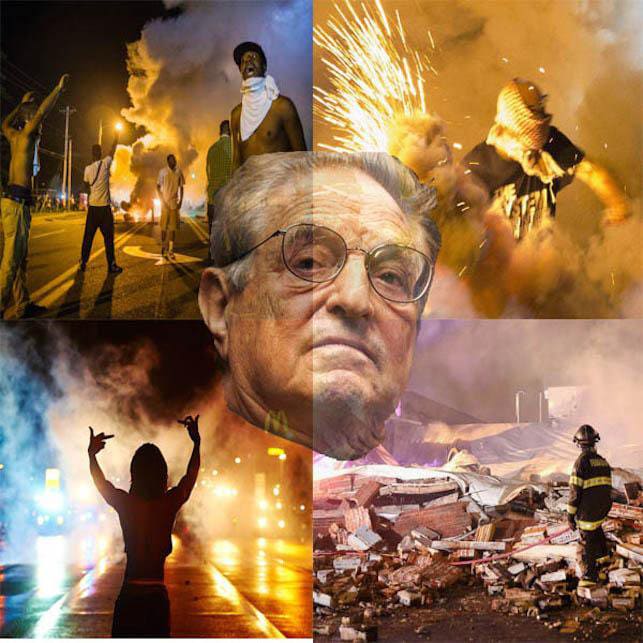
Source: There’s Been a George Soros for Every Era of Anti-Semitic Panic

Army discharged more than 500 immigrant recruits in one year

Another impact of the Trump administration:

During a 12-month period the U.S. Army discharged more than 500 immigrant enlistees who were promised a path to citizenship.

The enlistees were part of the Military Accessions Vital to the National Interest (MAVNI) recruiting program, which allows legal noncitizens to join the military in exchange for expedited U.S. citizenship.

The Defense Department has recruited more than 10,000 immigrants through MAVNI since 2009, the overwhelming majority in the Army, according to the Pentagon.

The program was started in 2008, when there was an urgent need for immigrants with medical and language skills. It was put on hold in 2016 after concerns of insufficient screening for immigrant recruits.

According to a list the Army submitted to the U.S. District Court for the District of Columbia, 502 service members who enlisted under MAVNI program were discharged between July 2017 and July 2018.

The list was first obtained by The Associated Press.

Two court documents containing the list were unsealed this week following a request from the AP.

Pentagon spokeswoman Maj. Carla Gleason told The Hill on Friday that “there are no individuals being released from their contracts or separated from the military due to their immigration status.”

Of the discharged immigrants, more than 100 were told their entry-level performance and conduct was subpar and 48 were dismissed because of an adverse security screening. Others were dismissed for reasons ranging from personal problems to encounters with police.

The Pentagon has had its ups and downs with immigrant recruitment efforts since former President George W. Bush ordered “expedited naturalization” for immigrant soldiers after 9/11. The push was an effort to quickly grow the military, and in 2009 MAVNI became an official recruiting program.

Former President Obama later allowed enlistment for young immigrants covered by the Deferred Action for Childhood Arrivals program, causing additional security clearances to be added to MAVNI.

The program was suspended in 2016 “after several classified assessments concluded that the program, as previously configured, was vulnerable to an unacceptable level of risk from insider threats such as espionage, terrorism, and other criminal activity,” according to the Pentagon.

The Trump Administration required new security screenings and longer enlistments that created a backlog, with some immigrants waiting more than a year to pass through the process.

Because of the long wait caused by new screenings, dozens of immigrant recruits already in the pipeline were discharged or had their contracts canceled. The ensuing complaints and lawsuits led the Army to halt the discharges and reinstate at least 36 recruits.

As of April there were 1,000 recruits in delayed entry or delayed training programs.

“Because of the Department’s desire to honor the commitments it has made to its MAVNI recruits, the Department is working diligently and with all deliberate speed to complete all background investigations for the MAVNI population,” Gleason said.

She added that “while the vetting process takes time, it is essential to national security.”

Army Secretary Mark Esper said last month that roughly 80 percent of MAVNI recruits who made it through screening were approved and enlisted.

He said the Army must “exercise due diligence, to make sure we understand who is coming into our ranks and just do that.

“The process is never quick enough, certainly for them, and for me as well,” Esper added.

Defense officials had planned to relaunch the MAVNI program in September after bolstering the vetting process, but Department of Homeland Security officials told the Pentagon that they would not be able to block the deportation of new immigrant recruits when their temporary visas expire, even if they signed a military contract.

Defense Secretary James Mattis backed the restart, telling reporters in August that “we need and want every qualified patriot willing to serve and able to serve.”

Source: Army discharged more than 500 immigrant recruits in one year