Australia – Guns, climate change and dual citizenship: Cabinet papers shed light on early Howard years

Always interesting to see how previous governments grappled with issues, in this case the Australian government under PM Howard, and how officials provided significant advice that for some reason was ignored, resulting in the recent crisis regarding parliamentarians who were dual citizens:

Creating dual citizenship

In April 1996, then-Immigration Minister Philip Ruddock said it was “urgent” to move ahead with reforms that would allow Australian citizens to pick up a second citizenship for the first time.

Back then, Australians automatically lost their citizenship if they acquired another nationality. 

Mr Ruddock said this was inconsistent. Migrants to Australia were often allowed to keep their home citizenships, but dual-citizenship was off-limits to natural-born Australians.

It would be another six years before the Howard government changed the law in 2002 — but the 1996 submission got the ball rolling.

The minister was concerned about some backlash from RSL groups, but said the prohibition was a matter of “great concern” to those affected.

He compared Australia with the countries that allowed dual citizenship at the time — like France, New Zealand, the USA, Israel and Syria — and those that did not, like Indonesia, Iran, Norway and Austria.

If only they knew

Right at the end of the submission, officials from the Department of Prime Minister and Cabinet make a prescient warning.

Allowing Australians to become dual citizens was all well and good — but it could cause problems for parliamentarians down the line. 

“Acceptance of the proposals would increase the disparity between the qualifications for citizenship and those for elected office,” the department wrote.

Under Section 44 of the Constitution, politicians are not allowed to run for office if they hold a dual nationality.

The unprecedented High Court drama of 2018 proved them correct, as more than 10 senators and MPs were ejected from their seats.

Source: Guns, climate change and dual citizenship: Cabinet papers shed light on early Howard years

Karen Robson: Why won’t Canada collect data on race and student success?

While I always favour more data to better understand the differences in outcomes between groups, I am puzzled by the assertions regarding data gaps made by Karen Robson in her recent opinion piece.

First, the OECD PISA study includes both first generation children, born abroad, and the second generation, born in the destination country, where issues related to racism and discrimination can be separated out more clearly from more basic integration issues (e.g., language fluency).

Secondly, while the visible minority category may not be perfect, it does provide a race-based breakdown in the Census with respect to education, along with other economic and social outcomes, which can be used to provide municipal level data at the census tract level. Toronto school board data uses largely comparable categories.

Ironically, the same pattern she cites with respect to Toronto, where the school board collects race-based data, can be seen nation-wide: Asian and South Asian students with stronger outcomes, Black and Latino weaker ones.

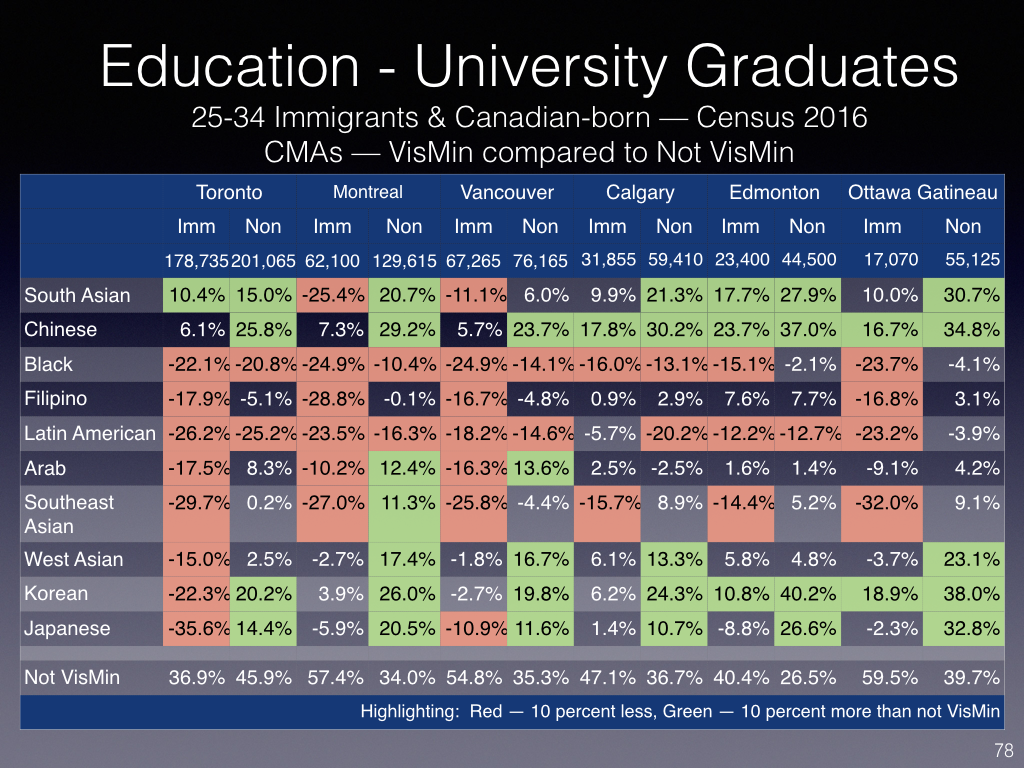
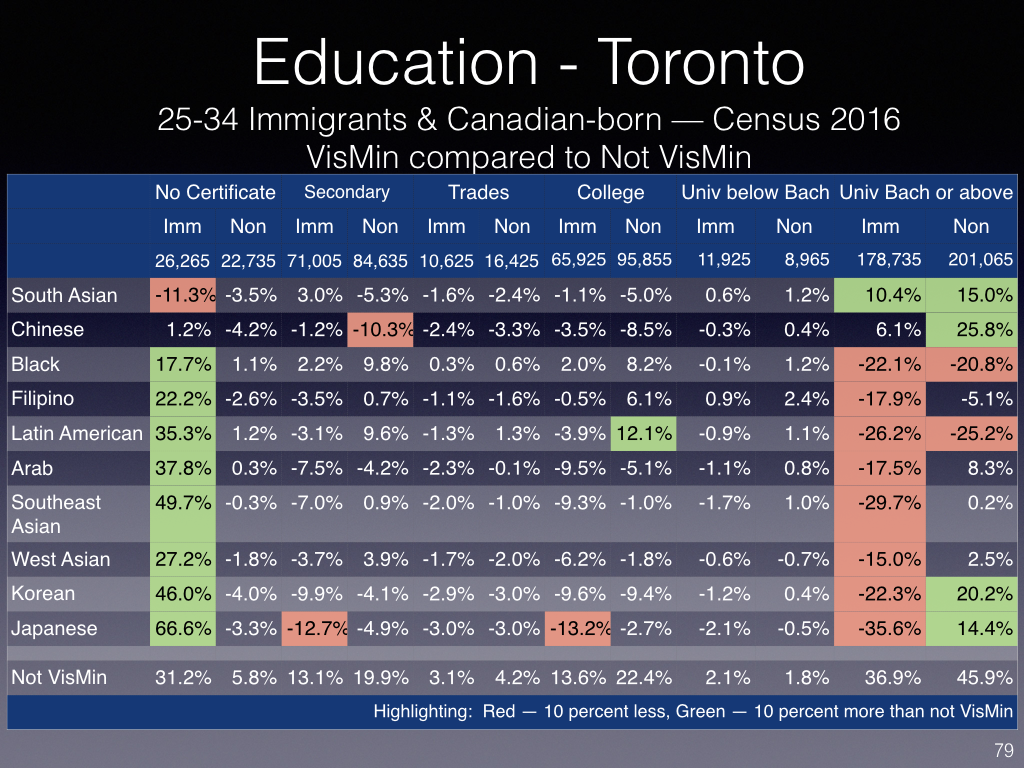
The following three charts illustrate this, looking at the highest level of education attainment for 25-34 year olds, or later than the high school data that she cites (i.e., the social and economic outcomes that reflect, in part, high school outcomes). The first looks at the university graduation rates for visible minorities, immigrant and non-immigrant (Canadian-born) compared to not visible minorities, the second provides a breakdown of the highest level of educational achievement for Toronto (I have done the same for the other cities) and the third looks at median employment income for university graduates:


Her academic article (journals.sfu.ca/cjhe/index.php…), on which this op-ed is based, doesn’t make these mistakes and is a comprehensive and interesting study of Toronto District School Board data.

But her arguments that the lack of comparable data to Toronto across the country is a significant data gap is less convincing.

Census data allows comparisons between municipalities (and down to the census tract level) and the richness of the data provides considerable scope for analysis. Whenever I find a blockage elsewhere (e.g., police force diversity numbers), I usually can find census data to respond to my key questions:

Although the impact of income inequality and gender on education outcomes is much discussed in Canadian government-level policy debates, factors of race and racism are seldom measured or addressed.

However, as an education researcher comparing student outcomes in Toronto, Vancouver, New York, Chicago and London, I can see Canada’s policy-makers have a big knowledge gap because they don’t deal with or have access to information regarding race.

Students are impacted by factors of income, gender and also race. The combinations of these identities undoubtedly shape how students experience access to education, work and other types of social mobility.

Research shows that low-income can be highly racialized, yet in Canadian cities, the patterns are not completely divided along racial lines. Therefore, examining income alone overlooks the many important ways that inequalities in education are not simply an issue of economics.

In the United States and the United Kingdom, research reports regularly provide summaries of student outcomes by various characteristics, including race.

In Canada, we have a tendency to focus exclusively on whether a student comes from immigrant parents. I believe this focus is problematic.

Canada has been deemed an education superpower because comparisons between the standardized test scores (PISA) of Canadian children with those in other OECD nations find Canada near the top. As well, the 2016 federal census revealed that Canada has the highest proportion of post-secondary graduates in all 36 member countries of the Organization for Economic Development (OECD). This mean that more than half of adult citizens in Canada between the ages of 25 and 64 have a college or university credential.

In particular, the success of immigrant children is used to argue that Canada is leading the way in equity.

In a country grappling with the heritage of colonialism, the success of immigrant children comes as good news to share and promote. This success can be interpreted as a sign that multiculturalism has been successful, that racism is not a barrier to education attainment and that immigrants are treated equally and have the same opportunities as children born in Canada.

This story continues in other arenas. Education researcher Trevor Gulliver analyzed citizenship guides for new Canadians and found that group identities in these education texts creates an idealized version of Canada as “Canada the redeemer.”

Such celebratory concepts of Canada need to be carefully considered.

There is a common misconception that racism is something that occurs in the U.S. and not in Canada.

One of the reasons that children of immigrants do so well in Canada is because of our immigration system which favours certain assets. The “points system” of immigration awards points to applicants who speak one of Canada’s official languages. Points are also awarded for job skills and level of education.

This is not to discount the work that teachers and schools do to integrate, educate and welcome students of immigrants; my point is that there are some reasons that such children who already speak an official language may be doing better than immigrants who arrive as refugees in another immigrant receiving country, like Sweden.

Focusing on the success of immigrants detracts from the problem of how systemic racism contributes to inequality in educational experiences and outcomes. Another common misconception is that race and immigrant status are equated; of course they are not the same thing.

The celebrated study about how well Canada did with global assessment scores only carries information on immigrant status, not race. With the exception of the Toronto District School Board, boards of education across the country do not record race data.

This lack of data has led to a dearth of studies examining the relationship between race and educational outcomes in Canada. Researchers simply do not have the data to analyze.

In response to research demonstrating a gap between Indigenous and non-Indigenous student outcomes in Canada, a Canadian think-tank reports that some provinces have pledged to begin asking Indigenous students attending mainstream schools to self-identify when provinces collect their PISA data. No known similar move is afoot, however, with regards to collecting data about racialized students or their income levels.

The Ministry of Education in B.C. has opted to ask students about the language students speak at home rather than their self-identified race.

Not only do we not have data on race, but it seems Canadians are also reluctant to talk about race. Even Statistics Canada defers to its old and outdated notion of “visible minority” when attempting to measure and discuss issues around race.

Lumping all non-whites together masks the huge differences we see in the educational outcomes of racialized students in Toronto.

Basically, this means comparisons are made between white and non-white people. This comparison happens even in areas like Toronto where “visible minorities” make up more than half of the population, making whites in fact, a minority. Further, the data tells us nothing about poverty by postal code.

In Toronto, where we do have data, the figures show that Asian and South Asian students trend toward having high marks and are more likely to go on to university. Black and Latino students trend toward lower grades and are more likely to be placed in the “applied” stream of high school courses (which are not eligible for university).

Considerable research in Toronto has identified Black males as having the lowest post-secondary opportunities due to their disproportionate placement in the “applied” stream of study.

These problems are not unique to Toronto; they are only measured in Toronto.

Lack of data does not mean lack of a problem. By not collecting data on race and other important sociodemographic factors of students, we fail to correct systemic barriers to success in our educational system.

By conflating immigrant success with a blanket commitment to equality, we blindly assume we are doing OK as we do not have any evidence to the contrary — because we haven’t taken the time to collect it.
Source: Karen Robson: Why won’t Canada collect data on race and student success?

Cato’s 2018 Immigration Research in Review | Cato @ Liberty

While I am far from being a libertarian, I do find that Cato’s analysis of immigration issues, and particularly of immigration-related data, impressive and worth following. Their round-up provides a good sense of the scope of their research and analysis, particularly with respect to some of the myths circulating or being propagated by the Trump administration:

Cato’s immigration policy team was very busy in 2018.  My colleagues David Bier and Andrew Forrester, in addition to some contributions by myself and numerous outside authors like the stupendous Michelangelo Landgrave, worked non-stop to produce almost 180 pieces this year in the form of blog posts, op-eds, Cato research papers, and peer-reviewed academic articles.  David Bier summarized many of these pieces in a twitter thread for those on Twitter.

Of those, I’m most proud of the pieces that discovered original facts and figures to illuminate the immigration issue.  With rare exceptions, the most valuable immigration policy research is that which produces original facts and figures, as too much of the debate over this topic is emotional and ungrounded.  We are trying to make the debate about the facts and contributing those that we have discovered on our own in the process. Below is a rundown of the original facts and figures that Cato scholars have calculated in 2018 by subtopic with links to our research.

Assimilation

The recent surge in immigrants along the border are low-skilled, poorly educated, and from Central America – but that doesn’t stop them and their descendants from learning English, converging to American wages, and joining the military at rates comparable to or higher than native-born Americans.

Border Security, the Wall, and Interior Immigration Enforcement

Much of the national immigration debate proceeds under the implicit and incorrect assumption that immigration enforcement only harms illegal immigrants. My colleague Matthew Feeney waded into the immigration debate with an excellent primer on how increased immigration enforcement, both at the border and in the interior of the United States, will infringe upon the civil liberties of American citizens and lawful permanent residents as well as an examination of legal protections that can help mitigate the lost rights.  Complementing Feeney’s paper is our finding, based on data from Travis County in Texas, that Immigration and Customs Enforcement (ICE) targeted at least 228 American citizens as illegal immigrants in that county over 12 years – or about 0.9 percent of all those detained.

Related to interior immigration reform is the E-Verify program, which is an electronic eligibility for employment verification system run by the federal government.  Congress created it in an attempt to turn off the magnet that attracts illegal immigrants to the United States in the first place: higher wages and low unemployment.  In theory, E-Verify would allow employers to check the identity information of new hires against government databases to see if they are legally eligible to work and to deny illegal immigrants.  For years, members of Congress have introduced bills to make E-Verify a national mandate to be used whenever a business hires somebody – including American citizens.

Four states have mandated E-Verify for all new hires, but only 56 percent of new hires in those states were run through E-Verify in the second quarter of 2017.  To be effective, a much higher percentage of new hires must be checked through E-Verify.  The four states that mandated E-Verify are Arizona, Alabama, Mississippi, and South Carolina.  Over time, the rate of new hires has barely budged in those states – even in South Carolina where the state conducts random audits of employers to supposedly guarantee compliance.  If those conservative states can’t effectively enforce an E-Verify mandate, there is no hope for doing so nationally.

Our next piece of original research confirmed that California’s TRUST Act, which limited state law enforcement cooperation with ICE, dramatically reduced deportations from that state.  Although deportations from California were falling prior to the TRUST Act going into effect in 2014, deportations from California that year dropped 39 percent relative to 2013.  In the rest of the country, the number of deportations only dropped 9 percent over the same period.

Much of the rest of our original research focused on border enforcement.  Republicans introduced a bill in 2018 to spend more on Border Patrol in the next five years than has been spent over the last 5 decades – in real terms.  A portion of that extra money would be spent on drones to patrol the border, an enforcement tool that has already been used on the border and is responsible for 0.5 percent of all border apprehensions at an astonishing cost of $32,000 per arrest.  Apprehended border crossers, whether discovered by drones or more traditional methods, spent an average of 39 hours in detention in late 2014 and 2015 or 12.8 million hours total.  Of course, all of this extra enforcement is unnecessary as the lesson of marijuana legalization on the state level shows that smuggling can more effectively be cut with better laws that allow cross-border flows rather than crackdowns.

Part of the justification for more spending and technology on the border is that Border Patrol agents face severe threats on the job.  While they certainly do, it’s not nearly as dangerous as many assume.  Thirty-three Border Patrol agents died on the job from 2003 through 2017 or about one death for every 7,968 agents per year.  Six of those agents were murdered on the job while the other 27 died in accidents or in unknown circumstances.  Their on-the-job murder rate is about 1 in 43,824 per year from 2003 onwards, much lower than the 1 in 19,431 annual murder rate for Americans during the same time period.  Every one of those murders or deaths is a tragedy, but those rates do not indicate an exceedingly dangerous job.

Crime

In 2016, illegal immigrants were 47 percent less likely to be incarcerated than native-born Americans and legal immigrants were 78 percent less likely to be incarcerated than natives.  By race and ethnicity, legal immigrants and illegal immigrants were less likely to be incarcerated than their native-born co-ethnics.  In the state of Texas, which actually counts criminal convictions by immigration status, the illegal immigrant criminal conviction rate is about half that of native-born Texans and the legal immigrant conviction rate was 66 percent below.  In Texas, that pattern also holds for crimes like homicide, larceny, and sex crimes.  Nationwide, only about 11 percent of “criminal aliens” actually committed a violent or property crime and 60 percent of those “criminal aliens” deported committed only a victimless crime. Related to these findings, DACA recipients were far less likely to be arrested than those who were not in DACA.

Illegal immigrants could commit more crimes and escape punishment for them by fleeing back to their home countries, but police clearance rates (the rate as which police solve crimes) are not correlated with the size of the illegal immigrant population even with numerous controls.  There is even some evidence that motor vehicle theft and burglary are solved as slightly higher rates in states with more illegal immigrants as a proportion of their population.  This is consistent with our finding that the interior immigration enforcement program had no effect on crime rates in North Carolina although it did increase assaults against police officers.  Interestingly, Arizona’s passage of an E-Verify mandate in 2007 drastically increased the flow of non-citizen offenders into Arizona state prisons – a serious potential side-effect of increased immigration enforcement that E-Verify supporters have yet to address.

Crime in Mexico along the U.S. border is a serious problem, but we found a negative correlation between homicide rates in Northern Mexico border states and homicide rates in American border states.  Expanding on the theme of crime flowing over the border, only about 0.2 percent of all border apprehensions in the first half of 2018 belonged to a gang.

DACA and Legalizing Unlawful Immigrants

President Trump’s slow-motion cancellation of the DACA program made for DACA-recipients and other Dreamers a big political issue in 2018 and several bills to do so in exchange for a border wall were proposed.  Many of those bills would have legalized only a small proportion of the Dreamer population, about half the number that President Trump claimed.  Another proposal would have denied a path to citizenship for 82 percent of Dreamers.

Economic Growth, Fiscal Effects, and Wages

Former visiting fellow Ike Brannon estimated that reversing DACA would cost the U.S. economy $351 billion from 2019 to 2028 in lost income and that the U.S. Treasury would lose $92.9 billion in tax revenue.  Under Trump’s proposal to halve legal immigration, we used a simple model to show that it would reduce the size of the U.S. economy by about $19 trillion in 2060 relative to what it would have been under the status quo, mainly by reducing the growth of the American population by 26 million.

Wage and economic assimilation of new immigrants is vitally important. Newly arrived immigrants have wages lower than otherwise identical natives, but those wage differences diminish greatly or disappear entirely after about two decades of working in the United States.  The immigrant wage gap has diminished in recent years.  Furthermore, illegal immigrants initially faced a hefty wage penalty of about 11.3 percent relative to legal immigrants due to their lack of legal work status.

Health

Many commentators expressed fear that immigrants, especially those in the migrant caravans, would spread disease once they arrive.  However, vaccination rates in Mexico  and Central America are generally higher than or about the same as those in the United States.

Immigration Affects the Fundamentals of Economic Growth

The best criticism of expanded legal immigration is that the new Americans and their descendants could vote for bad policies that diminish the prosperity of the United States.  On its face, this is plausible as immigrants generally come from countries with worse economic and political institutions than the United States.  Immigrants today are coming from more democratic countries than immigrants who came in the past.  Additionally, we published a working paper that examined a quasi-natural experiment in Jordan where a large and sudden exogenous shock of migrants permanently moved there.  We found that the migration significantly increased economic freedom.  That paper was accepted for publication in the World Bank Economic Review, the 28th best peer-reviewed academic economic journal in the world.  More impressively, that publication marks the first peer-reviewed publication for my talented colleague Andrew Forrester.

Unrelated to immigrant effects on public policy, we investigated whether immigrants could worsen U.S. economic growth by reducing the quality of firm management and found precisely nothing.

Immigration Policies in Foreign Countries

No analysis of American immigration policies is complete without a comparison to policies in other countries.  The United States ranks in the bottom third of wealthy countries in terms of net new immigrants as a share of total population from 2015 to 2017 as well as total foreign-born residents as a share of total population.  Singapore’s relatively open immigration policy provides a possible model for the United States.  About 47 percent of Singapore’s population is foreign-born, more than three-times greater than the United States as a whole and larger than any American urban area, but with fantastic economic effects compared to its neighbors.

Legal Immigration

One of President Trump’s immigration reform frameworks would have cut 22 million legal immigrants over the next 50 years and, if it was in place since 1965, it would have reduced legal immigration by about 23 million.  That latter figure doesn’t include the tens of millions of our fellow citizens born here since 1965 who would not be Americans if that framework was applied retroactively.  Consistent with the President’s plans to cut legal immigration, his administration has increased the denial rate for visas by 37 percent.

President Trump and those who want to cut legal immigrants have frequently said that they want to reduce low-skilled immigration and boost the number of highly-skilled immigrants so that our immigration system looks more like the Canadian system.  This is unnecessary as our immigration system, on its own, is already admitting far more skilled immigrants than it used to.  On paper, the proportion of skilled new immigrants admitted to the United States from 2012-2016 is about the same as in Canada during that time:  49 percent with a bachelors or above education admitted to the United States compared to 52 percent in Canada.  Even immigrants who arrive via family-reunification and on the diversity visa are more educated than native-born Americans.

Although our legal immigration system is admitting more skilled immigrants on its own, serious problems remain.  For instance, Indian immigrants with advanced degrees face a 150-year wait for employment-based green cards.  That is shockingly unfair and economically destructive, even for a government bureaucracy.  Small tweaks to our immigration system could reduce that problem significantly.  More importantly, a small administrative change that is consistent with current law could increase legal immigration by 27 percent across the board and allow in far more skilled immigrants.

Refugees and Asylum Seekers

President Trump’s so-called Muslim ban has cut Muslim refugees, immigrants, and travelers by 91 percent, 26 percent, and 60 percent, respectively.  Related to that, Trump’s refugee policy has also cut the number of Christian refugees by 64 percent.  Additionally, signing a Free Trade Agreement with the United States does not boost the number of refugees or asylum-seekers who come from those countries.  The Syrian Civil War is winding down, but a persistent criticism over recent years is that rich Gulf States have not sponsored any Syrian refugees.  While legally true, that analysis ignores the fact that the Gulf States have allowed over 1.2 million Syrians to enter and remain on their territory on non-refugee visas over that time in response to the humanitarian crisis.

Terrorism

President Trump favored “extreme vetting” for new immigrants and travelers to prevent future terrorist attacks. But since the 9/11 attacks, the U.S government has done an admirable job screening out terrorists.  From 2002-2016, the government issued one visa to a radicalized terrorist for every 29 million non-terrorists and issued 379 million visas for each deadly terrorist.  The government undertakes many more counterterrorism activities than just visa vetting.  Since 9/11, they have spent $2.8 trillion on counterterrorism.  Assuming the statistical value of life is $15 million, that spending would have to have prevented about 188,740 murders in terrorist attacks during that time to break even – or over 1,000 times as many people as were actually murdered in terror attacks on U.S. soil since 9/11.  That is extremely unlikely.

About 3,518 Americans have been murdered in terrorist attacks on U.S. soil from 1975 through the end of 2017.  That’s about a one in 3.3 million chance per year of being murdered in a terrorist attack here committed by any terrorist.  By comparison, 7,548 people have been murdered by animals during that time – a death rate about double that caused by terrorists.  The annual chance of dying in a terrorist attack in the United Kingdom during that time is higher at about 1 in 1.1 million per year.  Since 9/11, the chance of being murdered in a terror attack in France has been about 7-times higher than in the United States.  Terrorism is obviously a threat to Americans that the government should seek to keep low, but its deadliness should not be exaggerated.

The migrant caravan dominated headlines in 2018, but the terrorist threat from asylum-seekers and illegal immigrants has been very low since 1975 and not a single terrorist from Mexico or Central America has entered during that time.  The last year that illegal border crossers who were eventually convicted of planning a terrorist attack on U.S. soil entered the United States was in 1984.  They came as children and were arrested in 2007 before they killed or injured anybody.  Furthermore, those apprehended along the border from Muslim countries haven’t committed any attacks on U.S. soil and none of the examples given meet that criteria.

Welfare

On the basis of monetary value, immigrants individually consume about 39 percent fewer welfare benefits than native-born Americans.  Immigrants and their native-born children consume about 33 percent less welfare individually than native-born Americans whose ancestors have been here for at least two generations.

Conclusion

Immigration has been one of the top policy issues since 2015.  Cato scholars have been at the forefront of publishing new facts and figures to illuminate this debate.  This post does not include our other activities such as our work with Rep. Grothman (R-WI) to reduce immigrant welfare consumption, our numerous public debates, summations of outside research, and weekly analysis of immigration-related events.  We hope to continue this pace of original research in 2019 and beyond.

Source: Cato’s 2018 Immigration Research in Review | Cato @ Liberty

2018 Round-up: My articles

Seeing a number of round-up articles, thought it might be interesting, for myself at least, to do a similar recap.

By far, the articles that drew the most media and other attention were related to birth tourism, with extensive commentary in print media and a number of television and radio interviews.

First my reminder that the previous Conservative government had tried to limit birthright citizenship to those born to citizens and permanent residents, What the previous government learned about birth tourism. Secondly, my study showing that previous estimates, based upon StatsCan and provincial vital statistics agencies, seriously underestimated the extent of the practice by a factor of five or more, Hospital stats show birth tourism rising in major cities.

This  study may have encouraged the government to respond more substantively to the petition my Steveston-Richmond MP Joe Peschisolido’s petition calling for a study, with the government engaging the Canadian Institute of Health Information to conduct the study (the organization that provided me the data used in my analysis).

Expect that there will be more to write and analysis in 2019. Have submitted a number of ATIP requests to CBSA and key provinces regarding the introduction of Enhanced Drivers Licenses (EDL) to see if any costing estimates, as this was a concrete example of a provincial identity card including citizenship information.

One of my ongoing frustrations in this work is the lack of public information on how Australia made the change to qualified birthright citizenship in 2007. It is surprising that I couldn’t find anything through google searches or asking Australian academics whose work I am familiar with. When I was in Australia during the 2007 Metropolis conference, the most contentious issue among Australian attendees was the introduction of a citizenship test and, if I recall correctly, more stringent language requirements. So if any of my readers can shed any light, that would be appreciated.

Another article that prompted considerable discussion was We can have open, respectful debates on immigration and follow-up in terms of discussion and  speaking events either organized by others (e.g., Riddell Graduate Program in Political Management) or the annual Metropolis conferences (this year, looking at the Atlantic Canada perspective given the Halifax location).

A major focus of my time has been going through the 2016 and other data to assess how well integration and multiculturalism are working in Canada in terms of economic, social and political outcomes, with A new perspective on immigrants’ economic outcomes in Canada and What the census tells us about citizenship being published, along with my overview deck, presented at Metropolis and Ryerson, Multiculturalism in Canada: What Census 2016 and Other Data Tells Us. Another deck that may be of interest examined Education fields of study and economic outcomes, presented at an ACS/Statistics Conference, which took a detailed look at the economic outcomes of STEM and BHASE Canadian-born visible minorities. More to come.

I continued to write regarding my concerns about expansion of expatriate voting rights, Andrew Griffith and Robert Vineberg: What should the voting rights of Canadian expatriates be?  and Why benefits of citizenship aren’t always equal, but regrettably, there was little media or political interest in these concerns, save for an informal meeting with Senators (the provisions of Bill C-76, approved, allow for any Canadian citizen to vote no matter how short their time in Canada).

With Michael Adams, What can Canada teach the US about immigration? highlighted some of the key differences in attitudes and our political system that provide greater resilience to the anti-immigration populism of the USA. Our conclusions, of course, will be tested in the October election.

On that point, to complement my ongoing work on visible minorities and elections, I took a look at the impact of Indigenous voters and the 2019 election, noting that 16 ridings had 20 percent or more Indigenous voters, relatively small but growing.

I am looking forward to the release of 2018 citizenship statistics, applications and new citizens, to assess the impact of the Liberal government’s easing of residency, language and knowledge requirements.

Best wishes for 2019,

Andrew


Happy Holidays

Whatever you celebrate at this time of year, happy holidays and best wishes for the new year. And thanks for following my blog and tweets.

My blog will restart in early January.

Andrew


UK and German immigration: a tale of two very different laws

One of the better articles on planned changes to immigration policy in both countries:

Two European countries announced radical overhauls of their immigration rules on Wednesday, but there the similarity ended.

Britain, where concerns about long-term impacts of immigration helped drive the 2016 vote to leave the European Union, billed its stricter regime as “a route to strengthened border security and an end to free movement”.

Germany, however, facing such a shortage of workers that is threatening economic growth, said it was easing immigration rules to attract more foreign job-seekers.

In an interview on BBC Radio 4’s Today programme, the British home secretary, Sajid Javid, stressed that the Conservatives’ 2017 election manifesto had made clear the party’s “commitment to bring net migration down”.

His counterpart in Germany, Horst Seehofer, said: “We need manpower from third countries to safeguard our prosperity and fill our job vacancies.” The economy minister, Peter Altmaier, hailed the new law – keenly awaited by business – as historic.

Britain’s priority appears primarily to be establishing a system of tough controls capable of keeping certain people out. Business has accused the government of putting a political imperative for restriction before the needs of the economy.

In contrast, by introducing looser visa procedures and reducing red tape Germany’s emphasis appears to be on making it easier for certain people to enter and to stay. Some in Angela Merkel’s conservative alliance and in the far-right Alternative für Deutschland (AfD) have said such a move ignores public concerns about immigration.

The UK’s system does not put a cap on numbers but aims to reduce annual net migration to “sustainable levels”. It requires skilled workers to earn a minimum salary, to be decided next year. After Brexit there would be no more special treatment for EU citizens; a transitional temporary worker scheme would allow them, and workers of any skill level from other “low risk” countries, to enter Britain without a job offer for up to 12 months.

Business leaders have warned that the system will leave the UK poorer, depriving industry of a migrant workforce on which it has depended. The proposed £30,000 salary threshold for skilled workers would leave hospitals, the contstruction and hospitality sectors, manufacturing, agriculture and logistics desperately short of labour, they said.

Germany’s Fachkräftezuwanderungsgesetz, or skilled labour immigration law, will allow skilled workers such as cooks, metallurgy workers and IT technicians to enter the country for six months to try to find a job, provided they can support themselves financially.

More controversially, the law will offer the prospect of permanent residency to asylum seekers who have a job and speak good German but currently face deportation if their asylum applications are turned down.

Immigration has been a key political issue in Germany since Europe’s 2015 migration crisis, when the country absorbed more than 1 million mostly Muslim refugees and migrants, sparking a xenophobic backlash and surge of support for the anti-immigration AfD in federal and regional elections.

Ministers stressed the new rules were a “pragmatic solution” to a pressing economic problem. The AfD said they would fuel immigration, providing “a fresh incentive for people from around the world to come”. In Germany, however, those politics have not, so far, prevailed.

Source: UK and German immigration: a tale of two very different laws

Russia Used Identity Politics Against Us

Interesting angle with some valid points by Greenwald on this vulnerability:

Here’s a newsflash for progressives who think the Russians undermined the 2016 election via social media: Your obsession with identity politics did a lot of the work.

Judging from new (and old) reports about Russia’s propaganda campaign, it seems that Moscow put the most effort into stoking discontent among identity-mad leftists in hopes that they would turn away from the political process and not vote. Progressives divided. Moscow conquered.

Source: Russia Used Identity Politics Against Us

A Toronto conference on racism will feature both anti-Islam speakers and Jewish groups

Strange bedfellows:

An upcoming Toronto conference is going to feature anti-Islam speakers, anti-hate advocates and some of the most recognizable Jewish organizations in Canada.

The “national teach-in” on hate and racism is organized by a group called Canadians for the Rule of Law, which argues on its website that “‘political correctness’ is distorting valid criticism” and “‘Libel chill’ is preventing the sharing of ugly facts.” The teach-in seeks to expose those who perpetuate these problems to the detriment of Canadian democracy.

To that effect, the March 17 conference will scrutinize “(A) the radical left; (B) radical Islamists; and (C) the radical right,” in that order of priority. The teach-in was supposed to take place at an important synagogue in Toronto until it pulled out last week over security concerns.

B’nai Brith Canada, one of the country’s most prominent Jewish advocacy groups, has agreed to their CEO Michael Mostyn moderating one of the panel sessions, while Robert Walker, the head of Hasbara Fellowships Canada, a pro-Israel group that works primarily on campuses, is also speaking at the event next March.

Though the conference features a number of well-known, mainstream anti-hate advocates such as Donald Carr, who sits on the board of CFTRL, David Matas and Anita Bromberg, a significant number of organizers and featured speakers are active in Canada’s anti-Muslim or alt-right circles.

Perhaps most notable among these are Charles McVety, president of Canada Christian College, and Christine Douglass-Williams, who was fired from the Canadian Race Relations Foundation board for being an active writer to Jihad Watch, a leading Islamophobic platform. McVety had a national TV show pulled off the air in 2010 for his remarks against the LGBTQ community. His college hosted a Rebel Media event in Feb 2017, emceed by prominent far-right propagandist Faith Goldy. He also hosted the popular anti-Islam activist and then Dutch Parliamentarian Geert Wilders in 2011. At the time, McVety described the spread of Islam in Canada as a “demographic jihad.” “Islam is not just a religion, it’s a political and cultural system as well and we know that Christians, Jews and Hindus don’t have the same mandate for a hostile takeover,” he said in 2011.

“No reason whatsoever not to engage in a public discussion.”

John Carpay, who heads up Justice Centre for Constitutional Freedoms, will also be at the conference. He spoke at a Rebel Media event in Calgary last month about the threat of totalitarianism in Canada partly by comparing the Nazi swastika to the “rainbow flag,” a comment he later said was “unintentionally” made. Rebel also fundraised on behalf of Carpay’s centre and some of its initiatives.

B’nai Brith Canada’s media liaison Marty York qualified his organization’s overall involvement when asked whether the decision to send its CEO to participate was made with the consideration that it features such a prominent anti-Muslim presence.

“Mr. Mostyn is moderating one single session on hate speech, which is something he does regularly,” York told VICE News. “He found out who the panelists are going to be and he was comfortable with their identities. Whoever else is involved during the day in other sessions, I’m not even sure if he even knows.”

He said Mr. Mostyn saw “no reason whatsoever not to engage in a public discussion” on hate speech in his one session.

“So there seems to be a smear by association campaign going on, and if that’s the case it’s very unfortunate.”

He added that B’nai Brith Canada “supports the rule of law” in Canada and thus “has no qualms at all about” Mostyn’s participation, regardless of who else is involved throughout the day-long conference.

David Matas, a noted human rights specialist and Senior Honorary Counsel for B’nai Brith, says he’s troubled by the anti-Muslim presence in the planned conference, but didn’t know until friends and colleagues emailed him their concerns.

“This all sort of just popped up and I have to go through all of it and make a decision collectively with my colleagues,” he says. “I admit that from what I’ve seen, there are obviously concerns that we need to discuss and I may end up not participating, but we have to look at all the information first.”

Robert Walker, executive director of Hasbara Fellowships Canada, cited addressing “anti-Semitism” and “anti-Zionism” as the main reasons for his involvement in the conference, preferring to offer no comment on the anti-Muslim participants.

“There are obviously concerns that we need to discuss.”

Hasbara is an initiative run out of Aish Hatorah, a major international network of Jewish educational centres and synagogues.

“Contemporary anti-Semitism often masquerades behind different masks, such as anti-Zionism, which is denying the Jewish people’s right to self-determination in their historic homeland,” he told VICE News. “I do not and cannot speak for other panelists or speakers.”

Among the conference’s main topics is “Actions Against BDS,” or the international Boycott, Divestment and Sanctions movement against the state of Israel.

The conference was originally supposed to take place at the prominent Beth Tikvah synagogue in North York. But in an email to VICE News, Rabbi Jarrod Grover of the synagogue noted that it has pulled out of the arrangement, leaving CFTRL without a host.

Grover stated that the decision to pull out was based primarily on security concerns for participants and to avoid a “media circus” — not over any ideological concerns.

“I defend the right of CFTRL and their speakers to say what they want to say within the limits of Canadian law.”

“We like dialogue and free speech, but we are a religious, not a political organization,” he wrote. “I defend the right of CFTRL and their speakers to say what they want to say within the limits of Canadian law, despite the fact that I obviously have different beliefs than many speakers at this conference.”

According to the Canadian Jewish News, the decision to pull out came after Karen Mock, president of the progressive Jewish group JSpace Canada, reached out to Rabbi Grover to discuss “potential damage control” over media interest in the event due to “the Islamophobia and bigotry associated with some of these groups and individuals.”

A response for a media request to CFTRL’s general inbox was replied by board member David Nitkin, who rejected the request on the basis that VICE News is an “alt-left” publication. Carr did not respond to requests for comment. He told the Canadian Jewish News that the event will go on, and “we reject any attempt by those who wish to stifle free speech.”

Nitkin is also a leading organizer and board member of the anti-Islam group, Canadian Citizens for Charter Rights and Freedoms (C3RF), which indicates in its mission statement that “Islamophobia” is a concept invented by the Muslim Brotherhood and its allies to infiltrate Canada and implement Shariah law. It is listed as a “community supporter” of the conference, along with ACT! Canada, which is a prominent anti-Islam group.

Source: A Toronto conference on racism will feature both anti-Islam speakers and Jewish groups

Kenya: High Court makes Final ruling on Miguna’s Citizenship

Dual citizen of Canada and Kenya (and active politician in Kenya) ruling (see earlier Miguna maintains stance on citizenship row – Daily Nation for background):

The High Court on Friday ruled that Miguna Miguna was legally a citizen of Kenya.

His lawyer Nelson Havi confirmed that the ruling made ensured that Miguna was lawfully a Kenyan Citizen.

“Miguna Miguna is a citizen by birth, never lost his citizenship by acquiring Canadian citizenship. Respondents had no power to revoke his citizenship. Even if they could, they never acted procedurally,” stated Havi.

The ruling made by Judge Chacha Mwita stated that the government did not follow the correct process in the removal of Miguna.Mwita further pointed out that citizenship by birth could not be cancelled.

“Even if the petitioner (Miguna) acquired Canadian citizenship, he did not lose his Kenya citizenship.

“He remains a citizen of Kenya,” remarked the judge.

Havi, When questioned of what will happen after the ruling, the lawyer stated that, “We did our part, it’s up to him to decide what to do next,”

The controversial politician attempted to return to the country in March but was denied re-entry despite an order by the court to allow him.

The Nasa Activist was held in a tiny room in the JKIA airport before he was forced on to a Dubai bound flight, deported for a second time.

Lawyer Cliff Ombeta who was part of the legal team that represented Miguna, at the time confirmed that his client had been drugged and put on the flight.

Miguna had however vowed that he would have returned to Kenya in September.

Source: High Court makes Final ruling on Miguna’s Citizenship

Trump Is Making Americans More Immigrant-Friendly

The irony:

President Donald Trump may ultimately be a unifying force on one of the most divisive issues in U.S. politics: immigration.

That’s not Trump’s intent, of course. Having launched his presidential campaign in 2015 with a demagogic assault on immigrants, Trump has been a reliable fount of calumny ever since. His policies, from brutalizing children at the border — a 7-year-old girl died in U.S. custody last week — to terminating Temporary Protected Status for refugees, appear designed to convince his MAGAnauts that he can, and somehow will, forestall the further browning of America.

In public opinion, immigration is an imperfect substitute for “race.” However, Trump has succeeded in making it a more meaningful one. As numerous political science analyseshave determined, Trump’s racial animus is the sticky goo that binds him to his most enthusiastic followers. That goo may be a potent political force, but it’s not a boundless one. Trump appears to have found its limits.

The NBC/Wall Street Journal poll has been asking survey respondents since 2005 whether “immigration helps the United States more than it hurts it.” In December 2005, 37 percent said immigration helps more, while 53 percent said it hurts.

That anti-immigrant sentiment, regularly measured by the poll, largely prevailed until 2012, when opinions started gradually to shift. In the most recent poll, taken in September, the pro-immigration “helps” line reached a peak of 61 while the anti-immigration “hurts” side hit a new low at 28. Measured from December 2005 until September 2018, there is a 49-point swing in favor of immigration “helps.”

Likewise, in June this year, Gallup recorded a new high of 75 percent of Americans saying they believe immigration is a “good thing.”

In the 2018 midterm elections, Democratic pollster Stanley Greenberg wrote, Democrats ran as a “self-confident multicultural party” against a GOP running as an “anti-immigrant party.” The results were not good for the anti-immigrant side.

The greatest risk for Republicans is that Trump’s racial malice will energize nonwhite voters to be more politically engaged while also alienating them, long-term, from the GOP.

That’s what may have happened in California after the state GOP’s anti-immigrant turn under Republican Governor Pete Wilson, who won election in 1994 with a sharp anti-immigrant campaign. “The California GOP went from virtually splitting the Hispanic vote in 1990 to only capturing 17 percent of it in 1998,” wrote Alex Nowrasteh, an immigration expert at the Cato Institute, in an analysis of the electoral consequences. By contrast, during the same period Republicans in Texas continued to be competitive with Hispanic voters and in Florida, then-Governor Jeb Bush claimed to have won 60 percent of the Hispanic vote in his 2002 re-election.

I asked veteran Democratic consultant Bill Carrick, adviser to California Senator Dianne Feinstein, whether he sees Trump cultivating a California-style backlash. “Trump is doing for immigration nationwide what Pete Wilson did in 1994,” Carrick emailed. “The more we debate the immigration issue, the more supportive voters become of immigration reform.”

Political scientist Dan Hopkins of the University of Pennsylvania wrote in 2017 that “Americans became more liberal on immigration at exactly the time that Trump and the Republicans turned more hard-line.”

However, in an email last week, Hopkins said that his research, using a survey group that has been stable over several years, suggests that the pro-immigrant drift in the electorate has slowed. “The big-picture summary from my data,” he wrote, “is one of remarkable stability since Trump took office.”

That’s largely what Republican pollster David Winston sees as well. In a detailed report on the 2018 midterms, Winston concluded that the immigration debate did hurt Republican candidates. “The focus on the immigration/caravan issue instead of the positive jobs report in the last days of the campaign had a net result of late deciders breaking for Democrats by 12 points,” Winston wrote.

But Winston doesn’t think Democrats are necessarily gaining ground. The basic values debate between the parties, Winston said in a telephone interview, is that the U.S. is a “country of laws” (Republican) versus a “country of immigrants” (Democratic). “The public believes in both of these values,” Winston said. The job of politicians, he said, is to figure out how to make those values work together.

Making things work is not Trump’s strong suit. Consequently, there is a high probability that the immigration issue will fester until a new president is sworn in. But even if Trump doesn’t drive still more Americans into the pro-immigrant camp, the next president appears poised to have a stronger pro-immigrant constituency than Barack Obama had at any point during his presidency.

“There is a Trump effect,” said immigration advocate Frank Sharry, via email. “When it comes to the public’s view of immigrants and pro-immigration policies, Trump has made them more popular than ever.”

Source: Trump Is Making Americans More Immigrant-Friendly