Canada, U.S. move to redraft border treaty to cut flow of asylum seekers

More movement than I would have thought possible with a possible clever fix of taking seekers to a regular border crossing where they could be deported under the STCA.

Should the USA agree (far from certain), will be interesting to see how it would work in practice (a regular shuttle from Roxham Road until the flow decreases?).

And hanging over all of this is the court challenge to the STCA:

Canada and the United States are a step closer to redrawing the Safe Third Country Agreement covering asylum seekers, as Ottawa looks to stem the flow of refugee claimants crossing between authorized points of entry.

The U.S. Department of Homeland Security (DHS) has sent a formal request to the State Department – which handles international treaties – to renegotiate the STCA with Canada, a source in the U.S. administration said. The source was granted anonymity because they are not authorized to speak publicly on the matter.

Ottawa wants the pact changed to close a loophole, which would allow Canada to immediately deport most asylum seekers coming from the United States.

Canadian officials would take such asylum seekers to an official crossing, where they would be denied immediate entry. But that plan would have to clear legal hurdles articulated by the Supreme Court that guarantee a hearing to any refugee claimant setting foot in Canada.

More than 40,000 asylum seekers have entered Canada at unauthorized points of entry since U.S. President Donald Trump launched his crackdown on illegal immigration two years ago. The flood of claimants is bogging down the refugee protection system in Canada.

Under the current pact, most refugee claimants who come to Canada from the United States at official points of entry – such as border stations – are immediately sent back to the United States. But the pact does not apply between such points of entry, so those who cross between border stations have the right to make a refugee claim. Canada wants this changed so most people coming from the United States – at any point along the border – can be immediately deported. The idea behind the treaty is that refugees do not face a risk of persecution in the United States, so it is safe for them to apply for asylum there – no need to continue on to Canada.

The U.S. government source said DHS officials are working with their counterparts at the State Department on the request to start negotiations – formally called a C-175. Under that process, a high-ranking State Department official, usually an assistant secretary, must approve the request. An approval would allow talks to begin, but would not determine the outcome.

The State Department would not comment on the development. “We do not discuss internal and inter-agency deliberations, nor do we discuss specific documents or communications that are involved in such deliberations,” spokesman Noel Clay wrote in an e-mail.

Border Security Minister Bill Blair wrote to DHS Secretary Kirstjen Nielsen last September to ask her to start talks on changing the border agreement. Mr. Blair’s office said the letter mentioned his mandate from Prime Minister Justin Trudeau to manage the surge in asylum seekers at the border.

In a statement this week, Mr. Blair’s spokesman said Canada and the United States have not yet entered into formal negotiations on the STCA.

“However, since his appointment, Minister Blair has met with numerous stakeholders including U.S. members of Congress, Customs and Border Protection and Department of Homeland Security officials to discuss modernizing the STCA as soon as possible,” Ryan Cotter said.

Mr. Blair visited Washington this month to press his case. He met with three Republican legislators active on border-control matters – senators John Cornyn and Ron Johnson, and Representative Mike Rogers – as well as Matthew Reynolds, the U.S. representative for the United Nations High Commissioner for Refugees, and Kirsten Hillman, Canada’s deputy ambassador to the United States.

Mr. Rogers, the top Republican on the House Homeland Security Committee, would not discuss Canada’s requested change to the treaty.

“I don’t have a comment right now,” he said outside his Capitol Hill office Wednesday.

One Canadian official, who was granted anonymity because they are not authorized to speak publicly, said between 60 and 70 per cent of the asylum seekers crossing the border between points of entry appear to have gone to the United States specifically for that purpose: They arrive in the United States on a visitor’s visa, with no intention of seeking asylum there, then immediately head to the border.

Speaking to The Globe and Mail this month, Mr. Blair said Canada is proposing a change to the STCA that would allow Canadian officials to escort asylum seekers who enter at unauthorized entry points to a designated crossing area. There, the border agreement could be applied, allowing Canadian officials to refuse entry to the asylum seekers. The change would apply to the entire border.

Mr. Blair explained how it would work in Saint-Bernard-de-Lacolle, Que., the unauthorized point of entry at the end of Roxham Road in New York State, where most irregular asylum seekers have entered Canada.

“If, for example, there was an agreement of the United States to accept back those people that are crossing at the end of Roxham Road, then Canadian officials who are already there dealing with those people as they come across could theoretically take them back to a regular point of entry … and give effect to those regulations at that place,” Mr. Blair said on March 15.

The legal community is divided over whether the proposal would violate the Supreme Court’s landmark 1985 Singh decision, which found that all refugee claimants on Canadian soil are entitled to an oral hearing.

Errol Mendes, a constitutional law professor at the University of Ottawa, says the Singh decision would apply to asylum claimants who cross into Canada between official points of entry and express fear of persecution.

“The only way you can get around it is if they don’t claim that they’re seeking asylum, but once they do, the Singh case covers it,” Prof. Mendes said. “This is really tricky.”

However, refugee lawyer Lorne Waldman has a different interpretation of how the Singh decision would apply to Mr. Blair’s proposal.

“There doesn’t have to be a hearing … [because it’s assumed] the U.S. is going to give them a fair hearing,” Mr. Waldman said.

He added that while it may be legal to send refugee claimants back to the United States at the moment, a continuing Federal Court challenge may change that. In 2017, the Canadian Council for Refugees, Amnesty International and the Canadian Council of Churches launched a legal challenge to change the designation of the United States as a safe country for refugees. The groups argue that the rights of refugees have been stripped under the Trump administration. The Federal Court will take at least another year to issue a decision, Mr. Waldman said.

Craig Damian Smith, an immigration expert at the University of Toronto, said the political calculus for Mr. Trudeau is clear: He wants to shore up Liberal support in Quebec and in the 905 suburbs around Toronto, where anti-refugee sentiment boiled over into protests against asylum seekers arriving from the United States last summer. While tightening the STCA will cause some advocates for refugees to sour on the Prime Minister, there are not enough of them to matter electorally.

Still, the government’s proposed changes to the deal would clash with Canada’s image as a country that welcomes asylum seekers.

“The optics of that – pushing people back across the border, when right now we see friendly RCMP greeting people – what are they going to look like when they start chasing people down? That’s not good,” said Mr. Smith, associate director of the Global Migration Lab at the Munk School of Global Affairs and Public Policy.

It’s not clear exactly when Canadian officials first reached out to their U.S. counterparts to discuss reopening talks on the STCA. Mike MacDonald, an associate assistant deputy minister at the Immigration Department, told a parliamentary committee in May, 2018, that Canada had been in talks with the United States for “several months.”

Immigration Minister Ahmed Hussen and Public Safety Minister Ralph Goodale met with Ms. Nielsen last year to talk about the matter. Mr. Blair was the first minister to write to Ms. Nielsen last September, shortly after he was appointed the government’s first Minister of Border Security and took over the irregular asylum seekers file from Mr. Hussen.
Source: Canada, U.S. move to redraft border treaty to cut flow of asylum seekers

L’obsession identitaire

Il n’y a pas quinze ans, jamais on n’aurait cru le Québec capable de se plonger à ce point dans les méandres d’un nationalisme de brocante, qui conduit à édifier un tel barrage contre les apparences, sans rien changer pour autant au fonctionnement réel de notre monde.

Les espaces sociaux nous affirment autant qu’ils nous définissent, paraît-il. On peut du coup se prendre à rêver de lieux stables, immobiles, intouchés, intouchables, immuables, enracinés, figés, homogènes, bref de lieux qui constitueraient une sorte de pierre d’assise, de socle sur lequel pourraient se fonder nos existences, de quelque chose qui, pour tout dire, serait à la fois un point de départ autant qu’un point d’arrivée.

Mais de tels lieux n’existent pas. Ils n’ont jamais existé autrement que dans l’espace de nos pensées. Le monde n’est jamais tout à fait rassurant dans la mesure où il ne nous est pas révélé une fois pour toutes. Tout craque, tout se brise, tout s’effondre, tout est sans cesse à revoir, y compris au chapitre de l’identité, n’en déplaise à des zélotes agités. Ce que nous sommes demeure une question mouvante qu’il ne faut pas avoir peur de continuer de se poser. Les gloseurs du repli identitaire, en laissant croire le contraire, ne rendent service à personne.

Comment peut-on penser édifier une identité nationale sur la base du simple principe de la séparation de l’Église et de l’État, tout en maintenant des exceptions pour les écoles dites privées (soutenues à bout de bras par l’État), en faisant de même avec les services de garde, en ne définissant guère ce qu’est un signe religieux, c’est-à-dire en légalisant, au fond, un système qui ne fait que porter atteinte aux droits de certains individus, au point de les empêcher de travailler ? En quoi une société se trouve-t-elle de la sorte plus avancée ?

Le principe de la laïcité était déjà affirmé. Il demandait sans doute des changements ponctuels, ce qui aurait pu se faire sans la glose du repli identitaire et sans l’usage d’un canon législatif.

Voilà que d’un principe on fait un leurre voué, à force de le sublimer, de soustraire à l’attention publique des inégalités autrement plus sérieuses. Tout ce gâchis s’apparente bel et bien, au bout du compte, à un détournement du regard face à des enjeux sociaux plus structurants.

Dans le champ du discours, au nom de cette cavalcade effrénée de la laïcité, les séparations sociales sont dissimulées, comme si les problèmes de société les plus importants étaient tout entiers contenus dans celui-ci. Pendant ce temps, comme on l’a vu encore ces derniers jours, des enfants défavorisés se font supprimer leurs repas du midi ; le nombre d’itinérants s’avère en forte croissance ; des familles parmi les plus pauvres se voient soustraire des allocations pour leur progéniture sous des prétextes fumeux.

Mais dans cette société, plus déchirée que jamais à force d’agiter cette question de la laïcité, on continue de plus belle, comme si de rien n’était, à parler de « vivre-ensemble », en s’illusionnant sur ce que cela veut dire. Cette idée du « vivre-ensemble » fait l’impasse sur des stratifications sociales pourtant de plus en plus claires. On fait comme si, au moment de les enfermer dans une même cage, on disait à un lion et à un lapin : « Mais entendez-vous, puisque après tout vous êtes tous les deux des animaux ! » Nous voici dans une société qui feint d’ignorer quel sort attend le lapin, parce que le seul fait de vivre, croit-on, devrait suffire à affirmer un principe d’égalité en pratique sans cesse bafoué. En somme, nous nous rendons aveugles sur la vie ici-bas au nom d’un principe envisagé de trop haut.

Les mesures favorables à la laïcité sont vouées, telles qu’elles sont du moins présentées, à continuer de soutenir cette illusion d’égalité dans un monde qui multiplie de plus belle les motifs de relégation aux marges de la vie sociale. Sous le mince vernis de pareilles mesures tout en surface, cette société souffre d’un dangereux durcissement de ses artères sociales.

Oui à la laïcité. Mais si l’idée est d’affirmer l’égalité et la neutralité des individus au service de l’État, pourquoi s’en tenir à de frêles apparences, au point de contribuer à encore plus d’exclusions, tout en flattant de la sorte le populisme, en cajolant les pouvoirs de coercition, en endormant les revendications sociales ?

Le grand Tolstoï écrivait : « Je suis assis sur le dos de quelqu’un, je le fais suffoquer et je l’oblige à me porter ; pourtant, je m’assure moi-même et à d’autres que je suis désolé pour lui et que je désire soulager son sort par tous les moyens possibles — sauf de descendre de son dos. »

Source: L’obsession identitaire

Europe’s south and east worry more about emigration than immigration – poll

Interesting results but understandable given the demographics:

Southern and eastern European countries are more concerned about emigration than immigration, according to a wide-ranging survey of attitudes in 14 EU countries.

In Spain, Italy, Greece, Poland, Hungary and Romania, six countries where population levels are either flatlining or falling sharply, more citizens said emigration was a worry than immigration, according to the poll by the European Council on Foreign Relations (ECFR).

The steepest falls are in Romania, where the population has decreased by almost 10% over the past decade as an exodus of mostly young people move to work in western Europe.

https://interactive.guim.co.uk/uploader/embed/2019/03/popuation-change-zip/giv-3902leY08K5RYnIs/

However, in northern and western nations, concerns over immigration far outstripped those over emigration.

The survey was conducted to establish the principal issues of concern ahead of the European parliamentary elections in May. The 14 nations polled will occupy 80% of the seats in the new parliament.

The poll discovered that Europeans are concerned about far more than migration, even though it has dominated EU politics and discourse over the five year term of the outgoing parliament. Corruption, nationalism, terrorism and climate change are also uppermost in minds.

In the survey as a whole, 20% were worried about emigration and 32% about immigration. The poll was conducted by YouGov and questioned almost 50,000 people.

https://interactive.guim.co.uk/charts/embed/mar/2019-03-25T13:41:59/embed.html

In some countries, the fear of emigration was so great that large numbers of people believed compatriots should not be allowed to leave their country for long periods of time.

https://interactive.guim.co.uk/charts/embed/mar/2019-03-25T15:48:16/embed.html

“The EU elections have been sold as a battleground over the heart of Europe,” said Mark Leonard, the director of the ECFR, adding that nationalists were trying to turn the vote into a referendum on migration.

“The findings from this poll should give heart to pro-Europeans, and show that there are still votes to be won on major issues such as climate change, healthcare, housing, and living standards,” Leonard said. “They will be making a strategic blunder if they accept the framing of the anti-European parties that this election will be won or lost on migration alone.”

Populist leaders like Hungary’s Viktor Orbán and Italy’s Matteo Salvini are seeking to put migration front and centre of the 23-26 May polls, in which 374 million people are eligible to vote in a new parliament for a five-year term. The Orbán government recently deployed a scare poster warning about migration policy in Brussels.

Hungary has refused to take refugees under an EU quota system and continues to block an EU law that proposes a permanent redistribution system for asylum seekers. The poster referred to this theme, stating: “They want to introduce compulsory relocation quotas.”

Orbán, who is under pressure to quit the main centre-right European parliament group, has called for migration policy to be “withdrawn from the commission and returned to the member states”. EU member states already play the decisive role in migration policy.

While Orbán has scaled back his media attacks, following pressure from allies in the European People’s party, he has indicated that he could resume his anti-EU campaign. “Our job now is to continually inform the people about what Brussels is up to.”

But immigration numbers have fallen sharply over the past two years: in 2018, the number who crossed the Mediterranean was put at just over 116,000 by UNHCR, down almost 90% from those who made the journey in 2015.

The survey found that Islamic radicalism was the top area of concern, worrying about one in five Europeans, though fears were much higher in countries like Belgium, France and the Netherlands than in eastern Europe.

In almost all countries, a majority of people agreed that the environment should be made a priority even if it damaged economic growth.

https://interactive.guim.co.uk/charts/embed/mar/2019-03-25T15:47:08/embed.html

But the data also showed a wide range of concerns cropping up in different countries, meaning that the election will be fought on different issues across the continent.

The economy was the single biggest concern in Italy, Romania and Greece. In seven countries – Hungary, Italy, Poland, Romania, Spain, Greece and Slovakia – more than 50% of people surveyed said corruption was a major issue.

Some experts have warned centrist and traditional parties against accepting a pro-EU versus anti-EU narrative, fearing it will only bolster populists by setting up straw-man arguments.

The European elections are the second-largest electoral contest in the world, behind the Indian elections. Voters in 27 countries are due to elect 705 MEPs, who will take office on 2 July. The UK is not scheduled to take part in the vote and will have to inform the EU by 12 April if it wishes to elect MEPs, meaning a long Brexit delay.

Source: Europe’s south and east worry more about emigration than immigration – poll

Pope Francis on immigration: Political leaders ‘risk becoming prisoners of the walls they build’

Well said:

Pope Francis said on Sunday that political leaders who want walls and other barriers to keep migrants out “will end up becoming prisoners of the walls they build.”

The pope made his comments to reporters aboard the plane returning from Morocco in response to a question about migration in general and about U.S. President Donald Trump’s threat to shut down the southern border with Mexico.

“Builders of walls, be they made of razor wire or bricks, will end up becoming prisoners of the walls they build,” he said.

Francis, who did not mention Trump in his response, has sparred with the U.S. president before over migration, which was a theme of several questions on the plane as well as during the trip to Morocco.

Trump has declared a national emergency to justify redirecting money earmarked for the military to pay for his promised U.S.-Mexico border wall.

“I realize that with this problem (of migration), a government has a hot potato in its hands, but it must be resolved differently, humanely, not with razor wire,” the Argentine-born pope said on the plane.

Addressing Moroccan leaders on Saturday, Francis said that problems of migration would never be resolved by physical barriers but instead required social justice and correcting the world’s economic imbalances.

“With fear, we will not move forward, with walls, we will remain closed within these walls,” he said on Sunday.

Besides the United States, migration has again risen to the fore of national political debates in a number of North African and European countries.

On the plane, Francis repeated some of the key points of his views on migration.

He said wealthy countries should help eliminate the root causes of migration such as poverty, war and political instability.

Migrants should be accepted, protected and integrated and if a country cannot handle the numbers, the migrants should be distributed among other countries, he said.

Metropolis 2019 Halifax Conference notes

For the diversityvotes.ca, see our blog entry: https://www.diversityvotes.ca/whats-new/metropolis-conference-doing-immigration-differently

—–

Overall, the 2019 Metropolis conference had a stronger line-up of plenary speakers than previous years, with substantive discussion of immigration and integration issues in Atlantic Canada. 

The different context of Atlantic Canada, where demographic pressures are sharpest and consequently the need for increased immigration greatest, has parallels elsewhere in rural and northern Canada, as seen in the recently announced Rural and Northern Immigration Pilot and the Alberta UCP’s party platform aiming at increasing immigration to rural Alberta.

The Nova Scotia Minister of Immigration and the mayors of Halifax and Moncton reinforced this need and outlined their respective initiatives to attract and retain immigrants. 

The Atlantic Immigration Pilot, where 800 designated employers have access to Nova Scotia’s share of the Provincial Nominee Program spots, allowed Nova Scotia to introduce new streams: a physician stream and labour market priority (early childhood education, financial professionals, francophone). About 40 percent of employers were located outside Halifax.

Both mayors talked about their focus on retaining international students and events such as receptions to welcome students to the community. Halifax provides free transit and recreation policies to refugees for their first year. Moncton provides a “concierge” service to help newcomers navigate the “system” and holds job fairs to assist them find a job. Both mayors wanted to have a more formal consultative role in immigration along with the provincial and federal government. Additional resources for francophone immigrants were flagged by Moncton and permanent resident municipal voting rights by Halifax.

Michael Hahn of Western noted the vastly improved quantity and quality of data compared to when he did his thesis, particularly the linking of administrative and census data. Immigration was moving outside the major cities, reflecting in part the Provincial Nominee Program and Express Entry (expression of interest by employers). He echoed the call for a greater role for municipalities and suggested that more could be done to assist students to transition from temporary to permanent residency status. He noted, however, that municipalities with a university would benefit compared to those without.

The presentation by the international affairs advisor of Montreal focussed on their international activities in relation to the Global Compact on Migration. Dubious value compared to the practical on the ground initiatives outlined by the mayors. She also mentioned the need for more data regarding indicators of how welcoming a community was at the municipal level.

The plenary on refugees and asylum seekers in North America was a welcome change from last year’s infomercial on the North American Migration Policy forum with substantive presentations and discussion. 

Agustin Escobar Latapi, Director General, Centro de Investigaciones y Estudios Superiores en Antropología Social, Mexico gave a detailed presentation on how Mexico had changed from an emigration to an immigration country over the past 10-15 years given Mexican returnees and immigrants from Central America and Venezuela (mainly refugees, 30,000 in 2018). Given US immigration and refugee restrictions, most of them will become de facto residents of Mexico.

Julia Gelatt, Senior Policy Analyst, Migration Policy Institute, outlined the impact of staffing and funding constraints at USCIS on processing asylum applications. The decline of refugees from the Middle East and consequent relative increase in the share of refugees from Africa and East Asia reflect Trump administration changes. At the southern border, there was a shift from Mexican asylum seekers to those from Central American and Venezuela, with more being families rather than individuals.

Anne Richard, former Assistant Secretary of State for Population, Refugees and Migration in the Obama Administration (2012-2017) noted the 180 degree change in policy under the Trump administration. From the goal in the last year of the Obama administration of 110,000 to 45,000 in the Trump administration, with only 21,000 admitted in 2018. Prejudice against Muslims meant fewer Somalia and Syrian refugees. While stressing the importance of security screening, she animated that the more cumbersome processes were not necessarily more effective. The reduced numbers have had a corresponding impact on organizations that support refugees. On a more positive note, resistance to some of the changes by Congress, the courts, mayors and mainstream press, including the separation of children from their parents, was having an impact.

François Crépeau, Director, Centre for Human Rights and Legal Pluralism, McGill University, focussed on the Global Compact on Migration and systematically reviewed the myths regarding the Compact.

One of the strongest plenaries was Shaping the Story of Refugees and Immigrants in the News, covering the changing media landscape and suggestions on how best to get stories out.

Kelly Toughill, University of King’s College and former journalist noted that there were only three full-time immigration reporters in Canada: Doug Saunders (Globe), Nicholas Keung (Star) and Doug Todd (Vancouver Sun). There were many more free lancers on blogs and other media than reporters. Moreover, Communications staff, whether government or private, vastly outnumbered reporters. Reliance on communications officers to respond to reporters, rather than experts, further diminished the ability of reporters to report and analyze policy and program changes. Social media had a further impact: Michelle Rempel, Conservative immigration critic has 84,000 followers, twice as much as Minister Hussen, both dwarfing Saunders and Keung at about 5,000 followers each. Toughil noted that, unlike reporters, other sources all had an explicit agenda: #ImmigrationMatters is perceived as pre-election government propaganda, ISANS (Immigrant Services Association of Nova Scotia) can be perceived as advocating for more resources, CIC News is designed to attract high value clients to an immigration lawyer. Toughill ended with a plea for academics and service providers to develop relations and share their knowledge with reporters.

Michael Tutton, The Canadian Press, Halifax, noted that immigration-specific news can be easily lost in a “torrent” of other important news on the economy, healthcare etc. It is important to relate immigration to other aspects and stories rather than just stand-alone stories. Reporters have an important role to play in helping to “unpack the black box,” making the contrast between the Harper government not providing access to stowaways, and the arrival of Syrian refugees, where reporters were able to talk to sponsors, service organizations and many of the refugees themselves. Tutton noted that the discussion around the importance of immigration in economic terms — as in input — meant less understanding of immigrants as people. He cited the example of the Prince Edward Island investor immigrant program where most did not remain in the province as an example where people lost faith in immigration. However, that being said, reporters should cover the imperfections and problems of immigration. But the goal should be to tell all stories with knowledge, understanding and empathy.

Madeline Ziniak, Senior Broadcast Executive, Chair, Canadian Ethnic Media Association, noted the importance of ethnic media for marginalized voices. Ethnic media had a long history in Canada dating form a German newspaper in 1777. Ethnic media provides a platform for community building and sense of belonging in the context of the larger Canadian society and the lens of Canadian standards and values. These expressions and reflections of Canada’s diversity are part of the settlement and integration process. For seniors, who generally tend to revert to their mother tongue as they age, ethic media helps them to remain connected. Voices silenced in immigrant countries of origin can find a voice in Canadian ethnic media and thus perhaps influencing events in those countries. Ziniak noted the need for greater public support to ethnic media, citing CBC and TVO as examples, given that their business models were struggling as well, with less private sector interest.

Louisa Taylor, Director, Refugee 613, Ottawa, Ontario, after outlining the activities of her organization, noted the current context where the anti-immigration far right were organized and becoming more active. The challenge of getting the facts out in a “post-fact” world made it harder. She suggested that messaging should mobilize hope, know and focus on goals not means. In terms of engaging with those with immigration-related concerns, she recommended listening without judgment and find a space where values overlap in order to engage in discussion.

Some of the questions focussed around the “bubbles” between those with different views. Panelists noted the dangers of separate “facts,” the contrast between mainstream media’s use of the CP style guide compared to other media, and how to find ways to reach people. The example of Colin Colin Kaepernick’s kneeling during the US national anthems and Nike’s subsequent ad were cited as successful examples, recognizing that these approaches will inevitably annoy some people. Digging deeper into “happy” stories to include some of the problems would be more authentic and credible as well as finding ways to connect a story to the wider community.

The last plenary,  Immigration on the Margins, provided some good examples of how settlement organizations and governments were helping smaller communities welcome immigrants.

Ken Walsh, Association for New Canadians, Newfoundland talked about the range of services provided and how immigration was essential given that Newfoundland and Labrador had the most rapidly aging population in the country. Their approach has a number of satellite offices across the province with considerable focus on direct outreach with employers. Challenges to immigrant retention include lack of ethnocultural groups and social isolation of spouses which the organization which a variety of orientation programs and activities try to address. 

Cathy Woodbeck, Executive Director, Thunder Bay Multicultural Association, noted the work they do with Peel and Windsor to find placement for newcomers from those areas looking for opportunities, given that Thunder Bay has a labour shortage and low unemployment. They are learning from the best practices of the Atlantic Immigration Pilot and work with the community to improve service availability. Pre and post arrival services are available. Note:

Lara Dyer, IRCC and Shelley Bent, Nova Scotia Office of Immigration talked about the Atlantic Immigration Pilot’s experience in Nova Scotia. The AIP is employer driven, with an employer role in settlement services orientation, including a settlement plan for the entire family. Nova Scotia’s experience indicates the need for individual conversations with employers, with dedicated staff to help employers navigate through the system. The major lessons learned to date include: the need for increased support to employers tailored to the needs of the employee and his/her family, and the ongoing partnership with IRCC which has a dedicated team to support provincial staff in answering their questions. While people have fears about immigrants taking jobs, once immigrants are hired, more positive stories start.

Workshops

As has become  my regular practice, I organized a workshop on “how to debate immigration: Atlantic edition” with Kelly Toughill (moderator), Howard Ramos, Dalhousie University, Tony Fang, Memorial University and Alex LeBlanc, New Brunswick Multicultural Council. Although I was unable to locate a reasonable immigration critic for the panel, we did engage in a good discussion on how to engage those with concerns regarding immigration, with the key points a willingness to listen openly, find concrete examples where immigration was beneficial (ranging from the general labour needs to who will buy your house!).

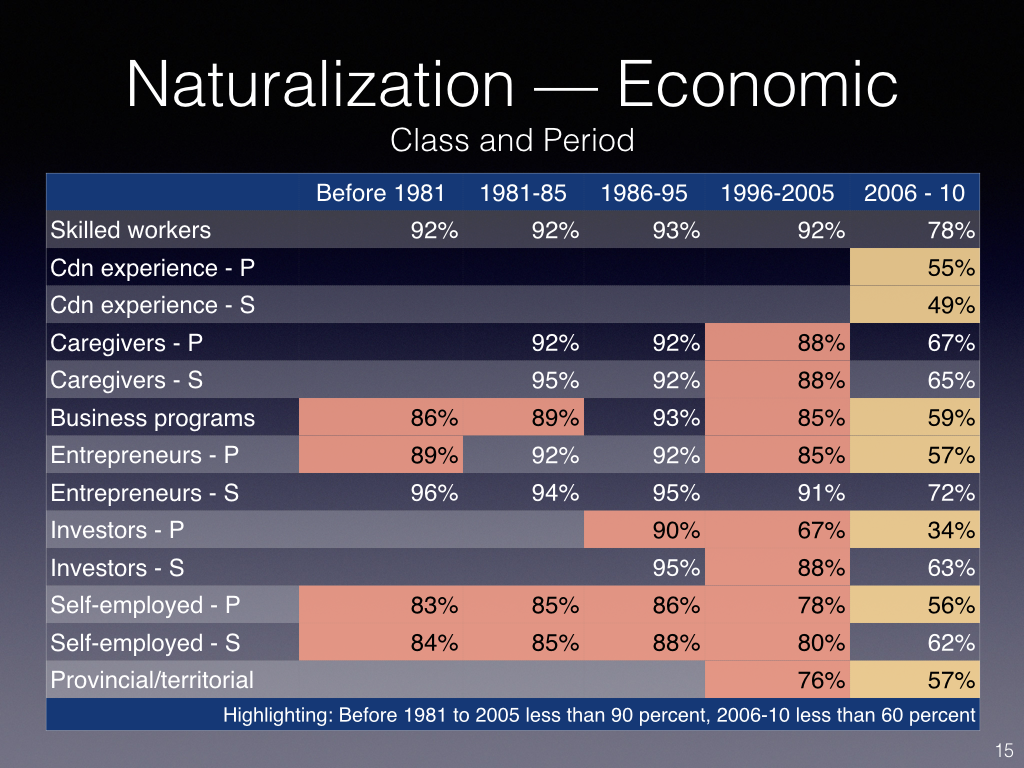
My annual citizenship workshop focussed on birth tourism with my presenting this deck and Audrey Macklin of UofT providing a frank and engaging critiqueI of the substance and magnitude of the issues. Governments also “gamed the system” the deportation of long-term permanent residents who had unwittingly not become citizens (e.g., Abdi, Revell, Moretto, Budlakoti) or imposing a first generation limit on transmitting citizenship. “Meaningfulness” was an elusive concept and there were citizens who had as little connections as the children of birth tourists. Fundamentally, she argued that citizenship laws are a highly imperfect proxy for meaningfulness and connection.  

The most interesting workshop for me focussed on improved data through integration of administrative data (e.g., IRCC’s Longitudinal Immigration Database – IMDB, health data from CIHI) and census data. Improvements to the IMDB include citizenship, children, preliminary 2017 wages and settlement services. External linkages being developed include health, education, and non-immigrant data. For example, with respect to birth tourism, the linkage with CIHI’s DAD will allow separating out temporary residents such as international students from the “non-resident self pay” coding to have a more accurate number of birth tourists along with countries of origin.


Elections Canada braces for a surge in international voters

Have written extensively against this extension and will be interesting to see what the take up will actually be and whether it is really an important issue for Canadian expatriates or not. The numbers below mentioned suggest it was not:

It was a short letter from Elections Canada — but for Gillian Frank, getting it felt like “an old wound had finally started to heal.”

“I was overjoyed,” said Frank, a Canadian living in the United States who received the letter earlier this month confirming his right to cast a ballot in the upcoming federal election.

For seven years, Frank and other Canadians living abroad fought for the right to vote in general elections and national referendums.

In December 2018, the Trudeau government passed Bill 76 — just a month before the Supreme Court of Canada shot down the 1993 law that prohibited Canadians who had lived outside Canada for more than five years from voting in Canadian elections, calling it a violation of the Charter of Rights and Freedoms.

Frank and fellow ex-pat Jamie Duong filed that charter challenge after being denied ballots in 2011. Bill 76 restored voting rights to all Canadians living abroad; the Supreme Court ruling prevents future governments from restoring the ban.

Number of international voters could triple

Since January, Elections Canada has been mailing out letters to Canadians abroad reminding them that they’re back on the international electors list.

“It felt like a moment of closure, a moment of real victory,” Frank said.

Elections Canada expects to see a surge in the number of mail-in or ‘special’ ballots. It estimates the number of Canadians voting from abroad could almost triple — from 11,000 voters in 2015 to 30,000 in 2019.

To cope with the demand, Elections Canada issued a tender in March for a new system to automate the way ballots are distributed.

“We are reducing the number of processes carried out by hand related to special ballots,” Elections Canada spokesperson Natasha Gauthier said in an email. “In automating these processes, we will reduce the number of staff required to handle the volume of ballots we receive.

“These optimizations will not include automated counting of ballots — all ballots will still be marked and counted by hand.”

‘We’re all Canadian citizens’

Duong said Canadians should not fret about the prospect of votes by Canadians living in the U.S. or Hong Kong swinging individual ridings. If it happens, it happens, he said.

“You can say that about any group. What if votes of people 65 and over change the outcome? What if votes [from voters aged] 18 to 25 change the outcome?” Duoug said.

“We’re all Canadian citizens. We all have a right to vote. So, yes our votes should matter. And they should possibly change the outcome of the elections.”

Former chief electoral officer Jean-Pierre Kingsley argues we’ll never know for sure whether the re-appearance of ex-pat voting in 2019 had any real effect on the outcome, since voting is secret. And while “it just takes one vote to swing a riding,” he said, the ex-pat vote likely isn’t going to have that kind of influence because Canadians abroad have to jump through a lot of hoops before casting ballots.

International voters, he said, have to register themselves on the international voter list, find which ridings they belong to, figure out who’s running, fill out their ballots correctly and then mail them in on time. They also have to pay the international postage themselves.

“These are all difficulties we do not have to overcome when we’re voting from Canada,” Kingsley said.

Source: Elections Canada braces for a surge in international voters

Why it’s time to restart the federal immigrant-investor program

No, it’s not (apart from creating business for immigration lawyers, some increased pressures on the housing market and some increased consumer spending. It is striking when looking at Canadian immigration data, that the incomes of primary applicants under the previous investment programs, based on tax data, are less than refugees since 1996.

I have not been able to find a Quebec government evaluation of its investor immigrant program on their website so it is hard to substantiate or refute Silverstone’s claim that it has pumped “billions” into the Quebec economy. We do know, however, that most of these immigrants end up elsewhere and pay little to know tax (Opinion | Study reveals awfulness of Canadian investor immigration):

These are exhilarating times for Canadian immigration. Ottawa announced last December that it would be accepting more than one million immigrants over the next three years, with an increase in 2018 to 310,000 from the previous 300,000 annually, followed by a further increase to 330,000 in 2019 then to 340,000 in 2020.The Province of Quebec, which essentially runs its own immigrant selection process, is, however, reducing its intake by some 20 per cent.

The large majority of these new entrants to Canada will be in various economic categories. In particular, the federal government’s new global talent stream, with its quick-processing turnaround time, and enhancement of the startup visa program, are becoming very useful mechanisms for recruiting and retaining international high-tech talent.The express entry stream, which brings skilled workers to Canada, broke a record in 2018, with almost 90,000 invitations to apply issued. This represents an increase of nearly 4,000 over the previous record set in 2017. Immigration authorities are also promising to clear some of the backlog in the family-reunification class, including the families of the much-needed live-in caregivers. The rules for obtaining Canadian citizenship have also been significantly relaxed.

With the national unemployment rate at a 40-year low 5.6 per cent, immigration is on its way to being an ever-more significant factor satisfying the Canadian labour market. It’s the major factor in Canada’s population growth, which rose by about 1.4 per cent last year. About 71 per cent of this growth is as a result of immigration.

However, processing immigration applications as well as refugee claims does not come cheap. The 2018 federal budget supports increased immigration levels to the tune of $440-million, with an additional $173-million for asylum seekers. The government’s pre-election budget earmarked $1.18-billion over five years to “accelerate” the claims process and to “facilitate the removal of failed asylum claimants.”

Quebec’s immigrant investor program 

Since its inception in 1986, the Quebec immigrant investor program has pumped billions of dollars into the Quebec economy. Quebec’s is a passive investment program. This means that potential immigrants must ante up $1.2-million for a period of five years, after which the money is returned in full but without interest. The prospective investor must establish a minimum personal net worth of $2-million and be able to demonstrate the legal provenance of the funds. They also have to be able to show at least two years of business management experience. The vast majority of the thousands of immigrant investors come from China and elsewhere in Asia, with some from the Middle East. Quebec charges a substantial application fee. The program is well run and has proved to be an economic winner.

Although the program is administered by the province, investors and their families must satisfy federal security and medical standards. One of the criticisms is that the bulk of successful applicants do not maintain their residence in Quebec, but rather flow to other parts of Canada, primarily southern Ontario and British Columbia. Quebec has responded to this by adding an intent to reside in the province proviso, but, in practice, inter-provincial mobility will really not be restricted.

Restarting the federal investor program 

Canada’s federal immigrant investor program was terminated in 2014. It is time for it to be restarted. An immigrant investor program geared toward job creation in economically challenged areas of the country should be implemented now. Such a program could require an active investment of $1-million, with perhaps a lower amount geared toward areas of higher unemployment. This money would be risk capital directed toward private-sector enterprises with job creation as an essential component. The Canadian stream should, of course, include all necessary checks to ensure the legitimate source of the funds as well as to determine the net worth of the applicant.

Borrowing from the EB-5 conditional-visa system in the United States, the Canadian plan should provide for the creation of regional centres, which would enable the private sector in any given area to participate constructively in the allocation of the investment by the foreign applicant. Regional centres in the U.S. bring together investors and local and regional entrepreneurs and economic development officials to ensure the best use of funds. Studies have found that, in the U.S., immigrant investor capital has played a key role in financing several large projects in areas as diverse as New York and Las Vegas.

In the Canadian context, the regional centre would always have as its focus the creation of at least two permanent jobs per investor. Substantial application fees and a security deposit, along with strict monitoring of the investment, will keep away tire kickers and fraudsters, and the regional centre must be prepared to provide complete transparency with regard to the investment process and allocation of resources. In addition, it should be tasked with assisting the immigrant investor as well as other classes of immigration, including refugees, by providing integration and employment services in order to ensure that newcomers build successful lives in this country. Refugees could be major beneficiaries of the job-creation component of a rejuvenated immigration investor program.

Alternatively, the government could just reinstate the discontinued federal immigrant investor program as it was, basically mimicking Quebec’s passive investment initiative. Either way, an essential element that would maximize chances for success would be a firm undertaking by the federal government that applications would be handled in a timely fashion. Serious overseas investors are not going to wait four and five years to have their applications processed.

A typical immigrant investor arriving with a family in a struggling area of the country will be serious and motivated. The investor, having paid perhaps $30,00 in application fees, along with a risk capital investment of a million dollars—and spending perhaps nearly that amount again in dwelling costs, clothing, schooling, vehicles, and many other needed expenditures—will surely be an asset rooted in his or her chosen community. This, combined with the establishment of a viable commercial enterprise and the creation of employment opportunities, produces a winning situation that could economically and socially boost many Canadian locales, especially those outside Montreal, Toronto, and Vancouver—that attract the bulk of new immigrants.

Ramping up to receiving 10,000 families annually could generate billions and create 20,000 jobs. Now is the time to act and get new money into our system before we lose more highly desirable investor immigrants to other jurisdictions.

Source: Why it’s time to restart the federal immigrant-investor program

The tropes around Jews and ‘Jewish money’

Of note:

The charcoal illustration on the front of the London Saturday Journal, a popular Victorian magazine, published in late March 1841, pictured a rather sinister looking man, with a cap in hand and a sack on his back looking slyly at the reader. Entitled “The Jew Old Clothes Man”, an article inside the magazine goes on to describe Jewish second-hand clothes sellers in London in particularly prejudiced terms.

The cover is one of the many chilling images and texts on display at a new exhibition at London’s Jewish Museum. Entitled “Jews, Money, Myth,” the exhibition, on till July 7, examines both the role that money has played in Jewish life as well as the ways in which the associations — mostly negative — between Jews and money and profit have developed over the centuries.

The exhibition is particularly timely. Concerns around anti-Semitism have risen in the U.K. as they have across much of the rest of the world. While the Labour Party has faced allegations that it has not been tough enough on anti-Semitism within its ranks, the Jewish charity Community Security Trust reported a record number of anti-Semitic incidents last year. It is striking that even in Camden, a diverse London neighbourhood, entry into the museum is subject to security checks.

Even as major political parties have attempted to crack down on anti-Semitic rhetoric, others have got away with sharply divisive language. In 2017, the former head of the U.K. Independence Party (UKIP) Nigel Farage faced considerable criticism over remarks on LBC radio about how a “Jewish lobby” in the U.S. was “very powerful”. He is yet to apologise.

In this context, the exhibition is particularly striking and powerful, drawing both on objects involved in Jewish rituals, art, literature, and other objects of life such as board games. It also has some newly created videos to explore and build up an understanding of how the tropes around Jews and money have come to be built up — as well as the reality. “Throughout history, there have been both rich and poor Jews. The exhibition shows how Jewish wealth and poverty have been created by circumstances as well as the activity and acumen of Jews themselves — rather than ‘Jewishness’ itself,” says a note on the exhibition.

Objects, ancient and modern

There are ancient Judean coins, ceremonial objects involved in charitable giving and, in more modern times, the paperwork of efforts made by Jewish communities in the U.K., during and before the Second World War to bring Jewish refugees to Britain. Chillingly — particularly in the context of the heated discussion on immigration and refugees under way across much of the West — there is a reminder of the difficulties that Jewish refugees faced coming to the U.K. even at that time: to seek refuge, they needed to prove they were able to finance themselves privately.

There are literary explorations of the stereotypes built up around Jews and money — from Shakespearean characters such as Shylock and Charles Dickens’s Fagin, to literature such as the Nazi propaganda book The Poisonous Mushroom.

There are also exhibits such as Rembrandt’s “Judas Returning the Thirty Pieces of Silver,” rather sympathetically picturing the biblical figure down on his knees begging for forgiveness from a group of priests as he attempts to return the thirty pieces of silver he was said to have betrayed Christ for. That story, the exhibition notes, has been key to propelling anti-Jewish stereotypes till this day.

Given the weight of the matter, it is perhaps unsurprising that some of the material resorts to black humour and satire, such as a video by U.S.-based artist Doug Fishbone. At one point, he notes the extent to which Indians in the West are now out-earning Jews there, leading British politician and author Lord Archer to declare, back in 2008, that Indians were the new Jews. “Maybe they will be accused of being the puppet masters behind the throne too?” asks Mr. Fishbone in his video.

Source: The tropes around Jews and ‘Jewish money’

Signes religieux: volte-face à Québec solidaire

Interesting:

Les militants de Québec solidaire ont rejeté par une écrasante majorité la position traditionnelle de leur parti sur le port de signes religieux, la recommandation du rapport Bouchard-Taylor. Ils ont voté pour s’opposer à toute interdiction, la même position que le Parti libéral du Québec.

À l’occasion du conseil national de leur parti, les quelque 300 délégués étaient appelés à reconsidérer la position sur les signes religieux. La direction de QS a donné le feu vert à la réouverture de ce débat après les élections du 1er octobre, à la suite de pressions exercées par des associations de circonscription.

Deux choix étaient offerts aux délégués : « l’option A » en faveur de la recommandation Bouchard-Taylor, celle de proscrire les signes religieux pour les agents de l’État ayant un pouvoir de coercition (policiers, gardiens de prison, procureurs de la Couronne et juges). QS défendait cette position depuis longtemps : Françoise David avait déposé un projet de loi en ce sens en 2013.

Mais une tendance claire se dessinait avant même l’assemblée plénière de samedi en faveur de « l’option B », selon laquelle « aucune règle particulière sur les signes religieux ne devrait s’appliquer à certaines professions plutôt qu’à d’autres, incluant celles qui exercent un pouvoir de coercition ».

Les délégués ont voté massivement en faveur de l’option B ce qui a déclenché un tonnerre d’applaudissements. L’assemblée plénière a été ouverte aux médias, contrairement au huis clos qui avait été voté lors du conseil national de décembre où le même sujet était sur le tapis.

Il y avait des militants en faveur d’une « option C » : interdire le port de signes religieux à tout employé de l’État en contact avec les citoyens. Ils ont accusé le parti de les avoir marginalisés, d’avoir orienté les discussions en refusant de soumettre leur option au conseil national.

La direction du parti a jugé que leur demande n’était pas recevable, en contradiction avec le programme. « On nous a nui, on ne nous a pas laissé parler trop librement », a soutenu Richard Aubert, du « collectif laïcité ». Que le parti ait accepté de présenter une candidate voilée, Eve Torres, aux élections du 1er octobre, une première au Québec, « ça me pose problème », a-t-il affirmé. « Ça me dérange qu’au niveau du Canada  un parti pour lequel je voterais au niveau du fédéral c’est un sikh qui le dirige, le NPD », a-t-il ajouté.

Is there an Austrian link to New Zealand mosque attacks?

More on the possible Austrian link:

The Austrian authorities are investigating possible connections after it emerged that the main suspect in the Christchurch mosque attacks made a donation of €1,500 (£1,293) to the far-right Identitarian Movement in Austria (IBÖ).

The suspect visited Austria from 27 November to 4 December last year, according to Austria’s Interior Minister Herbert Kickl, who said that potential links to Austrian extremists were being looked into.

Police have searched the house of the charismatic, social media-savvy IBÖ leader, Martin Sellner, who has done much to raise the profile of the Identitarians throughout Europe.

The group is hostile to multiculturalism, and claims to defend Europe against migrants, especially Muslims.

Mr Sellner has firmly denied any involvement with the 15 March attacks, which killed 50 people, but admits he received the donation and wrote an email of thanks.

In a video posted online, he said: “I am not a member of a terrorist organisation. I have nothing to do with this man, other than that I passively received a donation from him.”

Austria’s Chancellor Sebastian Kurz has said the group will be dissolved if it is deemed to be a terrorist organisation.

“There must be no tolerance for dangerous ideologies in our country – no matter if it’s radical Islam or right-wing fanaticism,” he said.

The main suspect in the Christchurch mosque attacks, Australian Brenton Tarrant, also seems to have had a preoccupation with Austrian history – something the interior minister said was being investigated.

Austrian landmark

The suspect’s clothes and weapons were covered with writing and symbols.

One of the words daubed in white on a gun magazine was “Vienna”.

There was also a string of names of historical figures, including that of Count Ernst Rüdiger von Starhemberg, the military commander of Vienna during the Ottoman siege of 1683.

Starhemberg and his company of 20,000 men defended the city against the 120,000-strong Ottoman army, which was eventually defeated by the combined forces of Poles, Habsburgs and the Holy Roman Empire.

The Battle of Vienna in 1683 is often cited by historians as the point where the Ottoman advance on Western Europe was stopped; the turning of the tide in the Muslim/Christian struggle for the control of Europe.

As such, it is a date celebrated by the far right, including, it seems, the Christchurch suspect, who is a self-confessed anti-Muslim white supremacist.

‘The Great Replacement’

The Documentation Archive of the Austrian Resistance (DOEW), which researches extreme-right activity, says there are “many rhetorical and ideological overlaps” between groups like the Identitarians and the suspected Christchurch attacker.

“The title of the attacker’s manifesto, The Great Replacement (which sees immigrants as a threat to “white” Western culture) was a slogan popularised by the Identitarians,” DOEW said on its website.

“Regardless of the outcome of the investigation,” DOEW says, the Identitarians seem to be sticking to their narrative “for the time being”. It points to an IBÖ statement from last week, which speaks of the “Great Replacement” and calls for “De-Islamification”.

The whole affair is uncomfortable not just for the Identitarians, but for Austria’s government as well.

Mr Kurz’s own conservative Austrian People’s Party is in coalition with the far-right Freedom Party (FPÖ), making Austria the only country in Western Europe with a far-right presence in government.

FPÖ leader and Vice-Chancellor Heinz-Christian Strache said on Wednesday that his party had “nothing to do with the Identitarians”.

However, Austrian media published photos of FPÖ politicians with members of the group, and Bernhard Weidinger from DOEW told the BBC that there were many links between FPÖ politicians and members of the IBÖ, who often attended each other’s events.

In 2016, before he became interior minister, Herbert Kickl gave a speech to a far-right conference in Linz, called Defenders of Europe. The FPÖ politician addressed his audience, which included Identitarians, as “like-minded people”, according to Austrian media reports.

The FPÖ has also long celebrated the Battle of Vienna victory of 1683. In 2010 it even published a comic, set during the siege, featuring Mr Strache as a knight saving Vienna’s cathedral from an Ottoman minaret.

And when Mr Strache and Mr Kurz presented their government programme back in 2017, shortly before the coalition was sworn in, they broke with tradition, and held the event on Vienna’s Kahlenberg mountain, where the Battle of Vienna took place.

Asked if there was any historical significance to the choice of venue, Mr Kurz said no.

But in a video blog, Mr Sellner hailed it as “a good omen”.

Source: Is there an Austrian link to New Zealand mosque attacks?