A growing source of Canadian asylum-seekers: US citizens whose parents were born elsewhere

Sean Rehaag, who has done some good work analyzing trends of decision making by IRB adjudicators, looks at the recent rise in the number of asylum seekers from the US:

Jokes about moving to Canada became common among progressives in the United States during Donald Trump’s presidential bid. When he won, a spike in U.S. citizens seeking information about how to relocate crashed Canada’s immigration website.

I’m a scholar of Canadian immigration law and will soon become the director of the Centre for Refugee Studies at York University in Toronto. My friends and colleagues in the United States, who still make those jokes, are often surprised when I fill them in on how U.S. immigration patterns in Canada have changed during the Trump administration.

Overall, the number of U.S. citizens who have immigrated to Canada for any reason rose from 7,522 in 2015 to 9,100 in 2017. In contrast with this modest 21% increase, the number of U.S. citizens applying for refugee protection during the same two years spiked by more than 1,000%. It grew from 69 in 2015 to as much as 869 in 2017.

The more than 1,500 U.S citizens who have sought a safe haven in Canada are mainly the children of people fearing deportation due to a change of their immigration status after spending years in the United States. Even with the recent increase, they still account for a small share of total applicants for refugee protection in Canada – only 1% in 2018, for example. Nonetheless, the dramatic growth in the number of refugee claims by U.S. citizens illustrates some of the differences between Canadian and U.S. immigration policies.

Long history

People from the U.S. have been seeking asylum in Canada since at least the 18th century.

Fearing mistreatment in the newly established United States, and drawn by offers of free land, as many as 100,000 British Loyalists fled to what is now Canada during and after the American Revolution.

Many enslaved people seeking liberty via the Underground Railroad, prior to the Civil War, headed to Canada. Around 20,000 to 40,000 made lives for themselves there.

In the 1960s and 1970s, some 100,000 young U.S. men, many with wives and children, came to Canada during the Vietnam War to avoid being drafted into military service – or in some cases after deserting. Canada enacted a law that let these “draft dodgers” immigrate with lawful status. Even though President Jimmy Carter issued a blanket pardon for them when he took office, about half remained in Canada.

More recently, dozens of U.S. soldiers who had voluntarily enlisted in the military and served in the wars in Iraq and Afghanistan sought asylum in Canada to avoid jail time when they deserted because they came to object to those wars. This time, the Canadian government denied most of their refugee claims, saying that they could have possibly qualified for conscientious objector status back home. However, the Canadian public expressed substantial support for these war resisters.

Change of status

The more recent wave of asylum applicants is related to changes in U.S. immigration policy.

Before Trump took office, the U.S. had granted hundreds of thousands of immigrants without papers from Sudan, Nicaragua, Haiti, El Salvador and other countries temporary protected status. These policies protected formerly undocumented immigrants from deportation and let them work legally.

The Trump administration has tried to end temporary protected status for eligible immigrants of many nationalities, despite evidence that many of their countries remained dangerous or their economies were still too unstable for them to return.

For example, the Inter-American Commission on Human Rights, an autonomous agency of the Organization of American States, asserts that Nicaragua operates as “police state” with government-sponsored repression that is resulting in hundreds of deaths and thousands of injuries. The UN Refugee Agency estimates that 62,000 Nicaraguans have fled to neighboring countries in the past year.

For now, the fate of about 300,000 of these immigrants from multiple countries awaits resolution in the courts.

A big share of the families with U.S. citizen-children seeking asylum in Canada today are immigrants from Haiti and other countries who fear losing their temporary protected status. Some people with this status from Nicaragua and Honduras have had it since 1999. Qualifying Sudanese immigrants have been shielded from deportation since 1997. The U.S. granted 59,000 Haitians temporary protected status in 2010, following a big earthquake.

Canada will probably deny the refugee claims of the U.S. citizen children because the system requires applicants to prove a well-founded fear of persecution in their country of origin. In this case, that would be the United States rather than, say, Haiti, Sudan or El Salvador.

But parents who obtain refugee protection in Canada will be able to obtain permanent residence for their children as well, putting them on the path to citizenship in Canada. Many likely will succeed with their claims. Canada approved about half of the refugee claims made in 2018after migrants crossed the U.S. border.

Indeed, some of the families with U.S. citizen children seeking asylum in Canada may figure that they are more likely to succeed in Canada than in the U.S. For example, Canadian refugee law is more permissive than U.S. asylum law for people fleeing gender-based violence or gang violence – both common types of claims for Central American asylum-seekers.

Different policies

Canadian and U.S. immigration policies have always been distinct but the contrast is becoming more stark.

Trump campaigned on an anti-immigrant agenda, while Canadian Prime Minister Justin Trudeau promised voters he would increase the number of resettled Syrian refugees welcomed in Canada. On the same day that Trump first decreed a Muslim travel ban, Trudeau famously tweeted out his hospitality: “To those fleeing persecution, terror & war, Canadians will welcome you, regardless of your faith.”

Under Trudeau’s leadership, the Canadian government has decided to boost the number of immigrants it grants permanent resident status yearly, from 286,000 in 2017 to 340,00 in 2020.

The U.S., with a population that is nearly nine times bigger than its northern neighbor, grants permanent resident status to 1.1 million newcomers. The Trump administration is trying to overhaul the nation’s immigration policy in ways that could cut that number considerably and it has slashed refugee admissions. In April 2019, Trump addressed the rising number of asylum-seekers arriving at the U.S.-Mexico border. “We can’t take you anymore,” he said. “Our country is full.”

As long as these sorts of divergences persist, I believe that immigrants who have been living in the United States for years, some with children who are U.S. citizens, will keep coming to Canada seeking asylum.

Source: A growing source of Canadian asylum-seekers: US citizens whose parents were born elsewhere
Australia: ‘You don’t belong here’: A Muslim MP on racism in politics

Of note:

It’s true what they say. Some Australians would rather have our prime minister than theirs. They looked across the Tasman after the March 15 terror attack in Christchurch and saw what Australian politician Mehreen Faruqi​ calls “authentic, compassionate leadership”.

Faruqi is a Green Party senator for New South Wales. In 2013, she became the first Muslim woman ever elected to an Australian parliament. When March 15 happened, shock and devastation were followed by mourning, because it all seemed very close to home. It could so easily have happened there. Faruqi remembers her first speech in the senate was about the normalisation and legitimisation of hate, and the people it was hurting.

“I felt it very close to my heart when Jacinda Ardern said, ‘You belong here’,” Faruqi says. “That’s what we were waiting to hear from many people. What we’ve always heard is, ‘You don’t belong here, get out of my country’.”

Born in Pakistan, Faruqi moved to Australia 27 years ago. It is home for her, she stresses. It is where she studied, where her children grew up. But she has seen the mood worsen since the early 1990s. Muslims became an obvious target after 2001, and Muslim women seem to bear a disproportionate amount of the abuse. It is a “toxic mix of sexism and racism” that manifests for Faruqi as online bullying and harassment, hate mail and abusive phone calls.

“I’ve had my face photoshopped onto Isis flags,” she wrote in the Guardian in February. “I’m now used to the tabloid media amplifying lies about me and other Muslims for clickbait.”

“It doesn’t matter what I say or do,” she says. “It could be something I’ve said in support of public education, women’s rights or animal welfare, but it always ends up being about my race or where I come from or what I look like. It seems that for some I’ll never be Australian enough.”

​Faruqi came to Christchurch to pay respects and show solidarity with those affected by the mosque attacks before heading to Auckland for a conference on racism on Friday, organised by Shakti Community Council. Other participants include Green MP Golriz Ghahraman​, whose experience of being targeted by online trolls “is very similar to mine and other women of colour in public life”.

Faruqi is looking forward to comparing notes with Ghahraman. As far as overcoming racism goes, she agrees that there is more Australia can learn from New Zealand than the reverse. A lack of diversity is a major problem in Australian politics.

“Our parliaments don’t actually look like our streets or suburbs. Politicians often highlight that we are one of the most multicultural countries in the world but our representation should be reflective of that multiculturalism.”

Another problem she notices is a lack of understanding of the diversity of Muslim communities. There is a lazy assumption that Islam is not compatible with the freedoms of liberal democracy. It is the clash of civilisations theory – see all the Right-wing agitators warning about Sharia law.

“As a Muslim, I grew up with strong values of social justice, kindness, compassion and equality for all,” she says. “Those values brought me into politics and a party like the Greens. I’ve never been shy as a Muslim of talking about rights for LGBTQI people. I brought the first bill in the history of New South Wales to decriminalise abortion.

“There is a very negative stereotype of what Muslims are and what they look like. Often we are presented as ‘the Muslim community’, like a monolith. We are as wild and wonderful as any other community.”

Source: ‘You don’t belong here’: A Muslim MP on racism in politics

Award-winning professor Salim Mansur disqualified from seeking Conservative nomination

A sign of who the vetting process of the CPC is catching (the right wing press, Rebel, Clarion, True North have been critical of this decision, will be interesting to see if Mansur is picked up by the PPC):

Professor, author and columnist Salim Mansur has been disqualified from seeking the Conservative nomination.

Mansur, a recently retired Western University professor, announced his candidacy last September in his home riding, London North Centre.

Despite being told by the Conservative Party of Canada’s regional organizer last November that he was allowed to launch his campaign and begin campaigning, Mansur received notice from the party’s executive director Monday morning that his nomination candidacy was “disallowed.”

“The (National Candidate Selection Committee of the Conservative Party of Canada) has disallowed your candidacy as a candidate for the Conservative Party of Canada,” said an email from Dustin Van Vugt.

No reason was provided in the email, but Mansur told me in a brief interview that Conservative leader Andrew Scheer’s campaign manager, Hamish Marshall, advised him last week of the party’s concerns with Mansur’s past writing and public speaking on Islamism and the politics of radical Muslims, which Marshall said will likely be portrayed by Liberals and others as Islamophobic, and become disruptive to the party’s national campaign.

It’s Mansur’s academic career that has held him in such high esteem by the Conservatives in the past, however. Mansur has testified before parliament on numerous occasions at the invitation of the Conservatives. In 2017, he was awarded the Canadian Senate’s 150th Anniversary Medal for his work promoting interfaith understanding, presented by Conservative senator Linda Frum.

Mansur, a devout Muslim, has been a stalwart opponent of radical Islamism and the groups advancing it within Canada. He’s chronicled this fight as a Muslim and as an academic in his bestselling book Islam’s Predicament: Perspectives of a dissident Muslim.

The retired professor said in an open letter on his website that his mission is to “elect a Conservative government in Ottawa with Andrew Scheer as our next Prime Minister.” On his platform page, Mansur cites economic growth, strengthening Canada’s security, and vigorously protecting individual freedoms as his priorities.

In the interests of disclosure, I have introduced Mansur to a number of political activists in London as a personal favour, and have served as a sounding board for some ideas he had about his campaign. I have received no compensation for these or any other efforts related to his candidacy.

Source: READ MORE

Bob Hawke: Why Chinese Australians are mourning a ‘tender-hearted’ PM

Moment in history, important to remember in the current context of China’s behaviour domestically and internationally and how politicians choose to act. If any reader has a Canadian angle to share, that would be welcome as I didn’t recall seeing a comparable piece during the coverage of the Tienanmen “anniversary”:

On Friday, Australians will honour beloved former leader Bob Hawke in a memorial service at the Sydney Opera House. Among them will be many Chinese Australians – including my parents – whose lives changed forever when Mr Hawke offered them asylum after the Tiananmen Square massacre.

In June 1989, Chinese troops used guns and tanks to suppress protesters calling for democracy in Beijing, killing an unknown number of people.

Half a world away in Australia, my father Cong Hui Mao watched in horror as the crackdown unfolded on his television set.

He had recently moved from China to Sydney, aged 30, on a one-year student visa. In Australia he found a vast nation with the kind of political freedoms that protesters in China had been calling for. The Tiananmen demonstrations had given him hope, and for weeks he closely followed the “promising flickers” of a new China.

“It was an exciting time – we felt that we were at a crossroads where we could bring up new ideas,” he says.

“So when Tiananmen happened, it was like a great fire had been quashed.”

In the days following, he joined crowds of Chinese students in Sydney who poured on to the streets to march for their peers at home. “We were grieving but also angry,” he says. “So angry at our government who had attacked its own people.”

The images from Beijing horrified the world, including then-Prime Minister Bob Hawke. At a national vigil in Canberra, he cried openly while reading out graphic details from a diplomatic cable: “When all those who had not managed to get away were either dead or wounded, foot soldiers went through the square, bayonetting or shooting anybody who was still alive.

“Tanks then ran backwards and forwards over the bodies of the slain, until they were reduced to pulp.”

Immediately afterwards, Mr Hawke granted visa extensions to all Chinese students in Australia.

Mr Hawke later confirmed that he did not consult his cabinet before announcing the decision. He told The Guardian in 2015: “I have a deep love for the Chinese people… when I walked off the dais I was told: ‘You cannot do that, prime minister.’ I said to them: ‘I just did. It is done.'”

‘Everyone felt grateful’

Ultimately, about 42,000 Chinese people took up the offer and forged new lives in Australia. They were given working rights and social support, and later their temporary visas were made permanent.

“Everyone felt so grateful to Hawke for his decision to allow us to stay,” says my father, who met Mr Hawke on numerous occasions at Chinese community functions held in the politician’s honour. “If he hadn’t said that, many of us would have returned to China where we feared it was unsafe, and where we feared China would go backwards.”

My mother, Ying Zhu Wang, flew to Australia in 1990 on a student visa. In Sydney, my parents met and married, set up a home and had their first two children. They didn’t return to visit China until five years after the massacre.

When Mr Hawke died on 15 May, my parents – like many Chinese Australians – contacted their friends and reminisced. Many will join other Australians at Friday’s state memorial service.

There is also much gratitude towards Mr Hawke for his attitude towards China after the Tiananmen Square protests. “He had good relations with China and its development. He understood us,” my mother says.

Jia Lu, a Chinese interpreter and researcher at the University of New South Wales, agrees: “Of course, we are thankful to him for his action after Tiananmen and the visas that allowed us to bring our families over. But people forget too that he was an Australian politician – a rare politician who kept a positive view of China’s development.”

She estimates that he attended more than 100 events held by community groups over the years.

“He was a real friend to the Chinese. For me and so many of my friends, we will really miss him.”

Transforming Australia

Mr Hawke felt the disappointment of Tiananmen deeply because he had been engaging directly with a newly West-looking China, says historian Prof Frank Bongiorno of the Australian National University.

“It’s almost beyond inconceivable today for a prime minister to make a unilateral and radical decision like Hawke did,” he says. “And he wanted to show Australia as a generous and compassionate society.”

The decision drew resistance from some officials and ministers who feared it could overwhelm Australia’s migration programme, or lead to resentment among other communities.

But it ended up “transforming the face of Australian multiculturalism”, says Dr Christina Ho, a migration expert at the University of Technology.

“They were a particular group – young, students who then went on to be educated, professional people who have made a huge contribution to Australian society.”

Not that it was an easy integration. During the 1980s and 1990s, there was ongoing political debate about the rate of Asian immigration and social cohesion. Many migrants were highly educated but had a poor grasp of English and struggled to find well-paying jobs, says Prof Ho.

“A lot of de-skilling happened in that generation,” she says. “But still, they worked hard, integrated into Australian society and raised their own families. Now they’re part of the vibrant multicultural society that is Australia today.”

This diaspora also became a cultural asset as Australia expanded its trade relationship with China in the 1990s, says Prof Bongiorno.

“You had a significant group of Chinese Australians who were a real resource,” he says. “They had the linguistic skills and native sense of the cultural dynamism of Chinese society.”

He cites the post-Tiananmen Square intake and Vietnamese migration in the 1970s as two critical points in steering Australia more towards Asia as a society.

Those Chinese students provided support for the next stream of Chinese migrants – largely middle class and from the mainland – who have moved to Australia in the past decade. Asia now accounts for more than half of Australia’s migration intake.

“Back in 1989, after Tiananmen, we were all scared – China was a closed door,” says my father.

“Bob Hawke – he showed kindness to us students. He gave us opportunity. Although he’s died, we still think of him in our hearts and remember him.”

Source: Bob Hawke: Why Chinese Australians are mourning a ‘tender-hearted’ PM

Saint-Léonard: un ex-député libéral outré par la candidature d’un non-Italien

More on Saint-Léonard-Saint-Michel which some in the Italian Canadian believe should “belong to them” despite demographic changes:

« Libéral ou Italien ? » C’est la question-choc posée par l’ex-député libéral fédéral de Saint-Léonard-Saint-Michel, Nicola Di Iorio, qui s’insurge contre l’élection d’un candidat non italien à l’assemblée d’investiture. Une première en près de 50 ans.

Le député démissionnaire, qui ne sera pas candidat aux prochaines élections, demande à Justin Trudeau, dans un texte paru dans un journal local de langue italienne, d’annuler le résultat du vote à l’investiture du 27 mai.

C’est Hassan Guillet, ancien imam révélé au grand public par son discours après le drame de la mosquée de Québec, qui a été choisi par les membres comme candidat du Parti libéral du Canada.

« La communauté se sent tassée », déplore M. Di Iorio, dont le siège à la Chambre des communes est vacant depuis sa démission en janvier dernier. En entrevue à La Presse, l’ex-député se confie sur la course à l’investiture, qu’il qualifie de « chaotique ».

Sans parler d’irrégularités, M. Di Iorio se plaint notamment d’une salle trop petite et d’une file d’attente trop longue, ce qui aurait, selon lui, défavorisé les électeurs italiens, en moyenne beaucoup plus âgés. Autour de 600 personnes n’auraient pas pu voter et seraient reparties bredouilles, dénonce-t-il.

« Si on est pour faire des investitures, qu’on en fasse des vraies », a-t-il dit durant l’entrevue, visiblement irrité.

Les libéraux affirment que tout s’est déroulé dans les règles de l’art.

« Le processus d’investiture a été mené en totale conformité avec nos règles nationales de sélection des candidats. »

– William Harvey-Blouin, stratège du Parti libéral, dans un courriel

Une deuxième course à l’investiture n’est pas envisagée. Personne ne semble y croire, pas même M. Di Iorio : « Est-ce que je pense que mon parti va faire ça ? Est-ce que je pense que mon chef va faire ça ? J’ai appris à être réaliste dans la vie. »

La réplique d’Hassan Guillet

« C’est de la foutaise », a affirmé d’entrée de jeu Hassan Guillet à propos de la requête de M. Di Iorio. « Il peut dire ce qu’il veut, mais il n’y a aucune raison pour faire une autre course à l’investiture simplement parce qu’il en demande une. »

M. Guillet souligne ses « bons rapports » avec la communauté italienne et rappelle qu’il a commencé son discours de victoire dans la langue de Dante. M. Di Iorio tempère. « Hassan ne s’est jamais manifesté auprès de la communauté italienne de sa vie », soutient-il.

« Je trouve que c’est un faux débat, signale M. Guillet. [M. Di Iorio] avait juste à mobiliser plus de monde, à obtenir la confiance des gens et la confiance du parti. Maintenant, les gens ont choisi. Je ne sais pas pourquoi on s’éternise sur ce débat-là. »

La circonscription Saint-Léonard-Saint-Michel est depuis belle lurette un château fort libéral grâce à une loyauté indéfectible de la population d’origine italienne qui s’y est installée et y a pris racine.

Le président du Congrès national des Italo-Canadiens, Antonio Sciascia, est clair.

« C’est un désastre. Ça nous met en tabarouette, en bon québécois. On a commis une grande bêtise. »

– Antonio Sciascia en entrevue avec La Presse

Comme d’autres au sein de la communauté, il préfère imputer la faute à la division du vote italien. Deux candidats d’origine italienne se sont présentés, ce qui a laissé la voie libre à M. Guillet. Francesco Cavaleri, le dauphin de M. Di Iorio, est arrivé troisième. « Je pense qu’il [M. Di Iorio] doit prendre une partie de la responsabilité de ce qui s’est passé à Saint-Léonard », a dit M. Sciascia.

Ce nouveau contexte causera-t-il un réalignement des allégeances politiques dans la circonscription ? S’il est trop tôt pour le dire, selon M. Sciascia, un grand nombre de « mécontents » pourraient retourner leur veste. Pour la première fois, un non-Italien au Parti libéral devra affronter un candidat conservateur italo-québécois connu, l’avocat Ilario Maiolo.

Alors, libéraux ou Italiens ? « Jusqu’à maintenant, libéral et Italien ont toujours été synonymes », a répondu M. Sciascia, sans toutefois se prononcer sur l’avenir.

Qui est Nicola Di Iorio ?

Nicola Di Iorio s’est fait connaître après avoir lancé Cool Taxi, une OBNL qui lutte contre l’alcool au volant. L’avocat spécialisé en droit du travail s’est présenté aux élections fédérales de 2015 pour le Parti libéral du Canada dans Saint-Léonard-Saint-Michel. Son passage en politique a été marqué par de longues périodes d’absence. M. Di Iorio avait annoncé sa démission en avril 2018 pour des « raisons personnelles », mais il s’était ravisé quelques mois plus tard. Alors qu’il était toujours député, il s’est associé au cabinet d’avocats BCF. M. Di Iorio prétendait qu’il avait été libéré par le premier ministre pour travailler sur une « mission secrète », qui reste secrète à ce jour. Il a finalement annoncé sa démission le 29 janvier, après avoir remis 100 000 $ à un organisme non identifié. En entrevue avec La Presse, M. Di Iorio est demeuré évasif sur ce mystérieux revirement de situation.

Qui étaient les candidats à l’investiture ? 

Le vote à l’investiture de Saint-Léonard-Saint-Michel pour le Parti libéral s’est tenu le 27 mai à la salle de réception Le Rizz, à Saint-Léonard. Trois candidats étaient sur la ligne de départ : Patricia R. Lattanzio, conseillère de la ville pour Ensemble Montréal à Saint-Léonard ; Francesco Cavaleri, avocat chez Cavaleri Donatelli, un bureau situé à Saint-Léonard ; et Hassan Guillet, ingénieur et avocat qui a fait carrière chez Bombardier avant de devenir imam. Selon les règles du parti, une course à trois requiert un vote à deux tours où les électeurs doivent choisir les candidats par ordre de préférence. M. Cavaleri a été exclu au premier tour avec seulement 275 voix, contre 588 pour M. Guillet et 474 pour Mme Lattanzio. C’est finalement Hassan Guillet qui l’a emporté au deuxième tour.

Source: Saint-Léonard: un ex-député libéral outré par la candidature d’un non-Italien

Child marriage ‘legal and ongoing’ in Canada, researcher finds

Not clear whether the definition used is the UN one (under 18) or the Canadian federal Civil Marriage Act of 16, although likely the latter. An average of 188 per year:

Ontario, Alberta and Quebec have licensed the most child marriages in the last 18 years, said professor Alissa Koski, who researches the practice in Canada

Since 2017, Canada’s government under Justin Trudeau’s Liberals has conducted foreign policy with an explicitly “feminist” approach, especially as it relates to sexual and reproductive health rights.

Part of that has involved trying to eradicate child marriage overseas. Canada is a leader and key funder of United Nations efforts to end child marriage, which is regarded as a revealing measure of a country’s development.

But there is a curious blind spot.

“There’s been absolutely no reflection on the fact that it remains legal in Canada,” said Alissa Koski, who researches child marriage in Canada as an assistant professor at McGill University’s Department of Epidemiology, Biostatistics and Occupational Health.

The bizarre result is that Canada legally permits the very practices it condemns and combats in the developing world.

Child marriage in Canada “is legal and ongoing,” Koski concludes, and not as a rare legal quirk in niche communities of religious extremists, as media coverage often suggests.

Provinces have, in fact, issued marriage licences for 3,382 children over the last 18 years, according to Koski’s presentation to the Congress of the Humanities and Social Sciences in Vancouver.

In absolute numbers, Ontario sanctioned the most child marriages with 1,353 since 2000, then Alberta with 791, Quebec with 590 and British Columbia with 429. She adds that her results likely “underestimate the true extent of the practice.”

It has happened in every region, Koski said. The vast majority are girls; and compared to boys, girls marry at younger ages and to substantially older spouses.

The rate is highest in Alberta, at five girls per 10,000, and one boy as measured by data from the year 2016, or three children total per 10,000.

Her discovery that Canada has approved at least 3,382 child marriages since 2000 is based on data from vital statistics offices, which indicates the marriage happened in Canada, but otherwise offers limited information. Further work with census data might offer a clearer picture of demographics, although with the added caveat that it will include marriages that happened in other countries before the person came to Canada.

In the United States, the rate of child marriage is about 6.2 children per 1000, higher in girls than boys (6.8 vs 5.7), lower among white people, higher among Indigenous and Chinese, and ranging from less than four children per 1,000 in Maine, Rhode Island and Wyoming, to as much as 10 per 1,000 in West Virginia, Hawaii and North Dakota, according to Koski’s previous studies of child marriage in America.

Her doctoral research was on child marriage in sub-Saharan Africa and India, which fits with the common imagination of the phenomenon as “something that happens elsewhere,” as Koski put it.

For example, her separate research on Canadian media coverage of the issue shows it is almost entirely about Canada’s efforts to eradicate child marriage abroad. The few exceptions are focused on specific religious minorities, primarily the fundamentalist Mormons in Bountiful, B.C., and the fundamentalist Jewish sect Lev Tahor, first in Ste-Agathe-Des-Monts, Que., later in Chatham, Ont.

Canada’s federal Civil Marriage Act sets the minimum age for marriage at 16. Provinces, which administer the licensing, require parental consent for people younger than 18.

But the United Nations, and Canada through its participation in its various programs and documents, regards child marriage as marriage of a child, which is to say someone younger than 18.

The reasons are well known. The proportion of girls who marry before 18 is used as a quantifiable measure of a country’s development progress, Koski said, and it is widely considered a violation of human rights. Research in the US has shown higher mental illness and substance abuse in women who married as girls.

“Child marriage is associated with poor health and economic outcomes, particularly for girls,” she said.

Koski said there seems to be a general political reluctance to raise the age to 18, part of which involves concerns over infringing on religious freedom.

Source: Child marriage ‘legal and ongoing’ in Canada, researcher finds

Québec définit ce qu’est un «signe religieux»

I have pity for the public servants who were tasked with the drafting what appears to be a fairly restrictive definition, given no mention of size (e.g., small pendants of the Cross, Star of David):

Le gouvernement Legault fait volte-face et consent finalement à définir ce que représente à ses yeux un « signe religieux » dans son projet de loi 21 sur la laïcité de l’État.

Depuis le dépôt du projet de loi controversé, le ministre responsable, Simon Jolin-Barrette, avait toujours refusé jusqu’à maintenant, malgré les pressions venant de toutes parts, de définir ce qu’il entendait par l’expression « signe religieux », qui est au coeur du document.

Mardi, en soirée, coup de théâtre à l’Assemblée nationale où son projet de loi est passé au peigne fin : le ministre Jolin-Barrette a déposé un amendement précisant aux nombreux employés de l’État visés par la loi ce qu’ils n’auront plus le droit de porter dans l’exercice de leurs fonctions.

Le libellé de l’amendement à l’article 6 démontre l’intention du gouvernement de ratisser large.

Ainsi, aux yeux du gouvernement, « tout objet, notamment un vêtement, un symbole, un bijou, une parure, un accessoire ou un couvre-chef » sera considéré comme étant un « signe religieux », s’il est porté « en lien avec une conviction ou une croyance religieuse » ou s’il est « raisonnablement considéré comme référant à une appartenance religieuse ».

Il n’y a aucune mention visant la taille de l’objet en question : minuscule ou ostentatoire, le signe religieux sera donc prohibé.

Le gouvernement Legault tient mordicus à faire adopter deux de ses projets de loi avant l’ajournement des travaux, prévu ce vendredi 14 juin : le projet de loi 9 sur l’immigration et le projet de loi 21 sur la laïcité de l’État.

Les deux législations sont pilotées par le ministre Jolin-Barrette.

Le projet de loi 21 en est rendu à l’étape de l’étude détaillée article par article.

Il prévoit interdire à plusieurs catégories d’employés de l’État – policiers, gardiens de prison, procureurs de la Couronne, enseignants et directeurs d’école des niveaux primaire et secondaire du secteur public, notamment – de porter tout signe religieux dans l’exercice de leurs fonctions.

Les employés actuels auraient un droit acquis (« clause grand-père »).

Durant la consultation menée sur le projet de loi, certains des témoins entendus avaient fait valoir que le document était beaucoup trop vague, sans définition précise de ce qui serait interdit ou pas, donc difficile à appliquer.

Source: Québec définit ce qu’est un «signe religieux»

Lessons from the Doug Ford School of Public Administration

I could not resist posting this pointed, and unfortunately all too accurate, rant by Les Whittington. Hopefully, year two will show a more measured and mature governing style (but not hopeful):

School is out at Queen’s Park, but here are the lessons for the next semester based on the first year of Premier Doug Ford’s government in Ontario:

Talk about helping “the people” while you slash programs that many need: Roll back promised funding increases for rape crisis centres, cut legal aid by 30 per cent, cancel a $1 increase in minimum wage, remove rent control for new units, get rid of the basic income pilot program, scrap legislation to help part-time workers, cancel free prescription medication for young Ontarians, kill off free university tuition for low-income students, and slice $84-million in funding for children and at-risk youth.

The public doesn’t pay attention so there’s no problem promising one thing and doing something else: Tell voters “not one single” public service job will be lost under a Ford government, then once elected change that to no “frontline” jobs. Then put thousands of teachers’ jobs at risk by raising school class sizes. Watch other jobs disappear at agencies that are being axed or downsized. Put thousands of beer store employees’ jobs in jeopardy.

Don’t worry about honouring your promise to continue with the planned increase in municipalities’ share of gas tax funding… they can do without that extra $300-million.

Treat the public like a bunch of dazzled rubes: Bread and circuses, supplemented with divisive anger, can be a winner, as U.S. President Trump has shown. Above all, in Ontario this means prioritizing beer and booze. Commenting on the Ford government’s budget, Green Party Leader Mike Schreiner noted the emphasis: “If you look through this budget, it mentions booze and gambling 63 times, it mentions climate change 15 times, and it mentions poverty zero times.”

Avoid annoying demands for consultation and advance information:Better to release details of your unexpected decisions in phone calls to the officials involved rather than publicly, as was done with the planned amalgamation of regional health organizations. Another example: Without warning, the Ford government trashed years of urban planning designed to keep Toronto liveable when it took over the city’s planning in a move to allow developers to build higher buildings—and more of them—in the city’s downtown and midtown. After all, developers need a freer hand.

Personal grudges are as good a basis for public policy as anything else:Given the province’s power over Toronto’s affairs, why not unexpectedly cut the size of Toronto’s city council in half? Didn’t the council give brother Rob Ford a hard time when he was mayor? Rob Ford always favoured a subway line to Scarborough. By taking over subway planning, a Progressive Conservative government can make it happen. As for the provincial Liberals, only old-fashioned notions of fairness could have stopped the PC majority from changing the rules to keep the Ontario Liberals from having a chance to achieve official party status.

Provincial taxpayers are so apathetic they won’t mind if their tax dollars are spent on federal political ads: If your government opposes carbon pricing imposed by the Trudeau government, why not spend millions from the Ontario treasury advertising against it? Also, there’s no need in today’s post-truth environment to mention the fact that Ottawa will be rebating the carbon tax revenues to individual Ontario taxpayers.

Don’t bother the public with difficult issues like climate change or the need to prepare for the green economy: Voters will buy things like park clean-ups as a substitute for action on global warming. So, you can cancel Ontario’s cap and trade program and cut 700 green energy programs, undermine the province’s independent environmental watchdog, and earmark $30-million to challenge the carbon tax in court.

Policies based on illusions of past greatness are always more popular than forward-looking plans designed to try to address the complex issues of modern life: Reduce financial support of post-secondary institutions and kill off new satellite university campuses while cutting funding for innovative research and work on improving Canada’s economic prowess. The future will look after itself.

Don’t bother with nuisances like avoiding favouritism in major government appointments or not interfering in politics outside your sphere: Just because Toronto Police Supt. Ron Taverner was a Ford family friend didn’t mean he wouldn’t have been a good choice for OPP commissioner.

On the federal-provincial scene, a premier should stake out the most provocative position possible, as in this Ford quote from October 2018:“We’ve taken Kathleen Wynne’s hand out of your pocket … and we’re going to take Justin Trudeau’s hand out of your pocket.”

Conservative Leader Andrew Scheer needs all the election help he can get, so pitch in. How could that not work out well for him?

Source: Lessons from the Doug Ford School of Public Administration

Senate survey offers better picture of diversity among Chamber staff

Good to see these data collection efforts and their sharing despite their limitations:

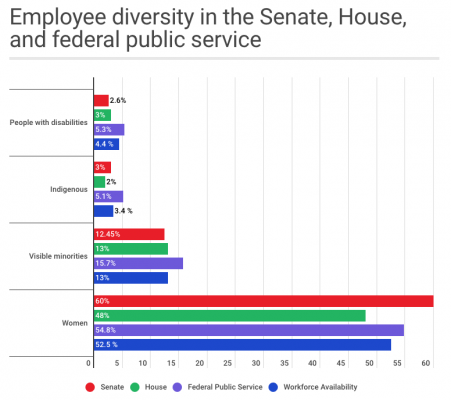
New numbers suggest the Senate’s hiring of women, Indigenous people, and visible minorities is on par with each group’s availability in the workforce, but behind on employing those with disabilities.

An estimated 2.6 per cent of Senate staff are people with disabilities, though they represent 4.4 per cent of the available workforce, according to new data collected from some Senate staff.

At the June 6 Senate Internal Economy, Budgets, and Administration meeting Diane McCullagh, the Senate’s chief human resources officer, reported on her office’s efforts to get better statistics through a voluntary survey of staff in both the administration and Senators’ offices. Because it’s an opt-in survey, the Senate doesn’t have diversity data on all its staff.

The latest push brought in 266 responses, Ms. McCullagh said, and pooled with past efforts, the Senate now has information for 596 people. That represents 81.5 per cent of the 731 employees at the time of the survey, conducted between March 29 and April 26.

Three per cent of Senate staff recorded identify as Indigenous, compared to an estimated 3.4 per cent workforce availability, Ms. McCullagh told Senators. Similarly, among visible minorities, the Senate is a few points off, hiring 12.45 per cent, compared to an estimated workforce availability of 13 per cent. Women represented 60 per cent of those surveyed, well above the 52.5 per cent workforce availability.

Where the Senate is falling behind, it isn’t far, said Ms. McCullagh, but the Senate has “work to do” to hire more people with disabilities.

Breakdown of diversity for staff in the House of Commons, Senate, and public service, according to 2018 data reported by each body. Graph created with Infogram

Ms. McCullagh acknowledged the limitations in the data, noting people are “still fearful” of singling themselves out. But the numbers can still help establish “benchmarks against which we can measure our progress going forward,” she said.

The search for better statistics emerged following a June 2018 report, Diversity in the Senate: From Aspiration to Action, from Internal Economy’s Subcommittee on Diversity.

The new data shows a shift from the 2016 numbers the committee studied, though that report only looked at the Senate’s employees, and didn’t include staff working in Senators’ offices. As of March 2016, among the 354 employees, women represented 59 per cent, visible minorities 15.3 per cent, people with disabilities 5.6 per cent, and Aboriginal people 3.4 per cent.

The new data puts the Senate behind the core public services in all areas, except hiring women, and ahead of the House of Commons only in its hiring of women and Indigenous people.

Of the 192,467 that made up the core public service as of March 31, 2018, women represented 54.8 per cent, according to the most recent report on employment equity. That’s slightly up from the estimated workforce availability of 52.5 per cent for the same year. Indigenous people represented 5.1 per cent of the public service (compared to 3.4 per cent workforce availability), people with disabilities accounted for 5.3 per cent (compared to 4.4 per cent), and visible minorities were 15.7 per cent (compared to 13 per cent workforce availability).

In the House of Commons, as of June 2018, 48 per cent of the House administration’s 2,479 employees were women, two per cent were Aboriginal persons, 13 per cent were visible minorities (up from 10 per cent the previous year), and three per cent were people with disabilities (down from two per cent in 2017).

Senators also asked Ms. McCullagh’s team to start tracking regional representation among staff, and while she didn’t have that data, she said the Senate has a wider reach than it has in the past.

Source: Senate survey offers better picture of diversity among Chamber staff

Hier les italophones, aujourd’hui les musulmans

On the politics of anti-immigration sentiment and a reminder that earlier waves also were affected:

Avec la marginalisation du Parti québécois et le remplacement du Parti libéral par la CAQ, nous assistons à un cycle politique caractérisé par l’alternance sans réelle alternative, en conformité avec l’ordre néolibéral. Ce gouvernement nationaliste de droite élu par 25 % de l’électorat, si l’on tient compte des abstentions, a recours à une recette éprouvée pour, à la fois, consolider et légitimer son pouvoir : détermination d’un problème réel ou imaginaire (la laïcité), élaboration d’une rhétorique alarmiste (retour du religieux) et désignation des responsables du problème (les musulmans). Les stratèges de François Legault n’ont rien inventé. Il y a une cinquantaine d’années, le mouvement nationaliste de l’époque s’est servi de la même recette mais avec d’autres ingrédients : la langue française, l’anglicisation et les italophones.

Il a fallu près d’une décennie pour que le psychodrame linguistique, se déroulant aux dépens des Québécois d’origine italienne, se dénoue enfin par l’adoption de la loi 101. Les relations entre ces derniers et les francophones se détériorèrent à tel point, et pendant si longtemps, que la méfiance et le ressentiment eurent raison de Giuseppe Sciortino, candidat péquiste dans Mercier, lors de l’élection précédant le dernier référendum. Il fut obligé, in extremis, de céder la place à un francophone d’ascendance canadienne-française à la suite de manoeuvres douteuses. Récemment, Michel David, chroniqueur au Devoir, écrivait que la présence de Sciortino, avocat éminemment ministrable au sein du futur gouvernement Parizeau, aurait probablement apporté au camp souverainiste les 45 000 voix qui lui manquaient pour remporter le référendum de 1995. Le nationalisme mesquin et revanchard est parfois suicidaire.

Aujourd’hui, ce sont les musulmans, en particulier les musulmanes, qui ont le mauvais rôle. Pourtant, il y a une vingtaine d’années, près des deux tiers des Québécois étaient contre l’interdiction du voile islamique. Selon un sondage récent, ils sont maintenant au moins autant à vouloir l’interdire. Pourquoi ce revirement ? Nul besoin d’être un exégète de Gramsci pour savoir que l’adhésion à un projet politique ou de société (ou perçu comme tel) est précédée par une longue période de propagation des idées et d’imprégnation des esprits auxquelles contribuent, consciemment ou non, de nombreux acteurs sociaux. En France (source d’inspiration pour certains Québécois) comme ici, politiques, chroniqueurs et essayistes se sont employés avec autant de ferveur que de constance à élaborer une rhétorique hostile à l’immigration et à la diversité culturelle — assimilée au multiculturalisme trudeauiste pour mieux la dénoncer — tout en souscrivant au mythe du choc des civilisations : une idéologie servant, entre autres, à dénigrer l’islam. Partout en Occident, l’islam est devenu l’ennemi à abattre. Le Québec ne fait pas exception. Il faut être d’une grande naïveté pour croire que le projet de loi 21 existerait sans la présence des musulmans.

Nationalistes conservateurs

Ce discours n’aurait pas eu autant de succès sans la contribution, depuis le tournant du millénaire, de nationalistes conservateurs, défenseurs d’une nation ethnoculturelle qui, craignant sans raison valable « la tyrannie des minorités » et « le reniement de soi », poursuivent, tout en le niant, la chimère d’un Québec assimilationniste et homogène. Il y a de cela aussi dans l’interdiction du port du foulard musulman. Ces hérauts d’un temps révolu, aux accents groulciens, doivent nous expliquer pourquoi l’assimilation que les francophones d’Amérique ont combattue avec autant de détermination serait souhaitable pour les immigrants.

Mais pourquoi la laïcité est-elle devenue la priorité de ce gouvernement, auquel on a dû rappeler l’importance de l’environnement, alors que deux millions et demi de Québécois ont un revenu inférieur à 25 000 $, que le système scolaire est le plus inégalitaire au Canada en raison de sa double ségrégation sociale et ethnique, et que les Québécois francophones sont sous-scolarisés par rapport aux immigrants (21 % contre 39 % de diplômés universitaires) et aux anglophones ? L’hégémonie néolibérale est telle, en Occident, que les partis de gouvernement, et non pas les formations politiques marginales, ne se distinguent presque plus sur les questions fondamentales et cherchent à tout prix à se différencier sur des questions secondaires ou fallacieuses, comme la laïcité ici ou l’islamisation et d’autres mythes ailleurs. C’est l’alternance sans véritable alternative. Ceux qui doutent de l’emprise, sur ce gouvernement, de cette rationalité mortifère, fondée principalement sur la concurrence généralisée, n’ont qu’à penser à la mise en concurrence de l’industrie du taxi avec Uber, aux immigrants réguliers avec les travailleurs temporaires et aux maternelles quatre ans avec les CPE.

Mais, au-delà de ce qui précède, il y a une réponse très simple à cette question : la laïcité est devenue une priorité parce que s’en prendre aux immigrants est politiquement rentable, comme partout en Occident. Le psychodrame d’il y a cinquante ans nous a peut-être coûté la souveraineté. Quel prix paierons-nous pour celui qui se déroule maintenant aux dépens des musulmans ?