☑️ diversityvotes.ca Launches: Matching ridings with ethnic media to increase civic knowledge and participation

As you may know, I have been working with MIREMS —Multilingual International Research and Ethnic Media Services— to match riding level demographic and socio-economic data with insights from ethnic media.

Our objectives are:

  • More in-depth understanding of riding characteristics, and how these interact with electoral strategies;
  • Wider awareness of how national and local issues are portrayed in community and regional ethnic media to increase accountability of ethnic-oriented media strategies;
  • Allow for more informed discussion regarding ethnic voting patterns and issues; and,
  • Greater responsibility of candidates and political parties of their messaging to different groups.

diversityvotes.ca launches today, a fully interactive website that combines this riding level data with stories and commentaries from ethnic media to fill the gaps in understanding between Canada’s diverse communities, the media they listen to, read and watch, and how that can affect how they cast their ballot in the upcoming federal election. 

We’re focussing on ridings with the largest number of visible minorities: 41 where visible minorities are the majority, 93 where they form more than 20 percent, with significant pockets of five to 20 percent in another 95 ridings.

So I invite you to check out diversityvotes.ca. Look up your riding and explore the data. Check the ethnic media headlines and articles. Read the blogs, articles and background. Let us know what you think.

diversityvotes.ca will only grow stronger over time, as we collect, compile and curate more election-related stories.

And, 

If you like what you see, support us by:

  • Signing-up for regular updates
  • Telling your friends and colleagues and share the link: diversityvotes.ca
  • Posting to your social media networks
  • Considering making a financial contribution given the more funds we raise, the more stories we can cover, translate and curate

The Canadian Press article: New tool launched to shine light on ethnic media coverage of election

The authoritarian reflex: Will it manifest in Canada? Adams

More insights on populism and authoritarianism, comparing USA and Canada, from Michael Adams and his collaborators:

A wave of authoritarian populism has been evident in Europe, Britain and the United States over the past few decades. Many Canadians are wondering how these energies might manifest in their own country’s upcoming federal election.

Social scientists have observed that some people, when made insecure by extreme complexity and uncertainty, respond with an insistence on order and conformity. Researchers call this the “authoritarian reflex,” a reaction characterized by increased rejection of and hostility toward “the other,” be they “deviants” from within or foreigners from without. Different societies manifest the authoritarian reflex to different degrees.

Canada is not immune to the forces at work in other societies. But our history, institutions and public policies are distinct – and it would be a mistake to assume any authoritarian reflex here will be the same as in the United States or elsewhere. Our survey conducted recently in the U.S. and Canada shows remarkable differences between the two countries – not so much in the prevalence of authoritarian sentiments as in the presence of countervailing anti-authoritarian beliefs and values.

In both Canada and the U.S., for example, about a third of the population expresses conformist sentiments such as the belief that obedience and discipline are keys to the good life. But more Canadians embrace open, flexible sensibilities that may serve as a check on the political expression of authoritarian impulses.

For example, Canadians are considerably more likely to agree that atheists can be just as virtuous as those who attend church regularly, and that gays and lesbians are just as healthy and moral as others. In other words, Canadians are more inclined to believe that people outside of traditionally normative groups (religious believers, heterosexuals) are truly equal – that “they” are really part of “us,” or that “those people” count as “the people,” too.

People in democratic countries used to be divided politically based on religious and ethnic identity (in Canada, Catholic/Protestant and French/English), and subsequently by economic class (as urban/industrial interests contended with rural/agrarian interests). Big-tent liberal, conservative and socialist parties represented these groups in legislatures.

But in recent decades, values and identity have become more salient, with issues such as same-sex marriage and environmentalism joining economic interests as key factors shaping voters’ allegiances. Status anxiety is also a growing presence. Those who feel stripped of privilege by social change are gravitating to parties that channel their resentments against groups such as women, immigrants and sexual minorities that are, from their perspective, taking over.

Some of these new drivers of political affiliation are fed by authoritarian tendencies. For example, while some who object to gay rights have specific and deeply considered theological objections, others simply long for a return to “normal” or a “simpler” social order. Where are order-seeking voters with such sentiments concentrating in Canada? Our data indicate they’re migrating to the Conservative Party.

While seven in 10 NDP and Liberal supporters think homosexuals and feminists should be praised for being brave enough to defy traditional family values, only a quarter of Conservative supporters agree. Similarly, while around six in 10 NDP and Liberal backers think it is wonderful that young people have the freedom to protest against things they don’t like, only a quarter of Conservatives relish this youthful defiance.

Conservative supporters are more likely to agree with statements strongly hostile to immigration. For example, 50 per cent of Conservatives strongly or somewhat agree that “Overall, there is too much immigration. It threatens the purity of the country.” Fewer than a third of New Democrats (31 per cent) and Liberal supporters (24 per cent) share this belief. This relative concentration of xenophobic sentiment in one party is a new phenomenon in Canada. Twenty years ago, more anti-immigrant sentiment existed in society over all, but it was evenly divided across all three major parties.

Today, a minority of Canadians are wary of social change in general and immigration in particular. Currently, most of these voters are parked with Andrew Scheer’s Conservatives. To be clear: Conservatives are not necessarily xenophobic, but Canadians who are xenophobic have been gravitating to the Conservative Party.

In a recent speech, Mr. Scheer forcefully denounced bigotry, saying to voters seeking channels for such sentiments, “There’s the door.” Mr. Scheer seems to calculate that his prospects are better if he opens the door to right-ish Liberals and immigrants disappointed with Justin Trudeau than if he tries to coax back hard-right, anti-immigration Conservatives who have decamped to the People’s Party, whose leader, Maxime Bernier, has claimed to be a defender of “Western civilization values.”

Will moderate Conservatives and disappointed Liberals be attracted to Mr. Scheer’s vision of a right-of-centre party that eschews xenophobia? How many protest votes will coalesce around Mr. Bernier? In this October’s federal election, Canadians will find out whether the authoritarian reflex will manifest in national politics here as it has in other countries and, if it does, whether it will be a passing spasm or a more significant seizure.

Source: The authoritarian reflex: Will it manifest in Canada? Michael Adams, Ron Inglehart and David Jamieson

Countries Are Ranked On Everything From Health To Happiness. What’s The Point?

Valid point. I prefer the actual data to an index that inherently is less transparent, given that the detailed methodology generally is not read widely, and the focus is invariably, and simplistically, on the rankings:

It’s a brand new ranking.

Called the Sustainable Development Goals Gender Index, it gives 129 countries a score for progress on achieving gender equality by 2030.

Here’s the quick summary: Things are “good” in much of Europe and North America.

And “very poor” in much of sub-Saharan Africa.

In fact, that’s the way it looks in many international rankings, which tackle everything from the worst places to be a child to the most corrupt countries to world happiness.

And there are a lot of rankings. Alexander Cooley, a professor of political science at Barnard College and the author of Ranking the World: Grading States as a Tool of Global Governance, used to keep track but stopped counting.

“It’s so hard to keep up. I’ve just sort of given up,” he says. In 2015, he counted 95 different indexes, with over two-thirds launched after 2001.

“Countries can get index fatigue, not know where to prioritize, become complacent and refuse to pay attention to them,” notes Jacqueline Muna Musiitwa, an international lawyer based in East Africa.

And you do have to wonder: What’s the value of creating so many indexes to measure human and economic development when they usually come to the same predictable conclusions?

Why we love to rank

It’s easy to understand why groups like to rank. “Rankings appeal to our notion of who’s on top, who’s below. And they generate competition,” says Cooley.

Even though the top and bottom countries are often markedly similar, international groups believe that there are benefits to the sorting and ordering.

For starters, a ranking can “name and shame” countries into trying to do better, says Cooley.

Consider the World Bank’s Ease of Doing Business Index, which measures how easy it is for a company to set up shop in a given country. It looks at everything from construction permits to access to electricity. It’s not a ranking that the general public has likely heard of. But it’s a big deal in the world of economic development.

In fact, it’s so influential that Vladimir Putin in 2012 vowed publicly to move Russia up from 120th place in the Doing Business index to 50th by 2015.

Russia did not quite succeed (it landed in 62nd place that year). But the index has spurred real-life policy change.

From June 2017 to May 2018, for example, the World Bank found that 128 governments “introduced a record 314 reforms” to benefit small- and medium- business entrepreneurs, enable job creation and spur private investment.

Another index that has moved countries to action is the African Development Bank’s Africa Visa Openness Index. It shows which African countries are making improvements that support free movement of people across the continent.

“Since this index has been in place, several countries, including Ghana and Ethiopia, now allow Africans to get visas on arrival at a border post,” says lawyer Musiitwa.

The researchers with Equal Measures 2030, the new gender index, hope their new index can also inspire change: positive steps for laws and policies that benefit girls and women.

Sarah Hendriks, director of gender equality at the Gates Foundation (a funder of this blog and NPR), worked on the index. She says the goal was to “put data in the hand of gender advocates” so they can inform their government ministers “where their country is doing well, where they are falling behind and how the country is performing in meeting [women’s] needs.”

To ensure that the index reflects the priorities of those advocates, the researchers teamed up with local organizations in countries like El Salvador, India, Indonesia and Tanzania, and drew from surveys from nearly 600 policymakers and gender advocates.

And that’s the way things should go, says Dapo Oyewole, an Aspen New Voices fellow working within the Nigerian government. He says that rankings are only useful if there’s local buy-in. “The rankings are only relevant if there’s a local champion willing to drive the local changes — and an appetite from the government itself,” says Oyewole.

The rankings game

Of course, there is a potential risk when countries try to move up. They can game the rankings.

Cooley cites an example in a 2015 piece for Foreign Affairs. In 2006, Georgia was in 112th place in the World Bank’s Doing Business index. The country put together a working group to “rapidly pass laws and promulgate administrative rules” to shoot the country to 37th place in 2007.

“The evidence suggests that the change was more cosmetic than structural,” Cooley wrote of Georgia’s rise up the index. He found that the country’s ranking had not improved on “comparable” indexes, nor did Georgia produce “a sustained increase in foreign investment.”

In response to this criticism, World Bank spokesperson Chisako Fukuda told NPR: “To improve their scores, substantive legislative changes need to be made, which require a strong commitment by governments to improve their business environment.”

Squishy data

Other rankings come in for criticism of another type: They’re just kind of vague.

Consider Transparency International’s Corruption Perceptions Index, which attempts to rank the world’s countries by how corrupt their public sectors are.

“A fuzzy concept like corruption isn’t amenable to unpacking,” says Charles Kenny, a senior fellow at the Center for Global Development and the author of Results Not Receipts: Counting The Right Things In Corruption.

A long-standing criticism from the international community is that the index relies on the perception of corruption to create its rankings.

The rankings are based on questionnaires with “experts and business leaders,” according to the group. They’re asked about a wide range of factors, from evidence of bribery to protections for whistleblowers.

That vagueness can make it difficult for local anti-corruption advocates and nonprofits to figure out what they need to do to fight the scourge in their countries: “Should I try to make the police less corrupt or should I join a government partnership to reduce corruption?” says Kenny.

When NPR asked Transparency International if it has seen any direct links to reform, spokesperson Ferenc Gaál responded: “It is difficult to draw clear causal links between the Index and concrete impact in the form of improvements of the corruption situation in any one country’s public sector.”

The group, however, has seen its index make an impression. Advocates against corruption in Nigeria, for example, have cited the country’s poor ranking (144th place out of 180 in 2018) in op-eds calling for government reform.

Same old stories — but some surprises

As for the fact that many rankings look the same at the top and bottom, one reason has to do with money. Many indexes are correlated with GDP per capita, a measure of a country’s prosperity, says Kenny. That includes the World Bank’s Human Capital Index, which measures the economic productivity of a country’s young people; and Freedom House’s Freedom in the World index, which ranks the world by its level of democracy, including economic freedom.

And countries that have more money can spend more money on health, education and infrastructure.

Musiitwa says it “annoys” her when countries in Africa get poor ratings. It can have a negative effect on a country’s financial opportunities, she says.

“I know that when investors are looking to do business in Africa, they look at indexes,” she says, citing the Doing Business index and the World Economic Forum’s Global Competitiveness Report. “The rankings provide some kind of guide to show that a country is well-placed to receive an investment, to figure out how stable the environment is.”

But what is more frustrating, she says, is “when these countries and others that have been good performers slide back.”

Perhaps the true value of the rankings, says Kenny, lies in the outliers: The surprising stories of countries that “demonstrate that there’s space to do better.”

Rwanda, for example, is often at the bottom of economic rankings. But in the World Economic Forum’s Global Gender Gap report in 2018, which ranked countries by how equal its men and women are, the country was in the top 10.

Even for wealthy countries, there are lessons to be learned about what they need to address.

Consider the U.S. in Equal Measures 2030’s new gender equality index.

Although the U.S. is one of the world’s wealthiest nations, when it comes to creating fair policies for women and girls, the country is nowhere near the top. The U.S. comes in at 28th place, in between Bulgaria and Greece.

Source: Countries Are Ranked On Everything From Health To Happiness. What’s The Point?

Maxime Bernier présente ses candidats québécois

Four women out of 31 (13 percent). Haven’t had time to look at immigrant and visible minority numbers:

Maxime Bernier a présenté vendredi à Montréal 31 candidats qui brigueront les suffrages pour le Parti populaire du Canada au Québec. Parmi eux, aucune figure connue, peu d’expérience politique et seulement quatre femmes.

«Le plus important pour nous ce n’est pas le sexe (des candidats): c’est que les gens partagent la plateforme et les valeurs du parti», s’est défendu le chef du Parti populaire du Canada (PPC), Maxime Bernier. Il présentait les candidats des circonscriptions de Montréal, Montérégie Ouest, Laval, Laurentides, et de l’Outaouais.

Les candidats sont issus des milieux des affaires ou des relations publiques, certains sont étudiants, ostéopathes, pasteurs, militaires, promoteurs immobiliers, avocats, etc. Ce panel hétéroclite a tout de même un point en commun: une vision d’un État aux pouvoirs restreints pour davantage de libertés individuelles.

Fort de ces candidatures, Maxime Bernier espère toujours participer au débat des chefs. Pour être éligible, puisque le PPC a été créé il y a neuf mois, le chef doit présenter des candidats dans au moins 304 des 388 circonscriptions. Ces candidats doivent aussi avoir «une véritable possibilité» d’être élus. Pour l’instant, il en a présenté 260. Selon le chef du PPC, il devrait de toute façon avoir sa place au débat, car il participe déjà chaque mardi aux côtés de représentants des autres partis politiques à l’émission Power Play, animée par Don Martin à CTV News.

Les «bons» changements climatiques

Maxime Bernier a réitéré l’opposition de son parti aux objectifs de l’accord Paris, puisqu’il croit «que c’est normal que le climat change» et «qu’il y a plus de 12 000 ans le Canada était sous la glace et que c’est grâce aux changements climatiques si le Canada est ce qu’il est aujourd’hui», ce qui a bien fait rire ses candidats. Il a ensuite affirmé vouloir dépolluer les lacs et les rivières pour qu’il soit possible d’y pêcher et de s’y baigner.

Maxime Bernier avait assuré que ses candidats pourraient prendre la position qu’ils désiraient dans le débat sur l’avortement. La candidate dans la circonscription de Shefford, Marriam Sabbagh, est pro-vie, tout comme celle dans Saint-Léonard-Saint-Michel, Tina Di Serio. «Je suis pro-vie, mais je respecte le choix des autres», a expliqué Mme Di Serio.

Pour le chef populiste, la catastrophe de Lac-Mégantic prouve par ailleurs qu’un oléoduc transnational est la solution la plus sécuritaire pour le transport du pétrole au pays. Si son parti remporte les élections, même en l’absence d’acceptabilité sociale, il imposerait ce pipeline.

Maxime Bernier a rappelé d’autres grandes lignes de son programme: fin de la gestion de l’offre en agriculture, réduction des seuils d’immigration, réforme du financement de Radio-Canada et de CBC, réduction de l’aide financière internationale et, entre autres, abolition du Conseil de la radiodiffusion et des télécommunications canadiennes (CRTC).

Source: Maxime Bernier présente ses candidats québécois

Le Canada s’excusera auprès des Italo-canadiens

This has been a long festering issue among some in the Italian Canadian community (former PM Mulroney made an unofficial apology at a luncheon in 1990, not in Parliament):

Le premier ministre Justin Trudeau a indiqué que le gouvernement fédéral s’engage à présenter des excuses officielles aux Italo-canadiens maltraités au pays au cours de la Seconde Guerre mondiale.

« Nous devons faire face au chapitre sombre de l’histoire de notre pays, a-t-il déclaré vendredi. Les Italo-canadiens vivent avec ces souvenirs depuis de nombreuses années. »

M. Trudeau en a fait l’annonce vendredi à Vaughan, en Ontario, lors d’un événement visant à célébrer le Mois du patrimoine italien.

Il a affirmé que pendant la guerre, les familles et les entreprises italo-canadiennes avaient souffert et que personne n’a été tenu responsable.

« C’était une période durant laquelle leur patriotisme était mis en doute et leurs vies plongées dans le chaos, a-t-il soutenu. Pendant la Seconde Guerre mondiale, des centaines d’Italo-canadiens ont été internés. »

M. Trudeau n’a pas révélé quand les excuses officielles seraient faites, mais il a dit qu’elles aideront à panser les plaies de la communauté.

Il a également annoncé que le gouvernement fédéral ouvrirait un centre d’affaires permanent à Milan, en Italie.

M. Trudeau n’a pas fourni plus de détails, mais il dit que le centre veillera à ce que l’avenir soit brillant entre le Canada et l’Italie.

Source: Le Canada s’excusera auprès des Italo-canadiens

Canada could see Hong Kong immigration bump after crackdown on protesters, experts say

Interesting. The first wave included many who were termed “astronauts,” given breadwinners who maintained their lucrative business activities in Hong Kong while their families settled in Vancouver.

Will be interesting to see if possible future waves repeat that pattern:

Vancouver resident Ivy Li knows what it’s like to flee political uncertainty. She left Hong Kong in 1982 as a university student.

“I knew Hong Kong would eventually be handed over to the (Chinese) regime,” she said. “My friends and I, we feared Hong Kong would be totally under the dictatorial rule.”

On June 4, 1989, Li was in Toronto when she saw the infamous tank scene unfold on TV, where a man stood in front of a line of tanks in Beijing’s Tiananmen Square after Chinese soldiers massacred hundreds, if not thousands, of protesters.

Li, now 63, watched in despair from her Vancouver home as police in Hong Kong shot rubber bullets and used tear gas against protesters who had amassed Wednesday to block a meeting on a proposed extradition bill that has become a lightning rod for concerns over greater Chinese control and erosion of civil liberties in the former British colony.

Hong Kong Police Commissioner Stephen Lo Wai-chung later said the “serious clashes” outside the government building forced police to use pepper spray, bean bag rounds, rubber bullets and tear gas.

At least 72 protesters were hospitalized and two are in serious condition, according to the Hong Kong Hospital Authority.

Some Hong Kong residents are now making arrangements to leave, saying the extradition law, if passed, would be the last straw in years of increasingly aggressive authoritarian moves from China. Members of the Hong Kong diaspora around the world and in Vancouver are watching as immigration lawyers prepare to help clients make the arrangements.

“The younger generation … and the people who decided to stay and are now fighting, they have my utmost admiration,” said Li.

Li and her family are among tens of thousands of immigrants from Hong Kong who left the city in the years surrounding what is known as the “handover” — when the United Kingdom gave control of Hong Kong back to China in 1997.

Under the “One Country, Two Systems” arrangement, Hong Kong was supposed to retain a high degree of autonomy, including an independent judiciary for 50 years until the year 2047.

The flow of migrants out of Hong Kong transformed Vancouver. Vancouverite and urban planner Andy Yan joked that Vancouver is like the 18th district of Hong Kong.

“Vancouver has a special relationship with Hong Kong,” he said.

There are 74,120 people in Metro Vancouver who were born in Hong Kong, according to 2016 census data.

Historically, most of the Chinese immigration to Vancouver came from the southern part of China, specifically from Hong Kong, said Yan. Cantonese, the dialect spoken by Hong Kongers, was the most commonly spoken Chinese language in Metro Vancouver homes until 2016 according to census data, said Yan. In 2016, Mandarin overtook Cantonese.

But at least one Vancouver immigration lawyer is expecting to see a bump in the number of people travelling from Hong Kong to Vancouver — in the way of international students.

There are more barriers to immigration in Canada now compared to the ’80s and ’90s, said Will Tao, which means many Hong Kong families may compromise and send their children to Canada to go to school, with plans to follow them afterwards if possible.

“I would assume more parents would want their children educated abroad, particularly pursuing North American education, possibly as a path of immigration.”

Immigration from Hong Kong has dropped off in the past two decades, but with growing uncertainty between the territory and China, Hong Kong residents may start looking at their options, he said.

Tao is already seeing an increasing number of inquiries from clients who once lived in Canada, either as children or as parents of children, then moved back to Hong Kong some time in the last two decades, and now want to return to Canada. This movement may not necessarily be captured by immigration numbers because many are already Canadian citizens.

“The political environment, the abundance of home-owning opportunities, or the well-being of their children and reuniting the family here, are all factors in that process,” he said.

Two weeks ago, Dominic Yeung, 30, sat at the dinner table with his family. They were discussing which country they could move to. The family has lived in Hong Kong all their lives.

“We were actively seeking, researching where we could go — where we could possibly afford to go,” said Yeung, a lawyer, in a phone interview from Hong Kong.

It was the first time the family had been serious about leaving their home.

Yeung recalls the Umbrella Movement in 2014, where protesters occupied the central business district in Hong Kong for months in a bid to bring universal suffrage to Hong Kong.

But even after the Chinese government refused to give in to those demands, Yeung and his family did not think to leave.

“It was nothing we had not dealt with before,” Yeung told Star Vancouver, referring to the lack of voting rights in Hong Kong under British rule.

“Liberty is still here. The rule of law is still here.”

But Yeung, like many others, now believes the extradition law amendment would allow China to implement a new rule of law, one that has little regard for human rights or fair trials.

“That is a different beast that we are dealing with,” he said.

“Make no mistake, if this passes, Hong Kong will be forever different. This is what this is about.”

Source: Canada could see Hong Kong immigration bump after crackdown on protesters, experts say

Fake online stories claim Trudeau begged foreign leaders ‘to send him a million immigrants’

Sigh….

Canada’s Prime Minister begs Nigeria President for one million immigrants,” reads the headline on an article published in April on the website CBTV.

The article claims that Prime Minister Justin Trudeau had announced the creation of a new employment and migration program for immigrants.

But the program doesn’t exist. Trudeau never had any such discussions with the president of Nigeria, Muhammadu Buhari.

The fabricated story has been shared about 2,600 times and drew negative reactions from the Yellow Vests Canada Facebook group, which is attached to the Canadian arm of the Yellow Vests, a mass movement of protests in France against taxation and high gas prices.

The article also circulated on social media, including WhatsApp groups in Nigeria. It’s impossible to determine how many times it was shared on WhatsApp because the messaging app is encrypted and the conversations aren’t public. But AFP Fact Check — a service of the international news wire service that debunks online hoaxes — and the High Commission of Canada to Nigeria both felt compelled to deny the story.

The High Commission of Canada in Nigeria had to debunk false news about immigration circulating there. This tweet uses a Nigerian expression, “Shine your eyes,” which means ‘be careful’ or ‘be vigilant’. (Twitter)

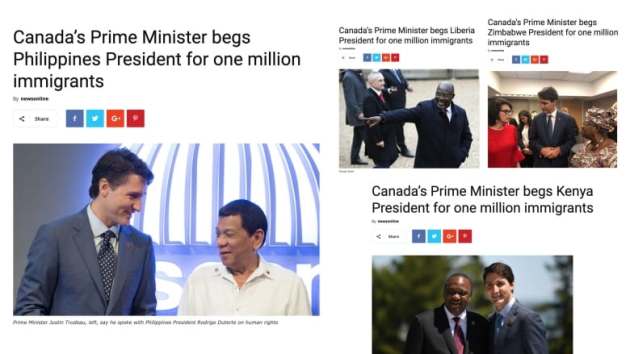
Nigeria isn’t the only country that’s been targeted by the fake story. Identical articles were published on the CBTV site mentioning the Philippines, Zambia, Zimbabwe, Liberia, Pakistan, Ghana and Uganda. In each instance the story text is identical — only the name of the country and the head of state who supposedly spoke to Trudeau were changed.

This image shows how the same false immigration story was re-purposed to target multiple countries, including the Philippines, Liberia, Zimbabwe and Kenya. (Screengrabs from CBTV/Array by Radio-Canada)

Another site called City News — which imitates a local Canadian news site — also published several of these articles. The site seems to be managed by the same person or people who run CBTV; a Radio-Canada analysis determined both sites share the same Google Analytics ID.

Tactics to confuse readers

These sites use the same visual codes as news media and sometimes even publish real news on their sties. According to Herman Wasserman, a media studies professor at the University of Cape Town in South Africa, this serves to confuse the reader.

It’s a popular tactic with the people who run fake news sites. In 2017, Radio Canada discovered imposter websites that looked like Quebec media sites but were actually based in Ukraine, and those sites used the same tactic.

A spokesperson for Immigration, Refugees and Citizenship Canada (IRCC) confirmed that the ministry is aware of the story.

“IRCC regularly surveys online disinformation. When false information is distributed, like in this case, we try to act quickly to provide the facts,” said Rémi Larivière. He said that the ministry published a tweet and posted on Facebook to counteract the story.

Where the one million figure originated

Even though the story is false, the one million immigrants figure does has some basis in reality. The federal government announced in 2017 that it wanted to welcome more immigrants over the next three years. The government planned to admit 310,000 immigrants in 2018, 330,000 in 2019 and 340,000 in 2020, for a total of 980,000 immigrants over three years.

That number includes the total number of immigrants Canada wanted to receive from all countries — not one country in particular.

Another false article on the CBTV website claimed that Trudeau “ordered “Parliament to approve visa-free entry” for visitors from certain foreign countries.

Another false story claimed that Prime Minister Justin Trudeau had ordered “Parliament” to approve visa-free entry for visitors from Fiji. The rest of the text of the article is similar to other false stories about Trudeau begging foreign leaders for immigrants. (Screengrab from CBTV)

Again, the site published the same article repeatedly, changing only the name of the country and the head of state. Fiji, Sri Lanka, South Africa and Gambia were all targeted by the false story. In Sri Lanka, the article was even translated into Tamil.

If you write stories about immigration, it’s something that lots of Africans think about: immigration, becoming more mobile, having a better life. So this type of story is immediately attractive.– Herman Wasserman, media studies professor, University of Cape Town

Herman Wasserman, a media studies professor at the University of Cape Town in South Africa, said it’s not surprising that Canada is the focus of articles that cater to an African audience, because many Africans aspire to immigrate here.

“If you write stories about immigration, it’s something that lots of Africans think about — immigration, becoming more mobile, having a better life. So this type of story is immediately attractive,” he said.

Wasserman said Canada also has a reputation of being more welcoming to immigrants than the United States, which makes these false stories more credible.

“Trudeau has a more positive and friendly image in the media than (U.S. President Donald) Trump. It’s well known that Trump is anti-immigration, that he wants to build a wall and that the United States is a hostile environment to foreigners,” he said.

…

Wasserman said he believes that false news stories about Canada are easier for a foreign audience to believe.

“Canada is less well-known,” he said. “In Africa there’s less news about Canada than about the United States.

“If you say that someone has died in Montreal or Toronto, it’s not easy (for a reader abroad) to verify. But if you say someone has died in New York, people will say, ‘If it’s true, it would be all over CNN and we would’ve heard about it, so it’s not true.'”

Who is behind the site?

It’s not possible to determine the identity of the person who runs CBTV and City News because both sites were registered anonymously. They were created several days apart in April this year, and almost immediately started publishing fake stories.

IRCC also doesn’t know the identity of the people who are spreading the fake stories, according to Larivière.

The purpose of the sites could be financial, because they contain ads. The platform that places the ads that appear on CBTV, MGID, didn’t respond to questions from Radio-Canada about whether the company was aware its ads fund sites that spread disinformation.

In 2017, Google announced it would ban fake news sites from its ad platform, Google AdSense. Since then, many false news sites have turned to other sources of revenue.

The strategy of creating repetitive fake articles targeting specific communities to attract clicks and and shares on social media isn’t new. In March of 2016, a site created hundreds of articles about celebrities moving to small towns across North America.

One of the stories, shared numerous times on Facebook in Quebec, said that actor Leonardo DiCaprio had bought a house in Baie-Saint-Paul, in the Charlevoix.

Source: Fake online stories claim Trudeau begged foreign leaders ‘to send him a million immigrants’

The rise of female Sharia judges in India

Of note:

Earlier this year, Maya Rachel McManus, a British Muslim, walked down the aisle in Kolkata on her wedding day and exchanged garlands with her partner in a traditional Hindu ceremony.

Later, her marriage was solemnised by female qazis, or judges, who govern Islamic law. 

“Maybe my multicultural wedding would have been frowned upon if the qazis were men,” McManus told Al Jazeera.

“The ones my husband and I had spoken to had problems with some of my basic rights; like keeping my maiden name and my British passport after marriage.”

She insisted that women perform her wedding rites.

“This was the first time one of our qazis solemnised a marriage,” said Noorjehan Safia Niwaz, cofounder of Bhartiya Mahila Muslim Andolan (BMMA), an organisation that launched in 2007 in India advocating for secular rights.

In 2016, BMMA began training Muslim women to become qazis, a role traditionally held by men.

To McManus, and many of India’s millions of Muslims, the recent rise of female qazis means fewer compromises and a chance at more justice for women.

“What is common between all versions of Sharia or Islamic law that is followed today is that it is extremely patriarchal,” said Niwaz, who is also a qazi.

“Women continue to suffer. They become victims of nikkah halala (a practise in Islam where a woman once divorced by her husband must consummate her marriage with another man if she wants to remarry her first husband), polygamous marriages and unilateral divorces.”

There are no teachings in either the Quran or the prophetic tradition that prohibits women from being qazis. Even the wife of the Prophet Muhammad, known as Sayyida Aisha, performed and solemnised the nikah of several people.

EBRAHIM MOOSA, PROFESSOR OF ISLAMIC STUDIES AT INDIANA’S UNIVERSITY OF NOTRE DAME

To replace what Niwas describes as a “misogynistic syllabus” designed for male qazis, BMMA drafted its own curriculum in which women study the Quran from a feminist perspective and examine the Indian constitution so they can make decisions, keeping in mind the law of the land.

“The practice of female [qazis] is novel in India, but the idea is not novel,” says Ebrahim Moosa, a professor

of Islamic studies at Indiana’s University of Notre Dame. “Muslims in North India followed the Hanafi school of law for centuries that allows women to be judges.”

According to BMMA, which is funded by private donors and charities, there are 15 female qazis spread across India including West Bengal, Maharashtra, Karnataka, Rajasthan, Tamil Nadu, and Orissa.

“We have over 150 cases in our centre alone,” said 47-year-old Hina Siddiqui, a qazi from Bandra, a western Mumbai suburb. “Though unlike male qazis, in each case we summon both the man and the woman involved. We don’t hear just one side of the story.”

Since triple talaq, or instant divorce, led by Muslim men was criminalised in India, carrying a possible jail sentence, Siddiqui and her colleagues have seen an increase in the number of distressed women in their offices.

“The men are now scared to give triple talaq,” said 60-year-old Zubeda Khatoon, another qazi in Bandra.

“So they abuse their wives both physically and emotionally, hoping that the woman will leave them instead. Another way this works in the man’s favour is that according to Sharia law if a woman asks for a divorce, her husband owes her no liabilities. “

This is where female qazis step in and attempt to ensure that women receive their legal rights during including receiving her mehr – a sum of money given to the bride on her wedding day, alimony and the belongings she contributed to the home after marriage.

For couples who wish to be married by a female qazi, there is a rigorous process. 

Through a period of one month, the judges verify the bride and groom’s details – including their identity, economic status, marital status and even their marzi, or personal reasons for wedlock. This is to reduce the rate of fraudulent marriages.

“They [the female qazis] explained the various aspects of the nikah [wedding] procedure to me. They were extremely helpful,” said McManus. “This kind of support was not forthcoming from the male qazis I had approached earlier.”

‘No such thing as women qazis’

But not everybody agrees that female qazis can better safeguard the interests of Muslim women.

“There is no such thing as women qazis in Islam. It is just a new-age thing,” Muslim leader Syed Moinuddin Ashraf, from Sunni Jama Mosque in Mumbai, told The Hindustan Times.

Moosa, the professor in Indiana, said while some schools of Islamic thought such as Shafiʿi, Ahl-e Hadis, and Salafi, prevent women from becoming qazis, it remains religiously permissible. 

“There are no teachings in either the Quran or the prophetic tradition that prohibits women from being qazis,” he said. “Even the wife of the Prophet Muhammad, known as Sayyida Aisha, performed and solemnised the nikah of several [people].”

In the two years that Siddiqui and Khatoon have been practising as qazis in Mumbai, they have presided over only one mutually consenting divorce. 

“In that case, we were able to get the woman two lakhs ($2,874) as maintenance from her husband,” said Khatoon. “But most people still prefer to have their divorce issued on the letterhead of male qazis.”

According to Niwaz, 30 more women eager to enrol in the second batch of qazi training by BMMA.

“Maya’s wedding [McManus’s] went through without any objections,” she says. “We haven’t had any fatwas issued for the work we [female qazis] are doing. We exist. That in itself is a positive thing.”

Source: The rise of female Sharia judges in India

Chris Selley: The debate over Quebec’s religious symbols bill nears its wretched end

Pointed commentary:

Better late than never, one supposes: Three days before Premier François Legault’s self-imposed deadline for passing Bill 21, which would prohibit certain civil servants from wearing religious symbols on the job, his government proposed an amendment that would actually define “religious symbol.” (It had hitherto argued none was necessary.) If the amendment is adopted, teachers, police officers, Crown prosecutors and others deemed to be in positions of authority would be forbidden to display any “clothing, symbol, jewellery, ornament, accessory or headgear that is worn in connection with a religious conviction or belief and can reasonably be considered as referring to a religious affiliation.”

Kudos to whichever reporter thought on Wednesday to ask whether wedding rings count. The question utterly stymied both Legault and his Diversity and Inclusiveness Minister — you read that correctly — Simon Jolin-Barrette, who’s in charge of this project. “The person who wears an object that for her constitutes a religious symbol, that constitutes a religious symbol,” Jolin-Barrette explained. “And the person who wears an object that in the eyes of a reasonable person represents a religious symbol, that constitutes a religious symbol.”

Many scoffed at the question. Reporters were just playing silly buggers, they said —  “f—ing the dog,” in Quebec parlance. The government quickly clarified that wedding rings would not be covered.

And indeed, there are many 100-per-cent non-religious wedding bands in the Quebec civil service. But many wedding rings are unambiguously religious symbols to the people wearing them. The standard Catholic marriage script suggests priests ask “the Lord (to) bless these rings” before giving them to the bride and groom. Each will ask the other to “receive this ring as a sign of my love and fidelity. In the name of the Father, and of the Son, and of the Holy Spirit.”

Of course, who’s to know? The religious rings don’t glow a special colour. So long as devoutly religious police officers and public-school teachers do their jobs properly and professionally, without fear or favour, everything will be fine. Only that’s precisely what Bill 21’s opponents have been saying forever: A kippa or hijab is no evidence of a partial or biased civil servant, and the lack of a kippa or hijab is no evidence of an impartial or unbiased one. By definition, a law about religious symbols can’t do anything that’s not symbolic — only in this case, the symbolism involves trampling all over minority rights.

Legault has never shown any particular enthusiasm for this project; rather, he defends it on grounds that it has majority support and that it’s time to put the whole issue to bed. As Bill 21 nears passage, more and more voices have made it clear that won’t happen.

On Saturday Le Devoir ran a huge spread about how much religion is costing Quebecers in terms of tax breaks for churches and faith-based organizations. It gave ample voice to the view that faith itself, separated from the charitable works of faithful people, has no intrinsic value to society (or is even a net detriment). “It is difficult to understand how we can enshrine the secular status of the Québécois state in the Charter of Human Rights and Freedoms, reaffirm the separation of the state and religion and the equality of all citizens, and give away hundreds of millions of dollars in tax revenue every year,” an editorial argued.

In fact it’s perfectly easy to understand: The government demonstrates its neutrality, and its respect for the equality of all citizens, by treating people the same way regardless of their private faith or lack thereof. If laïcité were incompatible with respecting religious faith and its contributions to society, it’s unlikely the French state would own and maintain so many churches.

Outright anti-religious sentiment is one thing Bill 21 won’t get rid of. It also won’t quiet people who think it should apply to daycare workers and teachers at state-subsidized religious schools — or indeed to the entire civil service, as was contemplated by Pauline Marois’ popular Values Charter. And Bill 21 certainly won’t dissuade bigots from taking out their inadequacies on Quebec’s minority populations. This week a Montreal woman who wears a niqab tracked down the driver of a bus that blew past her at a stop — deliberately, she alleges, based on anti-niqab sentiments the driver had previously expressed on Facebook. When the woman complained in the same medium, CBC reported, respondents included a Société de Transport de Montréal union rep who suggested “a normal Quebecer would have waited for the next bus.”

It’s one of many alarming incidents that Muslim Quebecers in particular insist have become more and more frequent as this interminable debate drags on. The government has proposed no solutions except to make the majority more comfortable — perhaps by banning women wearing niqabs from riding public buses. That particular question will have to wait for a while, tied up as it is in the courts. But Bill 21 will pass before MNAs break for the summer.

At least those affected will finally know where they stand (pending further restrictions). At least greener pastures await elsewhere in Canada if they decide, not unreasonably, that they are no long welcome.

Source: Chris Selley: The debate over Quebec’s religious symbols bill nears its wretched end

The case for having a federal evaluator general

While I respect the opinions of Steve Montague and Frank Graves, my experience has been that the OAG does go beyond financial accountability and departmental evaluations generally provided insights on outcomes.

Whether another agent of parliament would improve the situation is unclear to me, although I understand the need for longer-term analysis of program effectiveness and outcomes as well as cross-departmental analysis of program effectiveness:

A decade ago, a group of policy wonks obsessed with gathering hard evidence for decision-making began meeting regularly over beers in Ottawa. They put together a campaign for the creation of an independent evaluation watchdog to make sure taxpayers’ money is spent on federal programs that work.

The idea hasn’t quite gotten off the ground, but the group is more convinced than ever that Canada needs an evaluator general reporting to Parliament, making sure data, evidence and evaluation drive policy and funding decisions.

“We need someone to do the deeper dives and wade into and understand at a level of some depth what policies and programs work for whom, in what conditions and why,” said Steve Montague, a member of the advocacy group and an Ottawa-based management consultant.

“An evaluator-general could act as a check in an era when government doesn’t have enough independent analysis.”

Government evaluators do a systematic examination of a program’s design, its implementation and ultimate results to understand why it worked or not. They examine the context or events that triggered the program, such as a terrorist attack, opioid crisis, economic downturn or, at a local level, an increasing number of cyclists killed on a particular route. They look at the relevance or need for the program. Was it effective? Are recipients of program assistance and/or the broader community better off?

The Ottawa group proposing the creation of an evaluator general say this new agent of Parliament would be positioned between the auditor general and the parliamentary budget officer with the three of them providing independent “advice on the propriety of government spending, the credibility of government budgets and the likelihood that programs and policies will achieve desired objectives.”

The auditor general investigates whether programs are run in compliance with accounting rules. The evaluator-general would investigate whether programs are achieving the expected results.

Management consultant Michael Obrecht, considered an architect of the proposal, said the evaluator general would collect and synthesize evaluations, gathering studies from around the world to help improve decision-making and the determine the likelihood that programs and policies will achieve desired objectives.

The proposal calls for an office with a $2-million start-up budget and a team of experts in program evaluation that could do its own evaluations as well as assess the reliability and validity of data it gathers globally.

Four decades of evaluations

The government has had an evaluation function in departments for 40 years, but the scope of evaluations is typically narrow – often focused on a specific program rather than on the big policy issues that straddle various departments and other levels of government. Treasury Board has an online database of more than 1,600 evaluations conducted by various departments and agencies over the years.

The advocacy group, however, has long argued the evaluation function is not a priority for departments and has been underutilized for years. For parliamentarians, the reports are too narrow to help them wrestle with complex national and international issues that transcend a single department.

The evaluations have also been criticized as poor and questionable in their quality because departments are evaluating their own work and deputy ministers don’t want to receive bad news that they’ll have to share with the ministers.

“It would be a naive MP who took a departmental performance report or evaluation at face value,” the evaluator general group concluded in one of its papers.

Frank Graves, president of Ekos Research Associates, is a strong supporter of the group’s proposal and argues it’s more needed today than a decade ago, when he wrote a paper calling for an evaluator general “to champion and raise public consciousness about the importance of knowing what works and what doesn’t.”

“The capacity to assemble and interpret rigorous empirical evidence to test causal hypotheses about program effectiveness atrophied badly from the mid-’90s on,” Graves said.

“Despite a [Liberal] commitment to restoring evidence-based policy and decision-making there appears to be little progress to recovering that capacity in the federal public service.”

Are evaluations being marginalized?

New digital technologies that are changing the world at an unprecedented pace are ramping up the pressure on a risk-averse public service.

The Impact and Innovation Unit within the Privy Council Office has been examining new ways to improve the delivery of government programs and to ensure their efficacy. This new focus is partly in response to the unprecedented pace of technological change, which is putting pressure on normally risk-averse federal policy-makers to keep up with Canadians’ expectations. Public servants can no longer create and map out a new policy or program over five to 10 years and assess how well they work after that.

The unit recently released a “Guide to Impact Measurement, while its sister organization within PCO, the Results and Delivery Unit, was behind the controversial “deliverology” approach to achieving results on political promises and priorities.

The Impact and Innovation Unit is also overseeing a pilot project called the “Impact Genome,” which is using meta-analysis of research studies and predictive analytics to help develop the government’s Youth Employment Strategy.

But some in the evaluation field are worried that the government is marginalizing the traditional theory-based evaluations for which Canada is still seen as a world leader.

At the centre of these concerns is that a focus on results tends to prioritize short-term targets and on what can be measured simply and easily while missing out on the bigger picture. A similar concern was flagged in a recent report by the Organization for Economic Co-operation and Development (OECD) on results-based management.

But Privy Council Office officials insists that high-quality evaluations are as important as ever, and are central to its guide to impact measurement. New measurement tools, however, enable policy-makers to gauge the likely success of a program before it is rolled out and to make tweaks and adjustments to it once implemented.

International interest in evaluations

Governments around the world are wrestling with how to determine what policies are achieving outcomes based on evidence rather than politics, ideology or gut feelings.

In fact, Obrecht said the advocacy group’s campaign for an evaluator general got new life when other countries recently called for creation of similar posts.

In Australia, the Labour Party supports the creation of an evaluator general office. The evaluator would be housed inside the Australian treasury to help assess what policy programs are working.

Last year, a parliamentary working group in France urged the creation of an autonomous Parliamentary Evaluation Agency in a bid to boost Parliament’s oversight and role in evaluating policies.

Still, it’s unclear how much appetite there is for another agent of Parliament in Canada. A recent report by Public Policy Forum on the nine existing parliamentary watchdogs concluded “fewer, stronger agents” would better serve Parliament. The report recommended a high bar for creating new agents and to consider consolidating the work of agents with similar mandates.

The group advocating for an evaluator-general agrees on the need for the job but the structure of the office has generated much debate.

Some argue that a full agent of Parliament position isn’t necessary, and the work could be done by a chief evaluation officer, similar to the chief science officer appointed by the Liberals. Others say the work could be handled by expanding the role of the auditor general or the comptroller general.

Obrecht argued an independent evaluator general is even more critical with so much more information and misinformation floating around.

“Decision-making seems to be contracted into sound bites, and the capacity to collect extensive information and digest it seem to have been weakened by instant access to easy answers.”

Source: The case for having a federal evaluator general