How White Nationalists See What They Want to See in DNA Tests

Interesting:

On the hate site Stormfront, one of the largest online discussion forums dedicated to “white pride,” sharing DNA results with fellow members has become a rite of passage for some members.

But what happens when users’ results show that they fail to meet their own genetic criteria for whiteness? Are they still willing to post them? And if so, how do other users respond?

Such questions have long intrigued the sociologists Aaron Panofsky, who studies the social implications of genetics at the University of California, Los Angeles, and Joan Donovan, whose research at Harvard University focuses on how information is manipulated on the internet.

“We had a puzzle,” Dr. Panofsky said in an interview this week. “If Stormfront says, ‘You’ve got to be all white or we’ll kick you out,’ how do they deal with these anomalies?”

Esi Edugyan: ‘Where are you from?’ In search of my Canadian identity

Great piece by Edugyan on identities:

Back in 2006, I went to live for a year at an artist colony on the outskirts of Stuttgart, Germany, a city nearly obliterated during the Second World War. I remember the blue thread of the Neckar River running along it in the fine bright air, so that from our residence overlooking the city, we could almost imagine only wilderness lay below.

It was the year Germany played host to the FIFA World Cup. Among the young artists who had arrived from all over the world, an excitement had taken hold. We were eager to be a part of things, to take in as much as we could of this moment.

There was among the German artists, especially, a kind of mild shock at their countrymen’s outpouring of emotion for their nation. For the first time since before the war – which is to say, since before their lifetimes – it had become socially acceptable to hang the national flag from windows, to fly it from cars, to drape it over shoulders in the streets. Visual symbols of patriotism were something I took for granted in Canada, so that I was surprised when, walking the Stuttgart town centre with a friend, I heard her draw a sharp breath at the sight of a child turning a tiny plastic flag in his fingers. For her, it was truly a new era.

I remember so much about those days. How a group of us would spend hours in the beer gardens dotting the city to watch on massive screens matches taking place in all parts of the country. How lightly the sun fell, cupping our foreheads in a warmth that was like the touch of a human palm. How, sometimes, the air in the gardens would reek sharply of shredded grass. And how one evening, during a match between Germany and France, the weather suddenly turned black and churning and vicious, slinging thick braids of water into our faces, so that we opened our mouths.

There was so much beauty in those hours. I recall us all walking home after that rainy match and hearing a damp susurration from beyond the path. My friend, Eugen, parted the long grasses to discover an enormous frog. We passed the frog from hand to hand, and I remember so vividly the feel of it in my careful fist – a pulsing damp shudder, like a living heart. The wonder that came over me then was like a physical shock – I felt as if anything could happen in that moment, as if the world was made of the strange and the unexpected, that it was a place of great openness and possibility.

Then, as we continued on, something happened that drew me up short. We had all been complaining about the French soccer team, but Eugen began to mock them viciously, beginning with their names. His biggest complaint was the fact that so many of them were brown or black men, children no doubt of immigrants who’d settled in France from its former colonies. “How were any of those people actually French?” he said, and then he met my eye: “And you, Esi, how are you Canadian?”

It had been a question that had defined my life, although I would not then have expressed it so. For years I had travelled in search of the place I would feel most at home – indeed, my time in Germany was part of that search – but it was slowly dawning on me that the answer had been clear from the moment I first left home, that I had been stubbornly refusing to look at it.

What became so clear to me with Eugen’s question was how much I had taken a certain kind of multiculturalism for granted, and how much, until those years of travel, I’d come to surround myself with people who also took that plurality for granted. I had always believed that there were many different pathways to citizenship and fealty and belonging beyond the single one suggested by him, which was, of course, blood. In a country in which the population of black people has never exceeded 3.5 per cent (and in British Columbia, where I’ve lived for 20 years, it is less than 1 per cent), the idea of my being able to claim anything like true Canadian-ness was, to him, ridiculous.

My parents were Ghanaian immigrants who’d met, not in Canada, but in San Francisco, as students; A mutual friend was hosting a party to watch the moon landing on his black and white television. Six months later they were married, and my brother was born a year after that. They settled eventually in Alberta, first in Edmonton, where my sister was born, then in Calgary, where I was born. They often used to joke that they stopped moving to avoid having more children.

Migration is rarely a clean narrative. Alongside the joys, stories of migration often contain the loss of treasured things, and also the gaining of things not wanted. At the centre of these stories is often risk. And indeed, when I think of my mother’s case, what I’m struck by is how much she had to risk to gain an education. She was a young woman in an African society where women did much of the work and held little of the power, and as her secondary school years were coming to an end, she was left floundering at the starkness of her choices. She chafed at the expectation that she would keep her father’s house until she found a husband. She wanted to become a nurse. In order to do so, though, she would have to leave home. And what amazes me is that she managed to do it.

I sometimes ask myself what might have happened if she had never made the choice to leave. If my father had also stayed and by some whim of chance they’d met and married in Ghana? Her near-fate as an uneducated mother and wife could well have been my own fate, too. The life given to me is lived in the shadow of that other possible life. I marvel even now at the strange combination of circumstances that had to come about for me to be here.

To be a Canadian is to accept that the story has more than one thread, more than one character, more than one point of view. It has become a near cliché to say it, but it’s true: we are a nation of many narratives and histories, and it is in the attempts to harmonize our various stories that our culture lives.

These negotiations can sometimes be fraught, but they are ours. Within my own family, there are a multitude of stories: one of my sisters-in-law immigrated to Edmonton from Hong Kong when she was eight years old, while the other is from the Coast Salish tribes of Vancouver Island, whose people have lived on the land for generations. My brother-in-law is French-Canadian. My husband’s aunt, who was born and raised in Guyana, has commented that when we sit down to holiday dinners we look like a UN summit. I think, though, that the variety that strikes her as an international feature is actually a very national one. And it is in our struggle to forever negotiate and align these stories that our identity is made and shaped and reshaped. The failure to come to a consensus on a single narrative – the hesitation and uncertainty about having one dominant story – is what the culture has become.

What do we see as features of our future stories, going forward? What is it we can be? The image returns to me of that rainy walk home in Stuttgart, the feel of that tiny life in my hands – how unexpected and full of wonder that moment was, how much it made the world feel boundless and without limits, as if the miraculous lay within reach. That feeling is what we need to harness, it is what I want my children to feel. The sense that nothing is closed to anyone, not because of race or gender or religious belief, that everything is open and full of startling possibility, regardless of who we are.

Source:     ‘Where are you from?’ In search of my Canadian identity Esi Edugyan July 11, 2019     

Kelly Toughill: The corrosive power of “Where are you from?”

Part of the challenges in encouraging and retaining immigration to Atlantic Canada. Not unique to Atlantic Canada: my Russian-born mother always bristled when she was asked the question in Toronto in the 50s and 60s:
Opinion: If Atlantic Canadians are serious about boosting immigration and making newcomers feel welcome, writes Kelly Toughill, we need to find a way to have real conversations about regional culture and the come-from-away phenomenon.

“Do you feel like a Nova Scotian?” I asked the woman.

We had stumbled into the topic by mistake. It is not something we talk about here: not those of us who chose Nova Scotia nor those who are tethered to the province by ancestral DNA. We were cautious, hesitant, both aware of the danger surrounding the taboo.

She is a person of significant influence with a broad social and professional network who has lived here more than 20 years. No, she said, she does not feel like a Nova Scotian and knows she never will.

Neither do I.

“I moved to Nova Scotia 21 years ago and expect to live here until I die, but I have come to terms with the fact that I will always be treated like a guest.”

There is a stereotype about the “come from away” phenomenon in Atlantic Canada, but little deep, respectful discussion of how the tendency to divide people by origin affects the region and its future. If we hope to use immigration to bolster the flagging population, we must figure out how to have that conversation right now.

Where you are from means something very different here than in the other places I have lived. In San Francisco, Rio de Janeiro, Washington, D.C. or Toronto, when asked where I was from, the question really meant, “Where do you live? Where do you choose to make your home? Where can you best relax and let down your guard?”

Here, it means something else entirely. I have never seen a place so connected to its roots. That is a joyful thing. It is one reason this province has such a strong sense of identity, a distinct culture and a tradition of caring for its own. But traditions can be exclusionary.

“When I first moved to Nova Scotia, I travelled the Atlantic region extensively for work. In other regions, an opening social line might be, “What do you do?” But here it was always, “Where are you from?””

I would answer, “Halifax,” because that’s where I live or, if asked in Halifax, would say, “Here.”

And people treated me as if I were lying.

It took me a while to realize they were asking me to name a spot of earth that defines my identity. Where are my ancestors buried? Where do people remember my malevolent uncle, my grandmother’s affection for mathematics, my mother’s brilliant, eclectic career?

There is no place like that for me. There is no place like that for hundreds of millions of people around the world. And that is incomprehensible to many of my neighbours and, now, closest friends.

It was a union activist who helped me figure out how to answer that essential East Coast question. We were sitting on a wharf in Saint Anthony, Newfoundland, when he asked where I was from. I explained that I had no idea how to answer in a way that honoured the real intent of his question. After a long talk, he suggested I name the place that I was born.

Now, when people ask, I say “Washington, D.C.” My parents were newly arrived in Washington when I was born. I left when I was eight years old and I do not have a single relative or friend in that city. It feels a little bit like a lie every time I say it, but it is the closest answer to their truth that I can offer.

A recent article in the academic journal Ethnicities describes how that specific question can be part of a system of welcoming that leaves racialized newcomers as perpetual outsiders. Speaking welcome: A discursive analysis of an immigrant mentorship event in Atlantic Canada, by Kristi A. Allain, Rory Crath and Gül Çaliskan, examined an event in Fredericton designed to welcome newly arrived economic immigrants. They considered the language and structure of the event through the lens of Jacques Derrida’s theory of conditional hospitality. They found that the event designed to welcome newcomers actually reinforced their status as foreign and other. And it all started with, “Where are you from?”

This is not just a matter of manners and personal feelings. Atlantic Canada will need tens of thousands of new immigrants to maintain its population, tax base and public services over the next few decades. There is much public debate about how to structure immigration pathways, how to improve economic outcomes and how immigrants can best be supported for long term success. But there is little discussion of local culture and how that can work for – and against – the retention of newcomers.

The woman and I were hesitant because we both know that this topic relies exclusively on personal experience as evidence, and that can very easily be misunderstood as a blanket criticism of the region. It takes trust even to talk about the phenomenon.

I sent her a draft of this column and asked if she was comfortable being named. She thought about it for a day and then declined. She said was afraid of discouraging other newcomers and also afraid of hurting the feelings of her Nova Scotian colleagues.

I know what she means. My Nova Scotian friends have been hurt or angry when I tried to describe my experience, so now I just don’t. After all, the Atlantic region is known for its tremendous hospitality. There is even a hit Broadway musical about how Newfoundland welcomed strangers stranded on 9-11. But being treated well as a guest is not the same as being included, for guests are expected to leave.

I asked the woman if she feels Canadian. The answer was instant and affirmative: of course, absolutely.

Me too. I am Canadian through-and-through. My inclusion in the body Canada does not feel conditional in any way, unlike my status in Nova Scotia.

I still wince every time I hear someone ask, “Where are you from?” It reminds me that I will always be a stranger in my own home province. I’ve come to accept my outsider status as the price of living in this magnificent place, but it is sad. If we want to draw people here, not everyone will make the same choice that I have.

So, here’s a suggestion: No matter how much it might feel right, no matter whether your intention is to welcome, or simple curiosity, don’t ask a stranger, “Where are you from?” Wait until you get to know them to probe that specific identity marker. Wait until you have forged a bond. Wait until that question will not be seen as a signal that your new friend will never really belong.

Source: The corrosive power of where are you from

Will Your Job Still Exist In 2030?

More on the expected impact of automation and AI:

Automation is already here. Robots helped build your car and pack your latest online shopping order. A chatbot might help you figure out your credit card balance. A computer program might scan and process your résumé when you apply for work.

What will work in America look like a decade from now? A team of economists at the McKinsey Global Institute set out to figure it out in a new report out Thursday.

The research finds automation widening the gap between urban and rural areas and dramatically affecting people who didn’t go to college or didn’t finish high school. It also projects some occupations poised for massive growth or growing enough to offset displaced jobs.

Below are some of the key takeaways from McKinsey’s forecast.

Most jobs will change; some will decline“Intelligent machines are going to become more prevalent in every business. All of our jobs are going to change,” said Susan Lund, co-author of the report. Almost 40% of U.S. jobs are in occupations that are likely to shrink — though not necessarily disappear — by 2030, the researchers found.

Employing almost 21 million Americans, office support is by far the most common U.S. occupation that’s most at risk of losing jobs to digital services, according to McKinsey. Food service is another heavily affected category, as hotel, fast-food and other kitchens automate the work of cooks, dishwashers and others.

At the same time, “the economy is adding jobs that make use of new technologies,” McKinsey economists wrote. Those jobs include software developers and information security specialists — who are constantly in short supply — but also solar panel installers and wind turbine technicians.

Health care jobs, including hearing aid specialists and home health aides, will stay in high demand for the next decade, as baby boomers age. McKinsey also forecast growth for jobs that tap into human creativity or “socioemotional skills” or provide personal service for the wealthy, like interior designers, psychologists, massage therapists, dietitians and landscape architects.

In some occupations, even as jobs disappear, new ones might offset the losses. For example, digital assistants might replace counter attendants and clerks who help with rentals, but more workers might be needed to help shoppers in stores or staff distribution centers, McKinsey economists wrote.

Similarly, enough new jobs will be created in transportation or customer service and sales to offset ones lost by 2030.

Employers and communities could do more to match workers in waning fields to other compatible jobs with less risk of automation. For instance, 900,000 bookkeepers, accountants and auditing clerks nationwide might see their jobs phased out but could be retrained to become loan officers, claims adjusters or insurance underwriters, the McKinsey report said.

Automation is likely to continue widening the gap between job growth in urban and rural areas

By 2030, the majority of job growth may be concentrated in just 25 megacities and their peripheries, while large swaths of the country see slower job creation and even lose jobs, the researchers found. This gap has already widened in the past decade, as Federal Reserve Chairman Jerome Powell noted in his remarks on Wednesday.

Source: Will Your Job Still Exist In 2030?

Douglas Todd: What would happen to Canadian housing if immigration stopped?

Good range of perspectives covered in this thought experiment:

What would happen to Canada’s housing market if immigration to Canada was substantially reduced or even cut to zero? It’s a crucial question for the public, and for real-estate developers who start new construction projects on the basis of predictions of future sales.

Surprisingly, however, the answers are all over the map.

Some specialists suggest virtually nothing would happen to Canadian housing prices if immigration slowed or ended. Others say the impact would be lower prices and hard times for the powerful real-estate industry.

While there are no immediate signs immigration levels will be reduced — Prime Minister Justin Trudeau has increased the immigration rate by more than 30 per cent, to almost 350,000 newcomers a year — the issue is central to the dreams and anxieties of Canadian residents who either own homes or want to imagine the possibility.

Two Ontario real-estate specialists recently wrote in the Financial Post that, based on studies, the “overall impact of immigration on housing markets is modest at best in most cases.”

The most startling research spotlighted by Murtaza Haider, of Ryerson University, and Stephen Moranis, a Toronto real-estate insider, maintained that immigration has virtually no impact on overall Canadian housing prices.

The authors of that contentious study, Ahter Akbari and Yigit Aydede of Saint Mary’s University in Halifax, claimed immigration adds an insignificant $1 to every $1,000 people in Canada spend on housing.

Could that be true?

UBC geography professor emeritus David Ley, whose findings differ from the 2012 paper by the Saint Mary’s profs, said in an interview their study looks at the period from 1996 to 2006 and doesn’t focus on urban regions, which his analyses do. Ley has consistently found a close correlation between strong immigration and high housing prices in global cities.

In that way the Saint Mary’s paper sidesteps an increasingly plain-to-see phenomenon: Housing prices vary according to where immigrants choose to live. And for the most part they stream into major cities, especially sky-high Toronto and Vancouver.

Indeed, the authors of the Financial Post article that cites the Saint Mary’s study apparently contradict themselves at the end of their piece, after repeating the impact of immigration is “modest at best” on housing.

“The more important realization,” Haider and Moranis say in their last sentence, “is that an absence of immigration would result in a declining population and aging of the workforce, which could have a much larger negative impact on Canadian housing markets.”

So, which is it? Immigration has almost no influence on housing? Or the population growth it brings has a tremendous impact?

Simon Fraser University’s Josh Gordon, a specialist in public policy, says it’s crucial to follow through on the “counter-factual” question, to imagine a scenario not currently in the cards: What would happen to housing prices if immigration levels reduced to zero?

The real-estate industry, Gordon said, repeatedly says it must build more housing faster because the Canadian population is growing rapidly, predominantly because of immigration.

The development industry’s repeated warnings, Gordon said, that Metro Vancouver and Toronto property must be rezoned at higher density and that rents will continue to rise would be thrown into disarray with the ending of immigration.

“What’s revealing is that when certain members of the real-estate industry try to generate a fear-of-missing-out mentality (FOMO), as well as the expectation that prices will rise over time, their typical move is to emphasize how many people will be arriving on a yearly basis and how large the population will eventually be,” Gordon said.

“The actions of those organizations belie the idea that immigration is not likely to have much impact on prices.”

There is evidence housing prices would dramatically adjust if immigration stopped.

After all, the populations of Metro Vancouver and Toronto experience net growth of about one per cent a year, almost entirely from foreign-born newcomers, who need places to live. That does not include the  high portion the two cities take in of the roughly one million international students and temporary visa workers who are now in Canada at any one time.

And a recent study by Statistics Canada researchers found the detached houses bought by recent immigrants to Metro Vancouver are, on average, valued $824,000 higher than such homes owned by people born in Canada. In Toronto the cost of recent immigrants’ homes was about $50,000 higher than that of the domestic born.

UBC geographer Daniel Hiebert, in addition, showed in a peer-reviewed study that recent immigrants, especially those from China, show statistically greater determination than Canadian-born citizens to buy housing in Canada’s three major cities. “First and foremost,” Hiebert says, “immigration policy is, essentially, also a form of housing policy.”

The Urban Development Institute, which represents property developers, makes no bones about how housing supply must be expanded to support immigration.

“Over the next 25 years, our province is expected to grow by more than 1.4 million people, partly as a result of the federal government’s plan to raise immigration 13 per cent by 2020,” UDI president Anne McMullin recently wrote. “That means we must work together to create new homes if we want our children and grandchildren to have a future in B.C.”

A related June study by Gordon found a near-perfect correlation between housing unaffordability and foreign ownership in certain Metro Vancouver municipalities. Gordon discovered, for instance, that Vancouver, Richmond and West Vancouver are not only the most unaffordable municipalities, they are the one most attracting millionaire migrants and their wealth.

There is a complicating factor, however, as there often is when trying to understand the mass global movement of people and money.

Gordon emphasizes that immigration levels and foreign ownership, which he defines as “housing owned primarily on the basis of foreign income or wealth,” are related. But they’re different, too.

“There is some overlap to the extent that immigration, as it happens in Canada, involves many people arriving with significant amounts of wealth,” Gordon said. “But debates about immigration are largely distinct, though not entirely, from debates around foreign ownership, even while certain people have tried to conflate the two.“

How do the foreign-buyers taxes in B.C. and Ontario, as well as B.C.’s speculation tax, fit into the discussion of housing prices? Those measures are focused on foreign ownership, not immigration levels, Gordon said.

“The point of the measures in relationship to foreign ownership is to discourage the de-coupling of the housing market from the labour market, to discourage the use of large amounts of foreign capital to purchase property in Canada,” said Gordon.

“Measures around foreign ownership are about levelling the playing field for local working people. Measures around immigration are different. The irony is that measures to limit or curtail foreign ownership may in fact be beneficial for many new immigrants, because new immigrants who do not arrive with vast amounts of wealth are doubly disadvantaged in the housing market.”

It can take a while to get one’s head around the global forces running through Canadian housing.

But no matter which way you look at the impact of large-scale immigration, and foreign capital, on key sectors of Canada’s vigorous housing market, it’s undeniable they’re profoundly connected — and that decisions made about immigration will indeed always be a form of housing policy.

Source: Douglas Todd: What would happen to Canadian housing if immigration stopped?

Tung Chan: Dialogue with Chinese consul at reception can promote Canada’s case

Valid argument. The test, however, will be how many municipal politicians will raise their concerns and how forcefully or not they do so. And dialogue requires a willingness on the Chinese side, not very much in evidence these days:

I read with amazement about the debate over whether municipal politicians should attend the reception to be hosted by the Consulate of the People’s Republic of China at the 2019 Union of B.C. Municipalities Convention, to be held Sept. 23-27 at the Vancouver Convention Centre.

The central arguments against attending can be summed up in two points.

The first is that as a result of China acting in a hostile way toward our country, we should not have any contacts with its officials. The second is that if our politicians attend the reception, they will end up under the influence of the Chinese officials.

There is no doubt that China is acting in a heavy-handed way toward Canada. But this is precisely the time that more dialogue between our two countries is needed. Even Prime Minister Justin Trudeau tried to talk to Chinese President Xi Jinping at the recent G20 meeting in Japan. The reception at the upcoming UBCM will give our municipal politicians the opportunity to talk to Chinese officials.   

As to the second point about being afraid that our municipal politicians would be influenced, as a former Vancouver city councillor and former president of the Non-Partisan Association, I have full confidence that our elected mayors and councillors would not be so easily influenced by a cocktail or two. To suggest otherwise is an insult to their intelligence and integrity.

If we truly believe that our politicians can so easily become “under the general influence” of the cocktail host and then “all of a sudden, decisions aren’t taken on the basis of the public good, but on the basis of” the preoccupations of the cocktail party’s host (to paraphrase a statement by Richard Fadden, former head of CSIS), then we should, on principle, also ban commercial sponsorship at all gatherings of our politicians. Otherwise they will all be making decisions on the basis of those commercial enterprises and not on the basis of the public good. 

The fact is influence can go both ways. Why is it that those who suggest boycotting the reception have so little confidence in themselves or other politicians who want to participate of their own power of influence?  Why won’t they consider using the interaction to impress, to the extent possible, to the hosts of the reception in question that Canada is acting the way we are because we are a country that believes in the rule of law?

The points of view of the Chinese consular officials may not be changed but at least there would be constructive dialogue and our local politicians would reinforce the message of our prime minister and the foreign affairs minister. 

I believe, with the best interest of our country in heart, we need to open up more channels of dialogue between Canada and China.

Common sense tells us that problems can only be solved through dialogue, not through avoiding contact. It is time for our local politicians to join in the effort to tell China via the Chinese consuls face-to-face the feelings of the people they represent about the actions of the Chinese government. Our local politicians cannot leave that job to our prime minister and the minister of foreign affairs alone.

Tung Chan is a former Vancouver city councillor and former president of the Non-Partisan Association.

Source: Tung Chan: Dialogue with Chinese consul at reception can promote Canada’s case

HASSAN: UN should press Islamic nations for more inclusive societies

Valid critique of many members of the OIC:

Last year, the United Nations Council on Human Rights passed a resolution acknowledging defamation of religion as a human rights violation. Pakistan led the delegation representing the 56-nation Organization of Islamic Conference and proclaimed that “Islam is frequently and wrongly associated with human rights violations and terrorism.” Pakistan asserted that nations must “deny impunity” to those showing intolerance and ensure respect for religion.

But which religion, how and by whom?

Last Tuesday, the editor of a moderate Islamic website criticized the UN measure, citing freedom of speech issues. More important, he accused Muslim nations of expressing most of this so-called defamation of religion. He said reports from Muslim countries, such as Pakistan, not only tell horrific tales of local misogyny and terror but also reveal ways the rights of non-Muslim minorities are constantly violated. He cited many examples of this, including the publication of jihadi literature and laws that marginalize religious minorities and discriminate against women. In Pakistan, for example, Hindu girls continue to be forcibly converted to Islam and sold into marriage. This is the worst kind of intolerance based on faith.

New Age Islam editor Sultan Shaheen has tried hard in the past decade to salvage Islam from its darker manifestations and to encourage a more humane version of the faith. Like other South Asian moderates, such as Javed Ahmed Ghamidi, he has offered newer interpretations of religious precepts in an attempt to rid Islam of bigotry, violence and fundamentalism.

In drawing attention to these heinous practices in the Muslim world, Shaheen has identified the valid reasons for the bad reputation Islamic countries have earned. In a letter to the UN, he stated that, while this resolution seeks to protect Islam from defamation through any association with terrorism, other religions are routinely defamed in Muslim countries by radical Muslims. For example, propaganda is often published justifying violence against non-Muslim civilians. He cited a long essay in the Taliban mouthpiece Nawa-e-Afghan Jihad entitled Circumstances in which the Killing of Innocent People among Infidels is Justified.

Shaheen’s novelty is to interpret intolerance by Muslim extremists as defaming not only other religions but primarily distorting the essence of Islam itself. He urges the Council to “ask the Muslim countries to treat intolerance of minorities and jihadi literature too as defaming the religion of Islam.”

Shaheen quoted some jihadi literature in his letter, such as by radical Islamic scholar Sheikh Yusuf Al Abeeri, who has openly justified destroying American cities and killing enemy civilians. Shaheen characterized such literature as a tirade against Islam. He also highlighted the anti-Semitism of many of these radical scholars.

Sultan Shaheen has rightly identified the main reason for the negative image of Islam. It is the actions of radical Muslims more than anything else, coupled with the fact that moderates do not actively challenge them or distance themselves from their parochial ideas, that defame Islam the most.

The UN Council on Human Rights must look beyond its own naive resolution and urge Islamic nations to enact laws that enable freer and more inclusive societies. Instead of Pakistan urging consequences for those who supposedly defame its state religion, it should seek real consequences for those who openly and aggressively promote violence against women and non-Muslims.

Source: HASSAN: UN should press Islamic nations for more inclusive societies

In killing citizenship question, Trump adopts Census Bureau’s preferred solution to a thorny problem

After all the sound and fury, after all the lies and pretence:

President Donald Trump’s decision this afternoon to abandon plans to add a citizenship question to the 2020 census and instead rely on existing government records to generate citizenship statistics matches the Census Bureau’s preferred option for dealing with the politically explosive issue. It’s also a win for those who have wanted to keep such a charged question off the decennial headcount.

“This is Option C,” says former Census Director John Thompson, referring to a March 2018 memo in which Commerce Secretary Wilbur Ross spelled out several options for developing a citizenship tally, and gave his rationale for deciding to include the question on the count that will begin on 1 April. Option C “is what the Census Bureau proposed to Secretary Ross,” adds Thompson, who stepped down in June 2017, a few months after Ross began his clandestine efforts to get the Department of Justice to request the question. Ross eventually chose what he called Option D, a combination of using information already in government agency files, known as administrative records, along with a yes/no question about citizenship on the census questionnaire sent to U.S. households.

The Supreme Court, however, blocked Ross’s decision, saying he had violated administrative law by providing a “contrived” rather than a “genuine” explanation for why he wanted to add the question. Critics of the question say it would have prompted many people living in the United States to decline to answer the census, leading to an undercount of the population, and was motivated by a desire to reduce the political power of regions that tend to support Democratic candidates.

Today, speaking at a hastily arranged one-way press conference in which he took no questions, Trump said he will issue an executive order telling every federal agency to “immediately” provide the Commerce Department with “all requested records regarding the number of citizens and non-citizens in our country.” He said the goal is to generate “an accurate count of how many citizens, non-citizens, and illegal aliens are in the United States of America. Not too much to ask.”

Census experts say that the agency should be able to satisfy the president’s request to develop data on the first two categories – citizens and non-citizens. And the Census Bureau already has agreements with a number of federal and state agencies that allow it to access administrative records that include some citizenship information, according to this 2018 analysis by bureau researchers. But using administrative records to determine the number of undocumented immigrants living in the U.S. is not possible, the experts say. And that’s a good thing, believes Robert Santos, vice president and chief methodologist at the Urban Institute in Washington, D.C.

“What this administration really wanted was a tally of those who are undocumented,” says Santos, who is also president-elect of the American Statistical Association. “But that’s not going to happen. They will fly under the radar.” As a result, he says, “now they can participate in the census without fear” of political repercussions.

It’s also good news for Census Bureau, he adds. Extracting the agency from the bitterly partisan national debate over immigration should allow it to do its job of carrying out a complete and accurate census, he says.

Civil rights groups opposing the question also hailed the president’s decision as a victory but said they hadn’t given up their fight against the administration’s policies. “This is a welcome reprieve of his partisan agenda, and a win for all communities,” says Vanita Gupta, president of the Leadership Conference Education Fund in Washington, D.C. “[But] we remain on guard to combat any attempts to sabotage a fair and accurate count.”

Source: In killing citizenship question, Trump adopts Census Bureau’s preferred solution to a thorny problem

And further commentary:

Donald Trump pretended he was doing something meaningful on Thursday after he was forced to cave in on adding a citizenship question to the 2020 census.

But his post-cave bait-and-switch to push an executive order is also going up in flames almost immediately after it was issued.

Page said:

“So just saying it’s not a cave does not make it not a cave. Just the attorney general saying congratulations, Mr. President, does not make it a congratulatory moment. And the executive order, it is not at all clear that it’s necessary to have a new executive order to give publicly available data from federal agencies to the Commerce Department. That would seem to be something that would be easy to do. And in fact, as you noted, the government already calculates the number of illegal immigrants and the number of non-citizens who live in this country, and they’ve done that for some time.”

Trump is pulling out all the distractions after his census cave-in

Donald Trump’s executive order stunt that he announced on Thursday isn’t the only distraction he’s pulling out following his census loss.

It was also reported today that the administration would move forward with its raids on thousands of undocumented migrant families. According to The New York Times, “Nationwide raids to arrest thousands of members of undocumented families have been scheduled to begin Sunday, according to two current and one former homeland security officials.”

The raids, which had been delayed last month due to widespread backlash, will likely separate more families. Even the president’s acting DHS secretary has admitted as much.

Of course, none of these steps are being taken because they are sound policy solutions. They are just the latest in a two-year string of distractions meant to paper over an endless string of policy and political failures from this White House.

Source: Trump’s Citizenship Executive Order Is Already Going Up In Flames

Is ‘Race Science’ Making A Comeback? . News

Interesting and relevant interview:

When Angela Saini was 10 years old, her family moved from what she called “a very multicultural area” in East London to the almost exclusively white Southeast London. Suddenly her brown skin stood out, making her a target. She couldn’t avoid the harassment coming from two boys who lived around the corner. One day, they pelted her and her sister with rocks. She remembers one hit her on the head. She remembers bleeding.

There had been racist comments before that, she says, “but that was the first time that someone around my own age had decided to physically hurt me. And it was tough.”

It was also one of the first stories she reported, writing about the incident and reading it out for class. She says that’s what made her a journalist.

Saini is now an award-winning science journalist, often reporting on the intersection of science, race and gender. Her latest book, Superior: The Return of Race Science tracks the history and ideology of race science up to its current resurgence.

We talked to her about how race isn’t real (but you know…still is), why DNA tests are misleading and how race science crept its way into the 21st century. It’s a lot to get your head around.

This is an excerpt from our interview with her. It has been edited and condensed for clarity.

Code Switch: I guess we should start with the obvious question. What is race science?

Angela Saini: Once upon a time, in the 19th and early 20th century, race science was just science. It was very widely accepted that races exist biologically, that possibly we are different species or different breeds as human beings, and that there might be a racial hierarchy between us.

After the Second World War, when we saw eugenics play out — saw the consequences of Nazi racial hygiene in the Holocaust, the world kind of took a collective intake of breath and tried to put its house in order. So scientists, policy makers, the United Nations all came together and decided, race has no place in biology anymore. It’s not scientifically accurate. Race is not how difference plays out in the real world.

But there were two problems with this. Number one was the hardcore scientific racists. This includes Nazi race scientists. So the ones who believed that whites were superior, that slavery was justified, that segregation was justified. They kept scientific racism alive within a small, but very active global network.

The other aspect is mainstream science. Did everyday scientists really abandon these ideas completely? My argument is, no. They clung on to them, partly because, of course, racism was still there in society. We still had racism all around the world, discrimination embedded in the structures of institutions. And that means even to this day, there are still scientists who, despite knowing better, and despite being mainstream, good-hearted, well-intentioned scientists, still sometimes invoke race in scientific research, particularly medical research, when it’s inappropriate.

Should we even be talking about race anymore?

I’ve read genetics textbooks on race that say race is all silly, we should all let it go and live in this kind of colorblind world. Well, no, because that’s not the world that we live in. These things matter, because that boy when I was 10 years old did not throw rocks at me because of genetics. He threw rocks at me because I looked brown, and that he took exception to that. And that’s not going to stop.

…

The thing is, race is real in society. It’s real in politics, it’s real in the ways that we treat each other. It’s visceral because we have made it visceral in our everyday lives, and it has a biological impact because of that. Racism impacts people’s bodies. It impacts people’s minds. It affects how they live and how they grow.

So I think all researchers, if they’re going to invoke race, have to be really knowledgeable about where these ideas come from, and how they are using race. Are they using it because they’re studying the effects of racism and discrimination, or are they using it as a biological entity in itself? And if they’re using it as a biological entity in itself, then they had better be sure exactly how they define it.

In the U.S., race is defined differently from South Africa, Australia, the U.K., India. We can’t biologize blanket ideas about who people are, because these are socially constructed ideas. I think it’s deeply dangerous, because it falls into the same trap that the people who invented race in the first place wanted us to fall into. The people who hardened these categories wanted us to believe that we are fundamentally different. We are not fundamentally different.

We did an episode not so long ago about how people from certain populations in North and West Africa were more likely to have a trait that makes them predisposed to sickle cell anemia. Is it possible that we risk missing out on important scientific realities if we are skittish about getting into genetics and race?

I think we need to be careful about what we mean when we say race. We know that the sickle cell trait exists in those regions of the world where cases of malaria are high, and that is because, as devastating as it is to have sickle cell anemia, having the trait provides some resistance to malaria. So in the regions where it exists, it is beneficial to the people who have it, because one risk outweighs the other. And this means it’s geographical, it’s not racial. It exists in certain parts of Africa and not all, and it exists in other parts of the world outside Africa, where people don’t have black skin.

The reason it looks racialized in the U.S. is because in the U.S., many white people are of European ancestry, and many black people, because of the history of slavery, are of West African ancestry. That means that in the U.S., you see far higher rates of sickle cell in the black population than the white population.

But globally, it doesn’t look racialized. Globally, it looks as though people in certain regions of the world have it. So in the U.S., when people talk about sickle cell being a black disease or a black illness, they’re really using race as a proxy for geography.

And that goes for many illnesses or diseases that we think about as being racialized. Black Americans are more likely to die of almost everything than white Americans. The life expectancy of a black American is lower than a white American. It is perverse to assume that this must be genetic. Are black Americans so genetically disadvantage that even infant mortality would be higher in black Americans? It just doesn’t make any sense. In the U.K., where I live, we see this life expectancy gap between the rich and the poor. It is exactly the same in America, but in America, it is treated as racial because socioeconomic circumstances run along racial lines.

The inscription in your book reads, “For my parents, the only ancestors I need to know.” What does that mean?

Well, that kind of is a joke at ancestry testing companies. When they tell us that you can find out who you are descended from, thousands of generations back, to your “actual ancestors.” One, you can’t tell me who my actual ancestors are, because DNA testing cannot tell you that.

But secondly, why does it matter? Why is it so important to us to know who our distant ancestors were when we have people alive with us right now who can give us our culture, who give us our frameworks, who give us our sense of who we are, our sense of right and wrong, our place in the world?

…

[Race scientists] play on your sense of ethnicity or sense of origin story. They build up this image of you as being a biologically essential person, and that this ties you to this identity, and it becomes embedded in who you are.

And this is what ethnic nationalists do. They play on these assumptions and stereotypes and the lack of education that we have around these issues, and they make us believe that identity is biological, when identity is cultural.

Source: Is ‘Race Science’ Making A Comeback? . News

Immigrants are moving to smaller U.S. cities

Also happening in Canada to a certain extent:

As young Americans stream to coastal cities, immigrants are seizing opportunities in the midwest and south where mid-sized cities are struggling to maintain a younger, working-age population.

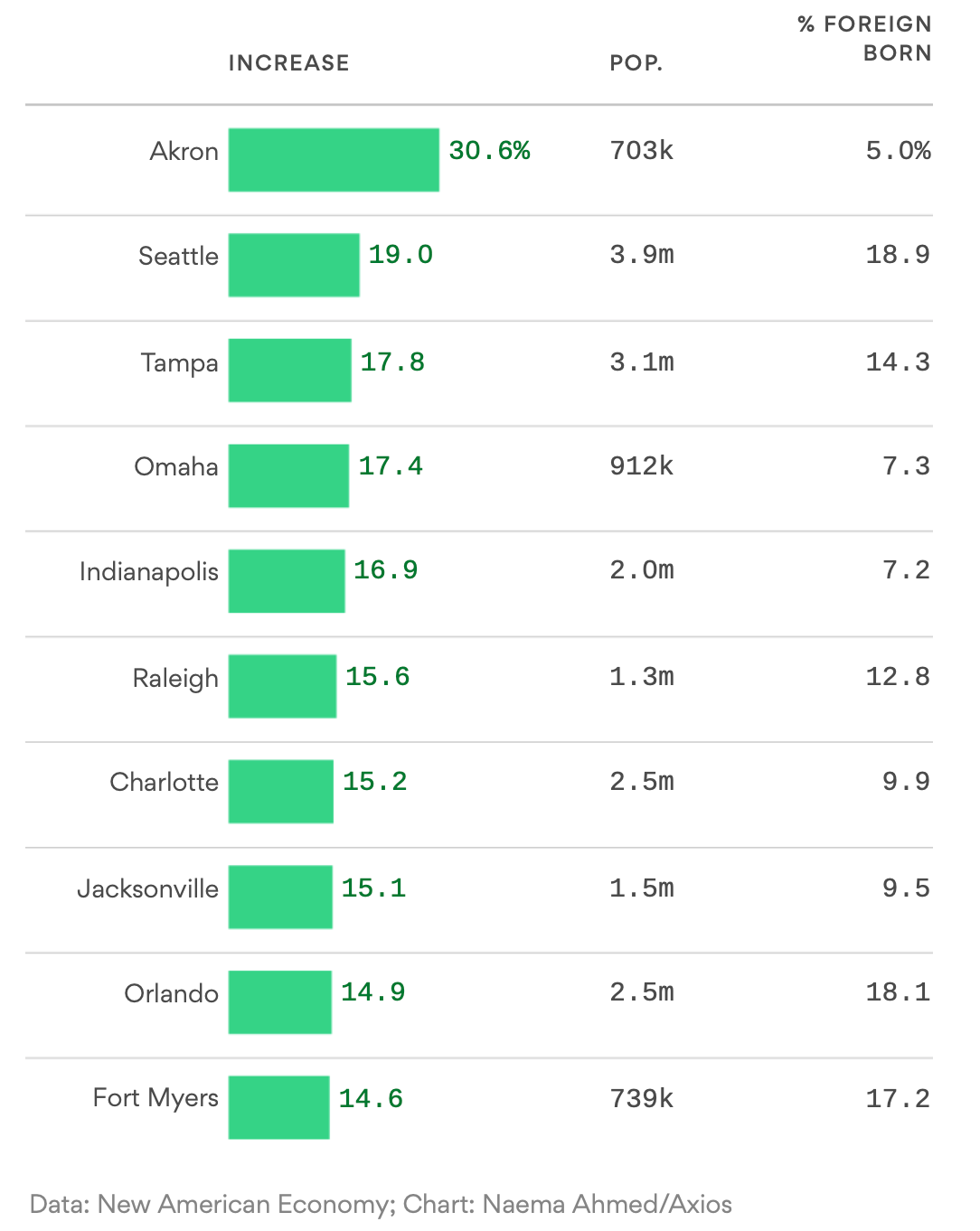
Why it matters: From 2014-2017, immigrants contributed nearly 33% of the total population growth in the top 100 U.S. metro areas — and they’re settling in smaller cities that aren’t typically considered immigration hubs, according to new research from New American Economy.

“Immigrants — very similar to other Americans — are looking for less crowded, more affordable cities that have dynamic job markets,” said Andrew Lim, research director at the bipartisan research and advocacy organization.

Details: Foreign-born migration helped reverse population decline in several metros, such as Detroit, Memphis, Dayton and St. Louis.

  • In 2017, immigrants were responsible for 98% of the population growth in metro Cincinnati, 88% of the growth in metro Birmingham, and 87% of growth in metro Miami.
  • Four of the top 10 cities seeing the most population growth from immigrants are in Florida — a state seeing a disproportionate growth of aging residents.

What’s happening: Many of the top destinations are grappling with a demographic double whammy: a growing aging population on one hand, and a dwindling young population on the other.

  • Immigrants to the U.S. are more likely to be of working age — between 25 and 64 — than the native-born population. Meanwhile, 98 of the top 100 metros saw an increase in population above the age of 65 between 2014 and 2017.
  • Healthcare is a popular job area as demands grow in caring for aging residents. In El Paso, for example, immigrants made up a third of healthcare workers in 2017. In the Minneapolis-St. Paul area, that number was 20%.

The big picture: Immigration is a national flashpoint right now, with controversies around poor conditions in detention centers along the Mexico border and political fights over whether the 2020 Census will include a citizenship question.

The research highlights the economic upsides of immigration.

  • Immigrant entrepreneurs grew by 7.7% in the top 100 metro areas between 2014 and 2017. The number more than doubled in Baton Rouge, and grew by more than 60% in Tulsa.
  • Immigrant homeownership increased by 9.5%, with Nashville, Oklahoma City and Charlotte seeing the fastest growth.
  • Despite growth in smaller cities, the more traditional metros (New York, Los Angeles, San Francisco) still saw the highest levels of spending power and taxes paid by immigrants.

Go deeper:

Source: Immigrants are moving to smaller U.S. cities