Laïcité: le Manitoba veut recruter des employés du secteur public québécois

Not surprising. Premier Pallister has been the most outspoken premier against Bill 21:

Le gouvernement du Manitoba veut recruter des employés du secteur public québécois préoccupés par la Loi sur la laïcité de l’État, qui interdit les signes religieux dans l’exercice de certaines fonctions.

Alors même que la Cour supérieure du Québec rejetait, jeudi, la requête de groupes de défense des libertés civiles et religieuses, qui réclamaient la suspension de la loi, le premier ministre Brian Pallister indiquait que le Manitoba avait besoin de fonctionnaires bilingues.

M. Pallister a promis de s’adresser aux employés de l’État québécois pour les assurer que sa province n’avait pas, elle, de « police du vêtement ». Il a indiqué que des lettres seraient bientôt envoyées aux associations professionnelles du Québec ainsi qu’aux cégeps et autres institutions d’enseignement afin de recruter des Québécois.

La Loi sur la laïcité de l’État, adoptée en juin à l’Assemblée nationale, interdit aux employés de l’État en position d’autorité coercitive, comme les juges, les policiers et les gardiens de prison, de porter des signes religieux dans l’exercice de leurs fonctions ; cette interdiction s’étend aussi aux enseignants du réseau public. Les opposants à la loi affirment qu’elle cible injustement les musulmanes, les sikhs et les autres minorités religieuses.

Le premier ministre Pallister, qui cherche à se faire réélire au Manitoba le 10 septembre, avait déjà affirmé son opposition à la loi québécoise lors de la rencontre estivale des premiers ministres des provinces et territoires, le 11 juillet. Le premier ministre François Legault a rappelé au Conseil de la fédération que la loi est appuyée par une majorité de Québécois et que son parti respectait une promesse électorale.

Jeudi, le juge Michel Yergeau, de la Cour supérieure du Québec, a déclaré que la loi continuerait de s’appliquer jusqu’à ce qu’un tribunal se prononce sur le fond de l’affaire.

En avril, le maire d’Edmundston, Cyrille Simard, invitait dans sa municipalité du nord-ouest du Nouveau-Brunswick les Québécois « qui pourraient rencontrer des obstacles » dans certaines catégories d’emplois. Alex LeBlanc, directeur général du Conseil multiculturel du Nouveau-Brunswick, rappelait alors que le Nouveau-Brunswick vivait notamment une pénurie d’enseignants francophones et bilingues qualifiés, et que de nombreux Québécois pourraient pourvoir ces postes.

Source: Laïcité: le Manitoba veut recruter des employés du secteur public québécois

The Surprising Way Republicans Used to Use Immigration to Boost the Economy

Nice historical reminder. Never thought when Reagan was in power that he would be viewed as progressive a generation later:

There was a time when a Republican president formed immigration policy for its economic impact, rather than its rhetorical value as a campaign issue. In 1980, Ronald Reagan recognized soaring unemployment in Mexico as the driving force behind the increased flow of illegal immigrants into the United States. Then-candidate Reagan said he wanted to “make it possible for them to come here legally with a work permit, then while they’re working, and earning here, they pay taxes here. And when they want to go back, they go back.”

While nobody would say Reagan, as president, solved the problem of illegal immigration—amnesty for 2.9 million illegals and increased employer responsibilities rubbed some the wrong way—his focus was on the needs of employers to find affordable labor, and the needs of immigrants to find jobs.

In fact, “there was a time in the 80s and 90s, under both Republican and Democratic presidents, when border patrol agents along the Texas border would regulate employment levels,” says Professor Gordon Hanson of the University of California, San Diego. “The border agents would keep track of the labor needs of employers in the Rio Grande Valley. The higher the need for workers, the weaker the enforcement would be.”

Fast forward to last week’s testimony by Fed Chief Jerome Powell on Capitol Hill. Powell addressed the pressures on homebuilders, who are trying to continue building affordable homes. “You have a shortage of skilled labor,” Powell said, “so it’s hard to get people on the job—electricians, plumbers, carpenters and other people…just to get the people, no matter what you pay them, just finding people who can do that work.”

“Would you say our immigration policy has something to do with that?” asked Democratic Senator Tina Smith of Minnesota.

“That’s what we hear from home builders,” Powell replied.

Depressing the housing industry

“The lack of labor force is one of the main concerns for U.S. business,” says Selma Hepp, Chief Economist at Compass, an independent real estate brokerage. Hepp cites a survey from John Burns Consulting indicating that 82% of builders report a labor shortage. And since the housing industry contributes roughly 15% to the economy, that’s significant potential growth not being realized.

“The current level of single-family construction,” Hepp says, “while improving, it is still at about 50 percent below the levels of housing starts we had during the housing boom in early 2000s.”

The issue of illegal immigration is a touchy political topic, but let’s look at economic space that illegal immigrants fill. They tend to arrive when the U.S. economy is booming, provide low cost labor that is flexible enough to go where it’s needed, when it’s needed, and fill many jobs that Americans are not willing to do, especially in housing, food service, hospitality services, and agriculture. (Legal immigrants, on the other hand, many of them sponsored by companies or families, tend to be more highly educated, demand higher wages, and are not as flexible in moving to where the jobs are—partially because they may be legally obligated to a sponsoring employer.)

That potential increase in the labor force could come in handy right now, with an estimated 10,000 baby boomers turning 65 every day, and when there are more job openings than there are people looking for work.

Perhaps sensing that the full story was not being told last week, Republican Senator John Neely Kennedy of Louisiana asked Powell, “What is the economic impact of illegal immigration on America’s economy?”

“I haven’t tried to quantify that, but people who come in legally or illegally, they add to our workforce,” Powell said, “and they contribute to GDP, certainly, so that’s part of it. You can really boil down growth into labor force growth and productivity increases, and immigration—total immigration—has contributed more than half of the growth in our workforce in the last few years.”

In fact, one of the ways that the economy could grow faster is if there were more workers, who are also tax payers and consumers, who supported other workers, who were also tax payers and consumers, and so on, and so on.

End to an unwritten policy

“But the shortage in the labor force isn’t just because of Trump’s policies,” says Professor Hanson. “That unwritten policy of border enforcement, following the ups and downs of the economy, ended with the border enforcement crackdown in 2005 under the George W. Bush administration.” Ironically, this was done by the former Texas governor to appease conservatives in Congress as a step toward comprehensive immigration reform. But reform never happened, even as tighter immigration policies continued, including under President Obama.

Then came the Great Recession, which took away the incentive for many foreign citizens to seek unfilled jobs in the United States. It was what Professor Hanson calls the end of the “Great Mexican Emigration.”

Kennedy clarified his focus for Powell: “What about illegal immigration? Does it have an impact on wages?”

“You know, there’s been a lot of research on that and it has really not reached a clear conclusion on that,” Powell said. “There is research that finds there is no visible impact, and there’s research that finds there’s a modest impact.”

Senator Kennedy was likely suggesting that illegal immigrants drive down the wages of Americans, which is a big part of the political argument Republicans have used against illegals coming into the country. And according to several sources, the argument is correct, especially when it comes to lower income, lower educated Americans who might find themselves competing with immigrants who are also looking for low-skilled work.

But the real drain on the economy from illegal immigrants comes when the resources they take from our economy exceed their contributions to it, which tends to happen, according to Professor Hanson, in the early years, just after they’ve arrived.

We’ll assume that the illegal immigrant worker IS paying certain taxes, including sales tax, property taxes (indirectly as renters), and possibly payroll taxes, under false social security numbers. But if a family comes into the U.S. illegally, sends their kids to publicly funded schools, and then has more children—who as natives are entitled to all American benefits such as Medicaid—will they be taking more from the economy than they are paying into it?

That’s the much-disputed question, politically as well as economically. Since illegal immigrants operate largely in the shadows, and are not eligible for most public benefits, a certain number is hard to determine, at least one that both parties will accept.

The problem for the administration is that with unemployment at 3.7%, it’s hard to say there’s a clear and direct impact being felt by many Americans economically. Most Americans who want a job, can find a job. That doesn’t take away the political argument, which will presumably still resonate—again, not without some validity—with a part of the voting public.

But as this expanding economy gets historically long in the tooth—the recession ended in June of 2009—a cooling housing industry may also put a chill on an economy that the president is hoping will carry him to reelection next year. That is surely not what he intended
Source: The Surprising Way Republicans Used to Use Immigration to Boost the Economy

Analysis: Why the 2020 census doesn’t need a citizenship question to count the undocumented

Good in depth analysis for data nerds:

It is now clear that there will be no question about citizenship on the 2020 U.S. Census.

After the Supreme Court ruled against the Trump administration, President Trump vowed to find a way to include the question. But with no legal path forward and time running out, the administration ultimately backed down.

Opponents of the citizenship question remain concerned about the census, though hopeful that more immigrant households will respond to the census now that the question has been removed.

But others worry that it will be much harder to keep track of undocumented immigrants. President Trump argued that a citizenship question was needed, saying: “I think it is very important to find out if somebody is a citizen as opposed to an illegal.”

However, a citizenship question wouldn’t actually help the government distinguish between who is an undocumented immigrant and who is not. The question distinguishes only between citizens and noncitizens, and noncitizens are not the same as undocumented immigrants. For example, three out of five noncitizens are in the country legally.

Even more importantly, demographers have figured out a simple and effective way to estimate the number of unauthorized immigrants – even without information on citizenship. In the last five years, my colleagues Frank D. Bean, James D. Bachmeier and I have conducted a series of studies that evaluate this method and its assumptions.

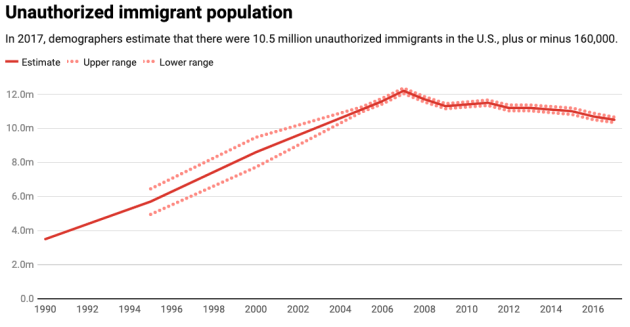
Our research on the methods used to estimate the size of the group indicates that existing estimates – putting the undocumented population at about 11 million – are reasonably accurate.

Here’s how it works.

What’s the formula?

Beginning in the late 1970s, a group of demographers consisting primarily of Jeffrey Passel, Robert Warren, Jacob Siegel, Gregory Robinson and Karen Woodrow introduced the “residual method” for estimating the number of unauthorized immigrants living in the country.

At the time, Passel and his collaborators were affiliated with the U.S. Bureau of the Census and Warren with the Office of Immigration Statistics of the Immigration and Naturalization Service. Much of this work was published in the form of internal reports, but some of it appeared in major journals.

The residual method uses an estimate of the total foreign-born population in the country, based on U.S. Census data. Researchers then subtract from it the number of legal immigrants residing here, estimated from government records of legal immigrants who receive “green cards” minus the number that died or left the country. The result is an estimate of the unauthorized population.

Various adjustments are typically made to this formula. Most adjustments are minor, but a particularly important one adjusts for what researchers call “coverage error” among the unauthorized foreign-born. Coverage error occurs when the census data underestimate the size of a group. This can occur when people live in nonresidential or unconventional locations – such as on the streets or in a neighbor’s basement – or when they fail to respond to the census.

Coverage error could be particularly high among unauthorized immigrants because they may be trying to avoid detection. The Census Bureau’s own research suggests that asking about citizenship would likely aggravate this issue.

Currently, the Department of Homeland Security, the Pew Hispanic Center and the Center for Migration Studies are the major producers of estimates of the unauthorized foreign-born population.

Chart by The Conversation, CC-BY-ND. Data source: <a href="https://www.pewhispanic.org/2019/06/03/facts-on-u-s-immigrants/" rel="nofollow noopener noreferrer" target="_blank" >Pew Research Center</a>

Chart by The Conversation, CC-BY-ND. Data source: Pew Research Center

How accurate are the estimates?

The residual method has been widely used and accepted since the late 1970s. Within a reasonable margin of error, it predicted the number of unauthorized immigrants to legalize under the Immigration Reform and Control Act of 1986, which, among other things, granted permanent residency status to unauthorized immigrants who had been living in the country since 1982. The residual method predicted that about 2.2 millionmet the residency requirement; the actual number to come forward was about 1.7 million.

Both Department of Homeland Security and Pew have used the residual method to estimate the unauthorized population since 2005. Despite using slightly different data and assumptions, Pew’s, Department of Homeland Security’s, and the Center for Migration Studies’s estimates have never differed by more than 1 million people, less than 10% of the total unauthorized population.

Nevertheless, skeptics question a key assumption of the residual method, which is that unauthorized immigrants participate in census surveys. All three organizations listed above inflate their estimates to account for the possibility that some unauthorized immigrants are missing from census data. For example, Pew inflates by about 13%. But is this enough?

My colleagues and I estimated coverage error among Mexican immigrants, a group that composes 60% of all unauthorized immigrants.

Even if they are not counted in a census, populations leave “footprints” of their presence in the form of deaths and births. Because people give birth and die with known regularity, regardless of their legal status, we were able to use birth and death records of all Mexican-born persons to determine the number of Mexican-born persons living in the U.S. We also looked at changes in Mexican census data between 1990 and 2010 to gauge the size of Mexico’s “missing” population, most of whom moved to the U.S.

We then compared these estimates with the estimated number of Mexican immigrants in census data. We found that the census missed as many as 26% of unauthorized immigrants in the early 2000s.

We speculated that this could have been due to the large numbers of temporary Mexican labor migrants who were living in the U.S. at the time. Because many worked in construction during the housing boom and lived in temporary housing arrangements, it may have been particularly difficult to accurately account for them in census surveys.

However, when the Great Recession and housing crisis hit, many of these temporary workers went home or stopped coming to the U.S. in the first place, and coverage error declined. By 2010, the coverage error may have been as low as 6% and does not appear to have changed much since then.

If current levels of coverage error for all unauthorized immigrants were as high as 26%, then the number living in the country could be as high as 13 million. But if coverage error were as low as 6%, then the figure could be as low as 10.3 million. The true number likely falls within that narrow range.

What this boils down to is that demographers already have a pretty good idea of the number of unauthorized immigrants living in the U.S., even without relying on citizenship data. If coverage error has declined as much as we think it has, then the truth is at the lower end of this range.

Will administrative records improve the estimates?

Looking ahead, methods could change as new data become available.

In the wake of its Supreme Court loss, the Trump administration issued an executive order directing government agencies to share administrative data on citizenship.

They want to link information on citizenship and immigration status in administrative records to everyone’s census responses. For example, the executive order requests the Department of Homeland Security’s records on refugee and asylum visas, as well as Master Beneficiary Records from the Social Security Administration. They want to use this information to estimate the undocumented population at very detailed levels of geography for purposes of redistricting, reapportionment and the allocation of public funds.

(It is worth noting that the Census Bureau is a fortress when it comes to protecting your data. Under federal law, the Census Bureau cannot share your personal information with anyone, including other government agencies such as ICE.)

Regardless of how anyone feels about these policy proposals, administrative data may not be up to the task. In my view, administrative records are complicated to use. They can provide inconsistent information about the same person depending on which agency’s records are used.

Additionally, the records will be of limited value for describing those who fall outside of the administrative records system, which can happen for all kinds of reasons. Even if the Trump administration uses administrative records to estimate the undocumented population, researchers will still need to make assumptions about coverage error, just like they do for the residual method.

Overall, I suspect that administrative records could help answer some narrowly defined questions about immigrants and improve national estimates. The jury is still out about their ability to provide definitive answers about the precise numbers of undocumented immigrants, particularly at detailed levels of geography.

Source: Analysis: Why the 2020 census doesn’t need a citizenship question to count the undocumented

Kuwait: Authorities crackdown on protesters demanding citizenship rights

Ongoing story:

The Kuwaiti authorities have arbitrarily arrested more than a dozen protesters in recent days, including prominent human rights defender Abdulhakim al-Fadhli and other activists, in a crackdown on peaceful protestors demanding greater rights for the stateless group known as Bidun [short for “without citizenship”]. Twelve protesters remained in custody, Amnesty International said.

The arrests took place between 11 and 14 July following demonstrations held last week by members of the Bidun group, who had gathered in Freedom Square in Tayma, in the Governorate of Jahra, and Al Erada Square, in Kuwait City, after Ayed Hamad Moudath, 20, committed suicide after reportedly being unable to obtain official documents and eventually losing his job.

“These arbitrary arrests primarily targeting peaceful protesters, activists and human rights defenders in Kuwait are not only unlawful, but are only set to exacerbate an already tense situation brought to the fore by the young man’s suicide. By continuing to deny the Bidun citizenship, the authorities are denying these long-term residents a range of basic rights, including their right to health, education and work, which in effect exclude them from being part and parcel of and contributing to a vibrant Kuwaiti society,” said Lynn Maalouf, Amnesty International’s Middle East Director of Research.

“This has been a long-standing issue since Kuwait’s independence in 1961. It is high time the authorities address it in a meaningful and sustainable manner by ensuring that all Biduns have access to an independent, prompt and fair process when applying for citizenship.”

Two of the detained protesters Nawaf al-Badr and Mohamad al-Anzi, were referred to prosecutors on 14 July and charged with “national security offences”. Their detention has been extended for 21 days.

Abdulhakim al-Fadhli and nine others were referred to prosecutors on 15 July and face a range of charges including participation in unlicensed protests, misuse of communication equipment, spreading false news, and other national security offences. Others were summoned and questioned but not arrested.

“We call on the Kuwaiti authorities to immediately lift the unlawful restriction of the rights to freedom of association, peaceful assembly and expression and to release the protesters or charge them with a recognizable criminal offence,” Lynn Maalouf said.

Background

More than 100,000 Bidun people are long-term residents of Kuwait, with most of them born there and belonging to families who have lived there for generations.

Despite government reforms announced in 2015, the Bidun community face severe restrictions on their ability to access documentation, employment, health care, education and state support enjoyed by Kuwaiti citizens.

In 2018, the minister of education rejected a parliamentary proposal to register children of Bidun in public schools. In the past, when Bidun people have protested to demand their rights, they have often faced repression.

Source: Kuwait: Authorities crackdown on protesters demanding citizenship rights

China relaxes rules to attract more skilled overseas talent

Interesting shift:

China’s Ministry of Public Security is to relax its immigration rules, opening the door to more highly skilled overseas workers and allowing a greater number of foreigners the opportunity to become permanent residents.

The rule changes, which will take effect from August, will also allow top talents from abroad to apply for long-term visas and make it easier for budding overseas entrepreneurs to start a business in China, the ministry announced on Wednesday.

Previously, only foreign talents who made “major and extraordinary contributions” while in China or who filled a skills gap were allowed to apply for permanent residence. From next month, those with in-demand skills and those whose annual income or taxes reached a specified threshold can apply for permanent residence, as can their spouses and underage children.

Those who have held a job in China for four years in a row and have been resident for at least six months each year, whose annual income is higher than six times the annual average worker’s wage in their city of residence, and who pay at least 20 per cent of their income in taxes, are eligible for permanent residence under the new rules.

In Beijing, the average salary last year was 94,258 yuan (US$13,706), setting the threshold for overseas candidates at 565,548 yuan (US$82,236) per annum.

The revised policy will also make it easier for people of Chinese ethnicity from overseas to apply for permanent residence. Those with a doctoral degree, or who have worked in what the ministry called “key development areas” for four years with a stay of at least six months each year are also eligible for permanent residence.

Source: China relaxes rules to attract more skilled overseas talent

Zelensky initiates dual citizenship for Ukrainians living abroad

Given the large number of Ukrainian Canadians (1.4 million), significant:

President of Ukraine Volodymyr Zelensky ordered the Foreign Ministry of Ukraine to develop the procedures of the provision of the second Ukrainian citizenship to the Ukrainians, who live abroad. He also ordered to simplify the procedure of the provision of the Ukrainian citizenship to people, whose rights and freedoms are violated as President’s Office reported.“From his side, President of Ukraine orders the MFA to develop the mechanism of the provision of Ukrainian citizenship as the second one to the ethnic Ukrainians from friendly states, to those, who want to join the development of their historical homeland. Besides, Volodymyr Zelensky orders to develop the mechanism of the simplified provision of Ukrainian citizenship to people who suffer from the violation of rights and freedoms in their countries,” the message said.

Such decision was made within the news on the extension of the arrest of Ukrainian POW sailors and signing of the order on the simplified procedure of the provision of the Russian citizenship to the Ukrainians by Russia’s president. Zelensky’s office believes that such steps create the obstacles for the weakening of the conflict in Donbas.

On July 17, 2019, Lefortovo Moscow Court extended arrest of all 24 Ukrainian POW sailors until the end of October.

The same day President of Russia Vladimir Putin distributed the effect of the order on facilitated issuance of Russian citizenship on all the residents of Donetsk and Luhansk regions.

Source: Zelensky initiates dual citizenship for Ukrainians living abroad

Trump’s ‘blatantly illegal’ immigration rules end asylum protections

One of the better summaries:

The Trump administration has announced new immigration rules ending asylum protections for almost all migrants who arrive at the US-Mexico border, in violation of both US and international law.

According to the new rules, any asylum seekers who pass through another country before arriving at the southern border – including children traveling on their own – will not be eligible for asylum if they failed to apply first in their country of transit. They would only be eligible for US asylum if their application was turned down elsewhere.

The change would affect the vast majority of migrants arriving through Mexico. Most of those currently come from Guatemala, Honduras and El Salvador, but an increasing number are from Haiti, Cuba and countries further afield in Africa and Asia.

The new rules were placed on the federal register on Monday and due to take effect on Tuesday, though they will be immediately challenged in court for contraventions of the US refugee act and the UN refugee convention guaranteeing the right to seek asylum to those fleeing persecution from around the world.

Source: Trump’s ‘blatantly illegal’ immigration rules end asylum protections

Opinion: Report On Racism, But Ditch The Labels

Thoughtful commentary:

Editor’s note: NPR this week has described the language in President Trump’s tweets about a group of Democratic congresswomen as “racist.”

Keith Woods, NPR’s vice president for newsroom training and diversity, argues that journalists should not be using the term “racist” to describe the president’s tweets. He explains why below.


Once again, the president of the United States has used the sniper tower of Twitter to take aim at immigration, race relations and common decency. And once again, journalists are daring their profession to boldly call bigotry what it is: bigotry. Enough of the vacuous “racially charged,” “racially loaded,” “racially insensitive” evasions, they say. It’s racist, and we should just call it that.

I understand the moral outrage behind wanting to slap this particular label on this particular president and his many incendiary utterances, but I disagree. Journalism may not have come honorably to the conclusion that dispassionate distance is a virtue. But that’s the fragile line that separates the profession from the rancid, institution-debasing cesspool that is today’s politics.

It is precisely because journalism is given to warm-spit phrases like “racially insensitive” and “racially charged” that we should not be in the business of moral labeling in the first place. Who decides where the line is that the president crossed? The headline writer working today who thinks it’s “insensitive” or the one tomorrow who thinks it’s “racist?” Were we to use my moral standards, the line for calling people and words racist in this country would have been crossed decades ago. But that’s not what journalists do. We report and interview and attribute.

I am not a journalism purist. I came into the profession 40 years ago to tear down the spurious notion of objectivity used to protects a legacy of sexism, xenophobia and white supremacy. The better ideals of truth telling, accountability, fairness, etc., are what give journalism its power, while the notion of “objectivity” has been used to obscure and excuse the insidious biases we do battle with today.

I’ve been an informed consumer of the media since my days as a paperboy. I read the Times-Picayune as I delivered it, and the distorted view it offered of black and poor New Orleans told me all I needed to know about “objectivity.” We have come miles since then as a profession. But why should I trust that we’re all on the same page with our labels now? Weren’t last week’s tweets racist? Or last year’s? Weren’t some misogynistic? Vulgar? Homophobic? Sexist? The language of my judgment is generous, and they are my opinion, and they belong in the space reserved for opinions.

What’s at stake is journalism’s embattled claim to be the source of credible news grounded in the kind of deep, fair reporting that exposes injustice and holds powerful people to account. It may be satisfying to call the president’s words, or the president himself, racist, given the attacks tweeted from his bully app and so often aimed at our profession. But at what cost?

It’s already nearly impossible to separate actual journalism from the argumentative noise on the cable networks that dominate so much of public perception. There are already too many journalists dancing day and night on the line that once separated fact and judgment. When that line is finally obliterated and we sink into the cesspool beckoning us to its depths, this historically flawed, imperfect tool for revealing and routing racism will look and sound indistinguishable from the noise and become just as irrelevant.

On Sunday, the president wrote this:

“So interesting to see ‘Progressive’ Democrat Congresswomen, who originally came from countries whose governments are a complete and total catastrophe, the worst, most corrupt and inept anywhere in the world (if they even have a functioning government at all), now loudly and viciously telling the people of the United States, the greatest and most powerful Nation on earth, how our government is to be run. Why don’t they go back and help fix the totally broken and crime infested places from which they came.”

His words mirror those of avowed racists and xenophobes that date back to the birth of this country. Was that moral judgement, my last sentence? I would argue no. I’d call it context, and it doesn’t require my opinion, just a basic understanding of history. That’s an alternative to labels: Report. Quote people. Cite sources. Add context. Leave the moral labeling to the people affected; to the opinion writers, the editorial writers, the preachers and philosophers and to the public we serve.

We just have to do journalism.

Source: Opinion: Report On Racism, But Ditch The Labels

Worried UK employers call for changes to proposed immigration reform

Echoes earlier concerns by the business community:

A coalition of British industry groups and education bodies, worried by the prospect of Brexit worsening skills and labour shortages, has called for the next prime minister to relax proposed reforms of the immigration system.

The #FullStrength campaign said on Wednesday it had written to both Boris Johnson, frontrunner to be the next leader of the Conservative Party and prime minister, and his rival, foreign minister Jeremy Hunt, calling for the government they would lead to lower the salary threshold proposed in draft immigration legislation from 30,000 pounds to 20,000.

In December, Britain set out in a policy paper the biggest overhaul of its immigration policy in decades, ending special treatment for European Union nationals.

Concern about the social and economic impact of immigration helped drive Britain’s 2016 referendum vote to leave the EU.

#FullStrength brings together bodies including London First, techUK, the British Retail Consortium, the Recruitment & Employment Confederation, UKHospitality, the Federation of Master Builders and Universities UK. Collectively they represent tens of thousands of businesses and employ millions of workers across all sectors and regions of Britain.

Their joint letter said more than 60% of all jobs in the UK currently fall under the proposed 30,000-pound salary threshold, highlighting the risk in setting the future level too high for vital services such as health and social care.

The coalition also wants the government to extend the temporary work route for overseas workers from one year to two years, revise the sponsorship model to make it easier for firms of all sizes to bring in the overseas talent they need, and reinstate the two-year, post-study visa for international students to work in Britain post-graduation.

“Without the ability to access international talent, many of our world-class sectors are at significant risk,” the joint letter said.

“As the UK prepares to leave the EU in the near future, it is imperative that the government puts in place measures that will avoid employers facing a cliff-edge in recruitment, and works towards building a successful economy that is open and attractive.”

Johnson has pledged that Britain will leave the EU with or without a transition deal on Oct. 31 if he becomes prime minister, while Hunt has said that he would, if absolutely necessary, go for a no-deal Brexit.

Source: Worried UK employers call for changes to proposed immigration reform

Bill introduced to allow dual citizenship for Indians

Given the large number of Indian expatriates, significant if passed and implemented:

Draft legislation brought before the Indian parliament seeks to allow dual citizenship for millions of foreign nationals of Indian origin who currently have to renounce Indian citizenship once they become citizens of another country.

Congress MP from Thiruvananthapuram, Shashi Tharoor introduced a Bill last week to amend Article 9 of the Constitution of India that provides for automatic termination of the Indian citizenship upon acquiring citizenship of another country.

“We have the largest diaspora in the world, many of whom have migrated abroad for better opportunities. Taking a foreign passport for convenience does not make them any less Indian,” said Mr Tharoor.

According to the UN World Migration Report 2018, over 15.6 million Indians are living in other countries, making it the largest diaspora in the world, followed by the Mexicans and the Russians.

A large section of India’s global diaspora has been calling for India to allow dual citizenship. The government of India, in order to cater to some of the demands of Indians living overseas, introduced the Overseas Citizen of India (OCI) card. The OCI has been further streamlined and extensively promoted under the BJP government.

India has emerged as the top source of Australian citizenship, overtaking the United Kingdom, with over 118,000 Indian-born migrants pledging allegiance to Australia since 2013-14. [Note: India has surprised China as the largest immigrant source country in Canada, about 52,000 in 2017, India and Philippines are roughly tied in the number of new Canadian citizens in 2018]

While the OCI allows foreign nationals of Indian origin to live and work in India indefinitely, they can’t vote or contest an election and don’t have the right to own agricultural land in India.

Mr Tharoor argues that the people of Indian origin, many of whom have been highly successful tech-entrepreneurs and quite a few also rose to high public offices overseas, have an important stake in India.

“In the era of globalisation, more people from India will search for opportunities abroad.

“By automatically terminating their Indian citizenship when they seek citizenship of countries of residence, the law effectively cuts them off their roots and makes them feel like they do not have a real stake in their country of origin,” he told the legislators.

Dubai-based policy consultant and writer Mohamed Zeeshan argues that while many Indians acquire citizenship of countries of their residence, they remain strongly committed to their country of origin and spread India’s global influence worldwide.

“The landmark India-US nuclear deal, for instance, was aided in Washington by strong political lobbying from the Indian-American community. In 2011, Indians in Australia helped convince the then Australian government to lift a ban on uranium exports to India,” he writes.

Australian citizenship approvals plunge to 15-year low
While Australian citizenship approvals have fallen to the lowest level since 2002-03, the number of citizenship applications awaiting processing is at a record high with migrants waiting longer than ever before to pledge their allegiance to Australia.

The UAE, the United States and Saudi Arabia are the top three countries of residence for people of Indian origin outside India, together home to about 7.5 million Indians.

According to the 2016 Census, the size of the Indian diaspora in Australia was 619,164. During the five years, from 2013 to 2017, over 118,000 Indian nationals acquired Australian citizenship.

Since then, migration from India to Australia has been on the rise.

Ritesh Chugh, a senior lecturer at the Central Queensland University in Melbourne says it will “open the doors” for many possibilities for Indians and India.

“Indians living abroad are already contributing immensely to India and there’s such an enormous wealth of experience that India can benefit from further. But many see this (not having Indian citizenship) as a big hurdle in making that contribution to the full extent possible,” he told SBS Punjabi.

“For example, at the moment, the research pathways are restricted to citizens alone. If this deterrent is removed, a lot of people would like to go back and work in India as opportunities grow in India,” Mr Chugh said.

According to the Indian Passport Act, it’s an offence not to surrender the Indian passport and formally renounce Indian citizenship after acquiring foreign citizenship, which may attract penalties of up to $1,050.

Source: Bill introduced to allow dual citizenship for Indians