Boris Johnson’s dramatic immigration u-turn leaves 2.5m uncertain of their future

Ongoing train wreck:

Less than a month after Boris Johnson officially became the UK’s prime minister, his government has announced changes to the status of EU citizens after the current deadline for UK withdrawal from the EU – October 31, 2019.

The new home secretary, Priti Patel, has said that if the UK leaves the EU without a deal on that day, then free movement will end immediately for all EU citizens in the UK.

This has caused much anxiety and confusion among the almost 3.5m EU citizens in the UK – 2.5m of whom have not yet registered for settled status, having been given a deadline of 2020 to get it done.

The previous government, led by Theresa May, made very different promises to these people. They were told that the UK wanted to “guarantee the rights of EU citizens who are already living in Britain … as early as we can.”. It appears that the new government has gone back on this promise.

EU citizens are still welcome to visit the UK for short trips without a visa. However, anyone planning to stay long-term after October 31 will be subject to proposed new rules if the UK leaves without a deal. So what is being planned by the new government in case of a no-deal for EU citizens?

Change of plan

Ending free movement on October 31 means that there would be no grace period for anyone who arrived after this date. A previous transition period was set to last until December 31, 2020. During this time, EU citizens arriving after Brexit day would enjoy the same rights as those who were there before.

Now, EU citizens would be subject to the planned new immigration system immediately.

The Department of Health has also said that after October 31, 2019, without a deal, NHS trusts will have to start to charge EU citizens for previously free treatment. This would mean NHS trusts would need to check the immigration status of EU citizens seeking treatment. This proposal has already been criticised by the British Medical Association. It would add more work to an NHS already under great strain.

Aside from anything else, the plan has been criticised for being impractical. The previous government admitted in January 2019 there needed to be some time between the end of freedom of movement and a new immigration system coming into force. This is because it would be difficult for employers, universities, landlords and others to distinguish between pre-exit residents and post-withdrawal arrivals. In particular, businesses have said it will make it difficult for them to recruit workers.

What do EU citizens need to do now?

The advice from the Home Office to EU citizens wanting to stay in the UK beyond October 31 is to apply for settled or pre-settled status under its EU Settlement Scheme. This has been officially open since March 30, 2019. However, there are some concerns about this, too.

Just over 1m applicants have already been granted settlement under this scheme. That’s approximately 30% of the eligible population.

For those who have already applied or who are in the UK before October 31, there should be no problem. However, there will probably be disruption for those who arrive after November 1. They will not be eligible to apply for settlement.

There will also be disruption for those who do not apply for EU settlement in time (and there is not much time left) and want to change jobs or move house after Brexit. Employers and landlords would be required to check these individuals’ immigration statuses, and it could be difficult to distinguish if they arrived before or after withdrawal.

There are serious concerns around certain groups of vulnerable individuals who will have most difficulty applying successfully for EU settlement, such as children without a passport, women in abusive relationships or those who simply cannot read English.

Of the approximately 3.5m EU citizens in the UK, there are still 2.5 million who have yet to apply for EU Settlement. It is unclear how many of them are vulnerable. I have previously highlighted that if large numbers of individuals become illegally resident after a certain cut-off date (for example, if free movement ends on October 31) anyone who does not have settled status but is still in the UK then could be illegal, and expelled automatically.

Furthermore, this could affect British citizens in the EU. The current arrangement for this group of approximately 1.3m people is based on reciprocity. But ending free movement on October 31 would mean British citizens in the EU would also lose their rights to stay in the EU. In the rush to end free movement as soon as possible, rights of British citizens in the EU seem to have been forgotten.

Another Windrush?

A leaked Home Office discussion document has already noted that it would be practically difficult to enforce an immediate end to free movement because of various complexities in establishing the system. In particular, it warned of a repeat of the Windrush scandal.

While the end to free movement will only become reality if the UK leaves the EU without a deal on the newest deadline of October 31, the deadlock between the EU and the UK suggests a growing likelihood of no-deal – especially under Boris Johnson’s new government. It is cold comfort for EU citizens in the UK and British citizens in the EU that once again citizens appear to be the bargaining chips for negotiations between the EU and the UK.

Source: Boris Johnson’s dramatic immigration u-turn leaves 2.5m uncertain of their future
Liberal party membership forms distributed at pro-Beijing rally against Hong Kong protests

Look forward to more details emerging:

As speaker after speaker criticized the mass protests in Hong Kong and defended the Chinese government at a Toronto-area rally recently, a different kind of politicking was quietly unfolding.

Several members of the crowd of about 200 passed around and appeared to fill in Liberal membership forms, a striking juxtaposition between Canada’s governing party and backers of China’s Communist regime.

A Liberal spokesman said Thursday the forms looked to be ones that haven’t been used for three years — since the party ended paid memberships — and which would not be accepted today as valid registrations.

And the party had nothing at all to do with the rally, he added.

But critics of the Chinese government say they’re troubled that any kind of Liberal recruiting efforts might have taken place at a pro-Beijing event, calling it more evidence of China’s sway within Canadian politics generally.

“You can see the close connection between the pro-Beijing camp and the Liberal party,” said Gloria Fung of the group Canada-Hong Kong Link. “But … the pro-Beijing camp actually has their people in different federal parties. It’s not only confined to the Liberal party. I can easily name people in the Conservative party who are advocates of the Chinese government’s interests.”

The Aug. 11 rally at King Square shopping centre in Markham featured a number of speakers who portrayed the massive demonstrations in Hong Kong as a dangerous threat to the city’s peace, stability and economy.

The protests have brought as many as a million or more people to the streets for the past 11 weeks, decrying a law that would have allowed extradition to mainland China, calling for the investigation of alleged police brutality and demanding democratic reforms. Some have become violent.

Speakers at the Markham event included Michael Chan, who until last year was an Ontario Liberal cabinet minister.

Chinese-language media reports had said Han Dong, another former MPP who is now running for the federal Liberal nomination in Toronto’s Don Valley North riding, would also attend. One of the event’s moderators mentioned his name, too. But Dong issued a statement latersaying neither he nor any of his campaign team were at the rally. He could not be reached for comment.

Recruiting new members is a timeworn way for would-be candidates to win party nominations.

John Yuen, a Toronto-based supporter of the Hong Kong democracy movement attended the Markham rally to observe, and said he videotaped people passing around forms bearing the Liberal logo.

In the video, posted on Facebook, some of the audience members begin filling out the papers.

Photographs taken by another observer at the rally, who asked to be identified only by his first name, Wilfred, provide a closer look at the form. It appears to be the same as one that was available for download from the Liberal website as recently as Wednesday evening. The National Post asked about the incident Thursday morning, and the download page had been disabled by the afternoon.

The form, which includes payment options, has not been used since 2016, when the federal Liberals decided to make membership in the party free, said spokesman Braeden Caley.

“Those images do not appear to be authentic Liberal registration forms, and they would not be accepted as valid by the party,” he said. “The Liberal Party of Canada was not involved in the event … in any respect.”

Canadians can now join the party without charge by registering online.

Regardless, the presence of partisan political activity at the event raised eyebrows within the Chinese-Canadian community.

“I was very alarmed,” said Fenella Sung of the group Canadian Friends of Hong Kong, who suggested the Liberal party investigate how it happened.

Fung of Canada-Hong Kong Link said she sees the incident as more evidence of Beijing’s attempts to involve itself in Canadian politics, an important issue with an election looming.

“I consider this to be a major threat to our democracy,” she said

Source: Liberal party membership forms distributed at pro-Beijing rally against Hong Kong protests

The Trump Administration’s Sustained Attack on the Rights of Immigrant Children

Good critique:

In 1985, two Salvadoran children, ages twelve and fifteen, were held in a squalid, overcrowded room in a rundown motel in Pasadena, California. For weeks, the government denied them food and kept them from seeing doctors or family members. The circumstances, one of the girls later told the Times, were “too painful to remember, to discuss.” A team of lawyers who went on to represent them and two other girls sued the government, in a case that dragged on for more than a decade, well after the initial plaintiffs were released. By 1997, two Presidential Administrations later, the government decided to settle. Doris Meissner, who was then the head of the Immigration and Naturalization Service, said, “If there are real issues surrounding the detention of minors, and the government is being held responsible for poor conditions, why are we litigating in favor of what we are doing wrong?”

For the past twenty-two years, the terms of this legal settlement, known as the Flores Agreement, have been a central tenet of U.S. immigration policy. When dealing with children, the most vulnerable immigrants to enter federal custody, the government must provide certain, baseline protections, including access to food and medical care; it must also promise to detain them for the shortest possible amount of time, in the “least restrictive” settings.

On Wednesday, the Trump Administration announced a sweeping new set of regulations to gut the Flores Agreement. “It is a wholesale attack on kids in custody,” Jennifer Podkul, the policy director of Kids in Need of Defense (kind), told me. The Administration’s immediate target is an outgrowth of the agreement, shored up by a judge a few years ago, which prevents children from being held in the custody of the Department of Homeland Security for more than twenty days. The agreement applies not just to children who came to the U.S. alone but also to those who crossed the border with their parents. This has meant, in effect, that thousands of asylum-seeking families have been released from detention while their cases have moved through the immigration courts. Now, according to Kevin McAleenan, the acting Secretary of Homeland Security, the government will detain families together for as long as it takes to resolve their immigration claims. For tens of thousands of families, that could easily amount to months in custody—an especially alarming prospect considering that another critical component of Flores, a requirement that the government keep children in licensed facilities overseen by independent monitors, would also fall away under the Administration’s plan.

In his announcement on Wednesday, McAleenan claimed that “all children in U.S. government custody” would be “treated with dignity, respect, and special concern for their particular vulnerability.” But his reassurances sound especially hollow at the present moment. In the past year and a half, seven children have died in immigration custody, and there have been widespread complaints about the conditions in which children are being held. Earlier this summer, at a Border Patrol facility in Clint, Texas, two hundred and fifty infants, children, and teen-agers spent weeks without adequate food and water, and were denied soap and toothbrushes; despite lice and flu outbreaks, authorities skimped on providing medical care. “The Flores monitors are the reason we knew about what was happening at Clint,” Podkul said.

On Monday, a lawyer known as a “special master,” who was appointed last year to investigate potential violations of Flores in facilities run by D.H.S. and the Department of Health and Human Services, filed a report with further details. In Customs and Border Protection facilities, in the Rio Grande Valley of Texas, “allegations of severe overcrowding and excessive length of custody, lack of appropriate food for minors, inability of detainees to sleep, ambient temperatures outside a reasonably comfortable range, and lack of access to medical treatment remain unresolved,” the special master wrote. At H.H.S. shelters across the country, the average time that children spent in government custody, between January of 2018 and May of 2019, was sixty-seven days. Nearly three thousand children who turned eighteen while in detention were transferred to Immigration and Customs Enforcement because they “aged out” and were no longer treated as minors.

The Trump Administration has, from the start, attacked Flores as a “loophole” that immigrant families have continually sought to exploit; closing it was part of a broader mission to deter other families from coming to the U.S. to seek asylum in the first place. In August, 2017, a group of Administration officials met at D.H.S. headquarters, in Washington, to devise a series of policies to restrict the number of asylum seekers entering the country. Among the proposals was separating families at the border and a move to end the Flores agreement. Attendees were also tasked with writing ten separate memos with blueprints for how the Administration could implement each policy goal. “I recall being stumped about what we could do by decree or executive action to get around Flores,” one former official, who was present at the meeting, told me. “It was one of the memos that floundered,” the former official added, because of its “questionable legality.”

The White House decided to work around Flores instead. When the Trump Administration began separating families at the border, in the summer of 2017, part of its rationalization was that, by criminally charging parents for entering the country illegally, the government could detain the adults, and their children would be treated as unaccompanied minors and transferred to the Department of Health and Human Services. The government could thus hold the parents indefinitely and penalize the entire family, as the children were kept in conditions that were notionally consistent with the terms of Flores. By late June, 2018, amid a national outcry, Trump promised to stop separating families at the border. But, in the same breath, he announced that the Administration would hold families together instead. Almost immediately, a federal judge in California named Dolly Gee, who is in charge of supervising the government’s compliance with Flores, blocked the Administration. There was a clear precedent for her decision, which the Trump Administration willfully ignored: in 2015, when President Obama responded to a sudden spike in Central American families seeking asylum by trying to detain families in ice facilities, Gee blocked him, too.

In September, 2018, the Trump Administration released a two-hundred-page document outlining proposed regulations that would end Flores altogether. Immigration advocates immediately appealed to Gee, in California, who took the challenge under advisement but withheld final judgment until after the Administration’s regulations were entered in the federal register, which is slated for Friday. “The President is telling [D.H.S.] they must terminate the settlement,” Peter Schey, one of the lead attorneys in the initial Flores class-action suit, told the Washington Post at the time. “They tried it in court, and now they’re trying it through regulations. But they’re in a bind, because the only way the regulations will be valid is if they’re consistent with the settlement, and if they’re consistent with the settlement then they won’t achieve the changes the President has demanded.” Now the Flores plaintiffs will have a week to amend their suit. Jennifer Nagda, an attorney at the Young Center for Immigrant Children’s Rights, told me, “We’ll have to do a line-by-line comparison between the new regulations and the proposed version from last September to decide how to direct our energy in the next seven days.”

The broader consequences of the Administration’s rollback could extend well beyond detention conditions. When minors travel to the U.S. alone, for instance, they’re categorized as unaccompanied, a designation that affords them additional rights such as the ability to apply for asylum through an asylum officer, as opposed to a judge in the more adversarial setting of an immigration court. “This isn’t just about being detained,” Podkul said. “It’s about the next two to three years an immigrant child spends going through the judicial system.” Earlier this summer, an official at H.H.S.—who at the time suspected that the President’s senior adviser, Stephen Miller, was behind an unprecedented push to reclassify unaccompanied children—told me, “The expectation is that the Administration will change the policy regarding the definition of an unaccompanied child. . . . A child arriving at the border alone will not be declared unaccompanied if they have a parent ‘available’ in the U.S. to care for them. That means the child will be subject to expedited removal.” The idea, the official added, was to skirt Congress by instituting the change in the form of a regulation, while creating yet another pretext for assailing lawmakers for their failure to take some radical action of their own. And that is exactly what has happened: the regulations announced this week will further whittle away the legal rights of immigrant children. “The change will end up in court immediately,” the official had told me. But the Administration wanted to send a message anyway.

Source: The Trump Administration’s Sustained Attack on the Rights of Immigrant Children

Unrest in Hong Kong fuels speculation of spike in ‘re-return migration’ to Canada

Largely anecdotal at this point in time but credible:

As riot police clashed with protesters in Hong Kong in recent days, it focused attention on the estimated 300,000 Canadian passport holders — most of them Hong Kong-born — who live in the port city and fuelled speculation of a surge in “re-return migration” back to Canada.

Hong Kong observers say they had already begun to see an uptick in the phenomenon of so-called “re-returnees” — those who moved from Hong Kong to Canada in the 1980s or 90s, returned to Hong Kong and are now back in Canada — beginning around 2014 and expect the recent political turmoil will accelerate it.

“Back in the 1990s, their parents moved to Canada because they worried Hong Kong one day would be a city of China. Right now, their worries have been actualized. … China has undermined the autonomy of Hong Kong. The next generation are making the same decision as their parents did,” said Kennedy Wong, co-investigator of an unpublished UBC study on re-returnees.

Hong Kong serves as a key trading hub in Asia for Canadian products and ranks third as a destination for Canada’s export of financial, engineering and other professional services.

In addition to shared business interests, Canada also has deep-rooted historical ties with Hong Kong. During the Second World War, the then-British colony was the first place Canadian troops fought a land battle. They suffered great casualties against the Japanese — 290 died in combat, nearly 500 were wounded and another 264 died as prisoners of war.

“There has been a long and strong ties between Canada and Hong Kong,” said Leo Shin, a professor of Chinese history at UBC.

While there was some migration from Hong Kong to Canada in the 1950s and 60s, the numbers swelled to about 380,000 from the mid-1980s to mid-1990s in advance of the handover of Hong Kong from British rule back to China. Many families did not, however, completely cut off ties to their homeland as evidenced by the “astronaut family” phenomenon, in which the breadwinner — typically the father — spent the bulk of his time overseas.

In the handover’s aftermath, fears subsided as China established a “one country, two systems” model of governing that allowed Hong Kong to maintain its economic and political autonomy. As a result, there was an outflow of migration of these now-naturalized Canadian citizens back to Hong Kong in the 1990s through the mid-2000s.

Many of those returning to Hong Kong had Canadian university degrees, weren’t married yet, and had the luxury of mobility. From their point of view, going back to Hong Kong was a no-brainer — the economy was booming, opportunities for climbing the corporate ladder were plentiful, and their Canadian schooling and English skills meant higher salaries. Many Canadian-born citizens of Chinese descent joined this outflow to Hong Kong — driven not only by job prospects but also a desire to connect with their ancestral homeland.

The fact they all carried Canadian passports offered peace of mind, Wong said. If things went sideways in Hong Kong, they could always come back to Canada.

“You can pick Canada or Hong Kong,” he said.

In 2011, the Asia-Pacific Foundation released a study that estimated the number of Canadian citizens in Hong Kong to be around 300,000 but possibly as high as 500,000 — making the Canadian diaspora in Hong Kong the largest outside of the United States. Most were naturalized Canadians; only 16 per cent were thought to be Canadian-born.

The study was based on the results of a phone survey of more than 500 Canadian citizens in Hong Kong.

Forty-six per cent of respondents said they considered Canada home “sometimes” or “all the time,” while 37 per cent said they “never” consider Canada home. Reflecting the push-pull dilemma facing many of these residents, about one-third said they would most likely return to Canada within five years.

And that’s what started to happen, experts say, citing a number of triggers.

In 2012, an idea was floated to introduce in Hong Kong’s public school curriculum civics courses intended to promote greater patriotism and identification with mainland China. The idea was panned by critics who worried about “brainwashing” and was ultimately scrapped.

But it sowed fear, observers say, about growing influence of Chinese politics in education, the economy and other sectors.

“They started to be more sensitive and aware of these things,” Wong said.

As part of his study on re-return migration to Canada, Wong interviewed about 20 people who had decided to settle in Vancouver and Toronto. One interviewee said the decision was tactical. “After 2008, the whole political situation has been getting worse. … And you can see how they (the government) wanted our children to be raised … to learn about something that is nonsense, or to learn to be a robot.”

That sort of fear intensified in 2014 when Beijing was accused of trying to interfere with the electoral process in Hong Kong, sparking protests that came to be known as the “Umbrella Movement.”

On top of the changing political climate, many in Hong Kong have been returning to Canada for personal reasons. Some are raising young families or nearing retirement age and prefer the quieter Canadian lifestyle over the chaos of Hong Kong, which has become notorious in recent years for overcrowding in hospitals and kindergarten classes. Some also have aging parents living in Canada.

“I told myself clearly that (if I make this decision), I am at a point of no return. Because I want to get settled in a place,” said another interviewee in the study.

While there is no hard data to show the number of re-returnees, there is anecdotal evidence to suggest it is on the rise. When the UBC alumni association in Hong Kong held a paid seminar at the start of this year titled “Thinking of Moving Back to B.C.?” more than 70 people showed up, higher than expected.

In June, the South China Morning Post cited census data to show that the number of Hong Kong-born people in Canada had been steadily declining since 1996 but then increased from 209,775 in the 2011 census to 215,750 in the 2016 census. The newspaper attributed the increase to the new phenomenon of “double reverse migration.”

In recent weeks, as violent clashes between police and pro-democracy demonstrators — upset over a proposed bill that would’ve allowed for the extradition of Hong Kongers to face trial in China — have intensified, observers have speculated that the turmoil is likely to fuel more departures.

“We can tell obviously people are not just worrying about democracy. They’re worrying about the freedoms that Hong Kong people have been enjoying,” said Miu Chung Yan, a UBC professor of social work who worked with Wong on the re-return migration study.

Wong said he has friends who have lived in Hong Kong all their lives but who have recently expressed interest in having a “working holiday” in Canada. “The push factor is much higher,” he said.

Migration consultants in Hong Kong have similarly been reporting sharp increases in young people inquiring about emigrating to other parts of Asia, Australia, the United States and Canada.

One of them, John Hu, told Global News this week the number of inquiries he’s received has doubled.

“Before June, when we answered calls, they were thinking about immigration,” he said. “But now, we are taking calls from people who are already determined to migrate.”

Source: Unrest in Hong Kong fuels speculation of spike in ‘re-return migration’ to Canada

Trump Again Says He’d End Birthright Citizenship

More identity politics:

President Donald Trump said Wednesday he was looking “very seriously” at ending the right to citizenship for babies born to non-U.S. citizens on American soil.

Trump spoke to reporters as he departed the White House for a speech in Louisville, Kentucky. He said birthright citizenship was “frankly ridiculous.”

“We’re looking at it very, very seriously,” he said.

This isn’t the first time Trump has claimed he’d do away with it — he said something similar in October.

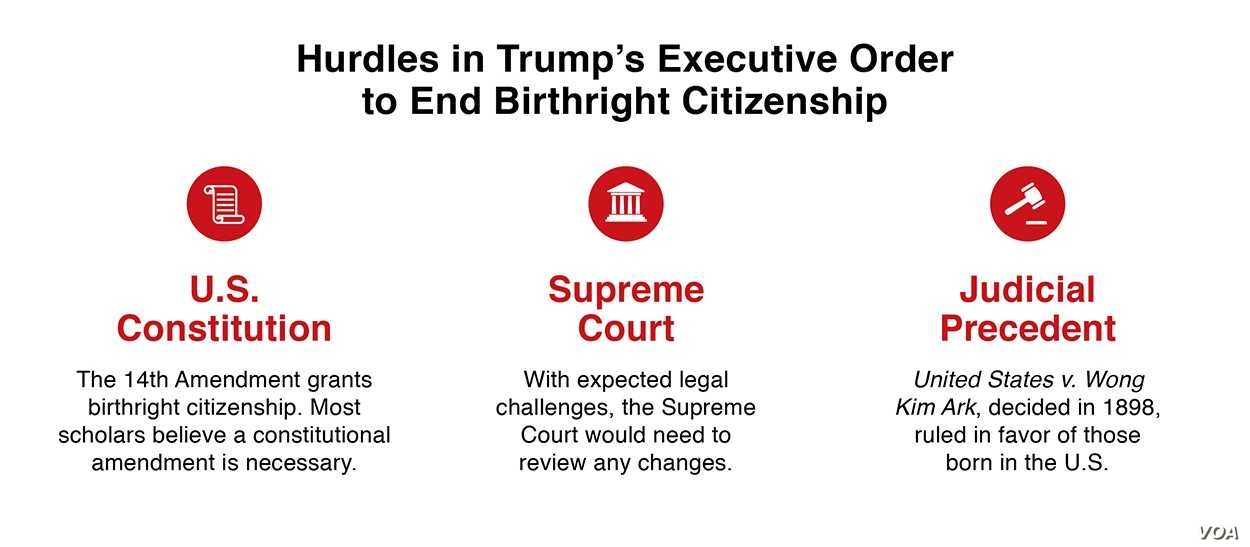
But the citizenship proposal would inevitably spark a long-shot legal battle over whether the president can alter the long accepted understanding that the 14th Amendment grants citizenship to any child born on U.S. soil, regardless of a parent’s immigration status.

Hurdles in President Trump's executive order to end birthright citizenship
Hurdles in President Trump’s executive order to end birthright citizenship

Executive order

James Ho, a conservative Trump-appointed federal appeals court judge, wrote in 2006, before his appointment, that birthright citizenship “is protected no less for children of undocumented persons than for descendants of Mayflower passengers.”

But Trump has said he was assured by his lawyers that the change could be made “just with an executive order” — an argument he has been making since his early days as a candidate, when he dubbed birthright citizenship a “magnet for illegal immigration” and pledged to end it.

There are no figures on how many foreign women travel to the U.S. specifically to give birth. The Center for Immigration Studies, a group that advocates for stricter immigration laws, estimated that in 2012 about 36,000 foreign-born women gave birth in the U.S., then left the country.

Places like Florida have seen in a boom in so-called “birth tourism.” Every year, hundreds of pregnant Russian women travel to the United States to give birth, paying from $20,000 to more than $50,000 to brokers who arrange their travel documents, accommodations and hospital stays. Sizable numbers of women from China and Nigeria also come to the U.S. for the same reason.

Immigrant detention

Trump’s comments Wednesday came as the administration continued to make immigration changes pushed by his hard-line advisers that have been in the works for months. On Wednesday, the Department of Homeland Security announced it had moved to end a longstanding federal agreement that limits how long immigrant children can be kept in detention. The decision will almost certainly lead to a legal battle over the government’s desire to hold migrant families until their cases are decided.

The rule also follows moves last week to broaden the definition of a “public charge” — a burden to the U.S. — to include immigrants on public assistance, potentially denying green cards to more immigrants. There was also a recent effort to effectively end asylum altogether at the southern border.

Source: Trump Again Says He’d End Birthright Citizenship

Ukip Might Not Get Votes – But Its Anti-Islamic Voices Have a Platform

On anti-Muslim attitudes in the UK and UKIP:

It seems tempting to ignore the election of Richard Braine, the new leader of the UK Independence Party. After all, its former leader Nigel Farage moved on to found the Brexit Party and much of Ukip’s support seems to have migrated there with him.

But it would be a mistake to disregard Ukip. Its strongest impact was never in the parliamentary seats it failed to get, either in the House of Commons or the European Parliament. Rather, it made its mark by moving the conversation dangerously further to the right than was previously acceptable. Take, for example, the first controversy to emerge involving Mr Braine. Footage of a hustings for the leadership race showed him complaining some British towns and cities were effectively no-go areas for non-Muslims and calling for it to be a crime to hand out copies of the Quran under laws connected to violence.

Such virulent anti-Muslim sentiment underpins Ukip and has only become more intense over the years, despite claims that it wants to distance itself from the anti-Islamic views that shaped the leadership of Mr Braine’s predecessor, Gerard Batten. Mr Farage quit the party over the issue of Islamophobia and Mr Batten’s links to far-right activist Tommy Robinson. The footage of Mr Braine seems to indicate it’s a different face at the helm but the same message.

For a party that is arguably on the far-right of British politics, Ukip enjoys an outsized presence in terms of press coverage. The boisterous antics of the likes of Mr Farage boosted his popularity and was handsomely rewarded by a disproportionate amount of airtime on television, a radio show on a mainstream network and a platform with various media outlets.

But as oxygen has been given to such right-wing views in so much of the mainstream media, such voices and their radical views have become normalised.

Ukip began as a Eurosceptic party and leaving the EU was the issue that defined its purpose. It never found a critical mass to vote for it as a party – but it did manage to get a critical mass to take up its one issue. As a result, the Brexit referendum of 2016 happened. The turmoil that has unfolded since is significantly down to mainstream political parties not taking seriously how to provide leadership in an age where Ukip-style populist politics can make a difference.

Mr Farage has now moved on to another political force, one which yielded considerably more success in the recent European elections. But the Brexit Party could never have done so if Ukip had not existed in the first place. Ukip continues to tap into a minority of the British public’s sentiments – an unruly minority that seeks division in order to promote its agenda.

That agenda is increasingly not about leaving the EU, an issue that has been taken up by the Brexit Party, large parts of the Conservative party, and even significant pats of the Labour party. Ukip might deny it is an anti-Islamic party – but the issue of Islamophobia is increasingly shaping conversations both within its ranks and about it.

Since the Brexit referendum took place, it is the issue that has energised the remaining Ukip base like no other. Robinson, currently serving nine months in prison, was until recently serving as a political adviser to Mr Batten. Others, including Ukip candidates Mark Meechan and Carl Benjamin and Paul Joseph Watson, have been accused of racist, threatening language. Mr Watson founded the far-right conspiracy website Infowars which is known for promoting absurd conspiracy theories; he himself declared “Islam control” was needed rather than gun control.

The anti-Islam animus has been present within Ukip since its early days – but it now seems to have overtaken nearly all other considerations within the party today. Anti-Muslim sentiment is a problem that infests many parts of the political spectrum already, including within the ranks of the Conservative party, to the point where even the term Islamophobia is challenged.

Ukip is currently polling badly in the UK. But with anti-Muslim bigotry across Europe on the rise, history reminds us that insignificance at the ballot box doesn’t mean irrelevance elsewhere.

Source: Ukip Might Not Get Votes – But Its Anti-Islamic Voices Have a Platform

Frédéric Bastien: L’immigration a des conséquences culturelles

While valid to question  arguments in favour of high levels of immigration, the reference to “notre peuple,” essentially “pure laine” French origin, in contrast to “the other” is telling.

Such exclusionary language hardly facilitates integration of immigrants, which is his stated objective:

Dans un texte publié dans Le Devoir le 19 août dernier, le président de la Chambre de commerce de Montréal, Michel Leblanc, invoquait la croissance économique et ce qu’il qualifie de « manque de main-d’oeuvre » pour justifier une hausse substantielle de l’immigration. Celle-ci serait essentielle pour nous propulser vers « un âge d’or économique » en vertu d’une politique nationaliste. Rien n’est plus faux.

Soulignons d’abord que les études faites sur le sujet montrent qu’il n’y a aucun lien entre l’immigration et la prospérité. Le PIB par habitant des pays qui reçoivent beaucoup d’immigrants n’est pas plus élevé que celui de ceux qui en reçoivent moins. Si ce lien existait, ça ferait longtemps que le Japon aurait été rayé de la carte des puissances économiques du globe, lui qui reçoit un nombre extrêmement faible d’immigrants. Pourtant, l’économie nippone demeure l’une des plus performantes de la planète.

La belle époque du chômage élevé

Depuis quelques années déjà, le taux de chômage au Québec est en baisse. Alors qu’il était de 10-12 % il y a quelques décennies, il tourne aujourd’hui autour de 5 %. Collectivement, on devrait se réjouir de cette situation. Mais ce n’est pas ce que font les lobbys patronaux. Ceux-ci regrettent la belle époque où il y avait dix postulants pour un emploi disponible. Les patrons avaient beau jeu de négocier à la baisse les salaires et de faire la fine bouche. Aujourd’hui, ce sont les travailleurs qui ont le gros bout du bâton. En quoi devrait-on se scandaliser de cette situation ?

Plusieurs employeurs refusent cependant de faire monter les enchères en offrant de meilleurs salaires et de meilleures conditions de travail. Par exemple, certaines grandes entreprises préfèrent se tourner vers la main-d’oeuvre étrangère. Elles sélectionnent des travailleurs qu’elles font venir ici pour les payer au salaire minimum, contournant les conditions locales du marché, maximisant ainsi leurs profits pour le plus grand bonheur des actionnaires. Les larmes de crocodile que verse aujourd’hui Michel Leblanc ne devraient pas nous émouvoir.

Ce dernier semble croire par ailleurs que l’arrivée massive d’immigrants fera en sorte que des postes seront pourvus. C’est vrai que l’immigration augmente l’offre de main-d’oeuvre, un élément essentiel pour faire baisser les salaires. Mais l’arrivée de nouveaux venus crée aussi de la demande. Ces gens consomment des biens et services que notre économie doit produire. Par conséquent, il faut engager encore plus de gens pour y pourvoir, et il faut donc faire venir encore plus d’immigrants, car « la pénurie de main-d’oeuvre » perdure, et on recommence avec une nouvelle vague migratoire. On se retrouve dans une spirale inflationniste sans fin.

Tout cela n’est pas sans conséquence pour la société d’accueil. Entre autres, toutes les études démontrent que l’immigration a pour effet de propulser à la hausse le marché immobilier. C’est excellent pour les propriétaires, mais les familles des classes moyennes et pauvres en paient le prix. Le coût des loyers est propulsé à la hausse et ces familles doivent déménager dans des banlieues toujours plus lointaines.

Le spectre de minorisation

L’immigration a aussi d’importantes conséquences culturelles. Plus les étrangers sont nombreux chez nous, plus il est difficile de les intégrer et, au fil des générations, de les assimiler. À Montréal, des ghettos se forment et plusieurs immigrants peuvent vivre en marge de la société d’accueil. À l’heure actuelle, le Québec reçoit par habitant presque deux fois et demie plus d’immigrants que la France et presque deux fois plus que les États-Unis, alors même que nous constituons 2 % de la population de l’Amérique du Nord et que nous ne sommes même pas un pays souverain. Sommes-nous plus capables que nos cousins français ou que nos voisins du sud d’intégrer et d’assimiler les immigrants à notre nation ? Comme le dit l’adage, poser la question, c’est y répondre.

Être nationaliste, ça veut dire être préoccupé par la survie de notre peuple. L’immigration a des conséquences culturelles importantes, notamment en faisant reculer de façon dramatique le pourcentage de personnes de langue maternelle française au Québec. Celui-ci était de 82 % en 1996 et il tourne aujourd’hui autour de 75 %. En 2100, ce taux pourrait être de 50 %, selon Statistique Canada.

Cette réalité, et non les mythes propagés par la Chambre de commerce de Montréal, devrait être au coeur de notre politique d’immigration. Les immigrants qui s’intègrent le mieux à la société québécoise, et dont les enfants s’assimilent ensuite à notre peuple, sont ceux qui parlent déjà français et qui ont un haut niveau d’éducation, obtenu dans des établissements reconnus. Il faut donc réduire la sélection de l’immigration à ce segment. Le but ne doit pas être de créer du chômage pour plaire au patronat, comme le réclame Michel Leblanc. Pour les nationalistes, il est plutôt primordial de rehausser le nombre de francophones au Québec et d’assurer notre survie.

Source: L’immigration a des conséquences culturelles

Trump’s tweets about ‘disloyal’ Jews are laced with centuries of antisemitism

Situates the broader and historical contexts:

It was January in Paris – cold, gray – when a ceremony held on the Champ-de-Mars roiled the city’s elite. Military officials and civilians gathered to watch as a young Jewish artillery officer was punished for his alleged treason. Days earlier Alfred Dreyfus had been convicted of passing secrets to the Germans in a rushed court-martial. A French army officer stripped his insignia medals, took his sword and broke it over his knee. Dreyfus was marched around the courtyard of the École Militaire as crowds jeered and spat. Cries of “Jew!” and “Judas!” drowned out his muffled professions of loyalty to the French state.

The scene was striking – in the shadow of the newly built Eiffel Tower, a symbol of modernity, an almost primal witch-hunt unfolded. A once decorated army servant pleaded for pity as his neighbors called out “death to the Jew”. Dreyfus was exonerated two years later. The message of his trial was clear: even in a cosmopolitan city, in a country whose revolutionary myth called for liberty and equality, leaders could baselessly point their people’s animus toward the other in their midst.

There’s a sordid history to charges of Jewish dual loyalty in the US In the early years of the second world war, isolationists opposed to American involvement dismissed the war as little more than a “Jewish cause”. Charles Lindbergh berated Jewish leaders for “agitating for war”. Decades later, when the US senator Joe Lieberman ran on the Democratic ticket for vice-president, pundits questioned whether he was more loyal to Israel than to the US. During the democratic primaries in 2015, the Vermont senator Bernie Sanders was challenged on his “dual citizenship” with Israel.

Source: Trump’s tweets about ‘disloyal’ Jews are laced with centuries of antisemitism

Opinion: Interculturalism reconciles a common culture, diversity

Apart from the usual tired misunderstandings of multiculturalism (again, multiculturalism is about integration, whether it be Quebec and French, or elsewhere in English or French.

Does one really believe that an “interculturalism” law would solve all the accommodation debates and avoid a Bill 21?

Recent calls for the adoption of a law on interculturalism, including by the Quebec Liberal Party’s youth wing, have given rise to fears that such a law would restrict minority rights in Quebec.

Such fears are unfounded. Interculturalism does not restrict minority rights, but rather reaffirms them. It reaffirms, for example, the right of the English-speaking community to maintain its culture and institutions, in particular its universities, hospitals and, especially, its school boards. It is a well thought-out, comprehensive policy framework that is inclusive of all Quebecers.

This policy, which has been promoted by every Quebec government in some form since 1971 and was given new impetus by the Bouchard-Taylor Commission, rests on two pillars.

The first is a common francophone culture, shared political institutions — notably the National Assembly — a common history that started with French exploration of the New World and continued with the development of a modern society that is in good part characterized by cultural diversity.

The second pillar, cultural diversity, recognizes a multiplicity of cultural communities and also accords special status to First Nations, the Inuit and the English-speaking community.

Interculturalism implies the recognition both of the francophone majority and of minorities. It is Quebec’s policy model for integration and the management of diversity.

What is the difference between interculturalism and multiculturalism? The former tries to reconcile a common culture with cultural diversity, while the latter restricts itself to the promotion of cultural diversity. For a national minority like Quebec, which naturally fears marginalization, multiculturalism is not a sufficient guarantee of its survival.

In my view, if the Quebec government were to restrict itself to the promotion of cultural diversity, it would actually hamper its ability to defend the special status of English-speaking Quebecers as a founding minority. The English-speaking community would be seen as one minority among others.

Interculturalism also promotes the social and economic integration of immigrants in French, which is not the case for multiculturalism. As the only francophone society in North America, it is reasonable for Quebec to implement legislation in defence of its language and culture.

Interculturalism places an onus on both institutions and citizens to resolve issues related to cultural differences by engaging with each other rather than through recourse to the courts.

It also informs the way in which we teach history and good citizenship, as it takes into account both the common culture and cultural diversity. It seeks to promote intercultural exchanges, the contribution of cultural diversity to Quebec and the fight against all forms of discrimination.

Some believe that a law on interculturalism is unnecessary, as it is already Quebec’s policy. However, like Canada’s Multiculturalism Act, legislation would allow the affirmation of Quebec’s model, the respect of diversity and the recognition of its founding minorities, and oblige the Quebec government to take into account not only the common culture, but also cultural diversity and the respect of minority rights.

Had Quebec already adopted a law on interculturalism, I believe it would have been much more difficult for the Coalition Avenir Québec government to adopt populist and discriminatory laws such as Bill 21 on secularism and Bill 9 on immigration. An interculturalism law would have established the foundational principles concerning integration and the management of diversity, and would have posed, both legally and logically, an additional obstacle to the CAQ’s policies.

Some believe that the recognition of the francophone majority and minorities is divisive. However, this reflects reality and the government cannot govern only for the francophone majority, nor can it govern only for minorities. It must address both groups’ legitimate interests. What is divisive is the absence of recognition of both groups’ legitimate interests.

This is why we need legislation that strikes a balance between the majority and minorities. We need to affirm a common culture that includes all Quebecers. This is the goal of interculturalism.

Source: Opinion: Interculturalism reconciles a common culture, diversity

‘Jihadi Jack’ and the folly of revoking citizenship: Macklin

Understandably, Macklin is the most quoted expert on citizenship revocation:

The British government has just stripped Islamic State recruit Jack Lettsof his United Kingdom citizenship.

In one sense, the move was unsurprising. The U.K. has been the undisputed leader in reviving banishment as punishment for “crimes against citizenship,” deploying it primarily against those deemed threats to national security.

The country’s Home Secretary favours stripping citizenship of nationals already abroad, which has the convenient effect of circumventing legal accountability and human rights impediments to deportation.

The mildly surprising feature of the U.K.‘s decision is that it has opted to make Letts Canada’s problem. Letts is currently being held in a jail in northern Syria after being captured by Kurdish forces in 2017.

Letts’ father is a Canadian citizen and, therefore, his son is a Canadian citizen by descent. As a result, the U.K. can deprive him of citizenship without rendering Letts stateless because he will remain a citizen of Canada.

With limited exceptions, international law prohibits rendering people stateless, though the U.K. plays fast and loose on that front. It strips citizenship from those who are dual citizens as well those who are not, but whom the Home Secretary speculates could, in the future, possibly obtain citizenship from some other country.

It doesn’t much matter to the U.K., really. Once discarded, the former citizen might be executed by drone strike, transferred elsewhere for prosecution or persecution or detained indefinitely by non-state armed forces. Wherever they go, it won’t be back to Britain, and whatever happens to them, they are someone else’s problem. That’s what makes citizenship deprivation, in the language of the British law, “conducive to the public good.”

No espionage or treason

Why another country should bear sole responsibility for a citizen that the U.K. disavows is an interesting question. These are not classic instances of espionage or treason, where the historic narrative underwriting stripping citizenship was that the individual betrayed one state in the service of the other state.

Shamima Begum, a British citizen who joined the Islamic State as a 19-year-old in 2015, was not working for Bangladesh in Syria. Jack Letts was not a Canadian spy.

I speculate that the British government has, until Letts, traded on a tacit understanding that British Muslims with brown skin inherently “belong” less to the U.K. than to some other country where the majority of people are Muslims with brown skin — even if they were born in Great Britain and have never even visited the other country of nationality.

On this view, stripping citizenship merely sends the targets back to where they “really” come from. Citizenship deprivation thus delivers an exclusionary message to all non-white, non-Christian British citizens that their claim to U.K. membership is permanently precarious, however small the literal risk of citizenship deprivation.

Indeed, British legal scholar John Finnis explicitly flirted with a similar idea a few years ago by proposing the “humane” expulsion of all Muslim non-citizens from Britain.

The Letts conundrum

But Letts is white, his parents are middle class and Christian in upbringing (though secular in practice). His other country of citizenship, Canada, is also predominantly white and Christian in origin.

Canada is a staunch British ally, an important diplomatic and trading partner and a G7 member. Queen Elizabeth remains the formal head of state in Canada.

The illogical underpinning of citizenship deprivation now emerges clearly, shorn of implicit appeals to racism, Islamophobia and colonial arrogance. Letts is no more or less a risk to national security in Canada than the U.K. In no sense does Letts “belong” more to Canada than to the U.K., the country where he was born, raised, and that formed him.

The world is not made safer from terrorism when the U.K. disposes of their unwanted citizens in Canada, Bangladesh or anywhere else. The very phenomenon of foreign fighters testifies to that.

Claims that “citizenship is a privilege, not a right” or that the undeserving citizen forfeits citizenship by his actions is flimsy rhetoric intended to distract from the grubby opportunism that motivates citizenship revocation.

The U.K. does this not because it enhances the value of citizenship or makes the world safer from terrorism. It does it because it can.

If the British government thinks stripping citizenship is a good way for a state to respond to the challenges of national security, it must think it’s a good idea for all states. So imagine that Canada also had a citizenship revocation law. In fact, Canada’s Conservative government did enact such a law in 2014 (inspired by the U.K.), though it was repealed by Prime Minister Justin Trudeau’s Liberal government in 2017.

Here is the scenario: Letts, ISIS foreign fighter, is a citizen of the U.K. and of Canada. Neither country wants to claim him. Each has the possibility of revoking his citizenship as long as Letts is not rendered stateless.

The result?

Race to the bottom

An arbitrary race to see which country could strip his citizenship first. To the loser goes the citizen — maybe Canada, maybe the U.K.

This every-state-for-itself race to the bottom is the antithesis of co-operation in a global struggle against radicalizaton and terrorism; one need not be schooled in game theory to recognize it as counterproductive parochialism. Once states contemplate the possibility of being on the receiving end of citizenship stripping, the tactic doesn’t look quite so clever.

Until now, the U.K. has targeted individuals whose other state of nationality lacked the resources or diplomatic heft to challenge the British practice under international law. Maybe it’s time for Canada to step up, and to work with other countries, to pressure the U.K. and other states to abandon citizenship revocation as a means of disavowing “bad citizens.”

The Letts case reminds us that citizenship revocation policies can bite back. Any country that seeks to dispose of their citizens in this way may some day be a disposal site for other countries. If human rights aren’t enough of a reason to abolish citizenship revocation, and undermining global co-operation isn’t enough either, perhaps self-interest can tip the balance.

Source: ‘Jihadi Jack’ and the folly of revoking citizenship