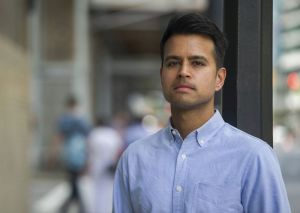
Amid political turbulence rocking Hong Kong, a pro-Conservative group is seeking to get out the expat vote in the city where an estimated 300,000 Canadians reside.
The recently-formed Canadian Conservatives in Hong Kong held two voter registration events at a bar in the city on Sept. 7 and 8, including on a day when pro-democracy protests shut down nearby streets. The group had also done online outreach in both English and Cantonese and drawn on the support of volunteers.
Organizers of the group, Canadians Brett Stephenson and Barrett Bingley, also enlisted the help of former foreign affairs minister John Baird for their two events as its special guest. The gatherings were advertised on the Conservative Party’s website but the group is unaffiliated.
For months, Hong Kong has seen large demonstrations that have posed a challenge to mainland China’s tightening grip on the semi-autonomous city. On Tuesday, during protests coinciding with China’s National Day, a teenage protester was shot in the chest by police.
Bingley, a senior director at The Economist Group by day, said political unrest in the city, as well as new liberalized voting rules for expats, are drawing their attention toward Canadian politics.
“It has to do with the election coming while there is this massive unrest happening in Hong Kong and people are looking to find a leader and a party who is going to stand up for them,” Bingley said in a phone interview last week.
“This year is not only when Canadians abroad are able to vote. There is a great desire by Hong Kong people to vote in the Canadian election this time.”
Amid that heightened interest, Bingley said their room-packed events were able to help register about 250 people. It was not only Conservatives attending but other Canadians wanting to vote. The Canadian Club in Hong Kong also hosted its own voter sign-up event on Sept. 20, with more than 200 people gathering.
The Supreme Court ruled in January that Canadians who have lived abroad for more than five years can vote.
Elections Canada’s figures show 1,588 Canadian voters have registered in Hong Kong as of Sept. 22. Voter registration abroad has now exceeded 31,000.
Canadians in Hong Kong consists of many Cantonese speakers with family in the city, as well as those working for multinational businesses.
Stephenson, a director at the Asia Business Trade Association working on Asia-Pacific trade, said Canadians who attended the events brought up issues including foreign policy, immigration and business concerns.
But the top issue was Hong Kong’s political situation and how federal parties will approach it.
Canadian Conservatives in Hong Kong’s logo. Photo courtesy of the group.
Stephenson believes the Tories are more inclined to support Hong Kong and the protection of the ‘one country, two systems’ model envisioned in the 1984 Sino-British Joint Declaration. That treaty spelled out, upon return to China’s rule in 1997, civil freedoms and a degree political independence for the city — something protesters say Beijing has moved to erode.
Stephenson said Scheer is the only federal leader to have “spoken up very forcefully” for Hong Kong. He pointed to an August tweet where Scheer said “now is the time for everyone committed to democracy, freedom, human rights and the rule of law to stand with the people of Hong Kong.”
On the contrary, Stephenson said he has only seen “timid” responses from Foreign Affairs Minister Chrystia Freeland and Prime Minister Justin Trudeau.
“I think a lot of Hong Kongers don’t feel Canada under the Liberals have stepped up and said anything that would help them in this struggle,” he said.
The Hong Kong protests occur as Canada-China relations remain sour over the detention of two Canadians in China widely seen as punishment for the Vancouver arrest of a Huawei executive in December.
In August, Freeland issued a joint statement with her EU counterpart urging restraint amid “a rising number of unacceptable violent incidents.” That statement prompted China’s embassy in Ottawa to issue a response accusing her of “meddling in Hong Kong affairs and China’s internal affairs.”
But so far during the campaign, Hong Kong’s unrest and other foreign policy issues have received scant attention from all party leaders.
Stephenson said parties’ attention toward expat votes could increase if they observe any influence on key swing ridings, particularly in the Greater Toronto Area and Metro Vancouver.
That sentiment was echoed by Baird, now a consultant with much of his work centred in Asia. Bingley said the former Harper minister, who was in town the weekend of their events, had told the audience their votes especially matter if they are being tallied in battleground ridings.
Interest abroad may mean more groups like theirs spring up, but Bingley said their creation is barely novel. Existing already are expat organizations that support the U.S. Republicans, the Australian Liberal Party and U.K. Conservatives.
“What we’re doing is very much within the mainstream of centre-right parties,” he said.
“It’s just that because Canadians couldn’t really vote from abroad up until the Supreme Court changed the rules. There was no infrastructure to do this. So it feels strange to Canadians and yet is actually not strange at all.”
From his observation, there are no Liberal or NDP groups in the city.
The group will have to be mindful of Elections Canada’s third-party rules, which require Canadians spending more than $500 on regulated activities during the campaign to register with it. Agency spokesperson Natasha Gauthier said whether voter registration events are considered a third-party activity depends on the facts and context of each situation.
Conservative spokesperson Simon Jefferies told iPolitics that the group isn’t affiliated with the party but nevertheless agreed to host a webpage for its event.
Bingley said Canadians in Hong Kong live the impact of the world’s geopolitical challenges that aren’t being discussed enough in this election.
“They need to be addressed by leaders, and one of the biggest is the rise of China.”
Drawing on over 1200 ethnic media pieces in the eight weeks prior to the election call as part of diversityvotes.ca, my analysis assesses the major themes and issues covered:
Canadians who rely on ethnic media as their main information source receive coverage of issues comparable to that of mainstream media.
A major focus of this 2019 election for the various campaigns will be courting voters from immigrant and visible minority communities, who are a majority of the population in 41 ridings, and 20 percent or more in an additional 93 ridings.
“The criminal madness of the [Nazi] occupier was seconded by the French, by the French state. Those black hours soiled our history forever. … France … committed the irreparable.”
These words were spoken by French president Jacques Chirac on July 16, 1995, and in the days since his death, he deserves credit for moral courage. The occasion was the anniversary of the infamous Vélodrome d’Hiver roundups of Parisian Jews on July 16 and 17, 1942, when French police incarcerated more than 13,000 Jewish men, women and children in a sports stadium on orders of the occupying Nazis. Before the war ended, 76,000 Jews had been deported to Nazi concentration camps with French collaboration. Only about 3,000 returned.
Everyone understood the significance of Mr. Chirac’s words. He said France was responsible. In speaking from the highest office, he exploded the postwar myth that the terrors committed on French soil were uniquely the work of the occupying Nazis and their collaborationist henchmen in Vichy and had nothing to do with the true France, which had resided in London with the government-in-exile of General Charles de Gaulle from 1940 until 1944 while aided at home by the French Resistance. In effect, Mr. Chirac had shattered the half-century-long taboo against an official acknowledgment of the truth.
The birth and demise of France’s long-standing fairy tale remains instructive, for all nations fashion a historical narrative of who they are and were, especially after times of crisis, and their stories ordinarily retain their power until overwhelmed by undeniable evidence. In the latter category, the following was fact: From May, 1940, France was occupied by the Nazis and governed at Vichy by General Philippe Pétain, a hero of the First World War. Pétain was adored by a majority of the French, and the collaboration of his government with the Nazis, including police actions against Jews, was broadly accepted as national protection. Yes, there was resistance. As historians later verified, about 1 per cent of the population participated in military-style resistance networks, just as about 1 per cent willingly participated in the collaboration by marching around in real or virtual jack boots helping the Nazis carry out atrocities. As for the rest of the population, they made small gestures in either direction or sat on the proverbial fence waiting to see which way the wind would blow.
Gen. de Gaulle created the myth of an all-encompassing resistance to the Nazis because he believed a shared narrative of winning the war would promote peace among his divided countrymen. On June 14, 1944, the day he landed at Bayeux, he identified himself and his resistance with “France” and with the “final victory of the Allies.” Only a tiny handful of traitors had sold out to the enemy. These would be duly tried and excised from the collective.
The die was cast, but still the story sat uneasily, for untold numbers of known upper- and lower-level collaborators had moved into positions of prominence in the postwar era. On the other hand, everyone won, including the collaborators who now said they had been playing a “double game” and had in reality been resisting.
Unsurprisingly, the first accurate history of the Vichy era did not appear until 1972 and was written by a foreigner, U.S. historian Robert Paxton. A second groundbreaking book, Vichy France and the Jews, followed in 1981, also written by Mr. Paxton, with a colleague, Canadian historian Michael Marrus. Notably, both works caused scandal and recriminations that eventually set in motion a train of trials, starting with the Nazi Klaus Barbie, in 1987, culminating with the Vichy-era French bureaucrat, Maurice Papon, in 1998, and underscored in 1995 with the first official statement by a French president on the subject of France’s complicity in the Holocaust.
Because timing and perceived sincerity matter, Mr. Chirac’s formal acknowledgment of his country’s mythologized history was a standout moment in the life of postwar France. Fifty years later, his sorrowful, truthful evocation would help his countrymen recalibrate long-time historical distortions and face their nation’s history, however painful.
Trapped inside a contemporary world of lesser moral clarity, we may admire Mr. Chirac’s principled act.
Somewhat unexpectedly, the issues of discrimination and racism have moved to the forefront in the federal election. At the start of the campaign, answering a journalist’s question about Quebec’s secularism Bill 21, Liberal Leader Justin Trudeau left open the possibility of some eventual legal intervention on the legislation. Predictably, there was an almost immediate response from Quebec Premier François Legault, asking all federal leaders to make a pledge to stay out of the matter. With the exception of Trudeau, the other federal party leaders quickly complied. Bill 21 prohibits the wearing of religious symbols by Quebec public school teachers, judges, police officers, prison guards, Crown prosecutors and other public servants in positions of authority, as a way of enshrining the concept of state secularism.
And then, just as the campaign’s attention on Bill 21 waned, some very distasteful photos of a younger Trudeau in brownface and in blackface hit the national and international media. Trudeau apologized many times for his past behaviour and correctly acknowledged that it was highly offensive.
Conservative Leader Andrew Scheer insisted that the blackface pointed to Trudeau’s lack of judgment and as such raised questions about his ability to govern. During a September 20 campaign stop in PEI, Scheer said all levels of government need to address the types of issues raised by such conduct. He said that “Conservatives will always support measures that tackle discrimination…We’ll always promote policies that promote inclusiveness and equality throughout our society.” Ironically, that’s precisely what needs to be said in addressing Bill 21.
For his part, NDP Leader Jagmeet Singh made an impassioned plea to all Canadians who were offended by the images of Trudeau in blackface. He chose to speak to those people who have felt the pain of racism and urged them not to give up on themselves, adding that they have value and worth and that they are loved. But that message does not appear to apply to those persons affected by Bill 21. Singh seems unwilling to defend those Quebecers who wear a turban, hijab or kippah and want to teach at a public school in their home province. Paradoxically, while Singh can become prime minister of Canada, he would be unable to teach at a public school in Quebec under Bill 21. By insisting on the need to respect provincial jurisdiction, Singh implies that members of religious minorities need to give up their hope of seeking a career in public service.
Both Scheer’s and Singh’s criticisms of Trudeau and the related concerns about the spread of racism would be more credible if they denounced the discriminatory aspects of Bill 21 rather than bowing to the Quebec Premier’s demands and looking the other way on what Legault insists is a strictly provincial matter.
Perhaps, like many observers, the federal party leaders don’t see any connection between blackface and a state prohibition against educators wearing hijabs, turbans and kippahs in public institutions. Yet the case can surely be made that both arise from subconscious or overt feelings and/or expressions of prejudice that are, regrettably, deemed acceptable by far too many people. The difference is that Trudeau’s use of blackface occurred two decades ago, while the legislation banning religious symbols is the object of current debate.
In the aftermath of the Trudeau blackface incidents, there have been calls for a national conversation about racism. But the tone of this election campaign does not allow for a thoughtful discussion about the ongoing challenge of eliminating racism and discrimination. Ideally, all federal party leaders should work together to combat racism and discrimination, whether it appears in Quebec or anywhere else in the country.
Has been discussed for some time but with climate change accelerating, will likely see more pressures:
Amita Kettner’s mother was killed when a mudslide wiped out the family home in North Vancouver.
The Green party candidate for Burnaby North was 14 when the sudden burst of extreme weather struck in 2005, sweeping Eliza Wing Mun Kettner and her house down an embankment.
The tragic family history adds to why Kettner, along with the Green party of Canada, is impassioned about the party’s out-of-the-ordinary election promise to advocate for making “environmental refugee” a new immigration category in Canada.
“We, as a country, have a certain amount of prosperity and comfort, and we can prepare to have climate refugees. That is not something that everywhere else can do,” says Kettner, who recently obtained a PhD in astrophysics from the University of California, Santa Clara.
Soon many regions of the globe are “likely to be on fire, or underwater or having crop failures,” said Kettner.
“We might not have to take refugees that come overland (entering Canada from the U.S.), but it’s possible we might see mass migration from the equatorial band. I think we should be ready to accept people from everywhere and anywhere.”
The Green party knows it faces an uphill battle on the issue, since the United Nations refugee agency, which currently defines refugees as people escaping war and persecution, has failed to come up with a definition of environmental refugee, citing legal and political complications.
Nevertheless, the party’s 2019 platform declares it intends to “lead a national discussion to define the term ‘environmental refugee,’ advocate for its inclusion as a refugee category in Canada, and accept an appropriate share of the world’s environmental refugees into Canada.”
With tens of thousands of Canadians joining climate-change protests on Friday and the environment ranking as leading election issue, projections about the potential scale of the climate crisis still vary. One widely cited study, from the United Nations University, suggests there will be 200 million environmental migrants by 2050.
Experts are also concerned that only the wealthy will have a chance to emigrate from the world’s increasingly hot spots, which could be devastated by water shortages, crop failure and extreme weather. This year, for instance, severe drought hit East Africa, unusual typhoons battered the Philippines, and crops withered in Honduras.
Sanjay Jeram.GERRY KAHRMANN / PNG
Simon Fraser University political scientist Sanjay Jeram says the Canadian Greens’ enthusiasm for broadening the refugee category “comes at an interesting time when, across the Western world, we have seen parties — on the left and right — express hesitation about their state’s capacity to take in refugees.”
Even people sympathetic to the plight of refugees are timid about reopening the definition used by the United Nations convention, Jeram said. They fear some nation-states will use it as an opportunity to withdraw from current commitments to take in people escaping war and persecution, of which there are more than 22 million.
Nevertheless, Sanjay pointed to New Zealand as a potential example for Canada to follow, since some of its politicians have been exploring how to make climate change a legitimate ground for an asylum claim.
Last year New Zealand Prime Minister Jacinda Ardern planned to create a special visa for Pacific Islanders forced to relocate because of rising sea levels. She hoped her nation, as a precedent, could offer 100 visas each year. Ardern’s plan, however, has run into legal barriers.
Like many environmental specialists, Kuttner, who wouldn’t speculate about how many environmental refugees Canada might accept, is concerned that rich and educated people will be most likely to escape climate-change calamity in their regions, including through migration to countries like Canada, which are somewhat less vulnerable.
“There’s a definite sense that some people, if they have enough capital, will be able to hide themselves from climate disaster,” Kuttner said.
“It’s definitely true that the more money people have the easier it is to handle large climate changes. But even for the well-off it’s still a gamble.”
Andy Yan.NICK PROCAYLO/ PNG
Andy Yan, director of the city program at Simon Fraser University, says it’s possible some people around the world who can afford it are trying to find a haven from climate change by migrating to Metro Vancouver and other parts of North America.
“That would probably be a factor. It goes into the idea of Metro Vancouver as a ‘hedge city.’ It’s not only about looking to create financial and political stability, it’s increasingly about searching for climate stability.”
That said, Yan is among those warning Metro Vancouver and Canada will not be immune from climate-change problems. He cites a recent study by University of Victoria scientists projecting that Vancouver could be warmer than San Diego by 2050, causing nearby forest fires and water shortages.
While it’s important to have discussions about our humanitarian responsibilities to the world’s migrants, however defined, Yan said the value of facing up to the potential for a mass movement of environmental refugees is that it reminds us to first take decisive action against climate change itself.
“How about having government policies that prevent the situation to begin with?”
Ironically, just as the Liberal platform came out promising to eliminate citizenship fees, saw this US advocacy piece:
It shouldn’t cost a cent for an immigrant to apply for United States citizenship. Here’s why:
After residing in the United States with their green card for five years (or many more), having “good moral character” and maintaining limited travel, immigrants visit us so we can assist with preparing their application and prepping them for their interview. While the thousands of immigrants come to our Citizenship Department at CASA in Maryland, meet ALL of the requirements for citizenship, more than half of them cannot afford the exorbitant price tag that comes along with applying. It’s wrong.
Over the last 34 years, the fee for naturalization has risen exponentially from $35 in 1985 to an incredible $725 to apply today. With the fee on the rise, many eligible immigrants fear that they will never be able to apply for citizenship in their lifetime. The message that we are sending to our immigrants is clear: sure, you can become a citizen…if you can afford it. In alignment with President Trump’s recent attack on poor immigrants with the passing of the recent public charge ruling, the fee itself discriminates against low-income folks who should be able to naturalize easily.
It’s important to note that the $725 fee doesn’t come close to the total financial burden in actual costs that immigrants have invested in the process. Many applying are also paying hundreds of dollars for English classes, U.S. history and government classes, legal fees, transportation fees, and are already sacrificing chunks of their paychecks when taking off from work to complete the process.
Why do green card holders want to get their citizenship? Because it grants them a long list of benefits from voting in elections for candidates that represent their interests to having access to better jobs and overall better economic prosperity. Additionally, with the administration’s heinous language and policies on immigration, even immigrants who are residing in the U.S. legally fear for deportation more than ever, though they have a right to U.S. citizenship after meeting the requirements.
The bottom line is this: Money should not be a barrier to U.S. citizenship.
Many people argue that these immigration fees are necessary, since the United States Citizenship and Immigration Services (USCIS), the agency that processes citizenship applications, doesn’t get funding directly from the government. But perhaps, this is a signal that Congress should allocate taxpayer money to cover citizenship processing fees.
Applying for citizenship should cost nothing. As U.S. Sen. Robert Menendez (D-N.J.) mentioned in a recent interview in regard to his proposed bill to increase access to fee waivers, “Citizenship promotes integration, civic responsibility, and a sense of community, which ultimately benefits all Americans.”
There are currently fee waivers available for low-income immigrants that an applicant can apply for based on their income level, their receipt of means-tested benefits, or financial hardship. However, the income-based requirement, that requires applicants to prove their income was at or below 150 percent of the Federal Poverty Guideline, doesn’t begin to scratch the surface of those who are in need.
To make things worse, USCIS has recently proposed to stop granting waivers for applicants who currently receive means tested benefits like Medicaid. In other words, USCIS has basically decided that only their office can determine whether a person needs assistance or not – despite state benefit granting agencies assessing need-based eligibility for years.
To those who are eligible for citizenship, apply now if you want to have a chance at voting in the 2020 election. Many local and state governments and non-profit organizations have temporary solutions to assist green card holders with the fee. For example, Montgomery County has partnered with CASA to provide ascholarship for residents of the county applying for citizenship. Other organizations like the Coalition for Humane Immigrant Rights (CHIRLA) and other members of the National Partnership for New Americans, are working hard to come up with solutions to make the fee more affordable for applicants. But this cannot be a permanent solution.
As a country, this cannot be how we treat people who have sacrificed everything to be here and who have contributed so deeply, both culturally and economically, to the core of our country. The physical and emotional cost of immigrating to a new country is high enough. When it comes to the brotherhood and sisterhood of our American family, a majority of immigrants, to us, are already United States citizens. Now it’s time for Congress to lift the financial hardship and make it possible for them to act as full citizens.
Jeromy Brown, a 46-year-old teacher in Iowa, considers President Trump a white supremacist.
“If the shoe fits, then say it, and the shoe fits him,” Brown said, while waiting in a photo line at an Elizabeth Warren rally in August. “Why should he be excused from that label?”
Brown, like many white liberal voters, appreciates that some Democratic presidential candidates have begun explicitly referring to Trump as a white supremacist. His top choice, Warren, told The NPR Politics Podcast in August that “when the white supremacists call Donald Trump one of their own, I tend to believe them.”
But she’s not alone in using such strong and direct language. Vermont Sen. Bernie Sanders has repeatedly referred to Trump as a “racist” on the campaign trail. And former Texas Rep. Beto O’Rourke insists that tackling white supremacy should be the No. 1 law enforcement priority in the country.
Undoubtedly, race and racism have become more salient political issues because of how the president talks about immigrants and minorities.
But the shift in how white liberals think about race actually predates both the president’s victory and the response from 2020 Democratic candidates.
Beginning around 2012, polls show an increasing number of white liberals began adopting more progressive positions on a range of cultural issues. These days, white Democrats (and, in particular, white liberals) are more likely than in decades past to support more liberal immigration policies, embrace racial diversity and uphold affirmative action.
Researchers say this shift among white liberals indicates a seismic transformation in the last five to seven years and not just a blip on one or two survey questions.
“The white liberals of 2016 or even 2014 are very distinguishable from the white liberals of the 1970s, the 1980s and the 1990s,” said Zach Goldberg, doctoral student at Georgia State University who has been studying the change.
In poll after poll, on a range of racial issues, both Goldberg and another researcher, Andrew Engelhardt at Brown University, have independently discovered repeated evidence of a more left-leaning white Democratic electorate.
These days, a large majority of white liberals — nearly 3 in 4 — say discrimination is the main reason black people can’t get ahead.
For some context, in the early 2000s, white liberals were split on that question — about half said blacks who couldn’t get ahead were mostly responsible for their own condition.
An increasing number of white liberals now think the criminal justice is biased against black people. An increasing number of white liberals also say the police are more likely to use deadly force against black people.
And, more white Democrats say the Confederate flag is a symbol of racism, rather than Southern pride. The reverse was true in 2000.
Some metrics even seem to be suggesting that white Democrats express more woke attitudes than their fellow brown and black Democrats.
Goldberg cited the 2018 American National Election Studies pilot survey, which found that 78% of white Democrats thought having more races/ethnicity in the country make it a “better” place to live. Fifty-seven percent of black Democrats, and 63% of Hispanic Democrats said the same.
About two years ago, Engelhardt said he also noticed another major shift.
“Starting about 2016 … white liberals actually rate non-white groups more positively than they do whites,” explained Engelhardt. “Usually, it’s the opposite.”
Most racial groups feel more warmly about their own race than they do about other races. That’s true for every group, except white liberals, according to the American National Election Studies.
Engelhardt says these recent flips suggests there’s something about being white in America that white liberals are trying to distance themselves from — something that could be accelerated by the rhetoric and tone of Trump and some of his supporters.
When white liberals adopt some of these progressive positions, Goldberg said, they’re “virtue signaling” — they want to prove that they’re allies of minority groups and feel they need to do that more assertively and openly in the Trump era.
Although Trump did not create the current conditions, both Goldberg and Engelhardt agree the president has accelerated the change in white voter attitudes.
Brown, from the Warren rally, derided some of his fellow white people for being “white supremacists” who think they are the only people “with the real birthright claim on this land, even though that makes no sense whatsoever.”
Engelhardt also suggests white guilt could be a motivating factor.
At an O’Rourke rally in Iowa a few weeks ago, 64-year-old Polly Antonelli teared up as the former congressman recounted a story from the El Paso, Texas, shooting. The suspected shooter in that incident had told police he was targeting Mexicans.
Antonelli said it’s “highly appropriate” to refer to Trump as a white supremacist.
“He is the one dividing people, by saying the things that he says about Muslims, about Mexicans, about s******* countries,” she said. “Calling him out on his crap might sound divisive, but it’s a reaction to his divisiveness.”
Antonelli admits that her own opinions on race have evolved as she learned more about different cultures.
“I realize how little I know and how I need to be more careful about what I say and how I pigeonhole people because of how they look,” she said, indicating a sense of cultural awareness you hear more often voiced by white liberals in recent years.
The “moral buttons” are being pushed
One possible explanation for the dramatic shift in racial attitudes in the last decade is that white Democrats who disagreed with the party’s embrace of diversity have just abandoned the party altogether. But even though the makeup of the parties has fluctuated, that’s not the only explanation; Researchers point to a genuine shift among the white liberals who have remained in the party.
“Whites’ identification as Democrats and Republicans is motivating them to hold different attitudes about people of color in the United States,” said Engelhardt.
Goldberg says he noticed an abrupt change around the time mainstream news outlets started picking up on social media accounts of fatal police shootings of black men.
“[White liberals’] exposure to injustice inequality has been heightened because of the internet,” said Goldberg. “The moral buttons of white liberals are being more frequently pressed.”
Engelhardt agrees, and pointed to one specific incident as a potential catalyst — when a white police officer shot and killed Michael Brown, an unarmed black man, in Ferguson, Mo., in 2014.
“This kind of renewed attention to discrimination is new and novel for white liberals,” he said, explaining why there has not been as large of a shift among people of color on these survey questions, in part because they didn’t need social media videos to know what was already happening in their communities.
May be some lessons for settlement services elsewhere in Canada in terms of which supports may be more effective:
La hausse de l’allocation hebdomadaire remise aux immigrants pour leur apprentissage de la langue a fait bondir la popularité des cours de francisation de 10 % au cours de la dernière année. C’est ce que constate le ministère de l’Immigration, de la Francisation et de l’Intégration dans son rapport annuel déposé mardi à l’Assemblée nationale.
Près de 31 000 personnes se sont inscrites au cours de français en 2018-2019 comparativement à un peu plus de 28 000 en 2017-2018, la plupart à temps complet. La hausse est plus marquée chez les femmes. Elles étaient près de 8500 à avoir suivi ces cours en 2018-2019, contre près de 7000 en 2017-2018. Une augmentation presque deux fois plus importante que celle des hommes.
L’allocation hebdomadaire remise aux immigrants inscrits aux cours avait été haussée de 25 $ par les libéraux et ainsi fixée à 140 $ en août 2017. Le nouveau gouvernement caquiste a fait de la francisation des immigrants l’une de ses priorités. Le ministre de l’Immigration, Simon Jolin-Barrette, a augmenté cette allocation à nouveau le 1er juillet 2019, à 185 $ par semaine. Il a également ajouté une allocation de transport et de frais de garde, en plus de donner accès à ces cours offerts par l’État à tous les immigrants vivant au Québec, y compris les travailleurs temporaires et les étudiants étrangers. Anticipant une plus forte demande, le ministre Jolin-Barrette avait également annoncé l’ajout de 300 nouvelles classes. Le coût de ces nouvelles mesures s’élève à 70,3 millions.
Si les inscriptions aux cours de francisation à temps plein offerts en territoire québécois ont augmenté, celles aux cours offerts en ligne ratent leur cible. Seulement 30 % des immigrants les ont suivis depuis l’étranger, alors que le ministère visait un objectif de 70 %. La baisse de participation à ces cours sur Internet est attribuable à la diminution du nombre de certificats de sélection du Québec délivrés aux personnes à l’étranger, selon le rapport annuel.
Targeted investor immigration program. Will be interesting to see the results and evaluations. Does seem better approach than some of the more passive citizenship-by-investment or immigration investment programs:
Ireland’s underserved property segments of nursing homes and social housing have opened up avenues for foreigners to qualify for the country’s fast-track residency scheme, and wealthy Hongkongers are eyeing the investment scheme as the city reels from its worst political crisis.
Dublin offers four options under the Immigrant Investor Programme (IIP) for those seeking to live and work in Ireland. The first two options are investing in companies that build social housing or nursing homes, which require a minimum €1 million each for at least three years. The other two options are donations of €500,000 to a public project and a €2 million investment in any real estate investment trust listed on the Irish Stock Exchange.
The interest has been substantial enough for Irish developer Bartra Capital to set up shop in Hong Kong following record-high inquiries it received from Hongkongers about the immigration scheme when social unrest in the city started to escalate in July.
“In the last seven to eight weeks, I’d say I’ve met between 80 and 100 clients in Hong Kong,” said James Hartshorn, director of Asia at Bartra. “Prior to that we had signed two to three Hong Kong clients.”
Henry Chin, head of research for Asia-Pacific, Europe and the Middle East at CBRE, said that there is an opportunity for investors to specialise in the development of social and affordable housing considering that affordability is challenging in the Irish market.
“It is estimated that there will be a notable increase in the number of over 65-year-olds in the next decade. The market is already undersupplied in terms of nursing homes and this is only going to get more acute as the population ages. Clearly, investment in health care and nursing homes is a huge opportunity.”
By 2021, the waiting list for nursing homes is likely to hit 10,000, while about 100,000 people are waiting for social housing.
Hartshorn said that Hongkongers have a variety of reasons for considering Ireland as an emigration option – it is an English-speaking country, one of the top places for quality education, and generally welcomes professionals in the finance and medical sectors.
To qualify for residency, Dublin’s other guidelines are that investors should not have been convicted of a crime, and have a minimum net worth of €2 million.
Portugal’s golden visa programme ‘swamped’ by inquiries from Hongkongers
Compared to other residency programmes in Europe, Dublin’s price is steeper than Greece, Cyprus and Portugal, which offer residency visas for property purchases ranging from €250,000 to €350,000.
Since promoting IIP in 2017, Bartra has so far had more than 200 successfully approved clients, with over 70 per cent of them from mainland China.
Hartshorn said Dublin picked nursing homes and social housing as approved investment schemes owing to the huge demand for these.
“The government is quite clever and had to use this programme to channel funds into areas of the economy that need them the most,” Hartshorn said.
For nursing homes, Bartra is offering a five-year term with a 4 per cent annual return, and social housing has a three-year term, but no interest.
“You get your resident visa, and you get a safe investment and your money back,” Hartshorn said.
The investor can only make the investment if the application has been approved.
Hannah Dwyer, director and head of research at JLL Ireland said that nursing homes provide a good opportunity for investors.
“The health care sector is performing steadily at the moment and the nursing homes market is particularly active,” she said.
Others, however, noted that Britain’s exit from the European Union will ultimately dampen Ireland’s economic growth and could impact the property market.
Brexit is likely to have more of an impact on smaller Irish cities than Dublin, said Marie Hunt, executive director of research at CBRE Ireland.
This is really a disappointing and shallow article and doesn’t look at exit poll and other analyses that analyse ethnic voting patterns, whether by immigrant status, visible minority or religious group.
There is no monolithic ethnic vote and immigrant and visible minorities largely follow the national trend. In the 2011 election the Conservatives won the most ridings in Ontario’s 905 and British Columbia’s Lower Mainland only to lose them in 2015 to the Liberals. Moreover, most Ontario 905 ridings, held by Liberals federally, flipped to Progressive Conservatives in the 2018 provincial election.
GATHER A GROUP of Canadian political observers together and sooner or later they’ll start to debate electoral math. This usually involves discussing which political party has an edge with a specific region or demographic group: who attracts more educated or young voters and so forth. In that context, saying that the Conservatives have an advantage in Alberta, for instance, isn’t exactly controversial. But start talking about the so-called ethnic vote and you’ll soon have as many analyses of which party has better chances, and why, as you have analysts.
Although it is often used by media to mean the non-white vote in general, political scientists and consultants use the term ethnic voteto refer to new or newer Canadians who are also visible minorities. The last two federal campaigns were won essentially by winning the seat-rich, and incredibly ethnically diverse, suburban Greater Toronto Area—ridings where visible minorities and immigrants make up a sizeable voting contingent. Accordingly, a clear narrative has emerged among both political commenters and the advisers who help run campaigns: winning the ethnic vote is essential.
All of which presumes that this thing that has been called “the ethnic vote” actually exists. But is it fair to label this the “ethnic vote” instead of the perhaps more accurate “suburban and exurban vote”? Are the concerns of ethnic voters in the GTA markedly different from their white counterparts? There are virtually no data to suggest so.
Political parties like to court the ethnic vote because it seems tactically efficient to do so. Canada has a higher naturalization rate than comparable Western jurisdictions, such as the US and Australia, and while other countries can afford to dial up the xenophobia come election time, Canadian political parties that want to form government do not have this option. (The two most populous and vote-rich provinces, Ontario and Quebec, have the largest proportion of immigrants who have obtained Canadian citizenship.)
In a way, this is good. It means all mainstream political parties must engage newer Canadians. But a cynic might—reasonably—say parties that reduce foreign-born visible minorities of all ages and genders and from all parts of the world to a homogeneous group, and then presume they all think and vote alike, are acting paternalistic, bordering on offensive.
The riding of York South-Weston (in that GTA suburban belt), for example, has a large visible-minority immigrant population, with roughly a quarter identifying their origins in a country in Africa or the Caribbean. Are we to assume that every single Black voter in the riding casts their ballot based on the same set of ideals and issues? Brampton East (Ontario) and Surrey-Newton (BC) both have a majority of residents identifying as having a South Asian background. Do Brampton East and Surrey-Newton have identical electoral politics, devoid of regional distinctions, and mirror each other because of population makeup? Hardly.
This isn’t just a question of being polite or politically correct. To give credence to the idea that there is a discernible ethnic vote, “ethnics” would need to demonstrably vote the same partisan way—both within their communities and across different communities—to an extent that overrides age, gender, education, and other demographic factors that we know shape voting patterns. The pundits who look at regional voting patterns and infer they can be explained because the majority of voters in the area are recently arrived from South Asia or the Caribbean or anywhere else are simply projecting a convenient simplification onto a far more complex situation.
There are, however, some data to indicate that if the members of a certain group feel that they are being negatively targeted, they will vote accordingly. In the 2015 federal election, wearing the niqab during a citizenship ceremony became a hot-button issue, as the Conservatives proposed banning the practice. The Environics Institute conducted a survey of Canadian Muslims at the time; a majority said they had voted for the Liberal Party and that they felt women should be allowed to wear the niqab during citizenship ceremonies. But there is nothing to indicate that this turn to the Liberals was due to some sort of innate political predisposition in this community. What the evidence indicates is that the Conservatives reduced these people to a bloc, and they responded accordingly.
While the electoral math may mean the path to a majority government runs through ethnically diverse suburban ridings, the issues on which the citizens in those ridings vote do not inherently diverge from general population trends. Ethnics do indeed vote, but there is no ethnic vote.

 Conservative Leader Andrew Scheer insisted that the blackface pointed to Trudeau’s lack of judgment and as such raised questions about his ability to govern. During a September 20 campaign stop in PEI,